20.07.23
Editorial Note
Dr. Nick Riemer from the English Department at Sydney University recently published a book, Boycott Theory and the Struggle for Palestine: Universities, Intellectualism and Liberation.
Riemer discusses in length the academic boycott of Israel led by the pro-Palestinian BDS campaign. The book details how academic BDS relates to a range of controversies in progressive politics, such as disruptive protest, silencing, free speech, the real-world consequences of intellectual work, the rise of the far right, and the nature of grassroots campaigning. The book “presents the fullest justification for the academic boycott yet given, considering BDS efforts on campuses around the world.”
The opening chapters explore the “fundamentals of the academic boycott campaign, detailing the conditions on the ground in Palestinian and Israeli higher education and analyzing debates over the boycott and its adoption or resistance in the west.” The later chapters contextualize the boycott with respect to broader questions about the links between theory and practice in political change. Directly rebutting the arguments of BDS’s opponents,” the book “demonstrates the political and intellectual soundness of a controversial and often misrepresented campaign.”
Riemer hopes that by “defending an original view of the differences between reflecting on politics and doing it in the specific context of the liberation of Palestine, the book’s arguments will have a resonance for many wider debates beyond the context of either universities or the Middle East.”
According to Riemer, “Palestinians cannot expect strong support from a profession that often cannot bring itself to defend its own members: resistance to the boycott is one especially obvious consequence of academics’ general disengagement from politics. The effect of scholarly political quietism is, of course, wholly political in its reinforcement of the status quo.”
The book brings “the hope of contributing to the Boycott Divestment and Sanctions (BDS) campaign—one of the most vital global justice movements there currently is—by advancing it in universities.”
He starts with a “detailed description of the daily reality of university life in occupied Palestine. The effects of Israeli apartheid on Palestinian universities still are not very well known, which is a significant obstacle in the way of international academic solidarity with Palestine.” Riemer explains, “My thought was that if readers can get a detailed account of what Israeli oppression means in a context they are familiar with—universities—then this would be a good way to understand the urgency of justice for Palestine in general. I also give a detailed account of Israeli universities’ responsibility for and involvement in state anti-Palestinianism, which is the justification for boycotting them in the first place.”
Chapter two in the book addresses the central “academic freedom” argument against the boycott of Israel. “My main idea is that, far from a violation of the ordinary norms of the academy, boycotting is actually a constitutive and deeply embedded feature of academic professionalism, albeit a strongly disavowed one.”
In chapter three, “I draw out the ideological and material parallels between neoliberal universities as mechanisms for the enclosure of knowledge, and Israeli apartheid as a mechanism for the enclosure of Palestinians, and I suggest ways in which universities can be seen as “little Israels”—in other words fundamentally coercive regimes that put a veneer of liberalism over basically inegalitarian practices. This chapter particularly considers the humanities and social sciences, the areas in which BDS activities are most vigorous.”
In chapter four, “I change gear to look at one of the best-known hallmarks of BDS activism internationally, the active disruption of Zionists invited to speak at universities. I try to give an account of speech, disruption, and silencing that is anchored in a materialist conception of language, predicated on the fact that disruptive protest has regularly been an instrument of social progress.”
Interestingly, Andrew Riemer, Nick’s father, was a famed author and the son of Holocaust survivors from Hungary.
Riemer promotes an egalitarian society, and in his view, the Palestinians are an egalitarian society. Quite obviously, he projects his own vision of what a social order should be for the Palestinians. He is a veteran academic “social warrior” ensconced in the privileged bubble of Western universities who indulge in fantasies about the superiority of non-Western civilizations. Typical of his “social warrior” cohorts, Riemer totally ignores the breathing corruption and abuse of power in the Palestinian Authority under Yasser Arafat, where regime cronies siphoned millions of dollars in donations from the international community. The governance of the current head of PA, Mahmoud Abbas, is not much better. Even worse, the brutal theocratic rule of Hamas, which has ruled the Gaza Strip since 2007. Monies sent by Arab countries and the international community are diverted to manufacturing weapons and digging tunnels against Israel. In what is a clear violation of international law, Hamas and its partner, Palestinian Islamic Jihad, have embedded their military assets among the civilian population in order to limit Israel’s ability to retaliate.
Riemer’s animus against Israel equals his dislike of the entire Western civilization. For example, in 2019, he objected to the teaching of Western civilization at the Ramsay Center for Western Civilization. Riemer was named a Useful Idiot by a fellow Australian, who wrote, “His arguments — I’m being charitable when I use such a word — are so risible that I’m doubtful that he has persuaded anyone at all.”
The same could be said about his recent book.
References:
Boycott Theory and the Struggle for Palestine
Universities, Intellectualism and Liberation
NICK RIEMER
The academic boycott of Israel, a branch of the pro-Palestinian Boycott, Divestment and Sanctions (BDS) campaign, is one of the richest—and most divisive—topics in the politics of knowledge today. In Boycott Theory and the Struggle for Palestine, Nick Riemer addresses the most fundamental questions raised by the call to sever ties with Israeli universities, and offers fresh arguments for doing so. More than a narrow study of the boycott campaign, the book details how academic BDS relates to a range of live controversies in progressive politics on questions such as disruptive protest, silencing and free speech, the real-world consequences of intellectual work, the rise of the far right, and the nature of grassroots campaigning.
Written for open-minded readers, the book presents the fullest justification for the academic boycott yet given, considering BDS efforts on campuses around the world. The opening chapters explore the fundamentals of the academic boycott campaign, detailing the conditions on the ground in Palestinian and Israeli higher education and analyzing debates over the boycott and its adoption or resistance in the west. The later chapters contextualize the boycott with respect to broader questions about the links between theory and practice in political change. Directly rebutting the arguments of BDS’s opponents, Boycott Theory and the Struggle for Palestine demonstrates the political and intellectual soundness of a controversial and often misrepresented campaign. In defending an original view of the differences between reflecting on politics and doing it in the specific context of the liberation of Palestine, the book’s arguments will have a resonance for many wider debates beyond the context of either universities or the Middle East.
==========================================
PUBLISHED 29 MAY 2023 · THE UNIVERSITY / PALESTINE
Universities as tools of apartheid
In his new book Boycott Theory and the Struggle for Palestine: Universities, Intellectualism and Liberation (Rowman and Littlefield, 2023), Nick Riemer mounts a comprehensive argument for the institutional academic boycott of Israel. This edited extract outlines the central rationale for the boycott—Israeli universities’ institutional role in enabling apartheid, occupation and anti-Palestinianism.
In its institutional support for the Zionist project, more than simply being complicit with anti-Palestinianism, Israeli higher education is a central instrument of it. This is a role Israeli universities have played from the outset. Like Palestinian ones, Jewish universities in Palestine were created in an explicit state-building perspective, and the 1948 Zionist takeover of historic Palestine means that university education in Israel takes place in areas from which Palestinians have been expelled, or where they are second-class citizens: Ben Gurion University is located in Beersheba, occupied by Israel on October 21, 1948, with the population of five thousand being driven out at gunpoint to Hebron and many of them shot; the University of Tel Aviv lies on the ground of the destroyed Palestinian village of Al-Shaykh Muwannis, one of whose last remaining houses is now the faculty club; most famously, the Mount Scopus campus of HUJ is on expropriated Palestinian land just beyond the Green Line.
A common narrative today stresses HUJ’s status as ‘a pioneer in establishing contacts with Palestinian scholars’ and a contributor to ‘the political movement towards peace.’ But the very existence of HUJ in Jerusalem, whether beyond or within the Green Line, derives from a project of Palestinian educational dispossession: in 1922, a proposal by the British governor of Jerusalem for an English university intended for a mixed student body of Arabs and Jews alike fell foul of the Zionist movement, which refused to participate on the grounds that it ‘constituted a threat to Hebrew culture in Palestine’ and to the future Hebrew University in particular. Zionists’ preference for exclusivity in education regularly obstructed the creation of mixed Jewish-Arab institutions, creating an obstacle to educational opportunity for Palestinian students by requiring them to go abroad if they wanted to pursue university study. Even today, most Israeli universities lack Arabic signage, and Arabic is largely missing from university websites. Use of Arabic has sometimes even been forbidden on campus, as have displays of the Palestinian flag. Historically, HUJ enacted Palestinian dispossession in other ways, too: after 1948, books plundered from Palestinian households became the core of the Hebrew University’s collection.
Institutional Zionism is matched by intellectual. The scientific and ideological service to the Zionist project provided by disciplines like history, archaeology, sociology and Middle Eastern studies has been documented in detail by many researchers. Archaeology in particular has been identified as central to the ongoing construction of Israel’s origin myth, with pro-settlement organizations regularly funding digs, including in the West Bank, in contravention of international law. The Israeli NGO Emek Shaveh opposes the politicization of Israeli archaeology, campaigning against the use of ‘the ruins of the past … [as] … a political tool in the Israeli-Palestinian conflict’ and the fact that, despite the frequent involvement of Israeli universities, ‘archeology in the West Bank is treated as a military activity and not as academic research.’
Criticisms of the Israeli academy’s silence in the face of attacks on Palestinians are frequent: the Israeli academic Chen Misgav reports that ‘it seems oppression and the egregious violation of the freedom of Palestinian academics produce mainly yawns’ from his colleagues. ‘Faculty members,’ a Haaretz journalist commented in 2017, ‘rarely involve themselves in issues not directly related to their employment conditions and responsibilities.’ When the Committee of University Heads in Israel was asked in 2019 by thirty-three academics at the University of Haifa to protest against Israel’s denial of visas to lecturers wanting to visit West Bank universities, it refused.
Israeli universities play a vital role in the development of the material and intellectual supports of Palestinian oppression. In 1963, the occupation of the West Bank was planned at the Hebrew University’s Givat Ram campus. Following the 1967 invasion of the West Bank, eminent Israeli political scientists, sociologists and anthropologists contributed to a large-scale study of the newly occupied territories, designed to provide accurate information on the characteristics of their population with objectives that were ‘not academic but rather aimed to serve state interests,’ such as suppression of resistance and the departure of Palestinians to neighboring Arab countries. Today, research cooperation between universities and weapons manufacturers binds Israeli higher education tightly into the state’s military-industrial complex: Israeli universities are reliant for much of their income on IDF training and research funding. The Technion, for instance, has close institutional links with Elbit Systems and Rafael Advanced Defense Systems, Israel’s biggest arms manufacturers, and developed the remote-controlled bulldozer used to destroy Palestinians’ houses. The university’s aerospace faculty maintains ‘exceptionally close ties’ with these firms, as well as with Ministry of Defense research agencies and army and air force units. During Operation Protective Edge in 2014, the Technion raised half a million dollars for those of its students involved in combat. Ben Gurion University cooperates closely with IDF logistics, cyber-defense, air force technology and computing units, and trains IDF soldiers in engineering and exact sciences. Its robotics lab has the IDF as an important ‘client and stimulus to research.’ The Hebrew University’s technology transfer company, Yissum, takes part in a long-term collaboration with Lockheed Martin, which supplies a very wide range of material, including fighter jets and artillery support, to the IDF. Tel Aviv University facilitates the recruitment of its students by weapons companies, cooperates closely with Elbit Systems and, in 2022, established the Elrom Center, a joint venture with the Israeli Air Force to advance air and space power in Israel. Given that Palestinians are privileged targets of IDF operations – Israel launched full-scale wars against Gaza in 2008, 2012, 2014 and 2021 – Israeli universities’ ties with the military translate directly into attacks on Palestinians.
Universities also train students in the rehabilitation of Israel’s tarnished reputation: the University of Haifa’s ‘Ambassadors Online’ course is aimed at the promotion of Israel’s online international image. The program provides students with training in combatting ‘delegitimization’ efforts online, in collaboration with the Israeli Ministry of Foreign Affairs. At the private Reichmann University, students can study for credit in the ‘Public Diplomacy’ program, which provides training in online activism in favor of Israel and against BDS, in collaboration with Act.IL, an aggressive online hasbara organization which the university started. The Technion’s ‘Defense Strategy for International Markets’ course prepares students to sell the weapons systems tested on Palestinians to global buyers. Students at HUJ can get credit for volunteering with the Zionist organization Im Tirzu, which intimidates and discredits pro-Palestinian academics.
The University of Haifa educates ‘senior officials and high ranking officers’ through the National Security Studies Program and the National Security Studies Centre. Tel Aviv University established and hosts the Institute for National Security Studies (INSS), which aims to shape Israeli national security policy. As at all such institutes in Israel, INSS staff are principally former senior IDF and other state security officers. The INSS’s 2018 ‘Plan’ sketches a proposal for dealing with the ‘Palestinian threat,’ predicated on a unilateral move to ‘serve Israeli interests.’ It recommends completion of the separation wall, ‘ongoing construction in settlement blocs and their definition as essential to Israel in any future situation,’ refusal of Palestinian refugees’ internationally-established right of return, and retention of IDF freedom of action throughout the West Bank – all presentedas compatible with the aim of a ‘just’ Israeli state. Another senior INSS figure, Gabi Siboni, a former IDF colonel and a senior research fellow at the institute, is a proponent of the ‘Dahiya doctrine’ used to devastating effect in Lebanon and Gaza: the doctrine specifies that ‘with an outbreak of hostilities, the IDF will need to act immediately, decisively, and with force that is disproportionate to the enemy’s actions and the threat it poses.’ ‘Such a response,’ it continues, ‘aims at inflicting damage and meting out punishment to an extent that will demand long and expensive reconstruction processes.’
The Moshe Dayan Center (MDC) at Tel Aviv University describes itself as ‘founded, in part, to bridge the gap between the Israeli intelligence apparatus and academia, and to provide research solutions to contemporary issues that the intelligence services did not have the time or capability to pursue.’ According to its website, it continues to ‘play a crucial role in safeguarding Israel’s future,’ undertaking activities that ‘are not merely academic in nature. Instead, the MDC attacks real-world problems and helps to achieve real-world solutions.’ Similarly, the BESA Center – the Begin-Sadat Center for Strategic Studies at Bar-Ilan University – produces policy recommendations for the Israeli political, military and foreign affairs communities, and ‘conducts specialized research on contract to the Israeli foreign affairs and defense establishment.’ Efraim Inbar, the center’s former long-term director, has acknowledged that ‘political neutrality’ is not an option for the center, which is Zionist in orientation. A paper released by the Center in 2018 argued that only ‘a fourth massive round of fighting against Hamas’ would make Hamas realize that ‘that the pain to be suffered is so great, and the chance of eliminating the Jewish state so slim, as to render further violence pointless.’ ‘Now, alas,’ the paper concluded, ‘is the time for war.’ After operation Guardian of the Walls in 2021, one BESA Center paper advocated boycotting Palestinians; another warned against any Israeli withdrawal from the West Bank.
The Israeli army and security apparatus supplies a significant proportion of universities’ senior academic leaders and administrators. IDF soldiers have privileged access to higher education throughout Israel thanks to the ‘Uniform to Studies’ scheme, which provides generous scholarships for discharged combat soldiers, with plans to extend the scheme to anyone who has served in any capacity. Since Palestinian Israelis do not serve in the IDF, they are ineligible for this significant reduction in the cost of university education. Reservists, too, gain automatic academic credit with every eighteen days of annual service. Tel Aviv university offered a year’s free tuition to students who participated in the 2014 Gaza war.
The formal instruction required for positions of responsibility in the IDF is dispensed through the university system, with the University of Haifa responsible for IDF officer-training since 2018. Even before this arrangement started, Haifa offered a Masters program in national security for members of the IDF, the police, Mossad, Shin Bet, and other security and intelligence services. Bar-Ilan University offers a bachelor’s degree for IDF and Shin Bet officers. The Hebrew University of Jerusalem hosts the Talpiot program, which supplies the IDF with elite expertise in technology, as well as the Military Medicine Program, applications for which are assessed by the army, with successful applicants’ tuition fees being waived. During the 2014 war on Gaza, HUJ declared that ‘the university is joining the war effort to support its warrior students, in order to minimize the financial burden’ on them. In 2019, the university took out a full-page newspaper advertisement to stress its commitment to its soldier students. Details of Israeli university graduates have been forwarded by universities to the Shin Bet, allegedly for recruitment purposes. In 2018, HUJ prompted further calls for boycott by hosting a day-long Shin Bet recruitment event for its students.
Israeli universities do not just supply the technical expertise on which the oppression of Palestinians depends, the training for the army that implements it, and the ideological firepower needed to justify it in the battle of world opinion: their own campuses are sites on which Palestinian oppression is enacted. The Hebrew University, for instance, lets its rooftops be used for police surveillance of Palestinians in the adjoining East Jerusalem suburb of Issawiya. Most significantly, this oppression is structural: Palestinian students, already subjected to significant discrimination in their schooling, are significantly under-represented in Israeli higher education, and are marginalized in many ways, including linguistically and in access to dormitories. Israeli Palestinian staff, too, are in a tiny minority: a 2018 appointment of an Arab Christian is thought to be the first Arabic Deanship in Israel ever. Political activity by Arab students on Israeli campuses has often been banned or obstructed, including by Zionist students, as have conferences on topics deemed excessively pro-Palestinian. In 2018, several Israeli universities voluntarily disrupted classes or otherwise supported protests against domestic violence, but nothing anywhere near such levels of institutional support for the Palestinian cause has ever been shown: on the contrary, Israeli universities have blocked prizes being awarded to pro-Palestinian organizations, and regularly suppress pro-Palestine and peace activism. Their heads and other senior officials defend Israeli society against charges of apartheid, discipline or fail to defend pro-Palestinian faculty members, and refuse to protest against violations of Palestinian academic freedom – instead denouncing BDS initiatives and initiating programs to counteract them. Israeli university authorities often criticize and resist government policy on other matters, such as the requirement for gender-segregated programs for ultra-Orthodox students. They have also sometimes asserted the independence of the Israeli faculty, including boycott supporters, against efforts by the state to interfere politically in university business through ethics codes or vetoes on appointments. But they have never officially objected to the overall militarization of Israeli higher education, or asserted the educational rights or academic freedom of Israel’s subject Palestinian population.
Nick Riemer
Nick Riemer works in the English and linguistics departments at the University of Sydney. He is currently president of the Sydney University branch of the National Tertiary Education Union.More by Nick Riemer
============================================
https://www.jadaliyya.com/Details/45071
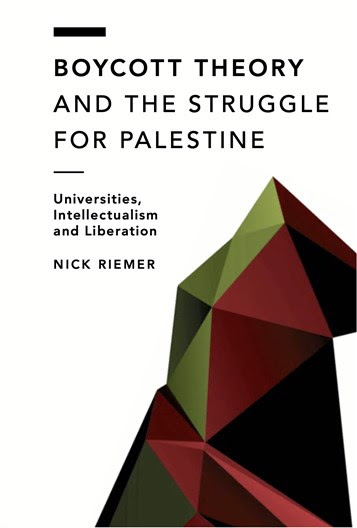
Nick Riemer, Boycott Theory and the Struggle for Palestine. Universities, Intellectualism and Liberation (New Texts Out Now)
By : Nick Riemer
Nick Riemer, Boycott Theory and the Struggle for Palestine. Universities, Intellectualism and Liberation (Rowman and Littlefield, 2023).
Jadaliyya (J): What made you write this book?
Nick Riemer (NR): Most importantly, the hope of contributing to the Boycott Divestment and Sanctions (BDS) campaign—one of the most vital global justice movements there currently is—by advancing it in universities. Usually, writing books is not the best way to advance political causes. But the academic boycott is complex and intensely contested, and it seemed to me that there was a potential political benefit in laying out the arguments for it at length, and in analyzing the uptake and resistance to it in the context of the contemporary “neoliberal” university.
A secondary motivation was simply the very high intrinsic interest of the questions the book addresses about the way that intellectual and political progress might relate. What makes the academic boycott so interesting and important is that it is a case where political advances do not arise from the explicit pursuit of intellectual work, but from its outright suspension, at least in the university. When we implement the institutional academic boycott of Israel and refuse to participate in certain kinds of intellectual exchange, just like when we go on strike, we are saying that there is something more important than engaging in the kinds of organized thinking that universities sponsor. It seems to me there is an important lesson there more broadly—about the responsibility to do more than think and talk, and about the risks of what in the book I call “smartwashing,” in other words the mystifying use of intellectualism or complexity to suppress political action.
The effects of Israeli apartheid on Palestinian universities still are not very well known, which is a significant obstacle in the way of international academic solidarity with Palestine.
J: What particular topics, issues, and literatures does the book address?
NR: The book goes from the most particular issues relating to the academic boycott to the most general. It starts with a detailed description of the daily reality of university life in occupied Palestine. The effects of Israeli apartheid on Palestinian universities still are not very well known, which is a significant obstacle in the way of international academic solidarity with Palestine. My thought was that if readers can get a detailed account of what Israeli oppression means in a context they are familiar with—universities—then this would be a good way to understand the urgency of justice for Palestine in general. I also give a detailed account of Israeli universities’ responsibility for and involvement in state anti-Palestinianism, which is the justification for boycotting them in the first place.
I then go on in chapter two to address the central “academic freedom” argument against the boycott. My main idea is that, far from a violation of the ordinary norms of the academy, boycotting is actually a constitutive and deeply embedded feature of academic professionalism, albeit a strongly disavowed one. In the third chapter I draw out the ideological and material parallels between neoliberal universities as mechanisms for the enclosure of knowledge, and Israeli apartheid as a mechanism for the enclosure of Palestinians, and I suggest ways in which universities can be seen as “little Israels”—in other words fundamentally coercive regimes that put a veneer of liberalism over basically inegalitarian practices. This chapter particularly considers the humanities and social sciences, the areas in which BDS activities are most vigorous.
In chapter four, I change gear to look at one of the best known hallmarks of BDS activism internationally, the active disruption of Zionists invited to speak at universities. I try to give an account of speech, disruption, and silencing that is anchored in a materialist conception of language, predicated on the fact that disruptive protest has regularly been an instrument of social progress.
The last two chapters take up more general questions that the academic boycott raises about the politics of intellectual activity in universities and outside them. Chapter five looks at a couple of case studies of situations where academic work was not boycotted but should have been, and the last chapter, chapter six, explores the ways in which intellectual activity can be reactionary and therefore deserving of boycott.
J: How does this book connect to and/or depart from your previous work?
NR: Boycott Theory is an outlier compared to most of my academic work, which is in (of all things) the history and philosophy of linguistics. But recently, as a result of my involvement with the BDS campaign, I have started to do scholarly work about the academic boycott too. The book expands on some of the ideas in my chapter in David Landy, Ronit Lentin, and Conor McCarthy’s collected volume Enforcing Silence (Zed Books, 2020), which is often referenced in Boycott Theory. One of the book’s chapters (chapter four) actually does draw on scholarship about language in linguistics and elsewhere, which it puts to work for an analysis of disruptive protest of the kind that Palestine activists often engage in. The book is also related to my teaching: I teach a seminar course called “Text, Action and Ideology” which covers many of the broader issues discussed in Boycott Theory.
J: Who do you hope will read this book, and what sort of impact would you like it to have?
NR: The book is polemical as well as scholarly, and I hope it will be a useful resource for the Palestine solidarity movement and will showcase just how solid the arguments for the academic boycott are. Academic research and exchange are prima facie the kind of activities where a boycott is least justifiable, so if a boycott of them does in fact make sense—as it does—that means there is no form of boycott that can be ruled out. So in justifying the academic boycott, the book indirectly justifies the consumer and cultural boycott as well.
Overall, Boycott Theory is probably intended for two main audiences: people—mainly but not just in universities—who are curious about the academic boycott and want to understand it better; and people already in the campaign who are looking for a repository of arguments and ideas about it. I also hope that Zionists will read it. Our side has all the good arguments, and they really need to let that sink in. I would also hope that the last two chapters, which are on the relation between thought and (in)action, might interest a further set of readers who might not otherwise ever open a book on Palestine solidarity.
J: What other projects are you working on now?
NR: I am working on several projects in linguistics—a second edition of an introduction to the field of semantics that first came out over a decade ago, and a large project on the political history of ideas about Western theories of language from World War I onwards. I am also working with a colleague on an article for a forthcoming issue of Middle East Critique on the Zionist repression of Palestine solidarity work in Australian universities.
J: Tell us more about those last two chapters, where you broaden the focus out from the academic boycott.
NR: Chapter five examines two recent debates about the political stakes of intellectual work conducted by academics—a much-reported German scholarly edition of Hitler’s Mein Kampf published in 2016, and a case of institutional collaboration between researchers and security forces responsible for torture. Both these cases raise parallel questions to those raised by the academic boycott about the political effects of research, and they allow us to see more clearly what is at stake in the boycott’s refusal of intellectual engagement. They are both also extremely interesting in their own right, and sharply raise the question of the conditions in which it can be politically regressive to undertake academic research—something we do not think enough about in universities.
In the last chapter, I look more generally at the connections between thinking and political inaction, and explore ways in which intellectual work can exert a conservatizing political impact. We like to think that the work we do as researchers, scholars, and thinkers is inherently progressive, but I think that—unfortunately!—that is clearly an illusion. What makes the academic boycott so interesting and also such an important example for the Left is that it is a case where political advances do not arise from the explicit pursuit of intellectual work, but from the outright suspension of it, or at least its outright suspension in the university. When we boycott certain kinds of intellectual exchange, just like when we go on strike, we are saying that there is something more important than engaging in the kinds of organized thinking that universities sponsor. It seems to me there is an important lesson there more broadly, about the risks of “smartwashing” and about the responsibility to do more than think and talk. So the book ends with a defense of a certain kind of progressive anti-intellectualism.
Excerpt from the book (from Chapter 3, pp. 59-63)
Denying Politics
Academics who encourage their colleagues to implement the institutional boycott of Israel violate one of higher education’s firmest commands: never politicize. In an academy often attacked as in thrall to dangerous “political correctness” – that is, politicized to the point of censorship – and riven by endless “political” disputes, including over Palestine, the claim that politics is regularly taboo will seem ludicrous. It is anything but. Just like any structured, professional activity, academia certainly has its own politics: academics seek power, strategize, form blocs, and make professional choices in ways that they believe further their values or interests, and that sometimes align with political choices they make outside the institution. This is not, however, the kind of politics that is relevant here: university workers are no more or less “political” in this – trivial – sense than are other comparable professionals. It is no more informative to conclude that universities are especially political places because they are the sites of academic or intellectual politics, than it would be to conclude that offices are especially political because they are the sites of office politics. But if academia well and truly has its own politics, that is where politics in universities is supposed to stop. In the imagination of most academics, universities should be undistorted by external political agendas: the objection that supposedly purely academic topics have been “politicized” is one of the right’s main complaints against the academic left.
That doesn’t mean that politics isn’t regularly discussed in universities. When prominent BDS-opponent Cary Nelson claims that “all teaching and research is fundamentally and deeply political,” especially in the humanities and social sciences, what he means, he tells us, is that it is in “dialogue with cultural values and norms that undergo continual change and that are sites of struggle, linked to assumptions about identity that are socially and politically constructed, engaged with social life and the public sphere and thus with the politics of culture, constrained and encouraged by discourses embedded in politics.” This claim of the distinctly political character of academic work amounts to the observation – an uncontroversial one – that universities abound in discussion of political topics: Nelson’s claim that the humanities and social sciences are “in dialogue” with politically important themes means that academics and students often relate their teaching and research to political issues.
The crucial point, however, is that talking about politics is not the same as participating in it. If we understand politics as the effort “to share power or … to influence the distribution of power, either among states or among groups within a state,” then, contrary to Nelson and others’ belief, it plays almost no part in most academics’ professional (as opposed to personal) lives, even when its “political” character is trumpeted. “Academics look at the social world as something to be studied, to be researched, to be analyzed, even to be opined – but not to be acted on,” according to Daniel W. Drezner in his study of the “ideas industry.” This is not to say that academics never act politically: “there comes a time,” one US scholar is quoted as saying in the aftermath of Donald Trump’s election in 2016, “when you have to take your head out of your books and your computers” and “try to come out, as some people say, on the right side of history.” Most of the time, however, books and computers are where academics’ heads stay firmly planted: the distinguishing feature of many kinds of academic professionalism, especially in much of the humanities, is its aspiration to stand imperiously above, and therefore not immediately affect, worldly political matters. To deal with “the broadly defined ‘humanities’,” Said wrote in 1982, “is to deal with the non-political.”
The comment captures an important truth: while academics often debate or invoke politics, sometimes heatedly, academic work rarely engages it: even if academics’ choice of problems to teach or research is informed by political considerations, and academics intend their teaching and research to contribute to advocacy for particular political positions, including Palestine justice, these goals are typically understood as derivative of their more essential academic features. Academic work can serve secondary political purposes only if it is, first and foremost, academic: the expression of political positions cannot, in conventional understandings, be allowed to escalate so far as to jeopardize scholarly objectivity, which is what guarantees universities’ imagined status as independent, non-partisan institutions.
It’s therefore no surprise that the assertion of the political nature of academic work, especially in the humanities and social sciences, is rarely meant to suggest that it could bear any strong relevance, let alone constitute any real challenge, to specific political actors. Politics as a concrete practice – and, even more so, the politics of Palestine justice – is for the most part taboo in universities. Cary Nelson concludes as a result of four decades’ observation that “the overwhelming majority of faculty members are reluctant to reveal their political views to their students”; “[d]uring my last six-year stint in the political science department at DePaul University in Chicago,” Norman Finkelstein tells us, “the country passed through two presidential elections, September 11, and two major wars, yet I can count on the fingers of one hand the number of political conversations with my colleagues.” So while academics do from time to time use their professional personas to take a stand on questions of immediate political moment, they do so mostly in heavily qualified ways, and almost always with the reminder that their students or readers must decide for themselves where they stand. Cushioned in that very typical proviso, the divorce between scholarship and politics is consummated. Politics is constitutively insulated from academic authority. It is the domain of opinion, where participants must ultimately be free to make their own choices: scholarship, safely confined within the seminar room or academic article, is politically inert. Speech in universities simply does not usually aim to mobilize opinion in favor of a concrete political outcome.
Given their general professional aversion to explicit politics, academics’ reluctance to embrace BDS is wholly expected, but it becomes even less surprising when seen in light of the profession’s general unwillingness to seriously defend its own professional milieus from the decades of higher education “reform” that have degraded it in many parts of the west. All around the English-speaking world, and in many places beyond it, neoliberalism in universities has largely won a crushing victory at students’ and academics’ expense. In that light, insistent claims of disciplines’ “political” character stand out in bathetic relief against their inability to accomplish what should be, surely, among their most elementary “political” aims – safeguarding the institutional security of their own practitioners. In relation to an important mechanism of the neoliberalization of higher education, the rise of academic managers, one attentive observer even feels that “the colonization of higher education by management has never been openly discussed.” Another – a London politics academic – says he found his five-year experience as an official of the University and College Union “exhausting and demoralizing, because so few academics seemed willing to participate” in defense of pay, pensions and reforms of higher education governance.
Any number of aspects of the professional culture of higher education support western academics’ unwillingness to acknowledge or confront their own political agency, whether over BDS or over their more immediate self-interest. In The Authoritarian Personality, Adorno identified the tendency of educational systems “to discourage anything supposedly ‘speculative,’ or which cannot be corroborated by surface findings, and stated in terms of ‘facts and figures’.” The analysis is still germane after more than seventy years. As the very agents of the positivistic educational culture Adorno identified, and institutionally immersed in a highly quantified world of enrolment figures, citation counts, grant income, funding formulas and ranking positions, there is nothing surprising in academics’ apparent inability to engage in “speculative” politics by grasping their own potential to act. The investment which academics typically bring to questions of disciplinary, intellectual politics – Which field will a new position be created in? What subjects are to be compulsory for final-year students? – contrasts starkly with their frequent disengagement from the broader issues which set the parameters of their professional life, whether over the Israel boycott or many other macro-questions of institutional politics. There is no lack of precedent for political activity by academics. But it is understood as exceptional, and often viewed with a certain degree of hesitation or embarrassment, even by its participants.
Palestinians cannot expect strong support from a profession that often cannot bring itself to defend its own members: resistance to the boycott is one especially obvious consequence of academics’ general disengagement from politics. The effect of scholarly political quietism is, of course, wholly political in its reinforcement of the status quo.
=================================
https://electronicintifada.net/content/why-are-colleges-civil-israel/38176
THE ELECTRONIC INTIFADA
You are here
Why are colleges “civil” to Israel?
Rod SuchThe Electronic Intifada12 July 2023
Boycott Theory and the Struggle for Palestine: Universities, Intellectualism and Liberation by Nick Riemer, Rowman & Littlefield (2023)
Australian scholar Nick Riemer explains the focus of his new in-depth study of the academic boycott of Israel by saying that “almost everything in the politics and culture of higher education works against academics boycotting Israel.”
Indeed, the obstacles presented by that culture are what’s mainly addressed in Boycott Theory and the Struggle for Palestine: Universities, Intellectualism and Liberation as he delves into the history of the academic boycott.
Academics, especially in the United States, have been denied work or tenure because of their advocacy for Palestine, a story presented in We Will Not Be Silenced: The Academic Repression of Israel’s Critics – an anthology of testimonials from repressed scholars published in 2017 but still relevant today.
Riemer describes the origins and early successes of the academic boycott, predating the 2005 Palestinian civil society call for BDS with the formation of the Palestinian Campaign for the Academic and Cultural Boycott of Israel (PACBI) a year earlier.
Even earlier, in 2002, Riemer notes, “several hundred European academics and researchers called for a moratorium on European funding of Israeli cultural and research institutions.” By year’s end, the University of Paris 6, now part of the Sorbonne, called for cutting off the European Union’s research agreement with Israel.
Other victories followed, including the University of Johannesburg in South Africa severing ties with Israel’s Ben-Gurion University in 2011. Numerous academic associations adopted pro-BDS resolutions in solidarity with the Palestinian people.
Ideology of the academy
But unlike the BDS movement against apartheid South Africa, which resulted in many US universities actually divesting from companies doing business with the country, nearly all Western universities and colleges have resisted calls from faculty and students to cut ties with Israel.
Riemer locates many of the reasons why, including university links to the military-industrial complex. But he reserves most of his critique for the dominant ideological narrative of “academic freedom” and the “civility” and “collegiality” reasons given for maintaining ties with Israeli academic institutions.
Riemer notes that from its beginning, PACBI called for the boycott of Israeli institutions, not individual Israeli scholars.
This provision, recognizing Israeli academics who oppose the occupation, differed from the academic boycott call issued in 1958 by the African National Congress – a blanket boycott of both institutions and individuals. Objections were rarely raised about the issue of “academic freedom” when it came to boycotting apartheid South Africa.
Riemer documents numerous examples of academic freedom being denied to Palestinian scholars, rarely acknowledged by hypocritical Western academic institutions.
Israeli troops routinely impose checkpoints outside university entrances, raid Palestinian campuses and arrest and imprison students. Movement restrictions prevent many Palestinian students from studying or teaching abroad or even in other parts of Palestine, and international scholars are restricted from teaching in the West Bank and Gaza.
As of 2022, Israel announced that it would vet all applications from foreign academics to teach at West Bank universities after a long history of limiting the number of foreign academics and refusing entry and re-entry. Israel’s numerous bombing campaigns in Gaza have not only disrupted education for long periods but have often targeted university campuses and buildings.
Outside Palestine, examples abound of “academic freedom” being denied to scholars who lost their positions due to their advocacy for Palestinian rights, such as Norman Finkelstein, Steven Salaita and Cornel West, to name only a few.
More recently, the effort by Israel and its proxies to impose the highly flawed IHRA definition of anti-Semitism on campuses – conflating criticism of Israel and Zionism with anti-Jewish bigotry – has resulted in numerous cancellations of scheduled talks, courses and film screenings in direct contradiction to most notions of academic freedom.
Riemer goes beyond the issue of censorship by asking why academic culture values not just civility and collegiality but actually negates the boycott by elevating thinking above acting. In contrast to the famous quote from Karl Marx, Riemer seems to be saying that for most academics, the point is to just interpret the world, not to change it.
The later chapters of Boycott Theory delve into this and related questions, such as those related to free speech and the right, both morally and politically, to disrupt hate speech aimed at reinforcing “the murderous practices of Israeli apartheid.” Riemer also discusses the role of intellectuals, asking can there be theory without practice, and what are the differences between solitary and collective intelligence.
Riemer couches some of these ideas in provocative phrases, such as the need for “groupthink” and “anti-intellectualism.”
Unfortunately, as intriguing as some of his ideas are, the author fails to convey them in an expository way by explaining the concept in detail, presenting the evidence for it and disrupting contrary claims. As a result, the reader is left unconvinced.
Tactic vs. strategy
Is there a need for a “theory of boycott,” as implied by the book’s title?
There is, but the author’s frequent description of the boycott as a tactic neglects its chief importance as a strategy.
The African National Congress regardedboycott, divestment and sanctions as one of the “four pillars” of South Africa’s liberation struggle, giving it a place of importance equal to its other strategic methods: armed struggle, political mass struggle and clandestine underground struggle.
The BDS movement has become a strategic component of the Palestinian liberation struggle not only because it has united Palestinians (polls show that more than 80 percent of Palestinians support BDS), but also because it has given people around the world a way to support that liberation struggle on a global scale.
It has also been the chief vehicle for changing the once-dominant belief that Israel is a democracy deserving of support, to an insurgent narrative that Israel is an apartheid state and that apartheid must end.
It is an idea that has become a material force. After all, ideas – once they’re grasped by a mass of people – can become a force in their own right.
Rod Such is a former editor for World Book and Encarta encyclopedias. He lives in Portland, Oregon, where he is active in the Demilitarize Portland2Palestine campaign.
=======================================
Three Cheers for Nick Riemer, Useful Idiot
14th April 2019
Timothy Cootes
In the debate over the establishment of the Ramsay Centre for Western Civilisation, no one has sniped and sneered from the opposing camp with anything quite like the ferocious energy of Dr. Nick Riemer, senior lecturer in English and Linguistics at the University of Sydney. No doubt, his noisy interventions must leave many longing for the days when the musings of academics were only available in the mercifully unreadable journals of the academic Left. Riemer, with his endless tweets, op-eds, essays, and campus protests, has been very difficult to avoid.
Not that I really mind, I have to confess. Surprisingly, whenever I come across Riemer’s latest hissy-fit in the Sydney Morning Herald, I react with wry appreciation rather than annoyance. You see, those of us who support the goals of Ramsay couldn’t have asked for a better enemy. His arguments — I’m being charitable when I use such a word — are so risible that I’m doubtful that he has persuaded anyone at all. If anything, he has powerfully made the case for the Ramsay Centre in a useful albeit unwitting manner.
Although Riemer’s campaign has been running for months, he introduced himself to a wider audience in the aftermath of the massacre in Christchurch. In a much-discussed column, he set out his reflections on that awful event in his characteristically obtuse way:
Many academics have accused Ramsay of being the intellectual face of a Western supremacist politics, and therefore fundamentally incompatible with universities’ obligation to support multiculturalism.
I like the honesty here: indeed, only academics could come up with such a ridiculous notion. The general and far more intelligent public would struggle to find a connection between a fondness for Plato and Aristotle and the horrors of white supremacy. Riemer, though, encouraged his readership to “reflect seriously on how the Ramsay curriculum validates the worldview behind Friday’s massacre.”
How so, exactly?
Well, Riemer seems especially bothered — or “triggered”, as the kids say these days — by the proposed reading list and its suggestion that the Great Books ought to be studied as a whole. That is, one should begin with Homer, stop by Augustine, and follow up with Shakespeare and Nietzsche. For Riemer, this will logically lead students and the Australian society at large to adopt attitudes of European supremacy, and only bloodshed could follow that.
Looking back, it’s obvious Riemer’s case against Ramsay would end up here. He had previously asserted, without any explanation, that the mere existence of Ramsay on campus could be physically harmful and constitute “a threat to students from non-Western backgrounds.”
If all this seems a bit bewildering, then congratulations: you, dear reader, have been spared whatever passes for an education in the humanities at our universities. Riemer apparently sees sinister and bloodthirsty motivations where none exist, and his vision is hard to square with the Ramsay Centre’s humbly stated ambition to “promote an interest in and awareness of Western Civilisation.”
For this reason, his connecting Ramsay with the massacre of innocent Muslims at prayer deserves special condemnation. The thinking here goes something like this: the murderer in Christchurch fretted about the state of the West, and anyone who shares those concerns must similarly share his aims and approve of his methods. This is an inexpensive and asinine trick, and an academic who is allegedly interested in the use of language should know better.
It’s too easy to point out, for example, that Riemer’s rhetorical flaying of the Western world, its heritage, as well as Israel and Zionism (of course) would meet the approval of any hardened jihadist. Let me hasten to add that such a comparison is unfair, of course. Despite some ideological comradeship, Riemer probably wouldn’t make a good recruit for the Islamic State.
No comparison is really necessary, anyway: dealing with Riemer and his shabby arguments is easy enough. Writing for a more ursine audience in Overland, he allowed himself to be even more unpersuasive in a follow-up rant:
In arts faculties themselves, the danger posed by the ‘Western Civilisation’ program has been clear to all but a small group of hold-outs. Driving the opposition to Ramsay has, of course, been the self-evident fact that the whole project is an initiative of the racist right…
One can begin to detect the elements of his strategy here: meet the word count by banging on about xenophobia, chauvinism, and white supremacy without ever saying anything meaningful at all. It’s remarkable, in a way: apparently, you can can easily get a series of non-sequiturs published in national newspapers and magazines. He groped his way towards an argument by drawing attention to the list of speakers for Ramsay’s public lectures, which includes Greg Sheridan of The Australian, the leftie writer and editor of Areo, Helen Pluckrose, and Rod Dreher of The American Conservative, among others.
And? So what? There’s certainly more intellectual diversity here than what you’d find at the typical humanities faculty meeting at, say, Mr Riemer’s Sydney University roost, where I’m sure there are hugely varying levels of commitment to the revolutionary struggle. And that’s the point, after all. Riemer, backed by an army of his colleagues, demonstrates just how corrupt and rotten and censorial the universities have become. The Australian public knows it, too, and Riemer seems to be working hard to convince them further.
That’s why I welcome his efforts. In all his anti-Ramsay whinging, one sees, very clearly, the case for the Ramsay Centre and why it must succeed. I suspect that Riemer may ultimately assist with this project rather than his own. In a small way, the Great Books program will be established not despite his interventions, but because of them.
Nick Riemer and his co-thinkers don’t know it, but their petulance and intolerance of others’ ideas is further proof of the need for the Ramsay Centre. Among the many things they don’t know and can’t understand, he and they are actually helping the right side.
Timothy Cootes has written for Quadrant, Quillette, and The Spectator Australia. He lives in Sydney.

 israel-academia-monitor.com