08.02.24
Editorial Note
On January 15, 2024, educator and researcher Manolo De Los Santos spoke at The People’s Forum in NYC and said, “When we finally deal that final blow to destroy Israel. When the state of Israel is finally destroyed and erased from history, that will be the single most important blow we can give to destroying capitalism.”
De Los Santos is a “popular educator” from the Caribbean, committed to “radical transformation of the world at the hands of the poor and oppressed. Versed in the histories of struggle and methodologies of education, Manolo seeks to engage a new generation of visionaries and fighters.” He is working toward “building international networks of people’s movements and organizations. In 2018, he became the founding director of the People’s Forum in New York City, a movement incubator for working-class communities to build unity across historic lines of division at home and abroad. He is also a researcher with Tricontinental: Institute for Social Research.”
The Tricontinental: Institute for Social Research is headed by the prominent American-Indian Marxist Vijay Prashad. In a talk at the People’s Forum NYC in 2021, Prashad said, “I’m a Marxist. I’m a Communist. I believe in women’s emancipation. I believe in gay rights. I believe in everything good, decent, and sensitive in the world.” Between 1996 and 2017, he served as a professor of international relations at Trinity College, Hartford, Connecticut. During this period, Prashad became a leading activist in the BDS movement. He is also a member of the advisory board of the US Campaign for the Academic and Cultural Boycott of Israel.
De Los Santos and Prashad follow the writings of the Italian Communist Antonio Gramsci, who urged intellectuals and academics to become “organic” or “new” intellectuals, that are close to the experience of the working classes: “Gramsci notes, [the new intellectual] is the person who is devoted to working to alleviate the grievances of the people, elaborate popular consciousness, push the suffocating narrowness of thought outwards, and make more and more space for popular struggles to sustain themselves and win. Our intellectual production aspires to meet Gramsci’s standard.”
To pursue “Gramsci’s standards,” these activists are “archiving and analyzing the histories of national liberation and elaborating and promoting the advances made by the range of theories of national liberation Marxism.” It means that the “popular consciousness” now includes an aggressive focus on the victims of colonialism, as well as capitalism. In the eyes of the neo-Marxists, the Palestinians are the ultimate victim of colonialism, capitalism and other assorted Western transgressions against Third World populations. Their alleged victimhood gives them a place of prominence in planning “global transformative change.” For instance, De Los Santos pushed this theme as part of the “Mapping Visions for Transformative Change,” of the Social Justice Initiative at the University of Illinois, Chicago.
It is well known that claiming that Israel is a product of a conspiracy of colonialists, capitalists, and imperialists is antisemitic because it denies Jewish rights to their ancestral land. The BDS, a global effort to destroy Israel through sanctions, is equally antisemitic. However, the story of Prashad and De Los Santos illustrates how difficult it is to fight the insidious academic antisemitism that masquerades as free speech. De Los Santos openly talks about destroying Israel and Parshad was hired by Trinity College despite his BDS activist background.
The irony is that the founders of the BDS movement originate from Muslim and Arab countries, where Marxist ideals such as rights for laborers, women, and LGBTQ are not respected.
Antisemitic and anti-Israel ideas are propagated on Western campuses, often dressed in fancy Marxist or neo-Marxist jargon. Those are disseminated into the community and media using the Gramsci protocols. Without a proper challenge, anti-Israeli sentiments that have been growing exponentially after October 7 would not be vanquished.
REFERENCES
“When we finally deal that final blow to destroy Israel. When the state of Israel is finally destroyed and erased from history, that will be the single most important blow we can give to destroying capitalism.”
-Manolo De Los Santos speaking at The People’s Forum in NYC.
Last edited 4:53 PM · Jan 15, 2024 6.7M Views
===========================================
Mapping Visions for Transformative Change
The Social Justice Portal Project is a project of the Social Justice Initiative at the University of Illinois Chicago.
Participants
Manolo de los Santos, Founding Director, The People’s Forum:
Manolo is a popular educator and organizer from the Caribbean. He is committed to the radical transformation of the world at the hands of the poor and oppressed. Versed in the histories of struggle and methodologies of education, Manolo seeks to engage a new generation of visionaries and fighters.For 10 years, he worked in the organization of solidarity and education programs to challenge the United States’ regime of illegal sanctions and blockades. Based out of Cuba for many years, Manolo has worked toward building international networks of people’s movements and organizations. In 2018, he became the founding director of the People’s Forum in New York City, a movement incubator for working-class communities to build unity across historic lines of division at home and abroad. He also collaborates as a researcher with Tricontinental: Institute for Social Research.
=============================================
https://thetricontinental.org/newsletterissue/icj-palestine-mural/
The Only Right That Palestinians Have Not Been Denied Is the Right to Dream: The Fifth Newsletter (2024)
FEBRUARY 1, 2024
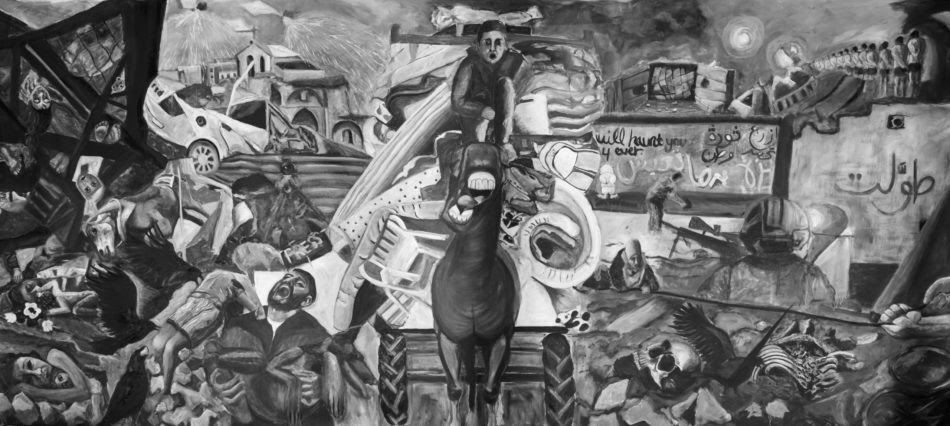
Malak Mattar (Palestine), Gaza, 2024.
Dear friends,
Greetings from the desk of Tricontinental: Institute for Social Research.
On 26 January, the judges at the International Court of Justice (ICJ) found that it is ‘plausible’ that Israel is committing a genocide against Palestinians in Gaza. The ICJ called upon Israel to ‘take all measures within its power to prevent the commission of all acts’ that violate the UN Convention on the Prevention and Punishment of the Crime of Genocide (1948). Although the ICJ did not call explicitly for a ceasefire (as it did in 2022 when it ordered Russia to ‘suspend [its] military operation’ in Ukraine), even a casual reading of this order shows that to comply with the court’s ruling, Israel must end its assault on Gaza. As part of its ‘provisional measures’, the ICJ called upon Israel to respond to the court within a month and outline how it has implemented the order.
Though Israel has already rejected the ICJ’s findings, international pressure on Tel Aviv is mounting. Algeria has asked the UN Security Council to enforce the ICJ’s order while Indonesia and Slovenia have initiated separate proceedings at the ICJ that will begin on 19 February to seek an advisory opinion on Israel’s control of and policies on occupied Palestinian territories, pursuant to a UN General Assembly resolution adopted in December 2022. In addition, Chile and Mexico have called upon the International Criminal Court (ICC) to investigate crimes committed in Gaza.
Israel’s reaction to the ICJ’s order was characteristically dismissive. The country’s national security minister, Itamar Ben Gvir, called the ICJ an ‘antisemitic court’ and claimed that it ‘does not seek justice, but rather the persecution of Jewish people’. Strangely, Ben Gvir accused the ICJ of being ‘silent during the Holocaust’. The Holocaust conducted by the Nazi German regime and its allies against European Jews, the Romani, homosexuals, and communists took place between late 1941 and May 1945, when the Soviet Red Army liberated prisoners from Ravensbrück, Sachsenhausen, and Stutthof. However, the ICJ was established in June 1945, one month after the Holocaust ended, and began its work in April 1946. Israel’s attempt to delegitimise the ICJ by saying that it remained ‘silent during the Holocaust’ when it was, in fact, not yet in existence, and then to use that false statement to call the ICJ an ‘antisemitic court’ shows that Israel has no answer to the merits of the ICJ order.
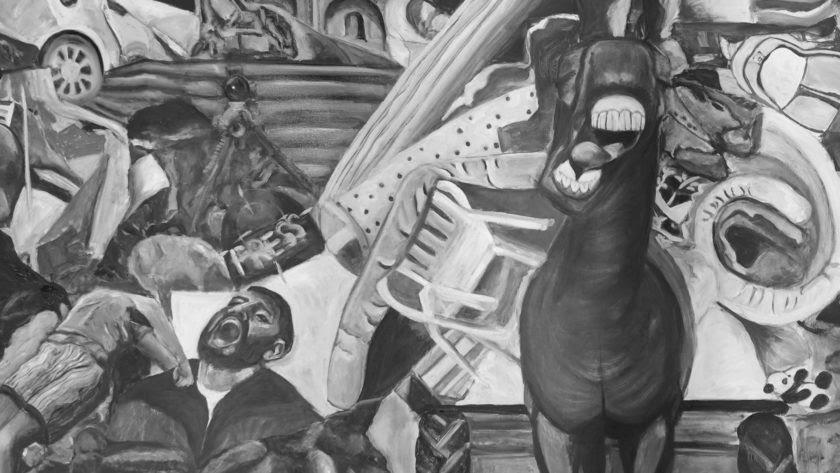
Malak Mattar (Palestine), Gaza (detail), 2024.
Meanwhile, the bombardment of Palestinians in Gaza continues. My friend Na’eem Jeenah, director of the Afro-Middle East Centre in Johannesburg, South Africa, has been reviewing the data from various government ministries in Gaza as well as media reports to circulate a daily information card on the situation. The card from 26 January, the date of the ICJ order and the 112th day of the genocide, details that over 26,000 Palestinians, at least 11,000 of them children, have been killed since 7 October; 8,000 are missing; close to 69,000 have been injured; and almost all of Gaza’s 2.3 million residents have been displaced. The numbers are bewildering. During this period, Israel has damaged 394 schools and colleges, destroying 99 of them as well as 30 hospitals and killing at least 337 medical personnel. This is the reality that occasioned the genocide case at the ICJ and the court’s provisional measures, with one judge, Dalveer Bhandari of India, going further to say plainly that ‘all fighting and hostilities [must] come to an immediate halt’.
Amongst the dead are many of Palestine’s painters, poets, writers, and sculptors. One of the striking features of Palestinian life over the past 76 years since the Nakba (‘Catastrophe’) of 1948 has been the ongoing richness of Palestinian cultural production. A brisk walk down any of the streets of Jenin or Gaza City reveals the ubiquity of studios and galleries, places where Palestinians insist upon their right to dream. In late 1974, the South African militant and artist Barry Vincent Feinberg published an article in the Afro-Asian journal Lotus that opens with an interaction in London between Feinberg and a ‘young Palestinian poet’. Feinberg was curious why, in Lotus, ‘an unusually large number of poems stem from Palestinian poets’. The young poet, amused by Feinberg’s observation, replied: ‘The only thing my people have never been denied is the right to dream’.
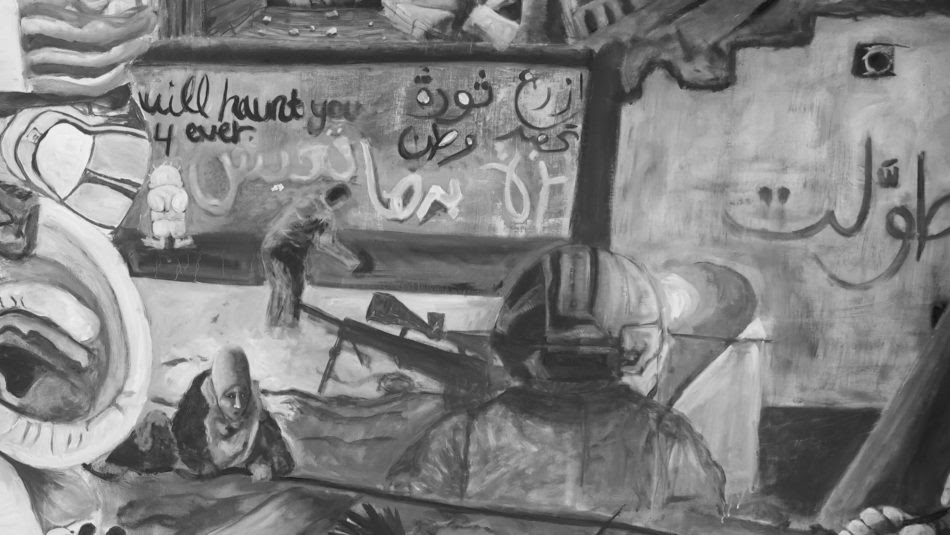
Malak Mattar (Palestine), Gaza (detail), 2024.
Malak Mattar, born in December 1999, is a young Palestinian artist who refuses to stop dreaming. Malak was fourteen when Israel conducted its Operation Protective Edge (2014) in Gaza, killing over two thousand Palestinian civilians in just over one month – a ghastly toll that built upon the bombardment of the Occupied Palestinian Territory that has been ongoing for more than a generation. Malak’s mother urged her to paint as an antidote to the trauma of the occupation. Malak’s parents are both refugees: her father is from al-Jorah (now called Ashkelon) and her mother is from al-Batani al-Sharqi, one of the Palestinian villages along the edge of what is now called the Gaza Strip. On 25 November 1948, the newly formed Israeli government passed Order Number 40, which authorised Israeli troops to expel Palestinians from villages such as al-Batani al-Sharqi. ‘Your role is to expel the Arab refugees from these villages and prevent their return by destroying the villages… Burn the villages and demolish the stone houses’, wrote the Israeli commanders.
Malak’s parents carry these memories, but despite the ongoing occupation and war, they try to endow their children with dreams and hope. Malak picked up a paint brush and began to envision a luminous world of bright colours and Palestinian imagery, including the symbol of sumud (‘steadfastness’): the olive tree. Since she was a teenager, Malak has painted young girls and women, often with babies and doves, though, as she told the writer Indlieb Farazi Saber, the women’s heads are often titled to the side. That is because, she said, ‘If you stand straight, upright, it shows you are stable, but with a head tilted to one side, it evokes a feeling of being broken, a weakness. We are humans, living through wars, through brutal moments… the endurance sometimes slips’.
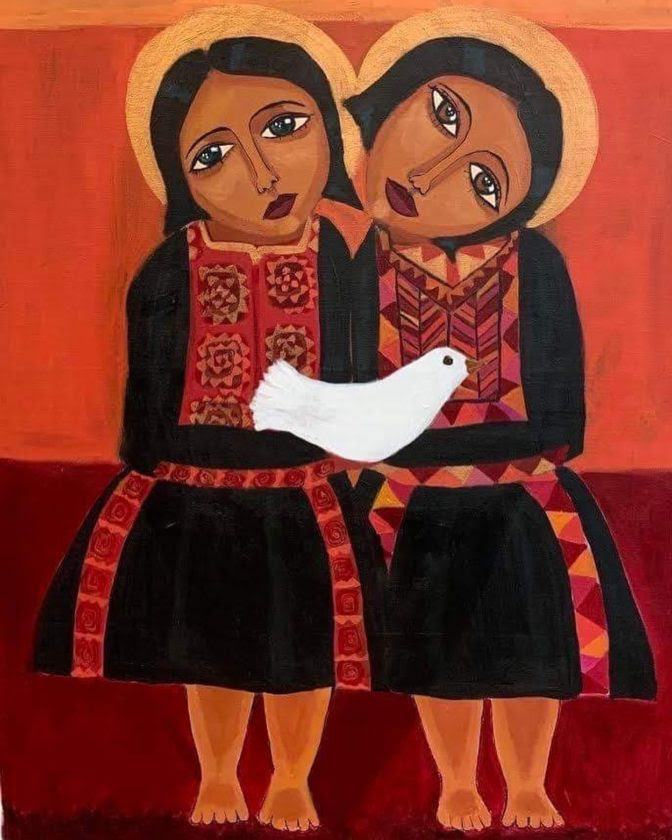
Malak Mattar (Palestine), Two Gazan Girls Dreaming of Peace, 2020.
Malak and I have corresponded throughout this violence, her fears manifest, her strength remarkable. In January, she wrote, ‘I’m working on a massive painting depicting many aspects of the genocide’. On a five-metre canvas, Malak created a work of art that began to resemble Pablo Picasso’s celebrated Guernica (1937), which he painted to commemorate a massacre by fascist Spain against a town in the Basque region. In 2022, the United Nations Relief and Works Agency for Palestine Refugees in the Near East (UNRWA) published a profile on Malak, calling her ‘Palestine’s Picasso’. In the article, Malak said, ‘I was so inspired by Picasso that, in the beginning of my art journey, I tried to paint like him’. This new painting by Malak reflects the heartbreak and steadfastness of the Palestinian people. It is an indictment of Israel’s genocide and an affirmation of Palestinians’ right to dream. If you look at it closely, you will see the victims of the genocide: the medical workers, the journalists, and the poets; the mosques and the churches; the unburied bodies, the naked prisoners, and the corpses of small children; the bombed cars and the fleeing refugees. There is a kite flying in the sky, a symbol from Refaat Alareer’s poem ‘If I Must Die’ (‘you must live to tell my story… so that a child, somewhere in Gaza while looking heaven in the eye… sees the kite, my kite you made, flying up above and thinks there is an angel there bringing back love’).
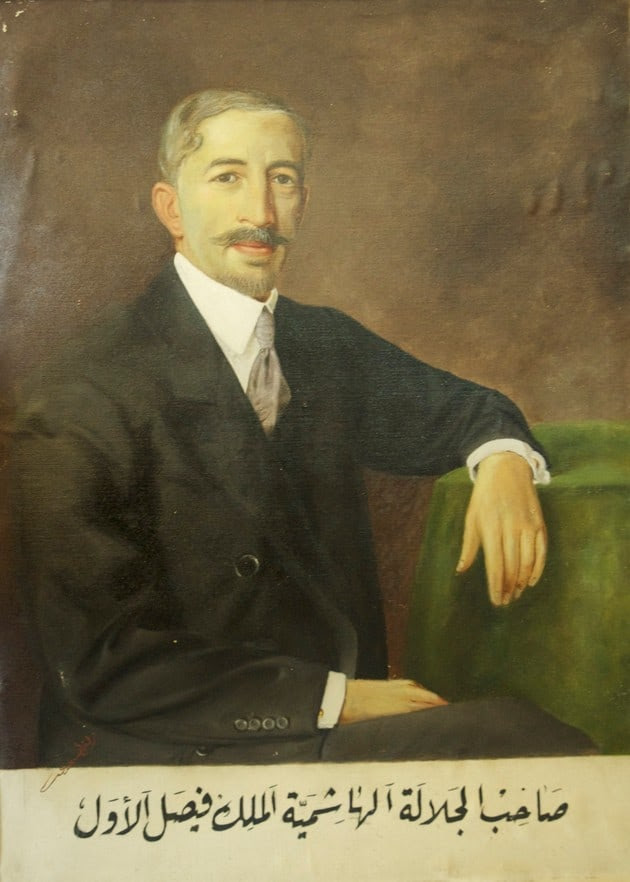
Zulfa al-Sa’di (Palestine), King Faysal I of Iraq, 1931.
Malak’s work is rooted in Palestinian traditions of painting, inspired by a history that dates back to Arab Christian iconography (a tradition that was developed by Yusuf al-Halabi of Aleppo in the seventeenth century). That ‘Aleppo Style’, as the art critic Kamal Boullata wrote in Istihdar al-Makan, developed into the ‘Jerusalem Style’, which brightened the iconography by introducing flora and fauna from Islamic miniatures and embroidery. When I first saw Malak’s work, I thought of how fitting it was that she had redeemed the life of Zulfa al-Sa’di (1905–1988), one of the most important painters of her time, who painted Palestinian political and cultural heroes. Al-Sa’di stopped painting after she was forced to flee Jerusalem during the 1948 Nakba; her only paintings that remain are those that she carried with her on horseback. Sa’di spent the rest of her life teaching art to Palestinian children at an UNRWA school in Damascus. It was in one such UNRWA school that Malak learned to paint. Malak seemed to pick up al-Sa’di’s brushes and paint for her.
It is no surprise that Israel has targeted UNRWA, successfully encouraging several key Global North governments to stop funding the agency, which was established by United Nations General Assembly Resolution 302 in 1949 to ‘carry out direct relief and works programmes for Palestine refugees’. In any given year, half a million Palestinian children like Malak study at UNRWA schools. Raja Khalidi, director-general of the Palestine Economic Policy Research Institute (MAS), says of this funding suspension: ‘Given the long-standing precarious nature of UNRWA’s finances… and in light of its essential role in providing vital services to Palestine refugees and some 1.8 million displaced persons in Gaza, cutting its funding at such a moment heightens the threat to life against Palestinians already at risk of genocide’.
I encourage you to circulate Malak’s mural, to recreate it on walls and public spaces across the world. Let it penetrate into the souls of those who refuse to see the ongoing genocide of the Palestinian people.
Warmly,
Vijay
==============================================
About Tricontinental: Institute for Social Research
Mission
Tricontinental: Institute for Social Research is an international institute guided by popular movements and organisations. We seek to bridge academic production and political and social movements in order to promote critical thinking and stimulate debates and research with an emancipatory perspective that serves the people’s aspirations.
What We Do
At Tricontinental: Institute for Social Research, our work is about building knowledge from the experience of social and cultural transformations wrought by popular struggles. The main epistemological basis for such an approach to knowledge is derived from Karl Marx’s ‘11th Thesis on Feuerbach’: ‘philosophers have hitherto only interpreted the world in various ways; the point is to change it’. Our understanding of this axiom is that those who are trying to change the world have a sharp assessment of its contradictions, vulnerabilities, and possibilities. The movements and struggles for social transformation teach immense lessons about the character of power, privilege, and property and about the possibility of building a different kind of world.
One of our key concepts, derived from Antonio Gramsci, is that of the ‘new intellectual’, which refers to organic intellectuals of working people who observe the conditions of their class, interpret them against the ruling ideas, and produce a radical understanding of the world. Their views emerge but might dissipate unless they are rooted in a social or political movement, preferably in a political party of some kind. Gramsci calls these intellectuals the new intellectuals: those who throw themselves into ‘active participation in practical life, as constructor, organiser, “permanent persuader”’. The ‘permanent persuader’, or new intellectual, Gramsci notes, is the person who is devoted to working to alleviate the grievances of the people, elaborate popular consciousness, push the suffocating narrowness of thought outwards, and make more and more space for popular struggles to sustain themselves and win. Our intellectual production aspires to meet Gramsci’s standard.
Two phrases capture the essence of our work: to bridge gaps and to amplify voices. We struggle to bridge the gaps between movements and intellectual institutions and to bridge the gaps between movements spread out across the planet. We amplify the voices of the new intellectuals who lead these movements and work to elaborate the movements’ theories. As part of the work of amplifying voices, we seek to reclaim our histories of socialism and national liberation.
Publications
Tricontinental: Institute for Social Research produces a weekly newsletter, monthly dossier, and various studies and other periodic publications.
Our work is rooted in the principle of hope: we believe that we do not have the right to be pessimistic. Our work is rooted in both a theory of exploitation and the reality of class struggle, in the experience of suffering but also in the insistence of struggle. To that end, our research is rooted in the dialectics of the human experience.
Our texts are collectively produced. We accompany social and political movements to conduct our research and analysis, and then we write, edit, translate, and design our materials as a team. We strive to produce accurate, credible, and accessible materials. In our texts, we do not distinguish between form and content; we build them with a firm belief in the importance of style and aesthetics, illuminating our pages with art and design that provides a sense of the hope inherent in human struggle. Our aesthetic practice is rooted in three concepts:
- That the working class, peasantry, and impoverished millions enduring wage-less life (the labampofu, or ‘the poor’, as the South Africans put it) exist as historical actors.
- That our readers must be able to breathe with joy as they read our texts.
- That our readers leave our texts with hope from both the analysis in the texts but also in the range of human emotions conveyed by the art.
Our Research Agenda
Our work is focused on three main axes:
- Contemporary Capitalism
Much of our work closely studies developments in the contemporary capitalist economy, with a special focus on the unproductive growth of the financial sector, the rise of rentier forms of near monopoly firms, the expansion of a precarious working class, and the social effects of capitalism’s structural imbalances. - Monsters
Our work develops a theory that the wretchedness of contemporary capitalism has been produced by proponents of both right-wing free market conservatives and liberals and of social democracy. - Futures
The future will be shaped out of what we do now. That’s the slogan with which we operate, which means we must track the various forms of socialism that are being developed in our time.
As our work has developed, it has become clear that we must illuminate and defend our past heritage. This includes two aspects, also represented by our publishing agenda: archiving and analysing the histories of national liberation and elaborating and promoting the advances made by the range of theories of national liberation Marxism.
Institutes
Tricontinental: Institute for Social Research is a network of research institutes in the Global South. We have institutes in Argentina, Brazil, India, and South Africa, as well as an inter-regional office with members in many parts of the world. Tricontinental: Institute for Social Research is part of an international process of creating a network of dozens of research institutes, whose first fruit is A Plan to Save the Planet. We are also part of the International Union of Left Publishers, made up of more forty publishers from over twenty countries to advance left ideas, produce collective books, and initiate the annual Red Books Day.
We are a partner organisation of the International Peoples’ Assembly, a growing network of more than 200 political and social organisations from around the world.
The Inspiration behind Tricontinental: Institute for Social Research
The name of our institute draws upon two sources: the Tricontinental Conference held in Cuba in January 1966 and the Institute for Social Research set up in Frankfurt in 1923.
The Tricontinental Conference brought together a range of revolutionary movements from across Africa, Asia, and Latin America. They brought with them the orientation of national liberation, non-alignment, and socialism. It is this tradition – national liberation Marxism – which anchors the work of our institute.
The Institute for Social Research, also known as the Frankfurt School, developed during the Weimar Republic in Germany to understand the European working class’s failure to take advantage of the revolutionary situation on the continent at the time. The institute’s scholars studied the crisis of capitalism, the limitations of working-class struggle and ideology, and the rise of fascism.
We seek to further their legacy.

 israel-academia-monitor.com