22.05.24
Editorial Note
Recently, the Islamic Republic of Iran announced the Persian translation of the 2016 book The Biggest Prison on Earth by the Israeli historian Prof. Ilan Pappe.
This should come as no surprise because the Iranian regime regards Pappe, a former professor at Haifa University, as one of its legitimizers, along with Shlomo Sand, Noam Chomsky, and other bashers of Israel.
The regime is interested in Pappe because of his “critically acclaimed investigation of the ethnic cleansing of Palestine in the 1940s.” According to Iran, Pappe is a “renowned historian” who turned attention to the “annexation and occupation of Gaza and the West Bank… bringing the readers the first comprehensive critique of the Occupied Territories.” Pappe investigated the “bureaucracy of evil” and explored the “brutalizing effects of occupation, from the systematic abuse of human and civil rights, the IDF roadblocks, mass arrests, and house searches to the forced population transfer, the settlers, and the infamous wall that is rapidly turning the West Bank into an open prison.”
Pappe is a huge asset to the regime because he is “a professor with the College of Social Sciences and International Studies at the University of Exeter in the UK, director of the university’s European Centre for Palestine Studies, co-director of the Exeter Centre for Ethno-Political Studies, and political activist. He was formerly a senior lecturer in political science at the University of Haifa (1984–2007) and chair of the Emil Touma Institute for Palestinian and Israeli Studies in Haifa (2000–2008),” as they wrote.
For the regime, the book “exposes Israeli violations in Palestine against its indigenous people.” The Israeli historian “reveals” Israel’s “ugly crimes against humanity over the years, using clear-cut evidence that indicts the settler colonial entity.” Pappe analyzed “Zionist objectives in occupied Palestine and the ethnic cleansing of the Palestinians” in different historical epochs. He “begins by describing Israeli preparations made several years before 1967’s Six-Day War to control large portions of Palestine without formally annexing them and thereby granting civil rights to the Palestinians living there” Instead, according to Pappe, with the imposition of Israeli rule, “the Palestinians living there were incarcerated for crimes they never committed and for offenses that were never committed, confessed, or defined.” Pappe showed that the Israelis offered an “open-air prison when the Palestinians were compliant and a maximum security prison.”
As the Iranians stated, Pappe is one of Israel’s New Historians who “has been rewriting the history of Israel’s creation in 1948, and the corresponding expulsion or flight of 700,000 Palestinians in the same year. He has written that the expulsions were not decided on an ad hoc basis, as other historians have argued, but constituted the ethnic cleansing of Palestine, in accordance with Plan Dalet, drawn up in 1947 by Israel’s future leaders. He blames the creation of Israel for the lack of peace in the Middle East, arguing that Zionism is more dangerous than Islamic militancy, and has called for an international boycott of Israeli academics.”
Prof. Benny Morris, one the original New Historians who became disillusioned with his colleagues, devoted time to exposing their “lie industry.” He wrote “The Liar as Hero” in the New Republic in 2011 that Ilan Pappe is a sloppy and dishonest historian. Morris reviewed Pappe’s two books, The Rise and Fall of a Palestinian Dynasty: The Husaynis, 1700-1948, and The Ethnic Cleansing of Palestine. Morris noted that, “At best, Ilan Pappe must be one of the world’s sloppiest historians; at worst, one of the most dishonest. In truth, he probably merits a place somewhere between the two.” According to Morris, Pappe’s “distortions, large and small, characterize almost every page of The Ethnic Cleansing of Palestine.” Morris wrote that “Pappe introduced the subject, and perverted the text, for one purpose only: to blacken the image of Israel and its leaders in 1948. This is also among the purposes of The Rise and Fall of a Palestinian Dynasty and Out of the Frame.” Morris says that Pappe “often omits and ignores significant evidence, and he, too, alleges that a source tells us the opposite of what it in fact says, but he will also simply and straightforwardly falsify evidence.” And that “To the deliberate slanting of history Pappe adds a profound ignorance of basic facts. Together these sins and deficiencies render his ‘histories’ worthless as representations of the past.” Or that, “Some of Pappe’s ‘historical’ assertions are, quite obviously, politically motivated, but they are mistakes nonetheless… Suffice it to say that Pappe’s contempt for historical truth and factual accuracy is almost boundless.”
Morris stated: “In sum, Pappeis a retroactive poseur. But by the middle or late 1990s, after getting tenure, Pappe did shift gears into a full-blown radicalism, political and historiographical. By then he was advocating Israel’s elimination and the establishment in the territory of Mandatory Palestine of one state, consisting of Jews and Arabs. That it would have an Arab majority and, if democratic, be ruled by Arabs was to be assured by a mass return of Arab refugees, which Pappe also advocated, and still advocates. One of his books is dedicated to his two children, whom he hopes will live in a better ‘Palestine.’ In Out of the Frame, Pappe defines Zionism as ‘a racist and quite evil philosophy of morality and life.’ The language is fully as virulent as Hamas’s, or worse.”
Morris even mentioned how “Pappe, in the course of the second intifada in 2000-2004—when Israel was virtually at war with the Palestinians of the West Bank and the Gaza Strip, while buses and restaurants in Tel Aviv, Jerusalem, and Haifa almost daily were being demolished by suicide bombers—publicly promoted an international boycott of Israel’s universities, including his own. In the name of the embattled Palestinians, Pappe called on Western academic institutions to stop joint projects and cut off research funds (‘divestment’).”
While Pappe was a pioneer of radical anti-Zionism, over time, the ranks of this group grew exponentially, as IAM frequently documented. Morris makes the same point when speaking about the integration of Israeli academics into university life in the West. “By the early 2000s, departments of political science, sociology, Hebrew literature, and cultural studies in some Israeli universities had become bulwarks of anti-Zionism, in which professing Zionists can barely achieve a toehold, let alone tenure. And the history departments and the Middle East studies departments are also far from being redoubts of Zionism. In Israeli academia today, one will find the whole political gamut, running from avowed Zionists to critics of Israeli policies to critics of Israel’s Jewishness and Israel’s existence to (a handful of) advocates of anti-Israel boycotts and divestments.”
Morris ended his piece by discussing how “In Out of the Frame, Pappe complains that Yoav Gelber had referred to him, during the University of Haifa troubles, as Israel’s “Lord Haw-Haw.” That was the name given by the British media to William Joyce, an American-born Englishman of Irish extraction who broadcast Nazi propaganda from Berlin during World War II. He was tried and hanged by the British as a traitor in 1946.” Pappe had fared much better in Great Britain. He got a plush job at the University of Exeter, which he turned into a platform of Israel bushing on steroids.
Indeed, critics attributed the current wave of pro-Palestinian protest on campuses in the United States and Western Europe to the dominance of the “narrative” that considers Israel to be a colonial usurper in the Middle East subjugating the Palestinians. Worse, the “narrative” portrays the brutal Hamas murders as “resistance fighters.”
Interestingly, shortly after the announcement of Pappe’s book published in Iran, Pappe, in a Facebook post on May 16, wrote that he was detained for questioning upon entering the U.S. After describing in great detail his “ordeal” at the hands of the FBI, he managed to find a silver lining in the episode: “The good news is – actions like this by the USA or European countries taken under pressure from the pro-Israeli lobby or Israel itself smell of sheer panic and desperation in reaction to Israel’s becoming very soon a pariah state with all the implications of such a status.”
Pappe is lucky that he landed in the United States. Iran, a country where he is a literary hero, would have dealt with anyone threatening its perceived security very differently. Many academics and others have ended up kept for years in the brutal regime’s prisons. But then again, Pappe has never raised any objection to the horrific violation of humanitarian laws that Iran has committed.
REFERENCES:
Book by Israeli historian on occupied territories published in Persian
May 13, 2024
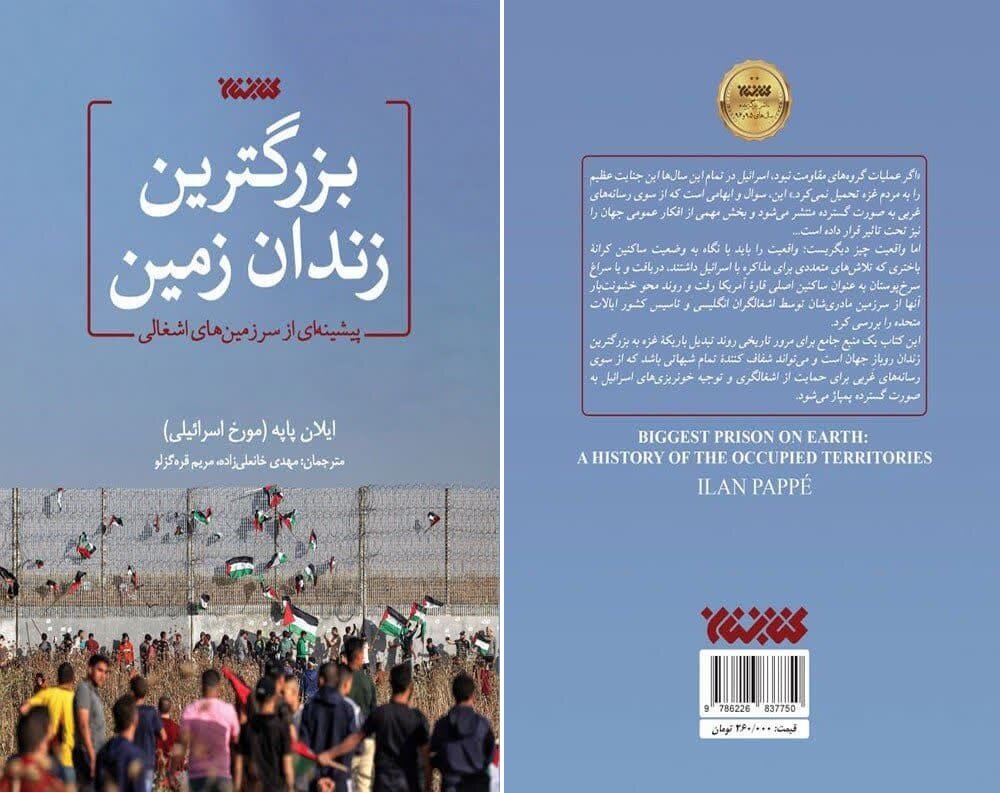
TEHRAN-The Persian translation of the book “The Biggest Prison on Earth” written by the Israeli historian Ilan Pappe has hit the Iranian bookstores.
Maryam Gharagozlou and Mehdi Khanalizadeh have translated the book, which is published by Ketabestan Publications, Mehr reported.
Following his critically acclaimed investigation of the ethnic cleansing of Palestine in the 1940s, renowned historian Pappe turns his attention to the annexation and occupation of Gaza and the West Bank in this book, bringing the readers the first comprehensive critique of the Occupied Territories.
Based on groundbreaking archival research, NGO records, and eyewitness accounts, Pappe’s investigation of the “bureaucracy of evil” explores the brutalizing effects of occupation, from the systematic abuse of human and civil rights, the IDF roadblocks, mass arrests, and house searches to the forced population transfer, the settlers, and the infamous wall that is rapidly turning the West Bank into an open prison. Providing a sharp contrast with life in Israel, this is a brilliantly incisive and moving portrait of daily life in the Occupied Territories.
First published in 2016, “The Biggest Prison on Earth” exposes Israeli violations in Palestine against its indigenous people. The Israeli historian reveals Israel’s ugly crimes against humanity over the years, using clear-cut evidence that indicts the settler colonial entity. Pappe comprehensively analyzes Zionist objectives in occupied Palestine and the ethnic cleansing of the Palestinians in different historical epochs.
He begins by describing Israeli preparations made several years before 1967’s Six-Day War to control large portions of Palestine without formally annexing them and thereby granting civil rights to the Palestinians living there. Instead, with the imposition of Israeli rule, “the Palestinians living there were incarcerated for crimes they never committed and for offenses that were never committed, confessed, or defined.”
Pappe shows that the Israelis offered an “open-air prison” when the Palestinians were compliant and a “maximum security prison” when they offered any resistance. Both left them shorn of basic human rights but the latter also featured harsh punishments up to and including military attacks on civilians.
The author cites numerous violations of international law as well as generally duplicitous behavior by Israeli leaders toward other nations and international bodies, particularly during the Oslo Accord negotiations. Moreover, according to a 2016 U.N. report, Israel’s actions toward the Gaza Strip will render life there “unsustainable” by 2020. Pappe’s conclusions won’t be welcome in all quarters but this detailed history is rigorously supported by primary sources.
The Israeli historian’s work earned the 2017 Book of Palestine Award, and it was recently translated into Arabic.
He has dedicated his book to the children of Palestine who endured killing, injury, and bullying because they live in the biggest prison on earth.
Pappé, 69, is a professor with the College of Social Sciences and International Studies at the University of Exeter in the UK, director of the university’s European Centre for Palestine Studies, co-director of the Exeter Centre for Ethno-Political Studies, and political activist. He was formerly a senior lecturer in political science at the University of Haifa (1984–2007) and chair of the Emil Touma Institute for Palestinian and Israeli Studies in Haifa (2000–2008).
Pappé is one of Israel’s new historians who, since the release of pertinent British and Israeli government documents in the early 1980s, have been rewriting the history of Israel’s creation in 1948, and the corresponding expulsion or flight of 700,000 Palestinians in the same year.
He has written that the expulsions were not decided on an ad hoc basis, as other historians have argued, but constituted the ethnic cleansing of Palestine, in accordance with Plan Dalet, drawn up in 1947 by Israel’s future leaders. He blames the creation of Israel for the lack of peace in the Middle East, arguing that Zionism is more dangerous than Islamic militancy, and has called for an international boycott of Israeli academics.
His work has been both supported and criticized by other historians. Before he left Israel in 2008, he had been condemned in the Knesset, Israel’s parliament; a minister of education had called for him to be sacked; his photograph had appeared in a newspaper at the center of a target; and he had received several death threats.
================================================
Ilan Pappe
16 May at 01:01
Did you know that 70 years old professors of history are threatening America’ national security?
I arrived on Monday at Detroit airport and was taken for a two hours investigation by the FBI, and my phone was taken as well.
The two men team were not abusive or rude, I should say, but their questions were really out of the world!
am I a Hamas supporter? do I regard the Israeli actions in Gaza a genocide? what is the solution to the “conflict” (seriously this what they asked!)
who are my Arab and Muslim friends in America…how long do I know them, what kind of relationship I have with them.
Is some cases I sent them to my books, and is some cases I answered laconically yes or no…(I was quite exhausted after an 8 hours flight, but this is part of the idea).
They had long phone conversation with someone, the Israelis?,
and after copying everything on my phone allowed me to enter.
I know many of you have fared far worse experience, but after France and Germany denied entry to the Rector of Glasgow university for being a Palestinian…God know what will happen next.
The good news is – actions like this by the USA or European countries taken under pressure from the pro-Israeli lobby or Israel itself smell of sheer panic and desperation in reaction to Israel’s becoming very soon a pariah state with all the implications of such a status.
=============================================
Questioned by FBI – Renowned Historian Ilan Pappé Detained in Detroit
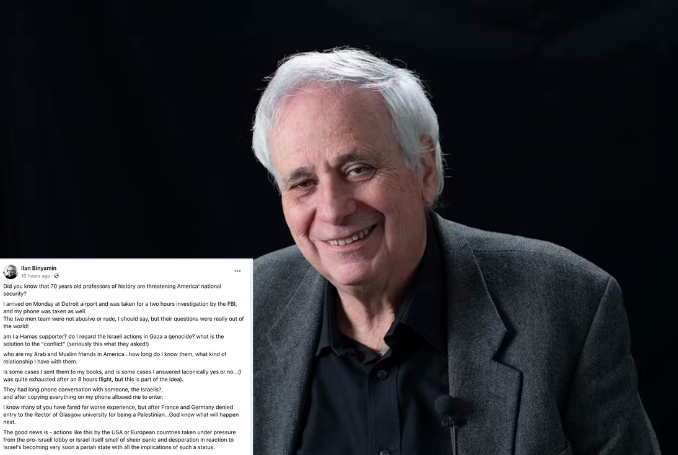
Professor Ilan Pappé was detained and interrogated at Detroit airport. (Design: Palestine Chronicle)
Renowned Israeli historian, Professor Ilan Pappé, was detained and interrogated on Monday at Detroit airport, in the US state of Michigan.
In a Facebook post on Wednesday, Pappé said that he was “taken for a two hours investigation by the FBI” and that his “phone was taken as well.”
“Am I a Hamas supporter? do I regard the Israeli actions in Gaza a genocide? what is the solution to the ‘conflict’ (seriously this what they asked!),” the post continued.
Pappé was also asked who were his “Arab and Muslim friends in America… how long do I know them, what kind of relationship I have with them.”
“They had long phone conversation with someone, the Israelis?, and after copying everything on my phone allowed me to enter,” the post added.
According to the anti-Zionist author and professor, this is a reflection “of sheer panic and desperation in reaction to Israel’s becoming very soon a pariah state with all the implications of such a status.”
Pappé is a professor at the University of Exeter. He was formerly a senior lecturer in political science at the University of Haifa.
He is the author of many books, including The Ethnic Cleansing of Palestine, The Modern Middle East, A History of Modern Palestine: One Land, Two Peoples, and Ten Myths about Israel.
Pappé is the co-editor, with Palestinian historian, Dr. Ramzy Baroud of ‘Our Vision for Liberation’.
Pappé is also a regular contributor to the Palestine Chronicle. In one of his latest articles, entitled ‘A Wall and a Watchtower: Why is Israel Failing?’, he wrote:
“Why do so many supporters of Israel and the Israeli Jews themselves believe that this is a sustainable project in the 21st century?
“The truth is, it is not sustainable.
“The problem is that its disintegration could be a long process and a very bloody one, whose principal victims would be the Palestinians.”
For more of Pappé’s writing in the Palestine Chronicle, click here.
==============================================
https://www.wsws.org/en/articles/2024/05/17/jwqd-m17.html
International Committee of the Fourth International (ICFI)
Anti-Zionist Israeli historian Ilan Pappé stopped and interrogated at Detroit airport
16 May 2024
By Patrick Martin
Internationally renowned Israeli historian Ilan Pappé was stopped by federal agents and interrogated for two hours Monday as he entered US territory at Detroit Metropolitan Airport. Pappé was visiting southeast Michigan to speak at public meetings in Detroit and two suburbs, Dearborn and Ferndale.
Agents from the Department of Homeland Security confiscated and copied the contents of his cellphone before returning it to him. They asked him detailed questions about his anti-Zionist political views and who he was in contact with in the United States, before finally admitting him to the country.
In a posting on his Facebook page, Pappé recounted some of the details of this outrageous attack on democratic rights, which gives a glimpse of the police-state methods of the US government towards those it suspects of opposition to American foreign policy.
“The two men team were not abusive or rude, I should say, but their questions were really out of the world!” Pappé wrote.
Am I a Hamas supporter? Do I regard the Israeli actions in Gaza a genocide? What is the solution to the “conflict” (seriously this what they asked!) Who are my Arab and Muslim friends in America… how long do I know them, what kind of relationship I have with them.
In some cases I sent them to my books, and is some cases I answered laconically yes or no… (I was quite exhausted after an 8 hours flight, but this is part of the idea). They had long phone conversation with someone, the Israelis?, and after copying everything on my phone allowed me to enter.
I know many of you have fared far worse experience, but after France and Germany denied entry to the Rector of Glasgow university for being a Palestinian… God know what will happen next.
The good news is – actions like this by the USA or European countries taken under pressure from the pro-Israeli lobby or Israel itself smell of sheer panic and desperation in reaction to Israel’s becoming very soon a pariah state with all the implications of such a status.
Pappé was formerly a senior lecturer in political science at the University of Haifa, before moving to Britain, where he was a lecturer at Leeds University. He is now professor of Middle Eastern studies at the University of Exeter.
He has written more than 20 books on the history of Israel-Palestine, including The Ethnic Cleansing of Palestine, which provides a thorough examination of the Nakba, the driving out of 700,000 Palestinians and the seizure of their land in the course of the founding of Israel in 1947-48.
Other works include The Modern Middle East, A History of Modern Palestine: One Land, Two Peoplesand Ten Myths about Israel.
Pappé gave an interview to Al Jazeera May 15 marking the 76th anniversary of the Nakba (although he prefers to refer to it, not as a catastrophe—Nakba in Arabic—but as a crime, since a catastrophe could be a natural one, but this was a crime with a perpetrator, the Zionists, and a victim, the Palestinians).
Based on his great familiarity with the events of 1948, he observed that the current attack on Gaza is “even worse” than those terrible events. “What we see now are massacres which are part of the genocidal impulse, namely to kill people in order to downsize the number of people living in Gaza,” he said. “Ethnic cleansing is a terrible crime against humanity but genocide is even worse.”
After his interrogation by the DHS, Pappé went on to address the three scheduled public meetings on the topic “Gaza in Context: Past, Present, & Future.” He spoke before large audiences which included many Arab Americans. The Detroit area has the largest population of Arab Americans in the US.
One of his many insights was a detailed explanation of the history of the Gaza Strip, established as a giant refugee camp for Palestinians pushed south by Zionist terrorism in 1948.
The territory was originally a third larger than the present Gaza, but additional land, about 110 square kilometers, was subsequently seized by the state of Israel and handed over for settlement after a campaign by the “left” Zionist party Mapam, which wanted the land to build kibbutzes, because of its fertility.
The kibbutzes attacked on October 7 were among those built on land directly adjacent to Gaza which had been confiscated and its Palestinian population driven into Gaza. Two generations of Palestinian youth learned of the dispossession of its original inhabitants from land which remained within view.
================================================
פרופסור אילן פפה נעצר עם הגעתו לארה”ב ונחקר על עמדותיו הפוליטיות
ע״פ פפה, סוכני המחלקה לביטחון המולדת, חקרו אותו על עמדותיו לגבי החמאס והעתיקו את כל תכולת הטלפון שלו
מערכת “זו הדרך”17.05.2024
החוקר והיסטוריון פרופ’ אילן פפה נעצר ביום רביעי האחרון עם הגעתו לארה”ב ונחקר על עמדותיו הפוליטיות. כך מסר פפה ברשומה שפרסם אתמול בפייסבוק. הוא הגיע לשיקגו על מנת להשתתף בדיון אקדמי ובשדה התעופה המתינו לו שני סוכנים של המחלקה לביטחון המולדת של ארה”ב, שמנוע ממנו להמשיך בדרכו וחקרו אותו במשך שעתיים. כמו כן, העתיקו את כל תכולת הטלפון הנייד שהחזיק.
“האם מרצה להיסטוריה בן 70 מהווה איום על הביטחון הלאומי של ארה”ב?”, כתב פפה והוסיף שבין השאלות שנשאל: “האם אתה תומך בחמאס?”, “האם אתה סבור שישראל מבצעת רצח עם ברצועת עזה?”, “מהו לדעתך הפתרון לסכסוך הישראלי-פלסטיני?”. ועוד נשאל “האם יש לך חברים ערבים או מוסלמים בארה”ב – כמה זמן אתה מכיר אותם?”. פפה סירב להשיב לחקירה הפוליטיות ורק ענה ב”כן” ו”לא”. יצוין שבשנה האחרונה נאסר כניסתו של פפה ל-29 מדינות אירופיות.
פרופ’ פפה (יליד חיפה, 1954) לימד באוניברסיטת חיפה משנת 1984, תחילה בחוג להיסטוריה של המזרח התיכון ולאחר מכן בחוג למדע המדינה. כמו כן, הוא ייסד את המכון לחקר השלום בגבעת חביבה ועמד בראשו במשך עשור, והיה יו”ר מכון אמיל תומא לעיונים פלסטינים וישראלים בחיפה. במשך שנים רבות פעל נגד כיבוש השטחים הפלסטינים. הוצאת “ספרי נובמבר” פרסמה לפני שלוש שנים את התרגום העברי לספרו “הטיהור האתני של פלסטין”. הספר ראה אור לראשונה באנגלית בשנת 2006, ומאז תורגם ל-15 שפות.
בשנת 2007 עזב פפה את ישראל ועבר לבריטניה, שם הוא מרצה וחוקר בפקולטה להיסטוריה באוניברסיטת אקסטר ומנהל את המרכז האירופי ללימוד פלסטין. בטרם עזב את ישראל קיבל איומי רצח בטלפון ובדואר, בכנסת גינו אותו, שר החינוך קרא לפיטוריו, ותמונתו הופיעה בעיתון “ידיעות אחרונות” במרכזה של כוונת רובה. לצד התמונה פורסם טור בו נכתב: “אני לא אומר שצריך להרוג את האיש הזה, אבל אני לא אהיה מופתע אם מישהו יעשה את זה”.
עוד בנושא: https://zoha.org.il/102882
================================
https://newrepublic.com/article/85344/ilan-pappe-sloppy-dishonest-historian
Benny Morris/March 17, 2011
The Liar as Hero
The Rise and Fall of a Palestinian Dynasty: The Husaynis, 1700-1948
By Ilan Pappe
(University of California Press, 399 pp., $29.95)
The Ethnic Cleansing of Palestine
By Ilan Pappe
(Oneworld, 313 pp., $14.95)
I.
At best, Ilan Pappe must be one of the world’s sloppiest historians; at worst, one of the most dishonest. In truth, he probably merits a place somewhere between the two.
Here is a clear and typical example—in detail, which is where the devil resides—of Pappe’s handiwork. I take this example from The Ethnic Cleansing of Palestine. On February 2, 1948, a young Jewish scientist named Aharon Katzir came to see David Ben-Gurion, the chairman of the Jewish Agency Executive and the leader of the Jewish community in Palestine. Two months earlier, the General Assembly of the United Nations had recommended the partition of the country into two states. The Zionist establishment had accepted Resolution 181, but the Palestinian Arab leadership, and the surrounding Arab states, had rejected it—and Palestinian militiamen began to shoot at Jewish traffic, pedestrians, and settlements. The first Arab-Israeli war had begun.
Katzir had come to report to the man managing the Jewish war effort (Ben-Gurion also held the defense portfolio in the Jewish Agency Executive) about an experiment that he and his team in the Haganah’s “science branch” had been conducting. As was his wont, Ben-Gurion jotted down in his diary what his visitor told him. (Ben-Gurion’s diary, a major source on Israeli and Middle East history, consists almost entirely of his summaries of reports by people coming to see him; very few entries actually enlighten the reader about what Ben-Gurion thought or said.) The entry reads:
Aharon: ‘Shimshon’ [the operation’s codename], an experiment was conducted on animals. The researchers were clothed in gas masks and suit. The suit costs 20 grush, the mask about 20 grush (all must be bought immediately). The operation [or experiment] went well. No animal died, the [animals] remained dazzled [as when a car’s headlights dazzle an oncoming driver] for 24 hours. There are some 50 kilos [of the gas]. [They] were moved to Tel Aviv. The [production] equipment is being moved here. On the laboratory level, some 20 kilos can be produced per day.
This is the only accessible source that exists, to the best of my knowledge, about the meeting and the gas experiment, and it is the sole source cited by Pappe for his description of the meeting and the “Shimshon” project. But this is how Pappe gives the passage in English:
Katzir reported to Ben-Gurion: “We are experimenting with animals. Our researchers were wearing gas masks and adequate outfit. Good results. The animals did not die (they were just blinded). We can produce 20 kilos a day of this stuff.”
The translation is flecked with inaccuracies, but the outrage is in Pappe’s perversion of “dazzled,” or sunveru, to “blinded”—in Hebrew “blinded” would be uvru, the verb not used by Ben-Gurion—coupled with the willful omission of the qualifier “for 24 hours.” Pappe’s version of this text is driven by something other than linguistic and historiographical accuracy. Published in English for the English-speaking world, where animal-lovers are legion and deliberately blinding animals would be regarded as a barbaric act, the passage, as published by Pappe, cannot fail to provoke a strong aversion to Ben-Gurion and to Israel.
Such distortions, large and small, characterize almost every page of The Ethnic Cleansing of Palestine. So I should add, to make the historical context perfectly clear, that no gas was ever used in the war of 1948 by any of the participants. Pappe never tells the reader this. Raising the subject of gas is historical irrelevance. But the paragraph will dangle in the reader’s imagination as a dark possibility, or worse, a dark reality: the Jews, gassed by the Nazis three years before, were about to gas, or were gassing, Arabs. I note also, for accuracy’s sake, that, apart from the 1917 battle for Gaza in World War I, the only people in the Middle East who have used poison gas against their enemies in the past century have been Arabs—the Egyptians in Yemen in the 1960s, the Iraqis in Kurdistan in the 1980s. So there can be no escaping the conclusion that Pappe introduced the subject, and perverted the text, for one purpose only: to blacken the image of Israel and its leaders in 1948. This is also among the purposes of The Rise and Fall of a Palestinian Dynasty and Out of the Frame.
II.
Palestinian Dynasty was a good idea. It attempts to describe the evolution and the activities of one of Palestine’s leading notable families, the Husaynis of Jerusalem, from their rise around 1700 to local and then “national” prominence, until their fall from grace and power in 1947-1948. The Husaynis over the generations were religious leaders and mayors of the holy city, and filled other posts as well, including representing the area in the Ottoman parliament. The most famous Husayni was Muhammad Hajj Amin al-Husayni, the grand mufti of Jerusalem from 1921 and the leader of the Arab Higher Committee (AHC), the Palestinians’ executive political body, and thus of the Palestine Arab national movement during the crucial years between 1936 and 1948. Thereafter only one member of the clan, Faysal, the son of Abd al-Qadir al-Husayni, was to achieve real prominence and a measure of power, as the Palestine Liberation Organization’s Jerusalem affairs supremo in the 1990s. Pappe calls Faysal “the most renowned Palestinian of the end of the twentieth century.” I always thought that was Yasir Arafat.
Pappe uses the Husayni story as a vehicle to describe Palestine’s history during those two and a half centuries, spanning Ottoman and British rule and the clash with Zionism, and ending with the first Arab-Israeli war, the establishment of the state of Israel and the collapse of Palestinian society and politics. The book’s treatment of the successive periods is chronologically disproportionate: pages 23 to 91 cover the Ottoman years, from 1700 to 1875, almost two centuries; and pages 92 to 342 cover the seventy-two years of waning Ottoman rule and the British and “Zionist” years, from 1876 to 1948. In fact, there is far more source material for the later years and a relative paucity of material on the earlier period. But Pappe’s real interest lies in politics, specifically anti-British-imperial politics and anti-Zionist politics, and not in distant Ottoman-era history.
The disproportion also reflects Pappe’s worth as a historian. Let me explain. To cover the history of Palestine—a geographically small backwater in the giant Ottoman domain—and the activities of its aristocracy and their interaction with the authorities in the eighteenth and nineteenth centuries, one would have to spend many months in the Ottoman archives in Istanbul. There one would need to locate and pore over reports and correspondence from and about the relevant vilayets (provinces), Syria/Damascus and Beirut, and the relevant sanjaks and mutasarafliks (districts), Jerusalem, Nablus, and Acre, in addition to the central government’s deliberations and decision-making about Jerusalem and its environs. Pappe, who lacks Turkish, has not consulted any Ottoman archives. There is not a single reference to any Ottoman archive, or any Turkish source, in his endnotes.
Another source for the history-especially social and economic history—of Ottoman Palestine is the archives of the local sharia courts in Jaffa and Jerusalem. These archives, to judge from the endnotes, Pappe tapped only briefly, if at all, as if ticking a box. In one endnote he thanks Dr. Mahmoud Yazbak of Haifa University, “who guided me in working on these documents in the Haram [the Temple Mount in Jerusalem].” To judge from the endnotes, Pappe was for some reason deterred from spending time in these repositories.
Indeed, almost all of Pappe’s references direct the reader to books and articles in English, Hebrew, and Arabic by other scholars, or to the memoirs of various Arab politicians, which are not the most reliable of sources. Occasionally there is a reference to an Arab or Western travelogue or genealogy, or to a diplomat’s memoir; but there is barely an allusion to documents in the relevant British, American, and Zionist/Israeli archives. When referring to the content of American consular reports about Arab riots in the 1920s, for example, Pappe invariably directs the reader to an article in Hebrew by Gideon Biger—“The American Consulate in Jerusalem and the Events of 1920-1921,” in Cathedra, September 1988—and not to the documents themselves, which are easily accessible in the United States National Archive.
Those who falsify history routinely take the path of omission. They ignore crucial facts and important pieces of evidence while cherry-picking from the documentation to prove a case. An apt illustration of this delinquency is Efraim Karsh, in Palestine Betrayed. At one point he tells us, quoting a news report from the Palestine Post, that the Palestinian Arab masses actually welcomed the UN partition resolution of November 1947, which posited the establishment of a Jewish state side by side with a Palestine Arab state, when a thousand other pieces of evidence—Haganah intelligence reports, newspapers, monitored Arab radio broadcasts, and the simple fact that Palestine’s Arabs went to war to stymie that resolution—tell us, with overwhelming persuasiveness, the exact opposite.
But Pappe is more brazen. He, too, often omits and ignores significant evidence, and he, too, alleges that a source tells us the opposite of what it in fact says, but he will also simply and straightforwardly falsify evidence. Consider his handling of the Arab anti-Jewish riots of the 1920s. Pappe writes of the “Nabi Musa” riots in April 1920: “The [British] Palin Commission … reported that the Jewish presence in the country was provoking the Arab population and was the cause of the riots.” He also quotes at length Musa Kazim al-Husayni, the clan’s leading notable at the time, to the effect that “it was not the [Arab] Hebronites who had started the riots but the Jews.” But the (never published) “Report of the Court of Inquiry [it was not a “Commission”] Convened by Order of H.E. the High Commissioner and Commander-in-Chief, Dated the 12th Day of April, 1920,” while forthrightly anti-Zionist, thereby accurately reflecting the prevailing views in the British military government that ruled Palestine until mid-1920, flatly and strikingly charged the Arabs with responsibility for the bloodshed. The team chaired by Major-General P.C. Palin wrote that “it is perfectly clear that with … few exceptions the Jews were the sufferers, and were, moreover, the victims of a peculiarly brutal and cowardly attack, the majority of the casualties being old men, women and children.” The inquiry pointed out that whereas 216 Jews were killed or injured, the British security forces and the Jews, in defending themselves or in retaliatory attacks, caused only twenty-five Arab casualties.
The bottom line of the Palin report of July 1, 1920, was that the Arabs “not entirely” unreasonably feared Jewish immigration and eventual political and economic domination, and that the Zionists had occasionally acted with “indiscretion” and political aggressiveness. At the same time, the report continued, in its complex account of the causes of the crisis, the British, too, through their “nonfulfillment” of promises, had contributed to Arab “alienation and exasperation,” as had deliberate incitement by various Arab leaders and journalists. Taken together, these were the wellsprings of the Arabs’ “panic” and rage. But it was the Arabs—the report concluded—who had resorted to murderous violence and attacked the Jews in “treacherous and cowardly” fashion. The picture painted by the Palin inquiry, despite its clear anti-Zionist bias, was far more complicated, nuanced, and balanced than that conveyed in Pappe’s “history.”
About the 1929 “Temple Mount” riots, which included two large-scale massacres of Jews, in Hebron and in Safed, Pappe writes: “The opposite camp, Zionist and British, was no less ruthless [than the Arabs]. In Jaffa a Jewish mob murdered seven Palestinians.” Actually, there were no massacres of Arabs by Jews, though a number of Arabs were killed when Jews defended themselves or retaliated after Arab violence. Pappe adds that the British “Shaw Commission,” so-called because it was chaired by Sir Walter Shaw (a former chief justice of the Straits Settlements), which investigated the riots, “upheld the basic Arab claim that Jewish provocations had caused the violent outbreak. ‘The principal cause … was twelve years of pro-Zionist [British] policy.’”
It is unclear what Pappe is quoting from. I did not find this sentence in the commission’s report. Pappe’s bibliography refers, under “Primary Sources,” simply to “The Shaw Commission.” The report? The deliberations? Memoranda by or about? Who can tell? The footnote attached to the quote, presumably to give its source, says, simply, “Ibid.” The one before it says, “Ibid., p. 103.” The one before that says, “The Shaw Commission, session 46, p. 92.” But the quoted passage does not appear on page 103 of the report. In the text of Palestinian Dynasty, Pappe states that “Shaw wrote [this] after leaving the country [Palestine].” But if it is not in the report, where did Shaw “write” it?
Actually, the thrust of the “Report of the Commission on the Palestine Disturbances of August, 1929,” which appeared in 1930, is completely contrary to what Pappe asserts (though it does list some non-lethal Jewish provocations—peaceful demonstrations, a newspaper article—as among the immediate triggers of the eruption of the Arab violence). The report states: “The fundamental cause, without which in our opinion disturbances either would not have occurred or would have been little more than a local riot, is the Arab feeling of animosity and hostility towards the Jews consequent upon the disappointment of their political and national aspirations and fear for their economic future.” As to the riots themselves, the report states: “The outbreak in Jerusalem on the 23rd of August [the start of the riots] was from the beginning an attack by Arabs on Jews for which no excuse in the form of earlier murders by Jews has been established.” The disturbances “took the form, for the most part, of a vicious attack by Arabs on Jews accompanied by wanton destruction of Jewish property…. In a few instances, Jews attacked Arabs and destroyed Arab property. These attacks, though inexcusable, were in most cases in retaliation for wrongs already committed by Arabs in the neighborhood in which the Jewish attacks occurred.”
Pappe repeatedly asserts, in order to demonstrate an Arab readiness for conciliation, that the Palestinian leadership in 1920-1922, including Hajj Amin, was “ambiguous” about Zionism and “was willing to compromise.” This is nonsense. Indeed, Hajj Amin was tried and convicted in absentia by a British court for helping to incite the murderous riots of April 1920.
To the deliberate slanting of history Pappe adds a profound ignorance of basic facts. Together these sins and deficiencies render his “histories” worthless as representations of the past, though they are important as documents in the current political and historiographic disputations about the Arab-Israeli conflict. Pappe’s grasp of the facts of World War I, for example, is weak in the extreme. He writes that the “Ottoman entry into the war was triggered by an incident in the Black Sea in December 1914.” In fact, the Ottoman Empire joined World War I with Russia’s declaration of war on Constantinople on November 1, following the bombardment of Sevastopol on October 29 by the Turkish cruiser “Yavuz Sultan Selim,” which was really the German cruiser Goeben manned by fez-wearing German sailors. Pappe tells us that Hajj Amin was commissioned as an officer in the Ottoman 46th division, at first serving as “assistant division commander to the governor of Smyrna,” thereby betraying his ignorance of the relevant Ottoman administrative and military structures (lieutenants are not “assistant division commanders”). Pappe maintains that Jamal Pasha’s Fourth Army “had failed to cross the Sinai Peninsula” in World War I—but the Turks crossed the peninsula and fought the British on the banks of the Suez Canal on February 2-4, 1915, and in their second invasion of Egypt, in August 1916, they reached Romani, just short of the canal. Pappe maintains that Allenby’s conquest of Jerusalem in December 1917 “concluded the [British] campaign in the Levant,” but of course it didn’t: Allenby’s army went on, in 1918, to conquer the rest of Palestine and Syria. Pappe notes that “the text of the Balfour Declaration remained unpublished” until February 1920, but it was published already in 1917. He refers to Raghib Nashashibi in 1923 as “a member of parliament”—what parliament?
Some of Pappe’s “historical” assertions are, quite obviously, politically motivated, but they are mistakes nonetheless. He refers to “statements made by Jewish and Zionist leaders about the need to build the ‘Third Temple.’” Husaynis often leveled that charge against the Jews, in order to incite the Muslim masses. But which important Zionist leader in the 1920s advocated the construction of a Third Temple? None whom I can name. Later Pappe reinforces this lie by remarking that “Palestinian historiography, including recent work that draws on newly revealed materials, suggests that the mufti’s concern was not baseless, and that there really was a Jewish plan to seize the entire Haram [Temple Mount].” Pappe offers no evidence for this extraordinary assertion.
Pappe repeatedly refers to “Harry Lock” of the British Mandate government secretariat in the 1920s—but the chief secretary’s name was Harry Luke. Pappe obviously encountered the name in Hebrew or Arabic and transliterated it, with no prior knowledge of Luke against which to check it: if he had consulted British documents, he would have known the correct spelling. Pappe refers to “the Hope Simpson Commission”—there was no such commission, only an investigation by an official named John HopeSimpson. He refers to “twenty-two Muslim … states” in the world in 1931, but by my count there were only about half a dozen. He refers to “the Jewish Intelligence Service”—presumably the Haganah Intelligence Service—and then adds, “whose archive has been opened to Israeli historians but not to Palestinians.” To the best of my knowledge, this is an outright lie. All public archives in Israel, including the Haganah Archive in Tel Aviv, which contains the papers of its intelligence service, are open to all researchers.
Pappe writes, regarding 1939, of “Colonial Secretary Ramsay MacDonald” when it should be Malcolm MacDonald, the official responsible for the famous White Paper of May 1939. (Ramsay MacDonald died two years earlier.) He speaks of “Rommel’s advance towards Alexandria” in “the summer of 1940,” but Rommel reached Africa only the following year. He writes that in 1947 the Haganah immigration ship Exodus “was refused entry [into Palestine] and made its way back to Germany.” Actually, the ramshackle Exodus from Europe-1947 was intercepted by British naval craft and forcibly boarded. The disabled ship was towed into Haifa harbor, where most of its passengers were transferred to a seaworthy ship and sent back to Europe, most disembarking in Hamburg. I could go on. Suffice it to say that Pappe’s contempt for historical truth and factual accuracy is almost boundless.
III.
Ilan Pappe has opted out of the Zionist dream—or as he would have it, the Zionist nightmare. About three years ago he moved from the University of Haifa, where he was a senior lecturer in the department of political science, to the University of Exeter in Britain. Out of the Frame gives us Pappe’s explanation of why he chose exile. The title apparently derives from Out of Place, his late friend Edward Said’s autobiography. But Pappe’s book, while offering some autobiographical tidbits, is really a political charge-sheet against Zionism—a polemic, not a memoir.
He tells us that he grew up in a German Jewish family transplanted to the Israeli port city of Haifa, where he was born in 1954. As a youngster he was a Zionist, passing through the routine stations of high school, army, and undergraduate studies in Israel. (He even mentions his service in the Golan Heights during the 1973 war, apparently still a source of pride.) His glissement into militant anti-Zionism began, he recalls, in 1982, at St. Antony’s College, Oxford, where he was supervised in his doctoral studies by Albert Hourani, an Anglo-Lebanese historian who in an earlier life (1945-1947) had served as a spokesman for Hajj Amin al-Husayni and the Palestinian cause.* Hourani went on to become a major historian of the Middle East, and the author of the elegant and acclaimed book A History of the Arab Peoples.
Whatever Hourani’s influence upon him, Pappe proffers another explanation for his disenchantment. He has a personal grievance. In 1982, he was chucked out of Peace Now, whose representative in Britain he says he was, because he had debated with a PLO representative in the House of Commons. (He doesn’t tell us on which side he appeared.) He was also asked by the Israeli embassy to speak at a pro-Israeli rally in northern Britain just after the Israeli invasion of southern Lebanon. He declined the invitation, he tells us, not just because of anti-Israeli sentiment but also because a few days earlier Israel’s ambassador in London, Shlomo Argov, had been shot by Arab gunmen, and Pappe was miffed that the embassy had displayed a “willingness to sacrifice me”—perhaps Arab “terrorists” would gun him down, too. The assumption that it was dangerous in those days to speak publicly on behalf of Israel, as if Arabs were regularly gunning down such speakers, is nonsense.
Armed with a Ph.D. in modern Middle East history, Pappe returned to Israel, immediately landing an academic position. His prose, at this point in Out of the Frame, becomes more opaque and convoluted, and for good reason: he wishes to project an image of himself in the 1980s as a young crusading rebel sharply critical of Israel and Zionism, valiantly battling a rock-hard Israeli establishment, including its academic establishment. Israel’s universities, he claims, were then (and are today) governed by an unremitting Zionist orthodoxy and dogmatism.
Yet Haifa University in 1984 accorded him a coveted position, and in fairly short order gave him tenure. Of this, Pappe writes: “Attaining tenure is a painful process for most young academics in Israel; it was doubly difficult for me given my views, which were already quite well known. And yet, as I noted, my positions were not yet crystallized in such a way as constituted a threat to the system, and I passed over the hurdles successfully.” He adds, somewhat contradictorily, that his “radicalism” “enhanced the university’s claim to pluralism and allowed it to boast of its openness to the world at large.” So he kept his radicalism under wraps in order to obtain tenure and he brandished it brazenly, also in order to obtain tenure. Take your pick.
The truth is more prosaic. While Pappe, as a citizen, was a clear dabbler in radical politics, he still operated within the Zionist camp to the extent that the Israeli Communist Party, to which he belonged, posited the existence of the Jewish state within the framework of a two-state solution—in line with Moscow’s position. At the same time, Pappe’s academic output was inoffensive in the extreme. He claims that his first book, Britain and the Arab-Israeli Conflict, 1948-51, which appeared in1988, asserts that “Britain played a major role in allowing the Zionist movement to found a state in Palestine through the ethnic cleansing of its indigenous people.” This is a misrepresentation. The book deals with British policy and, more specifically, with British-Jordanian relations—a subject that was covered much more thoroughly and insightfully, and in elegant English, by Avi Shlaim in his Collusion Across the Jordan: King Abdullah, the Zionist Movement, and the Partition of Palestine—and it says nothing at all about what Pappe today calls the “ethnic cleansing of Palestine.”
In this passage Pappe is laying claim to what he regards as early anti-Zionist laurels, to which he has no right. Nowhere in his first book is there a mention of “ethnic cleansing” or any of its equivalents. Indeed, Pappe curiously devotes less than one page of Britain and the Arab-Israeli Conflict to a sub-section titled “The Responsibility for the Creation of the Refugee Problem,” where he asserts, rather feebly and neutrally, that the British had two views on the matter: that the Jews alone were to blame, and that it was “the AHC [that was responsible] for encouraging the exodus in the cases of Haifa, Jaffa and Jerusalem.” Nowhere did the younger, more honest Pappe of the 1980s charge the Jews with expelling “the” Arabs of Palestine. Rather, he tellingly asserted that “the Israelis were prepared [in 1949] to admit joint responsibility with the Arab countries for the refugee problem by making a gesture and offering to repatriate some of the refugees.” Two decades later, moreover, both sides appeared to accept the refugee status quo: “The Israelis … hoped that the Arab states would resettle the refugees [in their territory], and … the Arab states … decided to exploit the conditions in the refugee camps as a political card against Israel.” Today’s Pappe would not let such outrageous truths pass his lips.
Britain and the Arab-Israeli Conflict was bland and hesitant enough (though, like Shlaim’s Collusion, it did postulate a measure of Jordanian-British-Israeli collusion in 1948) to enable Pappe to get a position in an Israeli university, where Zionist orthodoxy was still the rule and a sine qua non for obtaining a lectureship. The book made no waves, it was read by almost no one, it annoyed nobody. Pappe more or less admits as much when he observes, in his less-than-honest fashion, that the book “was written in the style of a doctoral thesis, which has a way of muting even the strongest critiques” and then claims that its publication elicited “hate letters and death threats”—another claim designed to enhance his selfportrait as a young rebel, which I find extremely difficult to believe.
In sum, Pappe is a retroactive poseur. But by the middle or late 1990s, after getting tenure, Pappe did shift gears into a full-blown radicalism, political and historiographical. By then he was advocating Israel’s elimination and the establishment in the territory of Mandatory Palestine of one state, consisting of Jews and Arabs. That it would have an Arab majority and, if democratic, be ruled by Arabs was to be assured by a mass return of Arab refugees, which Pappe also advocated, and still advocates. One of his books is dedicated to his two children, whom he hopes will live in a better “Palestine.” In Out of the Frame, Pappe defines Zionism as “a racist and quite evil philosophy of morality and life.” The language is fully as virulent as Hamas’s, or worse.
During the 1990s and early 2000s, despite his charm and his charisma as a teacher, Pappe managed to alienate the bulk of the University of Haifa’s establishment, and was for years denied promotion to associate (or full) professorship, despite a fulsome list of publications. His work may be shoddy, and it has grown shoddier with the years, and overtly propagandistic, but the denial of promotion was probably the result of political alienation and an unusual form, on his part, of uncollegiality. I have mentioned Pappe’s “one-statism.” But if truth be told, this is not what pushed the anti-Pappists to accuse him of “uncollegiality.” What drove his Haifa colleagues to distraction was that Pappe, in the course of the second intifada in 2000-2004—when Israel was virtually at war with the Palestinians of the West Bank and the Gaza Strip, while buses and restaurants in Tel Aviv, Jerusalem, and Haifa almost daily were being demolished by suicide bombers—publicly promoted an international boycott of Israel’s universities, including his own. In the name of the embattled Palestinians, Pappe called on Western academic institutions to stop joint projects and cut off research funds (“divestment”), to cease contact and cooperation with Israeli academics, to reject Israelis’ submissions to journals and university presses, and so on. (The paradox in all this is blatant: Israel’s academics have for decades been at the forefront of criticism of Israel’s policies in the occupied territories and toward Israeli Arabs. Those are the people Pappe set out to hurt.)
Pappe prefers to explain somewhat differently why many of his colleagues came to loathe him. He alleges that it was the “Tantura Affair,” about which more in a moment, and not his boycott advocacy, that made him his enemies. Pappe’s aim is to paint Israel’s universities as bastions of ideological rigidity and Zionist McCarthyism, and to configure himself as their victim: a crusader for academic freedom crucified on the cross of ideological and historiographical doctrine. This is a stark misrepresentation of reality. True, from the 1950s through the 1970s, and perhaps even in the 1980s, Israel’s universities were, in the humanities and social sciences, in all that concerned the history of Israel and of Zionism, bastions of dogmatism and conformism. But such a characterization is wildly wrong about Israeli universities since the 1990s.
From the 1950s to the 1970s, the universities’ humanities faculties—and, to a lesser degree, their social science faculties—kept out or marginalized anti-Zionist sentiment and dissent. Zionism, as represented by the Labor Zionist mainstream, ruled as the necessary framework for the understanding of Middle Eastern realities, especially the conflict with the Palestinians and the surrounding Arab world. Indeed, the conflict was simply omitted from the curriculum. (This was partly driven by something non-political: the prevalent Germanic view that “current affairs” were not worthy of scholarly treatment.) And the ideological pressure was such that in the 1950s and the 1960s even Zionist historians—but of the wrong persuasion, such as Benzion Netanyahu—were denied positions. (Netanyahu ended up at Cornell, where he became a prominent historian of the Spanish Inquisition.)
But things changed by the 1990s, partly due to the impact of the works of the “New Historians” (and the “Critical Sociologists,” who gained a foothold, or more than a foothold, in Israel’s social science faculties even earlier). Even more important, probably, was the integration of Israeli academia into the intellectually open university life of the West. By the early 2000s, departments of political science, sociology, Hebrew literature, and cultural studies in some Israeli universities had become bulwarks of anti-Zionism, in which professing Zionists can barely achieve a toehold, let alone tenure. And the history departments and the Middle East studies departments are also far from being redoubts of Zionism. In Israeli academia today, one will find the whole political gamut, running from avowed Zionists to critics of Israeli policies to critics of Israel’s Jewishness and Israel’s existence to (a handful of) advocates of anti-Israel boycotts and divestments.
But Pappe prefers to portray his alienation from Haifa as rooted in his own courageous dissidence, his fight against Zionism and McCarthyism. In Out of the Frame, these are portrayed as coming to a head in the Tantura affair. In March 1998, a Haifa University student named Teddy Katz submitted a 211-page master’s thesis titled “The Exodus of Arabs from Villages at the Foot of Southern Mount Carmel in 1948.” It dealt specifically with the fate of two villages, Umm al-Zinat, on the Carmel, and Tantura, on the Mediterranean coast south of Haifa. The main focus was on Tantura. There, argued Katz, a middle-aged kibbutznik and a peace activist, the 33rd Battalion of the Alexandroni Brigade of the Haganah, the main Jewish militia that in the spring of 1948 was transformed into the Israel Defense Forces (IDF), on the morning of May 23 massacred about 250 unarmed villagers after conquering the village the night before. Katz described a systematic Nazi-style slaughter of groups of young men shot and dumped into trenches dug by other Arabs who were themselves subsequently shot, while the village’s women and children sat on a beach a few yards away.
Katz had been supervised by a Haifa University historian named Kais Firro, and had been encouraged in his research by Pappe, who served as his spiritual guide. The student had based his thesis on extensive interviews with refugees from Tantura who lived in the West Bank and in Israel, and with veterans of the Alexandroni Brigade. He had not worked in the Haganah or IDF archives, and his massacre story was based on no documentation, Israeli, British, or Arab.
The thesis was awarded a 97 by Firro, a Druze historian, and by two other professors, an Ottomanist and a social scientist—none of them experts on the 1948 war; and in June 2000, Katz was awarded an M.A. “with distinction.” But by then the trouble had already started. In January 2000, the Israeli daily Maariv published a long magazine piece based on the Katz thesis, and on fresh interviews with some of Katz’s interviewees, that in effect supported the massacre allegation. Alexandroni veterans complained, and the following month Maariv published a second piece quoting the veterans at length, in effect denying the massacre allegation. In both pieces, the veterans had denied that a massacre had occurred of the type Katz and some of his Arab interviewees alleged (though some had hinted at “dark deeds” having taken place).
Meanwhile the Alexandroni veterans hired a lawyer (a left-winger who had represented Peace Now in several cases) and sued Katz for libel. Going through Katz’s taped interviews and his thesis, the lawyer, Giora Erdinast, discovered a series of distortions, discrepancies, and outright inventions. When the court was presented with these findings, Katz broke down—some said he suffered a nervous breakdown or a minor stroke—and agreed to recant: “I did not mean to say that there had been a massacre in Tantura…. Today I say there was no massacre at Tantura.” This was in effect accepted by the court as its ruling, and Katz was ordered to publish his recantation. He never did (it was eventually published by the Alexandroni veterans). Instead he recanted his recantation and appealed to Israel’s Supreme Court. But the high court upheld the lower court’s decision.
Parallel to this process, under pressure from several professors, the University of Haifa established a committee to review Katz’s thesis and evidence. It, too, discovered distortions and discrepancies. In his thesis Katz had “quoted” passages that did not appear in his interview tapes. The university annulled the thesis, but allowed Katz to submit a revised version. In September 2002, Katz resubmitted his thesis, now expanded to 568 pages. Again, inexplicably, he was supervised by Firro. He corrected the misquotations but he remained unrepentant: the Alexandroni troops, he still claimed, had massacred dozens, perhaps hundreds, at Tantura on May 23, 1948.
The university appointed a committee of five examiners. But again it bungled the matter. Two of them were clearly not experts on 1948, and two of the others had a few years earlier published (along with a third historian) an apologetic book effectively clearing the IDF of a massacre in Lydda during the 1948 war. Three of the examiners gave the thesis less than a 75, effectively failing it. The university authorities then compromised again and awarded Katz an M.A.—but of the “non-research” variety, preventing him from pushing on to a Ph.D. within its precincts.
Both times around, Katz had produced a poor piece of work. But this did not mean that there had been no massacre in Tantura. I decided to look into the matter myself, starting with the archives. I found that there is no evidence in the available documentation to show that there was a large-scale or systematic massacre in Tantura. And this is strange, indeed unique, if such a massacre had occurred, because in the case of all the other known massacres of Arabs that occurred in 1948, there is some sort of written corroborative evidence—an IDF report; a British, American, or United Nations cable; a monitored Arab radio transmission. About some of the Israeli massacres—Deir Yassin in April 1948, Dawayima and Eilaboun in October 1948—there are multiple and detailed reports in available Israeli, British, and United Nations documentation. (In recent months the IDF archive has inexplicably and illogically re-classified much of the Deir Yassin material that was open to researchers in the early 2000s.)
Regarding Tantura, there is written evidence that there were small-scale atrocities during and perhaps after the conquest of the village, including the shooting of a handful of captured Arab snipers. And one IDF document, from June 1948, obliquely speaks about an act of “sabotage” in the village, without further explication. But no document even obliquely mentions a “massacre.” There is not a single piece of written evidence from 1948 asserting a large-scale massacre (and 250 dead would have constituted the largest massacre to have occurred in the 1948 war). There are Israeli intelligence reports about Arab radio transmissions, from June 1948, alleging that women refugees from Tantura who had reached the West Bank had reported cases of rape, robbery, and arson. But none mentioned a massacre. Moreover, oral testimony, elicited forty to fifty years after the event, about a massacre—or a denial of a massacre—during a conflict that is still ongoing and in which propaganda continues to play a large role, is not necessarily credible or dispositive, and cannot form the basis of a reliable reconstruction of events. In my view, then, a large question mark hangs over what happened in Tantura.
(In Out of the Frame, Pappe alleges about the massacre at Dawayima, in order to buttress his advocacy of the value of oral history, that “Benny Morris, an ardent positivist and empiricist … reluctantly had to rely on interviews [for lack of documentation].” This is a lie. I interviewed no one about Dawayima. Had Pappe looked at the footnotes in my The Birth of the Palestinian Refugee Problem 1947-1949 (1988) and The Birth of the Palestinian Refugee Problem Revisited (2004), he would have discovered that there are a fistful of documents—Israeli, British, and United Nations—giving details about the massacre at Dawayima, or at least alleging that one had taken place there. I made no mention of any interviews. But Pappe is not one to look at footnotes, documents, or archives. He already knows what happened.)
In my own inquiry into what happened at Tantura, I, too, interviewed participants from both sides—and I found all equally persuasive and credible. None alleged a large-scale massacre, but some reinforced the smattering of documentary evidence about smaller atrocities. Pappe implicitly concedes the ineluctable weakness of oral testimony about something controversial that occurred decades earlier in the course of an ongoing conflict, and so he asserts at one point in Out of the Frame that “there is also a Palestinian document, the language of which is far from vague or ambivalent. It appears in the memoirs of a Haifa notable, Muhammad Nimr al-Khatib. A few days after the battle he recorded the testimony of a Palestinian who told of summary executions of dozens of Palestinians [in Tantura].”
The problem with this passage is that it contains a number of falsehoods. No document “appears” or is quoted in the al-Khatib memoir. One may consider the memoir itself—Consequences of the Naqbah—a document, but that is not what Pappe says. In any event, the memoir was published in Damascus apparently in the early 1950s (it is undated), and was written by a Muslim Brotherhood cleric and politician from Haifa who was living in Beirut, to which he was rushed for medical treatment and convalescence after being seriously wounded in Haifa in January 1948, four months before Tantura. Thereafter he lived as an exile in Lebanon. There is no evidence that he ever returned to Palestine, and it is highly unlikely that he ever went back. It is unclear whether he invented his Tantura story, or recorded it on the basis of rumors or things he heard from a Tantura refugee (who may or may not have invented his story—in 1948 the Arab world was rife with rumors and inventions about Jewish massacres that had never occurred). The memoir does not tell us when, if at all, he met the witness from Tantura. Al-Khatib’s memoir, which is full of untruths on a variety of subjects, cannot be regarded as a reliable “document” about anything (though it contains colorful, and in part accurate, descriptions of the mass flight of Arabs from Haifa in April 1948, which al-Khatib probably heard from friends and relatives who reached Beirut). It may well have served as the origin of the tale of the Tantura massacre that re-surfaced in Damascus in the 1990s.
Since 2000, Pappe has emerged as the chief proponent of the Tantura massacre story and the main defender of Teddy Katz. In 2002, in Al-Ahram (in English, online), Pappe alleged that the University of Haifa had expelled Katz. Like much of what Pappe has written on the affair, this, too, is a lie. Now, in Out of the Frame, Pappe uses the affair to explain, and to justify, his move to England. He argues that his defense of Katz and of the massacre allegation so alienated his colleagues that they proposed his expulsion from the university.
He describes what he calls a “disciplinary hearing” in May 2002, a month after he had signed an international call for a boycott of Israel’s universities, in which Professor Yossi Ben-Artzi, a historical geographer at Haifa and one of the founders and leaders of Peace Now, accused Pappe of slandering university departments and members of the faculty and generally behaving in a “non-collegial, unethical and immoral” way, deploying “lies, bad-mouthing and impudence.” Pappe, for his part, says that he had violated “not a code of honor, but the precepts of a very inflexible ideology. I was prosecuted by those who saw themselves as the guardians of national history.” Quite characteristically, Pappe fails to tell his readers that one of his University of Haifa critics, the historian Yoav Gelber, in his 2004 book Komemiyut VeNakba, or Independence and the Naqbah, himself revealed quite a bit about Israeli atrocities in 1948-indeed, Gelber uncovered, from documents, far more than Pappe has ever done, including information about what transpired at Dawayima.
In fact, there was no “disciplinary hearing” at the University of Haifa. What happened was that Ben-Artzi lodged a complaint with the university’s disciplinary board and submitted a charge sheet against Pappe. But the board’s chairman, Professor Jacob Barnai, refused to initiate proceedings, and the matter was simply dropped. In Out of the Frame, Pappe devotes five pages to a “disciplinary hearing” that never was. It seems that the university got cold feet because Pappe, as soon as the indictment against him began to materialize, dashed off a batch of e-mails to academics abroad, who promptly wrote the university condemning the “McCarthyite persecution” of Pappe (and Katz) and “the assault on academic freedom.” Pappe relates that he received “2,100 letters of support.” He quotes at length from these letters, mostly by academics who know nothing about 1948 or about Pappe’s falsifications of history. One of the exceptions, Avi Shlaim of Oxford University (who opposes the academic boycott that Pappe advocates but is solidly in Pappe’s camp when it comes to describing current Middle Eastern realities), is quoted as writing that the charges against Pappe were “politically motivated,” and “evoked shock and horror.” In any event, what happened to Pappe in Haifa was caused not by the Katz controversy or the Tantura affair, but by his defamation of the university and of his colleagues, and by his calls for an international boycott against the backdrop of the exploding bombs of the second intifada. An offer eventually arrived from Exeter, and Pappe left for England.
IV.
Last semester I taught at Ludwig-Maximilians University in Munich. The seminar, attended by M.A. students and advanced B.A. students, focused on the 1948 war. About half the students were German, the rest from elsewhere in Europe. This past week I received one student’s end-of-semester paper, titled “Ethnic Cleansing of Palestine May 1948-January 1949.” One of the introductory paragraphs reads: “Ethnic cleansing is inhuman, brutal, and absolutely terrible. Often, a link between the Jewish Shoa [sic] and the Ethnic [sic] cleansing of Palestine is made. While the Nazis expelled and tortured the Jews during World War II, the Jews did nearly the same with the Arab [sic]. The brutality between the two situations is visible [sic].” But the student was apparently troubled by the “nearly,” because in her “Conclusion” she added: “The ethnic cleansing operations from 1948 are often compared to the happenings during the 2nd world War [sic]. In this case, the Jews were on the same Level [sic] as the Nazis.”
The paper, while also listing other works in its bibliography, was based almost exclusively on Ilan Pappe’s The Ethnic Cleansing of Palestine. It is a fine indication of the measure of Pappe’s success, of his reach in polluting Middle Eastern historiography and in poisoning the minds of those who superficially dabble in it. This is unfortunate, even tragic.
In Out of the Frame, Pappe complains that Yoav Gelber had referred to him, during the University of Haifa troubles, as Israel’s “Lord Haw-Haw.” That was the name given by the British media to William Joyce, an American-born Englishman of Irish extraction who broadcast Nazi propaganda from Berlin during World War II. He was tried and hanged by the British as a traitor in 1946. I do not think Pappe has any grounds for complaint. Lord Haw-Haw would have understood and sympathized with what he is doing, and the British are treating him rather well.
*CORRECTION:
Hourani at the time appeared to share in the racist prejudices of his age and society of origin. He wrote (a year after the Holocaust): “The abnormal position and history of the Jews has bred in them certain characteristics—suspicion, clannishness, a sense of insecurity and inferiority—which themselves in turn have become contributory causes of persecution.” Hourani seemed to be suggesting that the Jews were at least partially responsible for what the Nazis had done to them (and perhaps for what Christians and Muslims had done to Jews during the previous 1900 years)—a passage more or less echoed in Husseini’s writings a few years later.
Benny Morris is a professor of Middle Eastern history at Ben-Gurion University and the author of 1948: A History of the First Arab-Israeli War (Yale University Press). This article originally ran in the April 7, 2011, issue of the magazine.

 israel-academia-monitor.com
Pappe’s increasing influence is very concerning. I suspect that even many of his critics have not actually read “The Ethnic Cleansing of Palestine” (understandably; it would be like reading “The World is Really Flat”), and hence do not understand how far beyond even their worst imaginings this “scholar” has gone with his lies, which are now being established as “truth.” I strongly recommend people watch this video exposing his landmark book: https://www.youtube.com/watch?v=n1_dc2wuteg
LikeLike