13.02.25
Editorial Note
In mid-January, IAM reported about an upcoming conference titled “Non-Zionist Jewish Traditions,” hosted by Brown University’s Cogut Institute for the Humanities and Brown’s Departments of History and Religious Studies. The conference scheduled for early February questioned the “contemporary conflations of Judaism and Zionism” and examined “non-Zionist Jewish traditions throughout history and across different regions.”
On the surface, the conference’s initiative was strictly academic: “contemporary conflations of Judaism and Zionism by exploring a rainbow of non-Zionist Jewish traditions throughout history and across different regions. Speakers at the conference will address the changing relation to Zionism and the State of Israel in various Orthodox communities, in socialist and communist Jewish traditions, in the U.S. and Europe, among Ottoman and Arab Jews critical of the Zionist idea before 1948, among those who refused to immigrate to Israel or who lived there as dissidents, and among disillusioned Zionists in Israel and abroad. Together they will give an account of the spectrum of non-Zionist forms of Jewish thinking, activism, and organizing in their historical, ideological, theological, and theoretical contexts.” However, the real goal of the conference was essentially propagandist, aimed at showing that Zionism was not an essential movement in Jewish history.
Before the conference, the Cogut Institute received over 1,500 emails protesting the event. The main complaint was that the conference was “antisemitic, racist” and that it “erases Zionism from history.” Although many requested that the conference would be canceled, the conference went ahead, albeit with heavy security.
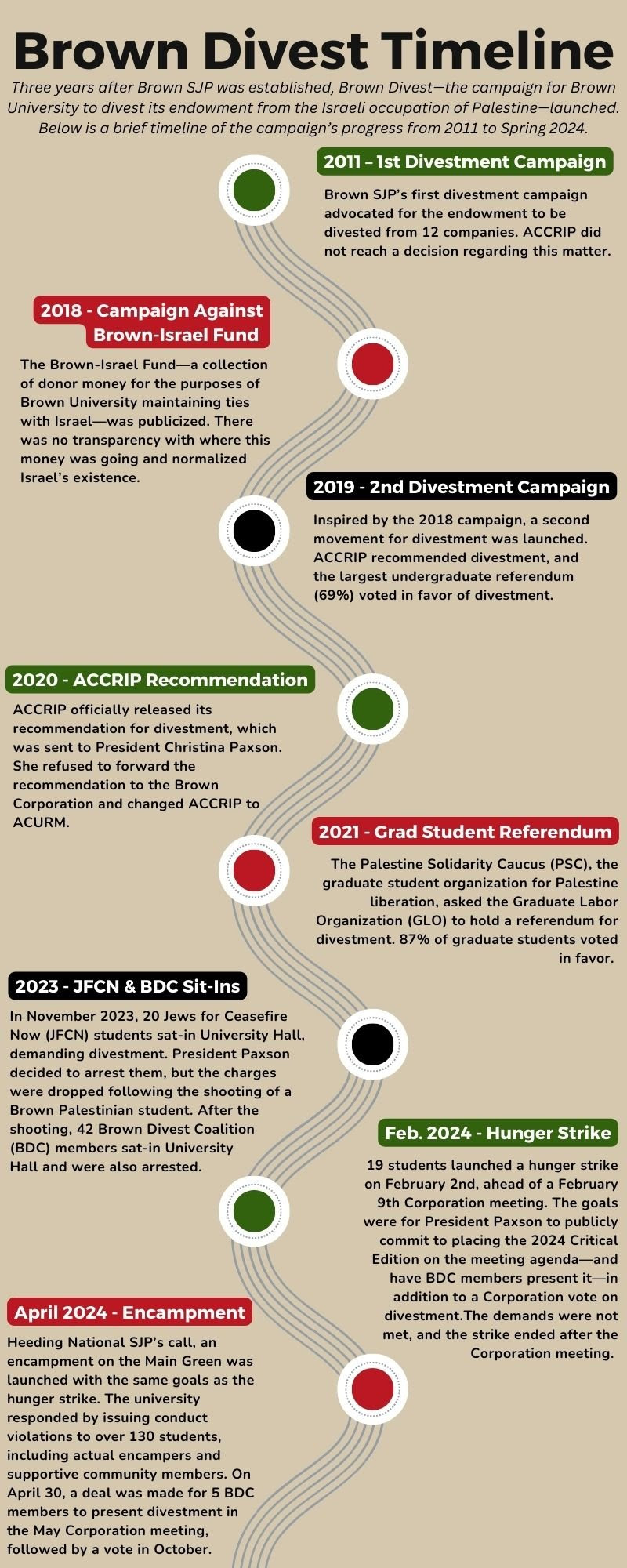
Questioning Zionism’s rights to exist at Brown University is hardly surprising. Brown Divest is a group running campaigns to compel Brown University to divest its endowment from the “Israeli occupation of Palestine.” It has been active since 2011.
Moreover, Brown has received money from the Palestinian Territories. This was revealed in a 2023 article by a local news outlet named GoLocalProv, operating in New England. It reviewed federal data on Brown University and found that Brown University received over $11 million of funding from the Palestinian territories, including money for the endowment of the professorship of Beshara Doumani, former President of the Palestinian Bir Zeit University. IAM reported before how Doumani recruited Prof. Ariella Azoulay, an anti-Israel activist and art specialist, to teach at Brown University’s Middle East Center.
Brown University Middle East Studies is a longtime host of anti-Israel activism. So much so that Willis J. Goldsmith, a former Brown University student, launched a blog four years ago titled “Middle East Studies at Brown,” which discusses “Developments on campus related to Middle East Studies.” In one of his latest posts, “Brown Heads Sink Deeper Into The Sand,” he discussed the anti-Zionist Conferences that Adi Ophir hosted.
The Middle East Center excels in the tactic of hiring anti-Israel Israeli activists such as Ariella Azoulay, Adi Ophir, and others. As IAM wrote before, the cadre of radical pro-Palestinain professors in Israel has been successful in parlaying their ideology for cushy jobs in American, British, and other universities. Using neo-Marxist critical jargon, they are rewriting history or imagining life without Zionism and Israel. These tactics have paid off, making Azoulay quite popular, even though her prose is quite convoluted, to say the least.
Last week, VIAD, a Research Centre at the University of Johannesburg, South Africa, hosted an online event, “RADICAL | OTHERS,” in collaboration with Verso Books. It curated a book launch for The Jewelers of the Ummah: A Potential History of the Jewish Muslim World, written by أريئيلا أزولاي Ariella Aïsha Azoulay. It aims to “bring Azoulay’s latest book into proximity with other anticolonial thinkers and artmakers.” According to VIAD, Azoulay “argues for the reclamation of indigenous worlds to re-make the world and unlearn imperialism.” VIAD adds that, in 2023, Azoulay received the Infinity Award for Critical Writing, Research and Theory.
In her new book Azoulay wrote, “In 1962 when I was born under the supremacy of the white Christian world, Jewish belonging and tradition could continue within the catastrophic project of the Zionist colony in Palestine, or among disconnected and blank individual citizens naturalized in other imperial countries. Claims to Jewish belonging within the Muslim world are still seen as an interference in the work of global imperial technologies tasked with accelerating their disappearance: most of North Africa was already emptied of its Jews, and the European imperial powers mandated the Zionists establish a nation-state for the ‘Jewish people’ in Palestine. That Jews had been part of the ummah since its very beginning, part of what shaped it and defined Muslims’ commitment to protect other groups, had to be forgotten by Jews and Muslims so that the Judeo-Christian tradition could emerge as reality rather than invention and be reflected in the global geographical imagination.”
These are the people the Middle East Center hires and these are the conferences they host.
IAM has repeatedly stated that there is no problem hosting controversial topics on campus as long as balanced views are also presented. Brown University repeatedly failed to do so.
REFERENCES
Cogut Institute’s Non-Zionist Jewish Traditions Conference receives backlash
The conference increased its security measures due to over 1,500 emails received in protest.
By Chiupong Huang and Hadley Carr
February 5, 2025 | 1:15am EST
This week, the Cogut Institute for the Humanities hosted a two-day academic conference discussing the prevalence of non-Zionist Jewish traditions throughout history.
The Non-Zionist Jewish Traditions Conference, held between Feb. 3 and 4, included a variety of panels and roundtables featuring 21 speakers and moderators from Brown, Princeton, Cornell and other universities. The conference aimed to address the evolving relationship that Zionism and the State of Israel have with different Orthodox communities and various ideological traditions.
Prior to the conference, the Cogut Institute received over 1,500 emails in protest of the event, according to conference organizers.
The main complaint voiced in the emails sent to the Cogut Institute was that the conference was “antisemitic, racist” and that it “erases Zionism from history,” said Visiting Professor of Humanities and Middle East Studies Adi Ophir, a conference organizer.
While the emails’ origins are unclear, some were sent by the Rhode Island Coalition for Israel, according to Ken Schneider, a RICI board member. RICI also protested outside of Andrews House on both days of the event.
Ophir noted that events hosted at Andrews House typically don’t feature any security. But in response to the emails, this event had a “heavy” security presence, Ophir said.
The email campaign prompted engagement from the University’s Office of Event Strategy and Management, the University’s Multi-Partial Team and the Department of Public Safety to ensure that the conference would “proceed smoothly,” Cogut Institute Director Amanda Anderson, a professor of English and humanities, wrote in an email to The Herald. The new security protocol included three DPS staff, two external security guards and one additional event staff.
On the first day of the conference, eight protestors from RICI stood outside the building. The second day saw three protestors, including Schneider. RICI members held up signs that read, “Anti-Zionism is Anti-Semitism,” “We stand with Israel” and “Free Hugs” while playing Jewish folk songs.
Schneider said that RICI “tried very hard” to get the conference canceled.
On Monday, DPS asked the protestors to move across the street because they were on “Brown’s property,” according to Schneider. On Tuesday, a DPS officer approached the protestors and asked them to lower the volume of their music.
But the protestors “didn’t bother us,” Ophir said. “They bothered other classes.”
“In a certain sense, the resistance is a sign that (the conference) is actually needed,” said Shaul Magid, a visiting professor at Harvard who was a member of the conference convening committee.
“A lot of people felt that we needed to convene and think of alternatives to the reality we live in,” Magid added.“There are non-Zionist traditions within the Jewish tradition that have somehow been marginalized, erased and it’s worth it to rethink again about what those are.”
The event was co-sponsored by the Department of History and the Department of Religious Studies and convened by Professor of Holocaust and Genocide Studies Omer Bartov, Professor of European History Professor Holly Case and Professor of Comparative Literature Peter Szendy, as well as Ophir and Magid.
Last February, Ophir attended a speaker event hosted by Jonathan Greenblatt, where some students walked out in protest. Ophir recalled that Greenblatt started his lecture by saying, “Anti-Zionism is antisemitism.” Ophir began planning the conference soon after.
The conference began with a panel held by Magid, Bartov and Sarah Hammerschlag, a religion and literature professor at the University of Chicago. Harry Merritt MA’14 PhD ’20, who spoke at a later panel, found the introduction “thought-provoking.”
“As a Brown alumnus, this interdisciplinary conference felt like an exemplary manifestation of the Cogut Center’s mission,” Merritt said. “The tendency by this conference’s detractors to conflate non-Zionism with anti-Zionism and anti-Zionism with antisemitism only points to the urgent need to define and analyze these terms theoretically and to contextualize them historically.”
Prior to the conference, Hammerschlag received an email which read, “Why do you hate Jews?” While many of Hammerschlag’s colleagues received similar emails, the majority of emails sent in protest were sent to the Cogut Institute.
The event was initially advertised to the public via Events@Brown and various on-campus email publications. The Cogut Institute did not advertise the event on social media.
But “word-of-mouth was far-reaching,” Anderson said. Spots filled up ten days before the event, shortly after the promotion began.
Jeremy Gold ’26 came to the event after hearing about the conference from friends.
“I’ve been thinking a lot about my relationship with Zionism and the State of Israel,” Gold said. He added that non-Zionist traditions in history are very “polarizing” and “hard to talk about.”
Eitan Zemel ’26, another attendee, said that his “main takeaway is that there are a lot more histories to learn, and there are so many different frameworks for understanding the political situation in the land as well as the history of divergent Jewish ideologies.”
David Litman, a conference attendee and a Senior Analyst for the Committee for Accuracy in Middle East Reporting and Analysis, thought the conference lacked Zionist representation. He continued that non-Zionist teachings are becoming increasingly popular in academia, a trend he says is not reflected in “mainstream Judaism.”
The events of the conference made two things “very clear,” Ophir concluded in his closing statement: “This conversation must continue and must expand.”

Hadley Carr
Hadley Carr is a university news editor at The Herald, covering academics & advising and student government.
===========================================================
https://www.golocalprov.com/news/brown-university-has-received-over-11-million-in-funding-from-palestinian-sEXCLUSIVE: Brown University Has Received Over $11M in Funding From Palestine
Wednesday, November 29, 2023
GoLocalProv News Team
Brown President Christina Paxon was reportedly booed at the vigil on Monday for Palestinian student Hisham Awartani who was shot over the weekend.
Brown University has received millions in funding from sources in “Palestinian Territories,” according to a review of federal data by GoLocal.
The United States Department of Education “requires institutions of higher education that receive Federal financial assistance to disclose semiannually to the U.S. Department of Education any gifts received from and contracts with a foreign source that, alone or combined, are valued at $250,000 or more in a calendar year.”
According to the “College Foreign Gift and Contract Report” — Brown University has received $11,692,251 from sources in “Palestinian Territories” over an indeterminate amount of time.
Federal records show that the biggest gifts include separate $2,000,000 donations — including one to “support an assistant professorship at the Watson Institute for International and Public Affairs, with preference for Security Studies.”
In addition, records show two entries from “Palestinian Territories” of $643,000 which state “the purpose of the Fund is to provide support for a Professorship in Palestinian Studies within Middle East Studies.”
The professor who those gifts supported is Beshara B Doumani, the Mahmoud Darwish Professor of Palestinian Studies at Brown. He also simultaneously has served as the President of Birzeit University from 2021 to 2023, located in the Palestinian West Bank territory. His Brown University bio does not mention his role heading the Palestinian University, but his Birzeit bio features his role at Brown.
When Doumani was named to the Presidency at Birzeit, the American conservation publication the American Spectator wrote, “Palestine’s ‘Terrorist University’ Picks Ivy League Prof as New President.”
The Birzeit University was raided in September of 2023, and eight students were arrested by Israeli Defense Forces for suspected ties to a terror plot.
The Times of Israel reported in September, “The students, from Birzeit University near Ramallah, were nabbed following an investigation into Hamas cells in Palestinian educational institutions, the Israel Defense Forces and Shin Bet said. They were allegedly recruited by Hamas operatives in Gaza, receiving weaponry intended for the attack.”
Doumani was the featured speaker at the Brown University vigil on Tuesday — an event closed to the press.
According to the federal database, Brown reported gifts and contracts from countries including England, Spain, Thailand, Jordan, Saudi Arabia, and more.
It did not report any donations from Israel to Brown.
Foreign Funding — and Campus Activities — in Focus
In total, Brown reported 484 entries for foreign gifts, restricted gifts, and contracts in the federal database.
The most recent dated entries were from June of 2023; the earliest dated entry was 2015.
There were dozens of entries with no dates, however, which included the twenty contributions from “Palestinian Territories.”
According to the entries, none of the funding was from the Palestinian government.
SLIDES: See Reported Funding From “Palestinian Territories” to Brown University BELOW
“What are Arab donors to universities buying for $10 billion?” wrote Mitchell Bard in the Jewish News Syndicate in June 2023.
“Out of more than 10,000 donations, only three were identified with a political purpose—two $643,000 contributions to Brown in 2020 from a giftor in ‘The State of Palestine’ to provide support for a professorship in Palestinian Studies within Middle East Studies and one for $67,969 for the same purpose from the UAE,” wrote Bard.
“The report did not identify the donors, but an official from Brown acknowledged the Palestinian contributor was the Munib and Angela Masri Foundation. Beshara Doumani, a supporter of the anti-Semitic BDS campaign, was named the first occupant of the position. Doumani has since also become the president of Birzeit University, which is known for the activism of students associated with terror groups such as Hamas and the Popular Front for the Liberation of Palestine (PFLP),” he continued.
Latest at Brown
At the November 8, 2023 rally at Brown, more than a hundred protesters turned out — and called the United States and Israel “complicit” in what they allege is genocide in Gaza. The groups have repeatedly called on the university to divest its endowment from Israel.
On Monday, Brown University blocked the press from attending a vigil for Palestinian-American student Hisham Awartani, who was shot along with two other Palestinian students in Vermont over the weekend.
“The vigil is intended as a space where our students, faculty and staff can have the comfort of community with hopes of encouraging healing. It’s considered a private University event for this reason,” said Brown. “Reporters are not permitted to film or conduct interviews on campus.”
Late Monday afternoon, Brown announced that it dropped charges against 20 Brown students arrested for trespassing on November 8.
“Dismissing the charges against the students certainly won’t heal the rising tensions on campus from the ongoing violence in the Middle East – or the hurt and fear from Islamophobia, antisemitism and acts of anti-Arab and anti-Palestinian violence – but perhaps it can help refocus attention on other issues that are important for the Brown community,” reported Brown.
“Section 117 of the Higher Education Act establishes the requirements for universities to disclose foreign gifts and contracts. We adhere to those requirements and submit our disclosures annually. All of that information is accessible publicly on the U.S. Department of Education website. If you look at the entries for Brown, you will see that we have no government funding related to Palestine. We do of course have alumni and donors all over the world, many of whom give Brown in support of our annual fund or other campaigns,” said Brown University Spokesperson Brian Clark in a statement to GoLocal. “
We have a detailed set of policies and practices in place to guide our work with donors, including written gift agreements that formalize all commitments made by both the donor and the university – in no case do we accept gifts that impinge on academic freedom or obligate Brown in any way to act counter to its values,” he added.
This was first published 11/28/23 12:00 PM
________________________________
Related Slideshow: Brown Funding From Palestinian Territories—U.S. Department of Education
The following information on contributions to Brown University was obtained from the “College Foreign Gift and Contract Report” at the U.S. Department of Education in November 2023.
Section 117 of the Higher Education Act of 1965 (HEA) requires institutions of higher education that receive Federal financial assistance to disclose semiannually to the U.S. Department of Education any gifts received from and contracts with a foreign source that, alone or combined, are valued at $250,000 or more in a calendar year. The statute also requires institutions to report information when owned or controlled by a foreign source.
The data reflects foreign gifts and contracts that institutions of higher education reported to the Department through its updated reporting portal, which became available for data entry on June 22, 2020. It therefore displays all foreign gifts and contracts reported between April 6, 2023, and October 13, 2023, no matter when the underlying transaction took place.
Additionally, in accordance with 20 U.S.C. 1011f(e), certain foreign gift and contract information reported to the Department constitute public records – all data, new and historic, is self-reported by institutions.
============================================================
Brown Heads Sink Deeper Into The Sand
Relentlessly Seeking the Nadir of Middle East “Studies”
FEB 07, 2025
(1) On February 5, the Brown Daily Herald (“BDH”) reported that Brown’s Cogut Institute for the Humanities’s (“Cogut”) February 3rd and 4th, 21-speaker “academic” conference drew “over 1500” emails complaining that the event was “antisemitic, racist” and that it “erases Zionism from history”. It was perfectly obvious from its published program, attached to my post of January 10, that the Cogut carnival was destined to be all of that and worse.
In covering this circus, the BDH spoke to Brown professor Adi Ophir. Ophir is arguably the leader of the lunatic fringe among Brown faculty when it comes to full-throated support for the martyrdom-seeking Islamic murderers, rapists, and hostage takers of Hamas who perpetrated the October 7, 2023 barbarism in Israel. (He is only “arguably” so because the number of competitors for that position on the Brown faculty is large, and the competition fierce.) Apparently traumatized by the prospect of protesters showing up at the Cogut show, Ophir, according to the BDH, noted that “events hosted at Andrews House typically don’t feature any security”. But, in his view, the Cogut undertaking necessitated a “heavy”security presence.
Cogut Director Amanda Anderson leapt into action. According to the BDH, “the email campaign prompted engagement from the University’s Office of Event Strategy and Management, the University’s Multi-Partial Team [whatever that is] and the Department of Public Safety to ensure that the conference would proceed smoothly”.
Apparently Anderson believed supporters of Israel would conduct themselves like the hundreds of Brown students and faculty who support the terrorists of Hamas. That adolescent crowd wasted countless student and university hours and irreparably torched the university’s reputation beginning on October 8, 2023. They spent months weeping, wailing and whining about divestment, blind to the factual absurdity of their position, and non-existent “Islamophobia” at Brown while taking over buildings and threatening and otherwise terrorizing Jewish students. Anderson must have anticipated a repeat of masked cowards showing up at Andrews House, but this time threatening and terrorizing Muslim students, shouting profanities, banging on cars and pitching tents to spend the night between the first and second half of what could be described as Cogut’s and Brown’s Center for Middle East Studies (“CMES”) anti-Zionist, anti-Semitic Super Bowl. What did happen by way of the much-feared protest by those who believe anti-Zionism is anti-Semitic as many scholars have so persuasively argued? According to the BDH:
“On the first day of the conference, eight protesters from RICI [“Rhode Island Coalition for Israel”] stood outside the building. The second day saw three protesters, including RICI [board member] Schneider. RICI members held up signs that read “anti-Zionism is Anti-Semitism,” “We stand with Israel” and “Free Hugs” while playing Jewish folk songs.”
The BDH article concluded by reporting that, to Ophir, “The events of the conference made two things ‘very clear’… This conversation must continue and must expand”. What kind of “conversation” is Ophir talking about? The Committee for Accuracy in Middle East Reporting and Analysis (“CAMERA”) reported that, in May, 2021, for example, Ophir:
“Engaged in antisemitic blood libel, Holocaust inversion, and accused Israel of being a “Jewish supremacist” state; glorifed the terrorist organization Hamas; “prayed” for the end of “Jewish supremacy” in Israel; and declared that the American Jewish community is “complicit” in the “colonization” of “Palestine.”. (“There are Jews, including Israeli Jews – how many only God knows – who pray with all their heart for the end of Jewish supremacy in Palestine. I’m speaking as one of them. The last few weeks in Palestine were especially devastating for these Jews. Despair, depression, anxiety, not because of the Hamas rockets – regardless of how frightening they are. Anxiety, because they have found themselves living in the midst of a Jewish mob thirsty for Palestinian blood. A Kristallnacht mob…”) (“Hamas is fighting for the residents of Jerusalem and those who pray in al-Aqsa.”) (“Only God knows how many Jews pray for the end of Jewish supremacy. But in in Palestine, there are certainly too few of them. For them, there is no possible win in sight. The colonization of Palestine, the process of destruction and extraction, go on relentlessly all over the land and the irreversible changes and irredeemable losses are fast and widespread. All this happens with the full support of the former, recent, and current American administration, and with the complicity of much of the American Jewish community. It is the latter that is most painful for a Jew who prays for the end of Jewish supremacy. It is for this reason that the Jewish part of my heart is broken, looking for a new book of lamentation to cry over not the fall of Jerusalem, but its rise to relentless, draconian powers and to wail the total perversion of its soul. We Jews who pray for the end of Jewish supremacy need these lamentations, not only to express our grief, but also to complete the process of parting from Zionism.”)”
It bears repeating that this unhinged, hair-on-fire rant took place two and 1/2 years before October 7, 2023. Ophir claimed to the BDH that he began planning the Cogut show after a February, 2024 appearance at Brown by Anti-Defamation League President Jonathan Greenblatt where Greenblatt said “Anti-Zionism is antisemitism”. Maybe that sequence is true. Odds are, though, that it is not. After all, there can be no doubt that Ophir has been playing the anti-Zionist game for a very, very long time as the CAMERA website and other sites make perfectly clear.
Ophir was of course an active participant in the Cogut show. His speaking topic was “Jewish Anti-Zionism: Reflection on its Context, Meaning and Political Imagination”. Ophir plainly is incapable of rational reflection. But equally plainly his capacity for blinkered, anti-intellectual, illiberal political imagination knows no bounds.
Another performance artist who participated in Cogut’s faux academic exercise was Brown professor Ariella Azoulay. Azoulay first came to public prominence, and well-deserved derision, following her appearance at Cornell in 2020. There she showed photos of the founders of the Jewish state of Israel, but with their faces blacked out. Her explanation? “I can’t bear to look at them.” If she had said anything in my sixth grade social studies class as childish as what she said at Cornell, my teacher would have made her stand in the corner. Azoulay is pawned off as an “educator” at Brown. But neither she nor Ophir is an educator; both are, however, propagandists and embarrassments to the university.
The February 5 BDH article noted that David Litman of CAMERA “thought that conference lacked Zionist representation. He continued that non-Zionist teachings are becoming increasingly popular in academia, a trend he says is not reflected in mainstream Judaism”. Litman is, of course, correct.
At Brown, the Zionist perspective is occasionally presented, but almost always when Brown is pressured to do so, and never on a panel or program with Ophir or Azoulay or any of their ilk. Ophir, Azoulay and the other anti-Semitic “anti-Zionists” are free to ramble on without regard to facts, law, judgment or common sense. But to let them get away with it without ever being challenged is shameful, especially by a university that was once a respected and proud liberal institution.
In a January, 2020 article in The Algemeiner, republished by Campus Watch, Tehilla Katz commented on Azoulay’s pathetically juvenile Cornell comments. Katz concisely and perfectly summarized the problem at that conference, and at Brown now for many years: “Their fear of engaging in dialogue and refusal to hear another side is the antithesis of academia, and a clear example of censorship.” Nothing could be more obvious. But nobody at Brown has the backbone, or is principled enough, to recognize and state the obvious. This includes, sadly, nobody in Brown’s Judaic Studies Department.
(Notably, Azoulay’s Wikipedia entry lists her “partner” as Adi Ophir. All couples argue from time to time. One can imagine Ophir and Azoulay arguing over which of the two hates Jews and Israel – or perhaps themselves – more. Maybe someone will write a comedy script for Netflix based on these two. But what is not at all funny is that some combination of tuition dollars, financial support from Brown graduates and others and U.S. taxpayers are funding this dynamic duo as well as Cogut and CMES. That is unconscionable.)
Given the foregoing, and what follows, it bears noting that on January 29, the President signed an Executive Order that states, in part:
“It shall be the policy of the United States to combat anti-Semitism vigorously, using all available and appropriate legal tools, to prosecute, remove, or otherwise hold to account the perpetrators of unlawful anti-Semitic harassment and violence.”
Ophir, Azoulay, Cogut, CMES and Brown would be well advised to give careful thought to the meaning, and potential application, of those words before, e.g., caving to Ophir’s desire to continue and expand the “conversation” of February 3rd and 4th or otherwise following the path laid out by Brown professor Beshara Doumani. See, e.g., Anti-Israel Extremism and Corrupt Scholarship at Brown University: How Middle East and Palestinian Studies Fuel Antisemitism (CAMERA, December, 2023). Reflexively trotting out old chestnuts misrepresenting the meaning of academic freedom in defense, as most certainly will be the case if Brown ever acknowledges the CAMERA reports, won’t wash.
Relatedly, the BDH reported on February 6 that on February 3, “the U.S. Department of Health and Human Services Office for Civil Rights notified the University that they will be investigating the Warren Alpert Medical School for alleged antisemitic incidents that occurred during its May 2024 commencement ceremony.” Brown spokesperson Brian Clark trotted out the university’s oft-used, tired boilerplate response, including nonsensically implying an equivalence, and an equivalent concern, over both antisemitism and Islamophobia at Brown. It is an article of faith at Brown that anti-Semitism cannot be mentioned without taking a knee to moan about imagined Islamophobia on campus. Actual facts? Irrelevant.
And on February 7, the BDH reported that Brown professor of Africana and American Studies Matthew Guterl was named to head the university’s Office of Diversity and Inclusion, formerly Brown’s Office of Institutional Equity and Diversity. According to Brown President Paxson, the newly titled department will “focus on sustaining a thriving, diverse community where all community members feel welcome”. Guterl is a great choice to head a department whose continued existence is questionable. Brown’s Jewish students, and all in the Brown community who support Israel and do not support Hamas, will surely “feel welcome” and take comfort from the fact that on or about November 2, 2023 – less than a month after October 7 – Guterl signed a petition demanding a ceasefire in the Hamas-initiated war against Israel. The first sentence of that petition read “We, the undersigned faculty at Brown University, are deeply aggrieved by the catastrophic events unfolding in Israel and Palestine, especially but not limited to Gaza.” The rest of the petition is empty political grandstanding without regard to actual facts, much less rational analysis.
At some point heads will have to come out of the sand at Brown. That said, there is no evidence that that will soon take place.
(2) On January 8, 2025, CAMERA published its fourth report on Brown: “Ivy League Propaganda: How Brown University Radicalized Students After October 7”. This lengthy, heavily footnoted document was a follow up to two of its previous and equally lengthy and heavily documented reports published in December, 2023 – “Anti-Israel Extremism and Corrupt Scholarship at Brown University: How Middle East and Palestinian Studies Fuel Antisemitism” and “Brown University’s Choices Curriculum: Platform for Anti-Zionist Narrative”. The latter described the Brown History Department’s effort to indoctrinate K-12 students in anti-Zionist, anti-Semitic bias. On January 25, 2024, CAMERA published “Brown University’s Middle East Studies Faculty: Profiles in Extremist Anti-Israel Bias”. All can be found by searching Brown University on the CAMERA website: camera.org. Brown’s response? None. Moreover, not once has any of the intrepid “journalists” of the BDH dared mention the CAMERA studies.
(3) Given the cavalier, but demonstrably incorrect and dangerous usage by Brown faculty and students of terms like “genocide” and “apartheid”, last May I wrote Brown professor Wendy Schiller, interim director of Brown’s Watson Institute, suggesting that Watson/CMES sponsor Eli Rosenbaum as an outside speaker. I wrote Schiller again on January 22, this time asking that Samuel Estreicher be invited as a Watson/CMES-sponsored speaker.
Rosenbaum, a graduate of the University of Pennsylvania (B.S. and MBA) and Harvard Law School, devoted 40 years to the investigation and prosecution of Nazi and other war criminals and human rights violators on behalf of the U.S. government. He led the U.S. Department of Justice’s Office of Special Investigations from 1995-2010. He ultimately was named Director of Human Rights Enforcement Strategy and Policy at the Justice Department; in June of 2022 he was appointed by then Attorney General Garland to serve as Counselor for War Crimes Accountability and to investigate possible war crimes committed by the Russians in Ukraine. He has written and spoken extensively on the laws of war including as to why, as a matter of fact and law, Israel has not committed genocide in Gaza.
Estreicher is the Dwight D. Opperman Professor of Law at the New York University School of Law. He received his undergraduate degree from Columbia, a masters degree from Cornell and his law degree from Columbia Law School where he was Editor-In-Chief of the Columbia Law Review. He served as a Law Clerk to Judge Leventhal of the U.S. Court of Appeals in Washington, D.C. (1975-76) and to Justice Lewis F. Powell, Jr. of the Supreme Court of the United States (1977-78). He, like Rosenbaum, has written and spoken extensively on the laws of war and genocide – including as to why Israel is not committing genocide in response to Hamas’s terrorism – and the jurisdiction and rulings of the International Court of Justice.
Brown has no problem importing Hamas acolytes from Birzeit University in Israel’s West Bank, aka “Terrorist U”, not just to speak at Brown but, incredibly enough, to “teach” at the university and opine about “genocide”. Brown also has no problem with well-known anti-Semites like U.N. hack Francesca Albanese, condemned as such by the U.S., Germany and France, speaking at Brown to offer, unchallenged, her hopelessly biased views on how Israel has responded to Hamas’ barbarism. But has either Rosenbaum or Estreicher yet been invited to speak at Brown? Of course not. Why would Brown invite speakers who actually know something about, e.g., genocide and apartheid, when students can be fed pro-Hamas/Palestinian propaganda by Brown faculty and outside speakers who haven’t the remotest idea what they’re talking about?
At what point will the Brown administration and the Brown Corporation take their collective heads out of the sand? When will they recognize that, for example, propagandizing is not education and that enabling anti-Semitism masquerading as anti-Zionism are completely contrary to what a liberal education is supposed to be?
Willis J. Goldsmith, Brown Class of 1969
=============================================================
radical_others_
REMINDER: BOOK LAUNCH
Friday, 31 January
11h00 EST, 18h00 SAST
Online, via Zoom
🔗 RSVP to link in bio
VIAD’s RADICAL | OTHERS in collaboration with Verso Books, curate a global, online book launch to bring Azoulay’s latest book into proximity with other anticolonial thinkers and artmakers. “The Jewelers of the Ummah: A Potential History of the Jewish Muslim World” by أريئيلا أزولاي Ariella Aïsha Azoulay argues for the reclamation of indigenous worlds to re-make the world and unlearn imperialism.
In 2023, Ariella Aïsha Azoulay received the Infinity Award for Critical Writing, Research and Theory. The International Center of Photography’s Infinity Awards honour outstanding achievements in photography and visual arts to recognize artists working in photojournalism, contemporary photography, new media, and critical writing, research and theory.
📸: This film is by MediaStorm and the video is courtesy of the International Center of Photography.
===================================================================
To be an Algerian Jew is to revolt
Ariella Aïsha Azoulay examines the disruption of Jewish Muslim life across North Africa and the Middle East by two colonial projects: French rule in the Maghreb and the Zionist colonization of Palestine.
Ariella Aïsha Azoulay30 September 2024
In her latest work, Ariella Aïsha Azoulay pens open letters to her ancestors — her father, mother, and great-grandmothers, and to her elected kin — Hannah Arendt, Frantz Fanon, Houria Bouteldja, and others. In these letters, she reintroduces Muslim Jews to the violence of colonization and traces anticolonial pathways to rebuild the rich world of the jewelers of the ummah.
In 1962 when I was born under the supremacy of the white Christian world, Jewish belonging and tradition could continue within the catastrophic project of the Zionist colony in Palestine, or among disconnected and blank individual citizens naturalized in other imperial countries. Claims to Jewish belonging within the Muslim world are still seen as an interference in the work of global imperial technologies tasked with accelerating their disappearance: most of North Africa was already emptied of its Jews, and the European imperial powers mandated the Zionists establish a nation-state for the “Jewish people” in Palestine.
That Jews had been part of the ummah since its very beginning, part of what shaped it and defined Muslims’ commitment to protect other groups, had to be forgotten by Jews and Muslims so that the Judeo-Christian tradition could emerge as reality rather than invention and be reflected in the global geographical imagination. Despite the dramatic change, this is never called a “crusade,” but it sought to make Jews foreign to Africa, transfer them elsewhere to serve Western interests, and make them Zionists by fiat.
Objections to this crusade incurred a high risk, for it was (and is) in the interests of those in power to keep the Jews away from the liberatory idea that Muslims and Arabs were never their enemies. To ensure that this idea would stay suppressed, the involvement of non-Jewish European Zionists in devising plans to colonize Palestine with Jews from Europe and to empty Europe of its Jews, including through collaboration with Nazi actors during the war, had to be diminished and construed as a Jewish liberation project.
In this way, the Zionists were tasked by Euro-American powers with conscripting Jews from across the globe as settlers. Jews were trained in the European school of racialized nationalism to become operators of imperialist, colonial, and capitalist technologies—though some were disguised at the time as socialists. Despite the fact that the tiny Zionist movement was unappealing to most Jews worldwide, at the end of WWII the Euro-American new world order included the accelerated colonization of Palestine as yet another “solution” for the Jews. The French colonization of Algeria facilitated the forced inclusion of those Jews from the Jewish Muslim world in re-birthing the Jewish people in Palestine as European colonizers.
The settler-colonial grammar that deracinated Jews from Muslim countries had to adopt was given to me as my “mother tongue.” For years, it forced me to say that though my ancestors were Algerians, I was not. For how could one belong to a world made nonexistent?
To be an Algerian Jew is to revolt. In 1962, with the forced departure of Jews from Algeria, the existence of a Jewish Muslim world turned into history, the stable past that can never re-emerge. To be an Algerian Jew is to resist this idea of history, to rebel against the settler identity that was assigned to me in the Zionist colony where I was born, and to open a door into the precolonial worlds where such identities can be possible again.
To be an Algerian Jew is to reclaim an ancestral world, to free ourselves from the “progress” imperialism forced upon us and from the new identities imperial nation-states imposed in every domain of our life. However, the refusal extends further. To be an Algerian Jew is to repair. It is to refuse to inhabit the “Jewish” identity invented by the secular imperial state, an identity bereft of the rich heritage of nonimperial world building of which it had been a part. To be an Algerian Jew is to inhabit Jewish Muslim conviviality. It is also a commitment to imagining that conviviality’s repair and renewal on a global scale.
To be an Algerian Jew is to acknowledge that I have been inhibited for more than fifty years from saying the obvious: that I’m not a child of empire but the descendent of a world that empire aims to destroy.
The force of this question. “Who am I?”—entangled with “who are we?”—surprised me when it presented itself to me more than a decade ago. It felt as if the weight of an entire world were at stake in the answer. The question imposed itself just after the death of my father, which coincided with my departure from the Zionist colony in Palestine and with my arrival into a Christian world, one where I felt more Jewish than ever.
I felt more Jewish than ever, I came to realize, because I had parted from the “Israeli” identity assigned to me at birth, and once I shed my national (Israeli) identity, I felt myself at once a “Jew” and robbed of being a Jew, a Muslim Jew, whose ancestors had once been part of the ummah. The national identity, I saw, had destroyed and subsumed diverse kinds of Jewish life.
Moreover, in the Euro-American world in which I now live, Jews are understood to have come from Europe, and their history is understood as a European one. I am often marked as a European Jew or Ashkenazi Jew, regardless of the fact that my ancestors are Arab Jews, Berber Jews, Muslim Jews. Simple statements like “I am an Arab Jew” or “I am a Muslim Jew” require long explanations because the concept of a Muslim Jew disturbs the fiction of Jewishness as a primarily European identity. The fiction of Jewishness also obscures the fact that asking diverse Jews to become simply “Jewish” was part of the European “solution” to the “Jewish problem” Europe had created on the continent and in its colonies.
Refusing this fiction is an unpopular thing to do, I have found. I looked for others who were refusing this fiction, so that we might refuse together. Reading the work of Katya Gibel Azoulay, Samira Negrouche, or Hosni Kitouni triggered letters from me about our shared investment in the realities of diverse Jews, those Jews whose experiences and worlds are eclipsed by the fictive construction of a cohesive Jewish people. This fictive border had also separated Muslims and Blacks from Jews.
Don’t dare to tell us
we cannot talk like this!
No, don’t dare!
You silenced our ancestors
until you pressed them to leave
a world in which
we could not be born.
Don’t dare to tell us
“it was their choice,”
as if
they had wanted to ruin the world
their ancestors shared
with Muslims.
Don’t dare to tell us
that their wish was
to see beloved Palestine
ruined.
We will not let you bury us
alive
in your museums,
where our ancestors’ worlds,
which should have been ours,
are piled up in your acclimatized halls
dedicated to extinct species:
Afghan Jews,
Algerian Jews,
Egyptian Jews,
Iranian Jews,
Iraqi Jews,
Tunisian Jews,
Yemeni Jews.
=================================================================================================
=================================================
Non-Zionist Jewish Traditions
February 3 – 4, 2025
Andrews House 110, 13 Brown St.
This academic conference sets into question contemporary conflations of Judaism and Zionism by exploring a rainbow of non-Zionist Jewish traditions throughout history and across different regions. Speakers at the conference will address the changing relation to Zionism and the State of Israel in various Orthodox communities, in socialist and communist Jewish traditions, in the U.S. and Europe, among Ottoman and Arab Jews critical of the Zionist idea before 1948, among those who refused to immigrate to Israel or who lived there as dissidents, and among disillusioned Zionists in Israel and abroad. Together they will give an account of the spectrum of non-Zionist forms of Jewish thinking, activism, and organizing in their historical, ideological, theological, and theoretical contexts.
Free and open to the public, but registration is required. Registration for this event is now closed. The event is full to capacity.
For questions or to request special services, accommodations, or assistance, please contact humanities-institute@brown.edu or (401) 863-6070.
The event is cosponsored by the Cogut Institute for the Humanities, the Departments of History and Religious Studies, and the Center for Middle East Studies. It is convened by Omer Bartov, Holly Case, Shaul Magid, Adi M. Ophir, and Peter Szendy.
Speakers and Moderators
- Ariella Aïsha Azoulay (Brown University)
- Aslı Ü. Bâli (Yale Law School)
- Omer Bartov (Brown University)
- Orit Bashkin (University of Chicago)
- Daniel Boyarin (University of California, Berkeley)
- Jonathan Boyarin (Cornell University)
- Michelle Campos (Penn State University)
- Holly Case (Brown University)
- Mari Cohen (Jewish Currents)
- Beshara Doumani (Brown University)
- Sarah Hammerschlag (University of Chicago)
- Jonathan Judaken (Washington University, St. Louis)
- Geoffrey Levin (Emory University)
- Shaul Magid (Harvard Divinity School)
- Harry Merritt (University of Vermont)
- David Myers (University of California, Los Angeles)
- Adi M. Ophir (Brown University)
- Maru Pabón (Brown University)
- Michael Steinberg (Brown University)
- Peter Szendy (Brown University)
- Max Weiss (Princeton University)
Schedule
Monday, February 3
8:30 am – 9:00 amOpening Remarks9:00 am – 10:50 am
Panel: In Europe
- Shaul Magid, “Zionism as Assimilation: Aaron Shmuel Tamares on the Hypnosis of Nationalism”
- Omer Bartov, “Yankel, Victor, and Manfred: Antisemitism and Zionism Before the Holocaust — Lived Reality and the Literary Imagination”
- Sarah Hammerschlag, “The Post-war Irremissibility of Being Jewish: Non-Zionist possibilities beyond Diasporism”
- Moderator: Adi M. Ophir
10:50 am – 11:10 amBreak11:10 am – 1:00 pm
Panel: Non-Zionists, Old and New
- Harry Merritt, “Jewish Sons of Latvia: Latvian Jews and Non-Zionist National Identity in War and Peace”
- Geoffrey Levin, “American Jewish Non-Zionism: A History — and a Future?”
- Jonathan Boyarin, “The Making of a Non-Zionist”
- Moderator: Omer Bartov
2:30 pm – 4:20 pm
Panel: In the Wake of the Ottoman World
- Michelle Campos, “Anti-Zionism in an Ottoman Turkish Key: David Fresko between Empire and Republic.”
- Orit Bashkin, “Zionism, Arabism, and MENA Jews, 1846–1956”
- Ariella Aïsha Azoulay, “Ima, Why Didn’t You Love Me in Ladino?”
- Moderator: Max Weiss
4:20 pm – 4:40 pmBreak4:40 pm – 6:30 pm
Roundtable: On Recently Published Books
- Shaul Magid on Jonathan Judaken’s Critical Theories on Anti-Semitism
- Daniel Boyarin on Shaul Magid’s The Necessity of Fate
- Jonathan Judaken on Daniel Boyarin’s The No-State Solution
- Moderator: Peter Szendy
Tuesday, February 4
8:45 am – 10:35 am
Panel: On and Over the Margins
- Michael Steinberg, “The Confederative Imagination”
- David Myers, “A Taxonomy of Jewish Anti-Zionisms: From the ‘Lost Atlantis’ to the New Jerusalem”
- Jonathan Judaken, “Judith Butler, Hannah Arendt, and the Tradition of the Conscious Pariah”
- Moderator: Maru Pabón
10:55 am – 12:10 pm
Panel: Disillusioned Zionists
- Daniel Boyarin, “Eretz-Yisroel [Is] Wherever You Are: Zionism Against the Jews”
- Adi M. Ophir, “Jewish Anti-Zionism: Reflection on Its Context, Meaning, and Political Imagination”
- Moderator: Holly Case
1:30 pm – 3:45 pm
Roundtable: Anti-Zionism, Anti-Semitism, and the Stakes of the Debate
- Aslı Ü. Bâli
- Omer Bartov
- Mari Cohen
- Beshara Doumani
- Moderator: Shaul Magid

 israel-academia-monitor.com