17.09.25
Editorial Note
Recently, IAM posted two reports on the German Law Blog, Völkerrechtsblog. One (March 19, 2025) was titled “Pro-Palestinians Take Over German Academic Blog of International Law,” and the second (August 12, 2025) was titled “German Academic Blog of International Law Promotes Iranian Regime’s Interests.”
The first report discussed a symposium that Völkerrechtsblog promoted on academic freedom and “its erosion amidst the heightened climate of restrictions and constraints imposed upon Palestinian advocacy, a situation that has become increasingly evident in the wake of developments having occurred across the globe since 7 October 2023.” Völkerrechtsblog published a call for contributors (CfC) to the symposium.
The German Law blog has published a rebuttal to the IAM claims.
According to Völkerrechtsblog, IAM presents itself as supporting “the universal tradition of academic freedom that is an indispensable characteristic of higher education in Israel,” and that IAM is also “concerned by the activities of a small group of academics – sometimes described as revisionist historians or post-Zionists, among other labels – who go beyond the ‘Free search for truth and its free exposition… that is the hallmark of academic freedom”. Völkerrechtsblog also noted that for IAM, the revisionist historians and post-Zionists are “[e]xploiting the prestige (and security) of their positions, such individuals often propound unsubstantiated and, frequently, demonstrably false arguments that defame Israel and call into question its right to existence.”
Völkerrechtsblog found in IAM’s work, “threefold betrayal of their proclaimed mission.” The first IAM betrayal is where IAM provided “academic profiling,” which is a “brief mug-shot-like introduction” of the three promoters of the symposium, as well as a “vaguely articulated and unsubstantiated criticism of the quality of our scholarship.”
Völkerrechtsblog argued that IAM inferred from a single CfC that there is a “take-over.” To prove a point of variety, Völkerrechtsblog brought up three other topics it discussed.
Völkerrechtsblog argued that upon noting who the people behind the Völkerrechtsblog symposium are, and upon emphasizing Khaled El Mahmoud’s Palestinian origin, IAM further marked as worth noting that “the organizers adopted the critical, neo-Marxist paradigm” and recalled that IAM “often discusses the critical, neo-Marxist scholarship …, lack[ing]… academic rigor,” without raising any specific points of criticism about the CfC.
For Völkerrechtsblog, IAM “Delegitimised academics as biased” due to their “Palestinian origin,” or “as lacking academic rigor,” due to their “engagement with critical perspectives clearly exhibits a complete lack of understanding for academic work.”
Völkerrechtsblog argued that the “insinuation” here is that Palestinians are not supposed to speak since they are “presumed to be disqualified” by “emotional involvement,” which “operates precisely through membership in the socially constructed category” of Palestinians, and like other racialized identities, it is “produced externally through processes of domination.” Therefore, “Palestinian scholars are racialized” as “biased”, “irrational”, or “too emotional” through the very “practices that silence and delegitimize their voices in academic and political discourse.”
For Völkerrechtsblog, such a gesture is “emblematic of what Gayatri Chakravorty Spivak has termed epistemic violence: the silencing of marginalized voices by construing their knowledge as illegitimate or irrational. It simultaneously delegitimizes the speaker and discredits the very possibility of Palestinian scholarly authority.”
Völkerrechtsblog borrowed Miranda Fricker’s terms, that this “constitutes a form of testimonial injustice, where credibility is unjustly withheld because of who the speaker is rather than the substance of what is said. The effect is to erase the line between lived experience and intellectual contribution, treating the former as a contaminant rather than, as scholars like Linda Tuhiwai Smith have argued, a vital resource for critical inquiry and decolonial knowledge production.”
Völkerrechtsblog added that “Such an approach undermines the very premise of academic engagement, which – far from demanding agreement – depends on rigorous confrontation with different premises, arguments, and conclusions in order to test and refine one’s own thinking.”
Völkerrechtsblog concluded that “IAM’s response to our CfC did not even attempt substantive critique or engagement according to academic standards. Instead, it relied on unsubstantiated assertions and ad hominem insinuations, functioning less as scholarly commentary than as a deliberate strategy of delegitimization. This raises the question of what truly puts the ‘A’ in IAM? It is surely not the monitoring of academic work, but the monitoring and targeting of academics.”
Völkerrechtsblog criticized IAM’s statement that “since October 7, 2023, Palestinian academics have been emboldened to criticize the Western democracies in which they reside,” while IAM is “disregarding the continuous work of Palestinian and non-Palestinian academics criticizing Israel’s wrongful acts in the region throughout the past decades.”
Furthermore, Völkerrechtsblog lamented that IAM provided a link to the names of the Völkerrechtsblog’s partners and sponsors.
When IAM ended its post by stating “IAM has repeatedly pointed out that the academy is the main platform for disseminating the Palestinian narrative on the global stage and bashing Israel,” and warned that “[t]he German sponsors and partners of Völkerrechtsblog should be vigilant,” for Völkerrechtsblog, “The target was clear;” an “attack” to “restrict our freedom as a predominantly volunteer project by questioning if supporting us was legitimate at all… offering a convenient tool to those who disagree with our positions and see silencing as easier than engaging in debate.”
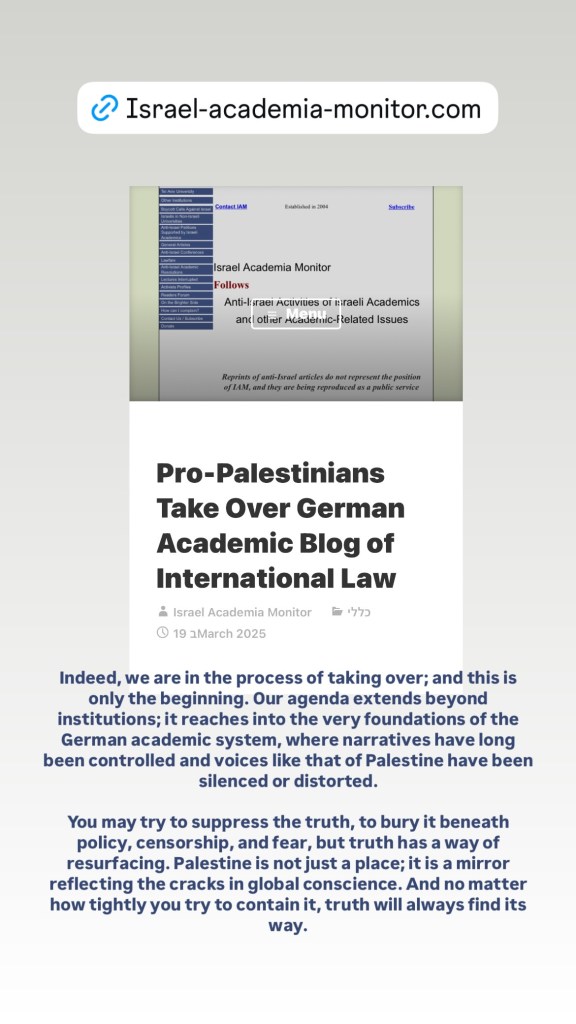
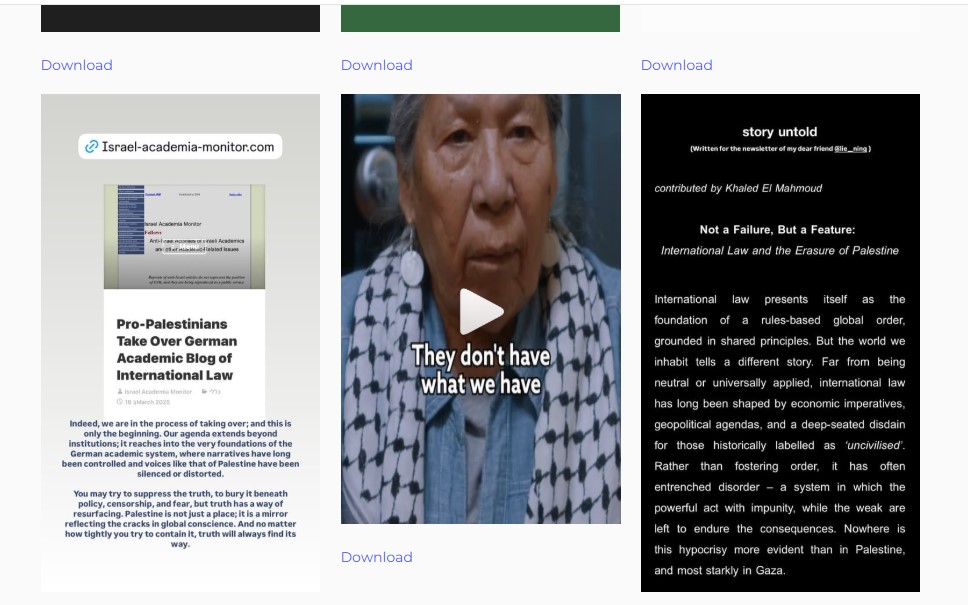
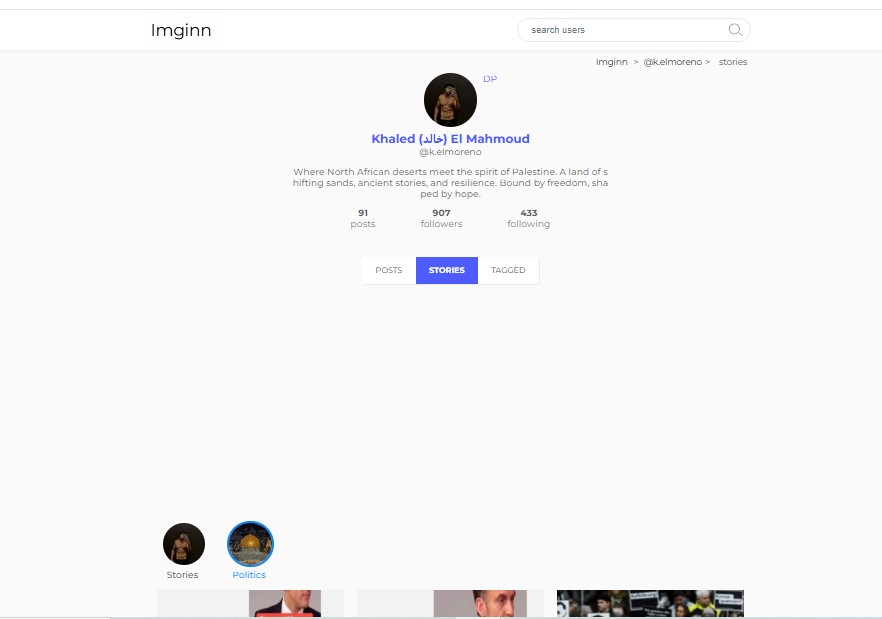
However, in a personal blog, under the sub-heading of Politics, Khaled El Mahmoud referred to the IAM post and stated clearly: “Indeed, we are in the process of taking over; and this is only the beginning. Our agenda extends beyond institutions; it reaches into the very foundations of the German academic system, where narratives have long been controlled and voices like that of Palestine have been silenced or distorted.”
Furthermore, when Völkerrechtsblog discussed academic engagement, as “far from demanding agreement – depends on rigorous confrontation with different premises, arguments, and conclusions in order to test and refine one’s own thinking.” It is precisely what IAM has criticized Völkerrechtsblog for: The one-sided anti-Israel bias. Missing totally from the discussion is a presentation of the Israeli perspective, which is how it is fighting a murderous organization that has controlled the Gaza Strip for two decades, effectively turning inhabitants into human shields. As IAM pointed out, the terrorist group turned the hospitals, mosques, and schools into a network of army bases full of weaponry connected by an elaborate 500 km tunnel system. What is more, Hamas robbed the public coffers of vast sums of money to pay for its military infrastructure. A legal blog like Völkerrechtsblog should have been aware of the Geneva Conventions that forbid turning civilians into human shields.
As part of the symposium, Völkerrechtsblog published an article by Dr. Itamar Mann, Professor of Law (on leave) at the University of Haifa, titled “Who Gets to Speak in the Israeli University?” (September 13, 2025). Mann stated, “Universities often claim to be bastions of free inquiry, including in research and in the classroom. But in Israel today, that claim rings increasingly hollow,” tracking the “lines of Jewish supremacy, protecting some while punishing others.” For Mann, “Since October 2023, campuses have reproduced the state’s broader regime of silencing.” He calls it “speech apartheid” and “apartheid of knowledge.” In Mann’s view, for Palestinian students, the “costs of criticizing the state have in the last two years become significantly more immediate and severe… I have been preoccupied with the question of whether and how universities such as my own can preserve spaces of equality. Equality in the classroom is not only a fundamental moral and political principle the university must uphold. It is also an epistemic precondition for higher learning.”
Mann discussed a 2024 report published by “Academia for Equality” titled “Silencing in Academia Since the Start of the War,” exposing the “scale of persecution directed at Palestinian students, citizens of Israel who have been silenced between October 2023 and June 2024. Expressions of dissent, or even basic empathy for the Palestinians in Gaza have been swiftly and unfairly punished.” He added that “faculty should not accept that solidarity with Palestinian students by definition threatens Jewish peers.”
Mann stated that in “Israeli universities, and elsewhere, we must remember that the measure of academic freedom is not comfort but the possibility of intellectual confrontation. If the university cannot sustain both sharp criticism and mutual respect, it is not only complicit in the hierarchies that silence those who most need to be heard. It can no longer be a place in which knowledge is produced.” Mann also disclosed he recently served as a legal advisor to the NGO Physicians for Human Rights Israel (PHRI) and helped to write the report “Health Analysis of the Gaza Genocide.”
He ended by stating, “This post may seem like it tries to serve a portion of naïve liberalism at a time when liberalism seems to be collapsing globally, let alone in Israel.”
He then thanked Prof. Orna Ben-Naftali, and others for helpful comments. To recall, Ben-Naftali influenced Judge Goldstone in his 2009 Goldstone Report; he later retracted his accusations against Israel.
Israeli academics are working hand in hand with Palestinians and pro-Palestinians in their war against Israel. Mann’s “naive liberalism” provides a glimpse into the decades-long expansive form of academic freedom in Israel.
Indeed, in 2013, IAM commissioned research titled “Academic Freedom in Israel: A Comparative Perspective.” The study examined the rise of the critical, neo-Marxist scholarship in Israeli universities, exploring its substantial following in the humanities and social sciences. Known as post-Zionism, it asserts that Zionism is a colonial-imperialist movement and that its progeny, the State of Israel, is a colonial-apartheid country. In addition, Israel is presented as a Nazi-like state, and the Israel Defense Force (IDF) is accused of Nazi-like behavior. Courses offered by self-described post-Zionist faculty have been heavily weighted toward this critical, neo-Marxist paradigm, with little or no effort expended to provide any different perspective. Combining academic research and political work, post-Zionist academics have engaged in a robust attempt to compel Israel to withdraw from the territories. Even some Israeli scholars have adopted the trend and acquired a leadership role in the Boycott, Divestment and Sanctions (BDS) movement and launched international petition drives condemning the IDF for war crimes.
The study found that government and university authorities have been slow to respond to this threat, due to the prevalent notion that academic freedom protects faculty speech and action, both intramurally and extramurally. Radical scholars and their liberal defenders have warned that imposing any limits would injure Israel’s standing in the academic world and place it at odds with standards of academic freedom practiced in other democratic countries.
The report concluded that Israeli universities—compared to those in Germany, Great Britain, and public universities in the United States—enjoy a high level of institutional autonomy and their faculties benefit from an exceptionally broad definition of individual freedom.
Mann and his peers have profited from the reticence of the academic authorities to take steps to bring the academic freedoms in Israel in line with what is customary in the West. As a result, liberal arts are a bastion of left-wing activist scholars who also legitimize the likes of Völkerrechtsblog and a variety of similar anti-Israeli and anti-Jewish platforms.
IAM has repeatedly pointed out that this has become a troubling pattern in certain academic and intellectual circles: the deliberate use of Israeli scholars as a figleaf to legitimize platforms that are openly hostile to Jews and Israel. By inviting or showcasing these scholars, such circles attempt to neutralize criticism of their own prejudice while advancing an agenda rooted in exclusion and bias.
This practice does not represent genuine intellectual engagement. Rather, it instrumentalizes individuals—casting them as “useful idiots”—to provide cover for rhetoric and projects that are deeply antagonistic to Jewish life and to the State of Israel. True scholarship demands honesty, independence, and integrity. Exploiting Israeli academics in order to launder antisemitic or anti-Israeli discourse is a betrayal of academic values and a manipulation of those who participate, knowingly or not, in this charade.
REFERENCES:
Isn’t it Ironic?
On Strategies of Silencing a Symposium against Silencing
11.09.2025
When a group of (early-career) scholars decides to organize a symposium on the alarming global restrictions of academic freedom – set against the backdrop of the “unfolding Genocide“ in Gaza and the egregious violations of core international law norms against the Palestinian people – it would surely be naïve to expect no backlash. After all, in our Call for Contributions(hereinafter “CfC”), we outlined a series of measures aiming to silence critical (academic) voices speaking up against the grave human rights violations and the illegality of Israel’s military actions and presence in the occupied Palestinian territories (“oPt”). Against this silencing – and the deafening silence of some – the project was born out of a deep conviction that we really, truly need to talk. That conviction has not diminished; if anything, it has grown louder and more urgent in light of our experiences since the publication of the CfC in March 2025.
The strategies pursued by different groups aiming to prevent the publication of this symposium do not only speak to the necessity to provide space to talk about the situation in Palestine but also to a general misconception of the role of academics and academic debate. One recent manifestation of such a blatant misapprehension is reflected in the attempt of advocacy groups to push the Freie Universität Berlin to (again) cancel a workshop with Francesca Albanese, UN Special Rapporteur for the Occupied Palestinian Territories, and Eyal Weizmann, the Founder of Forensic Architecture, on “Forensic and Counter- Forensic Approaches to Reconstructing International Law – Cartography and Anatomy of Genocide”, courageously organised and curated by the Interest Group on International Law and Technology as a pre-conference workshop to the annual conference of the European Society of International Law.
Since we do believe in the power of sharing personal experiences and in solidarity, we decided to share ours through this symposium as they highlight the different shapes and forms that silencing attempts and chilling effects can take as well as the salience of solidarity in academia. They further unearth the hidden costs associated with pursuing publication projects that resist topical normalization and try instead to re-open space for important – yet often uncomfortable – conversations in a highly polarized political environment. At the same time, these experiences contribute to a wider discussion about the systemic difficulties that public academic funding institutions, such as the German Research Foundation (Deutsche Forschungsgemeinschaft, hereinafter “DFG”) are facing when silencing campaigns exploit a misconstrued notion of Germany’s “Staatsräson” and rely on false allegations of antisemitism and deliberate detorsions of academic work.
The Irony of “Academic Profiling”
Shortly after the publication of the CfC, we were informed by concerned colleagues about a blogpost published by the so-called “Israel Academia Monitor” (“IAM”). On its website, this organization presents itself as supporting “the universal tradition of academic freedom that is an indispensable characteristic of higher education in Israel.” As the website further states, the organisation is also concerned by the activities of a small group of academics – sometimes described as revisionist historians or post-Zionists, among other labels – who go beyond the “free search for truth and its free exposition […] that is the hallmark of academic freedom”. According to the organisation, “[e]xploiting the prestige (and security) of their positions, such individuals often propound unsubstantiated and, frequently, demonstrably false arguments that defame Israel and call into question its right to existence”.
In what proved to be a threefold betrayal of their proclaimed mission, the IAM published the blogpost, “Pro-Palestinians Take Over German Academic Blog of International Law”, in which it provided what could be described as “academic profiling”, i.e. a brief mug-shot-like introduction of the three of us as authors of the CfC, as well as a vaguely articulated and unsubstantiated criticism of the quality of our scholarship and a warning about the potential implications of funding the Völkerrechtsblog, due to our engagement therein. Inferring from one CfC that there is something akin to a “take-over” is already bold, considering the number and range of topics discussed and projects realized on Völkerrechtsblog (see only recently here, here and here). Yet, such an allegation would also require more in-depth engagement with the CfC itself, which brings us to our next point.
Upon noting who “the people behind the Völkerrechtsblog symposium are” (and upon emphasising Khaled’s Palestinian origin), the organisation’s blog reiterated some parts of our CfC ad verbatim. It further marked as worth noting that “the organizers adopted the critical, neo-Marxist paradigm” and recalled that the organization “often discusses the critical, neo-Marxist scholarship […], lack[ing] […] academic rigor”, without however raising any specific points of criticism about the CfC. Delegitimising academics “as biased” due to their Palestinian origin or “as lacking academic rigor”, due to their engagement with critical perspectives clearly exhibits a complete lack of understanding for academic work by the self-proclaimed “Israel Academia (!) Monitor”. The insinuation is that, as a Palestinian, one is not supposed to speak on this subject, since one’s voice is presumed to be disqualified by “emotional involvement”. This disqualification operates precisely through membership in the socially constructed category of “the Palestinian”, which – much like other racialized identities – is produced externally through processes of domination. Thus, Palestinian scholars are racialized as “biased”, “irrational”, or “too emotional” through the very practices that silence and delegitimize their voices in academic and political discourse. This gesture is emblematic of what Gayatri Chakravorty Spivak has termed epistemic violence: the silencing of marginalized voices by construing their knowledge as illegitimate or irrational. It simultaneously delegitimizes the speaker and discredits the very possibility of Palestinian scholarly authority. In Miranda Fricker’s terms, this constitutes a form of testimonial injustice, where credibility is unjustly withheld because of who the speaker is rather than the substance of what is said. The effect is to erase the line between lived experience and intellectual contribution, treating the former as a contaminant rather than, as scholars like Linda Tuhiwai Smith have argued, a vital resource for critical inquiry and decolonial knowledge production.
Such an approach undermines the very premise of academic engagement, which – far from demanding agreement – depends on rigorous confrontation with different premises, arguments, and conclusions in order to test and refine one’s own thinking. The IAM’s response to our CfC did not even attempt substantive critique or engagement according to academic standards. Instead, it relied on unsubstantiated assertions and ad homineminsinuations, functioning less as scholarly commentary than as a deliberate strategy of delegitimization. This raises the question of what truly puts the “A” in IAM? It is surely not the monitoring of academic work, but the monitoring and targeting of academics.
Furthermore, the IAM provided a link of the names of the Völkerrechtsblog’s partners and sponsors. Upon consulting Wikipedia, it stated additional institutions supporting the blog and collaborating with it. Ultimately, the IAM blogpost argued that “since October 7, 2023, Palestinian academics have been emboldened to criticize the Western democracies in which they reside”, disregarding the continuous work of Palestinian and non-Palestinian academics criticising Israel’s wrongful acts in the region throughout the past decades. The blogpost concluded stressing that “IAM has repeatedly pointed out that the academy is the main platform for disseminating the Palestinian narrative on the global stage and bashing Israel”, warning that “[t]he German sponsors and partners of Völkerrechtsblog should be vigilant”. The target was clear. This time, the attack was not directed at us as individual academics, but at restricting our freedom as a predominantly volunteer project by questioning if supporting us was legitimate at all. Soon, we learned that such a strategy should prove attractive to others as well, offering a convenient tool to those who disagree with our positions and see silencing as easier than engaging in debate.
The Irony of Denigration
In early June, we were informed by the DFG that an advocacy group submitted a complaint in the form of a draft press statement to the Federal Ministry of Research, Technology and Space (hereinafter “BMFTR”) and the DFG, accusing the Völkerrechtsblog of promoting anti-semitism and hatred of Israel. It further called the DFG to seek “a noticeable reorientation of the blog” or to subject the blog’s funding to a renewed and comprehensive review so that “the publication of antisemitic or antizionist content is not financed by public funds”. We share the full text of the allegations here in German but redacted the authors of the draft press statement because we do not want them to become a target of some misunderstood acts of solidarity. For reasons of transparency, however, we think there is merit in making the text available to our readers since it displays the pursued strategy.
The allegations were either based on a deliberately distorted representation of our CfC, on a willful misunderstanding of the purpose of academic debate and the specific function of a “Call for Contributions”. Further on a lack of knowledge about the regular (yet, necessarily ex post) judicial scrutiny of restrictive executive measures by the administrative courts (with the abbreviation “FFK” ringing familiar for every German-trained legal professional) and/or on elusive “guilty by association”-type accusations that betray ignorance of the difference between authorship and scholarship. Therefore, we see little that requires substantive rebuttal. Given the space restrains of this contribution, and since both, the accusations of the advocacy group, as well as our CfC are now available online for our readers to consult directly, we will refrain from detailed debunking of each individual accusation. However, we welcome questions and a conversation on specific allegations at any time. In this contribution, we will turn to examine in more depth the details and, indeed, the irony of the advocacy group’s strategy: in its eagerness to discredit and silence, it ends up proving our very point about the mechanisms of distortion and suppression that threaten academic freedom today.
The complaint of the advocacy group, framed as a “press statement”, thus already adopting a “threatening gesture” of being ready to “go public”, concluded by declaring that they “have no expectations of those responsible for the symposium and other problematic articles and statements due to their clearly expressed attitudes”. Instead, the association called the DFG to subject the DFG funding that the Völkerrechtsblog has secured to review so that “the publication of anti-Semitic and anti-Zionist content is not financed by public funds”. It further reminded the professors listed as the blog’s sponsors on our website that “Jewish and Israeli students should also have the right to move around the universities without fear and without being forced to hide their own identity”. Accordingly, they called on the DFG to “either aim for a noticeable realignment of the blog or reconsider the funding”. They also expressed their shock that “not a single member of the [blog’s] ‘Scientific Advisory Board’ […] took offense at such an anti-Israeli thrust of the blog.” The way the advocacy group drafted its “press statement” suggests that it considered all options exhausted and expressed frustration not only with Völkerrechtsblog but also with the Scientific Advisory Board, which supports the blog by conducting peer reviews, thereby ensuring the high quality and adherence to the standards of good scientific practices of all of our publications.
Yet, crucially, the advocacy group had never contacted – nor attempted to contact – Völkerrechtsblog itself, Prof. Riegner or Prof. Thielbörger (our cooperation partners in the DFG-funded project: “Expansion of the Project ‘Völkerrechtsblog’ into an Open-Science-Hub”), or any members of our Scientific Advisory Board before sending the draft press statement to the BMFTR and the DFG. This reinforces the impression of a profound misunderstanding on the part of the advocacy group of what academia and Völkerrechtsblog as an academic blog (no quotation marks required) is about, and what the right to academic freedom under the German Constitution protects. Völkerrechtsblog has long established robust procedures to ensure the academic quality of its publications, a fact transparently set out on our website. The advocacy group’s conduct therefore does not reflect a willingness to engage in dialogue or contest ideas and arguments, but rather a deliberate attempt to delegitimize alternative voices and erase them from academic discourse altogether.
It further speaks volumes about their intentions to target us “through the backdoor” that we have not been contacted since mid-July, even after the DFG sent its response to the advocacy group making it clear that we are open to discussing concerns they may have about the CfC and the symposium, provided that our academic freedom is not jeopardized. There is a bitter irony involved in an advocacy group claiming to represent students demonstrating such ignorance for academic freedom. By invoking the language of protection while working to suppress it, they risk hollowing out the very principle they claim to defend. At the same time, this serves a significant reminder for every one of us that our curricula must embed a robust understanding of academic freedom – not only as an abstract right but as a lived safeguard of open, plural, and critical scholarship. That we do not only have to teach students about law but also on what grounds academic work is conducted and why it is important to protect it, especially in cases where there may be political polarization. The level of misunderstanding (and at times deliberate misconstruction) of the purpose and intricacies of academic work and discourse was only recently displayed in the failed elections of judges for the Federal Constitutional Court.
The Irony of Receiving Public Funding
The second important detail we would like to highlight is the role of the DFG as a public funding institution. Public funding in academia has proven to be more and more a mixed blessing, especially when liberal democracies, such as the United States become more and more polarized. On the one hand, it is intended to ensure high quality and independence of research from capitalist logics; on the other hand, precisely because resources remain public, they sit in closer proximity to political agenda, and in the German case, to the notion of “Staatsräson”. Until now the DFG has taken a strong stance in affirming that their funding will be awarded exclusively on the basis of academic excellence – even after the German Parliament passed a non-binding resolution embracing the IHRA definition for antisemitism and discussions about integrating them in funding guidelines gained more traction. Notably, the DFG has not asked us to change either the substantive orientation of the blog, the organization of this symposium, or our internal workflow. Their support for the project was, in fact, recently reaffirmed in the face of yet another round of (anonymous) allegations directed against us. We cannot stress how important that is.
At the same time, these developments call for critical scrutiny. The very debate about whether political definitions, such as the IHRA, should guide funding criteria demonstrates the fragility of the line between quality-based assessment and political litmus tests. Conflating academic excellence with conformity to political consensus risks instrumentalizing funding decisions in ways that undermine the independence they are meant to protect. Once funding is perceived as contingent on alignment with contested political resolutions – rather than on scholarly rigor and innovation – the space for plural, critical, and dissenting research narrows. The danger is that public funding, designed to shield research from private or partisan influence, becomes a tool for enforcing political orthodoxy, thereby chilling academic freedom instead of safeguarding it. These dangers do not only arise in theory; they also manifest in more subtle, practical ways. Even where an institution such as the DFG reaffirms its commitment to academic excellence as the sole funding criterion, the handling of politically motivated allegations can produce indirect pressures that risk chilling effects.
Despite the DFG’s explicit assurances, closing the gateway to over-restrictions and paternalism and protecting the autonomy of universities and academic freedom, we learned in the context of the advocacy group’s allegation against us that chilling can occur in more subtle forms. That is by agenda setting and vague communication. When the DFG asked us for a meeting, they highlighted that apart from wanting to discuss the allegations, which we understand and think is reasonable, their goal was to arrive at binding solutions that rule out any violations of the law as far as possible. Without talking to us first they seemed to have already decided that it would be necessary to reach “binding solutions.” While this may just have been an unfortunate choice of wording, it put us into an unwarranted defensive position. From their e-mail it remained unclear what stance they would ultimately take. This uncertainty was compounded by the fact that, in the same e-mail and again without awaiting the outcome of our meeting, the DFG requested to be removed from our website as a “partner” – a designation that had been in place for five years – and to be named only as a “funding institution.” While we readily complied, the gesture conveyed a sense of distancing on the part of the DFG before the matter had even been clarified. Such anticipatory distancing, even if intended as a precautionary step, risks contributing to chilling effects. Scholars, especially early-career scholars, may internalize signals of such caution and may begin to self-censor or self-silence, shying away from projects that deserve to be pursued with the full measure of academic rigor, particularly in a politically polarized atmosphere.
Here, Hannah Arendt’s reflections on oppression provide a useful lens. Arendt warned that oppression rarely begins with overt prohibitions, but with more subtle signals that instil fear, encourage conformity, and erode the willingness to speak and act freely. It is precisely this anticipatory obedience, i.e., the internalization of expected boundaries before they are formally imposed, that corrodes public spaces of freedom. Seen through this lens, the DFG’s request may not have been intended as censorship, but its effect risks aligning with what Arendt described as the gradual narrowing of the space for free action and speech. To stand firm in protecting academic freedom, the DFG could send a strong signal by establishing a robust internal procedure that sets out how to respond to such allegations in a transparent, consistent, and principled manner.
Self-censorship and self-silencing are not just hypothetical, but real and growing. As editors at Völkerrechtsblog we can attest having received an alarming number of requests for the retraction of academic publications critical of certain states’s conduct, as well as requests for the removal of academics’ names from our website due to their fear of being denied visas or entry to certain countries, where they had previously decided to continue their academic careers. Under such constant threats to academic freedom, survival instincts would almost inevitably push scholars toward self-censorship than toward speaking openly about restrictions on academic freedom.
This brings us to another layer of the sad irony of the whole matter.
The Irony of Silence
When subjected to such (often personal) allegations, scholars are deliberately singled out as targets. This is an uncomfortable position to be placed in. It is a situation in which one quickly learns who is willing to share that discomfort in solidarity, and who is either unwilling or unequipped to do so. Colleagues, whether more senior academics or institutional hosts, tend to pursue two main strategies to maintain a safe distance from the particularly unsavoury allegation of antisemitism. The first strategy, contrary to our usual commitment to intra- and interdisciplinarity, is a sudden retreat into a narrowly defined expertise. Statements such as “I am not an expert on this, and therefore I do not want to get involved” are increasingly common. Yet this posture sits in stark contrast to the inexhaustible intellectual curiosity that normally drives academic work, where questions outside one’s own immediate area of expertise are treated as opportunities for dialogue and shared inquiry, not as boundaries of silence.
The second strategy bears an uncomfortable resemblance to victim-shaming. Confronted with the harsh and dense allegations voiced by the advocacy group, yet unable (or unwilling) to dedicate the necessary (time) resources to verify them, some colleagues instead sought to discipline us – always with the best of intentions, of course. There have been, admittedly, only a handful of such cases, but they are nonetheless telling. Among them were curious demands that we distance ourselves from Hamas (as if we had ever endorsed it), requests to alter the framing or remove specific sentences in the CfC, accusations that we had been “too political” or “not balanced enough” in our choice of language, and insinuations of a lack of reflexivity on our part. This pattern raises difficult questions. Might such reactions be connected to the fact that we are early-career researchers – and, on top of that, two women and a BIPoC? Would the outcome, and the degree of solidarity shown, have been different if we were already more established, male and white? Would it then appear more plausible that the CfC was indeed the outcome of a lengthy process of collective reflexivity trying to strike precisely the right balance.
It is difficult to shake the impression that trust and credibility are not distributed equally: some voices are automatically granted the benefit of the doubt and the luxury of the most favourable interpretation possible, while others are burdened with suspicion, forced to prove legitimacy (or worse, preach to some elusive idea of neutrality) before they can even be heard. Allegations, in such a climate, do not merely challenge arguments, they also expose those who make them to unequal scrutiny, amplifying vulnerabilities rather than fostering open debate. These dynamics are reinforced by structural imbalances in academia. Senior scholars often enjoy the security of tenure, reputational capital, and institutional backing, which make it easier for them to weather controversy. Early-career researchers, by contrast, depend on precarious contracts, recommendations, and institutional goodwill, factors that can make solidarity more fragile and silence more tempting. The result is a double bind: those who are most vulnerable in academic hierarchies are also the ones most exposed to reputational attacks, and thus more easily disciplined into silence. While those who are (arguably) more powerful seem to have given into an elusive sense of defeat, telling us that we should not overestimate their (or our own) individual power and sometimes even ridiculing our efforts for collective action as illusive.
We find both strategies not only ironic but, in a way, cynical, because both rest on the illusion that there is a “safe place” to occupy or to retreat to, a vantage point shielded from attacks on academic freedom. Such a place does not exist. Defending academic freedom is the collective responsibility of all academics. Some, because of the discipline they work in or because their research touches on politicized issues, may be relatively more exposed or more vulnerable than others at a given moment. For others, strategies of self-censorship may seem to work better, perhaps because of their background or bodily features, which make them less immediate or obvious targets. But who can say what will become the next focus of scrutiny, or whose scholarship will be placed under suspicion in the future? And how can we reconcile the DFG’s general principles set out in the “Guidelines for safeguarding good research practice – Code of Conduct“ with practices of self-censorship? After all, they require all of us to remain committed to “permitting and promoting critical discourse within the research community.” (p.9). To remain silent now may appear to be a pragmatic interim solution, but, in reality, it undermines the very conditions that make academic freedom possible in the first place. Silence, in this sense, risks becoming a form of complicity because every instance in which repression goes unchallenged makes it easier for the next restriction to be imposed. Defending academic freedom has become political, and precisely because of this, solidarity is what we need. Silence cannot be our strategy; only collective resistance and mutual support can preserve the space for critical inquiry and safeguard the future of academic debate.
The Significance of Academic Solidarity
For us the solidarity we received from the vast majority of colleagues played a significant role. In this context, we felt a heartwarming support from the “Alliance for Critical Scholarship in Solidarity“ (“Krisol”) and are deeply grateful for their guidance in navigating the matter. Having extensive experience in managing the support for academics targeted by silencing campaigns in the past, they shared with us their knowledge and encouraged us to create a strong academic network that could support and protect us against such attacks.
Indeed, although we are early career scholars, we have the privilege of having worked within Völkerrechtsblog for quite some time, which has allowed us to build a strong network reflected also in our Scientific Advisory Board. Moreover, our colleagues at the Verfassungsblog, alarmed about the allegations raised against us and the potential impact that such attempts can have on academic freedom and knowledge production more generally, shared our concerns and organised an academic solidarity campaign to support us. Through a letter signed by numerous German and international senior in only 24 hours and shared with the DFG, the Verfassungsblog urged the DFG to not comply with the demands of the advocacy group and to uphold our academic freedom, while clarifying that they would do everything they can to ensure that the symposium will take place as planned, in case the Völkerrechtsblog was prevented from holding it. Through this profound academic solidarity, we were able to stay vocal, to stand strong against (self-)censorship and to continue working on the symposium that is more topical than ever.
Where does this leave us? We hope that other colleagues facing similar struggles with silencing attempts will be provided with alternatives to self-censorship and that the academic community will surround them with individual and institutional support. We also hope that these dark times for academic development will soon be over, although we are sober enough to recognize that with the rise of political polarization, populism, and the popularization of quick accusations over careful debate, these struggles will likely remain with us. Until then, we express our solidarity to scholars who have been targeted because they take up space in the narrow academic room for critical perspectives and who speak up to address inconvenient truths. We share the view that academics who are lucky enough to have acquired expertise in certain matters, have an obligation to problematise and to share with the broader public aspects that may not always be easy for them to consider, understand or to question by themselves. And we deem the Völkerrechtsblog a safe space for academic rigor, where this can be done and as a space where the academic responsibility to protect academic freedom is fulfilled.
At the same time, these recent experiences have shown us that academic freedom, just like any other fundamental right or liberty, is more fragile than ever. This fragility underscores the urgent need to rethink the role and structure of universities, academic institutes, and public funding systems. We must develop stronger mechanisms that shield these spaces from political repression and ideological conformity. Of course, this work begins at the individual level, with acts of solidarity. But more broadly, it requires a structural shift, moving beyond traditional frameworks toward institutional models capable of withstanding the pressures of a polarized world and safeguarding critical inquiry for the future.
Cite as Khaled El Mahmoud, Sissy Katsoni & Anna Sophia Tiedeke, Isn’t it Ironic?: On Strategies of Silencing a Symposium against Silencing,Völkerrechtsblog, 11.09.2025.
Authors
Khaled El Mahmoud Khaled is working as a law clerk at the Higher Regional Court of Berlin. Prior to this, he worked as a research assistant at the Chair of European and International Law at the University of Potsdam. His research interests focus on international environmental law, the law of the sea, and the procedural law of international courts and tribunals. He is also a Managing Editor at Völkerrechtsblog. Sissy Katsoni Spyridoula (Sissy) Katsoni is a Postdoctoral Researcher at Tilburg University. She is a Co-Editor-in-Chief at Völkerrechtsblog.
Anna Sophia Tiedeke Anna is a PhD candidate at Humboldt University Berlin and holds a scholarship from the Heinrich Böll Foundation. She is currently working as a Research Fellow at the Max Planck Institute for Comparative Public Law and International Law with the humanet3 research project, which is based in Berlin at the Centre for Human and Machines at the Max Planck Institute for Human Development. She is a Co-Editor-in-Chief at Völkerrechtsblog.
=====================================================
=========================================================
Who Gets to Speak in the Israeli University?
13.09.2025
Universities often claim to be bastions of free inquiry, including in research and in the classroom. But in Israel today, that claim rings increasingly hollow. While pockets of academic freedom exist, these often track the lines of Jewish supremacy, protecting some while punishing others. Since October 2023, campuses have reproduced the state’s broader regime of silencing. This unequal distribution generates a kind of speech apartheid, or – as Adi Mansour calls it in his contribution to this symposium – an “apartheid of knowledge”.
Below, I start from my own experience. To be a tenured Jewish Israeli scholar at an Israeli research university still provides a shield for free speech. And yet, for those who are not as protected, including non-tenured and non-Jewish faculty, the situation may be entirely different. Most importantly, for Palestinian students, the costs of criticizing the state have in the last two years become significantly more immediate and severe.
With some distance from my home institution, I have been preoccupied with the question of whether and how universities such as my own can preserve spaces of equality. Equality in the classroom is not only a fundamental moral and political principle the university must uphold. It is also an epistemic precondition for higher learning.
Relative Shelter
Since August 2024 I’m in Berlin, first on sabbatical and now on leave from my University, the University of Haifa. Recently, I served as a legal adviser to the NGO “Physicians for Human Rights” in Israel (PHRI) and helped in writing their recent “Health Analysis of the Gaza Genocide.” When I realized that the report was scheduled to be published during a family visit to Israel, I had a moment of cold feet.
The Israeli Knesset is currently in the process of voting on legislation that will make any such work a criminal offense. According to the Bill, a maximal five-year sentence is attached to providing information that can serve international or foreign courts and tribunals. While the Bill has not yet been adopted, I was afraid of being questioned or perhaps even arrested by Israeli authorities, perhaps at the airport, perhaps elsewhere. As I have argued elsewhere, the new legislation is a potential death blow to the independence of international legal research in Israeli universities. Against this backdrop, I suspected that the report could test the limits of my academic freedom.
Contrary to the scenarios I had imagined, my visit to Israel went smoothly. No administrator at my university questioned my activity. The fact that my academic freedom is protecting me for now, despite a generally very hostile environment towards the underlying position, is to the credit of the university which provided me with an academic home since 2016. Outside the university, of course, ramifications against PHRI, and other organizations, remain likely.
Speech Apartheid
This seemingly happily-ending personal anecdote is to be contrasted with stories from other, less protected parts of Israeli academia. Such stories populate the report published by “Academia for Equality” in June 2024 titled “Silencing in Academia Since the Start of the War”. The report exposes the scale of persecution directed at Palestinian students, citizens of Israel who have been silenced between October 2023 and June 2024. Expressions of dissent, or even basic empathy for the Palestinians in Gaza have been swiftly and unfairly punished.
At Bezalel Academy of Arts, seven Arab Palestinian students were suspended and fourteen brought before disciplinary committees over social media posts. Fifty-seven others sought psychological support in the wake of an atmosphere of fear. At the Technion and at Ben-Gurion University, Palestinian students were suspended or expelled for comments on Facebook. At Haifa University, entire groups of students were summoned for disciplinary hearings after posting critical remarks online. While I don’t have all the necessary information about every case, the pattern is alarming, and surely raises significant concerns about due process.
One Palestinian student described being suspended after stating, in a classroom discussion, that rape is an atrocity committed by both Hamas and Israeli soldiers. Jewish classmates apparently reported her directly to the dean, illustrating “a permissive atmosphere in which informing on others is encouraged…”. Within twenty-four hours she was facing disciplinary proceedings, and reinstated only after intervention by Adalah lawyers. The experience left its mark. “I will no longer express my opinions,” she said, “because I understand what could happen to me and to other Palestinian students here” (p. 9).
Survey data set out in the report confirm what the case files show. Ninety-seven percent of Palestinian students report that their universities are hostile to them. Eighty-seven percent believe they are under surveillance. Seventy percent of young Palestinians have stopped posting or engaging on social media altogether, fearing arrest or disciplinary action (pp. 4-5). Palestinian students in Israel are being taught that their identity and political voice are liabilities. They learn that empathy can be criminalised, that grief can be framed as treason, and that their presence on campus is tolerated only on condition of silence.
What ties my own experience to these stories is the structural distribution of speech rights – be it freedom of expression, or academic freedom – along the lines of Jewish supremacy. I can (still) speak freely. I can (still) provide legal advice on a sensitive matter to PHRI. Palestinian students, by contrast, have come to believe that they can be suspended, interrogated, or expelled for a social media post, for a single sentence in a classroom, or even for an expression of grief.
The asymmetry produces a paradox, familiar to Palestinians for generations, but recently brought into even starker relief. On the one hand, it risks recentring critique in the voices of Jews, who can speak with relative safety and thus become the “legitimate” conduits of dissent. Here in Germany, it is certainly the case that Jewish-Israeli scholars often become the more legitimate critics of Israel, in dynamics that overshadow and marginalize the most important Palestinian voices. Sami Kahtib commented on this clearly and sharply at the launch of the “Association of Palestinian and Jewish Academics” in Berlin in February.
On the other hand, it is precisely because of that asymmetry that Jewish scholars and students have a duty to speak: to refuse to let a system that criminalises Palestinian expression persist unchallenged, and to create a space in which Palestinians who choose to speak are not alone. To remain silent in the name of academic neutrality is to collude with the legal and institutional architecture that enforces this hierarchy.
To be sure, in the two years since October 2023, Palestinian students have also spoken for themselves on campus, often with enormous courage. To paint a picture of their successful silencing would therefore be misleading. Here too, relatively protected faculty can have a crucial role in responding to their expressions, creating conditions in which they can be heard, and meeting them where they are. The project “Eyes on Gaza”, organized by colleagues, has been one remarkable way of doing so.
Methodological Equality in the Classroom
Some may believe that actively supporting the speech of Palestinian students may disadvantage Jewish students. That should not be the case.
The university classroom must be committed to methodological equality. If the task is to advance the knowledge of all those sitting in the classroom, no particular viewpoint or positionality should have an a priori preference. Indeed, equality among students is not only a moral, political, or legal requirement; it is a precondition for the basic mandate of higher learning, especially in the humanities and social sciences, where we seek to examine social phenomena. When the “outside world” is structured around Jewish supremacy, protecting such bubbles of methodological equality can be radical in and of itself.
But is that even possible within an Israeli university? Over the past two years, many Jewish students have been serving in reserve units of the Israeli Military, including in Gaza. They have returned to classrooms straight from the battlefield – a battlefield that, in my judgment, has become a site of genocide. And as Nahed Samour recently explained, Israeli universities have supported them, for example through alternative and easier examination, indirectly supporting Israel’s actions in Gaza.
Can Palestinian students seriously be expected to speak their minds in front of reserve soldiers fresh from the battlefield? Can faculty even be expected to facilitate an open discussion among these different groups? Israeli student bodies are often far to the right of law school faculties. The latter may therefore feel a kind of bottom-up pressure to shut up. The risk is to be recorded or reported on by right wing organizations such as “Im Tirtzu”, and possibly suffer shaming on traditional or social media.
Jewish students have often expressed discomfort and dismay when sharp criticism of Israel has been voiced in classrooms. At times they may experience such discomfort as discrimination, demanding that the discussion be shut down. When a professor voices criticism, they may often feel that they cannot challenge the professor’s viewpoint because of the underlying institutional hierarchy. These are all understandable concerns. Yet, faculty should not accept that solidarity with Palestinian students by definition threatens Jewish peers.
The task is to meet Jewish students, too, where they are: not by softening criticism, but by extending an invitation to dialog. In such a dialog in the classroom setting, students who come fresh from roles as soldiers on a genocidal battlefield are always to be held innocent. It is contrary to the role of a university to incriminate anyone. Their viewpoints too should be encouraged and supported. At the same time, students from all backgrounds should be expected to hear viewpoints that cause them discomfort, and participate in their reasoned examination.
In Israeli universities, and elsewhere, we must remember that the measure of academic freedom is not comfort but the possibility of intellectual confrontation. If the university cannot sustain both sharp criticism and mutual respect, it is not only complicit in the hierarchies that silence those who most need to be heard. It can no longer be a place in which knowledge is produced.
This post may seem like it tries to serve a portion of naïve liberalism at a time when liberalism seems to be collapsing globally, let alone in Israel. What I have learned in my time abroad, is that even the seemingly most solid centres of liberalism may compromise methodological classroom equality. Conversely, even when the social surroundings seem to be particularly unamenable, pockets of methodological equality may emerge.
Preserving them as part of our universities can nowhere be taken for granted, and the task nowadays requires effort and determination, wherever you are.
I thank Orna Ben-Naftali, Gil Rotschild Elyassi, Lihi Yona, and the editors of this symposium for their helpful comments on a previous draft of this post.
Cite as
Itamar Mann, Who Gets to Speak in the Israeli University?,Völkerrechtsblog,13.09.2025.
Itamar Mann is a Humboldt Fellow at Humboldt University and Professor of Law (on leave) at the University of Haifa. His work spans international law, human rights, migration, climate, and international criminal law, approached through legal and political theory. He is currently writing Liferaft Manifesto: Democratic Survivalism and the Sea (Cambridge Elements) and has served as President of Border Forensics since 2021.

 israel-academia-monitor.com