IAM objectives: To collect information about Israel which relates to, inter alia, activities, publications and presentations of Israeli academics. To monitor their academic activities and publications. Activities for academic freedom and scientific resonance of institutions of higher learning and to prevent abuse of the academic platform for foreign interests. Activities for academic ethics.
Following the Congressional testimony of three college professors, a huge debate about antisemitism on campus erupted. Dr. Roza El-Eini, a Fellow at the British Royal Historical Society, published an interesting article called “American Universities and the Seeds of Evil.” She lays the blame for the shocking displays of antisemitism on the campus-based crusade against Israel. Academics have taught that Israel is an “apartheid state,” that it was “racist” and “committing genocide” against the Palestinians, and compared Gaza to a “concentration camp.” Israeli Apartheid Week, held on many campuses, was replete with visuals pushing these themes. BDS, another campus invention, has migrated to other sectors of society, including trade unions and the cultural world.
El-Eini noted that many of the professors who teach Middle Eastern Studies and the Israeli-Palestinian conflict are from the Middle East and “woefully unqualified.” In the guise of scholarly work, they invent or recycle antisemitic tropes. One of the most egregious is Jasbir K. Puar, from Rutgers University. Her book, The Right to Maim: Debility, Capacity, Disability, spread a blood libel that the IDF harvests Palestinian organs. A course offered by the Near East Studies department at Princeton University assigned the book to its reading list.
El-Eini praised IAM for “holding up a mirror to academia’s unscrupulous BDS advocacy and anti-Israel activism” since 2004. As readers of the IAM reports know, a sizable group of Israeli academics have contributed to the delegitimization of Israel most viciously.
Here are some names that have recurred in the IAM postings:
Oren Yiftachel was a pioneer of the comparison of Israel to apartheid South Africa. He started in the early 2000s, as detailed in the Guardian newspaper in 2002.
Neve Gordon, one of the most vociferous anti-Israeli advocates, pushed the Gaza ghetto analogy in an early article. He went on to criticize Israel for a long line of alleged offenses against the Palestinians and called for the boycott of Israel on the pages of the Los Angeles Times in 2009.
Gadi Algazi pushed the analogy of the “Gaza ghetto” while complaining about Israel’s policy of assassinating Hamas leaders.
Ilan Pappe, a former professor at the University of Haifa, was one of the first to demand boycotting of several Israeli universities.
Rachel Giora and Anat Matar contributed to the BDS movement by starting the Boycott from Within group in 2009.
Adi Ophir and Ariella Azoulay adopted the Nakba terminology, blaming Israel for the mistakes the Palestinians made when attacking Israel in the war of 1948.
Yehouda Shenhav promoted the “Arab Jews” theory that the Palestinians and the Mizrahim are victims of the Ashkenazim.
Ariella Azoulay used a fake image of Palestinians behind a fence chased by Israeli soldiers as if they were in Auschwitz.
Amos Goldberg and Raz Segal pushed for the Nakba-Holocaust equivalence.
Shlomo Sand argues that the Jewish People were invented by the Zionist movement and had no connection to the Biblical Land of Israel. In his view, they were Khazars, a Turkic tribe who converted to Judaism in the 8th century. Sand’s theory became a staple of Iranian antisemitism and anti-Zionism.
Moshe Zimmermann and Moshe Zuckermann wrote in their book that the establishment of the state of Israel “took place at the same time as the collective disaster of the Palestinian people… the Palestinians are indeed, to a considerable extent, victims of Zionism.” Both professors have implied that the Holocaust and Nakba are equal in some ways, supporting the increasingly popular theory that Israel has perpetuated genocide against the Palestinians.
Dalit Baum founded the group “Who Profits from the Occupation,” calling on people to boycott Israeli settlements.
Nurit Peled-Elhanan denied that there were calls for violence against Jews in the Palestinian education system. Numerous studies about the violent content of Palestinian textbooks, especially in the Gaza Strip, contradict this argument.
Yael Barda argued that Israel’s permit system, which allows Palestinians from Gaza and the West Bank to work in Israel, has nothing to do with security. In her opinion, it is a tool of control and segregation. Arguably, Barda’s theory fits well with the depiction of Israel as a colonial-apartheid state.
Daniel Bar-Tal studied Israelis’ siege mentality. In Israeli school books, according to Bar-Tal, Arabs are often stereotyped negatively and portrayed as “uneducated people and enemies.”
Oren Ben-Dor wrote “The Boycott Should Continue,” The Independent, 2005.
Baruch Kimmerling wrote in 2005 “I will be the first to admit that Israeli academic institutions are part and parcel of the oppressive Israeli state that has, among its other acts of foolishness and villainy, committed grave crimes against the Palestinian people.”
Tanya Reinhart published an article in 2002 seeking to convince Israeli academics “opposing Israel’s oppressive and brutal policies toward the Palestinian people” to join Professors Hilary and Steven Rose in their effort to promote a boycott against the Israeli academic community and its institutions.
It is beyond the scope of this post to provide a full record of these Israeli scholars. Still, even this abbreviated list speaks to their significance in delegitimizing Israel on campus and beyond. Conceptualizing Israel as an apartheid state spurred the popular Israel Apartheid Week on campuses; the not-so-veiled comparisons between the treatment of Palestinians and Jews in the Holocaust nourished the argument that Israel is committing “genocide.” The initial demand to impose a boycott on Israel all came from the academy in Israel.
It is hard to exaggerate the critical role of this cadre of activists. In a world of identity politics, antisemitic and anti-Zionist Israelis are considered the gold standard among Israel delegitimizers. So much so that many were offered positions in reputable universities in the West, and their articles and books appeared in numerous outlets that pushed the anti-Israel campaign.
As El-Eini rightly pointed out, rehabilitating Israel’s blackened image has to start on campus. The ideologically driven pseudo-science peddled by the activist cohorts needs to be recognized for what it is: anti-Israel propaganda supported by taxpayers.
When three university presidents cannot condemn antisemitic calls for genocide, the depravity of academia is proved
ROZA I.M. EL-EINI
Dr. Roza I.M. El-Eini, Fellow of the Royal Historical Society, specializes in the study of British Mandatory Palestine.
(December 13, 2023 / JNS)
The signing of the Oslo Accords in 1993 between Israel and the PLO set a dangerous precedent because it established terror-diplomacy as the PLO’s modus operandi. Seeing their bombings, stabbings and violence against Israelis rewarded, the PLO readily continued on this path, which culminated in the second intifada of 2000–2005. In tandem with this terrorist campaign, the Boycott, Divestment and Sanctions (BDS) movement against Israel began. Based on the anti-apartheid movement, it spread its antisemitic mantras to universities around the world.
Even before this, academics had been declaring that “Zionism is racism” and Israel was an “apartheid state” that was “ethnically cleansing the Palestinians” and “committing genocide.” Holocaust imagery was evoked through the libelous accusation that the Gaza Strip was a “concentration camp.” Well-organized and funded student unions joined in, advocating for an especially aggressive form of BDS. As a result, Jewish faculty and students were left increasingly isolated and distressed. Universities complacently and in many cases benevolently permitted “Israeli Apartheid Week” to become a fixture on campus, so that Jewish students and faculty were annually confronted with raw antisemitism.
University faculties became clogged up with academics—many from the Middle East and woefully underqualified—who peddled and published toxic antisemitic tropes. This has been well-documented by Israel Academia Monitor, which since 2004 has been holding up a mirror to academia’s unscrupulous BDS advocacy and anti-Israel activism. Some of the world’s leading institutions of higher education and academic publishers have become complicit in the dissemination of anti-Israel propaganda, indoctrinating students and legitimizing antisemitism.
Princeton University, once the home of Bernard Lewis, one of the greatest scholars of the Middle East, exemplified this when it authorized a Near Eastern Studies course for autumn 2023 with the turgid title of “The Healing Humanities: Decolonizing Trauma Studies from the Global South.” The syllabus included Rutgers University women’s and gender studies professor Jasbir K. Puar’s book The Right to Maim: Debility, Capacity, Disability, an anti-Israel screed published in 2017 by no less than Duke University Press. In the book, Puar parroted blood libels against Israel, claiming that the IDF is “harvesting Palestinian organs.” Where to begin? Perhaps by restricting the use of the notably abused terms “university,” “professor,” “academic,” “university publisher” and “academic publication.”
Almost immediately after the horrific news broke of the atrocities perpetrated by Hamas on Oct. 7, thousands upon thousands of faculty and students were unleashed onto university campuses and the streets of major cities in suspiciously well-organized antisemitic mob events, chanting pedantically rhyming hate slogans. The heaving throngs of the geographically ignorant hollered, “From the river to the sea!” a genocidal call for the elimination of Israel.
It soon transpired that many did not know of the whereabouts of all of this water. Perhaps they conflated it with the issue of global warming, thus pulling in another ignoramus, juvenile climate hysteric Greta Thunberg, complete with her febrile link to academia via her honorary doctorate of theology from Helsinki University.
Much more sinister, however, is Hamas’s infiltration of America and Europe both on and off campus. Lorenzo Vidino, of the Program on Extremism at George Washington University, has mapped out and quantified this phenomenon in his study “The Hamas Network in America,” revealing that the genocidal antisemitic organization has been operating in America for over 30 years.
Making their well-funded way from training camps in Latin America—which also harbors Hezbollah and Al-Qaeda, among others—Hamas terrorists cross the perfidiously open U.S. border and burrow into the hearts and minds of Americans while being zealously embraced by academia.
As a result, virulently antisemitic jihadists have concluded an alliance with progressives to further their joint assault on the Jews and Western civilization. Universities are at the forefront of this in their role as the Trojan Horse of terrorism, using the freedoms they enjoy even as they are systemically destroying them root and branch.
And who are “they”? “They” are, for example, the presidents of Harvard University, the University of Pennsylvania and the Massachusetts Institute of Technology, who glibly sneered and smirked their way through a congressional hearing on campus antisemitism. The moment is now indelible: The presidents of three of the world’s most prestigious universities testified before a House committee that to call for the genocide of the Jewish people is only a violation of their universities’ “code of conduct” in certain “contexts.” Their redolent hypocrisy and dereliction of duty was palpable.
The seeds of evil were long ago sown on university grounds and the writer Douglas Murray is correct when he says that “universities have let evil grow on campus.” The depravity of the three university presidents in question has proved it.
Dr. Jason Thomas, the director of Frontier Assessments, a group that analyzes risks and develops solutions, published an article in the Australian press. In “Islamist Terrorists Have Won War for Hearts and Minds,” Thomas argues that Hamas’s October 7 attack shows that the West did not win the global war on terror and that Hamas presented “successful psychological operations” aimed at Western audiences.
The author explained that the attack and the Gaza war play well to “the Islamist global insurgency,“ a plan to harness the power of hundreds of thousands of Western-hating, males who entered Europe during the war in Syria. “All the Islamist insurgency had to do was wait patiently for the right moment, using the sanctuaries secured in generous Western countries to drive its campaign into the heart of all facets of our Judaeo-Christian society.” The Islamist insurgency’s strategy also involves “deploying our own principles against us.”
Thomas wrote that the global Islamist insurgency aims to “break the US-led Western resolve by targeting our centers of gravity, belief in ourselves, driving splinters of hot dissent among Western populations who are now less sure of themselves and more divided… The Iranian-funded and coordinated attack on Israel and its multifaceted, hybrid nature is fourth-generational guerrilla warfare deployed against the West. This is the world we must now be prepared to face… Right now, the West’s enemies are coordinating a network of state and non-state actors, criminals, terrorists and international cartels while inspiring sympathizers at home to launch a perpetual multipolar conflict.”
All these, while spreading the message that the Islamist Jihadists, including Hamas in Gaza, are interested in peaceful coexistence.
As IAM reported since 2004, more than a handful of Israeli academics adopted the theme that Israel alone is to blame for the failure of peace with the Palestinians.
Rather than going through a heart-searching revision of their views, the October 7 massacre saw them doubling down on their defunct theory. Ironically, they have been busier than ever, giving interviews and writing articles to explain why they are right.
IAM gathered samples of some of their writings, focusing on a small group of activist academics.
Prof. Nurit Peled-Elhanan recently discussed in Haaretz her Facebook post for which she was attacked. She wrote that in Gaza, “referring to the context from which the murderers emerged – a brutal siege of almost three decades. To paraphrase words written by Jean-Paul Sartre: After so many years in which their necks were suffocated under your boot, and they were given a chance to raise their heads, what kind of a look did you think you would find? We saw this look on October 7. The vengeful and hateful gaze of the Nakba refugees, their children and grandchildren, young people whose lives range between oppression and humiliation, scarcity and repeated bombings that wiped out entire families, institutions and infrastructure… The occupation corrupts both the conqueror and the conquered. The occupier grows rotten fruits in the image of the terrorists of the hills whose representatives sit in the Israeli government today and encourage their ‘boys’ to perpetrate pogroms in the West Bank and even in Jerusalem without interference, and the occupied grows rotten fruit in the image of Hamas boys. Both see their neighbors as enemies in heart and soul and do not distinguish between a soldier and a civilian, between a man and a woman, between an old man and a young man or a baby.” Peled Elhanan added, “Anyone who dares to acknowledge the suffering of the residents of Gaza or the West Bank is denounced as a supporter of terrorism and could be harmed.”
Another fellow academic activist, Shlomo Sand, published an article discussing “The Global Left.” He touched upon the “radical right wing that was growing more extreme” while “the long historical bond between Jews and the liberal or social left loosened… Then came the horrors of 7 October. Hamas’ murderous attack shook Jews around the world. It was especially hard for Jews from the global left. On the one hand, you could no longer support the traditional argument, dating from Jean-Paul Sartre and Frantz Fanon, that defends the violence of the oppressed, and on the other hand it was hard to ignore the siege that Gaza’s residents have been living under, while at least half of them are descendants of refugees from the 1948 war.” Sand argues that the IDF’s “response against all Gaza residents has made it even harder to defend Israel, and to continue to only see in Israel a victim of immediate circumstance.” For Sand, “the rise of Judeophobia among Islamists, seen against the rise of Islamophobia among right-wingers and centrists in Europe, has embarrassed left-wing Jews. They have been torn between their universal values and this intensifying mutual hatred.”
Another activist, Prof. Ariella Aisha Azoulay, published an article in the Boston Review, titled “Seeing Genocide,” where she declares, “Israel’s weaponization of images since October 7 obfuscates its genocidal campaign against Palestinians.” She argues that to convince the world that the violence waged upon Gaza is not genocidal, governments and institutions in the West have enacted an ideological campaign of terror, weaponizing accusations of anti-Semitism against those who reject these claims and the conflation of Jews and Israelis.” She postulates, “My point of departure is that genocide can be recognized when a certain group is turned into a ‘problem’ to which violent ‘solutions’ are offered in the form of expulsion, concentration, forced vulnerability, incarceration, murder, destruction, and extermination. A genocidal regime is one that produces, cultivates, trades, uses, and legitimizes these forms of violence while at the same time socializing its citizens to see them as necessary for their protection and well-being. Over the last few weeks, we have been watching Palestinians in Gaza undergo a genocide. Meanwhile, the Israeli propaganda machine has launched its latest campaign to silence those who refuse to accept its narratives.” She terms it a “genocide targeting Palestinians.”
Likewise, Prof. Ilan Pappe wrote an article for Palestine Chronicle, for Pappe, “genocide taking place.” Pappe can “draw some hope, in these dark times, from the huge and growing solidarity movement all over the world. This movement doesn’t cave in to scare tactics employed by governments and politicians, and is advocating for an immediate ceasefire…. The political elites of the Global North and some of the Global South will continue to provide international immunity for Israel’s criminal policies on the ground. Yet their civil societies will continue by and large to stand behind the Palestinian liberation movement. On the ground, the military imbalance between Israel and the Palestinians – despite the surprise attack – will remain the same, and quite a few Arab states will eventually continue the normalization process. For Pappe, “the framing of Zionism and Israel as a settler-colonial project is a consensual issue among all the leading scholars on the Middle East, and it is rejected as an accurate paradigm only among mainstream Israeli academia.” The Global North, according to Pappe, has to take a stand: “Are they with the liberation movement or against it? There is no middle ground anymore. There is no way of supporting the liberal occupier, the progressive ethnic cleanser and the leftist genocider. The attempt to frame the stance I am calling for as racist or antisemitic will not hold water.” Pappe concludes, “This is indeed the time for people with moral courage, as the struggle for freedom and liberation will be a long one and needs such allies to support it.”
Another activist academic, Prof. Neve Gordon, recently published an article discussing Human Shields. Gordon postulates that Israel’s “claim that Hamas uses human shields should be understood as a pre-emptive legal defense against accusations that Israel is committing war crimes and crimes against humanity in Gaza. The Geneva Conventions prohibit the use of human shields: ‘The presence or movements of the civilian population or individual civilians shall not be used to render certain points or areas immune from military operations, in particular in attempts to shield military objectives from attacks or to shield, favor or impede military operations.’ In other words, it’s legal to bomb a site protected by human shields.” For Gordon, Israel accuses Hamas while Israel kills civilians or destroys hospitals because Hamas has used them as shields. “Thirty thousand tons of bombs have so far been dropped on Gaza, and more than two hundred mosques, two hundred schools and over forty hospitals and other medical facilities have been damaged or destroyed. More than five thousand children and around ten thousand adults have been killed. Most of them were civilians.” For Gordon, these are attempts by the Israelis to “justify their carpet bombing and blame Palestinians for bringing disaster on themselves.”
As the above quotes make clear, the anti-Israel Israeli academics bought into what Dr. Thomas described as the propaganda action for the Islamist global insurgency.
Al-Qa’ida leader Osama bin Laden, the mastermind of the 9/11 terrorist attack on the US, would have been proud because Islamist terrorism now is mainstreamed into Western society, including right here in Australia.
This phenomenon has been successful because it is coinciding with the denigration of everything that made the West strong since the Enlightenment. The fact is the October 7 attack on Israel was one of the most successful psychological operations against the West at the height of its weakness.
I witnessed Islamic State in Syria and northern Iraq, the Taliban in Afghanistan, the New People’s Army in The Philippines and the Tamil Tigers in Sri Lanka, as well as other rebel movements such as the Mai-Mai in the Democratic Republic of the Congo. One thing they all have in common is that their mission reaches beyond a physical dimension.
They have a cognitive network that is borderless. And when combined with a well-supplied sanctuary supported by a big brother, then they are hard to defeat. This is made even harder when they are allowed to swim in what Mao Zedong called the warm waters of the population.
In Australia and across the West, we have large pools of disgruntled, impressionable, narcissistic communities nurtured on identity politics, envy and hate, a generation reared on fear except the fear of losing the soul of the West. This is being legitimatised by leading global organisations such as the UN.
I recall when in northern Iraq describing to a UN security meeting in Erbil that ISIS was coming across from the east into Sinjar and they needed to be prepared. The response was “we don’t call them ISIS”. I then was proudly informed that UN secretary-general Ban Kimoon had sent a strongly worded letter to ISIS leader Abu Bakr al- Baghdadi. The Kurds couldn’t believe it.
The fact is, the war on Islamist terrorism never ended with the demise of ISIS.
Instead, the Islamist global insurgency manoeuvred into the next phase of its plan. A climate was created for hundreds of thousands of young, fit, Western-hating, fighting-aged males to cross freely into Europe and other Western countries during the civil war in Syria. All the insurgency had to do was wait patiently for the right moment, using the sanctuaries secured in generous Western countries to drive its campaign into the heart of all facets of our Judaeo- Christian society.
The plan has been evolutionary, with moments of revolution- ary fever, as we are now witnessing.
In the history of guerrilla warfare, insurgents are rarely defeated when they have sanctuary. Now that sanctuary is here.
Saudi-born Shaykh Youssef al- Ayyiri, who was killed in mid-2003, was one of al-Qa’ida’s key strategists and best communicators.
He said: “The entire world has become a battlefield and not in theory.” It is a fight beyond time and geography. Don’t be foolish to believe this is only about the Palestinian territories and Israel.
Terrorism is the tactic used by the insurgent to push forth their strategy. Its initial impact is physical, yet its lasting influence is psychological. The strategy is coopting as many centres of power and influence as possible within civil society. This is how I organised the Dozo groups on the border of Ivory Coast and Mali against al-Qa’ida affiliates.
The Islamist insurgency’s strategy also involves deploying our own principles against us. The success of this strategy is now evident.
The sight of many Western women celebrating or offering excuses for a movement that rapes, mutilates and kills women is an example.
Before our mind’s eye, the people and institutions we looked to for guidance and leadership turned the terrorists into the victims and the victims into the terrorists.
The strategy has been so successful that not even many of our politicians can make a distinction between the evil acts of the terrorists and the desperate plight of the people in the Palestinian territories.
Right now the West’s enemies are co-ordinating a network of state and non-state actors, criminals, terrorists and international cartels while inspiring sympathisers at home to launch a perpetual multipolar conflict in which Australia is also a target.
Their cunning will be in not triggering a world war. The aim is to break the US-led Western resolve by targeting our centres of gravity, belief in ourselves, driving splinters of hot dissent among Western populations who are now less sure of themselves and more divided – populations losing faith in everything that has made us strong since the Enlightenment.
The Iranian-funded and co-ordinated attack on Israel and its multifaceted, hybrid nature is fourth-generational guerrilla warfare deployed against the West.
This is the world we must now be prepared to face.
Jason Thomas is the director of Frontier Assessments.
Ideas 29 November 2023Left-wing Jews are torn between their values and the intensifying conflictThe IDF’s response against all Gazans has made it harder to only see in Israel a victim of immediate circumstance.
By Shlomo Sand
As is well known, in the long history of the left there have always been many Jews. Although in both of the great revolutions, the English and the French, that opened the modern age there were no significant figures of Jewish background. The moment that the left started to form in 19th-century Germany, people such as Karl Marx and Ferdinand Lassalle, and later on in eastern Europe Rosa Luxemburg, Leon Trotsky, and many other Jewish revolutionaries, became an inseparable part of the formation and spread of socialism in the West.
Many of those figures did not ask questions about their Jewish heritage, but others were preoccupied with the issue of Jewish identity, and tried to mediate in different ways between being part of the political left and having a unique background. They ranged from Moses Hess who, in his early career, was close to Marx through Bernard Lazare (the French anarchist who sparked the Dreyfus affair), to Harold Laski, the economist and political theorist who chaired the British Labour Party, or even the historian Isaac Deutscher, author of Message of the Non-Jewish Jew.
That modern anti-Semitism had already blossomed in the 19th century, including among different left-wing currents, did not deter Jews from identifying with the universal values of socialism. In the 20th century the alliance between Jews and the myth of social and political equality was strengthened and turned into an almost unquestionable fact.
Within the international Zionist movement, too, the left grew and spread until, with the establishment of the State of Israel in 1948, the left became the hegemon. In fact, it was the left that built and established Zionist society, at least until the 1970s. It is noteworthy that both the socialist and communist movement, led by Josef Stalin, supported the founding of the Jewish state.
Since the end of the 19th century, the relationship between Jews and the traditional right (Catholic, Protestant, or orthodox), or extreme secular right was always unstable and tense. The immigration of Jews from the Russian empire to the West had raised the level of hate towards Jewish immigrants even higher, and extreme nationalism turned the Jew into the chosen enemy of the nation. The peak of that hate was the Nazi genocide, but even after that, radical right-wing parties remained suspicious of any Jewish population in Europe.
Two developments slowly changed attitudes towards Jews, real or imaginary. First, Israel’s decisive victory over Arab states in the 1967 Six Day War turned the country into a symbol of aggressive national force, which stood out as unique against the background of Western defeats through decolonisation. Second, the significant immigration of Muslim workers to Europe again increased the xenophobia there under the surface, and Israel’s harsh treatment of Palestinians living under occupation increasingly became a political model worthy of replication. The image of the strong, fighting Jew became popular in the eyes of conservatives and, at a later stage, in the eyes of a radical right wing that was growing more extreme.
At the same time, the long historical bond between Jews and the liberal or social left loosened. In the 1960s dreams of the revolution sparkled among the Jewish youth, but with the defeat of the radical left in the 1970s, some joined growing waves of conservatism. In fact, the movement of many Jewish intellectuals to the right was an accompanying factor in the retreat of the global left.
Then came the horrors of 7 October. Hamas’ murderous attack shook Jews around the world. It was especially hard for Jews from the global left. On the one hand, you could no longer support the traditional argument, dating from Jean-Paul Sartre and Frantz Fanon, that defends the violence of the oppressed, and on the other hand it was hard to ignore the siege that Gaza’s residents have been living under, while at least half of them are descendants of refugees from the 1948 war.
The Israel Defense Forces’ (IDF) response against all Gaza residents has made it even harder to defend Israel, and to continue to only see in Israel a victim of immediate circumstance. In addition, the rise of Judeophobia among Islamists, seen against the rise of Islamophobia among right-wingers and centrists in Europe, has embarrassed left-wing Jews. They have been torn between their universal values and this intensifying mutual hatred.
What is left for us is to turn to a wise Jew who expressed his view about the ongoing conflict when it had only begun. On 25 November 1929, after the terrible massacre of Hebron – when Arabs murdered 69 Jews following rumours that Jews were planning to seize the Temple Mount in Jerusalem – Albert Einstein wrote to Chaim Weizmann, the Zionist leader: “Should we be unable to find a way to honest cooperation and honest pacts with the Arabs, then we have learned absolutely nothing during our 2,000 years of suffering and deserve all that will come to us.”
This article is part of the series What It Means to Be Jewish Now.
Shlomo Sand Shlomo Sand is an Israeli emeritus professor of history at Tel Aviv University
מדיניות הריגול, ההלשנה והשיסוי שמבקש להנהיג שר החינוך קיש במוסדות להשכלה גבוהה מצאה חייל נאמן בדמותו של נשיא מכללת דוד ילין יוסף פרוסט
המכללה האקדמית לחינוך ע”ש דוד ילין.
“הפתעה! גם להם נמאס לפעמים” כתבתי בפייסבוק, בעודי משוחחת עם בת דודי מבארי, שהיתה כלואה עם בעלה בממ”ד 28 שעות רצופות. כתבתי זאת לנוכח ה”הפתעה” שהפגינה ממשלת ישראל, עם היוודע דבר התקיפה של יישובי הדרום על ידי החמאס וגרורותיו. הפוסט הביע תדהמה על ההפתעה. הוא לא הביע הצדקה למעשי הרצח, הביזה וההתעללות שעליהם נודע לנו מאוחר יותר, אולם אי-הבנת הנקרא, שמן הסתם הייתה מכוונת, שימשה את שופרות השלטון להטיף לי מוסר, ולצאת במתקפה אישית. ה”עיתונאי” עמית סגל שהתחנך על ברכיו של מחבל מורשע, פרסם כתבת נאצה בנושא כחודשיים לאחר פרסום הפוסט. זאת כמובן מבלי לבקש כל תגובה או התייחסות מצדי.
בהנחה שלא מדובר בהסתה מכוונת נגדי אלא באי הבנת הנקרא יש לקרוא את הפוסט כמתייחס להקשר שממנו צמחו הרוצחים – מצור אכזרי של כמעט שלושה עשורים.
בפראפרזה על דברים שכתב ז’אן פול סארטר: אחרי שנים כה רבות שבהן צווארם היה חנוק תחת עקב מגפכם, וניתנה להם הזדמנות להרים את הראש, איזה מבט חשבתם שתמצאו שם?
את המבט הזה ראינו ב-7 באוקטובר. מבטם הנוקם ומלא השנאה של פליטי הנכבה, ילדיהם ונכדיהם, צעירים שחייהם נעים בין דיכוי והשפלה, מחסור והפצצות חוזרות ונשנות המחסלות משפחות שלמות, מוסדות ותשתיות. בחורים שהם עיוות של מה שהוא אנושי כיוון שחייהם הם עיוות של כל מה שהוא חיים אנושיים.
הכיבוש משחית גם את הכובש וגם את הנכבש. הכובש מגדל פירות באושים בדמותם של מחבלי הגבעות שנציגיהם יושבים היום בממשלת ישראל, ומעודדים את “נעריהם” לחולל פוגרומים בגדה המערבית ואף בירושלים באין מפריע, והנכבש מגדל פירות באושים בדמות נערי החמאס. אלה ואלה רואים בשכניהם אויבים בלב ובנפש ואינם מבחינים בין חייל לאזרח, בין גבר לאישה, בין זקן לצעיר או לתינוק.
אולם לומר שיש הקשר למתקפה ולטבח, ושלא היה זה פוגרום אנטישמי שנולד יש מאין, הוא פשע נורא יותר מרצח בארץ הזאת שכבר מזמן התהפכו בה הערכים שהכרנו. המלים הפכו למסוכנות וכדורי המוות ללגיטימיים. אנשי המלים נרדפים שעה שרוצחים נהנים מחיסיון. אדם ששרף למוות משפחה שלמה נחשב לצדיק ואילו מי שמעז להכיר בסבלם של תושבי עזה או הגדה, מוקע כתומך טרור ודמו מותר.
מדיניות הריגול, ההלשנה והשיסוי שמבקש להנהיג שר החינוך קיש במוסדות להשכלה גבוהה מצאה חייל נאמן בדמותו של נשיא מכללת דוד ילין יוסף פרוסט, שמיהר ליישמה. מדיניות זו הולידה את הנזיפה שזכיתי בה על היותי “תומכת טרור” ונזיפה זו הזינה את כתבת הנאצה של סגל. לפיכך, לפני יומיים הודעתי למכללת דוד ילין על החלטתי להתפטר. במכתבי נאמר, “בכל שנותיי כמרצה לחינוך לשוני לימדתי שהדיאלוג הפתוח, הביקורתי, הוא לב לבה של ההוראה ולב לבו של הלימוד. על כן, באווירת ציד המכשפות ברוחו של ארגון הרדיפה ‘אם תרצו’ לא אוכל להמשיך ללמד במכללה”.
מכונת הרעל שנועדה לשכנע אותנו ש”אלה החיים” ולהסיט את תשומת הלב הציבורית ממחדלי הממשלה, מחלוקת הנשק הלא-אחראית שאת תוצאותיה חווינו לפני מספר ימים, ומן המשבר שפוקד את ישראל בכל תחום, מפנה את חיציה אל מורים ומחנכים כמוני וכמו מאיר ברוכין המתעקשים לראות בשכנינו בני אדם. כדאי להזכיר למלעיזים שלא אני ולא אף אחד מן המרצים והסטודנטים הנרדפים, לא פיטם את החמאס במאות מיליוני דולרים, לא הפקיר את יישובי הדרום, לא הסיג את הצבא מן הגבול, לא פירק את יחידות הכוננות מנשקן ולא מנע את כניסתם של 500 חיילים לקיבוץ בארי. כדאי גם לזכור שנקמת ממשלת ישראל על שנתפסה בקלונה אינה מסתכמת ברדיפת המוקיעים בשער, אלא מתבטאת בעיקר בהרג הבלתי פוסק של חפים מפשע שהיא מבצעת מאז ועד היום בעזה.
ובמיוחד כדאי לזכור שגם אם נהרוג עשרות אלפים, אם נחריב את עזה ונחזירה לתקופת האבן, לא נחדל לחיות בין רצח מצד זה לרצח מצד זה, עד עולם. לא זה הגורל שמגיע לנו.
הכותבת היא פרופסור לחינוך וכלת פרס סחרוב לזכויות האדם ולחופש המחשבה מטעם הפרלמנט האירופי.
I. The pair of images above, Gaza “before and after,” has circulated in Israel as an image of victory over Hamas. If it were perceived by its perpetrators as evidence of a crime, it would have been censored so that it could not be used as proof of the spaciocide waged upon Gaza. Rather, it has been disseminated with pride, announcing that Palestinians can no longer walk along Al-Rashid Street in Gaza City, and more broadly cannot return to the Northern part of Gaza, which became a territory free of Palestinians.
“Ceasefire now,” “lift the siege,” and “stop the killing” are emergency calls to put an immediate end to Israel’s bombardment and destruction in Gaza. They are voiced by millions of people all over the world, in the streets and on social media. And yet, they are being rejected by liberal governments of the West as well as by institutional leaders from academia to the medical organizations. These groups turn these bare minimum demands—stop the killing—into controversial statements. Indeed, in an effort to convince the world that the violence waged upon Gaza is not genocidal, governments and institutions in the West have enacted an ideological campaign of terror, weaponizing accusations of anti-Semitism against those who reject these claims and the conflation of Jews and Israelis.
Images do not have an innate truth; they live in community with or against those who are involved in them.
There is no such a thing as an image of genocide; but images in plural, made over time, can be used to refute the terms of the conversation that deny the racialization of a group and its transformation into the object of genocidal violence. My point of departure is that genocide can be recognized when a certain group is turned into a “problem” to which violent “solutions” are offered in the form of expulsion, concentration, forced vulnerability, incarceration, murder, destruction, and extermination. A genocidal regime is one that produces, cultivates, trades, uses, and legitimizes these forms of violence while at the same time socializing its citizens to see them as necessary for their protection and well-being. Over the last few weeks, we have been watching Palestinians in Gaza undergo a genocide.
Meanwhile, the Israeli propaganda machine has launched its latest campaign to silence those who refuse to accept its narratives, which run counter to what they see, hear, remember, and think when they follow non-Western media. The Israeli government has used photographs and videos taken on October 7 to manufacture consent for genocidal violence against Gaza and Palestinians more broadly. A forty-seven-minute compilation of images and videos has been privately screened to sympathetic journalists, statesmen, and lobbyists in forty countries both to garner global support for genocidal violence against Palestinians and to reinforce the global intimidation and punishment campaign against whoever opposes or “misunderstands” this putative war against terror, which is mostly a war directed against Arabs and Muslims.
But images do not have an innate truth; they live in community with or against those who are involved in them. Painful as images from October 7 are, the violence inscribed in them can no longer be prevented, but it can be attended to. The eruption of violence against those who live on the other side of the wall is inseparable from the genocidal condition that must be reconstructed in connection to what is left outside the frame of every image taken between the sea and the river. The fact that images of violence targeting Israelis are being weaponized as decisive proof for the legitimacy of Israel’s response is itself a testament to this genocide targeting Palestinians.
This staging of a battle of images, through which Israel seeks to deny, obfuscate, and extend its violence, is not new. It has been a tool of this regime from its start in 1948, when the use of genocidal violence to destroy Palestine was justified through images in which the “triumphant solution” of creating a state for the Jews “won” in the eyes of Euro-American imperial powers. The destruction of Palestine and the attempt to bury it under the state of Israel—thereby undermining recovery, redress, and return for Palestinians—imposed a genocidal condition in the space between the river and the sea. This condition is innate to settler colonial regimes. It is sustained by the colonizers, who seek to perpetuate it at any price to ensure that what they did to Palestinians and what was expropriated from them goes unquestioned. The colonizers and the colonized are positions people occupy, regardless of their individual approaches to this condition of violence. The difference in their positions, as well as in their exposure to violence and the duration of this exposure, is not foreign to the realm of images.
II. The “after” image above differs from many images taken during the last few weeks in Gaza. Other images, most captured on phones by Palestinians as a means of bearing witness and alerting the world to the violence being waged, center persecuted Palestinians, their homes, and institutions. In this image, by contrast, the genocidal condition itself is foregrounded, and yet it is worth underscoring. This is an image of a place from which inhabitants have been removed—either killed, maimed, wounded, and deported—for no reason other than that they are Palestinians.
As of this writing, the soil in Gaza has been violated with more than 25,000 tons of explosives—equivalent to two nuclear bombs—that were dropped from the air and shells that were fired by thousands of soldiers who didn’t refuse orders to destroy entire worlds in Gaza. The soldiers who drove tanks in an imperial procession decimated worlds whose inhabitants were forced to leave if they were not already killed. They are fighting a demonized Hamas, which they compare to the Nazis to justify their actions, while denying that they themselves are enacting genocide against Palestinians. But of course, this before-and-after should not mislead us, since Israeli genocidal violence is also inscribed in the “before” image.
Prior to 1948, Gaza was not an isolated, narrow strip, and its inhabitants enjoyed free movement in the entire region of greater Palestine. With the isolation of Gaza from other part of Palestine in 1948, however, even the open sea was transformed into a border surveilled by the Israeli navy, which restricts the ways inhabitants can access it. Before the current genocidal campaign, more than half of the refugee population of Gaza lived in eight overcrowded refugee camps in Gaza, and the strip’s density allows only two main roads to connect North and South. Destroying Gaza now, Israel’s military forces have erased seventy-five years of memories inscribed in the region—wounds and scars of multiple genocidal “solutions” imposed on its inhabitants. The destruction of this geophysical archive of the Nakba, and the second mass expulsion of those who effectively became its archivists—Palestinians who are familiar with every bit and piece of it—are consistent with genocidal violence, seeking to erase the evidence of its crimes.
There is no such a thing as an image of genocide. But images in plural, made over time, can be used to refute the terms of Israel’s battle of images.
The Israelis who destroyed this world made themselves masters of this crying land with the exclusive right to photograph it. The aim was to ensure no Palestinians would be left to take their own photographs or photographs of their perpetrators. Yet despite Israel’s imperial aim to monopolize the meaning of its actions and eliminate human plurality from the photographic field, we still recognize the crimes these photos evince; we know that, until a few days ago, a world used to be here, before its inhabitants were deemed superfluous for being Palestinian. Though we see the way the tanks trampled the face of the earth, we also see the soil refusing to surrender and forget. We hear the tears, the groans, and the moans.
Despite the erection of different separation walls in the land between the sea and the river—including eighteen years of military rule, borders preventing return, an archipelago of enclaves surrounded by checkpoints, fences, and cement walls—the systematic racist violence and differential rule imposed there by the Israeli regime impacts and organizes the life of all its inhabitants. Only inculcated lies and a militarized state can create the illusion that the group responsible for creating and maintaining this racial regime can be protected from the consequences of its oppressive actions. The level of exposure to violence is obviously different for the racialized groups therein; nonetheless, whatever is done to impact the life of Palestinians also impacts and endangers Israelis. Hamas’s painful attack on October 7 did not transform this condition but rather revealed it.
What followed was an intensified campaign to essentialize the violence of its perpetrators as proof of who Hamas is and, by identification, who all Palestinians are. Thereby, Israelis’ grief was weaponized to continue to deny their positions and actions as colonizers and operators of genocidal technologies. Acknowledging this call is not a justification of the attack or a minimization of the harm, nor is it proof of a lack of empathy for the attack’s victims, as Israelis tend to interpret it. It is rather a refusal to forget that this attack, and the genocide that followed, could have been prevented if this genocidal and suicidal regime ceased to exist. Acknowledging the crimes against Palestinians prior to October 7 and opposing the genocide against them is the required minimum if one aims to imagine a shared future free of genocide in this place. And reconstructing the longer imperial history of this place is necessary for imagining the abolition of its regime and for restoring Palestine to a place rich in human diversity. One must remember that history didn’t start on October 7.
III.
Haifa, November 1948. Image: AP Photo/Jim Pringle
In the wake of World War II, as part of Euro-American imperial powers’ efforts to secure their influence in the Middle East, the imperial technology of partition was employed, and Euro-Zionists were entrusted with Palestine.
The promise of Zionist statehood in Palestine was at the same time another “solution” to Europe’s century-old “Jewish question,” which, at the end of the war when Europe’s racializing apparatuses were not dismantled, had to be “solved” again. Unsure of how to manage the many Jews left uprooted in camps in Europe after the Holocaust—who were still undesired in Europe and unwelcome in the United States—Euro-American imperial powers empowered Zionist leaders aiming for a sovereign state in Palestine and recognized them as the sole representatives of Jews. Their interests coalesced as the West didn’t want to lose this precious colony, situated in the heart of the Jewish Muslim world. As part of their campaign to withhold the right to indigenous sovereignty, Euro-American powers thus turned their own enemies—Palestinians—into the Jews’ enemies. Before then, no historical enmity existed between Jews and Palestinians, and more generally between Jews and Arabs and Muslims; for centuries, being Palestinian and Jew and being Jew and Arab were not mutually exclusive. Jews had lived together with Muslims in the wider region since before the emergence of Islam and were part of the Arab world.
Toward the end of World War II, the United Nations was created as a major instrument to facilitate the imposition of a “new world order.” It sought to legitimate partition and population transfer, giving these the imprimatur of international law and recognition. Barely two years after its creation, the UN announced the partition plan for Palestine in November 1947. With the help of colonial committees such as the Anglo-American Committee, the partitioning of Palestine was crafted and proposed as a “solution” against the will of the majority of the inhabitants of Palestine and the broader region (already divided and under French and British colonial rule), where many non-Zionists Jews lived. This UN resolution gave the greenlight to some Zionists armed groups to use an array of genocidal technologies for its implementation.
The outcome was the destruction of Palestine and Palestinians as a people, and along with them, their ancestral lands, practices, and heritage. The majority of Muslim and Arabs inhabitants of Palestine were expelled from the new nation state built in its place and have not been allowed to return, even to this day and those who live between the sea and the river are constantly forcibly displaced. Undesired in this racializing state, they were transferred to different disconnected sites. This first genocidal campaign against Palestinians was silenced through the UN’s recognition of the formation of the state of Israel as narrative of Western-Zionist triumph and as a national “solution” for the Jewish people. Through this logic, Muslims and Arabs were transformed into potential threats to this touted Jewish sovereignty. Since then, millions of children—myself included—were born Israelis, born as pawns for the orchestrated denial of Palestine’s destruction and as aids to the global campaign to recognize Israeli-Jews as the legitimate inhabitants of Palestine.
Though we see the way the tanks trampled the face of the earth, we also see the soil refusing to surrender and forget.
The outcome of this convergence of interests between the Zionist and Euro-American imperial powers was the destruction of Palestine and its replacement with the state of Israel. Both transpired alongside a narrative of historical enmity which figured the events as part of a conflict of “two sides,” a conflict between two identity groups: “Palestinians,” who were denied recognition as the survivors of a genocidal campaign, and “Israelis,” who were yet to be invented in 1948, out of Zionists, Palestinian Jews, survivors of genocide. If there were at that moment “two sides,” they were the colonizers and the colonized. At the center of the invented colonial identity donned by Israelis is the denial of the genocidal violence that enabled them to replace Palestinians and take over their lands and property. Thus, lying at the heart of Israeli identity is the interiorized notion that the Palestinians are the Jews’ enemies and not those whom Zionists dispossessed. Since the creation of Israel, those imperial states that support Zionist interests in Israel have invested in keeping Israelis the enemies of Palestinians and in blurring the differences between Israelis and Jews writ large.
From the end of November 1947, one place after another was destroyed and turned to rubble to prevent Palestinians who were expelled from returning to their homes. So too, this systemic destruction was sought out to facilitate the fabrication of an Israeli memory from which Palestine could fade away and emerge as the name of a threatening enemy. Alongside the expulsion of the 60,000 Palestinians from Haifa alone, Zionists started to destroy the heart of the city, approximately 220 buildings. What is captured in the photograph above are not signs of war but of a colonial policy—turning Haifa into a Jewish city so that the barely 30,00 Palestinians who were not expelled would no longer recognize themselves in their city, nor would they feel at home in it.
Beyond what we could read from it about Haifa, the photograph is also a generic image of the genocidal condition that, since installed in 1948, has turned towns, cities, and villages where Palestinians live into rubble, concomitantly destroying Palestinians’ livelihood, heritage, rights, histories, dreams and memories. Inscribed by the racial regime erected in this place, this condition provides constant proof that Palestinian life can be taken away at any moment; it also proves that attempts to rebuild Palestinian spaces are always shortcut by genocidal precarity. This condition inscribed here reveals itself in endless images taken throughout the years, in which it is always Palestinians who are being targeted. Under UN leadership, the world clock was set on May 15, 1948, to mark the birth of Israel, while Palestinians’ accounts of the genocide they endured were silenced, distorted, and replaced with other narratives. Institutions of culture and education flourished to promote this newly invented colonizing subject, the Israeli, whose identity is premised on the obliteration of the memory of its own birth.
IV. In several public interviews and in an op-ed in the New York Times, historian Omer Bartov warns that Israel’s ongoing attack on Gaza has the potential to become a genocide. He calls to condemn the onslaught “before it occurs, rather than belatedly condemn it after.” Bartov quotes a few published statements of several Israeli military officials and members of the government in which, as he writes, the intent of genocide is explicit. And yet, what is happening on the ground in Gaza, Bartov assesses, is not a genocide: “there is no proof that genocide is currently taking place in Gaza, although it is very likely that war crimes, and even crimes against humanity, are happening.”
When Bartov discusses the actual violence, he somehow puts aside these genocidal intents and rather chooses to believe the rhetoric that the Israeli military employs—in coordination with their lawyers and other specialists in international law—to describe their actions. He repeats their narrative as proof that their actions do not reflect their voiced and written intents:
Israeli military commanders insist that they are trying to limit civilian casualties, and they attribute the large numbers of dead and wounded Palestinians to Hamas tactics of using civilians as human shields and placing their command centers under humanitarian structures like hospitals. . . . And so, while we cannot say that the military is explicitly targeting Palestinian civilians, functionally and rhetorically we may be watching an ethnic cleansing operation that could quickly devolve into genocide.
What leads Bartov to assert that what he sees doesn’t fit the UN’s 1948 definition of genocide—“the intent to destroy, in whole or in part, a national, ethnical, racial or religious group, as such”—is his trust in the way the perpetrators of this genocidal violence justify their actions and shamelessly attribute their consequences to Hamas.
If Bartov were writing an article about the ethnic cleansing of Palestinians, which is what he recognizes is presently happening, I would not argue with him, since ethnic cleansing is a proper term to use here, among and alongside others. However, given the history of the instrumentalization and exceptionalization of the genocide perpetrated against Jews, using one’s authority as historian of genocide and the limited language of the 1948 UN document to judge that this is not a genocide—and doing so based on evidence provided by the perpetrators—participates in the fetishization of the term “genocide” and its reservation for exceptional cases in which the West is not the direct perpetrator—as in, the Rwandan or Bosnian genocides.
Instead of repeating the language of Israeli expressions of genocidal intent, I want to point to these expressions’ endurance and prevalence throughout Israeli history and society. As someone who was born and raised in the Zionist colony in Palestine, I heard such expressions repeated regularly, in oral and written modes, in public and private venues, by statespersons and lay persons. People older than me heard them expressed since 1948; they were socialized to see Palestinians enduring extreme violence again and again, always alongside justifications that obfuscate its genocidal nature—its aim to eliminate them as a group with its own history, desires, grievances, and dreams. The endurance and permanence of these open expressions require us to reconfigure the temporal premises of the term genocide. The temporal dimensions ascribed to the legal definition of genocide enable genocides perpetrated by Western colonial regimes to be dismissed, denied, and legitimized. Such genocides do not constitute a discrete event but unfold over time and share their duration with the lifespan of the regime that commits them.
Destroying Gaza now, Israel’s military forces have erased seventy-five years of memories inscribed in the region—wounds and scars of multiple genocidal “solutions” imposed on its inhabitants.
Instead of assuming that “we still have time” to warn of genocide, we have to reverse and say that we are running out of time; the genocide has already brought to extinction so many aspects of Palestinian life, so we must keep screaming that it’s genocide and act to stop it!
Settler colonial genocides have a blurred nature since they are often committed by liberal so-called “democratic” regimes that are sustained by a body of citizens—a single group among other groups governed—who believe that despite the fact that their government wields violent racial technologies against its colonized subjects, the regime’s foundations are democratic and fair. This is what happened in North and South America, in Algeria, and in Palestine, as colonial actors installed and maintained their regimes using different genocidal technologies. These technologies operate also through epistemological mechanisms which keep elements, which together could testify to a genocide, apart. It is the decades-long consistent use of genocidal violence against Palestine and Palestinians as a group that we have to assess, not each disparate event of which the genocide consists. The genocidal condition is the cumulative outcome of a genocidal regime built against Palestinians with the aim of their elimination.
The current totalitarian regime of speech orchestrated by Israel, which turns truth into “terrorist content” and looks for or reproduces it into a criminal form of “consumption,” didn’t emerge yesterday. Global imperial mechanisms were already in place to silence, distort, censure, intimidate, and punish those who countered the true meaning of the regime that was imposed in Palestine. It was under this regime that Palestinians were made disposable and deported to concentration camps called refugee camps, where life was impacted by humanitarian crisis and slow death, and simultaneously Israeli citizenship was shaped to prevent their return and redress, thus beckoning the militarization of all aspects of Israeli life. The way historians and other intellectuals globally betrayed Palestinians by complying with the triumphal narrative of this regime’s emergence in 1948 is still to be studied.
V. Genocide is not at the forefront of images, though it can be traced within them. If we wish to see beyond the bodies of the victims captured in discrete photos, we notice a template and the imprint that the systematic use of genocidal technologies left upon the colonized. All these images reveal a single aim: Israel’s aim to eliminate Palestinians from the land between the sea and the river and to eliminate Palestinians’ ways of life, their imprint upon the land’s soil, their autonomy, dignity, livelihood, and worldliness.
The excessive abundance of photographs of Palestinians testifies to this aim. Photographing Palestinians in such abundance didn’t start immediately in 1948. Few are the photos from the expulsion of Palestinians to Gaza and the from creation of the “Gaza strip” as a “solution” to separate and contain the 200,000 Palestinians expelled by Zionists from other parts of Palestine. As I visually reconstructed in From Palestine to Israel: A Photographic Record of State Formation(2011), the expellees were forced into this narrow strip of land where, up until then, only approximately 75,000 Palestinians lived. Soon after the area was closed behind barbed wires, the first humanitarian crisis erupted.
This was the expected outcome of the combined use of the genocidal technologies of expulsion, concentration, and killing. Very few photos interrupted the first two decades of the state’s existence. Most were taken in refugee camps in surrounding countries; in them Palestinians figure as worldless refugees, bereft of the world in which they lived in fullness in Palestine. During this period, the Zionist interest in state-building converged with Europe’s needs to absolve itself from the genocide it committed during World War II and to present itself rather as the liberator of the Jews. Under these conditions, Zionists, in concert with European imperialists, shaped the existence of Israel into a fait accompli. In 1967, despite the conquest of Gaza and West Bank and parts of Syria by Israel, the inhabitants of the refugee camps constructed therein resisted for several years. In response, Israel used genocidal technologies to destroy and internally displace Palestinians, implementing different “solutions” to eliminate them as a group and indenture their labor.
Gradually, Gaza, like the West Bank, became the biggest militarized open photography studio in the world; there, Palestinians could be turned at any moment into subjects of what are commonly known as “human rights photographs.” Waging consistent military assaults (with names like “Pillar of Defense,” “Returning Echo,” and “Cast Lead”) every few months, or sometimes more frequently, Israeli forces targeted Gazans with genocidal violence. During the First Intifada, Gaza became a true photographic mine and a spectacular laboratory for testing both new arms on Palestinians as well as the West’s tolerance for the exercise of these technologies in plain sight. Out of this mine, hundreds of thousands of photos of Palestinians were extracted, published, discussed, circulated, purchased, sold, auctioned, and held in press archives, museum collections, NGOs archives, and so on. Despite many noticeable differences between the myriad photographs, in almost all of them Palestinians are captured as disposable life, so that their killing is not a disruption but rather a validation of their disposability. When Israelis are also captured in the frame, they mostly appear as soldiers “on duty,” agents of the state, its law and order.
Such photos are commonly captioned through the lens of human rights, which focuses on the predicament of the victims rather than on the regime and technologies used to produce these conditions. Such captioning, which visually signals a call for humanitarian aid as opposed to denunciation of a regime that violates humanitarian law, normalizes the disposability of Palestinian life. In 2005, following Israel’s declaration that it would withdraw from Gaza, another “solution” was imposed upon it: its transformation into the biggest concentration camp on earth.
This was achieved through the use of a carceral technology that isolates Gaza from other parts of Palestine and from the world, creating a general condition of slow death for Gazans, which, as we have witnessed in the wake of October 7, can be accelerated at any moment. Contrary to the statements of the agents of this carceral regime that they no longer rule Gaza, the Israeli state continues to dispense attacks from the sea, the air, and the land while keeping Palestinians isolated from the world. Marketed for so long as precarious subjects in images of human rights violations, Palestinians are now exterminated in front of the worlds’ eyes without being recognized as victims of colonial genocidal violence.
Plans to further destroy Gaza were not drafted on October 7. They had been in preparation for years, and they were implemented on small and large scales from 1948 onward. The violence waged in last few weeks is different in scale and concentration of horror than ever before. So too is the resistance of millions of people around the world who are refusing to accept the imperial narrative that Israel and the United States use to justify this violence. But the violence waged over the past few weeks cannot be understood separately from the systematic use of genocidal technologies against Palestinians over the last seventy-five years. Those who prepared those plans waited for the occasion to implement them. As many generals and politicians in settler colonial regime have said along the years, the Israeli military just needed the occasion or event that would justify their intervention; once they received it, they would then bring it to fruition.
VI.
Palestinians fleeing North Gaza, November 10, 2023. Image: Reuters/Ibraheem Abu Mustafa
In her account of the trial of Adolf Eichmann, Hannah Arendt wrote that “genocide is an actual possibility of the future,” and, hence, “no people on earth . . . can feel reasonably sure of its continued existence.” Imperial governments do not represent humanity but the logic of their racializing regimes. This endows them with imperial rights to support each other when they use genocidal violence. The millions in the streets all over the world, blocking roads, protesting in front of the offices and factories of arms manufacturers, blocking shipments of arms, and marching in unprecedented numbers in support of Palestinians know that the order of humanity is being attacked yet again. They affirm that we should not fail to recognize the genocide that is happening right now. If this wave of genocidal violence will also pass unrecognized, and if the genocidal regime which is perpetrating it goes unquestioned, then not only Palestinians but more people will be unsafe.
These are not discrete images of what happened but visual megaphones calling us to recognize the decades-long genocide and to stop it now.
Arendt’s discussion of crimes against humanity is instructive. Those crimes, Arendt writes, are written in the bodies of their victims, but they are also committed against the community in the name of which they are perpetrated—against the community’s law, and more broadly against an order of humanity defined by its diversity. Palestine was destroyed because Zionists didn’t want Palestinians living among them; the regime the Zionists erected was meant to be the materialization of this genocidal intent. The enforcement of a racial law, an affront to human diversity, has been the raison d’être of this regime since 1948. It lies at its basis, and it is this law that should be abolished between the river and the sea for all inhabitants therein to be free. It must be abolished for the sake of Palestinians, so that they can regain their rights to return to live in Palestine and rebuild their world; and, so too, it must be abolished for the sake of Israeli Jews, so that they can liberate themselves from Zionism, free themselves from the position of perpetrators—the only one they can inhabit under this genocidal regime—and reclaim the diverse Jewish histories of which they were deprived when they were forced to embody a fabricated Israeli identity defined by its enmity to Palestinians. Israelis can choose to act as citizens of their genocidal regime and endorse the transformation of the tragic day of October 7 into its justification, or as some have done, they can reclaim their place as members of a shared humanity and reject the genocidal foundation of their regime.
The images of genocide over the last few weeks could have even inspired different outcomes—forcing Israelis to recognize that they are settlers and to overcome the false belief that wielding genocidal violence could keep them completely safe from the resistance of the colonized, or sparking a popular movement calling for a general strike against the colonial regime, one that refuses to support and execute its genocidal violence and serve in its army whose genocidal intents are clear. The flow of images in which nonstop genocidal violence is exercised against Palestinians—mainly in Gaza, but also in the West Bank—could have been prevented at any moment, had the use of such technologies not been normalized, justified, and legalized as a means for targeting Palestinians.
What makes this current genocidal violence revelatory is that it echoes and reiterates the inaugural moment when this genocidal regime was established. In 1948, it was 750,000 Palestinians—the majority of Palestine’s inhabitants—who were expelled in a period of over a year. Now, in barely a few weeks’ time, at the speed of a death factory, more than 1.5 million Palestinians—who were already living in a concentration camp, ghetto, or prison—have been displaced, and between 1 and 2 percent of the population of Gaza has been wounded or exterminated.
In an uncanny and painful way, the black-and-white still images taken in Palestine during the Nakba of 1948 are coming alive, in the form of moving images and in color. The images coming out of Gaza—at least when Israel hasn’t shut down the electricity and Internet—can only falsely be called images, since they capture the people who are calling to stop the genocide in rectangular immaterial forms. These are not discrete images of what had happened but visual megaphones calling us to recognize the decades long genocide and to stop it now. Recognizing the genocide also means rejecting any further genocidal solutions for Gaza and Palestine once this killing stops.
****************** Ariella Aïsha Azoulay Ariella Azoulay is a curator, filmmaker, and Professor of Modern Culture and Media at Brown University. Her latest book is Potential History—Unlearning Imperialism.
The Righteous Fury of the Israeli Left – Ilan Pappé
November 16, 2023 ‘One can only draw some hope, in these dark times, from the huge and growing solidarity movement all over the world.’ Ilan Pappé
By Ilan Pappe – The Palestine Chronicle
There is no middle ground anymore. There is no way of supporting the liberal occupier, the progressive ethnic cleanser and the leftist genocider.
It is hard to write on anything that is not aimed at informing people of the genocide taking place and adding our voice to those who are doing all they can to stop it.
This notion is reinforced by such tragic estimations as, for example, a recent statement by the World Health Organization, that every ten minutes, a child is killed by the Israeli military in Gaza.
However, one can only draw some hope, in these dark times, from the huge and growing solidarity movement all over the world. This movement doesn’t cave in to scare tactics employed by governments and politicians, and is advocating for an immediate ceasefire.
As horrific as this chapter in the history of modern Palestine is, it is unfortunately not a game changer.
The basic constellation of powers – locally, regionally and globally – will remain the same.
This might be more transformative if the fight spreads to include an uprising in the West Bank and inside Israel, and the opening of fronts in the east and north of Israel. As this piece is being written, this has not yet unfolded.
The political elites of the Global North and some of the Global South will continue to provide international immunity for Israel’s criminal policies on the ground. Yet their civil societies will continue by and large to stand behind the Palestinian liberation movement.
On the ground, the military imbalance between Israel and the Palestinians – despite the surprise attack – will remain the same, and quite a few Arab states will eventually continue the normalization process.
Also, the struggle in Israel between the messianic settlers and the secular Jews fighting over their own versions of apartheid will continue.
And it is in this context, that I would like to focus on the way that liberal Zionists, mainly through the newspaper Haaretz – but also with the support of liberal Zionists around the world – loyally stand behind Israel’s actions. This incomprehensible logic is also reflected in the way western powers justify their immunity to any accountability regarding the genocide in Gaza.
One after the other, main spokespersons for the Zionist Left publish daily op-eds in Haaretz, where they give vent to their righteous fury against what they call the Global Left.
Their anger is worth analyzing, if only just for the purpose of reminding us once more why there is very little hope for change from within Israel.
Zionist Left in a Limbo
The Zionist Left in Israel is in a limbo.
On the one hand, it is ostracized by Jewish society as, at best, being naïve and, at worst, as being accused of betrayal. This is in reaction to their support for the two-state solution and the call to end the occupation. This alienation, of course, is now more acute after the events of October 7.
On the other hand, they are not considered, and rightly so, genuine allies of the Palestinian liberation struggle.
The Israeli Left’s biggest hope was that the Global Left, as they call it, would share the same language and attitude regarding the October 7 operation by Hamas; namely to be unconditionally behind Israel.
The Israeli Left was outraged that, in the eyes of the Global Left, the Hamas operation did not absolve Israel from its past criminal policies nor did it provide Israel with a green light for its genocidal policies in the West Bank and the Gaza Strip.
To their great surprise, the Global Left in its entirety was galvanized behind the call to “Stop the War” and “Free Palestine”, rather than echoing their government’s repeated response of “We support Israel’s right to defend itself”.
Israel and Colonialism
What is most illuminating – in the dialogue the liberal Zionists have with themselves on the pages of Haaretz – is their vicious attack on any one associating colonialism with Israel.
For some reason, they chose Judith Butler as the main culprit, which would leave many of us disappointed, as we devoted our careers to frame Zionism as settler colonialism, probably going back to the 1960s.
In fact, today, the framing of Zionism and Israel as a settler-colonial project is a consensual issue among all the leading scholars on the Middle East, and it is rejected as an accurate paradigm only among mainstream Israeli academia.
The Global Left is guilty of two ‘sins’, in the eyes of the liberal Zionists: one, it refers to Israel as a settler-colonial state and two, it provides a context for the Hamas attack on October 7.
No Middle Ground
This self-righteousness and fury is not just typical to the Zionist Left. You will hear it from actors in Hollywood, journalists and mainstream academics in the Global North, who suddenly have to take a stand: Are they with the liberation movement or against it?
There is no middle ground anymore. There is no way of supporting the liberal occupier, the progressive ethnic cleanser and the leftist genocider.
The attempt to frame the stance I am calling for as racist or antisemitic will not hold water. It is a matter of where you would see yourself at this critical juncture in history, and how you value your own sense of self respect.
At least, a small ray of hope appeared on my horizon last week. A high school history teacher in Israel was arrested on November 10 for mentioning the context of the Hamas attacks on social media.
Unlike the lost souls on the liberal Israeli Left, this brave teacher reminded his students of the atrocities Israel perpetrated over the years, the right of the Palestinians to defend themselves, and the need for Israel to respect international law.
Such a view is a crime in Israel and, now, the British Home Office wishes to make it a crime in Britain as well.
This is indeed the time for people with moral courage, as the struggle for freedom and liberation will be a long one and needs such allies to support it.
– Ilan Pappé is a professor at the University of Exeter. He was formerly a senior lecturer in political science at the University of Haifa. He is the author of The Ethnic Cleansing of Palestine, The Modern Middle East, A History of Modern Palestine: One Land, Two Peoples, and Ten Myths about Israel. Pappé is described as one of Israel’s ‘New Historians’ who, since the release of pertinent British and Israeli government documents in the early 1980s, have been rewriting the history of Israel’s creation in 1948. He contributed this article to The Palestine Chronicle.
In the early 1990s I worked at Physicians for Human Rights – Israel. Not long after the Oslo Accords were signed we moved from offices on Gordon Street in Tel Aviv to larger premises on Allenby Street, not far from the Great Synagogue. Walking home from work one day, I noticed a small plaque near the synagogue’s entrance. Written in Hebrew and English, it says: ‘The Lehi used the basement and attic of this synagogue as a secret arms cache. It was discovered by the British during the “great curfew” imposed in July 1946, and the weapons were confiscated.’
Lehi was a Zionist paramilitary organisation that operated primarily against the British forces in Mandatory Palestine, but it was also among the groups that carried out the 1948 Deir Yassin massacre, killing at least 107 Palestinians. Four years earlier, the group had assassinated Walter Guinness, also known as Lord Moyne, the British minister resident in the Middle East. Later terrorist attacks included the assassination in 1948 of the Swedish diplomat Folke Bernadotte, the United Nations mediator between Israel and Arab countries.
The first provisional government of Israel declared Lehi a terrorist organisation and arrested more than two hundred members, but offered them a general amnesty before the first elections in January 1949. Thirty years later, Israel introduced the Lehi ribbon, honoring the militant group’s ‘activity in the struggle for the establishment of Israel’ and in 1983 a former leader of the organisation, Yitzhak Shamir, became prime minister. It was around this time that the plaque was placed in front of the Great Synagogue commemorating its role in the Zionist struggle for liberation – namely, hiding arms deployed in Lehi’s terrorist attacks.
A few kilometres from the Great Synagogue, in Ramat Gan, the first elementary school in the city was used for similar purposes. Its plaque says that the place was used by the Etzel during the 1930s and 1940s for weapons training and as a secret arms cache.
Etzel, a Hebrew acronym for Irgun Zvai Leumi (the National Military Organisation), is the group that bombed the King David Hotel in Jerusalem in 1946, killing 91 people and injuring scores of others. Led at one stage by Menachem Begin, the paramilitary group also participated in the Deir Yassin massacre and several other terrorist attacks before morphing into the ‘Freedom Party’ (Tnuat Herut). A letter to the New York Times in December 1948, signed by Hannah Arendt, Albert Einstein and others, described the party as ‘closely akin in its organisation, methods, political philosophy and social appeal to the Nazi and Fascist parties’. In 1977, it became the major partner of the newly formed Likud, which has been ruling Israel on and off ever since.
Synagogues and schools were not the only places Zionist paramilitary groups used to hide fighters and equipment. The Magen David Adom (Red Star of David) station in Netanya has a plaque which says that ‘the medical centre was used to cover and camouflage the operations of Haganah’s command centre in Netanya – the military arm of the state to come.’ This plaque also suggests that the pre-state use of civilian sites as a cover for military purposes is something that Israelis today should be proud of.
The use of civilian sites by paramilitary groups was in no way unique to Mandatory Palestine. When the Prussians occupied France in 1870, the French francs-tireurs or free shooters were ‘farmers by day and fighters by night’. From the American Revolution and the Italian Risorgimento to anti-colonial struggles in Malaya, India, Sri Lanka and Vietnam as well as Algeria, Angola and Palestine, militants have hidden among civilians in what we now call people’s wars. Given the asymmetry of power between non-state paramilitary groups and national armies, the ability to blend into the civilian population was necessary for military survival. Today, hi-tech state militaries deploy new surveillance technologies and enhanced weapon systems to find and kill militants much more easily, driving paramilitary groups across the globe to move into densely populated urban settings where they can conceal themselves more easily. Hamas, in this sense, is no outlier.
It has consequently been accused by Daniel Hagari, an Israeli military spokesperson, of using human shields. ‘Our war,’ Hagari said, ‘is against Hamas, not against the people in Gaza. Especially not the sick, the women, or the children. Our war is against Hamas who uses them as human shields.’
Hagari was referring not to the remaining Israeli hostages held by Hamas in secret locations across the Gaza Strip, but to the hundreds of thousands of Palestinian civilians who were unwilling or unable to flee when Israel instructed them to. Many of them have been taking refuge in hospitals, schools and mosques. They are cast as shields because Hamas has built what are believed to be hundreds of kilometres of underground tunnels beneath Gaza and the people above are in the way of Israel’s ability to destroy the tunnels. An IDF spokesperson said last week that ‘Hamas has been systematically using hospitals in Gaza to run its terror machine. Hamas built tunnels underneath hospitals … using the protected status of hospitals as a shield.’
Hagari’s claim that Hamas uses human shields should be understood as a pre-emptive legal defence against accusations that Israel is committing war crimes and crimes against humanity in Gaza. The Geneva Conventions prohibit the use of human shields: ‘The presence or movements of the civilian population or individual civilians shall not be used to render certain points or areas immune from military operations, in particular in attempts to shield military objectives from attacks or to shield, favour or impede military operations.’ In other words, it’s legal to bomb a site protected by human shields (provided legal principles, such as proportionality, are followed). The subtext of Hagari’s accusation, then, is that Hamas is to blame when Israel kills civilians or destroys hospitals because Hamas has used them to ‘shield’ its tunnels.
In recent years the ‘human shield’ accusation has been adopted by several state militaries trying to justify the killing of civilians in Mosul in Iraq, Raqqa in Syria and elsewhere. This justification, however, functions only in one direction. When state actors kill civilians, it’s become standard to describe them as human shields. But when non-state actors attack military targets in urban settings, the civilians they kill are still recognised as civilians.
When Islamic State captured Mosul in 2014, for example, there were no human shields in the city, but two years later, when the American-led coalition was preparing to retake it, headlines across the world warned readers that the jihadist militants were using 100,000 civilians as human shields. Israeli citizens living next to the military command headquarters in central Tel Aviv have never been cast as human shields, even though Hamas has targeted it. This is not to condone the brutality of IS or Hamas, who have frequently targeted civilians, but to show how state militaries exculpate themselves from the killing of civilians.
Besides the Great Synagogue in Tel Aviv, the primary school in Ramat Gan and the medical facility in Netanya, there are more than fifty other buildings in Israeli cities that have plaques commemorating how they were used to hide combatants and weapons before 1948. The British armed forces sent infantry troops to raid civilian sites that they suspected of being put to military use. In the Gaza Strip, the Israeli armed forces have sent in ground troops only after bombing.
Thirty thousand tons of bombs have so far been dropped on Gaza, and more than two hundred mosques, two hundred schools and over forty hospitals and other medical facilities have been damaged or destroyed. More than five thousand children and around ten thousand adults have been killed. Most of them were civilians. The attempt by the Israeli authorities to justify their carpet bombing and blame Palestinians for bringing disaster on themselves through the use of ‘human shields’ is not only political sophistry, but forgetful of Israel’s own history.
The Knesset Committee of Education, Culture, and Sports, chaired by MK Yosef Taib, met on November 15, 2023, to debate “The Struggle of Higher Education During the ‘Iron Swords’ War.” The committee discussed several issues concerning higher education, including postponing the opening of the school year to December 24, 2023, because many of the students are reservists serving in the Gaza Strip and the North.
The committee then discussed cases of students and lecturers in various institutions of higher education who supported terrorism and incitement. The universities established a forum to deal with this, and the Committee noted that there have already been cases where the instigators were expelled from the institutions.
The Knesset committee resolved that,
– The war Iron Swords is not a war between Jews and Arabs. However, there will be zero tolerance for incitement. The Committee notes that the CHE established a forum to deal with cases of incitement on campuses. Cases that are claimed to have been taken care of will be re-examined.
– Institutions should define clear rules of conduct expected of faculty and students. These rules must be published clearly, in all languages, to make sure that everyone is aware of them. Orderly, transparent and equitable mechanisms must be established regarding sanctions on incitement. It is recommended that the institutions be called to maintain restraint and respectful discourse.
– A sense of belonging to the institutions may serve as a basis for bringing together, and a common denominator between the different groups. It is recommended to encourage this feeling as a collective feeling, and it should be echoed prominently throughout the campuses.
– Security forces on campuses are the main bodies entrusted with maintaining order. Training should be conducted and procedures refined to ensure equal and respectful treatment for all students. The security personnel must be well aware of the limits of their powers and the rights of the students.
The Israeli media reported that since the beginning of the war, more than 270 publications encouraging violence, incitement, support, and identification with terrorist organizations have been dealt with by the police, of which about 130 investigation files have been opened for offenses of the type of incitement.
Israeli Arabs often claim that during hostilities Israel crackdowns on dissent. Mariam Farah, a Political Science Master’s student at Tel Aviv University, wrote in the online journal +972, a pro-Palestinian media outlet, that “Palestinian students and faculty have long encountered racism, discrimination, and harassment at Israeli universities and colleges.” She reported on a Technion student Bayan Khatib, who, the day after Hamas launched the massacre attack on southern Israel, posted a video on Instagram showing a skillet of shakshuka, a traditional dish of eggs, vegetables, and tomatoes, with the caption, “Soon we’ll eat victory shakshuka,” alongside an emoji of a Palestinian flag. The flag and the word “victory” signaled her support for Hamas. The Technion took this post seriously. On October 25, Khatib was arrested on suspicion of incitement. She spent one night in jail for sedition and was put on house arrest the following day. A complaint was also filed against Khatib at the Technion, and her hearing was held on Nov. 9. She was suspended from her studies while disciplinary proceedings against her are still ongoing. She said, “The allegations against me are absurd — merely over a video of shakshuka,” Farah reported.
According to Farah’s article, the following weeks since October 7 have seen a “significant spike” in the “crackdown on freedom of expression by Israeli authorities,” also impacting left-wing Israeli Jews, “creating an atmosphere of fear to silence any dissent” against the “Israeli army’s ongoing bombardment of the Gaza Strip.”
Farah quoted an estimate by the Union of Arab Students that approximately 160 Palestinian students at Israeli universities and colleges have faced disciplinary proceedings since October 7. The legal center Adalah reported that 113 Arab students from 33 different Israeli academic institutions requested support. In half the cases, the students were temporarily suspended before disciplinary proceedings started. In 8 cases, students were expelled without a hearing. The Union reported also that “Arab students are being arrested simply for writing or ‘liking’ seemingly innocuous posts on social media.”
Farah reported that “the National Union of Israeli Students called for the immediate suspension of anyone who expresses solidarity with Hamas’ attacks and encouraged students to anonymously report those suspected of supporting terror.” Farah added, “This call came frighteningly close to physical violence.”
Describing “Toxicity and persecution,” Farah’s article also details the case at the University of Haifa, which IAM reported, “University of Haifa Students Suspended for Supporting Hamas.”
Farah’s article touched upon the case of Nadera Shalhoub-Kevorkian, a Professor of Criminology at the Hebrew University’s Faculty of Law that IAM reported on, who signed two anti-Israel petitions after the Black Sabbath of 7 October, accusing Israel of committing genocide against the Palestinians.
Among others, Farah also discusses the case of Warda Sada, an educator and peace activist, who has faced “similar persecution.” Sada was “dismissed from her position at the Kaye Academic College of Education in Be’er Sheva after a student published a few of her social media posts before and after October 7. All these posts, according to Sada, “condemned violence from both sides and against the war and the killing of civilians.”
Farah’s article which claims “collective blame placed on all Arabs,” is a gross exaggeration and an example of propagandist writing to inflame passions. In reality, the number of cases of students and staff accused of incitement or supporting Hamas is very low. Opinion polls taken after the October attack indicate that more than half of Israeli Arabs support the war and reject the murder and horrific abuses inflicted on innocent civilians in the Israeli communities bordering Gaza. As stated by the Knesset Education Committee, the Iron Swords War is not a war between Jews and Arabs. The Committee even urged a respectful discourse and a sense of belonging to the institutions to help bring together the different Israeli groups on campus. The Committee thus stated that the security forces on campus are the bodies entrusted with maintaining order and should ensure equal and respectful treatment for all students.
Stopping incitement is not a war between Jews and Arabs but rather an action against the support of a Jihadist terror group that used the ISIS-style protocol to commit horrific crimes.
On Oct. 8, the day after Hamas launched a large-scale surprise attack on southern Israel, Bayan Khatib posted a video on Instagram showing a skillet of shakshuka that she had prepared. The 23-year-old Palestinian citizen of Israel, a student at Haifa’s Technion Institute and a self-confessed bad cook, proudly captioned the post, “Soon we’ll eat victory shakshuka,” alongside an emoji of a Palestinian flag.
Construing her use of the flag and the word “victory” as signaling support for Hamas, Khatib’s fellow students widely circulated the post and demanded that she be punished — both by the university and by state authorities.
The complaints were taken seriously. On Oct. 25, Khatib was arrested on suspicion of incitement. She spent one night in jail, sharing a cell meant for four people with eight other Palestinian women, all of them arrested after Jewish-Israeli colleagues reported them to the police for sedition. Khatib was released to house arrest the following day.
A complaint was also filed against Khatib at the Technion, and her hearing was held on Nov. 9. Despite seeking assistance from professors at the university by email and phone calls, Khatib said she received no response. She remains suspended from her studies while disciplinary proceedings against her are ongoing.
Khatib told +972 that she has never felt so at risk for her identity as she does now. “Simply being Palestinian and displaying symbols of my heritage has become a cause for suspicion, making me feel inherently guilty,” she said. “The allegations against me are absurd — merely over a video of shakshuka.”
According to the Union of Arab Students, approximately 160 Palestinians studying at Israeli universities and colleges have faced disciplinary proceedings since October 7, accused of supporting terror, supporting terrorist organizations, or incitement to terrorism.
The Haifa-based Palestinian legal center Adalah, meanwhile, reported that it has been approached by 113 Arab students at 33 different Israeli academic institutions in that time, all of them seeking legal support. Adalah further notes that in nearly half of the cases it is aware of, students were temporarily suspended before disciplinary proceedings had even started; in 8 cases, students were expelled without a hearing.
The Union reports that Arab students are being arrested simply for writing or “liking” seemingly innocuous posts on social media. For example, the arrests of four students at the Western Galilee College on Nov. 19, the Union said, were conducted in a particularly “barbaric” manner, intended to humiliate them and perpetuate a policy of intimidation.
Perhaps more frightening still has been the harassment of Palestinian students by their Jewish peers. Shortly after the war began, the National Union of Israeli Students called for the immediate suspension of anyone who expresses solidarity with Hamas’ attacks and encouraged students to anonymously report those suspected of supporting terror.
This call came frighteningly close to physical violence. On Oct. 28, a mob of extremist Jewish Israelis gathered outside the dormitories of Arab students at Netanya Academic College, chanting “Death to Arabs.” Police had to block the crowd from breaking into the building, and the threatened students were eventually evacuated to safety.
Together with Adalah, the Union of Arab Students has pressed for an investigation into the attack at Netanya College. It is also calling on the heads of Israeli universities to provide enhanced protection for Palestinian students and reinstate those who have been suspended, while encouraging progressive Arab and Jewish lecturers to intervene against unjustified punitive action.
The Union has also made the unusual step of seeking outside intervention, reaching out to foreign universities and donors affiliated with Israeli institutions and urging them to support Palestinian students, as well as asking the EU to reevaluate its academic collaboration with Israel’s Education Ministry.
Toxicity and persecution
The persecution of Palestinians on Israeli campuses extends beyond students, with faculty members also facing similar charges. On Oct. 9, 25 faculty members at the University of Haifa — including the vice rector — sent a private letter to the university’s rector, Professor Gur Alroey, raising concerns about the suspension of five students the previous day; the university had failed, they argued, to follow its own administrative regulations or explain its decisions.
In a letter that was later leaked to the public, Alroey wrote back to the professors, admonishing them for their alleged support of students he accused of supporting Hamas or terrorism. The rector even called for the resignation of the vice rector, but later retracted this demand.
Ameed Saabneh, a Palestinian senior lecturer at the University of Haifa and one of the professors who authored the letter to the rector, told +972 that the university lacks the authority to suspend students from their studies. “Hearing committees are the sole bodies empowered to make decisions regarding student suspensions,” he clarified.
Saabneh explained that after the incident became public, the atmosphere at the university became tense. “The relationship between students turned toxic, eroding the previously healthy manner of discussions,” he said. “I’ve been informed by my students that they feel persecuted by their peers, the student union, and the university administration.”
The situation has created a “crisis of trust” between professors and their students, Saabneh continued. “The most concerning aspect is that students began sending letters to the department head, threatening to boycott professors who signed the letter to the rector,” he said.
According to a recent report by Academia for Equality, at least six professors and junior faculty at Israeli academic institutions have faced disciplinary action since October 7 because of alleged incitement to terrorism or support for terrorist organizations. Some of them have been fired as a result.
One of the academics who has been targeted is Nadera Shalhoub-Kevorkian, a professor of criminology at the Hebrew University’s Faculty of Law and at Queen Mary University of London. Alongside 3,000 other academics and students around the world who specialize in the study of childhood, she signed a petition last month criticizing Israel’s attack on Palestinian children, and calling for an immediate ceasefire and an end to the “genocide” in Gaza.
A few days later, she received a letter from Asher Cohen, the Hebrew University’s president, in which he accused her of “incitement against the State of Israel,” threatened her with legal action, and urged her to resign. Cohen shared the letter with other staff at the university, and it gained traction on social media. Shalhoub-Kevorkian soon started receiving online threats.
Her lawyer, Alaa Mahajna, accused Cohen of distorting the contents of the petition and said the university was potentially liable for having violated labor laws and inciting threats against a faculty member. He believes the university sought Shalhoub-Kevorkian’s resignation on the sole basis of her political views, which he sees as a dangerous and unprecedented overreach.
In response to a request for comment, the university’s director of international communications stated: “The [president’s] letter pretty much speaks for itself.” Shalhoub-Kevorkian has so far refused to tender her resignation.
Warda Sada, an educator and peace activist, has faced similar persecution. She was dismissed from her position at the Kaye Academic College of Education in Be’er Sheva after a student published a few of her social media posts before and after the war. All these posts, according to Sada, condemn violence from both sides and against the war and the killing of civilians. Kaye College is generally known for fostering a multicultural and multilingual learning environment, and prides itself on the diversity of its students and faculty, which mirrors the ethnic diversity of the Naqab/Negev region.
“As an educator with three decades of experience in the field and 28 years in academia, I never thought academic persecution would reach such extremes,” Sada told +972. “Our responsibility as academics is to foster critical thinking, encourage inquiry, and apply the theories we impart. We, as educators, aim to convey a message to the world, to empower fellow teachers to freely express their ideas.”
The purge has affected Jewish academics as well. Uri Horesh, a professor of Arabic linguistics at Achva Academic College near Ashdod, told +972 that on Oct. 15, while he was in New York, he received an email from the college with a complaint regarding a Facebook post of his that included the phrase “Free the Gaza ghetto.” Horesh initially shared the post a month earlier but reposted it after the start of the war.
“The college twisted the meaning of my post, claiming that I openly supported an act of terrorism,” Horesh said. “They accused me of tarnishing the college’s reputation.”
On Oct. 23, Horesh discovered that he no longer had access to the university’s online system and that his name had been removed from the college’s website; he had received no formal indication that he had been suspended. A week later, he was asked to attend a disciplinary hearing; he refused, stating that the process was illegitimate and that his personal political views were irrelevant to his employment. A few days later, he received a letter from the college confirming his termination and threatening to withhold compensation (though ultimately he was paid).
Horesh noted that many of his students were Palestinian citizens of Israel and that his dismissal wasn’t just a blow to him but also to them — a chilling message that discourages them from sharing their own views. Though he was scheduled to return to Israel on the day he received the first complaint, Horesh feared being arrested upon his arrival and so postponed his return indefinitely.
‘Collective blame placed on all Arabs’
The academic year in Israel was due to begin on Oct. 8, but the outbreak of war the day before meant that studies were postponed and repeatedly delayed. According to a recent statement by the Association of University Heads, the next target is to begin on Dec. 24, but doing so first requires a demobilization of army reservists.
As that date approaches, there are fears about what the atmosphere will be like, especially for Palestinian students and faculty. A recent survey found that 17 percent of Arab students polled expressed uncertainty or lack of intention to commence the year, primarily due to economic and security concerns.
Amid these heightened tensions, the Follow-Up Committee on Arab Education has voiced apprehensions about the upcoming academic year. On Nov. 27, the body penned a letter to Varda Ben Shaul, the director-general of the Council for Higher Education in Israel, highlighting the pressing mental, social, and economic challenges arising in this new reality, and calling for an immediate specialized program to support Arab students and foster their engagement in higher education. The letter also emphasized the need for collaboration with educational institutions and relevant government ministries to address issues of harassment and racism, and formally requested a meeting with Shaul to proactively address current and future challenges.
On Nov. 25, the Union of Arab Students convened to strategize for the commencement of the academic year. Their agenda includes arranging meetings with university administrations, conducting face-to-face sessions with incoming first-year students to offer support amid forthcoming challenges, and revitalizing Arab students’ committees within universities and colleges.
A university’s role, even amid a crisis, is to be a space of reason and open dialogue. Yet in a stark departure from normal procedure, Israeli institutions have cracked down on critical expression since October 7, with Palestinians and left-wing Israeli Jews facing persecution.
“There’s a sense of collective blame placed on all Arabs within the university, including students who haven’t engaged in any posting [on social media,” Saabneh, from the University of Haifa, said. “This situation has escalated into a significant conflict on campus, creating an unhealthy environment for studying and discussions, which should ideally foster diverse viewpoints.”
Mariam Farah is a Palestinian journalist from Haifa
שר החינוך שר במשרד החינוך שר הביטחון יו”ר ור”ה יו”ר ול”מ יו”ר רמ”א
ויו”ר המל”ג
פרופ’ יפעת ביטון
יו”ר ור”מ
מכובדיי,
הנדון: התמודדות ההשכלה הגבוהה בתקופת מלחמת “חרבות ברזל”
אנשי מילואים מגוייסים כבר 6 שבועות ואין לדעת את מועד השחרור. ביניהם, סטודנטים רבים.
פתיחת שנה”ל במוסדות האקדמיים היא בסמכות כל מוסד אקדמי. כל מוסד ניהל את פתיחת השנה , בנפרד. יש שיקולים שונים ושונות בין המוסדות. כל מוסד חייב לוודא שכל סטודנט שנמצא במילואים, יוכל לסיים את שנת הלימודים, יחד עם חבריו. דחו את פתיחת שנה”ל , ככל הניתן, מבלי לפגוע בסמסטר קיץ. הלימודים יהיו במתכונת שונה.
המוסדות להשכלה גבוהה המתוקצבים, נתנו פתרונות בהתאם לתקציבם. דחיית פתיחת שנת לימודים לתאריך 24.12.23, וחבילת הטבות למשרתים במילואים. למשל –הנחה בתשלום, תרגול בקבוצת קטנות, תוספת נ”ז עבור השירות במילואים, קורס מקוצר כשיחזרו, ועוד.
מוסדות לא מתוקצבים, נתנו פתרונות אחרים. מי שלא משרתים במילואים, שזה 80% מהסטודנטים, התחילו את לימודיהם . מי שמשרתים במילואים, יקבלו קורס שלם, כשיחזרו.
היו מקרים של סטודנטים ומרצים, במוסדות שונים של השכלה גבוהה, שתמכו בטרור ובהסתה. המוסדות הקימו פורום לטיפול בכך, וכבר היו מקרים שהמסיתים הוצאו מהמוסדות.
מסקנות הוועדה :
1. הוועדה מודה ליואב קיש – שר החינוך ויו”ר מל”ג, ולכל המשתתפים בדיון.
2. 30% מהסטודנטים משרתים במילואים. הוועדה מברכת אותם ומייחלת לשיבתם המהירה לשלום לביתם.
3. הוועדה מברכת את כל הסטודנטים שנרתמו לעזור ולהתנדב בכל הנדרש, כתוצאה מהמלחמה.
4. הוועדה מבקשת להרגיע את הסטודנטים, משרתי המילואים, שלא ידאגו לנושא הלימודים. עליהם להתרכז במשימתם. כולנו מאחוריהם, כולל מוסדות הלימוד שלהם. הוועדה קוראת למוסדות לא להוציא הודעות מבלבלות.
5. הוועדה מבקשת לוודא שלא ייפגעו לימודיו של אף סטודנט המשרת במילואים. אסור שמילואים יהוו מכשול לסטודנטים המשרתים במילואים. מעמד של כל משרת במילואים צריך להיות זהה לחברו שלא שירת. הוועדה דורשת מכל המוסדות להשכלה גבוהה, כולל הפרטיות, לדאוג לכך.
6. הוועדה מבקשת לדאוג לסטודנטים המשרתים במילואים, לכל צרכיהם האקדמיים, כמו: גמישות בתאריכי מבחנים, מועדי מבחן נוספים, טיפול פסיכולוגי, אם נדרש, החזר תשלום למעונות, וכדומה.
7. הוועדה דורשת להטיל סנקציות למוסד להשכלה גבוהה שלא יעניק את המעמד הזהה לסטודנטים משרתי מילואים.
8. הוועדה קוראת למצוא פתרון לסטודנטים לרפואה, שמועד הבחינה שלהם חלף. יש למצוא מועד חדש לבחינה ולתקנן את היחסיות של הציון ליתר הסטודנטים שנבחנו במועד.
9. הוועדה מבקשת למצוא פתרון, לימודי וכלכלי, לסטודנטים במכללת ספיר שפונו מהמכללה בגלל המצב הביטחוני. הוועדה דורשת למצוא חבילת סיוע ייחודית למכללה, הכוללת: פטור משכ”ל לשנה הקרובה, וזאת כדי לעודד את הסטודנטים לחזור ללמוד במכללה.
10. הוועדה רשמה לפניה ששר החינוך יתמוך בהצ”ח פרטית להחזיר את שכ”ל לשנה זו, לכל סטודנט משרת מילואים.
11. מלחמת חרבות ברזל אינה מלחמה בין יהודים וערבים. עם זאת, תהיה אפס סובלנות להסתה. הוועדה רשמה לפניה שמל”ג הקים פורום לטיפול במקרי הסתה בקמפוסים. מקרים שנטען שלא טופלו, ייבדקו שוב.
12. על המוסדות להגדיר כללי התנהגות ברורים המצופים מאנשי הסגל והסטודנטים. יש לפרסם כללים אלה, באופן ברור, ובכל השפות, כדי לוודא שכולם מודעים להם. יש לקבוע מנגנונים מסודרים, שקופים ושוויוניים, לגבי סנקציות בנושא הסתה. מומלץ שהמוסדות יקראו לשמירה על איפוק ולשיח מכבד.
13. תחושת שייכות למוסדות עשויה לשמש בסיס מקרב ומכנה משותף בין הקבוצות השונות. מומלץ לעודד תחושה זו כתחושה קולקטיבית, ויש להדהד אותה, באופן בולט ברחבי הקמפוסים.
14. סגלי הביטחון בקמפוסים הם הגורמים העיקריים האמונים על שמירת סדר. יש לערוך הכשרות ולחדד נהלים כדי להבטיח יחס שיווני ומכבד לכלל הסטודנטים. על אנשי הביטחון להיות מודעים היטב לגבולות סמכויותיהם וזכויות הסטודנטים.
November 17, 2023 | Written By: Dr. Adam AsadConciliation between Jews and Arabs in Israel is not just a moral imperative, but also a necessary condition for maintaining peace and stability in the country.
Arab society in Israel shares the suffering of the Jewish public following the October 7 attack—it, too, has felt this terrible pain. Arab citizens of Israel were also among those who were murdered and abducted by Hamas. Meanwhile, conflict and tension have spread from the Gaza border region to other arenas, including the Lebanese border and the West Bank. The threats from both the north and the south do not differentiate between Jewish towns such as Metula, Nahariya, or Sderot and Arab towns such as Arab al-Aramshe, Kafr Qasim, or Rahat.
Indeed, the Arab public has also been hurt and bloodied over the last month by the Swords of Iron War. The sense of personal safety among Arabs has taken a further blow, after several years of sharp deterioration due to failed government policy, including institutional neglect and disfunction, in response to rising violence and crime. Despite this, a recent survey published by the Viterbi Center for Public Opinion and Policy Research at the Israel Democracy Institute found that the sense of belonging and identification with Israeli society among Arabs has actually increased: 70% of Arab citizens of Israel now say they feel part of Israel and its problems, compared with 48% in June 2023. This is the highest such score in the Arab population since the Center began measuring it some 20 years ago.
Declarations of this nature have also been evident among the Arab leadership in Israel following the events of October 7. A large proportion of Arab Knesset members and mayors condemned the massacre, in which the attackers did not discriminate between Jews and Arabs. The head of the Ra’am party, Mansour Abbas, publicly stated that the attack was fundamentally opposed to the values of Islam, which he said were based on peace and dialogue rather than violent acts of terror. MK Abbas also noted that Arab society in Israel has a significant role to play, particularly at the current time, in promoting acceptance, conciliation, and peace.
With Israel in a state of war, the Arab public has been staying quiet and exercising restraint, despite various attempts at provocation which have included warnings of a repeat of the clashes of 2021. The delicate relations between Arabs and Jews in the country have become especially sensitive. Suspicion toward Arab citizens is on the rise, and Arabs fear the consequences of overtly showing their Arab identity or even speaking Arabic in public spaces. There are also fears about posting in Arabic on social media, regardless of the content, and about expressing any form of sympathy for the civilian population in Gaza.
According to the Israel Police, more than 190 Arab citizens have been detained for questioning since the beginning of the war, mainly for expressing views on social media or for attempts to demonstrate that were classed as attempted incitement, even if in many cases these were just expressions of dismay over the suffering of civilians in Gaza or criticisms against the harming of innocents. Some of those detained have been people who make key contributions to Israeli society, such as doctors, pharmacists, nurses, and teachers. These events raise a serious question of whether the voice of Israeli democracy is being silenced during the war.
In practice, then, Arab society in Israel is dealing with challenges on three different levels: the external threat of rocket fire from the north and the south, just like their Jewish peers, alongside the unique challenges of violence and crime within Arab society and this policy of “silencing” that is being radically applied to Arab citizens in Israel. This combination of challenges may ultimately serve to deepen the divide between Jews and Arabs when the war is over, and impinge on the ability of these two peoples to find a balanced way of living together.
Particularly during these difficult times, conciliation between Jews and Arabs in Israel is not just a moral imperative, but also a necessary condition for maintaining peace and stability in the country. There is no doubt that without conciliation and mutual understanding, the trends we are seeing today will continue to tear our society apart and pour salt on wounds that need time to heal. Israel’s citizens, both Jews and Arabs, have a responsibility to take an active role in the struggle toward conciliation and a peaceful, just coexistence in our shared society.
Hebrew University German History Prof. Emeritus Moshe Zimmermann and Tel Aviv University Sociologist Prof. Emeritus Moshe Zuckermann have been very busy lately.
First, their bookThinking Germany was published in Hebrew and German earlier this year. The book rehashes their favorite theme: the alleged “Trinity: Germany-Israel-Palestine.”
The professors claim that “the establishment of the state as an act of emancipation for the Jews took place at the same time as the collective disaster of the Palestinian people.” The State of Israel arose “out of the disaster of the Jewish people, but it sacrificed, in the process of its establishment, the Palestinian people. However, as severe and deep as the dimensions of Palestinian suffering were, they cannot be compared to the civilizational rupture that took place in Auschwitz. Nevertheless, it is not for nothing that many Palestinians still see themselves as the “victims of the victims.” There is a kernel of truth in this Palestinian encoding of the conflict, and it must not be denied.” The book argues, “This can be understood: and how can you expect empathic identification with the (historical) suffering of the one who is the cause of your suffering (in the present)?”
According to the book, the problem begins with the comparison, “as horrific as the Israeli occupation of the territories is, the Israelis are not engaged in an industrial, administratively planned and bureaucratically organized extermination of the Palestinian people.” However, “Israelis and Palestinians deny, both of them, the historical and contemporary victims of the other collective.”
But after the Holocaust, as the book claims, the discussion on the issue of victims has opened: “The German society (also in East Germany) speaks of the Palestinians as the victims of the victims.” If, in the past, “many believed that the Jews were the victims and all others were the victims, then after the Holocaust, the conclusion was generally accepted that the Jews were the victims, not the Germans or the Europeans. But the third side of the triangle remained part of the discourse: the Arabs as victims of the Jews… After the Holocaust, this anti-Semitic attitude did not have wide support, and it was replaced by the claim that it is still possible to blame the Jews by making them the victims and the Palestinians their victims.” According to the authors, “The great difficulty in the discussion arises from the fact that the Palestinians are indeed, to a considerable extent, victims of Zionism.”
For those who are puzzled by the convoluted prose of Zimmerman and Zuckerman, here is the real meaning. Although the scholars avoid stating that Israel exterminated the Palestinian people, they come very close to pushing the Nakba-Holocaust equivalency. The Palestinians are the victims of the Jews because the Holocaust deprived the former from having a state. Popular as this theory is in anti-Israeli discourse, it totally misrepresents the historical context. The Palestinians and their Arab allies rejected the 1947 Partition Plan and started a war that they had lost. More offers for creating a sovereign state were rejected along the way. By the time Yasser Arafat signed the Oslo Agreement in 1993, he did not have enough control to implement it. Hamas and the Palestinian Islamic Jihad, under guidance from Iran, launched a bloody wave of terror that undermined the credibility of the peace process.
Second, since the October 7 Hamas massacre of Jews in the communities bordering Gaza, the professors found different opportunities to bash Israel. In a Haaretzarticle, Zimmermann and a colleague discussed “the relationship between Israel and the Diaspora.” Stating that “Diaspora Jews have long learned the hard way that, even if they are not Orthodox and are not Zionists or do not declare identification with the Jewish state, whether they want it or not, they are considered they are identified in the eyes of non-Jews with the State of Israel, especially in times when Israel’s policy is harshly scrutinized.” Zimmermann stated, “We follow the great concern expressed by German Jewry at the moment. Indeed, the community’s leadership has traditionally shown obedient loyalty to Israel and its policies. Until last year, when Israel’s extreme right-wing government took office, it was hard to find a word of criticism, and the community’s representative body, the Central Council of Jews in Germany, served almost as a rubber stamp for whatever Israeli governments did. But even the leadership of the German Jews realized that identifying with Israel under the Bibi–Ben-Gvir government was untenable. Now, as this government manages the Gaza crisis, German Jews too discover that they have become a punching bag for anyone who is appalled by Israel’s actions, or, less benignly, those who want to harass Israel’s supporters and assumes every Jew is a representative of Israel… Israel’s presumption to represent all Jews slaps Diaspora Jews in the face.”
For Zimmermann, in Germany, “Particularly serious for Diaspora Jews as a whole is the fact that today’s Israeli government, which still assumes the automatic support of all Jews, is a particularly unattractive option: to be identified with a government that is racist, nationalist, theocratic and annexationist – this is a demand that exposes Diaspora Jews to even greater hostility than in the past. Even when Diaspora Jews seek to clarify their support for Israel is distinct from any individual Israeli government, the Netanyahu government constantly collides the two. Moreover, after official Israel made manipulative use of the definition of ‘Israel-oriented antisemitism’ to protect itself from any criticism… Israel must be aware of the reality: That Diaspora Jews are effectively held hostage by its behavior and that of its government, and must act with the utmost caution in order not to cause, consciously or not, and fairly or not, more damage to Jews around the world.”
In another recent interview with the Evangelical Press Service, Zimmermann blamed the right-wing religious government of Israeli Prime Minister Benjamin Netanyahu for the Hamas terrorist attacks “because it is primarily interested in expanding the settlements,” and not in peace negotiations. “If you have peace in this region, if you want to, you just have to negotiate peace. If peace isn’t negotiated, the era of terrorists will begin.” Zimmermann also sees European and German politics as having a duty. Both Germany and the European Union should have put more pressure on the Israeli governments to initiate negotiations between Israel and the Palestinian Authority, said the historian. Now the situation is more confusing than ten years ago. Nevertheless, the German federal government must now support “the ‘true’ Israel,” said Zimmermann. “the people in Israel, not the Israeli government.”
Similarly, Zuckermann was interviewed with The International, an Austrian media outlet, on Oct 28, 2023. His host explained, “In a conversation with the Israeli historian Prof. Moshe Zuckermann, we analyze the current situation in Israel/Palestine. We both begin by condemning the actions of Hamas on October 7th, but then go into detail about the causes that led to an absolutely intolerable situation for the Palestinian people. Zuckermann describes Israel’s occupation of the Palestinian territories as the root cause of the conflict. He criticizes the fact that this question is largely taboo both in Israel and in the international debate: ‘Israel never wanted peace; the Israeli elites have preferred a policy of occupation and apartheid for many decades.’ As much as he condemns Hamas’ terror, Israel’s intention to destroy Hamas is wrong and hardly feasible. Because Hamas represents an idea that is supported by the entire Palestinian people, namely the creation of an independent Palestinian state. But that is exactly what Israel is preventing. In the conversation, Zuckermann also referred to Israel’s absolute double standards, which at the time supported the founding of Hamas quite favorably because it was expected to weaken the secular Fatah. The fact that there are now similar radical fundamentalist religious movements in Israel itself, which have even been represented in the government since the last government was formed, is a worrying and alarming development for which the Israeli elites are largely to blame.”
As the excerpts from the writings and interviews indicate, Israel and the occupation alone are blamed for the brutality of the Hamas attack, which included rape, murder, mutilation, burning alive of people, and the taking of hostages, from young babies to people in their eighties, some of whom are Holocaust survivors. Omitted from the comments is the fact that Hamas has rejected a two-state solution as per its 1988 Charter that calls to liberate Palestine from the “river to the sea.” Also left out is the strategy of the military wing of Hamas, the Qassam Brigades, under its leadership of Mohammed Deif, who was an admirer of Abu Musab al-Zarqawi, the founder of ISIS. Al-Zarqawi pioneered the tactic of spectacular violence, which the Hamas terrorists replicated during the massacre.
Academic elites are expected to show a sense of morality on top of disseminating factually based information. Sadly, the two professors have failed on both counts.
Israel News Opinion | Diaspora Jews Are Hostages to Israel’s Behavior
Diaspora Jews have learnt the hard way that, whatever their affiliation or politics, they become a punching bag for harsh critics of Israel’s actions, with incitement that slides into antisemitism. It’s time that Israel at least acknowledges this reality
Shimon Stein
Moshe Zimmerman Nov 19, 2023
During crises like the current war in Gaza, the issue of the relationship between Israel and the Diaspora re-emerges in full force, as massive anti-Israel demonstrations and soaring antisemitism span the globe.
Now, as before, the question arises: What are the boundaries, mutual responsibilities and repercussions of this relationship? And more urgently, for their identity and physical security, are Diaspora Jews effectively captives of Israel’s political and military conduct?
Already in Israel’s Declaration of Independence, the foundation was laid for the relationship between the State of Israel and the Jewish Diaspora: “Our call goes out to the Jewish people all over the world to rally to our side in the task of immigration and development, and to stand by us in the great struggle for the fulfillment of the dream of generations – the redemption of Israel.”
Meaning: the role of the Diaspora is to immigrate to Israel or to assist the State of Israel however they can. In exchange, the Diaspora gets to share in “the redemption of Israel,” whatever that may mean.
The Jews of the Diaspora contributed as much as they could: some made aliyah, though most Jews in the West remained in their homeland. Many supported Israel materially, politically and spiritually, and their leadership stood alongside Israel, or more precisely, alongside Israeli governments, which expected them to support them automatically, while Diaspora Jews were not given the chance to express their wishes.
Moreover, the repercussions of Israel’s conduct on the Diaspora are not, and have never been, taken into account.
‘Official’ Israel is indeed convinced that the Zionist solution is the only solution to the so-called ‘Jewish problem’ – antisemitism, disenfranchisement and conflicting identities of the Jewish people throughout history – and therefore designates Israel as the official and exclusive representative of the Jewish people (or the worldwide Jewish community).
According to this conception, Israel is not only the ultimate refuge for Jews in times of distress, but also the sole center of identification, regardless of its conduct. The accompanying assumption is that Israel is both a necessity and an object of pride for Diaspora Jewry, and therefore identification with it is not only self-evident, but also confers an authentic advantage to Jews as Jews.
Israel’s arrogant attitude ignores the fact that many Jews still see emancipation where they live as a viable solution to the ‘Jewish problem,’ and they see Zionism as just one solution among others, and they do not consider Israel’s institutionalized Orthodox Judaism their path either. Their connection to Israel can still be significant, differentiating them from the minority that prefers to join the Israel-hating, post-colonialist demagogic chorus.
However, Diaspora Jews have long learned the hard way that, even if they are not Orthodox and are not Zionists or do not declare identification with the Jewish state, whether they want it or not, they are considered they are identified in the eyes of non-Jews with the State of Israel, especially in times when Israel’s policy is harshly scrutinized.
Public opinion polls show that to the question: “Are Jews more loyal to the State of Israel than to their country of citizenship?” is answered by most respondents in almost every country with a “Yes.” That is: Jews are not only suspected of dual loyalty, a suspicion that firmly belongs to the arsenal of antisemitic attitudes, but they are suspected of disloyalty to the country where they live.
And when loyalty to the State of Israel is identified with unswerving loyalty to Israel’s problematic conduct, and thus collective responsibility for it, Jews find themselves in real distress, and even danger.
One should therefore ask: From where did the Zionist movement, and since 1948, Israel, take upon itself the presumption to be the sole authentic representative of the worldwide Jewish community?
Perhaps the presumption arising from the 1950 Law of Return, which makes every Jew in the world a potential Israeli citizen of Israel. Ironically, a law seen as a fundamental expression of Israel’s founding principles – to be a refuge for oppressed Jews – has been manipulated by both Israel and its enemies.
We are particularly familiar with the situation in Germany. We follow the great concern expressed by German Jewry at the moment. Indeed, the community’s leadership has traditionally shown obedient loyalty to Israel and its policies.
Until last year, when Israel’s extreme right-wing government took office, it was hard to find a word of criticism, and the community’s representative body, the Central Council of Jews in Germany, served almost as a rubber stamp for whatever Israeli governments did.
But even the leadership of the German Jews realized that identifying with Israel under the Bibi–Ben-Gvir government was untenable. Now, as this government manages the Gaza crisis, German Jews too discover that they have become a punching bag for anyone who is appalled by Israel’s actions, or, less benignly, those who want to harass Israel’s supporters and assumes every Jew is a representative of Israel.
It is an established fact that about a fifth of the population in Germany and Western Europe indeed hosts antisemitic prejudices, a proportion that covers the spectrum from far right to far left, as well as immigrant communities. In critical hours like now, latent and overt antisemitism surfaces and Israel’s presumption to represent all Jews slaps Diaspora Jews in the face.
In Germany, not only were protests held against the Gaza war replete with noticeably antisemitic signs and slogans. During the Israel-Hamas war, waves of hatred have caused German Jews, like Jews in other countries, to refrain from leaving their homes, from wearing identifiably Jewish symbols from kippot to Stars of David, and from congregating in Jewish institutions.
Particularly serious for Diaspora Jews as a whole is the fact that today’s Israeli government, which still assumes the automatic support of all Jews, is a particularly unattractive option: to be identified with a government that is racist, nationalist, theocratic and annexationist – this is a demand that exposes Diaspora Jews to even greater hostility than in the past.
Even when Diaspora Jews seek to clarify their support for Israel is distinct from any individual Israeli government, the Netanyahu government constantly collides the two.
Moreover, after official Israel made manipulative use of the definition of “Israel-oriented antisemitism” to protect itself from any criticism, it is difficult to convince both politicians and public opinion in the world that, this time, the boundless hate against Israel and the violent hatred of Jews is indeed a clear case of prejudice founded on the arsenal of “classic” antisemitism, from which Diaspora Jewry suffered before the state was established.
The time has come to have an eye-level discussion between Israel and the Diaspora about the relations between them. And until then, Israel must be aware of the reality: That Diaspora Jews are effectively held hostage by its behavior and that of its government, and must act with the utmost caution in order not to cause, consciously or not, and fairly or not, more damage to Jews around the world.
********
Shimon Stein served as Israel’s Ambassador to Germany 2000-7 and is research fellow at the INSS, Tel Aviv University
Moshe Zimmermann is a historian and Professor Emeritus at the Hebrew University, Jerusalem
גרמניה היא נושא טעון, בוודאי בישראל. עיסוקם המקצועי של שני מחבריו של החיבור שלהלן מתרכז בנושא זה, בהיסטוריה של גרמניה ובדיון בן־זמננו על היסטוריה זו. הספר שלפניכם הוא פרי של דיאלוג שקיימנו בינינו במשך כשלושת רבעי שנה, מאפריל 2021 ועד ינואר 2022. ניהלנו התכתבות מתמשכת בדוא”ל בקצב משתנה, שהוכתב מצד אחד על ידי אילוצי פעילותנו וחובותינו האחרות ומצד אחר על ידי הרצון הדוחק לברר לעצמנו את מה שהספר הזה מבקש לברר. מה שהספר מבקש לברר יכול להיחשב למעין סיכום (או שמא סיכום ביניים?) של מה שהרבינו לעסוק בו במשך כיובל שנים כאנשי אקדמיה וכאינטלקטואלים ציבוריים: ההיסטוריה רבת־הפנים של גרמניה, היסטוריית הציונות, יחסי הגומלין בין שתי ההיסטוריות על נגזרותיהן: שואת יהודי אירופה, הסכסוך הישראלי־פלסטיני, האנטישמיות וניצולה לצרכים פוליטיים, התרבות הפוליטית הישראלית־ציונית ומקורותיה (הגרמניים) במאה ה־19, ועוד כהנה וכהנה סוגיות ונושאים שעלו מדינמיקת הדיאלוג בינינו. מעט לאחר שנמסר כתב היד לפרסום נפתחה פרשה רלוונטית חדשה – מלחמה באירופה – ומצאנו לנכון להתייחס גם אליה כדי להשלים את הדיאלוג.
ההיגיון שבסיכום בצורת דיאלוג טמון בכך שאנו קרובים בהשקפותינו ההיסטוריות והפוליטיות, אך לא קרובים עד כדי כך שההבדלים והגוונים בעמדותינו, או השוני בקורות חיינו, ימנעו שיחה ערה, לא חדגונית מדי אך גם לא פולמוסית־לשם־הפולמוס. הקוראים יחוו כאן ניסיון כן לרדת לעומקם של דברים על בסיס משותף, לברר ניואנסים בתחומים שהדיון הציבורי נוטה לרוב להתייחס אליהם בחד־ממדיות גסה ולעתים גם בעיוורון מרצון. סביר להניח שתוצאות הדיאלוג שקיימנו אינן משתלבות בקונצנזוס הישראלי, ויהיה מי שיבקש לראות בהן מעין כפירה חילונית בעיקרי האידיאולוגיה הממלכתית ובהגמוניה של מנגנוניה. תגובה אופיינית ברוח “אי־אפשר להשוות” צפויה גם היא. התקבלות כזאת של דברינו לא תהיה חדשה לנו, אנו מורגלים בה, לא רק כאן בארץ אלא גם בגרמניה. ברם, מותר לצפות ששנויים במחלוקת ככל שיהיו הדברים, הדיון שיעוררו יהיה ענייני ככל הניתן.
זה עתה יצא בגרמניה, תחת הכותרת היסטוריונים ציבוריים (Public Historians), קובץ מאמרים על אנשים ועניינים שעמדו בלב דיון ציבורי־היסטורי בגרמניה. דיון מסוג זה הוא תופעה שכיחה שם. דפי הפיליטון בעיתונות המכבדת את עצמה מעידים על כך. הדיאלוג שאנו מספקים משלים את הדיון הפנים־גרמני המאופיין במה שקרוי בלשונם “עיון מרוכז בטבור עצמם” (Nabelschau) – במבט מן החוץ ובפנייה לציבור שאינו גרמני.
נשאלת השאלה אם זו הצורה הראויה לקיים דיון בנושאים כבדי משקל כאלה הכלולים בספר זה. מצד אחד, מובן שכתיבה מחקרית סדורה היורדת לפרטי־פרטים עשויה להניב תוצאה מסודרת ושיטתית יותר, ואולי אף “אחראית” יותר מבחינת ממדי העומק של העיון. ככלות הכול, הגבלנו את עצמנו לשניים־שלושה עמודים לכל היותר לכל אחד מהפרקים־מכתבים שהפקנו במהלך הדיאלוג. מצד אחר, אין ספק שדווקא דינמיקת ה”פינג־פונג” הדיאלוגי שהתחייבנו לו מראש, ללא סדר קפדני, הניבה היבטים וממדי דיון שכל אחד מאתנו לחוד לא היה מסוגל להפיקם, לפחות לא במלוא ההיקף והגיוון שהתקבלו בסופו של דבר. מי שיחוש בצורך לבחון מעבר לכך את הפירות המקובלים של מחקרינו, כלומר הספרים והמאמרים שכתבנו, מוזמן לקרוא בהם (בסוף הספר אף מצורפת רשימת חיבורים שפרסמנו בשפה העברית). אולי יסייע הדבר גם להתגבר סוף־סוף על הבלבול השכיח בין שני ה־משה העוסקים בגרמניה.
בין כך ובין כך – מלאכת הדיאלוג הושלמה וישפטו הקוראים.
משה צוקרמן ומשה צימרמן אפריל 2022
השילוש: גרמניה־ישראל־פלסטין
צוקרמן, 21.4.2021
הניסיון להכניס את ישראל, גרמניה ופלסטין להקשר היסטורי־פוליטי הומוגני הוא הכרחי כשם שהוא בעייתי. הוא הכרחי משום שלקונסטלציית השילוש אכן שורשים היסטוריים מובהקים שאין להתכחש להם. גרמניה חוללה את שואת יהודי אירופה. הקמת מדינת ישראל (ומכל מקום האצת הקמתה) באה, בין השאר, כתולדה של אירוע היסטורי־עולמי זה, בבחינת מקלט ממלכתי־לאומי לעם היהודי מפני כל פורענות עתידית שתפקוד אותו. אלא שהקמת המדינה כמעשה אמנציפטורי ליהודים התחוללה בד בבד עם אסונו הקולקטיבי של העם הפלסטיני. ואולם יצירת הקשר זה היא גם בעייתית משום שההקשר צופן בחובו את אפשרות האינסטרומנטליזציה האידיאולוגית של היבטיו האסוניים והכפפתם לצרכים הטרונומיים ברורים תוך כדי עריכת השוואות בלתי קבילות ומציאת קשרים סיבתיים מופרכים. כדאי להתעכב, אפוא, על המסדים האידיאולוגיים המרכזיים של קואורדינטות ההקשר של שילוש לא־קדוש זה.
מותר לתהות אם היה זה מובן מאליו שהכתובת לכפרת גרמניה על פשעים שביצעה בעם היהודי תימצא דווקא במדינת ישראל. ככלות הכול, הזוועה התרחשה טרם היווסדה של המדינה, היא התחוללה באתרים גיאוגרפיים רחוקים מטריטוריית המדינה שהוקמה לימים, וקורבנותיה ממילא לא היו אזרחיה, ספק גם אם חלקם הארי ראה עצמו כלל כציוני. ואולם משהגיעו להסכם בעניין זה (הסכמי השילומים משנת 1952), היה ברור לכל הנוגעים בדבר שמדובר בעסקה שהגיונה הושתת על האינטרסים הפרטיקולריים של כל אחד מהצדדים השותפים לה. ארצות הברית הגיבה מיד עם תום מלחמת העולם השנייה על המערך הגיאופוליטי החדש במסגרת מה שכונה עד מהרה “המלחמה הקרה”. היא הייתה זקוקה למעוז איתן במרכז אירופה, שיתייצב אל מול הקומוניזם הסובייטי ההולך ומתפשט. חלקה המערבי של גרמניה המובסת נבחר לשמש כמעוז זה – בחירה מובנת מאליה לאור תוצאות המלחמה וחלוקת גרמניה הכבושה שהכפיפה את חלקה המערבי למרות בעלות הברית. כדי לממש את תוכניתה של ארצות הברית, היה צורך לשלב את גרמניה (המערבית) ב”קהילת העמים”. לצורך זה הופעלו מנגנונים של חינוך־מחדש והליכי דה־נאציפיקציה שהיו אמורים “לטהר” את גרמניה משרידי השפעות הנאציזם על אוכלוסייתה. כמו כן זכתה גרמניה לסיוע כלכלי מסיבי מצד ארצות הברית, שנועד לשקמה מהר ככל הניתן; ואכן, תוכנית מרשל הצליחה עד כדי כך שבתוך פחות מעשור התחולל במערב גרמניה “הנס הכלכלי” שהפך את המדינה ההרוסה לאחת המעצמות החזקות והמשגשגות באירופה. הצמיחה הכלכלית היא שאפשרה גם את מטריאליזציית הכפרה של גרמניה, כפרה שמדינת ישראל, כאמור, שימשה לה כתובת למימושה.
ישראל מצדה מילאה את חלקה בעסקה בכך שהייתה מוכנה להשתלב בה ולקבל את הכסף. היו לכך סיבות טובות: המדינה שזה עתה נוסדה הייתה שרויה במצוקה כלכלית גדולה והייתה זקוקה להון שהוזרם אליה כדי להקים את התשתית לקליטתם של המוני עולים שהחלו להגר אליה. היו מי שהתנגדו לעסקה זו – בין שמטעמים פוליטיים (הקומוניסטים) ובין שמטעמים מוסריים־לאומיים (חירות) – אך בן־גוריון, הראשון שדיבר על “גרמניה האחרת”, הצליח להעביר את העסקה ולהקנות לה תוקף פרלמנטרי כול־ישראלי. איך שלא מסתכלים על ההחלטה שהתקבלה ומומשה – גרמניה וישראל, כל אחת משיקולים תכליתניים משלה, היו מעוניינות בהסכם: זו רצתה לשלם וזו רצתה שישלמו לה. הקורבנות, נספי השואה וניצוליה, הפכו מניה וביה לגורם מפתח בהמרת האשמה ההיסטורית והכפרה עליה לערך חליפין חומרי. הדיבור על זכר הקורבנות התגלה, כבר בשלב מוקדם זה, כאידיאולוגי מעיקרו.
עניין זה מצא את ביטויו הבולט גם בתוככי השיח הישראלי־יהודי – אז, ובמובן ידוע עד היום: מאחר שהאידיאולוגיה הציונית נסמכת על התביעה המוחלטת לשלילת הגלות, חייב קורבן השואה, במעמדו כהתגלמות הסובייקט הגלותי, להיקלט בהוויה הציונית על דרך השלילה, וליתר דיוק, כמי שיש לתבוע ממנו קטגורית את הסרת זהותו (הגלותית). כלפי הנספים כבר לא היה אפשר להפנות דרישה זאת – הם הפכו עד מהרה למסה אדירה של אובייקטים אנונימיים (“שישה מיליון”), מושאיה של טרוניה־האשמה אידיאולוגית צדקנית (“אילו רק התכוננה מדינת ישראל מבעוד מועד”); כלפי הניצולים שהגיעו למדינה החדשה (“מטעמים ציוניים”, כפי שנהוג לטעון) הייתה התביעה ברורה יותר: “חסלו את הזהות שהבאתם ‘משם’ – אמצו את זהות ‘היהודי החדש'”.
חלק לא מבוטל מהניצולים אכן עשה זאת, כלומר היה ציוני במשך היום – וניצול “משם” בלילות. לפעמים נכנעה הציונות ל”משם”; לפעמים הודחק ה”משם” לטובת הציונות; היו גם מקרים של חוסר יכולת מוחלט ליישב את הוויית החיים כאן עם המציאות הפסיכולוגית של זכר ה”שם”. גורל החיים של הניצולים כסובייקטים לא היה אחיד, כשם שזהויותיהם של הנספים, בעודם בחיים, היו שונות ומגוונות. אלא שתובנה בסיסית זו לא הייתה מעניינה של הספֵרה הציבורית ההולכת ומתהווה במדינה החדשה – הוויית הקורבן נגדה את הצרכים האידיאולוגיים־ממלכתיים שלה. המדינה הציבה, אפוא, תביעה אידיאולוגית במהותה: לייבא את הקורבן מבלי להידרש להתעמתות עם מציאותו המסוימת כסובייקט־שריד של הוויית חוסר אונים מוחלט (לא כל שכן לקבלת המציאות הזאת). במקרה הטוב השתררה שתיקה, אי־דיבור מודע, בין הסובייקט הנושא את מה־שאינו־נתפס לבין הסובייקט הנושא את חוסר הרצון לתפוס; במקרה החמור – והרווח! – התחוללו חפצון של הקורבן והכפפתו השיטתית של “הקורבן” לצורכי צידוקה של האידיאולוגיה הציונית.
זכר השואה ברמה הציבורית־ממלכתית הישראלית התגבש מלכתחילה כמעשה אינסטרומנטליזציה של מה־שאירע־שם לצרכים הטרונומיים לו. השואה נעשתה “שואה” והוכפפה ככזאת לעקרון החליפין – ככל שהלכה ותפחה אידיאולוגיית ייחודיותה, כך הלכה ונעשתה בת־המרה יותר ויותר: המרה חומרית מבחינה כלכלית־מסחרית, המרה אידיאולוגית מבחינה פוליטית־דיפלומטית, המרה מנטלית מבחינה צבאית־ביטחונית, המרה רטורית מבחינת שגרת היומיום. אכן, בישראל – דווקא בה – הפכה השואה לפיסת חרושת תרבות. ציווי ה”זכור!” היהודי הקמאי הפך לאזכור אינפלציוני, פרקטיקה של אי־זכירה על דרך הרוּטיניזציה הפֶטישיסטית של הזיכרון – מימושו המצמרר של ה”אי־זכור”.
אלא שזה רק צד אחד של שיח הקורבנוּת הישראלי. מדינת ישראל קמה, כאמור, מתוך אסונו של העם היהודי, אך היא עצמה קרבנה, בתהליך הקמתה, את העם הפלסטיני. ואולם חמורים ועמוקים ככל שהיו ממדי הסבל הפלסטיני, אין להשוותם לשבר הציוויליזציוני שהתחולל באושוויץ. בכל זאת, לא בכדי רואים עצמם רבים מהפלסטינים עד היום כ”קורבנות הקורבנות”. יש גרעין של אמת בקידוד פלסטיני זה של הסכסוך, ואסור להתכחש לכך. אולם לאור העובדה שהשואה כאסונם של היהודים מודרת כמעט כליל מהשיח הפלסטיני במישוריו השונים (יוצאי דופן בעניין זה היו אדוארד סעיד ועזמי בשארה), ההתייחסות לקורבנות (היהודים) כאל מקרבנים מצטיירת כאידיאולוגית מעיקרה, כלומר כעושה שימוש הטרונומי בקטגוריית הקורבנות – לפחות ככל שהדברים אמורים בקורבנות היהודים. אפשר להבין זאת: וכי כיצד ניתן לצפות להזדהות אמפתית עם הסבל (ההיסטורי) של מי שהוא גורם הסבל שלך (בהווה)? הבעיה מתחילה בהשוואה: אין צורך לגייס את אושוויץ כדי להזדעזע ממה שמחוללים ישראלים בשטחים הכבושים, ממידת הברבריות שהם מפגינים ומהיסודות הקלגסיים לפרקים בהתנהגותם ככובשים. אך משעה שנעשית ההשוואה (כפי שהיא אכן נעשית לפעמים בידי פלסטינים), היא מעוותת את ההקשרים ההיסטוריים שהולידו את הקורבנות ככאלה. עיוות זה שגוי מעיקרו. לא זו בלבד שההשוואה אינה תקפה מבחינת ההתרחשויות ההיסטוריות – זוועתית ככל שתהא הוויית הכיבוש הישראלי בשטחים, הישראלים אינם עוסקים בהשמדה תעשייתית, מתוכננת אדמיניסטרטיבית ומאורגנת בירוקרטית של העם הפלסטיני – היא גם מחמיצה את המטרה: כל השוואה מעין זו מעתיקה באחת את הדיון מתחום העניין עצמו לתחומי ההתרעמות על עצם ההשוואה וההתקוממות הפולמוסית נגדה; הסבל הפלסטיני אינו נדון עוד, ואילו “הצד הישראלי” מופיע שוב כ”קורבן” (מעצם ההשוואה).
ואולם מעבר להיבט הפוליטי הצרוף, מעשה ההשוואה צופן בחובו ממד מחפיר של זילות מושג הקורבן: מאחר שכל זכירת עבר מכילה בהכרח גם יסוד אינסטרומנטלי מעצם הכפפת העבר לצרכיו, מאווייו והתכוונויותיו של ההווה, הבעיה אינה בפונקציונליזציה התכליתנית של העבר, אלא בכוונה העומדת מאחוריה. ה”תחרות” על מעמד הקורבנוּת, המגולמת בהשוואה לקורבנותם של אחרים, מכפישה את זכרם של הקורבנות ההיסטוריים וקורבנות ההווה כאחד, משום שהיא אינה עוסקת בקורבנות במעמדם ככאלה (ובמעמדם של הפושעים ככאלה), אלא בכימות מופרך של הסבל לטובת איזו “צדקת דרך”, וחמור מכך – לצידוק מדיניות אידיאולוגית של יצירת עוד ועוד קורבנות. דבר לא בוגד בקורבנות ככאלה יותר מאשר גיוס זכרם כאפולוגטיקה של הוויה דכאנית מקרבנת.
במובן זה הבעיה בקונסטלציית השילוש ישראל־גרמניה־פלסטין מתבטאת בראש ובראשונה בכך שחרף העובדה שהיא ספוגה במנטליות רווית פתוס של “זיכרון”, היא נמנעת, בחשבון אחרון, מזכירת הקורבנות במעמדם כקורבנות: ישראלים ופלסטינים מתכחשים, אלו גם אלו, לקורבנותיו ההיסטוריים והעכשוויים של הקולקטיב האחר, והזיכרון הגרמני, ככל שהוא מתייחס לשני הקולקטיבים הללו, שבוי בדינמיקה ההטרונומית שפיתחו ביניהם.
צימרמן, 28.4.2021
מבין שני הנושאים הגדולים שבהם פתחת – “השילוש הקדוש” והאינסטרומנטליזציה של השואה – אבחר להתחיל בראשון. השניים אכן כרוכים זה בזה, אבל אני מעדיף להפריד לצורך הדיון.
כבר ברומן אלטנוילנד של הרצל מסתבר שאינך יכול לדבר רק במונחים של “אנחנו היהודים” מול “הם הגרמנים (או האירופאים)” ולהפך בלי לחבר צלע נוספת למשולש – את תושבי הארץ הערבים. הדיון בין יהודים וגרמנים, או מוטב: בין ציונים וגרמנים, לווה מתחילתו בהשלמה המתבקשת – ההתייחסות לאוכלוסייה הערבית במה שקרוי המזרח הקרוב. זה היה מפתיע לולא היה כן: גרמניה, מדינה בעלת שאיפות קולוניאליות, מעצמה עולמית שתמכה באימפריה העות’מנית שהייתה בעלת הברית במזרח התיכון, לא חשבה על הפתרון הציוני ל”בעיה היהודית” מחוץ למסגור הזה. ולא מדובר רק במה שחשבו בסביבת הקייזר או במשרד החוץ בווילהלמשטראסה,2 אלא גם במה שהיה מקובל על הציבור הרחב. לא רק תאודור הרצל, שרצה לפתור את בעיית האנטישמיות בדרך של הוצאת היהודים מאירופה וריכוזם בטריטוריה משלהם, ידע שארץ ישראל מיושבת בערבים, אלא גם וילהלם מאר (Marr), האיש שהמציא את התנועה האנטישמית, כאשר התוודע בערוב ימיו להקמת התנועה הציונית. כשהתבקשה גרמניה לתמוך בתנועה הציונית, היא ידעה להתחשב לא רק בקיום האימפריה העות’מנית אלא גם באוכלוסייה הערבית, וניסתה למצוא את שיווי המשקל המיטבי. כך היה גם לאחר שוויתרה על הקולוניות ועל היומרה הקולוניאלית בתום מלחמת העולם הראשונה, וכך היה גם בתקופת הרייך השלישי: בצורה נחרצת עוד יותר מאשר בימי הרייך הקיסרי תמך המשטר הנאצי במפעל הציוני, כלומר בפתרון “בעיית היהודים” באמצעות הגירה של יהודים לפלשתינה, תוך כדי ניסיון שלא לפגוע באוכלוסייה הערבית בכל האזור, שעמו ביקש הרייך לשתף פעולה נגד האימפריות הדמוקרטיות. על המסורת הזאת נבנתה גם המערכת המשולשת לאחר מפלת הרייך השלישי והקמת שתי הגרמניות. מערב גרמניה תומכת במפעל הציוני, כעת בתור פיצוי על רדיפת יהודי אירופה, ויחד עם זאת שומרת על האינטרסים בעולם הערבי המתייצב לצד הערבים הפלסטינים. רוצה לומר: מן העבר ועד ימינו מדובר במשולש שתלותו בשואה היא חלקית ומאוחרת. מבחינה זו גרמניה מצטרפת לדוגמאות אחרות של משולש שבו הצלע האחת היא המעצמה האירופית של עידן האימפריאליזם, האחרת – התנועה הציונית וישראל, והשלישית – העולם הערבי, ובכלל זאת פלשתינה. התגובה הערבית והפלסטינית הייתה מלכתחילה חד־משמעית, גם בלי השואה: מדוע אנחנו צריכים להיות הקורבנות של עימות אירופי בין יהודים ולא־יהודים? הסיפור ממוסגר אפוא עבור ההיסטוריון תחת הכותרת “קולוניאליזם אירופי ופוסט־קולוניאליזם” עוד לפני שהגענו למסגור תחת הכותרת “קטסטרופה ושואה”.
גם מרכיב הקורבנות במשולש קודם לשואה. ברור: היהודים הם קורבנות האנטישמיות, ואולי גם של הצורך להגדיר את עצמם מחדש בתור אומה בעולם של אומות. התוצאה מדברת בעד עצמה – ההגירה, ועל אחת כמה וכמה הרדיפות והרצח, מעידים שהיהודים היו קורבנות במערכה זו. יחד עם זאת התקיימה בקרב גרמנים, כמו בקרב אירופים אחרים, נטייה (פרי דעה קדומה) לראות בעצמם קורבנות של “שתלטנות יהודית”, של איום קיומי מצד היהודים. מבחינת מודעותם היו צעדיהם נגד היהודים תגובה קורבנית על עוולה יהודית. הם העדיפו להעתיק את ה”בעיה” למקום אחר, למקום שבו קורבנות העוולה היהודית לכאורה לא יהיו אירופאים. התמיכה בציונות משמעה לפי שיטה זו העתקת מקום המקרבן למזרח התיכון. ובכל זאת היו ששאלו את השאלה אם נכון לגלגל את הקורבנות אל האוכלוסייה הערבית. כבר וילהלם מאר לא היה סבור שמותר לאירופאים להפוך את הערבים לקורבנות, וגם הרייך השלישי הגיע בסופו של חשבון מסיבותיו הוא למסקנה שהופכים את הקבוצה הלא נכונה לקורבן.
לאחר השואה הדיון בנושא הקורבנות הוא גלוי: החברה הגרמנית (גם במזרח גרמניה) מדברת על הפלסטינים בחזקת “קורבנות של הקורבנות”. אם בעבר סברו רבים שהיהודים הם המקרבנים וכל האחרים הם הקורבנות, הרי שלאחר השואה התקבלה בדרך כלל המסקנה שהיהודים הם הם הקורבנות, לא הגרמנים או האירופאים. אבל הצלע השלישית במשולש נשארה חלק מהשיח: הערבים כקורבנות של היהודים. עם זאת, השיח הישן לא השתנה כל כולו: האנטישמים (ובכך הם יכלו לקבל תמיכה מהציונים) עדיין טענו שהם הקורבנות האמיתיים – זו הנחת עבודה שהנאצים שכללו אותה עד קצה. לא היה צעד אחד של הרייך השלישי נגד יהודים שלא היה בנוי על ההנחה שהגרמנים, האירופאים, האנשים הלא יהודים, רק מגיבים על הפרובוקציה היהודית, הם הקורבנות. לאחר השואה לא הייתה לגישה האנטישמית הזאת תמיכה רחבה, והיא הוחלפה בטענה שבעזרתה עדיין אפשר לגלגל אשמה על היהודים, על ידי הפיכתם למקרבנים ואת הפלסטינים לקורבנות. הקושי הגדול בדיון נובע מכך שהפלסטינים הם אכן במידה ניכרת קורבנות של הציונות, אבל המקרבנים החדשים, המדינה היהודית הציונית, מוצאים לעצמם צידוק על ידי ניכוס הקורבנוּת היהודית ההיסטורית, שעה שהקורבנות האמיתיים של אז הם אפר מפוזר על אדמת אירופה. והנה הגענו לנושא האינסטרומנטליזציה של השואה, שאליו אתייחס בנפרד.
לסיכום: מיקום הדיון ב”שילוש הקדוש” מעוגן היטב גם במסגרת השיח הפוסט־קולוניאלי או תחרות הקורבנוּת, עם או בלי השואה. וכשאני אומר זאת, איני מתכוון “להכפיף” את השואה לשיח בנושא רציחות־עם קולוניאליות על פי האופנה שצצה לאחרונה.
======================================
International – “Israel wollte nie Frieden” , Moshe Zuckermann [269]
108,641 views Oct 28, 2023 #internationalZeitschrift#israelpalestineconflict#palestineIn einem Gespräch mit dem israelischen Historiker Prof. Moshe Zuckermann analysieren wir die gegenwärtige Situation in Israel/Palästina. Zu Beginn verurteilen wir beide die Aktionen der Hamas am 7. Oktober, behandeln dann aber aber ausführlich die Ursachen, welche zu einer für das Palästinensische Volk absolut unerträglichen Situation geführt haben. Zuckermann bezeichnet die Besatzung der den Palästinensern zustehenden Gebiete durch Israel als die eigentliche Ursache für den Konflikt. Er kritisiert, dass diese Frage sowohl in Israel aber auch in der internationalen Debatte weitgehend tabuisiert ist: “Israel wollte nie Frieden, die israelischen Eliten bevorzugten seit vielen Jahrzehnten eine Politik der Besatzung und der Apartheid.” So sehr er den Terror der Hamas verurteile, so sei die Absicht Israels, die Hamas zu vernichten, falsch und auch kaum durchführbar. Denn die Hamas vertrete eine Idee, welche vom gesamten Palästinensischen Volk unterstützt werde, nämlich die Schaffung eines unabhängigen palästinensischen Staates. Genau das ist es aber, was Israel verhindert. Zuckermann verwies in dem Gespräch auch auf die absolute Doppelmoral Israels, welches seinerzeit die Gründung der Hamas durchaus wohlwollend unterstützte, da man sich dadurch eine Schwächung der säkularen Fatah erwartet hatte. Dass es inzwischen in Israel selbst ähnliche radikale fundamentalistische religiöse Bewegungen gibt, die seit der letzten Regierungsbildung sogar in der Regierung vertreten sind, ist eine bedenkliche und alarmierende Entwicklung, an der die israelischen Eliten große Mitschuld haben. Ein wichtiges Gespräch, in dem die Ursachen der gegenwärtigen nahezu ausweglosen Situation erörtert werden. Europa auf dem falschen Weg, mit Österreich an der Spitze In den letzten 1, 2 Tagen hat sich die Lage in Palästina dramatisch verschärft. Die israelische Armee hat zwar noch nicht den angekündigten massiven Angriff auf Gaza gestartet, führt aber regelmäßig Militäraktionen durch, auch in der Westbank werden Aktionen durchgeführt, denen bereits zahlreiche Palästinenser*innen zum Opfer gefallen sind. Ich verweise in diesem Zusammenhang auf den beiliegenden Bericht der OCHA. Inzwischen hat auch die EU eine Stellungnahme abgegeben, welche sich de facto mit der israelischen Vorgangsweise solidarisiert, der von wenigen EU-Staaten vorgeschlagene sofortige Waffenstillstand wurde abgelehnt, man hat sich gerade mal für fallweise “humanitäre Korridore” ausgesprochen. Österreich hat sich – wieder einmal – als besonderer israelfreundlicher Hardliner erwiesen. Der aus österreichischer Sicht traurigen Höhepunkt wurde allerdings bei der in der heutigen Nacht durchgeführten Abstimmung in der Generalversammlung der UNO erreicht. Dort wurde eine Resolution verabschiedet, welche sich für einen sofortigen “humanitären Waffenstillstand” aussprach und die ungehinderte Lieferung ausreichender Hilfsgüter für die Bevölkerung in Gaza aussprach. Diese Resolution wurde mit 120 pro, 14 contra und 45 Enthaltungen angenommen. Die Gegenstimmen kamen von: Austria, Croatia, Czech Republic, Fiji, Hungary, Israel, Marshall Islands. Micronesia, Nauru, Papua New Guinea, Paraguay, Tonga, United States. Eine Gesellschaft, in der sich das neutrale Österreich bislang wirklich noch nie befand – Eine Schande. Ich verweise abschließend auf die diversen Beilagen und empfehle nochmals das hoch interessante Gespräch mit Moshe Zuckermann. Links: https://www.ochaopt.org/content/hosti…https://www.pressenza.com/de/2023/10/…https://news.un.org/en/story/2023/10/… Abonnieren sie unseren Newsletter um nichts zu verpassen! E-Mail Newsletter abonnieren: https://international.or.at/anmelden/ Wir freuen uns über ihre Kommentare und ein Abo unseres Kanals! Für den Inhalt verantwortlich: International – Zeitschrift für internationale Politik Weitere Informationen finden sie auf der Webseite: https://international.or.at Kostenloses Probeheft: https://international.or.at/abo-beste... Abo abschließen: https://international.or.at/abo-beste... E-Mail Newsletter abonnieren: https://international.or.at/anmelden/ International auf Facebook: / internationaldiezeitschrift Produziert von benkas-design: https://benkas-design.at
Munich, Tel Aviv (EPD). The Israeli historian Moshe Zimmermann has blamed the right-wing religious government of Israeli Prime Minister Benjamin Netanyahu for the Hamas terrorist attacks. The Israeli government’s tactic in recent years has been to postpone the peace negotiations “because it is primarily interested in expanding the settlements,” Zimmermann told the Evangelical Press Service (EPD) on Tuesday: “If you have peace in this region If you want to, you just have to negotiate peace. If peace isn’t negotiated, the era of terrorists will begin.”
Zimmermann also sees European and German politics as having a duty. Both Germany and the European Union should have put more pressure on the Israeli governments to initiate negotiations between Israel and the Palestinian Authority, said the historian. Now the situation is more confusing than ten years ago. Nevertheless, the German federal government must now support “the ‘true’ Israel,” said Zimmermann: “So the people in Israel, not the Israeli government.” We have to “get something moving in Israel,” and not through more or more intense war.
Zimmermann said that the Hamas attack since Saturday, with many hundreds of dead and hostages on the Israeli side, was, from a Zionist perspective, “the worst catastrophe” in the history of the State of Israel: “The Zionist movement arose to provide a safe place for the Jews on the to create the world.” Zionism and therefore also the State of Israel have failed on this point in the face of the massive Hamas attacks. “People are slowly realizing this, and will probably continue to do so in the next few weeks,” the historian explained.
Dr. Omar Jabary Salamanca, a postdoc fellow at the Universite libre de Bruxelles, posted a petition on behalf of the steering committee of the International Critical Geographies Group (ICGG). Dated November 11, 2023, the petition was titled “The Palestine Statement. Against Genocide, for Liberation and Return” Jabary Salamanca invited his critical geographers peers to endorse the petition “In light of the ongoing genocide in Palestine.”
The petition states that “we refuse to remain silent in the face of Israel’s genocide of the Palestinian people and we stand in unwavering solidarity with Palestine. We condemn the Israeli slaughter, displacement, imprisonment, and dehumanization of Palestinian life, from the river to the sea. This brutal offensive is being carried out with the complicity of governments across the Global North and South, and it is a textbook case of collective punishment and genocide in violation of international conventions on war and human rights. As the Israeli offensive in Gaza enters its second month, we are horrified by and condemn the more than 10,000 Palestinians murdered and 25,000 others injured and maimed; 1,5 million people displaced; the ruination of half of the total residential homes as well as the destruction of hospitals, universities, schools and places of worship, the destruction of vital infrastructure such as water and energy ahead of winter, and the destruction of farms, livestock, soils and biodiversity, with long-lasting ecological consequences. Equally, we condemn the escalated siege imposed by Israel and Egypt, which cut off Palestinians from water, food, medical supplies, electricity, fuel, and communications in violation of international humanitarian law. We are deeply concerned about Palestinians in the West Bank. Israel has imposed a lockdown further depriving freedom of movement and vital access to supplies, services and livelihoods. Since the war erupted, 183 Palestinians have been killed by the Israeli army and settler militias. Another two thousand have been arrested and a thousand more have been forcibly displaced from their lands. Daily raids by the Israeli army terrorize the population and destroy critical infrastructures in cities and refugee camps across the West Bank. Palestinians in Jerusalem and those who are citizens of Israel are being arrested, dismissed from their jobs, legally prosecuted and threatened for expressing solidarity with their kin. Israel is also holding more than ten thousand Palestinian political prisoners in appalling conditions who, as documented by several human rights groups, are suffering from beatings, tortures, medicine withdrawals and death in custody. Despite the unprecedented intensity and scale of the current violence and devastation, these Israeli attacks are in no way new… There is a long history of Palestinian dispossession at play here. For more than a century, Palestinians have endured the criminal violence of imperialism, settler colonialism, and apartheid. This has been thoroughly and painstakingly documented in scholarship, civil society reports and UN resolutions, Palestinians do not exist in a vacuum. All life is sacred. We also recognize that the violence of the oppressed is a response to the condition of their oppression. However as indicated by the International Court of Justice in 2004, Israel’s right to self-defense is not applicable in the context of their colonial occupation. Equally, according to UN Resolution 2625, Palestinians have a legitimate right to resist colonial domination, apartheid and foreign occupation by all available means, within the boundaries of international law.”
The petition continues with the need to reject the IHRA Definition of Antisemitism. It ends with a plea, “we call on geographers, scholars, activists, artists, organizers, workers and people of conscience to reinvigorate internationalist efforts to implement the Palestinian call to promote boycotts, divestments, and economic sanctions against Israel until it complies with international law. Finally, we call on colleagues and comrades to mobilize against the criminalization and censorship of all things Palestinian which have turned our institutions, academic or otherwise, into spaces of intimidation and fear. We call on you to continue speaking up, to organize in your workplaces through unionizing, direct actions, statements, dialogues, teach-ins, screenings as well as collaborations and support of our Palestinian colleagues until we put an end to the genocide and Palestine is free.”
The petition comprises a long list of 1000 endorsers, including Haim Bresheeh-Zabner, Mona Baker, Nur Masalha, Rashid Khalidi, Ronit Lentin, Siggie Vertommen, Smadar Carmon, Adam Hanieh, and Abraham Zehavi, among others.
According to its website, the ICGG is committed to developing theory and practice for “combating social exploitation and oppression.” Critical Geography demands and fights for “social change aimed at dismantling prevalent systems of capitalist exploitation; oppression on the basis of gender, race and sexual preference; imperialism, national chauvinism, environmental destruction.” Critical means “opposing existing systems of exploitation and oppression… We are international because we are multicultural.”
Some of Jabary Salamanca’s peers in the forum agreed with him. Still, others criticized the petition, including Professor Oren Yiftachel from Ben Gurion University, whom IAM analyzed before as a geographer who adopted the apartheid accusations against Israel in 2002. Yiftachel’s response is harsh as the petition ignores Hamas’s atrocities.
Yiftachel responded, “the statement appears to have a glaring omission which hovers like a dark cloud over the text — namely overlooking the terrorist crimes committed by Hamas (for decades and especially) on October 7. Hamas’s 7.10 invasion wasn’t just ‘another attack’ but the largest day massacre in the history of the century-long conflict, ruthlessly murdering, injuring, burning, looting and torturing thousands of defenseless civilians — children, women, elderly, and young people at a dance party. All within Israel’s borders (not in the occupied Palestinian territories). Surely, the just struggle for Palestinian rights is not a license for committing such crimes. In a sad irony, many of the killed were peace activists. In addition, some 240 people, mostly civilians, were kidnapped and have been held hostage without Hamas disclosing any information, not even to the Red Cross. This is another serious violation of basic rights. All this while Hamas and Islamic Jihad are continuing to shell Israeli civilians daily and causing widespread displacement. These are additional unacceptable ‘blind spots’ in the statement.”
Yiftachel continues, “a statement by this important forum of geographers — committed to social justice, human rights, and humane values – must include a condemnation of these horrific acts. Otherwise, the statement is shrouded in hypocrisy. Needless to say, condemnation of Hamas’s atrocities does not justify in any way the crimes committed by Israel for many decades and during the current war – being the bloodiest attack in Gaza’s history. As a matter of principle, all abuses of human rights — by Jews, Palestinians, and others — should be condemned strongly on their own right. Otherwise, the statement is empirically distorted and morally flawed. How can such abuses not be condemned? How can the anti- human rights nature of Hamas and its declared violent and messianic goals be ignored? As we often claim with respect to the abuse of Palestinians – silence is a form of implied endorsement. Shouldn’t those who correctly complain against the silence regarding crimes against Palestinians be the first to condemn very serious human rights violations by Hamas?”
Yiftachel reiterated, “As intellectuals and critical thinkers who shape the public and academic discourse, I think it is imperative to be factually and morally credible and inclusive. For this, I strongly feel the statement must include a critical reference to the crimes committed by Hamas and a call for the release of the hostages. This would fill the glaring gap in the current text and would make it much more credible, politically and morally. Social justice and human rights are for all!”
He requested his peers to correct the statement before publication.
Yet, even after Yiftachel’s plea, the steering committee of the ICGG did not correct the petition to include any reference to Hamas’s atrocities on October 7. As Yiftachel said, keeping silent is an implied endorsement of Hamas.
THE PALESTINE STATEMENT AGAINST GENOCIDE, FOR LIBERATION AND RETURN
As geographers, scholars, activists, organisers, artists, workers and communities committed to social justice, we refuse to remain silent in the face of Israel’s genocide of the Palestinian people and we stand in unwavering solidarity with Palestine.
We condemn the Israeli slaughter, displacement, imprisonment, and dehumanization of Palestinian life, from the river to the sea. This brutal offensive is being carried out with the complicity of governments across the Global North and South, and it is a textbook case of collective punishment and genocide in violation of international conventions on war and human rights.
As the Israeli offensive in Gaza enters its second month, we are horrified by and condemn the more than 10,000 Palestinians murdered and 25,000 others injured and maimed; 1,5 million people displaced; the ruination of half of the total residential homes as well as the destruction of hospitals, universities, schools and places of worship, the destruction of vital infrastructure such as water and energy ahead of winter, and the destruction of farms, livestock, soils and biodiversity, with long-lasting ecological consequences. Equally, we condemn the escalated siege imposed by Israel and Egypt, which cut off Palestinians from water, food, medical supplies, electricity, fuel, and communications in violation of international humanitarian law.
We are deeply concerned about Palestinians in the West Bank. Israel has imposed a lockdown further depriving freedom of movement and vital access to supplies, services and livelihoods. Since the war erupted, 183 Palestinians have been killed by the Israeli army and settler militias. Another two thousand have been arrested and a thousand more have been forcibly displaced from their lands. Daily raids by the Israeli army terrorize the population and destroy critical infrastructures in cities and refugee camps across the West Bank. Palestinians in Jerusalem and those who are citizens of Israel are being arrested, dismissed from their jobs, legally prosecuted and threatened for expressing solidarity with their kin. Israel is also holding more than ten thousand Palestinian political prisoners in appalling conditions who, as documented by several human rights groups, are suffering from beatings, tortures, medicine withdrawals and death in custody.
Despite the unprecedented intensity and scale of the current violence and devastation, these Israeli attacks are in no way new. Before October 7th, 179 Palestinians had been killed and 683 injured by Israelis in 2023 alone, making it the deadliest year in two decades. This latest Israeli attack is the 6th large scale assault on Gaza since Israel imposed a siege in 2006. There is a long history of Palestinian dispossession at play here. For more than a century, Palestinians have endured the criminal violence of imperialism, settler colonialism, and apartheid. This has been thoroughly and painstakingly documented in scholarship, civil society reports and UN resolutions, Palestinians do not exist in a vacuum.
All life is sacred. We also recognize that the violence of the oppressed is a response to the condition of their oppression. However as indicated by the International Court of Justice in 2004, Israel’s right to self-defense is not applicable in the context of their colonial occupation. Equally, according to UN Resolution 2625, Palestinians have a legitimate right to resist colonial domination, apartheid and foreign occupation by all available means, within the boundaries of international law.
We reject any and all conflation of criticism of the Israeli state or Zionism with anti-Semitism. The accusation of antisemitism, particularly the new definition by the International Holocaust Remembrance Alliance (IHRA), has proven to be an effective means to silence and punish critics of Israel. False charges of antisemitism have been levied against academics and civil rights activists calling attention to the plight of Palestinians. We recognize anti-zionism as a legitimate stance against a nationalist, settler colonial and racist political movement and ideology premised on the subjugation, dispossession and erasure of Palestinians. We refuse to be part of a weaponization of antisemitism which tears apart communities and a united front against all forms of racism.
We denounce the increasing governmental, institutional and legislative criminalisation of those who express solidarity with and demand accountability for the violation of Palestinian’s rights in all countries. Germany, France, the United Kingdom, Canada and the United States are leading the charge in sanctioning, silencing, incarcerating and punishing those who speak out against their complicity, financial, military and political support of Israel. We warn that this backlash will become a boomerang. The curtailment of the basic rights to protest, organize, associate, speak and think as well as the ongoing deplatforming of scholars, artists, activists and workers is a violation of our basic rights and responsibilities to speak, write and disseminate the historical truth. This repression may have a chilling effect on our individual and collective freedoms to speak and organize for social justice but it will not stop us.
We condemn the unprecedented corporate censorship, alarming levels of disinformation and hate speech across traditional and social media platforms which are dehumanizing, targeting and silencing Palestinian voices through unethical and biased reporting, discriminatory content moderation and shadow banning.
We salute Palestinian parents, frontline health workers, journalists, bakers, fisherfolk, infrastructure maintainers and all workers and carers who are enduring and resisting the everyday horrors of genocide.
We applaud South Africa and Bolivia for severing all ties with Israel and salute the hundreds of thousands taking to the streets across the Global South and North in internationalist solidarity with the Palestinian struggle for liberation. Equally, we stand with all forms of labor organizing, protests and direct actions which are targeting the logistical infrastructures and supply chains that enable the imperial war machine, from the blocking of ships, planes and trains to the disruption of the military industrial complex.
We also see and take inspiration from the courage of migrant, diasporic and exiled communities who are organizing and speaking out against the genocide in Palestine despite the risks of arrest, suspension of resident permits, home raids and deportation.
In heeding the urgent call for solidarity from our Palestinian allies and joining millions globally, we demand an immediate ceasefire in the Gaza Strip that puts an end to the killings, displacements and destruction of Palestinian people, places and homes by the Israeli government.
We demand an end to the genocide against the Palestinian people, from the river to the sea. We call for accountability for the crimes of the State of Israel and its financiers, enablers and allies. Never again means never again, for Palestinians and everyone without exception.
We reject a return to the previous everyday violent status quo and demand an end to settler colonial occupation and apartheid for the implementation of the Palestinian inalienable rights to self-determination and return.
Drawing on the International Critical Geographies Group’ statement of purpose “A World to Win!” and on the 2015 resolution passed in Ramallah during the 7th ICCG, we call on geographers, scholars, activists, artists, organizers, workers and people of conscience to reinvigorate internationalist efforts to implement the Palestinian call to promote boycotts, divestments, and economic sanctions against Israel until it complies with international law.
Finally, we call on colleagues and comrades to mobilize against the criminalisation and censorship of all things Palestinian which have turned our institutions, academic or otherwise, into spaces of intimidation and fear. We call on you to continue speaking up, to organise in your workplaces through unionizing, direct actions, statements, dialogues, teach-ins, screenings as well as collaborations and support of our Palestinian colleagues until we put an end to the genocide and Palestine is free.
To add your name to this statement, the Form is accessible here:
thanks again, in fact my reply was to the argument (“if you imply”) more than to you – reading again my reply, I see it wasn’t clear, sorry for that. What I’m trying to argue, and the core of my response to Oren, is that one doesn’t need to condemn Hamas to condemn Israel – while only in the context of Israel’s condemnation can Hamas be condemned. By requesting to linking them, Israeli violence is assessed vis-à-vis a balance (whether it’s a proportional response), while it should be condemned as what causes violence *period*.
Btw, I do condemn Hamas, but that’s a moral statement from my positionality. By condemning Israel, I am doing politics, asking, inter alia, my government to stop fuelling colonisation and apartheid.
It’s not about justifying violence (it’s a pointless exercise), but framing it in context.
And that’s why I do not accept Andrei’s explicit implication that someone here is defending Hamas as the “legitimate violence of the oppressed” – using inverted commas as if someone had said so! That Hamas’ is an expression of the violence of the oppressed is a triviality, that it’s legitimate nobody said. That’s a dishonest implication, which I would expect on the CNN or La Repubblica, not in a forum of critical geographers.
And it’s actually hard discussing honest disagreements (like those with Özge or Oren, which would deserve much more detailed engagement) in the midst of dishonest implications, which is why I shall refrain to comment any further on this thread.
Simone, thanks for your reply. Just to reply very briefly (and then shut up indefinitely) I don’t think I was making a straw man argument. My reply was not only addressed to you (Dear Simone, Dear all), I addressed the email also to you because you replied to Oren’s criticism in defense of the statement. Legitimizing is not supporting or embracing, and I believe no one does that here. But the word Hamas does not appear in the statement at all and the only sentence on the October 7 attack (“We also recognize that the violence of the oppressed is a response to the condition of their oppression”) sounds like textbook legitimization to me precisely because it very undifferentiated, uniform and abstract.
The arguments you make to defend the position of not mentioning the Hamas attack (“In this sense, the condemnation of the genocide in Gaza does not need to be built on the condemnation of Hamas – once again, because the state of Israel has no right to respond to Hamas’ violence, irrespective of how vicious that violence is. Which means, third, that insisting on asking a stance to be taken against the violence of the colonised inevitably creates a proto-justification for Israel”) does not hold because we are not Israel but a group of critical scholars, and condemnation of the Hamas attack DO NOT lead to a proto-justification for Israel. If Israel is a state, it is bound by international law and CANNOT respond to any (violent, terrorist, resistance, etc.) attack by bombing the entire Palestinian population. This is simply the reversed version of the anti-semitism argument – that any criticism and condemnation of Israel’s actions indicate proto-anti-semitism.
Best,
Özge
On Tue, 14 Nov 2023 at 08:16, simone tulumello <[log in to unmask]> wrote:
Dear Özge,
thanks for your reply. But if you’re implying that my argument “accepts or legimitizes” Hamas, that’s another straw man argument. One thing is distinguishing the violence of the colonised from terrorism, another is to give carte blanche to the colonised – even in a context in which the coloniser is given carte blanche!
One thing is to say that the state of Israel has no right to judge Hamas, another is to say that there is no judgement to be made.
And, since I replied to what could implicitly be a straw man, I will reply to Hillary’s explicit one: even Israel calls its colonies colonies, so let us stop bullshitting on whether it’s a colonial frame we need to deploy. What are the boundaries of a Israeli state that can claim to not be colonial is not my or your decision to take. When Israel will retreat to the 1967 border that discussion will definitely be possible. (Unless something of the like Stefano would emerge).
These confusions are what create the space where the coloniser thrive, let us not make that mistake.
I did not want to write this email, as we are trapped in a hellish environment that is turning into a witch hunt here in Germany and the situation takes all our emotional and intellectual energy. However, I had an uneasiness that did not leave me after reading the discussion.
To make things clear, I am writing this as a person who just joined a Gaza demo on Saturday in Berlin, who shouted slogans like “Stop the Genocide”. I also have a history of signing petitions like the Academics for Peace petition “We will not be a party to this crime” (I stood on trial for “supporting terrorism” and became an “at-risk scholar” as a result). I recently signed the petition of critical scholars in Germany which could be dismissed as a “compromise” by many scholars here. Still, I think it was an important reaction considering the situation in Germany.
Ok, what I want to say is that terrorism is indeed a vague term that is defined only in reference to the use of a type of violence. Also, everyone defines terrorism from their own (political, ideological, confessional, ethnonationalist, etc.) angle – while the PKK is a terrorist organization for Erdogan for instance, Hamas is not. Even though I agree with Oren’s points in general, the use of the “terrorist frame” to condemn the Hamas attack on October 7 is not so crucial for me. What is crucial is that we do not legitimize it in the name of the anti-colonial struggle. If Hamas is the “violence of the colonized” it is a deeply reactionary articulation of it. As an Alevi whose people were murdered (in Maraş, in Çorum, in Sivas) in ways similar to those described by Oren in his email by our own Islamo-fascists, who now embrace Hamas as “mujahids”, I know what it looks like.
We have a tradition. We have other (leftist, egalitarian, anarchist, emancipatory, etc.) examples that have shown us that the violence of the oppressed is not a uniform and abstract violence, that it can be articulated differently (think about the IRA, who called in advance before their bombs exploded, think about the Kurdish movement, the Zapatistas and many other indigenous struggles). Anticolonial struggles and movements are not exempt from the ethics of warfare. And we do not have to – and should not – accept or legitimize Hamas in the name of the anti-colonial struggle.
Warm regards,
Özge
On Mon, 13 Nov 2023 at 20:22, dorit garfunkel <[log in to unmask]> wrote:
On Mon, Nov 13, 2023 at 7:31 PM Oren Yiftachel <[log in to unmask]> wrote:
Hello all, I understand there has been some confusion between the lists of (critical) geographers, so I am resending my letter from 11.11, which was sent in response to a draft sent by Omar Jabary Salamanca’s, and request for quick responses. Apologies if you have already seen it. Oren Yiftachel
Dear all,
I am glad critical geographers’ network is releasing a statement on Palestine in the wake of the current war, although I have serious reservations as detailed below. Let me start by noting that the rights of Palestinians have been overlooked and abused by Israel and other states for too long.
As people on this list know, I have been a staunch supporter of Palestinian rights — in research and decades of on the ground activism — and an arch critic of Israeli colonialism, occupation and injustices. Hence, I concur with many aspects of the statement, which highlight the continuing unacceptable, spatial and legal violence against the Palestinians, particularly those residing in Gaza under illegal siege and repeated attacks.
However, the statement appears to have a glaring omission which hovers like a dark cloud over the text — namely overlooking the terrorist crimes committed by Hamas (for decades and especially) on October 7. Hamas’s 7.10 invasion wasn’t just ‘another attack’ but the largest day massacre in the history of the century-long conflict, ruthlessly murdering, injuring, burning, looting and torturing thousands of defenseless civilians — children, women, elderly, and young people at a dance party. All within Israel’s borders (not in the occupied Palestinian territories). Surely, the just struggle for Palestinian rights is not a license for committing such crimes. In a sad irony, many of the killed were peace activists.
In addition, some 240 people, mostly civilians, were kidnapped and have been held hostage without Hamas disclosing any information, not even to the Red Cross. This is another serious violation of basic rights. All this while Hamas and Islamic Jihad are continuing to shell Israeli civilians daily and causing widespread displacement. These are additional unacceptable ‘blind spots’ in the statement.
As Mohamad Barakeh, head of the highest political body of Palestinians in Israel, commented in a joint meeting recently: “even the Nakba and 56 years of cruel occupation, cannot justify Hamas’s horrific deeds on October 7. Hence, in my eyes a statement by this important forum of geographers — committed to social justice, human rights, and humane values – must include a condemnation of these horrific acts. Otherwise, the statement is shrouded in hypocrisy. Needless to say, condemnation of Hamas’s atrocities does not justify in any way the crimes committed by Israel for many decades and during the current war – being the bloodiest attack in Gaza’s history.
As a matter of principle, all abuses of human rights — by Jews, Palestinians, and others — should be condemned strongly on their own right. Otherwise, the statement is empirically distorted and morally flawed. How can such abuses not be condemned? How can the anti- human rights nature of Hamas and its declared violent and messianic goals be ignored? As we often claim with respect to the abuse of Palestinians – silence is a form of implied endorsement. Shouldn’t those who correctly complain against the silence regarding crimes against Palestinians be the first to condemn very serious human rights violations by Hamas?
In addition, conceptually presenting the Palestinians as only passive recipients of Israeli abuse, denies their important agency in the (deeply asymmetric) dialectics that shape the political geography of our country. As intellectuals and critical thinkers who shape the public and academic discourse, I think it is imperative to be factually and morally credible and inclusive.
For this, I strongly feel the statement must includea critical reference to the crimes committed by Hamas and a call for the release of the hostages. This would fill the glaring gap in the current text and would make it much more credible, politically and morally. Social justice and human rights are for all!
I hope in future struggles we can oppose and resist all abuses of power, without losing the overall map of colonial and other powers. This is the right and credible way to mobilize the struggle for justice that is so needed in Palestine and elsewhere.
I hope this helps people on this list make up their mind about signing or correcting this statement before publication.
With regards,
Prof. Oren Yiftachel, Critical Geographer 11.11.2023
——————————————————— Prof. Oren Yiftachel אורן יפתחאל اورن يفتحئل Lloyd Hurst Family Chair of Urban Studies
Ben-Gurion University of the Negev, Beersheba, Israel 84105
From: A forum for critical and radical geographers <[log in to unmask]> On Behalf Of George Holmes Sent: Monday, November 13, 2023 13:51 To:[log in to unmask] Subject: Re: Palestine Statement · International Critical Geographies Group
I think it is because “from the river to the sea” has been used to mean many things. As you point out, it can be used as a call against oppression across the region, and I presume that this is the intent behind the writing of the letter. However, in some other instances, it has very explicitly been used as a call for the complete removal of Israel, and the ethnic cleansing Jewish people, from Palestine. Bear in mind that around 50% of the Jewish population of Israel are Mizrahi Jews, and whilst some of them (or their families) were living in the land that now constitutes Israel prior to 1948, the majority were living elsewhere in the Middle East and North Africa. Many arrived in Israel as refugees in very large numbers following the ethnic cleansing of around a million Mizrahi Jews in the 1950s from across the region. So, it is a phrase that sometimes refers explicitly to the continuation of this process.
George
From: A forum for critical and radical geographers <[log in to unmask]> On Behalf Of Stefano Portelli Sent: 13 November 2023 11:39 To:[log in to unmask] Subject: Re: Palestine Statement · International Critical Geographies Group
I also still don’t see how the idea of invoking the end of a genocide “from the river to the sea” – and I would add, from sea to sea all over the world – can be considered as something different than it is: a call for freedom from oppression and violence, everywhere. Anybody can identify in this call, regardless of their religion or cultural affiliation, except those that perpetrate and defend genocidal and colonial policies.
Please, let’s keep words for what they are, without projecting our fears and traumas over them. Let’s avoid polarization and overcomplexification, especially as scholars; this are often the tools of the powerful. The only enemies of a free world are the forces that keep extracting profit from conflicts over land and among people, regardless of the damage they inflict to both.
stefano
On Mon, Nov 13, 2023 at 12:27 PM ISABEL ARCE ZELADA <[log in to unmask]> wrote:
I wasn’t going to comment on Daniel and Sebastian’s email as I feel that if you have been following the casualties, not just of October 7th, but of everyday since and everyday before you would already understand the powerplays involved in the genocide being enacted on Palestinians and this moral high horse of “both sides have a point” would be unveiled as what it is: a complicit stance in the colonial and genocidal agenda of the US-UK-Israeli alliance that deems Palestinian lives as disposable when stealing their land and extracting their resources.
If you can dismiss the thousands of Palestinian lives annihilated since the 7th as a proportional response, if you can dismiss the selling of Gaza to other nations as an oil rich site and if you truly believe that the British and UN handing Palestine to the Zionist means that we have to respect the genocide being perpetuated by the nation-state of Israel, then I have nothing left to say.
If the voices of Palestinians are not enough for you, they are not the only ones identifying the violence of the Zionist state. Indigenous people around the world are siding with Palestine as they recognise what is happening. Jewish people around the world, including in Israel, are criticizing the violence, denouncing it and calling for Palestinian liberation. The fact that Latin American countries and South Africa are siding with Palestine is not a coincidence, it’s astonishing how apartheid already showed how the liberators are portrayed as terrorists and had given us a blueprint to how to deal with a colonising force when searching for liberation and yet we sit here going through the same mechanisms, being told to accept this violence.
I refuse to be condescended in the most colonial way by people who think that the loss of hundreds of Palestinians a day is justified.
Daniel and Sebastien, well said. Both sides have an historical claim to a State in the region, as stated in principle by the United Nations in 1948. The Israelis must recognise the Palestinian right to a safe. secure, prosperous State, and the Palestinians must recognise the Israeli right to a safe., secure, prosperous Srate.
Both sides rejected the actual UN division in 1948, but that does not alter the original principle of a Two State solution. 1948 was a bodge-up with neither side recieving a contiguous territory.
Back to 2023, some parties have suggested some more radical solutions such as a land swap (negotiated by a 3rd Party that both sides agree to trust and respect) of Gaza for an enlarged West Bank. Maybe this idea has some mileage? It might increase security for both Parties. Maybe even Jerusalem could become some kind of ‘International, United Nations city’. Yes these ideas will seem outlandish, even outrageous, to some, but isn’t that our job as scholars to investigate the less well known, the unfamiliar, and see whether a solution might lie there, especially when the well known and familiar seems depressingly devoid of a lasting peaceful solution to this longstanding conflict.
I have travelled many lands and had many men serve me,
I have been adored by many statesmen, politicians too, for they are not the same,
I am always hungry, and yet many strive to feed me, for I am never satisfied, yet many try and study me., but can never know where I go, Nor yet why I come, nor how long Ill stay,
Maidens of the land often say they hate me, yet they love those men who serve me,
As I consume their lands, I take their fields and their food, and hurry on for more,
For too I consume many hearths, yet none will call me home., nor ever house me yet ,
No indeed, for I am always roaming, and my name is War.
On Monday, 13 November 2023 at 10:23:14 GMT, Daniel Mullis <[log in to unmask]> wrote:
Dear colleagues,
As students we were part of the group that organised the ICCG in Frankfurt in 2011. Since then we have always felt connected to the international network of critical geographers. We now have read with dismay the “Palestine Statement” issued by the International Critical Geographies Group, and we are saddened to see it signed by so many people whose work and critical ideas we admire.
For at least two reasons, we feel obliged to make this clear: This statement is not in our name.
First, as critical scholars we are trained to see ambiguities, conflicts and shades of grey, and we are trained to accept contradictions, even to highlight and name them. The statement does none of this, it only knows black and white, the guilty and the victims. As critical scholars, we must recognise that this cannot be the whole story.
Secondly, the statement clearly lacks a firm position on the slaughter of innocent lives on 7 October, which can in no way be framed as a progressive path to freedom. There is no “but”, no historical apology for what happened that day. Furthermore, by quoting the slogan “from the river to the sea”, the statement crosses the red line of rightful and legitimate criticism of Israel’s actions in recent weeks and calling for a ceasefire (which we personally believe is necessary), as the slogan consequently denies Israel’s right to exist.
As critical academics, we see our duty in working for peace and social justice for all people, in seeking solutions where there seem to be none, and this is definitely missing from the statement, which therefore leaves us behind perplexed and sad.
Best regards, Daniel Mullis and Sebastian Schipper
Am 11.11.2023 um 18:49 schrieb Omar Jabary Salamanca:
Dear all,
Hope you are keeping well.
In light of the ongoing genocide in Palestine, the steering committee of the International Critical Geographies Group has decided to issue a statement coinciding with armistice day.
In January 2023, IAM reported how Nadera Shalhoub-Kevorkian abused her academic position to bash Israel. The Hebrew University Law Faculty professor spoke at a George Washington University Professional Psychology Program event in September 2022, where she espoused anti-Israel arguments. She said that Israel uses its humanitarian aid to distract from its “oppressive power.” She argued in support of Palestinians throwing stones at Jews as a form of “violent resistance.” She examined the “framing, production and performance of security regimes that create and encourage systems of racialized oppression.”
Shalhoub-Kevorkian has a history of anti-Israel scholarship. In 2017, she wrote that in the Palestinian city space of “occupied” East Jerusalem, “Colonial and settler colonial dispossession is performed through various forms of violence, justified by cultural, historical, religious and national imperatives… one of these forms of violence as the occupation of the senses, referring to the sensory technologies that manage bodies, language, sight, time and space in the colony.”
IAM also reported that Shalhoub-Kevorkian espoused fake news about Israel in her co-authored 2021 article, “Colonial Necrocapitalism, State Secrecy and the Palestinian Freedom Tunnel,” arguing that in Israel, “the very existence of the Palestinian endangers the colonial state… their death is necessary for the survival” of Israel. That “Necrocapitalism” is “operationalized through violent policing of Palestinians.” For Shalhoub-Kevorkian, necrocapitalism is the “means of accumulating capital and profit from the death” of Palestinians, where “profit flows from visible and invisible violence, as well as the killing of the colonized, as a state of fear generates continuous insecurity, which in turn generates a demand for security goods.” Because “Israel is one of the top arms exporters in the world.”
Her anti-Israel bias, paid by the Israeli taxpayers, prompted anger against her.
Things came to a head when she signed two anti-Israel petitions recently, after the Black Sabbath of 7 October, accusing Israel of committing genocide against the Palestinians.
The first petition, “Public Statement: Scholars Warn of Potential Genocide in Gaza” from 15 October, stated, “As scholars and practitioners of international law, conflict studies and genocide studies, we are compelled to sound the alarm about the possibility of the crime of genocide being perpetrated by Israeli forces against Palestinians in the Gaza Strip.” The second petition, published on November 7, 2023, “Childhood researchers and students call for immediate ceasefire in Gaza,” stated, “We write this letter as academics and students who specialize in the study of children and childhood to call for the immediate cessation of the Western-backed Israeli genocide in Gaza and the egregious violation of Palestinian children’s rights.”
Neither of the petitions expressed any empathy for the suffering of Israelis during the Black Sabbath attack by Hamas.
The Israeli media reported on the petitions, generating anger among Israelis against the professor.
For almost two decades, IAM has been reporting on Israeli academics who have used their position as a platform for anti-Israeli agitation. Professor Neve Gordon stands out in this context.
Gordon, formerly of the Ben Gurion Department of Politics and Government who called for the boycott of Israel in 2009, is currently teaching Human Rights Law at the Queen Mary University of London. For two decades, Gordon has been espousing the false Palestinian narrative that the Palestinians in Gaza and the West Bank live under Israeli occupation. He is a political scientist with no experience in human rights law, which is what he teaches, who apparently was recruited due to his anti-Israel bias.
Shalhoub-Kevorkian also works as the Global Chair in Law at Queen Mary University of London, where Gordon also teaches.
A couple of weeks ago, Gordon, as the vice president of the British Society for Middle Eastern Studies (BRISMES), sent a letter on behalf of the BRISMES Committee on Academic Freedom, addressing Prof. Asher Cohen, President of the Hebrew University of Jerusalem and Prof. Tamir Sheafer, the Rector of the Hebrew University of Jerusalem.
In his letter, Gordon stated that while “we grieve the heinous killings of Israeli and Palestinian civilians,” he wished to express the “profound concern over the content of your letter of 29 October to Professor Nadera Shalhoub-Kevorkian… given the current atmosphere in Israel, its capacity to incite both verbal and physical violence against Professor Shalhoub-Kevorkian.” According to Gordon, the letter’s widespread circulation has “potentially endangered Professor Shalhoub Kevorkian’s mental and physical wellbeing and contravenes your duty of care towards her.”
Gordon was referring to a letter sent to Shalhoub Kevorkian by Prof. Cohen and Prof. Sheafer, who were “astonished, disgusted and deeply disappointed” of Professor Shalhoub-Kevorkian signing a petition, which is “not very far from crimes of incitement and sedition.”
Prof. Cohen’s and Prof. Sheafer’s letter maintains that Israel’s actions in Gaza “do not come close to the definition of genocide” while Hamas’ massacre of 7 October “falls completely under this definition.” Prof. Cohen’s and Prof. Sheafer’s letter concludes, “We are sorry and ashamed that the Hebrew University includes a faculty member like you. In light of your feelings, we believe that it is appropriate for you to consider leaving your position at the Hebrew University of Jerusalem.”
On behalf of BRISMES, Gordon responded to Prof. Cohen and Prof. Sheafer that he understands “why some people might find the text of the petition of childhood researchers offensive, for example because the text does not refer to the Israeli children killed by Hamas. We further note that there is currently a disagreement among genocide and legal scholars about whether Israel’s attacks on Gaza are genocidal. However, with close to 900 scholars releasing a statement to that effect on 15 October, Professor Shalhoub-Kevorkian was simply echoing a widely held scholarly opinion.”
As can be seen, for Gordon, espousing a false accusation is an acceptable academic practice since it is widely held among pro-Palestinian academics.
According to Gordon, the letter of 29 October by Prof. Cohen and Prof. Sheafer breaches Professor Shalhoub-Kevorkian’s academic freedom and “produces a chilling effect among the University’s staff and students, particularly Palestinian staff and students, many of whom will feel unable to voice their lawful opinions on a wide range of urgent questions.” Gordon ended his letter by requesting Hebrew University to rescind the letter and issue an apology with a commitment to academic freedom to be circulated to all Hebrew University staff.
However, Gordon, on behalf of BRISMES and academic freedom, did not express any empathy over the killing of Dr. Haim Katzman, his former MA student, who was murdered by Hamas at home in Kibbutz Holit during the 7 October Black Sabbath.
Neither Shalhoub-Kevorkian nor Gordon, her colleague from Queen Mary University, expressed their disgust about the pogrom executed by Hamas. Their selective compassion is illustrative of the moral deficiency of the neo-Marxist, critical scholars who cannot bring themselves to acknowledge that Hamas is an ISIS-type terror group waging jihad on Israel. The same moral callousness prevents the neo-Marxist critical scholars from admitting that Hamas has used the population of Gaza as human shields and constructed an enormous command center under Al Shifa, the largest medical center in Gaza.
Professors Gordon and Shalhoub-Kevorkian are advised to look at the Hague and Geneva Conventions that make it illegal to hide behind non-combatants.
Letter to Hebrew University Regarding Treatment of Prof Nadera Shalhoub-Kevorkian
Posted: 30/10/2023
The BRISMES Committee on Academic Freedom has written to the president and rector of the Hebrew University in Jerusalem to express our profound concern over the content of their letter of 29 October to Professor Nadera Shalhoub-Kevorkian, its widespread dissemination and, given the current atmosphere in Israel, its capacity to incite both verbal and physical violence against Professor Shalhoub-Kevorkian.
It is precisely during times of war that academic freedom and freedom of expression are tested and need to be assiduously and robustly protected. Yet, the University’s letter of 29 October appears to do exactly the opposite. It not only breaches Professor Shalhoub-Kevorkian’s academic freedom, but it also produces a chilling effect among the University’s staff and students, particularly Palestinian staff and students, many of whom will feel unable to voice their lawful opinions on a wide range of urgent questions. Moreover, and as mentioned above, the letter’s widespread circulation has potentially endangered Professor Shalhoub-Kevorkian’s mental and physical wellbeing and contravenes the University’s duty of care towards her.
We ask that the president and rector rescind their letter to Professor Shalhoub-Kevorkian and issue an apology alongside a commitment to academic freedom that will be circulated to all Hebrew University staff. We further ask that they urgently inquire about her safety and offer her their support, including by assessing whether she needs the University to provide a security detail in the coming weeks.
Even as we grieve the heinous killings of Israeli and Palestinian civilians, I write on behalf of the Academic Freedom Committee of the British Society for Middle Eastern Studies (BRISMES) in order to express our profound concern over the content of your letter of 29 October to Professor Nadera Shalhoub-Kevorkian, its widespread dissemination by you and/or your staff, and, given the current atmosphere in Israel, its capacity to incite both verbal and physical violence against Professor Shalhoub-Kevorkian.
Founded in 1973, BRISMES is the largest national academic association in Europe focused on the study of the Middle East and North Africa. It is committed to supporting academic freedom and freedom of expression, both within the region and in connection with the study of the region, both in the UK and globally. In your letter, you note that you were “astonished, disgusted and deeply disappointed” that Professor Shalhoub-Kevorkian published and signed the petition of “Childhood researchers and students call for immediate ceasefire in Gaza”. In your letter, you then claimed that by doing so Professor Shalhoub-Kevorkian had committed an act that is “not very far from crimes of incitement and sedition.” You also maintain that Israel’s actions in Gaza “do not come close to the definition of genocide” while Hamas’ massacre of 7 October “falls completely under this definition.” You then conclude the letter to Professor Shalhoub-Kevorkian by stating, “We are sorry and ashamed that the Hebrew University includes a faculty member like you. In light of your feelings, we believe that it is appropriate for you to consider leaving your position at the Hebrew University of Jerusalem.”
After sending the letter to Professor Shalhoub-Kevorkian either you and/or members of your staff shared it with members of the Hebrew University community and the letter was quickly posted and disseminated on social media. Since then, Professor Shalhoub-Kevorkian has been receiving hate messages and threats of violence, creating a risk to her physical well-being. As two eminent scholars who are rooted in Israeli society you will be well-aware of the current atmosphere within Israel. The atmosphere to which we refer includes video clips made and circulated by Professor Shalhoub-Kevorkian’s colleague Professor Gad Yair, in which he calls for a ‘Nakba 2’ (recently taken offline), articles from Tel-Aviv University Professor Eviatar Matania calling in an op-ed for the complete destruction of Gaza City and the establishment of a park in its stead (Makor Rishon 27 Oct.), as well as attacks on student dorms in Netanya, where a mob surrounding the dorms is seen yelling “death to Arabs, death to Arabs.”
The threats to Professor Shalhoub-Kevorkian arriving in the wake of your letter could easily have been anticipated by those who chose to publish and/or disseminate it. We understand why some people might find the text of the petition of childhood researchers offensive, for example because the text does not refer to the Israeli children killed by Hamas. We further note that there is currently a disagreement among genocide and legal scholars about whether Israel’s attacks on Gaza are genocidal. However, with close to 900 scholars releasing a statement to that effect on 15 October, Professor Shalhoub-Kevorkian was simply echoing a widely held scholarly opinion.
It is precisely during times of war that academic freedom and freedom of expression are tested and must be assiduously and robustly protected. Yet, your letter of 29 October appears to do exactly the opposite. It not only breaches Professor Shalhoub-Kevorkian’s academic freedom, but it also produces a chilling effect among the University’s staff and students, particularly Palestinian staff and students, many of whom will feel unable to voice their lawful opinions on a wide range of urgent questions. Moreover, and as mentioned above, the letter’s widespread circulation by you and/or members of your staff has potentially endangered Professor ShalhoubKevorkian’s mental and physical wellbeing and contravenes your duty of care towards her. We therefore ask that you rescind your letter to Professor Shalhoub-Kevorkian and issue an apology alongside a commitment to academic freedom that will be circulated to all Hebrew University staff. We further ask that you urgently inquire about her safety and offer her your support, including by assessing whether she needs the University to provide a security detail in the coming weeks.
Yours sincerely,
Professor Neve Gordon
Vice President, BRISMES
On behalf of the BRISMES Committee on Academic Freedom
Public Statement: Scholars Warn of Potential Genocide in Gaza
15 October 2023
As scholars and practitioners of international law, conflict studies and genocide studies, we are compelled to sound the alarm about the possibility of the crime of genocide being perpetrated by Israeli forces against Palestinians in the Gaza Strip. We do not do so lightly, recognising the weight of this crime, but the gravity of the current situation demands it. The pre-existing conditions in the Gaza Strip had already prompted discussions of genocide prior to the current escalation – such as by the National Lawyers Guild in 2014, the Russell Tribunal on Palestine in 2014, and the Center for Constitutional Rights in 2016. Scholars have warned over the years that the siege of Gaza may amount to a “prelude to genocide” or a “slow-motion genocide”. The prevalence of racist and dehumanising language and hate speech in social media was also noted in a warning issued in July 2014 by the UN Special Adviser on the Prevention of Genocide and Special Adviser on the Responsibility to Protect, in response to Israel’s conduct against the protected Palestinian population. The Special Advisers noted that individual Israelis had disseminated messages that could be dehumanising to the Palestinians and that had called for the killing of members of this group, and reiterated that incitement to commit atrocity crimes is prohibited under international law. Israel’s current military offensive on the Gaza Strip since 7 October 2023, however, is unprecedented in scale and severity, and consequently in its ramifications for the population of Gaza. Following the incursion by Palestinian armed groups on 7 October 2023, including criminal attacks against Israeli civilians, the Gaza Strip has been subjected to incessant and indiscriminate bombardment by Israeli forces. Between 7 October and 9:00 a.m. on 15 October, there have been 2,329 Palestinians killed and 9,042 Palestinians injured in Israeli attacks on Gaza, including over 724 children, huge swathes of neighbourhoods and entire families across Gaza have been obliterated. Israel’s Defence Minister ordered a “complete siege” of the Gaza Strip prohibiting the supply of fuel, electricity, water and other essential necessities. This terminology itself indicates an intensification of an already illegal, potentially genocidal siege to an outright destructive assault. Late on 12 October, the Israeli authorities issued an order for more than 1.1million Palestinians in Gaza City and the northern Gaza Strip to leave their homes and flee to the south of Gaza within 24 hours, knowing that this would be practically impossible for many. Palestinians who did start to evacuate south reported that civilians and ambulances were targeted and hit by Israeli airstrikes on the designated “safe route”, killing at least 70 Palestinians who were fleeing to seek refuge. The ICRC stated that “the evacuation orders, coupled with the complete siege” are incompatible with international humanitarian law. Almost half a million Palestinians have already been displaced, and Israeli forces have bombed the only possible exit route that Israel does not control, the Rafah crossing to Egypt multiple times. The World Health Organisation published a warning that “[f]orcing more than 2000 patients to relocate to southern Gaza, where health facilities are already running at maximum capacity and unable to absorb a dramatic rise in the number patients, could be tantamount to a death sentence”. There has also been an escalation of violence, arrests, expulsions, and destruction of whole Palestinian communities in the occupied West Bank and Jerusalem. Since 7 October, Israeli settlers, with the backing of the army and police, have attacked and shot Palestinian civilians at point blank range (as documented in the villages of a-Tuwani and Qusra), have invaded their homes and assaulted residents. A number of Palestinian communities have already been forced to abandon their homes, after which settlers arrived and destroyed their property. Between 7 – 15 October, Al-Haq documented the killing by Israeli military and settlers of 55 Palestinians in the West Bank, and more the injury of 1,200 Palestinians there. Statements of Israeli officials since 7 October 2023 suggest that beyond the killings and restriction of basic conditions for life perpetrated against Palestinians in Gaza, there are also indications that the ongoing and imminent Israeli attacks on the Gaza Strip are being conducted with potentially genocidal intent. Language used by Israeli political and military figures appears to reproduce rhetoric and tropes associated with genocide and incitement to genocide. Dehumanising descriptions of Palestinians have been prevalent. Israeli Defense Minister Yoav Gallant declared on 9 October that “we are fighting human animals and we act accordingly”. He subsequently announced that Israel was moving to “a fullscale response” and that he had “removed every restriction” on Israeli forces, as well as stating: “Gaza won’t return to what it was before. We will eliminate everything.” On 10 October, the head of the Israeli army’s Coordinator of Government Activities in the Territories (COGAT), Maj. Gen. Ghassan Alian, addressed a message directly to Gaza residents: “Human animals must be treated as such. There will be no electricity and no water, there will only be destruction. You wanted hell, you will get hell”. The same day, Israeli army spokesperson Daniel Hagari acknowledged the wanton and intentionally destructive nature of Israel’s bombing campaign in Gaza: “The emphasis is on damage and not on accuracy.” Since 2007, Israel has defined the Gaza Strip as a whole as an “enemy entity”. On 7 October, Prime Minister Benjamin Netanyahu said that Gazans would pay an “immense price” for the actions of Hamas fighters. He asserted that Israel will wage a prolonged offensive and will turn parts of Gaza’s densely populated urban centres “into rubble”. Israel’s President emphasised that the Israeli authorities view the entire Palestinian population of Gaza as responsible for the actions of militant groups, and subject accordingly to collective punishment and unrestricted use of force: “It is an entire nation out there that is responsible. It is not true this rhetoric about civilians not being aware, not involved. It’s absolutely not true”. Israeli Minister of Energy and Infrastructure Israel Katz added: “All the civilian population in Gaza is ordered to leave immediately. We will win. They will not receive a drop of water or a single battery until they leave the world.” Evidence of incitement to genocide has also been present in Israeli public discourse. This ranges from statements by elected officials – such as Knesset member Ariel Kallner’s call on 7 October for “one goal: Nakba! [catastrophe for Palestinians] A Nakba that will overshadow the Nakba of 1948” – to public banners displayed in Israeli cities calling for a “victory” signified by “zero population in Gaza” and the “annihilation of Gaza”. On national television, security correspondent Alon Ben David relayed the Israeli military’s plan to destroy Gaza City, Jabaliyya, Beit Lahiya, and Beit Hanun. Such statements are not new and resonate with a wider Israeli discourse showcasing the intent for elimination and genocide against the Palestinian people. Earlier in the year, for example, Israeli Minister of Finance Bezalel Smotrich called Palestinians “repugnant”, “disgusting” and called for “wiping out” the entire Palestinian village of Huwwara in the West Bank. On 12 October 2023, a group of UN Special Rapporteurs’ condemned “Israel’s indiscriminate military attacks against the already exhausted Palestinian people of Gaza, comprising over 2.3 million people, nearly half of whom are children. They have lived under unlawful blockade for 16 years, and already gone through five major brutal wars, which remain unaccounted for”. The UN experts warned against “the withholding of essential supplies such as food, water, electricity and medicines. Such actions will precipitate a severe humanitarian crisis in Gaza, where its population is now at inescapable risk of starvation. Intentional starvation is a crime against humanity”. On 14 October 2023, the UN Special Rapporteur on the situation of human rights in the occupied Palestinian territory warned against “a repeat of the 1948 Nakba, and the 1967 Naksa, yet on a larger scale” as Israel carries out “mass ethnic cleansing of Palestinians under the fog of war”. The Palestinian people constitute a national group for the purposes of the Convention on the Prevention and Punishment of the Crime of Genocide (the Genocide Convention). The Palestinians of the Gaza Strip constitute a substantial proportion of the Palestinian nation, and are being targeted by Israel because they are Palestinian. The Palestinian population of Gaza appears to be presently subjected by the Israeli forces and authorities to widespread killing, bodily and mental harm, and unviable conditions of life – against a backdrop of Israeli statements which evidence signs of intent to physically destroy the population. Article II of the Genocide Convention provides that “genocide means any of the following acts committed with intent to destroy, in whole or in part, a national, ethnical, racial or religious group, as such: (a) Killing members of the group; (b) Causing serious bodily or mental harm to members of the group; (c) Deliberately inflicting on the group conditions of life calculated to bring about its physical destruction in whole or in part; (d) Imposing measures intended to prevent births within the group; (e) Forcibly transferring children of the group to another group.” All states are bound as a matter of law by the principle that genocide is a crime prohibited under international law. The International Court of Justice has affirmed that the prohibition of genocide is a peremptory norm of international law from which no derogation is allowed. The Convention provides that individuals who attempt genocide or who incite to genocide “shall be punished, whether they are constitutionally responsible rulers, public officials or private individuals”. Article I of the Convention on the Prevention and Punishment of the Crime of Genocide provides that: “The Contracting Parties confirm that genocide, whether committed in time of peace or in time of war, is a crime under international law which they undertake to prevent and to punish”. The International Court of Justice has clarified that “a State’s obligation to prevent, and the corresponding duty to act, arise at the instant that the State learns of, or should normally have learned of, the existence of a serious risk that genocide will be committed. From that moment onwards, if the State has available to it means likely to have a deterrent effect on those suspected of preparing genocide, or reasonably suspected of harbouring specific intent (dolus specialis), it is under a duty to make such use of these means as the circumstances permit”. Palestinian human rights organisations, Jewish civil society groups, Holocaust and genocide studies scholars and others have by now warned of an imminent genocide against the Palestinian population in Gaza. We emphasise the existence of a serious risk of genocide being committed in the Gaza Strip. The undersigned urgently appeal to states to take concrete and meaningful steps to individually and collectively prevent genocidal acts, in line with their legal duty to prevent the crime of genocide. They must protect the Palestinian population, and ensure that Israel refrains from any further incitement to genocide and from the perpetration of conduct prohibited by Article II of the Genocide Convention. All states should immediately act under Article VIII, and should call upon the competent organs of the United Nations, particularly the UN General Assembly, to take urgent action under the Charter of the United Nations appropriate for the prevention and suppression of acts of genocide. We note specifically the role of the General Assembly here, given that the Security Council is compromised by the United States and the United Kingdom (both permanent veto-holding members) sending military forces to the eastern Mediterranean in support of Israel. We recall that in 1982, the General Assembly condemned the massacre of Palestinian civilians in the Sabra and Shatila refugee camps as “an act of genocide”. We note also that the state of Palestine is entitled to initiate, in accordance with Article IX of the Genocide Convention, proceedings before the International Court of Justice in order to prevent the perpetration of genocidal acts. Finally, we call on all relevant UN bodies, including the Office on Genocide Prevention and the Responsibility to Protect, as well as the Office of the Prosecutor of the International Criminal Court to immediately intervene, to carry out the necessary investigations and invoke the necessary warning procedures to protect the Palestinian population from genocide. Signatories: 1. Aanchal Saraf, Dartmouth College 2. Aaron Seymour, Lecturer, University of Technology Sydney 3. Aasiya Lodhi, Senior Lecturer, University of Westminster 4. Abdelghany Sayed, Assistant Lecturer, PhD Candidate, Kent Law School. 5. Abdullah Omran, PhD student, Indiana University 6. Abigail Balbale, New York University 7. Adalmir Marquetti, Pontifícia Universidade Católica do Rio Grande do Sul (PUCRS). 8. Adam Elliott-Cooper, Lecturer, School of Politics and International Relations, Queen Mary University of London 9. Adil Hasan Khan, Melbourne Law School 10. Adrian Carrillo Gomez, PhD student, Deusto University. 11. Afshin Matin-Asgari, Professor of Middle East history, California State University, Los Angeles 12. Ahmad Al-Dissi, Professor, University of Saskatchewan 13. Ahmad Fouad, Lecturer of Law, the British University in Egypt 14. Ahmad Khaled, PhD, Assistant Professor of Public Law, Birzeit University. 15. Ahmad Mustafa, Ph.D. student at the University of Kansas 16. Ahmed Abofoul, International Lawyer, Legal Researcher and Advocacy Officer at Al-Haq Organisation 17. Ahmed Selim, PhD Student, University of Chicago 18. Ahmet Ferhat Baran, PhD Student, University of Aberdeen. 19. Ajantha Subramanian, Professor, City University of New York. 20. Alba Valenciano-Mañé, post-doctoral researcher, Universidad Autonoma de Madrid 21. Albert Caramés, Adjunct Professor, Blanquerna – Ramon Llull University 22. Alessandra Mezzadri SOAS Reader in Global Development and Political Economy 23. Alessandro Donadio Miebach, Adjunct Professor, Universidade Federal do Estado do Rio Grande do Sul. 24. Alexander D. Barder, Professor of International Relations, Florida International University 25. Alexandre Abreu, Assistant Professor, ISEG-Lisbon School of Economics and Management. 26. Alfredo Alietti, Professor, University of Ferrara Italy 27. Ali Cebeci, PhD, Georgetown University 28. Ali Raza, Associate Professor, Lahore University of Management Sciences 29. Alice Panepinto, Reader, School of Law, Queen’s University Belfast 30. Alicia Campos Serrano, Profesora Titular, Universidad Autónoma de Madrid 31. Alison Phipps, UNESCO, Chair University of Glasgow 32. Alma Khasawnih, The College of New Jersey 33. Alyosxa Tudor, Reader in Gender Studies, SOAS University of London. 34. Alyssa Kristeller, Graduate Student Georgetown University. 35. Aman, Associate Professor of Legal Practice, Jindal Global University 36. Amber De Clerck, PhD Student & Teaching Assistant, Ghent University, Belgium 37. Amber Lakhani, PhD Candidate & GTA, SOAS University of London. 38. Amina Adanan, Lecturer in Law, Maynooth University 39. Amira Abdelhamid, Lecturer in International Relations, University of Portsmouth 40. Amy Strecker, Associate Professor of Law, University College Dublin 41. Anamika Misra, Associate Lecturer, University of Bristol 42. Anand Sheombar, researcher & lecturer, HU University of Applied Sciences Utrecht 43. Anand Vaidya, Associate Professor of Anthropology, Reed College 44. Ananya Chakravarti, Associate Professor of History, Georgetown University 45. Anas Karzai, Laurentian University, Canada 46. Anastasiya Kotova, Doctoral candidate, Lund University 47. Anchita Dasgupta, Oxford Law Faculty 48. Andrea Cornwall, Professor of Global Development and Anthropology, King’s College London. 49. Andrea Gadberry, Associate Professor, NYU 50. Andrea Maria Pelliconi, Teaching Associate, University of Nottingham 51. Andrea Mura, Senior Lecturer, Goldsmiths, University of London 52. Andrea Teti, Associate Professor of Political Science, Univeristy of Salerno, Italy 53. Andrew Bush, Assistant Professor, Bard College 54. Andrew Woolford, PhD, Department of Sociology and Criminology, University of Manitoba 55. Angana Chatterji, University of California, Berkeley. 56. Angela Daly, Professor of Law & Technology, University of Dundee. 57. Angela Smith, Sessional Academic, University of New South Wales 58. Angela Zito, Anthropology/Religious Studies, NYU 59. Anita H. Fábos, Professor, International Development, Community & Environment Department, Clark University 60. Anita Rupprecht, University of Brighton 61. Anjali Arondekar, Professor, Feminist Studies, UCSC 62. Anna Bigelow, Stanford University. 63. Anna Ferguson, Georgetown University 64. Anna Rosellini, University of Bologna 65. Anna-Claire Steffen, PhD Candidate, UMass Amherst 66. Annaclaudia Martini, Assistant Professor at University of Bologna, Italy 67. Annapurna Menon, Teaching Associate, University of Sheffield 68. Anne Berg, Assistant Professor of History, University of Pennsylvania. 69. Anne Hunnell Chen, Assistant Professor of Art History and visual culture, Bard College 70. Anne Norton, Professor, University of Pennsylvania 71. Anne-Claire Defossez, Researcher, Institute for Advanced Study, Princeton 72. Anneke Newman, Senior Postdoctoral Fellow, University of Ghent 73. Anooradha Iyer Siddiqi, Barnard College, Columbia University 74. Anthony Alessandrini, Professor, City University of New York 75. Anthony Gorman, Senior Lecturer, University of Edinburgh. 76. Anton Shammas, Prof. Emeritus of Middle East Literatures, University of Michigan 77. Antonio Scialà, Università Roma Tre, Italy 78. Antonio Y. Vazquez-Arroyo, Associate Professor, Rutgers University-Newark. 79. Aoife Daly, Professor of Law, School of Law, University College Cork 80. Arathi Sriprakash, University of Oxford 81. Ardi Imseis, Professor of International Law, Queen’s University 82. Arun Kundnani, independent scholar and writer 83. Arzu Somalı, PhD student, University of Istanbul. 84. Aseil Abu-Baker, Legal Consultant. 85. Ashok Kumar, Senior Lecturer of Political Economy, Birkbeck University. 86. Aslı Bâli, Professor of Law, Yale University 87. Astrid Mrkich, refugee lawyer, Toronto, Canada 88. Ata Hindi, Birzeit University. 89. Atiya Habeeb Kidwai, retired Professor, Jawharlal Nehru University, India 90. Avital Ronell, University Professor of the Humanities, NYU 91. Ayça Çubukçu, Associate Professor in Human Rights, LSE 92. Ayesha Khalid Chaudhry, Doctoral candidate at Deakin University Australia 93. Ayesha Umaña Dajud, JSD student, Cornell University 94. Ayushman Bhagat, Lecturer, Brunel University London 95. Azam Khatam, Instructor, York University 96. Azeezah Kanji, legal academic and journalist 97. Badreddine Rachidi, Graduate Student & Center for Contemporary Arab Studies, Georgetown University. 98. Baki Tezcan, Professor of History, University of California, Davis 99. Banah Ghadbian, Assistant Professor Of Comparative Women’s Studies, Spelman College 100. Barbara Aiolfi, research fellow University of Milan – BICOCCA 101. Barbara De Poli, Associate Professor, Ca’ Foscari University Venice 102. Barry Trachtenberg, Rubin Presidential Chair of Jewish History, Wake Forest University, North Carolina. 103. Basheer Ahmad, Retired professor, JNU, New Delhi 104. Bashir Saade, Lecturer in Politics and Religion, University of Stirling 105. Bayan Abusneineh, Assistant Professor, Ohio State University 106. Ben Golder, Professor, UNSW 107. Ben Whitham, Lecturer in International Relations, SOAS University of London 108. Ben Wiedel-Kaufmann, Lecturer, The Open University. 109. Benjamin Selwyn, Professor of International Relations and Development, University of Sussex. 110. Benjamin Thorne, Lecturer in Law, University of Kent 111. Berklee Baum, DPhil, University of Oxford 112. Besan Jaber, Georgetown University 113. Bielasan Tareq Zaina, PhD Student, Georgetown University 114. Bikrum Gill, Assistant Professor, Department of Political Science, Virginia Tech 115. Bilal Maanaki, University of Virginia 116. Bilge Yesil, City University of New York 117. Bircan Ciytak, Research Fellow, University of Birmingham 118. Birgul Kutan, University of Sussex 119. Bishnupriya Ghosh, Professor, UC Santa Barbara 120. Blanca Camps-Febrer, Adjunct Lecturer, Autonomous University of Barcelona 121. Brannon Ingram, Associate Professor of Religious Studies, North-western University 122. Brendan Ciaran Browne, Assistant Professor, School of Religion, Theology and Peace Studies, Trinity College Dublin 123. Brenna Bhandar, Associate Professor, Allard Law Faculty 124. Brian McMahon, Lecturer in Sociology and Mindfulness-Based Wellbeing, Munster Technological University 125. Bridget Guarasci, Associate Professor of Anthropology, Franklin & Marshall College 126. Bruce Robbins, Columbia University 127. Bruna A. Gonçalves, PhD Researcher, European University Institute 128. Cahal McLaughlin, Professor, School of Arts, English and Languages Queen’s University Belfast 129. Camila Vergara, Senior Lecturer, University of Essex 130. Camilo Pérez-Bustillo, Executive Director, National Lawyers’ Guild – San Francisco Bay Area chapter 131. Carla Winston, Senior Lecturer in International Relations, University of Melbourne 132. Carles Fernández-Torné, Adjunct Professor in transitional justice and conflict analysis, Ramon Llull University 133. Carlo Caprioglio, Legal Clinic on Migration and Asylum, Università Roma Tre 134. Carlo Leget, Professor of Care Ethics, University of Humanistic Studies. 135. Carlos Bichet, Assistant Professor, Facultad de Derecho y Ciencias Políticas , Universidad de Panama 136. Catherine Charrett, Senior Lecturer, International Relations, University of Westminster. 137. Catherine Larocque, PhD candidate, University of Ottawa 138. Cemil Aydin, Professor of International History, University of North Carolina Chapel Hill 139. Ceyda Turan, Lawyer at Turan Law Office 140. Chaman Lal Retd Professor JNU 141. Charles des Portes, Teaching Fellow in Political Theory, University of Leeds 142. Chenjerai Kumanyika, Assistant Professor, NYU Journalism 143. Chi-Chi Shi, PhD Researcher, Durham University 144. Chiara De Cesari, Professor of Heritage, Memory and Cultural Studies, University of Amsterdam. 145. Chiara Pagano, Post-doc, University of Graz 146. Chris Barker, Assistant Professor, The American University in Cairo 147. Chris Dole, Professor of Anthropology, Amherst College 148. Chris Gilbert, Professor of Political Studies, Universidad Bolivariana de Venezuela 149. Christina Murray, Graduate Student, MAAS, Georgetown. 150. Christine Hong, Professor, UC Santa Cruz 151. Christo El Morr, Professor, York University, Canada 152. Christopher Gevers, School of Law, University of KwaZulu-Natal 153. Christopher Parker, Associate Professor, Ghent University 154. Christopher Roberts, Assistant Professor, Faculty of Law, Chinese University of Hong Kong 155. Cigdem Cidam, Professor of Political Science, Union College Schenectady NY 156. Cira Pascual Marquina, Professor of Political Studies, Universidad Bolivariana de Venezuela 157. Claire Begbie, PhD student at Concordia University, Montreal. 158. Claire Gallien, Professor, University Montpellier 3 159. Clara Han, Professor of Anthropology, Johns Hopkins University 160. Claudia Dides, Universidad de Santiago. 161. Claudia Saba, Adjunct Lecturer, Ramon Llull University 162. Clement Sichimwa, Lecturer and Researcher at University of Zambia 163. Clíodhna Murphy, Associate Professor of Law, Maynooth University 164. Clod Marlan Krister Yambao, Asst. Professor University of the Philippines Dept. of Art Studies and Doctoral Research Fellow, Conflict Research Group, Ghent Univesity 165. Colin Breen, Reader, Ulster University 166. Colleen Bell, Associate Professor, University of Saskatchewan 167. Cristiana Fiamingo, assistant prof. University of Milan 168. Cristina Bacchilega, Professor Emerita, University of Hawaii-Manoa 169. Curtis F.J. Doebbler, Research Professor of Law, Department of Law, University of Makeni 170. Cynthia Franklin, Professor, University of Hawai’i 171. Cyra Akila Choudhury, Professor of Law, FIU College of Law 172. Dalia Said Mostafa, Associate Professor, Hamad Bin Khalifa University, Qatar 173. Damien Short, Professor of Human Rights and Environmental Justice; Co-Director, Human Rights Consortium, School of Advanced Study, University of London 174. Daniel Brown, PhD, LSE Sociology Department 175. Daniel R. Quiroga-Villamarín, PhD Candidate, Geneva Graduate Institute 176. Daniel Segal, Jean M Pitzer Professor Emeritus, Pitzer College 177. Daniel Stein, Assistant Professor, O.P. Jindal Global Law School 178. Daniela Meneghini ca’ Foscari università of Venice 179. Daniela Pioppi University of Naples L’Orientale 180. Daniele Conversi, Research Professor at the Ikerbasque Foundation for Science and the University of the Basque Country (EHU/UPV), Bilbao, Euskadi 181. Danielle Fernandes, Doctoral researcher, Vrije Universiteit Brussel 182. Dara Leyden, PhD candidate, Queen Mary University of London 183. Daragh Murray, Senior Lecturer, School of Law, Queen Mary University of London. 184. Darryl Li, Associate Professor of Anthropology and Associate Member of the Law School, University of Chicago. 185. David Keane, Assistant Professor of Law, Dublin City University 186. David Landy, Director of MPhil in Race Ethnicity and Conflict, Trinity College Dublin 187. David Leadbeater, Adjunct Professor, Laurentian University, Canada 188. David Palumbo-Liu, Louise Hewlett Nixon Professor, Stanford University. 189. David Theo Goldberg, Professor, University of California, Irvine 190. David van Leeuwen, professor, Radboud University Nijmegen 191. David Whyte, Professor of Climate Justice, Queen Mary University of London 192. Dearbhla Minogue, Senior Lawyer at Global Legal Action Network 193. Deborah B. Gould, Professor of Sociology, University of California, Santa Cruz 194. Deborah Lawson, PhD Candidate, School of Law and Social Justice, University of Liverpool. 195. Deen Sharp, Visiting Fellow, LSE 196. Diana Allan, McGill University 197. Diana Jeater, Professor of African History, University of Liverpool 198. Diane Lamoureux, professeure émérite, Université Laval. 199. Didier Fassin, Professor, Collège de France 200. Dimitri Van Den Meerssche, Lecturer, Queen Mary University of London. 201. Dina Al-Kassim, Professor, University of British Columbia 202. Dina M. Siddiqi, Global Liberal Studies, New York University 203. Dina Matar, Professor Political Communication, SOAS 204. Dino Pancani C, Facultad de Comunicacion e Imagen, Universidad de Chile 205. Dipti Khera, Associate Professor, New York University 206. Dolly Kikon, University of Melbourne 207. Donia Khraishi, Georgetown University 208. Douaa Sheet, Assistant Professor, American University 209. Douglas Carson, University College Dublin 210. Edemilson Paraná, Associate Professor of Social Sciences, LUT University, Finland 211. Eduardo Villavicencio, PhD Student, Kent Law School. 212. Edward Brennan, Lecturer, Technological University, Dublin 213. Edwin Bikundo, Senior Lecturer, Griffith Law School 214. Eftychia Mylona, Lecturer, Leiden University 215. Egidio de Bustamante, Senior Lecturer, Unit for Peace and Conflict Studies, University of Innsbruck. 216. Ekin Kurtic, Postdoctoral Fellow, Northwestern University 217. Elena Vezzadini, Research affiliate, Institute for African Worlds 218. Elif Babül, Associate Professor, Mount Holyoke College 219. Elif Durmuş, Postdoctoral Researcher in International Law and Human Rights, University of Antwerp 220. Elisa Giunchi, Professor, Università degli studi di Milano 221. Elisabeth Weber, Professor of German and Comparative Literature, University of California, Santa Barbara 222. Elizabeth Shakman Hurd, Professor of Politics and Religious Studies, Northwestern University. 223. Elora Halim Chowdhury, Professor, UMass Boston 224. Elora Shehabuddin, Professor, UC Berkeley 225. Elyse Crystall, Teaching Professor, UNC Chapel Hill 226. Emilio Dabed, adjunct professor of law, York University, Toronto 227. Emily J. Sumner, Ph.D. candidate, University of Minnesota 228. Emily Watkins, Graduate Teaching Assistant/Instructor, University of Kansas 229. Emma Palmer, Senior Lecturer, Griffith University 230. Enrica Rigo, Associate professor of law, University of Roma Tre 231. Eren Duzgun, Assistant Professor of International Relations, University of Cyprus 232. Eric Hooglund, Editor, Middle East Critique 233. Eskandar Sadeghi, Associate Professor, University of York 234. Estella Carpi, Assistant Professor in Humanitarian Studies, University College London 235. Ettore Asoni, University of Bologna 236. Eva Nanopoulos, Senior Lecturer, Queen Mary University of London 237. Fabia Fernandes Carvalho, Assistant Professor, Universidade Federal de São Paulo 238. Fabio Lanza, Professor, University of Arizona 239. Fabio Marcelli, Senior Researcher of the Institute for International legal studies. 240. Fadi Ennab, Vanier Scholar/PhD Student, University of Manitoba 241. Farah Mahmoud, Doctoral Candidate, Florida International University 242. Farida Khan, Professor, University of Colorado 243. Fatemeh Shams, Associate Professor of Persian Studies, University of Pennsylvania, U.S.A 244. Fathimah Fildzah Izzati, PhD Candidate, SOAS University of London 245. Fatima Sajjad, Associate professor, Director Center for Critical Peace Studies, University of Management and Technology Lahore 246. Fauzia Ahmad, Senior Lecturer, Goldsmiths 247. Féilim Ó hAdhmaill, Lecturer, University College Cork 248. Felícia Campos, PhD researcher in Islamic & Middle Eastern Studies, University of Edinburgh. 249. Felicite Fairer-Wessels, emeritus professor, University of Pretoria, South Africa 250. Fernando Quintana, PhD Student and GTA, Queen Mary University of London, School of Law 251. Ferran Izquierdo Brichs / Profesor Agregat / Universitat Autònoma de Barcelona 252. Fida Adely, Assistant Professor, Georgetown University 253. Fien De Meyer, PhD, University of Antwerp. 254. Flagg Miller, Professor, University of California, Davis 255. Fleur van Leeuwen, Assistant professor in international law, Boğaziçi University, Istanbul 256. Frances Tanzer, Rose Professor of Holocaust Studies and Modern Jewish History and Culture, Assistant Professor of History, Strassler Center for Holocaust and Genocide Studies, Clark University 257. Francesca Biancani, Associate Professor, University of Bologna 258. Francesca Romana Ammaturo, Senior Lecturer, London Metropolitan University. 259. Francis Cody, Associate Professor of Anthropology, University of Toronto 260. Francisca James Hernandez, Instructional Faculty, Pima Community College 261. Fulya Pinar, Postdoctoral scholar, Middle East Studies, Brown University. 262. Gabriela Kuetting, Professor of Global Politics, Rutgers University-Newark 263. Gabriele vom Bruck, SOAS. 264. Gabriele Wadlig, Max Weber Fellow, Department of Law, European University Institute 265. Gareth Dale, Politics, Brunel University 266. Gargi Bhattacharyya, Professor, University of the Arts 267. Gary Fields, University of California San Diego 268. Gayatri Chakravorty Spivak, Professor, Columbia University 269. Gearóid Ó Cuinn, Founding Director, Global Legal Action Network (GLAN) 270. Gene Carolan, Lecturer in Law, Technological University Dublin 271. Gennaro Gervasio, Associate Professor, Università Roma Tre 272. German Correa profesor Universidad de Santiago de Chile. 273. Germán Santana Pérez, Universidad de Las Palmas de Gran Canaria 274. Ghada Ageel, University of Alberta. 275. Ghadir Zannoun, Associate Professor, University of Kentucky 276. Gholam Khiabany, Goldsmiths, University of London 277. Gianfranco Ragona, professor at University of Turin 278. Gijs Verbossen, Senior lecturer in conflict studies, University of Amsterdam 279. Gillian Hart, Professor Emeritus, University of California Berkeley 280. Gillian Maris Jones, Ph.D. candidate, University of Pennsylvania 281. Giorgia Baldi, Lecturer, University of Sussex. 282. Giulia Contes, project manger and PhD student, UAntwerpen 283. Giulia Pinzauti, Assistant Professor of Public International Law, Leiden Law School 284. Giuseppe Aragno, Storico, Fondazione Humaniter, Napoli 285. Giuseppe Mastruzzo, Director, International University College of Turin 286. Gloria Novovic, Gender, Development and Globalisation Fellow, London School of Economics. 287. Goldie Osuri, University of Warwick, UK 288. Golnar Nikpour, Assistant Professor or History, Dartmouth College 289. Gordon Christie, Professor, Peter A Allard School of Law, University of British Columbia 290. Goretti Horgan, Senior Lecturer, Ulster University 291. Greg Albo, professor, Politics, York University 292. Greg Burris, Associate Professor, American University of Beirut. 293. Guido Donini, former Assistant Professor 0ffof Classics at the University of Chicago 294. Guillem Farrés Fernández, Professor Lector, UOC 295. Guillermo Gigliani, Professor, Universidad Nacional de Moreno, Argentina 296. Hadia Mubarak, Assistant Professor of Religion, Queens University of Charlotte. 297. Haim Bresheeth-Žabner, Professorial Research Associate, SOAS University of London 298. Hakeem Yusuf, Professor of Global Law, University of Derby 299. Hamed Al-Mogarry, Sana’a University. 300. Hanan Elsayed, Occidental College 301. Hanan Kashou, Associate Teaching Professor, Rutger University. 302. Hanan Toukan, Associate Professor, Bard College Berlin 303. Hannah Birkenkoetter, Assistant Professor, Instituto Tecnológico Autónomo de México 304. Hannah Boast, Chancellor’s Fellow, University of Edinburgh 305. Hannah NS Bahrin, PhD student, Queen Mary University 306. Hannelore Van Bavel, postdoctoral researcher, Vrije Universiteit Brussel & University of Bristol 307. Harold Marcuse, Professor of History, University of California, Santa Barbara 308. Hasan Basri Bülbül, Assistant Professor of International Law, Boğaziçi University, Turkey. 309. Hasan Shuaib, PhD Graduate, Rutgers University 310. Hassan Jabareen, General Director, Adalah Legal Center. 311. Hatice Ozturk, PhD student, Georgetown University 312. Hayley Gibson, University of Kent. 313. Hazem Jamjoum, Curator, British Library. 314. Helena Sheehan, Emeritus Professor, Dublin City University 315. Helga Tawil-Souri, Associate Professor, New York University 316. Helmi Mohammed Abdo, Sana’a Community College. 317. Helyeh Doutaghi, Research Scholar, Yale University. 318. Hesham Sallam, Stanford University 319. Hilla Dayan, Lecturer, Amsterdam University College. 320. Hossein Kamaly, Professor of Interfaith Studies, Hartford international University for Religion and Peace 321. Howard Pflanzer, Adj. Associate Professor, Hunter College 322. Howard Winant, University of California, Santa Barbara 323. Howie Rechavia-Taylor, Fellow, LSE 324. Hulya Dagdeviren, Professor of Economic Development, University of Hertfordshire. 325. Humeira Iqtidar, King’s College London 326. Humoud Y. Alfadhli, Assistant Professor of International Law, Kuwait University 327. Huseyin Disli & Kent Law School/Worldwide Lawyers Association Research and Programmes Executive. 328. Idil Abdillahi Assistant Professor, TMU. 329. Ignasi Bernat, Postdoctoral Researcher, Department of Sociology, University of Barcelona 330. Inessa Hadjivayanis, PhD candidate, SOAS. 331. Inge van Nistelrooij, associate professor, University of Humanistic Studies, Utrecht. 332. Intan Suwandi, Assistant Professor of Sociology, Illinois State University. 333. Iqra Anugrah, Research Fellow, International Institute for Asian Studies, Leiden University. 334. Ira Bhaskar, Retd. Jawaharlal Nehru University, New Delhi, India 335. Irene Van Staveren, professor of economics, Erasmus University Rotterdam. 336. Irina Ceric, Assistant Professor, University of Windsor Faculty of Law 337. Isabel Huacuja Alonso, Assistant Professor, Columbia University 338. Isabel Käser, Postdoctoral Fellow, University of Bern 339. Isabella Camera d’Afflitto – Honorary Professor, Sapienza università di Roma 340. Isabelle Mildonian, Graduate, Roanoke College. 341. Işıl Aral, Assistant professor of international law, Koç University 342. Isobel Roele, Reader in Law, Queen Mary University of London 343. Issa Shivji, Professor Emeritus, University of Dar es Salaam 344. Itziar Ruiz Giménez, Profesora de RRII y Coordinadora del Grupo de Estudios Africanos e Internacionales, UAM 345. J. Travis Shutz, Assistant Professor, California State University Los Angeles 346. Jack Halberstam, Columbia University 347. Jack McGinn, PhD candidate, LSE 348. Jairo I. Fúnez-Flores, Texas Tech University 349. Jalal Kawash, Academic, University of Calgary 350. Jamal Ali, Assistant Teaching Professor, Rutgers University 351. James Eastwood, Senior Lecturer in Politics and International Relations, Queen Mary University of London 352. Jan Selby, Professor of International Politics, University of Leeds 353. Jaskiran Dhillon, Associate Professor, The New School 354. Jasmin Johurun Nessa, University of Liverpool. 355. Jasmine Barzani, PhD candidate Melbourne University 356. Jason Beckett, Associate Professor, American University in Cairo 357. Javier González-Arellano, Profesor asociado de filosofía del Derecho Universidad Carlos III de Madrid. 358. Jay Ramasubramanyam, Assistant Professor, Department of Social Science, York University 359. Jean Beaman, Associate Professor, Sociology, University of California-Santa Barbara 360. Jeannette Graulau, Associate Professor, CUNY 361. Jeff Handmaker, Associate Professor, Erasmus University Rotterdam. 362. Jeffrey Sacks, Associate Professor, University of California, Riverside 363. Jeffrey Stevenson Murer, Senior Lecturer on Collective Violence, University of St Andrews 364. Jehan Mohamed, Lecturer, Rutgers State University. 365. Jenny Phillimore, Professor, University of Birmingham 366. Jeremy Dell, Lecturer, University of Edinburgh 367. Jessie Daniels, PhD, Professor, CUNY 368. Jillian Rogin, Associate Professor (Law), University of Windsor. 369. Jinan Bastaki, Associate Professor of Legal Studies, NYUAD. 370. Jo Bluen, London School of Economics, PhD candidate 371. Jo-Marie Burt, Associate Professor, George Mason University 372. Joel Gordon, Professor of History, University of Arkansas 373. Johanna Ray Vollhardt, Associate Professor, Clark University 374. John Bellamy Foster, Profesor Emeritus, University of Oregon. 375. John Cox, Director, Center for Holocaust, Genocide & Human Rights Studies, University of North Carolina at Charlotte. 376. John L. Esposito, Distinguished University Professor, Georgetown University 377. John Reynolds, Associate Professor of International Law, Maynooth University 378. Jolanda Guardi, Professor, University of Turin 379. Jonathan Wheeler, Assistant professor and researcher, National University of TucumánCONICET. 380. Jordan Cortesi, PhD student, University of Kansas. 381. Jordana Silverstein, Senior Research Fellow, University of Melbourne 382. Jose Itzigsohn, Professor of Sociology, Brown University 383. Joseph Elsayyid, Yale University 384. Juan M. Amaya-Castro, Universidad de los Andes 385. Julia Dehm, Senior Lecturer in Law, La Trobe University 386. Julian Go, Professor, University of Chicago 387. Juliane Hammer, Professor of Religious Studies, University of North Carolina, Chapel Hill 388. Julie Carlson, Professor of English, UC Santa Barbara 389. Jyotirmaya Sharma, Professor, University of Hyderabad 390. Kaiya Aboagye, Senior Lecturer, University Western Sydney 391. Kalbir Shukra, former senior lecturer now independent researcher. 392. Kanad Bagchi, Postdoctoral Fellow, University of Amsterdam 393. Kareem Rabie, Associate Professor, University of Illinois at Chicago 394. Karen Crawley, Senior Lecturer, Griffith Law School 395. Karin Arts, Professor of International Law and Development, International Institute of Social Studies 396. Karin White, ECCE Programme Chair, Atlantic Technological University 397. Karma Nabulsi, Professor, University of Oxford 398. Kasia Paprocki, Associate Professor, London School of Economics and Political Science 399. Katherine Gallagher, Center for Constitutional Rights 400. Katherine Natanel, Senior Lecturer in Gender Studies, University of Exeter 401. Kathleen Lynch, University College Dublin, UCD Professor of Equality Studies (Emerita) 402. Kathy Engel, Associate Arts Professor, NYU 403. Katy Kalemkerian, John Abbott College 404. Kaveh Ehsani, Associate Professor, DePaul University- Chicago 405. Ken Fero Assistant Professor Coventry University 406. Kenzie El Bakry, Graduate Social Sciences, University of Düsseldorf 407. Kevin A. Gould, Associate Professor of Geography, Concordia University 408. Kevin Skerrett, Adjunct Research Professor, Institute of Political Economy, Carleton University 409. Khaled Abou El Fadl, Professor, UCLA law School 410. Kiran Asher, Professor and Chair, Department of Women, Gender, Sexuality Studies, UMass Amherst 411. Kirsten Forkert, Professor of Cultural Studies, Birmingham City University. 412. Koen Leurs, Associate Professor, Utrecht University. 413. Kristina Richardson, Professor, University of Virginia. 414. Kurt Schock, Professor, Rutgers University, Newark 415. Laila Farah, Depaul University, Associate Professor 416. Laila Parsons, Professor, McGill University 417. Laila Shereen Sakr, Associate Professor, University of California, Santa Barbara 418. Laith Aqel, Clinical Lecturer in Law, Yale Law School. 419. Laleh Khalili, Professor, Institute of Arab and Islamic Studies, University of Exeter 420. Lana Sirri, Postdoctoral Researcher, University of Amsterdam. 421. Lana Tatour, University of New South Wales 422. Lara Deeb, Professor of Anthropology, Scripps College 423. Lara Fricke, PhD candidate University of Exeter 424. Lara Khattab, Assistant Professor at Mount Allison University 425. Laura Betancur Restrepo, Associate Professor of International Law, Universidad de Los Andes 426. Laura De Vos, Assistant Professor American Studies, Radboud University 427. Laura Fair, Professor, Columbia University 428. Laura Feliu Martinez, Profesora titular, UAB 429. Laura Maghețiu, Doctoral Researcher, CLaSP, Queen Mary University of London 430. Laura McAtackney, Professor of Radical Humanities Laboratory and Archaeology, University College Cork (Ireland) and Professor of Heritage Studies, Aarhus University (Denmark) 431. Laura Rodriguez Castro, Southern Cross University 432. Laurie King, Teaching Professor, Department of Anthropology, Georgetown University 433. Layli Uddin, Lecturer, Queen Mary University of London 434. Leena Grover, Associate Professor of International Law, Tilburg University 435. Leila Ullrich, Associate Professor of Criminology, University of Oxford. 436. Lena Alhusseini, Phd Student, California Institute of Integral Studies 437. Leo Spitzer, Professor of History Emeritus, Dartmouth College 438. Leon Sealey-Huggins, Assistant Professor of Global Sustainable Development, University of Warwick 439. Leticia Rovira-Facultad de Humanidades y Artes- Universidad Nacional de Rosario – Argentina 440. Leyla Neyzi, Research Fellow, University of Glasgow 441. Lila Pine, Associate Professor, New Media, Toronto Metropolitan University 442. Liliana Suárez, Universidad Autónoma de Madrid 443. Lillian Robb, PhD Candidate Graduate Institute of International and Development Studies Geneva 444. Lisa Hajjar, Professor of Sociology, UC Santa Barbara 445. Livia Wick, Associate Professor, American University of Beirut. 446. Liyana Kayali, Postdoctoral Research Fellow, University of Sydney 447. Lori Allen, Reader in Anthropology, SOAS University of London. 448. Lucia Sorbera, Senior Lecturer and Chair Arabic Language and Cultures, The University of Sydney 449. Lucia Sorbera, Senior Lecturer and Chair Arabic Language and Cultures, University of Sydney 450. Luigi Daniele, Senior Lecturer in Law, Nottingham Trent University 451. Luis Andueza, Lecturer in International Development, King’s College London 452. Luis Eslava, Professor of International Law, La Trobe University & University of Kent 453. M. Bahati Kuumba, Professor of Comparative Women’s Studies, Spelman College 454. M. Muhannad Ayyash, Professor of Sociology, Mount Royal University. 455. Macarena Aguiló, Académica Universidad de Chile 456. Madawi Al-Rasheed, Professor, LSE 457. Madeline G. Levine, Kenan Professor of Slavic Literatures Emerita, University of North Carolina, Chapel Hill 458. Madina Thiam, Assistant Professor of History, New York University 459. Maggie Ronayne, Lecturer in Archaeology, University of Galway, Galway, Ireland. 460. Maghraoui Driss, Al Akhawayn University, Morocco. 461. Maha Abdallah, Graduate Teaching Assistant & PhD researcher, Faculty of Law, University of Antwerp. 462. Maha Nassar, Associate Professor, University of Arizona. 463. Maha Shuayb, University of Cambridge and Centre for Lebanese Studies. 464. Maher Hamoud, Associate Scholar, KU Leuven 465. Mahsheed Ansari, Senior Lecturer, Charles Sturt University 466. Mahvish Ahmad, Assistant Professor in Human Rights and Politics, LSE & Co-Director LSE Human Rights. 467. Mairaj Syed, Professor, Religious Studies and Middle East South Asia Studies, University of California, Davis 468. Maisha Prome, PhD Candidate, Yale University 469. Maja Janmyr, Professor, Faculty of Law, University of Oslo 470. Malek Abisaab, Associate Professor McGill University 471. Mandy Turner, professor of conflict, peace and humanitarian affairs, University of Manchester, UK. 472. Marcela Alvarez Pérez, Benemérita Universidad Autónoma de Puebla 473. Marcela Pizarro , Lecturer, Goldsmiths, University of London 474. Margaux L Kristjansson, Mellon Postdoctoral Fellow in Native American and Indigenous Studies, Bard College 475. Maria Bhatti, lecturer, School of Law, Western Sydney University 476. Maria Cristina Paciello, researcher, Ca’ Foscari University of Venice 477. Maria Federica Moscati, Reader in Law and Society, University of Sussex. 478. Maria Haro Sly, Ph.D. Candidate, Johns Hopkins University. 479. Maria LaHood, Deputy Legal Director, Center for Constitutional Rights. 480. Maria Rashid Fellow, Gender Studies Department, London School of Economics. 481. Maria Tzanakopoulou, Lecturer in Law, Birkbeck, University of London 482. Mariam Motamedi Fraser, Reader in Sociology, Goldsmiths, University of London 483. Mariana Gkiati, Assistant Professor, Tilburg University 484. Marianne Hirschberg, Faculty of Human Sciences, University of Kassel, Germany. 485. Marieke Potma, PhD-candidate, University for Humanistic Studies. 486. Marilù Mastrogiovanni, Adjunct professor in Journalism, University of Bari “Aldo Moro” 487. Mario Novelli, University of Sussex 488. Marion Kaplan, NYU, Emerita 489. Marios Costa, Senior Lecturer, City, University of London 490. Marissa Jackson Sow, Assistant Professor of Law, University of Richmond School of Law 491. Marjorie Cohn, Founding Dean, People’s Academy of International Law 492. Mark Goodman, Professor, Sociology, York University, Toronto 493. Marnie Holborow, Associate Faculty, Dublin City University 494. Marsha Henry, London School of Economics 495. Marsha Rosengarten, Professor of Sociology, Goldsmiths University of London 496. Marta Giallombardo, PhD candidate, Università degli studi di Modena e Reggio Emilia. 497. Marwa Daoudy, Associate Professor, Georgetown University 498. Marwa Neji, researcher, Ghent University, Belgium. 499. Mary Ana McGlasson, Director, Centre for Humanitarian Leadership, Deakin University, Melbourne 500. Mary Ellen Davis, part-time faculty, Concordia University, Montréal 501. Mary Laheen, Assistant Professor, University College Dublin 502. Mary Nolan, Professor of History Emerita, New York University 503. Marya Farah, Legal Researcher 504. Maryam Aldossari, Associate Professor, Royal Holloway University of London 505. Matiangai Sirleaf, Professor of Law, University of Maryland 506. Matt Howard, Lecturer, University of Kent 507. Matteo Capasso, University of Venice, Italy. 508. Matthew Cole, Lecturer in Technology, Work and Employment. 509. Maud Anne Bracke, Professor of modern European history, University of Glasgow UK 510. Maura Finkelstein, Associate Professor of Anthropology, Muhlenberg College 511. Mauricio Amar, Centro de Estudios Árabes Eugenio Chahuan, Universidad de Chile 512. Maya Mikdashi, Associate Professor, Rutgers University. 513. Mayur Suresh, Senior Lecturer, SOAS University of London. 514. Mazen Masri, Senior Lecturer in Law, The City Law School, City University of London. 515. Maziar Behrooz, San Francisco State University 516. Meera Sabaratnam, Associate Professor, University of Oxford 517. Mehmet Erken, İstanbul University 518. Mehrdad F. Samadzadeh, University of Toronto 519. Melania Brito Clavijo, PhD candidate; Universidad Autónoma de Barcelona 520. Melanie Richter-Montpetit, Senior Lecturer in International Security, Department of International Relations, University of Sussex. 521. Melinda González, Assistant Professor, Georgetown University 522. Micah Khater, Assistant Professor, University of California-Berkeley 523. Michael Daniel Yates, Professor Emeritus, University of Pittsburghersity of Pittsburgh 524. Michael Fakhri, Professor of Law, University of Oregon. 525. Michael Lynk, Associate Professor, Faculty of Law, Western University 526. Michael Rodríguez-Muñiz, Associate Professor, University of California, Berkeley 527. Michael Rothberg, Professor of English, Comparative Literature, and Holocaust Studies, UCLA. 528. Michel Feher, Editor/Publisher, Zone books, NY. 529. Michelle Burgis-Kasthala, Senior Lecturer in Public International Law 530. Michelle Farrell, Professor of Law, University of Liverpool 531. Michelle Hartman, Professor, McGill University 532. Michiel Bot, Associate Professor, Tilburg Law School. 533. Miguel Valderrama, investigador adjunto Instituto de Filosofía, Universidad Diego Portales. 534. Mikki Stelder, Assistant Professor Global Arts and Politics, University of Amsterdam. 535. Minoo Moallem, Professor, UC Berkeley 536. Miriam Ticktin, Professor, CUNY Graduate Center. 537. Miriyam Aouragh, Professor, University of Westminster. 538. Mirjam Twigt, Leiden University 539. Moara Assis Crivelente, Researcher in the Centre for Social Studies, University of Coimbra 540. Mohamad Arnaout, Associate Professor, Lebanese International University 541. Mohamed Adhikari, Emeritus Associate Professor, History Department, University of Cape Town 542. Mohamed Ali, PhD Candidate, Georgetown University 543. Mohamed Mathee, Senior Lecturer, University of Johannesburg. 544. Mohamed Sayed, Associate instructor and PhD candidate at Indiana University 545. Mohamed Wajdi Ben Hammed, Assistant Professor at UC Berkeley 546. Mohammad Ataie, Lecturer, University of Massachusetts Amherst. 547. Mohammad Fakhreddine, Assistant Teaching Professor, Georgetown University 548. Mohammad Shahabuddin, Professor, University of Birmingham 549. Mohammed Abukhdeir. Abukhdeir family President 550. Mohammed Sawaie, Professor, University of Virginia 551. Mohan Rao, former professor at JNU, New Delhi 552. Mohsen al Attar, Reader, Associate Dean, XJTLU 553. Mona Baker, University of Oslo 554. Monisha Das Gupta, University of Hawaiʻi 555. Mridula Mukherjee JNU India Retired Professor 556. Murad Idris, Associate Professor, University of Michigan 557. Myria Georgiou, Professor, LSE 558. Mythri Jegathesan, Associate Professor, Santa Clara University. 559. Nabil Al-Tikriti, Professor, University of Mary Washington 560. Nabil Salih, graduate student at Bard College 561. Nada Elia, Visiting Professor, Western Washington University 562. Nadeem Karkabi, Associate Professor of Anthropology, University of Haifa 563. Nadera Shalhoub-Kevorkian, Lawrence D Biele Chair in Law, The Hebrew University of Jerusalem and Global Chair in Law, Queen Mary University of London. 564. Nadia Abu El-Haj, Ann Whitney Olin Professor, Barnard College & Columbia University. 565. Nadia Ahmad, Associate Professor of Law, Barry University; PhD Student, Yale School of the Environment 566. Nadia Guessous, Colorado College 567. Nadia Silhi Chahin, PhD researcher, Law School – University of Edinburgh 568. Nadine El-Enany, Professor of Law, University of Kent. 569. Nadje Al-Ali, Professor of Anthropology and Middle East Studies, Brown University 570. Nahla Abdo, Professor, Carleton University. 571. Naiefa Rashied, Lecturer: School of Economics, University of Johannesburg, South Africa. 572. Nalini Mohabir, Associate Professor, Concordia University. 573. Namita Wahi, Senior Fellow, Centre for Policy Research. 574. Nancy Gallagher, professor emerita, UCSB 575. Nandini Chandra, Associate Professor, University of Hawaii at Manoa 576. Naomi Taub, Postdoctoral Fellow, UCLA 577. Naoual El Yattouti, PhD Researcher University of Antwerp 578. Natalie Kouri-Towe, Associate Professor, Concordia University 579. Natasha Iskander, Professor of Urban Planning and Public Service, New York University 580. Natasha Remoundou, Lecturer, University College Dublin 581. Nathalie Khankan, Continuing Lecturer, UC Berkeley 582. Nathan Patz Professor of Law, University of Maryland Francis King Carey School of Law 583. Nathaniel George, Lecturer in Politics of the Middle East, SOAS, University of London 584. Naveed Ahmad Mir. PhD student and GTA, Kent Law School. 585. Naveeda Khan, Associate Professor, Johns Hopkins University 586. Nazia Kazi, Associate Professor of Anthropology, Stockton University. 587. Nesrine Badawi, Associate Professor, The American University in Cairo 588. Niall Meehan, Head, Journalism & Media Faculty, Griffith College, Dublin (retired) 589. Niamh Rooney, Assistant Lecturer, Dept. of International Development, Maynooth University 590. Nichola Khan. Professor, University of Edinburgh 591. Nicola Perugini, Associate Professor, University of Edinburgh. 592. Nicola Pratt, Professor of the International Politics of the Middle East, University of Warwick 593. Nicola Soekoe, Counsel, Pan African Bar Association of South Africa (PABASA). 594. Nicole Beardsworth, Wits University 595. Nicole Ranganath, Assistant Professor, UC Davis 596. Nicos Trimikliniotis, Professor, University of Nicosia. 597. Nida Kirmani, Associate Professor, Lahore University of Management Sciences 598. Nikhita Mendis, Anthropology PhD Student, University of Chicago 599. Nimer Sultany, Reader in Public Law, SOAS University of London. 600. Nimet Cebeci, PhD Candidate, Harvard University 601. Nina Eliasoph, University of Southern California 602. Nina Farnia, Assistant Professor, Albany Law School 603. Nisha Kapoor, Associate Professor, University of Warwick 604. Nivi Manchanda, Reader in International Politics Queen Mary University of London 605. Noah Salomon, Associate Professor, University of Virginia 606. Noam Peleg, Senior Lecturer, UNSW Law and Justice 607. Noga Wolff, Independent Scholar 608. Noor Gieles, MD & PhD student, Amsterdam UMC. 609. Nora E.H. Parr, Research Fellow, University of Birmingham 610. Norma Rantisi, Concordia University. 611. Nour El Kadri, Professor, University of Ottawa 612. Noura Erakat, Associate Professor, Rutgers University, New Brunswick 613. Noura Nasser, PhD student, LSE. 614. Noureddine Jebnoun, Center for Contemporary Arab Studies, Georgetown University 615. Ntina Tzouvala, Associate Professor ANU College of Law. 616. Nusrat S Chowdhury, Associate Professor, Amherst College 617. Oishik Sircar, Professor, Jindal Global Law Schoo 618. Olga Grau, Universidad de Chile 619. Olga Touloumi, Associate Professor, Bard College 620. Oludamini Ogunnaike, University of Virginia 621. Olúfẹ́mi O. Táíwò, Associate Professor of Philosophy, Georgetown University 622. Omar Al-Ghazzi, Associate Professor, London School of Economics and Political Science 623. Omar Farahat, Associate Professor, McGill University 624. Omar Jabary Salamanca, Postdoc Fellow, Université libre de Bruxelles. 625. Omer Bartov, Samuel Pisar Professor of Holocaust and Genocide Studies, Department of History; Faculty Fellow, Watson Institute for International & Public Affairs, Brown University. 626. Omid Safi, Professor, Duke University 627. Omnia El Shakry, Professor of History, Yale University 628. Omr Kassem, University of Chicago 629. Orla Kelleher, Assistant Professor, School of Law and Criminology, Maynooth University 630. Osama Siddique. Inaugural Henry J. Steiner Professor of Human Rights. Harvard law School. 631. Osman Bakar, Professor of Islamic Thought, International Islamic University Malaysia 632. Othman Belkebir, Ph.D researcher, Geneva Graduate Institute. 633. Oudai Tozan, PhD candidate, researcher, and tutor at the University of Cambridge 634. Ozlem Biner Senior Lecturer in Anthropology, SOAS 635. Pablo Oyarzun R., Universidad de Chile. 636. Padraig McAuliffe, School of Law and Social Justice, University of Liverpool 637. Paola Rivetti, Associate Professor, Dublin City University 638. Paola Zichi, Postdoctoral Research Fellow, Warwick Law School 639. Patricia Sampedro, postgraduate student in International Development at the University of Oxford 640. Patrick Shi Timmer, Postgraduate Student, King’s College London. 641. Paul Michael Garrett, PhD, D. Lit, MRIA, University of Galway 642. Paula Chakravartty, James Weldon Johnson Associate Professor of Media Studies, NYU 643. Pauline Martini, Doctoral researcher, Queen Mary University of London. 644. Pere Franch, Professor of Journalism and International Relations, Blanquerna School of Communication and International Relations 645. Pete W. Moore, Associate Professor, Case Western Reserve University 646. Peter Drury, Kent Law School, PhD Student. 647. Peter Hallward, Professor of Philosophy, Kingston University UK 648. Pietro Masina, professor, University of Naples L’Orientale. 649. Pınar Kemerli, Assistant Professor, Bard College 650. Polly Withers, Leverhulme ECF, LSE 651. Pooja Rangan, Associate Professor of English in Film and Media Studies, Amherst College 652. Popy Begum, Saint Louis University. 653. Praggya Surana, PhD student at the Graduate Institute, Geneva 654. R. Brian Ferguson, Rutgers University-Newark 655. Rabea Eghbariah, SJD Candidate, Harvard Law School. 656. Rachad Antonius, retired full professor, Université du Québec à Montréal 657. Rachel Brown, author of Defusing Hate: A Strategic Communication Guide to Counteract Dangerous Speech 658. Rafael Quintero Godinez Affiliation: Lecturer, Birmingham City Law School 659. Rahima Siddique, Phd Student, University of Manchester. 660. Rahul Rao, Reader, University of St Andrews 661. Rami G Khouri, American University of Beirut. 662. Ran Zwigenberg, Associate Professor of Asian Studies, History, and Jewish Studies, Pennsylvania State University. 663. Rana Kazkaz, Associate Professor, Northwestern University Qatar 664. Rana Khalaf, PhD, Centre for Conflict and Humanitarian Response – University of Manchester 665. Randa M. Wahbe; PhD student; Harvard University 666. Randa Tawil, Texas Christian University 667. Randle DeFalco, Assistant Professor of Law, University of Hawaiʻi at Mānoa William S. Richardson School of Law 668. Rania Muhareb, PhD researcher, Irish Centre for Human Rights, University of Galway 669. Raphael Salkie, Emeritus Professor of Language Studies, University of Brighton 670. Rasha Bayoumi, Associate Professor of Psychology, University of Birmingham 671. Rashid Yahiaoui, Assistant Professor, Hamad Bin Khalifa University, Qatar. 672. Ratna Kapur, Professor, Queen Mary University of London 673. Raz Segal, Associate Professor of Holocaust and Genocide Studies, Stockton University. 674. Razan AlSalah, Concordia University. 675. Rebecca Ruth Gould, Professor, SOAS University of London. 676. Reem Abou-El-Fadl, Senior Lecturer in Comparative Politics of the Middle East, SOAS University of London 677. Reem Al-Botmeh, Lecturer, Institute of Law, Birzeit University 678. Reem Awny Abuzaid, PhD candidate, University of Warwick 679. Renate Bridenthal, The City University of New York 680. Renisa Mawani, Professor, Sociology, University of British Columbia. 681. Reuven Pinnata, Ph.D. Candidate, University of Washington. 682. Rhys Machold, Senior Lecturer, University of Glasgow 683. Ricarda Hammer, Assistant Professor, UC Berkeley 684. Richard Clements, Assistant Professor, Tilburg Law School 685. Richard Falk, Professor emeritus of international law at Princeton University. 686. Richard Marcuse, Anthropology, formerly University of Victoria 687. Richard Wild, Principal Lecturer in Criminology, University of Greenwich 688. Rita Sakr, Maynooth University 689. Robert Crews, Professor of History, Stanford University 690. Roberto Filippello, Assistant Professor at University of Amsterd. 691. Rochelle Davis, Sultanate of Oman Associate Professor, Georgetown University 692. Rodante van der Waal, PhD-candidate, University for Humanistic Studies. 693. Rodrigo C. Bulamah, Professor, State University of Rio de Janeiro 694. Roger Heacock, Professor of history emeritus , Birzeit University, Palestine 695. Rohini Sen, School of Law, University of Warwick. 696. Ronak Kapadia, Associate Professor, University of Illinois Chicago 697. Ronit Lentin, Retired Associate Professor of Sociology, Trinity College Dublin 698. Rose Parfitt, Senior Lecturer in International Law, University of Kent. 699. Rosemarie Buikema , professor of art, culture and diversity 700. Rosie Bsheer, Associate Professor of History, Harvard University 701. Roxana Pessoa Cavalcanti, University of Brighton 702. Roxana Pey, académica Universidad de Chile. 703. Ruba Salih, Professor, Università di Bologna. 704. Ruth Fletcher, Reader in Law, Queen Mary University of London 705. S. Hasan Mahmud, retired professor Jamia Millia Islamia, New Delhi 706. S. Sayyid, Professor of Decolonial Thought and Social Theory, University of Leeds. 707. S. Yaser Mirdamadi Researcher and lecturere at the Institute of Ismaʼili Studies, London. 708. Sa’ed Atshan, Associate Professor of Peace and Conflict Studies and Anthropology, Swarthmore College 709. Saada Hammad, part time instructor, Holt Spirit University of Kaslik. 710. Saadat Umar Pirzada, Assistant Lecturer, PhD Candidate, Kent Law School. 711. Sabreena Ghaffar-Siddiqui Sheridan College 712. Sacide Ataş, Ph.D. Candidate, Istanbul Medeniyet University 713. Sadiyya Haffejee, Associate Professor, University of Johannesburg. 714. Sai Englert, Lecturer, Leiden University. 715. Salem Abdellatif Al-Shawafi, Professor of Philosophy, Community College Qatar. 716. Samantha Morgan-Williams, Lecturer & Director of the LLM International Human Rights Law & Public Policy, School of Law, University College Cork 717. Samantha Payne, Assistant Professor, Department of History, College of Charleston 718. Samer Abdelnour, Senior Lecturer, University of Edinburgh. 719. Samer Jabbour, Researcher, Syrian Center for Policy Studies. 720. Sami Hermez, Director of Liberal Arts Program and Associate professor of Anthropology, Northwestern University in Qatar 721. Samia Bano, SOAS, University of London. 722. Samia Henni, Cornell University 723. Sandro Mezzadra, Professor, University of Bologna 724. Santiago Alberto Vargas Niño, Lecturer in IH(R)L and ICL, Universidad de los Andes, Bogotá D.C., Colombia 725. Santosh Anand, Assistant Lecturer, Kent Law School, University of Kent 726. Santosh Mehrotra, Visiting Professor, institute for Policy Research, University of Bath 727. Sara Alsaraf, University of Birmingham, UK, PhD Student 728. Sara Chaudhry, Senior Lecturer, Birkbeck 729. Sara Cheikh Husain, Research Assistant, Melbourne University 730. Sara Dehm, Senior Lecturer, University of Technology Sydney 731. Sara Elbrolosy, Georgetown University. 732. Sara Matthews, Associate Professor of Culture and Conflict, Global Studies and Communication Studies, Wilfrid Laurier University 733. Sara Pursley, Associate Professor, New York University 734. Sara Razai , Lecturer, University of Westminster. 735. Sarah Bracke, Professor, University of Amsterdam. 736. Sarah El-Kazaz, Senior Lecturer, SOAS, University of London 737. Sarah Ghabrial, Assoc. Prof, Concordia University (Montreal) 738. Sarah Ihmoud, Assistant Professor of Anthropology, The College of the Holy Cross. 739. Sarah Irving, Lecturer in History, Staffordshire University 740. Sarah Keenan, Reader in Law, Birkbeck College, University of London 741. Sarah Lamble, Reader in Criminology, Birkbeck, University of London 742. Sarah Phillips, Professor of Global Conflict and Development, The University of Sydney 743. Sarah Raymundo , Assistant Professor, Center for International Studies University of the Philippines Diliman 744. Sasan Fayazmanesh, Professor Emeritus of Economics, California State University, Fresno 745. Scheherazade Bloul, PhD, Deakin University 746. Scott Newton, Professor of Laws of Central Asia, SOAS University of London 747. Sean Lee, Assistant Professor of Political Science, American University in Cairo 748. Sean T. Mitchell, Associate Professor of Anthropology, Rutgers University-Newark 749. Sebastián Link, PhD student, Johns Hopkins University. 750. Selim Can Bilgin, Partner at Kabine Law 751. Shabbir Agha Abbas, PhD Candidate, University of Arizona 752. Shabnam Holliday, University of Plymouth 753. Shahd Hammouri, University of Kent. 754. Shahd Qannam, PhD candidate, City Law School, University of London 755. Shakuntala Banaji, Professor, LSE 756. Shane Darcy, Professor, Irish Centre for Human Rights, University of Galway 757. Sharika Thiranagama, Associate Professor, Stanford University Dept. of Anthropology. 758. Sharmila Parmanand, Assistant Professor, London School of Economics and Political Science. 759. Sheer Ganor, History, University of Minnesota, Twin Cities. 760. Shehnaz Abdeljaber, University of Pennsylavania 761. Sherene Seikaly, UCSB 762. Shirin Saeidi, University of Arkansas 763. Shohini Sengupta, Associate Professor, O.P. Jindal Global University, India 764. Siddhartha Deb, Associate Professor, The New School 765. Siggie Vertommen, Assistant Professor at University of Amsterdam. 766. Sigrid Schmalzer, Professor of History, University of Masschusetts Amherst 767. Silvia Groaz, Professor of Architecture History, ENSA Paris-Est 768. Silvia Posocco, Reader in Social Anthropology, Birkbeck, University of London 769. Simidele Dosekun, Assistant Professor, London School of Economics and Political Science 770. Simon McKenzie, Lecturer, Griffith Law School 771. Simone Sibilio, Associate Professor, Ca’ Foscari University of Venice 772. Sinéad Mercier, PhD Researcher (international law), University College Dublin 773. Sinead Ring, Lecturer School of Law and Criminology Maynooth University 774. Siobhan Airey, Assistant Professor, Erasmus University Rotterdam 775. Siobhán Wills, Director of the Transitional Justice Institute, Ulster University 776. Sivamohan Valluvan, Associate Professor, University of Warwick 777. Sladjana Lazic, Assistant Professor, University of Innsbruck. 778. Sneha Annavarapu, Yale-NUS college 779. Sophia Brown, postdoctoral researcher, Freie Universität Berlin 780. Sophia Stamatopoulou-Robbins, Associate Professor of Anthropology, Bard College 781. Sophie Richter-Devroe, Associate Professor, Hamad Bin Khalifa University 782. Souheir Edelbi, Lecturer, School of Law, Western Sydney University 783. Stefan Kipfer, York University 784. Stephanie Deig, PhD Candidate, University of Lucerne 785. Steven Alan Carr, Director, Institute for Holocaust and Genocide Studies, Purdue University Fort Wayne (affiliation for identification purposes only). 786. Steven I. Levine, Research Faculty Associate, Dept. of History, University of Montana, USA 787. Su-ming Khoo, Associate Professor/Senior Lecturer, Head of Sociology, School of Political Science and Sociology, University of Galway 788. Sujith Xavier, Associate Professor, University of Windsor 789. Sultan Doughan, Lecturer, Goldsmiths, University of London. 790. Sumathy Sivamohan, Professor, University of Peradeniya. 791. Sumayya Kassamali, Assistant Professor, University of Toronto 792. Sumedha Choudhury, PhD candidate, Melbourne Law School 793. Sumi Madhok, London School of Economics. 794. Sune Haugbolle, Professor, Roskilde University 795. Surabhi Ranganathan, Professor of International Law; Director of Postgraduate Education, University of Cambridge 796. Suraya Khan, Assistant Professor, San Antonio College 797. Susan M. Akram, Clinical Professor, Boston University School of Law 798. Susan Power, Head of Legal Research and Advocacy, Al-Haq 799. Susanne Wessendorf, Professor of Social Anthropology, Coventry University 800. Suzana Rahde Gerchmann, PhD candidate and GTA at City, University of London. 801. Swati Chattopadhyay, Professor, University of California, Santa Barbara 802. Sydney Chuen, Georgetown University. 803. Syed Muhammad Omar, PhD Research, University of Kansas 804. Syeda Masood, Phd candidate, Brown University 805. Talal Asad, Distinguished Professor Emeritus, City University of New York 806. Tamanisha J. John, Assistant Professor at York University 807. Tamsin Phillipa Paige, Senior Lecturer, Deakin Law School 808. Taner Akcam, Director of Armenian Genocide Research Program at Promise Armenian Institute, UCLA. 809. Tani Barlow, Professor of History, Rice University 810. Tania Saeed, Associate Professor, Lahore University of Management Sciences (LUMS), Pakistan 811. Tanya Serisier, Reader in Feminist Theory and Criminology, Birkbeck, University of London 812. Tanzil Chowdhury, Associate Professor of Public Law, Queen Mary University of London 813. Tarik Nejat Dinc, Visiting Assistant Professor, Reed College 814. Tariq Khan, Associate Professor, Govt College Township Lahore. 815. Tasniem Anwar, Assistant Professor, Vrije Universiteit Amsterdam 816. Taygeti Michalakea, Postdoc Fellow, Panteion University 817. Tendayi Achiume, Professor of Law UCLA School of Law 818. Teresa Almeida Cravo, Associate Professor, University of Coimbra, Portugal 819. Terri Ginsberg, Faculty, City University of New York 820. Thalia Kruger, Professor, Faculty of Law, University of Antwerp 821. Thomas Blom Hansen, Professor of Anthropology, Stanford University. 822. Thomas Cowan, University of Nottingham 823. Thomas Earl Porter, Professor of Russian, Modern European and Genocide Studies, North Carolina Agricultural & Technical State University 824. Tim Lindgren, Postdoctoral Fellow at Amsterdam Law School, University of Amsterdam. 825. Timothy Mitchell, Professor, Columbia University 826. Tom Frost, Senior Lecturer, Kent Law School. 827. Tom Pettinger, Research Fellow, University of Warwick 828. Tor Krever, Assistant Professor in International Law, University of Cambridge 829. Tori Fleming, Doctoral Student, York University 830. Traek Z. Ismail, CUNY School of Law 831. Trevor Lies, Ph.D. Candidate, University of Kansas. 832. Trevor Ngwane, Senior Lecturer, University of Johannesburg 833. Triestino Mariniello, Senior Lecturer in Law, Liverpool John Moores University 834. Ubeydullah Ademi, PhD Student, Northwestern University 835. Umair Pervez, Instructor University of Calgary 836. Usha Natarajan, LPE Faculty Fellow, Yale Law School 837. Valentina Zagaria, Research Associate, Anthropology Department, University of Manchester 838. Valerie Forman, Associate professor, New York University 839. Van Aken Mauro University of Milan-Bicocca, Italy 840. Vanessa Ramos, Asociación Americana de Juristas, President 841. Vanina Trojan, former Director, Irish Rule of Law International 842. Vasiliki Touhouliotis, Adjunct Faculty and Independent Scholar, Portland State University 843. Vasken Markarian, PhD, University of Texas at Austin 844. Vasuki Nesiah, Professor of Practice in Human Rights and International Law, The Gallatin School, NYU. 845. Véronique Bontemps, CNRS, France 846. Victoria Sanford, PhD, Lehman Professor of Excellence, Lehman College and the Graduate Center, City University of New York. 847. Victoria Veguilla del Moral, Pablo de Olvide University 848. Vida Samiian, Professor & Dean Emerita, CSU Fresno 849. Vidya Kumar, Senior Lecturer in Law, SOAS, University of London 850. Vikki Bell, Professor of Sociology, Goldsmiths, University of London 851. Vivan, Itala, Professor, Università degli Studi, Milano, Italy 852. Wade McMullen, international human rights lawyer, Robert F. Kennedy Human Rights 853. Wail S. Hassan, University of Illinois Urbana-Champaign 854. Walaa Alqaisiya, University of Venice-Italy. 855. Waqas Tufail, Reader in Criminology, Leeds Beckett University 856. Waseem Yaqoob, Lecturer, History of Political Thought 857. Wassim Naboulsi, Research Associate in IR, University of Sussex. 858. Wendy Brown, Professor, Institute for Advanced Study. 859. Wendy DeSouza, Adjunct Professor in Women and Gender Studies, Sonoma State University 860. Wendy Gifford, Professor, University of Ottawa 861. Wendy Pearlman, Professof Political Science, Northwestern University. 862. William I Robinson, Distinguished Professor of Sociology, University of California at Santa Barbara 863. William Mazzarella, Neukom Family Professor of Anthropology, University of Chicago 864. Yael Navaro, Professor of Anthropology, University of Cambridge 865. Yaseen Noorani, Associate Professor, University of Arizona 866. Yaser Amouri, PhD, Public International Law, Birzeit University, Palestine 867. Yasmeen Azam, graduate student, UC Berkeley 868. Yasmeen Hanoosh, Professor, Portland State University 869. Yasmine Kherfi, PhD Student, LSE 870. Yasmine Nahlawi, Legal Consultant. 871. Yolande Jansen, Professor, University of Amsterdam 872. Yosefa Loshitzky, Professorial Research Associate, SOAS, University of London 873. Yusuf Ahmed, Tutor, SOAS. 874. Zahra Ali, Assistant Professor at Rutgers University-Newark. 875. Zahra Moloo, PhD candidate, Human Geography, University of Toronto 876. Zakia Salime, Associate Professor , Rutgers 877. Zeina Jamal, PhD, Queen Margaret University 878. Zoé Samudzi, Visiting Assistant Professor, Strassler Center for Holocaust and Genocide Studies, Clark University 879. Zoha Waseem, University of Warwick 880. Zoya Hasan, Professor Emerita, Jawaharlal Nehru University, New Delhi
Childhood researchers and students call for immediate ceasefire in Gaza
We write this letter as academics and students who specialise in the study of children and childhood to call for the immediate cessation of the Western-backed Israeli genocide in Gaza and the egregious violation of Palestinian children’s rights.
For many of us, entering this field of study was motivated by a desire to improve the material, social, and political conditions of life for children globally. We cannot, therefore, sit by as the situation in Gaza continues to deteriorate because of Israeli bombardment with arms provided by Western powers; the forced evacuation of over a million people by the Israeli Defence Forces; and the denial of food, water, and fuel by the Israeli state. This compounds 75 years of settler-colonial occupation in Palestine and 17 years in which Gaza has been little more than an open-air prison. Together, this has produced some of the most heinous conditions of life imaginable for Gaza’s civilian population, almost half of whom are children.
Children are losing their lives, their futures, and their ability to breathe. As we write, more than 7,000 people have been killed in Gaza, nearly 3,000 of whom are children, and more than 16,000 have been wounded since Israel launched its attack on the besieged territory on 7th October. According to Defence for Children International, more than 100 children killed each day or 1 child every 15 minutes. Many others are among the wounded and orphaned. As the British-Palestinian surgeon Ghassan Abu Sitta pointed out, the Al Shifa Hospital has had to create the category of ‘wounded child with no surviving family’ given the sheer numbers the hospital is supporting. He explained that children are being operated on without anaesthesia and with no support, leaving them in a state of “daze” and total loss. Gazan children are writing their names on their arms so their bodies can be identified should they be killed.
Our research with children has shown that colonial occupation, state violence, and terrorism means a real threat to children’s physical and psycho-social continuity. Our research exposes the long-term effects of wartime experiences, and in Gaza it reveals the ongoing cumulative trauma, and its effect on children’s well-being and emotional, mental, and physical health. There is no moral justification whatsoever for continuing this brutality which will result in the debilitation, wounding and death of thousands more children. These injuries and deaths are preventable. It is a choice, and we call upon those who have the power and can act to save the lives of these children to do so. Stopping the genocidal war NOW is crucial for the survival and wellbeing of children.
It is often assumed that if children are the targets of state-sanctioned killings, enforced starvation, and dispossession, perpetrators will be immediately condemned. As they should be. Yet, not all lives are treated equally. The lack of attention to the horrific hardship facing Palestinian children furthers their debilitation and traumatisation, and continues to be complicit in dehumanising them, while minimising their agonies and death. Palestinian children have names, families, stories, and dreams, yet they are facing global and local brutalities that reduce them to anonymous numbers. As academics and students of childhood, we say that no child should be subjected to violent death, injury, or starvation, no matter where they are from. We affirm: Palestinian children’s lives are precious.
The intolerable consequences of the genocide in Gaza are not just affecting children, but their parents, grandparents, relatives, and adult neighbours. To protect and support children also means protecting and supporting the adults in their lives. The availability of emotional resources for children – including from family, friends, and neighbours – can ease the ‘wounds inside’. But the lives of Palestinian adults do not only matter because they care for children. We say: all Palestinian lives are precious.
We therefore support the call for immediate action from the people of Gaza for:
1. An immediate ceasefire.
2. The urgent restoration of water, food, fuel, medical supplies and humanitarian aid.
3. Immediate protection of medical and mental health facilities and the reversal of the illegal and inhumane evacuation orders for hospitals.
4. The facilitation of safe passage for casualties and critically-ill individuals.
5. The opening of crossings for those seeking to evacuate and permitting the entry of medical and rescue teams.
We support calls from within Palestine/Israel for a long-term political solution, premised on ending the ongoing occupation of Palestine and the Israeli apartheid regime.
We support global calls for the immediate release of civilians, including the 500-700 Palestinian children arbitrarily detained by Israel each year and those children held hostage by Hamas.
We commit ourselves to taking action wherever we are by:
● Demanding that our governments urgently and actively press for an immediate ceasefire in Gaza, publicly on the international stage and in back-channel discussions with Israel.
● Calling for Israel, our local and national governments and professional associations, the international community, and Hamas to uphold the rights of children affected by armed conflict as laid out in the Geneva Conventions and Article 38 of the UN Convention on the Rights of Children.
● Countering the dehumanisation of Palestinian children and adults, wherever we encounter these, whether in our schools, universities, media, or communities.
● Demanding the immediate release of Palestinian children arbitrarily held in detention and children held hostage by Hamas.
● Exposing our governments’ complicity in enabling the Israeli genocide in Gaza to continue unabated.
● Standing in solidarity with those organisations and individuals working for a just and lasting peace in Palestine/Israel, including those who have faced threats and harassment for speaking out in support of Palestine.
26th October 2023.
Please sign by completing the information below. Names of new signatories will be added in blocks.
Thank you to Serdar M. Değirmencioğlu for translating the statement into Turkish.
Thank you to Elise Reslinger for translating the statement into French.
Signatories 1. Nadera Shalhoub-Kevorkian, Queen Mary University of London & Hebrew University-Jerusalem 2. Rachel Rosen, University College London 3. Fikile Nxumalo, University of Toronto 4. Sarada Balagopalan, Rutgers University-Camden 5. Spyros Spyrou, European University Cyprus 6. Valeria Llobet, Universidad Nacional de San Martín 7. Kate Cairns, Rutgers University-Camden 8. Barbara Turk Niskac, Tampere University 9. Brenda A. LeFrançois, Memorial University of Newfoundland 10. Madhuwanti Mitro, Institute for Social & Economic Change 11. Catriona Pennell, University of Exeter 12. Leah Edwards 13. Simon Ungar, University College London 14. Valentina Glockner, Departamento de Investigaciones Educativas (CINVESTAV, México) 15. Gillian Stokes, University College London 16. Rebecca Richardson, Northumbria University 17. Ekta Oza, Queen Mary University of London 18. Andrea Rigon, University College London 19. Lourdes Gaitán, Grupo de Sociología de la Infancia y la Adolescencia 20. Adam Davies, University of Guelph 21. Serdar M. Değirmencioğlu, Goethe University Frankfurt a.M. 22. Susana Cortés Morales, Universidad Central de Chile 23. Meghanne Barker, University College London 24. Brenda Herbert, Goldsmiths, University of London 25. Jader Janer Moreira Lopes/Universidade Federal Fluminense (Brazil) 26. Lauren Silver, Rutgers University-Camden 27. Maria Dolores Cervera, Cinvestav Unidad Mérida. México 28. Diane Hoffman, University of Virginia 29. Thaís de Carvalho, The Open University 30. Alison Clark, University of South-eastern Norway 31. Maria Kromidas, William Paterson Univesrity 32. Humera Iqbal, University College London 33. Sara Bragg, University College London 34. Manasa Gade, University of Edinburgh 35. Carlie D. Trott, PhD – University of Cincinnati 36. Hanan Hauari 37. Derick Bird 38. Jan Kampmann Roskilde University 39. Matías Cordero Arce, Independent Researcher and Educator in a Juvenile Justice Centre, Basque Country 40. Doris Bühler-Niederberger, University of Wuppertal, Germany 41. Elaine Chase UCL 42. Marina Korzenevica, University of Oxford 43. Marlies Kustatscher, University of Edinburgh 44. Samyia Ambreen (Manchester Metropolitan University) 45. Florencia Paz Landeira / Universidad Nacional de San Martín 46. Katie J Parsons Loughborough University 47. Gabriela Piña, Pontificia Universidad Católica de Chile 48. Hilde Lidén, Institute for Social Research, Norway 49. Melisa Maida 50. Rachel Skrlac Lo, Villanova University, USA 51. Marie Skeie, University of South-Eastern Norway 52. Frank Edwards 53. Oishik Sircar, Jindal Global Law School, India 54. Dr Victoria Cann, University of East Anglia 55. Rebecca Swartz, University of the Free State 56. Christine Esknader- Rutgers University 57. Rachel Comly, Rutgers University-Camden 58. Nelly Ali – UCL University College London 59. Dr Mel McCree, Bath Spa University, UK 60. Elizabeth Chin, Editor in Chief, American Anthropologist 61. Linda Morrice, University of Sussex 62. Karishma Desai 63. Sarah Gallo, Rutgers University 64. Agnes Zenaida Camacho, Windesheim University of Applied Sciences 65. Colectivo Akarës 66. Phoebe Co, Rutgers University-Camden 67. Enes Akdağ /Kadir Has University, Istanbul, Turkey 68. Marjorie Faulstich Orellana/UCLA 69. Sheridan Bartlett 70. Rachel Berman, Toronto Metropolitan University 71. Lourdes de León-CIESAS 72. Kirrily Pells, University College London 73. Kristine Alexander, University of Lethbridge 74. Priscilla Alderson, Unversity College London 75. Natália Fernandes UMinho 76. LaTiana Ridgell, Rutgers University-Camden 77. Bengi Sullu/The Graduate Center, CUNY 78. Feryal Awan, UCL 79. Anusha Iyer, Rutgers University 80. Karen Wells, Birkbeck, University of London 81. Sophia L. Ángeles, Pennsylvania State University 82. MYRIAM FERNANDEZ NEVADO Cofounder ASOCIACIÓN GSIA (GRUPO DE SOCIOLOGÍA DE LA INFANCIA Y LA ADOLESCENCIA) y Fdez.Nevado Asoc. 83. Cecelela Tomi, Rutgers University-Camden 84. MYRIAM FERNANDEZ NEVADO Univ. Complutense de Madrid, Cofounder Asoc. GSIA y CEO Fdez. Nevado & Asoc. 85. Maria Cristina Soares de Gouvea, Universidade Federal de Minas Gerais (UFMG/ Brazil) e 86. Robyn Linde, Rhode Island College 87. Nicolas Brando, University of Liverpool 88. Sara Sequeiros – CIEC, Minho University 89. Elena Colonna, freelance researcher, Mozambique 90. Ketaki Prabha, Rutgers University – Camden 91. Anastasia Shaw, University of York 92. Geneviève Grégoire-Labrecque, Concordia University 93. Catherine Walker, Newcastle University 94. Erica Meiners, NEIU & PNAP 95. Erika Jiménez, Queen’s University Belfast 96. Kim Fleisher Department of Childhood Studies, Rutgers Camden 97. Vanessa Bradbury-Leather, Durham University 98. Lucia Rabello de Castro Universidade Federal do Rio de Janeiro 99. Janelle Rabe Durham 100. W’Ayendjina Antchandie/UCL 101. Brenda Baker, Arizona State University 102. Katherine Twamley, University College London 103. Sarah Ropp, University of Pennsylvania 104. Laurie Kocher, retired 105. Tina Benigno, Albertus Magnus College 106. Valentina Pagani, Università di Milano Bicocca 107. Elizabeth Ackerley, University of Manchester 108. Anna Strhan, University of York, UK 109. Heidi Morrison, University of Wisconsin, La Crosse 110. Hannah Dyer, Brock University 111. Hanan Hammad, Texas Christian University 112. Stevi Jackson, University of York 113. Nada Abu Qaoud, Lesley University 114. Stuart Tannock, University College London 115. Morgan Foster, University of Wisconsin-Milwaukee 116. Nicola Ansell, Brunel University London 117. Dina EL Khawaga 118. syed kazmi University of Leeds 119. Sara Joiko UNAP 120. Galila El Kadi 121. Kristi Barnwell, University of Illinois Springfield 122. Maryam Hisham, the American University in Cairo 123. Vina Adriany, Universitas Pendidikan Indonesia 124. Estella Carpi, University College London 125. Kareena Gor, Vanderbilt University 126. Virginia Morrow, Visiting Prof, UCL London 127. Deborah Lawson, School of Law and Social Justice, University of Liverpool 128. Ana Sofia Ribeiro, Instituto de Ciências Sociais, Universidade de Lisboa 129. Luciana Maciel Bizzotto, University of São Paulo, Brazil 130. Eve Dickson 131. Manuel Sarmento, Universidade do Minho, Portugal 132. OURANIA ELENI ZACHARIADOU, UNIVERSITY OF PELOPONNESE 133. Atika Khalaf, Kristianstad University, Sweden 134. Adam Sabra, University of California, Santa Barbara 135. Suzana Gomes, Universidade do Minho 136. Evelyn Palma, Laboratorio de Estudio en Violencia Institucional (Chile) 137. Susan Shepler, American University 138. Claudia Díaz Díaz, University of Victoria 139. Kerry Murphy (Goldsmiths University) 140. Elaysel Germán, Rutgers University 141. Victor Barrio Sierra, Derechos Infancia 142. Adriana Chaparro Universidad Nacional de Colombia 143. Massih Zekavat, University of Groningen 144. Julia Al-Kuwatli, University College London 145. Gulzar R. Charania, University of Ottawa 146. Elena Fiddian-Qasmiyeh, University College London 147. Nigel Patrick Thomas, University of Central Lancashire 148. Justin Sheria Nfundiko, Université Officielle de Bukavu(DRC) 149. Mariana Ramírez, UC Irvine 150. Matt Benwell, Newcastle University 151. Birhanu Fufa Feyissa, Jimma University 152. Juan Eduardo Ortiz López, Universidad de Las Américas 153. Inmaculada M. García-Sánchez/University of California, Los Angeles 154. Dr sharon Pinkney 155. Noam Peleg, University of New South Wales 156. Moloud Soleimani, Rutgers university 157. Paola Gilliam, Rutgers University-Camden 158. Suad Joseph, University of California, Davis 159. Narges Sadat Sajjadieh- University of Tehran 160. Daniel Gabaldón-Estevan, Universitat de València (Spain) 161. Eren Sözüer, Istanbul University 162. Francesca Meloni King’s College London 163. Kenneth Stevens, Texas Christian University 164. Elise Reslinger, University of Bath 165. Rosie Walters Cardiff University 166. Rose-Anne Reynolds University of Cape Town 167. Jason Hartzenberg, University of Cape Town 168. Walter Omar Kohan Universidade do Estado do Rio de Janeiro 169. Jason Hart University of Bath 170. Sandra El Gemayel, Manchester Metropolitan University 171. Brian K. Everett, Rutgers University – Camden 172. Cheryl Cowdy, York University, Canada 173. Zoe Walshe, Goldsmiths University of London 174. Caitlin Procter, Institut de hautes études internationales et du développement (The Graduate Institute, Geneva) 175. Krista J Armstrong/UCL 176. Veronica Pacini-Ketchabaw, Western University 177. Maggie Morrison University of Edinburgh 178. Kristina Konstantoni University of Edinburgh 179. Maria João Gomes Gonçalves/Universidade do Minho 180. Anne Luke, University of Leeds 181. Laura Casu, University College London 182. Nicole Land, Toronto Metropolitan University 183. Deborah W. Parkes, University of Ottawa 184. Carla Pascoe Leahy, University of Melbourne 185. Harriot Beazley, University of the Sunshine Coast, Australia 186. Gabriela Marzonetto Universidad Nacional de Cuyo 187. Sumaya Babamia / University of Cape Town, South Africa 188. Sarah Barriage, University of Kentucky 189. Dorothy Burlage, Harvard ‘78 190. Anna Markowitz, UCLA 191. Rose Ann Gutierrez, University of Nevada, Reno 192. Kate Feinberg Robins 193. Paulo Nin Ferreira – Universidade Federal de Alagoas (BR) 194. Sarah R. Meiners, Cornell University 195. Fatima Tufail, University of Minnesota 196. Hoda Elsadda Cairo University 197. Md Juel Rana 198. Anna Perry Rutgers University 199. Heloísa Matos Lins, Faculdade de Educação da UNICAMP, Brasil 200. Juanita Stephen, University of Windsor 201. Adriano De Francesco, University of Auckland 202. Bronwyn Wood, Victoria University of Wellington, New Zealand 203. Jessica Taft, University of California Santa Cruz 204. Bilqis Deaney (University of Cape) 205. Tahmina Shayan, Capilano University Canada 206. Claudia Soares, Newcastle University 207. Malika Ndlovu – Sp(i) eel Art Therapies Collective 208. Adrienne Argent Capilano University 209. Jana Tsoneva, Bulgarian Academy of Sciences 210. Rositsa Kratunkova, Bulgarian Academy of Sciences 211. Louise Croker University of East London 212. BULA BHADRA ,SISTER NIVEDITA UNIVERSITY, KOLKATA INDIA 213. Amr Khairy, Lund University 214. Kirsi Pauliina Kallio, Tampere University 215. Chiara DIANA, ULB 216. Arunima Mukherjee (University of Oslo) 217. Tahani Aldahdouh, Tampere University 218. Maija Repo, Tampere University 219. Eftychia Mylona, Leiden University 220. Valeriia Smirnova Tampere University 221. Rachel Murphy, University of Oxford 222. Arun Abraham Varghese, Central University of Tamil Nadu 223. Saad Alrayes, University of Exeter 224. Rosemarie Peña, Rutgers University-Camden 225. Professor Sue Nichols, University of South Australia 226. Kirstin Lewis Goldsmiths university of London 227. Annette Roos, autism support worker 228. Annette Roos, autism support worker 229. Maria Cristina Murano, La Paz University Hospital Health Research Institute 230. Francesca Vaghi, University of Strathclyde 231. Ella Mattila, Tampere University 232. Riikka Hohti, Tampere University 233. Zsuzsa Millei, Tampere University 234. Camila Rosa Ribeiro, Tampere University 235. Eleni Theodorou, European University Cyprus 236. Tuula Kolehmainen Tampere University 237. Jenny Robson University of East London 238. Tatek Abebe, Norwegian University of Science and Technology NTNU 239. Alessio Surian, University of Padova 240. Elena Mignosi Professor University of Palermo 241. Rebecca Conway, Bielefeld University 242. Anne Harju, Malmö University 243. Johanna Sjöberg, Linköping University, Sweden 244. Åsa Wahlström Smith, University of Gothenburg 245. Mariam, University of Cumbria 246. Sally Watson, Newcastle University, UK 247. Maureen McBride, University of Glasgow 248. Caitriona Ni Laoire, University College Cork 249. Dr Leah Gilman, University of Sheffield 250. Athina Moroglou, University of Antwerp 251. Khushboo Jain, Friedrich-Alexander-Universität Erlangen-Nürnberg 252. Lama Khouri Psychotherapy 253. Florence Halstead – University of Glasgow 254. Vanessa Cesário, Interactive Technologies Institute (ITI/LARSyS), IST Univ. Lisbon, Portugal 255. Micky LeVoguer, University of East London 256. Malena Janson, Stockholm University 257. Sharifa K Al Battashi, Queen Mary University of London 258. Majid Nasser Al Battashi 259. Eun K . Ahn 260. Karin Hognestad, University of South-Eastern Norway 261. Gregory Desierto 262. Saira Batasar-Johnie – Toronto Metropolitan University 263. Caterina Arciprete, University of Florence 264. International Burch university 265. Christie Garner, University of Sheffield 266. Bonnie Gitlin 267. university of Jyväskylä 268. Pavel Rubio-Hormazabal, University College London 269. Joseph Yaw Dwamena Quansah-University for Development Studies 270. Margaret Ravenscroft, Nottingham Trent University 271. Vesna Holubek, Tampere University 272. Dr Khawla Badwan, Manchester Metropolitan University 273. Juan Campo 274. Dr Jane McCarthy, Open University 275. Pauliina Alenius, Tampere University 276. Brooke Maddux, psychiatrist, France 277. Marcia Black PHD 278. Cheryl Qamar, LCSWR 279. Mansi Jain 280. Steven Knoblauch, New York University 281. Afua Twum-Danso Imoh, University of Bristol 282. Claire O’Kane, Proteknon 283. Elizabeth Berger, George Washington University 284. Signe Hvid Thingstrup, University College Copenhagen, DK 285. Gloria Burrett – private practice 286. Kerstin von Brömssen, University West, Sweden 287. Charlotte Burck, Tavistock & Portman NHS Trust & Refugee Resilience Collective 288. Ngo Thuy Anh Tuyet 289. Lou Harvey, University of Leeds 290. Mohammed Alruzzi, University of Bristol 291. Alison McGrath Howard 292. Raquel Willerman 293. Flávia Ferreira Pires – Universidade Federal da Paraíba 294. Maija-Eliina Sequeira, University of Helsinki 295. Elvira Dragonia Vernengo 296. Charlie Azzopardi 297. Ismail moh’d Alafandi /Alquds Open University 298. Nidhi Kapur, Independent consultant and child protection specialist 299. Stephen Benson, Association for the Psychoanalysis of Cuoture and Society 300. Salah Bustami, Ackerman Institute for the Family 301. Jocelyn Litrownik LICSW 302. Valentina Pezzini, Rai Radiotelevisione Italiana, Roma. 303. Dympna Devine, University College Dublin 304. Melvin Calleja, Institute of Family Therapy-Malta 305. Mona Abuhamda, Thé George Washington University 306. Luise Eichenbaum WTCI 307. Julie Spray, University of Galway 308. Camille Warrington, University of Bedfordshire 309. Michelle Bellino, University of Michigan 310. Teresa Cambiano, Agrigento, Italy 311. barbara Eisold 312. Christina McMellon, University of Edinburgh 313. Md Fakhrul Alam, Shahjalal University of Science and Technology 314. Najiya Shanaa, Light and Life LLC 315. Leila Farsakh, Professor of Political Science at University of Massachusetts Boston 316. Emma Galofré García, University of Colorado Boulder 317. Sophie Cockell Tavistock and Portman 318. Karen Quintano – Institute of Family Therapy, Malta 319. María Laura Manzi Araneda, University College London 320. María Eugenia Rausky, Universidad Nacional de La Plata 321. Kirsti Karila, Tampere University 322. Tejendra Pherali, University College London 323. Nancy van Groll, Capilano University 324. Alex Brousset, LMFT 325. Susan Ferguson, Wilfrid Laurier University 326. D 327. Wajiha Ali – University of Exeter 328. Zoe Walker Exeter University 329. Janine Hunter 330. Martin Kemp British Psychoanalytic Association 331. Haider Ali City, University of London 332. Cristiana Zara, University of Birmingham 333. Heike Schotten, University of Massachusetts Boston 334. Amy Doyle 335. Alison McCowat, Child and Adolescent psychiatrist and University of Exeter 336. Valerie N Adams 337. Miroslav Budimir, University of Ljubljana 338. Gabriela Martinez Sainz, University College Dublin 339. Karen Dias, PsyD 340. Xuxin (Sichuan University) 341. Martha Bragin 342. Reva Yunus, University of York 343. Deborah Levison, University of Minnesota, USA 344. Stephen Anen 345. Maria Federica Moscati, University of Sussex 346. Haohao ZHANG (Sichuan University) 347. Ashwini Shridhar, University of Minnesota 348. MJ Maynes, University of Minnesota 349. Nuno Ferreira, University of Sussex, UK 350. Kirsten Pontalti, Proteknôn Foundation for Innovation and Learning 351. Veena Meetoo, University College London 352. Alex Klapperich , University of Minnesota 353. Neil Ramjewan, Carleton University 354. Huang Anqi, Nanjing University 355. Krystal Strong, Rutgers University 356. Michleen Mickel 357. Magali Reis – PUC Minas 358. Michael Bourdillon, independent researcher 359. Stephanie Delaney 360. Magali Reis – PUC Minas/Núcleo de Pesquisa Social – Minas Gerais Brasil 361. Judy Blumenfeld 362. Zhenghong He, Sichuan University 363. Rebecca Fadil, USA Palestine Mental Health Network 364. Thi Nguyen, University of Minnesota-Twin Cities 365. Jeylan Mortimer, University of Minnesota 366. Ruth Brooks. University of Exeter 367. Michaela Wipond, Queen’s University-Kingston 368. Nicolas Mabillard, University of Geneva 369. Yuqian Li, LICSW 370. Neela Bibi 371. Ana Lucia Kassouf – University of Sao Paulo 372. Andréa Perosa Saigh Jurdi/Federal university of São Paulo 373. Ruth Fallenbaum, psychologist 374. Maria Li Puma 375. Rachel Thomson, University of Sussex 376. Pascale Denis 377. Travis Johnston 378. Laura May Lee, University of British Columbia 379. Atalia Omer, The University of Notre Dame 380. Minoo Moallem 381. Said Shehadeh, PsyD, Clinical psychologist in private practice 382. Rev. Don Wagner 383. Devin Atallah, University of Massachusetts Boston 384. Carmel OHara Family psychotherapist 385. Bill Slaughter MD Harvard Medical School, US Gaza Mental Health Foundation 386. University of Aruba 387. Shahnaaz Suffla, University of South Africa 388. Ragui Assaad, University of Minnesota 389. Naiema Taliep UNISA 390. Péter Berta UCL 391. Betsy Sneller, Michigan State University 392. Begoña Leyra Fatou, Universidad Complutense de Madrid 393. Ussama Makdisi, UC Berkeley 394. Lucía del Moral-Espín. University of Cadiz (Spain) 395. Ronelle Carolissen, Stellenbosch university 396. Simona Taliani university of Turin (Italy) 397. Mary Ann Chacko 398. David Theo Goldberg, University of California, Irvine 399. Tony haddad 400. Jean Hunleth, Washington University 401. Laura Miller-Graff, University of Notre Dame 402. Najla Athamnah 403. Courtney A. Hartman, PsyD 404. Ethel Kosminsky, Sao Paulo State University, retired 405. Penny Rubinfine 406. Manfred Liebel, University of Applied Sciences, Potsdam, Germ 407. Michelle Yanes University of Toronto 408. Aïda Diop 409. Mohamed Seedat University of South Africa 410. Claire spiteri , institute of family therapy, Malta 411. Hana Masud, PhD 412. Ashley van Niekerk, University of South Africa 413. Nancy Murray, PhD 414. Rev. Darrel Meyers, Burbank, Calif. 415. Abbey Eisenhower, University of Massachusetts Boston 416. Judith E. Tucker, Georgetown University 417. Kristen Cheney, University of Victoria 418. Ghouwa Ismail University of South Africa 419. Breny Mendoza, California State University, Northridge 420. Juan F. Caraballo-Resto, University of Puerto Rico 421. Khanum Shaikh 422. E Lapp, ECE 423. Meiyang Kadaba, PsyD 424. Marlinde Melissen 425. Lana Andoni, University of Massachusetts 426. Pavithra Sarma, SGSSS-ESRC funded PhD student, Moray House School of Education and Sport, University of Edinburgh 427. Lorraine Alire,University of Massachusetts Boston 428. Erin T. Pereida, University of Massachusetts Boston 429. Ana María González UMass Boston 430. Ravza Nur Aksoy Eren/ The Pennsylvania State University 431. Timothy P. Williams, Boston College School of Social Work 432. Ida Marie Lyså, Norwegian University of Science and Technology 433. Tarah Brookfield Wilfrid Laurier University 434. Jonaathan Kuttab FOSNA 435. Ravza Nur Aksoy Eren, The Pennsylvania State University 436. Kelsey Kehoe, University of Massachusetts Boston 437. Dr Janbee Shaik Mopidevi 438. Fiona Shaw, University of Exeter 439. Mari Mori, Kobe Shinwa University 440. Janine Coates, Loughborough University 441. Sinéad Matson, Maynooth University 442. Leonora Herlihy, National University of Ireland, Galway 443. Sinead Matson, Maynooth University 444. Dr Sharon Lambert 445. Dr Briony Towers, Learning Ecologies for Action on DRR and Resilience 446. Sinead Kelly 447. Victoria Bernal 448. Leah Russell NC Ireland 449. Ahseea Ahmed 450. Muge Olgun Baytas – Penn State Uni Abington 451. Mariko Miyata, Shiraume Gakuen University 452. Dr Omar Abdel-mannan, Gaza Medic Voices 453. Joe Benge, MA student, CREC 454. Inderpal GREWAL, professor emeritus, Yale University 455. Lelanie Brewer, Newcastle University 456. Alannah canton trinity college Dublin 457. Anthony Wright, Rutgers University-Camden 458. Dr. Daniela Bascunan 459. E Lev Feinman, Rutgers University-Camden 460. Mike Burton, University of California, Irvine 461. Shirin Vossoughi, Northwestern University 462. Joyce Cassel retired public school teacher 463. Miwa Takeuchi, University of Calgary 464. Rita Giacaman, Institute of Community and Public Health, Birzeit University, Occupied Palestinian Territory 465. Tanika Sarkar retired professor JNU delhi 466. Sabeen Rizvi, Gargi College, University of Delhi 467. Arpita Bohra 468. Ragini Verma, Delhi University 469. Zoya Chaudhary – Gargi College, University of Delhi 470. Meetali Devgun 471. Jigesha Punj – Gargi college, University of Delhi 472. Anjali Tiwari, Gargi College, University of Delhi 473. Ruchira Sharma, Gargi College, University of Delhi 474. Stuti Agnihotri – Gargi College 475. Lakshita Thakur, Gargi College, University of Delhi 476. Divya Rathi, Gargi College, University of Delhi 477. Nakul Singh Bisht – Deshbandhu College, University Of Delhi 478. Parvasika/ Gargi college, University of Delhi 479. Tripti, Gargi College, University of Delhi 480. Lydia Murphy- Dundalk Institute of Technology 481. Arya Mallik, University of Delhi 482. Bharbeeta Hazarika – Gargi College, University of Delhi 483. Nilza dechen – lady hardinge medical college Delhi 484. Rita Sharma, Gargi College, University of Delhi 485. Dr Mary O’Kane, Open University 486. Aditi Kaushik, Gargi College, University of Delhi 487. Misha Pal, Gargi College, University of Delhi 488. Pakhi Bargale- Gargi College University of Delhi 489. Umesh Bawa, University of the Western Cape, South Africa 490. Muireann Ranta South East Technological University Ireland 491. Nesibe Zeynep Arslanoğlu, Ankara Hacı Bayram Veli University 492. Jalalabad State University, Kyrgyzstan 493. Lorraine Davies-Smith 494. M. 495. Dr Stranger KGAMPHE-University of the Witwatersrand Johannesburg SA 496. Esra Saĝlam, Ankara Hacı Bayram Veli University 497. Stranger Jacob KGAMPHE; Wits University Johannesburg SA 498. Dr Stranger KGAMPHE-University of the Witwatersrand 499. Vanya Tandon, Gargi College, University of Delhi 500. Kristen Hope, PhD student, University of Bath 501. Yunus dilber isternational university of sarajevo 502. Ben White, Erasmus Universoty Rotterdam 503. Jane Moloi- Social Worker- Private Practice- SA 504. Saths Cooper, Pan-African Psychology Union 505. Liz Latto University of Edinburgh 506. Lindile Jela / Elihle Development Programme 507. Nitya Ullas 508. Teresa Bailey UK-Palestine Mental Health Network 509. Dr Brooke Maddux, psychiatrist, France 510. Olga Nieuwenhuys, University of Amsterdam 511. Sümeyye Kuşakcı / İbn Haldun University 512. Rima sehgal, Founder, TherapySupports 513. Vasudha Darbari University of Hull, PhD Student 514. Maliha Ibrahim Yorkville University, Canada 515. Frank van de Schans, Fontys Hogeschool Pedagogiet Eindhoven 516. Noreen Naseem Rodríguez, Michigan State University 517. Shruti Choudhary, Gargi College, University of Delhi 518. Nurlaila Tuttaqwa, practitioner 519. Anahita Ahuja, Gargi College, University of Delhi 520. Jo Albin-Clark, Edge Hill University 521. Samia Bano, SOAS, University of London 522. Dr Julie Ovington University of the West of Scotland 523. Smriti Gupta, Gargi College, University of Delhi 524. Jane Krishnadas CLOCK Keele University 525. Gita Febria Friskawati, STKIP Pasundan 526. Desvi Wahyuni, Universitas Islam Negeri Raden Fatah Palembang 527. Bintul huda, Kamala Nehru college, Delhi university. 528. Mohommad Haneef, BSA Crescent Institute of Science and Technology 529. Lívia Maria Fraga Vieira 530. Khatija Ahmed Setshaba Research Centre South Afruca 531. Arth Mohan, Manipal Institute of Technology 532. Sreemoyee Chatterjee, DU 533. Sangeetha K , Doctoral student, B.S.Abdur Rahman Crescent Institute of Science and technology 534. Amenah Shaikh 535. Hariharan and Bs abdur rahman university 536. Tanvi (Gargi College, University of Delhi) 537. Siobhán Saravanamuttu 538. Fayiza Inas, B.S abdur rahman university 539. Mohammad Akif, Indian Institute of Technology Madras 540. Jo Staines, University of Bristol 541. Jameela Jamal (B.S abdur rahman crescent institute of science and technology) 542. Nishana. J B. S. A. Abdul rahman University 543. Magathoom Sameena M BS Abdur Rahman Crescent Institute of Science and Technology 544. Judy Chen, Australian National University 545. Srimayee G, Manipal Academy of Higher Education Bangalore 546. Débora Teixeira de Mello-UFSM 547. Fathima Roshmi S / BSA Crescent Institute of Science and Technology 548. Lauren Hammond, University of Edinburgh 549. V A SUPRIYA 550. Anirudh Menon, Manipal institute of Technology Bangalore 551. Sreya Budharaju Manipal Institute of Technology Bangalore 552. Emma Davis, University of Worcester 553. Meghan L. Green, Erikson Institute 554. M.K MOHAMMED MUZZAMMIL /B.S Abdul rahman crescent Institute of Science and Technology, Chennai 555. Najuwa Arendse, University of South Africa 556. Zuhair Hussain, Crescent Institute Chennai 557. Saliha Selman, University of Wisconsin-Madison 558. BS Abdur Rahman Crescent University 559. Diana Apreda, Retired Registered Early Childhood Educator 560. Anna Chiara Satta, volunteer health professional psychotherapist Turin, Italy 561. Francesco Della Puppa Ca’ Foscari University of Venice 562. Saime ŞIK, PhD Student, Necmettin Erbakan University 563. Ahmed Arendse, University of the Western Cape 564. Enise Akçin, Boğaziçi University 565. Rajiya Sulthana.M , B.S Abdur Rahman Crescent institute of science and technology 566. Letícia Veiga Casanova 567. Sueda Pal, Uskudar University, Turkiye 568. Shafia Azzahra Setiawan, Universitas Pendidikan Indonesia 569. Mohammed Saad Khan – SRM University, Sonepat, India. 570. Anoushka Vij, University of Delhi 571. Elmas Kargın. Süleyman Demirel üniversitesi 572. Brenna Pendleton, Albertus Magnus College 573. Restine Andrea Portugal 574. Karen Suyemoto, University of Massachusetts Boston 575. Francisco Garate Vergara. Académico de UMCE y UNAB Chile 576. Jerome F Simmery, MTh, University of the Western Cape 577. Sarah Walker/University of Bologna 578. Ayse Ozcinar, PhD student university of İstanbul cerrahpasa 579. Asha Unni 580. Nindyah Rengganis, Early Childhood Care and Development Resource Center, Yogyakarta, Indonesia 581. Lenira Haddad, Federal University of Alagoas, Brasil 582. Ather Zia, UNCO Greeley 583. Bini Sebastian, University of California Berkeley 584. Mallika Akbar, psychoanalyst 585. Feyzanur Polat, Marmara University 586. Mehtap Alan 587. Lian Liu, Nemours Children’s Health 588. Tracy Hayes, Plymouth Marjon University 589. Zehra Akdağ 590. Hasan Kalyoncu University 591. Shereen Nased 592. Anoushka Sharan, SMGC 593. GENDER RESEARCH STUDENT CENTER 594. Fatiha Khoirotunnisa Elfahmi, National Dong Hwa University & Universitas Pendidikan Indonesia 595. Shereen Naser, Cleveland State University 596. Maria Alexis Martinez Universidad de los Andes-Colombia 597. Mildred Dreyer, University of South Africa 598. Maria Angelica González, Universidad Europea de Madrid 599. Hatice Altindal 600. Erica Wang 601. Akash A. B.S. Abdur Rahman Crescent Institute of Science and Technology 602. Catherine Maloney, University of Notre Dame 603. Registered Nurse . Chicago Illinois USA. 604. Juanita Mahecha Pardo 605. Andily Aprilia Rahmawati, Indonesia University of Education 606. Prasasti Suci Rahayu, Student, Universitas Pendidikan Indonesia 607. Alexandra Ronco 608. Kaidong Guo, UCL 609. Kate Pahl 610. Julia Gao, University of Edinburgh 611. Natalie Coulter, York University 612. Sabah Ouhassou, Fontys University of Applied Sciences 613. Asude Elmas, Medical Doctor of Giresun University 614. Gitika Talwar, Prānh Healing & Wellness PLLC 615. Nicole Fleischer, PsyD 616. Mel Nieuwenhuys primary school worker 617. Mariana Panji Ramadan, Early Childhood Education Post Doctoral Student, Jakarta State University ( UNJ) 618. Hina Naela, King’s College London 619. Christine Peddle 620. Nurul Ezkanandyta, Master student, Universitas Pendidikan Indonesia 621. Ankita Sharma, Gargi College, University of Delhi 622. Becky Sheppard, Child and Youth studies Grad, Mount Saint Vincent University 623. Dr Christiana Boules 624. Disha Barwal, Delhi University 625. Julia Sinclair-Palm, Carleton University, Canada 626. Krittika Ray, Manipal Institute of Technology, Bengaluru 627. M. Brinton Lykes Boston College Center for Human Rights & International Justice 628. Camara Chea, PhD Student 629. Rachael Stryker, CSU East Bay 630. Mariam Hafiz, University of Texas at Dallas 631. Dr. Gabriela Tebet, Universidade Estadual de Campinas – UNICAMP 632. Cait Talbot-landers former Senior Lecturer for Primary Education LOTC and Teacher Researcher 633. Melissa da Silva Ferreira, São Paulo, Brasil 634. Mayssoun Sukarieh, King’s College London 635. Nelis Nazziatus Sadiah Qosyasih 636. Alyssa Dalos, University of Edinburgh 637. Rie Shigemori, University of Edinburgh 638. Yesenia Lagos 639. Nurul Fahimah, Sekolah Tinggi Ilmu Tarbiyah Rakeyan Santang Indonesia 640. Casey Mecija, York University 641. Aysel Sultan 642. Lisiane Koller Lecznieski, antropóloga, Brasil. 643. Fardus shafici, Frantz fanon university 644. Zeynep ÜSTÜNER from Unıversity of Bursa Uludağ 645. Irene Pérez, Universidad de los Andes 646. Agida Hafsyah Febriagivary, Marwah Research Institute 647. Diana Prasatya 648. Maria Ballesteros, UC Berkeley 649. Khushi Trehan; Gargi College, University of Delhi 650. Michelle Gabriela Del Rio, UMASS Boston 651. Xiaorong Gu University of Suffolk 652. Vanessa Zhou, PhD 653. Nim’o Ahmed abdilahi University of Hargeisa 654. Sakshi Bhargava, NIFT Delhi 655. Poorva Chauhan- Gargi College, University of Delhi 656. Shreya Sanya, University of Delhi 657. Abbas Mehdi Hasan, BBD UNIVERSITY in India 658. Tisha Saini 659. Betina Hsieh, California State University, Long Beach 660. Ragini Narang, University of Delhi 661. Alexandra Tomkins, University of Manchester 662. Sanya Singh, Gargi College, University of Delhi 663. Fábio Accardo de Freitas – MST/Universidade Estudal de Campinas 664. Ruby Batz, University of Nevada, Reno 665. Nida Sümeyya Çetin İnönü University 666. Aarushi Rohilla – Gargi College, University of Delhi 667. Tania de St Croix, King’s College London 668. Ipshita – Gargi College, Delhi University 669. Ansh maini, MIT-WPU Pune,India 670. Sreejith Murali, Indian Institute of Technology Bombay 671. Sriramya Potluri/UMass Boston 672. Juliana Martínez Franzoni – University of Costa Rica 673. Marcela Rabello de Castro Centelhas, Colégio Pedro II, Brasil 674. Anwesha Guin, Tata Institute of Social Sciences 675. Adelaide Rezende de Souza UFRJ 676. Sonia Borges Cardoso de Oliveira / NIPIAC-UFRJ-Brasil 677. Dr. Paige Gray 678. Pallavi Banerjee, University of Calgary 679. Amrita Das, Indian Institute of Technology, Guwahati, India 680. Esma Çelik/ Izmir Democracy University 681. Houda mahamoud farah 682. Oas Kumar, Gargi College, University of Delhi 683. Raquel S L Guzzo ( Pontifícia Universidade Católica de Campinas) 684. Juliana Prates Santana, Universidade Federal da Bahia 685. Thea Renda Abu El-Haj, Barnard College, Columbia University 686. Andrea Vieira Zanella, Universidade Federal de Santa Catarina 687. Eve Manz, Boston University 688. Shiv Nadar Institution of Eminence 689. Veriana de Fátima Rodrigues Colaço/UFC 690. Beatriz Bissio – Federal University of Rio de Janeiro 691. Profª Dra. Sônia Altoé- UERJ Brasil 692. Adriana Carrijo/Universidade do Estado do Rio de Janeiro 693. Nilisha Lal, University of Hyderabad 694. Nitu choudhary, University of Delhi 695. Yashvardhan Singh, University Of Delhi 696. ari , Gargi college, University of Delhi 697. Isabel Pérez de Sierra, FLACSO Uruguay 698. Aylın Dikmen, Mimar Sinan Fine Arts University 699. Adrián Rozengardt. FLACSO Argentina 700. Arpith Isaac- UW- Madison 701. Emel Öncel, Gebze Technical University 702. Laura Rivera-Alfaro, Universidad de Costa Rica 703. Ragini S. Malhotra, University of Southern Maine 704. Universidade do Estado do Rio de Janeiro 705. José Eduardo Gama Noronha, Instituto Camará Calunga; Unicamp 706. Ting Huang, University of Maryland Baltimore County 707. Gina Ocasion, CT State Manchester 708. Meryem durgun 709. Cristiana Carneiro Universidade Federal do Rio de Janeiro 710. Heloisa Bezerra Unirio Brasil 711. Ana Maria Jacó Vilela- Universidade do Estado do Rio de Janeiro 712. Sanra R Indian Institute of Technology Ropar 713. Leon Dittmann, Bergische Universität Wuppertal 714. Vanessa Ferraz Almeida Neves/ Universidade Federal de Minas Gerais 715. Ingrid Vorsatz, University of Rio de Janeiro State 716. Maggie Moskal, University of South Carolina 717. Maria Cristina Antunes, University Tuiuti of Paraná, Brazil. 718. Jessica Benson, St Olaf College 719. Sergio Leite / Unicamp 720. Sergio Leite / Unicamp 721. Patrícia Corsino- Universidade Federal do Rio de Janeiro- UFRJ 722. Luciana Mourão Cerqueira e Silva; Universidade Salgado de Oliveira e Universidade do Estado do Rio de Janeiro 723. Mridula Vijayarangakumar, Shiv Nadar Institution of Eminence 724. Ailton de Souza Aragão/ Universidade Federal do Triângulo Mineiro 725. Ângela Fátima Soligo, Unicamp (Brasil) 726. Carlos Alberto Pereira de Oliveira – Multidisciplinary Institute for Human Development with Technologies – UERJ 727. Wendy Leon Arias, University of Costa Rica 728. Mayurika Chakravorty, Carleton University 729. MARIA JULIA AZEVEDO GOUVEIA 730. Maria Aparecida Crepaldi/Universidade Federal de Santa Catarina 731. Lucia França/ universidade Salgado de Oliveira – Rio de Janeiro 732. Zeidi Araujo Trindade, UFES, Brasil 733. Anna-Claire Simpson, UMass Amherst 734. Ana maria Jacó Vilela – UERJ 735. Alejandra Conto 736. Eunhye Grace Lee / Rutgers University 737. Esther Maria de Magalhães Arantes – Universidade do Estado do Rio de Janeiro/Brasil 738. Natalia Dobles Trejos. Centro de Investigación en Cultura y Desarrollo Uned Costa Rica 739. Maria isabel barros bellini 740. Ligia Leão de Aquino, Universidade do Estado do Rio de Janeiro/Brasil 741. Matthieu Tubino, Unicamp 742. Maria Isabel Barros Bellini. Secretaria da Saude do Estado-RS-Brasil 743. Universidade do Estado do Rio de Janeiro 744. Kaká Omowalê 745. Shaheeda Sadeck, WAM, IHOM, MRPS, UNISA 746. Swapandeep Mushiana MS, PsyD 747. Jane Kenner, Psychoanalytic Institute of Northern California 748. PROPED UERJ 749. Mônica Correia Baptista 750. Maria Ines Garcia de Freitas 751. Ademir Pacelli Ferreira 752. Danielle Monteiro de Sousa PPFH/UERJ 753. Dusan Bjelic 754. Juliana Siqueira de Lara 755. Ademir Pacelli Ferreira. UERJ 756. Paula Pimentel Tumolo, Universidade Federal do Rio de Janeiro 757. Luciana Maria Saldanha Kuenerz_Filhos e Netos MVJR-RJ 758. Mario Ernesto Bravow Universidad Icesi 759. Floriano José Godinho de Oliveira, PPFH da Universidade do Estado do Rio de Janeiro 760. Sherine Hamdy, University of California Irvine 761. Fernanda C. Magalhães, Universidade Federal do Rio de Janeiro 762. Mehtab Ülker, University of Wuppertal, Germany 763. Mehtab Ülker, University of Wuppertal, Germany 764. Edson Saggese/ IPUB/UFRJ 765. Ridha Aidah Azzahra, Indonesia University of Education 766. Manushree Sinha, Ambedkar University Delhi 767. 711 Carolina Ybirma Venezuela 768. Bárbara Castelo Branco Monte – University of Fortaleza ( UNIFOR) 769. Richard “Rich” Chang, University of Nevada, Las Vegas 770. Max Müller Cerqueira Sobrinho 771. Luiz Carlos Vicentini 772. Mehtab Ülker, University of Wuppertal, Germany 773. Universidade Federal Fluminense 774. Suzete de Paiva Lima Kourliandsky 775. Ivone Evangelista Cabral Universidade do Estado do Rio de Janeiro 776. Ana Lucía Fernández F./ Universidad Estatal a Distancia Costa Rica 777. Gopika S Pillai 778. Helaine Piorotti/DEGASE 779. Rhea Kuthoore and Rutgers University 780. Celso Francisco Tondin – Universidade Federal de São João del-Rei – Brasil 781. Gülsüm Demir, Eskisehir Osmangazi University 782. Adriana Sánchez Lovell/UCR 783. Maria Isabel Pedrosa 784. Eunice Fávero. NCA-SGD, PPGSS, Pontifícia Universidade Católica de São Paulo (PUC-SP) 785. luis zorraquino 786. Analice Lopes, Instituto Rede Abrigo 787. Lindomar Expedito Silva Darós – Aaspsi-Brasil 788. Renata Lira dos Santos Aléssio/ Universidade Federal de Pernambuco 789. Alvaro Crosta Unicamp Brasil 790. Aline De Coster – UFRJ 791. Prof Niki Edwards, University of Southern Queensland, Australia 792. Erica dos Santos Vieira- Universidade Federal do Rio de Janeiro 793. Marcos Ribeiro Mesquita – Universidade Federal de Alagoas 794. Simone Ouvinha Peres – UFRJ 795. Clotilde Rossetti Ferreira – University of São Paulo, Brasil 796. Joana Garcia, UFRJ – Brazil 797. Einas Odeh Haj, Mada Al-Carmel 798. Maria Helena Magalhães de Mendonça – Fiocruz 799. Elena Mignosi Università di Palermo (Italy) 800. Friedrich Glorian, Zyriab Music Academy Stuttgar 801. Elza Ibrahim / SPCRJ Brasil 802. Instituto de Cidadania e Direitos Humanos 803. Claudia Sapag Ricci / UFMG Minas Gerais Brasil 804. John Matthew Ang, International Institute for Social Studies 805. Cleyton Gerhardt / Universidade Federal do Rio de Janeiro 806. Ana Cecilia Escalante Herrera, Universidad decCosta Rica 807. Emine Rana Akbayram, Hasan Kalyoncu University 808. Cristiano inguglia- university of Palermo 809. Jailson Rodrigo Ricardo de Sousa, Universidade Federal de Pernambuco. 810. Eveline Algebaile, Universidade do Estado do Rio de Janeiro, Brasil 811. Caroline Faria Geography UT Austin 812. Vera Maria Ramos de Vasconcellos 813. Ana Cecília de Sousa Bastos, Universidade Federal da Bahia, Brasil 814. Catalina Baeza Hidalgo 815. Vera Maria rsmos de Vasconcellos/uerj 816. Margarita Triana. Universidad de los Andes 817. Dr Shona Minson, University of Oxford 818. Natália Meireles Santos da Costa, Oslo Metropolitan University 819. Nora Thompson, retired faculty Michigan State University 820. Sonia Maria de Carvalho Moura (SPRJ) 821. Vania C. G. Almeida Rio de Janeiro, Brasil 822. Jacqueline Chaves, Universidade Federal do Rio de Janeiro, Brasil 823. Julio Rique Neto, Universidade Federal da Paraíba. 824. João Francisco Capece, Universidade de Brasília 825. Sabrina Dal Ongaro Savegnago – Universidade do Estado do Rio de Janeiro 826. Andrea Lira Universidad de Magallanes 827. Sophie Geerken, Bergische Universität Wuppertal, Germany 828. Marcus Basso/UFRGS-Brasil 829. EdmundoLuisAlvesDias. Centro de edtudos da tecnica de alexander 830. Adriana de Freitas Velloso; Clínica da Família Rogério Pinto da Mota, Rio de Janeiro 831. Elisabete Búrigo – Ufrgs 832. Jane Farias Chagas Ferreira 833. Willian José da Cruz – Universidade Federal de Juiz de Fora 834. 711. Leandra Anversa Fioreze, Universidade Federal do Rio Grande do Sul 835. Haideh Hashemi Nouri, Capilano University 836. Fatima Maria Leite Cruz UFPE, Br 837. Kristen Goessling Penn State 838. Luciana Neves Nunes – Universidade Federal do Rio Grande do Sul 839. Maria Cecilia Bueno Fischer / Universidade Federal do Rio Grande do Sul 840. Nandini Manjrekar, TISS Mumbai, India 841. Tony monim haddad 842. Maria Cristina Kessler 843. Pronunciamiento hipócrita pues no habla nada de los terroristas de Hamás. La vida de todos los niños vale. 844. Celso Veras Baptista – NECA – Associação de Pesquisadores e Formadores da Área da Criança e do Adolescente (São Paulo, Brazil) 845. Umesh Bawa, University of the Western Cape, South Africa 846. Miriam Diederichs, FernUniversität in Hagen 847. Ana Maria Zagatti- Associacao de Pesquisadores e Formadores da area da Crianca e do Adolescente-NECA 848. Liana Albernaz de Melo Bastos , Universidade Federal do Rio de Janeiro, Brasil 849. Shin Shin Tang, Oregon State University 850. Karla Barroca – Creche Escola Recife Associação Cristã Feminina; 851. Raimundo Gouveia 852. Aurea Satomí Fuziwara, Fórum Estadual da Criança e do Adolescente de Saot Paulo/Brazil 853. Addison Duane 854. James M. Mitchell CSU East Bay 855. Mariana Cesar Coral, Udesc 856. Maria Helena Zamora, Pontifícia Universidade Católica do Rio de Janeiro 857. Suzana Libardi/ UFAL, ABRAPSO, Brazil. 858. Jen Newton Ohio University 859. Erica Atem Goncalves de Araujo Costa 860. João Carlos Alchieri 861. Kim Fernandes 862. Zeynep Kasap 863. Mufti Fauzi, Indonesia University of Education 864. Seni Apriliya/Universitas Pendidikan Indonesia 865. Sumika Freitas FOPEIES MIEIB 866. Briseida Resende Universidade de São Paulo 867. Geraldine Brady, Nottingham Trent University 868. Stephan Baumgartel Universidade do Estado de Santa Catarina/Brasil 869. Airton Fabro – UDESC Florianopolis/SC/Brasil 870. Elaine Beltran-Sellitti, Capilano University 871. Dalmo Coelho Córdova Filho – Engenheiro Civil e Metroviário 872. Cecília M A Goulart/UFF 873. Anne de Fátima Araújo Aguiar 874. 711. Alejandra Sanchez Alvarez 875. UFRGS/ Brasil 876. Lisandra Ogg Gomes, Universidade do Estado do Rio de Janeiro 877. Katia de Souza e Almeida Bizzo Schaefer – Colégio Pedro II 878. Maria Regina Maciel UERJ 879. Claudia Glavam Duarte/UFRGS 880. Herenilda de Freitas Felix / GEPEP-CP2 881. Ângela de Alencar Araripe Pinheiro – Universidade Federal do Ceará 882. Nelson Bison- CEMIR 883. Ramon Silva de Carvalho – Universidade Federal de Santa Catarina 884. Carmem Maria Craidy 885. Janet Moses/retired 886. Angela Marquez Filipe, Durham University 887. Maria Natália Ornelas Pontes Bueno Guerra 888. Fernanda Gomes Duarte Cavalcante Anselmo, Universidade Estadual do Ceará 889. Maurício Rosa – Federal University of Rio Grande do Sul – Brazil 890. Fiocruz 891. Isheh Beck, NYU, Stanford University, Wright Institute 892. Monique Sidney Moreira/ PUC-Rio 893. Wendy Feng, Stanford University 894. Magda Marques Melo, CEAM – Universidade de Brasília 895. Liz Perdomo / Universidad de Cuauhtémoc 896. Marcus Kissoon University of the West Indies 897. Jéssica Araújo da Silva, Brasilian University-Brazil 898. Elaine Luciana Sobral Dantas, UFERSA RN Brasil 899. Jocelyn Olcott / Duke University 900. Nandini Chandra University of Hawaii at Manoa 901. Lídice Bessa, retired 902. Rose Anne Negele, Ed.D., Child and Adult Clinical Psychologist 903. Flávia Mendonça Pereira – ONG Associação Apadrinhe Um Sorriso /Duque de Caxias-RJ/Brasil 904. Ivanilde M. P. da Silva/UNB 905. André Rangel PPFH/UERJ 906. Ana Chrystina Mignot/Universidade do Estado do Rio de Janeiro- Brasil 907. Rita oktafil marisa, Persis Bandung Islamic Institute, Indonesia 908. Maria Lúcia Vidal Mattos / Uniacademia 909. Asyifa Rafsanjani, early childhood education, Universitas Pendidikan Indonesia 910. Gloria Wong-Padoongpatt, University of Nevada Las Vegas 911. Universidade de Brasilia 912. Jenny Santoyo A. 913. Jordanna Castelo Branco, Universidade do Estado do Rio de Janeiro 914. Aila Lemos 915. Universidade do Estado do Rio de Janeiro 916. Roberta Guimarães do PPGEDU FFP UERJ 917. Whasgthon Aguiar de Almeida – Universidade do Estado do Amazonas 918. Maria Tereza Goudard Tavares – Universidade do Estado do Rio de Janeiro/risadeERJ/ Bra,il 919. Solange Jobim / PUC-Rio/UERJ 920. Pedro Henrique Gomes da Paz / Programa de Pós-Graduação em Antropologia (PPGA) – Universidade Federal da Paraíba (UFPB) 921. Jan DeFehr, University of Winnipeg 922. Laura Marques Lopes, Universidade Federal da Paraíba 923. Priscila Crispi, Roehampton University 924. Akhila Kumaran, Tata Institute of Social sciences 925. Eleta Freire, Universidade Federal de Pernambuco, Brasil 926. Universidade do Estado de Santa Catarina 927. Carlos Augusto Pereira de Sousa, Universidade de Brasilia 928. Marcia Soares de Alvarenga 929. Marcia Soares de Alvarenga Universidade do Estado do Rio de Janeiro 930. Rodrigo Sychocki da Silva/UFRGS 931. Ameya Singh, University of South Florida 932. Hiroaki Ishiguro, Rikkyo University 933. Anne Retzlaff 934. Alycia Ellington, UC Santa Cruz 935. Justine Adetola Ajao, PhD, University of Toronto 936. Farida khan independent researcher 937. Esya Anesty Mashudi ; Universitas Pendidikan Indonesia 938. Farida khan, independent researcher 939. Rodrigo Sychocki da Silva/UFRGS 940. Esma Erbil/ İstanbul Medeniyet University 941. Maria Cristina Garcia Vilaça/Sinesp 942. Ana merces bahia bock PUC-SP 943. Yulia Hidayati, MEd(EC) 944. Santos 945. FIST Frente Internacionalista dos Sem Teto 946. Muslima Nazir. Dept. Of Higher Education, J and K 947. Fatma Rizki Intan / PGRI University Palembang 948. Sandra Ferraz de Castillo Dourado Freire, Universidade de Brasília 949. Isma Widiaty 950. Prateeti Chowdhury, University of Hyderabad 951. Gonca Dedemoğlu/Gaziosmanpaşa Üni.-Hacettepe Üni 952. Yun Pang 953. Anggi Meilani, Gender Research Student Center, Indonesia University of Education 954. Samprity Pal, Dr. Harisingh Gour Central University, M.P. 955. Manpreet Uni of Delhi 956. Setsuko Kubotera, Aoyamagakuin University, Japan 957. Shifa Haq, Ambedkar University Delhi 958. Elizabeth White, University of the West of England, Bristol 959. Nilofer Kaul 960. Shashank SR, National Institute of Advanced Studies, India 961. Maria Gercileni Campos de Araujo. Universidade Federal do Ceará 962. Karre Sailu Tata institute of social science India 963. Shipra Suneja, India 964. Garima Sharma, HAQ: Centre for Child Rights 965. Stefanie Steinbeck, Copenhagen Business School 966. Diana Marre, Universitat Autònoma de Barcelona 967. Dominique Colinvaux UFF Brasil 968. Betül Kübra Nur DURU, Erciyes University 969. Sümeyye Pekcoşkun Çelik, Türkiye-Montreal 970. Donatella Savio Università di Pavia, Italia 971. Nimao Abdirahman, University of Hargeisa 972. Waikato Hospital 973. Ana Almeida, Child Studies Research Centre, Minho University 974. Catarina Tomás 975. 974. Brasil Luísa Urano 976. Isabel Soares , University of Minho, Portugal 977. Olivia Kunde, NHS, UK 978. Ana Luíza Bustamante Smolka, Universidade Estadual de Campinas, SP, Brasil 979. Juan Carlos Martín Quintana 980. Teresa Sarmento 981. Sara Bahia, University of Lisbon 982. Conceição Nogueira/ Faculty of Psychology and Education Sciences, university of Porto, Portugal 983. Judith Butler MTU Cork Ireland 984. Chihiro Abe,Yokohama elementary school 985. Adair Mendes Nacarato/Universidade São Francisco 986. Myriam Clancy Munster Technological University 987. Cristina Serván Melero / University of Cádiz (UCA) 988. Maria Helena Martinho, Instituto de Educação, Universidade do Minho. Portugal 989. Madalena Melo – University of Evora – Portugal 990. Erica Burman, University of Manchester 991. Ghivo Pratama 992. Sumeet 993. Instituto estudos superiores europeus fafe 994. Anabela Leal de Barros, University of Minho 995. Gloria Georgina Seddon. Universidade ßanta Úrsula. 996. Karen Smith, University College Dublin 997. Paulo Carvalho, University of Minho, Portugal 998. 974 Brasil Uillian Trindade Oliveira UFOB 999. Andrea Yankah 1000. Roosa Yli-Pietilä, Tampere University 1001. María Victoria Carrera-Fernández. University of Vigo, Spain 1002. Nele Johanna Dorsch, TH Köln, Germany 1003. Mansi Verma 1004. Maria Teresa Santos Ferreira Castro Laranjeiro/ Guimarães-Portugal 1005. Andreia Filipa Carvalho Rodrigues. Universidade do Minho 1006. Franziska Fay, Johannes Gutenberg-University Mainz 1007. Cristina del Barrio. Universidad Autónoma de Madrid 1008. Lúcia Isabel Silva _ UFPA – Brasil 1009. Aranzazu Gallego Molinero. Universidad de Granada 1010. Jo Boyden Oxford 1011. Qodri Azizi Akbar 1012. Paul Flanagan, University of Waikato, New Zealand 1013. José António Fernandes, Universidade do Minho 1014. Sadaf Lotfalian 1015. Pilar Soto, retired, UAM 1016. Noelia Vázquez Álvarez, Public Heath Agency of Barcelona 1017. Eugénia Maria Ribeiro Pereira /University of Minho 1018. Isabel Oetega 1019. Patrícia Domingos Universidde do Estado do Rio de Janeiro 1020. Ana Fernández, Agencia de salut pública de Barcelona, Spain 1021. Laura Visu-Petra, Babes-Bolyai University, Romania 1022. Maria Rubio-Valera. Parc Sanitari Sant Joan de Déu. Universitat Pompeu Fabra 1023. Claudia Gomes/ Faeterj e Unifase Petrópolis 1024. Juli Carrere. Agència de Salut Pública de Barcelona 1025. Elena Martín Ortega universidad Autónoma de Madrid 1026. Maria Nabubhoga 1027. Maria da Conceição de Abreu Ramalho de Almeida, Universidade da Maia 1028. José Luis Linaza. Universidad Autónoma de Madrid. Spain 1029. Rosa Helena Mendonça – universidade do Estado do Rio de Janeiro (UERJ) 1030. Uaiana Prates, Instituto Politécnico do Porto, Portugal 1031. Dr Sid Mohandas, Middlesex University, London, United Kingdom 1032. Helena Águeda Marujo/university of Lisbon 1033. Luísa Saavedra, University of Minho, Portugal 1034. Rejane Lucia Machado de Oliveira 1035. Maria Roseli Vianna Pereira/ UERJ/FFP/ RJ/ BRASIL 1036. Universidade federal de Juiz de Fora 1037. Clovis Bergere, Northwestern University in Qatar 1038. Carmen Paniagua Infantes, Universidad de Sevilla 1039. Maria de Fátima bueno fischer 1040. Iara Oliveira Fernandes, Universidade Federal do Pará – UFPA, Brasil 1041. Sara Luna Rivas, Universidad de Sevilla 1042. Carmen Moreno. Universidad de Sevilla (Spain) 1043. Jesús Palacios, University of Seville, Spain 1044. Concepción Moreno-Maldonado, Universidad de Sevilla 1045. Paulo Graziano/Unicamp Brazil 1046. Nayana Dhavan, KCL 1047. Maite Peñarrubia. University of Barcelona 1048. Dr Maria Mirza, Great western Hospital 1049. Rosa Jesus Ferreira Novo – FACULDADE DE PSICOLOGIA- UNIVERSIDADE DE LISBOA 1050. Maria Cecília de Góes 1051. Esperanza León (Universidad de Sevilla) 1052. Inmaculada Sánchez Queija, Universidad de Sevilla, España (Spain) 1053. Eduardo Brandão – UCAM 1054. Sibelle Maria Martins de Barros/ State University of Paraiba, Brazil 1055. Maite Román. Universidad de Sevilla 1056. Jean Von Hohendorff 1057. Ida Carneiro Martins 1058. Parceiros da Educação 1059. M. Clara Couto/FSU 1060. M. Clara Couto/FSU 1061. Maria Helena Teixeira 1062. Shaina Vasundhara Bhatia, Psychotherapist, India 1063. Ana Maria Costa e Silva, Universidade do Minho 1064. Tejaswinee Hazarika 1065. Julia Regueiro Sande 1066. Catherine Andreu, University of Valencia, Spain 1067. Luísa Habigzang/ pontifícia universidade católica do rio grande do sul 1068. Ana Cristina Serafim da Silva/Universidade Federal do Tocantins, Brasil 1069. Ana Paula de Freitas – Universidade São Francisco – SP/Brasil 1070. Isis Andrade Araújo 1071. Yuri Teixeira ISCED, Benguela 1072. Ana Paula de Freitas – Universidade São Francisco – SP/Brasil 1073. M. Teresa Anguera. Universidad de Barcelona 1074. Ana Paula Soares da Sila, Universidade de São Paulo, Brazil 1075. M. Pilar Ramos Valverde, University of Seville (Spain) 1076. Joelma Arantes Vaes professora ds prefeitura de Juiz de Fora/MG/Brasil 1077. Karlla Zloccowick /USF São Paulo 1078. Mar González. Universidad de Sevilla. Spain 1079. Fabiana Maio, Universidade São Francisco, Brasil 1080. Paulo Cesar Rodrigues Carrano/Universidade Federal Fluminense 1081. Thaís Arnoud, Pontifícia Universidade Católica do Rio Grande do Sul 1082. Yuriko Kobayashi, Meijigakuin University 1083. Silvia Tkotz/ Universidade Federal do Estado do Rio de Janeiro/UNIRIO 1084. Kethelyn Hellen da Silva Pinto 1085. Julia Sacrano de Mendonca 1086. Degelane Duarte ( GECRIARP/UFSC ; IFC/SC) 1087. Ana Paula Carneiro, Instituto Superior de Educação Pró-Saber 1088. ColetivoRJ Memoria Verdade Justica 1089. Paula Cristina Martins, University of Minho , Portugal 1090. Bekir Duzcan / Utrecht University 1091. Luisa Alonso, University of Minho, Portugal 1092. Manchester Metropolitan Univeristy 1093. Sreya Nair, University of Delhi 1094. Águeda Parra Jiménez. University of Seville (Spain) 1095. Ana Cristina Figueiredo- Universidade Federal do Rio de Janeiro 1096. Kartik Nair 1097. Marília Guimarães Vasconcellos, Physician, Brazil 1098. Pablo Carrera, Universidad Isabel I (España) 1099. Carlos Assunção Universidade dê Trás-os-Montes e Alto Douro 1100. Luana de Melo Ribas – Universidade de Brasília 1101. Octavia C. Martin Danziato (Littera – Clínica de Psicanálise / Associação Ser Ponte / Rede Emancipa – Movimento de Educação Popular) 1102. Robson Silva 1103. Gisele Toassa, Universidade Federal de Goiás, Brazil 1104. Pedro Henrique de Farias Martins, UFPA, Brasil 1105. Maria de Lurdes Serrazina 1106. Flávia Salazar Salgado/Universidade Federal Fluminense-Brasil 1107. Silvana Calvo Tuleski/ State University of Maringá/Paraná/Brazil 1108. Irene Grueiro Universidad de La Habana 1109. Federal University of Paraiba 1110. Ana Paula da Silva, Universidade Federal Fluminense (Brazil) 1111. Universidade estado de Minas Gerais( UEMG) 1112. Ilana Lemos de Paiva, Universidade Federal do Rio Grande do Norte 1113. Izabel Hazin, Universidade Federal do Rio Grande do Norte, Brasil 1114. Priscilla Costa Correia 1115. Annie Cummins, Munster Technological University 1116. Kappa Grealy, Autonomous University of Madrid 1117. Irene Bulcão / Universidade Federal Fluminense / Brasil 1118. Anna Carolina Lo Bianco – UFRJ 1119. Andre Mourthe de Oliveira University Federal of Ouro Preto, Brazil 1120. Süeda Vardar, Ozyegin University, Turkey 1121. Miriam Hassani, doctor, UK 1122. Catia da Silva Veloso Fernandez Casado 1123. Maria Jose Rodrigo. University of La Laguna, Spainnn 1124. Marco Aurélio Prado/federal university of Mina’s Gerais/Brazil 1125. Orlando Fernández Aquino 1126. Sophie Laurent, Expressive Arts Therapy Egypt 1127. Alejandra Navarro, U Autónoma de Madrid 1128. Maria Alice Rocha. UFRJ 1129. Denisa Kollarová 1130. Milene Maria Xavier Veloso 1131. Maria Carmen Silveira Barbosa 1132. Naiana Dapieve Patias 1133. Monica Winter, Journalist, Universidade Estacio de Sá – Rio de Janeiro – Brazil 1134. Lubelia de Paula Souza Barbosa – Programa de Pós Graduação em Educação UFF 1135. Carolina Inda, PUCRS 1136. Maria Juracy Filgueiras Toneli/ Universidade Federal de Santa Catarina 1137. Aditi Subramaniam 1138. Débora Barbosa Alves 1139. Aline Leal/ Universidade Federal do Pará/Universidade de São Paulo 1140. Universidad del Valle 1141. Aadil Hussain M, BSA Crescent institute of science and technology 1142. Maria Morais UERJ/SMERJ Brasil 1143. Maria Rodrigues Pereira / Universidade Federal Fluminense 1144. Janete Magalhães Carvalho, Universidade Federal do Espírito Santo 1145. Robert Álvarez Ochoa, Universidad Católica de Cuenca, Ecuador 1146. Maria Aparecida MELLO, Federal of São Carlos University , Brazil 1147. Renata Cristina Angelieri Badialli 1148. Fátima Morais . Universidade do Minho 1149. Thiago Costa Matos Carneiro da Cunha / UNIFOR – Universidade de Fortaleza 1150. Ann Marie Beals 1151. Maria Cristina de Oliveira/Pontifícia Universidade Católica de São Paulo/Brasil 1152. Alexandra Garcia/Universidade do Estado do Rio de Janeiro – UERJ 1153. Porta da lembrança 1154. Roberta Cortez Gaio 1155. Rovena Lopes Paranhos, UNIFASE, Brasil. 1156. Secretaria Municipal de Educação de Paty do Alferes e Pontifícia Universidade Católica do Rio de Janeiro (PUC-Rio) 1157. Héctor M. Jacobo Garcia. Universidad Pedagógica del Estado de Sinaloa, México 1158. Janette Habashi 1159. Carmo, Itamar Moreira,PUC/SP 1160. Adam Goren 1161. Velci muniz vieira 1162. Lenny Latip, Sherwood Forest Hospitals FoundationTrust, UK 1163. Gleice Azambuja Elali (ufrn) 1164. Andrea Jerônimo da Silva, UniChristus, Fort-CE 1165. Helena Valenzuela de Oliveira, Hospital São Matheus e Pontifícia Universidade Católica do Paraná, ( Brasil) 1166. Livia de Oliveira Borges, Federal University of Minas Gerais (Brazil) 1167. Alexandra Cavalcante de Farias. Universidade Federal do Rio Grande do Norte 1168. Dorany Mendes Rosa/ UFG 1169. Claudia Alexandre Queiroz 1170. PPGE uerr/ifrr 1171. Fabiana Silva 1172. Sheilla Fristella, Gender Research Student Center Universitas Pendidikan Indonesia 1173. Shivani Nag (AUD, India) 1174. Atitus Educação 1175. Beatriz Morgado Camacho. University of Seville 1176. Conchi Medrano 1177. UFRR/UERR/CEFORR 1178. Kathy Roberts,Co-founder of Dandelion School ’71-2002 2 1179. Nauzet Gutierrez-Rodriguez Universidad de La Laguna 1180. Levindo Diniz Carvalho – UFMG – Brasil 1181. Cecília Marilaine Rego de Medeiros / Universidade Federal do Rio Grande do Norte, Brasil 1182. Universidade Federal de São Carlos 1183. Ligia Lanna 1184. Raquel Rodrigues Capucci/Universidade de Brasília (UnB) 1185. Clarissa Freitas de Andrade – Programa de Pós Graduação em Arquitetura e Urbanismo – UFRN 1186. Darci Neves Santos – Institute of Collective Health – Federal University of Bahia, Brazil 1187. Maria Figueiredo Brasil 1188. Ellen L. Paul, Fort Lewis College (Colorado) 1189. Charlotte COSQUER 1190. Helen B. Durgante, UFPel, Brazil 1191. Isabel de Oliveira e Silva/ Universidade Federal de Minas Gerais 1192. Érico dos Santos Junior 1193. Hanna Christina da Silva Marques dos Santos/ SEDUC Paty do Alferes e PUC-Rio 1194. UNIVERSIDADE FEDERAL DE MINAS GERAIS 1195. Lela Zaphiropoulos 1196. Lynne Hall/Early Childhood Educator 1197. Hanna Christina da Silva Marques dos Santos/ SEDUC Paty do Alferes e PUC-Rio 1198. Eglê Betânia Portela Wanzeler- Universidade do Estado do Amazonas 1199. Susana Margarida Gonçalves Caires Fernandes University of Minho 1200. Ifba 1201. Francisléia Giacobbo / IFC 1202. Luci Melo Martins 1203. Tiago Ribeiro, Instituto Nacional de Educação de Surdos (INES), Brasil 1204. Saul Jonhatan Machuca Vargas Universidad Católica de Cuenca 1205. Tatiana Chaves/ Universidade de Fortaleza 1206. Sara Côrtes Vieira de Souza /Universidade Federal de Goiás- Brasil 1207. Eliete Marostica 1208. Dulce Maria Arraes de Carvalho 1209. Cláudia Santos da Rocha/ Secretária Municipal de Educação 1210. Dra. Maria Aparecida Alves da Silva – Blog Educar Sem Violência e Bloco Não é Não 1211. Cambria Ferguson, College of Charleston, SC 1212. Jack Hicks, University of Saskatchewan 1213. Muller, Maria. Brasil, RG/RS 1214. Liliana acero federal university of Rio de janeiro.ufrj 1215. Joana Novaes 1216. Waldeck Carneiro/ Universidade Federal Fluminense (Brazil) 1217. Fabiana Aparecida dos Reis-Universidade São Francisco 1218. Solar Mazzoccante Morgado 1219. Maria Elvira Vieira de Mello 1220. Christine Schmidt, LCSW Racial Literacy Groups 1221. Roberta T. Di Rosa University of Palermo 1222. Ana de Hollanda 1223. Inajara Erthal Amaral Psicanalista Brasil 1224. Bruna Teixeira Porto – Associação Mulheres na Comunicação 1225. Universidade Federal de São João del-Rei 1226. Iman Azzi, UCL 1227. Eva Leal, Universidad de Sevilla (Spain) 1228. Madalena Klein Universidade Federal de Pelotas (Brazil) 1229. Universidade Salgado de Oliveira, Niterói, RJ, Brazil 1230. Elzenir Batista de Lucena Campos/Sociedade civil 1231. Jocie Osika; Wayne State University; Detroit, MI 1232. Sebastião Benício da Costa Neto/Pontifícia Universidade Católica de Goiás/Brazil 1233. Deivison Freire, Núcleo de Teoria e Pesquisa do Comportamento 1234. Karina Ávila Pereira/ University Federal of Pelotas 1235. Patrícia Azaña Rezende Pereira/Universidade Federal Fluminense 1236. Iza Rodrigues da Luz, Universidade Federal de Minas Gerais, Brasil 1237. Célia Regina Rangel Nascimento Universidade Federal do Espírito Santo, Brasil. 1238. Monalisa Muniz/Universidade Federal de São Carlos 1239. Marisa G. Franco, University of Maryland 1240. Ana Cláudia Balieiro Lodi – Universidade de São Paulo, Brasil 1241. Universidade Salgado de Oliveira 1242. Fábio Henrique Borges, Universidade de Brasília – Brasil 1243. Andréa Righi Viana 1244. Gilberta Acselrad Uerj Rio de Janeiro 1245. Isabela Pereira Lopes – COLUNI UFF 1246. Tovar Nogueira Fonseca -Faculdade do Ipê Brasil 1247. Jane Farrell- retired – University of Oregon 1248. Alessandra Maletzki Ramasine, Centro de defesa dos direitos da crianca e do adolescente RJ 1249. James A. Murray 1250. Bushra Ahmed, Paediatrician, London. 1251. Kaif Ali – University of Delhi 1252. Maria de Fátima Siliansky de Andreazzi, Universidade Federal do Rio de Janeiro, Centro Brasileiro de Solidariedade aos Povos. 1253. Eliana Silvestre/ IBDCRIA 1254. Rosangela Comunale- Universidade Salgado de Oliveira, RJ, Brasil 1255. Andréa Azevedo Gomes da Silva 1256. Filipe Lima, Universidade do Minho 1257. Karen Seeley, Columbia University 1258. Icléia Thiesen – UNIRIO, Rio de Janeiro, Brazil 1259. Ana Sol Kosiniuk Martins, UFMG 1260. Liliane Vilete – Universidade Federal do Rio de Janeiro 1261. Helenice Gil Coury – UFSCar aposentada 1262. Mariel Karolinski/ UBA Argentina 1263. Joviana Avanci/ Oswaldo Cruz Foundation 1264. Georgete Medleg Rodrigues 1265. Simone Ginçalves de Assis/ Fundação Oswaldo Cruz 1266. Jenny Pridmore 1267. MARLANA REGO MONTEIRO DOS SANTOS – Educação Popular 1268. Angela Wittich UNIRIO 1269. Ângela da Costa Maia / Universidade do Minho 1270. Rebecca Suzuki, University of Denver 1271. Zeena Sakka 1272. Maria Fernanda Tourinho Peres/Universidade de São Paulo 1273. Cláudia Vianna de Melo – Universidade Federal Fluminense 1274. Silvia Branco Vidal Bustamante -UNIFASE. Petropolus. RJ. 1275. Enirtes Caetano/ Oswaldo Cruz Foundation 1276. City University of New York CUNY 1277. Patrícia Gomes Pereira- Universidade Federal do Rio de Janeiro 1278. Baltasara Villajos Carralero. Retired 1279. Edson Zangiacomi Martinez – Universidade de São Paulo 1280. Lúcia Ozório-Lipis/ Puc-RJ; L’Amap/França 1281. Paula Musumeci Soares/ Escola Alfa, Macaé, RJ 1282. Faculdade de Medicina da UFRJ 1283. Eloa Silva de Moraes 1284. Izabel Cristina 1285. Djalma Filho piranga movimento Indígena urbano 1286. Maria Guiomar da Cunha Frota UFMG 1287. Gabriela Estevam / Universidade Federal do Paraná 1288. Raysa Carvalho 1289. Pamela A. Hays 1290. Maribel Illescas Taboada Universidad Complutense 1291. Otavio A G Molleri 1292. Kyla Walters, Sonoma State University 1293. Jorge de Campos Valadares / Fundação Oswaldo Cruz 1294. Denize Sepulveda /Universidade do Estado do Rio de Janeiro 1295. Miles Smith Plymouth Marjon University 1296. Surayyah Christina Berkau Germany 1297. Rafael dos Santos Vieira/Universidade do Estado do Amazonas 1298. Carmen Loureiro Rey, Universidad Autónoma de Madrid 1299. Georgia Albuquerque de Toledo Pinto / Universidade Federal do Ceará 1300. Usp 1301. Ryan Febrianto / PUSKAPA University of Indonesia 1302. Plataforma PAJE – Apoio a Jovens (Ex)acolhidos 1303. Jamerson Bezerra Lucena/Universidade Federal da Paraíba 1304. Adriana Álamo Muñoz/ University of La Laguna 1305. Edinilsa Ramos de Souza/ Fundação Oswaldo Cruz 1306. Bernadete Porto/GEPED/UFC 1307. Mirta Fernandes 1308. Ana Carolina Perrusi Brandão – UFPE/ Brazil 1309. Leandro Pacheco / Universidade Federal do Rio de Janeiro 1310. Ligia Regina de Oliveira / UFMT, Brasil 1311. Monica Atalla Pietroluongo/ UFRJ 1312. Eliza Kelly Grosman Amorim / FEIZM 1313. Ana Clara de Castro Ferreira Araujo Alves / Universidade Federal do Rio Grande do Norte (UFRN) 1314. Lieke van Lieshout Fontys University of Applied Sciences 1315. Wendy Alabaster 1316. Ryan Schooley, University of Miami 1317. Maria Bernadete de Carvalho – Universidade Federal de Minas Gerais – Brasil 1318. Monique Delhoume-Sanciaud 1319. Universidade Federal de Minas Gerais 1320. Jacqueline Peres Vieira 1321. Lila Abu-Lughod, Columbia University 1322. Karla Cunha Padua / UEMG 1323. Chandra Kala Clemente, Autonomous University of Barcelona 1324. Poliana Cortez Marcelino/UNIVERSO Brasil 1325. Yolanda Guerra- Universidade Federal do Rio de Janeiro 1326. Francesca Moscatelli- Vieques, PR 1327. Ana Maria Jacó-Vilela Uerj 1328. Ana Maria Jacó-Vilela – UERJ 1329. Grazielle Figueredo University of Massachusetts Amherst 1330. Regina Camargo, Preschool Special Education Teacher 1331. Shadma, University of Bristol 1332. CRISTINA REIS DE SOUSA PRATA – BRASIL 1333. Simran Varma, Thompson & Shankar Impact 1334. Maria do Carmo Guimaraes Caccia Bava – Universidade de Sao Paulo – Brasil 1335. Dylan Baun, University of Alabama in Huntsville 1336. Sónia Caridade (Uiversity of Minho 1337. Eliani Ragonha, Coletivo A vez e a voz das crianças 1338. Mauro Luís Viera – Universidade Federal de Santa Catarina 1339. Maja Brzozowska -Brywczyńska, Adam Mickiewicz University, Poznań, Poland 1340. Orozimbo Henriques Campos Neto – Universidade Federal de Minas Gerais 1341. Maria Inês Crnkovic Octaviani, UFSCar 1342. Loriane Trombini Frick, Federal University of Paraná, Brazil 1343. Diana Slim UHBW UK 1344. Hallam Cooper, University of Oxford 1345. Rafael Douglas Cavalheiro/ UFPR 1346. Heloisa Bettiol, University of São Paulo, Brazil 1347. Maria da Conceição Pereira Saraiva 1348. Leda Tfouni universidade de São Paulo- USP 1349. Lucia Thomaz 1350. Dr Syed Ali Naqvi 1351. Jasmine Gibson 1352. Sajida Hassan- Karachi Pakistan 1353. Maria Carmen Euler Torres 1354. Querem Hapuque de Souza USP 1355. Luciana d’Ávila (School of Public Health of Minas Gerais, Brazil) 1356. Shams Fattom, psychotherapist, schools, USA 1357. Cathy Kilburn, University of Hull 1358. Ana Maria Carpenter Genescá – Instituto Superior de Educação Pró-Saber- Rio de Janeiro – Brasil 1359. Fernando Resende Universidade Federal Fluminense, Brasil 1360. Maria do Carmo Couto Teixeira 1361. Vera Figueiredo 1362. Maria da Graça Gonçalves de Canha 1363. Tânia Maria de Araújo 1364. Maraiza Alves Freitas/ USP Brazil 1365. Juliana A. de O. Camilo – UFBA 1366. Dr Antonia Canosa, Southern Cross University 1367. Maria Laura da Costa Louzada – University Of Sao Paulo 1368. Rosrane Freitas Nicolau / universidade Federal do Pará 1369. Unesp- São Paulo State University 1370. Anísia Silva/ Escola de Saúde Pública do Estado de Minas Gerais 1371. Maria José Clapis/ UNIVERSIDADE DE SÃO PAULO 1372. Full Professor Maria Cristina Pereira Lima, Botucatu Medical School, Unesp 1373. Carla Daiane Costa Dutra/ Escola de Enfermagem de Ribeirão Preto/USP 1374. Águeda Beatriz Pires Rizzato 1375. Alexandre de Abreu Marcelino Universidade Estácio de Sá 1376. Graciela Pagliaro/Brasil 1377. Leti Volpp, School of Law, University of California, Berkeley 1378. Áine Hutchinson IPMHN 1379. Jorgina da Silva Chaves / SME/RJ 1380. Maria Alfredo Moreira, Universidade do Minho 1381. Patricia Lorena Quiterio/ UERJ 1382. Fundação Oswaldo Cruz/FIOCRUZ 1383. Priscilla Read (individual) 1384. ESTÊVÃO COUTO TEIXEIRA Conservatório de Música de Juiz de Fora – MG BRASIL 1385. Fernanda Milanez, Universidade do Estado do Rio de Janeiro 1386. Fernanda Milanez, UERJ – Brasil 1387. Fernanda de Azevedo Milanez- Universidade do Estado do Rio de Janeiro 1388. Vasuki Nesiah 1389. Fernanda de Azevedo Milanez- Universidade do Estado do Rio de Janeiro 1390. Inês Sílvia Vitorino Sampaio 1391. Inês Sílvia Vitorino Sampaio, Federal University of Ceará 1392. Dr Ligia López University of Melbourne 1393. Anne Blumenthal, The University of Chicago 1394. Doris Fernandes – Psicóloga 1395. Maria Lúcia Medeiros – Brasil 1396. Sorbonne 1397. Félix Jesus Neves – CIDACS/FIOCRUZ 1398. Pam Alldred, Nottingham Trent University, UK 1399. Jesús Javier Escartín. Doctorando T.social. URV 1400. Cheryl Qamar, LCSWR, NY 1401. Kriti Budhiraja 1402. Mariana Teixeira Branco / Universidade do Minho 1403. Adriana Andreia da Silva Stanciola – Universidade Federal de Viçosa -Brasil 1404. Tânia Maria Lago Falcão/ Universidade de Pernambuco Brasil 1405. Cássia Maria Buchalla- Universidade de São Paulo – USP 1406. Ana Brito, Aggeu Magalhães Institute of the Oswaldo Cruz Foundation (IAM/Fiocruz), Pernambuco, Brasil 1407. Laura Oliveras Puig, Agència de Salut Pública de Barcelona 1408. João André Tavares Álvares Silva 1409. Clara Siagian, Center on Child Protection and Wellbeing, Universitas Indonesia 1410. Kate van Doore, Griffith University 1411. Suely Arruda Vidal Instituto de Medicina Integral Prof. Fernando Figueira 1412. Patrícia Vieira Trópia/ Federal University of Uberlândia, Brazil 1413. Lia Giraldo da Silva Augusto/Abrasco 1414. Jessica Ball 1415. Paola Amendoeira SPBsb/FEBRAPSI 1416. Dr Hana Alhadad, Independent Researcher 1417. Maria Júlia Gonçalves de Mello /Instituto de Medicina Integral Prof. Fernando Figueira 1418. Maria Regina Alves Cardoso – University of São Paulo 1419. Elis Candido de Vasconcelos, Instituto Federal do Espírito Santo, Brasil. 1420. CIESS/ UFRGS 1421. Tereza Cristina Teixeira da Fonsêca/ IMIP-PE 1422. Elaine Sampaio Araújo – Universidade de São Paulo/Brasil 1423. Dr. Tahira Yousaf Empowering Minds 1424. Fabiana Pedreira Gelard / Universidade do Estado do Rio de Janeiro 1425. Abel Rubén Hernández Ulloa/Universidad de Guanajuato, México 1426. Urmitapa Dutta, University of Massachusetts Lowell 1427. Thais Helena Barreira/Fundacentro/Brasil 1428. Karen Malone Swinburne University of Technology Australia 1429. Monica Eileen Patterson – Carleton University 1430. Catarina Cavalcanti Universidade de Pernambuco, Brasil 1431. Botucatu School of Medicine UNESP 1432. Cairo Arafat/ Bir Zeit University 1433. Mariana Carvalho Gouveia 1434. Laurel Donison Brock University 1435. Linda G Richard Retired Teacher’s Assistant 1436. Bernardo Nóbrega de Oliveira / University Federal of Rio de Janeiro 1437. Adelaide C Nardocci 1438. Nisha Thapliyal University of Newcastle 1439. Jeanette Lopez-Urbina 1440. Yoshie Shiraishi, Aichishukutoku University 1441. Dr. Alexandra Arraiz Matute, Carleton University 1442. Marly Augusto Cardoso/ Universidade de São Paulo 1443. Deivson Damascena / Universidade de Brasília (UnB) 1444. Sakiko Sagawa, Kyoto University of Education 1445. Stephanie H. Yu 1446. Theiss Fabricio 1447. Tia Albia 1448. Shikha Sen 1449. Retire UCR profesor, Costa Rica 1450. Dr. Fran Roznowski – Chelsea Uniting Against the War 1451. Juliana C S Czarny – Universidade Federal do Paraná – UFPR 1452. Isadora Browne Ribeiro 1453. Zabair Hussain 1454. Kate Macfarlane Charles Darwin University 1455. TOMOMI NISHIMURA 1456. Maiju Paananen, Tampere University 1457. Chandni Basu, Sister Nivedita University, Kolkata, India 1458. Dena Arya 1459. Dr Usha Mudiganti Dr B R Ambedkar University, Delhi 1460. Fabíola Mônica da Silva Gonçalves 1461. Martijn Hofman – Parnassia Groep 1462. Annie O’Brien, University of Manchester 1463. Paola Leone, University of Salento 1464. Cath Larkin’s, University of Central Lancashire 1465. Shona Macleod, University of Nottingham 1466. Myung Hwa Baldini – Linköping University 1467. Dr. Sreemoyee Dasgupta, American University of Beirut 1468. Johanna Annerbäck, Linköping University, Sweden 1469. Sophia Georgescu, University of Stirling 1470. Esperanza Jorge Barbuzano, Universidad Pablo de Olavide 1471. Carol Archer Independent Consultant in Early Education 1472. Irene Caselli, The First 1,000 Days 1473. Beth Goodyear 1474. Urânia Flores da Cruz Freitas/Universidade de Brasília. Brasília/Brasil 1475. Anna Witeska-Młynarczyk, Institute of Sociology, University of Maria Curie-Skłodowska, Lublin, Poland 1476. Evani Araujo 1477. Denise Kingston Oxford university 1478. Rashmi Rangarajan, Haute Ecole Pédagogique du canton de Vaud, Lausanne, Switzerland 1479. Rukmini Sen Delhi 1480. Mona Nicolaysen, University of South-Eastern Norway 1481. Anzhela Popyk, University SWPS, Poland 1482. Ann Phoenix UCL 1483. Dr. Angela Molloy Murphy – The University of Melbourne 1484. Araceli Lázaro Aparicio España 1485. Meri Häärä, Tampere University 1486. Jason Pearce 1487. Ignacio Campoy Cervera / Universidad Carlos III de Madrid 1488. Sonia Páez de la Torre. Universidad Pompeu Fabra 1489. Kiran Flynn, Sussex Partnership NHS Foundation Trust 1490. Hattie Campbell University of East London 1491. Amy Wang, Santa Clara University, California 1492. Rebecca Blake The University of East London 1493. Thuy Nguyen, Carleton University 1494. Vicenre Cabedo Mallol. Cátedra de Infancia y Adolescencia de la Universitat Politècnica de València España 1495. EJ Renold, Cardiff University 1496. Dr. Mahmoud Emira, Bath Spa University 1497. Alison Baker, University of East London, UK 1498. Patrícia Izar / Universidade de São Paulo 1499. Yvonne Griffiths, University of Leeds 1500. Cristina Santos 1501. Katie Wright, University of East London 1502. Rachel Fontes Baptista 1503. Laura Rodrigues, London School of Hygiene and Tropical Medicine, emeritus 1504. Asociación Solidaridad y Acción 1505. Jonathan Ofir 1506. Fernando Augusto Ramos Pontes UFPA 1507. Rebecca Crutchley University of Chester 1508. Marilene Barros de Melo 1509. Maria Almela Gambin, Universidad Carlos III de Madrid 1510. Angie Bamgbose (Individual) 1511. Rina Mustafa / University of Warwick 1512. Ås Wahlström Smith, University of Gothenburg, Sweden 1513. Dr Austin Griffiths UCL 1514. María José Jara Leiva, Universidad Diego Portales, Chile 1515. Laís Caroline Andrade Bitencourt/UFMG Brasil 1516. Estella Carpi, University College London 1517. Sheila Alvim/ Universidade Federal da Bahia 1518. Luciano Mendes de Faria Filho – UFMG – Brasil 1519. Fatima Seedat, Psychological Soceity of South Africa 1520. Rogerio Santos/Universidade Federal do Estado do Rio de Janeiro 1521. Veridiana Canezin Guimarães/SBPBsb 1522. Alisha O’Neill Leeds Beckett University 1523. José Luis Vianna da Cruz Universidade Federal Fluminense 1524. Kati Penttinen, Tampere University of Applied Sciences 1525. Henna-Julia Mikama / Tampere University of Applied Sciences (TAMK) 1526. Lauri Harkin, Tampere University of Applied Sciences 1527. Marit Ursin, Norwegian University of Science and Technology 1528. Elli Alatupa, TAMK 1529. Aada Dahlman, TAMK 1530. Akseli Haimilahti, Tampere University of Applied Sciences 1531. Tiia Fyrqvist, Tampere University of Applied Sciences 1532. Dr. Yesim Deveci, University of East London 1533. hugo ka canham, University of South Africa 1534. Oona Huhtaniemi / Tampere University of Applied Sciences 1535. Justyna Sarnowska, SWPS University, Poland 1536. Judite Ie/ University of Valladolid 1537. Beatriz Corsino Pérez, Universidade Federal Fluminense- Brasil 1538. Laila K, UCL 1539. Juliana Thimóteo Nazareno Mendes/ Universidade Federal Fluminense(Brasil) 1540. Deniza Ahmethanova / Tampere University of Applied Sciences 1541. Sarah Earle, Bath Spa University 1542. Universidade Federal Fluminense 1543. Grupo de Estudos em Juventudes e Políticas Públicas/ GEJUP da Universidade Federal do Rio Grande do Sul/ UFRGS 1544. Crisóstomo Lima / Universidade Federal Fluminense 1545. Paulo Santos Freitas Junior – SEDUCT/SEMED 1546. Maria Cecília R. Góes/UNICAMP, Brasil 1547. Giuseppe Burgio, Kore University of Enna (IT) 1548. Kati Penttinen / Tampere University of Applied Sciences 1549. Malin Arnesen Nilsen (QMUC) 1550. Daniela porta Guimarães 1551. Marco Aurelio Cardoso Henrique 1552. Hingridy Fassarella Caliari – Observatório Capixaba de Juventude 1553. Universidade Federal Fluminense/ESR- Serviço Social de Campos 1554. Turkan Firinci Orman, PhD / Aalto University, Finland 1555. Daisy Guilem Ampara Cuiabá 1556. Anna karolyne Resende Vilar Araujo/PUC-RIO 1557. Arathi Sriprakash, University of Oxford 1558. 1503. Jose Maurício dos Santos Souza 1559. Retired 1560. Lauri Myllymäki / Tampere University of Applied Sciences 1561. Neusely Gomes da Silva( UFF ) Campos dos Goytacazes 1562. Wendy Harkin 1563. Ida Engan Farstad, NTNU 1564. Mozart.Bezerra Alves Filho 1565. Camile de Souza Henrique Nunes da Cruz, 1566. Nina Odegard, University of SouthEast Norway 1567. María Soledad DAwson – Instituto Universitario del Hospital Italiano, Buenos Aires Argentina 1568. Rodrigo Lima / NUDISS Universidade Federal Fluminense 1569. Jessica Ringrose University College London 1570. Yuri Sousa / Universidade Federal da Bahia 1571. Gisele A. Gouvea Estácio / Universidade Federal Fluminense-UFF /Departamento de Psicologia 1572. Sang kil /San José state university 1573. Gisele A. Gouvea Estácio / Universidade Federal Fluminense-UFF 1574. Jorge Eduardo da Silva Figueiredo, Universidade Federal do Estado do Rio de Janeiro (UNIRIO) 1575. Jonathan Blagbrough, Children Unite 1576. Inés Botto, UW-Madison 1577. Subini Annamma, Stanford University 1578. Carolina Alves de Oliveira universidade federal do rio de janeiro 1579. Hunter Knight, Brock University 1580. Youngmin Yi, University of Massachusetts Amherst 1581. Steffi Schenzle/ UiT – The Arctic University of Norway 1582. Maria da Graça Brasil Rocha – UFSCar 1583. Amahl Bishara, Tufts University 1584. Luvel Garcia Leyva/ Universidade de São Paulo 1585. Roxana Waterson, retired 1586. Marja Kivirauma child psychotherapist Finland 1587. Bruna Pinto Martins Brito / Universidade Federal Fluminense 1588. Julie C. Garlen, Carleton University 1589. Lauren Ray, Indiana University 1590. Isabella Bergo Crosta/Universidade de São Paulo, Brasil 1591. Erick Conde / Universidade Federal Fluminense 1592. Amy North, UCL 1593. Narda Nelson, Western University, Canada/UVic Child Care Services 1594. Paulo R S Romanelli – Pediatric and Adult Rheumatologist – São Paulo – Brazil 1595. Janelle Brady, Toronto Metropolitan University 1596. Dr Christina MacRae, Manchester Metropolitan University 1597. Bianca da Silva dos Santos Silva/ Atitus Educação 1598. Kathleen Kummen Centre for Childhood Studies Capilano University 1599. Dr. Robin D. G. Kelley, UCLA 1600. Halle Singh, Rutgers University 1601. Graziano Pellegrino/ University of Las Palmas de Gran Canaria 1602. Ieva Salkauskiene, Norwegian University of Science and Technology 1603. Horacio Botti, Universidad de la República, UY. 1604. Rahmet Akpolat, University of Missouri 1605. Ceren Tosun / Istanbul University – Cerrahpasa Medical Faculty 1606. Roisin Harkin/ Stockholm University 1607. Elsa Auerbach, University of Massachusetts Boston 1608. Universidade Federal Fluminense – UFF Campos dos Goytacazes 1609. Hiba Abou-Taouk, University of Gothenburg, Sweden 1610. Sheila Patterson 1611. Renato Meira/ Universidade Federal Fluminense 1612. Ney Roitman 1613. Maria Reis da Rocha 1614. Pedro R. Santos de Oliveira/ Universidade Federal Fluminense 1615. Guilherme Souza Magalhaes Aposentado 1616. Narda Nelson, Western University & the University of Victoria Child Care Services 1617. IRENE GRETHER 1618. Maria Theresa da Costa Barros / Círculo Psicanalítico do Rio de Janeiro 1619. Angela Capelo, Pontificia Universidade Católica de São Paulo, Br 1620. Beyza Nur Karal. Istanbul Faculty of Medicine, Department of Child and Adolescent Psychiatry. 1621. UFF 1622. Fernanda Ahumada / University College London 1623. Kim Ainsworth, University of Victoria 1624. Sherene H. Razack, UCLA 1625. Gabriela Teixeira – PSIMIGRA/Brasil 1626. Laura Black 1627. Rustam Nabiullin, Russian psychologist 1628. Amal khamis 1629. Ricardo Cesar Caraffa – UNICAMP 1630. Carmen L A Paiva UNIRIO 1631. Jane Merewether / Murdoch University Australia 1632. Karina Ruiz, University of California Santa Cruz 1633. Suely Ferreira Deslandes/Fiocruz 1634. Leticia Scheidt / University of Limerick, Ireland 1635. Dr Gladys Todd, NYC 1636. Marjorie Adis 1637. Ronnie C. lesser, Ph.D., Private Practice 1638. Artemis7, bipocanalysis 1639. Fatin Asnan 1640. Dr. Fatin Asnan, PhD in Human Development & Family Science/UX Researcher 1641. Claudia Leite de Moraes/Instituto de Medicina Social/Universidade do Estado do Rio de Janeiro 1642. 1503. Aitziber Pascual Jimeno. University of the Basque Country 1643. Alpana Choudhury, New York City, USA 1644. Itziar Etxebarria / University of tha Basque Country 1645. Peter Zook, MSW, LCSW 1646. Alexandra Woods, Students for Justice 1647. Dina Al-Kassim/ California Scholars for Academic Freedom 1648. Karen Raney, University East London 1649. Rashmi Kumari 1650. Hider Shaaban / Philadelphia Center for Psychotherapy 1651. Claudia Raimundo Reyes / Universidade Federal de São Carlos 1652. J. Mullany 1653. MONICA CORNEJO / CSUN 1654. Jackie Rudin / Youth Arts New York 1655. Pamela Chambers/Auburn University 1656. Hélène Volat 1657. Dr. Edison Hurtado, FLACSO-Ecuador 1658. John Tyrrell, Socialist Labour Party 1659. Lisa Rofel, University of California, Jewish Voice for Peace 1660. Gumersinda Alonso, UPV/EHU 1661. Shannon Snapp/California State University, Monterey Bay 1662. Rahma Hida, PhD 1663. Pradyumna Behera, Indian Institute of Technology Bombay 1664. Sumeyye Sancak 1665. Celine Hume, University of Victoria 1666. Tatiana Fonseca/Sms RJ e INTO 1667. Michelle Salazar Perez 1668. Dr. Cindy Sousa 1669. Sawsan Abdulrahim, American University of Beirut 1670. Sylvia Kind, Capilano University 1671. Keith Eric Benson, Camden Education Association (Camden, NJ) 1672. Dr. Nancy Arvold, Psychologists for Social Responsibility 1673. Bernadette Congdon Retired RPN/SRN. Psychotherapist 1674. Maria Claudia Badan Ribeiro 1675. Dr. Angela Waldegg theatre pedagogue 1676. Jormailin Valdés Pareras / Pennsylvania State University 1677. Melanie M. Domenech Rodríguez, Utah State University USA 1678. Leonora Corsini / Psicóloga e pesquisadora independente São Paulo, Brasil 1679. Rev. Joe Roos 1680. G. Diver University of East London 1681. Giovanna Botini Zortea / Universidade Federal de Santa Catarina 1682. Ken Corbett, New York University 1683. Avgi Saketopoulou, NYU Postdoctoral Program in Psychotherapy and Psychoanalysis, NY, USA 1684. Dr. Emad Fathi 1685. Zsuzsanna Kaldy, University of Massachusetts Boston 1686. Dr. Annabella Cant/Capilano University 1687. Nancy Alexander, PsyD, Private Practice 1688. Bo Sun Kim, Capilano University, Canada 1689. luis zorraquino 1690. Leonardo Aranda Brito, Universidad Autónoma Metropolitana, México 1691. Laura Wright, University of Edinburgh 1692. Pulmonology, Critical Care Medicine and Sleep Disorders 1693. Fabiane Alves Pereira / Psychoanalyst / Brazil 1694. Atina Manelian, Santa Clara University 1695. EMILIA FREITAS DE LIMA – UFSCAR 1696. Clea McNeely, University of Tennessee 1697. Corinne Masur, Psy.D. 1698. Carolina de Cássia)/ coletivo 1699. Dr. Susan Terrio Georgetown University 1700. Stuart Aitken, San Diego State University 1701. Angie Simpson The University of Victoria Childcare Services 1702. Maria Tereza A. Silva / Porta da Lembrança 1703. Colectivo Trenza & ANID Researcher, Chile 1704. Judith Deutsch Toronto Psychoanalytic Institutete 1705. Alex Berry, Capilano University 1706. Emily Schlesinger, LCSW Contemporary Freudian Society 1707. Rafaella Sale, Virginia Commonwealth University 1708. Monica Rabello de Castro/ UERJ 1709. Virginia maria Gonçalves 1710. Christine El Ouardani / California State University Long Beach 1711. Sônia M.Pellegrini de Azeredo 1712. Lauren Berntsen / Norwegian Students’ and Academics’ International Assistance Fund (SAIH) 1713. Mara Lago/ universidade Federal de Santa Catarina/IEGa 1714. Stephanie Marando-Blanck 1715. Tomás Martín Rodríguez. Magistrate. Court 1716. Mackenzie Woodburn, University of Pennsylvania 1717. Mary Tucker-Pettersen 1718. Prof Aoife Daly, University College Cork 1719. Hatim Kanaaneh. The Galilee Society For Health Research and Services, Israel 1720. Isadora Scher Miranda, Universidade Federal Fluminense 1721. Hyun Su Cho, University of Maryland, Baltimore County 1722. Rebekah Willett, University of Wisconsin 1723. Petra Vackova, The Open University 1724. Fernando de Sousa, PhD / Universidade Porto 1725. Tarciane dos Santos Guedes / Universidade Federal Fluminense 1726. Marina Crelier Chagas dos Santos- Universidade Federal Fluminense 1727. Rhyzia Lopes, Universidade Federal Fluminense, Brasil 1728. Elsa Weber, Emerita, Purdue University Calumet 1729. Kathleen Copps MED Vancouver/Coast Salish Territories Territories Canada 1730. Meha Thakore 1731. Isaiah Bartlett, LCSW 1732. Karen Chan / California Institute for Integral Studies 1733. Sophia Thraya/University of Calgary 1734. James Deutsch University of Toronto 1735. Alayr R Pessôa Filha/ Universidade Federal Fluminense – OAB 1736. Universidade do Estado do Rio de Janeiro 1737. Nádia Cristina Soares Lopes de Araújo / Universidade do Estado do Rio de Janeiro 1738. Danilo Serafim TLS/MES 1739. Danilo Serafim TLS/MES Brasil 1740. LUIZ CARLOS DA SILVA BRAGA/SEERJ 1741. EHWright Retired ECE teacher Nelson New Zealand 1742. elizabeth hegeman phd 1743. Maria Esperança Fernandes Carneiro 1744. Urjasi Rudra 1745. Gerald Pang 1746. Thomas Piñeros Shields, UMASS Lowell 1747. John King, New York University 1748. Cynthia Boschi-Pinto / Universidade Federal Fluminense 1749. Shazia 1750. Arthur Heiserman, Columbia University, New York, NY USA 1751. Howard Winant, University of California, Santa Barbara 1752. Madeleine Hunter, DEFI Cambridge 1753. Hoda Elsadda, Cairo University 1754. Sheema Kermani, Tehrik-e-Niswan, Karachi, Pakistan 1755. Annakaisa Laine, Kangasala Finland 1756. Cameron Henshall, Monash University 1757. Joacim Strand, Linköping University, Sweden 1758. Ambreen Ahmad Child Psychiatrist 1759. Anna Pyszkowska, University of Silesia, Katowice 1760. Raed Naim Abd al Hafeez Amira – Coordinator of Public and International Relations PUSWP-Palestine 1761. Aline Martins, Brasil 1762. Annabelle Howard, Bath Spa University 1763. Ayse Yilmaz, Bahcesehir University 1764. Tuba Gokpinar, University of Suffolk 1765. Eugenice Pacheco, UERJ 1766. Garth Alperstein Paediatrician 1767. May Gresdahl, Norwegian University of Science and Technology 1768. Azra Talat Sayeed / Roots for Equity 1769. Joiciana Hotz 1770. Shreya Kundu, Ashoka University India 1771. Zeni Rocha Silva de Figueiredo/Maricá-RJ – Brasil 1772. Jacqueline Lopez / Harvard University, Ed.M., UC Berkeley, BA 1773. Stanley Thangaraj 1774. Crain Soudien, UCT 1775. Elaine Cristina Schmitt Ragnini – Universidade Federal do Paraná/Brasil 1776. Maria Natália Ornelas Pontes Bueno Guerra. Universidade Federal de São Paulo – UNIFESP 1777. Eniete Dias 1778. Telma Ferraz Leal UFPE 1779. Mary Hurley , University College Cork 1780. Farah Mahmud, Montclair State University 1781. Carla Shalaby, University of Michigan 1782. Déana Scipio/ IslandWood & University of Washington 1783. Samer Akram 1784. Laila Belhaj/Muslim Lives Matter DK 1785. Professor Judy Hutchings, Bangor Un diversity 1786. Márcia de Carvalho Martins/ Brasil 1787. Lisa Farley, York University 1788. Teresa Humphrey, York University 1789. Raffaella Sette / University of Bologna 1790. Ana Rosa Costa Picanço Moreira, Universidade Federal de Juiz de Fora, Brasil 1791. Rebecca O’Connell, University of Hertfordshire 1792. Julia Brannen ucl 1793. Havva Gorkem Altunbas /University College London – Institute of Education 1794. Busra Berber, University College London 1795. Terese Wilhelmsen / University of South-Eastern Norway 1796. Chiara Suttora, Università di Bologna 1797. Daianne Possoly, Universidade Federal Fluminense, Brazil 1798. Karin Arts, ISS of Erasmus University Rotterdam, the Netherlands 1799. Lama Dajani 1800. Sara Bufferd, University of Louisville 1801. Liane Gomes Esteves / Brasil 1802. Nuria Fuentes/ Universitat Barcelona 1803. Maurizio Sali, psychoterapist 1804. Eliana A P Cunha/ Profa da Rede Estadual do RJ e SEPE-RJ 1805. Association of Middle East Children and Youth Studies (AMECYS) 1806. Mariana Marcassa 1807. Hamida Trabelsi ISSHT Tunis 1808. Hayet Moussa Universite Tunus El Manar 1809. Nesrine Haj Hamouda, faculté de médecine dentaire de Monastir, Tunisia 1810. Wendy Chu, University of South Carolina 1811. sandra clare The University of Manchester 1812. Joseph Berra, Promise Institute for Human Rights, UCLA School of Law 1813. Paula Xavier, Polytechnic University, Viseu, Portugal 1814. Elizabeth Nelson, Rutgers University-Camden 1815. Ayesha Nehvi 1816. Tooba Rauf IOE-UCL 1817. Tâmara Biolo Soares, Instituto Cidade Segura, Brasil 1818. Shadie Burke/University of Nevada, Las Vegas 1819. Mary Isaac Cargill, Montclair State University 1820. Raoudha Elguedri / Doha Institute for Graduate studies 1821. Shaheen Motala Timol Higher Education Consultant, Mauritius 1822. University of São Paulo 1823. Muhammad Farooq, Sultan Qaboos University, Oman 1824. Siraj Eddine Thabet, Faculty of Dental Medecine of Monastir, Tunisia 1825. Dental faculty of monastir , tunisia 1826. Hadil Hassine, faculty of dental medicine of Monastir, Tunisa 1827. Erica Viana – FTD Educação 1828. Maria Lucia Dias Gaspar Garcia/Associacao de Pesquisadores e Formadores da area da Crianca e do Adolescente-NECA 1829. Matthew Abraham, University of Arizona 1830. Anca Minescu, University of Limerick 1831. Anastasiia Zubareva, University of Limerick 1832. Tracy Sidesinger, PsyD 1833. Cara Blaisdell, Queen Margaret University 1834. kasia a. oberc, University College London 1835. Fernando Lacerda Jr – Federal University of Goiás, Brazil 1836. Hana Ouaz INP Tunis 1837. Berna Sena Civan / University College London 1838. Umaira Khan, MSW/ PhD student at University of Houston 1839. Viviane Martins de Souza/ IFPR Brasil 1840. Alyaa AlMaadeed, MSW/ Social Work Howard University 1841. Jiyeon Kim, Capilano University 1842. SEPE RJ 1843. Zeineb Fradi , hochschule Koblenz , Germany 1844. HELTON Marcio dos Santos Rodrigues 1845. Breny Mendoza, California State University, Northridge 1846. Daniela Marçal/ UFRRJ/EBBS 1847. Jacqueline Teixeira Puc-Rio 1848. Wilma Lúcia Rodrigues Pessôa – Universidade Federal Fluminense 1849. Sharanya Rao, George Washington University 1850. Irene Jacobs, Virginia Commonwealth University 1851. Preeti Sethi/ University of East London 1852. Sara Sutherland Capilano University Children’s Centre 1853. Emina Zoletic/Universal of Warsaw 1854. Solange cantanhede Espać Brasileiro de Psicanalise 1855. Theodore Khoury / Portland State University 1856. Marielena Legey 1857. Marcelo Roberto Garcia Mazzoli/ Retired Education Officer 1858. Erica Thomas, Chair of Political Action, Portland State University Faculty Association 1859. Grace Kyungwon Hong, UCLA 1860. Nayereh Tohidi, California State University, Northridge, USA 1861. Sabina Tanovic / Delft University of Technology 1862. Shehzeen Ahmad, Wellesley College 1863. Rekha Wazir, International Child Development Initiatives, The Netherlands 1864. Shantha Sinha, former Chairperson, National Commission for Protection of Child Rights, Govt. Of India 1865. Enakshi Ganguly. / child rights activist – india 1866. Andrew Dawes University of Cape Town 1867. Alessandra Frigerio / Sigmund Freud University 1868. Linda Richter, University of the Witwatersrand 1869. Wahbie Long, University of Cape Town 1870. Dr. Mahasin Saleh 1871. Ashraf Kagee, Stellenbosch University 1872. Raija-Leena Punamäki-Gitai / Tampere University, Finland 1873. Ela Sümeyye SEÇİM/ Amasya University 1874. Bronwyne Coetzee, Stellenbosch University 1875. Marize Vieira de Oliveira/Associação Indígena Aldeia Maracanã. 1876. John Pinkerton, Queens University Belfast 1877. Leah Lipton/ Institute for Contemporary Psychotherapy 1878. Anne Michelle Dysman Gomes/Universidade Federal Fluminense 1879. Gabriele Mack / University of Bologna, Italy 1880. Comissão Quilombola do Sapê do Norte 1881. Dr. Dara Fisher / psychotherapist 1882. Roberto Beneduce, University of Turin, Dept. of Culture Politics and Society 1883. Laian Abussaud / University College London 1884. Inês Sá/Colégio Pedro II, Brasil 1885. Tytti Solantaus 1886. Rafael Soares 1887. Zulakha Asif 1888. Havva Nur Çelik/Çukurambar Psikoloji 1889. Martin KNAPP / Université Paris Nanterre, France 1890. tavis d. jules, Loyola University Chicago 1891. Elena Cucco, PhD 1892. Sahar Al-Najjar, Adler University 1893. Joanna Bielecka-Prus, Maria Curie University, Lublin, Poland 1894. Ivone Evangelista Cabral, PhD, RN, Brazil 1895. Teresa Ropert, CIPCI / UAI Chile 1896. Büşra Özbilgin/ Psychological Counselor, Turkey 1897. Leigh Potvin, Lakehead University 1898. Prachi Srivastava, former UN Department of Peacekeeping Operations 1899. Clarissa França Higgins / Pontifícia Universidade Católica do Rio de Janeiro (PUC-Rio) 1900. Merve Gölcük, Antalya Bilim University 1901. NYU 1902. Sonia Firmino Fiúza University College London 1903. Selen Dede 1904. Kate Schwartz, New York University 1905. Karima Gacem/Université Paris Nanterre 1906. Valerio della Sala, Phd, University of Bologna 1907. Grace Howard, San Jose State University 1908. Sedanur Caydı/Social Science University of Ankara 1909. José Peixoto/ Universidade do Minho 1910. Betul Tekin, PhD 1911. Sonja Giese DataDrive2030 1912. Halime Şeyda Horasanlı/ Ankara University 1913. Dennis Hilgendorf, MPH New York University 1914. Meryem Miyasoğlu/ İstanbul Arel Univercity 1915. Beatriz Judith Lima Scoz/Profissional liberal 1916. Sarah Peden- Capilano University 1917. Nadia Ahmed, Toronto Metropolitan University 1918. Lamar khatib/ Toronto Metropolitan University 1919. Lamar Alkhatib 1920. Rabab El-Mahdi, The American University in Cairo 1921. Anette Wickström Linköping University 1922. Liz Stott Clinical Psychologist University of Exeter UK 1923. Priyamvada Tiwari, New York University 1924. Dr Iain Ferguson, Social Work Action Network 1925. Dr Nicky Hardy, Clinical Psychologist 1926. Ayşegül Tellioğlu Karadağ/therapist 1927. John Ebel, Private psychotherapeutic practice 1928. John Ebel, Private Psychotherapetic Practice, Melbourne, Australia 1929. Jenny Heinz 1930. Jane foulkes 1931. Caroline Hiott, New York University Global TIES for Children 1932. Elaine McCullough 1933. SME Rio 1934. Paula M. Salvio, Ph.D. University of New Hampshire USA 1935. Miah Theresse Sabas / University of Massachusetts Boston 1936. Deborah Hellerstein PhD 1937. Valentina YD Utari, University of Western Australia & The SMERU Research Institute 1938. Phyllis Shulman, Ph.D., MFT 1939. Paula Domínguez Alarcón, Universidad de Sevilla 1940. Naciye Gül 1941. Fatmanur Petek Keser/ Ankara- Nutrition and Dietetic 1942. Ana Rodrigues (Education Specialist – Edukanvas) 1943. Şule Kara/MD.İstanbul 1944. Stefania Peca, University of Bologne, Department of Sociology and Business Law 1945. Elena Giacomelli, University of Bologna 1946. Georgina Christou/ Panteion University 1947. Chiara Davino / University of Bologna 1948. Hannah Carrim, University of Cape Town 1949. Mike Stein, University of York, England 1950. Jacqui O’Riordan University College Cork 1951. Colegio Oficial de Trabajo Social de Granada 1952. Loreto Corona Garcia 1953. Valerie O’ Callaghan, Old Youghal Road Childcare Project 1954. Cristina Moreno Núñez/Trabajadora Social 1955. Helena O Sullivan 1956. M. Rosa Fdez Mateos. Trabajadora social. Ugr 1957. Helen Woolley, Newcastle University 1958. Ursula Wirtz 1959. Regina Ais Castillo 1960. Gema. España 1961. Zülal İşcanoğlu 1962. Beatriz Martínez Guirado 1963. Alicia Ávila Delgado 1964. Sena Atalar 1965. Laura Peñalver Caro Asociación AFIM21 (Atención a Familia, Infancia y Mayores) 1966. Shirley Martin, UCC 1967. Ann Kutek British Psychotherapy Foundation 1968. Lluna Lorenzo Ramos 1969. Iris Andriessen 1970. María Jesús Rapela Pérez / Inserta Andalucía, España 1971. Ana María Matilla Oliva. Trabajadora social en Andalucía (España) 1972. Emily Franchett, NYU 1973. Atlas Abeer shah, Mehran University of Engineering and Technology Jamshoro 1974. Nafia memon, iskills 1975. Adela Maria Calvo Montoya CPIF Aynadamar 1976. Adina Vanesa Bocioroaga / UAL 1977. BSc Anesa Bytyqi 1978. Ayub/ SAUC 1979. Florence Noonan-Lepaon University College Cork 1980. Kaathima Ebrahim, CEO Mikhulu Trust 1981. Andrew D. Coppens, University of New Hampshire USA 1982. Eliana Elias City College of San Francisco CA Ans Early Learning Anew 1983. Alailta, National College of Arts, Pakistan 1984. Saah sarwat, dow university 1985. Elizabeth Wehbe, Rutgers University-Camden 1986. Francesco Vacchiano, University Ca’ Foscari, Venice 1987. Mehtap Biçer /Psikolojik Danışman EMDR Türkiye 1988. Ana Belén Gallardo Romero / Colegio Oficial Trabajo Social Granada 1989. Aisha Abrahams, University of the Free State 1990. María del Socorro Ortega Muros, Universidad de Granada 1991. Ana Guirado, Asociación Ad hoc 1992. Adriana Serrano Lara 1993. Axel Baptista Dornelles 1994. Charlie Owen, UCL 1995. Iris Berger/UBC 1996. Kushya Sugarman, CUNY Graduate Center 1997. Laura Sánchez Guijarro – Junta de Andalucía 1998. Fatma Enise Aslan 1999. Miguel Farah Neto – Unirio 2000. Hirokazu Yoshikawa, New York University 2001. Montserrat Abad Castelos, Universidad Carlos III de Madrid, Spain 2002. Laura Carballo Piñeiro, Universidade de Vigo (Spain) 2003. Brian Cabral, Stanford University 2004. Alexandros Orphanides, Stanford University 2005. Peter Cooper, University of Reading 2006. Caroline B Pacheco / Capilano University – Canada 2007. Dempsey Garcia 2008. Vincent De Stefano Assange Defense 2009. Alif Ahmed, NYU Silver 2010. Sneha Bolisetty, New York University 2011. Kathy Aanestad 2012. fahad Al fahad lebanon 2013. Dr. Lauren Pinkston, Kindred Exchange 2014. Elaine Kinsella, University of Limerick 2015. Harper Keenan, University of British Columbia 2016. Maria B 2017. Swati Shelar, IIT Gandhinagar 2018. Hazel McCorrisken Argyll, Scotland 2019. Daniela Felletti / DEI Practitioner & Lecturer 2020. Gary Overby 2021. Daniela Meneghini Ca’ Foscari University of Venice 2022. Patricia Darbyshire – Staffs,England 2023. Alex Schenkels, Tilburg University 2024. Leyla Keser Istanbul Bilgi University 2025. DD Dorvillier, La Corvette, France 2026. Alice Christy 2027. Sharon Kim, New York University 2028. N.L 2029. Dilana Schaafsma/Fontys University of Applied Sciences 2030. Frej Fenniche (Mr), Former UN Senior Human Rights Officer-Geneva 2031. Hatem KOTRANE, Professor Emeritus of Law- University of Tunis 2032. Isidora Sáez-Rosenkranz, University of Barcelona 2033. Ábel Bereményi / University of Barcelona 2034. University of Barcelona 2035. Celia Premat UPF 2036. Alejandro Egea Vivancos – Universidad de Murcia 2037. Lima Mennonite Church spiritual council president 2038. Robert Moyer 2039. Lin D. 2040. Mariem, university of Brescia (Italy) 2041. Judy Neunuebel/Jewish Voice for Peace 2042. Anne Verzijl/ Palestinakomitee Rotterdam 2043. Valérie P Costanzo, Ottawa University 2044. Marilyn Siddiqi 2045. Evelyn Hye Kyung Jeong/ University of Trento (Italy) 2046. Herman C. Waetjen – San Francisco Theological Seminary 2047. Ivón Padilla-Rodríguez, University of Illinois Chicago 2048. M. Mosese, FS, RSA 2049. Maren Rytter, University of Copenhagen 2050. Raquel Guzzo/ Pontifícia Universidade Católica de Campinas/ Brasil 2051. Lirene Finkler – UFSM Brasil 2052. Arushi Gupta, Pause 2053. Andi Rezqi Safitri 2054. Antonia M. Jiménez Iglesias. Universidad de Sevilla 2055. Aurore Roussel 2056. Ariana Davis, Fordham University 2057. Xiaochen Liang/Capilano University 2058. University of Trento 2059. Colin Apap 2060. Jackie Nicolosi 2061. Francisca Urbaneja Millán 2062. Nadya Selma Karamy / Institute of Social Studies EUR 2063. Iveta Silova, Arizona State University 2064. susnata, Azim Premji Foundation 2065. Ryan Parigoris, University of Massachusetts Boston 2066. Chloe Humphreys Ph.D. Capilano University 2067. Aishwarya Nair – Designskolen Kolding 2068. Elinor Adie 2069. Daliana Medeiros Cavalcanti / Universidade de Brasília 2070. Claudia Garcia 2071. Egla Martinez S., Social Justice and Human Rights, IIS, Carleton University, Canada 2072. Barbara Holifie;d 2073. Gladys Quinlan / William James College 2074. Manipur University 2075. Hanna Sjögren, Malmö University 2076. Dr Dyuti Chakravarty, University College Cork 2077. Mary Laheen, University College Dublin 2078. Audrey Bryan, Dublin City University 2079. Barry Percy-Smith 2080. Hanne Warming 2081. Kate Smith, University of Huddersfield UK 2082. Ana Nunes Almeida, Universidade Lisboa 2083. Yannis Pechtelidis / University of Thessaly 2084. Alba Lanau, UPF 2085. CNRS France 2086. Debbie Humphry 2087. Deborah Crook, University of Central Lancashire 2088. Svetlana Erpyleva / Public Sociology Laboratory; University of Bremen 2089. Domiziana Turcatti, University of Reading 2090. Martha Montero, Amsterdam University College 2091. Grainne McMahon, University of Huddersfield/ RAPAR 2092. Leila Angod, Carleton University 2093. Roseann Liu, Swarthmore College 2094. Goretti Horgan, Ulster University 2095. Wenna Price, University of Manchester 2096. Kyle Halle-Erby / UCLA 2097. Zainab Gaffoor, University of Cape Town 2098. Keira O’Donovan, Suffolk University 2099. Rosa Mas Giralt, University of Leeds 2100. Abigail Aparecida de Paiva Franco pesquisadora convidada doNCA-SGD/PPGSS-PUC -SP 2101. Lina Medaglia 2102. Caroline Burke UCC 2103. Pedro Álvarez Sifontes. Centro de Investigaciones Psicológicas y Sociologicas, la Habana 2104. N.C.Gordon, University of Toronto 2105. Megan Johnson/ Capilano University 2106. Jennifer Bradley/Swarthmore College 2107. Linda Herrera/ University of Illnios 2108. Yesica Chavez, Vrije University 2109. Anne Mavrommatis/ Bath Spa University 2110. Mark Tomlinson Stellenbosch University 2111. Jenny Santoyo Angulo/ Convivencia Productiva-Colombia 2112. Alisha Nalbo, University of New South Wales (UNSW) 2113. Pro. Jayne Osgood, Middlesex University 2114. Unnati, Delhi University 2115. Shaddai Tembo, Bath Spa University 2116. Jane Cervi- MA Early childhood studies candidate – Toronto Metropolitan University 2117. Patricia A. Maulden, George Mason University 2118. Sheryl Morris, Independent student of holistic education 2119. TK Hannah, Toronto Metropolitan University 2120. Abigail Hackett, Sheffield Hallam University 2121. Tiago Alexandre Fernandes Almeida || School of Education – Lisbon Polytechnic University 2122. Abi Mcdonald/Brock University 2123. Toronto metropolitan university 2124. Laura Trafí-Prats, Manchester Metropolitan University 2125. Shazana Virani / Toronto Metropolitan University 2126. Tristan Peterson, Toronto Metropolitan University 2127. Veronica Xavier 2128. Abdul-Kadar (AK) Rahim, New York University 2129. Alexandrea Mcdonald 2130. Ann Merete Otterstad, OsloMet University, Norway 2131. Mathias Urban, Dublin City University 2132. Usama Darwish / Manchester Metropolitan University 2133. Vishnu Nair, University of Reading 2134. Ana Lucia Kassouf/ University of Sao Paulo 2135. Jill Pluquailec, Sheffield Hallam University, UK 2136. Rhetta Moran, RAPAR 2137. JoAnna Rickard 2138. David Ben Shannon, Manchester Metropolitan University 2139. Professor Judy Hutchings, Clinical Child Psychologist, Bangor University 2140. Jennifer Boyd, University of Auckland 2141. Barbara Cavanagh 2142. Khadeejah Lambat 2143. Terri Ginsberg / City University of New York 2144. Angela Molloy Murphy/The University of Melbourne 2145. Paula Isabel Porter, ECCE student at Capilano University, Vancouver, BC, Canada 2146. Nikki Fairchild/University of Portsmouth 2147. Dr Louise Lambert Knapp Knapp 2148. Elin Førde / Volda University College 2149. The Open University UK 2150. alice christy 2151. Janice Kroeger, Kent State University 2152. Meral Özbek 2153. Hana Alhadi 2154. Claudia Triana Ipinza, University of Wisconsin-Madison 2155. Delyth Edwards (University of Leeds) 2156. Khadija Hussain Lancaster University 2157. Luz Marina Hoyos Vivas. Cali- Colombia 2158. Kassahun Weldemariam-Gothenburg University 2159. Joanne Lehrer, Université du Québec en Outaouais 2160. Amanda Quance / Cegep de Saint Felicien 2161. Catherine Hartung, Swinburne University of Technology 2162. Shakir Ahmad Naikoo, Aligarh Muslim University Aligarh India 2163. Zahoor Ahmad University of Kashmir 2164. Muzfer Ahamd, Islamic University Aligarh 2165. Fayaz Ahmad, Islamic University Kashmir 2166. Barbara Potter, Open University 2167. Lorraine Blatt / University of Pittsburgh 2168. Jacob Gregory, Capilano University 2169. Mohammed Bahey-El-Din, University College Cork 2170. Sarah Jeffery/Beverley High School 2171. Sara Williams 2172. Jarosław Jendza, University of Gdańsk, Poland 2173. Nina Odegard/University SouthEast Norway 2174. Christina Abu-Helil retired lecturer 2175. Leena Robertson, Middlesex University 2176. Palmira Cerrillos. Junta de Andalucía 2177. Evelyn Arizpe, University of Glasgow 2178. Narda de Jonge, King Nascholing Amsterdam 2179. Melanie Ramdarshan Bold, University of Glasgow 2180. Justyna Deszcz-Tryhubczak, University of Wroclaw 2181. Yazid Ben Hounet, CNRS, France 2182. Naomi Lott, University of Oxford 2183. Elizabeth L. Nelson, University of Glasgow 2184. Meena Sugandha 2185. LUZ NEYLA VANEGAS JARAMILLO 2186. Rahul Sridharan, Tata Institute of Social Sciences 2187. Monish Bhatia/University of York 2188. Loreto Aliaga Salas / University of Leeds 2189. Ingvild Kvale Sørenssen/Norwegian University of Science and Technology 2190. Karen Wilkes 2191. Jim SERMETH, Université Paris Nanterre 2192. Dr Red Ruby Scarlet 2193. Ahmed Abu Fayyad, Long Island University 2194. Radwa Soliman, University of Buffalo 2195. Muhammmed Hashir Shafi, Long Island University Brooklyn 2196. Ahmed Abu Fayyad/Fekra Therapeutics 2197. Danielle Kleinerman, University College London 2198. Susan Driver York University 2199. Polly Jarman, University of Northampton 2200. Mohammad Alshaer, University of Florida 2201. Somuya Amer, Long Island University 2202. Eric Kimathi 2203. Ahmed Elraaey , LIU 2204. Jehan Suleiman Consultant Child Neurologist Australia 2205. University of Leeds 2206. Merve Ozturk, Durham University 2207. Madline Gabra/ LIU 2208. Khadija Elkholy/National Research Center 2209. Sheryhan Ahmed, University of Kansas 2210. Ra’ed Khashan/Long Island University 2211. Samrawit Getaneh 2212. Sarosh Sawani / Toronto Metropolitan University 2213. Lauren Bird 2214. Safra Najeemudeen, York University 2215. Jess Tomas, RECE, VP CUPE 2484 2216. Jelisa Joncas of Toronto Metropolitan University 2217. Sofia Vlachou PhD candidate Panteion University of Social and political Sciences, Athens. 2218. Christine Marmé Thompson, Penn State University 2219. Rachel Neville, student at Toronto Metropolitan University 2220. Aline Diniz, psicóloga, RJ/BR 2221. European University Institute 2222. Lisa Johnston York University 2223. Iffah Humaira E.T, University of Edinburgh 2224. Association of Early Childhood Educators Ontario 2225. Sumaiya Rifat 2226. Dr. Casey Y. Myers/Watershed Community School 2227. Kathy Gelding /Western Sydney University 2228. Dr. Luke Fitzmaurice-Brown, Victoria University of Wellington 2229. Susana Sosenski 2230. Emily Ashton, University of Regina 2231. Huentz Hélène, université Paris Nanterre 2232. Cass Graham/Swinburne University student 2233. Elzbieta M. Gozdziak Adam Mickiewicz University 2234. Katarzyna Byłów, Uniwersytet im. Adama Mickiewicza w Poznaniu 2235. Telli Davoodi 2236. Marianne Bloch 2237. Lacey Peters, Hunter College, CUNY 2238. Kaukab Alam Toronto Metropolitan University 2239. Lauren McAllister Australian Catholic University 2240. Em Dandridge, University of Washington 2241. Alice McLean, Early Years teacher, London 2242. Marianne (Mimi) Bloch, retired Prof , RECE 2243. Wiktoria Moritz-Leśniak, Adam Mickiewicz University, Poland 2244. Izabella Main, Centre for Migration Studies, Adam Mickiewicz University 2245. Dr Xolisa Guzula, University of Cape Town 2246. Joanne Hardman University of Cape town 2247. LATRECHE Amani EHESS 2248. Juliette Wilson-Thomas Manchester metropolitan university 2249. Angélica Franco Gamboa, Universidad Nacional de Colombia 2250. Brenda Renteria Cervantes, colectivo Algaraza 2251. Breena Abigeal Vermilyea 2252. Barbara Niederer cnrs France 2253. Kostas Magos, University of Thessaly, Greece 2254. Chandrabali Dutta, HMM College for Women 2255. Paula Rodríguez Aznar; Universidad de Granada 2256. Nikos Chaniotakis, University of Thessaly 2257. Ruhma Khan / LONG ISLAND UNIVERSITY 2258. Jahan Foster Zabit, Birkbeck, University of London 2259. Helge Wasmuth, Mercy University 2260. Sean M. Harris, University of Michigan 2261. Paige Mendenhall, 3-6 Diploma holder from AMI 2262. Carolina Echegaray, University of Edinburgh 2263. Shauna O’Mahony, University of Limerick 2264. Evan Smith, CUNY Baruch College 2265. Mary Phan, Utah State University 2266. Claire van der Westhuizen, University of Cape Town 2267. Márcia Zampese, cityzen. 2268. Barbara Ramos / University of Sao Paulo 2269. Lucy Canzoneri Golden/ Coral Reef Montessori Academy Charter School 2270. Douha Boulares 2271. Brandon Stiver, Vanguard University of Southern California 2272. Ankit Kumar Keshri 2273. René Fleischbein 2274. Ira Sanyal
In a recent article, the British historian Dr. Simon Sebag Montefiore of the University of Buckingham, titled “The Decolonization Narrative Is Dangerous and False,” discussed how Western academics and activists celebrated the atrocities by Hamas against the Israeli civilians in the South. He wrote that Western academics and activists “have denied, excused, or even celebrated the murders by a terrorist sect that proclaims an anti-Jewish genocidal program. Some of this is happening out in the open, some behind the masks of humanitarianism and justice, and some in code, most famously ‘from the river to the sea,’ a chilling phrase that implicitly endorses the killing or deportation of the 9 million Israelis. It seems odd that one has to say: Killing civilians, old people, even babies, is always wrong.” Sebag Montefiore explains that the fashionable ideology of “decolonization,” comes from “leftist intellectuals who supported Stalin, and those aristocratic sympathizers and peace activists who excused Hitler.”
Sebag Montefiore argues that those “Hamas apologists and atrocity-deniers, with their robotic denunciations of ‘settler-colonialism,’ belong to the same tradition but worse: They have abundant evidence of the slaughter of old people, teenagers, and children, but unlike those fools of the 1930s, who slowly came around to the truth, they have not changed their views an iota. The lack of decency and respect for human life is astonishing: Almost instantly after the Hamas attack, a legion of people emerged who downplayed the slaughter, or denied actual atrocities had even happened, as if Hamas had just carried out a traditional military operation against soldiers. October 7 deniers, like Holocaust deniers, exist in an especially dark place. The decolonization narrative has dehumanized Israelis to the extent that otherwise rational people excuse, deny, or support barbarity. It holds that Israel is an ‘imperialist-colonialist’ force, that Israelis are ‘settler-colonialists,’ and that Palestinians have a right to eliminate their oppressors.”
Presenting Israel as a Fascist or Nazi-like state is not new, but the Palestinians and pro-Palestinian activists recruited those who pushed this narrative. In particular, Israeli Jewish academics have helped to cement the demonization of Israel.
Verso Books is a popular platform for academic activists who support the Palestinian false narrative. It recently published an article by Dr. Alberto Toscano, the co-director of the Center for Philosophy and Critical Theory at Goldsmiths, University of London, titled “The War on Gaza and Israel’s Fascism Debate,” he claims that “Western critics of Israel’s apartheid policies and far-right government are frequently accused of antisemitism, but leftist and left-liberal Israelis have been decrying the country’s descent into fascism for years.” Toscano argues that “fascism is embedded in the logic of Israel’s colonial project.”
For Toscano, Israel’s retaliation against Hamas’s Al Aqsa Flood October 7 attack shows Israel’s “genocidal intent.” To prove his point, he claimed “prominent intellectuals like the renowned historian of the far Right Ze’ev Sternhell, who wrote of ‘growing fascism and a racism akin to early Nazism’ in contemporary Israel… The likes of Hannah Arendt and Albert Einstein signed a letter to the New York Times in the wake of the Deir Yassin massacre in 1948 decrying Herut (the predecessor to Netanyahu’s Likud party) as ‘akin in its organization, methods, political philosophy and social appeal to the Nazi and Fascist parties.”
He then quoted a recent interview with Israeli Holocaust historian Daniel Blatman of the Hebrew Univsrsity who “observed” the biggest threat to the continued existence of the State of Israel. “As a historian whose field is the Holocaust and Nazism, it’s hard for me to say this, but there are neo-Nazi ministers in the government today. You don’t see that anywhere else – not in Hungary, not in Poland – ministers who, ideologically, are pure racists.”
The extent of antisemitism on campus is skyrocketing. In Canada, Laura Barkel, a student at the Toronto Metropolitan University, encountered a cover-faced student who told her: “Hitler didn’t finish the job… You wouldn’t be here.” Barkel is a StandWithUs Canada Fellow and the vice president of the TMU Hillel executive committee. Another student, Zach Rusonik, also a StandWithUs Fellow, said “I had one person say to me, ‘Take your Kippah off, you are not Jewish, you are Zionist.’” He told a story of a time when 50 pro-Palestinian supporters surrounded four Jewish students. One of the protesters followed him and his friends, saying, “I wanted to kill you.”
In Sydney, Australia, large posters appeared, showing a doctored image of Hitler behind a masked photo of Benjamin Netanyahu.
Antisemitic, pro-Hamas expressions are not limited to students. Some academics, including Israeli ones, joined in: Dr. Matan Kaminer, an anthropologist at the Buber Institute, Hebrew University, expressed his thoughts on Twitter, “I, an Israeli Jew, would very much like to live in a Palestine that is free from the river to the sea.” He wrote on November 4, 2023. Surely, Kaminer does not realize that the slogan means cleansing Palestine of Jews.
On another front, for several decades, Dr. Alon Liel of Tel Aviv University has been comparing Israel to apartheid South Africa. His influence is undeniable. Earlier this week, the South African Cabinet decided to recall all diplomats from Tel Aviv for consultation. Minister in The Presidency Khumbudzo Ntshavheni said, “The genocidal airstrikes by the government of Israel on the people of Palestine continue… The disparaging remarks of [Israeli] Ambassador Belotsercovsky are contrasted by the statements of two former Israeli ambassadors to South Africa (Illan Baruch and Dr. Alon Liel), who have been consistent in describing the actions of their government against Palestinians as apartheid. The disparaging remarks against those speaking up against the atrocities and the country’s leaders make Ambassador Belotsercovsky’s position more and more untenable.“
The Israeli Haim Bresheeth-Zabner, Professor of Film Studies at SOAS, University of London, took the demonization of Israel even further. In his article “Genocidal Israel: J’Accuse…’I accuse’ !” he stated that “The terrifying bombing of Al-Ahli Hospital and the murder of over 500 people sheltering there, is but the latest war crime in an incredibly long list; Israel’s lies about this terrifying crime were soon disproved. Israel is out of control in its brutal attempt to exact retribution for the humiliating defeat that the IDF was dealt by Hamas on 7 October. After the atrocities committed by some of the attackers against Israeli civilians in border communities, far greater atrocities have been committed by the IDF bombing and targeting 2.3 million helpless, and half of them now homeless, Palestinian civilians in Gaza.”
For Bresheeth-Zabner, Israel, just like “other colonial regimes,” is mainly “invested in separating the indigenous population from its land, and such projects are essentially militarized real estate operations, as seen in North and South America, Ireland, Nazi Germany, South Africa, Algeria and many other places. Indigenous populations have no choice; it is fight or die in most situations, clearly so in Palestine. Colonial projects do not define their boundaries, but, on the contrary, surpass and extend their control, avoiding clearly drawn and accepted borders. So it is with Zionism; as its population grows, Israel advances to grab more land, in the fashion and rationale described by Adolf Hitler as Lebensraum, ‘the territory which a group, state, or nation believes is needed for its natural development.’ (OED) The national ‘living space’ achieved by violent military means, linked to expulsion, ethnic cleansing or genocide. Most people would assume that such violent enterprises were all abandoned after 1945 and the defeat of Nazism. The facts prove otherwise: Israel may be an untypical colonial project, which started during the early 1900s, but its ethnic cleansing stage got going in 1947.” Since then, according to Bresheeth-Zabner, Israel “has used every conceivable means to dislodge the remaining Palestinians from their land: land theft, illegal settlements, daily brutalities, mass arrests, arbitrary killings, mass expulsion of villages and towns, holding thousands of Palestinians without charge under ‘administrative detention’, extra-judicial executions, and a cruel apartheid state controlling the whole of Palestine and using the Palestine Authority as its indigenous police force to subjugate the Palestinians.”
Bresheeth-Zabner spoke in a Zoom meeting on October 27, 2023, titled “Stop the Genocide – Stop the ethnic cleansing. Israel’s Food & Water Blockade of Gaza is a Nazi Tactic.”
The events on the Black Sabbath of October 7, 2023, serve as a reminder of the Nazi-era atrocities against the Jewish population. Supporters of Hamas understand it very well. To fight this equation, they mounted a counteroffensive to portray Israel as a Nazi evil. To this end, they flout spurious accusations of apartheid, ethnic cleansing, and now, genocide.
When Laura Barkel graduates from Toronto Metropolitan University next year, she will leave with some cherished memories.
Hitler didn’t finish the job,” and added, “You wouldn’t be here.”
It’s a heinous thing to say to anyone, let alone someone who’s great-grandparents were Holocaust survivors.
And since they survived the horrors inflicted by Hitler’s Nazis, Laura now lives in a free country where she is entitled to go to school without being dehumanized and terrorized. That’s not her experience right now.
While there are repercussions for someone like a conservative-leaning Don Cherry for something he did not say but is perceived to have said, there are no repercussions for statements like this on Canadian university campuses.
Many Jewish students say they do not feel safe on university campuses after the Oct. 7 Hamas massacre of 1,400 Israelis – many young people like themselves – and the kidnapping of 240 others. For some students, the university experience includes being swarmed, spit on, belittled and threatened.
It’s not easy being Jewish on campus at this time. In fact, it’s terrifying.
“It’s extremely difficult coming into that hostile environment,” said Barkel, who is a StandWithUs Canada Emerson Fellow and vice-president of the TMU Hillel executive committee.
Second-year student Zach Rusonik, also a StandWithUs Fellow, called it intimidating. “I had one person say to me, ‘Take your Kippah off, you are not Jewish, you are Zionist,’” he said.
He told a story of a time when four Jewish students were surrounded by 50 pro-Palestinian supporters.
One of the protesters followed him and his friends, saying, “I wanted to kill you.” But then the protester relented and said he realized that he had been fed anti-Jewish propaganda and has softened his position to one of more understanding.
It was a strange, confusing set of circumstances for kids who should just be focusing on their studies.
None of this should be happening. But it is.
While some law students were admonished for their anti-Semitic statements, more than 400 lawyers have signed a letter standing up for their right to be anti-Semitic. It has resulted in tense times – and not just on the campus, but in classrooms and lecture halls, too.
Barkel said since protesters cover their faces, she often wonders “is this a person, who wanted me dead this morning,” sitting next to her?
It’s a fair question because the situation on many Canadian campuses is untenable, said Jesse Primerano, executive director of StandWithUs Canada and a graduate of TMU when it was still known as Ryerson University.
He loves that place. There are many great things happening, too.
In fact, it’s Holocaust Education Week with speakers and displays organized by Hillel which are unimpeded and protected. But there are troubling things as well that cannot be ignored.
He compiled a list of what Jewish students are facing at TMU:
— Swarmings by protesters at Jewish or pro-Israel events on campus;
— Threatening messages, including “My advice for you is to stay undercover on campus”, and “your time here is almost up;”
— Professors cancelling class or using class time to criticize Israeli “apartheid”, “colonialism”, “genocide” and more;
— Having their names and photos shared in large group chats with peers, in order to mock and criticize their support for Israel;
— Being told that their “claims about Oct. 7 are as valid as their claims about the Holocaust;”
— Being followed around campus after leaving Chabad;
— Being spat on;
— Receiving statements from school-affiliated groups, such as student unions, that amplify misinformation in a way that demonizes and isolates Jewish students on their campuses;
— Being called “Islamophobic” for speaking positively about Israel;
— Being doxed in social media groups of their classmates for their support of Israel;
“We are hearing about things like this at institutions right across the country,” said Primerano.
With a homicide investigation into the death of Jewish protester at a pro-Palestinian rally in sourthern California and the firebombing of a synagogue in Montreal, any escalation of hate toward Jewish people needs to be taken seriously.
“The hate that we are seeing on campuses started when weak-kneed administrators allowed Israel Apartheid Week to have public space,” said Toronto Councillor James Pasternak.
“This event was nothing but a hatefest lead and attended by people who spread conspiracy theories and disinformation,” he added. “The universities hid behind the Charter. Conversely, when a Jewish group would try to hold a peaceful event, the anti-Israel mob would riot and the administration would shut down the event for safety reasons.”
For its part, Toronto Metropolitan University issued a statement saying that following “recent events on campus,” the institution hired Chief Justice J. Michael MacDonald to “assist in reviewing certain recent events to determine if any of these incidents are in breach of university policies and procedures to facilitate a fair and thoughtful process that recognizes a culture that supports diversity and understanding.”
In addition, TMU said, the university will launch a series of “supportive initiatives for all students, staff, and faculty, including education, trauma and well-being supports, and facilitation.”
Barkel and Rusonik, meanwhile, say they won’t quit, no matter how difficult anti-Semites make it for them.
Large posters showing a doctored image of Hitler behind a mask bearing a photo of Benjamin Netanyahu have appeared in Sydney’s Eastern Suburbs and the CBD.
Poster hanging from the footbridge spanning the Syd Einfeld Drive. Photo supplied by The New South Wales Jewish Board of Deputies
The Australian reports that MPs and community leaders have condemned the posters.
The newspaper
NSW Jewish Board of Deputies president David Ossip told The Australian: “The individuals who put up these sinister posters knew exactly what they were doing, choosing images that would inflict maximum trauma and placed them in the heart of Sydney’s Jewish community.
It is devastating to recognise that Holocaust survivors and their descendants would have this morning confronted prominent images of Hitler as they undertook their normal activities.”
Executive Council of Australian Jewry co-CEO Alex Ryvchin was also interviewed by The Australian]n.
He said: “It is intended to intimidate and harass Jewish Australians, many of whom are Holocaust survivors or their descendants. But if these thugs and cretins want to know who resembles Hitler in the context of the war with Hamas, they should look to the savages who went house to house hunting Jews with sadistic pride, raping, torturing and burning alive.”
NSW Vaucluse MP Kellie Sloane said: “These targeted attacks on Sydney’s Jewish community must stop and the full force of the law must be applied to those who practise or incite race hate.”
Federal Wentworth MP Allegra Spender told The Australian: “Many in our Jewish community have told me they feel scared to be openly Jewish in our streets. That is heartbreaking for us all – no matter what your faith. We must all stand for compassion and empathy, and stand up against fear and intimidation.”
For people far from Gaza, the past fortnight remains mostly beyond comprehension. The myth of the invincibility of the Israel Defense Forces has been one of the most enduring ever spun. To see the images of Israelis running for their life; of Kibbutzim taken over and bodies on street corners; to hear of Israeli soldiers and civilians taken as hostages; and to realize that the army was missing in action, these are a further nail in the coffin of the myths about colonial Israel, with multiplying reports on IDF responsibility for killing some of the Israeli victims.
The terrifying bombing of Al-Ahli Hospital and the murder of over 500 people sheltering there, is but the latest war crime in a an incredibly long list; Israel’s lies about this terrifying crime were soon disproved. Israel is out of control in its brutal attempt to exact retribution for the humiliating defeat that the IDF was dealt by Hamas on 7 October.
After the atrocities committed by some of the attackers against Israeli civilians in border communities, far greater atrocities have been committed by the IDF bombing and targeting 2.3 million helpless, and half of them now homeless, Palestinian civilians in Gaza. There is a distinct feeling of a step-change, as the tanks encroach and the aircraft, artillery and drones crush Gaza into rubble. What is the game-plan, apart from mass-murder? Is there one? Many of Israel’s former military leaders are warning against this latest genocidal act, which is more than one can say for the leaders of the West queuing up to cheer Israel on in its indiscriminate, illegal murder of civilians.
The truth is, as I argue in my recent book An Army Like No Other (Verso, 2020) that the Israel Defense Forces have never won a battle clearly since 1967, and never fought against another regular army since 1973. When fighting small resistance groups, like the PLO (1982, Lebanon) Hezbollah (2006, Lebanon) or Hamas (2008/9, 2012, 2014 Gaza, and numerous other battles) the IDF’s success was rather limited, proving that a small guerrilla group numbering a few thousand fighters can delay, hamper, harm or even defeat a huge modern army equipped with the latest technology.
Such small, highly motivated and innovative organizations know the territory, while the IDF is technology-reliant, too cumbersome to negotiate successfully small theatres of war like the Shouf Mountain range in Lebanon or Gaza City, dependent on complex supply lines, and despite the great investment in personnel, armaments, communication and logistics, clearly unprepared for fighting against armed groups; this army has been turned into a huge and brutal colonial police force, and like many before has fought unarmed men, women and children for too long. It is no longer trained to fight a war, and continuously underestimates the ability of its enemies, like it did in 1973, exactly five decades ago. The attitude of its military and political masters, combining Jewish supremacism with extreme Islamophobia, certainly does cloud judgement. Ironically, the IDF proved unable to protect Israeli Jews from attack; the so-called Jewish State is the only one in which Jewish life is in mortal danger.
Then again, Israel itself is not in great shape after almost two decades of Netanyahu’s rule. At least half the population has been opposing the government and its judicial coup, accurately describing the other half as fascists, although arguably both sides share such an identity, both being devoted to what is clearly an illegal apartheid state and to the subjugation of the Palestinians. The pilots and officers who marched against Netanyahu since January are now bombing civilians in Gaza or waiting in their armored vehicles to attack and destroy the enclave.
So, whatever divides Israelis – the judicial coup, government corruption, the disappearance of human rights, turning Israel into a religious state – they are united in their approach to Palestine and its people: settle, subjugate, confiscate (the land) and expel; get rid of as many Palestinians as possible, whenever possible. This was clear from the first moment of the Hamas attack, when the so-called Israeli Left criticized Netanyahu for being soft on Hamas, not for the brutal occupation, settlements and cruel illegal blockade. This should not surprise anyone. After all, Israel was built on colonial violence led by a left-wing army.
Like other colonial regimes, Israel is mainly invested in separating the indigenous population from its land, and such projects are essentially militarized real estate operations, as seen in North and South America, Ireland, Nazi Germany, South Africa, Algeria and many other places. Indigenous populations have no choice; it is fight or die in most situations, clearly so in Palestine.
Colonial projects do not define their boundaries, but, on the contrary, surpass and extend their control, avoiding clearly drawn and accepted borders. So it is with Zionism; as its population grows, Israel advances to grab more land, in the fashion and rationale described by Adolf Hitler as Lebensraum, “the territory which a group, state, or nation believes is needed for its natural development.” (OED) The national “living space” achieved by violent military means, linked to expulsion, ethnic cleansing or genocide.
Most people would assume that such violent enterprises were all abandoned after 1945 and the defeat of Nazism. The facts prove otherwise: Israel may be an untypical colonial project, which started during the early 1900s, but its ethnic cleansing stage got going in 1947, just after the UN resolved to divide Palestine, offering the Zionists 55 per cent of the country, an outrageous injustice.
Israel, though, fought to take over 78 per cent of Palestine, expelling 750,000 Palestinians in the process, and in 1967 gained control of the whole country, expelling another 250,000 Palestinians. Since then, it has used every conceivable means to dislodge the remaining Palestinians from their land: land theft, illegal settlements, daily brutalities, mass arrests, arbitrary killings, mass expulsion of villages and towns, holding thousands of Palestinians without charge under “administrative detention”, extra-judicial executions, and a cruel apartheid state controlling the whole of Palestine and using the Palestine Authority as its indigenous police force to subjugate the Palestinians.
In Gaza, this became much worse as early as 1971, but even before 1967 Israel subdued the people of the enclave by brutal military excursions throughout the 1950s and 1960s (250 Palestinians killed by the IDF in Khan Yunis in 1956, for example). Now has come the latest phase of the Zionist project, under the most extreme right-wing, brutal and Islamophobic government Israel has ever elected.
Zionism has always been incendiary – intentionally inflaming situations and using outbursts as casus belli – and this looks to have been the case on 7 October. We have heard from various corners, especially the Egyptian security services, that urgent, numerous and specific warnings were delivered to the Israeli intelligence services about Hamas intentions, but all were ignored. Netanyahu is under fire from leftist circles for this, but it is unlikely to have been an error of judgement, like in 1973. More and more voices are sharing a more sinister but likely narrative, that Netanyahu chose to ignore the warnings because he welcomed a surprise attack which could be used as casus belli for taking over the whole Gaza Strip.
The truth may be discovered after the war, as this is a live wire for many of his political opponents in Israel, but in the meantime, the Nakba 2.0 genocidal bandwagon is in full swing, with US and UK navy strike groups sent to support Israel and its increasing number of war crimes. Of the more than half a million refugees who moved to the south of the enclave under pain of death, how many will ever see their homes in Gaza City again? It is rather likely that those who survive will never be allowed back but will be pushed further south into the Sinai desert.
This plan has been discussed openly even before January this year, and is now referenced daily by the Israeli government; there they are, without food, water, fuel, medicines, as so many Jews were during the Holocaust, and they are likely to die from bombing, starvation, illness and epidemics in the largest ever refugee camp. If Israel succeeds in this genocidal enterprise, the West Bank is likely to follow, with the extreme neo-Nazi settlers just waiting in the wings to go on a murderous rampage. As opposed to the Holocaust, this is done in the full view of everyone on earth, with the West cheering Israel forward, as Western media aids and enables the atrocities.
Western reactions are themselves a war crime – US President Joe Biden and his western colleagues are braying for Palestinian blood by cheering on Israel’s attack and invasion of Gaza, by referring to “Israel’s right to defend itself”, as if this mighty militarized power, with total support from NATO and the West, is some tiny enclave suffering a sudden and unprovoked attack by a superior military power for no apparent reason. Such dishonest narrative inversions have been used numerous times before, but never so flagrantly.
There has been much talk in the past two decades about the non-existent “Judeo-Christian civilization” or “tradition”.
The only such relationship which is evident historically is that of anti-Semitism, historical Christian racism and hatred towards Jews. But now we are witnessing the rise of a real Judeo-Christian alliance, that of Islamophobia, focused on Palestine and the Muslim world, long being fingered for Islamic extremism and harboring terrorists. In the UK, the leaders of such Islamophobic partnership are very evident, from Prime Minister Rishi Sunak, sending the Royal Navy to protect Israel, to Labour leader Kier Starmer, who forbade his MPs to partake in pro-Palestine action: they face the sack if they participate in demonstrations, the largest of which to-date was held in London last Saturday, when more than 350,000 people marched for an end to the slaughter in Gaza.
Sunak and Starmer were joined by the Archbishop of Canterbury, who has rejected the description of Israel as an apartheid state, despite the leading Israeli and international human rights organizations saying that the state has passed the legal threshold for such a label to be appropriate, including B’Tselem, Human Rights Watch and Amnesty International. Such deluded politicians and public figures are likely to legislate against any further demonstrations for Palestine and peace, as Germany and France have done already.
Thus, as these lines are typed, in the cold light of day, and covered by all world news networks, we are watching this massive operation of genocidal ethnic cleansing roll forward, with no political leader in the west calling for a ceasefire, let alone for stopping the carnage altogether. Most of my own family was murdered in the Nazi Death Camps in Poland, mainly in Auschwitz and Treblinka, without anyone doing much to stop it. But then, it was all done in great secrecy and where no one could intervene.
This current exercise of genocide is public and includes all of us as hypnotized by-standers, unwilling and distressed witnesses to the criminality of the West and its stranglehold over international politics. I wish I could believe in future justice, and the prosecution of this line-up of war criminals, from Netanyahu to his Western partners, but how likely is that? Blair and Bush have never faced justice for their crimes in Iraq twenty years ago, have they? The heart cries in agony and despair over such cruelty and indifference of the so-called political leaders of humanity, as we can but stand by and watch helplessly.
Source: Middle East Monitor
Israeli Professor Haim Bresheeth-Zabner is a founder member of Jewish Network for Palestine (UK)
Let me clear before the Zionist howls become deafening. I want the Israeli state to disappear, just like the Nazi and Apartheid State of South Africa disappeared. The Jewish inhabitants of Israel have every right to stay, but no right to stay in a Jewish Supremacist State.
When I attended Palestine Expo in July 2019 I spoke at a workshop. For some reason the Jewish Chronicle singled out my contribution at this two day event when I said that:
Nazi Germany in a sense built the state of Israel at a crucial time and you can actually say that the state of Israel today is Hitler’s bastard offspring because the ideology that permeates Israel, Jewish racial supremacy, originated in the fascist states of Europe
Cabinet has decided to recall all South African diplomats from Tel Aviv for consultation.
“Cabinet is disappointed by the refusal of the Israeli government to respect international law and its continued undermining of the United Nations resolutions for the implementation of a ceasefire with impunity,” Minister in The Presidency Khumbudzo Ntshavheni said on Monday.
Addressing a media briefing in Pretoria, Ntshavheni said the humanitarian corridors for the people of Palestine remain closed, with dire consequences for children, women and innocent civilians.
“The genocidal airstrikes by the government of Israel on the people of Palestine continue, with a rising death toll that includes women and children.
“In the last two days, the world has sat helplessly and watched as intensifying airstrikes on Gaza and the West Bank have destroyed schools, health facilities, ambulances and civilian infrastructure, and supposedly safe roads travelling to the South of Gaza,” the Minister said.
“For these, the Cabinet has decided to recall all South African diplomats from Tel Aviv for consultation.”
According to the latest data, the Department of International Relations and Cooperation (DIRCO) said at least 9 227 Palestinian civilians have been killed in Israeli attacks on Gaza since 7 October.
Meanwhile, more than 1 400 Israelis, including settlers and soldiers, have been killed in Israel.
Cabinet also noted with disquiet the continuing disparaging remarks of the Israeli’s ambassador to South Africa, Eliav Belotsercovsky, against South Africans, the leadership of South Africa both in and outside government, including civil society, who are speaking against the holocaust being committed by the Israeli government against Palestinians.
“The disparaging remarks of Ambassador Belotsercovsky are contrasted by the statements of two former Israeli ambassadors to South Africa (Illan Baruch and Dr. Alon Liel), who have been consistent in describing the actions of their government against Palestinians as apartheid.
“The disparaging remarks against those speaking up against the atrocities and the country’s leaders make Ambassador Belotsercovsky’s position more and more untenable.
“As such, Cabinet has directed the Department of International Relations and Cooperation to convey the South African government displeasure with the ambassador formally through diplomatic channels,” the Minister said.
Minister Ntshavheni was briefing the media on the outcomes of the Cabinet meeting held on 1 November. – SAnews.gov.za
==================================
https://www.versobooks.com/en-gb/blogs/news/the-war-on-gaza-and-israel-s-fascism-debateThe War on Gaza and Israel’s Fascism DebateWestern critics of Israel’s apartheid policies and far-right government are frequently accused of antisemitism, but leftist and left-liberal Israelis have been decrying the country’s descent into fascism for years. In this article, Alberto Toscano argues that fascism is embedded in the logic of Israel’s colonial project
Green-lit by Western governments and described by myriad human rights law experts as demonstrating clear ‘genocidal intent’, the State of Israel’s retaliation against Hamas’s Al Aqsa Flood October 7 attack has also elicited talk of fascism in multiple quarters. In a collective statement, the Birzeit University Union of Professors and Employees has spoken of ‘colonial fascism’ and of the ‘pornographic call to death of Arabs by settler Zionist politicians across the political lines’; in their own declaration, the Communist Party of Israel (Maki) and the left-wing coalition Hadash ‘put the full responsibility on the fascist right-wing government for the sharp and dangerous escalation’; meanwhile, Colombia’s president Gustavo Petro described the onslaught on Gaza as the ‘first experiment to deem all of us disposable’ in a ‘global 1933’ marked by climate catastrophe and capitalist entrenchment. Even quoting these lines probably falls foul of the IHRA definition of anti-Semitism, which has served as an important instrument in efforts to curtail peaceful international solidarity activism against Israeli apartheid, especially in the guise of the Boycott, Divestment and Sanctions movement.
And yet the recognition of an incipient fascism in the latest Netanyahu government and even Israeli society at large seems, if not mainstream, certainly prominent in public discourse in Israel itself, not least in the wake of protests against the recent judicial reforms aimed at eviscerating the vaunted autonomy of Israel’s Supreme Court. Four days before the Hamas attack, the newspaper Ha’aretz published an editorial under the heading ‘Israeli Neo-Fascism Threatens Israelis and Palestinians Alike’. One month earlier 200 Israeli high school students declared their refusal to be conscripted thus: ‘We decided that we cannot, in good faith, serve a bunch of fascist settlers that are in control of the government right now.’ In May, a Ha’aretz editorial opined that the ‘sixth Netanyahu government is beginning to look like a totalitarian caricature. There is almost no move associated with totalitarianism that has not been proposed by one of its extremist members and adopted by the rest of the incompetents it comprises, in their competition to see who can be more fully full fascist,’ while one of its editorialists described an ‘Israeli fascist revolution’ ticking off all items in the checklist, from virulent racism to a contempt for weakness, from a lust for violence to anti-intellectualism.
These recent polemics and prognoses were anticipated by prominent intellectuals like the renowned historian of the far Right Ze’ev Sternhell, who wrote of ‘growing fascism and a racism akin to early Nazism’ in contemporary Israel, or the journalist and peace activist Uri Avnery, who escaped Nazi Germany at age ten, and who, not long before his death in 2018, declared that the discrimination against the Palestinians in practically all spheres of life can be compared to the treatment of the Jews in the first phase of Nazi Germany. (The oppression of the Palestinians in the occupied territories resembles more the treatment of the Czechs in the “protectorate” after the Munich betrayal.) The rain of racist Bills in the Knesset, those already adopted and those in the works, strongly resembles the laws adopted by the Reichstag in the early days of the Nazi regime. Some rabbis call for a boycott of Arab shops. Like then. The call ‘Death to the Arabs’ (‘Judah verrecke’?) is regularly heard at soccer matches.
Avnery also singled out the current Minister of Finance, Bezalel Smotrich, as a ‘bona fide Jewish fascist’. Smotrich, who has happily referred to himself as a ‘fascist homophobe,’ has laid out the theological bases for his own genocidal intent to ‘abort’ any Palestinian hopes for nationhood, and repeat the Nakba. In an interview, he declared:
When Joshua ben Nun [the biblical prophet] entered the land, he sent three messages to its inhabitants: those who want to accept [our rule] will accept; those who want to leave, will leave; those who want to fight, will fight. The basis of his strategy was: We are here, we have come, this is ours. Now too, three doors will be open, there is no fourth door. Those who want to leave – and there will be those who leave – I will help them. When they have no hope and no vision, they will go. As they did in 1948. […] Those who do not go will either accept the rule of the Jewish state, in which case they can remain, and as for those who do not, we will fight them and defeat them. […] Either I will shoot him or I will jail him or I will expel him.
Mention of the Book of Joshua is notable as it also served as an ideological reference for the secular David Ben-Gurion in the early years of the State of Israel. The Old Testament paean to destruction echoes disturbingly today: ‘So Joshua smote all the country of the hills, and of the south, and of the vale, and of the springs, and all their kings: he left none remaining, but utterly destroyed all that breathed, as the Lord God of Israel commanded. And Joshua smote them from Kadesh-barnea even unto Gaza’ (Joshua 10:40-41).
But the fascism ‘godfathered’ by Netanyahu cannot just be reduced to fundamentalist settlers and their stratagems of dispossession (including the deep tendrils into the state of Smotrich’s settler NGO, Regavim, and its lawfare against Palestinian land and property rights); it is also firmly anchored in the business interests and legislative maneuvers of billionaires who, in Israel as in India or the US, are happy to combine national-conservative mobilisations against decadent metropolitan ‘elites’ with the ruthless defense of profit and privilege. In a recent interview, the Israeli Holocaust historian Daniel Blatman observed:
Do you know what the biggest threat is to the continued existence of the State of Israel? It’s not Likud. It’s not even the thugs who run wild in the territories. It’s the Kohelet Policy Forum [a reference to a conservative, right-wing think tank supported by wealthy U.S. donors]. […] They are creating a broad social and political manifesto which, if adopted eventually by Israel, will turn it into a completely different country. You say “fascism” to people and they picture soldiers cruising the streets. No. It won’t look like that. Capitalism will still be extant. People will still be able to go abroad – if they are allowed into other countries. There will be good restaurants. But a person’s ability to feel that there is something protecting him, other than the regime’s good will – because it either will or not protect him, as it sees fit – will no longer be there. Israeli society was ripe to receive the present government. Not because of Likud’s victory, but because the most extreme wing pulled everyone after it. What was once extreme right is today center. Ideas that were once on the fringes have become legitimate. As a historian whose field is the Holocaust and Nazism, it’s hard for me to say this, but there are neo-Nazi ministers in the government today. You don’t see that anywhere else – not in Hungary, not in Poland – ministers who, ideologically, are pure racists.
Its insights notwithstanding, this passage also painfully demonstrates what liberal Israeli polemics against the rise of fascism bracket. Namely, Palestinians. Soldiers do cruise the streets in Israel and occupied Palestine. Millions of people ruled by Israel cannot go abroad. Or indeed return home. The ‘pure’ racism voiced without compunction by the likes of Smotrich and Minister of National Security Itamar Ben-Gvir is a product of the racism that structures and reproduces colonial domination, for bad faith liberals as much as for giddy fascists.
Long traditions of Black radical and Third World anti-fascism, as well as of Indigenous resistance, have taught us that, as Bill Mullen and Christopher Vials observe: ‘For those racially cast aside outside of liberal democracy’s system of rights, the word “fascism” does not always conjure up a distant and alien social order.’ In settler-colonial and racial fascist regimes – such as South Africa, which George Padmore in the 1930s deemed ‘the world’s classic Fascist State’ – we encounter a version of that ‘dual state’ which the German-Jewish lawyer Ernst Fraenkel anatomised: a ‘normative state’ for the dominant population and a ‘prerogative state’ for the dominated, exercising ‘unlimited arbitrariness and violence unchecked by any legal guarantees’. As Angela Y. Davis showed with reference to what state racial terror presaged for the rest of the US population in the early 1970s, the border between the normative and the prerogative state is porous.
This is patent in Israel today, as government ministers use the pretext of war to ‘promot[e] regulations that would allow [them] to direct police to arrest civilians, remove them from their homes, or seize their property if [they] believe they have spread information that could harm national morale or served as the basis for enemy propaganda’. As the Moroccan Jewish Marxist Abraham Serfaty analysed decades ago in his prison writings on Palestinian liberation, there is a ‘fascist logic’ at the heart of the Zionist settler-colonial project of dispossession, domination and displacement. While it may be disavowed by liberals, unless its core mechanisms are dismantled for good, it cannot but re-emerge, virulently, at every crisis. As testified by its broadsides against the hypocrisy of those who claim that they want a two-state solution while never intending to bring it about, the governing Israeli far-Right is in many ways saying the quiet part very loudly. At a time when the occupation and its brutalisation of Palestinians has been normalised and treated to all intents and purposes as interminable, the fascistic settler and religious right has come to affirm and celebrate the structuring violence and dehumanisation that marks Israel as a settler-colonial project – one which liberals have thought to mitigate or minimise, but never truly to challenge. In Israel, as in too many other contexts today, the ascendance of fascism might initially appear as a break or an exception, but it is deeply rooted in and enabled by a colonial liberalism that will never countenance true liberation.
In a world shaken by ecological, economic and political crises, the forces of authoritarianism and reaction seem to have the upper hand. How should we name, map and respond to this state of affairs…
“They demolish our houses while we build theirs.” This is how a Palestinian stonemason, in line at a checkpoint outside a Jerusalem suburb, described his life to Andrew Ross. Palestinian “stone m…
Israel’s military industrial complex uses the occupied, Palestinian territories as a testing ground for weaponry and surveillance technology that they then export around the world to despots and…
The current surge in antisemitism on campuses in the West since the Black Sabbath brutal attack on Jewish communities near the border of Gaza on October 7, showed that antisemitism and hatred of Israel, the collective embodiment of the Jewish people, are the same.
IAM reported that efforts to adopt IHRA, the authoritative document defining modern antisemitism have met with strong resistance from many scholars. They stridently protested that the document conflates antisemitic speech with legitimate criticism of Israel. Indeed, a group of radical scholars met at Van Leer Institute in Jerusalem in 2020, to issue the so-called Jerusalem Declaration on Antisemitism.
Even before October 7, Hamas and Palestinian Islamic Jihad spewed venomous antisemitic propaganda based on the writings of the Muslim Brotherhood founders Hassan al-Banna and Sayyid Qutb. Both were greatly influenced by the Nazi propaganda beamed to the Middle East from Berlin during WWII. Haj Amin al Husseini, the Grand Mufti of Jerusalem, traveled to Berlin to discuss with Hitler a Final Solution to the Jews of Palestine. Abdullah Azzam, the Palestinian preacher and co-founder of al Qaeda, published an antisemitic treatise that draws on the same materials. He pushed Sheik Ahmed Yassin to create Hamas, and his view that Jews are evil and need to be eliminated by a global Jihad shaped the organization’s 1988 Charter. Still, the pro-Palestinian activists considered Hamas a national liberation movement. To the extent that when its notorious antisemitism was acknowledged, it was brushed off as performative, that is, a rhetorical device to mobilize support. The massacre of innocent civilians, the burning of people alive, the raping of women, decapitating babies and adults, and taking hostages, demonstrated that for Hamas, like their Nazi role models, the goal is elimination. Few doubt that, given the opportunity, Hamas would try to exterminate all Israeli Jews. Indeed, Hamas threatens Israel with more massacres to come until it is annihilated, as reported recently on Lebanon TV.
More to the point, the war with Hamas had created a huge wave of antisemitism. The number of incidents has risen daily. In Sydney, Australia, there were chants in the streets calling to “Gas the Jews.”
Academics and students from Ivy League Universities, including Harvard, Columbia, Princeton, and others, have issued statements supporting the “Palestinian resistance” – their term for the October 7 massacre.
At Cornell University, an online student group conversation stated, “Watch out pig Jews. Jihad is coming. Nowhere is safe. your synagogues will become graveyards. Your women will be raped and your children will be beheaded. Glory to Allah.” Signed by Hamas Soldier.
Another post said, “If I see another Jew on campus…if I see a pig male Jew I will stab you and slit your throat. If I see another pig female Jew I will drag you away and rape you and throw you off a cliff. If I see another pig baby Jew I will behead you in front of your parents. If I see another synagogue another rally for the Zionist globalist genocidal apartheid dictatorial entity known as “Israel”, I will bring an assault rifle to campus and shoot all you pig Jews. Jews are human animals and deserve a pig’s death. Liberation by any means. From the river to the sea Palestine will be free!”
On another campus, Drew University, SJP published a poster spreading lies against Israel. “Addressing the circulation of kidnapping posters” claimed that the flyers of the people “kidnapped by Hamas,” posted on Drew Campus and across the county, are “serving the Zionist army” and that these kidnapped people are not innocent civilians but former or current Israeli soldiers. If, according to the Israelis, the captives were wounded, murdered, beaten, and raped by Hamas, according to Drew SJP, “There is not one iota of evidence that any of these prisoners of war have endured such brutalization.” Such “false claims and tropes perpetuate the propaganda used to silence, dehumanize, and threaten the livelihood of Palestinians who have been victims of the occupation and genocide that have been taking place in their homeland for over 75 years. They delegitimize the need for Palestinian resistance.” They added their disappointment that the Office of Student Life approved the flyers.
Failing to comprehend the antisemitic nature of the Hamas attack, even in Israel, the “Statement of the Israeli Sociological Association October 2023,” published in Hebrew, this is not clear. While it begins by discussing the horrific attack on October 7, it moves to attack “Extreme right-wing organizations” that “are abusing these emotional developments for actions of persecution and silencing of those who express positions that deviate from the consensus, and in particular positions critical of the Israeli response. These right-wing organizations started working several years ago and during the war accelerated their undemocratic action.”
It then discusses cases of “personal persecution of civilians, in particular of Palestinian citizens of Israel, against the background of statements that support violence and terrorism have nothing in common.” Surely, when a person is accused for no reason, the case is closed.
According to the Sociologists, some events continue to occur and be reported in the media and “create an atmosphere of violent silence and McCarthyist persecution, directed mainly towards the Palestinian citizens of Israel, but also towards citizens from the entire spectrum of the population who ‘dare’ to raise their voices regarding the Palestinian suffering in Gaza, the West Bank, the Jordan Valley and East Jerusalem… in the current atmosphere, even expressions of legitimate criticism of official Israeli policy or identification with the suffering of innocent civilians in Gaza are labeled – often as ‘support for terrorism’. As mentioned, there are those who take advantage of the explosive situation to incite and sow enmity and division by monitoring the statements of students, and lecturers on social media, harassing and demanding the administrations to act. Some of the institutions not only do not work to prevent the transformation of the campus into a space of supervisors, but cooperate with it and a number of lecturers, including a peace activist, have already been fired.” Furthermore, “The Israeli Sociological Association sees these developments as a danger to the Israeli academy and society as a whole. Apart from the question of whether monitoring the private activity of students on social networks is the role of the academic institutions, freedom of expression is the lifeblood of the academy and no scientific and intellectual activity worthy of its name would be possible without it. Academic institutions have an obligation to protect the freedom of expression of lecturers and students, even in times of emergency, as long as their words do not constitute an offense against the law. These revelations of persecution and silencing do not only concern freedom of expression. The academic communities are heterogeneous communities from a national, religious, ethnic and political point of view.”
This letter coincides with a Haaretz opinion piece, “The Original Sin was the Disengagement,” by Ben Gurion Sociologist Prof. Lev Grinberg, who is the president of the Israeli Sociology Association, and his colleague, Daniel De Malach, on October 30, 2023. They wrote, “The original sin that led to the current systemic collapse is the unilateral exit from Gaza, misleadingly known as ‘disengagement’. The withdrawal was planned with the aim of thwarting the establishment of a Palestinian state, knowing that following the separation from the West Bank and Israel and the blockade, serious distress would arise in Gaza, which would lead to violence against Israel. Israeli policy since then has been based on a repeated violent response to attacks from the Strip, which has been nicknamed ‘mowing the lawn’, putting up with the firing of rockets, which abandons the residents of southern Israel, and an attempt to force Egypt to ‘accept responsibility’ for the residents of Gaza.”
People need to understand that since the creation of Israel, antisemitic attacks against Jews around the world have been bolstered by an assault on the Jewish State. Antisemitism and anti-Zionism are the same.
Watch out Jews, jihad is coming’: FBI investigate Cornell University messaging board after vile anti-Semitic threats are made against students
By Stephen M. Lepore For Dailymail.Com04:53 30 Oct 2023, updated 13:08 30 Oct 2023
Cornell President Martha E. Pollack wrote a letter to students where she announced she’s contacted the FBI about ‘a potential hate crime’
Threatening messages with the headlines ‘Eliminate Jewish living from Cornell Campus’ or ‘Israel deserved 10/7’ were made against a Jewish living center
Authorities were investigating at the school’s Center for Jewish Living Sunday night after revolting anti-Jewish threats were discovered online.
Some of the abhorrent comments threatened violence – including rape – in the most grotesque terms. There was repeated use of the word ‘pig’ – an anti-Semitic slur.
Cornell President Martha E. Pollack wrote a letter to students where she announced she’s contacted the FBI about ‘a potential hate crime.’
Cornell University, the site of many anti-Israel sentiment in the wake of the October 7 attack, is on high alert about ‘a potential hate crime ‘ toward a Jewish community center on campus Sunday nightOf the several messages left on the school’s Greekrank page – a forum meant for fraternity and sorority reviews – were messages with the headlines ‘Eliminate Jewish living from Cornell Campus’ or ‘Israel deserved 10/7’
Of the several messages left on the school’s Greekrank page – a forum meant for fraternity and sorority reviews – were messages with the headlines ‘Eliminate Jewish living from Cornell Campus’ or ‘Israel deserved 10/7.’
One member wrote: ‘Watch out Jews, jihad is coming.’
Another was even more revolting, writing: ‘I will bring an assault rifle to campus and shoot all you pig Jews. Jews are human animals and deserve a pigs death.’
The commenter, who went by username ‘hamas‘ and also made threats of sexual violence toward female students, added: ‘Liberation by any means. From the river to the sea, Palestine will be free!’
One specific message singled out the Center for Jewish Living, which also includes the school’s Kosher dining hall.
‘Earlier today, a series of horrendous, antisemitic messages threatening violence to our Jewish community and specifically naming 104 West – the home of the Center for Jewish Living – was posted on a website unaffiliated with Cornell,’ wrote President Pollack in a statement.
She added that ‘law enforcement was immediately notified.
‘Threats of violence are absolutely intolerable, and we will work to ensure that the person or people who posted them are punished to the full extent of the law. Our immediate focus is on keeping the community safe; we will continue to prioritize that,’ Pollack added.
Cornel’s Hillel organization told students to stay away from the Center for Jewish Living in a statement of their own.
‘The Cornell University administration has been made aware of this concerning language, and the Cornell University Police Department is monitoring the situation and is on site at 104West! to provide additional security as a precaution. At this time, we advise that students and staff avoid the building out of an abundance of caution.’
Cornell Police said that the ‘targeted locations were intentionally selected’ in a threat alert for the entire city of Ithaca Sunday night, according to the Cornell Sun.
They reported parents trying to convince their students to leave campus and others attempting to find different places to stay the night to feel safe.
Cornell President Martha E. Pollack wrote a letter to students where she announced she’s contacted the FBI about ‘a potential hate crime’
Governor Kathy Hochul, a Democrat, made a lengthy post on X Sunday slamming the attacks.
‘The disgusting & hateful posts on a message board about Jewish @Cornell students is the latest in a series of concerning incidents on college campuses. While it is unclear if these are credible threats, @nyspolice is engaged & we’ll take any steps needed to keep students safe,’ she wrote.
She notified various state universities that the state police was being called to monitor any threats, while attempting to reassert a commitment to ‘free speech’ on campus.
New York’s Attorney General Letitia James also condemned the remarks in a post on X Sunday night.
‘These threats targeting Jewish students at Cornell are absolutely horrific. There is no space for antisemitism or violence of any kind. Campuses must remain safe spaces for our students.’
Cornell, like many liberal campuses, has been a hotbed for anti-Israel demonstrations in the wake of the state’s response to the Hamas terror attacks, which killed 1,400 Israelis on October 7.
The school was defaced with antisemitic graffiti reading ‘f**k Israel’ just days after a professor, who had described a Hamas attack as ‘exhilarating’ and ‘energizing,’ took a leave of absence.
Spray-painted messages such as ‘Zionism equals Racism’ and ‘Israel is Fascist’ began appearing on the sidewalks of Cornell University’s upstate New York campus on Wednesday morning.
The vandalism occurred amid a heated campus controversy surrounding the Israel-Palestine dispute, following Professor Russell Rickford’s leave of absence after his comments on Hamas’ brutal attack.
The graffiti, bearing messages like ‘Israel is Fascist,’ ‘Zionism equals Racism,’ ‘Free Palestine,’ and ‘F**k Israel,’ were first noticed just before 9am but have since been cleaned up by university staff.
It’s unclear who painted the appalling messages in red and white on Campus Road which is known to have a lot of foot and vehicle traffic through the day.Spray-painted messages such as ‘Zionism equals Racism’ and ‘Israel is Fascist’ began appearing on the sidewalks of Cornell University’s upstate New York campus on WednesdayIt remains unknow who left the messagesThe graffiti was painted on one of the busiest area on campus
A Cornell professor with a history of radical left-wing views called the Hamas terror attacks in Israel ‘exhilarating’ and ‘energizing’ at a pro-Palestine rally on October 15. He apologized on October 18, but on October 20 announced he was taking a leave of absence
The aggressive graffiti comes after Rickford told an October 15 rally at Ithaca Commons, the downtown shopping district in the upstate New York city, that he was thrilled by Hamas’ October 7 attack on Israel, in which 1,400 Israelis were killed.
He said he condemned the killing of any civilians, but said he was angered by ‘the injustice and the hypocrisy of Western support in celebration of Israeli war crimes, and the equation of any form of Palestinian resistance with terrorism.’
Rickford later apologized, saying on October 18 that he was sorry ‘for the horrible choice of words that I used’, and calling his language ‘reprehensible’.
It emerged later Rickford had pulled out of teaching his history class for the rest of the semester, and the Cornell Review confirmed that he has gone on leave.
ב-7 באוקטובר ישראל חוותה את מתקפת הטרור הקשה בתולדותיה. מספר הנרצחים, הפצועים, החטופים ושורדי הטבח, גם בקרב בדואים, הוא כה גדול, עד שאין כמעט אדם בישראל שאין לו נגיעה אישית כלשהי לאירוע. מדובר במתקפה נפשעת ואכזרית הראויה לכל לשון של גינוי. מאז, רבים פונו מבתיהם, נותרו עקורים באי וודאות לגבי העתיד. הטבח והאובדן העצום שנגרם למשפחות רבות, ולצידו המאבק הקשה של משפחות החטופים ורבים למען השבת יקיריהם, קשים להתמודדות והכלה. בהקשר זה, פחד זעם וחשדנות התחזקו ביחסים בין יהודים וערבים בקמפוסים ומחוצה להם. ארגוני ימין קיצוניים מנצלים לרעה התפתחויות רגשיות אלו לפעולות של רדיפה והשתקה של מי שמבטאים עמדות החורגות מן הקונצנזוס, ובפרט עמדות ביקורתיות כלפי התגובה הישראלית. ארגוני ימין אלו החלו פועלים לפני מספר שנים ובמלחמה האיצו את פעולתם הלא-דמוקרטית.
הרצון והצורך להוקיע את מעשי החמאס ולעמוד איתן נגד ניסיונות להצדיקם ברור ומובן, ורבים מאיתנו עוסקים במלאכה זו. יחד עם זאת, מאז ה – 7 באוקטובר נרשמו מקרים של רדיפה אישית של אזרחים ואזרחיות, בפרט של פלסטינים אזרחי ישראל על רקע התבטאויות שבינן לבין תמיכה באלימות ובטרור אין דבר וחצי דבר. דוגמא אחת היא של רופא בבית החולים הדסה שהושעה מעבודתו עקב פוסט שלכאורה הביע “תמיכה בחמאס” ועד מהרה הסתבר שמדובר בפוסט ישן עם תוכן דתי מוסלמי (הרופא הוא מוסלמי מאמין) שלא קשור בשום דרך לחמאס או למתקפת הטרור; דוגמא אחרת היא של פיטורי עובדת מערכת החינוך בחיפה ששינתה את תמונת הפרופיל שלה לרקע שחור (בלבד!) ביום של הפיצוץ בבית החולים בעזה שגבה עשרות קורבנות. אירועים דומים ממשיכים להתרחש ולהיות מדווחים בתקשורת כמעט מדי יום ומייצרים אווירה של השתקה אלימה ורדיפה מקארתיסטית, המכוונת בעיקר כלפי אזרחי ישראל הפלסטינים, אך גם כלפי אזרחים מכל קשת האוכלוסייה אשר ‘מעיזים’ להשמיע את קולם ביחס לסבל הפלסטיני בעזה, בגדה, בבקעת הירדן ובמזרח ירושלים.
כמוסד האמון על ערכים של שוויון וכבוד האדם, מובן שהאקדמיה אינה יכולה להסכין עם ביטויים של תמיכה בטרור, אלימות, הסתה וגזענות. אלא שבאווירה הנוכחית, גם ביטויים של ביקורת לגיטימית כלפי המדיניות הישראלית הרשמית או הזדהות עם הסבל של אזרחים חפים מפשע בעזה, מסומנים – לא פעם כ”תמיכה בטרור”. כאמור, יש מי שמנצלים את המצב הנפיץ כדי להתסיס ולזרוע איבה ופירוד באמצעות מעקב אחר התבטאויות של סטודנטים וסטודנטיות, מרצים ומרצות ברשתות החברתיות, התנכלויות ודרישה מההנהלות לפעול. חלק מהמוסדות לא רק שאינם פועלים למניעת ההפיכה של הקמפוס למרחב של מפקחים ומפוקחים, אלא משתפים עמה פעולה ומספר מרצים, ביניהם פעילת שלום, כבר פוטרו.
האגודה הסוציולוגית הישראלית רואה בהתפתחויות אלה סכנה לאקדמיה הישראלית ולחברה בכללותה. מלבד השאלה, האם ניטור פעילות פרטית של סטודנטים ברשתות החברתיות הוא מתפקידם של המוסדות האקדמיים, חופש הביטוי הוא נשמת אפה של האקדמיה ולא תיתכן פעילות מדעית ואינטלקטואלית ראויה לשמה בלעדיו. למוסדות האקדמיים יש חובה להגן על חופש הביטוי של המרצים והסטודנטים, גם בעתות חירום, כל עוד דבריהם אינם בגדר עבירה על החוק.
גילויים אלה של רדיפה והשתקה אינם נוגעים רק לחופש הביטוי. הקהילות האקדמיות הן קהילות הטרוגניות מבחינה לאומית, דתית, אתנית ופוליטית. יצירת אווירה של קבלה, אמון ופתיחות כלפי מגזרים שונים ודעות שונות היא הכרחית לשם שמירה על קהילה אקדמית חיונית ומתפקדת. הפיכת הקהילות האקדמיות לקהילות של חשד, מעקב, הלשנה והשתקה פוגעת פגיעה אנושה במרקם היחסים העדין בין קבוצות שונות בקמפוס, אשר ספק אם אפשר יהיה לשקם גם לאחר שתסתיים הלחימה.
יתרה מכך: למרות שההנהלות של חלק מהמוסדות פרסמו הצהרות המגנות תמיכה בטרור ובאלימות מכל סוג שהוא, עד כה ננקטו הליכים כמעט אך ורק כלפי סטודנטים וחברי סגל פלסטינים. לעומת זאת, כאשר ביטויים של תמיכה באלימות ובטרור כלפי פלסטינים מגיעים מצד סטודנטים ומרצים יהודים, הם אינם זוכים לאותו טיפול. בכך יש פגיעה בערך השוויון ומסר לסטודנטים פלסטינים לפיו רק יהודים זכאים להגנה.
האקדמיה היא אחד מן המרחבים המרכזיים בישראל בהם מתנהל מפגש מתמשך בין יהודים לערבים. שמירה על המוסדות האקדמיים כמרחב בטוח של חיים משותפים היא בנפשנו. בימים אלה של שידוד מערכות כולל, על האקדמיה להוות מופת של סובלנות, שוויון, פתיחות וצדק. ראשי האוניברסיטאות סרבו לשתף פעולה עם החלטת המל”ג המחייבת אותם לדווח על אופן הטיפול בתלונות על “תמיכה בטרור” מצד סטודנטים והבליטו את מחוייבותם לשמירה על החוק. זהו צעד חשוב אולם אין להסתפק בכך. האגודה הסוציולוגית קוראת לראשי המוסדות האקדמיים – אוניברסיטאות ומכללות – לנקוט בפעולה אקטיבית כדי להבטיח שמירה על הקמפוסים כמרחב חופשי ומכבד לסטודנטים וסטודנטיות, חברות וחברי סגל מכל הקבוצות, בכל זמן ובמיוחד בשעה קשה זו.
לצד זאת, באופן שאינו מפחית כהוא זה מהנאמר לעיל, אנו קוראים לכולם – מוסדות ופרטים כאחד – להימנע מקריאות המעודדות פגיעה בגוף, בנפש או ברכוש וכן להימנע מפרסומים ומקריאות המצדיקים פגיעות כאלה ונותנים להן לגיטימציה – לא בקרב ישראלים ולא בקרב פלסטינים.
A new petition titled “Sociologists in Solidarity with Gaza and the Palestinian People” was posted recently, with some two thousand signatures from students and staff. It includes many Arabs and some Jews, including David Feldman, Professor of Sociology at Oberlin College, and two Israelis, Eliran Arazi from the Hebrew University and Ecole des hautes études en sciences sociales, and Dr. Eliran Bar-El, Lecturer in Sociology, University of York.
The petition states, “Sociology as a discipline is rooted in a recognition of relationships of power and inequality. As sociologists and human beings, we unreservedly condemn the latest violence against the Palestinian people in Gaza and the West Bank at the hands of the Israeli regime. Over the past seven days, the government of Israel has undertaken, in its own words, a ‘complete siege’ of Gaza—the second most densely populated place on the planet, home to 2.1 million residents, of which 1.7 million are refugees.”
Since Israel “claims” its actions are justifiable responses to the Hamas violence against Israeli civilians, “it has targeted the civilian Palestinian population of Gaza, while exhibiting little regard for the loss of human life. Using racist and dehumanizing language.” It then quotes Israel’s Defense Minister, Yoav Gallant, who remarked, “We are fighting human animals and we act accordingly.” Because in just ten days, “Israel has dropped over 6,000 bombs on Gaza, hit the Rafah crossing on the border to Egypt several times, targeted hospitals and ambulances, members of the press, universities, United Nations’ schools and relief offices, and used white phosphorus, a highly flammable munition that the United Nations has banned for use in dense civilian areas. Israeli forces have also cut off water, food, electricity, and medical supplies, which has pushed hospitals to a breaking point. This is an act of collective punishment.”
This, “in contravention of international law threatens the lives of over two million people, half of whom are children, with unimaginable violence and displacement.”
As of writing, ״over 4,385 Palestinians have been murdered, including a staggering 1,756 children, and over 13,561 injured. Israel’s military campaign has also displaced nearly half of Gaza’s population. It has unconscionably demanded that 1.1 million residents relocate from Northern to Southern Gaza in 24 hours, while simultaneously bombing caravans of those attempting to evacuate, and continuing to bomb the Southern part of Gaza. Calls for “evacuation” parallel the military offenses of 1948 and 1967, when Palestinians were forced to leave their homes and never allowed to return. The majority of people in Gaza are long-term refugees, and now again face genocide and ethnic cleansing. At the same time, Israeli settlers across the West Bank, recently armed by the Israeli government with 10,000 assault rifles, have targeted Palestinian civilians, with over 50 already murdered and two villages depopulated in the last week. We are witnessing internationally supported genocide. This latest siege comes as a continuation and escalation of the daily violence Palestinians faced for decades from Israeli colonization; an apartheid regime whose occupation is in clear violation of international law, but persists with the support of powerful governments globally. “
The petitioners are upset that the Western world sides with Israel and protest the “increased harassment of pro-Palestinian voices around the globe. We join people around the world who are raising their voices in protest of this assault on human life.”
They conclude that “As educators, it is our duty to stand by the principles of critical inquiry and learning, to hold the university as a space for conversation that foregrounds historical truths, and that contextualizes this past week’s violence in the context of 75 years of settler colonial occupation and European empire. We are also deeply troubled by the lack of concern and care for Palestinian and Muslim students at many of our universities, as well as efforts to clamp down on student organizing and free speech. We cannot sit back and witness the continuation of this genocidal war. We demand that our governments push for an immediate ceasefire. This stance follows in the tradition of the civil rights movement, anti-war and anti-apartheid protests of decades past. Aligning ourselves with these freedom struggles, we call on all of our colleagues to stand in solidarity with Palestinians and against settler colonialism, imperialism, and genocide.”
The petition is a classic example of the anti-Israeli activists in the academy. First, it decontextualizes the Israeli action from any empirical reality. Nowhere does the petition mention the brutal, ISIS-style attack of Hamas on the civilian population in the border communities. One would not know from the text that the terrorists burned people, raped women, beheaded babies, and kidnapped more than two hundred people to serve as hostages.
Second, Hamas is also hurting the civilian population in Gaza. The organization is in complete control of the enclave and, over the years, siphoned billions of dollars of international aid to build a virtual military fortress replete with missiles, rockets, drones, and miles of tunnel. Most egregiously, many, if not most, of the installations are built in or under public buildings, mosques, schools, and hospitals. This turns the civilians into human shields, a practice strictly prohibited in International Humanitarian Law (IHL). On the other hand, Israel has always tried to comport with IHL, even warning civilians to leave the premises before a strike.
As for the Israeli signatories, Eliran Arazi is a “PhD researcher at the Hebrew University of Jerusalem and the Advanced School in the Social Sciences (EHESS-Paris). He is currently also a research fellow at the Musée du quai Branly. Already in 2012, he signed a BDS petition.
Dr. Eliran Bar-El is a lecturer in Sociology at the University of York. In 2016, he also signed a BDS petition.
Clearly, by signing the sociologists petition, Arazi and Bar-El are signaling to Arab peers they are on their side, like many anti-Israel Israeli academics who are recruited to Western Universities.
Sociologists in Solidarity with Gaza and the Palestinian People
Sociology as a discipline is rooted in a recognition of relationships of power and inequality. As sociologists and human beings, we unreservedly condemn the latest violence against the Palestinian people in Gaza and the West Bank at the hands of the Israeli regime.
Over the past seven days, the government of Israel has undertaken, in its own words, a “complete siege” of Gaza—the second most densely populated place on the planet, home to 2.1 million residents, of which 1.7 million are refugees. While claiming its actions are a justifiable response to recent Hamas violence against Israeli civilians, it has targeted the civilian Palestinian population of Gaza, while exhibiting little regard for the loss of human life. Using racist and dehumanizing language, Israel’s Defence Minister, Yoav Gallant, remarked, “We are fighting human animals and we act accordingly.”
In just ten days, Israel has dropped over 6,000 bombs on Gaza, hit the Rafah crossing on the border to Egypt several times, targeted hospitals and ambulances, members of the press, universities, United Nations’ schools and relief offices, and used white phosphorus, a highly flammable munition that the United Nations has banned for use in dense civilian areas. Israeli forces have also cut off water, food, electricity, and medical supplies, which has pushed hospitals to a breaking point. This is an act of collective punishment, in contravention of international law, which threatens the lives of over two million people, half of whom are children, with unimaginable violence and displacement. As of writing, over 4,385 Palestinians have been murdered, including a staggering 1,756 children, and over 13,561 injured.
Israel’s military campaign has also displaced nearly half of Gaza’s population. It has unconscionably demanded that 1.1 million residents relocate from Northern to Southern Gaza in 24 hours, while simultaneously bombing caravans of those attempting to evacuate, and continuing to bomb the Southern part of Gaza. Calls for “evacuation” parallel the military offenses of 1948 and 1967, when Palestinians were forced to leave their homes and never allowed to return. The majority of people in Gaza are long-term refugees, and now again face genocide and ethnic cleansing. At the same time, Israeli settlers across the West Bank, recently armed by the Israeli government with 10,000 assault rifles, have targeted Palestinian civilians, with over 50 already murdered and two villages depopulated in the last week.
We are witnessing internationally supported genocide. This latest siege comes as a continuation and escalation of the daily violence Palestinians faced for decades from Israeli colonization; an apartheid regime whose occupation is in clear violation of international law, but persists with the support of powerful governments globally. In 2023 alone, the United States has sent $3.8 billion to prop up the Israeli military and consistently legitimized Israel’s human rights violations on a global stage. The European Union too has brazenly supported Israel’s aggression, while failing to reflect on the historical irony to “never again” commit genocide.
Furthermore, the dehumanizing language used by heads of state, military leaders, and journalists throughout the West, has begun to increase anti-Palestinian and anti-Muslim sentiment and violence. This has already led to horrible consequences, like the stabbing murder of Wadea Al-Fayoume, a six-year old Palestinian American child, a hate crime against a Sikh teen, and increased harassment of pro-Palestinian voices around the globe.
We join people around the world who are raising their voices in protest of this assault on human life. As educators, it is our duty to stand by the principles of critical inquiry and learning, to hold the university as a space for conversation that foregrounds historical truths, and that contextualizes this past week’s violence in the context of 75 years of settler colonial occupation and European empire. We are also deeply troubled by the lack of concern and care for Palestinian and Muslim students at many of our universities, as well as efforts to clamp down on student organizing and free speech.
We cannot sit back and witness the continuation of this genocidal war. We demand that our governments push for an immediate ceasefire. This stance follows in the tradition of the civil rights movement, anti-war and anti-apartheid protests of decades past. Aligning ourselves with these freedom struggles, we call on all of our colleagues to stand in solidarity with Palestinians and against settler colonialism, imperialism, and genocide.
Mary Romero, Professor of Justice Studies and Social Inquiry, Arizona State University
Aldon Morris, Emeritus Professor of Sociology and Black Studies Northwestern University
Ruth Milkman, Distinguished Professor of Sociology, CUNY
Dorothy Roberts, George A. Weiss University Professor of Law & Sociology, Raymond Pace & Sadie Tanner Mossell Alexander Professor of Civil Rights, University of Pennsylvania
Julian Go, Professor of Sociology, University of Chicago
Jessica Halliday Hardie, Professor of Sociology, Hunter College and the Graduate Center, CUNY
José Itzigsohn, Professor of Sociology, Brown University
Michael Burawoy, Professor of Sociology, Emeritus, University of California Berkeley
Craig Calhoun, University Professor, Arizona State University
Eric Margolis, Arizona State University
Fatma Müge Göçek, Professor, University of Michigan
Moon-Kie Jung, Professor, University of Massachusetts
David Cook-Martín, Professor, CU Boulder
Michael Rodríguez-Muñiz, Associate Professor of Sociology, University of California, Berkeley
Jessie Daniels, Professor of Sociology, CUNY
Gianpaolo Baiocchi, Professor of Sociology and Individualized Studies, New York University
Arathi Sriprakash, Professor of Sociology and Education, University of Oxford
Howard Winant, Distinguished Professor of Sociology Emeritus
Anna Guevarra, Professor and Founding Director, Global Asian Studies, University of Illinois Chicago
Melissa Weiner, Professor, College of the Holy Cross
Tianna Paschel, Associate Professor of Sociology and African American Studies, University of California, Berkeley
Mara Loveman, Professor, UC Berkeley
Cedric de Leon, Professor of Sociology and Labor Studies, UMass Amherst
William I Robinson, Distinguished Professor of Sociology, University of California at Santa Barbara
Joe Feagin, Professor of Sociology, Texas A&M University
Tanya Golash-Boza, Professor of Sociology at UC Merced
Deborah Gould, Professor of Sociology, UC Santa Cruz
Ranita Ray, Associate Professor, University of New Mexico
Brandon Andrew Robinson, Chair and Associate Professor of Gender & Sexuality Studies, UCR
Ruth McAreavey, Professor of Sociology, Newcastle University
Rebecca Elliott, Associate Professor of Sociology, London School of Economics
Heba Gowayed, Assistant Professor of Sociology, Boston University
Eman Abdelhadi, Assistant Professor of Comparative Human Development, University of Chicago
James M. Thomas, Associate Professor, University of Mississippi
Heather Randell, Assistant Professor, University of Minnesota
Shay-Akil McLean
Vaclav Masek, USC PhD Student
Evangeline Warren, PhD Candidate, The Ohio State University
Yannick Coenders, Postdoctoral Fellow/Assistant Professor of Sociology, Washington University in St. Louis
A Johnson
Julien Larregue, Assistant Professor of Sociology, Université Laval
Chen Liang, Ph.D. Candidate, University of Texas at Austin
Jack Thornton, PhD candidate, University of Pennsylvania
Victoria Reyes, Associate Professor, University of California, Riverside
Muhammad Ridha, PhD Candidate, Northwestern University
Gabriel Hetland, Associate Professor, SUNY Albany
Ricarda Hammer, Assistant Professor of Sociology, UC Berkeley
Daniel R. Morrison, Associate Professor of Sociology, University of Alabama in Huntsville
Christy Thornton, Assistant Professor, Johns Hopkins University
Cihan Tugal, Sociology, UC Berkeley
Nabila Islam, Doctoral Candidate, Brown University
Andrea Constant, PhD Student, The Ohio State University
Saida Grundy, Associate Professor of Sociology, Boston University
Patricia McIsaac. Elementary Teacher
Irene Pang, Assistant Professor, School for International Studies, Simon Fraser University
Veda Hyunjin Kim, Assistant Professor of Sociology-Anthropology, Ohio Wesleyan University
Shantel Gabrieal Buggs, Assistant Professor, Florida State University
Zachary Levenson, Assistant Professor of Sociology, Florida International University
Benjamin Bradlow, Assistant Professor of Sociology and International Affairs, Princeton University
Raquel Douglas, Ph.D. student, Brown University
Amaka Okechukwu, Assistant Professor, George Mason University
Jamie O’Quinn, Assistant Professor of Sociology, California State University San Bernardino
Shannon Malone Gonzalez, Assistant Professor, University North Carolina-Chapel Hill
Semassa Boko, Graduate Candidate, University of California Irvine
Danielle E. Midgyett, PhD Student, University of Delaware
Daniel Aldana Cohen, Assistant Professor of Sociology, UC Berkeley
Katie Kaufman Rogers, Assistant Professor, Regis University
Salma Mostafa, graduate Sociology student at Northwestern University
Pilar Gonalons Pons, Associate Professor University of Pennsylvania
Paloma E Villegas, Associate Professor, California State University, San Bernardino
Yichen Shen, graduate student, Department of Sociology, Northwestern University
Cati Connell, Associate Professor of Sociology at Boston University
Karin Yndestad, PhD Candidate, Northwestern University
christina ong, PhD Candidate, University of Pittsburgh
Vivian Shaw, Mellon Assistant Professor, Vanderbilt University
Santiago J. Molina, Assistant Professor, Northwestern University
Archana Ramanujam, PhD student, Brown University
Carolina Hernandez, M.A., University of Pittsburgh
Spyros Sofos, Assistant Professor, Simon Fraser University
Nicole Jenkins, Assistant Professor Howard University
Madeleine Govia, MSDS
Carilee Osborne, PhD Student, Brown University
Xianni Zhang, PhD Student, University of Michigan
Brett Kellett, PhD Student, University of Michigan
Yeneca Lee, PhD student, University of Pittsburgh
Cat Dang Ton, PhD Student, Department of Sociology
Jean Beaman, Associate Professor, University of California-Santa Barbara
Lanora Johnson, PhD Candidate, University of Michigan
Eyako Heh, Sociology PhD Student, Northwestern University
Erika Kim, PhD Student, University of Michigan
Xavier Durham, UC Berkeley
Georgiann Davis, Associate Professor, University of New Mexico
Katie Jensen, Assistant Professor of Sociology and International Studies, UW-Madison
Sonia Planson, Postdoctoral Fellow, Brown University
Kalyani Jayasankar, Postdoctoral Scholar, University of Southern California
Laura Garbes, Assistant Professor, University of Minnesota
Kelsey Weymouth-Little, PhD Student, UC Irvine
Dr Babalwa Magoqwana- Nelson Mandela University
Mo Torres, Assistant Professor, University of Michigan
Carmen Gutierrez, Assistant Professor, University of North Carolina at Chapel Hill
Charles Bradley, PhD student, University of Virginia
Edlin Veras, V.A.P., Swarthmore College
Liora O’Donnell Goldensher, Assistant Professor, Virginia Tech
Parker Martin, PhD Candidate, University of Michigan
Karina Santellano, Research Postdoctoral Scholar, Arizona State University
Rahim Kurwa, UIC
Iolanthe Brooks, Graduate Student, Northwestern University
Saher Selod, Associate Professor, Simmons University
Sosi Segal Lepejian, PhD student, University of Michigan
Joshua Eisenstat, PhD Candidate, New York University
Kayonne Christy, PhD Candidate, The University of Michigan – Ann Arbor
Juan D. Delgado, Postdoctoral Fellow, University of Michigan
Kate Averett, Associate Professor, University at Albany, SUNY
Racheal Pinkham, PhD Student, University of Pittsburgh
Anna Palmer, PhD Student, UC Berkeley
Susila Gurusami, assistant professor, UIC CLJ
Amy Zhang, Ph.D. Candidate, University of Texas at Austin
Ryan Thombs, PhD Candidate, Boston College
Andrea Beltran-Lizarazo, PhD candidate, Boston University
Jessica Law, PhD Student, UC Berkeley
Eylem Taylan, PhD Student, UC Berkeley
Janna Huang, PhD Student, UC Berkeley Sociology
Steven Herrera Tenorio, Ph.D. Student, University of California-Berkeley
Prashasti Bhatnagar, Sociology PhD Student, UCLA
Hajar Yazdiha, Assistant Professor, USC
Gözde Güran, Assistant Professor, Georgetown University
Dialika Sall, Asst. Professor, CUNY-Lehman College
prabhdeep singh kehal, Postdoctoral Associate, University of Wisconsin-Madison
Abi Ocobock, Assistant Professor of Sociology, University of Notre Dame
katrina quisumbing king, Assistant Professor, Northwestern University
Kirsten Vinyeta, Assistant Professor, Utah State University
Stephanie L. Canizales
Dori-Taylor Carter, PhD Student, UC Berkeley
Mishal Khan, Postdoctoral Fellow, Yale University
Grey Rochon, PhD Student, University of California Irvine
Roi Livne, Associate Professor, University of Michigan
Hashem Alrefai, PhD Candidate Department of Sociology University of Pittsburgh
Nicholas Occhiuto, Assistant Professor, Hunter College-CUNY
Wynn Strange, PhD Candidate, Portland State University
Amelia Roskin-Frazee, Sociology PhD Student, University of California, Irvine
Vera Parra, PhD Student, UC Berkeley
Kayla Thomas, Sociology PhD Candidate, Yale University
Mushtaq Ahmad Wani, Doctoral Student, IBN Haldun Üniversite
Rachid Benbih, faculté des Langues, des Arts et des Sciences humaines Ait Melloul, Université Ibn Eohr
Marianne Madoré, PhD Candidate CUNY
Mustafa Koc, Professor, Department of Sociology, Toronto Metropolitan University
Viviththa Shrirajh, Year 3 Nursing Student
Chantrey J. Murphy, Associate Professor, California State University, Long Beach
Alex Kempler, Graduate Student, The Ohio State University
Merve Reyhan Ekinci, PhD student, Ibn Haldun University
Bogumila Hall, PhD, Polish Academy of Sciences
Imogen Tyler, Professor of Sociology, Lancaster University
M’hammed Belarbi, Professor / Public Law and Political science Faculty of Law / University Cadi Ayyad Marrakech, Morocco
Fatimah
Víctor Manuel Quintana Silveyram Doctor in Sociology. Professor-researcher, Universidad Autónoma de Ciudad Juárez, MEXICO
Thomas Serres, UC Santa Cruz
Aharmouche Fatima Zahra, Professeure universitaire sociologue. Université Ibn Zohr.
Chantal Figueroa, Assistant professor of Sociology, Colorado College
Irene Shankar, Associate Professor, Mount Royal University
Betül Babacan Sevim, PhD student, Boğaziçi University
Zeynel Hakan Aser, PhD cand.
Matthew Fritzler, PhD Candidate, Sociology, UC Santa Barbara
Ala Sirriyeh, Lancaster University
Kimberly Higuera, Assistant Professor of Sociology, Cal Poly, SLO
Sehel fidan
Mara Viveos Vigoya, Universidad Nacional de Colombia
Caroline Martínez, Graduate Student, UC Irvine
Zahra Ali, Assistant Professor, Rutgers University-Newark
Vanessa Nunez
Jyoti Puri, Simmons University
Mel Mahmoudi, Undergraduate Student
Ronit Lentin (ret) Associate Professor Sociology, Trinity College Dublin
Farah Hamouda, PhD student , Vanderbilt University
Melanie E L Bush, Professor, Adelphi University
Amanda Hernandez, Assistant Professor of Sociology, Southwestern University
Anjerrika Bean, Ph.D., Assistant Director, Howard University Center for Women, Gender, and Global Leadership
Fernanda Rios Petrarca, PHd Sociology, professor at Universidade Federal de Sergipe
Arezki Ighemat, Ph.D in economics and Master of Francophone Literature (Purdue University)
Lesley Schneider, Assistant Professor, North Carolina State University
Dip Kapoor, Professor, University of Alberta
Monserat Rodríguez Rico, grad student UIC
DR.KHALID HANTOOSH
Haider zwwer. Iraq
Tania Élias Magno da Silva
Mirebeigi Vahid
Kari Marie Norgaard, Professor, University of Oregon
Majid, iran
Dr. Katarzyna Rukszto, Sheridan College
Hye Jee Kim, PhD Candidate, Stanford University
Dr. Yahya AYDIN-Ankara Yildirim Beyazit University
Jay Arena, Associate Professor, College of Staten Island-CUNY
Cawo Abdi, Associate Professor, University of Minnesota-Twin Cities
Mark Thomas, Professor, Department of Sociology, York University (Toronto)
Artchil B. Fernandez, sociology graduate student, University of the Philippines (UP) – Diliman
Isabella Irtifa, Sociology PhD student, University of Minnesota – Twin Cities
FATIM ZAHRA RAFALI, Ph.D. Student, IBN ZOHR AGADIR/Morocco
Kriti Budhiraja, PhD candidate, University of Minnesota Twin CIties
Ms. Sherine Seoudi. B.A in Business Administration, Fresno State University
Uriel Serrano, UC Irvine
Anindita Adhikari, Postdoctoral fellow, University of Michigan
Zahra Baghdari
Snigdha Kumar, PhD candidate, University of Minnesota
Hassan Abdel Salam, Prof., Sociology
Mark Goodman, Sociology, York University
Hyunjae Kwon, Graduate Student, University of Minnesota
Daniel Curto-Villalobos, University of Minnesota
Michael Goldman, Sociology and Global Studies, University of Minnesota
Marisol Zarate, PhD Candidate, Stanford University
Caity Curry, PhD Candidate, University of Minnesota
Mary Hovsepian, Duke University
Shuhruh Akhand, undergraduate student at the University of Toronto
Dr. Oscar Fabian Soto, postdoctoral fellow, UC Irvine
Vanessa Jimenez-Read, PhD student, University of Michigan
Frances Hasso, Professor, Duke University
Daniel Cueto-Villalobos, PhD Candidate, University of Minnesota
Fatma Zehra Hamarat, MA Student, Ibn Haldun University
Maghraoui Driss Associate Professor, AlAkhawayn University, Ifrane, Morocco
José Anazagasty, PhD
GeorgePatrick J. Hutchins, MD/PhD Student, Harvard University
Shania Kuo, PhD Student, University of Minnesota
Brieanna Watters, PhD Candidate, UMN
Redy Wilson Lima, PhD Candidate, CEsA/CSG/ISEG-ULisboa
Labiba Chowdhury, Bachelors student at Toronto Metropolitan University
Deborah Brock, Associate Professor, York University
Farifta Rahman, University of Toronto
Marta Maria Maldonado
Antonia Randolph, Assistant Professor, University of North Carolina- Chapel Hill
Mary Shi, PhD Candidate, UC Berkeley
LaToya Baldwin Clark, Professor, UCLA
Brandon Sward, PhD
Dr Sherene Idriss, Lecturer in Culture and Society, Western Sydney University
Monica J. Sanchez-Flores, Associate Professor, ECS, Thompson Rivers University
Oton De Souza, Undergraduate, UC Berkeley Sociology
Dr Ben Green, Research Fellow, Griffith University
Madina Tahiri
Brian Sargent, Assistant Professor, University of Massachusetts Amherst
Jacob Ginn, PhD Student, University of North Carolina at Chapel Hill
Hyun Ok Park, Professor of Sociology, York University
Tennille Allen, Professor, Lewis University
Maura Toro-Morn, Sociology, Illinois State University
Joss Greene, Assistant Professor of Sociology, UC Davis
Rowan Greywolf Moore, M.A.; PhD Student, Arizona State University; Adjunct Faculty, Pima Community College
Dr Eve Mayes, Senior Research Fellow, Deakin University
Aziz Hlaoua, anthropologue, université Mohamed V de Rabat
Sylvie Tuder, PhD student at UNC Chapel Hill
César Ayala, Professor, University of California, Los Angeles
Emily Fox, PhD student, University of California Santa Barbara
Associate Professor Joanne Bryant, UNSW
Alicia Torres, PhD History, FLACSO Sede Ecuador
Yolé Tiangbe, Student, Rollins College
Professor michaeline Crichlow Duke University
Erin Wright, PhD Student, University of North Carolina – Chapel Hill
Dr Adrian Farrugia, La Trobe University
Courtney Allen, PhD student, University of Washington
Fatemeh Javaheri, Associate Professor of Sociology ,Kharazmi University of Iran
Rose Werth, PhD Candidate in Sociology at Northwestern
Nuri Can Akin, PhD Candidate, The New School for Social Research
Dr Randa Abdel-Fattah, Future Fellow, Macquarie University
Dr Robbie McVeigh
Sarah McGill Brown, MA. PhD student in sociology at UNC Chapel Hill
Maria Antonieta Barron, Profesor de Carrera de la Facultad de Economía, UNAM, México
Blu Buchanan, Assistant Professor, UNC Asheville
Chinyere Odim, Doctoral Student, Brown University
Jeylan Mortimer, Professor Emeritus, University of Minnesota
Jeffrey Broadbent, Professor Emeritus, University of Minnesota
Allison McKim, Associate Professor of Sociology, Bard College
Kimberly Kay Hoang
David Pellow, Professor, UC Santa Barbara
Lara Schiffrin-Sands, PhD Candidate, UC Berkeley
Houa Vang, Assistant Professor, CSU Stanislaus
Jasmine L. Harris, Associate Professor of African American Studies at the University of Texas at San Antonio
Allahshokrhatamzadeh, Teacher
Erika Busse, Associate Professor, Macalester College
Salsabil kassem /suriyeliyim /türkiye
Rebecca Ewert, Assistant Professor of Instruction, Sociology, Northwestern University
Elizabeth Nagib, Student, Students Justice for Palestine
Rosa Navarro, PhD Student, Sociology- UC Santa Cruz
Prof. Concepicón Martinez-Maske
Corinne Tam, Graduate Student, UC Santa Barbara
Shania Montúfar, Ph.D. Student, The University of Texas at Austin
Timothy Haney, Professor of Sociology, Mount Royal University
Gert Van Hecken, associate professor, university of Antwerp
Amanda Burroughs, PhD Student, Virginia Tech
Karen Crespo Triveño, PhD Student at UCSC
Annasel Dugenia, MSW, J&J
Francisco Martínez Gómez Dr en Ciencias Sociales. Centro de Investigaciones Socioeconómicas de la Universidad Autónoma de Coahuila. Saltillo, Coahuila México
Summer Sullivan, PhD Student, University of California, Santa Cruz
Sidra Kamran, Assistant Professor, Lewis & Clark College
Ahmet ASLAN, PhD, Sociologist
Mirian Martínez-Aranda, Assistant Professor at the University of California, Irvine
Alejandra Navarro – independent researcher
Andrew Woolford, Professor of Sociology and Criminology, University of Manitoba
Blair Sackett, Brown University
Amr M Mostafa, student at Fresno State University
Mohammadali
Saoud El Mawla. Professor.retired. Lebanese university, and Doha Institute for Graduate Studies
Yang Vincent Liu, PhD Candidate, Michigan State University
Benjamin Klasche, PhD, Tallinn University
Nida Ahmad, Independent researcher
Dalal Bajes Salem
Zahra
AJ Likosar, Graduate Student in Sociology, Virginia Tech
Elif Akçadaşoğlu
Vajihe Armanmehr, PhD Student in Economic Sociology and Development. Research Assistant, Social Development & Health Promotion Research Center. Gonabad University of Medical Sciences, Iran
Rae Willis-Conger, UC Berkeley
Mx. Robin Lawson, VT
Samantha Agarwal, postdoc, American University
Jess Robinson, PhD Student, Columbia University
Alexander Means, Associate Professor, University of Hawaii
Somayeh Tohidlou, Assistant Professor, Department of Social Studies, Institute for Humanities and Cultural Studies (IHCS), Iran
Arous Zoubir Professor of Sociology, University of Algiers 2, Algeria
Siyabulela Tonono, Coordinator of the Centre for Black Thought and African Studies
Boussaïd Khadidja, Sociological researcher, CREAD, University of Algiers 2, Algeria
Sarah Armstrong, University of Glasgow
منير السعيداني Mounir SAIDANI Centre for Economic and Social Studies and Research CERES Tunisia
Catherine Oliver, Lecturer in Sociology, Lancaster University
Sobia Kapadia, senior research manager, Middlesex University
Dr Fatima Rajina, Senior Research Fellow, Stephen Lawrence Research Centre, De Montfort University
Arous zoubir professor of sociogy university of algeries 2
Simina Dragos, PhD Candidate, University of Cambridge
Salem elabbassi Moulay Ismail university
Marta Mascarenhas, CES
Saide Mobayed, PhD Candidate, University of Cambridge
Aziz Hlaoua, anthropologue, université Mohamed V de Rabat
Irina Velicu, Dr. Resercher CES
Walaa Ammar, Ghent University
Seyed Mohammad Karbasi, Assistant Professor, Electrical Engineering Department
Joana Sousa, Researcher, Centre for Social Studies, Univ Coimbra
Kirsty Finn University of Manchester
Burhan Ghalioun, professeur de sociologie et auteur
Giovanni Allegretti, PhD, Reseracher at the Centre for Social Studies of Coimbra University, Portugal
Arous ZoubirProfessor of Sociology- University of Algiers 2
Dr Rebecca Gordon, Lecturer in Social Sciences University of the West of Scotland
Jaouad Agudal, Professor of Sociology, University of Hassan First
Ana Louback, PHD candidate, Centro de Estudos Sociais – CES
Rose Barboza, Research and professor, Centre for Social Studies, Univ. Coimbra/ Universidade de Brasília (UnB)
Michela Giovannini, Researcher Center for Social Studies (Coimbra, PT) and University of Trento (Italy)
Rose Barboza, Researcher and professor, Centre for Social Studies, Univ. Coimbra/ Universidade de Brasília (UnB)
Conor Wilson, University of the West of Scotland
Rachel Carvalho, PhD candidate, University of Coimbra/Ces
Patrícia Ferreira, posdoc researcher, Centre for Social Studies (Coimbra, Portugal)
Rachid Jarmouni professor of sociology university Moulay Ismail Meknes Morocco
Daniela Jorge, University of Coimbra
Rita Silva, PhD student, Centro de Estudos Sociais, Universidade de Coimbra
Laura Brito (Phd candidate, CES-UC)
Patrícia Branco, CES-UC
Francisco Venes, PhD Candidate, Centro de Estudos Sociais
Catriona Gray, University of Bath
Spoorthi Gangadikar, PhD, Université Paris 8
Gwendal Roblin, PHD Student, Poitiers University
Diego Antolinos-Basso, research engineer, CEVIPOF / médialab, Sciences Po Paris
Hestia Delibas, PhD student, CES
Wiame Idrissi Alami, PhD, Grenoble Alps University
María Fernanda Rodríguez, PhD Candidate, University of Cambridge
Laure Tisseyre, Docteure, Université libre de Bruxelles
Hippolyte Regnault, PhD student, Paris-Dauphine University & Aix-Marseille University
Julie Castro, MD, PhD, Postdoc at HETS Geneva
Paola Di Nunzio, Research Manager, Centre for Social Studies
Breanna J. McDaniel, PhD
YOUSEF GONSETH Flora P.h.D candidate University Paris VIII
Meghna Nag Chowdhuri, Research Fellow, UCL
Sérgio Barbosa, PhD candidate, Centre for Social Studies (CES), University of Coimbra / Research Fellow, Institute for Advanced Studies on Science, Technology and Society (IAS-STS), TU Graz
Iman EL FEKI, PhD candidate, Université de Strasbourg, France
Ahmed Mousa badawi, Freelance Sociological Researcher, Egypt
Dr Kate Herrity, Kings College
Siwar Harrabi – Researcher in Sociology /Criminology
Alec Cali, Postdoctoral Researcher, University of Amsterdam
Carlotta Benvegnù, Associate professor, Université d’Evry – Paris Saclay
Dr Saskia Papadakis, Royal Holloway, University of London
Scott T. Grether, Assistant Professor of Sociology, Longwood University
Ceren Şengül
Sirine Al hachimi, PhD, University Abdelmalek Essaâdi
Kostani ben Mohamed
BACHI Jasmine, étudiante à l’Ecole Normale Supérieur de Lyon
Cami Touloukian, Doctoral Candidate, Teachers College, Columbia University
Saadeddine IGAMANE, professor researcher, Sidi Mohamed Ben Abdellah University, Morocco
Marie Trossat, PhD candidate, Swiss Federal Institute of Technology Lausanne
Zouhair JEBBAR, SOCIOLOGY-PHD CANDIDATE, IBN TOFAIL UNIVERSITY, MOROCCO
Boutaleb kouider, professor of economy, University of Tlemcen (Algeria )
Faika Tahir Jan, Ph.D Candidate, Virginia Tech.
Ozlem Goner, Associate Professor, City University of New York
Caterina Peroni Research associate CNR Italy
Ahmed Jemaa, MA, University of Tunis (Central European University alumni)
Xu Liu, PhD Candidate, Goldsmiths, University of London
Marianne Quirouette, assistant professor, Université de Montréal
Aerin Lai, PhD researcher, University of Edinburgh
Matteo Bortolini, Università of Padova, Italy
Mouhssine AITBA
Ronja Walther, MSc, Trinity College Dublin
Faika Tahir Jan, Ph.D Candidate, Virginia Tech
Gaetano Marco Latronico, PhD Student, Centre for Social Studies, University of Coimbra
IULIUS-CEZAR MACARIE, PhD | University College Cork
Xuan Thuy Nguyen, Associate Professor, Carleton University
Aidan O’Sullivan, Lecturer in Criminology, Birmingham City University
Joana Monbaron, PhD candidate, Centre for Social Studies of the University of Coimbra
Aneira J. Edmunds
Dr Vinod Sartape, Assistant Professor of Sociology, MIT World Peace University, Pune
Kirsty Morrin, UoL
Mohamed Saib Musette – Sociologist, Algeria
Sara Araújo, researcher, Centre for Social Studies – University of Coimbra
Djamila Belhouari Musette, Sociologist- Algeria
Ignasi Bernat Molina, postdoctoral scholar, University of Barcelona
Dr Emily Luise Hart, Leeds Beckett University
Somia Bibi Independent Researcher
Patrick Heller, Professor of Sociology, Brown University
Fatema Abdulhusein, student
Samiha Salhi, Professor of sociology, Moulay Ismail University, Morocco.
Stefano Barone, Lecturer, University of Central Lancashire
Jeff Stilley, Instructor, Virginia Tech
Dr Martin Myers, University of Nottingham
Wardah Alkatiri, Ph.D. , Universitas Nahdlatul Ulama Surabaya (UNUSA), Indonesia.
Damiano De Facci, Temporary lecturer and research assistant, Paris-Dauphine University
Masoud Zamani-moghadam, PhD in Sociology, Iran
Samira Jarrar, PhD student, Aix-Marseille University
Professor Kalwant Bhopal
Carolina Triana-Cuéllar, Doctoral researcher, University of Sussex
abdullah rezai
Christina Hughes, Assistant Professor, Macalester College
Julia Legrand, researcher at centre de recherche sociologique et politique de Paris
Elorri Harriet, Phd student, Geneva University
Adrián Groglopo, PhD in sociology and senior lecturer, University of Gothenburg
Mahvish Ahmad, Assistant Professor, Department of Sociology, London School of Economics
Marc Mason, Senior Lecturer, University of Westminster
Sophia Woodman, senior lecturer, School of Social and Political Science, University of Edinburgh
Aurora Escudero, Universitat Autònoma de Barcelona
Ana Teixeira de Melo, Researcher, Psychologist, Centre for Social Studies, University of Coimbra, Portugal
Sambhavi Ganesh, PhD candidate (South Asian Studies), University of Edinburgh
hazal tural, University of Edinburgh
Professor Manali Desai, Sociology, Cambridge
Marta Kowalewska, PhD Student, University of Edinburgh
Yentl de Lange, PhD candidate, University of Amsterdam
Ruba Al-Hassani, Lancaster University
Hanaa Mustafa
Whitney Hayes, Virginia Tech
Victoria Redclift, Associate Professor of Political Sociology, UCL
Matea Senkic, PhD researcher, University of Edinburgh
Rima EL HERFI, architect
Karen Gregory, Senior Lecturer, Sociology, University of Edinburgh
Robert D. Weide, California State University, Los Angeles
Michael Twomey, Professor Emeritus of Economics, Univ. Michigan, Dearborn
Adel Bousnina, Professor, University of Tunis
Dmytro Kozak, CEU PhD candidate
Kubra kocabas
Anna Fox, PhD Student, University of Chicago
Sam Mousa
Inês Nascimento Rodrigues, Researcher, CES
Seyma Yetkin , PhD student at CEU
Zerrin Bulut , Adjunct, DePaul University
liam weikart / VA Tech sociology instructor
Dr Faye Wade, University of Edinburgh
Professor Colin Clark, Professor of Sociology and Social Policy, Associate Dean (Research and Innovation), University of the West of Scotland
Dِr Ahmed Abozaid, University of Southampton
Sue Renton, University of Edinburgh
Cara Hunter, PhD Candidate, Edinburgh University
Elif Buse Doyuran, PhD student, University of Edinburgh
Anthony Jimenez, Assistant Professor of Sociology, RIT
Youness Loukili
Dr. Lisa Howard, University of Edinburgh
Nour El Houda Bennama, Mrs, Arab (Muslim)
Hyeyun Jeong, PhD student, University of Minnesota- Twin Cities
David L. Brunsma
Roger Jeffery, Professor, University of Edinburgh
Suvi Keskinen, Professor in Ethnic Relations, University of Helsinki (Finland)
Nour El Houda, Mrs, School of Education, University of Leeds
Hana Mustafa, University of Leeds
Sidi Moussa Khaled, Mr, School of Art, University of Leicester
Kaitlin Shartle, Associate in Research, Duke University
Hayat Kallas
Claudia Howald, PhD Student, CES-UC Portugal
Llibert Mendez de Vigo Arnau, PhD Candidate in Sociology, University of Edinburgh
Ulrika Mårtensson, Professor, The Norwegian University of Science and Technology
Nathan Pécout–Le Bras, PhD student in Anthropology, University of Ottawa
Risa Murase, PhD student, University of North Carolina Chapel Hill
Michalis Lianos, Professor of Sociology, University of Rouen
Dr Merve Sancak- Loughborough University
Nematollah Nemati . Associate professor Islamic Azad University Damghan branch
Muhammad Ahsan Qureshi, Researcher, Tampere University, Finland
Elena Shih, Assistant Professor of American Studies, Brown University
Atiya Husain, Assistant Professor, Carleton University
Sofia Laine, PhD, Research Professor
Alaa A, PhD Student, York University
Caro Carter, Erasmus University Rotterdam
Theresa O’Keefe, Senior Lecturer, University College Cork, Ireland.
Erykah Benson, Graduate Student, University of Michigan
Melodi Var Ongel, PhD student, Syracuse University
Tayler Nelson, PhD candidate, University of Minnesota-Twin Cities
Janae Renten
Stellan Vinthagen, Endowed professor, University of Massachusetts, Amherst
Dr D J Crewe. Leeds Beckett University
Dr Eleni Dimou, Lecturer in Criminology, Open University UK
Lacey Kostishack
Alexandra Arraiz Matute, Carleton University
Nick Thoburn, Professor of Sociology, University of Manchester
Priyanka K, PhD candidate, Sociology, Cambridge
Fionnghuala Nic Roibeaird, PhD Candidate, Queen’s University Belfast
Elías García Rosas. Doctor en Derecho y psicólogo. universidad Autónoma del Estado de México.
Anaïs Duong-Pedica, PhD candidate, Åbo Akademi University
Forrest Lovette, PhD Student, University of Minnesota
Pyar Seth, Doctoral Candidate, Johns Hopkins University
Simone Schneider, PhD candidate, Department of Sociology, University of Cambridge
Daniel Colligan, Ph.D Candidate, CUNY Graduate Center
Srila Roy, Professor of Sociology, Wits University, South Africa
John C. Antush, Student, CUNY Graduate Center, Dept. of Sociology
Remi Joseph-Salisbury, Reader, University of Manchester
Jasmien Meeson, Undergraduate, Toronto Metropolitan University
Peter McMylor, Department of Sociology, University of Manchester
Alishya Dhir, Researcher, Durham University
Mohsen Saboorian, Assistant Professor, University if Tehran
Egla Martinez, Social Justice and Human Rights, IIS, Carleton University, Canada
Cathy Hu, PhD student, UC Berkeley
Nicole Muffitt, PhD Student, University of Illinois Chicago
Connor Strobel, Harper-Schmidt Fellow and Collegiate Assistant Professor, University of Chicago
Simranjit Steel, Assistant Professor, University of Memphis
Marite Fregoso. City Colleges of Chicago-HWC
Dr Mark Bahnisch, University of New South Wales
Ellen Frank Delgado- PhD Student, University of Edinburgh
Sebastien Roux, Research Director in Sociology, CNRS (France)
Heidi Nicholls, Postdoctoral Fellow, Johns Hopkins University
Rachel Bergman, PhD student, University of Minnesota Department of Sociology
Dr. David Scott, The Open University
parviz Ejlali retired associate professor IMPS Tehran
Katie Rainwater, Visiting Assistant Teaching Professor, Florida International University
Françoise Bartiaux, Em. Prof., Université catholique de Louvain (Belgium)
Chiara Bertone, Associate Professore, University of Eastern Piedmont (Italy)
Khalid Lahsika, sociologue université Mohamed V de Rabat
Richard Tardanico, Florida International University
Dr Alke Jenss
Farhan Qazi
Dr. Derek Morris, University of Edinburgh
Karim Mitha, University of Glasgow
Conrad Jacober, PhD Candidate in Sociology, Johns Hopkins
Aseel Ibrahim, MA student, York University
Jenn Sims, Associate Professor, University of Alabama in Huntsville
Edmund Coleman-Fountain, Lecturer in Sociology, University of York
James Cummings, Lecturer in Sociology, University of York
Selene Diaz, visiting assistant professor
Sean Chabot, Professor of Sociology, Eastern Washington University
Roxana Pessoa Cavalcanti, Dr, University of Brighton
Simin Fadaee, Senior Lecturer in Sociology, University of Manchester
Can Owen, UX Researcher, UC Irvine PhD
amin allal Researcher CNRS Lille France
Nacira GUENIF, Professor, University Paris 8
Justen Hamilton, Ph.D., University of California, Riverside
Iman Afify, Research Assistant, American University in Cairo
Jeremy F. Walton, University of Rijeka
Baker Khuder Jasem
Lisa S. Park, Professor, University of California, Santa Barbara
Sulafa Nofal, University of Brasilia (UNB)
Calvin John Smiley, PhD, Associate Professor, Sociology, Hunter College-CUNY
Agnese Battista, Master Student, Crisis and Security Management
Amelia Wallace, PhD student, UNC-Chapel Hill
Grayson Bodenheimer, Graduate Student, Indiana University
Sinda Garziz, Master student at the school of social innovation – Ottawa
Dr Kristina Saunders, University of Glasgow
Julian Mezarina, sociólogo, independiente
Kawtar Lebdaoui, Professor of sociology, Morocco
Glenda Babe, Western University
Mia Smith, PhD student, UNC
Pavithra Sarma, SGSSS ESRC-funded PhD student (Education and rooted in trans-disciplinary work), Moray House School of Education and Sport, University of Edinburgh
AbdullMajeed salah dawood, university of anbar
Dr James Beirne, Maynooth University, Ireland
Niamh Moore, Senior Lecturer, Sociology, University of Edinburgh
Abi O’Connor, PhD candidate, University of Liverpool
Marta Araújo, Senior Researcher, Centre for Social Studies – University of Coimbra
Sajjad Moghayyad, Sociology MA student, University of Tarbiat modares, Tehran
Sagynzhan Abduakhap, BSc Public Administration, Erasmus School of Social and Behavioural Sciences
Alice Corble, Leverhulme EC Research Fellow, University of Sussex
Ryan Moore, Lecturer Faculty, San Francisco State University
Alireza Ghadimi
Tania Tosta, Sociology professor, Federal University of Goias
Eyyup YILMAZ – Loyola University Chicago
Begum Zareefa Islam, PhD student, Virginia Tech
Stefanie Doebler, lecturer, Lancaster University
Associate Professor Caroline Lenette, University of New South Wales
Alexia Palomino-Cortez, PhD Student, University of Illinois at Chicago
Alf Nilsen, Director, Centre for Asian Studies in Africa, University of Pretoria
Kerry Woodward, Professor, California State University, Long Beach
Su-ming Khoo, Associate Professor and Head of Sociology, University of Galway, Ireland
Maryam AlHajri, University of Edinburgh
Siri Neerchal, PhD Student, Harvard University
Baptiste Brossard, University of York
Katy Sian, Dr, University of York
Dr Julius Elster, Senior Lecturer in Sociology and Youth, London Metropolitan University
Ankit, PhD Candidate, Sociology dept, UC Santa Cruz
Robin Gabriel, Ph.D. Candidate, University of California Santa Cruz
Ja Bulsombut, Ph.D. Student, University of California, Santa Cruz
Tim Gill
Allen Magaña, PhD student, Sociology Department, UC Santa Cruz
Erin Arikan
Emma Grove, University of Edinburgh
Hafedh Abderrahim ISAM, université de Gabes
Dr Viji Kuppan, Centre For Hate Studies, University of Leicester
Claudia M. Prado-Meza, PhD. Assistant professor, University of Colima, Mexico
Zahra Bei, PhD Candidate, University College London/IoE
Hossein Mirzaei,Associate Professor of Sociology,University of Tehran,Iran.
Dr Debra Ferreday, Lancaster University, UK
Tyler McDaniel, PhD Candidate, Stanford University
Mohammad Ali Dadgostarnia, PhD student of Political Sociology, Allameh Tabataba’i university
Sofia Butnaru, PhD Student, University of Chicago
Nikoleta Sremac, PhD Candidate, University of Minnesota Sociology
Fatima Sajjad, associate Professor , UMT Lahore
Jennifer J. Casolo, Pluriversidad Maya Ch’orti’
James Karabin, PhD Student, University of California Santa Cruz
Shaira Vadasaria, Assistant Professor, University of Edinburgh
Veronica Lerma, Assistant Professor, UC Davis
Mai Awad, PhD student in Sociology at University of California Santa Cruz
Mohamed Jahah. Sociologue
Michelle Gomez Parra, PhD Candidate, The University of California, Santa Cruz
Hannah Pullen-Blasnik, PhD Candidate, Columbia University
Jonas Van Vossole, Post-doc, Center for Social Studies, Coimbra University
Charles Post, Professor, City University of New York
Katy H, Columbia University
Marie-Claude Haince, Visiting Researcher, Université de Montréal
Jessie Miller, University of Illinois Chicago
Jayati Lal, College of Holy Cross
Peggy Watson, University of Cambridge
Cierra Raine Sorin, Doctoral Candidate in Sociology at UC Santa Barbara
Mahdi.hasanzadeh
Eva Jewell, Assistant Professor, Department of Sociology, Toronto Metropolitan University
Giulia Selmi, assistant professor, university of Parma (IT)
Catherine Stinton, PhD Student, University of York
Idir SMAIL, docteur en sociologie, université de bejaia
Professor Jo Littler, Goldsmiths
Luisa Farah Schwartzman , University of Toronto
Steven Roberts, Professor of Education and Social Justice, Monash University
Tawfik Sultan, Center for Educational Research and Development – Yemen
Aïsha Lehmann, PhD Student, University of Illinois Chicago
Amanda Lu, Postdoctoral Scholar, Stanford University
Dr Cath Lambert, University of Warwick
Coco, graduate student, UCSB
Juan Duchesne Winter, Emeritus Professor, University of Pittsburgh
Carrie Hamilton, PhD Student, University of California Santa Cruz
Ahmet Zahit Ekren, Graduate Student, Sabancı University-Cultural Studies
SABAHETA, Assoc. Professor, Luke FINLAND
Daniela Cherubini, assistant professor, university of Parma, italy
Aziz Iraki professeur à l institut national d aménagement et d urbanisme de Rabat, Maroc
Savannah Salato, PhD Student, University of North Carolina at Chapel Hill
Radhika Mongia, Associate Professor, Sociology, York University
Kelly Jones, PhD Student, UC San Diego
Dr. R. Hoyng, Lancaster University
Hanna Goldberg, Graduate Assistant, CUNY Graduate Center
Amin bozorgiyan, Phd candidate at department of anthropology in university of Nice (Côte d’azur) France
Daanika Gordon, Assistant Professor, Tufts University
Rose Porter, Doctoral Student and Adjunct Instructor, Sociology
Joseph Kaplan, PhD Student, UCLA
Naina Bawri, PhD candidate, University of Sussex
Naomi Smith, Lecturer, Sociology, University of the Sunshine Coast
Elizabeth Wrigley-Field, Associate Professor of Sociology, University of Minnesota, Twin Cities (affiliation for identification only)
Iam Chong Ip, Associate Professor, Institute of Social Research and Cultural Studies, National Yang Ming Chiao Tung University
Steph O. Landeros–Ph.D. student at University of Nevada, Las Vegas
Jean Halley, Professor of Sociology, College of Staten Island and Graduate Center of the City University of New York
Christopher Santiago, Doctoral Lecturer of Sociocultural Anthropology, College of Staten Island (CUNY)
Ryan DeCarsky, PhD Student, University of Washington
Claire Sieffert, PhD Candidate, New York University
Jacob Conley, Grad Student, UNC-CH
Katharina Klaunig, PhD Student, University of North Carolina – Chapel Hill
Meredith Riley, Grad Student UNC-CH
Jorge Mancilla, Graduate Student, UNC Chapel-Hill
Anna Gardner, Graduate Student, UNC Chapel Hill
Yunlin Li, Graduate Student, UNC-Chapel Hill
Raphael Porteilla, Profess, University of Bourgogne, France
Claudia Prestel, Professor, University of Leicester and Monash University
Imad, Teaching Assistant, UNC
Roland Prefferkorn, Professor Emeritus, Université de Strasbourg
H. Jacob Carlson, Assistant Professor, Kean University
Dr Shah, University of London
Priyanjali Mitra, PhD student, UChicago
Katie Beekman, PhD student, Vanderbilt University
Nantina Vgontzas, Assistant Professor of Labor Studies, City University of New York
Jarvis Benson, PhD Student, University of North Carolina at Chapel Hill
Alexandra Ro, PhD Student, University of North Carolina at Chapel Hill
Zakia Salime Rutgers
Annisa P. Rochadiat, Assistant Professor of Communication, California State University Stanislaus
Shre Kapoor
Derek Sayer, Professor Emeritus, University of Alberta
Meeta Rani Jha, Lecturer, UC, Berkeley
Michael Quiboloy, UC Berkeley
Johanna Quinn, Assistant Professor, Fordham University
Jessica Lopez Espino, Assistant Professor, University of California, Santa Barbara
Mehmet Soyer, Assistant Professor, Utah State University
Robert D. Weide, Associate Professor, Cal State LA
Dr. Sajjad Ali
Nicholas Vargas
Joshua Kalemba, Dr Western Sydney University
Dr Andrew Whelan, University of Wollongong
Dr. Fabricio Rodríguez, ABI Freiburg
Abdullah Çiftçi, Akdeniz University, Turkey
George Kalivis, PhD Candidate in Visual Sociology, Goldsmiths, University of London
Vina Adriany, Universitas Pendidikan Indonesia
Atty. Emmanuel S. Caliwan, Sociology Graduate student, University of the Philippines Los Baños
Dr. Alfian Helmi, IPB University Indonesia
Sara Goldrick-Rab
Jason Contino, PhD Student, UCLA
Mohammad Hossein Bahrani PhD .
Asyanadiva Fazrary, Sociology, University of Edinburgh
Yusuf Şahin
Dr. Şeyma Ayyıldız, Manisa Celal Bayar University
Sara Bragg, Associate Professor sociology of education, IoE, University College London
Mohammed Ababou, Laboratoire de Sociologie et Psychologie. USMBA, FÈS
Raviteja Rambarki, PhD Student, University of Hyderabad
Joowon Yuk, Associate Professor of Sociology, Kyungpook National University
Inseo Son, National Research Foundation of Korea Academic Research Professor, Korea University
Roh, Joongkee professor Hanshin University
Gabriella Paolucci Associate professor of Sociology University of Florence, Italy
Kim-taeyoung, Master, Kyungpook National University
Dr. Gunmin Yi, Research Fellow, Institute for Political & Economic Alternatives
Qonita, M.Pd, Universitas Pendidikan Indonesia
Chin Yong Chong, Ph.D candidate, Gyeongsang National University Dept. of Political Economy, South Korea
Fatemeh Sajjdi
Dr Marcus Maloney, Coventry University
Melissa Nolas, Reader – Goldsmiths, University of London
HEO KYEUNGJIN
May Geelani
Dr Aileen O’Carroll
Teresa Cunha Centre for Social Studies, University of Coimbra
Rosalba Altopiedi ricercatrice
Umut Erel, Open University
Muh. Khaerul Watoni A., M. Pd
Mufti Fauzi
Inhwa Kang, BK Assistant Professor, Seoul National University
Dr Eva Cabrejas/ Spanish and Latin American Studies/ Zapatista indigenous women/
sina aminizadeh, Assistant Processor of Social Sciences, Shahid Bahonar University, Kerman. iran
Merve Reyhan Baygeldi
Brenda Mondragon (University College Cork)
Dana L Givan Early Years Practitioner CEC
Asma alipor
نرجس فرحبخش
Sonia Dayan-Herzbrun, Professor emerita Paris
Reza Mansour Khanaki, Master of Sociology, Islamic Azad University, Iran
Reza alipour, phd student, the university of Ferdowsi, Iran
B Camminga
Dr Lucy Bryant, Open University
Thuraya AL-NASERI, Master student. Ibn Haldun University.
Young Hee Lee, Professor, The Catholic University of Korea
Mr. Damianos Tzoupis, PhD student at the University of Edinburgh
Weeam Hammoudeh, Assistant Professor, Birzeit University
Dr Stephanie Ejegi-Memeh, University of Sheffield
Dr Leah Gilman, University of Sheffield
Dr Matthew Hanchard, signed in a personal capacity and not representative of any stance taken by my employing institution.
Dr Laura Connelly, Lecturer, University of Sheffield
Forouhar Farzaneh, Professor, Sharif University of Technology
Ebru YILMAZ
Diana Prasatya
Osama Seyhali, PhD student at sociology department, Ibn Haldun University
Astrid Brodén, Alumni of University of Cambridge
Heba Attallah, master student in sociology department, Ibn Haldun University
Schmitt Lalia, PhD student, EPHE-PSL, France
Catrinel Toncu, MA student in Sociology and Social Anthropology at Central European University
Hye Min Oh, Lecturer at Korea National University of Arts
Luciane Lucas dos Santos, researcher, Centre for Social Studies
Katalin Halasz, Brunel University London
Faida Nur Rachmawati, Student at Gadjah Mada University
Hwansuk Kim, Professor, Kookmin University, South Korea
Ouasmani Fatima ,professor-researcher
Lesley Hustinx, Associate Professor Sociology, Ghent University
Hwanhee Kim, Dr, Inmuyeon
Jennifer Bouek, Assistant Professor of Sociology, University of Delaware
Francesca Romana Ammaturo, Senior Lecturer, London Metropolitan University
Ben Spies-Butcher, Macquarie University
Ginevra Floridi, Lecturer in Sociology and Quantitative Methods, University of Edinburgh
Laura Sochas, University of Edinburgh
Jessica Gagnon, University of Manchester
Mark Doidge, Loughborough University
Il-hwan Kim
Seo Dongjin, Professor, Kaywon University of Art and Design
Aziz Hlaoua, anthropologist, Mohamed V university of Rabat Morocco
Gemma Gibson, Teaching Associate, University of Sheffield
Dr Catherine Hartung
Annalisa Frisina (University of Padova)
Chansook Hong, Dr., SNU
Narzanin Massoumi, Senior Lecturer, University of Exeter
Miray Philips, Assistant Professor, University of Toronto
Aline Courtois, Senior Lecturer, University of Bath
HyangKoo Shon, Professor, Dongguk University
Kwang-Yeong Shin, Fellow, Chung-Yeong University
Dr Claire Dorrity, University College Cork
Tara Dourian, PhD candidate in sociology, France/Canada
Jarron Bowman, Postdoctoral Fellow, Kalamazoo College
Barbara Santibanez, PhD, University of Bordeaux
Dr Rachele Salvatelli, Research Fellow, Northumbria University
Fatemeh yazdani
Mahdi tavazoni
Professor Maggie O’Neill, University College Cork
Hanane Essaydi, African Studies, Marrakesh university
Mahla Takallou
Seyede kowsar hashemizadeh
Yao Xu, PhD Student, Stanford Sociology
Dan Kitson, PhD student, Brown University
Esther Moraes
Caoimhe McDonald
A. Jaidery
Pooya jamali, sociology student in atu
Abdessabour lagramate. Professor of Sociology. University ibn tofail.
Matin sharifi culture and communication studies researcher, allameh tabatabaei univ.
Ali Askari
Hyukkyoo, CHOI
Madeleine Straubel, PhD Candidate, UNC Chapel Hill
Hocine LABDELAOUI/Université Alger 2
Karis Campion, City, University of London
Lars Hulgaard, Professor PhD
Chun Wonkeun, Assistant Professor, Jeju University
Vincenza Pellegrino, University of Parma, Italy
Ana Margarida Esteves, Integrated Researcher, ISCTE-Lisbon University Institute
Jasper Cattell, PhD Student, Brown University
Professor Yasmin Gunaratnam, Kings College (London)
Jenny Thatcher
Braxton Brewington, Phd Student, UNC-CH
Andrew Keefe, JD/PhD Student, Harvard University
Jesse Wozniak, Associate Professor, West Virginia University
Jasmine Gani, University of St Andrews
Asriani Noer Afifah PCA
Gwendolyn Zugarek, Lecturer, Appalachian State University
Sohoon Yi, Assistant Professor, College of International Studies, Korea University
Alf Nilsen, Director, Centre for Asian Studies in Africa, University of Pretoria
Rogier van Reekum, Erasmus University
Ayşe Çandır sociologist, Phd Candidate Kadir Has University
Johnnie Lotesta, Assistant Professor of Sociology, Appalachian State University
Samira kooshki
Felicia Arriaga, Assistant professor, Baruch College
Annavittoria Sarli, Dr, University of Parma
Eli Melby, PhD candidate, University of Bergen
فاطمه شیخ زاده
Muhammad Fahmi Nurcahyo, S.Sosio / Student at Magister Media and Cultural Studies Gadjah Mada University
Muhammad Zahid Lecturer in Sociology at Abdul Wali Khan University Mardan Pakistan
Karen Hammond, Lecturer in Criminal justice and criminology, University of the West of Scotland
Zaid, Asstt Prof, Sociology AWKUM
Evan Cui, PhD Student, UCLA
Scarlet Harris, University of Cambridge
Mohammad reza ghaemi nik. Associate professor of sociology of razavi university in mashhad iran
Asif Mushtaq, PhD Candidate, IIT Bombay
Tom Boland, University College Cork
Jai, PhD scholar at IIT-Bombay
Tia Dafnos, Associate Professor, University of New Brunswick
Daryl Martin, University of York
Ebru Yılmaz, PhD Student at Ankara Social Sciences University, Women and family studies
Simab Khan
Shaikh maseera Abu sufiyan
Olivia Jin, PhD Student, Stanford University
Kasey Henricks
Sarah Ellis, Senior Lecturer
Anindya Kundu, professor, FIU
Dr Kavita Maya, Research Fellow, Gender Institute, Royal Holloway University of London
Swan Ye Htut, PhD Student, Stanford University
Sarah Philipson Isaac, PhD student, Dept. of sociology, Gothenburg university
ShakournematiSociology doctoral student
Senior Professor Diana Mulinari. Lunds University. Sweden
Pedro Hespanha, PhD in Sociology, Centro de Estudos Sociais Universidsde de Coimbra
Benlarbi Driss professeur de sociologie université Moulay Ismail Meknes Maroc
Suchisree Chatterjee, Indian Institute of Technology, Bombay
Andrew J. Shapiro, PhD Candidate, CUNY Graduate Center
Hannes Lagerlöf, PhD in Sociology, University of Gothenburg
Md Saquib Firdosi
Büşra Işık, Msc Student, Yildiz Technical University
Nargis khan
Julia Suárez-Krabbe, Associate Professor, Roskilde University
Mauricio Rogat, PhD, REMESO
Dr N Kennedy
Shaikh Mobasshir
Khan Ayesha Mobasshir
Katy Fox, PhD – Mycelium Design
Iznallah, Student, IIT Bombay
Davood Taleghani, Phd candidate of Social Knowledge of Muslims, University of Tehran
Mohammad soltanieh
Michael Marten, University of Aberdeen
Emina Zoletic, PhD student, University of Warsaw, Fulbright fellow Syracuse University
Steven W. Thrasher, PhD, CPT, former board member of CONTEXTS
Emily Ernst, Sociology PhD Student at University of California, Merced
Christian Maddox, PhD Student, Washington University in St. Louis
Dana Kornberg, Assistant Professor, UC-Santa Barbara
Armin Sauermann, PhD Student, Washington University in St. Louis
Rene Iwo, PhD Student, UNC Chapel Hill
Iteoluwakiishi (Rebecca) Arigbabu, Ph.D. Student, Washington University in St. Louis
Abhiti Gupta
Lynne Turner, PhD Candidate, The Graduate Center, CUNY
Dr Ashli Mullen, University of Glasgow
Alejandra Ledesma, UC Berkley former student
Siddartha Aradhya, PhD, Stockholm University
Dr. Darcy Tetreault, Universidad Autónoma de Zacatecas
Alejandro Abisambra, Northwestern University
Dr Kathryn Daley, RMIT University
Carl Cassegard, Professor, University of Gothenburg
Julia Willén, assistant lecturer, REMESO, Linköping university
Joseph van der Naald, PhD Candidate, CUNY Graduate Center
Karin Skill, Assistant professor, Linköping university, Sweden
Anders Neergaard, Professor, Linköping University
Lisa Karlsson Blom, PhD candidate, Linköping university
Mythili Rajiva, Associate Professor, University of Ottawa
Susmit, Grad Student, IIT Bombay
Amir NodehFarahani, Sociologist, Allame tabatabai University
Joti Sekhon, retired
Mahsa Saadati, university student, French language and literature
Victoria Brockett, Graduate Student, University of Illinois at Chicago
Sam Neylon, PhD Student, CUNY Graduate Center
Han Koehle, MSW, Washington University in St. Louis
Tom Haseloff, PhD Candidate, UC Berkeley
Brian Connor, Senior Lecturer of sociology, University of Maryland
Esmaeil Khalili; Freelance researcher in Sociology of Knowledge; Former researcher in ISCS; Member of Iranian Sociological Association
Patrik Zapata, professor in Public administration, University of Gothenburg
Susanna Lundberg, senior lecturer of sociology/social work/labour science, Malmö University Sweden
Greg Wolfman, independent researcher
Lydia Dana, PhD Student in Sociology, University of Illinois Chicago
Saadia Toor, City University of New York
Priyanka Das, IIT Bombay
Nid. S – Student – UofT
Efşan Çelikçi
Fatemeh Motalleb
Sam Maron, Lecturer of Sociology, Emmanuel College
Serena Coppolino Perfumi, PhD student, Stockholm University
Asha Larson-Baldwin, PhD student at Washington University in St. Louis
Marilia Verissimo Veronese
Anthony Palafox, PhD Student, UC Berkeley
Blythe George, Assistant Professor, UC Merced
KIM Myeongsoo, Chonnam National University, Republic of Korea
Roderick A. Ferguson, William Robertson Coe Professor of WGSS and American Studies
Kallan Larsen, Graduate Student, UNC-Chapel Hill
Baranmogharabian
Jose B. Castiblanco, PhD Student, The New School for Social Research
Yoke Sum Wong, Associate Professor, Alberta University of the Arts
Dr Nisha Biswas, Scientist, CSIR
Ellen Berrey, Associate Professor, University of Toronto
Sanjana, student, Ashoka University
Mohd Shaban Khan
Swatija Manorama FAOW member activists
Dr. Mehmet Baris Kuymulu, Assistant Prof., Middle East Technical University, Dept. of Sociology
Anuradha Kapoor, Feminist Activist
Mohammad Hossein Saei, Assistant Professor, in Journalism and news Department of Communication and Media, Faculty of Islamic Republic of Iran Radio and Television Broadcasting University (IRIBU) – Tehran, Iran
Fauziah Rahmat
Mohammadsadegh Karbalaeizadeh, Phd candidate of Sociology, University of Tehran
Abdus Salam Sociologist
Rajni Palriwala, Professor (retd.) University of Delhi
Papori Bora, Assistant Professor, Jawaharlal Nehru University
Nandini Sundar, University of Delhi
Ambika Tandon, University of Cambridge
Maitrayee Chaudhuri . Retired Professor. Jawaharlal Nehru University. New Delhi
Sujata Patel
Said Moidfar Tehran University
Amrita, University of Cape Town
Satish Deshpande, Professor (Retired), University of Delhi
Waldo Campos Undergraduate Student at UC Berkeley
Ferdose Idris PhD Candidate Princeton University
Suranjan Sinha, independent researcher, formerly University of Delhi, Sociology faculty.
Ruchi Chaturvedi Associate Professor, University of Cape Town
Asanda Benya, University of Cape Town
Fatemeh mohammad beigi, Economics student of Allameh Tabatabai University of Iran
Giselle EL RAHEB, Chargée d’enseignement pédagogie & andragogie, collectif SOS Palestine La Rochelle
Alexandra D’Urso, PhD, independent scholar
Francesca Esposito, Border Criminologies
SJ Cooper-Knock, University of Sheffield
AbdelMadjid Ben Habib, Associate professor in the department of psychology in the faculty of human and social sciences in university of Tlemcen in Algeria
Rushikesh, PhD student in Sociology, Indian Institute of Technology Bombay
Sadie Pendaz-Foster, Inver Hills Community College
Faisal Garba, Senior Lecturer, University of Cape Town
Dilar Dirik, PhD, independent researcher
Abhijit Dasgupta, Professor of Sociology (Retd)
Kenna Sim, PhD student, Linköping University
Kennouche Tayeb sociologue Alger Algerie
Maaz Shaikh, Doctor, Dentist
Zahra Kheirkhah
Areesh Ahmad, Ramjas College, DU
Almas Saeed, Research scholar, University of Delhi
Angela M. Toffanin, researcher, Italy
Karen Engle, Professor, University of Windsor
Marcello Maneri, Professor of Sociology, Università di Milano-Bicocca
Madhusree Dutta, MS, Filmmaker
Walaa, PhD candidate, GOLDSMITHS UNIVERSITY OF london
Raka Sen, PhD Candidate, University of Pennsylvania
Michaela Benson, Professor in Public Sociology, Lancaster University
Jungyoon Park, graduate student, kyungpook national university
Mohammad Sohrab, Professor, MMAJ Academy of International Studies, Jamia Millia Islamia, New Delhi, India
Sheeba Naaz, research scholar, Jamia Millia Islamia, India
Dr Mary Robson
Paran Amitava, Alumni of School of Social Work, Tata Institute of Social Sciences
Daniel Breslau, Associate Professor, Science and Technology Studies, Virginia Tech
Sheena Sood, Assistant Professor of Sociology, Delaware Valley University
Mustajab Khatir, Assistant Professor, MANUU
Asia jan, Post Graduate Student at Aligarh Muslim University
MSc. Sociology. Yasmin
Samina Hossain, PhD student, University of Wisconsin
Mouldi Guessoumi, Professor of Sociology, University of Tunis.
Asadolah Naghdi. Professor of Sociology .basu.ac.ir
Stephen Wulff, PhD candidate, University of Minnesota-Twin Cities
Nicolás Torres-Echeverry, Ph.D. Candidate, Univrsity of Chicago
Nadia Ahmad, PG student
Changez khan
Jasmine Hill, Assistant Professor, UCLA
Paige DePasquale, PhD Student, Northeastern University
Olivia Hu, Ph.D. Candidate, University of Pennsylvania
Taisto Witt, PhD Student, McGill University
Charlotte Gaudreau, PhD candidate, McGill University
Yi-Cheng Hsieh, PhD Student, McGill University
Hannah Zawahri, Jordanian/Palestinian- American
Tokarieva Marharyta, MA student in Sociology and Social Anthropology
Christopher Thorén, PhD student, department of sociology and work science, Gothenburg university
André Kaysel Velasco e Cruz, assistent professor, Universidade Estadual de Campinas (Brazil) and visiting scholar, UC Berkeley.
Ann-Marie, PhD Candidate, McGill University
Seunghan Paek, Assistant Professor, Pusan National University
Shannon Bucci, Graduate Student, CU Denver
Dr Ali kassem, National University of Singapore
Catherine Tan, Assistant Professor, Vassar College
Sumaira Sociologist
Areeg Faisal
Chan-Jong Park, Assistant Professor, Chung-Nam National University
Reiko Ogawa, Professor, Chiba University
Patricia Uberoi, Professor of Sociology (Rtd), Institute of Economic Growth, Delhi, India
Chulhee Chung Professor Chonbuk National Universityniversity
Sevdulje Ramadani, MA graduate in sociology and social anthropology (CEU)
David Sanchez Garcia, MPhil University of Cambridge, MA The New School
Amy Verdun, PhD in Political and Social Sciences
Veronica Grönlund, phd student, Gothenburg university
Helena Håkansson, University of Gothenburg
Sofya Aptekar, Associate professor, CUNY School of Labor and Urban Studies
Mabrouka Ben M’Barek, University of Massachusetts Amherst
José David López Blanco , PhD Student, Universidad Carlos III
Shannon Gleeson, Edmund Ezra Day Professor, Cornell University
Patrick Bond, Distinguished Professor, University of Johannesburg Department of Sociology
Erin Michaels, Assistant Professor of Sociology, UNCW
Rommy Morales Olivares. University of Barcelona
Annie Hikido, Assistant Professor of Sociology, Colby College
Victoria Sánchez Belando, Adjunct Prof. University of Barcelona.
Jacklyn cock, professor emeritus, wits university,
Bru Lain, associate professor. Universitat de Barcelona
Amat Saeed
Abrar Alshammari, PhD student, Princeton University
Melanie Samson, Associate Professor of Sociology, University of Johannesburg
Yomna ElSharony, PhD Student, Cornell University
Meghan Tinsley, Senior Lecturer, University of Manchester
SUZAN ILCAN, Professor, University of Waterloo, Canada
Aoife Dare, DSocSc candidate, University College Cork, Ireland
Rania Tfaily, Associate Professor, Carleton University
Alice Corble, Research Fellow, University of Sussex
Fahmo Rage, Teacher K-12 education
Srushti Upadhyay, PhD Candidate, University at Buffalo
Tamara Humphrey, Assistant Professor, Sociology, University of Victoria
Abigail A. Fuller, Lecturer, University of Southern Maine
Kathryn Wiley, PhD Candidate, University of Texas at Austin
Jules, Soupault, PhD Student; University of Victoria
Arman Zakeri; Assistant Prof. Tarbiat Modares University(۲۰۱۹-۲۰۲۳)
Clinton Nichols, Assistant Professor, Dominican University
Azim Hasanzadeh, M.Cs. in social research, social researcher in minority, ethnicity, gender and inequality
Khaled aboudouh, sohag University, egypt
Robyn Smith, Lecturer, Brunel University London
SeyedAlireza Afshani, Professor of Sociology, Department of Social Sciences, Yazd University, Yazd, Iran
Prof. Ari Sitas, University of Cape Town
Jin Ding
Taylor E. Hartson, PhD Student, University of Notre Dame
Keyhan safari, social researcher and lecturer
Katharine Rockwell
Aarti Ratna, Associate Professor, Northumbria University
David Webber, Solent University, Southampton
P Prakash University of Toronto
Ansh Sharma, MA student, Ambedkar University Delhi
Kenyon Cavender, Grad Student, Binghamton University Sociology
Rabab Abdulhadi, Professor of Ethnic Studies and Director of the Arab and Muslim Ethnicities and Diasporas Studies Program, San Fransisco State University
Sonia Chabane, Consultant, SC Rights Consultancy
Katie Moran, PhD Student, Princeton University
Muath Abudalu, Humboldt University in Berlin
Subini Annamma, Associate Professor, Stanford University
Sadia Habib, Lecturer, University of Manchester
Luke Yates, University of Manchester
Margaux Neve PhD student- EHESS
Dr Saleema Burney, Research Fellow, University of Birmingham
Professor Sariya Cheruvallil-Contractor
Daniel Chai, UCLA Sociology PhD Student
W. Carson Byrd, University of Michigan
Giti khazaie, University of Tehran
Christina Jackson, Associate Professor of Sociology
Waqas Tufail, Reader, Leeds Beckett University
Dr Fauzia Ahmad, Goldsmiths
Gargi Bhattacharyya, University of the Arts
Kiran Grewal, Professor of Sociology, Goldsmiths, University of London
Samia Rahman, PhD Student, Goldsmith’s University of London
Kasia Paprocki, Associate Professor, London School of Economics and Political Science
Brandon Saucedo Pita, PhD Student, University of Southern California
zohre soroushfar, PHD Candidate, Alzahra university
Dr. Evelyn Callahan, UCL
Mohamed Shedeed, PhD Candidate, Political Science, Ohio State University
Carmela Muzio Dormani, Assistant Professor of Sociology, Mercy University
Loubna BELAID
Ben Frymer, Associate Professor, Sonoma State University
Letisha Brown, Assistant Professor, University of Cincinnati
RA Saxton, PhD Candidate, George Mason University
Ji-Eun Ahn, University of Edinburgh
Sadia Saeed, Associate Professor, University of San Francisco
Jeffrey Parker, Assistant Professor, University of New Orleans
Maxwell Roberts, Graduate Student, UCI
Preethi Krishnan, Associate Professor, O.P.Jindal Global University, India
Karida Brown, Professor, Emory University
Tim Winzler, Tutor, University of Glasgow
Shahrokni, Shirin, Associate Professor, York University
Nicolette Manglos-Weber, Associate Professor of Religion & Society, Boston University
Ali Kadivar, Assistant professor of sociology and international studies, Boston College
Mackenzie Niness, Graduate Student, University of Delaware
Dalton Lackey, Doctoral Candidate, University of Maryland
Jonah Stuart Brundage, Assistant Professor, University of Michigan
Jon Blum, PhD Candidate, Boston College
LaTrina Johnson-Brown, EdD Student, American University
Ning Hsieh, Associate Professor, Michigan State University
Kourtney Nham, PhD Student, UC San Francisco
Özgün Aksakal, PhD Candidate, LSE
Crystal Eddins, Associate Professor, University of Pittsburgh
Dylan Farrell-Bryan, PhD, Yale University
Atef Said, Associate Professor , University of Illinois at Chicago
Sophie Webb, PhD Candidate, UCSD
Vicky Walters, Lecturer, Massey University
Soibam Haripriya
Dr Shaida Nabi Independent
Ehab Asfari
Anthony Alvarez, assoc prof, csuf
Samara Merhi, Undergraduate Student, University of Calgary
Nima Shojaei, PhD in Political Sociology, Iran.
Siphelo Ngcwangu, Prof, University of Johannesburg Sociology Department
John O’Brien, Associate Professor, Social Research and Public Policy, NYU Abu Dhabi
Roger Southall, Emeritus Professor, Sociology, University of the Witwatersrand.
Kezia Lewins, Senior Lecturer, University of the Witwatersrand, Johannesburg
Irfan Ahmad, Professor Dr, Ibn Haldun University, Turkey
Niknejat , Phd candidate
Diane Pranzo, Assistant Professor IHU, Istanbul
Luisa Gandolfo, Senior Lecturer, University of Aberdeen
Nthabiseng Motsemme, Associate Professor of Sociology, University of Johannesburg
Emilia Howker, Senior Tutor, University of Manchester
Michael Kwet, Dr, University of Johannesburg
Sophina Choudry, Senior Lecturer, University of Manchester
Mina Jafarisabet, PhD Candidate, Freie Universität Berlin & the University of Helsinki
Professor Jimi Adesina – University of South Africa (South Africa)
Laura Lucia Parolin
Ozge Ozduzen, Lecturer, University of Sheffield
Dr Carol Stephenson
Karina Vabson, PhD student, Estonian Academy of Arts
Zainab Gaffoor, University of Cape Town
Sara Farris, Reader, Goldsmiths University of London
Dr Svenja Bromberg, Lecturer, Goldsmiths, University of London
Vikki Bell, Professor of Sociology, Goldsmiths, University of London
Dr Jacqui O’Riordan, University College Cork
Virinder Kalra
Anastasia Yang, Dr, University of Edinburgh
Atiyeh. Gaza. Graduated in sociology from Iran
Zuhan Azad, Lecturer, F.C College Lahore
Martin Savransky, Reader, Goldsmiths, University of London
Anas Askar, PhD, Bowie State University
Rashida Bibi, Research Associate, Faculty of Social Science
Marie Larsson, PhD student Lund University
Zeynep üner, İbn Haldun Sosyoloji öğrencisi
Diane Reay University of Cambridge
پرویز بگ رضایی دکترای جامعه شناسی ، ایران ، ایلام
Jingyu Mao, Edinburgh University
Angeliki Sifaki, MSCA Fellow, CES, University of Coimbra, Portugal
Gayatri Nair, Asst Prof Sociology
Gabreella Friday, Postdoctoral Researcher at Brown University
Ms Ragi Bashonga, University of Johannesburg
Diana Cordoba, Assistant professor, Queen’s University, Canada
Julian Hartman, Postdoctoral Fellow, Cornell University
Heather Schoenfeld, Associate Professor, Boston University
Dr Amy Cortvriend, lecturer in criminology, Loughborough University
Matthew Jerome Schneider, Assistant Professor of Sociology, University of North Carolina at Pembroke
zeinab ahmadi, M. A. in women’s studies
Amin Asfari, Regis University
Luqman Muraina, PhD candidate, University of York
Dr Uttara Shahani, University of Oxford
Aminath Rooshan Zuhury, Graduate, Monash University
Kamilia Al-Eriani, University of Melbourne
zohre ahmadloo sociology student
Martin Preston, PhD Researcher, University of Bristol
Dominic Walker, PhD Candidate, Columbia University
Nathan Kalman-Lamb, Assistant Professor, University of New Brunswick
Kate Cairns, Associate Professor of Childhood Studies, Rutgers University-Camden
Cécile Jouhanneau, Associate Professor, Political Science, University Paul Valéry Montpellier (France)
Rodrigo C. Bulamah, Professor of Anthropology, University of the State of Rio de Janeiro (Brazil)
Dr Hil Aked, author ‘Friends of Israel: the backlash against Palestine Solidarity‘
Megan Linton, Carleton PhD student
Aaron Doyle, Professor, Sociology and Anthropology, Carleton University
Tonya Davidson, Carleton University
Xiaobei Chen, Professor of Sociology, Carleton University, Canada
Cihan Erdal, PhD Candidate, Department of Sociology and Anthropology, Carleton University
Yukiko Tanaka, Postdoctoral Fellow, University of Toronto Scarborough
Jamilah Dei-Sharpe, Course Instructor, Carleton University
Dr. Jacqueline Kennelly, Professor, Sociology, Carleton University
Mariya Khan, University Illinois Chicago
Alexandra P. Gelbard, Ph.D., Florida International University
Afaf NAIMI, Graduate Student, Ibn Haldun University, Istanbul
Hala Abdelgawad, Doctoral Tutor, University of Sussex
Lecho Kibinimat, University of Surrey
Erin Madden, assistant professor, Wayne state University
Dr Sabreena Ghaffar-Siddiqui, Sheridan College
Carlos Sedano, Sociologo, Mexico
Professor Kate Hardy, Professor of Global Labour, University of Leeds, UK
Maria Siddiqui, PhD student at Virginia Tech
Professor Beverley Skeggs, Lancaster University
Dina Ali, Graduate Student, Carleton University
Amy Argenal, Assistant Teaching Professor, UC Santa Cruz
Hanna Uddbäck, PhD, Malmö university
Fozia Mir
Laura Bullon-Cassis, Albert Hirschman Centre on Democracy, Geneva Graduate Institute
Mrs Michelle Graffagnino
Karen Ashikeh . EarthNeighborhood.com
Walner Osna, sociologue, University of Ottawa
Angharad Morgan, University of Lancaster, PhD candidate in Education and Social Justice
My Nguyen, Sociology PhD student, University of Minnesota – Twin Cities
Shaista Chishty, PhD student, Cardiff university
Richelle Swan, Professor, CSUSM
Adeola Young
Ahmad Amir Zulhafiz atudent UniSHAMS
V. Kantzara, Panteion University
Alessia Dalceggio, PhD student, London Metropolitan Universit
Dr. Masha Kardashevskaya, Peace and Conflict Studies, University of Manitoba
Po-Han Lee, Assistant Professor, National Taiwan University
Keely Grossman, PhD Student, Carleton University
Alison Wiggins, UCL
Benjamin Foley, PhD, The Q StudioLab, Middle School Teacher
Bhumika M, PhD Candidate, The New School
Dr. Joy Meyer
Melanie Bush, Professor, Adelphi University, MFMT, USSEN
Kayla Genereux, Graduate Student in Sociology, Carleton University
Sajedeh Allameh, Social Researcher
Saurabh Arora, University of Sussex
Jan Nespor, Professor, The Ohio State University
Roxanna Villalobos, Sociology, UC Santa Cruz
Dr. Vahid Shalchi Associate Professor of Sociology, Allameh Tabataba’i University
Christina Chica, Doctoral Candidate, UCLA
Shaila Wadhwani (PhD Candidate), Marquette University
Jess Rubin, MycoEvolve, Roots and Trails
Simeon J. Newman, postdoc, Max-Weber-Institut für Soziologie, Universität Heidelberg
Eliran Arazi, Hebrew University of Jerusalem and Ecole des hautes études en sciences sociales (EHESS)
Dr Sharon Walker, University of Bristol
Dr Sobia Ahmad Kaker, Department of Sociology, University of Essex
Dr Ana Tomičić, ARETE Institute for sustainable prosperity
Calla Brugmans, Graduate Student, McGill University
Thalia Anthony, Professor of Law, University of Technology Sydney
Sneha Singh, Doctoral Candidate, University of Auckland
Monisha Jackson, PhD Student, Georgia State University
CC Cannon, PhD Student, Georgia State University
Kayland Arrington, PhD Student, Georgia State University
Angela-Faith Thomas, PhD Student, Georgia State University
Matthew Harmon, MA Student, Georgia State University
Amanda Porter
Laila Reshad, Sociologist, UC Berkeley
Iris Pissaride, PhD candidate, University of Cambridge
Saeedeh Amini, associate professor of sociology, Allameh Tabataba’i university
sharmila, academic, IIT Bombay
Nadia Fotouhi
Judith Jordà Frias, PhD candidate, University of Coimbra
Samine Joudat, PhD candidate, Claremont Colleges
Syed Arabi Idid, IIUM, Malaysia
Klara Pölzl, PhD Candidate, University of Edinburgh
Alison Chiadzwa
Professor Carole Elliott, University of Sheffield
Ilich Ramírez Sánchez, Sociology, University of Barcelona
Samer Alatout, Buttel-Sewell Professor, Associate Professor, University of Wisconsin, Madison, WI
Harshad Keval, Lecturer, Edinburgh Napier University
Dr April-Louise Pennant
Wayej Kuruni, MA Student, Ibn Haldun University, Turkiye.
Azam Ravadrad, Professor, University of Tehran
Dr Anamika Twyman-Ghoshal, Senior Lecturer, Brunel University London
Dr Amani Hassani, Brunel University
Shirin Assa
Linda Lapina, Roskilde University
Oscar Dirlewagner, Associate Professor, Northwestern University of New Mexico
Dr Esther Muddiman, Lecturer in Sociology of Education, Cardiff University (UK)
Diana E. Lopez, Gender Advisor, KIT
Dr Giulia Champion, The University of Southampton
Dominic Dinh, PhD-Student, University of Cologne
Yasmiyn Irizarry, Associate Professor, UT Austin
Antonio Álvarez-Benavides, Ph. D, National University of Distance Education (UNED) – Spain
Andrea Grippo, Ph.D., Institut für das künstlerische Lehramt, Akademie der Bildenden Künste Wien.
Mahvish Ahmad, Assistant Professor in Human Rights and Politics, Department of Sociology, London School of Economics
Dr Farah Ahmed, Senior Research Associate, University of Cambridge
Paul O’Connor, Associate Professor, Department of Government and Society, United Arab Emirates University
Adele Phillips, PhD student at Canterbury Christ Church University
Kim hye-ok, Kyungpook National University
Simone, Lecturer, university of Sussex
Miguel Chavez, PhD Student, Department of Sociology at Northwestern University
Phillip Primeau, Carleton University
Karlia Brown, Postdoctoral Research Associate, University of Illinois at Chicago
Dr. Katerina Manevska, Radboud University, The Netherlands
Demar Lewis IV, Visiting Assistant Professor, University of Maryland
Miranda Dotson, PhD Student Northeastern
Meghan Daniel, University of Illinois at Chicago
Catherine Atkinson, Lecturer, University of Manchester
Blanka Koffer, Dr., historian and anthropologist, Berlin
Alessandro Giuseppe Drago, Ph.D. Candidate, McGill University
Dr. Erin O’Callaghan, Assistant Professor of Sociology, Colorado State University
Angelique Golding PhD Candidate QMUL
Addison Malone, Ph.D. Student, Sociology of Technology and Science, Georgia Institute of Technology
Fabio de Nardis, Professor of Political Sociology, University of Salento
Giulio Pitroso, PhD Candidate, Griffith University
*Editor’s Note (requested by Dr. Elisabet Barrios Dugenia)
Dr. Elisabet Barrios Dugenia has informed Israel Academia Monitor that she is a pacifist and has never expressed or endorsed support for Hamas or any other organization engaged in violence. Her name appeared in reference to a document that has since been removed from the internet.
Last week, the University of Haifa Rector, Prof. Gur Elroey, suspended six students due to expressions of support for Hamas on social media. The students are members of Hadash, the Israeli Communist Party. Elroey sent a letter of “suspension from studying,” to these students which stated, “In light of your statements on social media and your support for the terrorist attack on the Jewish communities surrounding Gaza and the murder of innocents, you are suspended from your studies at the University of Haifa until the issue is investigated.”
Shortly afterward, twenty-five senior lecturers at the University of Haifa appealed against the rector’s decision in a letter, claiming that the suspension was “illegal.”
This letter was signed by Prof. Zohar Eviatar, Prof. Dafna Birenboim-Carmeli, Prof. David Blank, Prof. Ayelet Ben-Yishay, Prof. Asad Ghanem, Prof. Avner Gilady, Dr. Dalia Sachs, Prof. Meir Hemmo, Prof. Yuval Yonay, Prof Meir Yaish, Dr. Cedric Cohen-Skalli, Prof. Tamar Katriel, Dr. Lior Levy, Dr. Aran Livio, Prof. Micah Leshem, Dr. Ilan Saban, Dr. Uri Simonson, Dr. Amid Saabneh, Prof. Amalia Saar, Prof. Avraham Oz, Prof. Kobi Peter (Peterzil), Prof. Sandy Kedar, Dr. Ram Reshef, Prof. Zohar Segev, and Dr. Ido Shachar.
Elroey responded harshly to the lecturers: “Women and men, young and old, IDF soldiers and minor girls were raped, kidnapped and murdered,” Prof. Elroey answered, “Young people were shot in the back and the fate of the women, the victims of the festival, was the same as that of the female soldiers and girls. Heads were chopped off. Bodies were dismembered and mutilated. Humans were burned alive. Children were taken captive without their parents. Entire families were wiped out. Wiped out! Hundreds of families are anxious about the fate of their missing, and you are busy with the issue of whether I exceeded my duty and acted contrary to the regulations after suspending six students until it is clarified. We are working to comply with the regulations along with the officer in charge of disciplinary actions.”
The storm surrounding the twenty-five professors has not abated. Over ten thousand students from the University of Haifa signed a petition demanding the dismissal of the twenty-five lecturers. Soon after, the same lecturers addressed another letter to the Reactor.
In the new letter, the professors sought to clarify their position. They claimed: “We are shocked by the dance of demons that developed around the previous letter we sent you demanding to cancel the suspension of the students who allegedly expressed identification with Hamas. The uproar against the letter resulted from an effort, not by you, but by others, to blacken it and paint it as a defense of the right to support terrorism in the name of the right to freedom of expression. Our only argument in the letter: the defense of a fair procedure. Our letter to you did not touch on questions of freedom of expression or freedom of opinion at all. All we believed was that before taking harsh measures such as suspension and removal from the dormitories, a transparent and fair procedure should be held, in accordance with university regulations. On the contrary, we thought that precisely in such a difficult and tragic reality, where the danger of deterioration into incitement, persecution and violence is huge, it is of particular importance to adhere to a proper, transparent and fair procedure. In the end, or rather in the beginning, we are all human beings. The signatories of the letter, the rector, the president and the entire university community, we were all filled with grief and astonishment, and we all acted in a sub-optimal way. It might have been more appropriate to contact you directly before sending the letter, to express and hear your position. We are sorry for that. We hope that together we will find a way to return a proper balanced discourse to our university community.”
Not surprisingly, according to the Arab anti-Israel media outlet in London, The New Arab, “Israel’s Haifa University expels five Palestinian students over social media posts.” The New Arab did not report that the students were suspended until further inquiry, but stated they were “expelled.” According to the New Arab, the students say they did nothing wrong, they only posted “pro-Palestinian content.” One of the students claimed she was “expelled” after “sharing a video interview of Palestinian writer Ghassan Kanafani, decades old, centered on the Palestinian cause and was not directly related to the current escalation of violence in Gaza.” Another “expelled” student said, “On Saturday, I posted a story on Instagram featuring a tank image.” The second student said, “It’s becoming evident that the last remaining freedom of expression for Arab students is only permissible if it favors the Israeli perspective.”
Academia for Equality (A4E), a group of radical-leftist activist academics IAM has covered before, jumped into the fray. It offers support to the suspended students.
The brutal attack on Israelis along the border with Gaza is crunch time for those who would like to turn praising Hamas into a free speech issue. Hamas is a terror group and has been considered as such in the West. Accordingly, supporting the group and those accused of inciting terror is illegal. But there is a larger moral issue involved here. Those who support Hamas have failed to make a moral distinction between national terrorism and the ISIS-type brutality of the terrorists who buttered innocent civilians and kidnapped others to serve as human shields. There was no support in the West for ISIS; the same should be applied to Hamas.
Universities in the West should pay attention to supporters of Hamas on their campuses.
https://www.colbonews.co.il/academy/158265/ 10,000 כבר חתמו: עצומה לפיטורי המרציםבעצומה נכתב: “אנחנו, סטודנטים באוניברסיטת חיפה, דורשים לפטר לאלתר את 25 המרצים החתומים על המכתב שלפיו אין להשעות סטודנטים שהביעו תמיכה במעשי הטבח. אנחנו לא מוכנים לשבת בהרצאות של אותם מרצים, שמשתמשים בתירוץ של ‘חופש הביטוי’ כהצדקה לתמיכה בטרור רצחני”
פורסם בתאריך: 14.10.23 08:25
מאת: שושן מנולהיותר מ-10,000 אנשים חתמו על עצומה שפרסמו סטודנטים באוניברסיטת חיפה אשר דורשים לפטר לאלתר 25 מרצים במוסד האקדמי. כפי שפורסם לראשונה ב”כלבו – חיפה והקריות”, בתחילת השבוע השעתה האוניברסיטה ארבעה סטודנטים בגלל פוסטים שפרסמו ברשתות החברתיות, ובהם תמיכה במתקפת הטרור של חמאס על ישראל וברצח ישראלים. במכתב ששלח הרקטור פרופ’ גור אלרואי לסטודנטים אלה נכתב: “לאור התבטאותך ברשתות החברתיות ותמיכתך במתקפת הטרור על יושבי עוטף עזה ורצח חפים מפשע, הנך מושעה מלימודיך באוניברסיטת חיפה עד לבדיקת הנושא”. בתגובה, בעיצומם של הקרבות המשתוללים בדרום ובעוד ישראל כולה מתאבלת על מתיה, חתמו 25 מרצים בכירים באוניברסיטה על מכתב שמכנה את ההשעיה “לא חוקית”. במכתב שנשלח לאלרועי נטען כי “אין לך סמכות להשעות סטודנטים. החלטה כזו מפרה את התקנונים של האוניברסיטה ופוגעת בזכויות אזרח ובזכויות סטודנטים המוקנות להם הן על פי משפט המדינה והן על פי תקנון משמעת האוניברסיטה”.
כעת, לאחר שסטודנטים בחוג למזרח תיכון פנו לאוניברסיטה בדרישה לפטר את המרצים ולבטל את הרשמתם לסמינריונים ולשיעורים המתקדמים שמלמדים שלושה מרצים בחוג אשר חתמו על המכתב, מגיעה גם העצומה.
“אנחנו, סטודנטים הלומדים באוניברסיטת חיפה, דורשים לפטר לאלתר ולצמיתות את 25 המרצים תומכי הטרור החתומים על המכתב שטוען כי אין להשעות סטודנטים אשר הביעו תמיכה במעשי הטבח המזעזעים המתרחשים בימים אלו”, נכתב בעצומה שפורסמה באתר “עצומה”, “אנחנו לא מוכנים לשבת בהרצאות של אותם מרצים, ולא ייתכן שהאוניברסיטה שממומנת על ידינו, הסטודנטים, תיתן יד להמשך ההעסקה של אותם המרצים שמשתמשים בתירוץ של ‘חופש הביטוי’ כהצדקה לתמיכה בטרור רצחני, שנחשבת בחוק לעבירה פלילית”.
מהאוניברסיטה נכתב בתגובה: “עמדת האוניברסיטה למכתב המרצים היתה ברורה, אך חשוב להדגיש שהמכתב עסק אך ורק בנהלים פנימיים של האוניברסיטה ובשום אופן לא בעמדת הסטודנטים שהושעו. האוניברסיטה, כמו כל החברה הישראלית, עוסקת כעת בהירתמות מלאה לטובת סיוע לתושבי העוטף, לצה”ל ולכוחות הביטחון, וזה הנושא היחיד שמעסיק אותנו כעת”.
המרצים מאוניברסיטת חיפה שהתנגדו להשעיית סטודנטים תומכי חמאס: “פעלנו באופן לא מיטבי”
25 המרצים באוניברסיטת חיפה שכינו את השעייתם של סטודנטים שהביעו תמיכה בחמאס וברצח ישראלים “בלתי חוקית”, נדהמו מעוצמת התגובה של האוניברסיטה ושל הציבור ומיהרו לשלוח מכתב הבהרה שבו הם אומרים: “אנו המומים ממחול השדים”
הסערה סביב 25 המרצים באוניברסיטת חיפה שהתנגדו להשעיית סטודנטים שהביעו תמיכה בחמאס, ממשיכה להכות גלים. אותם מרצים פנו במכתב לרקטור האוניברסיטה פרופ’ גור אלרואי, וביקשו לתרץ את מעשיהם בכל ש:”כולנו היינו שרויים באבל ותדהמה, וכולנו פעלנו באופן לא מיטבי”
בשבוע שעבר השעה פרופ’ אלרואי מלימודים באוניברסיטת חיפה שישה סטודנטים שהביעו תמיכה במעשי הרצח של ארגון החמאס. מיד לאחר מכן פנו 25 מרצים בכירים באוניברסיטה נגד החלטת הרקטור להשעות את הסטודנטים בטענה שההשעיה “לא חוקית”.
מכתב רקטור אוניברסיטת חיפה, פרופ’ גור אלרואי
פרופ’ אלרואי ענה להם בחריפות: ” נשים וגברים, צעירים וזקנים, חיילות צה”ל וילדות קטינות נאנסו, נחטפו ונרצחו” ענה פרופ’ אלרואי לאותם מרצים. צעירים נורו בגבם וגורל הנשים, קורבנות המסיבה, היה זהה לזה של החיילות והילדות. ראשים נערפו. גופות בותרו וחוללו. בני אדם נשרפו בחיים. ילדים נלקחו בשבי ללא הוריהם. משפחות שלמות נמחקו. נמחקו! מאות משפחות חרדות לגורל נעדריהן ואתם עסוקים בסוגיה האם חרגתי מתפקידי ופעלתי בניגוד לתקנון לאחר שהשעיתי שישה סטודנטים מלימודים עד לבירור שאנחנו פועלים לקיים בהתאם לתקנון יחד עם הממונה על המשמעת”.
התגובה החריפה של האוניברסיטה והכעס הציבורי שהתעורר, הביאו את אותם 25 מרצים לשלוח אמש (שבת) מכתב הבהרה לפרופ’ אלרואי שבו הם טוענים כי פעלו באופן לא מיטבי. “אנו המומים ממחול השדים שהתפתח סביב המכתב הקודם ששלחנו לך בדרישה לבטל את השעיית הסטודנטים שהביעו לכאורה הזדהות עם החמאס. הסערה כנגד המכתב נבעה ממאמץ, לא שלך, אך של אחרים, להשחירו ולציירו ככתב הגנה על הזכות לתמוך בטרור בשם הזכות לחופש ביטוי. בכך נמחק הטיעון היחיד במכתב: הגנה על הליך הוגן”.
מכתב ההבהרה של המרצים מאוניברסיטת חיפה
מכתבנו אליך לא נגע בשאלות של חופש ביטוי או מרחב הדעה כלל. כל שסברנו הוא שבטרם נוקטים צעדים קשים כמו השעיה והרחקה מהמעונות, יש לקיים הליך שקוף והוגן, בהתאם לתקנון אוניברסיטה. אדרבה, חשבנו כי דווקא במציאות קשה וטראגית כל כך, שבה הסכנה להידרדרות להסתה, לרדיפה ולאלימות גדולה, יש חשיבות מיוחדת לדבוק בהליך תקין, שקוף והוגן. בסופו של דבר , או ליתר דיוק בתחילתו של דבר, אנחנו בני אדם. חותמי המכתב, הרקטור, הנשיא וכל קהילת האוניברסיטה, כולנו היינו שרויים באבל ותדהמה, וכולנו פעלנו באופן לא מיטבי. ייתכן שהיה ראוי לפנות ישירות אליך קודם לשליחת המכתב, להשמיע ולשמוע את עמדתך. על כך אנו מצרים. אנחנו מקווים שנמצא יחד את הדרך להחזיר שיח שקול ראוי לקהילת האוניברסיטה שלנו”.
The New Arab Staff 10 October, 2023Palestinian students at Haifa University in Israel say they were suspended from the institution after posting pro-Palestinian content to social media and messaging platforms.
Israel’s Haifa University expelled five Palestinian students on Sunday over their social media posts on the Gaza war.
Speaking to The New Arab’s Arabic-language sister site, Al-Araby Al-Jadeed about her experience, one of the students said she was expelled after sharing a video interview of Palestinian writer Ghassan Kanafani through messaging service WhatsApp’s Story feature.
The interview, now decades old, centred on the Palestinian cause and was not directly related to the current escalation of violence in Gaza.
“Someone took a screenshot of my post and sent it to the university,” the student said. “I haven’t done anything wrong. I’m only expressing my opinion.”
Another expelled student said: “I was notified last evening about my removal and suspension from the university due to my expressed solidarity with Gaza. On Saturday, I posted a story on Instagram featuring a tank image. However, just hours later, I removed it upon hearing of potential monitoring and the risks associated with such expressions.”
“It’s becoming evident that the last remaining freedom of expression for Arab students is only permissible if it favours the Israeli perspective,” the second student said.
Adalah, a legal organisation for Palestinian rights in Israel, released a statement Monday addressing the concerns of several students from Haifa University who had received notices of expulsion or suspension from the university’s administration.
The centre, represented by attorney Adi Mansour, communicated with the university on behalf of the affected students. They emphasised that the dismissals are potentially unlawful, and that the students were not summoned or heard before such decisions were made.
Referring to the university’s internal guidelines, Adalah said the students’ rights cannot be violated without a process in which they can address allegations against them and defend their position.
About 800 Palestinians and 900 Israelis have been killed since Saturday, when fighters from the Palestinian group Hamas launched a surprise large-scale attack on Israeli territory. Israel has been bombarding Gaza since, killing mostly civilians. Hamas has continued to fire rockets into Israel.
קבוצה של מרצים פנתה אתמול (שני) אל פרופ’ גור אלרואי, רקטור אוניברסיטת חיפה, בעקבות השעייתם של סטודנטים פעילי חד”ש ללא הליך משמעתי תקין. הם דורשים לבטל מיידית את הצעד המשמעתי. במכתבם המרצים כתבו “שמענו שמספר סטודנטים וסטודנטיות קיבלו ממך הודעה שהם מושעים מהאוניברסיטה, וחלקם אף נדרש לפנות את חדרם במעונות, בשל פרסומים שלהם לכאורה ברשתות החברתיות. אנו סבורים שאין לך סמכות להשעות סטודנטים, ושהחלטה כזו מפרה את התקנונים של האוניברסיטה ופוגעת בזכויות אזרח ובזכויות סטודנטים המוקנות להם הן על פי משפט המדינה והן על פי תקנון משמעת האוניברסיטה”.
לדבריהם, “לא ברור כלל אלו סעיפים אתה סבור שהסטודנטים המושעים הפרו, ואיזה הליך של בירור עובדות הספקת להפעיל בזמן הקצר עד לנקיטה בפעולה החריפה של השעיה וגירוש מהמעונות, כאשר ככל הידוע לנו, הסטודנטים שהושעו לא קיבלו אפילו זכות להשמיע את גרסתם”.
כאמור, המרצים קראו לבטל מידית את ההשעיה ואת הגירוש של סטודנטים מהמעונות. “בכל מקרה בו מתעורר חשש להפרת תקנון המשמעת יש לפעול על פי החוק ותקנוני האוניברסיטה באופן שוויוני ותוך מתן משקל ראוי לשיקולים של חופש ביטוי וזכויות אדם ואזרח. בשעה שהחברה הישראלית נאבקת על שמירת שלטון חוק והפרדת הרשויות, אנו מקווים שתדע לשמור על עליונות החוק גם באוניברסיטת חיפה”, הדגישו. בין הפונים אל הרקטור הפרופסורים זהר אביתר, איילת בן-ישי, אסעד גאנם, אבנר גלעדי, מאיר חמו, יובל יונאי, תמר כתריאל, מיכה לשם, עמליה סער, אברהם עוז, קובי פתר (פטרזיל), סנדי קדר וזהר שגב.
גם אקדמיה לשוויון, ארגון של כ-800 מרצים יהודים וערבים המחויבים לשוויון, זכויות וסולידריות בכל המוסדות להשכלה גבוהה שיגר מכתב לפרופ’ אלרואי. במכתב נאמר “על פי איזו סמכות הושעתה הסטודנטית באופן מיידי כאשר טרם הואשמה בעבירת משמעת וטרם נשמע עניינה בפני ועדת משמעת? האם נבחנה האפשרות לאפשר לסטודנטית להציג את טענותיה בטרם ההשעיה? מהי ההתבטאות שבה מדובר, ועל איזו עבירה בתקנון האוניברסיטה מתבססות הטענות כנגד הסטודנטית? לא מצאנו בתקנון עבירה רלוונטית. מהיכן קיבלה האוניברסיטה את המידע על הפרסום ברשתות החברתיות ולכמה סטודנטים נשלחו הודעות דומות?”.
“בתקופות מתיחות קודמות למדנו כי סטודנטים ערבים הפכו מטרה להסתה ולהאשמות שבמקרים רבים התבררו כחסרות בסיס עם שוך הסערה. נדגיש כי גם אם ועדת משמעת שתכונס בעתיד תמצא שלא נפל פגם בהתנהגותה של הסטודנטית, או שהתנהגות זו לא הצדיקה השעיה מלימודים, השעיה מיידית כזו גורמת נזק שלא יירפא לסטודנטית, לסביבת הלימודים באוניברסיטה, ולזכויות המוגנות במשטר דמוקרטי”, הדגישו.
יצוין שפעילי אקדמיה לשוויון הקימו מערך תמיכה לסטודנטים ערבים-פלסטינים בכל האוניברסיטאות והמכללות בכל היבט הקשור למצב הנוכחי, החל מעניינים הקשורים לביטחון האישי ועד לפניות אקדמיות.
ניתן לפנות בעברית או ערבית למערך התמיכה של אקדמיה לשווין באמצעות הטלפון:
קבוצה של מרצים פנתה אתמול (שני) אל פרופ’ גור אלרואי, רקטור אוניברסיטת חיפה, בעקבות השעייתם של סטודנטים פעילי חד”ש ללא הליך משמעתי תקין. הם דורשים לבטל מיידית את הצעד המשמעתי. במכתבם המרצים כתבו “שמענו שמספר סטודנטים וסטודנטיות קיבלו ממך הודעה שהם מושעים מהאוניברסיטה, וחלקם אף נדרש לפנות את חדרם במעונות, בשל פרסומים שלהם לכאורה ברשתות החברתיות. אנו סבורים שאין לך סמכות להשעות סטודנטים, ושהחלטה כזו מפרה את התקנונים של האוניברסיטה ופוגעת בזכויות אזרח ובזכויות סטודנטים המוקנות להם הן על פי משפט המדינה והן על פי תקנון משמעת האוניברסיטה”.
לדבריהם, “לא ברור כלל אלו סעיפים אתה סבור שהסטודנטים המושעים הפרו, ואיזה הליך של בירור עובדות הספקת להפעיל בזמן הקצר עד לנקיטה בפעולה החריפה של השעיה וגירוש מהמעונות, כאשר ככל הידוע לנו, הסטודנטים שהושעו לא קיבלו אפילו זכות להשמיע את גרסתם”.
כאמור, המרצים קראו לבטל מידית את ההשעיה ואת הגירוש של סטודנטים מהמעונות. “בכל מקרה בו מתעורר חשש להפרת תקנון המשמעת יש לפעול על פי החוק ותקנוני האוניברסיטה באופן שוויוני ותוך מתן משקל ראוי לשיקולים של חופש ביטוי וזכויות אדם ואזרח. בשעה שהחברה הישראלית נאבקת על שמירת שלטון חוק והפרדת הרשויות, אנו מקווים שתדע לשמור על עליונות החוק גם באוניברסיטת חיפה”, הדגישו. בין הפונים אל הרקטור הפרופסורים זהר אביתר, איילת בן-ישי, אסעד גאנם, אבנר גלעדי, מאיר חמו, יובל יונאי, תמר כתריאל, מיכה לשם, עמליה סער, אברהם עוז, קובי פתר (פטרזיל), סנדי קדר וזהר שגב.
גם אקדמיה לשוויון, ארגון של כ-800 מרצים יהודים וערבים המחויבים לשוויון, זכויות וסולידריות בכל המוסדות להשכלה גבוהה שיגר מכתב לפרופ’ אלרואי. במכתב נאמר “על פי איזו סמכות הושעתה הסטודנטית באופן מיידי כאשר טרם הואשמה בעבירת משמעת וטרם נשמע עניינה בפני ועדת משמעת? האם נבחנה האפשרות לאפשר לסטודנטית להציג את טענותיה בטרם ההשעיה? מהי ההתבטאות שבה מדובר, ועל איזו עבירה בתקנון האוניברסיטה מתבססות הטענות כנגד הסטודנטית? לא מצאנו בתקנון עבירה רלוונטית. מהיכן קיבלה האוניברסיטה את המידע על הפרסום ברשתות החברתיות ולכמה סטודנטים נשלחו הודעות דומות?”.
“בתקופות מתיחות קודמות למדנו כי סטודנטים ערבים הפכו מטרה להסתה ולהאשמות שבמקרים רבים התבררו כחסרות בסיס עם שוך הסערה. נדגיש כי גם אם ועדת משמעת שתכונס בעתיד תמצא שלא נפל פגם בהתנהגותה של הסטודנטית, או שהתנהגות זו לא הצדיקה השעיה מלימודים, השעיה מיידית כזו גורמת נזק שלא יירפא לסטודנטית, לסביבת הלימודים באוניברסיטה, ולזכויות המוגנות במשטר דמוקרטי”, הדגישו.
יצוין שפעילי אקדמיה לשוויון הקימו מערך תמיכה לסטודנטים ערבים-פלסטינים בכל האוניברסיטאות והמכללות בכל היבט הקשור למצב הנוכחי, החל מעניינים הקשורים לביטחון האישי ועד לפניות אקדמיות.
ניתן לפנות בעברית או ערבית למערך התמיכה של אקדמיה לשווין באמצעות הטלפון:
במכתב ששלחו 25 מרצים בכירים באוניברסיטת חיפה לנשיא אוניברסיטת חיפה ולרקטור בעקבות השעייתם של שישה סטודנטים שהביעו תמיכה בחמאס, הם כתבו: “אין לך סמכות להשעות סטודנטים. החלטה כזו מפרה את התקנונים של האוניברסיטה ופוגעת בזכויות אזרח”
פורסם בתאריך: 11.10.23 15:37 מאת: שושן מנולה
25 מרצים בכירים באוניברסיטת חיפה יוצאים נגד החלטת הרקטור פרופ’ גור אלרואי להשעות מהלימודים שישה סטודנטים, לנוכח פרסומים שלהם ברשתות החברתיות שבהם הם הביעו תמיכה בחמאס וברצח ישראלים, ומכנים את ההשעיה “לא חוקית”.
כפי שפורסם ביום שני ב”כלבו – חיפה והקריות”, ביום ראשון השעתה האוניברסיטה ארבעה סטודנטים ערבים בגלל פוסטים שפרסמו ברשתות החברתיות ובהם תמיכה במתקפת הטרור של חמאס על ישראל. במכתב ששלח אלרואי לארבעה נכתב: “לאור התבטאותך ברשתות החברתיות ותמיכתך במתקפת הטרור על יושבי עוטף עזה ורצח חפים מפשע, הנך מושעה מלימודיך באוניברסיטת חיפה עד לבדיקת הנושא”. מאז נשלחו מכתבים דומים לשני סטודנטים נוספים.
במכתב ששלחו לרקטור כתבו המרצים: “שמענו שמספר סטודנטים קיבלו ממך הודעה שהם מושעים מהאוניברסיטה, וחלקם אף נדרש לפנות את חדרם במעונות, בשל פרסומים שלהם לכאורה ברשתות החברתיות. אנו סבורים שאין לך סמכות להשעות סטודנטים, ושהחלטה כזו מפרה את התקנונים של האוניברסיטה ופוגעת בזכויות אזרח ובזכויות סטודנטים המוקנות להם הן על פי משפט המדינה והן על פי תקנון משמעת האוניברסיטה”.
עוד כתבו המרצים: “לא ברור כלל אלו סעיפים אתה סבור שהסטודנטים המושעים הפרו, ואיזה הליך של בירור עובדות הספקת להפעיל בזמן הקצר עד לנקיטת הפעולה החריפה של השעיה וגירוש מהמעונות, כאשר ככל הידוע לנו, הסטודנטים שהושעו לא קיבלו אפילו זכות להשמיע את גרסתם. אנו קוראים לך לבטל מידית את ההשעיה ואת הגירוש של סטודנטים מהמעונות. בכל מקרה שבו מתעורר חשש להפרת תקנון המשמעת יש לפעול על פי החוק ותקנוני האוניברסיטה באופן שוויוני ותוך מתן משקל ראוי לשיקולים של חופש ביטוי וזכויות אדם ואזרח. בשעה שהחברה הישראלית נאבקת על שמירת שלטון חוק והפרדת הרשויות, אנו מקווים שתדע לשמור על עליונות החוק גם באוניברסיטת חיפה”.
אלרואי השיב למרצים במכתב זועם שבו הוא כתב: “קראתי בהשתאות ובאי אמון את מכתבכם המנותק מכל מציאות. החברה הישראלית (או כמסתבר, חלקים גדולים ממנה) עוברת תקופה קשה שלא נודעה כמותה. טרוריסטים רצחניים חצו את הגבול ורצחו כ־1,200 (או יותר) בני אדם. האירוע המתגלגל שאנו עדים לו מאז שבת השחורה הוא בגדר פשע נגד האנושות ואחד ממעשי הטבח הקשים של המאה ה-21. נשים וגברים, צעירים וזקנים, חיילות צה”ל וילדות קטינות נאנסו, נחטפו ונרצחו. צעירים נורו בגבם, וגורל הנשים קורבנות המסיבה היה זהה לזה של החיילות והילדות. ראשים נערפו, גופות בותרו וחוללו, בני אדם נשרפו חיים, ילדים נלקחו בשבי ללא הוריהם, מאות משפחות חרדות לגורל נעדריהן, משפחות שלמות נמחקו – נמחקו! – ואתם עסוקים בסוגיה אם חרגתי מתפקידי ופעלתי בניגוד לתקנון לאחר שהשעתי שישה סטודנטים מלימודים עד לבירור שאנחנו פועלים לקיים בהתאם לתקנון ביחד עם הממונה על המשמעת”.
עוד כתב הרקטור כי “הסטודנטים הושעו בגלל שפרסמו פוסטים שביטאו תמיכה ברורה בטרור החמאס וברצח חפים מפשע. מכתבי ההשעיה יצאו לסטודנטים תומכי חמאס, תומכי אויב בזמן מלחמה. עמדה בפניי אפשרות אחרת, והיא להגיש נגדם תלונה במשטרה. בחרתי באפשרות הראשונה – השעיה. באוניברסיטת חיפה לומדים סטודנטים יהודים, נוצרים, דרוזים וגם מוסלמים, שנתקלו בפרסומים ברשתות החברתיות של חלק מחבריהם ללימודים והם מתקשים לחזור לאוניברסיטה לאחר שצפו בגילויי השמחה. אותם סטודנטים שחלקו איתם את אותו ספסל לימודים עד לפני שבוע. זה פשוט לא נתפש. מחובתנו, כפי שכתב גם נשיא האוניברסיטה, להגן על קהיליית אוניברסיטת חיפה כולה – סטודנטים, סגל אקדמי וסגל מינהלי, וסטודנטים נפגעי המלחמה זקוקים להגנתנו ולתמיכתנו כעת, יותר מכולם”.
גם נשיא האוניברסיטה פרופ’ רון רובין שלח מכתב תשובה למרצים וכתב: “תקנון האוניברסיטה הוא מורה דרך שלנו לטיפול בחיים השגרתיים של המוסד והוא משרת אותנו נאמנה. התקנון לא עונה על מצבים שהם מעבר לדמיון, לא כל שכן אותו שבר חסר תקדים שחווינו. אף מסמך – גם לא התקנון שלנו – לא יכול להכיל את אשר עברנו באותו יום נורא של טבח חסר אבחנה וחסר תקדים. כמנהיגי הקהילה הנבחרים מוטלת עלינו החובה להגן על הקהילה שלנו בעתות משבר ולנקוט צעדים שאמורים לשמור על המרקם השברירי של היום שאחרי. על כן, גילויי שמחה ותמיכה באותם שונאים שביצעו מעשי רצח המונים, שחשבנו שהם נחלת העבר, יזכו לתגובה מיידית שלנו. על כך לא נתפשר. מתינו מוטלים לפנינו, ויש לנו חובה ערכית לכבד אותם. לסטודנטים שמורה זכות הערעור, ואנחנו מוכנים גם להגן על החלטותינו בכל פורום – משפטי וציבורי”.
פרופ’ יובל יונאי מחותמי המכתב: “נראה לי שאנחנו נסחפים מהר מאוד בכיוונים לא רצויים, ותוך כדי כך עושים דמוניזציה של סטודנטים ערבים ופוגעים במו ידינו בשמה הטוב של האוניברסיטה. יורשה לי להעלות ספקולציה שאני לא יכול להוכיח אבל נראית לי אמינה וסבירה – אין אף סטודנט שהתבטא בעד הטבח הנורא ואין אף סטודנט שרקד על הדם. ההשעיה של הסטודנטים יוצרת תחושה שזה המצב, אבל אף אחד מאיתנו, לבד מהרקטור, לא ראה מה נכתב והופץ על ידי הסטודנטים המושעים. סיבה אחת לביטחון היחסי שלי בטענה הזו היא שאף אחד לא ידע בשבת על הטבח הנורא. ידענו שהיתה חדירה של אנשי חמאס אבל מימדיה לא היו ברורים, ובטח לא הפרטים המזוויעים שהחלו להיחשף רק ביום שני, אחרי שהתלמידים כבר הושעו. סיבה נוספת היא שאני מכיר את הסטודנטים באוניברסיטה. אני לא מכיר כל אחד באופן אישי, אבל אני שומע ועוקב אחרי דעותיהם באופן ישיר ועקיף, וקשה לי להאמין שמישהו מהם יתמוך במעשים הברבריים שנעשו”.
לדבריו, “סטודנטית אחת שהושעתה מוכרת לי מקורס שלימדתי. אני לא יודע מה דעותיה הפוליטיות, אבל אני מכיר את אישיותה ואת מזגה, וברור לי שהיא לא היתה מעלה על דעתה לתמוך בטבח אזרחים. במקרה אחר, ראיתי שני פוסטים שבעטיים כנראה הושעתה סטודנטית אחרת. בשני המקרים מדובר בפוסטים שמסתובבים זמן רב ברשת ולא בדברים שהופצו ביום הטבח. באחד מהם יש ריאיון עם ע’סאן כנאפני, שכזכור חוסל על ידי ישראל לפני כ-50 שנה. אפשר לשאול למה היא עשתה שיתוף לפוסט הזה ביום שבת הנורא, אבל מכאן ועד להגיד שהיא ‘רקדה על הדם’ הדרך ארוכה. כמובן, הכל ספקולציות. אני לא יכול להיות בטוח, אבל איך אפשר להגיע למסקנות אם אפילו לא שאלו אותה, וההחלטה התקבלה בחופזה ביום ראשון שבו כולנו עוד היינו בהלם, והרקטור מן הסתם היה טרוד באלף ואחת בעיות דוחקות? אף אחד מהמושעים לא קיבל הזדמנות להגן על עצמו. למיטב ידיעתי הם שמעו לראשונה על כך שהם חשודים בדבר נורא עם קבלת מכתב ההשעיה”.
יונאי הוסיף כי “אין שום הצדקה לפגוע בזכויות של סטודנט בלי לתת לו אפשרות להתגונן. ברור גם שלרקטור אין סמכות להשעות סטודנטים. יש תקנון מחייב שנותן תשובה למקרים של צורך בהרחקה בשל נזק מיידי. פוסט שמישהו כותב זה לא ‘פצצה מתקתקת’. סטודנטים יהודים כותבים דברים נוראיים על ערבים וקוראים להרוג את כל תושבי עזה, וחלקם גם מאיימים על פלסטינים אזרחי ישראל. אם נתחיל לפשפש בעמוד האישי של כל סטודנט נגלה הרבה דברים לא נעימים, ולפי קנה המידה של הרקטור נצטרך להשעות רבע או שליש מהסטודנטים שלנו. אנו צריכים לחנך אותם, לא להשעות אותם. הטענה שזה לא נורא כי זה משהו זמני ולא נגרם נזק בלתי הפיך היא פשוט לא נכונה. השעיה כזו יכולה להרוס את עתידה של סטודנטית שהגיעה מהרבדים החלשים ביותר של החברה הישראלית, שגם כך קשה לה להתמודד בסביבה זרה ועוינת, וגם השעיה יכולה להשפיע על ההליך המשמעתי שיבוא אחריו, כי כבר ידוע שהרקטור חרץ את דינה. העצמאות של שופטים ושל דיינים במקרה המשמעתי היא דבר קדוש, ואסור לבעלי סמכויות ביצועיות להתערב בתהליך. הרקטור שגה שגיאה רצינית. האוניברסיטה מתפארת בכך שלא רק אוניברסיטת חיפה נקטה את זה. לצערי, זו לא הוכחה, ונראה שעוד כמה מוסדות נסחפו בכיוון לא טוב. אלפי הלייקים שהחלטת האוניברסיטה קיבלה ברשתות החברתיות היא לדעתי סימן שלילי ולא משהו להתגאות בו. אנו צריכים לחנך לסובלנות ולשמירת החוק, לא למצוא תירוצים במצב הקשה להפקעת זכויות אזרח בסיסיות. אני רוצה להאמין שהאוניברסיטה היא אי של שפיות, אבל השעיית הסטודנטים וחריצת גורלם גם בחילופי הדברים כאן מעידה על אובדן שפיות. זמנית אני מקווה”.
פרופ’ אסעד ע’נאם, מרצה נוסף שחתם על המכתב: “לא קראתי את הפוסטים שכתבו הסטודנטים אבל המכתב שלנו מכוון לתגובה הפזיזה והלא אחראית של רקטור האוניברסיטה, שאמור להיות אמון על חופש הביטוי ועל זכותם של הסטודנטים שלו לקבל הליך הוגן. הרקטור, ברגל גסה, מתנהג כמו סופרמן או טרזן שיכול להוציא סטודנטים לחופשה או להפסיק את לימודיהם בגלל שהוא סבור שלמשפט כזה או אחר יש משמעות של תמיכה בטרור. לדברים הנוראיים שקרו בעוטף עזה ועכשיו קורים בעזה יש משמעויות רחבות גם של טרור. גם בצד הפלסטיני כל צעד ישראלי נתפש כפשע מלחמה או טרור. כל משפט של גינוי לתקיפות ישראליות בעזה נתפש בצד הישראלי כתמיכה בטרור. כמובן שאי אפשר לקבל את מה שנעשה על ידי אנשי חמאס, אבל העניין של לשתף או לא לשתף – אני לא יודע עד כמה זו אכן עבירה. נניח שזה עבירה ונניח שנכתבו דברים קשים, חובתו של הרקטור לפנות לערכאה האחראית, שזו ועדת המשמעת, ולזמן את הסטודנטים לבירור, לתת להם להשמיע את דבריהם ואחר כך לקבל החלטה”.
לדבריו, ההשעיה המיידית של הסטודנטים לא נעשתה במקרה: “לדעתי, כל העניין הזה קורה בגלל שהאוניברסיטה כבר הרבה שנים רוצה להראות שהיא לא אוניברסיטה ערבית ולא שלוחה של אוניברסיטת ביר זית, אז הרקטור משתמש בהזדמנות הזאת כדי לתקוף כל גילוי של דברים שאולי הוא לא מסכים איתם. יכול להיות שאני גם לא מסכים להם, אבל לתקוף כל דבר על מנת להראות שהוא נאמן ואיש ימין זה לא מקובל. אנחנו אומרים גם לסטודנטים שלנו ביום יום – תבדקו מהו מקור הידע שלכם, תהיו בטוחים שזה הכוונה של הטקסט. כמובן שזה גם רלוונטי לרקטור כאדם שאמון על מערכת סטודנטיאלית. אין לי ספק שהסטודנטים יחזרו ללימודים ובית המשפט יבטל את ההשעיה. ככה לא נוהגים. זו עדות לכך שיש פה הנהלה שלא מתייחסת לסטודנטים הערבים. כאשר היו תקיפות על פלסטינים בחווארה לא ראיתי שהאוניברסיטה עשתה בירור אם היו סטודנטים יהודים שלה השתתפו בזה. זה אומר שכאשר מדובר באוכלוסייה חלשה שהרקטור יכול לרמוס את הזכויות שלה ברגל גסה, הוא עושה זאת בלא להניד עפעף”.
אקדמיה לשוויון תקיים הערב (ראשון) מפגש מקוון של אנשי סגל במוסדות להשכלה גבוהה בעקבות אווירת ההסתה המופנית כלפי הסטודנטים הערבים-הפלסטינים בימים האחרונים ואיומים בהשעיה מהלימודים במספר אוניברסיטאות ומכללות.
“אקדמיה לשוויון מתנגדת לפגיעה בכל צורה בחופש הביטוי ובחופש האקדמי והפוליטי של הסטודנטיות והסטודנטים הערבים ומטרת המפגש לשמוע, להפגין סולידיות ולדון בדרכי הפעולה ובצעדים העתידיים המבטיחים חופש ביטוי וחופש האקדמי לכל”, נמסר.
המפגש יתקיים הערב בשעה 19:30בהשתתפות ד”ר אריז’ סבאע’-ח’ורי, האוניברסיטה העברית בירושלים; עו”ד עדי מנסור, עדאלה – המרכז המשפטי לזכויות המיעוט הערבי בישראל; עו”ד סוסאן זהר היועצת המשפטית של קואליציית הארגונים למצב חירום בחברה הערבית; וטן מאדי-סטודנטית וחברה תא חד”ש באוניברסיטת בן גוריון וד”ר תמר ברגר, האקדמיה לאמנות בצלאל.
באקדמיה לשוויון פעילים מאות מרצים יהודים וערבים המחויבים לשוויון, זכויות וסולידריות והארגון הקים מערך תמיכה לסטודנטים ערבים בכל האוניברסיטאות והמכללות “בכל היבט הקשור למצב הנוכחי, החל מעניינים הקשורים לביטחון ועד לפניות אקדמיות. אל תהססו לפנות אלינו, בעברית או בערבית”.
פניות למערך התמיכה של אקדמיה לשוויון: באמצעות הטלפון 079-6106559.
الطلاب والطالبات الأعزاء، منظمة أكادميون من أجل المساواة هي منظمة مكونة من محاضرين يهود وعرب الملتزمين.ات بالمساواة، بالحقوق، والتضامن. أقمنا شبكة دعم للطلاب.ات العرب في كل الجامعات والكليات ونحن هنا لخدمتكم.ن، بكل توجه يتعلق بالوضع الحالي، بدءًا بالامور المتعلقة بأمنكم.ن الشخصي وحتى الاستفسارات الأكاديمية. لا تتردد.ي في التوجه الينا، بالعبرية أو العربية، عبر الهاتف في الرقم 079-6106559 أو ال “واتس-اب” على الرابط
סטודנטים וסטודנטיות יקרים, אקדמיה לשוויון הוא ארגון המורכב ממרצים יהודים וערבים המחויבים לשוויון, זכויות וסולידריות. הקמנו מערך תמיכה לסטודנטים ערבים בכל האוניברסיטאות והמכללות ואנו כאן לרשותכם, בכל היבט הקשור למצב הנוכחי, החל מעניינים הקשורים לביטחון האישי שלכם ועד לפניות אקדמיות. אל תהססו לפנות אלינו, בעברית או ערבית, בטלפון 079-6106559 או בוואטסאפ בקישור Dear Students, Academia for Equality is an organization of Jewish and Arab lecturers deeply committed to the principles of equality, rights, and solidarity. We are united in our mission to support students during these challenging times. To that end, we’ve established an emergency support line specifically for Arab students and colleagues across all universities and colleges. Our aim is to assist you with any concerns related to the current political situation, whether they pertain to personal safety or academic inquiries. Please do not hesitate to reach out to us in either Hebrew or Arabic. You can contact us via phone at 079-6106559 or connect with us on WhatsApp using the following link:
================================================
https://www.colbonews.co.il/academy/157776/ בגלל תמיכה בחמאס: האוניברסיטה השעתה ארבעה סטודנטיםארבעה סטודנטים ערבים קיבלו מכתב מרקטור אוניברסיטת חיפה פרופ’ גור אלרואי שבו נכתב: “לאור התבטאותך ברשתות החברתיות ותמיכתך במתקפת הטרור על יושבי עוטף עזה ורצח חפים מפשע, הנך מושעה מלימודיך עד לבדיקת הנושא”. האוניברסיטה: “מגלים אפס סובלנות”
פורסם בתאריך: 9.10.23 09:23
מאת: שושן מנולה
אוניברסיטת חיפה השעתה אתמול (ראשון) מהלימודים ארבעה סטודנטים בגלל פוסטים שפרסמו ברשתות החברתיות ובהם תמיכה במתקפת הטרור של חמאס על ישראל.
במכתב ששלח הרקטור פרופ’ גור אלרואי לארבעת הסטודנטים נכתב: “לאור התבטאותך ברשתות החברתיות ותמיכתך במתקפת הטרור על יושבי עוטף עזה ורצח חפים מפשע, הנך מושעה מלימודיך באוניברסיטת חיפה עד לבדיקת הנושא”.
ל”כלבו – חיפה והקריות” נודע כי ארבעת הסטודנטים שהושעו הם ערבים. השעייתם תהיה בתוקף עד לבירור הנושא על ידי האוניברסיטה. כפי שפורסם אתמול, פתיחת שנת הלימודים באוניברסיטאות נדחתה בשבוע ליום ראשון, 22 באוקטובר.
מאוניברסיטת חיפה נמסר בתגובה: “האוניברסיטה מגלה אפס סובלנות לסטודנטים שמביעים תמיכה בהתקפת הטרור על יישובי עוטף עזה וברצח אזרחים ישראלים חפים מפשע. מכתבי השעיה כבר יצאו לקומץ סטודנטים שאינו מייצג את הכלל”.


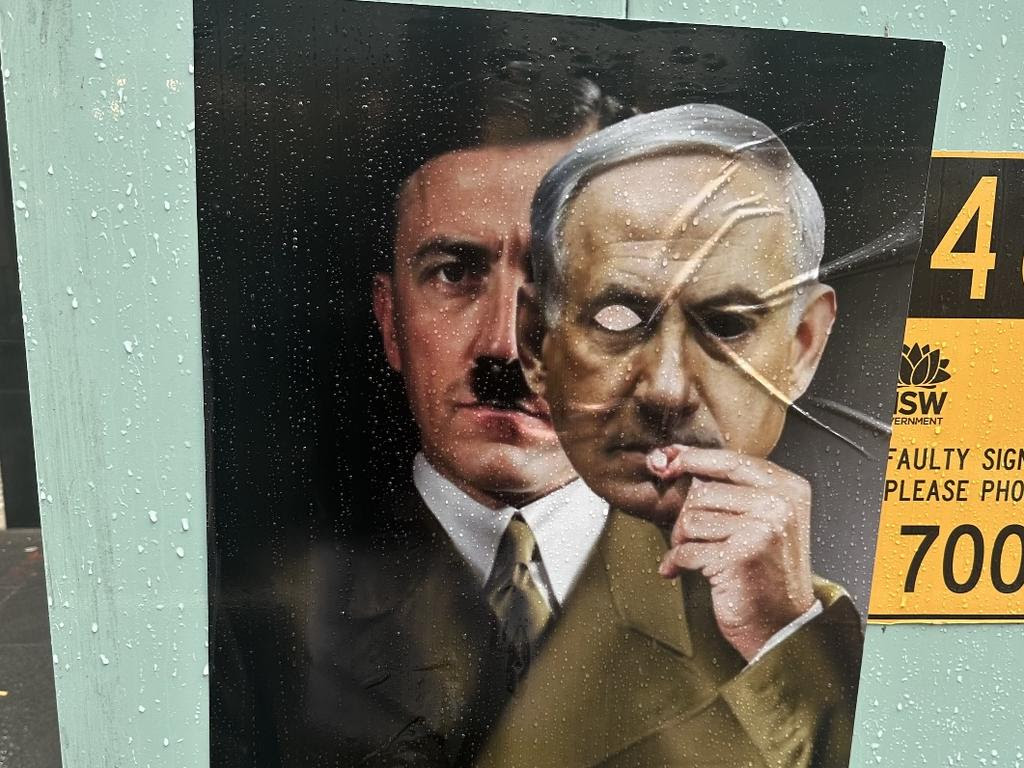
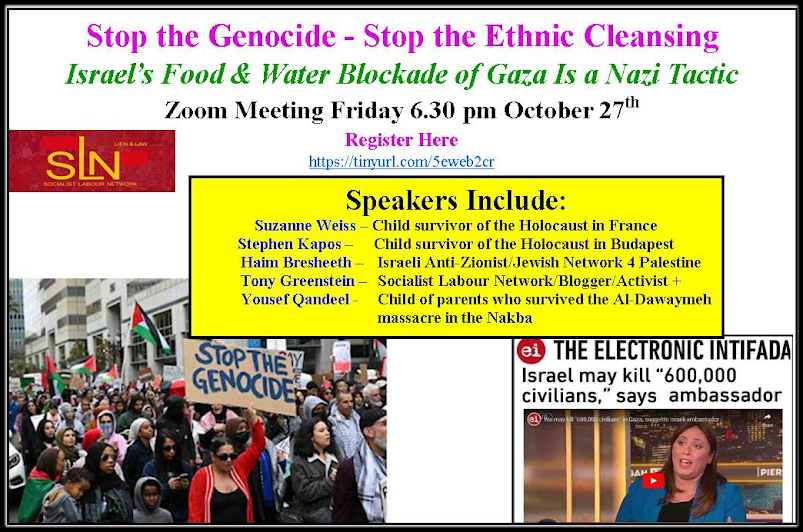

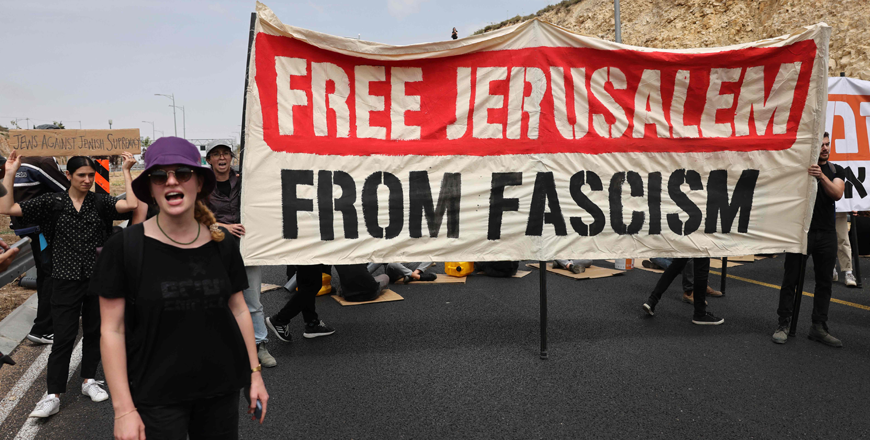

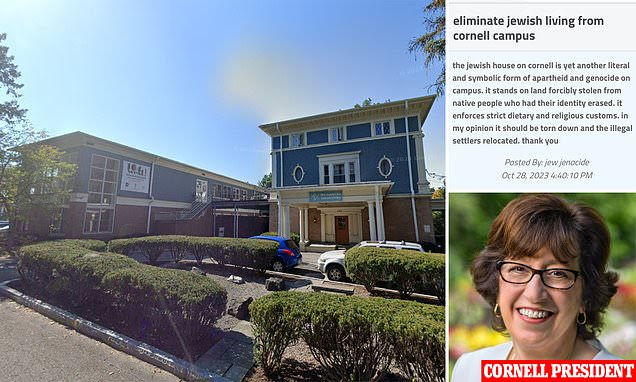
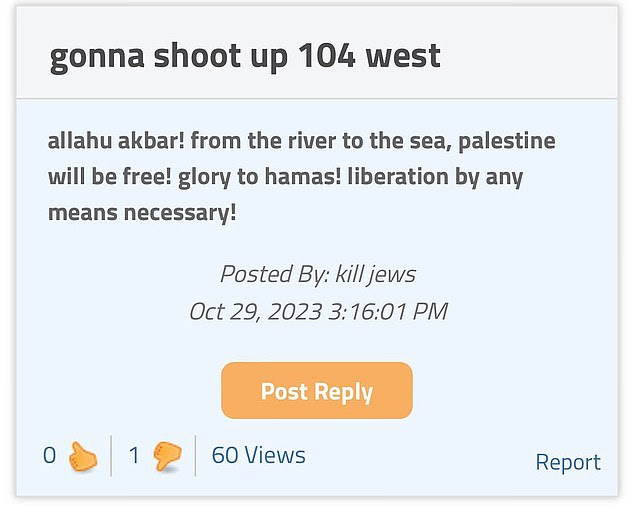 Of the several messages left on the school’s Greekrank page – a forum meant for fraternity and sorority reviews – were messages with the headlines ‘Eliminate Jewish living from Cornell Campus’ or ‘Israel deserved 10/7’
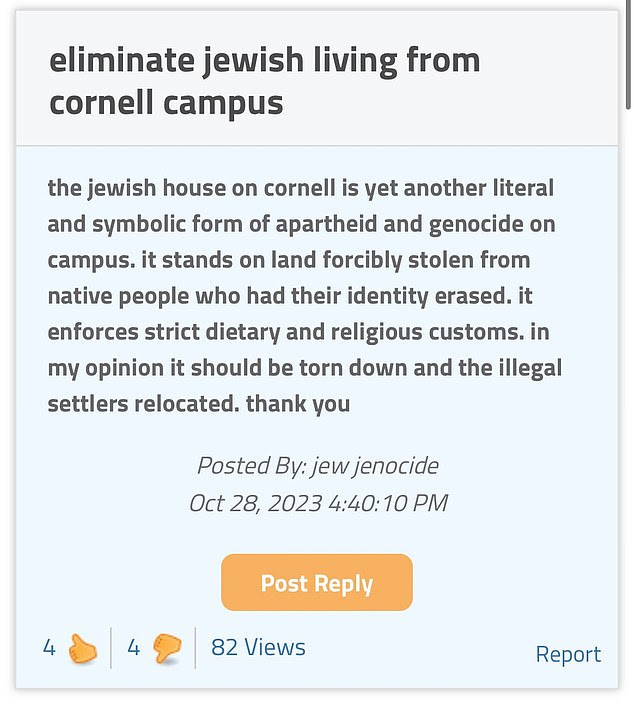
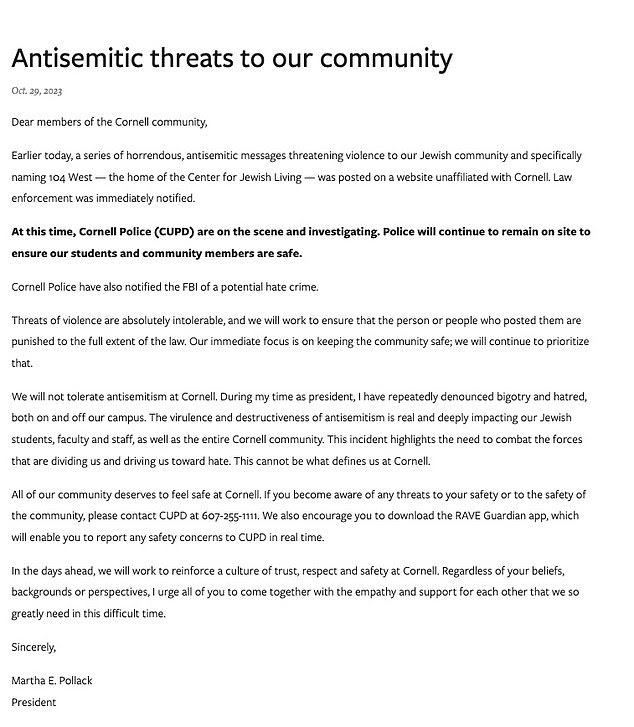
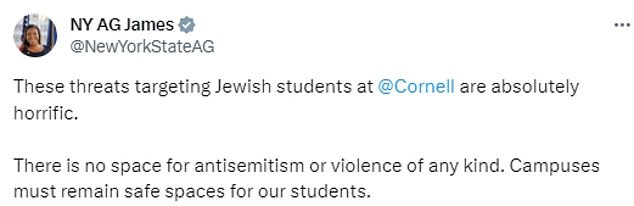
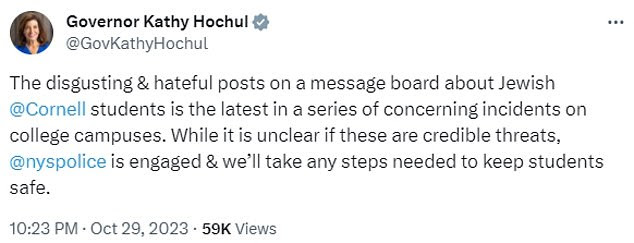
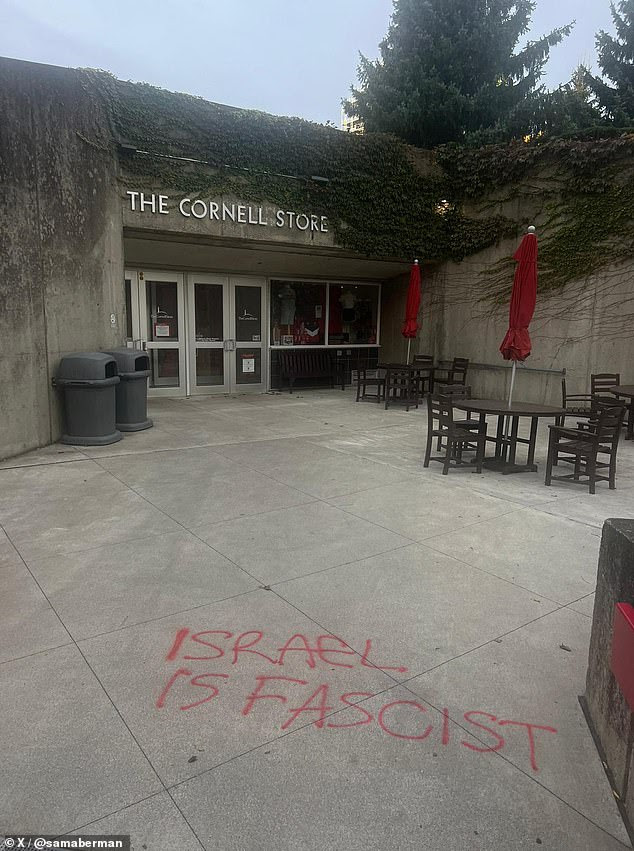 Spray-painted messages such as ‘Zionism equals Racism’ and ‘Israel is Fascist’ began appearing on the sidewalks of Cornell University’s upstate New York campus on Wednesday
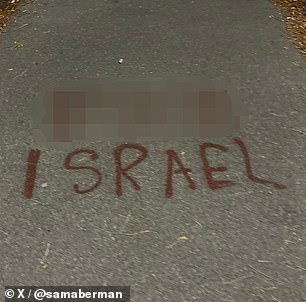 It remains unknow who left the messages
 The graffiti was painted on one of the busiest area on campus
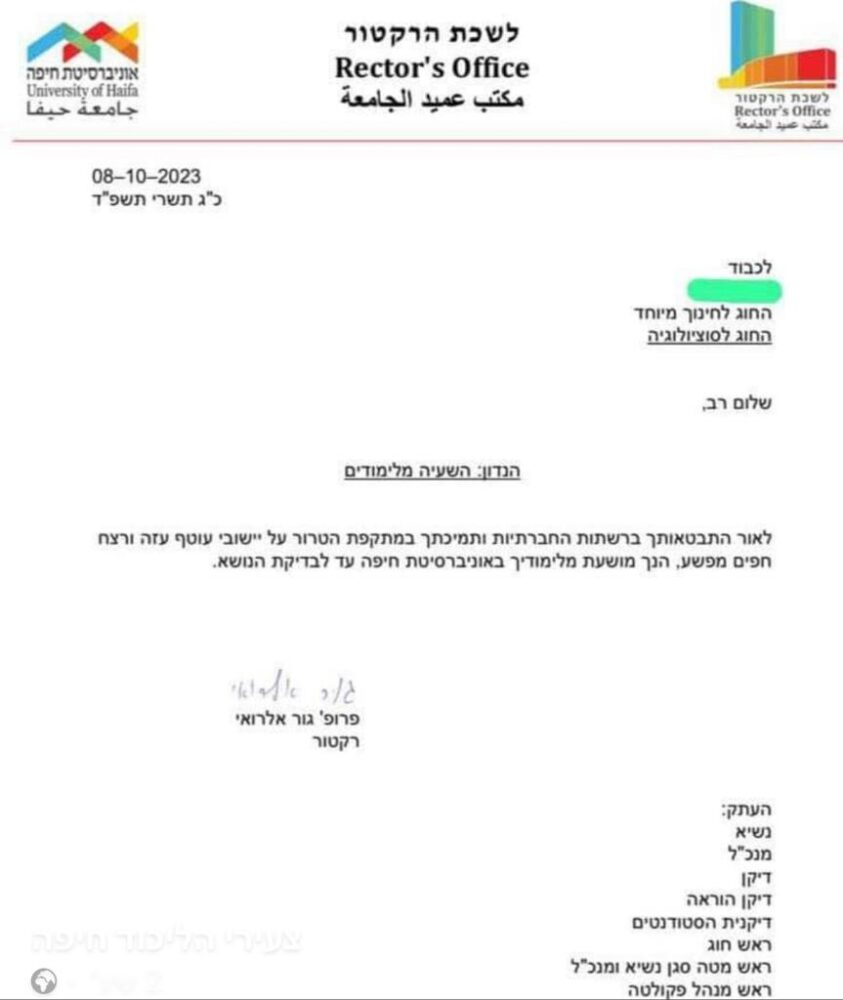

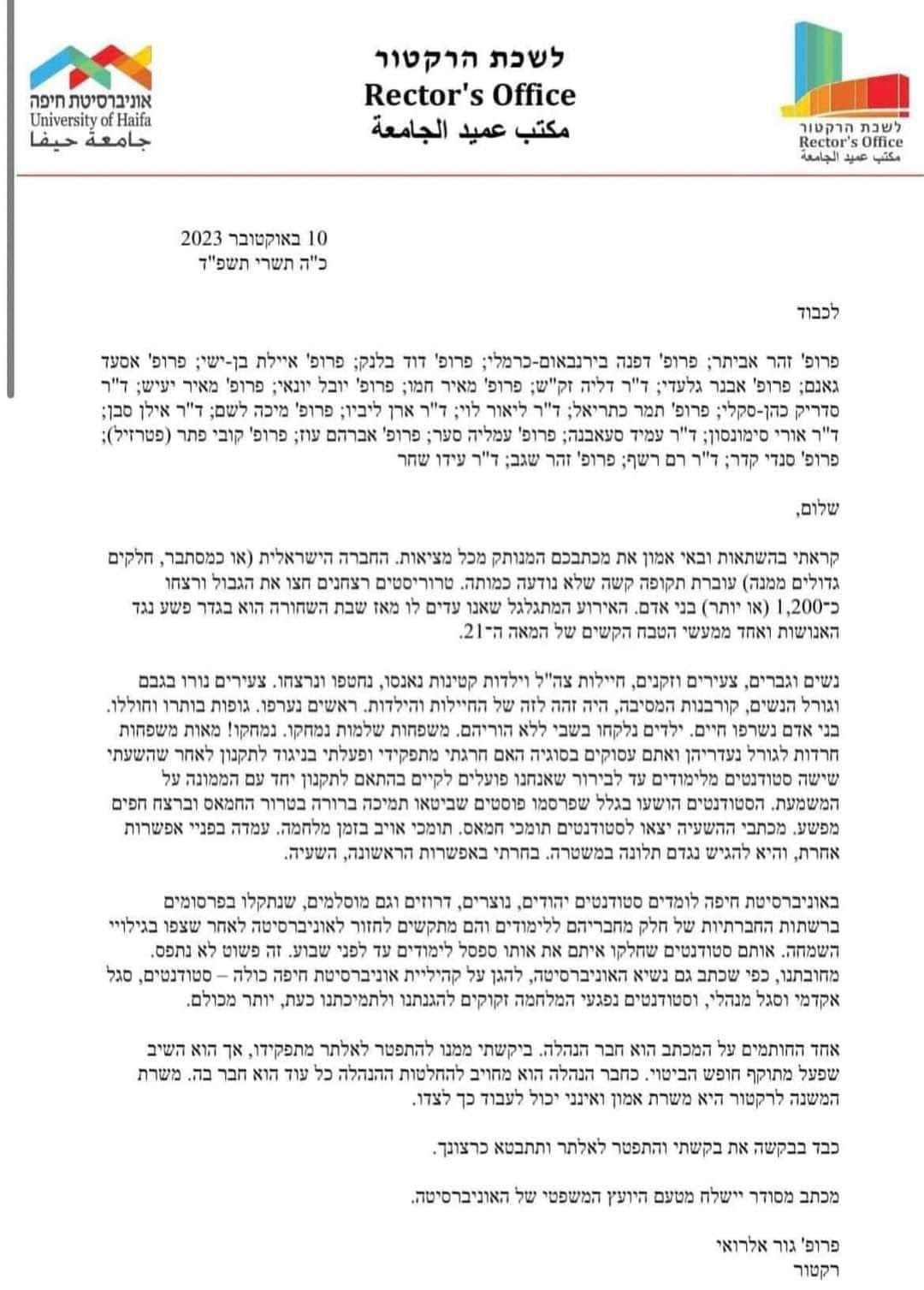
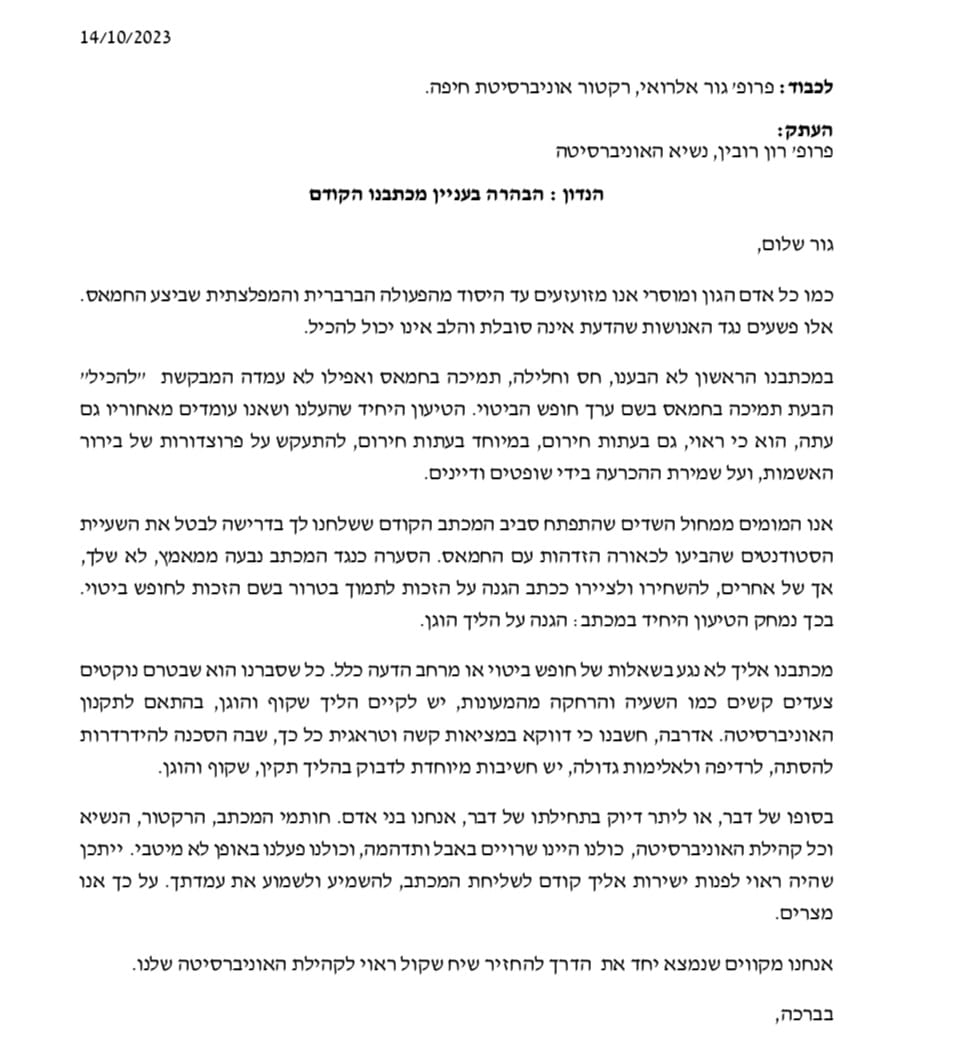
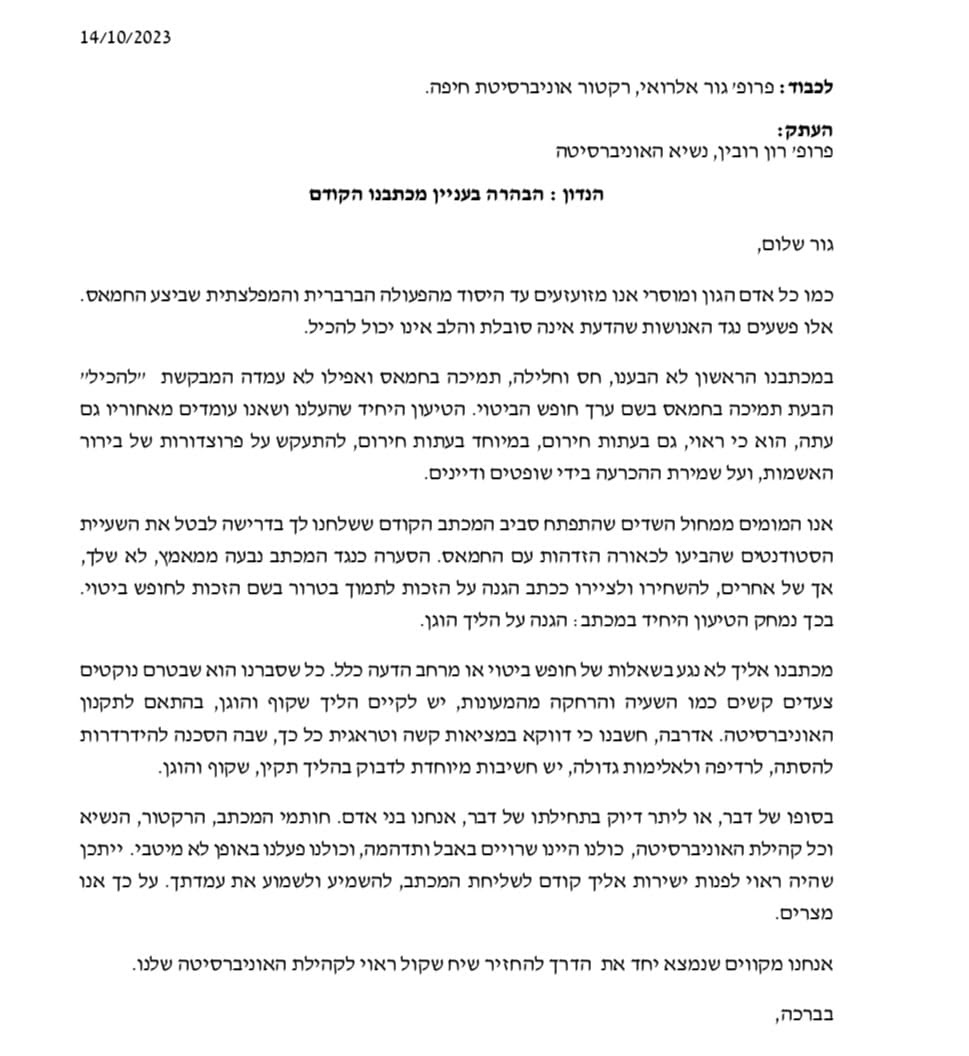
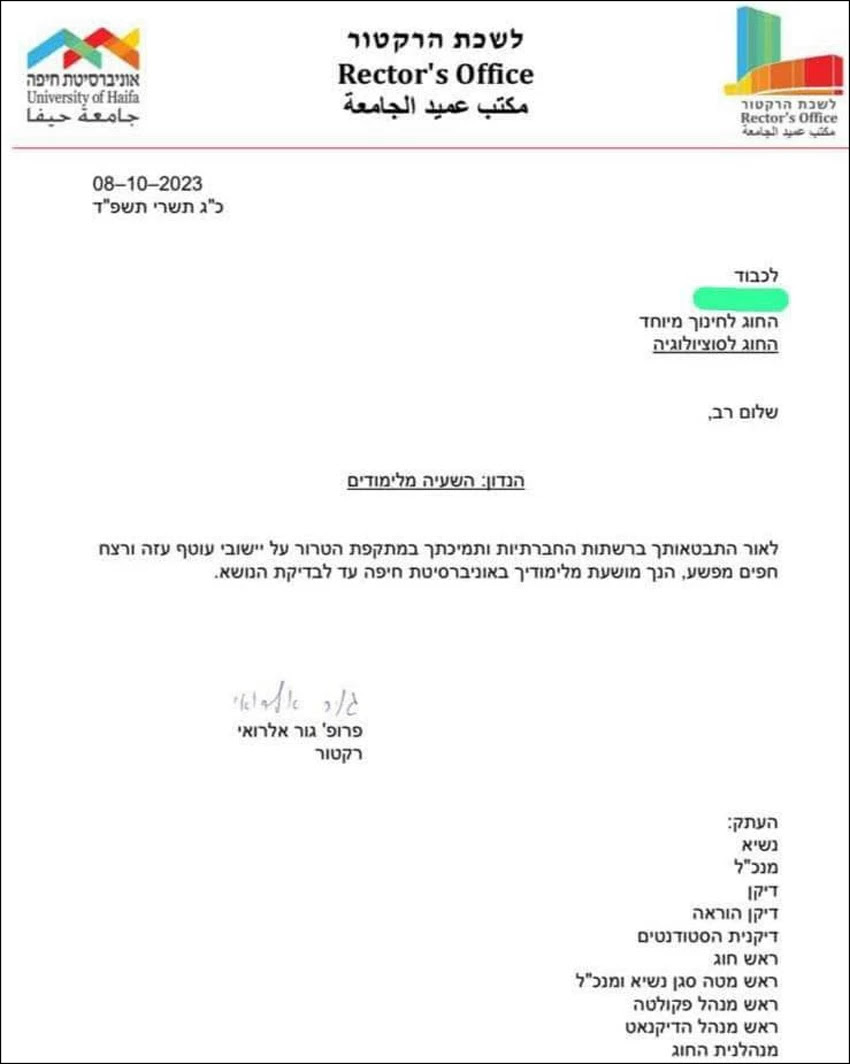
 israel-academia-monitor.com