As the war in Gaza continues, several Israeli NGOs that are sharply critical of the state have stepped up their activities. Among the most visible is New Profile, known as a movement to demilitarize Israeli society. New Profile recently issued a report titled “Education Under Command: Militarization of Higher Education in Israel,” which paints a picture of Israeli universities as deeply enmeshed with the country’s security establishment. The report describes military-academic programs, collaboration with the Ministry of Defense worth tens of millions of shekels, and close ties with the Shin Bet, Mossad, and arms industries.
Such claims, amplified by media outlets like Local Call, form the backbone of a narrative that Israeli academia is not only complicit in state militarism but also guilty of suppressing dissent. The report points to the destruction of universities in Gaza and accuses Israeli academia of responding with silence or even adopting the rhetoric of the army. It charges that Palestinian students in Israel have been penalized for expressing opposition to government policies, while Jewish students serving in the reserves have been rewarded.
The thrust of the document is not simply descriptive but accusatory: it frames cooperation between Israeli universities and the defense establishment as evidence of “systematic militarization,” positioning academia as an enabler of what it labels repression and even “extermination.” This framing is clearly designed to justify international academic boycotts of Israeli institutions.
The article says, “At the institutional level, academia in Israel has maintained an almost total silence regarding the destruction [of Gaza] and at times even adopted military and genocidal rhetoric; It imposed penalties (including suspension and dismissal without a hearing) on female students and academics, mostly Palestinians, who dared to criticize Israeli policy; assisted in the development of military technology; and provided financial relief and benefits to students who are reserve soldiers.” The report continues, “These phenomena are not accidental, and are not just a consequence of the vengeful, murderous, and hyper-militaristic mindset that gripped Israeli society after the October 7 attack… this is a systematic, highly funded, and long-standing collaboration between academic institutions in Israel and the defense establishment, the army, and the military industry. This cooperation makes the former active partners in the State of Israel’s military repression and violence, culminating in the current campaign of extermination of the Palestinian population in the Gaza Strip.”
The article ends by stating that “militarism and the extensive collaboration between academia and the security and military industries lead to self-censorship and the subordination of academic interests to military ones among academics. These are reflected, among other things, in the paucity of academic studies on the negative effects of militarism on civil society, and in the avoidance of institutions and faculty members from expressing public criticism and maintaining an open discourse on militarism and the values it promotes. In this way, academia shares responsibility for the crimes committed in Israel, Palestine, and around the world by the military bodies with which it collaborates, and for transforming itself into a space that promotes violence, nationalism, militarism, suppression, and silencing of critical thinking and anti-humanism.”
It added, “Academia in Israel must conduct a deep soul-searching and decide: Will it continue to serve as another arm of the regime – a position that justifies the continuation and expansion of the academic boycott against it – or will it choose to present itself as a truly civil, free and critical institution, capable of imagining and offering a different horizon.”
Beyond the allegations themselves, the article also elevates organizations such as Academia for Equality and student cell groups like Hadash, Balad, and Standing Together, presenting them as counterweights to militarization. These groups are held up as champions of Palestinian students, advocates of refusal to serve in the military, and critics of Israeli state policy.
What emerges from this campaign is less an impartial critique of Israeli higher education than an effort to mobilize academia as a tool of political warfare. The language of the report is deliberately inflammatory, blurring the lines between legitimate debate over the role of the military in society and outright delegitimization of Israel itself. Its calls for “refusal” and boycott are part of a broader pattern: for two decades, a network of Israeli academics—often in close contact with Palestinian and international activists—has worked to advance anti-Israel narratives from within. IAM has been reporting on the issue since 2004. The list includes Dr. Anat Matar, Prof. Rachel Giora, Prof. Anat Biletzki, Prof. Hannan Hever, Prof. Adi Ophir, Dr. Yishai Menuhin, Prof. Neve Gordon, Prof. Gadi Algazi, Prof. Ilan Pappe, Prof. Haim Bresheeth, and Prof. Avi Shlaim, among others.
Western universities have handsomely rewarded the cadre of anti-Israel academics – including some mentioned above – with prestigious positions, giving them both legitimacy and a powerful platform from which to continue their campaigns. Instead of using these appointments to promote scholarship, many have doubled down on their activism, working to delegitimize Israel at every turn. Previously, they pushed the fiction that Israel is a “colonial-apartheid state”; now they are amplifying the dangerous libel that the IDF is committing “genocide” in Gaza. These accusations are not only false but corrosive, designed to erode Israel’s moral standing and pave the way for boycotts, sanctions, and isolation. With the stamp of Western institutions behind them, these activists launder propaganda into supposed scholarship, feeding a global echo chamber that returns to Israel in the form of intensified pressure, hostility, and violence.
The long-term impact of this activism has been to place Israeli academia in a defensive position. Instead of being judged on scholarly merit, universities are framed as guilty by association with the state’s security needs. The ultimate aim of these campaigns is not reform of Israeli higher education but its isolation, weakening one of Israel’s most important cultural and intellectual assets.
חינוך תחת פקודה: מיליטריזציה של ההשכלה הגבוהה בישראל
עשרות תוכניות לימוד צבאיות-אקדמיות, שיתופי פעולה עם משרד הביטחון המניבים לאוניברסיטאות עשרות מיליוני שקלים, סיוע בגיוס בני נוער וסטודנטים לצבא, לשב”כ ולמוסד – דו”ח חדש פורש את עומק הקשר בין האקדמיה לגופי הביטחון, ואת המחיר הכרוך בו
ב-21 במאי 2024, בתגובה לידיעה שלפיה פורום הרקטורים בספרד שוקל להשעות שיתופי פעולה עם האקדמיה בישראל בשל הפעילות הצבאית של ישראל בעזה, פנה ועד ראשי האוניברסיטאות (ור”ה) לפורום בבקשה שיימנע מהמהלך, שלטענתו יוביל ליצירת חברה “מיליטנטית יותר וליברלית פחות”, והוסיף כי המוסדות האקדמיים בישראל הם “מוסדות עצמאיים” הנהנים מחופש אקדמי.
לפי דוח של משרד האו”ם לעניינים הומניטריים, שהתפרסם ב-8 באפריל 2025, מאז אוקטובר 2023 הצבא הישראלי השמיד קרוב לשישים מבנים אוניברסיטאיים ברצועת עזה. ההפצצות המכוונות לא פסחו על אף מוסד אקדמי ברצועה. אלפי סטודנטים, אקדמאים, נשיאים ודיקני אוניברסיטאות נהרגו על ידי הצבא, וקרוב ל-90 אלף הסטודנטים ברצועה איבדו את הגישה להשכלה גבוהה. כאשר התנאים אפשרו זאת, מעטים הצליחו להמשיך בלימודיהם ובעבודתם האקדמית מתוך מחנות האוהלים. עשרות ספריות ציבוריות, ספריות אוניברסיטאיות, ארכיונים, מוזיאונים וחנויות ספרים ברצועה הושמדו כליל.
ברמה המוסדית, האקדמיה בישראל שמרה על שתיקה כמעט גורפת בכל הנוגע להשמדת האקדמיה הפלסטינית בעזה, ולעיתים אף אימצה את הרטוריקה הצבאית והג’נוסיידית; הטילה עונשים (כולל השעיה ופיטורין ללא שימוע) על סטודנטיות ואקדמאיות, ברובן פלסטיניות, שהעזו למתוח ביקורת על המדיניות הישראלית; סייעהבפיתוחשלטכנולוגיהצבאית; והעניקה הקלות והטבות כספיות לסטודנטים משרתי מילואים.
תופעות אלו הן לא מקריות, ואינן רק תולדה של הלך הרוח הנקמני, הרצחני וההיפר מיליטריסטי שאחז בחברה הישראלית אחרי מתקפת 7 באוקטובר. כפי שעולה מהדוח שפרסמנו החודש בפרופיל חדש – “אקדמיהבפקודה: מיליטריזםבאקדמיהבישראל“ – מדובר בשיתוף פעולה שיטתי, עתיר מימון ורב שנים בין המוסדות האקדמיים בישראל לבין מערכת הביטחון, הצבא והתעשייה הצבאית. שיתוף פעולה זה הופך את הראשונים לשותפים פעילים במערך הדיכוי והאלימות הצבאית של מדינת ישראל, ששיאו במבצע ההשמדה הנוכחי של האוכלוסייה הפלסטינית ברצועת עזה.
שיתוף הפעולה הצבאי-אקדמי מרובד וענף, ומתקיים הן במישור הקונקרטי והן בזה האידיאולוגי-מחשבתי. הדוח כולל חמישה פרקים, הבוחנים את האופן שבו תהליכי המיליטריזציה ושיתופי הפעולה מעצבים את המרחב, ההון (הסימבולי והכלכלי), המגוון האנושי והשיח האקדמיים. אלה עוסקים בתוכניות הלימוד הצבאיות-אקדמיות ובחלקם של המוסדות האקדמיים בשיווקן ובניהולן; במיליטריזציה של המרחב האקדמי וההדרה שהיא יוצרת; בשיתוף הפעולה של המוסדות האקדמיים בגיוס בני נוער וסטודנטים לצבא, לחברות התעשייה הצבאית, לשב”כ ולמוסד; בשיתופי פעולה ובמימון של גופי ביטחון במחקר ופיתוח של טכנולוגיה צבאית; וכן בתפיסותיהם של אקדמאים וסטודנטיות את שיתופי הפעולה הצבאיים-אקדמיים.
מהדוח עולה כי במוסדות אקדמיים בישראל קיימות לפחות 57 תוכניות לימוד צבאיות-אקדמיות שונות להכשרת חיילים בשירות סדיר ובני נוער (בלשון הצבא: מלש”בים, או מועמדים לשירות ביטחון; בתקופת הכשרתם האקדמית הם לרוב נקראים “עתודאים” או “צוערים”).
כפי שעולה מתשובת משרד הביטחון לבקשה לחופש מידע שהגשנו בתחילת 2023, בין השנים 2019-2022 קיים משרד הביטחון התקשרויות עם מוסדות אקדמיים בישראל בנושא של הכשרת חיילים בשווי של קרוב ל-270 מיליון שקל. עבור הכשרת ארבעה מחזורים של חיילים-סטודנטים בתוכנית “תלפיות” (תוכנית צבאית-אקדמית להכשרת חיילים לתפקידי מחקר ופיתוח של אמצעי לחימה), משלם משרד הביטחון יותר מ-32 מיליון שקל לאוניברסיטה העברית בירושלים; ועבור הכשרת שלושה מחזורים של תוכנית “ארז” (תוכניות צבאית-אקדמית להכשרת מפקדים קרביים), משלם משרד הביטחון כ-15 מיליון שקל לאוניברסיטת תל אביב. סכומים אלה משקפים מניע כלכלי מובהק בבחירתם של המוסדות האקדמיים לשתף פעולה עם משרד הביטחון והצבא, גם כאשר שיתוף פעולה זה פוגע בקהילה האקדמית ובאיכות ההוראה, כפי שעולה מעדויות הסטודנטיות, הסגל האקדמי ובוגרי תוכניות העתודה.
אחת הדוגמאות החמורות לתוכניות אלו היא תוכנית “אודם”, תוכנית-בת של “תלפיות” שצוינה לעיל, אשר פועלת בשיתוף פעולה של הטכניון, מפא”ת, המוסד, שב”כ, רפאל – מערכות לחימה מתקדמות, וחברות נוספות בתעשיית הנשק הישראלית. במסגרת התוכנית, נערים בני 14-15 מגויסים למסלול של כ-13 שנה. במהלך שבע השנים הראשונות הם עוברים הכשרה תיכונית, צבאית ואקדמית משולבת, שלאחריה הם ממשיכים לשירות של שש שנים בתפקידים שונים ביחידות הטכנולוגיה של הצבא, השב”כ והמוסד, כמפתחי “מערכות אוטונומיות”. דוגמה למשמעות המושג “מערכות אוטונומיות” בהקשר הצבאי שלו ניתן למצוא, למשל, בתיאור שמופיע בדף המוצר של “משפחת” טילי הספייק (SPIKE) באתר של חברת רפאל, ככאלה ש”מצוידים במערכת ‘שגר ושכח’, אשר מאפשרת להם לפעול באופן אוטונומי לאחר השיגור”.
תוכנית “אודם” משווקת גם על ידי משרד החינוך ובפרסומים ברשתות החברתיות. בין הפרסומים בדף האינסטגרם של התוכניות ניתן למצוא מודעות כגון: “תלמידת ט’ שמתעניינת בטכנולוגיה? השב”כ מחפש אותך!”, ו”תמיד חלמת לעבוד במוסד או בשב”כ? תוכנית אודם היא המקום בשבילך”.
עוד עולה מהדוח שהמוסדות האקדמיים לוקחים חלק פעיל בגיוס בני ובנות נוער לתוכניות אלה, באמצעות שיווקן בדפיהם ברשתות החברתיות ובאתרי האינטרנט הרשמיים שלהם, ועל ידי ארגון כנסים ואירועי חשיפה בקמפוסים האקדמיים בשיתוף פעולה עם משרד הביטחון והצבא. בחלק מהמקרים, תוכניות אלו מובילות גם למיליטריזציה נוספת של המרחב והשיח האקדמי, כמו במקרה של תוכניות העתודה ה”עיליות”, בהן תוכנית “חבצלות” להכשרת קציני מודיעין.
שיתוף הפעולה בגיוס אינו מוגבל לתוכניות העתודה הצבאיות, ומכוון גם לסטודנטים פעילים במוסדות האקדמיים השונים: השב”כ, המוסד, וחברות התעשייה הצבאית הפרטיות והציבוריות משתתפים באופן תדיר בירידי התעסוקה השונים שמארגנות האוניברסיטאות, באירועים ייעודיים, ואף בקורסים אקדמיים שמארגנות חברות הנשק בשיתוף עם פקולטות וחוגים שונים.
ככל הנראה, גם עבור רבים משיתופי פעולה אלו המוסדות האקדמיים מתוגמלים כספית. לפי התשובה החלקית שקיבלנו לבקשה לחופש מידע שהגשנו לאוניברסיטה העברית, עולה כי רפאל, אלביט מערכות והתעשייה האווירית לישראל שילמו למוסד עבור חברות במועדון קשרי תעשייה. רפאל גם העניקה מלגות לסטודנטיות, והתעשייה האווירית שילמה עבור השתתפות ביריד הקריירה האוניברסיטאי.
כפי שעולה מהדוח, גם המוסדות האקדמיים עצמם משתמשים בפרקטיקות מיליטריסטיות בהליכי הקבלה ללימודים, כאשר בטופסי ההרשמה ללימודים כלולות שאלות שנוגעות לשירות הצבאי של המועמדים, וכן מתעדפים מסיימי שירות צבאי ואנשי מילואים בקבלת זכאות למעונות אקדמיים.
בתשובתה לבקשת המידע שהגשנו, הודתה האוניברסיטה העברית כי היא מקיימת קשרים מחקריים עם משרד הביטחון וגופים אחרים בתעשייה הצבאית בישראל, אך שאלה התירו לה למסור רק מידע חלקי בנוגע להסכמים המשותפים. בתשובתה, צירפה האוניברסיטה טבלת התקשרויות כספיות בינה לבין חברת רפאל בין השנים 2019–2022 בשווי של יותר מ-3 מיליון שקל. עדות נוספות לשיתוף הפעולה בין השתיים היא הקמתו של מרכז מחקר ופיתוח של רפאל בהר חוצבים בירושלים ב-2017, במטרה להרחיב את שיתוף הפעולה בין החברה לבין חוקרים מהאוניברסיטה העברית.
בתשובתה של האוניברסיטה הוזכרו גם שיתופי פעולה במחקר עם אלביט מערכות, התעשייה האווירית, וכן הסכם בסך כ-600 אלף שקל עם השב”כ.
אוניברסיטת תל אביב, מצידה, הודתה בתשובתה שהיקף שיתוף הפעולה שלה עם משרד הביטחון, התעשייה הביטחונית, המוסד, השב”כ וצה”ל הוא כה רחב, עד כדי כך שמסירת המידע תדרוש “זמן עבודה לא סביר”. בדוח המלא מובאות כמה דוגמאות קונקרטיות לשיתוף פעולה זה.
ממצאים אלה ורבים אחרים מראים שהמיליטריזם ושיתופי הפעולה הרבים בין האקדמיה לבין גופי הביטחון והתעשייה הצבאית מובילים לצנזורה עצמית, ולהכפפת האינטרסים האקדמיים לאלה הצבאיים בקרב סטודנטים ואקדמאיות. אלה באים לידי ביטוי, בין השאר, במיעוט של מחקרים אקדמיים על ההשפעות השליליות של המיליטריזם על החברה האזרחית, ובהימנעותם של המוסדות ושל חברי סגל מהבעת ביקורת ציבורית וקיום של שיח פתוח על המיליטריזם ועל הערכים שהוא מקדם.
בכך שותפה האקדמיה באחריות לפשעים שמבוצעים בישראל, בפלסטין ובעולם על ידי הגופים הצבאיים שאיתם היא משתפת פעולה, ולהפיכתה עצמה למרחב שמקדם אלימות, לאומנות, מיליטריזם, דיכוי והשתקה של חשיבה ביקורתית ואנטי הומניזם. על האקדמיה בישראל לערוך חשבון נפש עמוק ולהכריע: האם תוסיף לשמש כזרוע נוספת של המשטר – עמדה שמצדיקה את המשך והתרחבות החרם האקדמי עליה – או שתבחר להתייצב כמוסד שהוא באמת אזרחי, חופשי וביקורתי, המסוגל לדמיין ולהציע אופק אחר.
ראוי לציין שקיימות כמה התארגנויות של אקדמאיות וסטודנטים שנאבקות בתהליכים אלה כבר שנים, בהן ארגון אקדמיה לשוויון, שכבר קרוב לעשור פועל נגד תהליכי המיליטריזציה וההפרטה של האקדמיה בישראל. זאת, על ידי הפעלת קו סיוע לתמיכה בסטודנטים פלסטינים שחוו אלימות, רדיפה או השתקה, סולידריות עם האקדמיה הפלסטינית, ובניית מאגר המידע “אקדמיה מגויסת”, שתיעד את התמיכה ושיתוף הפעולה של מוסדות אקדמיים במדיניות הכיבוש הישראלית ומיליטריזם. לכך גם מצטרפת הפעילות ארוכת השנים של תאי הסטודנטים הפלסטינים, בהם חד”ש, בל”ד, ופורום אדוארד סעיד, ההתארגנות החדשה “סטודנטים נגד המלחמה”, ותאי הסטודנטים של תנועת עומדים ביחד.
ניסי פלאי הוא אקטיביסט בפרופיל חדש – התנועה לאזרוח החברה בישראל, ומחבר הדוח “אקדמיה בפקודה: מיליטריזם באקדמיה בישראל”
In March, IAM reported that “Pro-Palestinians Take Over German Academic Blog of International Law.” IAM noted that the German blog Völkerrechtsblog, an academic blog on international public law and international legal thought, is run by anti-Israel activists. Its managing editor, Khaled El Mahmoud, is a Palestinian-Tunisian who works as a law clerk at the Higher Regional Court of Berlin and is a Ph.D. candidate at the University of Potsdam.
However, now it seems that the Völkerrechtsblog has also moved to promote the Iranian regime’s interests. In one of its latest posts, titled “Striking Iran’s Nuclear Facilities: International Law Scholars Warn of Precedent-Setting Violations,” a group of international legal scholars published a petition endorsed by several Iranian scholars, listed below.
The group begins their petition by invoking the 120 Member States of the Non-Aligned Movement (NAM), which “categorically condemn and denounce in the strongest terms the wanton, unprovoked, and premeditated heinous attack by Israel against the Islamic Republic of Iran” on June 13, 2025, and the “deliberate targeting of peaceful nuclear facilities by Israel.” The petition also invokes the Joint Statement of the 57 Member States of the Organization of Islamic Cooperation, which states that Israel’s “reprehensible attack constitutes a flagrant violation of the Charter of the United Nations, the fundamental principles of international law, including sovereignty, territorial integrity, and the prohibition of the threat or use of force against the territorial integrity of States, while grossly violating fundamental rights, particularly the right to life and the right to health.”
The petition argues, “We, the undersigned international law scholars, submit this petition to call attention to the illegality of the June 2025 Israeli aggression against Iran, as well as of the subsequent United States’ strikes on Iranian nuclear sites. We are gravely concerned by the erosion of fundamental norms governing the use of force and the protection of civilians. Drawing on authoritative sources of international law, we demonstrate that Israel’s aggression, through invocation of ‘preventive self-defense’ has no legal foundation under the United Nations Charter and customary international law, that the attacks on Iran’s safeguarded nuclear installation contravened international nuclear and environmental law, and that it violated core principles of international humanitarian law. We caution that the practice of using force to impose agreements upon States contravenes the rules-based international legal order. Such acts produce void and nullified effects that no State may recognize as lawful. We further address the broader implications of these violations for the rule of law and global arms-control and disarmament regimes.”
They ended their petition by urging “States and international institutions to reaffirm these norms. We call on relevant bodies – the United Nations, the IAEA, and the international community at large – to condemn these grave breaches of the law. Upholding the rule of law is essential to preventing the very conflicts that such illegal attacks only exacerbate. Let this petition serve as a scholarly affirmation that neither might nor fear of future threats can override the clear limits of international law. For the sake of future peace and stability, all States must heed the Charter’s mandate and the laws of armed conflicts.”
The signatories, Pouria Askary, Associate Professor of International Law, Allameh Tabataba’i University of Tehran, Iran, and former legal advisor at the International Committee of the Red Cross in Tehran; Salah F. Al Jabery, Chairholder of the UNESCO Chair for Genocide Prevention studies in the Islamic world at University of Baghdad, Iraq; Said Mahmoudi, Professor emeritus of international law, Stockholm University, Sweden; Mohsen Mohebbi, Faculty Member, Islamic Azad University, Science and Research Branch, Iran; Ali Asghar Soltanieh, former Iran Representative to the IAEA (1982-87; 2006-13), President of the Vienna International Institute for Middle East Studies, which focuses on attacking Israel. In 2014, Soltanieh participated in the second New Horizon conference held in Tehran, a gathering of prominent Holocaust deniers, conspiracy theorists, and BDS supporters from around the world. The conference was backed and supported by the Iranian regime.
Others also signed the petition:
Olivier Corten, Professor of international law, Université libre de Bruxelles, Belgium; Pierre-Emmanuel Dupont, Senior Lecturer in international law, Institut Catholique de Vendée, France; Yoshiko Kurita, Professor, Chiba University, Japan. John Laughland, Senior Lecturer, Faculty of political science and history, Institut Catholique de Vendée, France; Rafaëlle Maison, Professor of international law, Université Paris Saclay, France; Chantal Meloni, Associate Professor of international criminal law, Universitá degli Studi di Milano, Italy; Keiko Sakai, Professor, Department of Law, Faculty of Law, Politics and Economics, Chiba University, Japan; Axel Schönberger, University of Bremen, Germany; Katariina Simonen, Adjunct Professor, University of Helsinki, Finland, and Pugwash Council/Pugwash Conferences on Science and World Affairs; Alfred M. de Zayas, Professor, Geneva School of Diplomacy, Switzerland.
The initiator and author of the petition is Pierre-Emmanuel Dupont, the director of the Public International Law Advisory Group, a consultant in public international law and dispute resolution, and a Senior Lecturer in International Arbitration at the Free Faculty of Law and Economics of Paris. Dupond, in 2014, endorsed the “Joint Declaration by International Law Experts on Israel’s Gaza Offensive,” initiated by Prof. Richard Falk, stating that “The International Community Must End Israel’s Collective Punishment of the Civilian Population in the Gaza Strip.” Falk, who was an expert on international law at Yale University, has a long history of anti-Israel activism. In 2013, Dupond authored the article “The ECJ and (Mis)interpretation of Security Council Resolutions: The Case of Sanctions Against Iran.”
Worth noting that the day before Israel’s preemptive strike against Iran, on June 12, 2025, the Board of the International Atomic Energy Agency (IAEA), the UN agency that enforces compliance with the Nuclear Non-Proliferation Treaty, announced that Iran was in significant breach of its non-proliferation obligation. The 35-country member Board and Rafael Grossi, the head of the IAEA, explained that these obligations were included in the 2015 Joint Comprehensive Plan of Action (JCPOA) and the related UNSC Resolution 2231 that Iran broke by manufacturing missiles. Grossi warned that Iran’s violations may trigger “snapback sanctions,” that is, reinstating the entire range of sanctions that existed before the JCPOA.
Interestingly, some of the signatories also appear in a petition published in July by the Tehran Times, owned by the Iranian regime, which states, “A group of esteemed Iranian lawmakers have issued a statement, underlining the illegal nature of Israel’s June war against Iran, and calling on their fellow academics in the world to condemn the outrageous act.” Tehran Times also claimed the Iranian lawyers emphasized the “necessity of International bodies to hold Israel accountable and prevent international law from becoming irrelevant in the face of the regime’s unchecked violence plaguing the region.”
The moral blindness of the petitioners is staggering. Iranian leaders have occasionally implied that a nuclear bomb could be used to wipe out Israel from the face of the earth – their eschatologically mandated step before the disappeared Twelfth Imam can return. According to the Supreme Leader, Ayatollah Ali Khamenei, the State of Israel will be destroyed in the year 2040. A digital clock erected in Palestine Square in Tehran in 2017 has been counting down the time for the alleged event.
Moral blindness aside, the Völkerrechtsblog exemplifies how the anti-Israel campaign that began in Middle Eastern studies departments at Western universities has now spread to international law faculties across both the United States and Western Europe. It is particularly egregious for the petition’s signatories to voice support for Iran—a state widely recognized as a principal sponsor of terrorism through proxies like Hezbollah and Hamas, a perpetrator of systematic repression against its own citizens, and a regime advancing toward nuclear weapons capability.
Germany must closely monitor this troubling development and respond decisively to counter the spread of such narratives within influential academic and legal circles.
Noting that the 120 Member States of the Non-Aligned Movement (NAM) ‘categorically condemn and denounce in the strongest terms the wanton, unprovoked, and premeditated heinous attack by Israel against the Islamic Republic of Iran on 13 June 2025’,[1] and that they ‘strongly condemn the deliberate targeting of peaceful nuclear facilities by Israel’,[2] while expressing ‘serious concerns that such attacks and the resulting damage pose formidable risks of radioactive material release, representing severe threats to civilian populations and the environment’;[3]
Recalling the Joint Statement of the 57 Member States of the Organization of Islamic Cooperation (OIC), spanning four continents, which states that the ‘reprehensible attack constitutes a flagrant violation of the Charter of the United Nations, the fundamental principles of international law, including sovereignty, territorial integrity, and the prohibition of the threat or use of force against the territorial integrity of States, while grossly violating fundamental rights, particularly the right to life and the right to health’;[4]
Recalling also the statement of the Member States of the Shanghai Cooperation Organization (SCO), which expresses serious concern and ‘condemns the military strikes carried out by Israel’ as ‘aggressive actions against civilian targets, including energy and transport infrastructure, which have resulted in civilian casualties,’ and characterizes them as a ‘gross violation of international law and the United Nations Charter’;[5]
Considering the assessments of UN Experts that the timing of the strikes – coinciding with diplomatic efforts by Iran and the United States in Muscat to revive the 2015 Iran Nuclear Deal – ‘raises serious concerns about the deliberate undermining of peace initiatives’; and that they ‘unequivocally condemn recent Israeli military attacks against Iran, which have targeted nuclear facilities, energy and military infrastructure, as well as residential and media buildings across multiple locations’, which represent ‘a flagrant violation of fundamental principles of international law, a blatant act of aggression, and a violation of jus cogens norms – peremptory rules of international law from which no derogation is permitted’;[6]
We, the undersigned international law scholars, submit this petition to call attention to the illegality of the June 2025 Israeli aggression against Iran, as well as of the subsequent United States’ strikes on Iranian nuclear sites. We are gravely concerned by the erosion of fundamental norms governing the use of force and the protection of civilians. Drawing on authoritative sources of international law, we demonstrate that Israel’s aggression, through invocation of ‘preventive self-defense’ has no legal foundation under the United Nations Charter and customary international law, that the attacks on Iran’s safeguarded nuclear installation contravened international nuclear and environmental law, and that it violated core principles of international humanitarian law. We caution that the practice of using force to impose agreements upon States contravenes the rules-based international legal order. Such acts produce void and nullified effects that no State may recognize as lawful. We further address the broader implications of these violations for the rule of law and global arms-control and disarmament regimes. The findings of this petition rely on treaties, UN General Assembly and Security Council resolutions, the jurisprudence of the International Court of Justice, IAEA resolutions, and academic commentary. The gravity of the issues involved calls for clear-headed legal analysis by the international community.
I. The Prohibition on the Use of Force under International Law
a. Article 2(4) of the UN Charter:
Article 2(4) of the UN Charter enshrines the obligation of all Members to refrain from the ‘threat or use of force against the territorial integrity or political independence of any state.’[7] The International Court of Justice considers the prohibition on the use of force under Article 2(4) of the UN Charter to constitute both an obligation under customary international law[8] and what it has characterized as ‘a cornerstone of the United Nations Charter’.[9] This prohibition is widely recognized in State practice and by the overwhelming majority of international law scholars as possessing a jus cogens or peremptory character from which no derogation is permitted.[10] Further, to highlight the importance of such an obligation it is beneficial to recall that, under the Rome Statue of the International Criminal Court, this act is defined as an ‘act of aggression’ which means the ‘use of armed force by a State against the sovereignty, territorial integrity or political independence of another State, or in any other manner inconsistent with the Charter of the United Nations.’[11]
As articulated by the UN International Law Commission in its Draft Articles on State Responsibility, all States are obligated to cooperate in bringing to an end a serious breach by any State of an obligation arising under a peremptory norm of general international law.[12] Also, States shall not to recognize as lawful any situation created by the use of force.[13] The duty of non-recognition was affirmed by the ICJ in its Advisory Opinion on Construction of a Wall, where the Court held that – as a corollary to the prohibition of the use of force – any measures resulting from the threat or use of force are illegal and must not be recognized as lawful by other States.[14]
The articulation by the U.S. President Donald Trump that ‘Iran should have listened to me […] I gave them a 60-day warning and today is day 61 […] They should now come to the table to make a deal before it’s too late,’[15] exemplifies an impermissible policy of coercive diplomacy. Such rhetoric amounts to ‘a blatant and direct threat of force, used to compel another state to […] make substantial political concessions (not required by law), would have to be seen as illegal under article 2(4) [of the UN Charter].’[16]
This kind of policy – predicated on unilateral threat and use of force – constitutes a null and void act under international law. It produces no legal effect and cannot legitimize the subjugation of another State’s sovereign will. More broadly, such actions pose a serious threat to the rule of law in international relations, fostering instability, impunity, and a return to the law of force over the force of law. If left unchecked, this approach risks hollowing out the normative framework of the UN Charter and emboldening other actors to similarly disregard international legal obligations, thereby precipitating a regression in global peace and security.
b. Absence of a Legitimate Self-Defense Justification:
In the Security Council meeting held on 13 June 2025 concerning the ‘Israeli Air Strikes on Iran’, the representative of Israel purported to justify the attacks as acts of ‘self-defense’ and claimed that Iran had ‘enriched uranium to a level with no civilian justification; obstructed inspectors and destroyed monitoring equipment; developed trigger mechanisms, detonation systems and warhead plans; actively recruited more nuclear scientists; and made false concessions during extended negotiations.’[17]
Bearing in mind that the head of the International Atomic Energy Agency, Rafael Grossi, acknowledged on 17 June 2025 – just days after the Israeli military campaign and before the United States strikes on Iranian nuclear sites – that the Agency ‘did not have any proof of a systematic effort [by Iran] to move into a nuclear weapon,’[18] it must be noted that, legally speaking, all the justifications raised by Israel’s representative fail to meet the threshold required under international law to lawfully invoke the right of self-defense.
As codified in Article 51 of the United Nations Charter, the use of force in self-defense is permissible only in response to an actual armed attack.[19] International law does not recognize a right to preventive or pre-emptive self-defense based merely on speculative or potential future threats. In one of the earliest commentaries on the UN Charter, it was observed that:
“Abuses of the right of self-defence were in the past facilitated by the theory that self-defence was justified in the face not only of actual, but also of threatened, aggression. The Charter does not admit self-defence against a threat. There must be an actual armed attack.”[20]
More recently, H.P. Aust expressed in his commentary on Article 51 of the United Nations Charter that:
“The interpretation of Art. 51 as being an exclusive regulation of the right of self-defence, has been confirmed by State practice and by the ICJ. In its Nicaragua judgment the ICJ proceeded from the assumption that the existence of an armed attack is a conditio sine qua non for the exercise of the right to individual and collective self-defence.”[21]
The International Court of Justice has repeatedly reaffirmed that Article 51’s exception to Article 2(4) applies only where an armed attack has occurred. In its 1986 judgment in the Nicaragua v. United States of America case, for example, the ICJ emphasized that self-defense lies outside the Charter’s prohibition of use of force solely to meet a genuine, present armed aggression, not hypothetical future threats:
“In the case of individual self-defence, the exercise of this right is subject to the State concerned having been the victim of an armed attack.”[22]
Thus, there is no right of self-defence unless the State has first been the victim of an actual armed attack. However, even if the so-called preventive, anticipatory, or pre-emptive self-defence were to have a basis in international law, the circumstances preceding Israel’s initiation of its military campaign were still insufficient to justify recourse to the use of force.
Those who argue in favour of such pre-emptive self-defence often rely on nineteenth-century State practice, particularly the obsolete Caroline test, according to which a truly imminent threat might justify an anticipatory strike – but still only under exceptional and exigent circumstances, where there exists ‘a necessity of self-defence, instant, overwhelming, leaving no choice of means, and no moment for deliberation.’[23]
Israel and United States’ strikes bore none of those hallmarks; no Iranian attack had occurred, nor was one demonstrably imminent. Leading scholars and States reject a broad doctrine of preventive or pre-emptive use of force; to the contrary, UN resolutions have repeatedly condemned any unilateral aggression under the guise of self-defense.[24] Therefore, Israel’s strike cannot be justified as self-defense and thus contravened the UN Charter’s jus ad bellum regime.
II. Potential Breaches of International Humanitarian Law
a. Attacks on Nuclear Facilities:
Nuclear reactors, installations, and enrichment plants contain radioactive materials, making attacks on these sites extraordinarily dangerous. Additional Protocol I to the Geneva Conventions (1977) on laws applicable in international armed conflicts, specifically prohibits targeting facilities like dams and nuclear power stations when an attack would release ‘dangerous forces’ and cause civilian harm. According to the article 56 of the Additional Protocol:
“Works or installations containing dangerous forces, namely … nuclear electrical generating stations, shall not be made the object of attack, even where these objects are military objectives, if such attack may cause the release of dangerous forces and consequent severe losses among the civilian population. Other military objectives located at or in the vicinity of these works or installations shall not be made the object of attack if such attack may cause the release of dangerous forces from the works or installations and consequent severe losses among the civilian population.”[25]
The IAEA Director-General has warned that assaults on nuclear installations ‘could result in radioactive releases with grave consequences within and beyond the boundaries of the State which has been attacked.’[26] He rightly cautioned that such attacks risk serious harm to ‘both people and the environment … as well as regional and international peace and security.’[27] In this regard, it is relevant to recall the numerous IAEA General Conference resolutions on the topic of military attacks against nuclear facilities, in particular, GC(XXIX)/RES/444 and GC(XXXIV)/RES/533, which provide, inter alia, that ‘any armed attack on and threat against nuclear facilities devoted to peaceful purposes constitutes a violation of the principles of the United Nations Charter, international law and the Statute of the Agency.’[28]
Israel’s repeated practice to attack nuclear facilities of other sovereign States in the region represents a flagrant violation of international law and a direct assault on the foundations of global non-proliferation efforts. Of particular relevance is Resolution 487 (1981), adopted on 19 June 1981, in which the Security Council:
‘Strongly condemn[ed]’ Israel’s aerial strike on Iraqi nuclear installations (7 June 1981);
Found the attack to be a ‘clear violation of the Charter of the United Nations and the norms of international conduct’;
Characterized it as ‘a danger to international peace and security’, warning that it could ‘explode the situation in the region, with grave consequences for the vital interests of all States’; and
Further determined that the strike ‘constitutes a serious threat to the entire safeguards regime of the International Atomic Energy Agency, which is the foundation of the Treaty on the Non-Proliferation of Nuclear Weapons.’[29]
From another point of view, military strikes on nuclear installations represent a clear violation of international humanitarian law due to their catastrophic and indiscriminate environmental consequences. The customary and treaty international law explicitly safeguards the natural environment and ‘installations containing dangerous forces’ – prohibiting attacks that risk causing ‘widespread, long-term and severe damage.’[30]
Beyond the legal implications, such actions recklessly endanger civilian populations and the environment, with catastrophic consequences: A deliberate attack on nuclear infrastructure risks widespread radioactive contamination, exposing civilian populations to acute and long-term health hazards, including elevated cancer incidence, genetic mutations, and severe birth defects. The resulting public health emergency could persist for generations, necessitating prolonged medical interventions and mass displacement. Nuclear fallout could precipitate ecosystem collapse, with irreversible damage to agricultural lands, freshwater supplies, and biodiversity. Contaminated zones may remain uninhabitable for decades, exacerbating food insecurity and economic destabilization in the region. Radiation dispersion does not adhere to political boundaries; neighboring States could face secondary contamination, implicating broader regional stability and triggering cross-border humanitarian and legal disputes.
Given these ramifications, such military actions not only breach cardinal principles of UN Charter and international humanitarian law but also directly contravene the core tenets of international environmental law.
b. Protection of Civilians
A core principle of international humanitarian law requires parties to an armed conflict to protect ‘the civilian population and civilian objects and establishes the distinction between combatants and non-combatants; States must never make civilians the object of attack and must consequently never use weapons that are incapable of distinguishing between civilian and military targets.’[31] Civilians shall ‘enjoy general protection against the dangers arising from military operations’[32] and parties must ‘distinguish at all times between the civilian population and combatants.’[33] Israel’s strike reportedly targeted Iranian military or nuclear personnel and simultaneously struck civilian and residential, according to credible reports. Such conduct violates the distinction rule: civilian family members and nearby homes or facilities are not military objects and must not be made the object of attack. Article 51(2) of Protocol I expressly forbids ‘acts or threats of violence’ of any kind against civilians.[34]
The deliberate or reckless killing of civilians and destruction of civilian infrastructure is a grave breach under the Fourth Geneva Convention and constitutes a war crime under customary international law.[35] In this case, striking at least partly civilian areas and family dwellings is inconsistent with any notion of lawful targeting. It echoes the prohibition against collective punishment and terrorizing the civilian population. Such actions undermine the very purpose of international humanitarian law, which is to limit suffering in conflict.[36]
III. Broader Implications for the International Legal Order
Whatever military objective the Israelis claimed, co-locating such an attack in civilian spaces and striking non-combatants with lethal force breaches this core prohibition. The June 2025 attacks on Iran transcend a bilateral dispute; these strike at the bedrock of international law:
First, the invocation of anticipatory or pre-emptive self-defense as justification for cross-border armed aggression erodes the Charter’s prohibition on force. If allowed, it would empower States to act as judge, jury and executioner based on perceived future threats, undermining collective security.
Secondly, the IAEA and UN have long sought to contain nuclear competition through diplomacy and law. Noting furthermore that Israel has not adhered to the Treaty on the Non-Proliferation of Nuclear Weapons, the joint Israel-United States strikes on Iran’s nuclear facilities constituted both a treaty violation and a blow to the credibility of international non-proliferation regimes. Such behaviour sends a catastrophic signal that nuclear accords can be overturned by force, incentivizing other States to flout arms-control commitments under threat.
Thirdly, these incidents undermine the norm of peaceful dispute resolution. Rather than exhausting lawful avenues (such as complaints to the UN Security Council or IAEA fact-finding), Israel resorted to military action. This contravenes Article 2(3) of the UN Charter, which obligates States to settle disputes by peaceful means.
Fourthly, the strikes have enormous implications for humanitarian and environmental norms. Attacks on nuclear facilities revive fears of radioactive pollution and long-term ecological catastrophe. In an era of growing environmental consciousness, such actions flout the developing principle that warfare must not cause ‘widespread, long-term and severe’ environmental damage.
Finally, the attacks set a perilous precedent for civilian protection. If a State can lawfully attack or kill civilians in another State claiming security interests, the entire corpus of international humanitarian law is trivialized. It invites retaliatory measures and escalates conflicts, as the victims may conclude that only reciprocal force can protect their rights. Worse, it encourages a slide toward open conflict in regions with unresolved tensions, eroding confidence in the UN system.
Conclusion and Appeal
For the reasons above, it is our firm conclusion that Israel’s June 2025 aggression against Iran and United States’ strikes on Iranian nuclear sites violated fundamental rules of international law. The preventive self-defense justification is legally invalid, the attacks contravened treaty obligations and IAEA safeguards, and these breached the IHL rules on distinction, proportionality, and civilian protection.
We do not express opinions on the merits of Iran’s policies; rather, we simply apply relevant principles and rules of international law. Under the UN Charter and customary international law, States must refrain from unlawful use of force, protect civilian populations, and respect nuclear safety and arms-control regimes. These principles exist for the sake of international peace, predictability, and humanity.
We, the undersigned legal scholars, respectfully urge States and international institutions to reaffirm these norms. We call on relevant bodies – the United Nations, the IAEA, and the international community at large – to condemn these grave breaches of the law. Upholding the rule of law is essential to preventing the very conflicts that such illegal attacks only exacerbate. Let this petition serve as a scholarly affirmation that neither might nor fear of future threats can override the clear limits of international law. For the sake of future peace and stability, all States must heed the Charter’s mandate and the laws of armed conflicts.
Signatories (in individual capacity) as of 1 July 2025:
Pouria Askary, Associate Professor of International Law, Allameh Tabataba’i University of Tehran, Iran
Olivier Corten, Professor of international law, Université libre de Bruxelles, Belgium
Pierre-Emmanuel Dupont, Senior Lecturer in international law, Institut Catholique de Vendée, France
Salah F. Al Jabery, Chairholder of the UNESCO Chair for Genocide Prevention studies in the Islamic world at University of Baghdad, Iraq
Yoshiko Kurita, Professor, Chiba University, Japan
John Laughland, Senior Lecturer, Faculty of political science and history, Institut Catholique de Vendée, France
Said Mahmoudi, Professor emeritus of international law, Stockholms University, Sweden
Rafaëlle Maison, Professor of international law, Université Paris Saclay, France
Chantal Meloni, Associate Professor of international criminal law, Universitá degli Studi di Milano, Italy
Mohsen Mohebbi, Faculty Member, Islamic Azad University, Science and Research Branch, Iran
Keiko Sakai, Professor, Department of Law, Faculty of Law, Politics and Economics, Chiba University, Japan
Axel Schönberger, University of Bremen, Germany
Katariina Simonen, Adjunct Professor, University of Helsinki, Finland, and Pugwash Council/Pugwash Conferences on Science and World Affairs
Ali Asghar Soltanieh, former Iran Representative to the IAEA (1982-87; 2006-13), President of the Vienna International Institute for Middle East Studies
Alfred M. de Zayas, Professor, Geneva School of Diplomacy, Switzerland
Persons wishing to sign the statement can send an email to its initiator and author, Pierre-Emmanuel Dupont, at petitioniran2025@gmail.com.
[4] Permanent Observer Mission of the Organization of Islamic Cooperation to the United Nations, ‘The Joint Statement of the Organization of Islamic Cooperation on the Recent Heinous Attack of Israel Against the Islamic Republic of Iran, UN Doc OIC/NY/25/P/61 (16 June 2025) [3].
[5] Shanghai Cooperation Organization, Statement of the Shanghai Cooperation Organization Regarding Military Strikes on the Territory of the Islamic Republic of Iran (14 June 2025).
[6] United Nations Human Rights, ‘UN Experts Condemn Israeli Attack on Iran and Urge End to Hostilities’ (20 June 2025).
[8]Military and Paramilitary Activities in and against Nicaragua (Nicaragua v United States of America) (Judgments) [1986] ICJ Rep 14, 146 [292].
[9]Armed Activities on the Territory of the Congo (Democratic Republic of the Congo v Uganda) (Judgment) [2005] ICJ Rep 168, 223 [148].
[10] Oliver Dörr and Albrecht Randelzhofer, ‘Article 2(4)’ in Bruno Simma et al (eds), The Charter of the United Nations: A Commentary (Oxford University Press, 4th edition, 2024) 229-30.
[11] Rome Statute of the International Criminal Court, opened for signature 17 July 1998, 2187 UNTS 90 (entered into force 1 July 2002) art 8 bis (2).
[12]Responsibility of States for Internationally Wrongful Acts, GA Res 56/83, UN Doc A/RES/56/83 (28 January 2002, adopted 12 December 2001) art 40(1).
[20] Norman Bentwich and Andrew Martin, A Commentary on the Charter of the United Nations (Routledge, 1st edition, 1950) 107.
[21] Helmut Philipp Aust, ‘Article 51’ in Bruno Simma et al. (eds), The Charter of the United Nations: A Commentary (Oxford University Press, 4th edition, 2024) 1769-1820.
[22]Military and Paramilitary Activities in and against Nicaragua (Nicaragua v. United States of America) (Judgment) [1986] ICJ Rep 14, 103 [195].
[23] Hunter Miller, ‘British-American Diplomacy: The Caroline Case’ (Documents in Law, History and Diplomacy, Yale Law School, 2025).
[24]Territorial integrity of Ukraine, GA Res 68/262, UN Doc A/68/L.39 and Add.1 (1 April 2014, adopted 27 March 2014).
[25] Protocol Additional to the Geneva Conventions of 12 August 1949, and relating to the Protection of Victims of International Armed Conflicts (Protocol I), opened for signature 8 June 1977 (entered into force 7 December 1978), Art. 56(1).
[31]Legality of the Threat or Use of Nuclear Weapons (Advisory Opinion) [1996] ICJ Rep 226, 257 [78].
[32] Additional Protocol I, supra note 25, art. 51 (1).
[33]Prosecutor v. Kordic and Cerkez (Judgment) (International Criminal Tribunal for the Former Yugoslavia, Appeals Chamber, Case No. IT-95-14/2-A, 17 December 2004) [54].
[34] Additional Protocol I, supra note 25, art. 51 (2).
[36] Prosecutor v. Brdjanind(Judgment) (International Criminal Tribunal for the Former Yugoslavia, Trial Chamber, Case No. IT-99-36-T, 1 September 2004) [591].
Iranian law professors call on intl. academic community to condemn Israel’s illegal aggression
July 5, 2025 – 7:33
TEHRAN – A group of esteemed Iranian lawmakers have issued a statement, underlining the illegal nature of Israel’s June war against Iran, and calling on their fellow academics in the world to condemn the outrageous act.
The group also emphazied the necessity of International bodies to hold Israel accountable and prevent international law from becoming irrelevant in the face of the regime’s unchecked violence plaguing the region.
Below is the full text of the statement:
Our fellow members of the academic community,
Given the military aggression by the Israeli regime against our beloved country Iran and the ensuing war in the volatile West Asian region, we, professors of law at Iranian universities, would like to draw your attention to the following points and request your assistance in effectively disseminating the information contained in this letter:
1. In accordance with the Charter of the United Nations, any threat or use of force in relations between states is prohibited. Despite this provision, Israel has for years threatened the government and people of Iran in various ways, and in the past two years, it has resorted to illegal use of force against our country on several occasions, the latest example being the blatant aggression on Iranian territory on Friday, June 13, 2025. Considering that the prohibition of aggression is recognised as a peremptory norm (jus cogens) in international law, and what has occurred is a grave violation of this fundamental rule of international law, it is imperative that, pursuant to customary rules of international law, all states cooperate in ending the violation of this peremptory norm and provide no assistance in its continuation. In this regard, it is noteworthy that the claim of preemptive self-defense, raised in statements by Israeli officials to legitimise this action, even if such a rule were to exist in positive international law—which it does not—is conditional on the existence of an imminent threat. It is absolutely clear that no such threat emanated from Iran towards Israel, and this aggression occurred precisely when the Iranian government was negotiating for a peaceful resolution of the issue related to its nuclear program.
2. Following this aggression, an international armed conflict has begun between Iran and Israel, which necessitates the application of positive and customary rules of international humanitarian law. From this perspective, it is essential that persons and objects protected by this international normative system be respected, and in accordance with Common Article 1 of the four Geneva Conventions, all states are obliged to ensure respect of these vital principles. These considerations, especially given what we have witnessed over the past days, include the following:
• Civilians are immune from attack. It is evident that the concept of “civilian” also includes scientists and university professors who, unfortunately, have lost their lives in targeted attacks in recent days, while they were asleep at midnight in residential buildings belonging to university faculty. The International Committee of the Red Cross (ICRC) explicitly states that civilians lose their immunity only when they directly participate in hostilities, and it is clear that academic activity does not fall within this definition. Furthermore, adherence to the fundamental principles of distinction and proportionality requires, firstly, avoiding direct attacks on civilians, and secondly, considering incidental civilian casualties in any attack. This is in stark contrast to the continuous attacks by the Israeli army on Iranian cities and residential areas, and the military and political officials of Israel have even ordered to evacuate Tehran several times! The result of these actions has been the killing and injuring of a large number of Iranian people in various cities and locations, and the bitter trend continues unabated.
• Aid centres and humanitarian aid personnel are immune from attack. These centres and individuals specifically include hospitals and staff of medical and aid organisations, including the property and aid workers of the Iranian Red Crescent Society, who, despite operating with identifying signs (the Red Crescent emblem), have been repeatedly attacked in recent days.
• Sites containing dangerous forces are immune from attack. Evidently, among the most prominent places containing dangerous forces are nuclear sites, any damage to which could pose severe, widespread, and long-term dangers to the civilian population and the environment. Unfortunately, over the past few days, Iranian nuclear sites have been attacked repeatedly also by the US forces on June ۲۲, and the International Atomic Energy Agency (IAEA) has also confirmed the occurrence of these attacks, and there is a constant concern that the leakage of radioactive materials could expose the lives of millions of people in the region to irreparable dangers. Furthermore, in recent days, Iranian oil depots and reserves have been subjected to repeated attacks.
• Media and journalists are immune from attack. These persons and properties, in addition to benefiting from general protections for civilians and civilian objects, are specifically protected by the provisions of international humanitarian law. Therefore, what occurred in the direct attack on the premises of the Islamic Republic of Iran Broadcasting (IRIB) is a grave violation of these regulations.
• Cyber-attacks on civilian targets are prohibited. Although humanitarian law regulations do not explicitly refer to cyber-attacks, it is clear that civilian data, including data from banks and public service providers, must be protected. Unfortunately, in recent days, the Iranian banking system and exchange offices have been subjected to cyber-attacks, resulting in serious difficulties for people accessing their money and assets. It should be emphasized that the ICRC in interpreting the principle of proportionality has stated that collateral and indirect damage must also be taken into account in calculations related to adhering to this principle. Therefore, in any cyber operation, all definite and probable damages and harms to the civilian population must be considered.
3. The barbaric actions of the Israeli regime, some of which have been mentioned in this correspondence, are considered war crimes. Due to their commission in Gaza since October of 2023, the criminal leaders of this regime, including Benjamin Netanyahu, are being prosecuted by the International Criminal Court.
This is a summary of the numerous violations of the fundamental principles and rules of international humanitarian law and the law on the use of force, which the mainstream media narrative may not accurately cover or may normalise and simplify the transgression of fundamental regulations governing the international community.
Therefore, we invite each of you to disseminate these issues and prevent the international legal system, and especially the law of armed conflicts, from being undermined. This will enable us, on the one hand, to call upon international organisations, particularly the United Nations Security Council, the General Assembly, and the IAEA to condemn these atrocities, and on the other hand, to unite in demanding an end to the violent and alarming trend that could jeopardise international peace and security more than ever before.
Sincerely yours,
The Signatories:
Abbas Mohammadkhani, Faculty Member, Ilam University Abbas Salmanpour, Faculty Member, University of Guilan Abbas Sheikholeslami, Faculty Member, Islamic Azad University of Mashhad Abbas Tadayyon, Faculty Member, Islamic Azad University, Central Tehran Branch Ahmad Yousefi Sadeghloo, Faculty Member, Islamic Azad University, Science & Research Branch, Tehran Ali Abbas Hayati, Razi University, Kermanshah Ali Eslamipanah, Faculty Member, University of Tehran Ali Khaleghi, Faculty Member, University of Tehran Ali Najafi Tavana, Faculty Member, Islamic Azad University Ali Nasehi, Faculty Member, Payam-e Noor University Ali Rezaei, Faculty Member, Shiraz University Amir Maghami, Faculty Member, University of Isfahan Badie Fathi, Faculty Member, Allameh Tabataba’i University Bagher Shamloo, Faculty Member, Shahid Beheshti University Bahram Taghipour, Faculty Member, Kharazmi University Behshid Arfa’nia, Faculty Member, Islamic Azad University Behzad Razavifard, Faculty Member, Allameh Tabataba’i University Bizhan Abbasi, Faculty Member, University of Tehran Elaheh Marandi, Faculty Member, Alzahra university Fatemeh Ebrahimi, Faculty Member, Alzahra university Fatemeh Ghannad, Faculty Member, University of Science and Culture Feizollah Jafari, Faculty Member, Bu-Ali Sina University, Hamadan Fereidoun Jafari, Faculty Member, Bu-Ali Sina University, Hamadan Gholam Nabi Fayzi Chakab, Faculty Member, Allameh Tabataba’i University Habibollah Rahimi, Faculty Member, Allameh Tabataba’i University Hadi Mahmoudi, Faculty Member, Shahid Beheshti University Hadi Salehi, Faculty Member, Shiraz University Hamid Abhari, Faculty Member, University of Mazandaran Hamidreza Oloumi Yazdi, Faculty Member, Allameh Tabataba’i University Hassan Savari, Faculty Member, Tarbiat Modares University Hassan Vakilian, Faculty Member, Allameh Tabataba’i University Hassanali Doroudian, Faculty Member, University of Tehran Homayoun Habibi, Faculty Member, Allameh Tabataba’i University Hossein Aghaei Jannatmakan, Faculty Member, Shahid Chamran University of Ahvaz Hossein Askarirad, Faculty Member, Islamic Azad University Hossein Fakhr, Faculty Member, University of Tabriz Hossein Gholami Doon, Faculty Member, Allameh Tabataba’i University Hossein Sharifi Tarazkouhi, Faculty Member, Imam Hossein University (AS) Hossein Soleimani, Faculty Member, Mofid University Jamshid Gholamloo, Faculty Member, University of Tehran Jamshid Yahyapour, Faculty Member, Shomal University, Amol Javad Kashani, Faculty Member, Allameh Tabataba’i University Latifeh Hosseini, Faculty Member, Alzahra university Mahdi Hadavand, Faculty Member, Allameh Tabataba’i University Mahdi Mokhtari, Faculty Member, Kish Campus, University of Tehran Mahin Sobhani, Faculty Member, University of Guilan Maryam Jalali, Faculty Member, University of Isfahan Masoud Kharashadizadeh, Faculty Member, Islamic Azad University of Mashhad Mehrzad Abdali, Faculty Member, Imam Khomeini International University, Qazvin Mohammad Ali Babaei, Faculty Member, Imam Khomeini International University, Qazvin Mohammad Ali Solhchi, Faculty Member, Allameh Tabataba’i University Mohammad Bagher Parsapour, Faculty Member, Tarbiat Modares University Mohammad Ebrahim Shams Natari, Faculty Member, University of Tehran Mohammad Ghasem Tangestani, Faculty Member, Kharazmi University Mohammad Hadi Javaherkalam, Faculty Member, Allameh Tabataba’i University Mohammad Isayi Tafreshi, Faculty Member, Tarbiat Modares University Mohammad Jafar Habibzadeh, Faculty Member, Tarbiat Modares University Mohammad Jafar Sa’ed, Faculty Member, Islamic Azad University, Central Tehran Branch Mohammad Mahdi Hajian, Faculty Member, Allameh Tabataba’i University Mohammad Mohammadi Gorgani, Faculty Member, Allameh Tabataba’i University Mohammad Reza Pasban, Faculty Member, Allameh Tabataba’i University Mohammad Reza Vizheh, Faculty Member, Allameh Tabataba’i University Mohammad Reza Ziaei Bigdeli, Faculty Member, Allameh Tabataba’i University Mohsen Abdollahi, Faculty Member, Shahid Beheshti University Mehrzad Eini, Faculty Member, Imam Khomeini International University, Qazvin Mohsen Mohebbi, Faculty Member, Islamic Azad University, Science and Research Branch Mohsen Sharifi, Faculty Member, Shiraz University Mojgan Raminnia, Faculty Member, Payam-e Noor University Morteza Shahbazinia, Faculty Member, Tarbiat Modares University Mostafa Fazaeli, Faculty Member, University of Qom Pezhman Mohammadi, Faculty Member, Tarbiat Modares University Pouria Askari, Faculty Member, Allameh Tabataba’i University Reza Daryaei, Faculty Member, University of Guilan Sattar Azizi, Faculty Member, Bu-Ali Sina University, Hamadan Seyed Alireza Mirkamali, Faculty Member, Shahid Beheshti University Seyed Elhameddin Sharifi, Faculty Member, Imam Khomeini International University, Qazvin Seyed Ghasem Zamani, Faculty Member, Allameh Tabataba’i University Seyed Mohammad Hadi Saei, Faculty Member, Imam Khomeini International University, Qazvin Seyed Reza Al-e-Mohammad, Faculty Member, Islamic Azad University, Fars Shahram Zarneshan, Faculty Member, Allameh Tabataba’i University Tahmoures Bashiriyeh, Faculty Member, Allameh Tabataba’i University Tavakkol Habibzadeh, Faculty Member, Imam Sadiq University.
IAM has reported numerous times on how pro-Palestinian activists have taken over academic associations in the West. Concurrently, IAM has also related how Qatar is funding anti-Israel activities on Western campuses. A recent example has come to light that pertains to Georgetown University in Qatar (GU-Q).
GU-Q has a significant connection to Palestine. For example, GU-Q and the organization Second Chance (which offers full scholarships to high-achieving, low-income students, primarily outside of their home country) are offering scholarships to Palestinian students to pursue their studies at the university. The GU-Q Library has a dedicated Palestinian Studies Guide, offering resources for students, scholars, and researchers. The GU-Q hosts various events focusing on Palestine, including speaker series, workshops, and the Hiwaraat conferences featuring discussions on historical and contemporary Palestine issues and the dynamics of Gaza.
Very glaring and detrimental is the absence of any ties to Israel, Israeli representatives, or even pro-Israeli speakers.
The Hiwaraat conference series hosts “Coalitions for Justice: Jewish and Palestinian Solidarity” as part of the “Reimagining Palestine” events. Panelists discuss “how Palestinians and their Jewish allies can effectively combat the rise of ethno-nationalism and advocate for a shared future [as well as] explore the potential for reconciling historical grievances, building partnerships that contribute to a just and inclusive future, and expanding these coalitions to include other marginalized communities.”
All the featured guests are anti-Israel activists, including the Jewish speakers such as Rebecca Vilkomerson (Moderator), who is the Co-Director of Funding Freedom. This group supports Palestinian liberation within philanthropy. She is the co-author of the 2024 book Solidarity is the Political Version of Love: Lessons from Jewish Anti-Zionist Organizing. From 2009-2019, she was the Executive Director of Jewish Voice for Peace. Arielle Angel is the editor-in-chief of Jewish Currents and an anti-Zionist activist. Tareq Baconi is a writer. He is the author of the 2018 bookHamas Contained: The Rise and Pacification of Palestinian Resistance. He is the former senior analyst for Israel/Palestine at the International Crisis Group based in Ramallah. He serves as the president of the board of Al-Shabaka: The Palestinian Policy Network. Fadi Quran is the Senior Director at Avaaz, a global civic movement with 69 million members dedicated to driving change worldwide. He is also organizing efforts toward Palestinian liberation. Simone Zimmerman is an organizer and strategist based in Brooklyn, New York. She is the protagonist of the film Israelism, about the deepening generational divide in the American Jewish community over Israel and Palestine. She is a co-founder of the US-based Jewish anti-apartheid organization IfNotNow. She is currently the director of Media & Special Projects for the Diaspora Alliance, an international organization dedicated to “fighting antisemitism and its instrumentalization.”
Likewise, the Reimagining Palestine conference in September 2024 was co-organized with the legal group, Center for Constitutional Rights (CCR), which was founded in the US in 1966 to promote civil rights legislation and to pursue social justice causes. However, the group has been taken over by pro-Palestinian/anti-Israel activists. For example, on October 7, 2023, when Hamas launched its deadly attack against Israel, the CCR published a press release, stating, “International Indifference to 16 years of a Suffocating Closure of the Gaza Strip and Decades of Israeli Impunity for War Crimes and Crimes Against Humanity Against Palestinians Is Necessary Context.” For the group, the Hamas attack was a “Palestinian armed resistance from occupied Gaza, following months of intensive Israeli military attacks against Palestinians in the West Bank including East Jerusalem, and Gaza, and in the context of 75 years of Israeli military occupation of historic Palestine.” CCR then issued a statement: “The Center for Constitutional Rights stands in solidarity with the Palestinian people in their decades-long struggle for self-determination and freedom from Israel’s regime of apartheid and prolonged belligerent military occupation… Israel’s brutal 16-year closure of Gaza has suffocated the two million Palestinians imprisoned there.” They ended the statement with, “We echo demands for accountability and reaffirm our commitment to dismantling all forms of colonialism.”
CCR does not mention the fact that Israel withdrew from Gaza twenty years ago, nor has it acknowledged that Hamas is a terrorist organization. The fact that Georgetown University in Qatar is affiliated with terror sympathizers is appalling.
The GU-Q’s conference with the CCR aimed to “protect Palestinians in Gaza from the risk of ‘genocide’.”
Qatar’s Georgetown campus’s anti-Israel project has been acknowledged. A Jewish News article recently reported that “Qatar is buying influence at Georgetown University and reshaping the Jesuit school’s academic mission, hiring practices and campus culture.” The article discussed a new report that came out in June 2025 by the Institute for the Study of Global Antisemitism and Policy (ISGAP). According to the report, Qatar invested “$1 billion of soft power” in one of the most important universities in the United States.
Dr. Charles Asher Small, the founding director and president of ISGAP, said in this article that “Muslim Brotherhood ideologues have had an influence in the academic world… Not just in Georgetown but throughout the United States.” Decades of substantial funding from Oman, Saudi Arabia, Kuwait, Egypt, Jordan and Qatar have changed Georgetown in the past 50 years from “a prestigious academic institution rooted in Jesuit traditions into a pivotal nexus where radical ideologies, academic inquiry and geopolitical influence converge.” Those funders have steered GU-Q “toward a distinctive pro-Islamist and anti-Israel orientation.”
In particular worrying, the article discloses that the Muslim Brotherhood is a driving force behind the Qatari belief system, which, according to Small, is a “fusion of European genocidal antisemitism and even Nazism fused with a perversion of Islam,” that aims to “alienate and weaken Israel, to fragment and weaken the United States and Europe and to fragment the ‘great Satan’.”
The Georgetown University in Qatar reflects the common practice in Middle Eastern Studies of using a one‑sided narrative in discussing the Israeli-Palestinian conflict. This narrative strips events of their historical and regional context, portrays Palestinians as actors without agency or accountability for their decisions, and casts them primarily as perpetual victims of alleged Israeli colonialism, apartheid, or even genocide. This framing not only simplifies a highly complex conflict but also serves broader ideological objectives by assigning moral clarity to one side while absolving the other of responsibility.
Georgetown University, whose name legitimizes the degrees granted by its Qatar campus, should conduct a thorough audit of the programs and associated activities, addressing and rectifying the ideological biases embedded within its curriculum and outreach.
Using ‘$1b of soft power,’ Qatar has corrupted Georgetown University, new report says
“It’s all open-source information that we have seen,” the Institute for the Study of Global Antisemitism and Policy told JNS. “Just imagine what we couldn’t find.”
Qatar is buying influence at Georgetown University and reshaping the Jesuit school’s academic mission, hiring practices and campus culture, according to a new report from the Institute for the Study of Global Antisemitism and Policy.
“The big takeaway is that we found $1 billion of soft power from the Qatari regime that goes into one of the most important universities in the United States, and if not the world,” Charles Asher Small, founding director and president of the nonprofit, told JNS.
“Muslim Brotherhood ideologues have had an influence in the academic world,” he said. “Not just in Georgetown but throughout the United States.”
According to the 135-page report, decades of “substantial” funding from Oman, Saudi Arabia, Kuwait, Egypt, Jordan and Qatar have changed Georgetown in the past 50 years from “a prestigious academic institution rooted in Jesuit traditions into a pivotal nexus where radical ideologies, academic inquiry and geopolitical influence converge.”
Those funders have steered the Washington private school “toward a distinctive pro-Islamist and anti-Israel orientation,” according to the report. The foreign donors, of which Qatar is the principal, have also shaped a school that is “a training ground for U.S. foreign service professionals,” according to the report.
“It’s all open-source information that we have seen,” Small told JNS. “Just imagine what we couldn’t find.”
‘Blur the lines’
In 2005, the school opened a campus in Doha that is “an extension of the university that operates under a distinctly different set of political and academic constraints,” according to the report.
The Qatar campus, Georgetown’s Center for Contemporary Arab Studies and its Prince Alwaleed Bin Talal Center for Muslim-Christian Understanding—the latter two of which are parts of its School of Foreign Service in Washington—are “conduits through which external capital and ideological impulses converge to promote narratives that challenge the traditional American bipartisan consensus on international relations and cultural understanding,” according to the report.
“By fostering environments that often blur the lines between academic freedom and ideological advocacy, these centers have not only influenced scholarly discourse but have also played a significant role in the formation of activist networks and policy-oriented debates,” it states.
The Muslim Brotherhood is a driving force behind the Qatari belief system, which Small described as a “fusion of European genocidal antisemitism and even Nazism fused with a perversion of Islam.” It aims to “alienate and weaken Israel, to fragment and weaken the United States and Europe and to fragment the ‘great Satan,’” he said.
By infiltrating elite North American and European universities, the brotherhood and its allies are shaping the values and ideas of future leaders, with the effects now visible “from the classroom to the encampment to our streets,” Small said.
In Doha, Georgetown’s campus depends financially on the Qatar Foundation, which the royal family and the government control. Events organized on the campus and scholars invited to them have ties to extremism.
Small told JNS he had “particular shock” that Georgetown awarded its president’s medal to Sheikha Moza bint Nasser, chair of the Qatar Foundation and a public supporter of Hamas. (Jewish Insider noted that she posted, “O Allah, we entrust Palestine to you,” in Arabic on Oct. 8, 2023.)
“Here’s Georgetown giving a medal to a woman who supports Hamas, applauds Hamas’s activities when it comes to murdering Israelis and Jews,” he said. “This, to me, is astounding. It’s almost like it’s prime and plain sight.”
Since the Hamas-led terrorist attacks in southern Israel on Oct. 7, 2023, there have been more antisemitic incidents, pro-Hamas demonstrations and harassment of Jewish students at Georgetown, according to the report.
“Universities have a sacred mission,” Small told JNS. “You’re educating young people on how to be citizens in a democracy. When liberal educational institutions are taking money from regimes that want to exterminate Jews, subjugate women, murder gay people, destroy democracy, this is really a threat to our stability and to our democracy and our democratic principles.”
He added that other research from the Institute for the Study of Global Antisemitism and Policy has found that Qatar funds U.S. institutions to the tune of $100 billion.
“It’s probably only the tip of an iceberg,” Small told JNS. “Now, we’re extending our research into Canada, the United Kingdom, Australia and South Africa.”
“We’re very concerned that Qatar has excellent relations with Iran,” he said. The Qataris “understand our culture and our language and our political institutions, and we in the West remain ignorant and oblivious.”
Coalitions for Justice: Jewish and Palestinian Solidarity
Panelists will discuss how Palestinians and their Jewish allies can effectively combat the rise of ethno-nationalism and advocate for a shared future. The session will explore the potential for reconciling historical grievances, building partnerships that contribute to a just and inclusive future, and expanding these coalitions to include other marginalized communities.
Rebecca Vilkomerson (Moderator)
Rebecca Vilkomerson is the Co-Director of Funding Freedom, which organizes support for Palestinian liberation within philanthropy. She is the co-author, with Rabbi Alissa Wise, of the 2024 book Solidarity is the Political Version of Love: Lessons from Jewish Anti-Zionist Organizing, published by Haymarket Books. She authored the report Funding Freedom: Philanthropy and Palestinian Freedom Movement, published by Solidaire Network in 2022. From 2009-2019, she was the Executive Director of Jewish Voice for Peace. She serves on the boards of Showing Up For Racial Justice (SURJ) and her synagogue in Brooklyn, NY.
Arielle Angel
Arielle Angel is the editor-in-chief of Jewish Currents and a frequent host of the Jewish Currents podcast, On the Nose. In addition to Jewish Currents, her work has appeared in The Guardian, Guernica, and Off Assignment.
Tareq Baconi
Tareq Baconi is a writer. He is the author of Hamas Contained: The Rise and Pacification of Palestinian Resistance (Stanford University Press, 2018). His writing has appeared in the London Review of Books, the New York Review of Books, the New York Times, the Washington Post, among others. He is the former senior analyst for Israel/Palestine at the International Crisis Group based in Ramallah. He serves as the president of the board of Al-Shabaka: The Palestinian Policy Network.
Fadi Quran
Fadi Quran is the Senior Director at Avaaz, a global civic movement with 69 million members dedicated to driving change worldwide. In his current role, he focuses on cultivating transformative leadership throughout the Southwest Asia and North Africa (SWANA) region, advocating for human rights across the globe, and organizing efforts toward Palestinian liberation. He has led numerous organizing and civil disobedience efforts in the occupied territories, which garnered international attention to the regime of Apartheid governing Palestinians, and resulted in multiple arrests and detentions. Previously, he served as the UN Advocacy Officer with Al-Haq’s legal research and advocacy unit in Palestine, where he specialized in international law and human rights advocacy. Beyond his advocacy work, he is an entrepreneur in the alternative energy sector, contributing to innovative solutions for sustainable energy. His insights and expertise have been featured in prominent media outlets, including The New York Times, NPR, The Guardian, AFP, TIME Magazine, Al Jazeera, and others. He holds degrees in Physics and International Relations from Stanford University. Follow him on Twitter @fadiquran for updates and insights.
Simone Zimmerman
Simone Zimmerman is an organizer and strategist based in Brooklyn, New York. She is the protagonist of the film Israelism, about the deepening generational divide in the American Jewish community over Israel and Palestine. She is a co-founder of the US-based Jewish anti-apartheid organization IfNotNow, which has been a part of the ceasefire mobilizations across the US since October 7. She is currently the director of Media & Special Projects for the Diaspora Alliance, an international organization dedicated to fighting antisemitism and its instrumentalization. She serves on the board of Jews for Racial and Economic Justice Action and the Advisory Board of Jewish Currents Magazine.
Georgetown University in Qatar will host the Reimagining Palestine conference, September 20 – 22, 2024. Some of the world’s leading academics and practitioners will gather for a thought-provoking exploration of such pressing, forward-looking questions as the future of Gaza and how to make it livable again, pathways toward a viable Palestinian political future, and the regional implications of the current moment. This conference aims to advance academic discourse on Palestine, meaningfully engaging participants in dialogue that challenges the status quo and envisions new possibilities for justice and peace.
Center for Constitutional Rights Senior Staff Attorney Diala Shamas will join the session, “Gaza Now”, which will explore the devastating impact of the ongoing war on Gaza, focusing on effective advocacy for ending the suffering and upholding the protection and dignity of Palestinian lives. The discussion will reference international humanitarian law and established United Nations guidelines and court rulings, such as the International Court of Justice’s order for “immediate and effective measures” to protect Palestinians in Gaza from the risk of genocide.
Speakers:
Diala Shamas, Senior Staff Attorney Center for Constitutional Rights
Jehad Abusalim, Executive Director of Institute for Palestine Studies
Safwan M. Masri, Dean of Georgetown University in Qatar
Ghassan Abu Sittah, Associate Professor of Surgery
Tareq Baconi, writer and author of Hamas Contained: The Rise and Pacification of Palestinian Resistance (Stanford University Press, 2018)
Noura Erakat, human rights attorney and Professor of Africana Studies and the Program of Criminal Justice at Rutgers University
This session will explore the devastating impact of the ongoing war on Gaza, focusing on effective advocacy for ending the suffering and upholding the protection and dignity of Palestinian lives. The discussion will reference international humanitarian law and established United Nations guidelines and court rulings, such as the International Court of Justice’s order for “immediate and effective measures” to protect Palestinians in Gaza from the risk of “genocide.”
In Conversation withDean Safwan M. Masri
Safwan M. Masri is the Dean of Georgetown University in Qatar and a Distinguished Professor of the Practice at Georgetown’s Walsh School of Foreign Service. Prior to joining Georgetown in October 2022, Professor Masri was Executive Vice President for Global Centers and Global Development at Columbia University, and a Senior Research Scholar at Columbia’s School of International and Public Affairs. Prior to that, Dean Masri was a professor at Columbia Business School, where he also served as Vice Dean. He previously taught engineering at Stanford University and was a visiting professor at INSEAD (Institut Européen d’Administration des Affaires) in France. Dean Masri is the author of Tunisia: An Arab Anomaly (2017). He is a lifetime member of the Council on Foreign Relations and an honorary fellow of the Foreign Policy Association. Dean Masri led the establishment of King’s Academy and Queen Rania Teacher Academy in Jordan. He is a trustee of International College in Beirut and serves as a director of AMIDEAST and of Endeavor Jordan.
Jehad Abusalim
Jehad Abusalim is the Executive Director of the Washington, DC-based Institute for Palestine Studies (IPS-USA). He grew up in Deir el-Balah in the Gaza Strip, where he spent most of his life. He co-edited the anthology Light in Gaza: Writings Born of Fire, published by Haymarket Books in 2022. His writings have been featured in the Washington Post, Al-Jazeera, The Nation, Journal of Palestine Studies, and Vox. He has also appeared on Al-Jazeera, CNN, ABC, TRT World, Russia Today, and various radio stations and podcasts in the United States and internationally.
Tareq Baconi
Tareq Baconi is a writer. He is the author of Hamas Contained: The Rise and Pacification of Palestinian Resistance (Stanford University Press, 2018). His writing has appeared in the London Review of Books, the New York Review of Books, the New York Times, the Washington Post, among others. He is the former senior analyst for Israel/Palestine at the International Crisis Group based in Ramallah. He serves as the president of the board of Al-Shabaka: The Palestinian Policy Network.
Noura Erakat
Noura Erakat is a human rights attorney and Professor of Africana Studies and the Program of Criminal Justice at Rutgers University, New Brunswick. She is the author of Justice for Some: Law and the Question of Palestine (Stanford University Press, 2019), which received the Palestine Book Award and the Bronze Medal for the Independent Publishers Book Award in Current Events/Foreign Affairs. She is co-founding editor of Jadaliyya and an editorial board member of the Journal of Palestine Studies. Noura is a co-founding board member of the DC Palestinian Film and Arts Festival and a Board Member of Palestine Legal and the Center for Constitutional Rights. In 2024, she served as the Co-Chair of an Independent Task Force on the Application of National Security Memorandum-20 to Israel, which submitted a report to the White House recommending suspending U.S. weapons transfers to Israel. She has served as Legal Counsel for a Congressional Subcommittee in the US House of Representatives, as Legal Advocate for the Badil Resource Center for Palestinian Refugee and Residency Rights, and as national organizer of the US Campaign to End the Israeli Occupation. Noura has also produced video documentaries, including “Gaza In Context” and “Black Palestinian Solidarity.” Her writings have appeared in The Washington Post, The New York Times, the Los Angeles Review of Books, The Nation, Al Jazeera, and the Boston Review. She is a frequent commentator on CBS News, CNN, MSNBC, CBS, Fox News, the BBC, and NPR, among others. She has been awarded fellowships at Harvard Divinity School and Brown University’s Center for Middle East Studies. In 2022, she was selected as a Freedom Fellow by the Marguerite Casey Foundation.
Diala Shamas
Diala Shamas is a Senior Staff Attorney at the Center for Constitutional Rights, where she works on challenging government and law enforcement abuses perpetrated under the guise of national security in the U.S. and abroad. She also litigates a range of international human rights issues, particularly focusing on Palestinian rights. She has most recently been counsel on a landmark case in U.S. federal court challenging Israel’s genocide against the Palestinian population in Gaza in U.S. Federal Court and worked on related international accountability efforts. Prior to joining CCR, Diala was a Clinical Supervising Attorney and Lecturer at Stanford Law School and supervised the CLEAR project at CUNY School of Law. Her practice includes working with social justice movements and advocates, including those in support of Palestinian rights, as they face suppression, helping them craft creative legal and advocacy strategies that build their power. She has worked to challenge the Muslim Ban, and represented individuals targeted for surveillance or placed on federal watch lists.
International Indifference to 16 years of a Suffocating Closure of the Gaza Strip and Decades of Israeli Impunity for War Crimes and Crimes Against Humanity Against Palestinians Is Necessary Context
October 7, 2023, New York – In response to Palestinian armed resistance from occupied Gaza, following months of intensive Israeli military attacks against Palestinians in the West Bank including East Jerusalem, and Gaza, and in the context of 75 years of Israeli military occupation of historic Palestine, the Center for Constitutional Rights issued the following statement:
The Center for Constitutional Rights stands in solidarity with the Palestinian people in their decades-long struggle for self-determination and freedom from Israel’s regime of apartheid and prolonged belligerent military occupation of the West Bank, including East Jerusalem, and Gaza. Israel’s brutal 16-year closure of Gaza has suffocated the two million Palestinians imprisoned there, while Israel has repeatedly launched military assaults that have killed thousands of civilians and injured tens of thousands more.
Israeli colonization of historic Palestine gives rise to the international legal right of colonized people to resist colonial domination and to pursue national liberation and self-determination. Under international law, armed groups, such as Palestinian resistance fighters, can lawfully carry out attacks on military targets. Israel, with the full support of the United States and much of the international community, has committed war crimes and crimes against humanity with complete impunity, resulting in the profound erosion of international norms and the necessary protections for occupied people and civilians. We echo demands for accountability and reaffirm our commitment to dismantling all forms of colonialism.
The Center for Constitutional Rights works with communities under threat to fight for justice and liberation through litigation, advocacy, and strategic communications. Since 1966, the Center for Constitutional Rights has taken on oppressive systems of power, including structural racism, gender oppression, economic inequity, and governmental overreach. Learn more at ccrjustice.org.
Letter to Co-Sponsors of Proposed American Bar Association Resolution 514 on Antisemitism
Document Date: January 19, 2023
The ACLU, Americans for Peace Now, Center for Constitutional Rights, Foundation for Middle East Peace, and Palestine Legal, along with 37 other organization signatories, wrote a letter expressing strong objection to the reference to the “International Holocaust Remembrance Alliance (IHRA) working definition of antisemitism” in proposed American Bar Association resolution 514 (Resolution 514). Addressed to the co-sponsors of the proposed resolution, the letter explains how the IHRA definition has been continually instrumentalized to delegitimize critics and criticism of Israel and its policies, as well as suppress voices and activism in support for Palestinian rights. Consequently, any embrace of the IHRA definition by the ABA would undermine fundamental rights of free speech, freedom of assembly and protest, and academic freedom. Moreover, the reference to the IHRA definition in the ABA resolution would undermine the ABA’s own ability to engage on key issues related to Palestinian rights, including in support of human rights defenders who are increasingly under attack.
Juan Thomas, Chair Mark Schickman, Senior Advisor Paula Shapiro, Director ABA Section on Civil Rights and Social Justice Hon. Benes Z. Aldana (Ret.), Chair Skip Harsch, Director Ann Breen-Greco ABA Commission on Sexual Orientation and Gender Identity Twanda Turner-Hawkins, Chair Selina Thomas, Director ABA Coalition on Racial and Ethnic Justice Priya Purandare, Executive Director Navdeep Singh, Interim Policy Director Wendy Shiba, Past President, ABA Delegate National Asian Pacific American Bar Association James L. Schwartz, Chair Richard M. Leslie, Chair-Elect Jack Young, Delegate ABA Senior Lawyers Division Marcos Rios, Chair David Schwartz, Chair-Elect Michelle Jacobson, Policy Officer ABA International Law Section cc: Deborah Enix-Ross, ABA President Palmer Gene Vance II, Chair ABA House of Delegates
January 18, 2023
Dear Co-Sponsors of Proposed American Bar Association Resolution 514 on Antisemitism, We write to convey our strong objection to the reference to the “International Holocaust Remembrance Alliance (IHRA) working definition of antisemitism” in proposed ABA resolution 514 (Resolution 514). We urge you to remove all mentions of the IHRA definition from ABA Resolution 514. With antisemitism surging in the United States and in countries around the globe, we agree with the co-sponsors of proposed Resolution 514 that the ABA – as a leading organization devoted to, among other things, justice and human rights – can and should be involved in fighting antisemitism. There are many constructive forms such involvement could take; embracing the IHRA definition of antisemitism is emphatically not among them. Ongoing efforts to codify the IHRA definition into law and policy, including at the ABA, are invariably framed as efforts to fight antisemitism. Yet, the clear objective behind the promotion of the IHRA definition is the suppression of non-violent protest, activism, and criticism of Israel and/or Zionism – a fact that is so well-documented as to be beyond reasonable dispute. The IHRA definition has been instrumentalized, again and again, to delegitimize critics and criticism of Israel and its policies, and to suppress voices and activism in support for Palestinian rights. The most common targets of IHRA-based attacks have been university students, professors, and grassroots organizers over their speech and activism on Israel/Palestine; IHRA has likewise been used to disparage (among others) human rights and civil rights organizations, humanitarian groups, and members of Congress for documenting or criticizing Israeli policies or speaking out about Palestinian rights. Indeed, regardless of the original intent of its drafters, in practice the IHRA definition has been used consistently (and nearly exclusively) not to fight antisemitism, but rather to defend Israel and harm Palestinians – at the cost of undermining and dangerously chilling fundamental rights of free speech, freedom of assembly and protest, and academic freedom. Any embrace of the IHRA definition by the ABA would legitimize and encourage this undermining of core democratic rights. Equally, extending its own credibility to the IHRA definition would implicate the ABA in ongoing efforts to pressure states and the federal government to adopt and enforce the IHRA definition, and the violations of basic democratic rights that have been at the center of its application, both as a matter of policy and of law. To be clear: while its champions present the IHRA definition as a “consensus” and “noncontroversial” definition, nothing could be further from the truth. The IHRA definition has been challenged, vigorously, by hundreds of antisemitism experts, rabbis, and scholars of Jewish studies, Jewish history, and the Holocaust, by Palestinians who have borne the brunt of its application, as well as by experts on fighting racism and free speech. These experts – who include Kenneth Stern, the original lead drafter of the definition – have published hundreds of reports and articles articulating their concerns and objections. They have given speeches at countless think tanks, universities, synagogues, and international forums. They have presented testimony before Congress, and even before the ABA in connection with this resolution. Concern about either the misuse of, and/or the plain text of, the IHRA definition among Jewish scholars is so acute that it has given rise (so far) to two mainstream, independent projects aimed at developing alternative definitions. Just as we believe the ABA should be involved in fighting antisemitism, we believe the ABA – consistent with its commitment to the rule of law, the legal process, holding governments accountable under law, human rights, and justice – has an important role to play in conveying concerns about Israel and its policies. With that in mind, we are concerned that the reference to the IHRA definition in the ABA resolution would undermine the ABA’s own ability to engage on key issues related to Palestinian rights, including in support of human rights defenders who are increasingly under attack. For all of these reasons, we urge you to remove all mentions of the IHRA definition from proposed ABA Resolution 514. Sincerely,
American Civil Liberties Union Americans for Peace Now Center for Constitutional Rights Foundation for Middle East Peace Palestine Legal Joined by: Adalah Justice Project American Humanist Association American Muslim Bar Association American Muslims for Palestine (AMP) American-Arab Anti-Discrimination Committee (ADC) Americans for Justice in Palestine Action (AJP Action) Anethum Global Arab American Institute Asian Law Caucus Boston University International Human Rights Clinic Center for Security, Race and Rights Coalition for an Ethical Psychology Council on American-Islamic Relations (CAIR) Defending Rights & Dissent Diaspora Alliance Human Rights Clinic, Inter-American University of Puerto Rico School of Law Human Rights First ICNA Council for Social Justice Indiana Center for Middle East Peace, Inc. International Service for Human Rights (ISHR) Jewish Voice for Peace Minnesotans Against Islamophobia MN BDS Community Muslim Advocates NAACP Rutland VT National Arab American Women’s Association (NAAWA) National Lawyers Guild Northfielders for Justice in Palestine/Israel Project South Promise Institute for Human Rights at UCLA Law The Civil Liberties Defense Center The Legal Resources Centre (South Africa) Twin Cities Assange Defense University Network for Human Rights US Campaign for Palestinian Rights Women Against Military Madness Women’s All Points Bulletin (WAPB)
Panel II “Role of Civil Society Organizations” of the 2024 Conference of Civil Society Organisations Working on the Question of Palestine (UNOG) – CEIRPP – Press Release
The Role of Civil Society Organizations in Ensuring Third Party Responsibility: Perspectives from Global and Regional Voices
SAMAH SISAY, Attorney at the US Centre for Constitutional Rights (CCR), said the Centre worked to advocate for the rights of Palestinians in the United States and supported the work of the International Court of Justice into investigating human rights violations in Palestine. It had issued urgent warnings to the US Government on the events in Palestine; nevertheless, the US was failing to uphold its legal obligation to prevent genocide, and members of the Government were actively supporting that genocide. The Government had continued to express unwavering support for Israeli activities. The total siege and closure and mass starvation, among others, were evidence of the crime of genocide, one of the gravest crimes under international law. And yet, the United States Government continued to support the Israeli Government, providing financial and military support, even as the situation escalated.
The Centre for Constitutional Rights had brought a case to court against United States President Biden, and other members of the Government, for the United States’ failure to prevent and complicity in the ongoing genocide, asking the Court to establish that these officials had failed to prevent and were aiding and abetting genocide, and to prevent any further support, including the sale of fighter jets and munitions to Israel whilst the case was being considered. For the first time in history, Palestinians had been able to testify in a United States court about the Nakba and the harmful effects of United States support of the bombardment of, and displacement in, Palestine. The testimony of the plaintiffs and the expert opinions offered had indicated that the ongoing military siege of Gaza was intended to eradicate a whole population, and therefore fell within the definition of genocide.
Over the last few months, the US Government had sought to displace its liability, however it had a legal obligation to stop and not further this genocide. The Centre for Constitutional Rights would continue to work to hold them to their obligations.
Yasmine Ahmed, Director of Human Rights Watch UK, said Human Rights Watch had been documenting for decades the ongoing abuses in Palestine, the Occupied Palestinian Territory, and Israel. Today was the sixth month of ongoing atrocities in Gaza, and after decades of crimes, including apartheid, inflicted by the Occupying Power, Israel. Most of the international community stood at best indifferent and at worst complicit in these crimes. Over 20,000 Palestinian women and girls had been killed. Today, Gaza was literally starving. Israel was using starvation as a weapon of war, in violation of its international obligations and in direct contravention of the International Court of Justice’s provisional measures. This sat against a backdrop of decades of crimes against humanity inflicted on the Palestinians by Israel.
The hostages who were being held against international law and those subjected to crimes on 7 October 2023 must not be forgotten, but the atrocities inflicted on the Palestinian people in Gaza today would not be happening if not for the provision of arms, diplomatic cover, and other forms of support by other States, including some who claimed to be the pillars of the international order, making this order shake in the clear assault on democratic standards. This moment was not only about the Palestinian people but about the legitimacy and survival of the entire rules-based order. Unfortunately, this complicity had not begun in 2023, and there was a heavy historical responsibility that should weigh on the conscience of States such as the United Kingdom. The crimes seen today were a direct result of the cloak of impunity that had been provided to Israel over many decades by third States. States also had a duty with regard to arms transfer, where there was clear evidence that arms could be used to violate international human rights law: this threshold had clearly been met.
Human Rights Watch was working to push the United Kingdom Government to impose an arms embargo now, and to impose sanctions on Israel that went beyond this embargo. It was pushing for the Government to ensure that it supported accountability efforts at the International Criminal Court and the Human Rights Council, and to ensure that Israel ended its activities.
RAWAN ARRAF, Director of the Australian Centre for International Justice, said the Australian people’s response to the war on Gaza had been multi-faceted and widespread, due to their commitment to a ceasefire, with the greatest anti-war movement since the Iraq War, especially as the Parliament remained silent about the human rights violations taking place. The Government had ignored Israel’s attacks, despite clear evidence of genocidal intent. Concerted action by the right-wing Press and others had derailed attempts to advocate for Palestinian rights. Activists, union members and artists had worked to raise awareness of the situation, and many new groups had sprung up recently to work to protect Palestinian rights, educate communities, and end Australian complicity with Israeli crimes in all its forms. Support continued to grow.
Grassroots groups continued to call for an end to apartheid and the conflict. Australia had hardly condemned Israeli actions, allying with Israel, providing it with political cover, and developing economic and military ties, despite Israel’s violations of humanitarian law. Australia should be doing more, imposing the counter-measures available to it when States were committing violations of humanitarian law. The Centre for International Justice had filed a case in the Federal Court in an attempt to gain more transparency over arms transfers, and was determined to continue to find avenues to uncover information and challenge those transfers. The Government initially ignored the International Court of Justice’s order and instead immediately ended funding to UNRWA. Australia did not accept the premise of the South African application to the International Court of Justice, having stated that it was “binding on the parties”, but this did not absolve Australia of its own obligations. Australia must hold an inquiry and review and assess its political, economic and military links with Israel, and at minimum impose an arms embargo. A comprehensive response should consider a two-way arms embargo, and Australia should issue an advisory to dual nationals warning them of criminal liability if they participated in the Israeli military actions, and of the possibility of prosecution should they do so.
TILDA RABI, President of the Federation of Argentinian-Palestinian Entities, said the urgent and pressing need to respond and take action on behalf of Palestine and Palestinians, and put an end to the systematic and continuing genocide, was clear today. Regarding Palestine and the occupation of Palestinian land by Israel, this had culminated in multiple waves of aggression against the indigenous population, leading to expulsion, arbitrary detention, and death. There had been numerous crimes committed by the Zionist entity, going back more than 75 years. Today, and since last October, these oppressive activities had affected the world as a whole, challenging humanity. Faced with this, civil society and its actors had a critical and decisive role to play, bringing together all who were active in the sphere in different fora and processes in the Global South, putting an end to the dehumanising narrative.
The instruments that civil society organizations had available to them were awareness-raising and civil society mobilisation. Pursuing responsibilities and tasks took the guise of street activities, with mass gatherings calling for a ceasefire, accountability, the respect of the rights of the Palestinians, and an end to the silence or moral support of governments. At the beginning of 2022, a sizeable delegation had left Argentina for Israel, headed by the Minister of the Interior, with the aim of concluding various agreements including social and economic cooperation. However, Argentinian civil society had been working to cooperate further with Palestinian organizations, highlighting new forms of colonialization and settlement, which was also seen in Argentina. The Government was in full support of Zionism, and yet many sectors in society had had it brought home to them just what was meant by “colonial settler policy”, witnessing it first-hand in Argentina itself, where there had been a surge in repression of those who sought to speak out against the Zionist entity.
Community groups often served as the catalyst to achieving the resolution of a tragedy facing humanity. If civil society did not continue to pressure Israel, the deaths would only continue to increase. There was a vital need to approach all of this in a spirit of empathy and humanity, in the spirit of the acts of the Government of South Africa, which confronted an international community that was held hostage by illicit interests. Those who were perpetrating the most documented genocide in human history must be confronted, and contribute to peace and decolonisation, the absence of which cast a long shadow into the twenty-first century.
FRANK CHIKANE, Chair of the Steering Committee of the Global Anti-Apartheid Conference – South Africa, said listening since the morning session to the presentations and discussions, it was a repeat of the same show and same film: South Africans had been present at the United Nations in the 1980s to combat apartheid, and the same countries involved then were present today, where the same countries that supported apartheid were supporting Israel. These governments must be pressurised to not support Israel, and this could only be done by force, by putting pressure on them. He had visited Israel, and had come out convinced that what was experienced there was worse than what was experienced in South Africa at the height of the apartheid system.
Mr. Chikane had met Palestinians who had been driven from their homes, and noted that a Jewish person coming from any part of the world could claim belonging of land in Israel, but a Palestinian could not do the same. It shocked him that the world could allow Palestine to be illegally occupied for about 57 years, and that Gaza could be blockaded for 16 years, and expect the Palestinian people to do nothing. If the United States were blockaded, there would be hell raised. What was happening in Israeli prisons was unknown and it was unconscionable that the world continued to allow this to happen. Unless the international community was able to drill down into the situation, nothing would happen. The problem began with the 1917 Balfour Declaration, the 1948 Nakba, the United Nations resolution that partitioned Palestine.
The international community had allowed Israel to be emboldened to pursue the Zionist project, which was clearly expressed by the words of the current Finance Minister in the Cabinet of Israel, who had said that either Palestinians submitted, left, or died. Palestinians were being brutalised to the end of forcing them to leave, and the world had allowed Israel to do this publicly, in front of the whole world. The only way this could happen was in a context where Palestinians were not viewed as human beings. A racist, settler, colonial mind had to be in place to establish a racist, settler, colonial system. Brutalising Palestinians in the way that they were was simply racist. The worst part was that Israelis themselves were being brutalised and traumatised, and Israeli society would be reinvented to be something else that did not see anything wrong in killing so many children. States must be forced to do what they ought to do, and adopt sanctions. History had shown that no empire lasted forever: those who had power must remember that power came to an end.
In the ensuing discussion, speakers raised such issues as how the South African experience could be used to advance the Palestinian cause.
Regarding the United States failing its obligations to not aid and abet genocide, a speaker asked what these obligations were and what were the legal obligations of not living up to them. Regarding complicity, Palestinians had been calling for an arms embargo for many decades, a three-way embargo, namely on selling, buying, and transfer. The panellists were asked for more details on what sanctions could be implemented.
Another speaker pointed out the issue of changes in Government and how this could affect relationships between States and Israel and Palestine, highlighting various challenges that could arise in this context. No legal mechanism could work without political will, the speaker said. Priorities must be established, as the way that the international community had been working was not a long-term strategy that could provide change; it was not only the decades of impunity and lack of accountability, it was also the settler process that caused tensions. Focus should be on implementing a de-colonialist strategy.
A further issue raised by a speaker was on the value and potential efficacy of sanctions, and what possible effects could come from targeted effects of sanctions on certain corporations. Another spoke of the need to ensure the prosecution of the Israeli Government members for their actions over past years. Gaza was facing a famine, and this had not been discussed, whilst it should be urgently pursued by the United Nations and world governments. Humanitarian aid and food must be supplied before the people of Gaza died of starvation, as would happen within the next few weeks.
What was the role of neighbouring countries in terms of receiving Palestinian refugees and asylum-seekers, from a legal standpoint, asked another speaker. What specific role could Palestinian communities in the diaspora play in the context of the broader actions of civil society in their countries, another asked.
SAMAH SISAY, Attorney at the US Centre for Constitutional Rights, responding to questions raised, said under the United Nations Convention there was a legal provision to prevent genocide. The Convention did not say that it had to be underway to apply – it showed that if events had a likelihood of extending into genocide, it was up to all parties to intervene to end this. There was mass killing and targeted starvation, and Israel was creating a situation in which a mass of people was about to die. There was an obligation to not commit genocide, prevent it, and to prosecute those who had been or were engaged in it, and this applied to all, so all State parties should be doing everything possible to end the situation, which all knew was an unfolding genocide in Gaza. However, this was not the case in the United States. This was not a war nor just a humanitarian crisis; it was a situation that had been created to target Palestinians. The role of Palestinian society in the diaspora had been to show leadership on behalf of Palestinians, and this had been seen in the litigation against the United States Government that was underway in the United States: the voices and testimony of Palestinians was being heard loud and clear. There had been mass protests, which was causing a shift in the attitude in the United States Congress and legislature, who were calling to an end to weapons sales, and this was due to the efforts of Palestinian civil society, among others.
YASMINE AHMED, Director of Human Rights Watch United Kingdom, said when in such a situation, where it felt like it could not get worse, and yet unfortunately it could, this was an opportunity for change. This was a moment that the international community needed to take, to say enough was enough, and take steps for change. There was an appetite for change – many States were saying that the way forward had to be a two-State solution. What was happening now in Gaza was far from a two-State solution, and civil society must hold governments to account, demanding that action be taken to make this a possibility. Some action had been taken against settlers, but more needed to be done to ensure that those who were involved at the institutional and organisational level knew that they would be sanctioned, and their activities would not be tolerated. There was an obligation on States to not be complicit in action and not facilitate international crimes, but they also had other obligations under international texts, including the Geneva Conventions, to not allow atrocities to be committed. They therefore needed to look beyond sanctions, to options that would stop Israel from perpetrating its acts, with an entire gambit through which the State of Israel would be re-evaluated. States with particularly close relationships with a State that was committing violence had a greater obligation to ensure that this violence ended. There should be a suspension on buying, selling and transferring weapons to Israel.
On the role of the Palestinian diaspora community, they should be front and centre of all the work being done across the world, speaking of their rights and the rights of their communities. There was a weaponization of anti-Semitism across the world to shut down discussion of the rights of Palestinians. Anti-Semitism was egregious and must be fought, but it was not being used in the interests of Jews, undermining the real fight. It was critical for the United Nations to use its role – it was the role and the duty of the Security Council and the Special Committee to fight apartheid. For the first time the United Nations Secretary-General had spoken of the roots of the conflict, contextualising the suffering of the Palestinian people, and it was important to keep this context in mind.
RAWAN ARRAF, Director of the Australian Centre for International Justice, said civil society must play an important role, and should make recommendations in a multilateral fashion in the different jurisdictions with laws in response to targeted objectives linked to Israeli crimes. The Australian Centre had done so in the context of Myanmar regime and corporations linked thereto. It was looking into financial institutions and banks in this context, aiming to refer them to Australia in the context of sanctions.
TILDA RABBI, President of the Federation of Argentinian-Palestinian Entities, said regarding the role of the Palestinian diaspora, with regard to Argentina, that community was fairly small, but was getting stronger internally as well as externally. The Federation had always been convinced that civil society and its organization were its main support, and strove to work together, be it politically, within trade unions, the student movement, or others. The Federation was the main glue bringing all together, allowing for strategic action. It had waged battles. However, the landscape had changed. There had been demonstrations organised by the President, but progress had been made since then on Boycott, Diversion and Sanctions (BDS). In the past legislators did not wish to talk about Israel, but this was now changing. Argentina was not taking strong steps forward, but people’s awareness was changing, and they were taking a specific stance. However, how to arm-wrestle the Government into not being an accomplice to Israel was still the question. The starting point was to create a society that was ready, but the crimes in Gaza would only end when people were really aware of what was happening on the ground. There must be an end to apartheid, discrimination and colonialization, but there needed first to be a change in the political determination in many States.
FRANK CHIKANE, Chair of the Steering Committee of the Global Anti-Apartheid Conference – South Africa, said there were precedents in terms of what had happened with South Africa, which had been suspended from the United Nations, and only returned after the elections in 1994. There was therefore a basis upon which if, Israel defied all provisions of international law, it could be dealt with under international law. Regarding the International Court of Justice action, South African’s action there had been well known, and was a major development there. It was clear that there was a blockage within the International Criminal Court: South Africa had suggested that the whole War Cabinet of Israel be charged with crimes against humanity, but had received no response.
On the Special Committee, there should be adoption of a resolution against apartheid, and it should be generalised beyond Palestine. He was concerned that Western democracies were allowing themselves to reverse the gains of democracy, maintaining ignorance among their populations in order to avoid calls for change. This showed that democracy itself was at risk, and there was a reversion backwards into dictatorship. These countries should realise that such actions were detrimental to themselves. Member States of the United Nations would not tolerate the killing of their children in the way that children were killed in Gaza.
Brandeis University’s Cohen Center for Modern Jewish Studies recently published a report by Graham Wright, Shahar Hecht, and Leonard Saxe titled “Ideology in the Classroom: How Faculty at US Universities Navigate Politics and Pedagogy Amid Federal Pressure Over Viewpoint Diversity and Antisemitism.”
This study explores how faculty at US universities think about contentious political issues and how they address them in the classroom. It is based on 2200 faculty who taught undergraduates in the 2024-25 academic year. The research was conducted in spring 2025.
The methodology is quite straightforward and includes several variables: faculty’s political identities and viewpoints, level of political activism, extent to which they hold hostile views about Jews and Israel, concerns about being targeted because of their political views, and strategies for addressing political controversies in the classroom.
The results are interesting: Only around 3% of non-Jewish faculty had a pattern of views about Israel that are generally described as antisemitic, such as denying Israel’s right to exist. An additional 7% of non-Jewish faculty had a pattern of explicitly hostile views toward Jews as a people. Faculty who were extremely liberal were the most likely to be hostile to Israel.
This study is interesting in light of the ongoing federal investigations on antisemitism and related funding cuts to university programs.
Currently, the US Congress is in the process of investigating incidents of antisemitism on college campuses. In a recent hearing on July 15, 2025, the House Education and Workforce Committee (HEWC) is illustrative. Titled “Antisemitism in Higher Education: Examining the Role of Faculty, Funding, and Ideology,” the HEWC looked at the DEI, foreign funding, unions, and faculty members who espouse antisemitism. According to reports, Committee members stated that, “The DEI ideology embraced by so many university bureaucrats categorizes Jews as white oppressors—and therefore excuses, or even justifies, antisemitic harassment. The violence, fear, and alienation felt by Jewish students is, at its core, a result of administrators and their staff lacking the moral clarity to condemn and punish antisemitism that is creating a hostile environment for Jewish students on America’s campuses.”
The hearing put several university leaders in a difficult spot.
Dr. Robert M. Groves, Interim President of Georgetown University, was asked whether Georgetown would allow members of the Ku Klux Klan (KKK) to speak on campus. Groves replied with a non-committal “I don’t think we would.” A member of the Committee then asked, “if Georgetown would prevent white KKK bigots on campus, why would the university allow faculty and students to invite antisemitic bigots?”
Dr. Rich Lyons, Chancellor at the University of California, Berkeley, was questioned about the decision to hire and continue to employ a professor who stated the unprovoked October 7th attack was justified. Lyons repeatedly defended this professor by describing him as “a fine scholar.” When asked whether he would commit to transparency of foreign funding, the Chancellor responded that several donors request anonymity and could not commit to transparency. One Committee member pointed out that such a policy deprives the American people of information about foreign influence on college campuses. The Committee members stated that Jewish students may not feel safe on his campus. His reply was telling: “Well, I think there are Jewish people that don’t feel safe in lots of parts… I think there is antisemitism in society.“
Dr. Félix V. Matos Rodríguez, Chancellor of The City University of New York, was asked about two faculty members who voiced support for Hamas and compared Zionists to Nazis. Matos Rodriguez stated, “I have been clear that Hamas is a terrible terrorist organization, and we have no tolerance at the City University of New York for anyone who would embrace that support of Hamas.“ However, when asked whether these professors were dismissed or reprimanded, he failed to answer.
The Committee summed up the hearing by stating, “Colleges and universities have failed to address the drivers of antisemitism on campus, leading to surging antisemitism and hostility toward Jews, decreased ideological diversity, and diminished discourse. Republicans are holding these schools accountable and working to protect Jewish students and faculty.”
Not surprisingly, pro-Palestinian groups in the U.S. are fighting the Committee.
Ahead of the Committee hearing, a petition was signed by groups of “Faculty and Staff for Justice in Palestine” at CUNY, Georgetown, and Berkeley, and Georgetown AAUP, as well as the National Faculty and Staff for Justice in Palestine.
The petition says, “these show trials have been focused on cynically deploying false claims of antisemitism, specifically to silence and punish advocacy for Palestinian human rights and freedom.”
For the group, the “fallacious equation of Palestinian liberation with antisemitism is contested by many Jewish students and faculty.”
The group stated that these Congressional hearings “are not about actually addressing antisemitism in higher education. Rather, their agenda is to bring the higher education sector to heel. The hearings are part of longstanding and ongoing efforts to attack academic freedom, faculty governance, and higher education as a public good.”
The group spoke against “the patently false, hypocritical, and deeply anti-intellectual haranguing by members of the committee.”
The group then urged, “It is time to break this pattern.“
Another group, “Left Voice,” a revolutionary socialist news outlet, objected to the Committee ahead of the hearing.
Their article was titled “The Most Despicable Far-Right Politicians Are Leading the Congressional Education Hearings.”
It was published a day before the hearing, and claimed “The far-right politicians leading them don’t care about Jewish people, students, or education; they use these hearings to attack the Palestine movement, queer people, Muslim people, the Left, and universities. “
According to this outlet, “This is one of several witch-hunt hearings in which members of the committee endlessly grill university presidents about antisemitism, which they falsely conflate with anti-Zionism and the pro-Palestine movement.”
For this outlet, the HEWC, “don’t care about education. The HEWC wants to restructure the way that universities and their unions operate and to instill a new far-right norm at universities, which would be even more violently repressive.”
They ended by stating, “We must fight back, organized from below on university campuses… It is time to stand up.”
The level of antisemitism on campus is skyrocketing. Kenneth L. Marcus, Chairman and CEO of the Louis D. Brandeis Center for Human Rights Under Law, discussed the alarming rise in anti-Semitism on college campuses. He said, “The cultural and moral rot within higher education has gotten to the point where there are now large numbers of students and student organizations within elite institutions that are praising Hamas and attacking Israel, and who have become inflamed with the old hatred of Jews — anti-Semitism. This is something that requires a powerful response.”
The battle to undo antisemitism on campus is a long one and may not succeed. Too many elements are working against it. It would be interesting to see how it continues after the current administration’s term.
Ideology in the Classroom: How Faculty at US Universities Navigate Politics and Pedagogy Amid Federal Pressure Over Viewpoint Diversity and Antisemitism
This study explores how faculty at US universities think about contentious political issues and how these issues are addressed in the classroom. The report examines the political identities and viewpoints of faculty, their levels of political activism, their concerns about being targeted because of their political views, their approach to addressing current political controversies in the classroom (climate change, racism in America, Donald Trump and American democracy, Russia-Ukraine, and the Israel-Palestine conflict), and the extent to which they hold hostile views about Jews and Israel. The study is based on a survey conducted in spring 2025 of more than 2, 200 faculty at the 146 Carnegie-2021 classified R1 universities, who taught undergraduates in the 2024-25 academic year. This study provides insights about the role faculty play in shaping the climate on campus, in light of the intense focus on viewpoint diversity and antisemitism at US universities and ongoing related federal investigations and funding cuts to university programs.
Most faculty identify as politically liberal but have a wide range of views on controversial political issues. More than two thirds of faculty identified as liberal, while one third identified as moderate or conservative. However, their opinions differed with respect to specific political issues. There was overwhelming agreement among faculty that climate change is a crisis requiring immediate action and that President Trump is a threat to democracy. At the same time, less than half of faculty supported returning all land seized through colonization to indigenous peoples, and a substantial minority expressed conservative positions on issues related to gender identity, immigration, and DEI.
Only a minority of faculty are politically active on issues related to climate change, racism in America, Donald Trump and American democracy, Russia-Ukraine, or the Israel-Palestine conflict. Notwithstanding their own political views, only a minority of faculty had been involved in activism or had posted on social media in relation to any of these five issues. Participation in political activism and posting on social media was highest with respect to Trump and American democracy (44%) and lowest with respect to Russia-Ukraine and the Israel-Palestine conflict (22% for Russia-Ukraine and 21% for the Israel-Palestine conflict).
Many faculty members are concerned about the consequences of holding liberal political views. Half of liberal faculty members and 70% of extremely liberal faculty members expressed serious concerns about being targeted by the federal government for their political views.
Many contentious issues that dominate news headlines do not come up often in college classes. For example, despite the intense focus on how faculty teach about Israel, more than three quarters of the faculty in our sample reported that, over the past academic year, the Israel-Palestine conflict never came up in class discussions, and less than 10% reported actively teaching about it.
When teaching about contentious topics, most faculty say they would present arguments from a variety of perspectives and encourage students to make up their own minds. Whether they actively taught about these political topics or not, only a small percentage of faculty, less than 10% for most topics, said that they would teach as if there was only one legitimate perspective on the controversy.
The vast majority of faculty do not endorse statements widely considered to be antisemitic. Only around 3% of non-Jewish faculty had a pattern of views about Israel that are generally described as antisemitic by formal definitions put forward by Jewish organizations and that Jewish students tend to see as antisemitic (such as denying Israel’s right to exist). An additional 7% of non-Jewish faculty had a pattern of explicitly hostile views toward Jews as a people. Faculty who were extremely liberal were the most likely to be hostile to Israel, while those with more conservative political views, including those who were the most critical of DEI, were the most likely to be hostile to Jews. However, those faculty with the strongest views on DEI, Israel, or decolonization were still unlikely to indicate hostility to either Jews or Israel.
Hearing Recap: “Antisemitism in Higher Education: Examining the Role of Faculty, Funding, and Ideology”WASHINGTON, D.C., July 15, 2025Today, the Education and Workforce Committee held ahearing to examine the main drivers of antisemitism on college campuses such as polices on diversity, equity, and inclusion (DEI), foreign funding, unions, and faculty members that espouse antisemitism. Committee Chairman Tim Walberg (R-MI) discussed how DEI policies perpetuate antisemitic ideology. “The DEI ideology embraced by so many university bureaucrats categorizes Jews as white oppressors—and therefore excuses, or even justifies, antisemitic harassment. The violence, fear, and alienation felt by Jewish students is, at its core, a result of administrators and their staff lacking the moral clarity to condemn and punish antisemitism that is creating a hostile environment for Jewish students on America’s campuses,” he explained.Rep. Burgess Owens (R-UT) highlighted how antisemitic speakers who have been welcomed on college campuses have played a role in spreading hatred. He askedDr. Robert M. Groves, Interim President of Georgetown University,whether Georgetown would allow members of the Ku Klux Klan (KKK) to speak on campus. Dr. Groves replied with a non-committal “I don’t think we would.” Rep. Owens followed up and asked, “if Georgetown would prevent white KKK bigots on campus, why would the university allow faculty and students to invite antisemitic bigots?”In his line of questioning, Rep. Randy Fine (R-FL) listed examples of antisemitic speech used by faulty and professors on each campus. He asked Dr. Rich Lyons, Chancellor at the University of California, Berkeley,why he hired and continues to employ a professor whostated the unprovoked October 7th attack was justified.Chancellor Lyons defended this professor multiple times by stating he is “a fine scholar.”Rep. Michael Baumgartner (R-WA) discussed foreign funding and called for increased transparency around foreign donations and partnerships. When asked whether he would commit to full transparency of foreign funding, Chancellor Lyons stated he has several donors who request anonymity and could not commit to transparency. “What do you think that says to the American people when you want to hide foreign influence on your college campus?” Rep. Baumgartner replied. In an exchange with Dr. Félix V. Matos Rodríguez, Chancellor of The City University of New York, Rep. Mary Miller (R-IL) brought up two faculty members who voiced support for Hamas and compared Zionists to Nazis. “I have been clear that Hamas is a terrible terrorist organization, and we have no tolerance at the City University of New York for anyone who would embrace that support of Hamas,” Dr. Matos Rodriguez stated. However, when asked whether these professors were dismissed or reprimanded, he failed to provide an answer.Rep. Glenn Grothman (R-WI) noted that antisemitism is so widespread at universities due to their political leanings. “Universities are just overwhelmingly Democrat, which is a breeding ground for this antisemitism because right now the progressive wing of the Democrat party…this anti-Israel feeling has become…the norm,” he said. Rep. Lisa McClain (R-MI)asked Chancellor Lyons why some Jewish students might not feel safe on his campus and he replied with, “Well, I think there are Jewish people that don’t feel safe in lots of parts,” dismissing the concerns about antisemitism on campus. When she asked again, the Chancellor said, “I think there is antisemitism in society,” further undermining his credibility to take antisemitism on campus seriously.Bottom line: Colleges and universities have failed to address the drivers of antisemitism on campus, leading to surging antisemitism and hostility toward Jews, decreased ideological diversity, and diminished discourse. Republicans are holding these schools accountable and working to protect Jewish students and faculty.
The Most Despicable Far-Right Politicians Are Leading the Congressional Education Hearings
Tomorrow the House Education and Workforce Committee will hold yet another hearing on antisemitism at universities. The far-right politicians leading them don’t care about Jewish people, students, or education; they use these hearings to attack the Palestine movement, queer people, Muslim people, the Left, and universities.
Three university presidents from the City University of New York (CUNY), Georgetown, and University of California Berkeley have been called before the House Education and Workforce Committee (HEWC) to testify in a hearing on Tuesday, July 15, titled “Antisemitism in Higher Education: Examining the Role of Faculty, Funding, and Ideology.” This is one of several witch-hunt hearings in which members of the committee endlessly grill university presidents about antisemitism, which they falsely conflate with anti-Zionism and the pro-Palestine movement.
The committee’s 21 Republicans and 16 Democrats will each question the university presidents. The Republicans will attempt to paint the university presidents as soft on antisemitism and demand increased disciplinary measures on students and faculty. While the committee itself does not have disciplinary power, it relies on the threat of President Trump pulling federal funding, as well as working hand in hand with far-right and Zionist groups outside of the university to pressure universities to impose increasingly draconian measures on their campuses. It is clear that the federal government is connected to far-right groups like Canary Mission, which are targeting students for deportation.
As a result of these hearings as well as continued pressure by far-right and Zionist forces, several university presidents have been forced to step down, including Claudine Gay from Harvard and Liz Magill from University of Pennsylvania.
These hearings have nothing to do with antisemitism, nor do they have anything to do with supporting universities. They are attacks on anyone who is speaking up against the genocide in Gaza, and they are attacks on critical thinking, free speech, and the Left. The movement for Palestine is made up of people of different races and religions, including a significant sector of Jewish people who say “not in our name.” There is an international movement, an international call for justice for the Palestinian people and that is what the Far Right wants to crush.
These hearings are an attempt to force university leaders to enact harsher discipline on students and academic workers in the movement for Palestine, including against Jewish faculty and students. They are meant to demonize anyone who questions U.S. imperialism, racism, patriarchy, and capitalism and create an education system devoid of critical thinking and that erases the history of oppressed people. Further, they are used as an excuse to defund already limited federal support for universities.
HEWC is ruthlessly attacking all initiatives for oppressed and under-represented people at universities, from Diversity, Equality, and Inclusion (DEI) initiatives to African-American and Gender Studies departments, as well as transgender athletes and anti-genocide mobilizations. They go further and also attack faculty and staff labor unions. Leading up to the July 15 hearing, the committee reposted a Zionist and anti-union op-ed with a tweet that reads:
Unions are promoting antisemitism. Instead of listening to dues-paying members, unions spout antisemitic propaganda and sideline workers with pro-Israel views. In many cases, workers are REQUIRED to fund these organizations that discriminate against them! The disease of antisemitism runs deep.
These people don’t care about education. The HEWC wants to restructure the way that universities and their unions operate and to instill a new far-right norm at universities, which would be even more violently repressive than the existing neoliberal order in higher education.
The Republicans in this committee consist of some of the most racist, transphobic, and white-nationalist members of Congress, who have no business investigating “hate.” We have compiled some of the worst members of the House Education and Workforce Committee and provided only a few examples of their hateful, right-wing ideology.
The Worst of the House Education and Workforce Committee
TIM WALBERG, CHAIR
As of this year, the new chair of the committee is Representative Tim Walberg (R-MI). He came into Congress in 2006 in a push to purge moderate Republicans from office, clearing space for the Right. He has consistently aligned with Trump, going so far as to vote against the certification of Biden’s 2020 electoral victory and lend credence to “election hoax” conspiracy theories.
His positions on Gaza dehumanize Palestinians and Muslims. Walberg has said the United States shouldn’t “spend a dime” on humanitarian aid in Gaza, and instead implied a nuclear bomb should be dropped on Palestine: “it should be like Nagasaki and Hiroshima. Get it over quick.”
Walberg is also known for attacks against the LGBTQ+ community. He introduced legislation that would force schools to disclose students’ identities to parents and require parental consent for teachers to use students’ preferred pronouns. At Uganda’s National Prayer Breakfast, he voiced support for the country’s Anti-Homosexuality Act, which includes the death penalty.
VIRGINIA FOXX, FORMER CHAIR
Virginia Foxx (R-NC) was the previous chair of the committee and used her leadership as a weapon against the movement for Palestine and to pave the way for Trump’s attacks on the university. She perpetuates the far-right, populist perception of universities as out of control, expensive, and elite liberal institutions to demand more “accountability” from administrators. Here, “accountability” means privatizing education, disciplining the Left, and attacking LGBTQ+ people, all long-term goals cynically pursued under the guise rooting out antisemitism.
As chair of the HEWC, Foxx was able to help push Claudine Gay out of Harvard and Liz Magill out of the University of Pennsylvania, promoting the fallacy that they were allowing antisemitism to run rampant at pro-Palestine actions on their campuses.
In October 2024, under her leadership HEWC issued a report on antisemitism that continued the witch hunt on universities. A statement on the report read:
Our investigation has shown that these ‘leaders’ bear the responsibility for the chaos, likely violating Title VI and threatening public safety. It is time for the executive branch to enforce the laws and ensure colleges and universities restore order and guarantee that all students have a safe learning environment.
She later stated that, “the Committee’s findings indicate the need for a fundamental reassessment of federal support for postsecondary institutions that have failed to meet their obligations to protect Jewish students, faculty, and staff.” In short, she works hand-in-hand with Trump to blatantly repress the movement for Palestine at universities through threats to cut their funding.
Foxx is a longtime supporter of private school vouchers and for-profit institutions. She has no interest in promoting public education for all, much less university for all. Instead, she wants to dismantle public funding for education and is hiding behind false claims of antisemitism in the Palestine movement to do it.
Foxx speaks out against anything that promotes diversity. Even before the Trump era, she stood against same-sex marriage and supported “Don’t Ask Don’t Tell” and other homophobic and transphobic measures.
ELISE STEFANIK
Elise Stefanik (R-NY) was widely considered a possible Trump pick for vice president. She describes herself as an “ultra-MAGA” warrior and is among the most far-right legislators in Congress. She peddles the Great Replacement theory, a white supremacist theory that claims white Americans are being replaced by Black and Brown immigrants. This theory also formed the basis for the dangerous antisemitic slogan “Jews will not replace us” — which was promoted in the far-right Charlottesville action in 2017. Of course, Donald Trump said there were “very fine people” on both sides, highlighting the Far Right’s hypocrisy and cynical weaponization of antisemitism. Antisemitism is real and it is coming from the Far Right.
Stoking conspiracy theories and election hoax lies, Stefanik accused “radical Democrats” of planning what she called a “PERMANENT ELECTION INSURRECTION.” The ad read, “Their plan to grant amnesty to 11 MILLION illegal immigrants will overthrow our current electorate and create a permanent liberal majority in Washington.” She erroneously claimed that during the baby formula shortage, Biden was providing infant formula to undocumented immigrants while “American mothers” suffered, attempting to foster anti-immigrant hatred. She also called Democrats “pedo grifters” — a term used by QAnon conspiracy theorists who claim that a Satan-worshipping group of liberal pedophiles runs the Democratic Party.
Stefanik was also among the main attackers of the Harvard and University of Pennsylvania Presidents in 2023, promoting the lie that the movement for Palestine calls for the genocide of Jewish people. Despite being a Harvard graduate herself, she embraces Trump’s populist rhetoric against universities. She said, “This warped pseudo-intellectualism from the pinnacle of the ivory tower — Harvard, Penn and MIT — it is atrocious, and it’s a sad reflection of what’s happened in academia.” She has consistently sought to bully university Presidents into taking disciplinary measures against students and faculty.
A case in point: in the past week, she publicly harassed the CUNY chancellor online, claiming that he was trying to avoid testifying. Threatening to subpoena him, she wrote, “Please confirm your attendance immediately with the other college presidents to testify — and I would be remiss if I did not remind you that Congressional Republicans have subpoena authority and have used it extensively in our higher education investigations.”
RANDY FINE
Randy Fine (R-FL) is among the most blatantly hateful and Islamophobic members of Congress. Like Walberg, he called to drop nuclear bombs on Gaza. In a Fox news interview, he said:
In World War II, we did not negotiate a surrender with the Nazis. We did not negotiate a surrender with the Japanese. We nuked the Japanese twice in order to get unconditional surrender. That needs to be the same here.
As the Council of American-Islamic Relations (CAIR) explained, his statement,
[C]onstitutes an explicit incitement to violence, endangering American Muslims and Palestinians, by calling for nuclear genocide against more than two million Palestinians, half of whom are children. It represents one of the most dangerous and dehumanizing remarks ever made by a sitting member of Congress and marks an escalation of Fine’s long-standing pattern of inciting violence and bigotry.
Fine not only doubled down on these remarks, but continued to make disgustingly Islamophobic comments, saying “I recognize that half of people in Gaza are married to their cousins, so you’re going to find a lot of people with mental defects. But you’ve got to have a mental defect to interpret the comment that way.”
The Council on American-Islamic Relations (CAIR) has documented numerous other instance of Fine’s hate speech, including:
Saying “Gaza must be destroyed.”
Telling Palestinians to “eat rockets” and posting hashtags like #BombsAway and #StarveAway.
Mocking a dead Palestinian child with “Quite well, actually! Thanks for the pic!”
Telling a Muslim constituent to “go blow yourself up.”
Referring to a Palestinian keffiyeh as a “terrorist rag” during a public hearing.
Threatening to weaponize anti-protest and anti-boycott laws to silence dissent.
He also attacked fellow HEWC member Ilhan Omar, calling her a terrorist. Instead of apologizing, he doubled down, responding to Democrats who condemned the hateful and Islamophobic attack by saying “the Hamas Caucus is upset. Boo hoo.”
It is clear that Fine’s agenda has nothing to do with protecting Jewish people and everything to do with a hateful attack on Muslims, Palestinians, and the movement for Palestine.
GLENN GROTHMAN
Glenn Grothman (R-WI) is a long-time member of Congress, consistently representing the Far Right.
took the purpose out of the man’s life, because now you have a basket of goodies for the mom. They’ve taken away the purpose of the man to be part of a family. And if we want to get America back to, say, 1960, where this was almost unheard of, we have to fundamentally change these programs.
Grothman went on to blame the “breakdown of the family” on “people like Angela Davis, [a] well-known Communist, people like the feminists who were so important in the 1960s.”
In short, Grothman was actively arguing to go back to a time when marital rape was legal in every state in the United States and to the expectation that women cook and clean, remaining in the home and dependent on men. He even opposed equal-pay legislation, saying“you could argue that money is more important for men.”
He also once criticized sex-ed classes because, as Grothman put it, some gay teachers “would like it if more kids became homosexuals.”
MARK HARRIS
Mark Harris (R-NC) is an evangelical pastor turned far-right politician. He is deeply Islamophobic and believes peace in Israel and Palestine can only be achieved if Jewish people and Muslims all convert to Christianity. In fact, he claimed Islam was “dangerous” and the work of Satan.
Mary Miller (R-IL) is part of the far-right Freedom Caucus and a strong Trump supporter. In 2021, she quoted Hitler, claiming that his views on indoctrinating youth should be emulated (after an uproar, she apologized). Someone who quotes Hitler in a positive sense cannot claim to be standing with Jewish people. In 2022, she said the overthrow of Roe v. Wade was a “victory for white life,” although her office claimed she misspoke. These aren’t mistakes — they are thinly-veiled dog whistles.
More recently, she argued that non-Christians ought not be allowed to lead the House of Representatives’ prayers, simultaneously misidentifying that morning’s Sikh prayer leader as a Muslim. She tweeted (and eventually deleted), “This should have never been allowed to happen. America was founded as a Christian nation, and I believe our government should reflect that truth, not drift further from it. May God have mercy.”
She has also repeatedly insisted on misgendering Sarah McBride, a trans congresswoman from Delaware. She supports abolishing birthright citizenship, and believes conservative Christian ideas should be taught in public schools.
The House Education and Workforce Committee’s Aim Is Hate, Austerity, and Control
The idea that any of these merciless bigots are capable of seeking out and rectifying “hate” is farcical. The House Education and Workforce Committee is about repressing the Left and appeasing the Right through attacks on oppressed communities, the Palestine movement and public funding for universities. The politicians in HEWC are not fighting antisemitism, but are instead part of a far-right, Christian nationalism that is antisemitic. As Jewish Voice for Peace writes, Christian nationalists “invoke Jewish protection only to advance a White supremacist, misogynist, imperial, and anti-LGBTQIA+ agenda that further endangers Jewish peoples in the U.S. and abroad.” This is precisely what is happening.
This new round of hearings recalls the McCarthy era, but repression now hides behind Zionist victimhood. The imperialist bipartisan consensus tried to paint Israel as the victim by erasing the real experience of Palestians starved, under constant fire from rockets, forced into ever smaller enclosures, and shot for desperately seeking aid.
The situation in the United States follows the same logic: this “education” committee parades inflated fears of Zionist students and faculty, all while it is the defenders of Palestine — many of whom are Jewish — who are fired, assaulted by police, and threatened with deportation.
A central function of these attacks is to eradicate leftist thought and anti-imperialist thought from the university. Further, the Far Right wants to enforce austerity and to build an excuse to defund universities. HEWC voted for the reconciliation bill to reduce eligibility for Pell Grants, making it more difficult for working class students to attend university. The majority of the politicians on the committee supported the Big Beautiful Bill, which is replete with attacks on working-class students, such as caps on how much students can borrow.
The House Education and Workforce Committee is a key tool of the Far Right to attack universities as we know it. While the university leaderships do not side with the movement for Palestine and have overseen neoliberal attacks on students and academic workers, they never go far enough to satisfy Trump and his goons. They want universities to ban protests, strip curricula down to job training, and convert whatever’s left to an ideological machine for their agenda, sacrificing the vulnerable to distract from real economic deterioration and widening inequality. The assault on the university is the tip of a new repressive spear that will only go deeper every time its excesses go unchecked. We cannot trust the courts or the Democrats, who have been complicit in these attacks. We must fight back, organized from below on university campuses, in our neighborhoods and workplaces. It is time to stand up.
Statement on July 15 Congressional Hearing: We Call Upon Our Institutional Leaders to Meet the Moment
July 3, 2025
On July 15, 2025, City University of New York Chancellor Félix V. Matos Rodríguez, Robert M. Groves, Interim President of Georgetown University, and Rich Lyons, Chancellor of the University of California, Berkeley will testify before the House Committee on Education and Workforce at a hearing on “Antisemitism in Higher Education: Examining the Role of Faculty, Funding, and Ideology.”
This will be the ninth hearing on antisemitism held by this committee. If the pattern from previous hearings holds, these university administrators will be shown examples of what the committee deems campus antisemitism and asked how they plan to combat it. They will be expected to explain why they have failed to sufficiently discipline, expel, suspend, or fire students, faculty, and staff—many of whom identify as Jewish—in the name of Jewish safety. And like prior instances, the House Committee will demand that these leaders ignore, bend, or break all university policies, contractual agreements, state and federal laws, and constitutional guarantees to due process, freedom of speech and expression, and academic freedom in order to eliminate what the committee considers to be antisemitism from their institutions.
The hypocrisy of the Republican members leading this committee is evident in their refusal to condemn rampant antisemitism within their own party, including by the very members of this committee. Instead, these show trials have been focused on cynically deploying false claims of antisemitism, specifically to silence and punish advocacy for Palestinian human rights and freedom. As David Cole, a professor of law and public policy at Georgetown University and former legal director at the ACLU, wrote of his experience at the last hearing on May 8: “I soon realized that neither the law nor the facts matter to the Committee on Education’s Republican inquisitors.” Instead, he noted, Republicans like Joe Wilson insisted that “‘Free Palestine from the river to the sea’ is a code for death to Israel, death to America. We know that anti-Zionism is antisemitism.”
Yet this fallacious equation of Palestinian liberation with antisemitism is contested by many Jewish students and faculty. Our Jewish colleagues at Haverford College, another institution recently summoned to a hearing, characterized it as “an unacceptable way of policing, censoring, distorting and inhibiting our Jewish life and our Jewish identity, and the holy connection of our faith to humanity and justice.” A group of more than 100 Jewish faculty and staff at Northwestern University issued a similar statement, declaring: “The fact that U.S. government leaders are making unwarranted threats to our university and stripping rights from students, faculty, and researchers nationwide in the name of Jews is deeply offensive to us. We believe it should stop.” And almost 3500 Jewish faculty from across the country came together across differences to say:
We hold various views about Israel and Palestine, politics in the Middle East, and student activism on our campuses. But we are united in denouncing, without equivocation, anyone who invokes our name—and cynical claims of antisemitism—to harass, expel, arrest, or deport members of our campus communities. We specifically reject rhetoric that caricatures our students and colleagues as “antisemitic terrorists” because they advocate for Palestinian human rights and freedom.
Their concern is echoed in a statementby scholars of genocide and the Holocaust who decry “the cynical use of false claims of rampant antisemitism to strip members of our communities of their constitutional rights.”
Despite their stated purpose, then, these Congressional hearings are not about actually addressing antisemitism in higher education. Rather, their agenda is to bring the higher education sector to heel. The hearings are part of longstanding and ongoing efforts to attack academic freedom, faculty governance, and higher education as a public good. The scapegoating of Palestine advocacy is directly linked to the dismantling of racial and gender equity initiatives and of whole areas of critical scholarly inquiry, all in the service of an ideological makeover of the university system.
The hearings began with a targeted attack on some of the wealthiest private universities: Harvard, Columbia, and the University of Pennsylvania. For these institutions, with large endowments and federal grants, the leverage was clear and the retribution, despite capitulation by Columbia and others, swift. More recently, the focus has shifted to public institutions like Rutgers, UCLA, Berkeley, and CUNY. If the pattern holds, the leaders of these and other universities will prove unable or unwilling to stand up effectively to the patently false, hypocritical, and deeply anti-intellectual haranguing by members of the committee.
It is time to break this pattern.
We demand that the leaders of our universities do better than those who have previously gone before this committee, who through their acquiescence have advanced the federal government’s agenda of undermining institutional autonomy and exposing faculty and students to the violence of the security apparatus. At the very least, the leaders of our universities must defend our institutions from baseless attacks and affirm principles of academic freedom and free speech. They must oppose the weaponizing of antisemitism through the equation of Jewish safety with the silencing and exclusion of those who speak up for Palestinian freedom and an end to genocide. And leaders of public universities in particular must stand by the mandate of fostering accessible, inclusive, and equitable educational spaces in which critical debate is foundational to intellectual development.
We understand the immense political pressure university administrators are facing, but this is the time for all of us to stand up to that pressure. We join with the American Association of University Professors (AAUP) in warning against anticipatory obedience, and recognizing that, in the face of attacks on the very mission of universities, “it becomes the obligation of the university as an institution to oppose such measures and to actively defend its interests and its values.”
President Groves, Chancellor Lyons, and Chancellor Matos Rodríguez, we ask you to do more than defend our institutions from false accusations and unfounded attacks. We ask you to use that national platform to outline what you will do to protect the best of what our institutions already do. That includes securing full funding for our universities, especially our public institutions; insisting upon the need for reliance on the expertise of faculty, staff, and students, not outside political forces, in creating a culture of inclusion at our universities; and affirmatively nurturing freedom of speech, freedom of political expression, and academic freedom.
We are at an inflection point. Either we defend the rights of our students, faculty, and staff to learn, teach, and protest, or we surrender and permit the university to become an instrument of money power and government propaganda. We call upon our institutional leaders to meet the moment by demonstrating the power and value of higher education as a cornerstone of democracy and a counterweight to authoritarianism.
Signed by:
CUNY Faculty and Staff for Justice in Palestine Georgetown Faculty and Staff for Justice in Palestine Berkeley Faculty and Staff for Justice in Palestine Georgetown AAUP
Endorsed by:
National Faculty and Staff for Justice in Palestine
The Knesset Education, Culture and Sports Committee, headed by MK Yosef Taib, recently approved Amendment No. 10 to the Student Rights Law (Prohibition of Incitement to Terrorism and Illegal Activity within the Framework of Organized Public Student Activities) 2025, for its second and third readings. MK Limor Sonn Har-Melech initiated the bill, which seeks to impose restrictions on organized public activity in academia, including student cells supporting or inciting terrorism against the State of Israel. A clause was also added that prohibits the publication of incitement to racism. Academic institutions will be required by law to issue regulations controlling public activities that include, among other things, a prohibition on incitement to terrorism and racism.
MK Sonn Har-Melech stated, “After consultation and discussion that I had with students from the Ethiopian community, mainly, I was convinced to include in the legislation a clause that prohibits incitement to racism.”
The proposed legislation triggered a spirited debate among academics and students during the meeting on July 9, 2025.
Chairman Taib stated, “Even an expression like ‘may your village burn down’ is part of the law,” following remarks by representatives of the movement “Standing Together,” a progressive grassroots movement mobilizing Jewish and Palestinian citizens of Israel against the occupation.
According to the bill authors, “Educational institutions are supposed to be centers of learning, research, and dialogue. In practice, students incite terrorism, with leniency from the academic administrations. The public funds these institutions, so it should be impossible for students who support terrorism to continue studying there.”
At the request of Chairman Taib, the Council for Higher Education provided data on the scope of complaints about incitements of racism and violence, and how they were handled disciplinarily in academic institutions during a time of war. The document shows that during the aforementioned period (until March), dozens of complaints were filed. Some institutions stated that there was no incitement or racism, while in others, disciplinary procedures were taken to the point of permanent exclusion from studies, and some cases were even referred to the police. The Hebrew University received 41 complaints, Bar-Ilan University handled 18 complaints, Tel Aviv University handled 28, and the University of Haifa handled 15.
Dr. Mark Asraf, senior manager for academic development and policy of the Council for Higher Education, said, “There were also institutions that reported, ‘We don’t have such things.’ When I go through the review, if you isolate incitement to racism, it’s not as serious as incitement to terrorism and support for terrorist organizations. The issue of racism is not equal to that in terms of the scope of complaints.”
Legal representative of the Council for Higher Education, Attorney Omri Golan, said that they do not oppose the wording of the bill.
Hadar Kali, a student at the Hebrew University, stated, “The university does not enforce complaints about incitement under the pretext that it is freedom of expression, but it is incitement. Unequivocally. We have had demonstrations calling IDF soldiers’ murderers and waving swastika flags.”
A representative of the movement “Im Tirtzu – Building a Zionist Society” disclosed that his movement filed hundreds of complaints over the years, but “nothing has been addressed.”
Nadav Golan, chairman of the Bezalel Student Union, said, “This is a populist law designed to persecute Arab students. You are turning academic institutions into enforcement and policing institutions, and that is not their job.”
The University Presidents claimed that their statutes do not need clauses on incitement, that the meaning of the legislation is “to impose a legal issue on the institutions, and the police should handle incitement offenses.”
Two groups issued lengthy objections to the proposed law. The Sikkuy-Aufoq Association, promoting partnership and equality between Jews and Arabs, submitted to the hearing a position paper against the law. The Association believes that the law endangers freedom of expression and academic independence, harms the relationship of trust between the university and its students, and raises concerns that it will be enforced selectively. According to the Association, laws already exist that address the problem. The Association wrote, “Higher education in Israel is a space where strong foundations of mutual trust, understanding, and cooperation can be built… It is appropriate to strengthen the institutions through in-depth processes of dialogue and joint learning, and to encourage students to heal the rift through encounters and dialogue. Instead, the bill threatens to deepen foreignness, alienation, and fear, to mark groups as dangerous, to jeopardize long processes of integration and mobility, and to create silencing and aversion to expressing and acting oneself.”
The Israel Democracy Institute (IDI) published its objection to the Bill in May 2023, stating, “We wish to express our opposition to the bill in question and believe that it should be rejected, and below are briefly the reasons for our position. The bill seeks to prohibit a variety of activities within the scope of an institution of higher education and to oblige the institutions to enforce them.” For example, the clauses, “Expression of support in an armed struggle of an enemy state or a terrorist organization against the State of Israel; expressing support for an act of terrorism or a terrorist organization; raising the flag of an enemy state, a terrorist organization, or the Palestinian Authority.”
The IDI explained, “The activities prohibited under the proposed law are an expansion of the prohibitions under the Combating Terrorism Law: Section 24 of the Combating Terrorism Law in an armed struggle or act of terrorism determines that expressing identification with a terrorist organization and incitement to terrorism may amount to an offense, only if additional conditions stipulated therein are met, and filing an indictment pursuant to this section is conditional on the approval of the Attorney General. Prudent judgment in filing an indictment is necessary, since we [the IDI] are interested in the activities of freedom of speech, there is a close connection to freedom of expression, and extreme caution must be exercised in these offenses.”
In addition, the IDI stressed that “there is no law in Israel that prohibits the raising of the Palestinian Authority flag. And for good reason – raising a flag is a fundamental part of freedom of expression, the Palestinian Authority is a body with international status with which the State of Israel has signed agreements, and raising the flag can be done by someone who has no connection whatsoever to terrorism, and is merely an act of identification with a symbol of national significance. There is no reason to establish broad prohibitions in areas of expression, which extend beyond the provisions of the criminal prohibitions already established in general law and which apply to permitted expressions (such as raising the Palestinian Authority flag). There is certainly no reason to establish prohibitions on expression without the checks and balances that are currently established in these areas, primarily the Attorney General’s approval to file an indictment.”
The IDI argues further, “This criminal law will only apply to students. The sphere of higher education institutions is no different from the city square, the beach, or any other place, and certainly, no restrictions should be established in law regarding expressions that will apply only there.”
On the contrary, the IDI states, “higher education institutions, similar to cultural institutions, are among the institutions that have the highest social importance of maintaining a diverse space for expression to enable the realization of their essential goals for society, vibrant spaces of free and critical thought that enable the development of knowledge, educational infrastructures and a healthy democratic society… Higher education institutions should not be turned into enforcement agencies… Requiring institutions to act in these matters could lead to a climate of suspicion among students and threats from those among them who would engage in surveillance.”
Prof. Ariel Porat, the President of Tel Aviv University, expressed similar sentiments in the pages of the Israeli daily Haaretz.
This struggle within the Knesset to balance national security with academic freedom reflects a broader challenge faced by many democracies: how to combat incitement to racism and terrorism without compromising the core liberal values of free inquiry and open debate.
IAM will report on the developments when the Knesset votes on the proposed law.
Education Committee approves for second and third readings bill to prohibit incitement to terrorism and illegal activity within activity of student groups
The Education, Culture and Sports Committee, chaired by MK Yosef Taieb (Shas), convened on Tuesday and voted to approve for second and third readings the Students’ Rights Bill (Amendment No. 10) (Prohibition on Incitement to Terrorism and Illegal Activity within Organized Public Activity of Students), 2025.
The bill, sponsored by MK Limor Sonn Har Melech (Otzma Yehudit), proposes to impose restrictions on conducting organized public activity in academic institutions, including a student group, which supports or incites to terrorism against the State of Israel. Following the debates in the committee and the Legal Department’s position, a clause was also added that prohibits publication of incitement to racism. The academic institutions are required in the legislation to issue regulations on public activity that will include, among other things, prohibition on incitement to terrorism and racism.
MK Sonn Har Melech, the bill’s sponsor: “After consultation and dialogue I had with students, mainly from the Ethiopian community, I was convinced to include in the legislation a clause prohibiting incitement to racism.” Following statements presented by representatives of the Standing Together (Omdim Beyachad) movement, Committee Chair MK Taieb clarified, “A phrase such as ‘May your village burn’ is also part of the bill.”
MK Sonn Har Melech: “Institutions of [higher] education are supposed to be seats of study, research and dialogue. In practice, students incite to terrorism, with a forgiving attitude by the administrations of the academic institutions. These institutions are financed by public funds, and it’s unthinkable that students who support terrorism will continue to study there.”
At the request of the Education Committee, the Council for Higher Education (CHE) sent detailed data on the number of complaints regarding incitement to racism and violence, and the disciplinary handling of these complaints by academic institutions during the war. The document shows that in the period in question (until March) several dozen complaints were submitted. In some cases, the institutions stated that there was no incitement or racism involved; in others, disciplinary proceedings were conducted, to the point of permanent expulsion from studies; and there were also cases that were turned over to the police. The Hebrew University received 41 complaints, Bar-Ilan University handled 18 complaints, Tel Aviv University 28 and the University of Haifa 15.
Dr. Marc Assaraf of the CHE: “There were also institutions that reported ‘we have no such things here.’ When I look at the review, if you isolate the issue of incitement to racism, it’s not as severe as incitement to terrorism and support of terrorist organizations. The issue of racism is not equal to those issues in terms of the number of complaints.” Adv. Omri Golan, representative of the CHE’s Legal Department, said that they were not opposed to the version of the bill on the committee’s table.
Hebrew University student Hadar Kali: “The university doesn’t enforce complaints about incitement, on the grounds that it’s freedom of speech, but this is incitement. Absolutely. We had demonstrations in which people called IDF soldiers murderers and raised PLO flags.” A representative of the Im Tirtzu movement: “We in the movement submitted hundreds of complaints over the years, and nothing was handled.”
Nadav Golan, chair of the student union at Bezalel: “This is a populist bill that is intended to persecute the Arab students. You’re turning the academic institutions into enforcement and policing institutions, and that’s not their job.”
The university presidents who were present in previous debates asserted that their regulations did not need incitement clauses, and stated that the meaning of the legislation was to “impose a legal issue on the institutions,” and that “incitement offenses should be handled by the police in any case.” MK Sonn Har Melech said, “If you had done your job, the bill might not have been necessary.”
Ministry of Justice official Hadeel Younis said, “The Ministry of Justice’s position is that a clause of incitement to violence should also be added.” The clause was not ultimately included in the legislation.
תיקון חוק זכויות הסטודנט: ועדת החינוך אישרה לקריאה שניה ושלישית את הצעת החוק שתאסור הסתה לטרור ופעילות בלתי חוקית במסגרת פעילות תאי סטודנטים
8 ביולי 2025, י”ב בתמוז תשפ”ה, בשעה 14:00
בעקבות דיוני הוועדה נוסף גם סעיף שאוסר הסתה לגזענות
ועדת החינוך, התרבות והספורט בראשות ח”כ יוסף טייב אישרה היום (ג’) לקריאה שנייה ושלישית את תיקון מס’ 10 לחוק זכויות הסטודנט (איסור הסתה לטרור ופעילות בלתי חוקית במסגרת פעילות ציבורית מאורגנת של סטודנטים), התשפ”ה–2025.
הצעת החוק של ח”כ לימור סון הר-מלך מבקשת להטיל מגבלות על קיום פעילות ציבורית מאורגנת באקדמיה, לרבות תא סטודנטים, התומך או מסית לטרור נגד מדינת ישראל. בעקבות הדיונים בוועדה ועמדת הייעוץ המשפטי נוסף גם סעיף שאוסר פרסום הסתה לגזענות. המוסדות האקדמיים נדרשים בחקיקה לקבוע תקנוני פעילות ציבוריים שיכללו, בין היתר, איסור על הסתה לטרור ולגזענות. ח”כ הר מלך: “אחרי התייעצות ושיח שהיה לי עם סטודנטים מהקהילה האתיופית בעיקר, שוכנעתי להכניס לחקיקה גם סעיף שאוסר על הסתה לגזענות.” בהמשך לדברים שהציגו נציגי תנועת “עומדים ביחד” הבהיר יו”ר ועדת החינוך ח”כ יוסף טייב: “גם ביטוי כמו ‘שיישרף לכם הכפר’ – זה חלק מהחוק.”
יוזמת החוק ח”כ לימור סון הר מלך: “מוסדות ההשכלה אמורים להיות מוקדים של לימוד, מחקר ודיאלוג. בפועל, סטודנטים מסיתים לטרור, תוך סלחנות מצד הנהלות האקדמיה. מוסדות אלה ממומנים מכספי ציבור, לא ייתכן שסטודנטים תומכי טרור ימשיכו ללמוד שם.”
לבקשת יו”ר ועדת החינוך, העבירה המועצה להשכלה גבוהה נתונים מפורטים אודות היקף התלונות על הסתה לגזענות ולאלימות ואופן הטיפול המשמעתי בהן במוסדות האקדמיים בתקופת מלחמה. מהמסמך עולה כי בתקופה האמורה (עד חודש מרץ) הוגשו עשרות תלונות שבחלקן אמרו המוסדות כי אין משום הסתה או גזענות, בחלקן ננקטו הליכים משמעתיים עד כדי הרחקה לצמיתות מהלימודים והיו מקרים שאף הועברו לטיפול המשטרה. לאונ’ העברית הגיעו 41 פניות, אונ’ בר אילן טיפלה ב-18 תלונות; אונ’ ת”א – 28; אונ’ חיפה – 15. ד”ר מרק אסרף: “היו גם מוסדות שדיווחו “אין אצלנו דברים כאלה”. כשאני עובר על הסקירה אם מבודדים הסתה לגזענות זה לא חמור כמו הסתה לטרור ותמיכה בארגוני טרור. נושא הגזענות זה לא שווה לזה בהיקף התלונות”. נציג הלשכה המשפטית של המל”ג עו”ד עמרי גולן אמר כי הם לא מתנגדים לנוסח הצעת החוק שעל השולחן.
הדר כאלי, סטודנטית באונ’ העברית: “האוניברסיטה אינה אוכפת תלונות על הסתה בתואנה שזה חופש ביטוי, אבל זאת הסתה. חד משמעית. היו אצלנו הפגנות שקוראים לחיילי צהל רוצחים ומניפים דגלי אשף.” נציג תנועת “אם תרצו”: “אנחנו בתנועה הגשנו מאות תלונות לאורך השנים וכלום לא טופל.”
נדב גולן, יו”ר איגוד הסטודנטים בבצלאל: “זהו חוק פופוליסטי שנועד לרדוף את הסטודנטים הערבים. אתם הופכים את המוסדות האקדמיים למוסדות אכיפה ושיטור, וזה לא תפקידם.”
נשיאי האוניברסיטאות שנכחו במהלך הדיונים הקודמים טענו כי התקנונים שלהם לא צריכים סעיפי הסתה וגם כי משמעות החקיקה היא “להטיל על המוסדות סוגיה משפטית ועבירות הסתה ממילא צריכות להיות בטיפול המשטרה.” ח”כ סון הר מלך: “אם הייתם עושים את עבודתכם אז אולי לא היה צריך את החוק.”
“לעמדת משרד המשפטים, נכון להוסיף גם את סעיף הסתה לאלימות.” אמרה נציגת המשרד הדיל יונס. הסעיף לא נכנס בחקיקה לבסוף.
הצביעו בעד: חברי הכנסת יוסף טייב, לימור סון הר מלך, עמית הלוי, אושר שקלים ואליהו ברוכי; חברי הכנסת שהתנגדו סמיר בן סעיד, סימון דוידסון ויסמין פרידמן.
חדשות, פרשנויות ודעות מהשמאל העקביסותמים פיות בהשכלה הגבוהה: אושרה לקריאה שנייה ושלישית הצעת חוק לסגירת תאי סטודנטיםהצעת החוק אושרה חרף התנגדות ראשי מהאוניברסיטאות, אגודות סטודנטים ותאי הסטודנטים של חד”ש
מערכת “זו הדרך”
13.07.2025
מרצים וסטודנטים, בהם פעילים בתא חד”ש, מפגינים נגד המלחמה בקמפוס אוניברסיטת תל-אביב, 11 ביוני 2025 (צילום: דגל שחור באקדמיה)
ועדת החינוך של הכנסת אישרה בשבוע שעבר לקריאה שנייה ושלישית את הצעת החוק לסתימת פיות באקדמיה של ח”כ לימור סון הר מלך (עוצמה יהודית), שמבקשת להטיל מגבלות על פעילות תאים סטודנטיאליים באוניברסיטאות והמכללות. הצעת החוק אושרה חרף התנגדות ראשי מהאוניברסיטאות, אגודות סטודנטים ותאי הסטודנטים של חד”ש בהשכלה הגבוהה.
בדיון הוצגו נתונים של המל”ג על כמות התלונות שהוגשו למוסדות האקדמיים בתקופת המלחמה, “בתמיכה או הסתה לטרור”. מהמסמך שהוצג עלה כי רבים מהמקרים התגלו כאלה שאינם מהווים כלל הסתה או תמיכה בטרור. באוניברסיטה העברית בירושלים למשל נרשמו 41 פניות, באוניברסיטת חיפה 15, באוניברסיטת ת”א 28 ובבר אילן 18. אך נציגי המוסדות מסרו כי רובם ככולם אינן קשורות בהסתה. נשיאי האוניברסיטאות שנכחו בדיונים הקודמים טענו כי התקנונים שלהם לא דורשים הוספת סעיפים לנושא ההסתה, וכי החקיקה “מטילה על המוסדות סוגיה משפטית, שכן עבירות הסתה ממילא צריכות להיות בטיפול המשטרה”. נציג המועצה להשכלה גבוהה (המל”ג) אמר כי המועצה לא מתנגדת להצעת החוק.
לעומתם טען נדב גולן, יו”ר איגוד הסטודנטים בבצלאל, כי “זה חוק פופוליסטי שנועד לרדוף את הסטודנטים הערבים. אתם הופכים את המוסדות האקדמיים למוסדות אכיפה ושיטור, וזה לא תפקידם”. יצוין שעמותת סיכוי-אופוק הגישה לפני הדיון נייר עמדה נגד החוק. עמותה העוסקת בשותפות ובשוויון בין יהודים לערבים, סבורה שהחוק מסכן את חופש הביטוי והעצמאות האקדמית; פוגע ביחסי האמון בין האוניברסיטה לסטודנטים; ועולה חשש שייאכף באופן בררני. לטענת העמותה כבר קיימים חוקים המטפלים בבעיה.
“ההשכלה הגבוהה בישראל היא מרחב שבו יכולים להיבנות יסודות חזקים של אמון הדדי, הבנה ושיתוף פעולה”, כתבו בעמותה, “ראוי לחזק את המוסדות בתהליכי עומק של שיח ולימוד משותף, ולעודד את הסטודנטים לרפא את השבר דרך מפגש ושיח. תחת זאת, הצעת החוק מאיימת להעמיק את הזרות, הניכור והפחד, לסמן קבוצות בחברה כמסוכנות, לסכן תהליכי השתלבות ומוביליות ארוכים, וליצור השתקה ורתיעה מלהתבטא ולפעול”.
לכבוד, מר יריב לוין שר המשפטים ויו”ר ועדת השרים לחקיקה ואכיפת החוק
חברי ועדת השרים לענייני חקיקה
הנדון: הצעת חוק זכויות הסטודנט )תיקון – הרחקת סטודנטים תומכי טרור ממוסד לימוד ופירוק תאים תומכי טרור(, התשפ”ג- 2023 מטעם ח”כ לימור סון הר-מלך ]פ/ /25 2368[
אנו מבקשים להביע את התנגדותנו להצעת החוק שבנדון וסבורים שמן הראוי לדחות אותה, ולהלן בקצרה טעמי עמדתנו. מהות ההצעה הצעת החוק שבנדון מבקשת לאסור על מגוון פעולות בתחומי מוסד להשכלה גבוהה ולחי יב את המוסדות לפעול לאכיפתם ביחס לסטודנט ים. הפעילויות האסורות )להלן – הפעילויות האסורות לפי הצעת החוק(: )1( הבעת תמיכה במאבק מזוין של מדינת אויב או של ארגון טרור נגד מדינת ישראל; )2( הבעת תמיכה במעשה טרור או בארגון טרור; )3( הנפת דגל של מדינת אויב, ארגון טרור או הרשות הפלסטינית. לפי ההצעה, המוסד להשכלה גבוהה מחויב להשעות סטודנט שקיים את פעילות אסורה ואם עבר עבירה חוזרת – להרחיק את הסטודנט מן המוסד לצמיתות ולשלול את זכאותו לקבל תואר בישראל )או להכרה בתואר אקדמי זר( ל- 5 שנים. בנוסף, מוסד להשכלה גבוהה נדרש למנוע את פעילותו של תא סטודנטים שקיים פעילות אסורה. לבסוף, לגבי סטודנט שהורשע בהליך פלילי: המוסד להשכלה גבוהה מחויב להרחיק מיידית ולצמיתות, סטודנט שהורשע בגין השתייכות לארגון טרור או שהורשע בעבירת טרור, והמועצה להשכלה גבוהה מחויבת לשלול את זכאותו לתואר אקדמי בישראל או להכרה בתואר אקדמי שניתן מחוץ לישראל, של סטודנט שהורשע בעבירת טרור, לתקופה של 10 שנים. טעמי ההתנגדות: .1 החלת איסורים רחבים מעבר לאלה הקבועים בדין הפלילי – לפי חוק העונשין, תשל”ז 1977- )להלן – חוק העונשין(, או לפי חוק המאבק בטרור, תשע”ו – 2016 )להלן – חוק המאבק בטרור( וזאת למרות ההפניה למשמעות מונחים בחוק המאבק בטרור )רק לענין המונחים “ארגון טרור”, “מעשה טרור” ו”עבירת טרור”(. הפעילויות האסורות לפי הצעת החוק הן בגדר הרחבה ניכרת של האיסורים לפי חוק המאבק בטרור: סעיף 24 לחוק המאבק בטרור במאבק מזו ין או במעשה טרור קובע כי גילוי הזדהות עם ארגון טרור והסתה לטרור, עשוי לעלות כדי עבירה, רק בהתקיים תנאים נוספים הקבועים בו, ו הגשת כתב אישום לפי הסעיף מותנית באישור היועץ המשפטי לממשלה. שיקול הדעת הזהיר בהגשת כתב אישום הוא הכרחי שהרי עניין לנו בפעילויות הכרו כות קשר הדוק בחופש הביטוי ויש להיזהר זהירות יתירה בעבירות אלה. בנוסף, אין חוק בישראל האוסר על הנפת דגל הרשות הפלסטינית. ולא בכדי – הנפת דגל הוא חלק עקרוני ובסיסי מחופש הביטוי, הרשות הפלשתינית היא גוף בעל מעמד בינלאומי שמדינת ישראל חתומה על הסכמים עימו, ו הנפת הדגל יכול שתהיה על ידי מי שאין לו זיקה כלשהיא לטרור, ואך ורק בגדר מעשה הזדהות עם סמל בעל משמעות לאומית אין מקום לקבוע איסורים רחבים בתחומי ביטוי, המרחיבים מעבר להוראות האיסורים הפליליים הקבועים כבר כיום בדין הכללי והחלים על ביטויים מותרים )כמו הנפת דגל הרשות הפלסטינית(; ובוודאי שאין מקום לקבוע איסורים על ביטוי בלא מגבלות בקרה ואיזון אשר קבועות כיום בתחומים אלה, ובראשם אישור היועץ המשפטי לממשלה להגשת כתב אישום. .2 אין הצדקה לקבוע מגבלות ביטוי כלשהם ב איסורים רחבים מאלה הקבועים בדין הפלילי הכללי אשר יוחלו רק על אוכלוסיית הסטודנטים בתחומי המוסדות להשכלה גבוהה. תחומי המוסדות להשכלה גבוהה אינם שונים מכיכר העיר, מחוף הים או מכל מקום אחר, ובוודאי שאין לקבוע לגביהם מגבלות בדין על ביטויים שיחולו בהם בלבד. במובנים רבים, ההיפך הוא הנכון: המוסדות להשכלה גבוהה, בדומה למוסדות תרבות, הם מן המוסדות שיש חשיבות חברתית ראשונה במעלה לקיים בהם מרחב ביטוי מגוון, כדי לאפשר את הגשמת מטרותיהם החיוניות לחברה, מרחבים תוססים של מחשבה חופשית וביקורתית שמאפשרת את התפתחות הידע, תשתיות השכלה וחברה דמוקרטית בריאה. .3 אין להפוך את המוסדות להשכלה גבוהה לגורמי אכי פה במקומם של גורמי האכיפה הפליליים או גופי הביטחון, לפי העניין, ובלא שיקול הדעת של היועץ המשפטי לממשלה – המוסדות להשכלה גבוהה, כמו כל מוסד אזרחי, דו- מהותי, ציבורי או מנהלי אחר, אינם מתאימים לשמש חליף לגורמי האכיפה הפליליים או לגופי הב יטח ון, לשיקול הדעת המקצועי הנתון לגופים אלה ולאיזונים הטבועים בהליכים הפליליים ובהליכים לפי חוק המאבק בטרור. הדין הפלילי הוא המסגרת להגנה על החברה מפני מעשי תוקפנות ומעשים אחרים המאיימים על הסדר הציבורי, שלום הציבור ובטחוני. גורמי האכיפה הפלילית אמונים על איתור העבירות וחקירתם; מערכת משפטית אמונה על בחינת האישומים, ובמסגרתה קיימים סדרי דין המבטיחים את זכויות הנאשמים וכל אלה מתקיימים תוך הבטחת האכיפה השוויונית והעניינית. המוצע מבקש להפוך כל מוסד להשכלה גבוהה למפרש עצמאי של האיסורים, ללא מומחיות ב נושא, תוך ששיקול דעת ופרשנות הדברים יכול וישתנו בין מוסד למוסד, ללא בקרות ואיזונים הטבועים בהסדרים הפליליים, כמו בחוק המאבק בטרור. אין למסור בידי מוסדות אזרחיים פרשנות של הוראות מתחום הדין הפלילי, חקירה ואכיפה בעניינים אלה, גם אם הם פועלים כגופים דו-מהותיים דוגמת המוסדות הציבוריים להשכלה גבוהה. כפי ש חקיר ה וענישה בגין תקיפה, גניבה, אונס או הסתה לגזענות אינם נתונים בידי יחידים, מוסדות ציבור או בעלי סמכות מנהליות אלא נתונים בידי גורמי האכיפה של מערכות הדין הפלילי, שוטרים, חוקרים, פרקליטים ושופטים, כך יש להותיר גם לגבי העבירה של הבעת הזדהות עם מעשה טרור. חיוב המוסדות להשכלה גבוהה לקיים הליכים בגין הפעילויות האסורות לפי הצעת החוק, בלא כל שיקול דעת, ולחייבם בענישה – יש בכך כדי להפוך את המוסדות להשכלה גבוהה לזרוע ארוכה של אינטרסים חיצוניים שאינם תואמים בהכרח לפעו לתם כמוסדות הוראה ומחקר ואשר עלולים להשפיע באופן מצמית גם על אופי פעילותם פנימה, בין המוסדות לבין תלמידיהם ובין התלמידים לבין עצמם. חיוב המוסדות לפעול בעניינים אלה עלול להתבטא באווירת חשדנות בין סטודנטים ואיומים מצד מי מביניהם שיעסקו במעקב אחר אחרים, התנכל ות ו”גיוס” הנהלת המוסד, עיסוק מתמיד בפוליטיזציה של ביטויים, חשש לשימוש בהנהלת המוסדות ככלי ברדיפה פוליטית כנגד מי שהם בעלי דעות לא רצויות, הכל כפי שמוכר מתקופות אחרות במדינות אחרות בהיסטוריה של המאה ה20- )דוגמת תקופת מקארתי בארצות הברית(. במצב הקיים, נתונה למוסדות להשכלה גבוהה סמכות לקבוע בתקנוני משמעת, כללי התנהגות וסנקציות, המתייחסים להתנהגות בקשר עם הלימודים במוסד “לרבות בזמן הלימודים ובתחומי המוסד” )וראו גם סעיף 17 לחוק זכויות הסטודנט, תשס”ז – 2007(. המוסדות פועלים לפי שיקול דעתם העצמאי להבטיח את קיום הלימודים התקין ו למנוע פגיעה של הסגל או הסטודנטים במרקם הלימודים והמחקר, והכל ככל שהדבר נדרש לקיום הלימודים ובאופן שאין בו כדי לפגוע בזכויות בניגוד לדין. אין לחייב את המוסדות בקיום הליכים משמעתיים או מעין-משמעתיים בעניינים אחרים, שאינם נדרשים לפעולתם והם עניין לאכיפת הדין הפלילי הכללי. על גורמי אכיפת החוק לפעול ככל שיש חשש להפרת החוק על ידי סטודנטים יחידים או תאי סטודנטים בהתאם להוראות הדין הקבועות בחוק המאבק בטרור ובחוק העונשין, ובהתאם למדיניות שהם מפעילים בעניינים אלה גם במרחבים ציבוריים אחרים. .4 ענישה של הרחקה מן המוסד להשכלה גבוהה לצמיתות ומניעת תארים אקדמיים לתקופות ארוכות – הענישה אשר מוצע כי המוסדות להשכלה גבוהה יחויבו בה, ללא שיקול דעת, היא ענישה לא מידתית שיש בה כדי לפגוע בזכויות יסוד ובאינטרסים חברתיים. לא כל שכן שמניעת אפשרות ללימודים או לקבלת תואר אקדמי ממי שלא הורשע בעבירה פלילית ביטחונית אינו תואם את הדין הכללי ואת הזכות הבסיסית להשכלה ונגישות לחינוך. בנוסף, כריכה שתעשה לפי המוצע בין הזכות לתארים אקדמיים לבין הרשעה בעבירות של חופש ביטוי, ולו גם בשל ביטויים מקוממים וקשים במיוחד, עלולות להכתים את דמותה של ישראל בעולם, להעצים את מבקריה ובאופן מיוחד – לפגוע חמורות במעמדה של מערכת ההשכלה הגבוהה הישראלית, ולהטיל צל כבד על אופן פעולתה. לסיכום, אנו סבורים שהצעה זו תפגע קשות בחופש הביטוי. היא תכניס איסורים חדשים מעבר לאלה הקיימים בדין הקיים, וכן תהפוך את המוסדות האקדמיים למוסדות אכיפת חוק מבלי שזה תפקידם, תוך יצירת חשש של ממש לפגיעה באכיפת החוק ראויה ויעילה, מחד גיסא, וביכולת המוסדות להשכלה גבוהה למלא את תפקידם החברתי החשוב שעליו הם אמונים, מאידך גיסא.
נייר עמדה בנושא: הצעת חוק זכויות הסטודנט (תיקון 10) (איסור הסתה לטרור ופעילות בלתי חוקית במסגרת פעילות ציבורית מאורגנת של סטודנטים) התשפ”ה-2025
מוגש לוועדת החינוך התרבות והספורט בכנסת
החקיקה המוצעת[1] תחייב, במידה ותאושר, מוסדות אקדמיים לשינוי תקנון המשמעת בנושא פעילות מאורגנות של סטודנטים או תאים סטודנטיאליים ויצירת מנגנוני אכיפה ייחודיים ונוספים על אלו שקבועים ממילא בחוק אשר יעסקו בנושא ההסתה לטרור, על אף שלא בוסס כל צורך מקצועי במנגנונים אלה. חקיקה זו עלולה לפגוע פגיעה חמורה בחופש הביטוי באקדמיה, בהשתלבות של החברה הערבית בהשכלה הגבוהה, בשוק התעסוקה בישראל וכן בחוסן ובמרקם החברתי בישראל.
בהתקיים מערכות חינוך נפרדות, אחת מנקודות המפגש הראשונות המהותיות בין צעירים וצעירות מהחברה היהודית והערבית מתרחשת באקדמיה. מפגש זה יכול לתרום ליצירת חברה איתנה שחוסנה מתבסס על היכרות עם מגוון דעות, התרבויות, הרעיונות וההשקפות המשותפות והשונות של הקבוצות המרכיבות אותה. האקדמיה מהווה אבן דרך מהותית למוביליות חברתית, השתלבות בשוק התעסוקה וכתוצאה מכך חיזוק החוסן והמרקם החברתי בישראל. בשנים האחרונות ישנה עלייה בהשתלבות החברה הערבית באקדמיה וכתוצאה מכך בשוק התעסוקה, מגמה חיובית ומבורכת שיש לשמר ולחזק. החקיקה המוצעת עלולה לסכן תהליכים אלו, שכן היא מסמנת את האקדמיה כזירה מסוכנת שיש להחיל עליה חקיקה נפרדת ולהפעיל בתחומה מנגנוני אכיפה נוספים על אלה שמגדירים החוקים שנועדו להגן על ביטחונם של האזרחים. הצעת החוק מאיימת לערער את יחסי האמון בין מוסדות האקדמיה לסטודנטים ולזרוע פחד והשתקה במרחב בו חופש ביטוי ומחשבה הוא תנאי יסוד להתפתחות מחשבתית ומקצועית. תחת החקיקה המוצעת, עשויה להפוך האקדמיה ממרחב שמעודד פעילות חברתית, אקטיביסטית וניהול פורה של מחלוקות ודיונים ציבוריים לזירה שבה יגברו חשש ופחד מרדיפה, והצוות האקדמי שתפקידו לעודד חשיבה ביקורתית, פתוחה ומחקר יהפוך לגורם אכיפה וענישה. חברה משותפת ושוויונית לא יכולה לצמוח במקום בו השתקה ופחד נוכחים. על כן, אנו מתנגדים להצעת החוק וקוראים לגנוז אותה לאלתר.
רקע
הצעת החוק המדוברת הינה הצעת חוק פרטית של ח”כ לימור סון הר מלך (עוצמה יהודית), המבקשת לערוך תיקונים בחוק זכויות הסטודנט. התיקונים המוצעים בחוק הינם להגדיר מהו “תא סטודנטים” וכן, החובה לתקן בתקנון הפעילות הציבורית במוסדות להשכלה גבוהה איסור גילוי הזדהות עם ארגון טרור והסתה לטרור כמשמעותם בסעיף 24 לחוק המאבק בטרור התשע”ו-2016. לפי הצעת החוק, הפרת הוראות שנקבעו בתקנון הפעילות הציבורית של המוסדות להשכלה גבוהה, לרבות סעיף זה של הסתה לטרור תיאכף ותטופל בכלים משמעתיים על ידי המוסד האקדמי[2]. החוק מבקש לחייב כי תקנון פעילות ציבורית מאורגנת יחול בכל תחומיי המוסד האקדמי, בכלל זה גם שטח המעונות. בנוסף, הצ”ח מבטלת את חובת ההיוועצות עם ארגוני הסטודנטים כמקובל בכללי המשפט המנהלי,במקרים בהם נוספים סעיפים חדשים אל תקנון המשמעת במוסדות להשכלה גבוהה כמו במקרה זה.
סטטוס הצ”ח: הכנה לקריאה שניה ושלישית.
להלן הסיבות להתנגדותנו להצעת החוק:
היעדר תשתית עובדתית לקיומה של התופעה שהחוק מתיימר לפתור – בדברי ההסבר להצעת החוק וכן במהלך הדיונים לקראת קריאה ראשונה בוועדת החינוך של הכנסת נטען על ידי המציעה כי “מוסדות אקדמיים הפכו בשנה האחרונה לבמת הסתה מרכזית במדינת ישראל”[3]. טענה זו לא נתמכה על ידי נתוני הגורמים המקצועיים – מל”ג והמשרד לביטחון לאומי, וגם לא על ידי יוזמי החוק. למעשה, אין כל תשתית עובדתית המצדיקה לסמן את האקדמיה בישראל כזירה מסוכנת הדורשת פיקוח יתר או חקיקה נפרדת מזו הקיימת על כלל מרחבי החיים בישראל מכוח חוק המאבק בטרור. כלומר, החוק מתיימר להציע פתרון לתופעה שאינה קיימת תוך הנחת מצג מציאות שאינו נכון.
קיומם של חוקים ונהלים שמאפשר טיפול במקרים של הסתה לטרור – מציעת החוק טוענת בדברי ההסבר להצ”ח כי “המסגרת החוקית הקיימת לא מקצה מספיק כלים למוסדות אקדמיים כדי לפעול מול תמיכה מפורשת בטרור”[4], אך בדיונים בוועדת החינוך בנושא הוצגה החלטה של המועצה להשכלה גבוהה משנת 2014 המגדירה עקרונות מנחים לפעילות ציבורית בקמפוסים, אחד מהם הינו שאין הפעילות הציבוריתאסורה על פי דין. החלטה זו מיושמת ומעוגנת בתקנוני פעילות ציבורית במוסדות להשכלה גבוהה, שברבים מהם ישנו תקנון מוסדר לכך. לפיכך גם היום יש למוסדות האקדמיים את הכלים למנוע פעילות ציבורית אסורה על פי דין, ובכלל זאת גם פעילות שיש בה הסתה לטרור.
סכנה לאכיפה בררנית בין עבירות מסכנות חיים – לאור זאת שכבר היום מוסדר בתקנון פעילות ציבורית ברוב המוסדות האקדמיים איסור פעילות ציבורית האסורה על פי דין, ובוסס שאין תשתית עובדתית המצדיקה את סימונה של הזירה האקדמית כבעלת סיכון מיוחד המצדיק חקיקה ייעודית נפרדת- נדרשת השאלה מדוע אם כן להחריג את איסור הסתה לטרור משאר האיסורים האסורים בדין הפלילי בישראל בתקנוני המשמעת במוסדות האקדמיים. הבחנה בין עבירות וציון של עבירה אחת על פני אחרות עלול ליצור הבנה מוטעית על העדפה בפיקוח ובאכיפה של עבירה זו על פני עבירות אחרות שמהוות אף הן סכנה לפגיעה בגוף ובנפש, ובכך לסכן את שלומם ובטחונם של הסטודנטים וציבור העובדים במוסדות ההשכלה הגבוהה.
סכנה לפגיעה בחופש הביטוי והעצמאות האקדמית – במידה ותאושר הצעת החוק המוסדות האקדמיים יתייגו כבמה מרכזית להסתה, באופן שיסמן ויחתים מראש את ציבור הסטודנטים, ככאלה שמסיתים לאלימות. באופן בלתי נמנע, יווצר פיקוח יתר בתוך כותלי האקדמיה במסגרתו כל ביטוי ופעילות יבחנו וישקלו בחשש מפני סימונם ורדיפתם. כך עשוי להיווצר אפקט מצנן שיצר את חופש הביטוי ועצמאות המוסדות האקדמיים ויוביל לפגיעה ביכולת הסגל והסטודנטים להתבטא בחופשיות, לפעול פוליטית, לקדם תהליכי מחקר וחשיבה עמוקה ללא תלות ופחד.
פגיעה ביחסי האמון בין ציבור הסטודנטים למוסדות ההשכלה הגבוהה – הצעת החוק מבקשת לחייב גורמים אקדמיים בסמכויות אכיפה וענישה בעבירה פלילית של “הסתה לטרור”, הנחשבת לעבירה חמורה הדורשת אישור פרקליטות לפתיחה בחקירה. אנשי אקדמיה אינם אנשי משפט ואכיפה ויש להם תפקיד מקצועי חשוב ומהותי בהכשרת הסטודנטים, דרישה שכזו מהם עלולה לפגוע בתפקיד החינוכי שלהם ויחסי האמון בין הסטודנט למוסד. הטיפול בחשד להסתה לטרור כמקובל בחוק הוא בידי גורמי אכיפת החוק והמשפט, להם הסמכות, הידע המקצועי והכלים לאכוף ולטפל בנושא. הפקדת סוגיה רגישה זו בידי גורמים לא מיומנים עשויה להוביל לרצף של תלונות שווא שיוביל לתרבות ארגונית של רדיפה והשתקה ולפגיעה בחופש הביטוי וביחסי האמון בין ציבור הסטודנטים לבין המוסדות האקדמיים.
החברה בישראל נמצאת בעיצומה של טראומה מתמשכת וקשה, יותר מתמיד יש לחזק ולשקם את המרקם החברתי העדין בישראל, דרך אותן נקודות מפגש מהותיות. ההשכלה הגבוהה בישראל היא מרחב שבו יכולים להיבנות יסודות חזקים של אמון הדדי, הבנה ושיתוף פעולה. לכן ראוי דווקא עכשיו לעודד שיח, היכרות, הכרה, החלפת רעיונות ומחשבות, לחזק את המוסדות בתהליכי עומק של שיח ולימוד משותף, לעודד את הסטודנטים לרפא את השבר דרך מפגש ושיח. תחת זאת, הצעת החוק הנ”ל מאיימת להעמיק את הזרות, הניכור והפחד, לסמן קבוצות בחברה כמסוכנות, לסכן תהליכי השתלבות ומוביליות ארוכים, ליצור השתקה ורתיעה מלהתבטא ולפעול. לכן, אנו קוראים לחברי הועדה לגנוז את ההצעה ולא לקדם אותה לקריאה שניה ושלישית במליאה.
Earlier this week, in the Netherlands, Leiden University’s Committee on External Collaborations – Human Rights and Conflict Zones advised the University’s Executive Board to suspend student exchange programs with the Hebrew University and Tel Aviv University, pending further notice. The Committee also recommended against engaging in new student exchange programs with academic institutions in Israel that have similarly close ties to the Israeli military, pending the Executive Board’s decision to submit new exchange programs to the Committee.
The Committee has reached this conclusion by observing both universities, to the extent that they are “entangled with the Israeli military, may be implicated in or contribute to human rights violations.” It also concluded that the “involvement in the conflict is increasingly restricting academic freedom at these universities, with potentially negative effects for Leiden University and its students.”
The Committee emphasized that the suspension addresses the universities as institutions, but “does not have a bearing on the admission of individual students nor on academic contacts between individual staff members. Individual students and staff from Israel who wish to come to Leiden University are and remain welcome.”
As for “Other aspects of cooperation with partners in Israel, such as in the field of research, are to be dealt with in a later advisory report by the committee.”
The decision will be made by the Executive Board following consultation with the deans and the University Council soon after the summer break.
Rector Hester Bijl stated that “we understand that this initial advice is not the result some in our organization would have hoped for, whereas others think the whole process is taking too long. We are going to reflect carefully on the advice and the potential implications. We believe it is important we continue engaging with our academic community on topics that evoke strong emotions and division. This disastrous war and the ongoing conflict are claiming countless human lives. Their impact extends beyond those directly involved, affecting students and staff within our university as well. This advice from the committee will undoubtedly stir up emotions once again. We understand the strong need for clarity. We will make a decision regarding the student exchange programs and the committee’s advice as soon as possible, taking the utmost care and consideration.”
The Committee on External Collaborations – Human Rights and Conflict Zones, established by the Executive Board on May 27, 2025, aims to “investigate whether Leiden University works with organizations, institutions, or consortia that directly or indirectly violate human rights, support war, or violate other provisions of international law.”
The Executive Board asked the Committee for advice following “significant concerns about the human rights situation and the serious humanitarian crisis in Gaza and the Middle East within the context of the Israel-Palestine conflict. Since October 2023, this deep-rooted and extremely complex conflict has sparked intense debate, strong emotions and growing tensions within our academic community. Students, staff and, increasingly, members of the broader public have urged universities to reconsider their collaborations with Israeli academic institutions. The two institutional exchange programs on which the committee has advised were placed on hold by the university last year. Just a few students were involved in these exchanges.”
At the Executive Board’s request, the Committee began “assessing the student exchange programs with the Hebrew University of Jerusalem and Tel Aviv University. The committee used the method developed at the request of the Executive Board by the temporary Committee on Ethical Aspects of Collaborations.”
In its advice, the committee noted that, “in the context of a long-lasting and complex conflict where various parties have over the years used force, Israel is currently held responsible for serious violations of international human rights law and international humanitarian law.”
The Committee also observed that the Hebrew University and Tel Aviv University “are entangled with the Israeli military, may be implicated in or contributing to human rights violations… To continue the current institutional framework for student exchanges with these universities would place Leiden University in a morally precarious position and would challenge its core values, especially its responsibility to cultivate an open, inclusive community and to uphold academic freedom.”
The Committee also noted a large number of responses from Leiden University students and staff and the University Council, reflecting the “diversity of opinions and interpretations on this issue within the university’s academic community.” Additionally, the Committee members attended dialogues within the university and spoke with various experts.
The report concluded, “The fact that the specific student exchange programs are of a very modest scale, and that they may not be directly linked to the violations, does not diminish the Committee’s ethical concerns.”
As stated by the university, before the Executive Board reaches a final decision, it will take the following steps, “Discuss the advice with the University Council; Discuss the advice with the Management Board, the meeting between the Executive Board and the deans of the faculties; Discuss the advice with the Board of Governors; Contact the rectors of Tel Aviv University and the Hebrew University of Jerusalem. The Executive Board will also continue its dialogue with the community and alumni of Leiden University.”
Worth noting that the aggressive protests by pro-Palestinian factions are out of proportion to the very modest scale of collaboration with Israeli universities.
Dutch media recently reported that there are some 140 collaborations in the Netherlands, funded mainly by the European Union. The partnerships span fields such as physics, medicine, agriculture, and technology, involving consortia of dozens of international partners. While none of the projects are explicitly military, it has been said that 14 are potentially dual-use, which could contribute to Israeli defense.
The intense pressure Dutch universities have faced from pro-Palestinian activists reflects the influence of small but highly vocal and well-funded groups. These activist coalitions—though not large in numbers—have successfully leveraged media attention, institutional access, and ideological appeal to exert disproportionate influence on academic policy and public discourse.
A range of actors have contributed to this effort. Human rights NGOs, peace organizations, socialist-aligned groups, and Christian solidarity networks have all been documented as providing material, logistical, or ideological support. European legal advocacy bodies, such as the European Legal Support Center based in Amsterdam, have provided legal support to student activists, enabling them to resist administrative sanctions and assert their rights within university structures. In parallel, European socialist parties and their affiliated foundations have endorsed the movement, amplifying its visibility and legitimizing its demands.
While the Dutch security services have not found conclusive evidence of direct links between these protests and foreign governments, including Iran and Qatar, it is prudent not to rule out such connections entirely. Iran and Qatar, with their affiliated networks, have a well-documented history of supporting proxy activism in Europe through direct and indirect means, cultural centers, or affiliated NGOs. In the context of rising geopolitical tensions, the Netherlands’ role as a liberal and open society makes it a favorable environment for both genuine activism and potential influence operations.
IAM will report on Leiden University after the summer break.
Suspend student exchanges with Hebrew University of Jerusalem and Tel Aviv University
COMMITTEE’S ADVICE 14 July 2025
Leiden University’s Committee on External Collaborations – Human Rights and Conflict Zones advises the Executive Board to suspend student exchange programmes with Hebrew University of Jerusalem and Tel Aviv University until further notice.
The committee also advises against engaging for the time being in new student exchange programmes with academic institutions in Israel that have similarly close ties to the Israeli military: that is, until the Executive Board decides to submit new exchange programmes to the committee.
The committee has reached this conclusion, having observed that both universities, to the extent that they are entangled with the Israeli military, may be implicated in or contribute to human rights violations. It also concludes that the involvement in the conflict is increasingly restricting academic freedom at these universities, with potentially negative effects for Leiden University and its students.
The Committee emphasises that the suspension of these student exchange programmes addresses the universities as institutions; it does not have a bearing on the admission of individual students nor on academic contacts between individual staff members. Individual students and staff from Israel who wish to come to Leiden University are and remain welcome.
Other aspects of cooperation with partners in Israel, such as in the field of research, are to be dealt with in a later advisory report by the committee. Below, we explain the committee’s method, the context of the assignment and the nature of the committee’s advice.
Initial response from the Executive Board
The Executive Board has received the advice and will reach a decision on this as soon as possible after the summer break, following consultation with the deans and the University Council.
‘We pay tribute to the committee and the team supporting it for preparing this careful and comprehensive advice in such a short timeframe,’ said Rector Hester Bijl. ‘It’s impressive how a committee of staff with different backgrounds and perspectives has arrived at unanimous advice, using a previously developed method. These are important steps in our learning approach. At the same time, we understand that this initial advice is not the result some in our organisation would have hoped for, whereas others think the whole process is taking too long. We are going to reflect carefully on the advice and the potential implications.
‘We believe it is important we continue engaging with our academic community on topics that evoke strong emotions and division. This disastrous war and the ongoing conflict are claiming countless human lives. Their impact extends beyond those directly involved, affecting students and staff within our university as well. This advice from the committee will undoubtedly stir up emotions once again.
‘We understand the strong need for clarity. We will make a decision regarding the student exchange programmes and the committee’s advice as soon as possible, taking the utmost care and consideration.’
The committee’s task
The Committee on External Collaborations – Human Rights and Conflict Zones was established by the Executive Board on 27 May to investigate whether Leiden University works with organisations, institutions or consortia that directly or indirectly violate human rights, support war or violate other provisions of international law. The committee will advise the Executive Board on the outcomes of this investigation, and the Executive Board will reach a decision on collaborations. The committee comprises the following members: Prof. J.P. van der Leun (chair), Prof. D.P. Engberts, Prof. D.M. Mokrosinska and (until 1 September 2025) Prof. R.A. Lawson. Prof. P. Sijpesteijn was added to the committee specifically for this case as an expert on the region.
Background and context of the advice
The Executive Board asked the committee to advise on its collaborations following significant concerns about the human rights situation and the serious humanitarian crisis in Gaza and the Middle East within the context of the Israel-Palestine conflict. Since October 2023, this deep-rooted and extremely complex conflict has sparked intense debate, strong emotions and growing tensions within our academic community. Students, staff and, increasingly, members of the broader public have urged universities to reconsider their collaborations with Israeli academic institutions.
The two institutional exchange programmes on which the committee has advised were placed on hold by the university last year. Just a few students were involved in these exchanges.
Committee’s method
At the Executive Board’s request, the committee began by assessing the student exchange programmes with theHebrew University of Jerusalem and Tel Aviv University. The committee used the method developed at the request of the Executive Board by the temporary Committee on Ethical Aspects of Collaborations.
The committee assessed international collaborations on three levels: (1) context (country/region), (2) partner (institution/university/organisation), and (3) activity(education/research/exchange/conference). The committee based its assessment on internationally recognised sources and spoke to experts within the university. It then engaged in a process of weighing the pros and cons of cooperation with the partner.
The committee’s advice
In its advice, the committee notes that, ‘…in the context of a long-lasting and complex conflict where various parties have over the years used force, Israel is currently held responsible for serious violations of international human rights law and international humanitarian law.’ The committee also observes that ‘… Hebrew University of Jerusalem and Tel Aviv University, to the extent that they are entangled with the Israeli military, may be implicated in or contributing to human rights violations.’
The committee concludes, ‘To continue the current institutional framework for student exchanges with these universities would place Leiden University in a morally precarious position and would challenge its core values, especially its responsibility to cultivate an open, inclusive community and to uphold academic freedom.’
The fact that the specific student exchange programmes are of a very modest scale, and that they may not be directly linked to the violations, does not diminish the committee’s ethical concerns, it concludes.
University community involved
The committee included different perspectives in its work. ‘The large number of responses the committee has received from Leiden University students and staff as well as the responses from the University Council reflect the diversity of opinions and interpretations on this issue within the university’s academic community,’ it remarks. The committee members also attended dialogues taking place within the university and spoke to experts.
Executive Board’s next steps
Before the Executive Board reaches a definitive decision on whether to suspend the student exchange programmes with Tel Aviv University and the Hebrew University of Jerusalem, it will take the following steps:
Discuss the advice with the University Council
Discuss the advice with the Management Board, the meeting between the Executive Board and the deans of the faculties
Discuss the advice with the Board of Governors
Contact the rectors of Tel Aviv University and the Hebrew University of Jerusalem.
The Executive Board will also continue its dialogue with the community and alumni of Leiden University.
Advisory report of the Committee on External Collaborations – Human Rights and Conflict Areas
Student Exchange Programmes with Hebrew University of Jerusalem and Tel Aviv University
11 July 2025
Final version
1. Advice (summary) At the request of the Executive Board, the Committee on External Collaborations – Human Rights and Conflict Areas has assessed the student exchange programmes with Hebrew University of Jerusalem and Tel Aviv University in terms of the context, the partners, and the activities. The Committee notes first that, in the context of a long-lasting and complex conflict where various parties have over the years used force, Israel is currently held responsible for serious violations of international human rights law and international humanitarian law. The Committee also observes that Hebrew University of Jerusalem and Tel Aviv University, to the extent that they are entangled with the Israeli military, may be implicated in or contributing to human rights violations. To continue the current institutional framework for student exchanges with these universities would place Leiden University in a morally precarious position and would challenge its core values, especially its responsibility to cultivate an open, inclusive community and to uphold academic freedom. The fact that the specific student mobility schemes are of a very modest scale, and that they may not be directly linked to the violations, does not diminish our ethical concerns. The Committee therefore advises the Executive Board: • to suspend the existing student exchange programmes with Hebrew University of Jerusalem and Tel Aviv University until further notice, i.e. until the Executive Board sees fit to request a fresh advice of the Committee; • not to engage in new student exchange programmes with academic institutions based in Israel with similar close ties with the Israeli military until further notice, i.e. until the Executive Board sees fit to submit new agreements for consideration by the Committee. The Committee emphasises that the suspension of these exchange programmes addresses the universities as institutions; it does not have a bearing on the admission of individual students nor on academic contacts between individual staff members. 3 2. Introduction 2.1 Establishment of the Committee on External Collaborations – Human Rights and Conflict Areas On 27 May 2025, the Executive Board of Leiden University decided to establish, as of 1 June 2025, a Committee on External Collaborations – Human Rights and Conflict Areas. This Committee is tasked with: advising the Executive Board, at the Board’s own request, on the question of whether Leiden University, through its collaboration with certain institutions or within certain consortia, is involved in or indirectly contributes to systematic violations of human rights and/or to (the continuation of) situations of armed conflict, or to the violation of other fundamental ethical principles and/or mandatory provisions of international law and, if so, in what way; and advising the Executive Board on what the outcome of the investigation into this question should, in the opinion of the committee, mean for the continuation of that collaboration. The Committee consists of Professor J.P. van der Leun (chair), Professor D.P. Engberts, Professor D.M. Mokrosinska and (for the period until 1 September 2025) Professor R.A. Lawson. Professor P. Sijpesteijn was added to the committee specifically for the case of institutional collaborations with Israel. The Committee is supported by a secretary and a policy adviser from the University’s Strategy and Academic Affairs department. The Committee examines ongoing and proposed institutional collaborations and provides advice. In principle, these assessments are not applied to academic cooperation and the mobility of individuals, whatever their scholarly affiliation, outside the institutional context. The Executive Board simultaneously requested the Committee to start with the assessment of current institutional ties with Israeli partners, and to advise the Board before the summer break (i.e., before mid-July 2025) on the two arrangements for student exchanges that currently exist, that is with Hebrew University of Jerusalem (HUJ) and Tel Aviv University (TAU). Other aspects of cooperation with partners in Israel (including HUJ and TAU), in the field of research, are to be dealt with in a later advisory report. The Committee notes at the outset that the Israel-Palestine conflict has sparked intense debate and growing tensions within the academic community. Students, staff, and – increasingly – members of the broader public have urged universities to reconsider their collaborations with Israeli academic institutions. 4 The Committee also notes that the context in which universities are responding to these calls differs significantly from the circumstances in which universities reconsidered their ties with Russian academic institutions following the Russian invasion of Ukraine: in the latter case, the termination of academic collaborations aligned with sanctions adopted by the Dutch government. By contrast, in the case of the Israel-Gaza conflict, neither the Dutch government nor the European Union has (thus far) imposed sanctions on Israel. In the absence of such official directives, Dutch universities have been independently assessing their partnerships with Israeli institutions, focusing on whether these collaborations place them in morally problematic positions that contradict their core values. 2.2 Process and methods In formulating its recommendations, the Committee draws on Leiden University’s mission and responsibilities, acknowledging that these are carried out within broader social and political contexts. While it is necessary to describe and analyse the political landscape in which the University operates, the Committee does not consider it its role to make or express political judgments. In its work, the Committee is guided by Leiden University’s commitment to academic freedom, as well as its responsibility ‘(..) for promoting an inclusive community. For integrity in academic practice. For what we say and do, and how we interact with one another.’ 1 Leiden University presents itself as ‘a guardian of academic freedom, and a guarantor of an open and inclusive community.’ 2 This is the context in which the Committee has independently worked, using the method outlined by the temporary committee on ethical aspects of collaborations3 for the assessment of the two student exchange programmes. This method prescribes the assessment of international collaborations on three levels: (1) context (country/region) (2) partner (institution/university/organisation), and (3) activity (education/research/exchange/conference)4 1 Innovating and connecting. Leiden University Strategic Plan 2022-2027, p. 17. 2 Innovating and Connecting. Leiden University Strategic Plan 2022-2027, p.14. 3 The Executive Board of Leiden University decided on 14 May 2024 to install a temporary committee to formulate a framework or method for the assessment of Leiden University’s institutional collaborations with external partners, if there is a reason to do so. The advice and framework were presented to the Executive Board on 20 February 2025. 4 See advice of the temporary committee on assessing ethical aspects of collaborations, 20 February 2025: https://www.universiteitleiden.nl/binaries/content/assets/algemeen/bb-scm/nieuws/advice-of-temporarycommittee-.pdf. 5 For each level, questions were formulated to help inform and raise awareness about potential human rights violations related to international cooperation (see appendix 1). Together, the answers inform the weighing process of pros and cons of cooperation with the partner, whether current or envisaged. The Committee did not conduct independent historical nor empirical research, but focused primarily on identifying internationally recognised, objective, and authoritative sources, 5 and based its assessment of the situation in Israel-Palestinian occupied territory including Gaza on these sources. The Committee considered it crucial to engage the university community and asked the University Council as well as staff and students to provide it with written input, contributing to a broader view on opinions within the academic community, within the limited time frame that was available. A large number of students and staff responded to this call and put forward a wide variety of perspectives. The Committee has taken these perspectives, which demonstrate immense commitment, into consideration when formulating its advice. The Committee members also attended dialogues taking place within the university during the assessment period. 6 Finally, there has been regular contact in a collegial context between the Dutch universities (within the context of Universities of the Netherlands, UNL) and with the Flemish universities (between UNL and Flemish Interuniversity Council, VLIR) to discuss and learn from each other how to navigate the situation with sensitive collaborations. So far, nine Dutch universities and all Flemish universities have published their decisions on current and future cooperation with universities in Israel, 7 and the Committee has made use of their findings where the same partner universities were concerned. The Committee met with a number of directly interested parties during four meetings and convened on 10 June, 30 June, and 8 July 2025 for discussions on the present advice. 5 Reports and decisions of international and regional judicial or supervisory bodies and agencies, such as the UN Human Rights Committee (UNHCR), the International Court of Justice (ICJ), and the International Criminal Court (ICC). 6 Two debates have taken place at Leiden University: ‘Palestinian-Israeli Coexistence in the Middle East, 17 June 2025 and ‘A University Conversation on Israel/Palestine’, 1 July 2025. 7 The University of Amsterdam, Tilburg University, Radboud University Nijmegen, Erasmus University Rotterdam, and Delft University of Technology have published the advice of their advisory committees; Eindhoven University of Technology, Wageningen University and Research, Vrije Universiteit Amsterdam , and University of Twente have made statements on their websites. 6 3. Full assessments 3.1 Assessment of the general situation (Context) The Executive Board’s request to review the arrangements for student exchanges with Hebrew University and Tel Aviv University must be seen in the context of the current Israel-Palestine conflict. Information about the conflict is widely available and does not need to be repeated in full here. Suffice to recall that the current phase of the conflict started with the terrorist attack by Hamas on Israel on 7 October 2023, in which well over 1,100 individuals were killed, widespread gender-based violence occurred and at least 247 persons were taken hostage. Israel responded with extensive military operations, notably in Gaza and the West Bank and other areas. It is estimated that well over 50,000 individuals were killed; extensive damage was caused to civilian infrastructure, including hospitals, schools and universities; the already extremely vulnerable Palestinian population in the Gaza Strip was subjected to large-scale displacement. As early as January 2024 the situation in Gaza was described as ‘catastrophic’, 8 and it has since deteriorated. In a series of interim decisions, the International Court of Justice (ICJ) found that it was plausible that the right of Palestinians in the Gaza Strip to be protected from acts of genocide and related prohibited acts identified in Article III of the Genocide Convention was at stake, and that a real and imminent risk of irreparable harm existed. The ICJ ordered Israel to ‘immediately halt its military offensive, and any other action in the Rafah Governorate, which may inflict on the Palestinian group in Gaza conditions of life that could bring about its physical destruction in whole or in part.’9 To date, Israel has not complied with this order. It should be noted that the ICJ has not yet delivered its opinion on the merits of the dispute; a final judgment may take several years. Separately, the International Criminal Court (ICC) issued, on 21 November 2024, arrest warrants for two Israeli leaders and for a Hamas leader; it later became clear that the latter was killed in Gaza. The two Israeli leaders are charged with war crimes and crimes against humanity. 10 The United Nations High Commissioner for Human Rights has warned repeatedly of violations of international human rights law and international humanitarian law. In May 2025, he noted that ‘there appears to be a push for a permanent demographic shift in Gaza that is in defiance of international law and is tantamount to ethnic cleansing.’11 8 See, e.g., ICJ, Application of the Convention of Prevention and Punishment of the Crime of Genocide in the Gaza Strip (South Africa v. Israel), Order of 26 January 2024, para. 72. 9 ICJ, Application of the Convention of the Prevention and Punishment of the Crime of Genocide in the Gaza Strip (South Africa v. Israel), Order of 24 May 2024, para. 50. 10 See https://www.icc-cpi.int/news/situation-state-palestine-icc-pre-trial-chamber-i-rejects-state-israelschallenges 11 UN OHCHR, 16 May 2025, ‘Türk deplores Gaza escalation, pleads for global action to stop more killings’. 7 In April 2024, UN experts drew attention to the widespread destruction of the education system in Gaza. They reported that ‘after six months of military assault, more than 5,479 students, 261 teachers and 95 university professors have been killed in Gaza, and over 7,819 students and 756 teachers have been injured (…). At least 60 per cent of educational facilities, including 13 public libraries, have been damaged or destroyed, and at least 625,000 students have no access to education. Another 195 heritage sites, 227 mosques and three churches have also been damaged or destroyed, including the Central Archives of Gaza, containing 150 years of history. Israa University, the last remaining university in Gaza was demolished by the Israeli military on 17 January 2024. (…). With more than 80% of schools in Gaza damaged or destroyed, it may be reasonable to ask if there is an intentional effort to comprehensively destroy the Palestinian education system, an action known as ‘scholasticide’. 12 In the Netherlands, the Court of Appeal of The Hague had to rule on the legality of arms transfers to Israel. Based on an elaborate analysis of the facts, the Court of Appeal found that there was a clear risk of serious violations of international humanitarian law. 13 The case is currently pending before the Supreme Court. In May 2025, the Dutch Minister of Foreign Affairs took the view that Israel is violating international humanitarian law by blocking the provision of food to Gaza; he called for a review of the situation by the European Union (EU) in the context of the association agreement with Israel. 14 The proposal received support from a large majority of Member States, and the review procedure was consequently started. 15 The Committee understands that these facts have emerged in the context of a deeply rooted and highly complex conflict. In fact, the conflict extends well beyond the Gaza strip and includes the West Bank and East Jerusalem, as well as Lebanon and Syria. 16 The recent war with Iran shows how volatile the situation in the region is. 12 https://www/ohchr.org/en/press-releases/2024/04/un-experts-deeply-concerned-over-scholasticide-gaza. See also Report of the Independent International Commission of Inquiry on the Occupied Palestinian Territory, including East Jerusalem. and Israel. A/HRC/59/26. Furthermore, see the project and exhibition ’Picturing Scholasticide’: Preserving knowledge, culture, and lives’ by Leiden University researchers Nadia Sonneveld, Matthew Canfield, Elisa Da Via, and Benjamin Fogarty-Valenzuela. This project was made possible with funding from a Leiden KIEM grant. 13 The Hague Court of Appeal, 12 February 2024, ECLI:NL:GHDHA:2024:191. 14 See Parliamentary papers, House of Representatives , 2024-2025, 32623, nr. 352; see also NOS, 7 May 2025, ‘Veldkamp wil Europees onderzoek naar Israël: “Blokkade schendt verdrag”’. 15 See https://www.europarl.europa.eu/RegData/etudes/ATAG/2025/772892/EPRS_ATA(2025)772892_EN.pdf; EU External Action Service, press release of 20 May 2025, ‘Foreign Affairs Council: press remarks by High Representative Kaja Kallas after the meeting’. 16 Part of this context was analysed in ICJ, Legal Consequences arising from the Policies and Practices of Israel in the Occupied Palestinian Territory, including East Jerusalem, Advisory Opinion of 19 July 2024. 8 Mentioning the facts, opinions, judicial findings and (preliminary) decisions described above does not imply any denial or questioning of Israel’s right to self-defence – a right that is vehemently asserted by the Israeli government. Instead, these observations relate to the way in which Israel used, and continues to use, armed force and the consequences that this use of force entails. The Committee is also very much aware that views differ widely, and emotions run very high – in the first place, of course, amongst those who are directly affected by the conflict. But across the globe very strong messages can be heard in support of either Israel or Palestine. Both in politics and in public debate, very different interpretations have been voiced of the causes and nature of the conflict, and possible solutions. These discussions are also present at our university. Students and staff have clearly shown themselves to be engaged with the conflict and its victims. The large number of responses the committee has received from Leiden University students and staff as well as the responses from the Committee for Education and Research of the University Council following its call also reflect this diversity of opinions and interpretations on this issue within the university’s academic community. Various Dutch universities have already reviewed their relationships with partners in Israel. The Flemish Interuniversity Council (VLIR) and the Flemish universities have evaluated academic collaboration with Israel, partly in response to an open letter from more than 6,600 professors, university staff and students. The letter called for recognition of and respect for international law, the end of academic collaboration with Israel, the application of the precautionary principle, and a joint effort to halt European-funded research with Israel.17 The presidents of 10 Belgian universities have called for suspending the European association treaty with Israel. 18With the establishment of the Committee on Human Rights and Conflict Areas, Leiden University has set the procedure in motion to re-assess its collaborative ties with Israeli academic institutions. The Committee is clearly not a court of law that can establish the facts and then rule on the legality of conduct, let alone impose penalties, nor can it award compensation. The same applies to Leiden University. The matter at hand is limited to reviewing the impact of institutional ties between our university and its current academic partners in Israel and advising on the University’s policy implications. In terms of the conduct of Israel in Gaza, the Committee accepts that there is a measure of uncertainty as to the facts. Contradictory claims are made; allegations are refuted. The scope for independent fact-finding is very limited, at least in part because international journalists are not 17 https://www.vrt.be/vrtnws/nl/2025/01/14/6-500-academici-roepen-in-open-brief-onderwijsinstellingenop-to/ 18 See Press release: https://vlir.be/nieuws/samenwerkingisrael/#:~:text=De%20Vlaamse%20Interuniversitaire%20Raad%20(VLIR,Europees%20gefinancierde%20ond erzoekssamenwerking%20met%20Isra%C3%ABl. Urgent appeal to the leaders of the European Union and the Member States to immediately suspend the Association Agreement between Israel and the European Union | Université catholique de Louvain 9 allowed to enter Gaza. Many individuals who reported about the situation from within Gaza have been killed. Yet, basing itself on authoritative international sources, and limiting its assessment to the conduct of Israel – as requested by the Executive Board – the Committee entertains no doubts that Israel is responsible for serious violations of international human rights law and international humanitarian law. 3.2 Assessment of the position of the academic partners in Israel (Partners) Regarding the academic partner institutions in Israel, the Committee notes at the outset that Leiden University has a limited number of exchange agreements in place. In the case of Hebrew University of Jerusalem (HUJ), the only exchange agreement currently in place is with the Institute of Political Science at the Faculty of Social Sciences. This agreement runs until 31 August 2027. It allows both partners to send 2 students for an academic year, or 4 students for a semester. The agreement can be terminated by either party, provided that written notice is given at least 6 months in advance. Previously, an Erasmus+ cooperation scheme existed between HUJ and Leiden University, which ended earlier in 2025. In the case of Tel Aviv University (TAU), Leiden Law School has an agreement that runs until 31 August 2027, providing for 2 students for one semester. The Faculty of Humanities had an exchange agreement that ended earlier in 2025. Due to the limited scope of these exchange programmes, Leiden University has received only a small number of students from Israel through such agreements. No students from Leiden University were sent from 2023 onwards because of safety concerns and the travel advice of the Ministry of Foreign Affairs. For the sake of clarity, it is repeated that this advice is limited to institutional ties between Leiden University and Israeli universities. Consequently, Israeli students who independently apply for programmes offered by Leiden University are not affected. In examining the institutional ties between Leiden University and the two Israeli universities, the Committee identified two factors that may pose challenges to continued collaboration: the institutional ties of HUJ and TAU with the Israeli military, and the way academic values are currently implemented at these universities. Institutional ties with the military There is ample evidence that all public universities in Israel cooperate closely with the Israeli army, the Israeli Defence Force (IDF), in the context of training, research and development, and 10 knowledge sharing, and provide facilities and expertise to the education and training of future military. 19 Hebrew University of Jerusalem operates the Havatzalot training programme for military students, to prepare them for the work of the IDF intelligence services, the Talpiot programme to train military students in the field of technology, and the Tzameret programme providing classes in military medicine to postpone military service and then work as a doctor for the IDF. 20 Similarly, at Tel Aviv University there are various projects and programmes with the IDF, such as the Eretz programme in which IDF security officers participate, 21 and the Galim programme ‘where soldiers receive academic guidance from the Intelligence Corps to prepare for placement in technological units of the Israeli military and in the security forces. 22 In addition, there are former high-ranking officers who hold important administrative and academic positions within the universities, 23 research projects and conferences with military and security 19 See, for instance, the Atuda Programma (Ministry of Education, 2023). Students who take part in this programme can postpone their military service, and their tuition fee is (partly) covered by the IDF in exchange for prolonged service after the completion of their studies (see also Wind 2024) 20 Further reference to the Havatzalot programme: https://www.jpost.com/israel-news/jerusalems-hebrewuniversity-to-host-military-intelligence-program-586822 The entanglement of Hebrew University of Jerusalem with the IDF is for instance illustrated by the Talpiot programme which is managed by Israel’s Ministry of Defence and one of Israel’s elite military technology units. See Maya Wind, Towers of Ivory and Steel, New York: Verso (2024: 101-102). Further reference to Talpiot programme: https://blogs.timesofisrael.com/israels-edge-the-story-of-the-idfs-most-elite-unittalpiot-2/ Yet, another programme under the name of Tzameret provides classes in military medicine to postpone military service and then work as a doctor for the IDF. See: https://www.jpost.com/health-andscience/largest-ever-class-of-military-track-med-students-to-begin-studies-328448#:%7E:text=Sixtyfour%20new%20medical%20students%20will%20on%20Sunday%20become,physicians%20for%20at%20le ast%20five%20or%20six%20years 21 Maya Wind, Towers of Ivory and Steel, New York: Verso (2024: 3,12). 22 Maya Wind, Towers of Ivory and Steel, New York: Verso (2024:102). 23 Isaac Ben-Israel, a retired major general, whose last appointment in the Israeli military was as head of MAFAT (Israel’s Administration for the Development of Weapons and Technological Infrastructure, the R&D directorate of Israel’s Ministry of Defence), joined the faculty of TAU in 2002. He founded and still heads the Yuval Ne’eman Workshop for Science, Technology and Security, ‘which leads academic research with concrete applications for the security state, including cybersecurity, robotics, missiles, and guided weapons’. See Maya Wind, Towers of Ivory and Steel, New York: Verso (2024: 107) and website Technion R&D Foundation: https://www.trdf.co.il/eng/. 11 services, 24 technological collaborations with the defence industry, 25 and legal departments for the defence of military operations. 26 Many universities around the world maintain collaborations with military institutions and the defence industry. However, in the case of the ties between, on the one hand, Hebrew University and Tel Aviv University and, on the other hand, the Israeli military, it is to be noted that internationally recognised legal bodies—including the International Court of Justice (ICJ)—have determined that in the current situation there is a plausible case of grave and systematic violations of human rights and fundamental freedoms, including the risk of genocide, being committed by the Israel Defence Forces. Academic values The abundance of information and reports about HUJ and TAU gives rise to a mixed picture regarding scientific integrity, academic freedom, and the expression of criticism. On the one hand, dissenting voices are present27 , while on the other, it is becoming increasingly difficult to express oneself freely. Although this is especially true for Palestinian28 (including so-called Arab Israeli) 24 Academic research supporting military-technological applications (such as military medicine, drones, defence innovations) is facilitated through institutions affiliated with the IDF (reference) Research and technological knowledge contribute to military capacity; the research is funded by MAFAT that finances research projects in various fields that are related to warfare. See Maya Wind, Towers of Ivory and Steel, New York: Verso (2024: 107-108). Another example is the conference organised by Tel Aviv University entitled ‘Warfare of Tomorrow’ (December 2024) in which new technologies were introduced, designed to improve the IDF to kill faster, more effectively, and with as little human contact as possible’. ‘These technologies rely on “field experience” – that is, the IDF’s devastating campaign of destruction in Gaza’. During the conference a video was shown about an engineering war room creating life-saving solutions (solutions for our warriors), that have killed thousands of people (including children). See Academy4Equality on the social media platform X: https://x.com/AcademiaFor/status/1868962168273822066. 17 December 2024. 25 The commercial branch of Hebrew University under the name Yissum markets knowledge about military applications in collaboration with the military industry (reference); the commercial branch of Tel Aviv University under the name Ramot markets knowledge about military applications in collaboration with the military industry. Tel Aviv University’s nanoscience centre works with Israel Aerospace Industries and Elbit Systems on security and military technologies; Tel Aviv University Ventures also collaborates with Shin Bet, one of the three principal organisations of the Israeli Intelligence Community. See Maya Wind, Towers of Ivory and Steel, New York: Verso (2024: 108). Finally, projects such as autonomous drone navigation are being carried out in partnership with companies like Elbit and this technology has been used against civilians in Gaza (Operation Protective Edge, 2014; see https://www.amnesty.org.uk/gaza-operation-protective-edge). 26 TAU’s Institute for National Security Studies (INSS) and the Law & National Security Programme provide legal support (publications defend military operations; development of legal frameworks to counter ICC or Amnesty International findings; promotion of ‘Dahiya Doctrine’ – intensive bombing strategy). See Maya Wind, Towers of Ivory and Steel, New York: Verso (2024: 23, 37,95). 27 See for example https://www.haaretz.com/israel-news/2025-05-28/ty-article/.premium/1-300-israeliacademics-urge-end-to-gaza-war-citing-moral-collapse/00000197-1617-df22-a9d7-9ef7724d0000 28 A well-documented example is the case of Palestinian academic Professor Nadera Shalhoub-Kevorkian, who was suspended and policed for her criticism of Israel’s policies and statements about genocide in Gaza. Her arrest in April 2024 was widely condemned as a political act that undermines academic freedom. See Scholars at Risk Network, 2024. 12 students and faculty, we observe that it is also increasingly difficult for Israeli students and faculty to speak out freely.29 Concerns about the roles of HUJ and TAU in promoting the Israeli government’s narrative regarding the conflict and the Palestinian people, as well as their entanglement with the military forces enforcing that narrative, are echoed in a recent report by Francesca Albanese, UN Special Rapporteur on the Occupied Palestinian Territories: In Israel, universities – particularly law schools, archaeology and Middle Eastern studies departments – contribute to the ideological scaffolding of apartheid, cultivating State-aligned narratives, erasing Palestinian history and justifying occupation practices. Meanwhile, science and technology departments serve as research and development hubs for collaborations between the Israeli military and arms contractors, including Elbit Systems, Israel Aerospace Industries, IBM and Lockheed Martin, and so contribute to producing the tools for surveillance, crowd control, urban warfare, facial recognition and targeted killing, tools that are effectively tested on Palestinians. 30 In this context, too, the archaeological excavations in internationally recognised occupied Palestinian territory including the Westbank and East-Jerusalem in which HUJ and TAU staff participate, violate international law.31 3.3 Possible consequences for student exchange programmes (Activities) The Committee recalls that the exchange agreements that are currently in force provide for a very small number of exchanges. In addition, since January 2024 all exchange programmes have been discontinued. As is reflected by the negative travel advice of the Dutch Ministry of Foreign Affairs, the current situation in Israel has an impact on the security of those present in the territory. The security situation also impacts their freedom of movement, while their freedom of expression is also under pressure. During recent wars, Palestinian students have been condemned, banned from participating or pressured for expressing criticism. See this Israeli NGO: https/www.adalah.org/en/content/view/11116; also see this Palestinian NGO in Israel: https/www.mada-research.org/storage/PDF/2025/Between%20the%0Grip30.6.pdf. 29 See https://www.scholarsatrisk.org/resources/free-to-think-2024/#Israel; see furthermore https://www.aaup.org/academe/issues/winter-2025/use-and-misuse-academic-freedom#sidebar and https://www.academia4equality.com/en/post/new-report-by-academia-for-equality-silencing-in-academiasince-the-start-of-the-war 30 Francesca Albanese, A/HRC/59/23: From economy of occupation to economy of genocide – Report of the Special Rapporteur on the situation of human rights in the Palestinian territories occupied since 1967 (Advance edited version), point 82, p.23-24. 31 See UN Independent International Commission of Inquiry on the Occupied Palestinian Territory, including East Jerusalem, and Israel, A/HRC/59/26 Report 6 May 2025; Emek Shaveh, Appropriating the Past: Israel’s Archaeological Practices in the West Bank, (Israeli NGO operating within the ’green line’). 13 The Committee has no indications that the activities of the student exchange programmes with Hebrew University of Jerusalem and Tel Aviv University have directly led to the oppression of minorities or contributed to armed conflict and conflict situations, or gross and systematic human rights violations. Yet, as far as the Committee could ascertain, there is a certain likelihood that Leiden University exchange students could come into a situation in which they participate in or contribute to research that is involved in the oppression of minorities or that contributes to armed conflict and conflict situations (e.g. archaeological projects, history and cultural studies, political science, and law). The likelihood of this varies, depending on the field of study and the concrete activities. Although good preparation can have a mitigating effect, it is difficult to apply sufficient mitigating measures to exclude that chance. 14 4 Conclusion and advice Based on the assessment of the current context and of the involvement of the partners in the current situation, the Committee accepts that Hebrew University of Jerusalem and Tel Aviv University, to the extent that they are institutionally entangled with the Israeli military, are implicated in or contributing to serious violations of international human rights law and international humanitarian law. Continuing these partnerships would place Leiden University in a morally precarious position and challenge Leiden University’s professed commitment to its core values, especially its responsibility to cultivate an open, inclusive community and uphold academic freedom. The latter becomes impossible when certain categories of the academic and broader community, namely Palestinian scholars and civilians, are being excluded and/or eliminated by the IDF, which acts amid associations with and with the awareness of Leiden’s partner institutions, HUJ and TAU. The Committee concludes that the close connection between the Israeli partner institutions and the Israeli defence makes the current situation morally problematic. Since the ties with these universities have been ratified at the institutional level, the continuation of the collaboration in the form of student exchange programmes would imply that Leiden University is willing to remain passive in the face of all the wrongdoing. Its knowledge of this possibility places Leiden University at odds with its own core values, particularly the principle of responsibility, which must ‘set the direction for (…) the partnerships we establish’.32 The Committee therefore advises the Executive Board: – to suspend the existing student exchange programmes with Hebrew University of Jerusalem and Tel Aviv University until further notice, i.e. until the Executive Board sees fit to request a fresh advice of the Committee; – not to engage in new student exchange programmes with academic institutions in Israel with similar close ties with the Israeli military until further notice, i.e. until the Executive Board sees fit to submit new agreements for consideration by the Committee. The Committee emphasises that the suspension of these exchange programmes addresses the universities as institutions; it does not have a bearing on the admission of individual students and on academic contacts between individual staff members. While many students and academic colleagues at these universities dissent individually and sometimes collectively, it is becoming increasingly difficult, if not impossible, for them to be heard. In contexts where academic freedom is limited, sustaining individual contacts and receiving individual students, beyond the institutional framework, is essential to supporting these voices and to welcoming them in our classrooms to enrich our discussions with their perspectives and experiences. 32Innovating and Connecting. Leiden University Strategic Plan 2022-2027, p.17. 15 Appendix 1: Questions to inform the decision-making process Context • Does the collaboration take place in a geopolitical context in which the oppression of minorities or a contribution to armed conflict and conflict situations, or gross and systematic human rights violations have been documented? • Does the collaboration take place in a geopolitical context where academic institutions are likely to be instrumentalised by the government and/or where the academic freedom of scholars and students is likely to be restricted by the government? Partner • Does the partner provide sufficient readily available information on its research, education and impact activities? • Are there recent documented allegations that any of the collaboration partners are involved in the oppression of minorities or contribute to armed conflict and conflict situations, or gross and systematic human rights violations? • Are there recent documented allegations that any of the collaboration partners systematically violate the academic freedom of their staff, fellows and/or students? Activities • Could the activities lead to involvement in the oppression of minorities or contribute to armed conflict and conflict situations, or gross and systematic human rights violations? • Are students or staff participating in the exchange or fellowship programme, etc., placed in an environment where their exercise of human rights, such as freedom of expression or freedom of movement, is likely to be restricted? • Is there a possibility that students or staff participating in the exchange or fellowship programme will have to participate in or contribute to research that involves the oppression of minorities or supports armed conflict and conflict situations, or gross and systematic human rights violations? • Is there a possibility that students or staff will enter an unsafe environment for an unsafe environment?
Dutch universities continue facing backlash over Israeli research ties amid Gaza war
Dutch universities are under growing pressure from pro-Palestinian activists to cut research ties with Israeli institutions, but more than 140 collaborations allegedly remain in place, many supported by European Union funding, according to De Telegraaf.
The partnerships span fields such as physics, medicine, agriculture and technology, typically involving consortia of dozens of international partners. While none of the projects are explicitly military, at least 14 could lead to applications in defense, according to an investigation by De Telegraaf.
Concerns about so-called “dual-use” technologies—innovations that can serve civilian and military goals—have escalated since Israel’s offensive in Gaza began last year. Student protests have erupted at all 13 Dutch universities.
Wageningen University & Research (WUR) has been singled out by demonstrators for refusing to end cooperation with Israeli partners. “WUR works on food security and flood mitigation,” a spokesperson said. “We do not collaborate on military projects with Israel.”
One WUR initiative includes more than 40 partners, among them the Israeli Nature and Parks Authority and the Reichman Institute. Activists argue that WUR should pull out because the Reichman Institute works with Elbit Systems, a defense contractor. WUR has also been criticized over its involvement in an EU-funded wildfire prevention study with Airbus, which supplies helicopters to the Israeli military.
Meanwhile, faculty at WUR have pledged not to supervise students who wish to join exchange programs with the Hebrew University of Jerusalem, which they accuse of housing students in occupied territories and training Israeli security forces. The university disputes that claim.
Several institutions, including universities in Amsterdam, Utrecht, Delft, Leiden, Tilburg, Radboud, Rotterdam and Eindhoven, have suspended most exchange programs with Israeli universities. Even degree programs such as Hebrew studies have been affected.
The University of Twente has reportedly taken a more cautious approach, keeping collaborations active while forming an ethics committee to review them. Ongoing Twente projects include mental health data research with Ben-Gurion University, water pollution detection with Haifa University, and elder-care innovations with Tel Aviv University and Sheba Medical Center.
Twente is also allegedly involved with Delft University of Technology and defense firm Thales on technologies to protect vehicles from electromagnetic fields. Although Thales and Fokker are not Israeli, they reportedly supply components for F-35 jets used in Gaza.
TU Delft defends its engagement with defense industries as a “societal responsibility” to strengthen security amid geopolitical tensions. Nonetheless, it announced this summer that it would no longer start new projects with Israeli institutions over concerns about complicity in human rights abuses. Sixteen existing partnerships will continue under review, including work on hydrogen aircraft engines and drone systems for medical use. One Israeli partner, Flyvercity, develops drones for urban transport.
Dual-use potential is at the heart of the debate. One EU-backed program, worth more than 28 million euros, develops hybrid-electric aircraft materials and involves Israel Aerospace Industries, which manufactures both civilian and military systems, including the Iron Dome missile defense network.
“Almost everything is dual use,” Patrick Bolder of Dutch think tank HCSS told NOS. “Israel’s military AI is already so advanced I doubt we are contributing much.” Most Dutch research, universities note, is in early-stage development, far from deployment.
Eindhoven University of Technology has stressed that Israeli researchers do not represent the government. Even so, it suspended ties with the Technion earlier this year, citing the war’s impact on public perception. Joint research had focused on OLED screens and AI in construction.
“It’s not the science itself that changed,” Eindhoven’s board said, “but the situation in Gaza makes unrestricted cooperation morally untenable.”
Professor Asad Ghanem, a political scientist at the University of Haifa, was the topic of a recent article in Wattan, an Egyptian daily newspaper. The article titled
“Ass’ad Ghanem: Israel’s Genocidal War on Gaza Is Rooted in Deep Structural Shifts,” discusses his lecture in Nazareth about his new book, “Gaza: An Entry to the Prolonged War.” He talked about Israel’s “genocidal war on Gaza” and emphasized that “Israel bears primary responsibility, though Palestinians also share part of the burden.”
Ghanem explores the structural causes behind the “war of genocide and ethnic cleansing,” attributing them to “long-brewing changes in Israeli society.” In his view, “This barbaric war would not have happened without deep changes in both societies: the rise of fascism and extremism in Israel and the collapse of the Palestinian national liberation movement, as well as the internal division between the West Bank and Gaza.” Ghanem warned that “this existential war targets not just Gaza but also the occupied West Bank—through settler violence, forced displacement, and systematic Judaization.” He noted that “this existential war also affects Palestinian citizens of Israel, seen in the ethnic cleansing of Bedouins in the Naqab, their marginalization, and the silent encouragement of emigration through state-enabled criminal violence and systemic pressure.”
Ghanem describes Israel as an “increasingly right-wing and violent state that no longer fears Western criticism.” He argues that “post-October 7, Israel has shown daily willingness to commit massacres in the name of vengeance and strategic control—working to establish a Jewish state from the river to the sea through apartheid, the erasure of equal citizenship, and the elimination of the two-state solution.”
For Ghanem, “Hamas’s October 7 attack must be seen in the context of internal Palestinian competition without any unified national framework or consensus. Palestinians are not just passive victims but have also contributed to their current crisis through fragmentation.” Gaza “has been abandoned—not just by Arab regimes but by other Palestinians.” For him, “Palestinians, even amid genocide, have failed to reach a national consensus on how to respond.”
According to Ghanem, “Hamas launched the Al-Aqsa Flood operation without sufficient strategic foresight, while the Palestinian Authority has failed to protect its people. Both have isolated Gaza.” Ghanem “criticizes Arab states for prioritizing their own national interests over the Palestinian cause.”
Ghanem believes that the “Palestinians now face a more existential threat than even the Nakba of 1948… [The current war] is placing all Palestinian projects at risk amid the broader colonial and apartheid agenda.” The urgent task, he stresses, is “for Palestinians to agree on a unifying vision to confront this strategic threat, including a radical shift in resistance strategies.”
Recently, Ghanem also co-authored an article titled “The Other War on Palestinians: How Israel Scapegoats Its Arab Citizens,” together with Basel Khalaily, a graduate student in the Institute of Arab and Islamic Studies at the University of Exeter, on the pages of Foreign Affairs in April 2025. They discussed the fate of Palestinian citizens of Israel since the Hamas attacks of October 7, 2023. They stated that “since the outbreak of the war in Gaza, their place in Israeli society has become increasingly untenable. As Jewish Israelis have lurched further to the right, their Palestinian fellow citizens have faced unprecedented levels of persecution and abuse from an Israeli government that includes overt Jewish supremacists.”
For Ghanem and Khalaily, Israeli universities, “which market themselves as liberal institutions dedicated to equality and diversity and in some cases have partnerships with Western universities, monitored their Palestinian students, suspending some from their courses and, in a few cases, even filing police complaints against them for expressing their opposition to the war or solidarity with Gazans under Israeli bombardment. Israeli high academic institutions have punished 160 Palestinian students for antiwar social media posts, including by suspending or expelling some, but have disciplined few, if any Jewish Israeli students for racism against Palestinians. The targeting of Palestinian citizens of Israel has not been limited to students: in March 2024, the Hebrew University of Jerusalem suspended the Palestinian scholar Nadera Shalhoub-Kevorkian after she accused Israel of committing genocide in Gaza, comments for which she was arrested and detained; the university then pressured her to resign.”
The authors claim, “Jewish Israelis are increasingly rejecting the uneasy coexistence of pre–October 7. Israeli society, leading to more explicit calls to revoke the citizenship of Palestinian citizens and expel them from Israel. This turn has made it even more difficult for Palestinian political parties to operate within Israeli politics, where they already faced significant constraints.” For the authors, “the rights of Palestinian citizens will not truly be protected until Israel becomes a democracy for all its citizens.”
According to the authors, the war in October 2023 prompted the Israeli government to launch “an unprecedented campaign of persecution and intimidation against Palestinian citizens of Israel, seen as a ‘fifth column’ of internal enemies who threatened the safety of Jewish Israelis.”
For the authors, Israeli public officials “issued calls for the surveillance and, in some cases, expulsion of Palestinian citizens.” And that Israel Police “declared a total ban on antiwar protests in Arab towns and villages in Israel. The prohibition, which did not apply to Jewish Israelis, remained in effect until March 2024.” The Israeli police “began monitoring the social media accounts of Palestinian citizens for expressions of sympathy for the suffering of Gazans, as well as what it deemed to be support for Hamas. The dragnet ensnared hundreds of Palestinian citizens, particularly activists and social media influencers targeted by the newly created Task Force for Monitoring Incitement Online… in order to track down critics of the official Israeli position on the war.”
For Ghanem and Khalaily, the Israeli government “seized the opportunity to advance its vision for an Israel free of Palestinians. It has used the pretext of the state of emergency to enact new antidemocratic and anti-Arab laws targeting the citizenship of Palestinian Israelis. A law passed in November 2023 grants Israeli authorities the power to revoke the citizenship of and deport relatives of those convicted of committing or supporting terrorism, charges that are almost exclusively applied to Palestinians.”
The authors ended by stating, that the Palestinian citizens of Israel, “will not find lasting justice until Israel ends its occupation of Gaza and the West Bank, recognizes the Palestinian people’s right to self-determination, and transforms from a hollow democracy built on Jewish supremacy to a genuine liberal democracy that serves all its citizens equally.”
Ghanemis a veteran Palestinian activist with very negative views about Israeli democracy, even though he has enjoyed complete academic freedom as a full professor at the University of Haifa.
Ghanem’s lack of criticism of Hamas shows he is morally corrupt.
He has used his position to claim “Israel is an apartheid state” and that the war with Hamas is a “genocidal” war. This perception raises questions about his academic neutrality; his books have been published by highly respectable presses, including Cambridge University Press and Routledge.
As noted, his co-authored article was published by Foreign Affairs, arguably the most prestigious and influential journal in international relations and foreign policy, published by the Council on Foreign Relations. It is widely read by U.S. and international government officials, diplomats, defense and intelligence professionals, academics, think tank experts, business leaders, and military experts.
Ghanem’s views have also been picked up by Arab language media, including Al Jazeera. More troubling from an Israeli perspective, he has been featured by the vast public relations enterprise of the Islamic Republic of Iran, including specialized pro-Palestinian forums.
Ghanem delegitimizes Israel by framing it as an “ethnic democracy” rooted in settlercolonialism, rather than a legitimate nation-state, and by advocating for a one-state model that would dissolve its Jewish national character. Through his academic and media work, he presents Zionism as inherently racist, aligning Israel with global systems of oppression such as apartheid and genocide. There is a striking irony in the fact that Ghanem’s critiques are not only tolerated but openly published and debated within the very academic and civic institutions of the state he so vehemently condemns. It is equally noteworthy that the academic freedom and civil liberties Ghanem enjoys in Israel—including his ability to criticize the state harshly—are freedoms he would not be granted in Arab countries, where such dissent is often met with censorship, persecution, or imprisonment.
Ass’ad Ghanem: Israel’s Genocidal War on Gaza Is Rooted in Deep Structural Shifts
In his new book “Gaza: An Entry to the Prolonged War”, political scientist Ass’ad Ghanem examines how internal Israeli and Palestinian transformations made genocide possible—and why the war is likely to continue for years.
Watan News
July 3, 2025
Professor Ass’ad Ghanem’
Watan-Professor Ass’ad Ghanem, a political scientist at the University of Haifa (inside the 1948 territories), argues that Israel’s genocidal war on Gaza cannot be understood without examining the deep internal transformations on both the Israeli and Palestinian sides over recent decades. He emphasizes that Israel bears primary responsibility, though Palestinians also share part of the burden.
Speaking during a lecture in Nazareth based on his new book “Gaza: An Entry to the Prolonged War”, Ghanem delved into the structural causes behind the war of genocide and ethnic cleansing, attributing them to long-brewing changes in Israeli society that culminated before October 7. He believes the war is far from over, as reflected in the book’s title, and insists that fire must cease at all costs to ensure the survival of Gaza and its people.
He argued:“This barbaric war would not have happened without deep changes in both societies: the rise of fascism and extremism in Israel and the collapse of the Palestinian national liberation movement, as well as the internal division between the West Bank and Gaza.”
Ghanem warns that this existential war targets not just Gaza but also the occupied West Bank—through settler violence, forced displacement, and systematic Judaization. He noted that ten ministers from the Likud party recently demanded Netanyahu impose full Israeli sovereignty by the end of the month.
He added that this existential war also affects Palestinian citizens of Israel, seen in the ethnic cleansing of Bedouins in the Naqab, their marginalization, and the silent encouragement of emigration through state-enabled criminal violence and systemic pressure.Professor Ass’ad Ghanem’s new book explores the deep structural shifts in Israeli and Palestinian societies behind the Gaza genocide
Fascist State and Strategic Shift
Ghanem describes Israel as an increasingly right-wing and violent state that no longer fears Western criticism. He argues that post-October 7, Israel has shown daily willingness to commit massacres in the name of vengeance and strategic control—working to establish a Jewish state from the river to the sea through apartheid, the erasure of equal citizenship, and the elimination of the two-state solution.
He warns that the ideological shift in Israel is not just a drift to the right, but a full-blown fascist transformation. Ghanem points to the recent exclusion of Arab MP Ayman Odeh from the Knesset—with support from center-left figures like Benny Gantz and Yair Lapid—as indicative of Israel’s radical shift.
He concludes:“There is no partner for Palestinians in the Israeli left, which is itself intimidated by the dominant Zionist right. Netanyahu’s far-right bloc—along with Smotrich and Ben Gvir—believes in crushing Palestinians by force. Contrary to many analyses, Netanyahu will not fall. He’s one of the most dangerous prime ministers Israel and the region have ever seen—more influential than even Menachem Begin.”
Palestinian Role and National Collapse
Ghanem also highlights the collapse of the Palestinian national movement, noting two key consequences:
Hamas’s October 7 attack must be seen in the context of internal Palestinian competition without any unified national framework or consensus.
Palestinians are not just passive victims but have also contributed to their current crisis through fragmentation. Gaza, he asserts, has been abandoned—not just by Arab regimes but by other Palestinians.
He argues that Palestinians, even amid genocide, have failed to reach a national consensus on how to respond.
According to Ghanem, Hamas launched the Al-Aqsa Flood operation without sufficient strategic foresight, while the Palestinian Authority has failed to protect its people. Both have isolated Gaza. He criticizes Arab states for prioritizing their own national interests over the Palestinian cause.
He asks:“What have Palestinians gained from the Al-Aqsa Flood, given the immense sacrifices? Hamas, nearly two years later, is now calling for an end to the war and an Israeli withdrawal.”
Ghanem concludes that both armed struggle and negotiations have reached dead ends, predicting a long, unresolved conflict and the emergence of a de facto one-state reality.Hamas
A Historic Moment of Existential Danger
Ghanem believes that Palestinians now face a more existential threat than even the Nakba of 1948. The war, he says, is placing all Palestinian projects at risk amid the broader colonial and apartheid agenda.
The urgent task, he stresses, is for Palestinians to agree on a unifying vision to confront this strategic threat, including a radical shift in resistance strategies.
Arab Citizens of Israel
Ghanem criticizes the political leadership of Palestinians inside Israel for failing to respond morally and nationally to the Gaza war. He argues that they must defend themselves and their future by holding onto citizenship, resilience, and organization.
He advocates for the revival of positive steadfastness—not just survival, but community building and unity, drawing inspiration from the 1950s–70s within Israel and the West Bank.
He proposes structural reform of the High Follow-Up Committee inside Israel and greater Palestinian coordination overall, urging a grassroots strategy of building institutions and communal strength rather than waiting for a final solution.
In his final reflections, Ghanem suggests that the historic confrontation with Zionism has entered a new strategic phase—armed struggle has collapsed, negotiations have failed, and only a one-state reality looms ahead with no near solution in sight.
The book, written months before and published just one year into the war, represents a bold intellectual endeavor by an engaged scholar who bridges theory and activism in the Palestinian public sphere.
Since the Hamas attacks of October 7, 2023, and the ensuing Israeli war on Gaza, the plight of Palestinians in the occupied territories has rightfully attracted the attention of observers in the Middle East and beyond. Lost in these discussions, however, is the fate of Palestinian citizens of Israel, who make up about 16 percent of the total Palestinian population and around 20 percent of Israel’s population. They occupy a unique position in Israeli society. By virtue of their Israeli citizenship, they enjoy more rights than Palestinians in the occupied territories. But because of their Palestinian identity, they are confined to second-class citizenship by laws enshrining the country’s Jewish character and by discriminatory practices intended to prevent them from achieving equality with Jewish Israelis.
Palestinian citizens of Israel have always endured de jure and de facto discrimination, living in largely segregated communities with limited access to state resources. Their political parties have navigated the limits of participation in a system built on the ethnopolitical supremacy of Jewish Israelis, advocating in the Knesset for equality, civil rights, and greater government investment in Arab communities. But since the outbreak of the war in Gaza, their place in Israeli society has become increasingly untenable. As Jewish Israelis have lurched further to the right, their Palestinian fellow citizens have faced unprecedented levels of persecution and abuse from an Israeli government that includes overt Jewish supremacists. Jewish Israelis are increasingly rejecting the uneasy coexistence of pre–October 7 Israeli society, leading to more explicit calls to revoke the citizenship of Palestinian citizens and expel them from Israel. This turn has made it even more difficult for Palestinian political parties to operate within Israeli politics, where they already faced significant constraints.
The current Israeli government and its far-right supporters among Jewish Israelis have a clear intention: to subject Palestinian citizens of Israel, to the extent possible, to a version of the apartheid-style oppression that Palestinians face in the West Bank and Gaza. Only a shared effort byinternational institutions,Arab countries,Palestinians inside and outside Israel, and Jewish Israelis committed to equality will be able to pressure Israel to uphold its commitments to civil, political, and legal equality. Ultimately, however, the rights of Palestinian citizens will not truly be protected until Israel becomes a democracy for all its citizens.
SAME AS IT EVER WAS
In recent decades, despite the backdrop of increasing suppression by the Israeli government following Prime Minister Benjamin Netanyahu’s return to government in 2009, Palestinian citizens of Israel had made meaningful if incomplete progress: reducing the earnings gap with Jewish Israelis, fighting to address the systemic underfunding of Arab communities, and becoming a powerful force in the Knesset following the creation of the Joint List, a bloc of the four main Arab parties, in 2015. But these successes were short-lived.
The Joint List attempted to integrate more deeply into Israeli politics and gain access to decision-making circles by supporting the centrist Benny Gantz for prime minister and engaging in negotiations to support a government coalition opposing the right. But its efforts were ultimately thwarted by the center-left camp in Israel, after Gantz decided to form a coalition with Netanyahu rather than a government supported by the Arab parties. The dissolution of the Joint List in 2022 led to a more polarized Arab vote and an overall decline in Arab voter turnout, and left the insecure position of Palestinian citizens of Israel unresolved.
The declaration of a state of war in Israel in October 2023 and the start of Israeli military operations in Gaza shortly after heralded a fundamental shift in this already precarious status. The Israeli government launched an unprecedented campaign of persecution and intimidation against Palestinian citizens of Israel, seen as a “fifth column” of internal enemies who threatened the safety of Jewish Israelis. Political figures, such as the far-right National Security Minister Itamar Ben-Gvir, Knesset members, and other public officials, issued calls for the surveillance and, in some cases, expulsion of Palestinian citizens. Kobi Shabtai, then commissioner of the Israel Police, declared a total ban on antiwar protests in Arab towns and villages in Israel. The prohibition, which did not apply to Jewish Israelis, remained in effect until March 2024.
In recent decades, Palestinian citizens of Israel had made meaningful if incomplete progress.
The Israeli police also began monitoring the social media accounts of Palestinian citizensfor expressions of sympathy for the suffering of Gazans, as well as what it deemed to be support for Hamas. The dragnet ensnared hundredsof Palestinian citizens,particularly activists and social media influencers targeted by the newly createdTask Force for Monitoring Incitement Online, overseen by Ben-Gvir in order to track down critics of the official Israeli position on the war.
The days following October 7 saw a wave of arrests targeting dozens of Palestinian citizens of Israel, in some cases merely for posting images of children in Gaza or expressing their opposition to the war. The popular singer Dalal Abu Amneh was detained and accused of “incitement” for sharing a social media post that read “There is no victor except God.” An Arab standup comedian was arrested for writing “The eye weeps for the residents of Gaza” in an Instagram post. These high-profile arrests have created an atmosphere of relative silence that has prevailed among Palestinian citizens in the 18 months since Israel’s ground invasion began. From October 2023 to May 2024, police indicted more than 150 Palestinian citizens for incitement to terror; no Jewish Israelis were indicted for incitement to racism or calling for genocide, both of which are considered crimes under Israeli law.
The Israeli government, with its coalition of hard-right members, including Ben-Gvir and Finance Minister Bezalel Smotrich, seized the opportunity to advance its vision for an Israel free of Palestinians. It has used the pretext of the state of emergency to enact new antidemocratic and anti-Arab laws targeting the citizenship of Palestinian Israelis. A law passed in November 2023 grants Israeli authorities the power to revoke the citizenship of and deport relatives of those convicted of committing or supporting terrorism, charges that are almost exclusively applied to Palestinians.The government has also proposed a law that aims to impose further limits on the political representation of Palestinian citizens in the Knesset and on their participation in local elections. Several Jewish Israeli municipal leaders and the mayors of several cities have closed down or restricted access to construction sites in order to prevent Palestinian citizen workers from accessing them, effectively choosing not to build in their own communities in order to not interact with Palestinian citizens of Israel.
NO ROOM TO MANEUVER
Scarred by the shock of Hamas’ attack and seeking vengeance, sections of Israeli civil society have engaged in their own attacks on the civil liberties of Palestinian citizens. Israeli universities, which market themselves as liberal institutions dedicated to equality and diversity and in some cases have partnerships with Western universities, monitored their Palestinian students, suspending some from their courses and, in a few cases, even filing police complaints against them for expressing their opposition to the war or solidarity with Gazans under Israeli bombardment. Israeli high academic institutions have punished 160 Palestinian students for antiwar social media posts, including by suspending or expelling some, but have disciplined few, if any Jewish Israeli students for racism against Palestinians.
The targeting of Palestinian citizens of Israel has not been limited to students: in March 2024, the Hebrew University of Jerusalem suspended the Palestinian scholar Nadera Shalhoub-Kevorkian after she accused Israel of committing genocide in Gaza, comments for which she was arrested and detained; the university then pressured her to resign.Violent racially motivated attacks on Palestinian citizens have also become more common, the most notable among them an incident in which a mob chanting “Death to Arabs!” trapped Arab students at the Netanya Academic College in their dormitories in October 2023.
Palestinian citizens’ leadership, accustomed to working within the confines of Israeli society, has been forced to confront unprecedented limits on political activity. The High Follow-Up Committee for Arab Citizens of Israel, the public body that represents Palestinian citizens of Israel, voiced its opposition to the war by organizing several demonstrations against it, although they were only permitted many months after the war began and faced many limitations. The committee also provided support to civil society organizations in their efforts to combat persecution in the labor market, academia, and the broader public sphere.
Meanwhile, Arab parties and their representatives in the Knesset have resumed protests against the war within the halls of parliament and in the streets. But these measures pale in comparison to prewar activism. Israel’s criminalization of opposition to the war has created an atmosphere of widespread fear. Even as activism ramps back up among Palestinian citizens and their political leadership, the chilling effect of Israeli policies and violence has foreclosed the possibility of mass mobilization. Palestinian politics in Israel remains paralyzed, with no obvious domestic solution to the enduring discrimination or its latest intensification on the horizon.
DUTY TO PROTECT
The latest wave of persecution reflects the increase in anti-Palestinian attitudes among Jewish Israelis that tracks with the country’s rightward shift and long predates the war in Gaza. In fact, the impunity with which Israeli lawmakers and right-wing Jewish Israelis have targeted Palestinian citizens of Israel has been enabled by the mainstreaming of anti-Palestinian prejudice in Israeli society. According to an Israel Democracy Institute poll from 2022, 49 percent of Jewish Israelis believe that they should have more rights than non-Jewish citizens, and 79 percent of the total Jewish population in the country oppose including Arab parties in Israeli government coalitions and appointing Arab ministers to government positions. The war has only increased the prevalence of such attitudes.
Surveys conducted by the Israel Democracy Institute between September 2024 and February 2025 reveal that the majority of Jewish Israelis do not think the Israeli army is committing war crimes or acting immorally in Gaza, and 83 percent believe that its conduct during the war has been ethical. Over 73 percent of JewishIsraelis have said that they support Trump’s deportation plan for Palestinians from Gaza.
As a result, Palestinian citizens of Israel cannot rely on the Israeli government to protect them. They should, of course, continue to organize by building institutions, strengthening grassroots initiatives, and community solidarity, and participating, to the extent possible, in Israeli civil society. They should also deepen their tactical and strategic partnerships with Jewish Israelis dedicated to fighting for democracy and against Jewish ethnic supremacy in Israel. But they need help from outside, as well.
Arab states must renew their engagement with Palestinian citizens of Israel after decades of isolation and disconnection by amplifying their voices in international forums, supportingtheir cultural and educational institutions, and, for those Arab countries with whom Israel has relations, demanding an end to state-sanctioned discrimination. And international institutions, including the EU and the United Nations, should demand that Israel uphold international law on minority rights. If Israel refuses to reverse its latest anti-Arab laws and continues to ignore Jewish Israeli extremism, these organizations should urge international, economic, and academic institutions connected to Israel to make their relationship with Israel contingent on the protection of Palestinian citizens.
Palestinian citizens of Israel must coordinate with one another and with supporters abroad. The best they can hope for in the near term, however, is to temporarily alleviate their suffering. They will not find lasting justice until Israel ends its occupation of Gaza and the West Bank, recognizes the Palestinian people’s right to self-determination, and transforms from a hollow democracy built on Jewish supremacy to a genuine liberal democracy that serves all its citizens equally.
The 5th International Sociological Association (ISA) is hosting a Forum titled “Knowing Justice in the Anthropocene” at the Mohammed V University in Rabat, Morocco, from July 6 to 11, 2025.
The International Sociological Association (ISA), founded in 1949 under the auspices of UNESCO, is a member of the International Social Science Council and has NGO consultative status with the United Nations Economic and Social Council. The Forum, the first to be held in the region, is expected to welcome nearly 5000 participants.
In the list of panels, the Palestinian issue and the war in Gaza are amply debated.
The Forum even issued a statement titled “ISA Solidarity Statement with the Palestinian People” on May 13, 2025, stating that the ISA “has been concerned for some time and condemned the acts of violence that have occurred in the Israeli-Palestinian conflict. Since the beginning of the conflict, the ISA has issued general and critical statements on the conflict and has supported colleagues who have been persecuted and harassed for standing against violence and for defending the human rights and freedoms of the people in these territories.”
The ISA then argued that “Israel’s relentless assault on Gaza has resulted in 52,535 confirmed deaths, although it is estimated that the actual figure could be closer to 300,000.” The statement further accuses Israel of committing genocide in Gaza, adding, “We condemn those universities and higher education institutions in Israel that have played a central role in Israel’s government settler-colonial and apartheid regime, including their links to military intelligence, epistemicide, and scholasticide. We recognize and commend the work of Israeli sociologists, academics, and academic institutions who have consistently campaigned against war and genocide, as well as other pro-peace mobilizations and organizations in the country. We also pay tribute to the academic institutions, colleagues, students, social movements, and organizations that have courageously spoken out against and protested the violation of human rights and the suppression of freedom of expression around the world.”
The ISA calls for “An end to the genocide in Gaza and the escalating violence in the West Bank, and a complete end to Israel’s military occupation and all colonial practices in these territories, as well as in Lebanon and Syria. An end to the apartheid-like conditions faced by Palestinians with Israeli citizenship; the establishment of conditions that enable the return of Palestinian refugees, including ensuring a viable and dignified life upon return; and the urgent, unimpeded delivery of humanitarian aid—such as food, healthcare, and water—which is currently being obstructed by Israel’s government. The protection of academic freedom and freedom of speech for all people, especially faculty and students who research, teach, and speak out against Israel´s government’s violent practices, both within Israel and globally.”
Interestingly, the BDS Movement threatens to boycott the ISA Forum. In a public letter, the Palestinian Campaign for the Academic and Cultural Boycott of Israel (PACBI) “calls upon academics standing in solidarity with the inalienable rights of the Indigenous people of Palestine, to pressure the International Sociological Association (ISA) to cancel the participation of academics de facto representing Israeli institutions complicit in Israel’s settler-colonial and apartheid regime in the 5th ISA Forum of Sociology.” Because “This participation is a violation of the BDS movement’s academic boycott guidelines and the anti-normalization guidelines that apply to the Arab region. Should the ISA fail to cancel the participation of scholars representing complicit Israeli academic institutions, we call for boycotting the ISA 5th Forum.”
For PACBI, the ISA 5th Forum, “contradicts itself by including broad participation from complicit Israeli universities, including the Hebrew University of Jerusalem, Ben-Gurion University, Bar-Ilan University, the Open University of Israel, and Tel Aviv University.”
PACBI ended its demand by bringing the BDS movement’s anti-normalization guidelines which state: “ensuring that joint projects and activities between Arabs and Israelis do not undermine the principle that the struggle for the Palestinian people’s inalienable rights is an Arab struggle is certainly not the same as a boycott of Israeli individuals because of their Israeli identity. Indeed, the BNC has never called for or condoned the latter. What anti-normalization principles reject are attempts to represent Israel alongside Arab countries as if it were a normal part of the region, not a settler-colonial and apartheid state. This stance emerges from the particular context of this struggle and the centuries-old intimate relationship between Palestinians and other Arab peoples of the region.”
The ISA Forum responded to the threat in a statement, “ISA Response to the Call for Boycott of the 5th ISA Forum of Sociology,” authored, “with respect and in solidarity,” by the ISA President and Vice-President. They stated, “Both individually and in our roles at the ISA, we share the global outrage over the ongoing genocide in Gaza. Since October 2023, the ISA has released three public statements expressing our profound concern for the suffering of the Palestinian people and calling for an immediate end to war and violations of human rights. In those statements, the ISA officially called for: An end to the genocide in Gaza and the escalating violence in the West Bank, and a complete end to Israel’s military occupation and all colonial practices in these territories, as well as in Lebanon and Syria; An end to the apartheid-like conditions faced by Palestinians with Israeli citizenship; the establishment of conditions that allow for the return of Palestinian refugees, and the urgent, unimpeded delivery of humanitarian aid—currently obstructed by Israel’s government; The protection of academic freedom and freedom of speech for all, especially faculty and students who research, teach, and speak out against the Israeli government’s violent practices, both within Israel and globally.”
They continued that the ISA has “consistently defended the academic freedom of scholars persecuted for their views on this issue, including Israeli sociologists who have condemned the war and faced serious professional and personal consequences, including exile. These individuals are among those named in PACBI’s call for boycott. Sociologists around the world have long stood at the forefront of social movements and political critique. The ISA Forum in Rabat continues this tradition. Several major panels will be dedicated to the Palestinian cause. Solidarity with Palestine and with Palestinian colleagues is central to our mission and will be clearly visible throughout the Forum. Palestinian scholars have been offered free registration, and we are working to support those unable to travel. The opening and closing ceremonies will reaffirm our condemnation of the genocide in Gaza and our solidarity with communities facing systemic violence and dispossession.”
In particular, they stated that “The ISA maintains no institutional relationship with Israeli universities or with the Israeli government. We welcome participation from individual Israeli scholars… on the basis of academic freedom. The Israeli Sociological Society, a non-governmental body, has opposed settlement expansion and supported Palestinian colleagues.”
They ended by saying, “We are deeply concerned that, rather than amplifying Palestinian voices, this boycott call may end up silencing them—especially those Palestinian scholars who plan to share their research and testimonies with a global audience in Rabat. Our commitment to Palestine has been visible throughout the organization of the Forum. Ironically, it is precisely this commitment that now makes the Forum a convenient target for pressure, despite its role as a rare and open space for critical reflection and solidarity. We respect the right of civil society organizations to express disagreement and to call for boycotts. However, the ISA remains committed to its founding purpose: to offer a platform where sociologists—regardless of nationality, institutional affiliation, or political stance—can engage in meaningful, open, and critical dialogue. We therefore respectfully ask those calling for a boycott to reflect on whether this particular Forum—organized for the first time in the Arab world, with a strong presence of Palestinian voices and a commitment to justice and decolonial knowledge—is the most appropriate target for such a campaign.”
Another boycott threat came from the Global Sociologists for Palestine (GSP), which issued a call titled “Global Sociologists for Palestine Join Palestinian Calls To Boycott ISA 5th Forum Over Ties to Complicit Israeli Institutions.” The GSP states that “due to the ISA’s continued refusal to exclude academic representatives of Israeli institutions complicit in occupation, apartheid, and genocide. This is not a call against individual Israeli scholars who have taken a principled stand for Palestinian national liberation. Rather, it is a call to boycott the Israeli Sociological Association and institutional representation, in line with the ethical framework of the academic boycott.”
The GSP declares that this “call has also been supported by the Palestinian Sociological and Anthropological Association (PSAA), a member of the International Sociological Association, and our colleagues in Morocco, including the Moroccan Campaign for the Academic and Cultural Boycott of Israel.”
The GSP call claims that ISA “has categorically refused to take similar action against the Israeli Sociological Society (ISS),” despite: “The well-documented entanglement of Israeli academia with the military and intelligence apparatus; and The ISS’s complete silence—its failure to condemn, or even acknowledge, the genocide unfolding in real time. This silence is not neutrality—it is an active form of complicity. For instance, the Israeli Sociological Society maintains a dedicated ‘Army & Security’ subgroup that has worked in close coordination with the Israeli military and intelligence establishment, a clear example of how Israeli academic institutions directly contribute to military operations against Palestinians. Moreover, Israeli adults are subject to a compulsory draft and serve in the military reserves after their draft, including many academics who may have directly participated in or enabled war crimes. In this context, the ISS’s refusal to take clear action on this matter raises serious ethical and political concerns about the organization’s integrity. There is no place in our academic institutions for the normalization of regimes engaged in occupation, apartheid, and genocide.”
They ended by urging, “We invite you to stand in active solidarity with Palestinians, Moroccan civil society, and all those resisting academic complicity in colonial violence. Join efforts to organize alternative panels.”
The ISA then issued a statement, “ISA Executive Committee Decision on the Israeli Sociological Society,” reiterating its declaration that, “as part of its public stance against the genocide of Palestinians in Gaza, it has no institutional relationships with Israeli public institutions. We regret that the Israeli Sociological Society has not taken a clear position condemning the dramatic situation in Gaza. In a decision that reflects the extraordinary gravity of the current situation, the Executive Committee has decided to suspend the collective membership of the Israeli Sociological Society.”
Worth noting that the Forum does not include any reference to the role of Hamas in the destruction of the Palestinian society in Gaza, aimed at world condemnation of Israel.
ISA Executive Committee Decision on the Israeli Sociological Society
The ISA reiterates its declaration that, as part of its public stance against the genocide of Palestinians in Gaza, it has no institutional relationships with Israeli public institutions.
We regret that the Israeli Sociological Society has not taken a clear position condemning the dramatic situation in Gaza. In a decision that reflects the extraordinary gravity of the current situation, the Executive Committee has decided to suspend the collective membership of the Israeli Sociological Society (ISS).
The 5th ISA Forum of Sociology will take place in Rabat, Morocco on July 6-11, 2025. This is the first ISA Forum to be held in the region and specifically in a country that is known for being at the crossroads of civilizations spanning the Mediterranean, the Middle East and Africa. This unique geographic location, and the campus of Mohammed V University where we will be hosted, is the perfect setting for the intense intellectual debates that are foreseen around the theme “Knowing Justice in the Anthropocene”. The dates of the Forum provide us with the opportunity to engage these debates in our Forum and in a sociological film festival that will be open to the public, just before the city will turn its gaze from sociology to football as host of the 2025 Africa Cup of Nations.
The Forum will bring together sociologists from around the world to unpack this complex theme. Our point of departure lies in the recognition of the Anthropocene and the environmental concerns that accompany it. This word entered our lexicon at the turn of the Millennium when geologists first began to identify what they considered to be irreversible geological traces of human societies on the planet. In March 2024, the ‘scientists’ (according to a New York Times reporter) decided that no, we were not really in a new geological epoch. But the journalist noted that the term had already gained so much importance in anthropology and history that it will most likely stay relevant in societies. This situation of contested knowledges is precisely what we will tackle in Rabat.
What does it mean to “know” in the context of the Anthropocene? Whose knowledge counts? What forms of knowing (understood in its feminist and relational sense) are prioritized, and with what consequences, in societal change? While some sub-disciplines have been actively contributing to academic and public debates, sociology writ large has not been at the center of these debates regarding the conditions of living with and in the Anthropocene. How might engaging the sociological imagination in discussions of the Anthropocene better equip sociologists and citizens to contribute to these public debates about our individual and collective capacities to live together in such an epoch?
This brings us to the question of justice. How do we know what is fair and just? Can we forge new understandings of justice for the Anthropocene? What can sociology contribute to how we know justice among knowledges (ontological and epistemic justice) or about aspects of our social worlds, such as environmental justice, legal justice, transitional justice, land justice, water justice, interspecies justice, racial justice, ethnic justice, or gender justice? What new questions are opened about these types of relations when the conditions of the Anthropocene are taken seriously?
This broad theme provides a space for dialogue within and across ISA’s 67 Research Committees (RCs), Working Groups (WGs), and Thematic Groups (TGs). We invite all sociologists from all walks of life and all corners of the earth to join us in Rabat in 2025!
Allison Marie Loconto Vice-President for Research & 5th ISA Forum President
ISA Solidarity Statement with the Palestinian People
The International Sociological Association (ISA) has been concerned for some time and condemned the acts of violence that have occurred in the Israeli-Palestinian conflict. Since the beginning of the conflict, the ISA has issued general and critical statements on the conflict and has supported colleagues who have been persecuted and harassed for standing against violence and for defending the human rights and freedoms of the people in these territories (ref. ISA Statements & the article by former ISA President Michael Burawoy). This has been done through letters to their academic institutions and issuing public statements. The ISA has also endorsed statements by other organizations and disseminated them through its social media platforms.
The violation of human rights has been increasing exponentially and sustained over time. We observe with great indignation the deterioration of the situation and the deepening and widening of this conflict beyond any limits we could have imagined and are therefore compelled to issue a new declaration.
Israel’s relentless assault on Gaza has resulted in 52,535 confirmed deaths, although it is estimated that the actual figure could be closer to 300,000. Around 70% of those killed were women and children. And 118,491 Palestinians have been injured (as of March 4th, 2025). Since the 7 October attack that killed 1,200 Israelis, the world has witnessed the Israeli military’s indiscriminate bombardment of hospitals, schools, universities, mosques, churches, and areas that the Israeli government has designated as ‘safe zones’ across Gaza, including after the declared ceasefire.
Amnesty International, Human Rights Watch, Médecins Sans Frontières, the International Federation for Human Rights, and the UN Special Committee to Investigate Israeli Practices Affecting the Human Rights of the Palestinian People and Other Arabs of the Occupied Territories have all concluded that Israel is committing genocide in Gaza. Despite formal ‘ceasefire’ declarations in January 2025, the Israeli military has continued to bomb Gaza, also cutting off electricity and restricting access to water and food.
The continued assault on Gaza is accompanied by a wave of violence and forced displacement in the West Bank, where more than 50,000 Palestinians have been displaced, as well as murderous attacks against Palestinians in Israel. The Israeli government has also expanded its military operations in Lebanon and Syria and carried out bombings in Iran and Yemen.
We condemn those universities and higher education institutions in Israel that have played a central role in Israel’s government settler-colonial and apartheid regime, including their links to military intelligence, epistemicide, and scholasticide.
We recognize and commend the work of Israeli sociologists, academics, and academic institutions who have consistently campaigned against war and genocide, as well as other pro-peace mobilizations and organizations in the country.
We also pay tribute to the academic institutions, colleagues, students, social movements, and organizations that have courageously spoken out against and protested the violation of human rights and the suppression of freedom of expression around the world.
The ISA therefore calls for:
An end to the genocide in Gaza and the escalating violence in the West Bank, and a complete end to Israel’s military occupation and all colonial practices in these territories, as well as in Lebanon and Syria.
An end to the apartheid-like conditions faced by Palestinians with Israeli citizenship; the establishment of conditions that enable the return of Palestinian refugees, including ensuring a viable and dignified life upon return; and the urgent, unimpeded delivery of humanitarian aid—such as food, healthcare, and water—which is currently being obstructed by Israel’s government.
The protection of academic freedom and freedom of speech for all people, especially faculty and students who research, teach, and speak out against Israel´s government’s violent practices, both within Israel and globally.
ISA Response to the Call for Boycott of the 5th ISA Forum of Sociology
Both individually and in our roles at the ISA, we share the global outrage over the ongoing genocide in Gaza. Since October 2023, the ISA has released three public statements expressing our profound concern for the suffering of the Palestinian people and calling for an immediate end to war and violations of human rights.
In those statements, the ISA officially called for:
An end to the genocide in Gaza and the escalating violence in the West Bank, and a complete end to Israel’s military occupation and all colonial practices in these territories, as well as in Lebanon and Syria;
An end to the apartheid-like conditions faced by Palestinians with Israeli citizenship; the establishment of conditions that allow for the return of Palestinian refugees, and the urgent, unimpeded delivery of humanitarian aid—currently obstructed by Israel’s government;
The protection of academic freedom and freedom of speech for all, especially faculty and students who research, teach, and speak out against the Israeli government’s violent practices, both within Israel and globally.
The ISA has consistently defended the academic freedom of scholars persecuted for their views on this issue, including Israeli sociologists who have condemned the war and faced serious professional and personal consequences, including exile. These individuals are among those named in PACBI’s call for boycott.
Sociologists around the world have long stood at the forefront of social movements and political critique. The ISA Forum in Rabat continues this tradition. Several major panels will be dedicated to the Palestinian cause. Solidarity with Palestine and with Palestinian colleagues is central to our mission and will be clearly visible throughout the Forum. Palestinian scholars have been offered free registration, and we are working to support those unable to travel. The opening and closing ceremonies will reaffirm our condemnation of the genocide in Gaza and our solidarity with communities facing systemic violence and dispossession.
The ISA maintains no institutional relationship with Israeli universities or with the Israeli government. We welcome participation from individual Israeli scholars—as we do from Russian scholars—on the basis of academic freedom. The Israeli Sociological Society, a non-governmental body, has opposed settlement expansion and supported Palestinian colleagues. The Palestinian Sociological Association, a collective ISA member, has not called for a boycott of the Forum, and several Palestinian colleagues have explicitly supported our position.
The ISA Forum, held every four years, is organized by 68 Research Committees composed of individual ISA members. These committees do not represent countries or governments. The 2025 Forum in Rabat will welcome nearly 5,000 participants from over 100 countries.
We are deeply concerned that, rather than amplifying Palestinian voices, this boycott call may end up silencing them—especially those Palestinian scholars who plan to share their research and testimonies with a global audience in Rabat. Our commitment to Palestine has been visible throughout the organization of the Forum. Ironically, it is precisely this commitment that now makes the Forum a convenient target for pressure, despite its role as a rare and open space for critical reflection and solidarity.
We respect the right of civil society organizations to express disagreement and to call for boycotts. However, the ISA remains committed to its founding purpose: to offer a platform where sociologists—regardless of nationality, institutional affiliation, or political stance—can engage in meaningful, open, and critical dialogue.
We therefore respectfully ask those calling for a boycott to reflect on whether this particular Forum—organized for the first time in the Arab world, with a strong presence of Palestinian voices and a commitment to justice and decolonial knowledge—is the most appropriate target for such a campaign.
With respect and in solidarity,
Geoffrey PLEYERS, ISA President Allison-Marie LOCONTO, President of the 5th ISA Forum of Sociology & ISA Vice-President for Research
Global Sociologists for Palestine Join Palestinian Calls To Boycott ISA 5th Forum Over Ties to Complicit Israeli Institutions
Published28-06-2025
Author infoPalestinian Campaign for the Academic and Cultural Boycott of Israel (PACBI)
Dear colleagues and participants of the 5th ISA Forum in Rabat,
This call comes at a critical and urgent time. As the genocide in Gaza continues, with hundreds of thousands of Palestinians killed, displaced, or starved, we write to reaffirm and amplify the call for boycott issued this week by the Palestinian Campaign for the Academic and Cultural Boycott of Israel (PACBI). PACBI is a founding member of the Boycott, Divestment and Sanctions (BDS) Movement National Committee (BNC), the largest coalition in Palestinian society leading the global BDS campaign.
PACBI has called for a boycott of the 5th ISA Forum in Rabat (July 6–11, 2025) due to the ISA’s continued refusal to exclude academic representatives of Israeli institutions complicit in occupation, apartheid, and genocide. This is not a call against individual Israeli scholars who have taken a principled stand for Palestinian national liberation. Rather, it is a call to boycott the Israeli Sociological Association and institutional representation, in line with the ethical framework of the academic boycott.
This call has also been supported by the Palestinian Sociological and Anthropological Association (PSAA), a member of the International Sociological Association, and our colleagues in Morocco, including the Moroccan Campaign for the Academic and Cultural Boycott of Israel (MACBI), who highlight how ISA’s refusal to act aligns with the Moroccan regime’s broader normalization agenda with Israel, at a time when Israel is committing grave war crimes across Palestine and military expansionism in the region. Maintaining business-as-usual with Israeli institutions in this context renders ISA actively complicit in that agenda.
We believe that attending the Forum without challenging these conditions not only normalizes Israeli war crimes and occupation but also undermines the ethical and political integrity of our scholarly community and contradicts the values at the core of our discipline.
ISA’s Double Standards
The ISA’s position reflects a deeply troubling double standard. When Russia invaded Ukraine, the ISA:
Relocated its meeting out of Russia,
Froze the membership of the Russian Sociological Association, and
Yet, it has categorically refused to take similar action against the Israeli Sociological Society (ISS), despite:
Israel’s ongoing mass atrocities and genocidal violence in Gaza;
The well-documented entanglement of Israeli academia with the military and intelligence apparatus; and
The ISS’s complete silence—its failure to condemn, or even acknowledge, the genocide unfolding in real time.
This silence is not neutrality—it is an active form of complicity.
For instance, the Israeli Sociological Society maintains a dedicated “Army & Security” subgroup that has worked in close coordination with the Israeli military and intelligence establishment, a clear example of how Israeli academic institutions directly contribute to military operations against Palestinians.
Moreover, Israeli adults are subject to a compulsory draft and serve in the military reserves after their draft, including many academics who may have directly participated in or enabled war crimes. In this context, the ISS’s refusal to take clear action on this matter raises serious ethical and political concerns about the organization’s integrity.
There is no place in our academic institutions for the normalization of regimes engaged in occupation, apartheid, and genocide. At this moment of profound political, humanitarian, and moral emergency, we must uphold the principle that there is no academic business as usual with institutions complicit in such crimes.
We invite you to stand in active solidarity with Palestinians, Moroccan civil society, and all those resisting academic complicity in colonial violence. Join efforts to organize alternative panels (including panels currently scheduled for the Forum) and scholarly spaces in Rabat, in coordination with our local Moroccan colleagues, independent civil society and the Global Sociologists for Palestine network. These spaces will allow us to continue our academic engagement in a principled and just manner.
PACBI: ISA MUST EXCLUDE ISRAEL AND ITS COMPLICIT INSTITUTIONS FROM ITS 5TH FORUM OR FACE A BOYCOTT
Published24-06-2025
Author infoPalestinian Campaign for the Academic and Cultural Boycott of Israel (PACBI)
The Palestinian Campaign for the Academic and Cultural Boycott of Israel (PACBI), a founding member of the Palestinian BDS National Committee (BNC), the largest coalition in Palestinian society that leads the global BDS movement, calls upon academics standing in solidarity with the inalienable rights of the Indigenous people of Palestine, to pressure the International Sociological Association (ISA) to cancel the participation of academics de facto representing Israeli institutions complicit in Israel’s settler-colonial and apartheid regime in the 5th ISA Forum of Sociology, scheduled to take place at Mohammed V University in Rabat, Morocco, from July 6–11, 2025. This participation is a violation of the BDS movement’s academic boycott guidelines and the anti-normalization guidelines that apply to the Arab region.
Should the ISA fail to cancel the participation of scholars representing complicit Israeli academic institutions, we call for boycotting the ISA 5th Forum.
At a time when Israel, supported by the colonial West, is perpetrating the world’s first livestreamed genocide against 2.3 million Palestinians in the occupied and besieged Gaza Strip, and in line with international law, Israel should be isolated and expelled from all international fora.
Following the International Court of Justice’s July 2024 determination that Israel’s occupation of Gaza and the West Bank, including East Jerusalem, is entirely illegal and that it is violating the prohibition against apartheid, dozens of UN human rights experts called on all states to “cancel or suspend economic relationships, trade agreements and academic relations with Israel that may contribute to its unlawful presence and apartheid regime in the occupied Palestinian territory” [Emphasis added].
By accepting Israeli institutions to be represented in a conference held in an Arab country* the ISA and its members are in breach of the Palestinian civil society picket line that refuses to normalize with Israel within all fields, including academic normalization. Israeli academics participating in conferences in the Arab world can only be seen as representatives of their country and institution – as representing their “flags,” so to speak – rather than as private individuals.* This violates the BDS movement’s anti-normalization guidelines.
It is precisely this representation, which comes in the context of Israeli academics at complicit Israeli institutions establishing relations with Arabs and the Arab region, that creates a situation of normalization because it attempts to present Israel and its institutions as a normal part of the region. It also serves to further colonize people’s minds with a deceptive normalcy and a false premise of symmetry/parity between the oppressors and the oppressed, ultimately perpetuating the oppressive status quo. Such normalization undermines the struggle for Palestinian liberation and self-determination as well as the international solidarity movement’s inspiring efforts to cut the links of state, corporate, institutional, and academic complicity in Israel’s regime of colonial oppression.
Recognizing the deep complicity of all Israeli universities in the state’s regime of illegal occupation and apartheid, international law experts at the University of Antwerp in Belgium published a legal opinion in August 2024 calling on universities and research institutions in Belgium and beyond to meet their legal obligations by ending “all collaborations with [Israeli] academic and other institutions directly or indirectly implicated in the violations of international law.” Severing all links with Israel – including with its complicit institutions – that aid or assist in maintaining its occupation and apartheid regime is a legal, not just moral, duty.
The ISA 5th Forum, which is held under the theme of “Knowing Justice in the Anthropocene,” contradicts itself by including broad participation from complicit Israeli universities, including the Hebrew University of Jerusalem, Ben-Gurion University, Bar-Ilan University, the Open University of Israel, and Tel Aviv University. Can sociologists claim “knowing justice” when their own academic association is criminally complicit in systems of injustice?
Israeli higher education institutions have long played a role in planning, implementing, and justifying Israel’s occupation and apartheid policies while maintaining a uniquely close link to the Israeli military and security apparatus. Much of Israel’s military arsenal and patently criminal and dehumanizing doctrines are developed in deep collaboration with Israeli universities. There is also institutionalized racial discrimination against Palestinians throughout Israel’s education system, including higher education institutions.
To give a few examples of this deep criminal complicity of Israeli universities, the Hebrew University Mount Scopus campus is partially built on land illegally expropriated from Palestinian owners in Israeli occupied Jerusalem directly serving the ongoing land theft and dispossession of Palestinians; it also hosts a military base on campus to offer academic training to Israeli soldiers. Ben Gurion University (BGU) hosts the Homeland Security Institute whose partnerships include Israel’s top weapons companies and the Israeli Ministry of Defense. The Israeli military is building a technology campus next to its campus aimed at furthering the ties between the military and BGU to “reinforce the army’s operational capabilities.” Tel Aviv University runs joint centers with the Israeli military and Israel’s arms industries; it also hosts the Institute for National Security Studies (INSS), which developed the so-called Dahiya Doctrine, or doctrine of disproportionate force. This doctrine, adopted by the Israeli military, calls for “the destruction of the national infrastructure, and intense suffering among the [civilian] population.”
Furthermore, the representation of complicit Israeli universities strengthens and solidifies their presence in the Arab region, which seems to contradict ISA’s much appreciated recent statement in solidarity with the Palestinian people in which it condemns “those universities and higher education institutions in Israel that have played a central role in Israel’s… settler-colonial and apartheid regime, including their links to military intelligence, epistemicide, and scholasticide.”
Although the primary responsibility falls upon the ISA, Israeli participation in a forum hosted by a public Moroccan university further demonstrates the Moroccan authoritarian regime’s complicity in Israel’s oppression and crimes against Palestinians. During Israel’s ongoing genocide, Moroccan ports have facilitated U.S. military equipment transfers to Israel’s army. The regime has also chosen ElbitSystems—Israel’s leading arms company that is directly implicated in Israel’s genocide and other atrocity crimes against Palestinians—as a primary arms supplier, and hosted joint military exercises with Israeli forces involved in the Gaza genocide.
In this context, Moroccan universities, all under direct regime control, have engaged in persistent attempts at normalization through partnerships with Israeli academic institutions despite firm mass opposition from thousands of Moroccan students and academics, not to mention Moroccan society at large. These normalization actions reflect the regime’s disregard for the people’s will and expose its role in enabling Israel’s academic whitewashing. By engaging in this normalization, the ISA aligns itself directly with the despotic Moroccan regime, its policies of normalization with the Israeli state, and its complicity in Israel’s genocide of Palestinians in Gaza. By being a party to this normalization, the ISA places itself in opposition to the struggle waged by Palestinian and Arab civil society, including academic unions and associations, against normalizing Israeli settler-colonialism. In this context of the Arab region, we call on the ISA to do no harm.
PACBI also calls for pressure to be exerted on Mohammed V University to respect the Palestinian boycott call and to align with the academic boycott and anti-normalization guidelines.
PACBI demands the cancellation of the participation of Israeli academics affiliated with complicit universities that have, for decades, played a central role in sustaining Israel’s system of oppression, unless the following conditions are met:
The Israeli participant publicly and unequivocally recognizes the Palestinian people’s inalienable rights under international law, foremost among them the right of return for Palestinian refugees and an end to Israel’s illegal military occupation and apartheid;
The Israeli participant’s presentation falls within the framework of co-resistance to oppression and not coexistence under oppression, and if they state the Israeli universities to which they are affiliated, ISA must add a land acknowledgement* and a brief description of those universities’ complicity;
The conference organizers investigate all Israeli participants to insure that they have not been directly or indirectly involved—including through incitement or dehumanizing justification—in Israel’s grave violations of Palestinian rights, particularly war crimes, crimes against humanity (including apartheid), or genocide.
Finally, PACBI calls on all Palestinian, Arab, and international academics to boycott the ISA 5th forum entirely should it fail to meet the above demands.
* Upholding the Universal Declaration of Human Rights, the BDS movement condemns racism and discrimination (according to the UN criteria) in all its forms. It rejects the exclusion of national/ethnic minorities in the Arab region as well as all discrimination or persecution against them. It understands “Arabism” not in its narrow ethnic or national sense, but rather in its progressive and inclusive sense of democratic citizenry that considers national/ethnic minorities as an integral part of the composition of the Arab region and its peoples.
* The BDS movement’s anti-normalization guidelines state: “ensuring that joint projects and activities between Arabs and Israelis do not undermine the principle that the struggle for the Palestinian people’s inalienable rights is an Arab struggle is certainly not the same as a boycott of Israeli individuals because of their Israeli identity. Indeed, the BNC has never called for or condoned the latter. What anti-normalization principles reject are attempts to represent Israel alongside Arab countries as if it were a normal part of the region, not a settler-colonial and apartheid state. This stance emerges from the particular context of this struggle and the centuries-old intimate relationship between Palestinians and other Arab peoples of the region.”
* Upholding the United Nations’ 2007 Declaration on the Rights of Indigenous Peoples, ISA must acknowledge the inalienable rights of Indigenous peoples, including Palestinians, to “the lands, territories and resources which they have traditionally owned, occupied or otherwise used or acquired” (Article 26), in all its events and publications.
In March, I registered for the 5th ISA Forum of Sociology.However, BDS has launched a boycott (see link). As a supporter of the BDS movement, the only consequential decision for me is to withdraw my participation unless BDS's demands are met #FreePalestinehttps://t.co/KtP93qrSbJ
In March, I registered for the 5th ISA Forum of Sociology.However, BDS has launched a boycott (see link). As a supporter of the BDS movement, the only consequential decision for me is to withdraw my participation unless BDS’s demands are met #FreePalestine
In late May, IAM reported on the First Jewish Anti-Zionist Congress in which Israeli academics were participating. Among them is Prof. Haim Bresheeth-Zabner, a film studies scholar formerly of Sapir College, who retired from the University of East London and now teaches at the School of Oriental and African Studies (SOAS). Bresheeth was an activist with Matzpen, an Israeli socialist revolutionary group opposing Zionism.
A day before the Congress, Bresheeth and his comrade Ronnie Barkan co-authored an article, “Joining forces: Time for Jews to unite in the struggle against Zionism, apartheid and genocide.” They wrote that the First Jewish Anti-Zionist Congress was going to take place from June 13 to 15, with the “aim of amplifying Jewish voices against Zionism and assisting the global movement for justice and liberation in Palestine.”
In a symbolic act, the meeting took place in Vienna, the hometown of Theodor Herzl, the father of political Zionism. According to Bresheeth et al., the Congress intended to “use the voice of anti-Zionist Jews, whose numbers have swelled worldwide in the last decade, especially since October 7, 2023, to assist a necessary and urgent change in Western attitudes towards the crimes of Zionism.” They wrote, “We believe it is crucial to create an international political movement for ending Zionism and decolonizing Palestine. The genuine organization representing Palestinian civil society is the BDS/BNC movement, with which we are aligned, which we fully support, and which will be led by. The various progressive forces in Europe and elsewhere must unite behind it, and we hope the Congress will assist this process. We intend to enable opposition to Zionism, helping Palestine gain support across the globe; we see ourselves as an integral part of such a movement… this struggle is not just against Zionism in Palestine but against our own Western governments, elites, and deep states who aid and abet in Israeli crimes.”
Bresheeth and Barkan postulate that “Palestine should become the litmus test of every ‘democracy’ in the West.”
Bresheeth and Barkan even claimed that “The six million Jews who died in the Holocaust were not Zionists – most were anti-Zionist, either as Bundist Socialists, or Ultra-Orthodox religious Jews, who saw Zionism as anti-Jewish in the extreme. By exterminating the great Jewish communities of Europe, the Nazis killed off Anti-Zionism, leaving behind some 250,000 survivors, mostly incarcerated in European DP camps after WW2. Europe, the U.S., UK, Canada, and the rest of the West were loath to take in any survivors, if they could help it. So instead of offering the broken people who survived the Nazis a home in their own lands, they just sent them to Palestine – out of sight, out of mind.“
Bresheeth and Barkan argued that “The Nakba in 1948 compounded the severe injustice of the UN depriving Palestinians of 55% of their land, in order to find a place for the victims of European fascism and Nazism – a conflict the Palestinians or other Arabs had no part in. This injustice, which the UN decided not to address apart from passing resolutions defied by Israel, had only deepened in 1967, with Israel taking control of the whole of Palestine, and starting to settle it illegally. Today, Palestinians do not control even 5% of their own country. Despite this, the UN has avoided any sanctions against Israel. All efforts to start sanctions were all vetoed by the West. This has been the situation since 1948, but it does not have to be that way.”
Bresheeth and Barkan asked, “how much more justified is it against Israeli crimes, including genocide, mass starvation, denial of medication, the mass destruction of housing, universities, schools, mosques, and basic services including water purification, sewage disposal, electricity production, roads and agricultural land – all bombed out of existence. There seems to be no war crime that Israel has not enacted in Gaza, with the full support, funding, and armament supplied by the West.”
Bresheeth and Barkan stated, “We need to build the struggle together with all progressive and socialist groups everywhere, bearing in mind that some are silent or reluctant to act openly due to political suppression in their society.” They regretted that “Some ‘left’ organizations in Europe even support Israel, like in Germany and Austria. But this is changing. The wide opposition to Zionism is emerging from across society, sometimes unexpectedly, as people realize that the state is using support for Palestine as the stick against freedom of speech and action. And this is where we come in.”
For Bresheeth et al., the purpose of the Congress is to bring “together global voices against the crimes of Zionist settler-colonialism, practiced and supported across the West, against the Palestinians and their supporters. The Congress is organized by Jews and Palestinians, but it is for everyone. One does not need to be Jewish to oppose Zionism.”
They expressed their hope for some of the following: “An event uniting Anti-Zionist Jews, Israelis, Palestinians, and all other groups – blacks, Arabs, Muslims, feminists, environmentalists, and more – against the terrifying crimes by Zionism against humanity, international Law, the environment, political justice, religious tenets – and against the Palestinians. This is also a crime against Jews, denying the history of common existence in Palestine for more than a thousand years, until the arrival of the Zionist colonists. A clarion call for all citizens, whatever their politics, religion, history – to unite against toxic Zionism, its lawlessness, brutality, supremacism, racism, and sheer cruelty.”
For Bresheeth and Barkan, “The Jewish Anti-Zionist voice demonstrates moral fibre, progressive history, legal vigor, morality of coexistence.” They ended by stating, “Our Congress aims to focus Jewish voices against Zionism, to connect to the liberation of Palestine, and to assist the global movement for justice and peace, for Palestinians and for those Israeli Jews who wish to be part of a democratic, equal polity, from the river to the sea.”
Some 500 people attended the First Jewish Anti-Zionist Congress. Israeli Prof. Ilan Pappe, formerly of the University of Haifa and later the University of Exeter, also participated.
Pro-Israel Liam Hoare provided another report from the Congress. His report was published on June 18, 2025. He noticed that the slogan “Neither Herzl nor Hitler” was chanted in unison. Dalia Sarig, formerly of the German desk at the Givat Haviva Institute in Israel, said that the delegates gathered “in the very country where Herzl launched Zionism as a racist colonist ideology.” Austria’s “deliberate alliance with Zionism” is a “racist, nationalist and colonial ideology… brought about a genocide,” placing Austria “on the wrong side of history.” Hoare noted that many people were wearing keffiyeh, watermelon earrings, and hats with “Make Palestine Whole Again” and “Make Palestine Free Again.”
Hoare noted that the Congress “was a clear and deliberate attempt to seize the memory of the Holocaust and the legacy of anti-fascism to grant moral legitimacy to the anti-Zionist cause.”
Hoare noticed that the Congress’s political representation “came exclusively from the far-left. Among the Congress’s supporters were the last remaining Trotskyists of the Revolutionary Communist Party who sold copies of their newspaper, the Funke. Also participating were prominent members of the Gaza List, which ran for parliament in September 2024’s national elections, gaining a meagre 0.4 percent of the vote.” Among its leading candidates were Sarig, who lived in Israel before returning to Austria because of Israel’s “structural racism,” Hoare noted.
A week before the Congress, Sarig and her comrades staged a political action by temporarily renaming Theodor Herzl Square—Gaza Square. Sarig then said: “Theodor Herzl is honored annually in Vienna—and for what? For an ideology of colonialism and racist nationalism? As anti-Zionist Jews, we reject this ideology, which justifies colonial violence and expulsion.”
Hoare cited Bresheeth, who said, “This is the first day of Israel’s fast decline… They have attacked humanity. They have no longer just attacked in Gaza, but everywhere in the Middle East. No one anywhere in the Middle East is safe from Zionism. There is no safety anywhere as long as Zionism is with us… There is no place for Zionism in today’s world—anywhere.” Or that “the UN is a useless body and it was made useless by Zionism and the West.”
Hoare noted that Jewish Prof. Donny Gluckstein, a historian who teaches at Edinburgh College and is a lifelong Marxist, claimed in the Congress that “Herzl didn’t even mention a Jewish state in Palestine.” Gluckstein should be reminded that Herzl wrote two books, Der Judenstaat (The State of the Jews), published in 1896, arguing that the Jewish people should leave Europe for Palestine, their historic homeland. His second book, Altneuland (The Old New Land), published in 1902, is a utopian novel imagining a future Jewish society in Palestine. Gluckstein further erroneously argued that “antisemitism is a product of capitalism and that to erase capitalism would be to erase antisemitism.”
As part of the Congress, the group produced the Viennese Jewish Anti-Zionist Declaration, stating: “We, the undersigned, as individuals from Jewish family backgrounds, descendants of displaced persons and/or Holocaust victims, Holocaust survivors, and resistance fighters against the Nazi regime, all with ties to Austria, oppose Zionism and the actions of the state of Israel in our commitment to universal human rights, equality, and a just peace in the Middle East. We declare that our values are not represented by the Vienna ‘Israelitische Kultusgemeinde’, which claims to speak for Jews in Austria and which unconditionally supports Israel. We oppose the marginalization or suppression of Palestinian and anti-Israel voices within Austrian politics, media, and state institutions and in particular, we call for dissenting Jewish voices to be heard…”
Non-Jewish anti-Zionist stalwarts like the musician Roger Waters and Rima Hassan, a member of the European Parliament, were on hand to offer support.
In choosing Vienna—the birthplace of Theodor Herzl—as their stage, the organizers of this so-called anti-Zionist congress aimed for symbolism but succeeded only in highlighting their profound detachment from geopolitical and moral reality. To denounce Zionism as a colonial project while Israeli civilians were under fire from Iran and its proxies is not only historically illiterate—it borders on complicity. German Chancellor Friedrich Merz, whose own country gave rise to Hitler and Nazism, put it plainly: Israel has “done the dirty work for all of us” in confronting Iran’s escalating threats.
The Jewish Anti-Zionist Congress, as the organizers stated clearly, was not Jewish but predominantly Palestinian and pro-Palestinian. The Jewish elements were minimal and were recruited to deflect accusations of antisemitism.
Clearly, rejecting the Jews’ right to self-determination in their ancestral homeland is antisemitic.
Joining forces: Time for Jews to unite in the struggle against Zionism, apartheid and genocide
The First Jewish Anti-Zionist Congress will take place from June 13 to 15 in Vienna, Austria, with the aim of amplifying Jewish voices against Zionism and assisting the global movement for justice and liberation in Palestine.
Protestors carry a banner reading, “Jewish Bloc for Palestine” at the front of a march. (Photo courtesy of Jewish Anti-Zionist Congress)
Anti-Zionism is as old as political Zionism. Both movements were born in the same year, 1896. One was a small movement, started by a Viennese journalist, Theodor Herzl, while the other was a mass movement of Jewish workers in Eastern Europe and Russia – the Socialist Labour Bund. While the Bund became a large movement in several East European countries – in Poland, for example, it was the second largest party in the Seym, the Polish Parliament – Zionism represented less than 1% of the Jewish population in Europe. During the great period of Jewish emigration out of Eastern Europe starting in 1881, millions of Jews immigrated to North and South America, Britain, South Africa, and Australia. During the same period, a few thousand Zionist Jews immigrated to Palestine.
If not for Hitler, Zionism would have remained a small and insignificant Jewish colony in Palestine in all probability. The six million Jews who died in the Holocaust were not Zionists – most were anti-Zionist, either as Bundist Socialists, or Ultra-Orthodox religious Jews, who saw Zionism as anti-Jewish in the extreme. By exterminating the great Jewish communities of Europe, the Nazis killed off Anti-Zionism, leaving behind some 250,000 survivors, mostly incarcerated in European DP camps after WW2. Europe, the U.S., UK, Canada, and the rest of the West were loath to take in any survivors, if they could help it. So instead of offering the broken people who survived the Nazis a home in their own lands, they just sent them to Palestine – out of sight, out of mind. This is one of the main reasons that these states voted in 1947 for dividing Palestine – the larger part – 55% – for Zionism, with the rest – 44% – ‘given’ to the indigenous population, the Palestinians, who made up the great majority – more than two thirds – of the population. This kind of justice has been applied to Palestine by the West ever since.
The Nakba in 1948 compounded the severe injustice of the UN depriving Palestinians of 55% of their land, in order to find a place for the victims of European fascism and Nazism – a conflict the Palestinians or other Arabs had no part in. This injustice, which the UN decided not to address apart from passing resolutions defied by Israel, had only deepened in 1967, with Israel taking control of the whole of Palestine, and starting to settle it illegally. Today, Palestinians do not control even 5% of their own country.
Despite this, the UN has avoided any sanctions against Israel. All efforts to start sanctions were all vetoed by the West. This has been the situation since 1948, but it does not have to be that way.
While the West, led by the U.S., automatically vetoes all Security Council Resolutions against Israel, it cannot veto UNGA resolutions, which constitute international law. In 1974, the UNGA voted to suspend South Africa for the crime of Apartheid. It was passed by a large majority—91 for, 22 against. Most of the West, led by the US, UK, and France, voted against. South Africa was only readmitted in 1994, under President Mandela.
There is no reason why this cannot happen again. If this is the right action against the crime of apartheid, how much more justified is it against Israeli crimes, including genocide, mass starvation, denial of medication, the mass destruction of housing, universities, schools, mosques, and basic services including water purification, sewage disposal, electricity production, roads and agricultural land – all bombed out of existence. There seems to be no war crime that Israel has not enacted in Gaza, with the full support, funding, and armament supplied by the West.
The First Jewish Anti-Zionist Congress is to take place from June 13 to 15 in Vienna, the hometown of Theodor Herzl, the father of political Zionism. It intends to use the voice of anti-Zionist Jews, whose numbers have swelled worldwide in the last decade, especially since October 7, 2023, to assist a necessary and urgent change in Western attitudes towards the crimes of Zionism.
We believe it is crucial to create an international political movement for ending Zionism and decolonising Palestine. The genuine organisation representing Palestinian civil society is the BDS/BNC movement, with which we are aligned, which we fully support, and which will be led by. The various progressive forces in Europe and elsewhere must unite behind it, and we hope the Congress will assist this process. We intend to enable opposition to Zionism, helping Palestine gain support across the globe; we see ourselves as an integral part of such a movement.
With Jews living mainly in the West, making up part of its delinquent elites, this struggle is not just against Zionism in Palestine but against our own Western governments, elites, and deep states who aid and abet in Israeli crimes. Palestine should become the litmus test of every ‘democracy’ in the West. We need to build the struggle together with all progressive and socialist groups everywhere, bearing in mind that some are silent or reluctant to act openly due to political suppression in their society. Some ‘left’ organisations in Europe even support Israel, like in Germany and Austria.
But this is changing. The wide opposition to Zionism is emerging from across society, sometimes unexpectedly, as people realise that the state is using support for Palestine as the stick against freedom of speech and action. And this is where we come in.
The Congress brings together global voices against the crimes of Zionist settler-colonialism, practiced and supported across the West, against the Palestinians and their supporters. The Congress is organised by Jews and Palestinians, but it is for everyone. One does not need to be Jewish to oppose Zionism. We hope for some of the following:
An event uniting Anti-Zionist Jews, Israelis, Palestinians, and all other groups – blacks, Arabs, Muslims, feminists, environmentalists, and more – against the terrifying crimes by Zionism against humanity, international Law, the environment, political justice, religious tenets – and against the Palestinians. This is also a crime against Jews, denying the history of common existence in Palestine for more than a thousand years, until the arrival of the Zionist colonists.
A clarion call for all citizens, whatever their politics, religion, history – to unite against toxic Zionism, its lawlessness, brutality, supremacism, racism, and sheer cruelty.
The Jewish Anti-Zionist voice demonstrates moral fibre, progressive history, legal vigour, morality of coexistence – in joining the struggle against Zionism, fighting on the Palestinian side to liberate not only Palestine – but also liberate Judaism from Zionism.
Both Mandela and Archbishop Tutu reminded us “none of us are free, until Palestine is free!”. A Jewish partner of Mandela, the leader of the armed struggle in South Africa, Ronnie Kasrils, stated in support of the Congress:
“The question then of bringing together Jewish anti-Zionists from all over the world in such a congress is of historic importance. And it’s a project, of course, it’s a work in progress. The organisers aren’t claiming that they represent the final view and crystallisation of what this is about.
But it’s a step towards the creation of now a political movement of anti-Zionist Jews involved with Palestinian people directly, as was the case with a few whites who were directly involved in the struggle to free South Africa.”
We stand together, because our message is one of peaceful, equal and just coexistence in Palestine – an upgraded version of the Muslim-led Convivencia (life together) in Palestine, North Africa, Al Andalus, the Ottoman Empire, the Middle East, Arabia, Iran, India and few other territories in Southern Europe – where the three religions were existing in accord rather than conflict. This model for resolving conflicts, in a world where conflict has become the standard mode of action, is what we support; the conflict is now not just between nations, religions, states, blocs, and empires, but with nature, the living environment, and its delicate balance supporting life on this planet. Coexistence is the future, if we are to have a future.
Our Congress aims to focus Jewish voices against Zionism, to connect to the liberation of Palestine, and to assist the global movement for justice and peace, for Palestinians and for those Israeli Jews who wish to be part of a democratic, equal polity, from the river to the sea.
Around 500 people attended the First Jewish Anti-Zionist Congress in Vienna, Austria, in early June 2025.Rebecca Collard/The World.
In the city of its birth, Jews reject Zionism
Among Jewish people around the world, there’s a growing movement that’s challenging the pairing of Zionism with Judaism. In Vienna, Austria, where the idea of modern political Zionism was born, Jewish organizers held a first-of-its-kind congress to challenge the idea.
June 19, 2025
Over a weekend in mid-June, about 500 people gathered in Vienna, Austria, for what organizers dubbed the city’s first Jewish Anti-Zionist Congress. Israelis, Jews, allies, activists and academics from around the world gathered under banners in German and English that read: “Stop Zionism,” “Judaism is not Zionism” and “Never Again for Anyone.”
They came to reject Zionism in the very city of its birth.
Inside the Jewish Anti-Zionist Congress held in Vienna, Austria.Rebecca Collard/The World
In 1896, Theodor Herzl, a Jewish journalist, writer and Vienna resident, published “Der Judenstaat, or “The Jewish State,” arguing that Jews could only be truly safe in a country of their own.
On the side of a small stone stairway in Vienna’s first district, a plaque memorializes Herzl as the man who had “the bold idea for the foundation of the state of Israel.” Herzl wasn’t the first to advocate for an independent Jewish state, but he is largely seen as the father of secular, national Zionism.
From the bottom of the steps, one can see across the Danube River to Leopoldstadt, once a marshy island, which later became a densely populated Jewish neighborhood — in part because of antisemitic persecution and expulsions of Jews from the center of Vienna. Leopoldstadt was also where Herzl’s family first settled upon arrival from Budapest, Hungary, in 1878.
The Theodor Herzl stairway in Vienna’s first district.Rebecca Collard/The World
Herzl held his First Zionist Congress in Basel, Switzerland, in 1897 — not in Vienna or Munich as he had first planned. Dr. Yavov Rabkin, a history professor at the Université de Montréal in Canada, said that Herzl’s idea was met by three types of Jewish opposition.
“One, religious, [against] the idea that you can gather Jews in the Holy Land before the arrival of the Messiah,” Rabkin said. “Two, the Jews who were integrating into European societies, and they didn’t want to hear that they don’t belong there because Zionism had pretty much the same message as antisemitism. And finally, there were people who considered Zionism to be a distraction from class struggle.”
Holocaust survivor and speaker at the Jewish Anti-Zionist Congress Stephen Kapos outside the conference.Rebecca Collard/The World
Within several decades, however, that opposition was eroded among many European Jews who had survived the Holocaust during World War II. For American Jews, that moment came after the 1967 Six-Day war, which resulted in Israel’s capture of the West Bank, the Gaza Strip and the Old City of Jerusalem from Palestine, the Sinai Peninsula from Egypt and the Golan Heights from Syria.
Rabkin added that Jewish people no longer feared being seen as having split loyalties — an accusation that had often been levied against them.
“So, you can be a Zionist and all the while remaining a good American,” he explained. “It wasn’t always like that, because between the two wars, there was real concern about dual loyalty. [Afterward], this concern disappeared.”
But Rabkin said younger Jews today, especially in the United States, are rejecting Zionism for other reasons: “Most young people are averse to the idea of apartheid, of ethnic nationalism, of supremacy of all kinds. And Israel encapsulates all three.”
Dalia Sarig, one of the organizers of the Jewish Anti-Zionist Congress this month, said her family had fled to Palestine before the creation of Israel, and then returned to Austria after the Holocaust. She said she grew up on the idea of Zionism and even moved to Israel when she was 18 years old.
“I think Zionism delivered something that a lot of people bought into. It was, you know, ‘How can I be Jewish when I’m not religious?’” Sarig said. “So, it’s this that Zionism used to gather Jews around the world and to collect them into this national ideology.”
She said what she saw and learned while living in Israel made her give up on that ideology and once again moved back to Austria. She points to conversations she had with a Palestinian teacher while at the University of Haifa.
“ He told me his story of expulsion. How his family was expelled from their Palestinian village,” she said. “I started to think how he would be feeling as a Palestinian living in this Jewish state. … I understood how racist this was.”Speakers at the Jewish Anti-Zionist Congress in Vienna, Austria.Rebecca Collard/The World
The organizers of the June event kept the exact location secret until just days before the event. Previous Palestinian solidarity events in Vienna have been met with pushback from pro-Israel groups and the official Jewish community. (In Austria and Germany, there are Jewish organizations that are considered official representatives for the community.)
The divide between that official community and those attending the congress is reflective of the growing divide among Jewish communities globally over support for Israel, not just over the occupation of Palestinians or the war in Gaza, but over the very idea of a Jewish state.Police arrive at the Jewish Anti-Zionist Congress in Vienna, Austria, at the request of the congress organizers.Rebecca Collard/The World
The expected opposition from the official Jewish community didn’t materialize, but a Volkswagen hatchback with German plates flying Israeli flags and flags of Israeli Prime Minister Benjamin Netanyahu’s Likud party did. One of the two occupants of the car said she was Jewish, and only gave her first name, Sophia.
“For me, anti-Zionism is equal to antisemitism,” she said, despite the organizers of the congress being Jewish. “We have seen from historical experience, anti-Zionism is always connected with killing Jews.”An Israeli activist challenges counter-demonstrators at the Jewish Anti-Zionist Congress in Vienna who arrived with Israeli flags and the flags of Benjamin Netanyahu’s Likud party.Rebecca Collard/The World
Participants at the conference reject that notion, and say a Jewish state hasn’t kept Jews safe and has cost the lives and displacement of hundreds of thousands of Palestinians.
And in the very city where Herzl made his case for the Jewish state, they are coming together now to reject it
From June 13 to 15, the first anti-Zionist Jewish congress was held in Vienna, aiming to give voice to fierce opponents of the Zionist abomination. From the Austrian capital, and in the name of the memory of the Shoah, the slogan “Neither Herzl nor Hitler” was chanted in unison, as if the two were ultimately one and the same. Is this moral “clarity” sufficient to illuminate the political path ahead? Our correspondent Liam Hoare’s report suggests not: all is not clear among the anti-Zionist Jews, who were joined for the occasion by their allies Roger Waters and Rima Hassan.
VIENNA – Dalia Sarig was barely audible as she took the stage to open what was billed as the First Jewish Anti-Zionist Congress. Technical issues plagued the opening day of the event on June 13, and her microphone screeched and hissed and faded in and out as she made her opening remarks. Delegates, she said, were gathered “in the very country where Herzl launched Zionism as a racist colonist ideology.” Austria and its political elites remain in a “deliberate alliance with Zionism”—a “racist, nationalist and colonial ideology” which has “brought about a genocide”—and that places Austria “on the wrong side of history.”
Sarig was addressing an audience likely in the low hundreds that almost filled the hall, a space typically used for weddings and Turkish community and cultural gatherings. Must-have fashion accessories included the black-and-white keffiyeh typically draped over the shoulders, watermelon earrings, and faux-MAGA hats in green with slogans like ‘Make Palestine Whole Again’ and ‘Make Palestine Free Again.’ The stage was phalanxed by two large olive trees, and the tables in front of the speakers’ black leather chairs were decorated with white roses in memory of the anti-Nazi resistance group and yellow daffodils, the symbol of the Warsaw Ghetto Uprising.
Domestic and international Jewish anti-Zionists made up a chunk of the congress’ delegation. These included some of the 36 Viennese anti-Zionist Jews—out of a Jewish community of around 10-12,000 people—who put their signatures to the Viennese Jewish Anti-Zionist Declaration published in December 2024 prior to the congress. The paper ends with the clarion call: “Judaism does not equal Zionism!”
Present too—either in person or via Zoom—were folk heroes of the international anti-Zionist movement: musician Roger Waters, who instead of giving a speech read the lyrics to a terrible new song he had been working on; Francesa Albanese, United Nations’ Special Rapporteur on the occupied Palestinian territories; and Rima Hassan, Member of the European Parliament for the far-left La France Insoumise and participant in June’s Gaza Freedom Flotilla with Swedish climate campaigner turned anti-Israel activist Greta Thunberg.
The First Jewish Anti-Zionist Congress in Vienna was a clear and deliberate attempt to seize the memory of the Holocaust and the legacy of anti-fascism to grant moral legitimacy to the anti-Zionist cause. The manipulation of history and memory would become this event’s leitmotif.
From what appeared to be streetside at a Parisian café, Hassan recounted her experience of being, as she framed it, “kidnapped” and detained by the “Israel Occupation Forces.” As she spoke, she cradled in her hands a flower bulb, something evidently of tremendous meaning to her for it brought her to tears to speak of it. It was plucked, she explained, from the soil of historic Palestine prior to her deportation, a gesture one of her captors allowed her to undertake. Her story would be among the first, but far from the last, displays of alarming cognitive dissonance.
Like Hassan, the congress’ political representation came exclusively from the far-left. Among the congress’ supporters were the last remaining Trotskyists of the Revolutionary Communist Party selling copies of their newspaper, the Funke. Also embedded in the organizational structure were prominent members of the Gaza List, which ran for parliament in September 2024’s national elections, gaining a meagre 0.4 percent of the vote. Among its leading candidates were Sarig—who frames herself as someone who lived in Israel for “many years” before returning to Austria because of Israel’s “structural racism”—and Astrid Wagner, perhaps most famous for having acted as the child rapist Josef Fritzl’s lawyer.
At either ends of the hall were two large banners displaying the congress’ principal slogans: ‘Stop Zionism’ and ‘Never Again for Anyone.’ The latter, a reclamation of the German and Austrian anti-fascist commandment ‘never again,’ was a prelude of things to come. The First Jewish Anti-Zionist Congress in Vienna was a clear and deliberate attempt to seize the memory of the Holocaust and the legacy of anti-fascism to grant moral legitimacy to the anti-Zionist cause. The manipulation of history and memory would become this event’s leitmotif.
Vienna, the city of Lueger, Herzl and Hitler
At the end of the nineteenth and beginning of the twentieth centuries, Vienna was home to three people of enormous significance to the destiny of European Jewry. Vienna was the city of Karl Lueger, mayor of the Austrian capital during the fin de siècle period. Even if he himself was not an antisemite, through antisemitic rabble-rousing, anti-Jewish agitation, and a party platform steeped in nationalism and xenophobia as well as Germanic and Catholic supremacism, Lueger rode a wave of anti-Jewish hatred among the Viennese lower-middle class to reach Vienna’s highest office.
Vienna was the city of Adolf Hitler, who relocated there in 1907 as part of a failed attempt to get into Vienna’s Academy of Fine Arts that left him homeless and destitute. Lueger was still mayor of Vienna at that time, and Hitler later wrote in Mein Kampf that he was “one of the most immense German mayors of all time.” Although Lueger and his party were not Nazis, for the Catholics and German nationalists constituted separate political camps divided by the question of Austrian nationhood, Hitler “absorbed pan-Germanism, the concept of the Aryan master race, antisemitism, and anti-Slavism,” in Lueger’s Vienna, Avineri concludes.
By staging their first Jewish Anti-Zionist Congress in Vienna, the organizers undertook a conscious attempt to insert themselves into this historical framework, albeit via an inversion and a perversion of historical and political events. “The antisemitic mayor of Vienna, Karl Lueger, once declared: ‘I decide who is a Jew,’” reads the Viennese Jewish Anti-Zionist Declaration. “Those who aligned with his policies were exempt from being labeled as ‘Jews’ by Lueger, while dissenting voices opposing his policies were, by his definition, the voices ‘of the Jews’”:
Even today, our anti-colonial Jewish voices in Austria are silenced and delegitimized according to this principle—albeit reversed as ‘We decide who is not Jewish.’ Those who align with Israel are allowed to be considered ‘Jewish’ and to speak as Jews, while those who do not are expected to remain silent as ‘non-Jews.’ We recognize this as a form of antisemitism and as complicity in spreading antisemitism, as it conflates Jewish identity inseparably with the genocide of Palestinians and fuels hatred against Jews.
Karl Lueger is not dead. He is, in fact, alive and well in the hearts and minds not only of the Austrian political establishment but also, by extension, the Austrian Jewish one too, who are all antisemites. His contemporary victims are Austria’s anti-Zionist Jews whose rights and freedoms are being suppressed: “We, the undersigned, unequivocally demand the right to freely express our democratic and anti-colonial views,” a funny demand to issue prior to an organized anti-Zionist congress and after running an explicitly anti-Zionist party in national elections.
As Dalia Sarig noted in her opening remarks, the Viennese Jewish Anti-Zionist Declaration was issued in Herzl’s city. A week prior to the congress, Sarig and her comrades staged a political action temporarily renaming Theodor Herzl Square—a rather innocuous piece of concrete beside Vienna’s Marriott hotel—Gaza Square. Sarig said: “Theodor Herzl is honored annually in Vienna—and for what? For an ideology of colonialism and racist nationalism? As anti-Zionist Jews, we reject this ideology, which justifies colonial violence and expulsion.”
Dalia Sarig
So too in her address to congress did Sarig reference the Mauthausen Oath, a commitment sworn by survivors of the concentration camp on May 16, 1945, which read in part:
True to these ideals, we make a solemn oath to continue to fight, firm and united, against imperialism and against the instigation of hatred between peoples. … We want to erect the most beautiful monument that one could dedicate to the soldiers who have fallen for the cause of freedom of the international community on a secure basis: A world of free men.
“Invoking this oath in support of radical anti-Zionism distorts its historical meaning,” researcher Stephanie Courouble-Share warned prior to the congress. “By mobilizing the Mauthausen Oath against Israel, the organizers suggest that the Jewish state represents the very system of oppression the survivors vowed to resist. This comparison, lacking historical accuracy, is a rhetorical maneuver that distorts Holocaust memory for political purposes, erasing the specificity of Nazism and the genocide of European Jews.” This, though, precisely the point—not only of this citation but, far too often, this congress.
Israel is weak but the game is strong
The First Jewish Anti-Zionist Congress was undermined by a series of internal contradictions and characterized by a detachment from historical and political reality. In the early hours of June 13, Israel launched a series of quite extraordinary targeted strikes against Iran’s military and nuclear infrastructure. Its long-term ramifications remain unclear, but in the short-term, in contradistinction to the deadly failings of October 7, 2023, it demonstrated the inherent strength of Israel’s military and intelligence apparatus.
The [Jewish Anti-Zionist] congress could never quite make up its mind whether Zionism was so weak that it was on the verge of total collapse or so strong that it is responsible for all the world’s ills.
Whether congressional delegates knew or could comprehend this is unclear. “This is the first day of Israel’s fast decline,” thundered Haim Bresheeth, professional research associate at London’s School of Oriental and African Studies, one of the many old comrades from the international anti-Zionist movement to make it Vienna. “They have attacked humanity. They have no longer just attacked in Gaza, but everywhere in the Middle East. No one anywhere in the Middle East is safe from Zionism. There is no safety anywhere as long as Zionism is with us.”
Bresheeth—who gave a largely irrelevant speech to congress about the history of Andalucia—was rather prone to aphoristic proclamations that appeared to come from nowhere and had about as much substance as a Kinder Egg. “There is no place for Zionism in today’s world—anywhere,” for example, or “the UN is a useless body and it was made useless by Zionism and the West.” At one point, he asked delegates: “Which side are Jews on?”: with the European West, responsible for colonialism, or the East, which, it goes without saying, has never perpetrated an act of war or colonialism in its life.
Much like Bresheeth himself, congress could never quite make up its mind whether Zionism was so weak that it was on the verge of total collapse—not just a decline but a fast decline, no less—or so strong that it is responsible for all the world’s ills, its reach stretching from the bomb-damaged nuclear facilities of Iran to the congress halls of Vienna where anti-Zionists’ free speech was being stifled. “Everybody in this room is convinced that this is the beginning of the end of Zionism,” the Egyptian journalist and influencer Rahma Zein said in remarks that somehow were not intended as a joke.Haim Bresheeth
Anti-fascism and identity politics
This congress, Israeli anti-Zionist activist Ronnie Barkan said in his opening address, “is not about discussing Judaism or identity politics”—a rather astonishing statement for an event that frames itself as being both Jewish and anti-Zionist. If Barkan’s words are genuine, then Palestinian author and academic Ghada Karmi, who spoke explicitly both about Jewish identity and her perception about the role of Jews both in the Zionist and anti-Zionist movements, didn’t get the memo.
“Anti-Zionist Jews are still a small minority in Israel and in the world outside,” she observed. “The majority of Jews actively or passively support Israel. You have to ask yourself how would Israel have become so powerful in the U.S. and Europe if it were not for these Jewish accomplices.” It is her belief, therefore, that “the fight against Zionism is an intra-Jewish affair in which the Palestinians should play no part. It is for Jews to turn away from Zionism.”
Zionism, Karmi said, “has caused dissimilation among Jewish communities in Diaspora,” before going on to argue that “we need a transition from tribalism to universalism” among Jews in Diaspora who have tended towards a view that “they belong to a tribe.” Rather giving the game away, she appealed: “It is the task of anti-Zionist Jews who have seen the light to do this work and only they can do it. It doesn’t have the same credibility as Jews who have turned away from Zionism or were never for it in the first place.”
Barkan’s perception of his own congress was incredible. “We are following in their footsteps,” he said of the Warsaw Ghetto Uprising. An attempt to claim the legacy of Jewish anti-fascism is nothing if not a form of identity politics. In an op-ed published on the anti-Zionist portal Mondoweiss prior to the event, Barkan wrote that “the Jewish anti-Zionist voice demonstrates moral fiber, progressive history, legal vigor, morality of coexistence—in joining the struggle against Zionism, fighting on the Palestinian side to liberate not only Palestine—but also liberate Judaism from Zionism.”
The Viennese Jewish Anti-Zionist Declaration is also bound up in identity politics and intracommunal struggle: “We do not feel represented by the [Jewish Community of Vienna], which claims to represent Jews in Austria and unconditionally supports every action of Israel,” argue its three-dozen signatories. The declaration is, too, an attempt to situate anti-Zionism in the legacy of Jewish anti-fascism:
We, the undersigned, are individuals with Jewish family backgrounds, descendants of displaced persons and/or Holocaust victims, Holocaust survivors, and resistance fighters against the Nazi regime with ties to Austria. We are committed to universal human rights, equality, and a just peace.
But more than that, the declaration ties to distinguish anti-Zionist Jews from the Zionist Jewish majority and cast that majority as racist, colonialist, and ethno-nationalist by implication. “Around the globe, Jews like us condemn Israel’s actions against Palestinians, the genocide Israel is committing in Gaza, the ethnic cleansing, and the colonial seizure of the West Bank. We unequivocally declare”—in case you had missed the point—’This does not happen in our name!’”Vienna, June 14, 2025, Jewish Anti-Zionist Congress
Historical unreality, moral unclarity
Ronnie Barkan notes that, in the year The Jewish State was published, “a mass movement of Jewish workers in Eastern Europe and Russia, the Socialist Labor Bund” was born. (The General Jewish Labor Bund was actually founded one year later.) “While the Bund became a large movement in several East European countries, Zionism represented less than 1 percent of the Jewish population in Europe.” And then two extraordinary sentences:
If not for Hitler, Zionism would have remained a small and insignificant Jewish colony in Palestine in all probability. The six million Jews who died in the Holocaust were not Zionists: most were anti-Zionist, either as Bundist socialists or ultra-Orthodox religious Jews who saw Zionism as anti-Jewish in the extreme.
Setting aside the implication that only the good Jews died in the Holocaust, never has the small word ‘if’ been responsible for so many heavy lifting. Indeed, if not for the rise of Nazism, perhaps European Jewish history, and therefore Israeli history, would have been different. But that is neither the history we have nor the reality in which we live. Israel is an established state, and two peoples with two distinct national identities claim ownership, either in whole or in part, of the same strip of land. The anti-Zionist movement claims to have the power of facing unpleasant facts while displaying none of it, choosing instead to comfort itself in an alternate reality.
Historical flights of fancy were a problem at the First Jewish Anti-Zionist Congress. Donny Gluckstein, who teaches at Edinburgh College (rather troublingly for his students), claimed that Herzl didn’t even mention a Jewish state in Palestine, which suggests he either has not read or could not read The Jewish State, in which Herzl wrote of Palestine as Jews’ “ever-memorable historic home.” Gluckstein further argued that antisemitism is a product of capitalism and that to erase capitalism would be to erase antisemitism, which would be news to the Jews of postwar Poland and the Soviet Union.
The anti-Zionist movement claims to have the power of facing unpleasant facts while displaying none of it, choosing instead to comfort itself in an alternate reality.
Comfort food was one of congress’ catering options. Rahma Zein said—again, apparently in all sincerity—that “anybody who’s here today is proving that they’re human.” What kind of humanity is it, however, what kind of morality, that regards Zionism as a conspiracy and the dominant force in the world, responsible for all its problems. Ghada Karmi described Zionism in insidious terms as “a foreign political force was snaking its way into our homeland with malign intent.” No question about it, she said: “Zionism is evil, and if you are against evil, you must be against Zionism.”
What kind of morality, too, that blurs the line or inverts the relationship between victim and perpetrator. “Israel has to stop using the suffering of the Jews at the hands of the Nazis to justify their crimes against the Palestinians,” said the local Palestinian activist Samy Ayad. “Like de-Nazification in 1945, there has to be a de-Zionization of every single institution, every single group” in a future Palestinian one-state, Haim Bresheeth said, who also remarked: “After 1945, there was a problem: How do you live with Germans in Europe? Just as difficult a question as we are discussing in Palestine. How do you live with génocideurs in your midst?” before he was cut off in something resembling his prime.
“Wide opposition to Zionism is emerging from across society,” Ronnie Barkan wrote, but if the post-October 7 protest movement against Israel is a sign of that, the narrow, far-left audience at the First Jewish Anti-Zionist Congress scarcely indicated a burgeoning future. The situation today in Gaza is indeed intolerable: for the remaining Israeli hostages in Hamas captivity as well as the hundreds of thousands of Palestinians displaced en masse, their homes and environs destroyed. Yet October 7 itself was hardly acknowledged at the congress, and in the sessions I attended, there was not one critique of Hamas, its ideology, or its actions which provoked Israel’s counter-operation.
Moreover, if the conversation is to be, as Palestinian journalist Ramzy Baroud framed it, that “the solutions should be focused on a one-state solution, a state called Palestine, and nothing else,” then the suffering of the Palestinian people is doomed to continue. It was to her credit that Karmi was prepared to acknowledge that there were two communities in Palestine who, fundamentally, do not want to live together—who would prefer a divorce over an arranged marriage. “What do you do?” she asked, a question to which the First Jewish Anti-Zionist Congress had no answer.
https://x.com/JVoiceLabour/status/1901302952117125298Viennese Jewish Anti-Zionist Declaration We, the undersigned, as individuals from Jewish family backgrounds, descendants of displaced persons and/or Holocaust victims, Holocaust survivors, and resistance fighters against the Nazi regime, all with ties to Austria, oppose Zionism and the actions of the state of Israel in our commitment to universal human rights, equality, and a just peace in the Middle East. We declare that our values are not represented by the Vienna “Israelitische Kultusgemeinde”, which claims to speak for Jews in Austria and which unconditionally supports Israel. We oppose the marginalization or suppression of Palestinian and anti-Israel voices within Austrian politics, media, and state institutions and in particular, we call for dissenting Jewish voices to be heard… https://juedisch-antizionistisch.at/en
On May 31, 2025, an article titled “The Shame of Israeli Medicine” was published by Prof. Neve Gordon, Dr. Guy Shalev, and Dr. Osama Tanous in The New York Review of Books. The authors claimed that Israel’s medical establishment has disregarded the field’s most basic ethical principle, the right to health.
Gordon, Shalev, and Tanous, the three Israeli academics, explained that affidavits are collected by Physicians for Human Rights–Israel (PHRI), a nonprofit organization “where one of us, Guy Shalev, is the executive director and another, Osama Tanous, is a board member.” The authors were “drawing on data gathered by rights organizations and the Palestinian Authority.”
The article discusses cases of Palestinian prisoners in Israeli jails, among others, and states, “Palestinians in general and prisoners in particular have long been dehumanized.”
The article claims, “When Palestinian doctors working in Israeli hospitals were persecuted, the medical establishment refused to support them. The overwhelming majority of doctors—not to mention every Israeli hospital and the Israeli Medical Association—refused to condemn the destruction of Gaza’s health care system; some openly praised it and even called for the demolition of hospitals in Gaza. As these offenses accumulated, in most cases the country’s major medical-ethics institutions refused to speak out.”
The article argues, “The Israeli medical establishment has long had close ties with the state and security apparatus, not least because most senior officials come from the military Medical Corps. Leading hospitals have taken pride in joining war efforts: ‘In wartime, the civilian and military systems became one’.”
The article postulates, “in the first days of Israel’s attack on Gaza, cases of medical neglect and complicity escalated dramatically. On October 11, 2023, Israel’s Moshe Arbel, then Minister of Health, instructed hospital directors to refuse treatment to ‘terrorists’ and send them back to medical facilities belonging to the prison authorities and the military.”
For Gordon, Shalev and Tanous, “In practice, government officials and the mainstream media tend to apply the word ‘terrorist’ indiscriminately to Palestinian men between fifteen and seventy.”
The writers state, “Even as hospitals turned away Palestinian detainees, their own Palestinian employees—who comprise a quarter of all doctors and almost half of new doctors and nurses in Israel—found themselves under suspicion. About a week after October 7 several people sent complaints alleging that Abed Samara, director of the cardiac intensive care unit at Hasharon Hospital in Petah Tikva, had expressed support for Hamas on Facebook.”
Palestinian doctors and nurses have confided PHRI, according to Gordon, Shalev and Tanous, that “they fear posting anything that could be construed as political on their private social media accounts. Hospitals, they testify, have been suffused with an atmosphere of militarization, scrutiny, and silencing.”
The article mentions a medical worker who said in a report by the Mada al-Carmel Research Center, “Nowadays, to continue working in the hospital, you are required to become inhumane.” According to the authors, “You are not allowed to express sympathy for anyone dying on the other side, even if it is a child.”
The authors complained that Israeli medical staff “circulated an Instagram post featuring doctors dressed in military garb and stationed in Gaza.”
Moreover, Gordon, Shalev, and Tanous reject an Israeli claim that “the residents of Gaza saw fit to turn hospitals into terrorist nests to take advantage of western morality. [They] brought destruction upon themselves.”
The authors end their article by stating sarcastically that “Sheba Medical Center was named the eighth-best hospital in the world by Newsweek, a prestigious recognition that reflects not just Sheba’s reputation but that of Israel’s health care system as a whole. In a press release celebrating the designation, it promised that its doctors would ‘keep striving…to raise the standard of healthcare for all’.”
In response, Zion Hagay, the President of the Israeli Medical Association (IMA), and Malke Borow, the Director of Division of Law and Policy at IMA, refuted these allegations on behalf of IMA on the pages of the New York Review of Books. They stated, “We were deeply dismayed by many of the claims in your article… Its glaring omissions, selective interpretations, and misrepresentation of facts call for an urgent and clear response.”
Hagay and Borow posited that Gordon, Shalev, and Tanous provided an extremely one-sided view, “the piece makes no mention whatsoever of the unprovoked October 7th Hamas massacre—the horrific attack that precipitated the current war. Simply put, Hamas declared war on Israeli civilians, not the other way around.” The IMA response pointed out that Gordon, Shalev, and Tanous failed to “acknowledge the 251 hostages, many of whom were denied food, water, and medical care, and who endured unimaginable cruelty.” Accordingly, “It is not only possible—but essential—to grieve the devastation in Gaza’s health care system while also recognizing the calculated violence inflicted on Israeli civilians.”
For Hagay and Borow, the article by Gordon, Shalev, and Tanous “adopted an overtly biased tone, presenting unverified allegations as fact while ignoring any perspectives or evidence that might challenge its narrative.”
Hagay and Borow, speaking on behalf of the IMA, emphasized that their organization “consistently acted to uphold medical ethics and international humanitarian law.” They gave an example, “in January 2024, the IMA issued a public statement affirming that Israeli physicians must provide care to all individuals—regardless of identity, affiliation, or actions—based solely on their shared humanity. We reached out to hospital directors facing pressure to cease treating terrorists and reaffirmed their ethical responsibilities, offering the IMA’s full support.”
With regard to the bombing of Palestinian hospitals, Hagay and Borow stressed that the IMA “reaffirmed that medical facilities must never be deliberately targeted.”
According to Hagay and Borow, the article by Gordon, Shalev and Tanous ironically “references the Geneva Convention’s call for the protection of hospitals but omits the critical clause stating that such protection may cease if hospitals are used to commit harmful acts against the enemy.” They further argued that “to criticize Israeli doctors for joining the IDF and taking pride in defending their country. To imply that such service is incompatible with medical ethics is both unjust and profoundly naive.” The claim that the IMA has “failed grievously in its obligations to defend medical ethics” is “not only unfounded—it is clearly both false and offensive.”
Hagay and Borow ended by stating, “The New York Review of Books owes its readers a more honest and comprehensive portrayal of the complexities at hand.”
Worth noting that Prof. Neve Gordon, Dr. Guy Shalev, and Dr. Osama Tanous are all Israeli academics. Their article also appears on the pages of the Palestinian newspaper Alquds.
Gordon, formerly of Ben Gurion University, is currently teaching at Queen Mary University of London. He called for the boycott of Israel on the pages of the Los Angeles Times in 2008. Prior to that, he was recruited by Prof. Nezar alSayyad to produce an anti-Israel scholarship at UC Berkeley in 2004. In his book Israel’s Occupation, Gordon listed Israeli efforts to improve the standard of living of Palestinians after 1967’s victory, “In the health field practices were introduced to encourage women to give birth at hospitals (a means of decreasing infant mortality rates and monitoring population growth) and to promote vaccinations (in order to decrease the incidence of contagious and noncontagious diseases). Palestinian teachers were sent to seminars in Jerusalem, where they were instructed in methods of ‘correct’ teaching. A series of vocational schools were established to prepare Palestinians who wished to join the Israeli workforce, and model plots were created to train farmers. Many of these controlling devices aimed to increase the economic productivity of the Palestinian inhabitants and to secure the well-being of the population.” But for Gordon, all these good measures were merely acts of control.
Shalev is employed by the Hebrew University. His 2016 paper, “A Doctor’s Testimony: Medical Neutrality and the Visibility of Palestinian Grievances in Jewish-Israeli Publics,” published in Culture, Medicine, and Psychiatry, “follows the testimony of Izzeldin Abuelaish, a Palestinian physician who bears witness to his experiences working, living, and suffering under Israeli rule. He presents his story… to challenge the limited legitimacy of Palestinian grievances. In this paper, I explore his testimony as a medical voice that at once recounts the suffering and loss endured by the Palestinian people and also struggles to negotiate the values associated with being a ‘reliable’ witness.”
Tanous is a pediatrician and public health scholar based in Haifa and a visiting scientist at Harvard. His 2023 article, “On Settler Colonialism, Environment, and Health,” published by Jerusalem Quarterly, was refuted by a group of health scholars, who published a review essay titled “Identifying Settler Colonial Determinants of Health (SCDH) as the Upstream Cause of Palestinian Ill Health Is Both Incorrect and Harmful,” on the pages of Rambam Maimonides Medical Journal, in April 2025.
Israel Academia Monitor pointed out many times before that radical academic critics of Israel misrepresent International Humanitarian Law (IHL). Article 19 of the Geneva Convention, adopted in 1949, states, “The protection to which civilian hospitals are entitled shall not cease unless they are used to commit, outside their humanitarian duties, acts harmful to the enemy. Protection may, however, cease only after due warning has been given, naming, in all appropriate cases, a reasonable time limit, and after such warning has remained unheeded.” Gordon, who is now an “expert on international law,” should know that the Hague and Geneva Conventions consider using the civilian population as human shields, a practice that Hamas has perfected, to be a grave violation of IHL.
We were deeply dismayed by many of the claims in your article entitled “The Shame of Israeli Medicine,” published recently. Its glaring omissions, selective interpretations, and misrepresentation of facts call for an urgent and clear response.
To begin with, oddly, the piece makes no mention whatsoever of the unprovoked October 7th Hamas massacre—the horrific attack that precipitated the current war. Simply put, Hamas declared war on Israeli civilians, not the other way around. The article also fails to acknowledge the 251 hostages, many of whom were denied food, water, and medical care, and who endured unimaginable cruelty. More than fifty (both dead and alive) remain in captivity today. It is not only possible—but essential—to grieve the devastation in Gaza’s health care system while also recognizing the calculated violence inflicted on Israeli civilians.
Secondly, the article adopts an overtly biased tone, presenting unverified allegations as fact while ignoring any perspectives or evidence that might challenge its narrative. In stark contrast, the Israel Medical Association (IMA) has consistently acted to uphold medical ethics and international humanitarian law.
For example in January 2024, the IMA issued a public statement affirming that Israeli physicians must provide care to all individuals—regardless of identity, affiliation, or actions—based solely on their shared humanity. We reached out to hospital directors facing pressure to cease treating terrorists and reaffirmed their ethical responsibilities, offering the IMA’s full support.
When reports emerged that certain Israeli doctors had endorsed the bombing of Palestinian hospitals, the IMA immediately condemned such statements, reaffirmed that medical facilities must never be deliberately targeted, and personally contacted each signatory to reinforce the ethical obligations of the profession.
Ironically, the article references the Geneva Convention’s call for the protection of hospitals but omits the critical clause stating that such protection may cease if hospitals are used to commit harmful acts against the enemy. This caveat is central to the debate. Claims that Hamas utilized hospitals for military purposes have been substantiated by reputable outlets, including The New York Times. Testimonies from both Israeli intelligence and video footage from Hamas members confirm that hospitals were used as command centers and to hold hostages.
On the matter of prisoner restraint, the IMA’s ethical stance long predates the current conflict. Our first statement was issued in 1997, the issue was revisited in 2008 and an updated edition was released in September 2023, prior to the war. Most recently, we reiterated this position in a February 2025 letter to the Ministry of Health.
The authors also criticize Israeli doctors for joining the IDF and taking pride in defending their country. No one longs more to return to the sanctity and relative comfort of clinical practice than these physicians—treating patients of all ethnicity and religions. But in the face of existential threats to the country, they are called to serve. To imply that such service is incompatible with medical ethics is both unjust and profoundly naive.
The claim that the IMA has “failed grievously in its obligations to defend medical ethics” is not only unfounded—it is clearly both false and offensive. We have long and consistently condemned any unethical behavior by Israeli physicians, investigated individual complaints, and reasserted our unwavering commitment to medical neutrality and humanitarian principles (latest statement).
In times of war, nuance matters. The New York Review of Books owes its readers a more honest and comprehensive portrayal of the complexities at hand.
Zion Hagay, M.D. President, Israeli Medical Association (IMA)
Malke Borow, J.D. Director, Division of Law and Policy, IMA
Faced with the destruction of Gaza’s hospitals and the systematic deprivation of Palestinians’ right to health, Israel’s medical establishment has disregarded the field’s most basic ethical principles. May 31, 2025
Gordon, Shalev & Tanous for NYBooks:
“In late March 2024 Israeli soldiers raided Nasser Hospital in the southern Gaza Strip. They arrested medical staff and patients, as well as civilians who were sheltering in the hospital compound. H., an orthopedic doctor, was partway through a shift when the soldiers began beating him. They kicked him in the stomach, groin, and testicles, told him to take his clothes off, handcuffed and blindfolded him, and escorted him to the hospital yard. Then they drove him across the Israeli border to the infamous Sde Teiman military base, near the southern city of Be’er Sheva, where at the time hundreds of Palestinians were being held blindfolded and shackled in overcrowded, filthy cages, some forced to sleep on the floor without mattresses or blankets.
In October 2024 H. gave an affidavit to Physicians for Human Rights–Israel (PHRI), a nonprofit where one of us, Guy Shalev, is the executive director and another, Osama Tanous, is a board member. H. recounted that at one point during his sixty-nine days at Sde Teiman his guards put him in a “disco room” with no mattresses, where deafening music blared at all times. Eventually they took him to an interrogation room, where, he testified, “for six days they tortured me by tying my hands and feet to a chair behind my back, hitting my stomach, and slapping me while I was blindfolded.” After forty-three days at Sde Teiman, he was sent to a prison not far from Tel Aviv to be interrogated.
There he saw a doctor, who affirmed that H. had developed inguinal and abdominal hernias as a result of the beatings. “He said I needed surgery and should not be interrogated,” H. said. But he was sent back to Sde Teiman without treatment. “As soon as I returned to the detention facility,” H. recounted, “the soldiers beat me up, banged my head on the ground and rubbed my face in the sand, kicked me and punched me.”
After another three weeks at Sde Teiman, they transferred H. once again, to a prison facility in Ashkelon, near the Gaza border. There he was seen by another doctor, who made him keep his blindfold on during the examination. “We are colleagues in the same profession,” H. said. “You are supposed to treat me humanely.” In response, he remembered, the Israeli doctor “slapped me while I was still blindfolded.” “You are a terrorist,” he recalls the man saying.
A few weeks later, at the Israel Prison Service’s medical facility in Ramleh, H. met with yet a third doctor, who confirmed in a ten-minute exam that he needed a hernia operation—yet the doctor insisted it was not urgent and H. was again returned, this time to Ofer prison. H. recalls in the affidavit that at a court hearing last July the judge extended his detention for forty-five days; neither there nor in the following interrogations was he given access to a lawyer. In August, when he appeared before a judge in a phone hearing, he was told that he is considered “affiliated with a terror organization.” Before the judge abruptly hung up the call, he told H. that he would be remanded to Ofer until further notice. “I am a doctor,” H. protested. Then the judge was gone.
*
H. remains incarcerated at Ofer awaiting trial—one of the over 380 health care workers from Gaza who have been detained by Israeli forces since October 2023. (According to Health Care Workers Watch, two dozen of them have been subjected to enforced disappearance and remain missing.) Between July and December 2024 PHRI gathered testimony from twenty-four of these Palestinian medical professionals, who were held across civilian and military prison systems in Israel. Practically all of them described suffering torture in the form of severe beatings, continuous shackling, and sleep deprivation. According to documents that PHRI obtained through a freedom of information request, at least sixty-three Palestinians died in Israeli custody between October 2023 and September 2024, including the doctors Adnan al-Bursh, Iyad al-Rantisi, and Ziad al-Dalou, as well as the paramedic Hamdan Abu Anaba. Since then, drawing on data gathered by rights organizations and the Palestinian Authority, the group has determined that at least twenty-seven further detainees have died in the past nineteen months, bringing the total number to ninety. In comparison, nine inmates died in detention at Guantánamo Bay over a period of more than twenty years.
The affidavits gathered by PHRI reveal some recurring themes. One is the use of dogs to attack and humiliate prisoners. M.T., the head of the surgery department at the Indonesian Hospital in northern Gaza, told PHRI that soldiers from a counterterrorism unit called Force 100 raided his detention enclosure in Sde Teiman with dogs three days in a row, “beating prisoners and allowing the dogs to urinate and defecate on us.” K.S., a twenty-nine-year-old surgeon at al-Shifa Hospital, recounted that “they beat us with batons, with their fists, and let their dogs urinate on us. There are always dogs with them…. They attacked me twice with dogs.”
Another repeatedly cited abuse was pervasive medical neglect. Echoing other detainees, a twenty-seven-year-old general practitioner from al-Aqsa Hospital named M.S. described the scabies outbreaks in his prison ward. “Nobody is treating these infections,” he said, “nor anything else.”
Those who did manage to see Israeli doctors often had experiences similar to the ones that H. described. K.S. recalled a doctor telling him his scabies “would heal on its own.” N.T., a forty-nine-year-old surgeon who takes medication for hypertension, was denied access to a physician for months after he was detained during the March 2024 raid on Nasser Hospital. In his affidavit, he describes being taken to Sde Teiman, handcuffed and blindfolded, and forced to wear only underwear for the first seventeen days. He spent the next month in a detention facility called Anatot, near the Palestinian village Anata in the occupied West Bank, then the next two months at Ofer, where he finally saw a physician. The doctor prescribed medication—but only for ten days.
Neglect can be a death sentence. In his testimony M.T. recounted that another prisoner, M., had a stroke in the enclosure where prisoners with medical conditions were held. “A shawish [an inmate delegated as a go-between by the prison authorities] called for a nurse,” M.T. recalled, “who told him, ‘You’re not a doctor, don’t interfere.’” The following day they alerted the guard, then a Shin Bet officer. “They warned him that the prisoner was going to die,” M.T. said. At last a doctor showed up, “but M. was already dead.”
*
In 1989 the South African physicians William John Kalk and Yosuf Veriava treated twenty political prisoners who had been hospitalized in Johannesburg after participating in a hunger strike. When the authorities asked them to send their patients back to detention, they refused, fearing that the men might be tortured. Known in the literature of medical ethics as “Kalk’s refusal,” their action has since served as a moral roadmap for doctors unwilling to violate their ethical obligations toward patients. In 1999 it was cited in the Istanbul Protocol, the most important UN guideline for medical professionals who are documenting cases of torture and ill-treatment, which instructs doctors to refrain from returning a detainee to the place of detention if an examination supports allegations of abuse.
Over the past year and a half, however, a different kind of refusal has characterized medical institutions in Israel. Some hospitals initially refused to treat wounded Palestinian detainees. Later some doctors continued to refuse on an individual level; many who did treat detainees failed to demand that their blindfolds and shackles be taken off. When Palestinian doctors working in Israeli hospitals were persecuted, the medical establishment refused to support them. The overwhelming majority of doctors—not to mention every Israeli hospital and the Israeli Medical Association—refused to condemn the destruction of Gaza’s health care system; some openly praised it and even called for the demolition of hospitals in Gaza. As these offenses accumulated, in most cases the country’s major medical-ethics institutions refused to speak out.
Demonstrators in Ramallah holding up posters of the Palestinian pediatrician Hussam Abu Safiya, the director of Kamal Adwan Hospital, to protest his detention by Israel, January 14, 2025
The groundwork for these refusals has been laid for decades. Palestinians in general and prisoners in particular have long been dehumanized. The Israeli medical establishment has long had close ties with the state and security apparatus, not least because most senior officials come from the military Medical Corps.1 Leading hospitals have taken pride in joining war efforts: “In wartime, the civilian and military systems became one,” Yoel Har-Even, vice president of global affairs at Sheba Medical Center, said at the Jerusalem Post’s Miami summit this past December.
But in the first days of Israel’s attack on Gaza, cases of medical neglect and complicity escalated dramatically. On October 11, 2023, Israel’s then–health minister, Moshe Arbel, instructed hospital directors to refuse treatment to “terrorists” and send them back to medical facilities belonging to the prison authorities and the military. (In practice, government officials and the mainstream media tend to apply the word “terrorist” indiscriminately to Palestinian men between fifteen and seventy.) That same day Ichilov Hospital in Tel Aviv and Sheba Medical Center in Ramat Gan denied treatment to Palestinian detainees; a right-wing mob, meanwhile, stormed Sheba looking for “terrorists.” Less than a week later, reportedly fearing another such mob attack, Hadassah Hospital in Jerusalem refused to admit an injured Palestinian man whom the military had brought to the emergency room for serious gunshot wounds. “Sources within the hospital” told Haaretz that treating him would “hurt national feelings.”
Soroka Hospital, in Be’er Sheva, took this practice further. In the ten months following Hamas’s October 7 attacks, according to Haaretz’s reporting, hospital staff called the police on at least three undocumented Palestinian women when they reached the emergency room. (Spokespeople for the hospital stressed to the journalists that this was a policy devised “in coordination with the police,” even after the police themselves “denied that such a directive exists.”) In one instance a pregnant Palestinian woman from the West Bank arrived experiencing contractions. Since 2013 she had been living with her husband in Rahat, a Bedouin town in Israel; her three children are Israeli citizens. Once the physician had seen her, she was detained by the police before even being formally discharged, taken to a West Bank checkpoint, and left stranded there until her husband picked her up and drove her to Jenin, where her parents live. She gave birth five days later.
Even as hospitals turned away Palestinian detainees, their own Palestinian employees—who comprise a quarter of all doctors and almost half of new doctors and nurses in Israel—found themselves under suspicion. About a week after October 7 several people sent complaints alleging that Abed Samara, director of the cardiac intensive care unit at Hasharon Hospital in Petah Tikva, had expressed support for Hamas on Facebook. On October 18 Yinon Magal—a television anchor, right-wing influencer, and former Knesset member—insisted on his telegram channel that Samara had “changed his profile picture to a Hamas flag, agitating and talking about the Muslims’ ‘Day of Judgment.’” The image in question featured a green flag bearing the Shahada, a saying repeated by every observant Muslim five times a day: “There is no God but Allah and Muhammad is His Messenger.”
That same day the hospital suspended Samara after fifteen years of service. Israel’s brand-new health minister, Uriel Busso, insisted on social media that Samara had headed his profile with “Hamas flags” and written “words of support for the terrorist organization that slaughtered and murdered hundreds of Jews in cold blood.” By the time the police and Shin Bet notified the hospital that the picture had been posted in 2022 and merely expressed religious devotion, Samara had been subjected to death threats and hundreds of hate messages and had decided he no longer felt comfortable returning to work.
Other Palestinian doctors and nurses have confided in PHRI that they fear posting anything that could be construed as political on their private social media accounts. Hospitals, they testify, have been suffused with an atmosphere of militarization, scrutiny, and silencing. “Nowadays, to continue working in the hospital, you are required to become inhumane,” one medical worker said in a report issued by the Palestinian research center Mada al-Carmel. “You are not allowed to express sympathy for anyone dying on the other side, even if it is a child.”
*
Their Israeli colleagues have felt no such inhibitions about their own speech. Palestinian doctors and nurses who spoke to PHRI described overhearing coworkers suggesting that Israel should “ethnically cleanse Gaza,” “transform Gaza into rubble,” and “flatten it.” They have seen colleagues post messages on social media like the one recirculated on October 21, 2023, by a senior surgeon from Carmel Medical Centre in Haifa. Apparently first posted by someone serving in Gaza, it invoked the famous prisoner exchange Israel negotiated with Hamas for the release of the captured solider Gilad Shalit:
The UN is asking for a proportional response. So here, some proportions: for Gilad Shalit we released 1027 prisoners. One Jew is equal to 1027 terrorists. 1350 murdered Jews times 1027 [equals] 1,386,450 dead in Gaza. This is the proportion we have become accustomed to; I was happy to help.
This and other genocidal calls were not limited to the first weeks and months after the October 7 massacre. Nineteen months into the war on Gaza, Amos Sabo, a senior surgeon at Maccabi Healthcare Services, posted on X that he considered his reserve service a way of advancing public health by “eliminating cockroaches and other loathsome insects.” A few months earlier he wrote: “Gaza should be erased. There are no uninvolved people there.”
Hospitals themselves have likewise rallied on social media around Israel’s war in the Strip. In November 2023 Bnai Zion Medical Center in Haifa circulated an Instagram post featuring doctors dressed in military garb and stationed in Gaza, with the message “sending regards from the front.” A Sheba Medical Center Instagram story from June 2024 covered the “double life” of one of its doctors, who splits his time between the operating room and the cockpit of an F16 fighting jet. There are parallels between combat flying and surgery, the pilot says:
Both take you to the edge and both require precision, responsibility, decision-making under pressure, and the ability to deal with failure. There’s no such thing as “I almost hit the target”—either you hit it, or you didn’t. If you weren’t accurate at altitude, you crashed—if you cut a blood vessel one millimeter to the right, the result could be catastrophic.
These posts appeared at a time when Israel’s aerial and ground attacks were frequently killing scores of civilians a day and producing an extremely precarious environment for health care workers in Gaza, where, according to the UN, the number of health and aid professionals killed in military strikes is unprecedented in recent history.
In early November 2023—around the time the World Health Organization (WHO) reported that the Israeli military had already killed at least 9,770 Palestinians, including an estimated 4,000 children, and injured an additional 25,000—dozens of Jewish Israeli doctors published an open letter calling on the military to bomb Palestinian hospitals. The doctors were not dissuaded by the fact that fourteen out of Gaza’s thirty-six hospitals had already stopped functioning due to air strikes or shortages of fuel, oxygen, medicine, medical equipment, and food. Nor were they deterred by international humanitarian law, which stipulates that medical facilities “must be protected at all times and shall not be the object of an attack.” Because “the residents of Gaza saw fit to turn hospitals into terrorist nests to take advantage of western morality,” these doctors reasoned, they “brought destruction upon themselves.… Abandoning Israeli citizens while granting protection to mass murderers simply because they are hiding in hospitals is unthinkable.” One of the signatories, an American-born Israeli gynecologist named Chana Katan, explained: “I will do everything I can to defend and protect IDF soldiers and ensure they return safely to their homes. It is the IDF’s duty to bomb the terrorists hiding in hospitals in Gaza.” (UN officials as well as human rights organizations, such as Human Rights Watch, repeatedly emphasized that Israel had not provided sufficient evidence to substantiate its claims about militant groups’ use of hospitals. An analysis of Israeli visual material found those claims not credible.)
The acting head of the ethics committee at the Israeli Medical Association, Tammy Karni, soon issued a concise statement in response to the doctors’ letter. “Even in these sensitive days, in times of war, it is the role of doctors to treat the wounded,” Karni felt the need to explain:
Upholding a moral position is what distinguishes the State of Israel. Throughout history, Israeli doctors have not agreed to be dragged into the conscientious and moral decline that our enemy has reached…. The doctors of the IMA will not encourage crimes against humanity.
And yet less than three weeks later the IMA—a professional association that represents 95 percent of physicians in Israel—would itself sign on to a statement that, in effect, justified the Israeli army’s assaults on Palestinian hospitals in the Strip. In mid-November the Israeli military laid siege to al-Shifa Hospital, shelled its surroundings, cut off its supply of water and electricity, and sent ground troops into the compound, which then housed 7,000 displaced people, 1,500 healthcare staff, and 700 patients, including premature infants. Israeli military spokespeople had insisted that “Hamas’s headquarters” were located in tunnels directly under the medical facility—an accusation for which Israel failed to provide substantiating evidence, despite eventually occupying the entire site.
Starting on November 8, 2023, officials with the WHO and UNRWA had denounced the siege for its “disastrous” effect on medical conditions. On November 23 the ethics committees of six Israeli health associations—including the IMA, the National Association of Nurses, and the Israeli Psychological Association—sent a letter to the WHO not to join it in condemning the siege but to castigate it for its “silence” about Hamas’s alleged control of al-Shifa. Parroting the government’s delegitimizing rhetoric about the Palestinian health care system, the heads of the ethics committees explained that “once terrorists or militants see that no objections are raised when hospitals are used for combat, they will feel free to do so on other occasions and in other locations as well.”
*
Meanwhile the members of these associations’ ethics committees have remained largely silent as health care staff in Israel violate the profession’s ethical principles. What began as an institutional policy of refusing to admit detained Palestinians in October 2023 soon turned into a pervasive practice of individual refusals by practitioners: late that month, upon the arrival of a fifteen-year-old detainee to a hospital in Israel’s Center District, one nurse refused to provide medical treatment, while another forcibly removed his intravenous drip and demanded his immediate transfer from the hospital. The pattern persisted for many months after the war started; a nurse at Kaplan Medical Center in Rehovot refused to treat a detainee as recently as this past February.
When detainees are admitted, their hands and legs are regularly shackled to the bed in what the guards call “four-point restraints.” One doctor confided to one of us that coworkers “withheld painkillers after invasive procedures, and then explained to colleagues that pain medication is a privilege that Palestinian detainees do not deserve.” After months of complaints submitted by PHRI’s ethics committee, in February the IMA at last issued a letter condemning “the restraint of prisoners and detainees in hospitals across the country.”
In still other cases detainees have received only minimal treatment before being sent back to a detention facility, even when their conditions were life-threatening. On July 6, 2024, a detainee was transferred from Sde Teiman to Assuta Hospital in Ashdod after suffering critical injuries to his neck, chest, and abdomen, as well as a ruptured rectum. The medical examination indicated that he had been subjected to torture and sexual violence while in custody. Immediately after the treatment, however, he was sent back to his torturers. According to Human Rights Watch, detainees at Sde Teiman could hear the screams of other inmates being tortured; doctors at the field hospital—where patients routinely arrived with injuries indicative of severe violence—would surely have heard them, too. Physicians working there were prohibited by military authorities from using their names or license numbers when examining prisoners or signing medical reports. When doctors are asked to conceal their identity in this way, the aim is usually to shield them from future scrutiny over their complicity in the facility’s abuses.
In April 2024 Haaretz reported that an Israeli physician had sent a letter to the ministers of defense and health and the attorney general detailing the harsh conditions to which Palestinian detainees were subjected at the facility and the tacit assent expected from the medical staff. “Just this week,” he explained, “two patients had their legs amputated due to injuries from being cuffed. Sadly, this has become routine.” The doctor went on to describe how patients were fed through straws, made to use diapers for defecation, and kept handcuffed and blindfolded at all times. “Since the early days of the field hospital’s operation,” he wrote, “I have been grappling with challenging ethical dilemmas…. We have all become partners in violating Israeli law. As a physician, I am even more troubled by the violation of my fundamental commitment to provide equal care to all patients—a pledge I made upon graduating twenty years ago.” (In a response to the paper’s reporter, the ministry of health insisted that “the medical treatment provided at Sde Teiman complies with the international rules and conventions to which Israel is committed.”)
Between February and April 2024 PHRI published two reports detailing how incarcerated Palestinians had been systematically deprived of the right to health. In both reports the group urged the IMA to ensure that detainees receive medical care in line with Israeli law, international treaties, and ethical medical standards. Finally, that April, Yossef Walfisch, the new chairperson of the IMA’s ethics committee, responded with an official statement. “Israeli physicians,” he stressed, “are required to adhere by international conventions, medical ethics principles, and the Geneva Declaration.” They “must provide all necessary medical care, whether in hospitals, prisons, or military facilities, and should be guided exclusively by medical considerations.”
He elaborated on that letter in an article on Doctors Only, a website for the country’s medical community. Yet even here Walfisch paired his lofty pronouncements about the significance of providing everyone humane medical care with attempts to deny the evidence of Palestinians’ horrific treatment. Again and again he referred to Palestinian patients as “Hamas terrorists.” Because the medical staff’s “safety takes precedence over any other ethical consideration,” he explained, the professional bodies responsible for incarceration ought to determine who should be restrained and blindfolded, and although health care staff in prisons and hospitals should strive for “a minimum of handcuffing,” on the whole they should follow the authorities’ guidelines. He invoked Sde Teiman but failed to say a single word about the beatings, torture, and medical neglect there. Instead he revealed that, when he visited the base’s medical team, he found staffers who “work day and night to provide the most suitable treatment within the limitations of this type of facility.” Echoing a self-congratulatory trope often used to describe the Israeli military, he called them “among the most moral doctors I have met.”
It is hard not to conclude that the IMA has failed grievously in its obligations to defend medical ethics. It could have criticized Israeli doctors who posted genocidal messages on social media, investigated health professionals who allegedly facilitated torture, and defended Palestinian doctors like Abed Samara who were wrongly persecuted for supporting terror. Instead it has not just turned a blind eye to these abuses but adopted Israel’s line of defense, blaming Hamas for Israeli transgressions in Gaza that include not only egregious crimes of starvation, murder, and forced displacement—widely acknowledged by rights groups as amounting to genocide—but more specifically the destruction of the Strip’s medical system, the killing of more than 1,400 health care workers, and the unlawful detention of nearly four hundred others.
In recent months the Israeli medical establishment’s silence has grown all the more deafening. Not a single prominent medical official, to the best of our knowledge, spoke up after reports emerged that, in the early hours of March 23, Israeli forces had ambushed and massacred fifteen Palestinian paramedics and aid workers who were carrying out a rescue mission in southern Gaza, then tried to cover up the crime by burying the bodies in a sandy mass grave alongside their smashed ambulances and fire truck; nor when it was revealed that a military spokesperson had lied about the atrocity, falsely claiming that the ambulances’ emergency lights were off when they arrived at the scene and accusing the murdered paramedics of having “advanced suspiciously.” No hospital director, dean of medical faculty, or IMA official said a word even after two witnesses from the UN retrieval team claimed that at least one dead aid worker had his hands bound, nor after the doctor who carried out the postmortems said that several had been killed by gunshots to the head and torso.
A month earlier, Sheba Medical Center was named the eighth-best hospital in the world by Newsweek, a prestigious recognition that reflects not just Sheba’s reputation but that of Israel’s health care system as a whole. In a press release celebrating the designation, it promised that its doctors would “keep striving…to raise the standard of healthcare for all.””
We speak to political scientist Neve Gordon and medical anthropologist Guy Shalev about their new article, “The Shame of Israeli Medicine,” which looks at the “complicity of the Israeli medical establishment with Israel’s egregious violations of international law.” The article’s third author, Osama Tanous, is a Palestinian citizen of Israel and has not been able to make media appearances for fear of reprisal by the Israeli government. “The Israeli medical establishment in general identifies with Israel’s colonial project and puts the colonial project over the most basic ethical principles of their profession,” says Gordon, who previously served as the inaugural director of the organization Physicians for Human Rights-Israel. Shalev, the current executive director of the group, connects the Israeli military’s targeting of healthcare workers and infrastructure in Gaza with its silencing of the great number of Palestinians who make up the medical workforce in Israel. The authors call for an international boycott of Israeli medical institutions, until “Israel stops its colonial project, [and] after the Palestinians receive liberation and self-determination.”
Transcript
This is a rush transcript. Copy may not be in its final form.
AMY GOODMAN: This is Democracy Now!, democracynow.org. I’m Amy Goodman, with Nermeen Shaikh.
NERMEEN SHAIKH: Earlier today, Israel attacked the Al-Ahli Baptist Hospital in Gaza City. It marked the eighth time the hospital has been attacked over the past 600 days. Three Palestinian journalists were killed at the hospital. A fourth journalist was seriously wounded. We turn now to look at how the Israeli medical establishment has responded to Israel’s systematic attacks on Gaza’s health system.
AMY GOODMAN: We’re joined now by the co-authors of a new article headlined “The Shame of Israeli Medicine,” published in The New York Review of Books. Joining us in Tel Aviv, in Israel, is the medical anthropologist Guy Shalev, who serves as executive director of Physicians for Human Rights-Israel. And in London, the Israeli political scientist Neve Gordon, who was the first director of Physicians for Human Rights-Israel, he’s a professor of international law and human rights at Queen Mary University of London.
We welcome you both to Democracy Now! Professor Neve Gordon, let’s begin with you. Talk about what you found.
NEVE GORDON: What we found is that the support for Israel’s assault on Gaza, the genocidal assault, including the decimation of its medical system, including the killing of 1,400 health workers, including the detention and disappearance of 400 medical doctors and healthcare workers, including the torture of detainees, has been supported by the Israeli medical establishment through and through, whether it’s from the top, the Israeli Medical Association, that represents 95% of Israeli doctors, the other healthcare associations, including the Nursing Association and the psychological associations and their ethical committees.
We found that hospitals did not accept Palestinian detainees who were wounded and needed medical care. We found that doctors inside hospitals were unwilling to treat Palestinian detainees or did not demand that the shackles from their legs and their arms and their blindfold be removed before they were treated. We found that doctors did not provide painkillers to Palestinians, claiming that they should suffer from the pain. We found doctors in Israeli hospitals that sent, posted genocidal messages on their private social media accounts. We found persecution of medical doctors and nurses, Palestinian medical doctors and nurses, in the Israeli establishment. So, there’s a whole system. The whole medical establishment inside Israel has been actually supporting Israel’s assault on the Palestinian people, and particularly on its healthcare system.
NERMEEN SHAIKH: Now, Guy Shalev, you are joining us from Tel Aviv. You are the executive director of Physicians for Human Rights-Israel. It is this organization, your organization, that gathered testimony from 24 of these Palestinian health workers. Can you explain how the testimony was collected, and, you know, the key things, what most surprised you about what you found?
GUY SHALEV: Right. So, first of all, it was impossible to collect testimonies for many months, since the beginning of the war. In the beginning, there was no access to detainees. We could not send lawyers to visit them. We could not have any kind of supervision of their conditions of how they’re being held. After approximately six months, we could have starting — we could start to send lawyers to visit them, to collect the testimonies.
And then, what we heard was just impossible to hear: doctors that were detained while they were doing their work in hospitals, other doctors who were detained while crossing checkpoints across Gaza, after the soldiers found out that they are doctors, and then being taken to facilities in Israel — most famous, probably infamous, is the Sde Teiman facility — being subjected to torture, medical neglect, violence, starvation. Four doctors — three doctors and one paramedic died in Israeli facilities. These are four out of the 90 Palestinian detainees who died in the past 20 months.
And we tried to figure out what was the reason why doctors were targeted in such a way. And we realized that in their investigations, they were asked to provide information or kind of reveal the structure of hospitals and what they know, which is a violation of the international law and protection of medical workers. You cannot detain a medical worker for the purpose of collecting information, if you don’t have any evidence that they violated any law. And in fact, these people, most of these people, were held without a trial, without charges. Many of them are still held. Approximately 150 medical personnel are still held in Israeli detention facilities.
NERMEEN SHAIKH: And, Guy Shalev, you also point to an extraordinary statistic regarding the number of Palestinians who work in the Israeli medical establishment. You say Palestinians comprise 25% of all doctors and almost 50% of all new doctors and nurses in Israel. So, can you explain how they have been treated in the months since October 7th, these Palestinians who work in Israeli hospitals?
GUY SHALEV: Right. And, yes, first of all, these are amazing numbers, and this is the outcome of a long process of many years of Palestinians studying medicine, both in Israel and abroad, and choosing medicine as their kind of profession for the reasons that many people in the world choose that profession, but also for the reason that many minorities and people of marginal communities choose medicine, because they see that as an opportunity for social mobility, an opportunity to be accepted as equal. And that is why we see a lot of doctors in the Israeli medical system.
And unfortunately, this ideal of a system that is — that considers them as equal was never a reality, and definitely not after October 7, when there was basically a witch hunt of Palestinian medical workers in the Israeli system. Social media profiles were scanned to see whatever they’re posting there. And then a very large number of doctors and medical workers were subjected to hearings and other kind of processes, including firing doctors and medical workers for just the most basic social media posts, such as supporting children in Gaza or just feeling compassion for the people of Gaza. And it created this atmosphere that basically silenced and censored an entire group of doctors and medical workers in the Israeli system.
AMY GOODMAN: We’re speaking with two of the three authors of the piece, “The Shame of Israeli Medicine,” published in The New York Review of Books. We’re speaking with the medical anthropologist Guy Shalev in Tel Aviv and with Neve Gordon, professor, speaking to us from London. The third author is Dr. Osama Tanous, a pediatrician, board member of Physicians for Human Rights-Israel. He was advised by his lawyers not to do the interview. Guy Shalev, can you explain why?
GUY SHALEV: Yes, this is exactly what we just talked about. It is just too risky for a Palestinian citizen of Israel to be publicly kind of resisting the war, publicly criticizing the Israeli establishment. And we’ve seen cases. For example, professor Nadera Shalhoub, a very famous professor in the Hebrew University, who participated — was interviewed in a podcast and was later — had to resign from the university for very basic kind of critical opinions, professional critical opinions she had over the Israeli policies in Gaza. So, the risk is, unfortunately, high. And we are — we’re sorry that his voice is silenced once more, once again, because Neve and I are here, and Osama is not.
NERMEEN SHAIKH: And, Professor Neve Gordon, if you could say what exactly are you calling for?
NEVE GORDON: Well, I think what we managed to show in the article is the complicity of the Israeli medical establishment with Israel’s egregious violations of international law, including the Genocide Convention. And what we also know from past experience and from what we detail in the article is that change will not emerge from within without pressure from without.
And so, what we think — or at least I think — is that the international medical establishment and medical community needs to put pressure on their counterparts in Israel in order that they raise their voice against Israel’s policies. The Israeli medical establishment in general identifies with Israel’s colonial project and puts the colonial project over the most basic ethical principles of their profession. And that, we think, needs to change. So, one very practical idea is that students and staff in research institutions in the United States, Canada, in the U.K., in Europe map the kinds of partnerships their institutions have with Israeli medical institutions, with Israeli research teams, with Israeli medical corporations and demand from their own institutions to cut these partnerships, to cut ties with these partnerships, to end the contracts with Israeli medical corporations — not as a principle, but as a strategy, saying to their Israeli counterparts, “We’ll be happy to carry out these partnerships again, we’ll be happy to do business, but only after Israel stops its colonial project, after the Palestinians receive liberation and self-determination.” It is time, we think, that the international community boycott the Israeli establishment in order to bring about change and to stop this genocide we’re witnessing.
AMY GOODMAN: Neve Gordon, we want to thank you for being with us, Israeli political scientist, the first director of Physicians for Human Rights-Israel. He’s a professor of international law and human rights at Queen Mary University of London, speaking to us from London. And Guy Shalev, executive director of Physicians for Human Rights-Israel, speaking to us from Tel Aviv. We’ll link to your new article, “The Shame of Israeli Medicine,” published in The New York Review of Books.
Next up, we go to the British journalist Carole Cadwalladr, talking about taking on the broligarchy. Back in 20 seconds.
[break]
AMY GOODMAN: “Black Spartacus Heart Attack Machine” by Tom Morello here in our Democracy Now! studio.
In conversations about Israel and Palestine, I am often asked about my views on the internal resistance to Prime Minister Benjamin Netanyahu’s government.
My questioners point to hundreds of thousands of Israelis who have been taking to the streets to protest against the government and its efforts to introduce a judicial overhaul over the past two years and inquire why I remain apathetic to these efforts to end Netanyahu’s rule.
My answer is simple – the real problem facing Israel is not its current government. The government might fall, but until we radically transform the nature of the regime, not much will change, and particularly not in relation to the basic human rights of Palestinians. A recent Israeli Supreme Court decision underscores my point.
On March 18, 2024, five Israeli human rights organizations filed an urgent petition with Israel’s Supreme Court, asking the court to instruct the Israeli government and military to fulfill their obligations under international humanitarian law and address the civilian population’s humanitarian needs amid the catastrophic conditions in Gaza.
The petition was submitted at a time when aid was entering Gaza, but the amount crossing the border was far from sufficient to meet the minimal needs of the population, of whom 75 percent had already been displaced. The rights groups wanted the government to lift all restrictions on the passage of aid, equipment and personnel into Gaza, particularly in the north where there were already documented cases of children dying from malnutrition and dehydration.
The court did not issue a ruling for more than a year, effectively allowing the government to continue restricting aid unchecked. Three weeks after the rights groups filed the petition, the court convened only to provide the government additional time to update its preliminary response to the petition. This set the tone for how the petition would proceed over the next 12 months.
Each time the petitioners provided data on the worsening conditions of the civilian population and emphasized the urgent need for judicial intervention, the court simply asked the government for further updates. In its April 17 update, for example, the government insisted that it had significantly increased the number of aid trucks entering Gaza, claiming that between October 7, 2023, and April 12, 2024, it had allowed 22,763 trucks to cross the checkpoints. This amounts to 121 trucks per day, which according to every humanitarian agency working in Gaza, does not come close to meeting the population’s needs.
In October 2024, at least half a year after the petition was submitted, the rights organizations asked the court to issue an injunction after the government deliberately blocked humanitarian aid for two weeks. In response, the government claimed that it had been monitoring the situation in northern Gaza closely and that there was “no shortage of food”. Two months later, however, the government confessed that it had underestimated the number of Palestinian residents trapped in northern Gaza – thus acknowledging that the aid entering the Strip was insufficient.
On March 18, 2025, after Israel breached the ceasefire agreement and resumed its bombardment of Gaza and the minister of energy and infrastructure halted the supply of electricity to the Strip, the petitioners submitted yet another urgent request for an interim order against the government’s decision to prevent the passage of humanitarian aid. Again, the court failed to issue a ruling.
Finally, on March 27, more than a year after the rights organizations had filed the petition, the court issued a verdict. Chief Justice Yitzhak Amit and Justices Noam Sohlberg and David Mintz unanimously ruled that it lacked merit. Justice David Mintz interlaced his response with Jewish religious texts, characterizing Israel’s attacks as a war of divine duty, while concluding that, “[The Israeli military] and the respondents went above and beyond to enable the provision of humanitarian aid to the Gaza Strip, even while taking the risk that the aid transferred would reach the hands of the Hamas terrorist organization and be used by it to fight against Israel.”
Thus, at a time when humanitarian agencies have pointed again and again to acute levels of malnutrition and starvation, Israel’s Supreme Court – both in the way it handled the judicial process and in its ruling – has ignored Israel’s legal obligation to refrain from depriving a civilian population of objects indispensable to their survival, including by wilfully impeding relief supplies. In effect, the court legitimized the use of starvation as a weapon of war.
This is the court that hundreds of thousands of Israelis are trying to save. It’s March 27 ruling – and almost all other rulings involving Palestinians – reveal that the Supreme Court of Israel is a colonial court – one that protects the rights of the settler population while legitimizing the dispossession, displacement, and horrific violence perpetrated against the Indigenous Palestinians. And while the Supreme Court might not reflect the values of the existing government – particularly on issues relating to political corruption – it undoubtedly reflects and has always reflected the values of the colonial regime.
Hence, the liberal Zionists who fill Tel Aviv’s streets every weekend are not demonstrating against a judicial overhaul that endangers democracy, but against an overhaul that endangers Jewish democracy. Few of these protesters have any real qualms about the court’s horrific ruling on humanitarian aid, or, for that matter, on how the court has consistently upheld Israeli apartheid and colonial pillars. The regime, in other words, can continue to eliminate Palestinians unhindered as long as the rights of Israel’s Jewish citizenry are secured.
This article first appeared in Al Jazeera.
Neve Gordon is a Leverhulme Visiting Professor in the Department of Politics and International Studies and the co-author of The Human Right to Dominate.
Guy Shalev is a medical anthropologist interested in the intersections of professional and national politics in the Israeli health sphere. His research considers the everyday border-work that marks the lives of Palestinian physicians in the Israeli public health system and ask how medical expertise and ethics play a role in ethnonational politics both within and without the medical field.
Selected publication:
Shalev, Guy. 2016. A Doctor’s Testimony: Medical Neutrality and the Visibility of Palestinian Grievances in Jewish-Israeli Publics. Culture, Medicine, and Psychiatry 40(2), 242-262.
Minerva Center for the Rule of Law Under Extreme Conditions
Guy Shalev was a postdoctoral fellow at the Minerva Center for the Rule of Law Under Extreme Conditions between October 2021 and September 2023. Guy is the Executive Director of Physicians for Human Rights Israel. He is a medical and political anthropologist with a strong interest in the intersection of medical professionalism, ethnonational politics, and bioethics in Israel/Palestine. He received his Ph.D. in Cultural and Medical Anthropology from The University of North Carolina–Chapel Hill in 2018 and was a postdoctoral fellow at the Martin Buber Society of Fellows at the Hebrew University of Jerusalem. Guy’s publications have appeared in American Anthropologist , Israeli Sociology, and Culture, Medicine, and Psychiatry.


 שמות קודמים:
 סוג הצ”ח:פרטית

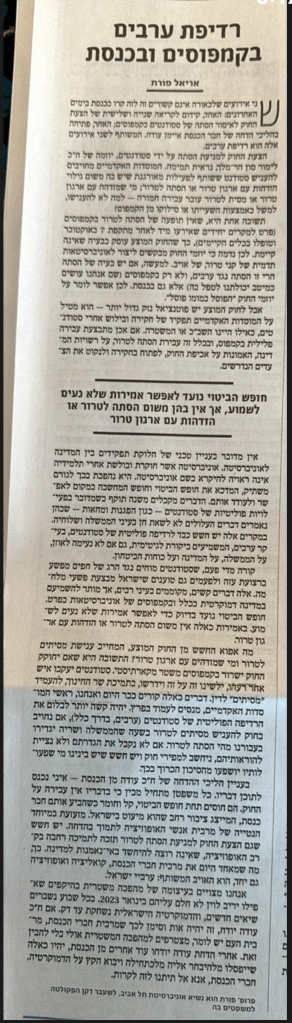


 Watan News
 Professor Ass’ad Ghanem’
 Professor Ass’ad Ghanem’s new book explores the deep structural shifts in Israeli and Palestinian societies behind the Gaza genocide
 Hamas
Hamas Read PACBI’s full statement here:


 Protestors carry a banner reading, “Jewish Bloc for Palestine” at the front of a march. (Photo courtesy of Jewish Anti-Zionist Congress)


 Speakers at the Jewish Anti-Zionist Congress in Vienna, Austria.Rebecca Collard/The World
 Police arrive at the Jewish Anti-Zionist Congress in Vienna, Austria, at the request of the congress organizers.Rebecca Collard/The World
 An Israeli activist challenges counter-demonstrators at the Jewish Anti-Zionist Congress in Vienna who arrived with Israeli flags and the flags of Benjamin Netanyahu’s Likud party.Rebecca Collard/The World
 First Jewish Anti-Zionist Congress, Vienna, June 2025. © Liam Hoare
 The Lueger Monument, 2021, vandalized with the word “Shame” © Liam Hoare
 Dalia Sarig
 Haim Bresheeth
 Vienna, June 14, 2025, Jewish Anti-Zionist Congress
 israel-academia-monitor.com