On August 12, 2024, the American Association of University Professors (AAUP) released a new Statement on Academic Boycotts, written and unanimously approved by the AAUP Committee A on Academic Freedom and adopted on August 9 by the AAUP’s governing Council.
The new statement reconsiders the 2006 AAUP opposition to academic boycotts.
The newly revised policy maintains that “academic boycotts are not in themselves violations of academic freedom and can instead be legitimate tactical responses to conditions that are fundamentally incompatible with the mission of higher education.” The AAUP recognizes that “when faculty members choose to support academic boycotts, they can legitimately seek to protect and advance academic freedom and the fundamental rights of colleagues and students who are living and working under circumstances that violate academic freedom and one or more of those rights. In such contexts, academic boycotts are not in themselves violations of academic freedom.”
According to the AAUP, the “freedom to produce and exchange knowledge depends upon the guarantee of other basic freedoms and human rights, among them the rights to life, liberty, security of person, freedom from arbitrary arrest or detention, and the rights to liberty of movement and freedom to choose one’s residence.”
The statement argues that “individual faculty members and students should be free to weigh, assess, and debate the specific circumstances giving rise to calls for systematic academic boycotts and to make their own choices regarding their participation in them.”
Also stating, “a faculty member’s choice to support or oppose academic boycotts should not itself be the basis of formal reprisal.”
The AAUP “reiterates that academic boycotts should neither involve any political or religious litmus tests nor target individual scholars and teachers engaged in ordinary academic practices, such as publishing scholarship, delivering lectures and conference presentations, or participating in research collaborations.” For the AAUP, “Academic boycotts should target only institutions of higher education that themselves violate academic freedom or the fundamental rights upon which academic freedom depends.”
It is the AAUP’s Committee A on Academic Freedom and Tenure, which is behind the new move. According to its publication, it has “long held that academic exchange should be freely conducted without regard to political or religious viewpoint. On that basis, since its 2006 report On Academic Boycotts, the committee has opposed academic boycotts and encouraged faculty and academic associations to “seek alternative means, less inimical to the principle of academic freedom, to pursue their concerns.” At the same time, according to Committee A, the AAUP has “recognize[d] the right of individual faculty members and groups of academics not to cooperate with other individual faculty members or academic institutions with whom or with which they disagree… when such noncooperation takes the form of a systematic academic boycott, it threatens the principles of free expression and communication on which we collectively depend.”
“While we reaffirm Committee A’s commitment to the free exchange of knowledge, regardless of political or religious viewpoint, we also recognize that the committee’s position opposing academic boycotts has been controversial, contested, and used to compromise academic freedom.” The AAUP “position deserves reconsideration and clarification.”
According to Committee A, “the Association’s own history is “complex” and “includes support for campus strikes, support for divestiture during the anti-apartheid campaigns in South Africa, and a questioning of the requirement of institutional neutrality during the Vietnam War.”
Committee A recognizes that when “faculty members choose to support academic boycotts, they can legitimately seek to protect and advance the academic freedom and fundamental rights of colleagues and students who are living and working under circumstances that violate that freedom and one or more of those rights. In such contexts, academic boycotts are not in themselves violations of academic freedom; rather, they can be considered legitimate tactical responses to conditions that are fundamentally incompatible with the mission of higher education.”
The “freedom to produce and exchange knowledge depends upon the guarantee of other basic freedoms, including the rights to life, liberty, security of person, and freedom from arbitrary arrest or detention; the rights to freedom of thought, conscience, and religion; the right to hold opinions without interference; the right to freedom of expression; the right to participate in public affairs; the right to equal protection and effective protection against discrimination; the right to freedom of association; the right to peaceful assembly; the right to work; the right to participate in cultural life; the right to education; and the rights to liberty of movement and freedom to choose one’s residence. Not all of our academic colleagues and students in the United States and around the world are afforded these fundamental rights.”
Interestingly, Rana Jaleel, the chair of Committee A, is a pro-Palestinian activist. In a 2016 AAUP publication titled “November-December 2016: Race on Campus,” Jaleel published an article, “Teaching Palestine: The importance of bringing the Israel-Palestine conflict into the mainstream.” She stated, “the AAUP must, in the name of academic freedom, continue to push back against legislation and campus policies that cast any critique or less than favorable academic assessment of the Israeli state as discriminatory.” In plain English, Jaleel and other activists have turned their classes and writings into the propaganda arm of the Palestinians. Even worse, Jaleel is a signatory of the petition “Endorsers of the US Campaign for the Academic and Cultural Boycott of Israel.”
The widely-read Inside of Higher Educationemphasized the significance of the change under the title “AAUP Ends Two Decades Opposition to Academic Boycotts.” The author described “the AAUP’s now-abandoned statement opposing academic boycotts shows how the organization found it necessary, from the beginning, to thread the needle on what kinds of protests it deemed acceptable.”
Critics have pointed out the ongoing social science revolution, which turned from post-WWII positivism to activism. As well known, in positivism, social sciences were committed to detailed empirical research to reach conclusions. The currently dominant neo-Marxist, critical theory has little interest in empirical reality because of what it describes as the cultural hegemony of the ruling classes. To unmask the “true reality,” scholars must apply more “intuitive methods” like ideologically driven ontology and epistemology. The influx of activist faculty, notably in sociology, political science, and Middle East Studies, many of Middle Eastern origins caused a wholesale delegitimization of Israel. Worse, in a manifestation of double standards – the hallmark of antisemitism – the activist scholars have not attempted to censure Iran and Arab societies where violations of human rights are widespread. In Iran, for example, women who refuse to wear the hijab are arrested, some even killed, and gays are executed by hanging. In some Arab societies, LGBTQ live often in hiding; ironically, Palestinian LGBTQ have sought refuge in Israel.
Clearly, the AAUP is becoming not only an anti-Israel podium but also unacademic. By arguing that “academic boycotts are not in themselves violations of academic freedom,” the AAUP contradicts the essence of academic freedom. The whole academic world will lose once academics start boycotting each other due to politics.
The AAUP has released a new Statement on Academic Boycotts, which was written and unanimously approved by Committee A on Academic Freedom and adopted by the AAUP’s governing Council on August 9.
The new statement reconsiders the AAUP’s prior categorical opposition to academic boycotts set forth in the 2006 report On Academic Boycotts. The AAUP’s revised policy maintains that academic boycotts are not in themselves violations of academic freedom and can instead be legitimate tactical responses to conditions that are fundamentally incompatible with the mission of higher education. The statement recognizes that when faculty members choose to support academic boycotts, they can legitimately seek to protect and advance academic freedom and the fundamental rights of colleagues and students who are living and working under circumstances that violate academic freedom and one or more of those rights. In such contexts, academic boycotts are not in themselves violations of academic freedom.
The freedom to produce and exchange knowledge depends upon the guarantee of other basic freedoms and human rights, among them the rights to life, liberty, security of person, freedom from arbitrary arrest or detention, and the rights to liberty of movement and freedom to choose one’s residence. The statement concludes that individual faculty members and students should be free to weigh, assess, and debate the specific circumstances giving rise to calls for systematic academic boycotts and to make their own choices regarding their participation in them. Further, it holds that a faculty member’s choice to support or oppose academic boycotts should not itself be the basis of formal reprisal.
The statement reiterates that academic boycotts should neither involve any political or religious litmus tests nor target individual scholars and teachers engaged in ordinary academic practices, such as publishing scholarship, delivering lectures and conference presentations, or participating in research collaborations. Academic boycotts should target only institutions of higher education that themselves violate academic freedom or the fundamental rights upon which academic freedom depends.
The following statement was approved by the AAUP’s Committee A on Academic Freedom and Tenure in July 2024 and adopted by the Association’s Council in August 2024. It supersedes Committee A’s 2006 report On Academic Boycotts.
The AAUP’s Committee A on Academic Freedom and Tenure has long held that academic exchange should be freely conducted without regard to political or religious viewpoint. On that basis, since its 2006 report On Academic Boycotts, the committee has opposed academic boycotts and encouraged faculty and academic associations to “seek alternative means, less inimical to the principle of academic freedom, to pursue their concerns.”1 At the same time, as Committee A observed in that report, the AAUP has “recognize[d] the right of individual faculty members and groups of academics not to cooperate with other individual faculty members or academic institutions with whom or with which they disagree.” Yet, the committee continued, “when such noncooperation takes the form of a systematic academic boycott, it threatens the principles of free expression and communication on which we collectively depend.”2 While we reaffirm Committee A’s commitment to the free exchange of knowledge, regardless of political or religious viewpoint, we also recognize that the committee’s position opposing academic boycotts has been controversial, contested, and used to compromise academic freedom. We therefore believe that this position deserves reconsideration and clarification.
Academic freedom and productive debate may not always be appropriately secured by a categorical position that disregards nuance and is inattentive to context. As Committee A’s 2006 report observed, the Association’s own history is “complex” and “includes support for campus strikes, support for divestiture during the anti-apartheid campaigns in South Africa, and a questioning of the requirement of institutional neutrality during the Vietnam War.”3 The report also quoted comments made by Nelson Mandela to the African National Congress: “In some cases . . . it might be correct to boycott, and in others it might be unwise and dangerous. In still other cases another weapon of political struggle might be preferred. A demonstration, a protest march, a strike, or civil disobedience might be resorted to, all depending on the actual conditions at the given time.”4
Committee A recognizes that when faculty members choose to support academic boycotts, they can legitimately seek to protect and advance the academic freedom and fundamental rights of colleagues and students who are living and working under circumstances that violate that freedom and one or more of those rights. In such contexts, academic boycotts are not in themselves violations of academic freedom; rather, they can be considered legitimate tactical responses to conditions that are fundamentally incompatible with the mission of higher education. The freedom to produce and exchange knowledge depends upon the guarantee of other basic freedoms, including the rights to life, liberty, security of person, and freedom from arbitrary arrest or detention; the rights to freedom of thought, conscience, and religion; the right to hold opinions without interference; the right to freedom of expression; the right to participate in public affairs; the right to equal protection and effective protection against discrimination; the right to freedom of association; the right to peaceful assembly; the right to work; the right to participate in cultural life; the right to education; and the rights to liberty of movement and freedom to choose one’s residence. Not all of our academic colleagues and students in the United States and around the world are afforded these fundamental rights.
Committee A therefore holds that individual faculty members and students should be free to weigh, assess, and debate the specific circumstances giving rise to calls for systematic academic boycotts and to make their own choices regarding their participation in them. To do otherwise contravenes academic freedom. Faculty members’ choices to support or oppose academic boycotts should not themselves be the basis of formal reprisal.5 While such choices may be criticized and debated, faculty members and students should not face institutional or governmental censorship or discipline for participating in academic boycotts, for declining to do so, or for criticizing and debating the choices of those with whom they disagree. The decision to participate in an academic boycott should be situationally sensitive and consider the full range of alternative tactics available to achieve the desired goals. We reiterate that academic boycotts should neither involve any political or religious litmus tests nor target individual scholars and teachers engaged in ordinary academic practices, such as publishing scholarship, delivering lectures and conference presentations, or participating in research collaborations. Academic boycotts should target only institutions of higher education that themselves violate academic freedom or the fundamental rights upon which academic freedom depends.
4. Nelson Mandela, No Easy Walk to Freedom(London: Heinemann Educational, 1990), 63, quoted in “On Academic Boycotts,” 42.
5. See also “Committee A Statement on Extramural Utterances,” Policy Documents and Reports, 11th ed. (Baltimore: Johns Hopkins University Press, 2015), 31.
AAUP Ends Two-Decade Opposition to Academic Boycotts
In 2005, the American Association of University Professors spoke out against this form of protest amid calls for scholars to spurn Israeli institutions. Now, the group says boycotts “can be considered legitimate tactical responses.”
The American Association of University Professors has dropped its categorical opposition to academic boycotts.
Photo illustration by Justin Morrison/Inside Higher Ed | American Association of University Professors
The American Association of University Professors (AAUP) has dropped its nearly 20-year-old categorical opposition to academic boycotts, in which scholars and scholarly groups refuse to work or associate with targeted universities. The reversal, just like the earlier statement, comes amid war between Israelis and Palestinians.
In 2005, near the end of the second intifada, a Palestinian uprising, the AAUP denounced such boycotts; the following year, it said they “strike directly at the free exchange of ideas.” That statement has now been replaced by one saying boycotts “can be considered legitimate tactical responses to conditions that are fundamentally incompatible with the mission of higher education.” The new statement doesn’t mention Israel, Palestine or other current events—but the timing isn’t coincidental.
The new position says that “when faculty members choose to support academic boycotts, they can legitimately seek to protect and advance the academic freedom and fundamental rights of colleagues and students who are living and working under circumstances that violate that freedom and one or more of those rights.”
The AAUP is both a union and a national faculty group that establishes widely adopted policies defining and safeguarding academic freedom and tenure. Its Committee A on Academic Freedom and Tenure voted to approve the new stance in July, and the group’s national Council voted to approve it Friday.
The old policy had “been reportedly used to squelch academic freedom,” said Rana Jaleel, chair of Committee A. Now, “what we’re saying is that we trust our members—our faculty on the ground who are doing the organizing work—to assess, weigh and decide whether or not they want to participate in academic boycotts,” she said.
The AAUP’s new statement still says boycotts shouldn’t “involve any political or religious litmus tests nor target individual scholars and teachers engaged in ordinary academic practices,” such as conference presentations. It says such “boycotts should target only institutions of higher education that themselves violate academic freedom or the fundamental rights upon which academic freedom depends.”
“Freedom to produce and exchange knowledge depends upon the guarantee of other basic freedoms,” the document says—including, among others, the freedom to live, the freedom from arbitrary arrest and the freedom of movement.
Both two decades ago and today, the organization’s statements on academic boycotts have come amid calls from Palestinian supporters to boycott Israel—academically, economically and otherwise. Despite the AAUP’s past opposition, some major discipline-based U.S. scholarly associations have endorsed academic boycotts of Israel: the American Studies Association did so around a decade ago, and the American Anthropological Association joined last year.
The AAUP, while it called for an “immediate ceasefire” in Gaza in February and has now dropped its opposition to academic boycotts, hasn’t gone as far as specifically endorsing an academic boycott of Israeli universities or the broader boycott, divestment and sanctions movement.
The importance of bringing the Israel-Palestine conflict into the mainstream.
By Rana Jaleel
I teach courses that reflect my work in critical queer, feminist, and ethnic studies, security studies, and law. In all of my classes, I teach about Palestine. When I tell colleagues this, I tend to hear one of the following in reply:
1. That’s brave; I avoid it like the plague.
2. You are going to get in trouble.
But teaching Palestine is not about bravery or troublemaking. It is about academic freedom—about the ability to conduct research and teach about a topic of global import without undue constraint.
For any account of the historical and contemporary politics of race in the United States, the issue of Palestine has been and remains a significant, if at times overlooked, subject. US civil rights–era activist groups—including the Student Nonviolent Coordinating Committee and the Black Panthers—advocated global racial justice platforms that viewed Palestinian problems as racial problems akin to their own. More recently, the Israel-Palestine conflict has emerged as a key element of the Black Lives Matter “Vision for Black Lives” policy platform (which calls for the cessation of US funding and military aid to the Israeli state and dubs its treatment of Palestinians “genocide”). The issue has also arisen in more conventional venues, proving contentious at the 2016 Democratic National Convention.
Yet despite the fact that the Israel-Palestine conflict is unequivocally a mainstream political and social issue, on many campuses, it is almost too fraught to mention.
BDS and Beyond
The AAUP categorically condemns academic boycotts on the grounds that they inhibit the free exchange of ideas and are therefore prima facie violations of academic freedom (although this position is a matter of no small amount of internal debate; see, for example, the lively exchange in volume 4 of the AAUP’s Journal of Academic Freedom, published in 2013). But initiatives developed by opponents of the boycott, divestment, and sanctions (BDS) movement have smuggled in proposals and regulations that undermine the very academic freedoms they purport to defend. These include campus policy and mission statements that equate anti-Zionist and other criticisms of certain Israeli state actions with anti-Semitism. Undertaken in the name of antidiscrimination, these policies can chill classroom discussion of Israel and Palestine—especially as nationwide legislative efforts to forestall BDS activism embrace this same logic.
Over the last several years, a groundswell of legislation introduced at the local, state, and federal levels has taken aim at human rights activism related to Palestine, specifically BDS. According to Jewish Voice for Peace, as of August 2016, twenty-two states had introduced or passed anti-BDS legislation that seeks to deny public funding to organizations that choose to participate in the BDS movement. This year alone saw anti-BDS laws enacted in Alabama, Arizona, Colorado, Florida, Georgia, Illinois, Indiana, Iowa, Rhode Island, and South Carolina. Similar legislative initiatives are being organized in dozens of other states. Meanwhile, in New York, Governor Andrew Cuomo signed an anti-BDS executive order, and in New Jersey, another anti-BDS bill passed the legislature. Eugene Kontorovich, a law professor at Northwestern University who has consulted with groups advancing anti-BDS legislation, describes the turn to legal activism as an attempt to “use state contracting power to fight back against racism.”
These efforts have bolstered campus-oriented initiatives that deny the distinction between critical perspectives on Zionism or Israeli state policies and anti-Semitism. The same logic lends credence to projects like Canary Mission, the latest in a line of anonymous blacklisting sites designed to intimidate students, faculty members, and community activists engaged in Palestine solidarity work. Canary Mission has used Twitter to reach these students’ employers and prospective graduate departments, claiming that members of Students for Justice in Palestine are racist and anti-Semitic and that they support terrorists.
At the institutional level, in March 2016 the University of California Board of Regents proffered a document intended to reaffirm antidiscrimination as a core institutional tenet by restating the mission of the University of California. These “Principles against Intolerance,” however, identified only one specific form of discrimination (anti-Semitism), and early iterations of the principles essentially equated anti- Zionism with anti-Semitism. All ten UC academic senate divisional chairs as well as many individual faculty members cosigned a statement in response, noting that the document as written would be “counterproductive . . . insofar as it reinforces the perception that those in charge of the university take discrimination against some groups more seriously than discrimination against others.” The responding statement also urged the regents to refrain from altering the mission statement of the University of California system absent “the same tests and discussions as the mission of the 1970s,” which had included extensive consultation with systemwide faculty, staff, student, and other university community members.
Both Canary Mission and the “Principles against Intolerance” (and its incursions on shared governance) are the fruit of a collective unease about discussing Israel and Palestine that has been cultivated through the collapse of critique into (illegal) discrimination. In today’s climate, it is personally and professionally risky to participate in activist or academic work on Israel and Palestine in or out of the classroom. This situation endangers meaningful engagement with race, including the comprehensive study and discussion of global antiracist social movements. These tensions resurface each quarter in my classroom.
In the Classroom
Like it or not, discussion of Israel and Palestine is a necessary component of any course that aims to cover contemporary thinking in critical ethnic and queer studies. Critical ethnic studies scholars grapple with global racial solidarity platforms of the sort offered by Black Lives Matter and indigenous activists. Like certain US civil rights–era activists before them, these activists link the logic that fuels US racial injustices domestically with a global foreign policy animated by racial hierarchies, now including the US military funding of the Israeli state. Queer studies scholars—particularly those whose research involves sexuality and transnational social movements—have produced multifaceted works that follow what happens when gay movements, often historically oppositional or even antagonistic to state interests, succeed in wooing the state to their side. The recent and unprecedented successes of these movements have given scholars a lot to talk about: How are states now championing sexual rights in ways that can mask other forms of oppression, including racial and migrant oppression? What steps may democratic states take in the name of security (including the protection of sexual and racial minorities)? What are the possibilities and limits of contemporary global racial and sexual solidarity campaigns?
Each quarter, my classes engage with these questions in the US and Canadian, Western European, and Israeli contexts because these states and regions broadcast their embrace of certain LGBTQ issues to signal a larger dedication to democratic rule. Often, states undertake this signaling to refute legitimate criticisms of the state’s repressive policies against other marginalized groups, especially racialized minorities. Queer activists and scholars call this practice “pinkwashing” and use the term to mark the limits of who gets protected, whose and what types of “diversity” (racial, sexual, or otherwise) are valued within liberal multicultural democracy. The Obama administration, for example, has praised queer DREAMers even as US Immigration and Customs Enforcement deports a record number of migrants and detains transgendered ones under deplorable conditions. Similarly, through its state-sponsored “Brand Israel” campaign, Israel seeks to establish itself as a “Mecca” and global destination for LGBTQ persons—unless those LGBTQ persons happen to be Palestinian. In short, the advent of same-sex sexual rights as a state agenda has opened new vistas of global activism and scholarship that require critical examination— not unthinking or automatic acceptance or rejection—in and out of the classroom.
But before introducing this scholarship in my courses, I have to establish and defend the necessity and propriety of speaking about Israel and Palestine at all. In the current political climate, some students come into the classroom already equating any criticism of Israeli state policy with anti-Semitism. This, in turn, makes it difficult for them to enter classroom discussions in which simplistic media representations of the Israel-Palestine conflict as a purely ethnoreligious antagonism are displaced, disrupted, or in any way complicated. Some classroom statements that have provoked shock, tears, deadening silence, and rage from students from a range of political and ideological persuasions include the following:
1. There is a Palestinian diaspora.
2. There are Jewish Arabs and Christian Arabs, Jewish Palestinians and Christian Palestinians. And there are Druze, Samaritans, migrant workers (who come primarily from the Philippines, Sri Lanka, India, and Thailand and often labor in substandard conditions), and African refugees, among others, who reside in Israel and Palestine and are affected by their respective laws and policies.
3. Sharia is neither a uniform nor a unified body of law.
4. Anti-Semitism and Islamophobia are both severe social problems.
5. US-based social justice activism has historically linked and continues to link domestic racial oppression, including black oppression, to global racial struggles, including Palestinian ones.
These are statements of fact, well established by vast bodies of scholarship. What’s disturbing is not that students (and faculty) don’t know these particular facts. What’s disturbing is that clear moral lines have been drawn in ways that place facts beyond the discursive pale, where they have come to be seen as traumatic psychological triggers rather than as subjects of academic inquiry or political debate.
This has little to do with any shortcoming on the part of the students, who are overwhelmingly serious thinkers and above all striving to be good people, and everything to do with the political and cultural context in which we find ourselves—one that can perversely curtail academic freedom in the name of a hollow concept of antidiscrimination that supplants equity or justice concerns with behavioral policing and speech prohibitions. Here, a neutral civility (read: silence) in the face of Palestinian human rights abuse is recompense for an anti-Semitism that spans centuries. Here, the prescribed, purportedly antiracist response to the long-standing problem of global anti-Semitism amounts functionally to silence in the face of state violence.
Everyone researching, teaching, or otherwise engaged in any discussion of race at the university, however, deserves better. And some of the work to make “better” a possibility must start on our campuses and within our professional organizations, including the AAUP. Whatever one believes about BDS, faculty and other academic workers should be concerned with how the idea of its unlawfulness has at times transmogrified into the presumed incorrectness—even racist illegality— of discussions or analyses that do not begin and end with an at least tacit endorsement of the Israeli state. For some wings of queer studies, for example, this silencing essentially amounts to a silencing of disciplinary work. When one of the tasks of queer studies scholars is to analyze how certain notions of sexual freedom can become a vehicle (for better or worse) of state power, no state or institution can emerge entirely unscathed. And if a core tenet of a functioning democracy is robust political dissension and critique, no one should expect, desire, or require affirmation of or complicity with state action as proof of another’s nondiscriminatory bona fides.
For these reasons, when we talk about race on campus, Israel and Palestine should be considered. And in order for Israel and Palestine to be considered adequately, the AAUP must, in the name of academic freedom, continue to push back against legislation and campus policies that cast any critique or less than favorable academic assessment of the Israeli state as discriminatory. To insist on the academic freedom necessary to speak, teach, and conduct research about Israel and Palestine is to preserve a condition of learning. It is to ensure the intellectual space necessary to consider how to live in an interconnected world and how to produce the kinds of knowledge that can be responsive to and responsibly engaged with it. Most crucially, to insist on that academic freedom is to acknowledge and refuse to obscure a history of global antiracist work and social justice organizing premised on the core belief that people share interests that connect them across identity groups and state membership designations. That’s a lesson as good as lost if evidence of antiracist thinking on and off campus continues to require deference to, if not praise of, the state.
Rana Jaleel is assistant professor of gender, sexuality, and women’s studies at the University of California, Davis. She is also a member of the AAUP’s Committee on Women in the Academic Profession.
Since its foundation in 2004, Israel Academia Monitor has reported on numerous cases of academic boycotts. Indeed, some of the early advocates of BDS were Israeli academics, such as Prof. Rachel Giora, Dr. Anat Matar, and Prof. Ilan Pappe, among others. The Israeli academic community and the government were very slow to respond to these challenges. The upheaval on campus in the United States and Europe changed this attitude. Currently, several efforts are emerging to combat the threats of academic boycotts.
On July 9, 2024, The Lobby for Higher Education held a meeting in the Knesset titled “The State of Campuses in the USA and Boycott Campaigns: Challenges and Opportunities for the Israeli Higher Education System.”
The Israeli Ministry of Innovation, Science and Technology published an announcement titled “The Higher Education Lobby in the Knesset,” which received little media attention.
The Higher Education Lobby meeting was chaired by MK Ze’ev Elkin and MK Eli Dallal. The Lobby dealt with the state of higher education under the threat of boycotts. Gila Gamaliel, the Minister of Innovation, Science and Technology, said, “Calls for a boycott have devastating consequences for the freedom of research and international cooperation on our part, and it is a matter of long-term potential damage. We will not stand by while Israel’s research and academic centers are under a gnawing attack from Israel’s economic and security strength.” The heads of higher education institutions, ministers, and members of the Knesset also participated in the discussion.
Minister Gamaliel referred to the increasing calls for a boycott that have devastating consequences for the freedom of research and may harm high-tech, technological, defense, and medical industries – which depend on academic research. The Minister informed the lobby that she defined the fight against the boycott as a top priority issue in her Ministry’s activities with the intention of protecting Israeli research. Israeli researchers are, according to her, “under a gnawing attack against Israel’s economic and security strength.” Following her remarks, the Minister reviewed her Ministry’s activities to curb the destructive consequences of an academic boycott in the Israeli and international arena, which includes formulating and approving an operative decision-making proposal in the Ministerial Committee for Innovation and Science chaired by her in the amount of NIS 90 million for the purposes of a legal fight against the boycotts; conducting scientific conferences in Israel; exposure of programs in Israel for students from abroad, promotion of binational research, exposure of tours in Israel for senior researchers and teams from academic institutions abroad.
The Minister also announced she is working to form an international front against boycotts and manifestations of anti-Semitism in the academic and scientific arena, as she did recently in her meeting with her German counterpart, who stated: “There must be no place for hatred of Israel and hatred of Jews,” and that “Jewish students and lecturers must be able to feel safe.”
Minister Gamliel assured the heads of higher education institutions that the Ministry of Innovation, Science and Technology will act resolutely to ensure that the scientific boycott does not harm Israeli education and research and that Israeli researchers and students can continue to create and lead in their fields despite the challenges.
Another effort to fight the boycott comes from the Technion – Israel Institute of Technology. The Technion’s Samuel Neaman Institute for National Policy Research has recently established a task force to collect data on academic boycott activities worldwide, analyze them, and suggest ways to confront them. As the Samuel Neaman Institute notes, “Since the Hamas attack on October 7th, 2023, there has been an increase in reports of anti-Israel activities on campuses worldwide.” The task force addresses the issue under the banner “Scholar Shield.” It includes the following team members: Prof. Boaz Golany,Prof. Rivka Carmi,Tsipy Buchnik,Ella Barzani,Oshrat Katz Shacham,Golan Tamir, and Prof. Yair Goldberg. The task force collaborates with the Council of University Heads (VERA), the Council of College Heads (VARAM), relevant government ministries, and other stakeholders.
Responding to the boycott calls, the Israeli association of scholars, “BaShaar – Academic Community for Israeli Society,” published their position paper on July 9, 2024, titled “The Academic Boycott on Israel.” It states that BaShaar “views with great concern the expanding trends in academia worldwide to boycott Israeli academia. The calls for a boycott are a central part of the wave of riots and demonstrations that sweep campuses. In some cases, these calls reveal blind antisemitism, anti-Israelism and often even blind support of Hamas terror organization, its atrocities and its charter which calls for the destruction of Israel. These trends should be fought vehemently.” BaShaar added it “condemns supporters of the murderous terrorist organization Hamas, the rising manifestations of anti-Semitism against Jews just because they are Jews, the anti-Israelism that denies any right of the State of Israel to exist, and the incitement and boycott movement.”
BaShaar stated there are some liberal scholars who are not blindly Antisemitic or anti-Israel. Such scholars do support the calls for a boycott out of “critical response to Israel’s policies and activities in Gaza and the genuine concern for the tens of thousands of Gazan casualties, many of them non-involved civilians, men, women and children in this terrible war and the demand to guarantee the needed humanitarian help.”
BaShaar then argued that even in such cases, the “call for boycott is unjustified.” BaShaar said, “Regardless of one’s views concerning the policies of the Israeli government, they do not justify an academic boycott. Science and humanities should serve as bridges between people and nations. Academic values and ethos including freedom of thought and expression, tolerance, equality and progress are now under attack in many countries, including Israel. Israeli universities are committed to these values, as declared by academic staff, academic organizations and university managements. An academic boycott joins such attacks and undermines these cherished values.” BaShaar ended by calling “upon our colleagues worldwide: while one may certainly express her or his criticism and strong concern about Israeli policies and actions, it should not follow the road of boycott.
However, upon announcing the newly established Scholar Shield on the pages of Academia-IL-Bashaar, two messages surfaced from Israeli academics. The first arrived from Prof. (emerita) Outi Bat-El Foux, Department of Linguistics, Tel-Aviv University, who wrote, “There are no Israeli academics who act against Israel, but there are people who interpret the words and actions of academics as activity against Israel and as anti-Semitism. Even those who advocate a boycott of academic institutions do so for Israel, and not against it, with the true intention that the boycott will cause the government to behave with a certain degree of sanity.” The second message that followed arrived from Hanna Herzog, Professor Emeritus of Sociology, Department of Sociology and Anthropology, Tel Aviv University, who wrote, “I agree with what Outi wrote. Still, I was amazed to receive this email – is this what the Neaman Institution was created for? To be part of the Shin Bet or any other state body. And all for money. Where did we get to?”
Bat-El Foux’s comments are sheer sophistry with its twisted logic and turgid prose. BDS, in her opinion, “would cause the government to behave with a certain degree of sanity.” In other words, she considers the Israeli response to the murderous attack of Hamas on October 7 “insane,” as opposed to the “sane” behavior of Hamas. Herzog’s comment lamenting that the Neaman Institute is “part of the Shin Bet” is even more egregious. The BDS crowd made no secret of their desire to degrade Israel’s leading role in advanced technology in a variety of fields, including medicine, environmentally friendly agriculture, and environmental amelioration. Not incidentally, many of the scientific-military developments, including the Iron Dome, saved the lives of countless Israelis from targeted attacks of Iran and its proxies on the civilian population. Israel’s enemies would want nothing more than to degrade the technological advantage of a country surrounded by existential threat.
IAM welcomes the new initiatives to fight BDS abroad. However, since some Israeli academics have supported a boycott against Israeli institutions for decades, the lesson is clear: the efforts to combat BDS should start at home.
שרת החדשנות המדע והטכנולוגיה גילה גמליאל בישיבת שדולת ההשכלה הגבוהה בכנסת: “לקריאות לחרם השלכות הרסניות על חופש המחקר ושיתוף הפעולה הבינלאומי מצדנו, ומדובר בנזק פוטנציאלי ארוך טווח. לא נעמוד מנגד בעוד מרכזי המחקר והאקדמיה בישראל נמצאים תחת מתקפה המכרסמת בעוצמתה הכלכלית וביטחונית של ישראל.”
תאריך:
29.07.2024
שרת החדשנות, מדע וטכנולוגיה גילה גמליאל השתתפה היום (ג’) בישיבת שדולת ההשכלה הגבוהה בכנסת בראשות ח”כ אלקין וח”כ אלי דלל שעסקה במצב ההשכלה הגבוהה תחת איום החרם. בדיון בהשתתפות ראשי מוסדות ההשכלה הגבוהה בישראל, שרים וחברי כנסת התייחסה השרה גמליאל לקריאות המתגברות לחרם המביאות להשלכות הרסניות על חופש המחקר ועלולות לפגוע בהיי-טק ובתעשיות טכנולוגיות, ביטחוניות ורפואיות – התלויות במחקר האקדמי. השרה עדכנה את המשתתפים כי הגדירה את המאבק בחרם כנושא בעדיפות עליונה בפעילות משרדה מתוך כוונה להגן על המחקר הישראלי, על החוקרות והחוקרים הישראלים הנמצאים לדבריה “תחת מתקפה המכרסמת בעוצמתה הכלכלית וביטחונית של ישראל”.
בהמשך דבריה סקרה השרה את פעילות משרדה לבלימת ההשלכות ההרסניות של חרם אקדמי בזירה הישראלית והבינלאומית הכוללת גיבוש ואישור הצעת מחליטים אופרטיבית בוועדת שרים לחדשנות ומדע בראשותה בסך 90 מיליון ₪ לצורכי מאבק משפטי בחרם; ביצוע כנסים מדעיים בישראל; תוכניות חשיפה בישראל לסטודנטים מחו״ל, קידום מחקר דו לאומי סיורי חשיפה בישראל לחוקרים בכירים ומנהלים ממוסדות אקדמיים בחו״ל. בו בזמן השרה עידכנה כי היא פועלת לגיבוש חזית מאבק בינלאומית בחרמות ובגילויי האנטישמיות בזירה האקדמית והמדעית כפי שעשתה לאחרונה בפגישתה עם מקבילתה הגרמנית שהצהירה: “אסור שיהיה מקום לשנאת ישראל ושנאת יהודים״, וכי ״סטודנטים ומרצים יהודים חייבים להיות מסוגלים להרגיש בטוחים״. השרה גמליאל הבטיחה לראשי המוסדות להשכלה גבוהה כי משרד החדשנות, מדע וטכנולוגיה יפעל בנחישות להבטיח כי החרם המדעי לא יפגע בהשכלה ובמחקר הישראלי וכי החוקרים והסטודנטים הישראלים יוכלו להמשיך ליצור ולהוביל בתחומם, למרות האתגרים.
If you come across any instances of an academic boycott targeting Israelis (such as academic faculty members, post-doctoral students, or students) or academic institutions in Israel, please report them using the following link: https://surveys.sni.technion.ac.il/survey/index.php/893414
The BDS movement has been active globally for over two decades. The movement operates on multiple fronts, including economic, political, academic, and cultural. Since the Hamas attack on October 7, there has been a significant increase in anti-Israel activities on campuses across the USA, Canada, Australia, and Western and Northern Europe. Students, faculty, and even some university administrators have organized protest camps, marches, roadblocks, and have forcibly prevented Israelis and Jews from entering parts of the campus. Additionally, there have been calls for halting student exchanges with Israel and banning Israeli researchers from submitting proposals to national and international foundations. These developments compel Israeli universities and the government to evaluate the potential consequences of the BDS movement’s escalated actions. This includes examining the practical, scientific, academic, legal, and economic implications and exploring measures to mitigate their impact. Recognizing the potential harm of an academic boycott on Israel, the Samuel Neaman Institute has established an ad-hoc task force to address the issue under the concept of SCHOLAR SHIELD. This team collaborates with the University Heads’ Committee, relevant government ministries, and other organizations.
Following the Hamas attack on October 7th, there has been a notable surge in anti-Israel activities on university campuses worldwide. This surge is being manifested through protest encampments, marches, blockades, preventing the access of Israeli and Jewish students and faculty to sites on campuses and more. Academic BDS (Boycott, Divestment, Sanctions) supporters are calling for the severance of research collaborations with Israeli scientists and academic institutions, termination of student exchange programs, excluding Israeli researchers from submitting proposals to national and international research funds, cessation of investments by universities endowment funds in Israeli companies etc. Institutional Response
The escalating academic boycott, either implicit or explicit, necessitates proactive measures by universities and government agencies to both assess the potential impact and address the needs involved in combating it. To this effect, the Samuel Neaman Institute for National Policy Research has formed a task force entitled “Scholar Shield”. This task force collaborates with the Council of University Heads (VERA), the Council of College Heads (VARAM), relevant government ministries, and other stakeholders. Project Objectives & Approach
The project aims to collect data on BDS initiatives, analyze it and develop insights that would help individual researchers, university leadership teams, the Council for Higher Education and government ministries thwart the boycott attempts and mitigate their impact.
Key Activities
Mapping BDS Incidents
• Incident Reporting system
• Data Mining
Information Center
• Mapping BDS Initiatives
• Creating Global Network
Knowledge accessibility & Dissemination
• Dashboard • Dynamic Toolbox • Periodic Reports
Research Focus
The collected data and accumulated knowledge will enable the project team to address critical research and policy questions, such as:
• Identification of countries/universities with stronger BDS impacts and trends over time.
• Analysis of Israeli universities’ exposure to academic BDS and trends over time.
• Examination of research fields more vulnerable to academic BDS and trends over time.
• Quantification of the overall impact of academic BDS on Israeli academia, including economic damages.
• Identification of effective responses and best practices in tackling the phenomenon.
Since the Hamas attack on October 7th, 2023, there has been an increase in reports of anti-Israel activities on campuses worldwide. The Samuel Neaman Institute for National Policy Research has established a task force whose purpose is to collect data on academic boycott activities worldwide, analyze it and suggest ways to confront it. To support the team, the Neaman Institute has created an infrastructure over time and from various sources.
The following questionnaire aims to assist the task force in gathering information about this phenomenon and its scope, enabling analysis, insights and recommendations for action.
If you have experienced or encountered an academic BDS incident, we would appreciate your participation in filling out the questionnaire.
Your contribution to this research is important!
Please note that all information received from the questionnaire will be used solely by the Samuel Institute team for processing and analysis purposes. No personal data will be shared with external entities without your explicit consent. The Samuel Institute is committed to full confidentiality and protection.
Best regards,
Boaz Golany, Senior Research Fellow at the Samuel Neaman Institute and Professor at the Technion – Israel Institute of Technology
Rivka Carmi, Senior Research Fellow at the Samuel Neaman Institute and Emeritus Professor at Ben-Gurion University of the Negev
For more information and a list of useful sources, visit the project page on the Neaman Institute website:
Position Paper | The Academic Boycott on Israel | 9.7.24
“BaShaar – Academic Community for Israeli Society”* views with great concern the expanding trends in academia worldwide to boycott Israeli academia. The calls for a boycott are a central part of the wave of riots and demonstrations that sweep campuses.
In some cases, these calls reveal blind antisemitism, anti-Israelism and often even blind support of Hamas terror organization, its atrocities and its charter which calls for the destruction of Israel. These trends should be fought vehemently. “BaShaar” condemns supporters of the murderous terrorist organization Hamas, the rising manifestations of anti-Semitism against Jews just because they are Jews, the anti-Israelism that denies any right of the State of Israel to exist, and the incitement and boycott movement.
There are, however, liberal colleagues who are not blindly anti-Semitic or anti-Israel. These scholars support the calls for boycott out of critical response to Israel’s policies and activities in Gaza and the genuine concern for the tens of thousands of Gazan casualties, many of them non-involved civilians, men, women and children in this terrible war and the demand to guarantee the needed humanitarian help. “BaShaar” argues that even in these cases, the call for boycott is unjustified.
“BaShaar” has demanded in the past and continues to demand that the Israeli government should refrain, as much as possible, even during war, from acts that harm (even unintentionally) the civilian population, and act in accordance with the laws of war. Humanitarian aid, shelter, food, and medical care must be ensured for the civilian population. Additionally, the Israeli government must formulate a strategic plan for the release of the remaining 120 hostages, as a first priority, to ensure the safety of Israelis in general and the displaced communities in particular, to significantly weaken Hamas, and to look for ways for a future Palestinian management of the Gaza Strip for the benefit of its people. A responsible handling of these issues by the Israeli government is necessary for ending the war and building a better peaceful future for both Israelis and Palestinians.
Regardless of one’s views concerning the policies of the Israeli government, they do not justify an academic boycott. Science and humanities should serve as bridges between people and nations. Academic values and ethos including freedom of thought and expression, tolerance, equality and progress are now under attack in many countries, including Israel. Israeli universities are committed to these values, as declared by academic staff, academic organizations and university managements. An academic boycott joins such attacks and undermines these cherished values.
We, therefore, call upon our colleagues worldwide: while one may certainly express her or his criticism and strong concern about Israeli policies and actions, it should not follow the road of boycott.
We call on academia and research institutions worldwide to fight against and oppose any manifestation of racism, anti-Semitism, Islamophobia, and anti-Israel views. We urge members of the international academic community to ensure that the academic space is a safe space for all and to denounce and eradicate any activity that endangers personal and institutional security.
As members of the Israeli academic community in Israel and internationally, we are increasingly alarmed by the recent institutional attempts to boycott Israeli academics and implement bans within organizations and institutions on collaborating with Israelis. This includes attempts to exclude Israeli colleagues from existing grant projects; the cancellation of student exchange programs involving Israeli partners; and the cancellation of lectures by Israeli faculty. We are also witnessing attempts to eject Israelis from academic forums and working groups and a range of other actions by international colleagues to diminish the visibility of lectures by Israeli faculty and otherwise air-brushing out references to their home institutions’ location in Israel.
To date, all of Israel’s institutions of higher education are reporting numerous cases. Most of these cases have originated in Europe, but we are witnessing a growing number in the U.S., Canada, and Australia.
First and foremost, institutionally imposed boycotts as imposed for example by Ghent University break the clear boundaries safeguarding the academic freedom of the faculty within these institutions. We find it unacceptable for a university to ban its faculty from pursuing their research based on the political decisions of its management. We call on our colleagues within these universities to uphold their own academic freedom and resist calls to break ties with their colleagues.
We further call on all academic colleagues of all nationalities to join us in calling for the cessation of boycott attempts against Israeli academics, on both legal and ethical grounds, and thus uphold the fundamental principles of professional conduct and academic freedom. Moreover, we strenuously call for the global research community to enhance communication, dialogue, and collaboration as a powerful tool that can foster peaceful resolution of conflicts and improve the lives of all.
We are heartened by the European Commission’s stance that the termination of grants within the Horizon Europe Programme with Israeli researchers on the basis of their nationality “would be improper and would amount to discrimination prohibited under the Association agreement” of Horizon Europe.[1] The letter’s author, EU research and innovation commissioner Dr. Iliana Ivanova, made this statement in a reply to a letter by Flemish universities. Dr. Ivanova’s letter comes in the wake of decisions by a series of these universities to suspend research ties with Israel.
We appreciate the clear voices of objection to boycott, to discrimination against Israeli researchers[2]. The collective will of all members of academia who care about academic freedom, freedom of speech, and freedom from discrimination is critical, particularly in the face of crisis.
The global academic research community, which engages in the overall pursuit of knowledge for the betterment of humanity, is a critical player in the pursuit of solutions to conflict. Both the bonds brokered in the research process (the means to the end) and the insights and discoveries that emanate from it (the end itself) are essential in the common mission to advance and improve the state of humanity, in all countries and territories, and for all peoples.
———- Forwarded message ——— From: Dana Barnett Date: Tue, Jul 30, 2024 at 11:23 AM Subject: Re: [Academia-IL-Bashaar] טופס לדיווח על מקרים של חרם אקדמי To:
לכבוד: אלה ברזני, צוות חרמות ברזל, מוסד שמואל נאמן.
שלום רב,
אני מנכלית עמותת מוניטור האקדמיה הישראלית.
בשנת 2004 פתחנו אתר אינטרנט ומאז אנחנו אוספים חומרים מהאינטרנט ומפרסמים פוסטים על אנשי אקדמיה שפועלים נגד ישראל, דה לגיטימציה לישראל, קוראים לחרם, ואנטישמיות.
אנחנו גם מתייחסים אל אנשי אקדמיה ישראלים מהאוניברסיטאות בארץ הפועלים נגד ישראל.
יתכן וזה ישמע תמוה אבל ישנם אנשי אקדמיה ישראלים שעבור הטבות וצ׳ופרים קראו לחרם נגד ישראל, כבר מתחילת שנות האלפיים.
אני חוקרת את התופעה כבר עשרים שנה וכתבתי על כך דוקטורט ומאמרים אקדמיים.
———- Forwarded message ——— From: Outi Bat-El Foux<obatel@tauex.tau.ac.il> Date: Tue, Jul 30, 2024 at 6:28 PM Subject: Re: [Academia-IL-Bashaar] טופס לדיווח על מקרים של חרם אקדמי To:
הרשו לי לציין שאתר מוניטור מזעזע, אבל בשם חופש הדיבור יש לו זכות קיום. אין אנשי אקדמיה ישראלים שפועלים נגד ישראל, אבל יש אנשים שמפרשים את דבריהם ומעשיהם של אנשי אקדמיה כפעילות נגד ישראל וכאנטישמיות. גם אלה שדוגלים בחרם על מוסדות אקדמיים עושים זאת למען ישראל, ולא נגדה, מתוך כוונה אמיתית שהחרם יגרום לממשלה לנהוג במידה מסוימת של שפיות. Prof. (emerita) Outi Bat-El | Department of Linguistics | Tel-Aviv University | Tel-Aviv 69978, Israel | obatel@tauex.tau.ac.il | www.outibatel.com
———- Forwarded message ——— From: Hanna Herzog<hherzog@tauex.tau.ac.il> Date: Thu, Aug 1, 2024 at 11:41 AM Subject: RE: [Academia-IL-Bashaar] טופס לדיווח על מקרים של חרם אקדמי To:
מסכימה עם מה שאותי כתבה.
ובכל זאת, נדהמתי לקבל דוא”ל זה – בשביל זה נוצר מוסד נאמן ? להיות חלק מהשב”ק או כל גוף מדינתי אחר.
Mohammad Elias Feroz is an Afghani PhD student at the University of Innsbruck in Austria. His research area is the history of Israel and Palestine, as well as “cultures of remembrance and their role within national identity constructions.” Feroz “studied in Jerusalem and Cairo as part of exchange programs in order to delve deeper into the modern history of the Middle East and to study Arabic and Hebrew.”
Feroz is also a team member of the Islamic Forum Innsbruck (IFI). The IFI’s mission is “Creating science-based and context-related educational spaces for all… Creating open spaces for discourse in our ideologically pluralistic and democratic society… Promoting intercultural and interreligious activities and encounters to cultivate peaceful coexistence. “O mankind, We created you from a male and a female and made you into nations and tribes that you may recognize one another…” (Quran 49:13) We introduce ourselves … We are a group of young adults who live in Innsbruck and live their Muslim life there as part of the pluralistic Austrian society. Our community is characterized by our roots in different cultures, traditions and spiritual orientations and draws strength from this for a diverse and open coexistence. We came together mainly through studying together at the University of Innsbruck, especially at the Institute for Islamic Theology and Religious Education.”
Feroz is a freelance writer and teacher in Austria. One of his earlier articles was a piece for TRT World, a Turkish media, titled “Are Austrian politicians responsible for increased anti-Muslim hate crimes?”
In February, Feroz published an article with the anti-Israel websiteMondoweiss, titled “Thirty years after Baruch Goldstein’s massacre, his followers are now carrying out a genocide.” Where he discussed how thirty years have gone since “Baruch Goldstein carried out his massacre of Palestinian worshippers in Hebron. His legacy of bloodshed continues in Gaza and the West Bank as his followers are now in power.” For Feroz, this is like an “Orwellian novel: a Minister of National Security distributing weapons and advocating for ethnic cleansing.” By “’encouraging’ Palestinians to leave the Gaza Strip and the West Bank — a euphemism for ethnic cleansing and a continuation of the Nakba that began in 1948.” Feroz argues, “Since the beginning of the war, around 30,000 people have been killed in Gaza. In the West Bank, the number of deaths due to violent settlers is also rising. At least 400 Palestinians have been killed since October 7, and more than 7,000 have been detained. After a shooting by Palestinian gunmen at a checkpoint in Jerusalem, in which an Israeli also died.”
But in his most recent article last week, he interviewed Prof. Amos Goldberg, a Hebrew University expert in Holocaust Studies and a radical-leftist activist. Feroz described Goldberg as a “leading critic of Israel’s war in Gaza, which he calls genocide.” In his interview, he “explained why the term applies.”
Goldberg told Feroz, “I’ve lived my entire life in Jerusalem as an activist and academic, acting and writing in hopes of change. In a coedited book with my friend and colleague Professor Bashir Bashir, The Holocaust and the Nakba: A New Grammar of Trauma and History, and in other articles we wrote, we envisioned an egalitarian binational solution. This solution emphasizes equal rights for all, both collective and individual. This vision now feels more remote than science fiction. The two-state solution is also just a smoke screen used by the international community, as there is no realistic path to achieving a viable two-state solution that grants Palestinians their rights. The expansion of settlements has left no room for it, and the idea of two equal states is not even considered. Even the most progressive proposals from the Israeli left and the international community fall short of the minimum level of dignity, sovereignty, and independence that Palestinians can accept. Within Israeli society, racism, violence, militarism, and a narcissistic focus on Israeli suffering alone are so prevalent that there is almost no public support for any solution other than more force and killing.”
Goldberg continues, “The status quo is unsustainable and will continue to lead to more violence. Israel, which was never a full democracy to begin with, is losing even its partial democratic features. Today there are more or less 7.5 million Jews and 7.5 million Palestinians between the Jordan River and the Mediterranean Sea under Israeli control. The former enjoy full rights while the latter enjoy no rights or partial rights. The Israeli Jewish society is becoming more militant, expansionist, and authoritarian. Germany, the US, and most Western countries have contributed significantly to the current dead end. I’m very pessimistic and depressed about the future.” I say this with great sadness because Israel is my society and my home. Nevertheless, history has shown us that the future can be unpredictable, and perhaps things will change for the better, but this requires immense international pressure. This abstract notion is my only hope.”
In April, Goldberg published an article in Local Call, in which he “concluded that Israel’s actions in Gaza are genocidal.” He wrote, “In the case of Gaza, the ‘safe haven zones’ have often become death traps and deliberate extermination zones, and in these refuges Israel deliberately starves out the population. For this reason, there are quite a few commentators who believe that ethnic cleansing is the goal of the fighting in Gaza.”
Goldberg ended his article by referring to an article he wrote in 2011 in Haaretz about the genocide in Southwest Africa, where he concluded, “We can learn from the Herero and Nama genocide how colonial domination, based on a sense of cultural and racial superiority, can spill over, in the face of local rebellion, into horrific crimes such as mass expulsion, ethnic cleansing and genocide. The case of the Herero rebellion should serve as a horrifying warning sign for us here in Israel, which has already known one Nakba in its history.”
For the last forty years, a growing number of Israeli academics and activists have been persuaded by their Western colleagues that it is possible to reach an agreement with the Palestinians. However, because some Palestinian factions decided to embrace a radical Islamist agenda, the path to agreement is not feasible. Goldberg is a clear example of someone who has been misled all these years.
The problem with Goldberg’s theory is that he does not find any fault with the Palestinians, he blames Israel alone and cannot acknowledge any wrongdoing by the Palestinians, not even by Hamas. Goldberg’s decision to give an interview illustrates this point: Muhammad Elias Feroz, who pretends to promote “intercultural and interreligious activities and encounters to cultivate peaceful coexistence,” is promoting an outright anti-Israel agenda. Goldberg, as an expert on Holocaust Studies, is falsifying the truth to suit this politics at the expense of the Israeli taxpayers who pay his salary.
Israeli historian Amos Goldberg has been a leading critic of Israel’s war in Gaza, which he calls genocide. In an interview, he told Jacobin why the term applies — and why the international community needs to wake up to this reality.
Over nine months since Hamas’s October 7 attacks slaughtered over a thousand Israelis, there is still no end in sight in Palestine. Israel’s war in the name of physically eliminating Hamas has reduced much of the Gaza Strip to rubble and killed tens of thousands of people, in their large majority civilians. Even if the war did end tomorrow, much of Gaza would be uninhabitable for years.
This new level of escalation — and the extent of the destruction in Gaza — have sparked debate about whether Israel’s actions should be classified as genocide. This was the accusation raised by South Africa’s case before the International Court of Justice, later joined by Spain, Belgium, and Mexico. The question remains controversial among experts, but ever more of them agree that such an assessment is at least plausible. In Israel itself, most of the population is united behind its army. But there surely are critics of the war.
Amos Goldberg is an associate professor at the Department of Jewish History and Contemporary Jewry at the Hebrew University of Jerusalem. In April, an article by him was published in Local Call, in which he concluded that Israel’s actions in Gaza are genocidal. In the following interview, he speaks about his views and conclusions regarding the ongoing war, the situation in the West Bank, and the future of Israel-Palestine.
Elias Feroz
A few weeks ago, you described Israel’s actions in Gaza as “genocide” against the Palestinian population there. Can you briefly explain which specific definition of genocide you are applying, and why you think it is important to use the term to describe what is happening in Gaza?
Amos Goldberg
I wrote an article in Hebrew titled “Yes, It Is a Genocide” in a magazine called Sicha Mekommit, which means Local Call. It was then translated into English and circulated widely.
I acknowledge that this is a serious allegation, and I don’t take it lightly. It was very difficult for me to write this article, because it is also about my people and my society. As a part of this society, I also bare responsibility for what is happening. The magnitude of the atrocities and destruction in Israel on October 7 were unprecedented. It took me some time to be able to digest what was happening and to be able to articulate what I saw unfolding in front of my eyes. But once you see what is happening, you cannot be silent anymore. Even if it is agonizing and painful for me, my readers, or Israeli society, the debate must start somewhere.I acknowledge that this is a serious allegation, and I don’t take it lightly.
There are various definitions of genocide but only one is globally accepted and that is the Genocide Convention’s [The Convention on the Prevention and Punishment of the Crime of Genocide], which was adopted by the UN in December 1948. It’s a legal definition, but still vague and open to interpretation, which is why it was and still is criticized. The convention describes genocide as a crime committed with the intent to destroy in whole or in part a national, ethnic, racial, or religious group as such. The intent to annihilate is crucial — though it does not have to be full annihilation; it can be “in whole or in part.”
The definition has been criticized for its omission of other categories, such as political groups, which the Soviet Union opposed. By the same token, the convention does not specify “cultural genocide,” because the US feared being accused of committing genocide against its own indigenous population. Including cultural aspects in the conventions was very important for the Polish-Jewish lawyer Raphael Lemkin, who coined the term “genocide” and lobbied for it in the UN, but he was forced to compromise in order to get the convention approved.
Ultimately, the definition put forward by the convention was the outcome of a certain political and historical moment in the UN, when the Global South had very few representatives and the US and USSR dominated. Nevertheless, most scholars refer to this definition when they speak about genocide today. Many coined additional terms like democide, ethnocide, politicide, etc. (which are not legal anyhow) or turned away from definitions all together. But the basic widely accepted definition is the legal one from the convention.
Elias Feroz
Your article also mentions other examples of genocide, such as in Bosnia, Armenia, or the Herero and Nama genocide in what is today Namibia. Around 8,000 Bosnians were killed in Srebrenica, while anywhere between several hundred thousand to 1.5 million people are thought to have perished in the Armenian genocide. You also emphasize that not every genocide has to result in the horrors of the Holocaust. At what point in the current war were you sure that Israel’s actions in Gaza had become genocidal?
Amos Goldberg
As a historian, if you look at the overall picture, you have all the elements of genocide. There is clear intent: the president, the prime minister, the minister of defense, and many high-ranking military officers have expressed that very openly. We have seen countless incitements to turn Gaza into rubble, claims that there are no innocent people there, etc. Popular calls for the destruction of Gaza are heard from all quarters of society and the political leadership. A radical atmosphere of dehumanization of the Palestinians prevails in Israeli society to an extent that I can’t remember in my fifty-eight years of living here.
The outcome is as would be expected: tens of thousands of innocent children, women, and men killed or injured, the almost-total destruction of infrastructure, intentional starvation and the blocking of humanitarian aid, mass graves of which we still don’t know the full extent, mass displacement, etc. There is also reliable testimony of summary executions, not to mention the numerous bombings of civilians in so-called “safe zones.” Gaza as we knew it does not exist anymore. Thus, the outcome fits perfectly with the intentions. To understand the full scale of this destruction and cruelty, I recommend reading Dr Lee Mordechai’s report, which is the most comprehensive and updated record of what has been happening in Gaza since October 7.
A radical atmosphere of dehumanization of the Palestinians prevails in Israeli society to an extent that I can’t remember in my fifty-eight years of living here.
For mass killings to be considered genocide it does not have to be a total annihilation. As we already mentioned the definition states explicitly that destroying a group in whole or in part could be considered genocide. This is what happened in Srebrenica as you mentioned, or in the case of the Rohingya in Myanmar.
I admit that, at first, I was reluctant to call it genocide, and sought any indication to convince myself that it is not. No one wants to see themselves as part of a genocidal society. But there was explicit intent, a systematic pattern, and a genocidal outcome — so, I came to the conclusion that this is exactly what genocide looks like. And once you come to this conclusion, you cannot remain silent.
Elias Feroz
How do your students, colleagues, or friends react when you elaborate on your conclusions?
Amos Goldberg
As I have mentioned before, I wrote my article in Hebrew. I didn’t write it in English because I primarily wanted Israelis to confront it and to help my society overcome the denial and the impulse not to see what is happening in Gaza. I would say that denial is part of all genocidal processes and acts of mass violence.
Some students were very angry at me for my article, but others thanked me. Some colleagues argued with me, and one even wrote on Facebook that he hopes that students will not attend my classes anymore. Others agreed with me, while some told me that I gave them food for thought. There are also people who disagree with me, but whom I at least managed to convince that the allegation of genocide is not an absurd allegation motivated by antisemitism.
Elias Feroz
In Germany, Israel’s universities are often seen as a bastion of resistance against the [Benjamin] Netanyahu government. What is the mood like on Israeli campuses right now?
Amos Goldberg
It is true that the universities are a bastion of opposition to the Netanyahu government. This started with the judicial overhaul before the war. Many voices within the universities are speaking up against the war, although many actively support it, or even encourage the government to increase the already inhumane pressure on Gaza.
Many of those who oppose the war do so primarily because of the hostages — which is a very worthy cause — but only a minority in Israel acknowledges the inhumane and criminal nature of the war as such. I should also stress the many displays of solidarity between Jews and Palestinians that happened in the universities. Nevertheless, overall, I would say that, as institutions, the universities failed this test of their morality and their obligations to free speech, humanism, and the critical analysis of reality in times of crisis.
Tel Aviv University and its president, Ariel Porat, might be an exception, as he for the most part stood up for free speech, but on the whole, there is an atmosphere of fear and suppression. This is particularly true for Palestinian professors and students, who feel they cannot even express any kind of public empathy toward their brothers and sisters in Gaza. There is no room for their feelings or their perspectives on campus, in the public sphere, or on social media.
Denial is part of all genocidal processes and acts of mass violence.
Some professors — Jews included — have lost their jobs in colleges for expressing legitimate criticisms, but others who did not lose their jobs were harassed. The most well-known incident happened to Professor Nadera Shalhoub-Kevorkian, a world-renowned Palestinian professor at the Hebrew University of Jerusalem known for her outspoken views on genocide and Zionism. She was suspended by the university from teaching for a short while. She faced harassment from colleagues and threats, and was even arrested and detained for two days. Police interrogated her several times. Her critique might have sounded harsh and unpleasant to most Israeli ears, but it is still legitimate and, in my opinion, for the most part very true. She is now waiting to see whether she will be indicted for “incitement” based also on her peer-reviewed academic articles.
Another worrying development is the National Union of Israeli Students’ promotion of a controversial bill that would oblige universities to summarily fire anyone, including tenured professors, for practically any criticism of the state or army which the education minister considers to be “incitement.” Not all local student unions, including the chapter at Hebrew University, support the bill, and the universities themselves are also vehemently opposing it. I hope the bill fails, but the government coalition is pushing it hard, together with parts of the opposition. It is truly shameful that students in the Israeli academic community are pushing for such a draconian, totalitarian measure, and it is frightening to think about the outcomes should the bill indeed pass.
Elias Feroz
Your own university rejects the allegations of genocide against Israel, but on the other hand, immediately labeled the Hamas attack on October 7 as such. What is your opinion? Did October 7 meet the criteria to qualify as a genocide?
Amos Goldberg
I agree with most UN and other assessments, including the current warrants issued by the [International Criminal Court] chief prosecutor, Karim Khan, which state that the Hamas attack was horrendous and criminal, involving war crimes and crimes against humanity. Though some consider it a genocidal act, I don’t think so. I believe it was a terrible crime, particularly the targeting of civilians, the destruction of the kibbutzim, and the taking of hostages, including children. However, calling it genocide stretches the definition to the point of meaninglessness.
The university explicitly rejected the term genocide with regard to Israel’s actions when condemning Nadera Shalhoub-Kevorkian. They stated that it was outrageous to call it genocide, despite many legal experts, historians, and genocide experts like Raz Segal, Marion Kaplan, Victoria Sanford, Ronald Suny, and Francesca Albanese using the term. Other prominent experts, such as Omer Bartov, believe that the situation may be on course to become a genocide.
We also know that the highest court on earth, the International Court of Justice, ruled in January on several provisional measures while stating that it is indeed plausible that the rights of the Palestinians according to the Genocide Convention were violated, or, in other words, that it is plausible that what is happening in Gaza is a genocide.
As academics, our role is to examine facts and draw conclusions, not to reject terms ideologically.
I think the dismissal of the term genocide to describe Israel’s actions as “baseless” is a grave mistake. As academics, our role is to examine facts and draw conclusions, not to reject terms ideologically. While one might conclude that it is not in fact genocide, it is not baseless to call it so, given the evidence and so many experts who have reached the same conclusion. Dismissing it as outrageous without considering the facts and the arguments contradicts our academic commitment to the truth.
Elias Feroz
The German government also rejects the genocide allegations and supports Israel at the International Court of Justice. Since October 7, a number of Palestinians and Israelis who are critical of Israel’s war conduct have seen their voices silenced or even been banned from entering the country. Given your own opinion on the war, do you think the German government is drawing the wrong lessons from history?
Amos Goldberg
Yes, Germany is drawing the wrong lessons from history. The German government and most German media are biased, wrong, and hypocritical when it comes to Israel’s crimes against Palestinians. This stance is not new. Germany supports Israel and its narrative due to the idea of a German Staatsräson, or reason of state, which ties the state’s legitimacy to its support for Israel. It’s not only that they don’t want to see what is happening. They actively refuse to see! This unwavering support, seen as a carte blanche for Israel’s actions, including what I view as genocide, is not good for Israel.
Germany, the country that committed the Holocaust under Nazi rule, should stand for universal values. “Never again” must apply to all. Almost 30 percent of Israel’s ammunition and arms imports come from Germany. This helps neither Palestinians nor Israelis.Germany is drawing the wrong lessons from history.
The issue of Germany suppressing free speech predates the current war, as the German state considers almost any critique of Israel, including criticism expressed by Jews, antisemitic. The German media and government deliberately ignore the reality in Israel and Palestine, enabling Israel to commit crimes and continue its apartheid, annexation, occupation, and settlement policies. I do not believe that Germany’s actions help Israel. On the contrary, they push Israeli society further toward an abyss from which it may not be able to recover.
Elias Feroz
Israel’s finance minister, Bezalel Smotrich, recently announced that he wanted to turn the cities and villages of the West Bank into ruins, like the Gaza Strip. While most of the world’s attention is focused on Gaza, the situation in the West Bank is also spiraling out of control, with growing attacks on the Palestinian population and moves by the Israeli government to expand settlements there. Is this part of a unified strategy?
Amos Goldberg
The government and many settlers and their supporters see the war as an opportunity to expand settlements, take over land, and expel Palestinians. More than five hundred Palestinians in the Occupied Territories have been killed by the Israeli army and settlers since the war started.
I’m part of an Israeli group called Jordan Valley Activists that tries to protect Palestinian shepherd communities and help them maintain their land and livelihoods. I’ve witnessed settler violence firsthand. Just recently, a horrific incident occurred in which settlers seemingly from Shadmot Mehola attacked Palestinian shepherds and farmers, stealing a car, breaking all its windows, hitting people and injuring them, and constantly terrorizing and harassing them. It’s clear that the settlers are taking advantage of the war to expand their territory, expel Palestinians from their land, particularly in Zone C of the West Bank, and “Judaize” the territory.
In many cases, the army and police support the settlers’ actions, either actively or passively, by deliberately not intervening nor holding the perpetrators accountable. The police does not serve the rule of law but rather the lawless settlers. Hence, the attackers almost never have to show up in court. The US and other countries ultimately placed sanctions on those settlers because they understood that the Israeli legal system would rarely hold them accountable.
In 2017, Bezalel Smotrich published something called the “Decisive Plan,” which offered Palestinians two options: accept living under apartheid or leave. He actually threatened to annihilate Palestinians who decide to oppose these two options. This plan, designed by high-ranking politicians, enjoys widespread support. I suspect that even if not formally adopted by the current government, its spirit determines its policy.
Elias Feroz
High levels of support for the war among the Israeli population are evidenced by almost all available polling data, but at the same time, protests for a cease-fire and Netanyahu’s resignation are also growing. Is the mood in Israel beginning to shift?
Amos Goldberg
The mood is changing bit by bit, as many understand that the only way to bring back the hostages is by reaching a permanent cease-fire. Some also don’t see the point of the war anymore. However, the majority still supports the war and is undoubtedly completely blind to the crimes Israel is committing in Gaza.
One positive thing I want to point out is that organizations like the Jordan Valley Activists, which I mentioned before, or grassroots movements like Standing Together are growing as well, although these are very small groups compared to the rest of society. A notable action by Standing Together involved the escorting of humanitarian aid convoys, which were being blocked and vandalized by settlers and right-wingers, to Gaza. The minister of national security, Itamar Ben-Gvir, even ordered police not to protect the convoys, allowing the vandalism to happen. Standing Together activists protected the trucks until they reached the Gaza border crossing.
The mood is changing bit by bit, as many understand that the only way to bring back the hostages is by reaching a permanent cease-fire.
This movement consists mainly of Jews and Arabs from within the 1948 borders, who protest the war and demand the freeing of the hostages, because they understand that the war will not lead us anywhere and that both sides are indeed paying a huge price. However, these voices are heavily suppressed by the government, the police, and even local officials — such as the mayor of Haifa, Yona Yahav, who said that demonstrations against the war should not take place in his city Haifa.
Elias Feroz
What future do you see for Israel–Palestine after the war? What will its long-term effects be?
Amos Goldberg
Nothing good will come from this war, and I see no way out of this dead end. I’ve lived my entire life in Jerusalem as an activist and academic, acting and writing in hopes of change. In a coedited book with my friend and colleague Professor Bashir Bashir, The Holocaust and the Nakba: A New Grammar of Trauma and History, and in other articles we wrote, we envisioned an egalitarian binational solution. This solution emphasizes equal rights for all, both collective and individual. This vision now feels more remote than science fiction.
The two-state solution is also just a smoke screen used by the international community, as there is no realistic path to achieving a viable two-state solution that grants Palestinians their rights. The expansion of settlements has left no room for it, and the idea of two equal states is not even considered. Even the most progressive proposals from the Israeli left and the international community fall short of the minimum level of dignity, sovereignty, and independence that Palestinians can accept. Within Israeli society, racism, violence, militarism, and a narcissistic focus on Israeli suffering alone are so prevalent that there is almost no public support for any solution other than more force and killing.
The status quo is unsustainable and will continue to lead to more violence. Israel, which was never a full democracy to begin with, is losing even its partial democratic features. Today there are more or less 7.5 million Jews and 7.5 million Palestinians between the Jordan River and the Mediterranean Sea under Israeli control. The former enjoy full rights while the latter enjoy no rights or partial rights. The Israeli Jewish society is becoming more militant, expansionist, and authoritarian. Germany, the US, and most Western countries have contributed significantly to the current dead end. I’m very pessimistic and depressed about the future. I say this with great sadness because Israel is my society and my home.
Nevertheless, history has shown us that the future can be unpredictable, and perhaps things will change for the better, but this requires immense international pressure. This abstract notion is my only hope.
Thirty years after Baruch Goldstein’s massacre, his followers are now carrying out a genocide
It has been thirty years since Baruch Goldstein carried out his massacre of Palestinian worshippers in Hebron. His legacy of bloodshed continues in Gaza and the West Bank as his followers are now in power.
Thirty years ago, on February 25, 1994, the Zionist terrorist Baruch Goldstein killed 29 Palestinian worshippers and injured another 125 inside the Ibrahimi Mosque in the old city of Hebron. Today, Israel’s Minister of National Security, Itamar Ben-Gvir, and other admirers of the mass murderer, continue his legacy by calling for the ethnic cleansing of Gaza and the West Bank.
Last year, Ben-Gvir praised the terrorist Goldstein in a speech on the memorial day of Israeli Independence at a yeshiva (a Jewish religious educational institution), which was founded by another extremist called Meir Kahane. Kahane and Goldstein (both originally from the United States) dreamed of a Jewish theocracy that would extend far beyond the borders of Palestine. Their idea of “Greater Israel” included parts of today’s Syria, Lebanon, Jordan, and Egypt as a place exclusively for Jews. To politically implement the expulsion of Arab Palestinians, Kahane founded the right-wing extremist Jewish Orthodox party, “Kach,” in 1971, which was declared a terrorist organization and banned by the Israeli government in 1994 after Goldstein’s terror attack.
Today, however, Zionist hatred towards Palestinians lives on and is stronger than ever. After all, Ben-Gvir himself was part of the right-wing Kach organization, and his speeches advocating for the ethnic cleansing of Palestinians, whether in Gaza or other Palestinian territories, demonstrate that he continues to remain loyal to the racist ideologies of his two idols. His party, Otzma Yehudit (“Jewish Power”), is the ideological successor to the right-wing Kach organization.
Ben-Gvir lives with his family in an illegal settlement in the West Bank called Kiryat Arba, where Goldstein also resided and where he is buried. Apart from the fact that Ben-Gvir is not just anyone, but a leading politician in the current Israeli government, he cannot be regarded as an exception. Even before October 7, other members of the Israeli government, such as Finance Minister Bezalel Smotrich, used genocidal language. In March of last year, he called for the eradication of the Palestinian town of Huwwara.
This does not prevent the United States and Germany from continuing to unconditionally support Israel’s most right-wing government in history. A few days ago, German Chancellor Olaf Scholz responded at the Munich Security Conference to the question of what evidence he relies on when claiming that Israel is abiding by international law in Gaza by stating: “We are asking that they [i.e. Israel] do so, and we are constantly discussing this question…”
One wonders with whom the German government is engaging in these discussions. Netanyahu, who rejects a two-state solution? Ben-Gvir, who calls for the ethnic cleansing of Gaza and the West Bank? Or Bezalel Smotrich, who also threatened to wipe out Palestinian cities?
Meanwhile, the next escalation is already looming, as Ben-Gvir does not cease to provoke. The Muslim fasting month of Ramadan is just around the corner, and he stated just recently that residents of the West Bank should be denied entrance to the al-Aqsa Mosque, which is the third most important mosque in Islam. In a speech last month at a conference in Jerusalem, he spoke about “encouraging” Palestinians to leave the Gaza Strip and the West Bank — a euphemism for ethnic cleansing and a continuation of the Nakba that began in 1948.
Furthermore, Netanyahu threatens to attack Rafah during Ramadan, where 1.5 million refugees are located. In the meantime, food prices continue to skyrocket. Since the beginning of the war, around 30,000 people have been killed in Gaza. In the West Bank, the number of deaths due to violent settlers is also rising. At least 400 Palestinians have been killed since October 7, and more than 7,000 have been detained. After a shooting by Palestinian gunmen at a checkpoint in Jerusalem, in which an Israeli also died, Ben-Gvir once again advocated for the distribution of weapons to Israeli civilians and settlers.
In Israel and Palestine, the tragedy of war and occupation often resembles an Orwellian novel: a Minister of National Security distributing weapons and advocating for ethnic cleansing. Yet, irony also permeates Goldstein’s biography. Despite studying medicine in the United States, he, instead of saving lives, ruthlessly killed and injured innocent worshippers — also during the month of Ramadan. His legacy of bloodshed persists even 30 years after his death. However, in contrast to the past, his beliefs now find greater acceptance within Israeli society, extending to the highest echelons of the government.
*****
Elias Feroz
Elias Feroz is a PhD student at the University of Innsbruck in Austria whose research area is the history of Israel and Palestine, as well as cultures of remembrance and their role within national identity constructions. Feroz studied in Jerusalem and Cairo as part of exchange programs in order to delve deeper into the modern history of the Middle East and to study Arabic and Hebrew.
In most cases of genocide, from Bosnia to Namibia, from Rwanda to Armenia, the perpetrators of the murder said they were acting in self-defence. The fact that what is happening in Gaza does not resemble the Holocaust, writes Holocaust scholar Amos Goldberg, does not mean that it is not genocide
*Amos Goldberg is a Holocaust and genocide researcher at the Hebrew University, whose book VeZcharta — And Thou Shalt Remember: Five Critical Readings in Israeli Holocaust Remembrance will be published by Resling in the coming weeks.
Yes, it is genocide. It is so difficult and painful to admit it, but despite all that, and despite all our efforts to think otherwise, after six months of brutal war we can no longer avoid this conclusion. Jewish history will henceforth be stained with the mark of Cain for the “most horrible of crimes,” which cannot be erased from its forehead. As such, this is the way it will be viewed in history’s judgment for generations to come.
From a legal point of view, there is still no telling what the International Court of Justice in The Hague will decide, although in light of its temporary rulings so far and in light of increasing prevalence of reports by jurists, international organisations, and investigative journalists, the trajectory of the prospective judgement seems quite clear.
As early as January 26, the ICJ ruled overwhelmingly (14–2) that Israel may be committing genocide in Gaza. On 28 March, following Israel’s deliberate starvation of the Gazan populace in Gaza, the court issued additional orders (this time by a vote of 15–1, with the only dissent coming from Israeli Judge Aharon Barak) calling on Israel not to deny Palestinians their rights which are protected under the Genocide Convention.
The well-argued, and well-reasoned report by UN Special Rapporteur on the Human Rights Situation in the Occupied Palestinian Territories, Francesca Albanese, reached a slightly more determined conclusion and is another layer in establishing the understanding that Israel is indeed committing genocide. Israeli academic Dr. Lee Mordechai’s detailed and periodically updated report [Heb], which collects information on the level of Israeli violence in Gaza, reached the same conclusion. Leading academics such as Jeffrey Sachs, a professor of economics at Columbia University (and a Jew with a warm attitude toward traditional Zionism), with whom heads of state all over the world regularly consult on international issues, speaks of the Israeli genocide as something taken for granted.
Excellent investigative reports such as those [Heb] of Yuval Avraham in Local Call, and especially his recent investigation of the artificial intelligence systems used by the military in selecting targets and carrying out the assassinations, further deepen this accusation. The fact that the military allowed, for example, the killing of 300 innocent people and the destruction of an entire residential quarter in order to take out one Hamas brigade commander shows that military targets are almost incidental targets for killing civilians and that every Palestinian in Gaza is a target for killing. This is the logic of genocide.
Yes. I know, they are all antisemites or self-hating Jews. Only we, Israelis, whose minds are fed by the IDF Spokesperson’s announcements and exposed only to the images sifted for us by the Israeli media, see reality as it is. As if interminable literature had not been written about the social and cultural denial mechanisms of societies committing serious war crimes. Israel is really a paradigmatic case of such societies, a case that will still be taught in every university seminar in the world dealing with the subject.
It will be several years before the court in The Hague will hand down its verdict, but we must not look at the catastrophic situation purely through legal lenses. What is happening in Gaza is genocide because the level and pace of indiscriminate killing, destruction, mass expulsions, displacement, famine, executions, the wiping out of cultural and religious institutions, the crushing of elites (including the killing of journalists), and the sweeping dehumanisation of the Palestinians — create an overall picture of genocide, of a deliberate conscious crushing of Palestinian existence in Gaza.
In the way we normally understand such concepts, Palestinian Gaza as a geographical-political-cultural-human complex no longer exists. Genocide is the deliberate annihilation of a collective or part of it — not all of its individuals. And that’s what’s happening in Gaza. The result is undoubtedly genocide. The numerous declarations of extermination by senior Israeli government officials, and the general exterminating tone of the public discourse, rightly pointed out by Haaretz columnist Carolina Landsman, indicate that this was also the intention.
Israelis mistakenly think that to be viewed as such a genocide needs to look like the Holocaust. They imagine trains, gas chambers, crematoria, killing pits, concentration and extermination camps, and the systematic persecution to death of all members of the group of victims to the last one. An occurrence like this has indeed not taken place in Gaza. In a similar way to what happened in the Holocaust, most Israelis also imagine that the victims collective is not involved in violent activity or actual conflict, and that the murderers exterminate them because of an insane senseless ideology. This is also not the case with Gaza.
The brutal Hamas attack of October 7 was a heinous terrible crime. Some 1,200 people were killed or murdered, including more than 850 Israeli (and foreign) civilians, including many children and the elderly, some 240 live Israelis were abducted to Gaza, and atrocities such as rape were committed. This is an event with Profound, catastrophic, and lasting traumatic effects for many years, certainly for the direct victims and their immediate circle, but also for Israeli society as a whole. The attack forced Israel to respond in self-defence.
However, although each case of genocide has a different character, in the scope and features of the murder, the common denominator of most of them is that they were carried through out of an authentic sense of self-defence. Legally, an event cannot be both self-defence and genocide. These two legal categories are mutually exclusive. But historically, self-defence is not incompatible with genocide, but is usually one of its main causes, if not the main one.
In Srebrenica — on which the International Criminal Tribunal for the former Yugoslavia determined on two different levels that a genocide took place in July 1995 — “only” about 8,000 Bosnian Muslim men and youths, over the age of 16, were murdered. The women and children had been expelled earlier.
The Bosnian Serb forces were responsible for the murder, their offensive took place in the midst of a bloody civil war, during which both sides committed war crimes (albeit immeasurably more by the Serbs) and which erupted following a unilateral decision by the Bosnian Croats and Muslims to break away from Yugoslavia and establish an independent Bosnian state, in which the Serbs were a minority.
Bosnian Serbs, with bleak past memories of persecution and murder from World War II, felt threatened. The complexity of the conflict, in which neither side was innocent, did not prevent the ICC from recognising the Srebrenica massacre as an act of genocide, which exceeded the other war crimes committed by the parties, since these crimes cannot justify genocide. The court explained that the Serbian forces intentionally destroyed, through murder, expulsion and destruction Bosnian-Muslim existence in Srebrenica. Today, by the way, Bosnian Muslims live there again, and some of the mosques that were destroyed have been reinstated. But the genocide continues to haunt the descendants of murderers and victims alike.
The case of Rwanda is totally different. There, for a long time, as part of the Belgian colonial control structure, based on divide and rule, the Tutsi minority group ruled, and it oppressed the Hutu majority group. However, in the 1960s the situation was reversed, and upon independence from Belgium in 1962, the Hutu took control of the country and adopted an oppressive and discriminatory policy against the Tutsi, this time too with the support of the former colonial powers.
Gradually, this policy became intolerable, and a brutal bloody civil war broke out in 1990, beginning with the invasion of a Tutsi army, the Rwanda Patriotic Front, consisting mainly of Tutsi who fled Rwanda after the fall of colonial rule. As a result, in the eyes of the Hutu regime, the Tutsi became collectively identified with an actual military enemy.
During the war, both sides committed serious crimes on Rwandan soil, as well as on the soil of neighboring countries to which the war spilled over. Neither side was absolutely innocent or absolutely evil. The civil war ended with the Arusha Accords, signed in 1993, which were supposed to involve Tutsi people in government institutions, the army, and state structures.
But these agreements collapsed, and in April 1994, Rwanda’s Hutu president’s plane was shot down. To this day, it is not known who shot down the plane, and it is believed that they were actually Hutu fighters. However, the Hutu were convinced that the crime had been committed by Tutsi resistance fighters, and this was perceived as a genuine threat to the country. The Tutsi genocide was on its way. The official rationale for the act of genocide was the need to remove the Tutsi existential threat once and for all.
The case of the Rohingya, which the Biden administration recently recognised as genocide, is very different again. Initially, after Myanmar (formerly Burma) independence in 1948, the Muslim Rohingya were seen as equal citizens and part of the mostly Buddhist national entity. But over the years, and especially after the establishment of the military dictatorship in 1962, Burmese nationalism was identified with several dominant ethnic groups, who were mainly Buddhist, of which the Rohingya were not a member.
In 1982 and thereafter, citizenship laws were enacted, stripping most Rohingya of their citizenship and their rights. They were viewed as foreigners and as a threat to the existence of the state. The Rohingya, among whom there have been small rebel groups in the past, made an effort not to be dragged into violent resistance, but in 2016 many felt they could not prevent their disenfranchisement, repression, state and mob violence against them, and their gradual expulsion, and an underground Rohingya movement attacked Myanmar police stations.
The reaction was brutal. Raids by Myanmar’s security forces expelled most Rohingya from their villages, many were massacred, and their villages completely obliterated. When in March 2022 Secretary of State Antony Blinken read out the statement at the Holocaust Museum in Washington 2022 acknowledging that what was done to Rohingya was genocide, he said that in 2016 and 2017, about 850,000 Rohingya were deported to Bangladesh and about 9,000 of them were murdered. This was enough to recognise what was done to Rohingya as the eighth such an occurrence that the United States views as a genocide, apart from the Holocaust. The Rohingya case reminds us of what many genocide scholars have established in terms of research, and is very relevant to the case of Gaza: a link between ethnic cleansing and genocide.
The connection between the two phenomena is twofold, and both are relevant to Gaza, where the vast majority of the population was expelled from their places of residence, and only Egypt’s refusal to absorb masses of Palestinians on its territory prevented them from leaving Gaza. On the one hand, ethnic cleansing signals the willingness to eliminate the enemy group at any cost and without compromise, and therefore easily slips into genocide or is part of it. On the other hand, ethnic cleansing usually creates conditions that enable or cause (e.g. disease and famine) the partial or complete extermination of the group of victims.
In the case of Gaza, the “safe haven zones” have often become death traps and deliberate extermination zones, and in these refuges Israel deliberately starves out the population. For this reason, there are quite a fewcommentators who believe that ethnic cleansing is the goal of the fighting in Gaza.
The genocide of Armenians during World War I also had a context. During the declining years of the Ottoman Empire, Armenians developed their own national identity and demanded self-determination. Their different religious and ethnic character, as well as their strategic location on the border between the Ottoman and Russian empires, made them a dangerous population in the eyes of the Ottoman authorities.
Horrific outbreaks of violence against the Armenians occurred as early as the end of the 19th century, and therefore some Armenians were indeed sympathetic to the Russians and saw them as potential liberators. Small Armenian-Russian groups even collaborated with the Russian army against the Turks, calling on their brethren across the border to join them, which led to an intensification of the sense of an existential threat in the eyes of the Ottoman regime. This sense of a threat, which developed during a deep crisis of the empire, was a major factor in the development of the Armenian Genocide, which also began a process of expulsion.
The first genocide of the twentieth century was also executed out of a concept of self-defense by the German settlers against the Herero and Nama people in southwest Africa (present-day Namibia). As a result of the severe repression by the German settlers, the locals rebelled and in a brutal attack murdered some 123 (perhaps more) unarmed men. The sense of threat in the small settler community, which numbered only a few thousand, was real, and Germany feared that it had lost its deterrence vis-à-vis the natives.
The response was in accordance with the perceived threat. Germany sent an army led by an unrestrained commander, and there, too, out of a sense of self-defence, most of these tribesmen were murdered between 1904 and 1908 — some by direct killing, some under conditions of hunger and thirst forced on them by the Germans (again by deportation, this time to the Omaka desert) and some in cruel internment and labour camps. Similar processes occurred during the expulsion and extermination of indigenous peoples in North America, especially during the 19th century.
In all these cases, the perpetrators of the genocide felt an existential threat, more or less justified, and the genocide came in response. The destruction of the collective of victims was not contrary to an act of self-defence, but from an authentic motive of self-defence.
In 2011, I had a short article [Heb] published in Haaretz about the genocide in Southwest Africa, concluding with the following words: “ We can learn from the Herero and Nama genocide how colonial domination, based on a sense of cultural and racial superiority, can spill over, in the face of local rebellion, into horrific crimes such as mass expulsion, ethnic cleansing and genocide. The case of the Herero rebellion should serve as a horrifying warning sign for us here in Israel, which has already known one Nakba in its history.”
About My Name is M. Elias Feroz an I am an Austrian writer. I received my Bachelor of Education in Lectureship and my subjects are History & Political Education and Islamic Religion. I speak English, German and (since my parents are originally from Afghanistan) also Dari. Currently, I’m also learning Arabic. My topics: – Islam and Islamic History – Middle East and “Muslim World” in general – Austria (politics etc.) – Education
Produced for TRT World Digital
Are Austrian politicians responsible for increased anti-Muslim hate crimes?
Are Austrian politicians responsible for increased anti-Muslim hate crimes?
The rise in hate crimes towards Muslims in Austria is part of a broader trend that has real and negative ramifications for their safety in Europe.
Elias Feroz
The Anti-Muslim Racism Report 2018 shows an increasing number of anti-Muslim incidents in Austria. The main target of these incidents were women. In 2017, a total of 309 incidents had been reported and in 2018, the number of reported events increased by 74 percent, which makes a total of 540 incidents.
Recently in Vienna, Austria, an older woman insulted a young Muslim lady and spat at her afterwards. “That is my country you wh**e!” the old woman shouted. She referred to the Muslim lady as an “animal” and “pig”.
The Muslim lady pointed out that she was born in Austria and that she is not going to leave her home country. The woman responded by shouting that the FPO (the Austrian Freedom Party, which is also part of the coalition government) would throw all of “them” (meaning Muslims) out.
Anti-Muslim racism is a daily problem in Austria and there is a risk that this behaviour is becoming increasingly normalised in the country’s political and social climate.
The Austrian government’s anti-Muslim smear campaign
Austria’s Federal Chancellor Sebastian Kurz, from the Christian Democratic People’s Party (OVP) strongly condemned the incident on Monday. He said: “A disgusting attack that I condemn in the strongest terms. In Austria, we stand for a respectful and peaceful coexistence of all religions!”
That might seem like a statesmanlike act from Kurz, but both he and FPO Vice Chancellor Heinz-Christian Strache are taking part in this smear campaign against Islam and its followers.
Their whole election campaign in 2017 was grounded in combatting “political Islam”, a term, which was not even defined or explained.
In public debate, it is striking that concepts and terms (such as Sharia or jihad) based in Islamic tradition are rarely explained. In most cases, words that are not known to the public at large are deliberately deployed to stir up confusion and anxiety in society.
Before using such terms, it is important to clarify them and convey the different views on the subject. The vagueness of the term benefits the very purpose of the Austrian government. It is easier to scapegoat somebody if the problem stays abstract. As a result, the wedge between Muslims and non-Muslims threatens to be driven deeper and deeper as politicians and other protagonists are continue to demonise Islam.
Links to the Christchurch terrorist
The far-right FPO has links with right-wing extremists such as the Identitarian Movement of Austria, which, it was recently revealed, received a significant donation of nearly $1700 from the Christchurch terrorist who attacked two mosques in New Zealand, killing 50 Muslims.
The Christchurch killer had networked internationally with several right-wing extremist groups, but so far, the clearest connection is with Vienna.
The terrorist wrote in his ‘manifesto’, which he posted online before the attack, that he had donated money to many nationalist groups and associations.
The leader of the Identitarian Movement of Austria, Martin Sellner, claimed he didn’t know that the donation was from the Christchurch assassin, but the link prompted a preliminary investigation into Sellner under Austria’s anti-terrorism laws.
Strache emphasises that his party has nothing to do with the Identitarian Movement, however he has repeatedly shared posts from the movement on his official Facebook page.
Photos from 2015 have also emerged showing Strache and members of the Identitarian Movement at the same table.
Both the chancellor and vice chancellor expressed their sympathy for the victims of Christchurch on the day of the terrorist attack via Twitter.
However, no such post appeared on their Facebook pages, ensuring there was no awkward backlash from their Facebook followers.
The Anti-Muslim Racism Report 2018 also shows that more than 50 percent of the reported anti-Muslim incidents occur online.
It is no secret that the FPO has carried out several anti-Muslim campaigns in the past.
The current Home Secretary Herbert Kickl is famous for using Nazi terminology against migrants and refugees. He also pulls the strings behind several anti-Muslim slogans such as “home instead of Islam.”
The opposition Social Democrats and liberal party JETZT have demanded Kickl’s resignation.
The government is carefully taking steps against Muslims and migrants. Kurz is arguing for the shutdown of Islamic kindergartens, saying they are dangerous. It once again highlights the unequal treatment of those with Islamic faith, compared to the followers of Christianity, Judaism or any other religion.
Islam is the very concern of Kurz and Strache and through the way they deal with Muslims and Islam, it is likely that the discrimination will only increase.
Elias Feroz is a freelance writer and teacher in Austria.
In what became a routine occurrence on German campuses, pro-Palestinian students protested the Gaza War while using vicious antisemitic tropes against Israel. At the beginning of May, the police cleared one such protest camp at the Free University of Berlin. Around a hundred Berlin teachers expressed their solidarity with the demonstrators in a “statement by teachers at Berlin universities.” The protest, especially faculty involvement, created a political controversy that reached Parliament.
In late June, the German Parliament, the Bundestag, held a discussion by the Committee on Education, Research, and Technology Assessment on the topic of “Combating Antisemitism in Educational and Research Institutions.” The public hearing featured eight experts who announced a unanimous call to fight antisemitism in educational and research institutions and criticized the pro-Palestinian protest camps in German universities. Jews must be able to live, learn, and study freely and safely, the experts demanded.
Elio Adler of the Values Initiative in the committee said, “Liberal democracy and society as a whole are currently under extreme pressure,” Some universities have become places where hostage-taking, terrorism and rape “are not only not mentioned or trivialized, but even glorified,” Adler added. The participants in such cases are encouraged by forces that are interested in destabilizing the Western world; the expert specifically mentioned Russia and Iran. Regarding the interests of the Palestinians, Adler found that they were merely being abused as a “political football” in order to “saw away at the pillars of our coexistence.”
Shila Erlbaum from the Central Council of Jews in Germany “strongly condemns antisemitic attacks on Jewish pupils, students and teachers.” According to her, pro-Palestinian protest camps at universities are nothing more than “externally controlled propaganda events for the ideology of Hamas,” for which some students make themselves “useful idiots,” she said. Erlbaum criticized the repeated attempts to legitimize antisemitism with supposed freedom of expression. She emphasized: “Antisemitism is not an opinion, but hatred.” She called for content about Judaism, antisemitism, and Israel to be included in compulsory school curricula.“
Dr. Felix Klein, Federal Government Commissioner for Jewish Life in Germany and the Fight against Antisemitism said, “We are experiencing an absolutely untenable situation for Jews in educational institutions throughout Germany.” Jews are currently being prevented from exercising their fundamental right to education, he said. Klein expressly praised the work of the police, which is taking “consistent but also cautious action against so-called protest camps.” He called for real consequences for anti-Semitic statements and proposed measures at universities to prevent violations of the law at events, as well as the appointment of antisemitism officers at universities.
Susanne Krause-Hinrichs from the Foundation for Tolerance and International Understanding pointed out that antisemitism related to Israel has spread at German universities. Teachers have not been adequately trained in Israeli history. Even in the training of teachers, there is a lack of knowledge about Israel’s history and how to deal with anti-Semitic incidents in practice. The use of antisemitism commissioners could help here, said Krause-Hinrichs. There is also a lack of legal and constitutional basis for combating antisemitism and protecting Jews.
Stefan Müller from the Frankfurt University of Applied Sciences emphasized that antisemitism is a learned phenomenon and can, therefore, be changed. Since October 7, 2023, Jewish university members and students have been withdrawing from universities and are increasingly exposed to attacks. Müller called for the Jewish presence on campus to be secured and the visibility of Jewish life in academia to be strengthened institutionally and structurally. All university members must find an atmosphere at their institutes in which they can research, study and learn safely and free from fear and discrimination. He also called for reliable data and facts on the subject of antisemitism.
Noam Petri of the Jewish Student Union of Germany criticized the anti-Israel and anti-Semitic protests by students at German universities in recent weeks. Petri noted the hypocrisy and double standards applied: teachers who defended the anti-Jewish protests would not stand for similar treatment of anti-Muslim protest. While “Islamophobia “ is automatically applied to even the slightest criticism of Islamist terrorism, harsh attacks on Jews are considered free speech.
Walter Rosenthal of the German Rectors’ Conference explained that, according to a recent report by the Research and Information Center on Antisemitism (RIAS), ten percent of anti-Semitic incidents take place in cultural, scientific, and educational institutions. However, Jewish students, researchers, and employees must feel safe at universities under all circumstances. Universities must not be places of violence, antisemitism, and exclusion, but must be based on the free democratic basic order. Rosenthal demanded that the boycott of Israeli academic institutions must continue to be prevented.“
Samuel Salzborn of the Berlin School of Economics and Law explained that an “anti-Semitic mood of incitement” is noticeable in Berlin’s universities. He condemned the protest camps and threats against university presidents by the activists. Such actions are not just attacks against Jews but on the basic values of democracy.
Universities are places of controversy, exchange, and pluralism, but that is not what the activists are concerned about, but rather the massive intimidation of Jewish and Israeli students.
The German Federal Government is currently taking steps to fight antisemitism. Bettina Stark-Watzinger, the Federal Education Minister is considering introducing an antisemitism clause in scientific funding applications. “This is a debate that should be conducted with science in order to find the right path,” she told the Frankfurter Allgemeine Zeitung. Antisemitism should never be promoted with taxpayers’ money. At the same time, however, she reiterated that funding from her Federal Ministry of Education and Research (BMBF) would be awarded in exclusively science-led procedures according to excellence criteria and not according to political worldview.
The BMBF announced reviewing funding commitments to numerous university professors who signed a letter against the police clearing of an anti-Semitic and terror-glorifying protest camp in Berlin.
IAM will report on the developments in due course.
Experts agree: anti-Semitism in education and research must be combated
The Committee on Education, Research and Technology Assessment discussed the topic of ” Combating anti-Semitism in educational and research institutions ” in a public expert discussion on Wednesday, June 26, 2024. The eight invited experts unanimously called for the fight against anti-Semitism in educational and research institutions and criticized pro-Palestinian protest camps at German universities. Jews must be able to live, learn and study freely and safely, the experts demanded.
“Liberal democracy under extreme pressure”
Liberal democracy and society as a whole are currently under extreme pressure, said Elio Adler of the Values Initiative in the committee. Some universities have become places where hostage-taking, terrorism and rape “are not only not mentioned or trivialised, but even glorified,” said Adler.
The participants in such events are encouraged by forces that are interested in destabilizing the Western world; the expert specifically mentioned Russia and Iran. Regarding the interests of the Palestinians, Adler found that they were merely being abused as a “political football” in order to “saw away at the pillars of our coexistence.”
“Anti-Semitism is not an opinion, but hatred”
Shila Erlbaum from the Central Council of Jews in Germany strongly condemned anti-Semitic attacks on Jewish pupils, students and teachers. Pro-Palestinian protest camps at universities are nothing more than “externally controlled propaganda events for the ideology of Hamas” for which some students make themselves “useful idiots”.
Erlbaum criticized the repeated attempts to legitimize anti-Semitism with supposed freedom of expression and emphasized: “Anti-Semitism is not an opinion, but hatred.” She called for content about Judaism, anti-Semitism and Israel to be included in compulsory school curricula.
“Absolutely untenable situation”
“We are experiencing an absolutely untenable situation for Jews in educational institutions throughout Germany,” said Dr. Felix Klein, Federal Government Commissioner for Jewish Life in Germany and the Fight against Anti-Semitism. Jews are currently being prevented from exercising their fundamental right to education.
Klein expressly praised the work of the police, which is taking “consistent but also cautious action against so-called protest camps.” He called for consequences for anti-Semitic statements and measures at universities to prevent violations of the law at events, as well as the appointment of anti-Semitism officers at universities.
“There is a lack of knowledge about Israel’s history”
Susanne Krause-Hinrichs from the Foundation for Tolerance and International Understanding pointed out that anti-Semitism related to Israel has spread at German universities. Teachers have not been adequately trained in Israeli history. Even in the training of teachers, there is a lack of knowledge about Israel’s history and how to deal with anti-Semitic incidents in practice.
The use of anti-Semitism commissioners could help here, said Krause-Hinrichs. There is also a lack of legal and constitutional basis for combating anti-Semitism and protecting Jews.
“Ensuring Jewish presence on campus”
Stefan Müller from the FrankfurtUniversity of Applied Sciences emphasized that anti-Semitism is a learned phenomenon and can therefore be changed. Since October 7, 2023, Jewish university members and students have been withdrawing from universities and are increasingly exposed to attacks.
Müller called for the Jewish presence on campus to be secured and the visibility of Jewish life in academia to be strengthened institutionally and structurally. All university members must find an atmosphere at their institutes in which they can research, study and learn safely and free from fear and discrimination. He also called for reliable data and facts on the subject of anti-Semitism.
“You don’t surrender to extremists”
Noam Petri of the Jewish Student Union of Germany criticized the anti-Israel and anti-Semitic protests by students at German universities in recent weeks.
Petri critically noted that teachers who defended these protests would not be concerned about academic freedom if panel discussions were disrupted by protesters, institutes destroyed and students threatened with Islamist terror symbols. He also said: “You don’t capitulate to extremists, you fight them – and it’s high time.”
Walter Rosenthal of the German Rectors’ Conference explained that, according to a recent report by the Research and Information Center on Anti-Semitism (RIAS), ten percent of anti-Semitic incidents take place in cultural, scientific and educational institutions. However, Jewish students, researchers and employees must feel safe at universities under all circumstances.
Universities must not be places of violence, anti-Semitism and exclusion, but must be based on the free democratic basic order. Rosenthal demanded that the boycott of Israeli academic institutions must continue to be prevented.
“Anti-Semitic mood noticeable”
An “anti-Semitic mood of incitement” is noticeable in Berlin’s universities, explained Samuel Salzborn of the BerlinSchool of Economics and Law , condemning the protest camps and threats against university presidents by the activists. Such actions are attacks against Jews and on the basic values of democracy, criticized Salzborn.
Universities are places of controversy, exchange and pluralism, but that is not what the activists are concerned about, but rather the massive intimidation of Jewish and Israeli students. (cha/26.06.2024)
Time: Wednesday, June 26, 2024, 9:30 a.m. to 11:30 a.m. Location: Berlin, Marie-Elisabeth-Lüders-Haus, Conference Room 3.101
Hatred of Jews should never be promoted with taxpayers’ money, says the Education Minister
25.06.2024 08:08
Federal Education Minister Bettina Stark-Watzinger (FDP) is considering introducing an anti-Semitism clause in scientific funding applications.
“This is a debate that should be conducted with science in order to find the right path,” she told the “Frankfurter Allgemeine Zeitung.” Anti-Semitism should never be promoted with taxpayers’ money.
At the same time, however, she reiterated that funding from her Federal Ministry of Education and Research (BMBF) would be awarded in exclusively science-led procedures according to excellence criteria and not according to political worldview.
Secretary of State had to go
Following the BMBF’s review of funding commitments to numerous university professors who signed a letter against the police clearing of an anti-Semitic and terror-glorifying protest camp in Berlin, the minister is under criticism. She says she knew nothing about the review and did not want it.
“Anyone who knows how ministries work also knows that we have a certain division of labor in the management,” said Stark-Watzinger, referring to State Secretary Sabine Döring, who was placed on temporary retirement last week because of the reviews.
“We have now created transparency about the processes in the ministry. It was important to first clarify things and then speak out,” added the minister. The scientists’ open letter was covered by freedom of expression. However, she believes it is wrong, “because you cannot rule out criminal prosecution for crimes across the board.”
Questioning in the Bundestag is pending
For weeks, anti-Israel protests by students at several German universities had sparked controversy. At the beginning of May, one such protest camp at the Free University of Berlin was cleared by police.
Around 100 Berlin teachers expressed their solidarity with the demonstrators in a “statement by teachers at Berlin universities.” Stark-Watzinger had clearly criticized this at the time.
This week, the minister must answer questions in the Bundestag’s research committee and at the government questioning session in parliament – about the events in her ministry.
In late June, the European Commission warned universities and researchers that terminating Horizon Europe projects with Israeli counterparts based on their nationality would be considered discrimination. This warning came after several institutions said they were suspending EU-funded research collaborations with partners in Israel.
Iliana Ivanova, the EU research and innovation commissioner, said, “Termination solely on the basis of nationality would be improper and would amount to discrimination prohibited under the Association Agreement. Ivanova warned that “any termination request would need to be issued in accordance with the terms and conditions of the relevant grant agreement.” Some universities in Europe announced the suspension of research ties with Israel over its military campaign in Gaza. These include the University of Granada, the Association of Spanish Universities, and the Academic Council of the Free University of Brussels, among others.
However, Ivanova says that Israeli entities are eligible to participate in all Horizon Europe grants under the same terms and conditions as other institutions based in EU member states.
Still, the European Commission may not understand where the pressure to boycott Israel is coming from. For four decades, several Arab states have funded Western academic institutions and used their influence to delegitimize Israel. Their efforts were mostly hidden, and they even recruited Israelis and Jews to defame Israel.
Now, British universities are being targeted.
The British case illustrates the complexity and sophistication of the BDS campaign with its plethora of actors. Palestine Solidarity Campaign (PSC) is the apparent leader. The group describes itself as a “community of people working together for peace, equality, and justice and against racism, occupation, and colonization.” It is the “biggest organization in the UK dedicated to securing Palestinian human rights”, campaigning for “Palestinian rights and freedom.” PCS found that “UK Universities collectively invest almost £430 million in companies complicit in the state’s war on Gaza, which has since killed over 38,000 Palestinians.”
The Qatari-owned media outlet based in the UK, The New Arab, reveals another part of the story. It describes how a pro-Palestinian coalition from the Gulf states, comprising activist groups from Qatar, Bahrain, and Kuwait, has launched a campaign to boycott universities in Britain that are “allegedly contributing to what they call the genocide in Gaza.” The Gulf Coalition Against Normalization (Gulf CAN) has called on students not to enroll in certain universities in the UK, to remove the universities from scholarships, and to end their relations with arms companies that supply weapons to Israel.
The aim of coordinating campaigns within the Gulf states is to “resist Zionism and the normalization with Israel.”
The Gulf CAN statement reads: “British universities are not only complicit in refusing to acknowledge the genocide in Gaza, but also play a direct role in financing and developing weapons supplied to the Zionist occupation army.” Gulf CAN is “calling on local education stakeholders to boycott the following list of UK universities: Newcastle University, University of Liverpool, University of Nottingham, University of Leeds, Northumbria University, Queen Mary University of London, University of Portsmouth, University of Manchester, Manchester Metropolitan University and Coventry University.”
The institutions on Gulf CAN’s list have invested over £34 million in Israel-linked companies, according to the Palestine Solidarity Campaign. “These universities take an explicit position in protecting the occupation by suppressing demonstrations by students demanding an end to their participation in the genocide in Gaza.”
The statement adds, “the suppression has included the use of physical violence, sexual harassment, and the removal of the hijab.”
As can be seen, the Arab coalition invents cases against Britain.
The statement concludes with what is known since the Hamas October attack against Israel: “Universities across the globe, especially institutions in Britain, have been facing pressure to divest from companies linked to Israel with protests and encampments.”
The pressure comes primarily from Qatar. According to The New Arab website, it provides “voices that promote a progressive discourse and counter autocratic and sectarian narratives. We are a progressive, non-partisan news outlet that focuses on issues of democracy, social justice and human rights.” The owner of the New Arab, Fadaat Media Group, was established as a private commercial institution in the Qatari capital, Doha, in 2012. Their missions are: “To side with the Palestinian cause and support all efforts of the Palestinian people, the Arab nation and the peoples of the world to achieve justice in Palestine. Respecting all religious, cultural and ethnic components of Arab societies, and celebrating the diversity and pluralism that characterize our region.”
There is more to it. Middle East actors insert themselves in the Western academic scene to delegitimize Israel. A few days ago, Avril Haines, the director of US National Intelligence, disclosed that Iranian agents have “Inserted themselves in the protest movement,” promoting and even funding the anti-Israel groups on campus. The bombshell announcement rattled the mainstream media and the progressive camp, which portrayed the massive campus disruptions as spontaneous grassroots protests. The American authorities, including the FBI, have launched several investigations into the funding behind the campus upheaval.
As well known, Israel stands as a symbol for the anti-Western, anti-democratic movement of the Islamic theocrats, whose real goal is to destroy the Western world order.
The European Commission should take notice. The players behind the action to terminate Israel from the Horizon Europe project have a larger vision: to undermine free ideas and the exchange of information—the bedrock of Western Civilization.
The European Commission has warned universities and researchers that terminating Horizon Europe projects with Israeli counterparts on the basis of their nationality alone would be considered as discrimination, after several institutions said they were to suspend EU-funded research collaborations with partners in Israel.
“Termination solely on the basis of nationality would be improper and would amount to discrimination prohibited under the Association Agreement [with Israel], EU research and innovation commissioner Iliana Ivanova said in a reply to a letter by Flemish universities published earlier this month.
Ivanova warned that “any termination request would need to be issued in accordance with the terms and conditions of the relevant grant agreement.”
The letter follows on from announcements by several higher education institutions across Europe that they were suspending research ties with Israel over its military campaign in Gaza.
The University of Granada decided to stop working with Israeli partners in five Horizon Europe and Horizon 2020 projects. An association of Spanish universities said it was committed to reviewing and, where appropriate, suspending collaboration agreements with Israeli universities and research centress “that have not demonstrated a firm commitment to peace and adherence to international humanitarian law.”
Last month, the academic council of the Free University of Brussels (ULB) announced it would “suspend all agreements and institutional research projects involving an Israeli university” until universities in Israel made a “clear commitment” to abide by a recent International Court of Justice order against Israel’s assault on Rafah.
The ULB council had asked for clear recommendations and instructions on how to proceed with Horizon Europe projects that involve partners from Israel, so they can better assess if Israeli partners comply with Horizon Europe ethical standards.
The council pointed to Article 14 of the Horizon Europe grant agreement, which stipulates that research projects “must be carried out in line with the highest ethical standards and the applicable EU, international and national law on ethical principles”. Project partners are expected to “commit to and ensure the respect of basic EU values (such as respect for human dignity, freedom, democracy, equality, the rule of law and human rights, including the rights of minorities)”.
Termination request
However, Ivanova says Israeli entities are eligible to participate in Horizon Europe grants under the same terms and conditions as institutions based in EU member states. “Moreover, Israeli entities’ participation in Horizon Europe projects is regulated by guidelines “related to entities based in occupied territories since 1967 and the terms and conditions of each grant agreement concluded by consortia involving Israeli entities,” Ivanova said.
It is not immediately clear if universities that have already terminated or suspended the access of Israeli researchers in Horizon grants will be investigated for discrimination.
Ivanova said the granting authority – in this case the European Commission – will assess each termination request. “On the basis of this assessment, the granting authority will decide on the possible legal and financial consequences of the termination such as a grant reduction, which would require a formal contradictory procedure.”
In a scathing letter earlier this month, German MEP Christian Ehler, the European Parliament’s co-rapporteur on Horizon Europe, asked the Commission to defend Israeli participation in the EU research and innovation programme.
Boycott groups from Qatar, Bahrain, and Kuwait announced a campaign to boycott British universities that are complicit in Israel’s war on Gaza.
The New Arab Staff & Agencies 07 July, 2024
A pro-Palestine coalition group based in the Gulf states has launched a campaign to boycott universities in Britain that are allegedly contributing to what they call the genocide in Gaza.
The Gulf Coalition Against Normalization(Gulf CAN) is calling on students not to enrol in the targeted universities, contracted agents to terminate relationships and ministries of education to remove the universities from scholarships and end their relations with arms companies that supply weapons to Israel and withdraw their investments.
Gulf CAN is an umbrella organisation comprised of activist groups from Qatar, Bahrain and Kuwait. It aims to coordinate campaigns within the Gulf states to “resist Zionism” and normalisation with Israel within the region.
“British universities are not only complicit in refusing to acknowledge the genocide in Gaza, but also play a direct role in financing and developing weapons supplied to the Zionist occupation army,” the statement reads.
Gulf CAN is calling on local education stakeholders to boycott the following list of UK universities: Newcastle University, University of Liverpool, University of Nottingham, University of Leeds, Northumbria University, Queen Mary University of London, University of Portsmouth, University of Manchester, Manchester Metropolitan University and Coventry University.
The institutions on Gulf CAN’s list have invested over £34 million in Israel-linked companies, according to the Palestine Solidarity Campaign.
“These universities take an explicit position in protecting the occupation by suppressing demonstrations by students demanding an end to their participation in the genocide in Gaza,” the statement adds, highlighting that “the suppression has included the use of physical violence, sexual harassment, and the removal of the hijab”.
The organisation says the universities have lost £600,000 due to their campaign so far, noting that scholarship programmes and partnerships with local universities in the Gulf are an “indispensable source of income for British universities.”
The British Council found that Gulf countries, including Kuwait and Qatar, are among the largest markets for sponsored UK study visas in 2018. The UK saw an almost six percent increase in T4 visas from Kuwait.
At the same time, the UK remained Bahrain’s number one destination for students leaving the country, with over 15,000 students.
Universities across the globe, especially institutions in Britain, have been facing pressure to divest from companies linked to Israel with protests and encampments.
The Palestine Solidarity Campaign (PSC) found that UK Universities collectively invest almost £430 million in companies complicit in the state’s war on Gaza, which has since killed over 38,000 Palestinians.
At the beginning of July, more than a thousand German academics signed a petition stating, “In light of current events: No place for anti-Semitism at universities!” The academics explained, “We, as academic teachers at German universities and researchers at non-university research institutions, stand in equal terms with our Jewish students and colleagues. We will do everything in our power to ensure that they can study and work at our institutions safely and without harm, and that Jews in Germany can feel safe. We condemn anti-Semitic exclusion, the use of terrorist symbols, the questioning of Israel’s right to exist, any form of violence and vandalism within university buildings in the strongest terms. Therefore, it is our belief that the promotion and public expression of hatred towards Jews in our institutions should be ostracized and penalized. We are also deeply concerned about developments regarding the boycott of Israeli universities and the exclusion of Israeli colleagues from academic conferences and journals. We strongly oppose these forms of exclusion and remain committed to collaborating with colleagues at Israeli universities or researchers holding Israeli citizenship.”
Such a demonstration of support is unique and should be praised. While German scholars embrace Israel and the Jews, some in Germany embrace the Palestinians.
In a striking opposition, there are even some Israeli academics who bash Israel.
Moshe Zimmermann, professor emeritus of German history at the Hebrew University, is a case in point. He published a new book, Niemals Frieden? Israel am Scheideweg (Never Peace? Israel at the Crossroads) to impact public opinion in Germany.
The German press reviewed the book and reported on it. Zimmermann does not want Germany’s Federal Government to unambiguously support the Government of Prime Minister Benjamin Netanyahu, not even after the atrocious terror attacks of 7 October. He insists that the German Government must confront Israel’s current leadership in ways that help to bring about the two-state solution, which, according to him, is the only political arrangement that can facilitate lasting peace and true security for Israel. For Zimmermann, “Lip service won’t do,” as the Israeli Government is not “inclined to live up to the Oslo peace agreements.”
The Hamas atrocities and the Gaza war are Zimmermann’s starting points, not the topic. Zimmermann discusses how the Israeli policymakers bear some responsibility for what happened in October. For example, according to Zimmermann, in 2023, provocations of aggressive and escalating settler activism in the West Bank amounted to “fuel poured onto the fire.”
Zimmermann’s core argument is that right-wing parties have been sabotaging peace efforts for decades, with things getting increasingly worse since Benjamin Netanyahu became Prime Minister again in 2009. Zimmermann calls the current cabinet a Kakistocracy.
Zimmermann argues that unconditional support for Netanyahu will further empower the extremists who hold public office. These people claim the entire area between the Jordan River and the Mediterranean Sea for Israel. “Netanyahu himself insists there can be no other state on this land besides Israel. Right-wing populists and radicals systematically endorse the building of ever more Israeli settlements on the very territory, which, according to the Oslo treaties, is meant to become the Palestinian state. Instead, they want to annex it. Their actions have been aggravating tensions for decades.”
Furthermore, Zimmermann accuses settlers of being “trigger-happy as their Islamist Palestinian counterparts.” Like the latter, Zimmermann insists, they want a theocratic state and refer to the Holy Scriptures to justify their action. Zimmermann warns against conflating Israel with its current Government. According to Zimmermann, Hamas does not represent all Palestinians. Extremist aggression, according to Zimmermann, is not only directed at the other ethno-religious group but also targets the opponents. Zimmermann “finds it depressing that religious fundamentalism on both sides is holding both groups captive”.
From Zimmermann’s radical leftist perspective, religious Jews are the enemy; they are similar to Hamas, and the Hamas attack was Israel’s fault.
Zimmermann provided a similar observation in a Haaretz interview, where he declared that “The Hamas Pogrom Demonstrates That Zionism Has Failed.” In his view, the Israelis cannot be safe in their own country if they have to endure what their Diaspora forefathers had suffered at the hands of violent antisemites who raped and pillaged the defenseless Jews.
Unfortunately for the professor, who is fond of comparing everything to Jewish history in Europe, the Hamas attack is anything but a simple pogrom. The 1988 Charter of Hamas, a radical Jihadist terror group, made clear that the overall goal is to liberate Palestine from the “river to the sea,” meaning cleanse all Israelis. More to the point, Hamas serves as Iran’s proxy ring around Israel, along with Hezbollah and the pro-Iranian militias in Syria, Iraq, and the Houthis. The theocratic regime has given Hamas millions of dollars over the years and provided it with sophisticated missiles and rockers. Iranian engineers helped Hamas to build a network of tunnels in densely populated residential areas. Tutored by the Islamic Revolutionary Guards Corps (IRGC), the military wing of Hamas, the Izzaddin al Qassem Brigades carried out a successful attack on October 7 using the brutal tactics of ISIS. There is virtually no doubt that Hamas’s success was made possible by the calamitous failure of Israeli intelligence. Yet, the Gaza War indicates that the military can defend the civilian population. On both counts, Professor Zimmermann’s comparisons are fallacious but fit well his habit of making eye-grabbing “equivalences.”
In fact, Zimmermman’s propensity for creating false analogies got him into trouble in the past. He was sued several times for equating children of Hebron settlers to the Hitlerjugend, or the “motivation and the conditions of service of some elite units” in the IDF to Waffen SS, the most notorious military divisions implicated in horrific acts of atrocity during WWII, and, the Bible to Mein Kampf. He also sued his former MA student for libel; she accused him of embracing the equivalency theory to please the German foundations who showered him with honors and monetary prizes. The presiding judge dismissed the case in 2004 and determined that Germany-Israel relations are a highly important public issue, adding that it is unthinkable that a professor, being a public figure, could publish his controversial opinions, which include a comparison between the Hebron youth and the Hitlerite youth, but on the other hand would refuse to accept criticism of his opinions. The judge emphasized that “the court is not the appropriate place for settling accounts between colleagues, and the differences of opinion should be left in the academic arena.”
In the Haaretz interview, Zimmermann returned to his favorite pastime, finding similarities between Nazi Germany and Israel. He said, “When I look at the Israeli propaganda system – ‘Together we will win’ – it’s hard for me not to remember the spirit of steadfastness in a war I am familiar with from German history. You’re in a tough situation, and you know that you somehow have to cultivate this spirit of ‘We will hang in there.’ That’s the type of thing that generates misery. The comparison is of course not one to one, but in Germany in 1944 slogans appeared such as, ‘Our walls are broken but our hearts are firm.’ Today you see, ‘Together we will win’ in every corner of the country. It’s an attempt to generate unconditional support, which prevents a discussion about the goals of the war and the logic of the war. You have to be very careful about the work of propaganda… Anyone who has studied German history and watched Goebbels’ career, sees what a dangerous instrument propaganda is – one that can lead to a loss of the way.”
Zimmemman’s obsession with finding parallels between Israel and Nazi Germany blinds him to the fact that despite his egregious comparisons, his academic career flourished and he retired with full benefits. Zimmerman ignores the fact that Israel is not even slightly similar to Germany in the 1930s. If he was teaching there and trashing the Nazi regime, he would have been sent to a concentration camp, and then as a Jew, he would have been sent to any of the extermination camps.
Zimmermann’s new book empowers antisemites by comparing religious Jews to radical Islamists.
Why prominent Israeli scholar wants Germany to confront Netanyahu
Moshe Zimmermann disagrees with how German leaders interpret our nation’s special responsibility for Israel in particular and Jews in general. The historian from Jerusalem wants them to challenge the right-wing policies of Israel’s government rather than rally around Netanyahu.
Even after the atrocious terror attacks of 7 October, Zimmermann does not want Germany’s Federal Government to unambiguously support the government of Prime Minister Benjamin Netanyahu. He insists that it must confront Israel’s current leadership in ways that help to bring about the two-state solution, which, according to him, is the only political arrangement that can facilitate lasting peace and thus true security for Israel. Lip service won’t do, he argues, as Israel’s government is not inclined to live up to the Oslo peace agreements.
In the hope of having an impact on public opinion in Germany, Moshe Zimmermann wrote his latest book “Niemals Frieden? Israel am Scheideweg” (Never peace? Israel at the crossroads) in German. I hope many persons in positions of leadership will read it. The Hamas atrocities and the Gaza war are its starting points, not the topic. Zimmermann does what was totally taboo in Germany after the bloodbath of 7 October: he puts that horrible date in its historical and political context.
The Jewish scholar elaborates eloquently why Israeli policymakers bear some responsibility for what happened. In rather explicit terms, he points out on page 135 that, in 2023, the provocations of aggressive and escalating settler activism in the Westbank amounted “fuel poured onto the fire”. It also matters that, in order to support the settlers, Israel’s government had reduced the military presence along the Gaza border, which Hamas then attacked.
Sabotaging peace efforts for decades
Zimmermann’s core argument is that right-wing parties have been sabotaging peace efforts for decades, with things getting increasingly worse since Benjamin Netanyahu became Prime Minister again in 2009. The professor emeritus of Jerusalem’s Hebrew University even calls the current cabinet a Kakistocracy. The Greek term means government of the worst. Zimmermann is appalled by corruption and incompetence.
In view of these things, Zimmermann argues, unconditional support for Netanyahu will further empower the extremists who hold public office. These people claim for Israel the entire area between the Jordan river and the Mediterranean Sea. Netanyahu himself insists there can be no other state on this land besides Israel. Right-wing populists and radicals systematically endorse the building of ever more Israeli settlements on the very territory which, according to the Oslo treaties, is meant to become the Palestinian state. Instead, they want to annex it. Their actions have been aggravating tensions for decades.
On page 176, Zimmermann indeed accuses settler activists of being as “trigger-happy as their Islamist Palestinian counterparts”. Like the latter, he adds, they want a theocratic state and refer to Holy Scriptures to justify their action. He warns against conflating Israel with its current government and also insists that Hamas does not represent all Palestinians. Extremist aggression, according to him, is not only directed at the other ethno-religious group, but also targets opponents in the own. Zimmermann finds it depressing, that religious fundamentalism on both sides is holding both groups captive.
What has become of Zionism?
The author argues consistently that this is not what Zionism originally intended. Many chapters in the book follow the same pattern:
they begin with a short summary of the ideas articulated by Theodor Herzel, the founder of Zionism in the late 19th century,
elaborate next how those ideas shaped the newly founded state of Israel in its early decades and
then conclude with an assessment of Israel’s right-wing shift that started in the late 1970s.
Early Zionists wanted to create a secular nation state with scope for the peaceful coexistence of Jews and Muslims, Zimmermann writes. Instead, a fanatic government is now trying to abolish the country’s Supreme Court. He stresses that the basic law, which defines Israel exclusively as the state of Jewish self-determination, was only adopted by a right-wing controlled Knesset in 2018, seven decades after the state became independent. The same law downgraded Arabic from the second official language to one that is merely used.
Zimmermann repeatedly mentions apartheid-like conditions in the West Bank, stressing that Palestinians are being denied their rights. He also states that the first Jews who moved to what was, before World War I, still part of the Ottoman Empire had a colonial mindset in the sense of believing that they, as Europeans, were entitled to claim land overseas. However, their migration did not serve the expansion by any European empire, nor was it actively supported by one. Jewish migration to Palestine was thus not a colonial effort.
It matters even more, that masses of those who came to Palestine were fleeing from oppression. That did not change after Israel was established as a state and prevailed against its Arab neighbours in successive wars. Jews were forced to flee many Muslim countries, and their obvious destination was Israel.
It is ironic, according to Zimmermann, that Sephardic Jews from the MENA region tended to appreciate religiously coded identity politics in opposition to the secular Zionism originally endorsed by Ashkenazi Jews from Europe. The background was that they felt oppressed by the first comers and considered them to be arrogant.
Escalating vicious cycle
The historian shows how a vicious cycle escalated over the decades. Both Israeli and Islamist radicals do not want peace, but victory. On both sides, the radicals claim the entire territory between the river and the sea for their own ethno-religious group. On both sides, the radicals benefit from warning against the dangers posed by the radicals on the other side.
Zimmermann expresses deep-felt grief when he reports how he has been warning for decades that violence will only get worse unless peace is made. He insists, however, that there are political forces who still want peace on both sides. In the scholar’s eyes, they deserve more assertive diplomatic support by Germany, the EU, the USA and the international community in general.
Zimmermann does not list precisely what he wants Israel’s allies to do. To me, diplomatic recognition of a Palestinian state and endorsement of Security Council resolution calling for a ceasefire, seem to be steps that would put the right kind of pressure on Israel’s government. Moreover, allies should speak out publicly when the Netanyahu government does not act in accordance with international law or universal values such as pluralism, democracy and human rights.
Tackling antisemitism
The book makes it very clear that it is wrong to side with Netanyahu under the impression that anything else would be antisemitic. Zimmermann, who specialises in German history, obviously abhors antisemitism. However, he warns that overemphasising this important concept will only blunt it. He refers to the fairy-tail of the boy who cried “wolf” for fun too often, so nobody came to his help when he was actually attacked by wolves.
My impression is that the sudden international outburst of antisemitism after 7 October, with many people actually celebrating the atrocious mass violence, resulted from “wolf” having been screamed far too often in recent years. German opinion shapers were wrong, for example, to obsess about whether antisemitism had left a mark on reports of international human-rights organisations that spoke of “apartheid”. They condemned Human Rights Watch and Amnesty International of hating Jews, instead of considering the substance of the apartheid reports. Neither organisation has a track record of antisemitism. For many young people, the lesson was that public opinion is biased in Israel’s favour, which made them more susceptible for Hamas propaganda.
Zimmermann takes sides in a long-standing debate on what the precise meaning of “antisemitism” is. He reports that he was among the experts who launched the Jerusalem Declaration, an important document, which emphasises the freedoms of speech and academic research.
According to Zimmermann, Israel’s government has a misleading habit of claiming to speak for all Jews everywhere. However, its policymakers do not consult the diaspora, even though its actions have an impact on Jews abroad, and they expect them to unconditionally support Israel. The author emphasises that many diaspora Jews find that endorsement increasingly impossible – in the USA, for example.
Zimmermann states that his personal stance is one of “constructive pessimism”. He knows that the two-state solution looks less likely with every new turn of the vicious cycle of violence. Given that the alternative is war after war after war, he refuses to give up the hope that peace can ultimately be achieved even though it is becoming increasingly difficult. In his eyes, that is the effort that Israel’s friends must focus on, and lip service is not enough.
Book Zimmermann, M.,2024: Niemals Frieden? Israel am Scheideweg (Never peace? Israel at the crossroads). Berlin, Propyläen.
Never peace? Israel at the crossroadsPropylaea , Berlin 2024
192 pages
16.00 euros
By Ofer Waldman · 25.05.2024
Moshe Zimmermann’s new book is an outcry. Written under the impression of Hamas terror and the Gaza war, the historian sees Israel as a Jewish democratic state more than ever on the brink of collapse – and the life’s work of his generation under threat.
“Constructive pessimism” – this is the term used by Israeli historian Moshe Zimmermann to sum up his own work. The hierarchy between adjectives and nouns is clearly established: with this book, Zimmermann rings all the alarm bells at his disposal. Never before has the German-reading public received a more urgent, prominent and detailed warning that Israel, as a Jewish-democratic state, is on the brink of collapse. Zimmermann presents a grim indictment of Israeli policy over the past few decades, which he has been warning about for years. He does so with increasing urgency and with the sharp analysis of one of Israel’s best-known historians.
Secular, liberal, humanistic
In this almost personal book – the pronoun “I” appears frequently in it – Zimmermann mourns an Israeli “road not taken”, a liberal-democratic development internally, and externally a compromise-oriented path towards the Arab world and especially the Palestinians. A development that corresponds to Zimmermann’s own biography: secular, liberal, humanistic and European in character, even if occasionally alienated from other cultural spheres.
Zimmermann’s grim view of Israel today arises from the two temporal features to which this book refers: it opens with a poem written about the pogroms in the Russian Empire at the beginning of the 20th century; the other temporal feature is the Hamas massacre on October 7, 2023.
The conclusion that emerges from this is that the – according to Zimmermann – messianic, “ethnic” derailment of Zionism, driven by the advocates of a borderless “Greater Israel”, by settlers and their nationalist representatives in Israeli politics, led by Benjamin Netanyahu, is an existential threat to Israel, which has led to the repetition of pogrom-like images on Israeli soil. Zimmermann does not shy away from the explosive claim that Netanyahu and the settler movement are partly to blame for the massacre of October 7.
The cowardice of German federal governments
Zimmermann is well aware of the German context in which this book is read. He clearly rejects those currents that read Israel’s history and present through the paradigms of post-colonialism, but refrains from providing a deeper insight into the post-migrant reality of today’s German society. Many reactions from the left to October 7 made him “suspicious”: Like many other progressive Israelis, he complains that since the Hamas terror attack he has been torn between anti-Semitic criticism of Israel and the far-right Israeli government.
Zimmermann is also critical of German politics: The inflationary use of the term anti-Semitism in the domestic German context in order to – according to Zimmermann – fend off criticism of Israel’s policies, and the lack of courage of German federal governments towards their Israeli partners, are devastating for Israel’s future: “Since Israel’s security can only be guaranteed by settling the conflict via the two-state solution, and Germany must resign because it is ‘unsuitable’, the slogan ‘Israel is German state policy’ remains a bluff, and the path to the abyss is clear.” This book is a cry of resistance, a cry of protest written in words by Zimmermann, who sees the life’s work of his generation being destroyed. A book that offers a condensed history and an alarming assessment of Israel and the conflict, combined with an urgent call to force the two-state solution under international pressure. Not because Zimmermann necessarily considers this possibility to be feasible, but because the alternative would be the end of Israel as a Jewish democratic state.
Moshe Zimmermann, Israeli historian: ‘Jewish nationalism tends to consider everything that does not belong to its nation as the enemy’
The former director of the center for German history at the Hebrew University of Jerusalem believes that the ‘pogrom’ of October 7 forces us to ‘question the whole idea of Zionism
Moshe Zimmermann’s family history coincides with his academic specialization. He was born 80 years ago in Jerusalem because his parents fled Nazism in 1938, moving from Hamburg to the British protectorate of Palestine. In the last 50 years he has written dozens of books and articles on German social history, the history of Jews in Germany, nationalism and antisemitism. A professor emeritus of modern history at the Hebrew University of Jerusalem, he directed the Richard Koebner Minerva Center for German History and received the Humboldt Prize for international researchers.
Along the way, he has also delved into cinema and sports, as attested to by the large library inside his home in Kiryat Ono, 6.8 miles east of Tel Aviv. He has not remained within the confines of his academic ivory tower, instead coming down to provide a counter-current analysis of his country’s present, to the point of drawing parallels with Nazism. This struck a chord and earned him three defamation suits that were all ultimately dismissed. He believes that the “pogrom” perpetrated by Hamas on October 7 forces us to “question the whole idea of Zionism,” and that comparing it to the Holocaust is a tremendous example of weakness.
On the way here, I heard Israeli Prime Minister Benjamin Netanyahu on the radio saying that Israel is fighting neo-Nazis. Why is what has happened since October 7 being framed as related to the Holocaust?
Answer. The absolute and historical enemy of the Jews were the Nazis, so if you want to delegitimize your enemy, it is best to compare him with them. It has become an instinct in Israel, mainly among politicians. It has an element of truth. In one day, more than a thousand Jews were massacred. A pogrom. So one instinctively clings to that comparison. But it is also the source of great weakness. If the worst catastrophe in Jewish history since 1945 has occurred in Israel, we must admit that something is wrong with the whole idea of Zionism, which was created to save the Jews from a diaspora that lasted 2,000 years. And the question is: what did Zionism do on October 7 to save the Jews?
Q. But it was a day, not the six million exterminated in the Holocaust — that could not happen today in Israel. So how does that challenge the whole idea of Zionism?
A. I don’t want to say that it is the end of the idea of Zionism, but it failed at a crucial moment. If such a defect exists, you have to question the whole idea of Zionism. If as a Jew you are discriminated against, you look for a way not to be. This is what happened in Europe since the end of the 18th century. We believed that self-emancipation, having our own state as a nation, not as a religion, was a solution. Until it emerged that Jewish life is in danger, even within a Jewish state that can defend itself. It created a new problem in the Middle East. You have to wonder if it was taken into account beforehand or not.
Q. And was it?
A. If so, was it the right way to move forward, at the expense of the Palestinians? At first, the idea was typically European. Europe as the center of the world and whose inhabitants can colonize or emigrate anywhere. This is how the United States or South Africa were created. This is how colonialism worked in the 19th century, and the Jews were no strangers to that. The idea was not to create an empire, but to save Jews from persecution. From that approach, a conflict emerged. Jewish nationalism developed the tendency to consider everything that does not belong to its nation as the other; even more, like the enemy. The Arab population of Palestine also learned from the Europeans to develop a national consciousness. Soon we had two national identities living in the same place and in conflict.
Q. Those who went to Palestine saved their lives…
A. The majority believed that Europe would provide them with security. It is the main argument in favor of Zionism after 1945. This poses a problem. If [Nazi Marshal] Rommel had occupied Palestine, he would have treated the Jewish population like that of Europe. The counterargument is that if they had already had a state, things would have been different. Take the fate of Poland or Czechoslovakia under Nazi occupation… A state is no guarantee. The fact that people like my family, who went to Palestine, were saved was in large part due to luck.
Q. This touches on what is happening today: having a state and an army does not guarantee safety against all threats.
A. It is an illusion created by the state of mind that everything that happened to us was because we did not have sovereignty. And it is a paradox with no way out. Jews who experience antisemitism abroad are willing to move to Israel, but it is not a safe haven. In the end, Israel is today the main target of antisemitism, and Jews outside Israel have not been spared from antisemitism. Was it predestined, or was it a mistake?
Q. What do you think?
A. If from the beginning the tendency had been to create a nation-state in Palestine based on cooperation with the Arabs on equal terms, the basis for a Jewish existence without antisemitism could have been laid: there would be no motivation for non-Jews to adhere to antisemitic ideas. What we are experiencing today is increasing antisemitism due to the existence of Israel.
“My opinion is that taking revenge on Hamas at the expense of Gazans is unjustified and irrational, but not genocide”
Q. The counterargument is that antisemitism simply takes different forms.
A. Antisemitism is based on stereotypes. But it needs a platform to articulate itself. What would have happened to antisemitism if Israel did not exist? I’m not saying Israel is the cause of this, but it gives antisemites the opportunity to turn latent antisemitism into overt antisemitism. And since Israel behaves the way it does, it favors it.
Q. Where is the line between a legitimate criticism of Israel and an antisemitic one?
A. Motivation. If you attribute a Jew’s behavior to being Jewish, you are arguing on the basis of antisemitism. If you criticize Israel for ruling the West Bank and you would say the same thing about any other nation that occupies territory and subjugates its inhabitants, it is not antisemitism. Or even if you call for a boycott. It is not antisemitic per se. Israeli politicians automatically define all criticism as antisemitic, which will have a boomerang effect, because then it can be said that any criticism of Israel is not antisemitism by definition, even if stereotypes are used.
Q. The International Holocaust Remembrance Alliance’s definition of antisemitism includes comparing the policies of Israel and the Nazis, as you have done…
A. Comparing is something we historians do to understand. I did so with the idea of warning Israeli society that there are elements of Israeli politics or behavior comparable to elements of National Socialism.
Q. So where are we now regarding these elements and what is happening in Gaza?
A. Everyone is using the word genocide. The comparison is legitimate, but I hope that [the International Court of Justice in] The Hague will pay attention to the differences. The genocide planned by the Nazis was based on a plan to wipe out an entire group of people. You cannot prove that this is happening in Israel. My opinion is that taking revenge on Hamas at the expense of Gazans is unjustified and irrational, but not genocide.
Q. You are just now investigating the moment when nations “went crazy,” as happened during Nazism. How does that happen?
A. Only in retrospect do you discover how deep the chasm crossed was. For many, January 31, 1933 [the day after Hitler was appointed chancellor] was no different from January 29. “We have a new government every six months, now Hitler…” Six months later, they discovered that what they got was not just another chancellor.
The Hamas Pogrom Demonstrates That Zionism Has Failed, Says Israeli Historian Moshe Zimmermann
A pioneering Israeli scholar of German history, Prof. Moshe Zimmermann looks back to 1930s Europe in order to understand where Israel is headed
Ofer Aderet
Dec 29, 2023
In the early 1960s, Moshe Zimmermann’s mother was summoned for a reprimand by the principal of Ma’aleh High School in Jerusalem. She was asked to explain why her boy, who was a good student, had drawn a likeness of a man in an SS uniform on a table in the school. The fact that both the principal and the mother were proud Yekkes – Jews of German-speaking origin – undoubtedly added to the mutual embarrassment. Not to mention the fact that Moshe’s father was the principal of the adjacent primary school.
“My poor mother had to explain what had befallen her jewel,” Zimmermann tells Haaretz in an interview marking his 80th birthday. From the distance of years he notes that the background to the incident was the seminal historic event that was then unfolding in Israel: the trial of Adolf Eichmann. “I was riveted by that story, and it was clear to me at that moment that I wanted to be a historian. As a child who grew up in a Yekke home, it was also clear to me that I ought to, and wanted to, deal with the enigma called Germany.”
In the decades since then, Zimmermann became a pioneer and shaper of the study of Germany in Israel. Today an emeritus professor at the Hebrew University of Jerusalem, and former director of its Richard Koebner Minerva Center for German History, he has written and edited dozens of books and articles on Germany’s Jews and their complicated and tragic relationship with their homeland, and has proved that history can also be gleaned from sports and the cinema. In contrast to some of his colleagues in academia, however, Zimmermann also goes out of his way to maintain his image as a public intellectual, one who is not afraid to sound his voice trenchantly and acutely about current events, drawing on his insights as a historian. At the height of his career he found himself in courtrooms on several occasions, fending off lawsuits that were filed against him for statements he had made.
“A historian is supposed to stimulate thought,” he observed this month at a conference held in his honor at the Leo Baeck Institute in Jerusalem. “A historian who insists on being neutral, a person of footnotes, and does not provoke, is doing a disservice to the profession.”
“When I think about Germany and about German historians who constantly hid behind the ‘neutrality’ and ‘objectivity’ of history, I know where that leads,” he says. “Those who are colorless, who are neither here nor there, in the end collaborate with what exists. Writing a chronicle is boring. There is no point in telling what happened in Troy, for example, only in order to tell a story. A historian needs to infer from the past about the present.”
Many people are likening October 7 to the Holocaust. They call Hamas “Nazis” and view the pogrom that was perpetrated in communities of the south as a modern parallel to the pogroms they perpetrated.
“What happened on October 7 is very similar to the pogroms that were carried out against Jews not only during World War II, and not only by German Nazis, but also by ‘good’ Lithuanians, Poles and Ukrainians. As a historian, the important thing is not for me to say ‘A pogrom happened here,’ but to infer from that the implications for the Zionist movement. The moment a pogrom against Jews takes place in the Jewish state, the Zionist state, both the state and Zionism are testifying to their own failure. Because the idea underlying the establishment of a Zionist state was to prevent a situation like that in which Jews in the Diaspora find themselves.
“Here is what we need to think about: How did it come about that Zionism disappointed and that the Zionist state – or its prophets, from Herzl onward – is incapable of meeting the goals it set for itself? The event of October 7, a pogrom on the soil of Israel, in the State of Israel, is a turning point in our assessment of the success of Zionism, and a turning point in the Israeli-Palestinian conflict.
“I look at what happened,” he continues, “and I say: The Zionist solution is not [really] a solution. We are arriving at a situation in which the Jewish people who live in Zion live in a condition of total insecurity, and not for the first time. Beyond this, we need to take into account that Israel is causing a reduction in the security of Diaspora Jewry, instead of the opposite. So this Zionist solution is very deficient, and we need to examine what caused this deficiency.”
And what is the cause?
“We need to understand that there are different solutions for Jewish existence, and to accept that the Jews have the right to choose. Emancipation and Jewish nationhood can exist side by side. Some say that emancipation is enough for us, that we can manage the risks of life in the Diaspora. Others say they want a national solution. The very fact that the two solutions are perceived as mutually competitive is already [evidence of] the incipient failure of the nationhood solution.”
To which we need to add the situation at which Jewish nationalism in Israel has arrived.
“Jewish nationhood in the Land of Israel went through a process of nationalism, racialism and ethnocentrism. It created a situation of being unable to reach a modus vivendi with the neighboring world. I look with longing at the early Zionists or at those who were in Brit Shalom [1920s intellectuals in Mandatory Palestine who sought a binational state] and who thought about something different, not about eternal war. The moment you think about eternal war, you expose yourself to the same weaknesses we saw on October 7 in the cruelest form.”
So where do we go from here?
“It’s clear that the two-state solution needs to be the logical result, even though at the moment it looks hopeless and totally absurd. The alternative is either for us to execute a Nazi-like act against the Palestinians, or for the Palestinians to execute a Nazi act against us, meaning an attempt to destroy [Israel] – an apocalyptic ‘solution’ of Armageddon.
“Eight years ago, [Prime Minister Benjamin] Netanyahu replied to the question of whether we are always to live by the sword with ‘Yes.’ That is an appalling answer. There are people who would say that there is another alternative: We can expel them from the country, or the Palestinians can live under Israeli rule. But those are solutions that every sensible person would consider unrealistic, and reject. The two-state solution with a completely new conception of ‘state’ should be the aspiration.”
Are you referring to the establishment of a federation?
“Two states, alongside each other, within a new, modern, framework. When I look at Europe, I find the light at the end of the tunnel, no matter the current plight of the European Union. It’s a situation in which countries were willing to give up part of their sovereignty for the benefit of a superstructure, without giving up the old state.
“Two systems, one next to the other, in order to obviate a situation of the sort we were familiar with until World War II,” Zimmermann adds. “We need to evoke the picture of Europe when we think about the Middle East, despite the great challenge of Ukraine. Some people will burst out laughing at that: ‘Come off it, we’re not Switzerland.’ But we need to remember that the Europeans were caught up in harsh confrontations and in enmities that were thought to be eternal, yet they nevertheless succeeded in creating a European union. If it’s possible there, it’s also possible here. I am not being delusional.”
The Zionist solution is not a solution. Jewish people who live in Zion live in a condition of total insecurity. Beyond this, we need to take into account that Israel is causing a reduction in the security of Diaspora Jewry.
Moshe Zimmermann
Isn’t that a utopian scenario?
“We know which forces are interfering, but the term ‘utopian’ says that I am inventing a story that seems unconnected with reality. That is not the case. A basis exists. We work with and cooperate with Palestinians all the time. Even the settlers take pride in the fact that the people who build their homes come from there. In other words, they are able to find a common language with them at some level. Work needs to be done on the religious component. In Europe, it has been much weakened in the modern era. In the Muslim and Jewish worlds, religion has become influential and fundamentalist, and we need to work on secularizing or liberalizing it. That is dependent on education for coexistence, instead of toward confrontation and hatred. This needs to be done with persistence, and with speed, because otherwise the solution I am apprehensive about – destruction, liquidation and expulsion – will become real. And that is something we cannot accept.”
As events unfold rapidly, it’s possible to forget that up until October 7 we were occupied with a different event bearing historical attributes: the legislative-regime coup. Fear for the future of Israeli democracy also led many to draw on comparisons from the Nazi period.
“As a researcher of Germany, I have tended for years to refer to the Weimar Republic, in which democracy was endangered by authoritarian, nationalist, racist and revisionist forces. For years we tried to determine where on the chronological calendar of the Weimar Republic we in Israel were situated. Now, in 2023 we are wondering: Are there not features of the regime in Israel that are familiar from German history after 1933? But the Israeli case of 2023 can be likened to every point in history in which the government was a kakistocracy – a term meaning ‘government by the worst citizens’ – be it Nero, Czar Nicholas II or Donald Trump. If there were a competition, the present Israeli government would be fighting for a place at the top of the list.”
Where do you discern the danger?
“The term ‘putsch from above’ is appropriate to describe the situation. When the separation of powers is in danger, the independence of the judiciary is in danger and the rights of the individual are in danger, it’s clear that the fears of the advocates of liberal democracy are definitely justified. When the majority operates according to fundamentalist religious values or racist principles, the fears are a matter of certainty. The tyranny of the majority, together with rule over another people by an apartheid-like, racist system, is a terrible mixture, certainly if we look over our shoulder to history in other places.”
Zimmermann is currently engaged in a new research project – the study of “nations that went mad” – which sets out to explain “how nations deviate from their course and become extreme,” he says. “The occupation with Germany, which went mad in 1933, until it decreed its self-destruction, and the occupation with astonishing developments in Jewish and Israeli society, led me to deal with a trans-human phenomenon: societies that at a certain point went off-course, or simply ‘went mad,'” Zimmermann explains. “I am examining how societies arrive at a situation in which a sensible outside observer can think to himself: How could these societies, learned and rational, be swept up into collective acts of madness?
“I am looking to locate the spot at which societies fly off-course and find themselves on a dangerous track. It’s important to locate this point in order to cope with such situations in the present.”
What do societies in which this happens have in common?
“It happens in societies that are unwilling to come to terms with insoluble situations, or in societies that are dogmatic in the search for a solution. My guide is the story of the ‘Final Solution.’ After the Nazis made certain assumptions – that there was a problem that needed to be solved – within the external conditions that were created, they had to move from phase to phase until that stage: the Holocaust. It happened without being planned in advance.”
Who is in your sights? Is Israel also on the list?
“The United States during the periods of [Sen. Joseph] McCarthy and of Trump, the Soviet Union in the period of the public trials [under Stalin], Mao’s China and also societies in the Muslim world. Israel went mad starting in 1967 when the idea of biblical territory began to dominate it politically. Romanticism is a dangerous tendency, as we saw in 19th-century Europe. The story of ‘Greater Israel’ and the settlements is the story of a society that is becoming a hostage to biblical romanticism that is sweeping the whole society to perdition. And that is the problem: Once you have embarked on the path, it’s difficult to leave it without undergoing another catastrophe. That happened to Germany in 1945 in the most drastic way. We obviously do not want a catastrophe like that.”
Moshe Zimmermann was born in Jerusalem on December 25, 1943. His parents had arrived in Mandatory Palestine five years earlier from Hamburg. The family of his mother, Hannah Heckscher, of Sephardic Portuguese ancestry, lived in the northern German city for some 400 years. Some branches of the family tree converted to Christianity. One ancestor became a minister in the German government in 1848, others immigrated to different destinations in northern Europe. Zimmermann’s mother left Germany in 1937, first for England, to which her brother had also fled, and afterward, with the aid of a capital certificate – a privilege reserved for affluent families – immigrated to Palestine.
His father, Karl (later Akiva) Zimmermann, was also born in Hamburg, but the family’s origins lay in Eastern Europe and they were thus viewed as Ostjuden (“Jews from the East”). “My father wanted to be a German writer, but in 1933 he could not enter university,” Zimmermann says. As a substitute, he attended a seminary for Jewish teachers and taught in a Jewish school in Stuttgart. He too immigrated to Palestine in 1938, with a Mandatory worker’s certificate, which he obtained by learning carpentry.
Moshe was the first child born in the family – he has three siblings: two sisters and a brother. All of them were educated in the state-religious track and went on to become liberals and left-wingers, “according to the Israeli categories,” Zimmermann says. In Israel, his father was the principal of the Ma’aleh primary school, which Moshe attended. “The whole elite of the National Religious Party [NRP] went there and received a liberal state-religious education: the children of [the philosopher and scientist] Yeshayahu Leibowitz and the children of [NRP] cabinet ministers Burg – with the exception of Avrum – [Haim Moshe] Shapira and [Zorach] Warhaftig. Some in my class became settlers, including a rabbi in Hebron, and others, like me, are on the left side of the map. A classmate of mine was Herzl Halevi, whose nephew is the army chief of staff [Herzi Halevi, who is named for his uncle, who died in the Six-Day War]. Two years below me were the writer Haim Be’er and the [late] journalist Amnon Dankner.”
What is your first childhood memory?
“For a historian, the term ‘memory’ is very problematic. The first photograph in my possession that is relevant for me is of a boy standing on a balcony on King George V Street in Jerusalem next to [what became the] Israeli flag. The date is May 8 or 9, 1945. With the aid of the photograph, I can still remember the celebration that took place to signify Germany’s defeat in World War II.” Later memories are related to the War of Independence. They revolve around “a boy going to kindergarten who has to worry about a shell falling or a sniper operating from the Old City.”
He lived adjacent to the first Knesset building, on King George Street, in the city center, and followed Israel’s unfolding history from that same home balcony. “I remember the demonstrations against the Reparations Agreement [with Germany] and the attempt to assassinate MKs and [bring down] the government. I remember the major politicians who scurried about in front of our home.”
Zimmermann left Jerusalem when he was in his 50s and lives today in Kiryat Ono, east of Tel Aviv, with his partner. His only child, Ariel Zimmermann, is a judge in Tel Aviv District Court. “Today’s Jerusalem is alien to me,” he says. “My Jerusalem is the western part. The eastern part is not mine to this day. I don’t have a connection to it.”
He recalls that he was a “good student, but some were better than I was.” In history he remembers once receiving a grade of 8.5, “which is the last grade before the one that’s given to God.” At 18 the army declined to draft him because he was too thin. He took advantage of the time to embark on undergraduate studies at the Hebrew University of Jerusalem. Subsequently, after gaining some weight, he was drafted and was given a singular assignment. “I was in charge of the libraries and the publications of the judge advocate general’s unit,” he says. “I don’t have ‘falafels’ [slang for epaulettes] on my shoulders. It’s not the kind of service you brag about, but from my point of view, it was very beneficial.”
What did you learn there?
“Everything about public international law and the problems the military prosecution had with that. The judge advocate general at the time was Meir Shamgar [later the president of the Supreme Court]. During the Six-Day War, in which I did reserve duty, my assignment was to provide military prosecutors with the ‘security toolbox.’ We knew very well, in advance, that we were organizing for a situation of occupation, and a manual was prepared for the staff about how to comport themselves according to international law.”
The materials Zimmermann is referring to, aka “Shamgar’s toolboxes,” included texts about the laws of war, international conventions, legal history and relevant drafts of legislation.
The two-state solution needs to be the logical result… The alternative is either for us to execute a Nazi-like act against the Palestinians, or for the Palestinians to execute a Nazi act against us.
Zimmermann resumed his studies after his army service; one of his teachers was the renowned historian Jacob Talmon. He wrote his doctoral dissertation in Jerusalem and Hamburg in the 1970s, on the subject of the connection between German nationhood and Jewish emancipation. “It was clear to me that German nationhood was very important for Germany’s Jews, because it was the pre-national reality of separate German entities that blocked their way to equality of rights. But that connection was unstable. The Jews became national-oriented Germans, and the German nationalists said, ‘We don’t want them,’ and invented the new antisemitism. Before, they hated the Jews because they were different; now they hated them because they were trying to be similar.”
What does the German antisemitism of that period have in common with the present-day antisemitism on campuses in the United States and on the streets of some European cities?
“In the meantime, the State of Israel was created, which became a platform for antisemitic attacks. I am not saying that there is antisemitism because of Israel. Heaven forbid. Antisemitism exists because of a legacy of prejudices. But the platform that’s called Israel allows antisemites to express themselves not in the old way of ‘Jews have crooked noses,’ but to speak about ‘Israelis’ – who [just happen to be] ‘Jews.’ That takes us back to the most relevant question today: How can one distinguish between references to Israel that are antisemitic and those that aren’t? That requires a great deal of differentiation. And then you say: When there are stereotypes, beliefs and antisemitic intentions behind criticism of Israel and its policy, we are in the realm of antisemitism.”
As far as Israel’s leaders are concerned, every critique of the government is antisemitic, isn’t it?
“That’s the catch. Israel is aware of this difficulty and is abusing that knowledge. Official Israel makes sure to interpret every criticism of this sort as antisemitism. Because Israel dared, with its effrontery, to present itself as the exclusive representative of Judaism and of the Jewish people, it is bringing about a situation in which whoever attacks Israel can make use of the same Israeli arrogance that identifies Jews with Israel, in order to speak in condemnation of Jews when they speak about condemnation of Israel.
“The result is that pressure is created from both sides. From the Israeli side, every criticism of us is antisemitism; and from the antisemitic side, everything Israel does is Jewish. That is the thin rope on which we walk all the time. And because it is so thin, there is usually a fall from one side of it or the other, and so this argument is mostly not useful.”
Zimmermann’s critique of nationalist extremism in Israel has landed him in court several times, after he pointed out similarities he observed between Nazi Germany and phenomena that occur in Israel.
“I have suffered personally from the self-righteous approach of ‘There can be no comparison.’ My attempt to draw a comparison between a particular element in the Third Reich and what is happening here became the foundation for a judicial campaign against me. And it was very difficult to explain to judges – though in the end it succeeded – what the role of the historian is, why these comparisons are appropriate and why, also as a Jew, one must always make comparisons,” he says. “Whoever, like me, received a state-religious education, learned virtues that the Torah speaks of – kal vehomer [roughly, all the more so], gzeira shava [a parallel between]. That means you make a comparison and from it you reach a conclusion.”
In 1995, half a year before the assassination of Yitzhak Rabin, Zimmermann was at the center of an affair that caused a public furor. A local newspaper belonging to from the Yedioth Communications Group interviewed him and titled the resulting article, “Children of Hebron settlers are exactly like Hitler Youth.” Zimmermann was quoted as saying, “There is a whole segment of Israeli society that I unhesitatingly assert is a copy of Nazism. Look at the children in Hebron, they are exactly like Hitler Youth… From the age of zero their head is stuffed with ‘bad Arabs,’ antisemitism, how everyone is against us. They’re transformed into paranoids from a master race, exactly like Hitler Youth.” In the interview, Zimmermann also drew a comparison between “Mein Kampf” and the Bible as books from which an extreme ideology could be derived.
Zimmermann maintained that his words had been taken out of context, and set forth his version in an article he published in Haaretz. “When the question is asked, in reaction to the terrible things children from Hebron said on the anniversary of the death of Baruch Goldstein [perpetrator of the 1994 massacre of 29 Muslim worshippers in the Tomb of the Patriarchs there], as to whether there is a place for comparing their views to what we encountered in the study of National Socialism, we need to take seriously the comparison as the grounds for a reply.
“And the positive reply, however grave it sounds, has a basis. So too in regard to another comparison that was discussed in angry tones. The allegation was made that publishing chapters from ‘Mein Kampf’ in Hebrew, for teaching purposes, is liable to have a detrimental effect on readers in Israel. To which I responded that in Israel, as differentiated from the countries of Europe, racist, right-wing extremism is nourished also from the use of the Bible, and not ‘Mein Kampf.’ However, are we to therefore ban dissemination of the Bible in Israel?” Concluding the article, Zimmermann wrote, “Precisely because I am knowledgeable about the history of Nazism, I can warn about the harmful potential that is latent in every society.”
That prompted some politicians to call on the attorney general to launch an investigation of Zimmermann on suspicion of incitement and insurrection. MKs from the NRP termed him an “Israel-hating paranoiac” and described what he had said as “shocking incitement that could aid Israel haters and Holocaust deniers.” Lecturers at the Hebrew University urged the institution to be rid of him, and Haaretz columnist Dan Margalit wondered, “If a Jewish professor in Jerusalem talks about Bible study in Israel in the same comparative context as inculcation of Hitler’s ‘Mein Kampf,’ what is left for Germans to repent about?”
Three defamation suits were filed against Zimmermann – all of which were ultimately unsuccessful. He also recruited the Nazi era in his defense, when he wrote in Haaretz, “Many like to quote Heinrich Heine’s dictum, ‘Where books are burned, people too will ultimately be burned.’ This has a prelude: Where people question legal free speech, they will ultimately burn books. On May 10, 1933, that happened in Nazi Germany. I wonder: Will that be recommended now by those who wish to eject me from the university because of my opinions? To burn the books I have written, or the lectures I gave? There will be a lot of work here, because it’s not just my academic studies. Every year, tens of thousands of students learn from textbooks that I took part in writing. Will they too be burned at the stake?”
You claimed that what you said about the Hebron settlers was taken out of context. What did you actually say, which you continue to stand by?
“I gave an interview in which I explained that behavior of the sort that characterized the Reich is found among us as well. I spoke about a prominent case that gives rise to a comparison between the education of children in Hebron and the education of the Hitler-Jugend. Or, if I look at [Meir] Kahane, who disseminated a leaflet and introduced ‘Kosher Daughter of Israel’ legislation – stipulating that Jewish women need to be protected by the law from having sexual contact with non-Jews – we are in the same school as National Socialism. I am a historian. I am not doing this in order to vilify or to make headlines, but in order to learn from history. By analytical methods, I try to understand what can improve and benefit our society in the present and the future.”
You paid a price.
“It didn’t give me much satisfaction to sit in court. It cost a lot of time and money and hurt my public image – people consider you an Israel-hater. Even in the period before the social media, the post office and the telephone were working. I got my portion in very large doses. I saw the scale of hatred and misunderstanding. People claimed I was an SS man only because I explained to them that Kahanism contains the same elements you find in Nazism.
“But as a historian, it was my duty. And the more time that passes, what was written about me in Wikipedia as a denigration, becomes the Balaam-like example of ‘came to curse, left by blessing’ [from Numbers 24]. Because of what I was quoted as saying, which wasn’t accurate, settlers and their supporters took me to court three times, and in each case the defamation suit was rejected. What’s interesting is who those people were. Rehavam Ze’evi, who later became a cabinet minister, a few parents from Hebron, who were joined by Mrs. Orit Strock [currently a cabinet minister from the Religious Zionism party] and all kinds of others. In retrospect I can say that they proved that what I maintained is right: that there is place to compare certain elements of Israel’s behavior with what I am familiar with from German history after 1932 as well.”
You aren’t the first or the last to draw that comparison. Prof. Leibowitz spoke of “Judeo-Nazis” before you, and Yair Golan, when he was deputy army chief of staff, spoke after you about similar “processes.”
“I spoke in a period when the right was afraid of the left. Today the Israeli right rules with a high hand. It’s the consensus. If you examine what I said then, the warning was well-grounded. What I said at that time is proving itself today, and the matter should have been dealt with already then.”
The story of ‘Greater Israel’ and the settlements is the story of a society that is becoming a hostage to biblical romanticism that is sweeping the whole society to perdition. Once you have embarked on the path, it’s difficult to leave it.
Moshe Zimmermann
A few months later, in October 1995, the late journalist Amnon Dankner, speaking on the television program “Popolitika,” said in reference to Itamar Ben-Gvir (at the time a 19-year-old far-right activist belonging to the Kach party), “One is permitted to defend oneself against little Itamar the Nazi,” and told the man who is today a government minister, “Shut your mouth, dirty Nazi.” Ben-Gvir sued him. This time Zimmermann was involved in the trial behind the scenes. “I had to prepare a professional opinion about whether the doctrine espoused by Ben-Gvir resembles Nazism.” The court affirmed the defamation charge, but ruled that Dankner would pay compensation of just one shekel.
In another lawsuit, which Zimmermann filed against Haaretz and against a former student of his, he lost. Zimmermann maintained that an article the student published in the paper libeled him by claiming that he compared Israel to Nazis while Germany supports him financially. The court rejected the suit, stating, “It is inconceivable that a professor, as a public personality, can publish his controversial opinions, which include a comparison between Hebron youth and Hitlerite youth, but in contrast, will refuse to accept criticism of his views.” Zimmermann says today that he regrets that lawsuit.
Back to 1995. Two months before Rabin’s assassination, Zimmermann published an article in Haaretz that today reads like a self-fulfilling prophecy. Under the heading “Weimar writing on a Jerusalem wall,” he wrote, “The history of the Weimar Republic, a clear-cut test case of the collapse of democracy in the 20th century, appears more relevant than ever.” He warned against the way in which “the enemies of democracy are exploiting its operating rules without the democratic regime being able to defend itself properly,” adding, “One of the paradoxes of democracy is that its dismantlement is not felt on the spot.”
Warning against the prospect of political assassination, he noted, “Those who are familiar with the history of Weimar – that of Germany on the way to the Third Reich – knows that the assassination of citizens, police officers and statesmen who represented the republic, by far-right extremists, threatened democracy more than a decade before the change of government.” Citing the assassination of the German-Jewish Foreign Minister Walter Rathenau in 1922 by right-wing extremists, he observed that this is “often considered the beginning of the end of German democracy then” – and linked that situation with the Israeli reality on what would turn out to be the eve of the Rabin assassination.
That was 28 years ago. Can we say that you were right?
“I wrote then that a political killing was looming. Anyone who was alert, as I was then, to the comparison between the Weimar case and the State of Israel, knew the direction in which things were developing.”
On the other hand, there are now left-wingers who say they have “sobered up” from their naive belief that peace with the Palestinians was possible. The right is delighted. They say they demanded that the “Oslo criminals” be tried back in real time.
“Talk of the ‘Oslo criminals’ recalls the ‘November criminals’ of November 1918 – the month in which the Germans signed the armistice agreement. At that time, the German right wing branded those people, who we know in hindsight did the right thing, as criminals. And the Israeli right is branding the people who paved the way to Oslo as criminals. I am not one of those who ‘sobered up.’ The great prospect for which we strove was Oslo. The two sides, one alongside the other, with mutual acceptance.
“I am not naïve. I know that among the Palestinian population there was a large enough force that was in favor of Greater Palestine, just as on the Israeli side there are the advocates of Greater Israel. The crime is the collaboration between the extremists on this side and the other. Accordingly, there is no place for ‘disillusionment’ about Oslo. The disappearing Israeli left is attesting to the fact that it has lost its confidence when it uses the same linguistic coinages as the right.”
In Germany, too, some are saying they are “disillusioned” with the policies of the former chancellor, Angela Merkel, who opened the gates to immigration and let some people into Germany who don’t wish to adopt German values. Just recently there were reports of raids on terrorist properties, including of Hamas, in Germany. And against this background the far right is gaining strength.
“The extreme-right, populist party entered the Bundestag in 2017. What had been considered impossible became reality. Six years later, that party [the AfD – Alternative for Germany] is only getting stronger. The policy of all the traditional parties – not to cooperate with it – will become even more complicated. Will the ‘firewall’ between the establishment parties and this party be breached? The concern is that in the end people will say there is no other choice, we need to cooperate with them.
“From that moment we know how the disaster will occur, because we Israelis have excellent experience. Netanyahu needed [Ben-Gvir’s party] Otzma Yehudit for parliamentary reasons at first, and then as ministers. Judging by this model, we should be apprehensive that the flood will arrive in Germany, too.
“The difference is that the Germans understand well what the Third Reich was and they have a defensive shield in the form of a constitution. But the case of Germany can’t be isolated from the European situation. So we need to be concerned about what is happening in Germany. I also find it very worrisome that ties exist between the populist right there and the settler right in Israel. A kind of fraternal alliance based on enmity for Muslims.”
Let’s talk about Islam in Germany. The authorities there are intervening to prevent Muslim demonstrators from denying Israel’s right to exist, and this after Merkel said in the past that “Islam has become part of Germany.”
“There are about five million Muslims in Germany. You can’t say that they don’t belong while you agree that Jews belong to Germany when there are no more than 200,000 of them there. The demand being made of those Muslims is to adapt themselves to the German constitution. Anyone who disagrees with the constitution is ostracized. Every time Israel attacks Gaza, there are Muslim elements in Germany, some of them well instructed by the Turkish government and indirectly also by Iran, who speak out against Israel and use antisemitic slogans.
“There are antisemitic elements in the Muslim world, but in the past it displayed a more tolerant attitude toward Jews than the Christian world. In the wake of the Israeli-Palestinian conflict, the use of European antisemitic slogans by the Muslim world emerged as a weapon against the Jewish state.”
You maintain that Israel has also contributed to this development.
“Israel does everything to place weapons in the hands of its enemies. The moment the Israeli government includes outright racists who talk about ‘Jewish power,’ ‘erasing the Arabs’ or annexation, you are serving those forces. When we act very cruelly against Gaza – and I of course remember the cruelty of October 7 – it’s clear that people who feel that they identify ethnically or religiously with the group that is suffering will take to the streets.
“And that gives rise to another paradox: They are serving their enemy. The German right, which constantly talks about the mistake of accepting Muslim elements as refugees in Germany, says: ‘We were right in 2015 when we said that they must not be admitted. The Muslims are showing us that they are against the Jews, against the constitution, and we, as a result, are in favor of the Jews.’ I hope that readers will be aware of the ironic note: Suddenly the populist German right is on the side of the Jews.
“That is a tactical achievement, of course,” Zimmerman continues. “Public opinion polls show that it’s those who vote for this right who display the highest level of antisemitism. Most Muslims in Germany have undergone an integration process, and don’t have the struggle against Israel on their agenda. But those elements who do so are now receiving a voice, in the social media. So there is a dual danger. On the one hand, that the Muslim element in Germany will acquire a clear antisemitic hue; and on the other hand, that the German right will be reinforced by this situation – and after all, we don’t want that.”
During your years in academia you also dealt with the attempt by the Education Ministry to shape the education of Israel’s children in history. What did you want to see included in the curriculum in Israel?
“That a multicultural way of life is preferable to a culture war, and that an attempt at dialogue is preferable to war. That Jewish nationalism arose as part of the national movements of Europe. That antisemitism is a prejudice, hatred between societies. That other genocides have also taken place [beside the Holocaust]. They said, ‘Heaven forbid, it was something exceptional, different, something else entirely, we are special, there’s no comparison.'”
What happened to the program you formulated and proposed?
“It was attacked by political elements and became a dead letter.”
To conclude, Zimmermann wishes to return to his favorite arena: comparing between then and now. “When I look at the Israeli propaganda system – ‘Together we will win’ – it’s hard for me not to remember the spirit of steadfastness in a war I am familiar with from German history. You’re in a tough situation, and you know that you somehow have to cultivate this spirit of ‘We will hang in there.’ That’s the type of thing that generates misery. The comparison is of course not one to one, but in Germany in 1944 slogans appeared such as, ‘Our walls are broken but our hearts are firm.’ Today you see, ‘Together we will win’ in every corner of the country. It’s an attempt to generate unconditional support, which prevents a discussion about the goals of the war and the logic of the war.
“You have to be very careful about the work of propaganda,” Zimmermann sums up. “Anyone who has studied German history and watched Goebbels’ career, sees what a dangerous instrument propaganda is – one that can lead to a loss of the way.”
לטענת צימרמן, מאמר שפורסם בעיתון היווה פרסום לשון הרע נגדו, מאחר שנטען בו כי הוא משווה את ישראל לנאצים וקשרו זאת לעובדה שגרמניה תומכת בו כספית
אסף ברגרפרוינד 28 במרץ 2004
בית משפט השלום בתל אביב דחה ביום חמישי תביעת דיבה שהגיש פרופ’ משה צימרמן, ראש החוג להיסטוריה באוניברסיטה העברית, נגד עיתון “הארץ” ונגד ענת פרי, דוקטורנטית להיסטוריה וסטודנטית שלו לשעבר. השופטת יהודית שבח דחתה את טענותיו של צימרמן בנוגע למאמר שפירסמה פרי באוגוסט 2002 ב”הארץ”. לטענת צימרמן, המאמר היווה פרסום לשון הרע נגדו, מאחר שפרי טענה בו כי הוא משווה את ישראל לנאצים וקשרה זאת לעובדה שגרמניה תומכת בו כספית.
השופטת קבעה כי נושא יחסי גרמניה-ישראל הוא נושא ציבורי ממדרגה ראשונה והוסיפה כי לא יעלה על הדעת שפרופסור, בהיותו אישיות ציבורית, יוכל לפרסם את דעותיו השנויות במחלוקת, הכוללות השוואה בין נוער חברון לבין הנוער ההיטלריסטי, אך מנגד יסרב לקבל ביקורת על דעותיו. השופטת הדגישה כי “בית המשפט אינו המקום המתאים לעריכת חשבונות בין עמיתים למקצוע וחילוקי הדעות אמורים להיוותר בקתדרה האקדמית”.
צימרמן ופרי מכירים שנים: פרי היתה תלמידתו של צימרמן שאף בדק את עבודתה לקראת סיום התואר השני שלה והעניק לה את הציון 93. בהחלטתה קבעה השופטת כי ממאמרים שכתב צימרמן ומראיונות שנתן לכלי התקשורת ניתן לקבוע כי הוא נוהג לערוך השוואות בין גורמים ישראלים לבין גורמים נאצים וכן הוכח כי הוא מקבל כסף מקרנות מחקר גרמניות.
השופטת ציינה כי המאמר שפירסמה פרי נכתב כחלק מנורמה מקובלת של החלפת דעות הנהוגה בין חוקרים בכלל והיסטוריונים בפרט. השופטת העירה כי העובדה שבעבר נדחו תביעות דיבה שהוגשו נגד צימרמן אין בה כדי להשליך על המקרה הספציפי. במקרה זה, קבעה השופטת, השקפתה של פרי שלפיה המימון ניתן לצימרמן מחמת דעותיו הינה סבירה ומתבקשת מהנסיבות. לקראת סיום פסק הדין מבקרת השופטת את התנהגותו של צימרמן בעת הדיון המשפטי אותה תיארה כ”יהירה ומתנשאת”.
השופטת חייבה את צימרמן, אותו יצג עו”ד ערן לב, בתשלום שכר טרחה של הנתבעים בסך 75 אלף שקל. את הנתבעים יצג משרד עורכי הדין ליבליך-מוזר.
Prof. Oren Kroll-Zeldin, the assistant director of the Swig Program in Jewish Studies and Social Justice at the University of San Francisco, has published a new book, Unsettled: American Jews and the Movement for Justice in Palestine. The book is an ethnographic study, as well as polemics. Kroll-Zeldin identifies himself as an anti-Zionist, an activist who participated in some of the campaigns he wrote about in the book. He interviewed some 70 Jewish young adults. His central thesis is that these young activists who engage in Palestine solidarity express their Jewish identity. They “understand Jewish values as demanding a deep commitment to social justice that necessitates distancing themselves from Israel and Zionism.”
In his new book, Kroll-Zeldin identified the four main Jewish anti-Israel activist groups, “IfNotNow,” protesting against the mainstream institutions’ support for Israel; “All That’s Left” and “the Center for Jewish Non-Violence,” engaging the diaspora Jews in co-resistance actions with West Bank Palestinians; and “Jewish Voice for Peace,” an anti-Zionist organization promoting BDS against Israel.
Kroll-Zeldin’s fifth chapter in the book is titled “Under Pressure: Boycott, Divestment, Sanctions.” He discusses a student-wide referendum from December 2020 at Tufts University with the highest voter turnout in the school’s history. The student body voted to end their campus police’s partnership with Israeli law enforcement. Kroll-Zeldin explains that the student effort was part of a national campaign led by Jewish Voice for Peace (JVP), “End the Deadly Exchange,” seeking to end programs that send U.S. law enforcement personnel on trips to Israel to train with Israeli police and military. According to Kroll-Zeldin, the referendum resulted from more than two years of organizing and coalition building led by the campus chapter of Students for Justice in Palestine (SJP), a student organization advocating for Palestinian rights. The Tufts’s SJP chapter was the first U.S. student group to implement the “End the Deadly Exchange” campaign on college campuses bolstered by a diverse coalition of student organizations, such as JVP and Alt-J (Alternative Jews), as Kroll-Zeldin stated.
The Tufts campaign was part of the global BDS. As Kroll-Zeldin describes it, “This movement has grown into one of the most widespread global strategies used to combat Israeli state power and end its policies of occupation and apartheid.” Kroll-Zeldin argues that “as evidenced by the Tufts “End the Deadly Exchange” campaign, “the national BDS movement had played a central role in raising the consciousness of left-wing progressive students across the country around justice struggles in Palestine/Israel. For this movement, U.S. college campuses are among the most important sites of BDS organizing.” Kroll-Zeldin discussed in the book how “student involvement in BDS campaigns helped break the hegemonic pro-Israel consensus in Jewish communities and visibilized the Palestinian struggle both within Jewish campus organizations and in students’ home communities.”
Most importantly, the author acknowledged that because the activists were Jewish, “they defused accusations of antisemitism from Zionist-affiliated organizations.”
Kroll-Zeldin has a long history of anti-Israel activism on campus. As the organizer of the program “Beyond Bridges” since 2010, he was quoted in a 2016 book as saying, “what is often portrayed is that Israel and Palestine are incredibly violent places, that it’s a constant war-torn area, constantly under violence, and while in some respects that is true, in Tel Aviv that is not true, but in Gaza City that is true. I think that the dominant narrative doesn’t make the necessary distinctions between Israelis, Jews, Zionists, the Israeli defense force, and it doesn’t make a distinction between Palestinian, terrorists, Muslims. I think that Orientalist tropes of Muslim as violent, as terrorist are continuously re-inscribed by the media, by scholars… by the US government, so that people continuously think that Palestinians must be violent.”
Kroll-Zeldin has written a chapter in a 2019 book arguing that Israel is an apartheid state.
In another chapter of a 2019 book, Kroll-Zeldin argues “that the situation there— namely, the near-permanent status of occupation supported by institutionalized and systemic oppression—merits the apartheid label. He contends that the widely accepted definition of apartheid, embodied in various international conventions, is an apt descriptor of the situation in the West Bank, as the occupation relies on two separate legal systems, one privileging Jewish citizen and the other oppressing Palestinian residents.”
IAM has repeatedly empathized that for three decades, Jewish or Israeli faculty were recruited by pro-Palestinians to promote an anti-Israel agenda through their teachings. Oren Kroll-Zeldin is a good example of this trend and, crucially, he openly acknowledged that Jewish students at Tufts were valuable to the other groups because they deflected from charges of antisemitism. IAM has also made clear that the International Holocaust Remember Alliance (IHRA) Definition of Antisemitism, which has been adopted widely in the West, defines antisemitism as a set of beliefs and actions unrelated to ethnicity. In other words, both Jews and non-Jews who embrace certain beliefs and actions could be considered antisemitic.
Kroll-Zeldin is an example of faculty indoctrinating social science students. Dr. Chaim C. Cohen, who teaches at the Hebrew University School of Social Work, recently published a fascinating article, “Faculty social-cultural Marxism is behind the campus riots.” The article explains that the faculty, not the students, are responsible for the recent campus uprisings. Social-cultural Marxism rules the academic social sciences and arts in America and actively promotes antisemitism. As Cohen describes it, social-cultural Marxist faculty seized the teaching of the social sciences and liberal arts. The article explains how the ideology of social-cultural Marxism now determines what millions of young students are taught when studying subjects such as history, sociology, psychology, literature, media, and gender studies, among others. The tenured faculty send their students out to protests and tell them what pro-Palestinian slogans to chant. The names of this current ideology include radical progressivism, critical theory, post-colonial analysis, wokism, and social-cultural Marxism. Cohen suggests that without focusing on faculty, fighting antisemitism and excessive pro-Palestinian activism on campus is not complete.
Since 2004, IAM has reviewed countless books and articles that adopted the neo-Marxist, critical theory to paint Israel as a colonial apartheid state. This explains the scope of Israel’s international predicament.
Faculy social-cultural Marxism is behind the campus riots
The faculty, and not the students or presidents, are responsible for the campus uprisings Social- cultural Marxism now rules the academic social sciences and arts in America, and actively promotes antisemitism
Dr. Chaim C. Cohen
Jun 28, 2024, 1:08 PM (GMT+3)
Dr. Chaim C. Cohen, whose PhD. is from Hebrew U., is a social worker and teacher at the Hebrew Univ. School of Social Work, and Efrata College. He lives in Psagot, Binyamin.
Introduction: The media hid the Real Story of the campus uprisings: Social- cultural Marxist faculty ‘formally’ completed their coup de tat -seizure of the teaching of the social sciences and liberal arts in many America’s major universities
This spring’s campus protests/riots in favor of Hamas prove beyond a doubt that the ideology of social cultural Marxism now determines what millions of young Americans are taught when studying subjects such as history, sociology, psychology, literature, media and gender studies in major universities.
This spring, a Leftist dominated faculty hid behind the student protestors, and confused, debilitated administrators. The media only reported the programmed, staged antics of ‘summer camp’ protestors, and the very confused mumbling of university presidents appearing before Congressional committees.
But the power behind the throne, behind the campus riots, was the tenured, secure Leftist faculty. They sent the students out to protests. They told them what pro-Palestinian slogans to chant, and what ideological sound bites to voice. The administrators, in turn, knowing that their faculty unequivocally supported the students, were not able to provide strong, determined leadership to prevent anti American and anti-Jewish/Israel hate speech and campus disruptions.
How do I know? The administrators may have called in the police to provide a temporary quiet, but in the end not a single student, not a single student, was permanently punished. They all got their college credits, and all graduated with diplomas. Graduation without punishment, was the reward they received for being successful co-conspirators with the faculty.
In sum, these spring protests, brought the almost unrestrained academic power of the Leftist faculty ‘ out of the closet’. It is now clear to all Americans who is really determining what millions of young Americans are being taught, and much more worrisome, what these indoctrinated students are beginning to internalize as their “American’ self-identify and political beliefs.
Jewish students, in the short run, were the main victims of this Leftist show of academic strength. But in the long run America and the liberal Western society will be the true victims of this ideological, academic seizure of power.
A brief, necessary ‘detour’: the historical development of the current Left ideology that can best be termed ‘social cultural Marxism ‘
How did this academic coup de tat, palace revolution, come about, most of it ‘under the radar, and unknown to the common American?
1.The different names of the current ideology:
The current Left ideology dominating academic education has several names: it has been termed radical progressivism, critical theory, post-colonial analysis, wokism, and social cultural Marxism. I will use the term social cultural Marxism because it shows how the ‘Marxism of the twentieth first century, evolved from the Marxism of the twentieth century.
2.The historic themes common to all Left ideologies since the French Revolution
For close to two hundred years, all Left ideologies advocate these basic themes:
a) Society is composed of two conflicting forces- one being the segment of society that controls the societal forces that Oppress, and the otherbeing the segment of society that lacks societal resources and is Oppressed
b) The goal of the Oppressed segment is to ‘rise up’ and seize societal control from the Oppressing segment
c) With regard to the civil societal conflict between the Oppressing and Oppressed segments, one standard of civil morality applies to the Oppressing segment, and a different standard of civil morality applies to the Oppressed segment.
d) The successful seizing of control of societal resources by the previously Oppressed segment will then enable it to ‘structurally re- engineer -from above’- a more equal, and a more liberating distribution of societal resources to wider segment of the society.
Leftist ideology here contains an inherent, ‘built in’, contradiction/tension between a government engineering social change from above, and the maintenance of ‘individual freedom/autonomy’ from below.
e) Leftist ideology is ‘utopian-romantically idealistic’ in its historical vision. It believes that is historically possible, and even incumbent, to create a truly just, free basically egalitarian society. Because such a purpose is historically possible and imperative, attaining such an End justifies ‘means’ which are often not free, just or liberal.
3. The recent developmental history of social cultural Marxism
a) Traditional Marxism (beginning in the late 19th century) focused on economic class warfare. It called for the majority laboring, working class (the proletariat) to organize, unite and throw off the oppression of the minority capitalist, property owning bourgeois upper class. The majority working class would then equalize the economic conditions by nationalizing property and wealth
b)1960’s-70’s- by the mid twentieth century the above economic -class definition of societal conflict (capitalists as the Oppressor, and labor as the Oppressed) was beginning to lose credibility. Post World War Two social democratic regimes in Western Europe provided extensive social service benefits, and ongoing economic prosperity was established. The average laborer no longer felt economically insecure. He no longer saw himself as an Oppressed class. Also, the economic and social bankruptcy of the communist/socialist Soviet Union gave economic Marxism a ‘bad name’.
And the New Left of the sixties (with which I partially identified), in both America and Europe, dropped economic Marxism and began to define ‘Oppression’ in non-economic terms, such as ending an imperialistic war in Vietnam, ending racist discrimination, and redefining the social role of woman-feminism.
Thus was born the first ‘seeds’ of a social cultural definition of Marxism.
My New Left, 1960’s radical friends, after losing the political battle for societal change, then made a strategic decision to become professors in the social sciences and arts, and from their academic posts to continue their battle for radical societal change.
c) Important footnote : Already in post-World War One, the German Frankfurt School social philosophy began to define the ideology of social cultural Marxism. They saw that during World War One the laboring class defined their self-identity not in economic Marxist terms (as a proletariat) but in nationalistic terms
They retained the basic Marxist paradigm of Oppressor versus Oppressed, but redefined the identity of Oppression. They argued that the main forms of oppression in a capitalist society were the forces of a ‘capitalist encouraged and imposed false consumerism’ and ‘sexual repression’.
d) 1970’s-80’s, ‘The Truth is that there is no Truth: The academic Left radicals of the 60’s, now holding significant academic posts, made the principle of moral relativism the corner stone of their developing social cultural Marxism. Basing themselves on trendy French philosophers they argued that all claims to ‘ objective, absolute truth’ are simply ideological projections of one’s specific social position in society’s institutional power social structure. This ‘philosophical’ claim would allow them in the next generation to legitimize all ‘fringe’ social movements, easily delegitimize traditional, orthodox morality, and two generations later claim that Hamas terror is the moral equivalent of Israel’s military battle for self-survival.
e)1990’s -2010 – The second generation of radical, Left academic social cultural Marxists now acted to ‘update’ their canonized division of their ‘Oppressing’ and “Oppressed’ social classifications, particularly focusing on self-identities in the context of ‘institutional racism’, ‘a more radical definition of feminism’ and homosexuality.
We can generalize that claims to being part of an ‘Oppressed ‘ social entity now had very little to do with economic status, and everything to do with ‘defining one’s social self-identity’, often in rejection of traditional, normative social self-identities.
f) 2010 till the present: Third generation radical Left academics now more formally organized the ideological framework of the social cultural Marxism, and continued to expand and ‘canonize’ additional minority social self identities as ‘Oppressed’ social entities, including all forms of ‘fluid gender identities and gender transformation’ and to include ALL non-White, second and third World entities (basically all non-Europeans). This was based on adopting a ‘post -colonial ‘social analysis.
For example, ‘To be ‘queer’ – to live outside almost all traditional social norms – has now attained an almost a super legitimate, ‘prophetic’ social status. Also, they have developed the theory of ‘intersectionality’ which means that people of ‘radical sexual social identities’ are now allies in ‘overthrowing social oppression’ with third world Islamic movements who daily ostracize and punish all forms of sexual deviations. (I am sure one hundred years from now historians will laugh at this ideology of intersectionality).
g) Summary of the development of social cultural Marxism . So ‘the results are now in’. According he latest acts of ‘canonization’, if you are White (that also means Jewish), of European origin, and base your social cultural identity on the traditional two parent (male and female) family, traditional organized religion, traditional community organizations, and strongly identify with national patriotism You Are The Oppressors. (I hate to say this). This means you have become the Enemy of all ‘Oppressed ‘ social entities (as the ones defined above) in the world.
Operationally, this means that social cultural Marxism demands that we socially engineer society, in a semi totalitarian manner from above, to transfer ‘societal privileges and resources from the Oppressing class to the Oppressed classes. This program of ‘social engineering from above’ is entitled DEI, meaning the goal is to Diversify, Equitize, and Include the above canonized Oppressed groups in a transfer/redistribution of societal statuses, privileges and resources.
This means to ‘Take from the above Oppressing classes (Whites, two parent families, traditional religious’) and ‘Give to the above canonized Oppressed social groups, mentioned above” and thus detour around the democratic expectation that all societal groups should have basic access to society’s resources, and then compete -without active governmental intervention- to build the life to which they aspire.
This essay’s basic message:
I ‘apologize’ to my readers for the above somewhat ‘heavy’ philosophical detour. But it was the only way that I can demonstrate to my readers what a very serious and very powerful force social cultural Marxism has become; and what We, the defenders of Israel, of the traditional family and sexual morality, and of traditional religion, are ‘up against’.
A three generation, academic Leftist revolution has put the study of the social sciences and the arts in the hands of academics now ruling with an iron fist of a basically undemocratic, non-liberal, non-tolerant social Marxist ideology.
We holders of traditional social values are the real ‘underdog’. And I am not optimistic. It will take more than a generation to free the academic studies from their reign and regime. A social conservative on campus today has to feel like he is fighting, with a bow and arrow, against a well-disciplined army, with advanced intellectual weapons.
But after this ‘philosophical detour’ the reader should now better understand my original point that ‘these campus pro Hamas ‘uprisings’ ‘ were meticulously choreographed from ‘above’ by the social cultural Marxist faculty rulers of the universities.
How bad is this social cultural Marxist academic regime for the Jews? Very bad!
When confronted with complicated questions of social policy and change we Jews somewhat jokingly like to ask to asking “Is it good for the Jews?’ I would answer as following:
First, social cultural Marxism is bad for the Jews because it has made academic studies in the arts and social sciences a very unfriendly, even hostile, cultural-academic environment for Jews who feel proud, and want their Jewish heritage to be an important part of their self-identity. (Radical left wing social activism is a part of our Jewish cultural past, but only a fringe minority)
Jews and academic life and success are like ‘fish and water, bees and honey’. Most Jews probably see academic success as the key to their extraordinary social success of assimilating into American life, and key positions in American society, in less than three generations. I am sorry to write that most Jews will probably choose to achieve academic achievement in a culturally hostile social- even anti-semitic- environments, rather than learn in in what they see as a more culturally friendly, but ‘second rate’ academic institutions. I worry what four years in an unfriendly academic environment will do to their Jewish self-identity. I believe that some will find their Jewish identity strengthened, but the Jewish identity of most will be weakened.
Second, and more important, social cultural Marxism has seriously destabilized American society , thus creating a fertile ground for antisemitism.
Social cultural Marxism has been a very major force in polarizing and destabilizing America, destroying the traditional social norms of the majority of moderate Americans, and destroying America’s sense of national self-confidence. The result is growing sense that American society has become ‘dysfunctional’. Society has to become destabilized when you argue that America was born in the ‘sin of racism’, and the majority White population is inherently the Oppressing Bad Guy who must be condemned to walk around with a sign of Cain on his forehead. (Admittedly the social cultural Marxism now dominating academic life is not the only cause of America’s polarization and destabilizing. The white supremacy and Chistian nationalism of rural Trump America also contribute. But social cultural Marxism is the chosen topic of this article)
And for three thousand years, (be it a declining Rome, a Russia of the Czars, or the German Weimar Republic) a society that has become destabilized, and a sense of polarization and dysfunction pervades it, has always become an extremely fertile ground for the emergence and spread of the cancer of antisemitism.
And this what is happening now. American Jews had a ‘golden age’ when American society believed in its own goodness, and perceived itself as being open, pluralistic and liberal. When American society, and all societies in history, begin to feel polarized and dysfunctional, both the Right and the Left always first point the finger, and blame, the Jews. Jews are always the first to get the blame for society’s sense of failure. This has been our historical destiny.
In brief, academic social cultural Marxism is wood and tinder of the current bonfire of campus antisemitism. The Hamas massacre of Oct. 7th is only the match that lite this raging bonfire
Summary-social cultural Marxism is destroying American academic life, and has become the major source of galloping antisemitism
First, RadicalLeft academics, over the last three generations, have developed a systematic ideology of social cultural Marxism until it is now the most powerful social philosophy dominating the study of the social sciences and the arts.
Second, social cultural Marxism is an inherently divisive, polarizing political ideology as it divides society into Oppressing and Oppressed social entities, and wants to reengineer America’s socials structure from above. “Privileged Whites, and particularly Jews’ have been labeled as the Bad Guys Oppressing class.
Third, the recent campus uprisings are the direct result of academic social cultural Marxist choreographing their students to take their ideology out of the classroom and into the street. This means teaching that Israel is a colonial settler state that deserves to be extinguished ‘From the river to the sea’. Israel’s post Oct. seventh war of survival provided them with a ‘not to be missed’ opportunity to teach their anti-semitic ideology in the street.
Four The domination of social cultural Marxism on campus has thus become an inevitable, inherent, very potent force promoting antisemitism, and anti Israelism in American society today.
Conservative, pro-Israel, Jewish forceswill have to work very hard, and for a very long time, in order to disarm social cultural Marxism and repair the horrible damage it has done to Jewish and American society.
In a student-wide referendum that took place in December 2020, one with the highest voter turnout in school history, the student body at Tufts University voted to end their campus police’s partnership with Israeli law enforcement. The student effort was part of a national campaign led by Jewish Voice for Peace (JVP) called End the Deadly Exchange, which seeks to end programs that send U.S. law enforcement personnel on trips to Israel to train with Israeli police and military. The referendum was the culmination of more than two years of campus organizing and coalition building led by the campus chapter of Students for Justice in Palestine (SJP), a student organization that advocates for Palestinian rights. The Tufts chapter of SJP was the first U.S. student group to implement the End the Deadly Exchange campaign on a college campus. They were bolstered by a diverse coalition of student on-campus organizations, such as JVP and Alt-J (Alternative Jews), two Jewish-identified groups that operate independently of the university’s Hillel chapter. The success of the campaign hinged on the broad-based coalition of supporters, which enabled them to convince people of its importance and validity. The Jewish campus organizations, in addition to the Jewish student members of SJP, were integral to this coalition, as, among other things, they defused accusations of antisemitism from Zionist-affiliated organizations. The Tufts campaign was part of the global movement to boycott, divest from, and sanction Israel, more commonly referred to as BDS. This movement has grown into one of the most widespread global strategies used to combat Israeli state power and end its policies of occupation and apartheid. As evidenced by the Tufts End the Deadly Exchange campaign, the national BDS movement had played a central role in raising the consciousness of left-wing progressive students across the country around justice struggles in Palestine/Israel. For this movement, U.S. college campuses are among the most important sites of BDS organizing. As I discuss in greater detail below, student involvement in BDS campaigns helped break the hegemonic pro- Israel consensus in Jewish communities and visibilized the Palestinian struggle both within Jewish campus organizations and in students’ home communities. This chapter examines the central role that BDS activism plays among young Jewish American Palestine solidarity activists.
Oren Kroll-Zeldin has been studying and writing about Israel/Palestine for his entire academic career. Now he has written his first book about it. “Unsettled: American Jews and the Movement for Justice in Palestine,” published this month, delves into the subject through interviews with young American Jews active in the Palestine solidarity movement.
Kroll-Zeldin, 43, is the assistant director of the Swig Program in Jewish Studies and Social Justice at the University of San Francisco, where he is also an assistant professor of theology and religious studies. He identifies as anti-Zionist, as do many of the 70 or so young adult Jews he interviewed.
His book is an ethnographic study, but it’s also a polemic, as Kroll-Zeldin is himself an activist who took part in some of the same campaigns as his interview subjects.
His thesis is that these young activists, ages roughly 18 to 40, engage in Palestine solidarity work to express their Jewish identity; they understand Jewish values as demanding a deep commitment to social justice that necessitates distancing themselves from Israel and Zionism. They are active in four main groups: IfNotNow, which protests mainstream Jewish institutions’ support for Israel; All That’s Left and the Center for Jewish Non-Violence, which try to engage diaspora Jews in co-resistance actions with West Bank Palestinians; and Jewish Voice for Peace, an anti-Zionist organization that promotes the boycott, sanctions and divestment movement against Israel. This book may not be a comfortable read for older generations of American Jews — but it describes a phenomenon that is real and happening right now.
This conversation has been edited for length and clarity.
J.: Why did you write this book?
Oren Kroll-Zeldin: I had always been interested in the generational shifts in American Jewish connections to and support for the State of Israel and for Zionism, and I had personal experiences interacting with the groups that I focused on. I knew that this was a project that was politically important, that was personally meaningful, and that academically was worthy of inquiry.
You interviewed young American Jews active in four main groups. Despite their political differences on whether Israel should exist as a Jewish state, they all seem to have found a space to “be Jewish” in their activism. How does this work?
A lot of the young activists that I worked with and then interviewed for this project expressed a hesitation in connecting with their Jewishness, at least in mainstream Jewish spaces, because they saw those spaces as upholding certain values that they didn’t agree with vis-a-vis Zionism and the State of Israel. Some removed themselves from Jewish life altogether. Others found Jewish life in places where they could feel connected politically to others based on their anti-Zionism or their anti-occupation political stance.
For many of them, participating in these direct actions on the ground alongside Palestinians, leveraging their privilege as American Jews, was a really important way for them of performing a Jewish identity rooted in the values that they were taught in the Jewish educational spaces they grew up in.
They very intentionally engage with their activism, and they articulate it in Jewish language. They’re engaging in Jewish rituals, having Passover seders at the encampments on campus, reciting Kaddish at protests, as a way of saying we are doing this to perform our Jewish identities.
But there’s another really important part of this. They’re saying we don’t want to end synagogue life or ruin institutionalized Jewish life in the United States. No, we want it to be better, because being Jewish is important to us, and here’s how we think it can be better. You — our Jewish day school, our summer camp, our youth group, our synagogue Hebrew school — you taught us about certain values of peace, of freedom, of equality, of justice. We are enacting these very things that you taught us because we think it is important to apply these values to everyone — not only to Jews, to everyone, and that includes Palestinians.
You often mention the need to “disentangle Judaism from Zionism.” What does that mean?
These activists learned Zionism as a Jewish value in their Jewish upbringings, that being Jewish means, in part, believing in the importance of a Jewish state and a Jewish homeland. What they were not taught is the impacts that that political ideology has had on Palestinians. And in a process of what I call in the book “unlearning Zionism,” which I borrow from other scholars and activists, they went through this very deep process of learning about Palestinian narratives, about Palestinian experiences that were largely hidden from them in their Jewish educations.
A lot of people growing up as Jews in the United States would plant trees in honor of someone through the Jewish National Fund and were never taught that the trees that they were planting were, for the most part, being planted over the remains of destroyed and depopulated Palestinian villages. So liberating Judaism from Zionism is a way of disentangling the Israeli state violence done in the name of Judaism, in the name of Jews, and saying: Our Jewish identities are not intertwined with nationalism, with an ethnonational project.
American Jews have stood up for Palestinian rights for decades, but it’s different with this generation. You write about the importance of lived experience in creating that difference. What are the defining moments for those you interviewed?
This generation of Jews is very far removed from the Holocaust, and that is very significant. This is one of the foundational narratives of the State of Israel, and this is not a lived experience for them. Likewise, the 1967 Arab-Israeli war is not something that young American Jews today can relate to. They only really have experiences seeing news clips and consuming social media, where Israel is the aggressor, where Israel is an occupier, where Israel has all of the power, a country that is supported by the United States government. They don’t see Israel as the underdog; they see the Palestinians as the underdog.
Also, older generations were less likely to encounter Palestinians on campuses or in their communities. Now, it’s very likely for Jewish students to encounter Palestinians on their campuses, for them to become friends, for them to meet each other’s families and to know each other quite well. People are able to travel to Israel and to the Palestinian territories much more easily than previous generations. They can consume alternative news sites like +972 Magazine or Mondoweiss or Al Jazeera and see things that they wouldn’t have seen before. All of this helps to expose people to different narratives than previous generations.
Now there’s a couple of really key mobilizing moments, cataclysmic episodes that transformed this generation of American Jews. The 2014 Gaza war really is the biggest one in the last 10 years [until Oct. 7 and the subsequent war]. That is what led to the founding of IfNotNow and the dramatic rise of membership in groups like Jewish Voice for Peace.
The Trump electoral victory in 2016 forced a lot of young American Jews to rethink their priorities and to mobilize them into activists. The Gaza war in May 2021 was another really significant factor, and again today, what we have seen over the last nine months, since Oct. 7, has really shook the foundation of American Jewish life and has catalyzed a lot of young American Jews to participate.
You finished writing this book before Oct. 7. Would you write the same book today?
Everything has changed since then, and nothing has changed at all. Everything remains the same, only more so. The destruction of Palestinian life is more intense. The violence in Gaza and the West Bank is more intense. The power of the right in Israel and the settler movement are only more intense now. The divisions in the American Jewish community were always there. They’re only more intense today. So I don’t think that I would write anything different.
>>We need you! Become a 48hills member today so we can keep up our incredible local news + culture coverage. Just $20 a month helps sustain us. Join us here.
Kroll-Zeldin, an assistant professor of Jewish Studies at the University of San Francisco, has spent years talking with young American Jews and researching their attitudes toward Israel, Palestine, and social justice.
He argues that growing numbers of young Jewish people in the US don’t see themselves as closely connected to Israel as their parents and grandparents were, and many are rejecting the idea that Zionism is part of the American Jewish identity.
Kroll-Zeldin, who is also the assistant director of USF’s Swig Program in Jewish Studies and Social Justice, teaches a semester-long class on the conflict in the Middle East. He’s the director of the Beyond Bridges: Israel-Palestine program with the Center for Global Education at USF. It’s an understatement to say he’s an expert on the region.
We spoke with him about his research, his conclusions, how “unlearning Zionism” personally changed his life and his studies—and how this change may impact the future of the Middle East.
48HILLS Shortly after the invasion of Gaza, you did a talk at USF that I went to that I thought was really, really good. And one of the things you said was when you talk about the birth of Israel, multiple narratives can be true at the same time. And I’m wondering if you could start off by talking a little bit about that.
OREN KROLL-ZELDIN: There can be multiple truths at the same time. The birth of Israel, for some Jews around the world, was understood as an absolutely incredible moment in history, a really important moment for Jews rising out of the ashes of the Holocaust. Zionism itself was understood as a national liberation movement.
At the same time, the founding of Israel led to the Nakba, the catastrophe for Palestinians, the ethnic cleansing and dispossession of Palestine, and the creation of a massive refugee problem.
Both of those things are factually accurate, and different people hold different truths about those foundational narratives.
48HILLS One of the things you mentioned in your book is that for a lot of American Jews, the idea of Zionism and support for the state of Israel, almost no matter what it does, was kind of embedded in Judaism for generations, including yours. Can you talk a little bit about that?
OREN KROLL-ZELDIN Yeah, there was a concerted effort by certain American Jewish establishment institutions in conjunction with the government of the State of Israel to ensure this very, very clear link between American Judaism and Israel and Zionism and support for the state of Israel. And really there is a very long history of American Jewish institutions silencing dissent and critique of that connection.
After the Arab Israeli war of 1967, Zionism became deeply interwoven into both American political life, but also, and more importantly for this conversation, Jewish American life in such a way that Zionism almost became a new American Jewish religion. When you would go to a synagogue, there would be an American flag and an Israeli flag on the pulpit. If you went to Hebrew School or Jewish day school or Jewish overnight summer camps, or almost really any Jewish educational institutional space, there were people teaching about Israel, unquestionably teaching about Israel, not telling anything about this other narrative that we started with, that narrative of ethnic cleansing, of dispossession, of the catastrophe of Nakba.
And the byproduct of that is people never knowing in American Jewish spaces what Palestinian narratives were, what Palestinian experiences were. It was only, we’re Jewish, there’s the state of Israel, it’s there for you, it is there for us, and let’s learn about it. Let’s celebrate it.
48HILLS You write in the book about “unlearning Zionism.” And you talk about your own personal experience, and maybe you can tell us a little more about the Berkeley Hillel trip you took in 2006 and how that experience as a young Jewish scholar affected you and brought you kind of on the journey to where you are today.
OREN KROLL-ZELDIN Much like the people I write about in the book, I went through a very similar process of being indoctrinated into unquestioning Zionism, which was strange because in the community that I grew up with, and at least in the home that I grew up in, we would question everything. We were taught to question everything, to champion liberal causes. The one thing we weren’t taught to question was Israel and Zionism, and it wasn’t until much later in my life that I learned to think more critically about that and for me, as for others who go through the process of unlearning Zionism, there are moments that form cracks in the foundational narratives.
I have a whole chapter in the book about Birthright critiquing. And part of the way I know so much about it is my own sort of experience.
48HILLSMaybe we could stop for a second here and you can explain to people what the Birthright program is.
OREN KROLL-ZELDIN Birthright is a free 10-day trip to Israel for Jews from around the world between the ages of 18 and 34, who have never been on a peer trip to Israel before. More than 700,000 Jews from around the world have gone to Israel on a Birthright program. It is the single largest provider of Israel education for Jews across the world.
So I was staffing a trip in 2006, when the 2006 Israel Lebanon war broke out. We were in the north of Israel, very close to the Lebanon border. And one day on the Sabbath, we were eating lunch in our hotel, and three rockets from Lebanon fall within 100 meters of the hotel.
The whole thing shakes. We end up spending much of that day in the bomb shelter, waiting for clearance to be able to get on a bus and leave and go to the center of the country.
I had a really hard time hearing what people were saying: ‘They’re just our enemies. They hate Jews. They just want to wipe us off the face of the map. It’s only because we’re Jewish, that they’re doing this.’ And I remember hearing some deep-seated Anti-Arab racism, Islamophobia.
And I was wondering, well, what are the people on the other side of the border saying? What are people in Lebanon experiencing? And anytime I would ask people that, they would really quickly shoot me down: ‘How could you be talking about them? This is about our survival.’ And that really shook me. I was like, I know there’s more to this story.
So that sort of led me to examine and start learning more. What was happening in Lebanon. What was this war all about? How does this connect to the Palestinian issue? Who are the Palestinians? As I started learning more, I started to meet Palestinians, learn from them, and got deeply invested in the academic scholarship of Palestine studies, of Middle East studies, and connecting that to my own research in Jewish studies and anthropology.
And I guess now there’s this book, exploring that all.
48HILLS One of the stories you also tell is about a student who was on one of these Birthright trips, who was given a map of Israel that did not include any lines around the West Bank. Can you talk a little bit about that?
OREN KROLL-ZELDIN So there’s a really common thing, the use of maps, and this is a big thing today. In these Jewish institutional spaces and on Birthright they give you maps and it’s a map of greater Israel. And there’s no demarcation of the West bank. There’s a very, very small line that points out where Gaza is. But the indication is that all of this is Israel. There’s no occupied Palestinian territories. There’s no sense that there’s any differentiation.
This really speaks to how American Jews are taught about Israel, but it also speaks to the power of the apartheid system in Israel. Jews on the entire land are citizens living with the rights of citizenship. But Palestinians, if they’re living in the West Bank or Gaza, they don’t have the same rights.
So this person on his Birthright trip was pointing out: But wait, where’s the West Bank? What’s going on here? What does that say about the program and the erasure of Palestinian life, Palestinian identity, culture, history, narratives.
You hear American Jews who are pro-Israel on campuses starting to say they feel uncomfortable when they see a protester wearing a shirt where what they would consider to be the state of Israel is with, like, maybe the checkered pattern of a keffiyeh, and is saying, well, this is all Palestine.
In a sense, both sides are using these maps to claim the whole thing belongs to me. It is all Israel, it is all Palestine. And in a sense, this sort of speaks to what we started with, the multiple truths and competing narratives.
We need to make sense of this. American Jews weren’t taught to make sense of this. And this activist on this Birthright trip was raising this as an issue. We need to reckon with what’s going on here. With what you’re putting on these maps.
48HILLS One of the things you write about is anti-Zionism as a Jewish value, and I’m hoping you can talk a little bit about that.
OREN KROLL-ZELDIN Anti-Zionism is a political ideology that is contesting the Jewish nation-state’s stronghold in Israel and its oppression of Palestinians. It’s a way of liberating Jewishness from Zionism. It’s saying there are so many different ways to be Jewish. It’s about the liberation and safety of all, the safety and security of Jews and Palestinians.
We are seeing a lot of allegations of antisemitism [in the movement for justice in Palestine], equating anti-Zionism with antisemitism, which makes it harder to call out actual instances of antisemitism.
Like what we see in the rising white nationalists, the strength of white nationalism that people are very literally being attacked in their places of worship, in their synagogues, and being killed.
And we need to take that seriously. That is very real. But the individual instances of antisemitism in the movement should not be painting the entire thing as antisemitic.
48HILLS One of the themes that comes out of the people you’ve interviewed and the people you talked to was this idea of “co-resistance.” Can you talk a little more about that?
OREN KROLL-ZELDIN: Co-resistance, I think, is one of the most important and profound ways of resisting Israeli policies of apartheid and occupation that exists today. It means that Palestinians and Jews resist collectively on the ground, in alliance and collaboration with one another.
Co-resistance emerged out of the failure of coexistence programs There was a proliferation of coexistence programs during and immediately following the Oslo chords of the 1990s. Coexistence is like, whoa, let’s have a dialogue. And we’ll get to peace through these track two dialogue programs, and we’ll realize: Look, you love movies. I love movies. You like music. I like music. You eat hummus. I eat hummus. Amazing. Let’s all be friends.
The problem with that is it didn’t really address the imbalance of the power dynamics that continued to exist in society. So when coexistence activities started to fail, and not lead to any meaningful changes, Palestinian activists turned towards a new strategy which we now call co-resistance.
Co-resistance is meaningful because it’s always led by Palestinians. They set the terms for what the actions look like, and they invite Jewish Israelis and Jews from the diaspora to participate. Sometimes, if it leads to material changes, real material wins that improve the conditions of everyday life for Palestinians in the West Bank.
But on a symbolic level, I think that co-resistance activism is very significant because, among other things, it builds strong alliances on the ground based on shared political commitments. And provides the framework for what a shared future based on equality for all might look like.
48HILLS What is that future? What’s going to happen now? I feel like there’s now a generation of Palestinians who’ve seen 40,000 of their neighbors killed, and are not going to be easily convinced to make peace with Israel. And Netanyahu has energized the Israeli right, and now you have the right in Israel that doesn’t want to make peace with the Palestinians.
The concept of a two-state solution has been so damaged by the settlements. I see so much anger on both sides, anger among Jews at the attacks of October 7 and the deaths and the hostages and anger among Palestinians over the wildly disproportionate response.
What’s the best outcome? Is there a two-state solution. How do we make this? What would you like to see happen?
OREN KROLL-ZELDIN: Yeah, we’re in a really difficult moment, that’s for sure. This book and my research is not about pointing to solutions, or offering solutions. I’m offering research that talks about the ways that young American Jews are changing the conversation in the American Jewish community, which has a tremendous amount of power over what happens in Israel and Palestine.
There is no consensus among activists over what should happen. And October 7 and the actions of the Israeli military in the months since then have changed the game completely.
The actions of October 7 I think in a day really undid a lot of the work of peace activists and justice activists that people have been working on for the last quarter of a century. In the intervening weeks after that, people who were fully in support of Palestinian liberation, all of a sudden turned very hard against that. And then the actions of the military since then has changed people back.
There are many Jewish Israeli peace and justice activists out there. They do not get the necessary attention; they don’t get the media coverage that others get. Both Israeli and Palestinian societies are struggling right now themselves, so anytime there is the advancement of these Palestinian nonviolent actors, they are either beaten by soldiers or settlers, or they are arrested and put behind bars and held in administrative detention to silence them.
Israel has basically criminalized armed resistance. They have criminalized nonviolent resistance. They, in conjunction with institutions and politicians in the United States have criminalized boycotts and divestments and sanctions campaigns.
So what is the recourse? If every action, every form of resistance has been criminalized. Where do we go from there?
I think we need to work very hard to highlight those who are engaged in co-resistance activism and to build up the profiles of these nonviolent actors, both Palestinian and Israeli Jews, and to highlight the voices of the American Jews who are participating in that work of upholding those voices.
Find out more about Unsettled here.Full disclosure: I teach at USF and run into Oren Kroll-Zeldin in the halls every now and then.
In partnership with the Center for Global Education at the University of San Francisco (USF), the Center for Transformative Education’s Beyond Bridges: Israel-Palestine (BBIP) program was launched in summer 2010 with a pilot group of eight participants from three American schools: Swarthmore College, the University of California, Santa Barbara, and the University of San Francisco. We ran similar programs in summers 2011 and 2012, with 16 students in each group, almost all from USF. All three of these iterations ran for three-weeks, giving participants the opportunity to meet with individuals and organizations working to end, and even transform, this decades-old conflict. We ran the program again in summer 2023.
Between 2008-12, CTE focused exclusively on two conflict transformation programs: (1) a facilitation training course offered at Columbia University’s School of International and Public Affairs and USF and (2) BBIP.
For more on the pedagogical underpinnings of these two programs see the following two academic articles:
The University of Minnesota has rescinded its offer to Dr. Raz Segal to direct its Center for Holocaust and Genocide Studies. Segal, a former University of Haifa historian is a professor of Holocaust and Genocide Studies at Stockton University.
The move came after two members of the Holocaust and Genocide Studies’ advisory board, Profs. Karen Painter and Bruno Chaouat resigned in protest over Segal’s criticism of Israel’s “ongoing genocide of Palestinians in occupied Gaza.” According to reports, Chaouat and Painter wrote in separate letters of resignation to Provost Rachel Croson and Interim President Jeff Ettinger that Segal was “supporting Hamas” and that he was engaging in “indirect support of antisemitism… Professor Segal, by justifying Hamas’ atrocities five days after they occurred, cannot fulfill the mission of the center.”
The Jewish Community Relations Council (JCRC) of Minnesota and the Dakotas published a statement saying that dozens of community members contacted the University to protest Segal’s appointment, including descendants of Holocaust survivors and a person who survived the Oct. 7 attack. The JCRC said the next director must be “a unifying and not divisive figure.”
Segal’s support for the Palestinians is evident.
The BDS movement promoted Segal on October 15, 2023, citing him as saying, “Israel’s genocidal assault on Gaza is quite explicit, open, and unashamed. Perpetrators of genocide usually do not express their intentions so clearly. – Raz Segal – Associate Professor of Holocaust & genocide studies at Stockton University.”
In an article published in The Guardian on October 24, 2023, titled “Israel must stop weaponizing the Holocaust,” Segal wrote, “A powerful state, with powerful allies and a powerful army, engaged in a retaliatory attack against stateless Palestinians under Israeli-settler colonial rule, military occupation and siege, is thus portrayed as powerless Jews in a struggle against Nazis. This historical context in no way justifies or excuses the mass murder of 1,500 Israelis on 7 October, which constitutes a war crime and crimes against humanity. This was the single largest massacre of Jews since the Holocaust, which deeply shocked Jews and many others around the world.”
On December 9, 2023, Segal published a statement on behalf of “over 55 scholars of the Holocaust, genocide, and mass violence deplore the atrocity crimes against civilians committed by Hamas and Islamic Jihad on 7 October and by Israeli forces since then. The starvation, mass killing, and forced displacement of Palestinian civilians in Gaza is ongoing, raising the question of genocide, especially in view of the intentions expressed by Israeli leaders.” Segal ridicules Israeli President Isaac Herzog where Herzog said, “This war is a war that is not only between Israel and Hamas. It’s a war that is intended, really, truly, to save Western civilization… We are attacked by [a] Jihadist network, an empire of evil… and this empire wants to conquer the entire Middle East, and if it weren’t for us, Europe would be next, and the United States follows.” For Segal, “Herzog builds on Israeli Prime Minister Benjamin Netanyahu’s association of Israel’s attack on Gaza with the Biblical evil of Amalek. but he places it on a modern scale as the last stand against global apocalypse and the demise of ‘Western civilization.’ For Segal, Herzog and Netanyahu “use of religious language and symbolism in this case, reflects a dangerous intersection in the case of Israel of the exclusionary modern nation-state with a settler colonial project in a place infused with multiple religious histories and meanings.” Segal ended his statement by saying that “the scholars who have signed the statement are signaling their alarm about the mass violence underway in Gaza and the inflammatory language that threatens to escalate it further. They call for urgent action to stop Israel’s attack on Gaza and to work towards a future that will guarantee the equality, freedom, dignity, and security of all the people who live between the Jordan River and the Mediterranean Sea.”
Particularly worrying, Segal spoke live on December 12, 2023, at a meeting of the UN Palestinian Rights Committee. He stated there, “the unprecedented level of mass killings the first two acts of genocide in the UN genocide convention are not the only ones that Israel is perpetrating now in Gaza it is the third Act of the convention ‘deliberately inflicting on the group conditions of life calculated to bring about its physical destruction in whole or in part’ that mostly fits Israel’s mass violence in Gaza… annihilatory language has also appeared in public spaces in Israel such as banners on the bridges in Tel Aviv that call ‘to annihilate Gaza’ and explain that ‘the picture of Triumph is zero people in Gaza’ there are dozens and dozens of examples of incitement in Israeli media.” Segal ended his speech, “the 56 Scholars of the Holocaust genocide and mass violence who signed a statement on 9th of December wrote that ‘the time for concerted action to prevent genocide is now” warning also that “should the Israeli attack continue Palestinians under Israeli military occupation in the West Bank and East Jerusalem and Palestinian citizens of Israel face grave danger as well it is our urgent responsibility and is the obligation of States under article one of the UN genocide convention to heed this warning and act now to stop and prevent genocide.”
Segal delivered a lecture on Zoom, promoted by the group New England Network for Justice for Palestine, on January 11, 2024, titled “Gaza and the Question of Genocide.” This lecture focused on a “number of unprecedented elements in Israel’s genocidal assault on Gaza. It will discuss the exceptionally direct, explicit, and unashamed statements of intent to destroy Palestinians in Gaza by Israeli leaders and senior army officers, the widespread incitement to genocide in Israeli political and public discourses, and the nature of the mass violence itself that a number of reports have described as one of the deadliest and destructive since World War II.”
Segal wrote in the Time Magazine, “How Weaponizing Antisemitism Puts Jews at Risk,” on May 14, 2024, that Many “have accused protestors and colleges of rampant antisemitism. That’s woefully misguided—and dangerous. Indeed, the blanket assertion by pro-Israel advocates is intended as a political cudgel: weaponizing antisemitism to shield Israel from criticism of its attack on Gaza… those accusing protesters of antisemitism do not appear to consider the many Jews among the protestors in the encampments as Jews, arguing in effect that Jews can only be Jews if they support Israel or do not express pro-Palestinian sentiment. This is absurd, for the idea that all Jews should hold the same views by virtue of their identity is an antisemitic idea itself.” There is “the false equivalency between Jews and Zionists.” According to Segal, “many Jews feel more unsafe today because of the policies of the right-wing government of Prime Minister Benjamin Netanyahu and claims that Israel represents Jews anywhere. The weaponization of antisemitism by Israel and its allies, including the U.S. government, draws on the deeply problematic ‘working definition of antisemitism” adopted in 2016 by the International Holocaust Remembrance Alliance (IHRA)”.”
Segal was an anti-Israel activist even before the war in Gaza. On March 31, 2022, he published an anti-Israel article titled “Israeli Apartheid and Its Apologists,” naming Dr. Deborah Lipstadt, the Special Envoy to Monitor and Combat Antisemitism, as an Israel apologist. In his view, when the famous Holocaust historian rejected the claims that Israel is an apartheid state, she “portends a worrying and accelerating trend” of “attacking human rights organizations and conflating legitimate criticism of Israel with antisemitism.” Segal stated that “criticism of Israeli policies: those defending such policies distort legitimate criticism of a state and present it, only in the case of Israel, as an attack against a people. I have been engaged in research and teaching about the Holocaust, genocide, state violence, Jewish history, and antisemitism for over fifteen years in Israel and in the US. I have also written about the weaponization of the discourse of antisemitism, used often to silence and attack those who speak about Israeli state violence, especially Palestinians. It is a crude and cruel distortion: abusing the historical struggle of a vulnerable people, Jews, under attack by powerful states to blur the attack of a state, Israel, against a vulnerable people, Palestinians. Knee-jerk allegations of antisemitism are meant to marginalize engagement with this reality.”
Not surprisingly, the pro-Palestinian academic group, the Committee on Academic Freedom of The Middle East Studies Association of North America (MESA), wrote a letter to Minnesota University to “express our grave concern about your decision to rescind the offer which the University of Minnesota (U of M) made to Dr. Raz Segal to assume the directorship of its Center for Holocaust and Genocide Studies (CHGS). This action, the result of your capitulation to political pressure from groups based outside the university which had attacked Dr. Segal for his assessment of Israel’s war in Gaza.” MESA requested the University to “immediately reinstate the offer made to Dr. Segal and apologize to him for surrendering to the smear campaign against him. We further urge you to publicly and forcefully reaffirm your commitment to the principles of academic freedom and to the integrity and independence of your institution’s faculty hiring process. We look forward to your response.” MESA is known to limit its concern to those who promote the Palestinian cause.
IAM has been reporting since 2004 that Palestinians and pro-Palestinians are recruiting Israeli academics to bash Israel. The purpose is to deflect accusations of antisemitism. Segal is a prime example of this trend. He is an Israeli and an associated professor of Holocaust Studies, a double trophy for the community of academic Israel bashes. His academic output is quite modest, especially as compared to his academic activism of writing articles accusing Israel of apartheid and genocide. University authorities should have been more vigilant about the abuse of academic freedom. Recruiting faculty due to their political activism violates the very spirit of higher education.
REFERENCES:
"Israel’s genocidal assault on Gaza is quite explicit, open, and unashamed. Perpetrators of genocide usually do not express their intentions so clearly."
Raz Segal – Associate Professor of Holocaust & genocide studies at Stockton University.https://t.co/zLe8prmVVb
“Israel’s genocidal assault on Gaza is quite explicit, open, and unashamed. Perpetrators of genocide usually do not express their intentions so clearly.” Raz Segal – Associate Professor of Holocaust & genocide studies at Stockton University.
ON FRIDAY, Israel ordered the besieged population in the northern half of the Gaza Strip to evacuate to the south, warning that it would soon intensify its attack on the Strip’s upper half. The order has left more than a million people, half of whom are children, frantically attempting to flee amid continuing airstrikes, in a walled enclave where no destination is safe. As Palestinian journalist Ruwaida Kamal Amer wrote today from Gaza, “refugees from the north are already arriving in Khan Younis, where the missiles never stop and we’re running out of food, water, and power.” The UN has warned that the flight of people from the northern part of Gaza to the south will create “devastating humanitarian consequences” and will “transform what is already a tragedy into a calamitous situation.” Over the past week, Israel’s violence against Gaza has killed more than 1,800 Palestinians, injured thousands, and displaced more than 400,000 within the strip. And yet Israeli Prime Minister Benjamin Netanyahu promised today that what we have seen is “only the beginning.”
Israel’s campaign to displace Gazans—and potentially expel them altogether into Egypt—is yet another chapter in the Nakba, in which an estimated 750,000 Palestinians were driven from their homes during the 1948 war that led to the creation of the State of Israel. But the assault on Gaza can also be understood in other terms: as a textbook case of genocide unfolding in front of our eyes. I say this as a scholar of genocide, who has spent many years writing about Israeli mass violence against Palestinians. I have written about settler colonialism and Jewish supremacy in Israel, the distortion of the Holocaust to boost the Israeli arms industry, the weaponization of antisemitism accusations to justify Israeli violence against Palestinians, and the racist regime of Israeli apartheid. Now, following Hamas’s attack on Saturday and the mass murder of more than 1,000 Israeli civilians, the worst of the worst is happening.
Under international law, the crime of genocide is defined by “the intent to destroy, in whole or in part, a national, ethnical, racial or religious group, as such,” as noted in the December 1948 UN Convention on the Prevention and Punishment of the Crime of Genocide. In its murderous attack on Gaza, Israel has loudly proclaimed this intent. Israeli Minister of Defense Yoav Gallant declared it in no uncertain terms on October 9th: “We are imposing a complete siege on Gaza. No electricity, no food, no water, no fuel. Everything is closed. We are fighting human animals, and we will act accordingly.” Leaders in the West reinforced this racist rhetoric by describing Hamas’s mass murder of Israeli civilians—a war crime under international law that rightly provoked horror and shock in Israel and around the world—as “an act of sheer evil,” in the words of US President Joe Biden, or as a move that reflected an “ancient evil,” in the terminology of President of the European Commission Ursula von der Leyen. This dehumanizing language is clearly calculated to justify the wide scale destruction of Palestinian lives; the assertion of “evil,” in its absolutism, elides distinctions between Hamas militants and Gazan civilians, and occludes the broader context of colonization and occupation.
The UN Genocide Convention lists five acts that fall under its definition. Israel is currently perpetrating three of these in Gaza: “1. Killing members of the group. 2. Causing serious bodily or mental harm to members of the group. 3. Deliberately inflicting on the group conditions of life calculated to bring about its physical destruction in whole or in part.” The Israeli Air Force, by its own account, has so far dropped more than 6,000 bombs on Gaza, which is one of the most densely populated areas in the world—almost as many bombs as the US dropped on all of Afghanistan during record-breaking years of its war there. Human Rights Watch has confirmed that the weapons used included phosphorous bombs, which set fire to bodies and buildings, creating flames that aren’t extinguished on contact with water. This demonstrates clearly what Gallant means by “act accordingly”: not targeting individual Hamas militants, as Israel claims, but unleashing deadly violence against Palestinians in Gaza “as such,” in the language of the UN Genocide Convention. Israel has also intensified its 16-year siege of Gaza—the longest in modern history, in clear violation of international humanitarian law—to a “complete siege,” in Gallant’s words. This turn of phrase that explicitly indexes a plan to bring the siege to its final destination of systematic destruction of Palestinians and Palestinian society in Gaza, by killing them, starving them, cutting off their water supplies, and bombing their hospitals.
It’s not only Israel’s leaders who are using such language. An interviewee on the pro-Netanyahu Channel 14 called for Israel to “turn Gaza to Dresden.” Channel 12, Israel’s most-watched news station, published a report about left-leaning Israelis calling to “dance on what used to be Gaza.” Meanwhile, genocidal verbs—calls to “erase” and “flatten” Gaza—have become omnipresent on Israeli social media. In Tel Aviv, a banner reading “Zero Gazans” was seen hanging from a bridge.
Indeed, Israel’s genocidal assault on Gaza is quite explicit, open, and unashamed. Perpetrators of genocide usually do not express their intentions so clearly, though there are exceptions. In the early 20th century, for example, German colonial occupiers perpetrated a genocide in response to an uprising by the Indigenous Herero and Nama populations in southwest Africa. In 1904, General Lothar von Trotha, the German military commander, issued an “extermination order,” justified by the rationale of a “race war.” By 1908, the German authorities had murdered 10,000 Nama, and had achieved their stated goal of “destroying the Herero,” killing 65,000 Herero, 80% of the population. Gallant’s orders on October 9th were no less explicit. Israel’s goal is to destroy the Palestinians of Gaza. And those of us watching around the world are derelict in our responsibility to prevent them from doing so.
Correction: An earlier version of this piece said that Israel dropped more bombs on Gaza this week than the US dropped on Afghanistan in any single year of its war there. In fact, the US dropped more than 7,000 bombs on Afghanistan in both 2018 and 2019; at the time of publication, Israel had dropped an estimated 6,000 bombs on Gaza in less than a week.
📽️ LIVE Dr. Raz Segal, referring to the 9 December Statement of Scholars in Holocaust and #Genocide Studies on Mass Violence in #Israel & #Palestine since 7 October, said "𝐓𝐡𝐞 𝐭𝐢𝐦𝐞 𝐟𝐨𝐫 𝐜𝐨𝐧𝐜𝐞𝐫𝐭𝐞𝐝 𝐚𝐜𝐭𝐢𝐨𝐧 𝐭𝐨 𝐩𝐫𝐞𝐯𝐞𝐧𝐭 𝐠𝐞𝐧𝐨𝐜𝐢𝐝𝐞 𝐢𝐬 𝐧𝐨𝐰." pic.twitter.com/PTpD6sPZZ2
@UNISPAL LIVE Dr. Raz Segal, referring to the 9 December Statement of Scholars in Holocaust and #Genocide Studies on Mass Violence in #Israel & #Palestine since 7 October, said “𝐓𝐡𝐞 𝐭𝐢𝐦𝐞 𝐟𝐨𝐫 𝐜𝐨𝐧𝐜𝐞𝐫𝐭𝐞𝐝 𝐚𝐜𝐭𝐢𝐨𝐧 𝐭𝐨 𝐩𝐫𝐞𝐯𝐞𝐧𝐭 𝐠𝐞𝐧𝐨𝐜𝐢𝐝𝐞 𝐢𝐬 𝐧𝐨𝐰.”
5:53 PM · Dec 12, 2023 · 1,747 Views
@UNISPAL Official account for United Nations GA Committee on the Exercise of the Inalienable Rights of the Palestinian People لجنة الأمم المتحدة لحقوق الشعب الفلسطيني
On Friday, June 7, the University of Minnesota halted indefinitely its search for a director of the Center for Holocaust and Genocide Studies, just days after it had offered the position to Raz Segal, an Israeli historian and current professor of Holocaust and Genocide Studies and Endowed Professor of Modern Genocide Studies at Stockton University in New Jersey.
The move by the university came after two current members of the Holocaust and Genocide Studies’ advisory board, Karen Painter and Bruno Chaouat, both professors at the university, resigned in protest over Segal’s criticism of Israel’s ongoing genocide of Palestinians in occupied Gaza.
This decision comes amidst a frontal assault by the ruling class on the democratic rights of those opposed to the US-Israeli genocide in Gaza. Students, artists, academics and professionals have faced harsh punishment for daring to speak out against Israel’s actions or continued US support of the genocide. In May, over 3,000 students, professors and academic staff were arrested for protesting the genocide in Gaza on college campuses and throughout American cities.
In separate emailed letters of resignation to Provost Rachel Croson and Interim President Jeff Ettinger, Chaouat and Painter claimed Segal was “supporting Hamas” and that he was engaging in “indirect support of antisemitism.” Chauoat declared, “Professor Segal, by justifying Hamas’ atrocities five days after they occurred, cannot fulfill the mission of the center.”
Segal was one of the first renowned public academics to describe Israel’s attacks in Gaza as a genocide. He also unequivocally condemned the attacks carried out by Hamas. In a commentary published in The Guardian October 24 under the headline, “Israel must stop weaponising the Holocaust,” Segal wrote:
A powerful state, with powerful allies and a powerful army, engaged in a retaliatory attack against stateless Palestinians under Israeli-settler colonial rule, military occupation and siege, is thus portrayed as powerless Jews in a struggle against Nazis. This historical context in no way justifies or excuses the mass murder of 1,500 Israelis on 7 October, which constitutes a war crime and crimes against humanity. This was the single largest massacre of Jews since the Holocaust, which deeply shocked Jews and many others around the world.
The attacks on Segal are mounting. Mark Rotenberg, vice president of Hillel International—a Jewish campus organization which describes itself as “steadfastly committed to the support of Israel as a Jewish and democratic state with secure and recognized borders”—claimed that Segal’s appointment “severely degraded the academic integrity of the department.”
He added, “It’s terribly distressing to see the Department of Holocaust and Genocide Studies led by an anti-Israel propagandist rather than a top scholar in the history of the eradication of European Jewry.”
The decision comes amidst some of the most horrendous massacres of the genocide, including the Nuseirat refugee camp slaughter, which killed almost 300 Palestinians and injured over 700 more. It comes weeks after the Israeli army decided to invade Rafah, crossing a supposed “red line” for the Biden administration, with US support, endangering over a million lives in the only remaining untouched areas of the Gaza Strip.
The absurd attacks on Segal are belied by his scholarship on genocide and Holocaust studies, which is recognized internationally, including in Israel.
After studying at Bar-Ilan University in Israel, he moved on to receive an M.A. in history from Tel Aviv University and then continued his studies at Clark University in Worcester, Massachusetts. He has received multiple fellowships and awards for his work during the course of his career, such as a Harry Frank Guggenheim Fellowship, a Fulbright Fellowship and a Lady Davis Fellowship at the Hebrew University of Jerusalem.
He has published multiple books on the Holocaust. In recognition of his scholarship, one of his books, DaysofRuin:TheJewsofMunkácsDuringtheHolocaust, was published by Yad Vashem, Israel’s official memorial to victims of the Holocaust.
Other notable works cover the periods preceding and during World War II. He has also made several contributions to the study of genocides and the Holocaust in history to journals such as the Journal of Holocaust Studies over the past decades, including a notable recent publication in March earlier this year on the ongoing genocide in Gaza, GazaasTwilightofIsraelExceptionalism:HolocaustandGenocideStudiesfromUnprecedentedCrisistoUnprecedentedChange.
In the week following the beginning of Israel’s operation in Gaza, he published a blog post titled, “A Textbook Case of Genocide.” In this article, he poses the question, “Israel has been explicit about what it’s carrying out in Gaza. Why isn’t the world listening?” He continues:
Israel’s campaign to displace Gazans—and potentially expel them altogether into Egypt—is yet another chapter in the Nakba, in which an estimated 750,000 Palestinians were driven from their homes during the 1948 war that led to the creation of the State of Israel. But the assault on Gaza can also be understood in other terms: as a textbook case of genocide unfolding in front of our eyes. I say this as a scholar of genocide, who has spent many years writing about Israeli mass violence against Palestinians. I have written about settler colonialism and Jewish supremacy in Israel, the distortion of the Holocaust to boost the Israeli arms industry, the weaponization of antisemitism accusations to justify Israeli violence against Palestinians, and the racist regime of Israeli apartheid. Now, following Hamas’s attack on Saturday and the mass murder of more than 1,000 Israeli civilians, the worst of the worst is happening.
In the article, he cites the words of Israeli representatives, including Israeli Minister of Defense Yoav Gallant, who explicitly declared the genocidal intent of Israel’s operation just two days following the Hamas attack on the Nova music festival. He noted that perpetrators of genocide in history have rarely expressed their intent so clearly as is happening now in Israel.
Despite the attacks on academics and professionals, Segal maintained a principled stance on Israel’s genocide. In December last year, he was interviewed on “Breaking Points,” where he denounced Israel’s ongoing aggression against Palestinians in Gaza and the continued genocidal incitement in Israeli society. He clarified, “I’m talking about, you know, huge signs hanging on the bridges of the Tel Aviv Freeway right after the 7th of October, calling to flatten Gaza, to destroy Gaza, written on them directly that the ‘image of triumph would be zero people in Gaza.’ Very direct, very explicit.” This is in addition to his identification of Israeli apartheid, a stance which he maintains.
In an interview conducted in May by New Jersey Spotlight News, Segal defended student protests against the genocide, denouncing the absurd claims of antisemitism and violence by the media and politicians.
I think that anyone who visits the many “Gaza Solidarity Encampments” now on campuses across the U.S. sees that these accusations are baseless … it’s rooted historically. There have been accusations in the Jewish world among Jews that some Jews are not actually Jews. But these historically actually have been wielded by ultra-Orthodox and Orthodox rabbis against Zionists in their communities.
The entire political establishment—with the Democratic Party at the helm, supported by their fascistic Republican counterparts—has hurled baseless accusations of “antisemitism” in an attempt to silence opposition to the ongoing genocide.
The University of Minnesota’s decision to rescind Segal’s offer is occurring against the backdrop of continued attacks on democratic rights and free speech by US media, politicians and multiple employers against employees speaking out. This is also in the context of the Democratic Party’s rapid escalation of war not only in the Middle East but in Ukraine against Russia and threats against China. The same Democratic Party establishment and media denouncing protests against the obvious genocide in Palestine as “antisemitic” are now supporting self-admitted antisemites in Ukraine, such as the neo-Nazi Azov Battalion. This fascistic group was just cleared to receive more direct support from the Biden administration, which had previously cited it as a hate group.
The Democratic and Republican parties view the massive and growing opposition to Israel’s genocide in Gaza as a critical threat to plans for a wider war, which the ruling class sees as the only way out of the economic crisis facing global capitalism. As the threat of war grows, the Biden administration is intensifying repression at home. It has criminalized protests, carrying out mass arrests of students, workers and young people. The violence directed at the opposition is a sign of the level of fear within ruling circles that the movement will spread to the working class.
University students, graduate workers, and staff should come to the defense of Professor Segal and demand the university move forward with his hire. The attempt to silence Segal must be seen as part of a broader attack against students, workers and democratic rights. The growing demand to stop Israel’s genocide in Gaza must be combined with a struggle against the US-NATO war against Russia in Ukraine and against dictatorship and social inequality.
We write on behalf of the Middle East Studies Association of North America (MESA) and its Committee on Academic Freedom to express our grave concern about your decision to rescind the offer which the University of Minnesota (U of M) made to Dr. Raz Segal to assume the directorship of its Center for Holocaust and Genocide Studies (CHGS). This action, the result of your capitulation to political pressure from groups based outside the university which had attacked Dr. Segal for his assessment of Israel’s war in Gaza, starkly contravenes your administration’s avowed commitment to academic freedom and to respect for the integrity of the faculty hiring process.
MESA was founded in 1966 to promote scholarship and teaching on the Middle East and North Africa. The preeminent organization in the field, the Association publishes the prestigious International Journal of Middle East Studies and has nearly 2,800 members worldwide. MESA is committed to ensuring academic freedom and freedom of expression, both within the region and in connection with the study of the region in North America and outside of North America.
Dr. Segal, Associate Professor of Holocaust and Genocide Studies and Endowed Professor in the Study of Modern Genocide at Stockton University, is widely regarded as a leading scholar in the academic fields in which he works. After a thorough search conducted in full accord with U of M procedures and policies, he was deemed the most qualified candidate for the directorship of CHGS and offered the position. Two members of the CHGS board resigned in protest, citing an October 2023 article in which Dr. Segal had described Israel’s actions in Gaza as “a textbook case of genocide.” Organizations and media outlets based outside the university, including the Jewish Community Relations Council of Minnesota and the Dakotas, then launched a campaign to block Dr. Segal’s appointment.
Rather than defend academic freedom and the principle that faculty should make hiring decisions based exclusively on scholarly criteria, without interference by individuals or organizations pursuing their own political agenda, your administration first “paused” and then rescinded the offer to Dr. Segal. The video recording of President Ettinger’s 14 June 2024 report to the Board of Regents explaining his decision, available here (starting at 19:23), clearly indicates that the university surrendered to the campaign against Dr. Segal.
We note the statement issued by the U of M chapter of the American Association of University Professors (AAUP) on 12 June 2024 expressing alarm at the withdrawal of the offer to Dr. Segal and declaring that “the central administration has rewarded the brinkmanship of two faculty members acting outside the norms of acceptable faculty conduct, overruled a comprehensive faculty-led process of evaluating candidates for this position, and violated established policy and precedent regarding collegiate hiring practices.” The statement went on to characterize your action as “an appalling violation of academic freedom and a stain on the U’s record. If it goes uncorrected it will have a chilling effect on academic freedom at this institution, not only for faculty but also students and staff, by showing that our central administration will side with outside groups when they demand actions that violate academic freedom.” We also call your attention to the open letter signed by nearly a thousand faculty at universities across the United States and beyond, which noted that “by overruling the faculty experts who selected Dr. Segal, the University of Minnesota’s administrators have effectively issued a vote of no confidence in its own faculty. This move endangers the University’s reputation as an internationally-renowned research institution.”
We must remind you of the statement on “Academic Freedom in Times of War” issued by the AAUP on 24 October 2023, which is directly relevant to the current circumstances:
“It is in tumultuous times that colleges’ and universities’ stated commitments to protect academic freedom are most put to the test. As the Israel-Hamas war rages and campus protests proliferate, institutional authorities must refrain from sanctioning faculty members for expressing politically controversial views and should instead defend their right, under principles of academic freedom, to do so.”
We therefore call on you to immediately reinstate the offer made to Dr. Segal and apologize to him for surrendering to the smear campaign against him. We further urge you to publicly and forcefully reaffirm your commitment to the principles of academic freedom and to the integrity and independence of your institution’s faculty hiring process.
We look forward to your response.
Sincerely,
Aslı Ü. Bâli
MESA President
Professor, Yale Law School
Laurie Brand Chair, Committee on Academic Freedom Professor Emerita, University of Southern California
Scholars of genocide are criticizing the dangerous use of the Holocaust to justify Israeli mass violence against Palestinians
President Joe Biden began his remarks in Israel with this: “Hamas committed atrocities that recall the worst ravages of Isis, unleashing pure unadulterated evil upon the world. There is no rationalizing it, no excusing it. Period. The brutality we saw would have cut deep anywhere in the world, but it cuts deeper here in Israel. October 7, which was a … sacred Jewish holiday, became the deadliest day for the Jewish people since the Holocaust.
“It has brought to the surface painful memories and scars left by millennia of antisemitism and the genocide of the Jewish people. The world watched then, it knew, and the world did nothing.
“We will not stand by and do nothing again. Not today, not tomorrow, not ever.”
With this, Biden reinforced the rhetorical framework that the former Israeli prime minister Naftali Bennett expressed, in typically unashamed terms, in an interview on Sky News on 12 October: “We’re fighting Nazis.”
A powerful state, with powerful allies and a powerful army, engaged in a retaliatory attack against stateless Palestinians under Israeli-settler colonial rule, military occupation and siege, is thus portrayed as powerless Jews in a struggle against Nazis. This historical context in no way justifies or excuses the mass murder of 1,500 Israelis on 7 October, which constitutes a war crime and crimes against humanity. This was the single largest massacre of Jews since the Holocaust, which deeply shocked Jews and many others around the world. The context of the Hamas attack on Israelis, however, is completely different from the context of the attack on Jews during the Holocaust. And without the historical context of Israeli settler colonialism since the 1948 Nakba, we cannot explain how we got here, nor imagine different futures; Biden offered us, instead, the decontextualized image of “pure, unadulterated evil.”
This weaponization of Holocaust memory by Israeli politicians runs deep. In 1982, for instance, in the context of Israel’s attack on Lebanon, the Israeli PM, Menachem Begin, compared the Palestinian leader Yasser Arafat in Beirut to Adolf Hitler in his bunker in Berlin at the end of the war. Three decades later, in October 2015, Benjamin Netanyahu took this weaponization to new levels when he asserted in a speech to the World Zionist Congress in Jerusalem that the Palestinian grand mufti Haj Amin al-Husseini planted the idea to murder Jews in Hitler’s mind. And last Tuesday, Netanyahu described Hamas in a press conference, together with the German chancellor, Olaf Scholz, as the “new Nazis”.
The Israeli defense minister, Yoav Gallant said: “Gaza won’t return to what it was before. Hamas won’t be there. We will eliminate everything.” Nissim Vaturi, a member of the Israeli parliament for the ruling Likud party, to take another example, called for “erasing the Gaza Strip from the face of the earth”. There are many other such expressions by Israeli politicians and senior army officers in the last few weeks. The fantasy of “fighting Nazis” drives such explicit language, because the image of Nazis is one of “pure, unadulterated evil”, which removes all laws and restrictions in the fight against it. Perpetrators of genocide always see their victims as evil and themselves as righteous. This is, indeed, how Nazis saw Jews.
Biden’s words constitute therefore a textbook use of the Holocaust not in order to stand with powerless people facing the prospect of genocidal violence, but to support and justify an extremely violent attack by a powerful state and, at the same time, distort this reality. But we see the reality in front of our eyes: since the start of Israeli mass violence on 7 October, the number of Palestinians killed in Gaza has surpassed 4,650, a third of them children, with more than 15,000 injured and over a million people displaced.
Israel has also escalated the violence against Palestinians under occupation in the West Bank, including the killing of more than 95 people and an intensification of expulsions, including the destruction of whole communities. Hamas wields no power in the West Bank, but the reality that we can all see means little for Israelis fighting, in their minds, Nazis.
We have seen this sort of use of Holocaust memory in another case of mass violence not too long ago. On 24 January 2020, the Russian president Vladimir Putin was invited to speak at the fifth World Holocaust Forum at Yad Vashem in Jerusalem, to mark 75 years to the liberation of Auschwitz by Soviet forces. In his speech, Putin presented a distorted history of the second world war and the Holocaust, including distorted maps, to fit a Russian narrative that erased the Nazi-Soviet alliance in the destruction of Poland in 1939 and presented Ukrainians, Latvians and Lithuanians primarily as Nazi collaborators.
Putin used precisely this weaponization of Holocaust history when he launched his assault on Ukraine in February last year, explaining it as a campaign of “denazification”. Explicit and unashamed, just like Bennett. Putin thus used the Holocaust to create a world turned upside down: Ukrainians facing a brutal and unprovoked Russian attack became Nazis.
The history of the Holocaust, however, does offer lessons for the current bloodshed.
For one, it reminds us to center the voices and perspectives of those facing state violence and genocide. And the most urgent thing that Palestinians in Gaza now need is a ceasefire and an end to the Israeli bombing campaign. That is also what at least some of the Israeli survivors of the Hamas attack and family members of Israeli civilians killed or in captivity in Gaza want. A top priority now should be stopping the unfolding violence, saving lives, and the release of Israeli hostages together with hundreds of Palestinian civilians, including 160 children, detained by Israel unlawfully, without charges or trial.
The history of the Holocaust also points to the importance of accountability, even as post-Holocaust accountability remained limited. In the case of Israel’s assault on Gaza, accountability needs to begin from what is very clear: incitement to genocide, which is punishable under article 3 of the UN genocide convention, even when genocide does not follow. While the debate about genocide in Israel’s current assault on Gaza will undoubtedly continue for years, perhaps also in international courts, Israeli war crimes and violations of international humanitarian law are beyond dispute.
It will also be important then that Israeli perpetrators of war crimes and those responsible for violations of international humanitarian law in the many years of the siege on Gaza, including during this current assault, will stand trial. Palestinian leaders and Palestinians who perpetrated the mass atrocities on 7 October should also be held accountable. International courts and legal processes are important because they hold potential to become spaces, however limited, for survivors to tell their stories, assert their humanity, and demand truth and justice.
Indeed, no value related to the study of the Holocaust and its memory occupies a more central place perhaps than truth. No justice is possible, not in the short term and certainly not in the long term, without a truthful reckoning of how we got here. This means recognizing fully the long history of Israeli settler-colonial violence against Palestinians since the 1948 Nakba.
The world is indeed watching, as Biden said, and it knows, despite Biden’s use of the Holocaust to distort what is clearly in front of our eyes, as more than 800 scholars of international law, conflict studies, and Holocaust and Genocide Studies declared in a statement on 15 October: “We are compelled to sound the alarm about the possibility of the crime of genocide being perpetrated by Israeli forces against Palestinians in the Gaza Strip. We do not do so lightly, recognizing the weight of this crime, but the gravity of the current situation demands it.” Scholars whose work has shaped the field of Holocaust and genocide studies, such as Omer Bartov and Marion Kaplan, signed the statement.
This is significant. More and more Holocaust and genocide studies scholars are refusing to allow the continuation of the dangerous use of the Holocaust to distort the historical reality of the Holocaust and Israeli mass violence against Palestinians. This provides some hope in these dark days, as it supports the struggle for a different future, beyond the Israeli settler state, a future that should be based on equality, justice, freedom and dignity for all the people who live between the Jordan River and the Mediterranean Sea.
This article was amended on 30 January 2024. In an earlier version, a reference to Hamas was omitted from the quote attributed to Yoav Gallant, owing to an incomplete translation used as a reference. These missing words have been added.
Raz Segal is an associate professor of Holocaust and genocide studies at Stockton University and the endowed professor in the study of modern genocide
Raz Segal is associate professor of Holocaust and Genocide Studies and an endowed professor in the study of modern genocide at Stockton University.
As Gaza solidarity encampments take root at dozens of campuses across the U.S., many Democratic and Republican lawmakers—in addition to President Joe Biden—have accused protestors and colleges of rampant antisemitism.
That’s woefully misguided—and dangerous. Indeed, the blanket assertion by pro-Israel advocates is intended as a political cudgel: weaponizing antisemitism to shield Israel from criticism of its attack on Gaza, which has left at least 35,000 Palestinians dead in the wake of the Oct. 7 Hamas attack, wounded tens of thousands more, and forcibly displaced nearly 2 million Palestinians who now face famine conditions. The conditions in Gaza are such that many scholars have said that the situation amounts to a genocide.
Ultimately, the weaponization of antisemitism intensifies the discrimination and exclusion against vulnerable communities in the U.S.—including Jews.
Indeed, those accusing protesters of antisemitism do not appear to consider the many Jews among the protestors in the encampments as Jews, arguing in effect that Jews can only be Jews if they support Israel or do not express pro-Palestinian sentiment.
This is absurd, for the idea that all Jews should hold the same views by virtue of their identity is an antisemitic idea itself. Alarmingly, President Biden has at times exacerbated the false equivalency between Jews and Zionists. In February, on Late Night With Seth Meyers, he said that “were there no Israel, there would not be a Jew in the world who would be safe.”
This claim is ahistorical—and ignores the fact that many Jews feel more unsafe today because of the policies of the right-wing government of Prime Minister Benjamin Netanyahu and claims that Israel represents Jews anywhere.
The weaponization of antisemitism by Israel and its allies, including the U.S. government, draws on the deeply problematic “working definition of antisemitism” adopted in 2016 by the International Holocaust Remembrance Alliance (IHRA). A central force in the institutional world of global Holocaust memory, this international organization of 35 member states (almost all of them in Europe) deals with Holocaust education, research, and remembrance.
The IHRA definition is the basis for the recently proposed Antisemitism Awareness Act, which some 700 Jewish college faculty have signed an open letter urging Biden not to back. The definition includes 11 examples of antisemitism, seven of which mention Israel and thus blur the distinction between Jews and the State of Israel. By contrast, the IHRA definition includes no mention of white supremacists, even though they pose the greatest danger to Jews in the U.S.—as the 2018 Tree of Life Synagogue massacre of 11 Jews in Pittsburgh demonstrated.
This silence, combined with the focus on Israel, facilitates the IHRA definition’s use as a particularly insidious weapon to target people whom white supremacists in the U.S. also single out: Muslims and Arabs.
Take, for instance, the recent attack by a House Committee on Education and the Workforce on Rutgers University-Newark’s Center for Security, Race and Rights (RUCSRR) and its director, Distinguished Professor of Law Sahar Aziz. RUCSRR has come under scrutiny for alleged antisemitism.
Over 500 law professors from across the U.S., who describe themselves as a “racially, religiously, and ideologically diverse” group, condemned these allegations in a letter to the House Committee last month. These law professors note that the Committee is targeting the only center in a U.S. law school devoted to the civil and human rights of South Asians, Muslims, and Arabs, and that Professor Aziz is the only Muslim Arab woman among 130 professors in the law school.
They also point out that since its founding in 2018, RUCSRR has organized nearly 90 events on a wide range of topics, including on the prosecution of Nazi criminals. Yet without any evidence, the House Committee describes Palestinian speakers or speakers who have expressed pro-Palestinian views as antisemitic.
The Committee, the professors argue, is engaged in the “mobilization of Islamophobic tropes to fuel and sustain spurious allegations of antisemitism to discredit and delegitimize critics of Israeli policy and military action.”
Notably, the House Committee has been engaged in similar baseless attacks on dozens of U.S. colleges in the last few months—with Committee member Rep. Elise Stefanik, a Republican who has expressed white supremacist views in the past, playing a key role.
None of this ensures the safety of Jews in the U.S. On the contrary, the Islamophobia and racism inherent in the weaponization of antisemitism risks making antisemitism a meaningless charge, and therefore much harder to combat, at a time when genuine examples of it are rising.
The Gaza solidarity encampments across the U.S. are anti-racist spaces, where Jews, Palestinians, Arabs, Christians, Muslims, Black people, men, women, LGBTQI people, and others stand in solidarity with each other and against Israel’s war on Gaza. (There have been isolated cases of antisemitism on campuses, which remain few and far between.) They stand for truth and justice—demanding that their government and their universities cease their support of Israel’s extremely destructive assault on Gaza. And they point to a different future of equality and peace around the world. By doing so, they also stand as a genuine expression today of a real struggle against antisemitism.
In the following statement, over 55 scholars of the Holocaust, genocide, and mass violence deplore the atrocity crimes against civilians committed by Hamas and Islamic Jihad on 7 October and by Israeli forces since then. The starvation, mass killing, and forced displacement of Palestinian civilians in Gaza is ongoing, raising the question of genocide, especially in view of the intentions expressed by Israeli leaders. Israeli President Isaac Herzog used particularly loaded language in an interview on MSNBC just a few days ago, on 5 December: “This war is a war that is not only between Israel and Hamas. It’s a war that is intended, really, truly, to save western civilization. … We are attacked by [a] Jihadist network, an empire of evil. … and this empire wants to conquer the entire Middle East, and if it weren’t for us, Europe would be next, and the United States follows.” Herzog builds on Israeli Prime Minister Benjamin Netanyahu’s association of Israel’s attack on Gaza with the Biblical evil of Amalek, but he places it on a modern scale as the last stand against global apocalypse and the demise of “western civilization.” Both Herzog and Netanyahu are secular Jews. Their use of religious language and symbolism in this case reflects a dangerous intersection in the case of Israel of the exclusionary modern nation state with a settler colonial project in a place infused with multiple religious histories and meanings. The scholars who have signed the statement are signaling their alarm about the mass violence underway in Gaza and the inflammatory language that threatens to escalate it further. They call for urgent action to stop Israel’s attack on Gaza and to work towards a future that will guarantee the equality, freedom, dignity, and security of all the people who live between the Jordan River and the Mediterranean Sea.
***
Statement of Scholars in Holocaust and Genocide Studies on Mass Violence in Israel and Palestine since 7 October
December 9, 2023
We, scholars of the Holocaust, genocide, and mass violence, feel compelled to warn of the danger of genocide in Israel’s attack on Gaza. We also note that, should the Israeli attack continue and escalate, Palestinians under Israeli military occupation in the West Bank and East Jerusalem and Palestinian citizens of Israel face grave danger as well.
We are deeply saddened and concerned by the mass murder of over 1,200 Israelis and migrant workers by Hamas, the Islamic Jihad, and others on 7 October, with more than 830 civilians among them. We also note the evidence of gender-based and sexual violence during the attack, the wounding of thousands of Israelis, the destruction of Israeli kibbutzim and towns, and the abduction of more than 240 hostages into the Gaza Strip. These acts constitute war crimes and crimes against humanity. We recognize that violence in Israel and Palestine did not begin on 7 October. If we are to try to understand the mass murder of 7 October, we should place it within the context of Israeli settler colonialism, Israeli military occupation violence against Palestinians since 1967, the sixteen-year siege on the Gaza Strip since 2007, and the rise to power in Israel in the last year of a government made up of politicians who speak proudly about Jewish supremacy and exclusionary nationalism. Explaining is not justifying, and this context in no way excuses the targeting of Israeli civilians and migrant workers by Palestinians on 7 October.
We are also deeply saddened and concerned by the Israeli attack on Gaza in response to the Hamas attack. Israel’s assault has caused death and destruction on an unprecedented level, according to a New York Times article on 26 November. In two months, the Israeli assault has killed more than 16,000 Palestinians (with thousands more buried under the rubble)—nearly half of them children and youth, with a Palestinian child killed every ten minutes on average before the ceasefire—and wounded over 40,000. Considering that the total population of Gaza stands at 2.3 million people, the killing rate so far is about 0.7 percent in less than two months. The killing rate of civilians in Russia’s bombing and invasion of Ukraine in the areas most affected by the violence are probably similar—but over a longer period of time. A number of experts have therefore described Israel’s attack on Gaza as the most intense and deadliest of its kind since World War II, but while Russia’s attack on Ukraine has, for very good reason, prompted western leaders to support the people under attack, the same western leaders now support the violence of the Israeli state rather than the Palestinians under attack.
Israel has also forcibly displaced more than 1.8 million Palestinians within the Gaza Strip, while destroying almost half of all buildings and leaving the northern part of the Strip an “uninhabitable moonscape.” Indeed, the Israeli army has dropped more than 25,000 tons of explosives on Gaza since 7 October, which is equivalent to two Hiroshima bombs, and according to Human Rights Watch, deployed white phosphorous bombs. It has systematically targeted hospitals, schools, universities, mosques, churches, bakeries, and agricultural fields. The state has also killed many essential professionals, including more than 220 healthcare workers, over 100 UN personnel, and dozens of journalists. The forced displacement has, furthermore, created in the southern part of the Strip severe overcrowding, with the risk of outbreak of infectious diseases, exacerbated by shortages of food, clean water, fuel, and medical supplies, due to Israel’s “total siege” measures since 7 October.
The unprecedented level of destruction and killing points to large-scale war crimes in Israel’s attack on Gaza. There is also evidence of a “widespread or systematic attack directed against any civilian population, with knowledge of the attack” that the Rome Statute of the International Criminal Court defines as a crime against humanity. Moreover, dozens of statements of Israeli leaders, ministers in the war cabinet, and senior army officers since 7 October—that is, people with command authority—suggest an “intent to destroy” Palestinians “as such,” in the language of the UN Convention on the Prevention and Punishment of the Crime of Genocide. The statements include depictions of all Palestinians in Gaza as responsible for the Hamas attack on 7 October and therefore legitimate military targets, as expressed by Israeli President Herzog on 13 October and by Israeli Prime Minister Netanyahu when he invoked, on 29 October, the Biblical story of the total destruction of Amalek by the Israelites, just as Israel began its ground invasion. Casting an entire civilian population as enemies marks the history of modern genocide, with the Armenian genocide (1915-1918) and the Rwanda genocide (1994) as well-known examples. The statements also include dehumanizing language, such as Israeli Defense Minister Yoav Gallant’s reference to “human animals” when he proclaimed “total siege” on Gaza on 9 October. The slippage between seeing Hamas as “human animals” to seeing all Palestinians in Gaza in this way is evident in what Israeli Coordinator of Government Activities in the Territories Maj. Gen. Ghassan Alian promised to people in Gaza the next day: “Hamas has turned into ISIS, and the residents of Gaza, instead of being appalled, are celebrating. … Human animals must be treated as such. There will be no electricity and no water [in Gaza], there will only be destruction. You wanted hell, you will get hell.”
These expressions of intent need to be understood also in relation to the widespread incitement to genocide in Israeli media since 7 October. Israeli journalist David Mizrachi Wertheim, for instance, wrote on social media on 7 October that “If all the captives are not returned immediately, then turn the [Gaza] Strip into a slaughterhouse. If a hair falls from their head – execute security prisoners. Violate all norms on the way to victory.” He also added, “we are facing human animals.” Four days later, another Israeli journalist, Roy Sharon, commented on social media “that if, in order to finally eliminate the military capabilities of Hamas, including Sinwar and Deif, we need a million bodies, then let there be a million bodies.” Annihilatory language now also appears in public spaces, such as banners on bridges in Tel Aviv that call “to annihilate Gaza” and explain that “the picture of triumph is 0 people in Gaza.” There are dozens of examples of incitement in Israeli media, which recalls the incitement to genocide in Rwanda as genocide was unfolding there in 1994.
This incitement points to the grave danger that Palestinians everywhere under Israeli rule now face. Israeli army and settler violence in the occupied West Bank and East Jerusalem, which has intensified markedly from the beginning of 2023, has entered a new stage of brutality after 7 October. Sixteen Palestinian communities—over a thousand people—have been forcibly displaced in their entirety, continuing the policy of “ethnic cleansing” in Area C that comprises 60 percent of the West Bank. Israeli soldiers and settlers have furthermore killed more than 220 Palestinians in the West Bank since 7 October, while arresting thousands. The violence against Palestinians also includes acts of torture.
Palestinian citizens of Israel—almost 2 million people—are also facing a state assault against them, with hundreds of arrests since 7 October for any expression of identification with Palestinians in Gaza. There is widespread intimidation and silencing of Palestinian students, faculty, and staff in Israeli universities, and the Israeli Police Commissioner Kobi Shabtai threatened to expel to Gaza Israeli Palestinians identifying with Palestinians in Gaza. These alarming developments and measures build on a view of Palestinian citizens of Israel as potential enemies that stretches back to the military rule imposed on the 156,000 Palestinians who survived the Nakba and remained within the territory that became Israel in 1948. This iteration of military rule lasted until 1966, but the image of Israeli Palestinians as a threat has persisted. In May 2021, as many Israeli Palestinians came out to protest an attack on Palestinians in East Jerusalem and another attack on Gaza, the Israeli police responded with massive repression and violence, arresting hundreds. The situation deteriorated quickly, as Jewish and Palestinian citizens clashed across Israel—in some places, as in Haifa, with Jewish citizens attacking Palestinian citizens on the streets and breaking into houses of Palestinian citizens. And now, Itamar Ben-Gvir, the far-right settler who serves as Israeli minister of national security, has put Israeli Palestinians in even more danger by the distribution of thousands of weapons to Israeli civilians who have formed hundreds of self-defense units after 7 October.
The escalating violence against Palestinians in the occupied West Bank and the exclusion and violence against Palestinian citizens of Israel are particularly worrying in the context of calls in Israel after 7 October for a “second Nakba.” The reference is to the massacres and “ethnic cleansing” of more than 750,000 Palestinians and the destruction of hundreds of villages and towns by Israeli forces in the 1948 war, when Israel was established. The language that member of the Israeli Knesset (parliament) Ariel Kallner from the ruling Likud party used in a social media post on 7 October is instructive: “Nakba to the enemy now. … Now, only one goal: Nakba! Nakba that will overshadow the Nakba of 1948. Nakba in Gaza and Nakba to whoever dares to join [them].” We know that genocide is a process, and we recognize that the stage is thus set for violence more severe than the Nakba and not spatially limited to Gaza.
Thus, the time for concerted action to prevent genocide is now. We call on governments to uphold their legal obligations under the UN Convention on the Prevention and Punishment of the Crime of Genocide to intervene and prevent genocide (Article 1) by (1) implementing an arms embargo on Israel; (2) working to end Israel’s military assault on Gaza; (3) pressuring the Israeli government to stop immediately the intensifying army and settler violence against Palestinians in the West Bank and East Jerusalem, which constitute clear violations of international law; (4) demanding the continued release of all hostages held in Gaza and all Palestinians imprisoned unlawfully in Israel, without charges or trial; (5) calling on the International Criminal Court to investigate and issue arrest warrants against all perpetrators of mass violence on 7 October and since then, both Palestinians and Israelis; and (6) initiating a political process in Israel and Palestine based on a truthful reckoning with Israeli mass violence against Palestinians since the 1948 Nakba and a future that will guarantee the equality, freedom, dignity, and security of all the people who live between the Jordan River and the Mediterranean Sea.
We also call on businesses and labor unions to ensure that they do not aid and abet Israeli mass violence, but rather follow the example of workers in Belgium transport unions who refused in late October to handle flights that ship arms to Israel.
Finally, we call on scholars, programs, centers, and institutes in Holocaust and Genocide Studies to take a clear stance against Israeli mass violence and join us in efforts to stop it and prevent its further escalation.
Mohamed Adhikari, University of Cape Town
Taner Akçam, Director, Armenian Genocide Research Program, The Promise Armenian Institute, UCLA
Ayhan Aktar, Professor of Sociology (Retired), Istanbul Bilgi University
Yassin Al Haj Saleh, Syrian Writer, Berlin
Sebouh David Aslanian, Professor of History and Richard Hovannisian Endowed Chair in Modern Armenian History, UCLA
Karyn Ball, Professor of English and Film Studies, University of Alberta, Edmonton
Haim Bresheeth-Žabner, Professorial Research Associate, School of Oriental and African Studies, University of London
Cathie Carmichael, Professor Emerita, School of History, University of East Anglia
Daniele Conversi, Professor, Department of Contemporary History, University of the Basque Country
Catherine Coquio, Professeure de littérature comparée à Université Paris Cité, France
John Cox, Associate Professor of History and Global Studies and Director of the Center for Holocaust, Genocide, and Human Rights Studies, University of North Carolina, Charlotte
Martin Crook, Senior Lecturer in Sociology, University of the West of England
Ann Curthoys, Honorary Professor, School of Humanities, The University of Sydney
Sarah K. Danielsson, Professor of History, Queensborough, CUNY
John Docker, Sydney, Australia
John Duncan, affiliated with the Institute of Commonwealth Studies, School of Advanced Study, University of London
Didier Fassin, Professor at the Collège de France and the Institute for Advanced Study
Joanne Smith Finley, Reader in Chinese Studies, Newcastle University, UK
Shannon Fyfe, Assistant Professor of Philosophy, George Mason University; Faculty Fellow, Institute for Philosophy and Public Policy
William Gallois, Professor of the Islamic Mediterranean, University of Exeter
Fatma Muge Gocek, Professor of Sociology, University of Michigan, Ann Arbor
Svenja Goltermann, Professor of Modern History, University of Zurich
Andrei Gómez-Suarez, Senior Research Fellow, Centre of Religion, Reconciliation and Peace, University of Winchester
Penny Green, Professor of Law and Globalisation and Director of the International State Crime Initiative, Queen Mary University of London
John-Paul Himka, Professor Emeritus, University of Alberta
Marianne Hirschberg, Professor, Faculty of Human Sciences, University of Kassel, Germany
Anna Holian, Associate Professor, School of Historical, Philosophical & Religious Studies, Arizona State University
Rachel Ibreck, Senior Lecturer in Politics and International Relations, Department of Politics and International Relations, Goldsmiths, University of London
Adam Jones, Professor, Political Science, University of British Columbia Okanagan
Rachel Killean, Senior Lecturer, University of Sydney Law School
Brian Klug, Hon. Fellow in Social Philosophy, Campion Hall, University of Oxford, and Hon. Fellow, Parkes Institute for the Study of Jewish/non-Jewish Relations, University of Southampton
Mill Lake, Associate Professor, International Relations Department, London School of Economics
Mark Levene, Emeritus Fellow, University of Southampton
Yosefa Loshitzky, Professorial Research Associate, School of Oriental and African Studies, University of London
Thomas MacManus, Senior Lecturer in State Crime, School of Law, Queen Mary University of London
Zachariah Mampilly, Professor, Baruch College and the Graduate Center, CUNY
Benjamin Meiches, Associate Professor of Security Studies and Conflict Resolution, University of Washington-Tacoma
Dirk Moses, Professor of International Relations, City College of New York, CUNY
Eva Nanopoulos, Senior Lecturer in Law, Queen Mary University of London
Jeffrey Ostler, Professor of History Emeritus, University of Oregon
Thomas Earl Porter, Professor of History, North Carolina A&T State University, Greensboro, NC
Michael Rothberg, Professor of English, Comparative Literature, and Holocaust Studies, UCLA
Colin Samson, Professor of Sociology, University of Essex
Victoria Sanford, Lehman Professor of Excellence, Lehman College and the Graduate Center, CUNY
Raz Segal, Associate Professor of Holocaust and Genocide Studies and Endowed Professor in the Study of Modern Genocide, Stockton University
Elyse Semerdjian, Robert Aram and Marianne Kaloosdian and Stephen and Marian Mugar Chair of Armenian Genocide Studies, Clark University
Martin Shaw, University of Sussex/Institut Barcelona d’Estudis Internacionals
Damien Short, Co-Director of the Human Rights Consortium and Professor of Human Rights and Environmental Justice at the School of Advanced Study, University of London
Ronald Grigor Suny, William H. Sewell, Jr. Distinguished University Professor Emeritus of History and Emeritus Professor of Political Science, University of Michigan
Adam Sutcliffe, Professor of European History, King’s College London
Barry Trachtenberg, Rubin Presidential Chair of Jewish History, Wake Forest University
Enzo Traverso, Professor in the Humanities, Cornell University
Jeremy Varon, Professor of History, The New School, New York
Ernesto Verdeja, Associate Professor of Peace Studies and Global Politics, University of Notre Dame
Johanna Ray Vollhardt, Associate Professor of Psychology, Clark University
Pauline Wakeham, Associate Professor, Department of English, Western University (Canada)
Keith David Watenpaugh, Professor and Director, Human Rights Studies, University of California, Davis
Louise Wise, Lecturer in International Security, University of Sussex
Andrew Woolford, Professor of Sociology and Criminology, University of Manitoba
Ran Zwigenberg, Associate Professor of Asian Studies, History, and Jewish Studies, Pennsylvania State University
Dr. Raz Segal is Associate Professor of Holocaust and Genocide Studies and Endowed Professor in the Study of Modern Genocide at Stockton University. Dr. Segal has held a Harry Frank Guggenheim Fellowship, a Fulbright Fellowship, and was recently a Senior Fellow at the Vienna Wiesenthal Institute for Holocaust Studies (March-July 2023). His publications include >Genocide in the Carpathians: War, Social Breakdown, and Mass Violence, 1914-1945 (2016); Days of Ruin: The Jews of Munkács during the Holocaust (2013); and he was guest editor of the Hebrew-language special issue onGenocide: Mass Violence and Cultural Erasure of Zmanim: A Historical Quarterly (2018). In addition to scholarly publications, Dr. Segal has published op-eds, book reviews, and larger articles on genocide, state violence, and memory politics in Hebrew, English, and German in The Guardian , LA Times, The Nation, Jewish Currents, Haaretz, +972 Magazine, and Berliner Zeitung , and he has appeared on Democracy Now! and ABC News.
Thursday, January 11, 12:00 PM EDT – on Zoom and in person at Georgetown University, (CCAS Boardroom ICC 141), 1421 37th And O St NW, Washington, DC
Gaza and the Question of Genocide
This lecture will focus on a number of unprecedented elements in Israel’s genocidal assault on Gaza. It will discuss the exceptionally direct, explicit, and unashamed statements of intent to destroy Palestinians in Gaza by Israeli leaders and senior army officers, the widespread incitement to genocide in Israeli political and public discourses, and the nature of the mass violence itself that a number of reports have described as one of the deadliest and destructive since World War II.
Dr. Raz Segal is Associate Professor of Holocaust and Genocide Studies and Endowed Professor in the Study of Modern Genocide at Stockton University. Dr. Segal has held a Harry Frank Guggenheim Fellowship, a Fulbright Fellowship, and was recently a Senior Fellow at the Vienna Wiesenthal Institute for Holocaust Studies (2023). His publications include Genocide in the Carpathians: War, Social Breakdown, and Mass Violence, 1914-1945 (2016), and Days of Ruin: The Jews of Munkács during the Holocaust (2013)
The Time for concerted action to PREVENT genocide is NOW!
Jan 4, 2024 This address to the United Nations panel on the Holocaust, Genocide, and Mass Violence, by Mr. Raz Segal, in early December outlined the joint statement presented by 56 scholars, all experts on genocide, who confirmed that Israel IS COMMITTING GENOCIDE against the Palestinians. He also emphasizes the urgency of the UN acting to prevent further killings of the Palestinians. “”The time for concerted action to prevent genocide is now,”” Mr Raz Segal, Associate Professor of Holocaust and Genocide Studies. No doubt this will be powerful testimony that should be presented to the International Court of Justice on January 11, when Israel will be forced to defend its illegal, immoral and inhumane against the civilians of Gaza since October 8 leading to the deaths of more than 22,000 babies, children, women and men and injuring more than 57,000 others.
Transcript
“on 9th of December a group of 56 senior Scholars of the Holocaust genocide and mass violence who like academics disagree on much all agreed on a statement on the mass violence in Israel and Palestine since 7th of October I signed that statement as well there is evidence the scholars wrote of quote a widespread or systematic attack directed against any civilian population with knowledge of the attack that the Rome statute of the international criminal court defines as a crime Against Humanity moreover they added dozens of statements dozens of statements of Israeli leaders ministers in the war cabinet and Senior army officers since 7th of October that is people with command Authority suggest quote an intent to destroy Palestinians as such in the language of the UN convention on the prevention and Punishment of the crime of genocide we should take seriously the professional position and the warning of dozens of senior Scholars who have devoted their lives to studying Mass violence including genocide Israeli president Isaac Herzog used particularly loaded language in an interview on MSNBC just last week for It’s A War he continued that is intended really truly to save Western Civilization we are attacked by a jihadist network an Empire of evil and this Empire wants to conquer the Middle East and if it weren’t for us Europe would be next and the United States follows OK Builds on Israeli Prime Minister Benjamin Netanyahu’s Infamous Association in late October and early November of Israel’s attack on Gaza with a biblical story of a this is a story of the Israelites destroying completely an enemy perceived as the ultimate Evil but Herzog places it on a modern scale as the last stand against Global apocalypse and the demise quote of Western Civilization Israeli defense Minister Yoav Galant set the tone for this on 9th of October when he proclaimed quote total Siege on Gaza in a fight against in his words Human animals Israeli coordinator of government activities in the territories Major General Ghasan Alyan in his video message to the people of Gaza and I quote him Human animals must be treated as such there will be no electricity and no water there will only be destruction you wanted hell you will get hell so quite explicit and direct this practice of casting an entire civilian population as enemies as legitimate military targets is a common genocidal mechanism thus Israeli president Herzog’s words in a press conference on 13th of October that quote it is an entire nation out there Palestinians in Gaza that is responsible that quote should have set off alarms history is again instructive here Hutu authorities in Rwanda for example identified all the Totsis with the Rwanda patriotic front the rebel Totsi Army that had invaded Rwanda from Uganda in 1990 which led to the Rwanda genocide in 1994 Israeli authorities and the Israeli Army have acted according to this genocidal intent in the last two months this is the reason for the unprecedented level of mass killings the first two acts of genocide in the UN genocide convention are not the only ones that Israel is perpetrating now in Gaza it is the third Act of the convention quote deliberately inflicting on the group conditions of Life calculated to bring about its physical destruction in whole or in part that mostly fits Israel Mass violence in Gaza now the total Siege measures together with a forced displacement of over 1.8 million of the 2.3 million Palestinians in Gaza have indeed created in the southern part of the strip severe overcrowding with the risk of outbreak of infectious diseases exacerbated by acute shortages of food clean water fuel and medical supplies all along moreover the Israeli Army pushes Palestinians into an increasingly shrinking area in what is to begin with one of the most densely populated areas in the world annihilatory language has also appeared in public spaces in Israel such as banners on the bridges in Tel Aviv that call quote to annihilate Gaza and explain that quote the picture of Triumph is zero people in Gaza there are dozens and dozens of examples of incitement in Israeli media which recalls the media incitement to genocide in Rwanda as genocide was unfolding there in 1994 which led it is worth reminding everyone to the media case when journalists were put on trial and convicted in the ictr the post genocide Trials of incitement to genocide which is a separate crime under article 3 of the UN genocide convention genocide then has become normalized in Israeli media society and politics today the 56 Scholars of the Holocaust genocide and mass violence who signed a statement on 9th of December wrote that quote the time for concerted action to prevent genocide is now warning also that quote should the Israeli attack continue Palestinians under Israeli military occupation in the West Bank and East Jerusalem and Palestinian citizens of Israel face grave danger as well it is our urgent responsibility and is the obligation of States under article one of the UN genocide convention to heed this warning and act now to stop and prevent genocide.”
Scholar says he still wants U Holocaust center job despite controversy
Minnesota News Matt Sepic Minneapolis June 11, 2024 7:30 PM UPDATED: JUNE 14, 2024 3:35 PM
The University of Minnesota has put its search for a new director of the Center for Holocaust and Genocide Studies on hold after its job offer to a controversial Israeli historian drew strong objections from two professors and some members of the Twin Cities Jewish community.
Less than a week after the Oct. 7 Hamas attack in southern Israel, Raz Segal of Stockton University in New Jersey published an essay in the magazine Jewish Currents in which he called Israel’s military response “a textbook case of genocide unfolding in front of our eyes.”
University of Minnesota professors Karen Painter and Bruno Chaouat resigned from the center’s board on Friday in protest of Segal’s selection, as first reported in TC Jewfolk.
In a phone interview on Wednesday, Segal told MPR News that he stands by his October article and its key argument that Israel’s siege of Gaza constitutes the systematic destruction of Palestinians and their society in violation of international law.
“They’re concerned about absolute loyalty to Israel, and they’re narrowing down Jewish identity to loyalty to a violent state,” Segal said.
Painter said in a phone interview with MPR News on Tuesday that Segal’s views are extreme.
“We need a moral core to the research,” Painter said. “Sometimes scholars are just trying to be original and provocative. This is not a job for a highly provocative, contentious scholar.”
She praised U Interim President Jeff Ettinger for pausing the hiring process.
“I’m so proud to be at an institution where they recognize a mistake and they correct it and say wait,” Painter said.
Chaouat writes in his resignation letter that Segal cannot fulfill the center’s mission.
“He has failed to recognize the genocidal intent of Hamas. He does not understand that a movement like Hamas is inherently fascist and represents precisely what CHGS stands against.” Chaouat also contends that Segal justified “Hamas’s atrocities five days after they occurred.”
Segal said that Chaouat’s statement is false and defamatory.
“I have said exactly the opposite,” Segal said. “I’ve described the Hamas-led attack on Israel as a case of mass murder, as war crimes, as crimes against humanity. I’ve been very clear on this for months and months on end.”
Segal said that he dedicated his career to studying genocide after hearing stories from his maternal and paternal grandparents about surviving the Holocaust. He has focused much of his scholarship on the mass deportation and murder of Jews in the Subcarpathian Rus’ region of Europe, both by Nazis and Hungarian authorities during and prior to World War II.
In a statement, the U says that because of the director’s “community-facing and leadership role,” it’s important to consider the views of those who opposed the hiring decision, and that Ettinger has paused the selection process “to allow an opportunity to determine next steps.”
Segal said that he received a job offer after meeting with the search committee and visiting campus, and that he still wants to come to Minnesota, though he has not signed a contract.
“What the university should do now is before it descends more into this hole that it has dug itself into, it’s best to retract, to apologize, to offer me the job that I received in a completely legitimate process,” Segal said.
In its own statement, the Jewish Community Relations Council of Minnesota and the Dakotas says that dozens of community members contacted the U to protest Segal’s appointment, including descendants of Holocaust survivors and a person who survived the Oct. 7 attack.
The JCRC says the next director must be “a unifying and not divisive figure.”
Segal said he has received many messages of support in response to the U’s announcement.
Dr. Deborah Lipstadt testified on February 8, 2022 before the Senate Foreign Relations Committee in her confirmation hearing for the role of Special Envoy to Monitor and Combat Antisemitism. In response to a question from Senator Marco Rubio, she criticized Amnesty International’s latest report on Israel, the most recent among similar evidenced-based reports by human rights organizations, including Human Rights Watch and the Israeli B’Tselem, which apply the international legal category of apartheid to describe ongoing Israeli violence against Palestinians since 1948. Amnesty’s report on apartheid in Israel is thorough and well-documented. Still, Lipstadt retorted that it is “unhistorical,” “delegitimizes” Israel, and is somehow threatening for Jewish students on US campuses. This portends a worrying and accelerating trend for an important role in the US State Department, carrying on the Trump Administration’s legacy of attacking human rights organizations and conflating legitimate criticism of Israel with antisemitism.
Dr. Lipstadt is not alone in her harsh condemnation of the Amnesty report, entitled “Israel’s Apartheid Against Palestinians: A Cruel System of Domination and a Crime Against Humanity,” which was published on February 1, 2022. It prompted immediate reactions from the Israeli government and its aligned American Jewish organizations that seek to control a narrative that persistently erases Palestinian experiences, human rights, and political aspirations. Instead of engaging with the evidence presented in the report, they accused Amnesty of antisemitism and of singling out and seeking to destroy Israel. Never mind that Amnesty is a respected human rights organization that has reported extensively on violations of international human rights and humanitarian laws around the world. Amnesty has, for instance, described Myanmar’s system of rule as apartheid in 2017, without anyone understanding this as rooted in anti-Buddhist prejudice. Amnesty is also reporting now on the severe violations of international law in Russia’s war in Ukraine since February 24, 2022, and no one has suggested that Amnesty is biased against Russians. What is singled out in the case of Israel, therefore, is criticism of Israeli policies: those defending such policies distort legitimate criticism of a state and present it, only in the case of Israel, as an attack against a people.
Knee-jerk allegations of antisemitism are meant to marginalize engagement with this reality, as presented in the report. There is indeed much to discuss: the report is the product of four years of research, based also on the work of Palestinian, Israeli, and international human rights organizations, and on a large body of scholarship. It clearly shows that, according to international human rights and humanitarian law, Israel has created and maintains a system of apartheid, consisting of segregation, discrimination, persecution, and violence against Palestinians in all the areas under its control and military occupation. The report therefore calls for dismantling the apartheid system, not the state; for those responsible for apartheid to be held accountable; and for the victims and survivors to receive justice—all according to international law. The report is a critique not of a people, but of a state, though it does not prescribe what the political future of the state should look like following the dismantling of the apartheid system.
Jews who care deeply about Israel have, in fact, described it as an apartheid state, including leading Israeli organizations and politicians, among them former prime ministers.
Those attacking the report present themselves as representatives of all Jews, but Jews hardly agree on anything, including Israel. It is, furthermore, precisely the association of Jews everywhere with Israel that puts them in danger, as it confirms in the eyes of antisemites that Jews do not really belong where they live. This unfortunate meeting point of antisemites and apologists for Israeli state violence stems from a shared segregationist view of the world, which brings us back to the report: the reality of the system of Israeli apartheid.
Those attacking the report present themselves as representatives of all Jews, but Jews hardly agree on anything, including Israel. It is, furthermore, precisely the association of Jews everywhere with Israel that puts them in danger, as it confirms in the eyes of antisemites that Jews do not really belong where they live.
On the day before Dr. Lipstadt’s hearing, February 7, 2022, the Israeli Parliament approved in first reading the proposed Citizenship Law, which denies Palestinians married to Israeli citizens permanent residency in Israel and thus bans Palestinians from the occupied Palestinian territories and Gaza from living in Israel with their Palestinian partners. Israel’s Minister of Health, Nitzan Horowitz, whose party (Meretz) opposes the proposed law, described it as “racist and discriminatory, and there is no place for it in a democratic state.” This failed to prevent the final approval of the law on March 10, 2022. Israeli Interior Minister Ayelet Shaked sees the Citizenship Law as an “important result for the security of the state and its fortification as a Jewish state,” expressing the apartheid rationale that, furthermore, casts Palestinians collectively as a security threat.
Dr. Raz Segal is Associate Professor of Holocaust and Genocide Studies and Endowed Professor in the Study of Modern Genocide at Stockton University. Dr. Segal has held a Harry Frank Guggenheim Fellowship, a Fulbright Fellowship, and was recently a Senior Fellow at the Vienna Wiesenthal Institute for Holocaust Studies (March-July 2023). His publications include >Genocide in the Carpathians: War, Social Breakdown, and Mass Violence, 1914-1945 (2016); Days of Ruin: The Jews of Munkács during the Holocaust (2013); and he was guest editor of the Hebrew-language special issue onGenocide: Mass Violence and Cultural Erasure of Zmanim: A Historical Quarterly (2018). In addition to scholarly publications, Dr. Segal has published op-eds, book reviews, and larger articles on genocide, state violence, and memory politics in Hebrew, English, and German in The Guardian , LA Times, The Nation, Jewish Currents, Haaretz, +972 Magazine, and Berliner Zeitung , and he has appeared on Democracy Now! and ABC News.
Following the model of the American campus encampments, in early May, some 150 pro-Palestinian activist students occupied a courtyard at Berlin’s Free University to protest Israeli military action in Gaza.
The pro-Palestinian student group, named “Student Coalition Berlin,” said in their statement: “In solidarity with the Palestinian people, we the students of Berlin, have set up our camp on the grounds of the Freie Universität (location in previous post). We call our universities and research institutes, our fellow students, faculty and academic partners in Germany and beyond to unite in this urgent call to action. We understand that universities aligned with the politics of this racist state will attempt to downplay the urgency of our demands or deem them unrealistic, but we will not waver, and we will not accept negotiations for half solutions and performative actions. We especially plead with the large and growing number of critical but so far silent lecturers and professors: fulfil [sic] your obligation to protect your integrity as critical researchers. JOIN US. TOGETHER LET US STAND IN SOLIDARITY WITH THE PALESTINIAN PEOPLE AND WORK TOWARDS A FUTURE FREE FROM COLONIAL OPRESSION.” [sic]
The university administration quickly called in the police, who cleared the area. According to the Police, 79 people were temporarily detained, with 80 criminal investigations and 79 misdemeanor proceedings initiated.
In response, some 100 scholars from universities in Berlin wrote an open letter affirming the students’ right to protest. “Regardless of whether we agree with the specific demands of the protest camp, we stand with our students and defend their right to peaceful protest,” they wrote. The lecturers urged “university management to refrain from police operations against their own students as well as from further criminal prosecution.”
The scholars said in their statement, “Academics in Germany are experiencing an unprecedented attack on their fundamental rights, on the 75th anniversary of the Basic Law… The withdrawal of funding ad personam on the basis of political statements made by researchers is contrary to the Basic Law: teaching and research are free. The internal order to examine such political sanctions is a sign of constitutional ignorance and political abuse of power… It illustrates an increasing rift between decision-makers in the Federal Ministry of Education and Research and those who support the academic system through their research and teaching. Through its intimidating effect alone, the Minister’s actions risk permanently damaging the hard-won right of academic freedom against political and state interference… Regardless of whether we agree with the specific demands of the protest camp, we stand up for our students, and defend their right to peaceful protest, which also includes the occupation of university grounds.”
The scholars also wrote, “As teachers at Berlin universities, our self-image obliges us to accompany our students as equals, but also to protect them and under no circumstances to hand them over to police violence… Freedom of assembly and freedom of expression are fundamental democratic rights that must be protected, especially at universities. In view of the announced bombing of Rafah and the worsening humanitarian crisis in Gaza, the urgency of the protesters’ concerns should be understandable even to those who do not share all of the specific demands or who consider the chosen form of action to be unsuitable. It is not a prerequisite for a protest protected by basic rights that it be based on dialogue. Conversely, we believe it is one of the university management’s duties to strive for a dialogue-based and non-violent solution for as long as possible. The FU Berlin executive board violated this duty by having the police clear the protest camp without a prior offer of dialogue. The constitutionally protected right to assemble peacefully applies regardless of the opinion expressed. According to the case law of the Federal Constitutional Court (“Fraport”), freedom of assembly also restricts house rules for places that, like the FU Berlin university campus, are publicly accessible and serve a variety of purposes, including public ones. We call on the Berlin university administrations to refrain from police operations against their own students as well as from further criminal prosecution. Dialogue with students and the protection of universities as spaces for critical public opinion should be the top priority – both are incompatible with police operations on campus. Only through discussion and debate can we as teachers and universities fulfill our mission.”
German Education Minister Bettina Stark-Watzinger criticized the academics’ letter for not mentioning the October 7 attacks by Palestinian extremist group Hamas. She repeated that Hamas is listed as a terrorist organization.
Things came to a head when Sabine Döring, a top education ministry official, was fired by Stark-Watzinger over a botched response to the dispute about academic freedom and the right to protest. A report by German broadcaster ARD uncovered emails showing that the Ministry of Education had requested a legal review into whether funding could be cut to the lecturers who spoke against the removal of a pro-Palestinian protest camp. Döring admitted that she “had apparently expressed herself in a misleading manner when commissioning the legal review.” Döring is the second-highest-ranking official in the Ministry. Stark-Watzinger was interviewed about the incident and said, “I have arranged for the facts of the case to be investigated thoroughly and transparently.” She also confirmed that “an examination of potential consequences according to funding law was indeed requested from the relevant departments.”
The latest tussle over free speech is interesting both in its own right and as a reflection. There is also a Muslim interest in this issue. Iranian and Turkish intervention in Germany’s affairs is noticeable. Both countries often report on the events on campus. Germany recently released a report on the widespread Iranian activities and media manipulation. Turkey has used the large expat community to create espionage and influence campaigns, mainly by misrepresenting events.
Hamas’s attack on Israel and Israel’s response has triggered a lot of anti-Israel activities on German campuses as well.
German education chief sacked over Gaza protest response
June 17, 2024
The top civil servant in Germany’s education ministry has been fired after floating a possible funding cut for academics who spoke in favor of pro-Palestinian students.
A top education ministry official has been fired after over a botched response to a dispute about academic freedom and the right to protest.
The request followed a report by German broadcaster ARD reporting emails that showed a legal review had been requested inside the ministry into whether the academics’ funding could be cut.
The review was initiated by Döring, who is responsible for universities. Döring is the second-highest-ranking official in the ministry and, unlike Stark-Watzinger, is not an elected figure.
“I have arranged for the facts of the case to be investigated thoroughly and transparently,” said Stark-Watzinger. She confirmed that “an examination of potential consequences according to funding law was indeed requested from the relevant departments.”
Pro-Palestinian activists had been protesting across the city for several weeks when police moved inImage: Axel Schmidt/Getty Images
Döring admitted that she “had apparently expressed herself in a misleading manner when commissioning the legal review,” Stark-Watzinger said.
“Nonetheless, the impression was created that the Education Ministry was considering examining the consequences under funding law on the basis of an open letter covered by freedom of expression,” the minister added.
Why were the academics targeted?
Some 150 pro-Palestinian activist students, protesting Israel’s military action in the Gaza Strip, occupied a courtyard at Berlin’s Free University in early May. The university quickly called in the police, who cleared the area.
In response, some 100 academics from universities in Berlin wrote an open letter affirming the students’ right to protest.
“Regardless of whether we agree with the specific demands of the protest camp, we stand with our students and defend their right to peaceful protest,” they wrote.
Police said 79 people were temporarily detained following the protest in May, with 80 criminal investigations and 79 misdemeanor proceedings initiated.
In their statement, the lecturers urged “university management to refrain from police operations against their own students as well as from further criminal prosecution.”
At the time, Stark-Watzinger criticized the academics’ letter for not mentioning the October 7 attacks by Palestinian extremist group Hamas and other militants in southern Israel. She repeated that criticism on Sunday. Hamas is listed as a terrorist organization by the United States, the European Union and others.
Clearance of a camp at the FU BerlinProtest-free university
Pro-Palestinian students occupy an inner courtyard at the Free University. The area is evacuated shortly afterwards. Teachers express their solidarity with the protests.
Updated: May 8, 3:38 p.m.
BERLIN taz | At around 1:30 p.m. the time has come: the police begin to clear the pro-Palestinian protest camp at the Free University (FU) of Berlin. The demonstrators are sitting on the ground, tightly entangled with one another. Police officers gradually pull people out one by one, sometimes using painful grips, and lead them off the premises – all amid loud protests. Students continue to knock, chant and clap at the windows of the adjacent university rooms in support of the occupiers.
On Tuesday morning, around 150 students set up tents, benches and a small pavilion and hung banners in the theater courtyard of the FU’s “Rost- und Silberlaube” in Dahlem. Almost all of them are wearing keffiyehs; in the middle of the open space stands a woman with a megaphone. “We are the students, let’s stop the bombing now,” she calls out, followed by the controversial chant “From the River to the Sea, Palestine will be free.” The crowd cheers and applauds.
The protesters put up a list of names of Palestinians killed in Gaza on a wall. A small information stand is set up under the pavilion, with apples, tea and information brochures on the topics of “Occupying Berlin Universities” and “Intifada, resistance everywhere in this country”.
The person at the stand tells taz: “Actually, we have invited speakers for discussion rounds, but the police are not letting them through.” Another protester is upset. She says she did not think “that democracy in Germany is so thin-skinned. Cultural and educational institutions are taking fascist positions.”
Counter-protest quickly forms
But not everyone likes what is happening here: a person is standing within earshot, wearing an Israeli flag. She does not want to be intimidated, but considering what is going on here at the university, she says that as a Jew she is very afraid. “The anti-Semitism that is openly displayed at the university is unbearable.” Someone has also hung an Israeli flag from the window of a room bordering the inner courtyard.
“The situation for Jewish students is becoming increasingly unsafe,” criticizes Noam Petri, Vice President of the Jewish Student Union, to the taz. Petri reports that many Jewish and pro-Israel fellow students are receiving threatening messages. “The situation has not calmed down, we have been warning about this for a long time.”
The group also demands a comprehensive cultural and academic boycott of Israel – which would also mean an end to the FU’s scientific cooperation with Israeli universities. SCB announced that it would not accept “any negotiations or compromises”.
A FU spokeswoman told taz that the protesters had also tried to break into rooms and lecture halls on Tuesday morning. After the occupiers refused to negotiate, the university administration had already ordered the camp to be cleared that morning.
“This form of protest is not aimed at dialogue. We are available for an academic dialogue – but not in this way,” said university president Günter Ziegler. Ziegler made it clear that the FU “firmly rejects” an academic boycott of Israel.
Teachers criticize university management
Many teachers, in turn, criticize this attitude. “It is not a prerequisite for protests that are protected by basic rights that they be directed toward dialogue,” says a statement signed by around 100 teachers from Berlin and other universities . “Regardless of whether we agree with the specific demands of the protest camp, we stand up for our students and defend their right to peaceful protest, which also includes occupying university grounds.”
In view of the worsening situation in Gaza, “the urgency of the protesters’ concerns should also be understandable to those who do not share all of the concrete demands or who do not consider the chosen form of action to be suitable.” The scientists called on the management of Berlin’s universities to refrain from police or criminal prosecution of their students. “Dialogue with students and the protection of universities as spaces for the critical public should be the top priority.” This is not compatible with police operations on campus.
And yet that is exactly what happened: from midday onwards, the police surrounded the theatre courtyard, and officers were also positioned on the adjacent roofs. Just an hour and a half after the evacuation began, the theatre courtyard was empty. Tents, blankets, posters and the protesters’ megaphone were pushed together at the edge of the open space. As the police later announced, 79 people were arrested and released after their identities were established. 80 investigations and 79 administrative offence proceedings were initiated.
In the meantime, pro-Israel demonstrators have gathered in front of the entrance to the building for a counter-demonstration. The approximately 35 people are carrying Israeli flags and signs, for example with the inscription “Jewish Lives Matter”. The remaining pro-Palestinian demonstrators are standing opposite. The police are trying to remove them from the premises.
Tensions have been noticeable for months
The university administration’s quick and repressive action against the occupation comes as little surprise. On Friday, Humboldt University had already cleared a pro-Palestinian sit-in of around 150 people on the lawn in front of the main building in Mitte after just a few hours. The police announced that 37 investigations had been initiated for possible cases of incitement to hatred and resistance against law enforcement officers.
At the Free University, on the other hand, things have remained quiet in recent months, although tensions between pro-Palestinian and pro-Israeli students were noticeable. In December, pro-Palestinian activists occupied a lecture hall , which was also quickly cleared. At that time, there were physical altercations between pro-Israeli and pro-Palestinian students.
Meanwhile, Jewish FU student Lahav Shapira in particular came into focus of pro-Palestinian activists on the social media platform X. In January, a fellow student beat up Shapira and seriously injured him . The police suspect that the motive for the attack was the previous dispute over the Gaza war.
Is the wave of protests from the USA spreading to Germany?
The authorities’ fear that the wave of protests at US universities could spill over into Germany is also behind the tough crackdown on Tuesday. For example, students at New York’s Columbia University occupied a meadow for several weeks to protest against their university’s involvement in the Gaza war. At the beginning of May, the university had the camp cleared with a martial police force.
The form of action was imitated across the country and now also around the world. In addition to Berlin, pro-Palestinian activists also attempted to set up a protest camp at the University of Vienna on Tuesday. At the University of Leipzig, students occupied the main auditorium. In Amsterdam, the police cleared a camp set up on Monday with heavy equipment.
In solidarity with the Palestinian people, we the students of Berlin, have set up our camp on the grounds of the Freie Universität (location in previous post). We call our universities and research institutes, our fellow students, faculty and academic partners in germany and beyond to unite in this urgent call to action. We understand that universities aligned with the politics of this racist state will attempt to downplay the urgency of our demands or deem them unrealistic, but we will not waver, and we will not accept negotiations for half solutions and performative actions. We especially plead with the large and growing number of critical but so far silent lecturers and professors: fulfil your obligation to protect your integrity as critical researchers. JOIN US. TOGETHER LET US STAND IN SOLIDARITY WITH THE PALESTINIAN PEOPLE AND WORK TOWARDS A FUTURE FREE FROM COLONIAL OPRESSION
Occupations of universitiesDispute over Palestine protests
More than 100 university lecturers criticize the clearing of occupations at universities in a letter. The Science Minister reacts indignantly.
BERLIN taz | The pro-Palestinian protests at the Free University in Berlin only lasted a short time: after a few hours they were ended by a massive police presence. But they are causing quite a stir. On Tuesday, around 150 activists tried to occupy a courtyard on the university grounds and set up tents. The university management called the police. 79 people were temporarily arrested. 80 criminal investigations and 79 administrative offense proceedings were initiated.
More than 100 professors and lecturers from several Berlin universities subsequently published a statement : “Regardless of whether we agree with the specific demands of the protest camp, we stand up for our students and defend their right to peaceful protest, which also includes occupying university grounds,” it says.
They call on Berlin university management to “refrain from police operations against their own students as well as from further criminal prosecution.” Several prominent scientists have signed, including philosophers Rahel Jaeggi, Eva von Redecker and Robin Celikates, historian Michael Wildt, sociologists Naika Foroutan and Sabine Hark and lawyer Maximilian Steinbeis.
“Shocking letter: University professors support Jew-hating mob,” was the headline in the Bild newspaper. Federal Education Minister Bettina Stark-Watzinger told the newspaper that the statement left her “stunned”: Instead of clearly standing up against hatred of Israel and Jews, the university occupiers were being trivialized. Teachers in particular must “stand on the basis of the Basic Law.”
Demand for minister’s resignation
The FDP politician received sharp protests online. Ralf Michaels, director of the Max Planck Institute for Comparative and International Private Law in Hamburg, responded to her on X: “It contradicts your role as Federal Minister of Education to cast doubt on the constitutionality of university lecturers in such a blanket manner.”
The minister received encouragement from Berlin’s Governing Mayor Kai Wegner. “I have absolutely no understanding for the authors of this pamphlet,” the CDU politician told Bild . Anti-Semitism and hatred of Israel are “not expressions of opinion, but criminal offenses.” Schleswig-Holstein’s Education Minister and CDU Vice-President Karin Prien was “stunned” at how scientists “point to the humanitarian suffering in Gaza without mentioning the Hamas hostages with a single syllable.”
The president of the Central Council of Jews, Josef Schuster, said the activists were driven by hatred of Israel and Jews. “I would have expected university lecturers in particular to at least state this clearly when they advocate this form of protest.”
The group “Student Coalition Berlin” (SCB) published a list of demands in advance on Instagram. Among other things, the university should call for an immediate ceasefire and a stop to German arms exports. The group also demands a comprehensive cultural and academic boycott of Israel, which would also mean an end to the FU’s scientific cooperation with Israeli universities.
There have recently been more protest camps in other cities. In Bremen and Leipzig, the universities had them cleared. In Cologne, tents are set up on a meadow, and in Hamburg there is a vigil.
German Education Minister Rules Out Resignation Over Gaza Protest Response
18.06.2024 01:12’No reason’ to step down as directive on looking into sanctioning of university professors supporting pro Palestinian students’ right to protest was not hers, says Bettina Stark Watzinger.
German Education Minister Bettina Stark-Watzinger on Monday dismissed calls for her resignation after more than 2,500 academics urged her to step down over her alleged role in considering sanctions against scholars who supported pro-Palestinian students’ right to protest on university campuses.
Asked at a press briefing in Berlin whether she would submit her resignation over the affair, Stark-Watzinger said “I see no reason to do so.”
The minister’s statement came in the wake of the weekend firing of a top education ministry official over a botched response to a dispute about academic freedom and the right to protest.
Sabine Doering, who is responsible for universities, was reportedly found to have looked into a plan to sanction, with financial cuts, university professors who spoke against shutting down a pro-Palestinian protest camp at a Berlin university.
“I did not give the relevant order to have the consequences of funding examined, nor did I want to,” said Stark-Watzinger.
German public broadcaster ARD reported last week about emails that showed a legal review had been requested inside the ministry into whether the academics’ funding could be cut.
Stark-Watzinger had stated that she had “arranged for the facts of the case to be investigated thoroughly and transparently.”
She confirmed that “an examination of potential consequences according to funding law was indeed requested from the relevant departments.”
On Sunday, more than 2,500 academics signed a letter demanding that Stark-Watzinger resign over her alleged attempt to penalize university teachers who supported pro-Palestinian students’ right to protest.
“Academics in Germany are experiencing an unprecedented attack on their fundamental rights, on the 75th anniversary of the Basic Law,” the scholars said in a statement, underlining that recent actions taken by the ministry make Stark-Watzinger’s position as minister untenable.
“The withdrawal of funding ad personam on the basis of political statements made by researchers is contrary to the Basic Law (German Constitution): teaching and research are free. The internal order to examine such political sanctions is a sign of constitutional ignorance and political abuse of power,” the scholars said.
“It illustrates an increasing rift between decision-makers in the Federal Ministry of Education and Research and those who support the academic system through their research and teaching. Through its intimidating effect alone, the minister’s actions risk permanently damaging the hard-won right of academic freedom against political and state interference,” they added.
On May 8, more than 300 academics from Berlin universities expressed their support for pro-Palestine protest camps on the campus of the Free University of Berlin and defended the students’ right to demonstrate.
“Regardless of whether we agree with the specific demands of the protest camp, we stand up for our students and defend their right to peaceful protest, which also includes the occupation of university grounds,” they said.
The academics accused the university’s management of subjecting the demonstrators to “police violence.”
German authorities remove education undersecretary over pro-Palestine sanctions
June 17, 2024 LONDON: German authorities have dismissed Sabine Doring, the undersecretary responsible for higher education, for attempting to impose financial sanctions on academics supporting students protesting against Israel’s attacks on Gaza.
The decision, announced on Sunday, follows days of pressure on Education and Research Minister Bettina Stark-Watzinger from thousands of academics.
“In May of this year, a group of university lecturers wrote an open letter regarding the protest camps at universities. This is a legitimate part of debate and freedom of thought. Having a different opinion is equally natural,” Stark-Watzinger said.
She affirmed that academic freedom was protected under constitutional law, adding: “I defend academic freedom in all its aspects. Funding for science is based on scientific criteria, not political ideology. This is a fundamental principle of academic freedom.”
Stark-Watzinger had faced intense criticism and calls for her resignation after media reports revealed that her office launched a legal review to explore sanctions against academics who supported protesting students, including the potential revocation of their funding.
“Academics in Germany are experiencing an unprecedented attack on their fundamental rights, on the 75th anniversary of the Basic Law,” more than 2,000 scholars said in an open letter on Friday.
The letter added: “Regardless of whether we agree with the specific demands of the protest camp, we stand up for our students, and defend their right to peaceful protest, which also includes the occupation of university grounds.”
Over 2,000 academics demand resignation of German education minister over repression
Minister’s attempt to sanction scholars who supported pro-Palestinian students sparks concern over academic freedom in Germany
Anadolu staff |14.06.2024 – Update : 15.06.2024
BERLIN
More than 2,000 academics have signed a letter demanding the resignation of Germany’s education minister over her attempt to sanction scholars who supported pro-Palestinian students’ right to protest.
Minister Bettina Stark-Watzinger has come under growing criticism after media reports revealed that her ministry initiated a legal review last month to examine the open letter released by these scholars, and the possibility of dropping funding for their studies.
“Academics in Germany are experiencing an unprecedented attack on their fundamental rights, on the 75th anniversary of the Basic Law,” the scholars said in a statement on Friday, and underlined that recent actions taken by the ministry make Stark-Watzinger’s position as minister untenable.
“The withdrawal of funding ad personam on the basis of political statements made by researchers is contrary to the Basic Law: teaching and research are free. The internal order to examine such political sanctions is a sign of constitutional ignorance and political abuse of power,” the scholars said.
“It illustrates an increasing rift between decision-makers in the Federal Ministry of Education and Research and those who support the academic system through their research and teaching. Through its intimidating effect alone, the Minister’s actions risk permanently damaging the hard-won right of academic freedom against political and state interference,” they added.
On May 8, more than 300 academics from Berlin universities expressed their support for pro-Palestine protest camps on the campus of the Free University of Berlin, and defended the students’ right to demonstrate.
“Regardless of whether we agree with the specific demands of the protest camp, we stand up for our students, and defend their right to peaceful protest, which also includes the occupation of university grounds,” they said.
The academics accused the university’s management of subjecting the demonstrators to “police violence.”
Media reports have revealed that a few days after this open letter, Minister Bettina Stark-Watzinger’s office initiated a legal review to examine the possibility of sanctions under civil service law and criminal law against these academics, including the option to revoke funding for their studies.==============================================
More than 2,000 academics have signed a letter demanding the resignation of Germany’s Education Minister over her attempt to sanction scholars who supported pro-Palestinian students’ right to protest, Anadolu Agency reports.
Minister Bettina Stark-Watzinger has come under growing criticism after media reports revealed that her Ministry initiated a legal review last month to examine the open letter released by these scholars, and the possibility of dropping funding for their studies.
“Academics in Germany are experiencing an unprecedented attack on their fundamental rights, on the 75th anniversary of the Basic Law,” the scholars said in a statement on Friday, and underlined that recent actions taken by the Ministry make Stark-Watzinger’s position as Minister untenable.
“The withdrawal of funding ad personam on the basis of political statements made by researchers is contrary to the Basic Law: teaching and research are free. The internal order to examine such political sanctions is a sign of constitutional ignorance and political abuse of power,” the scholars said.
“It illustrates an increasing rift between decision-makers in the Federal Ministry of Education and Research and those who support the academic system through their research and teaching. Through its intimidating effect alone, the Minister’s actions risk permanently damaging the hard-won right of academic freedom against political and state interference,” they added.
On 8 May, more than 300 academics from Berlin universities expressed their support for pro-Palestine protest camps on the campus of the Free University of Berlin, and defended the students’ right to demonstrate.
“Regardless of whether we agree with the specific demands of the protest camp, we stand up for our students, and defend their right to peaceful protest, which also includes the occupation of university grounds,” they said.
The academics accused the university’s management of subjecting the demonstrators to “police violence”.
Media reports have revealed that, a few days after this open letter, Minister Bettina Stark-Watzinger’s office initiated a legal review to examine the possibility of sanctions under civil service law and criminal law against these academics, including the option to revoke funding for their studies.
“As teachers at Berlin universities, our self-image obliges us to accompany our students as equals, but also to protect them and under no circumstances to hand them over to police violence.
Regardless of whether we agree with the specific demands of the protest camp, we stand up for our students and defend their right to peaceful protest, which also includes the occupation of university grounds. Freedom of assembly and freedom of expression are fundamental democratic rights that must be protected, especially at universities. In view of the announced bombing of Rafah and the worsening humanitarian crisis in Gaza, the urgency of the protesters’ concerns should be understandable even to those who do not share all of the specific demands or who consider the chosen form of action to be unsuitable.
It is not a prerequisite for a protest protected by basic rights that it be based on dialogue. Conversely, we believe it is one of the university management’s duties to strive for a dialogue-based and non-violent solution for as long as possible. The FU Berlin executive board violated this duty by having the police clear the protest camp without a prior offer of dialogue. The constitutionally protected right to assemble peacefully applies regardless of the opinion expressed. According to the case law of the Federal Constitutional Court (“Fraport”), freedom of assembly also restricts house rules for places that, like the FU Berlin university campus, are publicly accessible and serve a variety of purposes, including public ones.
We call on the Berlin university administrations to refrain from police operations against their own students as well as from further criminal prosecution. Dialogue with students and the protection of universities as spaces for critical public opinion should be the top priority – both are incompatible with police operations on campus. Only through discussion and debate can we as teachers and universities fulfill our mission.”
Refqa Abu-Remaileh, FU Berlin Mihaela Adamović, FU Berlin Moritz Ahlert, TU Berlin Myriam Ahmed, Free University of Berlin Olly Akkerman, FU Berlin Emad Alali, FU Berlin Yvonne Albers, Free University of Berlin Hamed Al Drubi, FU Berlin Rainer Alisch FU Berlin Rabya AlMouslie, HU Berlin Tunay Altay, HU Berlin Moritz Altenried, HU Berlin Christian Ambrosius, Free University of Berlin Qusay Amer, TU Berlin Ulf Aminde, Weissensee Academy of Art Berlin Schirin Amir-Moazami, FU Berlin Wulf-Holger Arndt, TU Berlin Thomas Arslan, Berlin University of the Arts Daniele Artico, HU Berlin Pelin Asa, TU Berlin Ryszard Auksztulewicz, FU Berlin Eleftherios Avramidis, TU Berlin Juana Awad, W eißensee Academy of Art Berlin Magnus Axelson-Fisk, TU Berlin Thaer Ayoub, FU Berlin Annabella Backes, FU Berlin Fabian Backhaus, TU Berlin Karlotta Jule Bahnsen, FU Berlin Martin C Baier, University of the Arts Berlin Sadia Bajwa, HU Berlin Michael Barenboim, Barenboim-Said Academy Manuela Barney Seidel, FU Berlin Céline Barry, TU Berlin Denise Barth, Free University of Berlin Jamie Baxter, TU Berlin Sina Becker, Free University of Berlin Theodore Beers, FU Berlin Friederike Beier, Free University of Berlin Uli Beisel, Free University of Berlin Christine Belakhdar, FU Berlin Neil Belakhdar, FU Berlin Richard Bellamy, Hertie School Sarah Bellows-Blakely, FU Berlin Marwan Benyoussef, FU Berlin Sofia-Greta Berna, FU Berlin Elena Bernal Rey, FU Berlin Reinhard Bernbeck, FU Faysal Bibi, Museum of Natural History Berlin & University of Potsdam Selma Bidlingmaier, HU Berlin Beate Binder, HU Benjamin Bisping, TU Berlin Milena Bister, HU Berlin Marion Blacher-Schwake, HWR Berlin Carolin Blauth, HU Berlin Jan Boesten, FU Berlin Jonny-Bix Bongers, HWR Berlin Stefan Born, HU Berlin Manuela Bojadžijev , HU Berlin Erik Bos, FU Berlin Jandra Böttger, FU Berlin Dorothee Brantz, TU Berlin Paolo Brusa, FU Berlin Magdalena Buchczyk, HU Berlin Dominic Bunnett, TU Berlin Roberta Burghardt, Berlin University of the Arts Maria Burguera, FU Berlin Basak Cali, Hertie School Diego Calderara, Free University of Berlin Juliana Canedo, TU Berlin Alberto Cantera, FU Berlin Maddalena Casarini, HU Berlin Erna Cassarà, FU Berlin Bruno Castanho Silva, FU Berlin Geert Castryck, HU Berlin Sambojang Ceesay, FU Berlin Robin Celikates, FU Berlin Zülfukar Çetin, Evangelical University Berlin Haci Cevik, HU Berlin Rasha Chatta, FU Berlin Giulia Maria Chesi, HU Berlin Mihnea Chiujdea, FU Berlin Luciana Cingolani, Hertie School Simon Clemens, FU Berlin & HU Berlin Sebastian Conrad, Free University of Berlin Franziska Cooiman, HU Berlin Vinicius Pedro Correia Zanoli, FU Berlin Hana Curak, HU Berlin Eric CH de Bruyn, FU Berlin Siria De Francesco, FU Berlin Osman Demirbağ, FU Berlin Nathalie De La Cruz Aquino, FU Berlin Mercedes del Campo Garcia, FU Berlin Claudia Derichs, HU Berlin Marion Detjen, Bard College Berlin Aletta Diefenbach, FU Berlin Hansjörg Dilger, FU Berlin Maria do Mar Castro Varela, ASH Berlin James Dorson, Free University of Berlin Mahmoud Draz, TU Berlin Lindsey Drury, Free University of Berlin Alexander García Düttmann, University of the Arts Berlin Sarah Eaton, HU Berlin Teboho Edkins, dffb Berlin Harry Edwards, FU Berlin/HU Berlin Ulrike Eichinger, ASH Berlin Patrick Eiden-Offe, Leibniz Centre for Literature and Cultural Research Nadia El-Ali, FU Berlin Hassan Elmouelhi, TU Berlin Onur Erdur, HU Berlin Domenico Esposito, Free University of Berlin Shelley Etkin, HU Berlin Ingrid Evans, Free University of Berlin Farzada Farkhooi, HU Berlin Firoozeh Farvardin, HU Berlin Erika Feldhaus-Plumi, eh Berlin Bernold Fiedler, FU Berlin Norbert Finzsch, Sigmund Freud Private University Berlin Edgardo Flores, Free University of Berlin Ute Florey, Berlin University of the Arts Naika Foroutan, HU Berlin Julia Franz, ASH Berlin Hannah Franzki, FU Berlin Ulrike Freitag, Free University of Berlin Anke Friedel-Nguyen, HU Berlin Martin Fries, Free University of Berlin Iuliia Furman, FU Berlin Alejandra Garcia, FU Berlin Julian Genten, FU Berlin Nida Ghouse, UdK Berlin Silvia Gioberti, Berlin University of the Arts Aniella Goldinger, TU Berlin Jayme Gomes, FU Berlin Edgar Göll, IZT and FU Berlin Philipp Goll, HU Berlin Kristina Graaff, HU Berlin Till Grallert, HU Berlin Federica Gregoratto, FU Berlin Jannis Julien Grimm, FU Berlin Anke Gründel, HU Berlin Beatrice Gründler, FU Berlin David Grundy, Free University of Berlin Anisha Gupta Müller, Weissensee Academy of Art Marie Guthmüller, HU Berlin Heike Hanhörster, TU Berlin Marianne Hachtmann, TU Berlin Caroline Hambloch, HU Berlin Gada Hammoudah, FU Berlin Cilja Harders, FU Berlin Sabine Hark, TU Berlin Angela Harutyunyan, Berlin University of the Arts Constantin Hartenstein, University of the Arts Sophie Hartleib, Free University of Berlin Elke Hartmann, Free University of Berlin Maren Hartmann, University of the Arts Berlin Nadine Hartmann, Berlin University of the Arts Elahe Hashemi Yekani, HU Berlin Aseela Haque, FU Berlin Fe Hentschke, FU Berlin Irene Hilden, HU Berlin Jochen Hinkel, HU Berlin Till Hoeppner, FU Berlin Jeannette Hofman, WZB Berlin Lara Hofner, HU Berlin Lukas Benedikt Hoffmann, FU Berlin Sarah Holz, HU Berlin Daniel Horn, Free University of Berlin Daniel Hromada, Berlin University of the Arts Macartan Humphreys, HU Berlin/WZB Waldemar Isak, HU Berlin Tuba Işik, HU Berlin Daisuke Ishida, Berlin University of the Arts Christian Jacobs, Free University of Berlin Rahel Jaeggi, HU Berlin Janez Janša, UdK Berlin Leonie Jegen, University of Amsterdam/ FU Berlin Gesa Jessen, FU Berlin Matilda Jones, Free University of Berlin Johanna Kaiser ASH Berlin Patricia Acevedo-Kallweit, FU Berlin Juliane Karakayali, eh Berlin Onur Karaköse, HU Berlin Camille Kasavan, FU Berlin Omar Kasmani, FU Berlin Frank Kelleter, Free University of Berlin Natasha A. Kelly, Berlin University of the Arts Gertrud Koch, FU Berlin, retired professor Werner Kogge, Free University of Berlin Markus Kienscherf, FU Berlin Sophie-Jung Kim, FU Berlin Luis Kliche Navas, FU Berlin Kai Koddenbrock, Bard College Berlin Sebastian Kohl, Free University of Berlin Henrike Kohpeiß, FU Berlin Priska Komaromi, HU Berlin Aysuda Kölemen, Bard College Berlin Daniel Kolland, FU Berlin Anika Koenig, FU Berlin Laura Kotzur, FU Berlin Martin Konvicka, FU Berlin Anja Kretschmer, Free University of Berlin Simone Kreutz, HU Berlin Manuela Kruehler, FU Berlin Kai Kruger, Free University of Berlin Heike Kuhlmann, ASH Berlin Bouchra Laun, FU Berlin Yann LeGall, TU Berlin Eric Llaveria Caselles, TU Berlin Baz Lecoq, HU Berlin Kristina Lepold, HU Berlin Dörte Lerp, FU Berlin Eckart Leiser, Free University of Berlin Jakob Lesage, HU Berlin Julia Leser, HU Berlin Mischa Leinkauf, KHB Weissensee Academy of Art Berlin Susanne Lettow, FU Berlin Annette Lewerentz, FU Berlin Claudia Liebelt, FU Berlin Stephan Liebscher, Free University of Berlin Riley Linebaugh, HU Berlin Agata Lisiak, Bard College Berlin Roberto Lo Presti, HU Berlin Dorothea Löbbermann, HU Berlin Isabella Löhr, FU Berlin Nicolas Longinotti, Free University of Berlin Carolin Loysa, FU Berlin Elisabeth Luggauer, HU Berlin Martin Lüthe, FU Berlin Kirsten Maar, Free University of Berlin Viviana Macaluso, FU Berlin Paula Maether, ASH Berlin Somar Almir Mahmoud, HU Berlin Mina Mahouti, Weißensee Academy of Art Berlin Ana Makhashvili, Free University of Berlin Jaime Martínez Porro, FU Berlin Alexandre Martins, FU Berlin Alejandro Marquez, FU Berlin Rosa Matera, HU Berlin Ethel Matala de Mazza, HU Berlin Dominik Mattes, FU Berlin Jordane Maurs, FU Berlin Kalika Mehta, HU Berlin Malte Meyer, FU Berlin Nassim Mehran, Charité Hanna Meißner, TU Berlin Christian Meyer, FU Berlin Anja Michaelsen, HU Berlin Karin Michalski, UdK Berlin Ismay Milford, FU Berlin Laura Moisi, HU Berlin Monika Motylińska, IRS Erkner Deborah Mühlebach, FU Berlin Ernst Müller, HU Berlin Mirjam Müller, HU Berlin Ansgar Münichsdorfer, FU Berlin Maryse Napoleoni, FU Berlin Patty Nash, FU Berlin Tahani Nadim, HU Berlin Klara Nagel, HU Berlin Christfried Naumann, HU Berlin Rima Najdi, UdK Jan Naumann, FU Berlin Ursula Neugebauer, UdK Berlin Esther Neuhann, FU Berlin Johanna Neumann, HU Berlin Valentin Niebler, HU Berlin Sophie Luisa Nientimp-Yakut, FU Berlin Pedro Oliveira, UdK Berlin Aline Oloff, TU Berlin Teresa Orozco, FU Berlin Barbara Orth, FU Berlin Mathieu Ossendrijver, FU Berlin Pamela Owusu, FU Berlin Kübra Özermis, FU Berlin Özgür Özvatan, Berliner Institut für Migrationsforschung, HU Berlin Manuela Peitz, FU Berlin Ivana Perica, ZfL Berlin Margrit Pernau, FU Rodrigo Perujo, FU Berlin Kathrin Peters, UdK Berlin Lucio Piccoli, FU Berlin Maria Piedad Martin Benito, FU Berlin Michael Plöse, HU Berlin/HWR Berlin Sonja Pyykkö, FU Berlin Thomas Poeser, HTW Berlin Susan Pollock, FU Berlin Anne Potjans, HU Berlin Nivedita Prasad, ASH Berlin Joseph Prestel, FU Berlin Josephine Pryde, UdK Berlin Björn Quiring, FU Berlin Montserrat Rabadan, FU Berlin Francesca Raimondi, FU Berlin Lubna Rashid, TU Berlin Alia Rayyan, HU Berlin Jan Rehmann, FU Berlin und Union Theological Seminary New York Gisela Renner, EHB Berlin Nina Reusch, FU Berlin Mykola Ridnyi, UdK Berlin Alix Ricau, FU Berlin Karina Rocktäschel, FU Berlin Raquel Rojas, FU Berlin Gisela Romain, FU Berlin Regina Römhild, HU Berlin Jonathan Rößler, FU Berlin Georg Roth, FU Berlin Kendrick Rowan, FU Berlin Till Rückwart, FU Berlin Mariam Salehi, FU Berlin Ilyas Saliba, HU Berlin Christin Sander, FU Berlin Fabio Santos, FU Berlin Luis Sanz, HWR Berlin Barbara Schäuble, ASH Berlin Utan Schirmer, ASH Berlin Linda Schmidt, FU Berlin Antonie Schmiz, FU Berlin Morten Schneider , HU Berlin Nadja-Christina Schneider, HU Berlin Till Schöfer, FU Berlin Peter Schöttler, FU Berlin Liesbeth Schoonheim, HU Berlin Vanessa Hava Schulmann, FU Berlin Sabine Schülting, FU Berlin Nicolai Schulz, HU Berlin Johannes Schröder, TU Berlin Helga Schwalm, HU Berlin Charlotte Sebes, UdK Berlin Luke Shuttleworth, HU Berlin Jan Slaby, FU Berlin Silvia Steininger, Hertie School Johannes Stephan, FU Berlin Silke Stöber, HU Berlin Hauke Straehler-Pohl, FU Berlin Julia Strutz, HU Berlin Marcela Suarez, FU Berlin Petra Sußner, HU Berlin Kristóf Szombati, HU Berlin Tarik Tabbara, HWR Berlin Niloufar Tajeri, TU Berlin Nader Talebi, HU Berlin Sylvie Tappert, Charité Berlin Farifteh Tavakoli-Birazjani, FU Berlin Heba Tebakhi, FU Berlin Ayşe Tetik, FU Berlin Lili Theilen, KHB Weißensee Dillwyn Thier, FU Berlin Jan Thoben, UdK Berlin Hanan Toukan, Bard College Berlin Mayıs Tokel, FU Berlin Ertug Tombus, HU Berlin Isabel Toral, FU Berlin Izoke Tubi-Weit, WZB Jule Ulbricht, Free University of Berlin Peter Ullrich, Technical University of Berlin Evrim Uzun, HU Berlin Asli Vatansever, Bard College Berlin Jasper Verlinden, HU Berlin Jasa Veselinovic, FU Berlin Richard Palomar Vidal, FU Berlin Joseph Vogl, HU Berlin Alice von Bieberstein, HU Berlin Jonas von Ciriacy-Wantrup, FU Berlin Ferdinand von Mengden, FU Berlin Margareta von Oswald, HU Berlin Livia von Samson, HU Berlin Stefanie von Schnurbein, HU Berlin Jasper Verlinden, HU Berlin Dina Wahba, FU Berlin Agnes Wand, ASH Berlin Janis Walter, Free University of Berlin Tina Walther, FU Berlin Caleb Ward, Free University of Berlin Felix Werfel, Free University of Berlin Gabriele Werner, Weißensee Academy of Art Berlin Ana Werkstetter Caravaca, FU Berlin Linus Westheuser, HU Berlin Marina Weiss, FU Berlin Philipp Weitzel, HU Berlin Roman Widder, HU Berlin Adrian Wilding, HU Berlin Michael Wildt, HU Berlin Luise Willer, FU Berlin Eva Wilson, Free University of Berlin Ruth Wishart, FU Berlin Luc Wodzicki, FU Berlin Vera Lucia Wurst, FU Berlin Liza Wyludda, FU Berlin İlkay Yılmaz, FU Berlin Nicola Zambon, FU Berlin Martha Zapata Galindo, FU Berlin Florian Zemmin, FU Berlin Zinka Ziebell, FU Berlin Johanna zum Felde, FU Berlin
Other supporters
Nelly Y Pinkrah, TU Dresden Benjamin Braun, MPIfG Cologne Margarita Tsomou, University of Osnabrück Max Müller, University of Halle Isabelle Ihring, EH Freiburg Vanessa Thompson, Queen’s University Michelle Pfeifer, TU Dresden Nanna Heidenreich, University of Applied Arts Vienna Sabine Broeck, University of Bremen Daniel Loick, University of Amsterdam Natascha Sadr Haghighian, Bremen University of the Arts Denise Bergold-Caldwell, University of Innsbruck Ivo Eichhorn, University of Frankfurt am Main Eva von Redecker, philosopher and freelance author Michi Knecht, University of Bremen Lotte Warnsholdt, German Maritime Museum, Leibniz Institute for Maritime History Charlie Ebert, Free University of Berlin Encarnación Gutiérrez Rodríguez, Goethe University Frankfurt Miriam Schickler, Kassel Art Academy Christopher Weickenmeier, Leuphana University Lüneburg Rainer Mühlhoff, University of Osnabrück Miriam Chorley-Schulz, University of Oregon, FU Alumna Miriam Siemon, FU Berlin Dörthe Engelcke, Max Planck Institute for Comparative and International Private Law Nina Franz, HBK Braunschweig Aram Ziai, University of Kassel Martin Nonhoff, University of Bremen Roy Karadag, University of Bremen Teresa Koloma Beck, Helmut Schmidt University, Hamburg Ina Kerner, University of Koblenz Timothy Williams, University of the German Armed Forces Munich Ana Teixeira Pinto, HBK Braunschweig Jesse Darling, Bremen University of the Arts Katrin Köppert, HGB Leipzig Philip Widmann, University of Zurich Evelyn Annuß, University of Music and Performing Arts Vienna Christian Achrainer, Roskilde University Emile Ike, FU Berlin Jacob Blumenfeld, HU Berlin Andrea Behrends, University of Leipzig Ömer Alkin, Niederrhein University of Applied Sciences Dominik Herold, Goethe University Frankfurt am Main Henriette Gunkel, Ruhr University Bochum Juliane Rebentisch, University of Art and Design Offenbach/Main Donatella della Porta, Normal School of Advanced Studies, Florence Andrei Belibou, FU Berlin Katja Diefenbach, European University Viadrina Pinar Tuzcu, Queen’s University Davide Prati, former UdK lecturer Götz Bachmann, University of Siegen Anselm Franke, Zurich University of the Arts Johannes Bruder, Critical Media Lab Basel Britta Ohm, Johannes Gutenberg University Mainz Sophia Hoffmann, University of Erfurt Alfred Freeborn, MPI for the History of Science, Berlin Jesse Olszynko-Gryn, MPIWG Hannah Vögele, FU Berlin/University of Brighton Rita Macedo, HBK Braunschweig Patricia Ward, University of Bielefeld Aki Krishnamurthy, EmpA ASH Berlin Benjamin Meyer-Krahmer, HGB Leipzig Miriam Schröder, Institute for Social Research Frankfurt aM Frieder Vogelmann, Albert Ludwig University of Freiburg Barbara Winckler, University of Münster Aino Korvensyrjä, FU Berlin/University of Helsinki Florence Vienne, FSU Jena Alisha Heinemann, University of Bremen Marc Siegel, Johannes Gutenberg University Mainz Manuela Boatcă, University of Fribourg Christian Strippel, Weizenbaum Institute Mirjam Brusius, German Historical Institute London Leonhard Riep, Goethe University Frankfurt am Main Sebastian Elsaesser, Kiel University Caroline Adler, University of Hamburg Johannes Frasch, FSU Jena Alke Jenss, ABI Freiburg Daniel James, TU Dresden Fabricio Rodríguez, Arnold Bergstraesser Institute (ABI) Freiburg Ferdiansyah Thajib, FAU Erlangen-Nuremberg Janina Dill, University of Oxford Thomas Stodulka, University of Münster Andreas Bieler, University of Nottingham/UK Dror Dayan, Liverpool John Moores University, England Helge Jörgens, ISCTE-University Institute of Lisbon Christopher Olk, FU Berlin / HfGG Koblenz Simon Strick, University of Potsdam Johanna Schaffer, Kassel Art Academy Steffen Haag, University of Hamburg Olaf Zenker, Martin Luther University Halle-Wittenberg Carmen Mörsch, Mainz Art Academy, Joannes Gutenberg University Mark U. Stein, University of Münster Maximilian Steinbeis, Constitutional Blog Bea Lundt, European University of Flensburg (em.) Diedrich Diederichsen, Academy of Fine Arts Vienna Jovan Maud, Max Planck Institute for Social Anthropology Dennis Büscher-Ulbrich, Christian-Albrechts University of Kiel Klaus Schlichte, University of Bremen Laurence Cox, National University of Ireland Maynooth Stefanie Ortmann, University of Sussex Max Schneider, HGB Leipzig Pablo Valdivia, European University Frankfurt/Oder Oliver Nachtwey, University of Basel Nina Reiners, University of Oslo Joel Glasman, University of Bayreuth Samuli Schielke, Leibniz Centre for Modern Orient and Berlin Graduate School Muslim Cultures and Societies Viviane Gladow, University of Paderborn Anja Löwe, University of Cologne Franz Knappik, University of Bergen Ralf Rapior, University of Bielefeld Mithu Sanyal, writer and journalist Priyam Goswami Choudhury, University of Potsdam Matthew Stephen, Helmut Schmidt University Hamburg Nora Ragab, IES Abroad Berlin A. Dirk Moses, City College of New York Estefania Bournot Austrian Academy of Sciences Grit Wesser, Johannes Gutenberg University Mainz Henning Melber, University of Pretoria Rosa Burc, Center for Social Movement Studies (SNS, Florence) Maria-Inti Metzendorf, Heinrich Heine University Düsseldorf Julia Kaiser, University of Leipzig Niklas Platzer, University of Chicago Idal Damar, Georg-August University of Göttingen Tareq Sydiq, Philips University Marburg Idal Damar, Georg-August University of Göttingen Sheryn El-Alfy, University of Göttingen Heike Breitenbach, Goethe University Frankfurt Islam Dayeh, Ghent University Jumana Jaber, Göttingen University Nur Yasemin Ural, University of Leipzig Michael Thiel, human rights activist, member of Amnesty International Hamburg Marlon Lieber, Goethe University Frankfurt Melanie Richter-Montpetit, University of Sussex Inga Aenne Feldmann, FU Berlin Carna Brkovic, Johannes Gutenberg University Mainz Isabel Feichtner, University of Würzburg Isabell Lorey, Academy of Media Arts Cologne Vanessa Wintermantel, HU Berlin/Constitutional Blog Torsten Menge, Northwestern University in Qatar Katarzyna Puzon, HU Berlin Wolfram Lacher, German Institute for International and Security Affairs, Berlin Eraldo Souza dos Santos, Panthéon-Sorbonne University Jan Wilkens, University of Hamburg Lukas Schmid, Goethe University Frankfurt Ines Schaber, hgb Leipzig Duygu Örs-Ildiz, Leuphana University Lüneburg Christian Kreuder-Sonnen, Friedrich Schiller University Jena Vanessa Carr, LMU Munich Nils Riecken, Ruhr University Bochum Judith Pieper, Free University of Berlin Anthony Obst, FU Berlin Sassan Gholiagha, European University Viadrina, Frankfurt (Oder) Dennis Klinke, Free University of Berlin Eva Hausteiner, FAU Erlangen-Nuremberg Susanne Schultz, Goethe University Frankfurt Katharina Schramm, University of Bayreuth Sami Khatib, OIB Susanne Leeb, Leuphana University Lüneburg Zozan Baran, FU Berlin Jaime Martínez Porro, FU Berlin Dana Abdel Fatah, HU Berlin Naomi Boyce, Free University of Berlin Friedemann Vogel, University of Siegen Deniz Gedik, HU Berlin Azucena Moran, University of Potsdam Janette Helm, HU Berlin Verena Klemm, Saxon Academy of Sciences Leipzig Cengiz Barskanmaz, Fulda University of Applied Sciences Daniel Marwecki, University of Hong Kong Elizabeth Hicks, University of Münster Claudius Naumann, FU Berlin Mikko Toivanen, FU Berlin Kübra Gümüşay, author Benjamin Savill, Free University of Berlin Christine Binzel, FAU Erlangen-Nuremberg Martin Klein, University of Würzburg Anne Storch, University of Cologne Vildan Seçkiner, Dr.phil., Munich Antje Glück, Bournemouth University (UK) Johannes Jude, University of Edinburgh Lucas Scheel, University of Adelaide Moritz Klenk, Mannheim University of Applied Sciences Ehsan Mohagheghi Fard, hfm Weimar Ana Ivasiuc, European Association of Social Anthropologists Madigbé Sylla, University of Osnabrück Sonja Brentjes MPIWG Sué González Hauck, Helmut Schmidt University Hamburg Martins Kohout, UMPRUM Prague Sebastian Eduardo, Leuphana University of Lüneburg Lisa Franke, Ghent University Giorgos Venizelos, Democracy Institute, Central European University Birte de Gruisbourne, University of Paderborn Sarah Naira Herfurth, University of Applied Sciences Erfurt Aleya Marzuki, University of Tübingen Alia Mossallam, EUME/Forum Transregionale Studien, Berlin Tarik Tabbara, HWR Berlin Anne Altvater, Frankfurt Daniela Russ, Universität Leipzig Martin Höpner, Max-Planck-Institut für Gesellschaftsforschung Stephanie Reiß, CiS Forschungsinstitut, Aninstitut der TU Ilmenau Jan Thiele, Consejero Superior de Investigaciones Científicas Endre Borbáth, Uni Heidelberg / WZB Irene Weipert-Fenner, Leibniz-Institut für Friedens- und Konfliktforschung Christian Basteck, WZB Berlin Robert Schmidt, KU Eichstätt-Ingolstadt Doris Bühler-Niederberger, Bergische Universität Wuppertal Bernd Bösel, Universität Potsdam Karim Zafer, Universität zu Köln Isabel Bredenbröker, HU Berlin Dorothee Bohle, Universität Wien Lara Krause-Alzaidi, Universität Leipzig Mark Porter, Universität Erfurt Franca Kappes, Geneva Graduate Institute Alfred Freeborn, MPIWG André Bank, GIGA German Institute for Global and Area Studies, Hamburg Hannelies Koloska, Hebrew University Pia Berghoff, FU Berlin Annika Haas, Lehrbeauftragte UdK Berlin Severin Penger, FU Berlin Doris Bühler-Niederberger, Bergische Universität Wuppertal Wouter F.M. Henkelman, EPHE (Paris) Holger Pötzsch, UiT The Arctic University of Norway Tim Seitz, Goethe Universität Frankfurt Björn Bentlage, LMU München Amir Theilhaber, Universität Bielefeld Alexander Dunst, TU Dortmund Irina Herb, Friedrich Schiller Universität Jena Liam Cagney, BIMM Berlin Stephan Milich, Universität zu Köln Mark Curran Visiting Professor FU Berlin (2011-2021) Elif Durmuş, Universiteit Antwerpen John Lütten, Universität Hamburg Roswitha Skare, UiT The Arctic University of Norway Jannis Steinke, TU Braunschweig Pablo Santacana López, Fachhochschule Erfurt Nina Lawrenz, ASH Berlin Bettina Schlüter, Universität Bonn Serena Talento, University of Bayreuth Thomas Bierschenk, Johannes Gutenberg-Universität Mainz Himmat Zoubi, EUME/ Forum Transregionale Studien, Berlin Guneet Kaur, LSI-BGSS, Humboldt University Maximilian Lasa, University of Copenhagen Christian Hawkey, Pratt Institute Melisa Çiçek, Justus-Liebig-Universität Gießen Katrin M. Kämpf, Kunsthochschule für Medien Köln Mareike Biesel, Georg-August-Universität Göttingen Irene Brunotti, Universität Leipzig Valentin Jeutner, Lund University Martin Zillinger, Universität zu Köln Florian Geisler, CAU Kiel Boris Liebrenz, Sächsische Akademie der Wissenschaften zu Leipzig Seb Zürcher, HU Berlin Lana Sirri, Forum Transregionale Studien EUME Yasemin Karakasoglu, Universität Bremen Leire Urricelqui, Uni Graz Lucia Hortal Sanchez, FU Berlin Lars Eckstein, Universität Potsdam Hendrik Süß, Universität Jena Eman Megahed, Ärztin Katia Schwerzmann, Ruhr-Universität Bochum Jana Schäfer, BTU Cottbus Bettina Gräf, LMU München Otmar Venjakob, Universität Heidelberg Cameron Brinitzer, MPIWG Dmitri van den Bersselaar, Universität Leipzig Hauke Dorsch. Johannes Gutenberg-Universität Mainz Björn Bentlage, LMU München, Institut für den Nahen und Mittleren Osten Bo Li, FU Berlin Monica DiLeo, Hertie School Nisaar Ulama Andy Le, Sheffield Hallam University Mira Wallis, HU Berlin Lisa Stelzer, TU Berlin Guneet Kaur, LSI-BGSS, HU Berlin Yulia Khalikova, Universität Hamburg Mirko Reul, Universität Lausanne Malte Kayßer, CAU Kiel Kardelen Günaydin, Universität Osnabrück Philipp Köncke, Uni Erfurt Jens Theilen, Helmut-Schmidt-Universität Hamburg Friederike Nastold, Carl von Ossietzky Universität Oldenburg Victoria Sakti, MPI for the Study of Religious and Ethnic Diversity Thea Santangelo, Fachhoschule Potsdam Flora Ghazaryan-Abdin, CEU Wien Ursula Probst, FU Berlin Liina Mustonen, Universität Duisburg-Essen Kfeel Arshad, CAU Kiel Walid Maalej, Universität Hamburg Sylvia Sadzinski, Lehrbeauftragte UdK Berlin Toby Friend, FU Berlin Jan Sändig, Universität Bayreuth Jakob Wunderwald, Universität Potsdam Sarah Etz, HU Berlin Jan van Ginkel, FU Berlin Safia Samimi, Goethe Uni Frankfurt Liverpool John Moores University UCU branch Clara Schmidt, FU Berlin Miriam Friz Trzeciak, BTU Cottbus-Senftenberg Chiara Liso, FU Berlin Imko Meyenburg, ARU Cambridge Thomas Poeser, Lehrbeauftragter HTW Berlin Waseem Ahmed, UCL Agnes Kloocke, SoMi Freie Universität Berlin Boris Michel, MLU Halle Pia Schramm, Uni Tübingen Lara Fricke, University of Exeter (UK) Tobias Banaschewski, Zentralinstitut für Seelische Gesundheit, Universität Heidelberg Ahmed Sayed Julia Hotopp, FU Berlin M. Kamal Nasr, Universitätsmedizin Greifswald Jamie Gorman , Victoria University Melbourne Hannah Müssemann, FU Berlin Lejla Djulancic, FU Berlin Juliane Schicker, Carleton College Lucio Baccaro, MPIfG Liina Mustonen, Universität Duisburg-Essen Angela Anderson, Kunsthochschule Kassel Ned Richardson-Little, ZZF Potsdam Ilse Lenz, Ruhr-Universität Bochum chris zisis, UHH Hatice Gülru Turhan, Freie Universität Lucio Baccaro, MPIfG Oguzkagan Er, TU Berlin Christoph Anderer, FU Berlin Pedro Alexander Bravo Lavin, weißensee kunsthochschule Luisa Stuhr, BTU Cottbus-Senftenberg Maja Wolter, Albert-Ludwigs-Universität Freiburg Övül Ö. Durmusoglu, HBK Braunschweig Martin Middelanis, FU Berlin Tori Sinanan, FU Berlin Yoonha Kim, HU Berlin Thomas Wendler, Universität Augsburg Sophie Rühlich, FU Berlin Mariam Goshadze, Universität Leipzig Tanja Nusser, University of Cincinnati Katrin Bahr, Centre College Beth Muellner, College of Wooster Carl Gelderloos, Binghamton University Valeria Graziano, Justus-Liebig University, Giessen Nathalie Kallas, FU Berlin Alia Mossallam, EUME/Forum Transregionale Studien Stephen Cummins, MPI für Bildungsforschung/FU Berlin Claudia Pinzón, FU Berlin Anna Holian, Arizona State University Francesca Ceola, TU Berlin Lizzie Richardson, Goethe University, Frankfurt Marina Carmona Ruiz, FU Berlin Rick McCormick, Professor Emeritus, University of Minnesota Kilian Spandler, Universität Kiel Dirk Wiemann, Universität Potsdam Rónán Riordan, Maastricht University Pietro Matteoni, FU Berlin Christiane Carlsson, Webster University St. Louis USA Léa Perraudin, HU Berlin A. Silvera, FU Berlin Rabea Berfelde, HU Berlin Hanna Janatka, Berlin Graduate School Muslim Cultures and Societies Dana Eichhorst, FU Berlin Kim Lucht, FSU Jena Stefani Engelstein, Duke University Sabine Damir-Geilsdorf, Universität zu Köln Juliana Streva, FU Berlin Susan Bernofsky, Columbia University; FU Berlin SS23 Kate Roy, Franklin University Switzerland Ergün Özgür, FU Berlin Veronica Ferreri, University of Waterloo Hannah Birkenkötter, ITAM Mexiko-Stadt/HU Berlin Sebastian Heiduschke, Oregon State University, USA Dominik Finkelde, Hochschule für Philosophie München Niloufar Vadiati, HafenCity University Hamburg Lorena López Jáuregui, FU Berlin Mina Jawad, Autorin Edward Larkey, University of Maryland, Baltimore County Laura Jung, Universität Graz Claudia Wittig, Martin-Luther-Universität Halle-Wittenberg Ari Linden, University of Kansas Anna Katharina Mangold, Europa-Universität Flensburg Sabine Mohamed, Johns Hopkins University Imogen Goodman, FU Berlin Cynthia Porter, The Ohio State University Mareike Lisker, HTW Berlin Martin Hamre, FU Berlin Ibrahim Mahfouz Abdou, FU Berlin Paulina Jo Pesch, Friedrich-Alexander-Universität Erlangen-Nürnberg Clara-Auguste Süß, GIGA German Institute for Global and Area Studies, Hamburg Lovisa Claesson, Maastricht University Katrin Sieg, Georgetown University Anastasia Kolas, HfK Bremen Christine Okoth, King’s College London Fabio Gasparini, Seminar für Semitistik und Arabistik Paula Gutierrez de Teran Prado, Rutgers University Alumni Leonie Rau, MPIWG Berlin Maurice Stierl, Universität Osnabrück Belén Díaz, FU Berlin Evan Torner, University of Cincinnati Johannes Siegmund, Uni Wien Daniel Moreno, FU Berlin Julia Lange, Ludwig-Maximilians-Universität München Laura Horn, Roskilde Universität Yannick Ecker, MLU Halle-Wittenberg Doreen Muhl, Universität Siegen Christian Weber, FSU Jena Linda Beck, Georg-August-Universität Göttingen Pedro Fernández Michels, Universitat Oberta de Catalunya Ricarda Theobald, Humboldt Universität Berlin Sven Lütticken, VU Amsterdam & Universiteit Leiden Bernhard Scholze, Hochschule München Shanti Suki Osman, Carl von Ossietzky University Oldenburg André Grahle, Universität zu Köln Denis Schulz, CODE University of Applied Sciences Berlin Ida Westphal, HU Berlin Adel Mutahar Mutahar, TU Berlin Stefan Ouma, University of Bayreuth Emilia Klebanowski, Radboud University Nijmegen Nina Paarmann, Europa-Universität Flensburg Emilio Guzmán Schwarz, University of Amsterdam Matthieu Stepec, UdK, Barenboim-Said Akademie Raphaël Grisey, NTNU Trondheim Mary Hennessy, University of Wisconsin-Madison Maike Neufend, FU Berlin Sara Lennox, University of Massachusetts Amherst Halil Ege, Carl von Ossietzky Universität Oldenburg Terri Ginsberg, City University of New York Maike Neufend, FU Berlin Stas Gutenberg, Touro University Berlin Jens Hanssen, OIB & University of Toronto Oliver Szerkus, FU Berlin Sarah Mühlbacher, Goethe-Universität Frankfurt Max Oliver Schmidt, Uni Potsdam Leyla v. Mende, Universität Hamburg Jens Heibach, German Institute for Global and Area Studies Lilian Haberer, Kunsthochschule für Medien Köln Kyan Pur-Djandaghi, Universität Hamburg Anna Guaita, CAU Kiel Rukeia El-Athman, Robert Koch-Institut Julia Ludewig, Allegheny College Marie Köhler, Universität Köln Ewa Karwowski, King’s College London Ana Cárdenas Tomažič, Institute for Social Research, Frankfurt aM Iken Brockstedt Riegger, FU Berlin Sophie Karbjinski, FU Berlin Juri Kilian, University of Kassel Hannah Knoop, KIT Karlsruhe Sepideh Gherekhloo, TU Ilmenau Heike Becker, University of the Western Cape Candice Breitz, HBK Braunschweig Alba Delgado-Aguilar, University of Leipzig Axel Fair-Schulz, State University of New York at Potsdam/NY Nataša Mišković, Basel Gabriela Manda Seith, guest lecturer UdK Vera Huwe, University of Duisburg-Essen Mar Mañes-Bordes, Saarland University Maria Fosheim-Lund, University of Oslo Faris Mansouri, University of Münster Janina Kehr, University of Vienna André Weissenfels, FU Berlin Jörg Naeve, Reutlingen University Mojisola Adebayo, University of Potsdam / Queen Mary, University of London Kerstin Schrödinger, University of the Arts Helsinki Leila Ullrich, University of Oxford Nicolas Lamp, Queen’s University Samuel Coghe, Ghent University María Antonia Pérez, Goethe University Frankfurt am Main Markus Arnold, University of Art and Design Linz Jakob Hollweck, FSU Jena Florian Muhl, University of Hamburg Sumit Mandal, University of Nottingham Malaysia Ryu Okazaki, Dokkyo University Joanna Ostrowska, University of Warsaw Sebastian Scheerer, University of Hamburg Kathrin Thiele, Utrecht University Claudius Zibrowius, Ruhr University Bochum Tabea Giese, University of Rostock Susanne Koch, University of Southern Denmark Friedemann Gürtler, University of Potsdam Rosa van Dorp, FU Berlin René Kreichauf, FU Berlin/VUB Brussels Sandra Dema Moreno, University of Oviedo Carola Fritsche, MIT Emily Frank, HU Berlin Michael Zander, Magdeburg-Stendal University of Applied Sciences Licia Soldavini, TU Braunschweig Azadeh Ganjeh, Hildesheim University Christine Andrä, University of Groningen Max Oliver Schmidt, University of Potsdam Aydin Demircioglu, University of Duisburg-Essen Maike Messerschmidt, University of the Federal Armed Forces Munich Max Rapp, FAU Erlangen-Nuremberg Sonya El Amouri, Heinrich Heine University Düsseldorf Anne Cristina de la Vega-Leinert, University of Greifswald Ulrich Thielmann, University of St. Gallen Paulina Block, University of Potsdam Richard Lang, University of Hamburg Peter Förster, University of Cologne Mara Recklies, Burg Giebichtenstein Art Academy Halle Tom Selje, TU Berlin Julian Daum, journalist, FU Alumni Nastaran Tajeri-Foumani, ASH Berlin Mark Barden, Detmold University of Music Krzysztof Gorny, FU Berlin Christoph Bode, LMU Munich Sabine Rutar, IOS Regensburg Sina Emde, University of Leipzig Lisa Mohrat, University of the Federal Armed Forces Munich Ralf Tönjes, University of Potsdam Gwendolyn Gilliéron, University of Strasbourg Andreas Guidi, INALCO Paris Sebastian Schneider FernUni Hagen Annette Lewerentz, FU Berlin Manolis Mikrakis, National Technical University of Athens Giacomo Croci, Brandenburg Medical School Jörg Arnold, University of Münster Jochen Hinkel, Humboldt University, Berlin Florian Hannig, JLU Giessen Hanan Badr, University of Salzburg Felix Anderl, Philipps University Marburg Teresa Kulawik, Södertörn University, Sweden Cristina Samper, Potsdam University René Wildangel, International Hellenic University Thessaloniki Katharina Drasdo, IU International University Salwa Aleryani, UdK Berlin Daniel Hedinger, University of Leipzig Fabian Arntz, University of Potsdam Anja Pichl, University of Potsdam Birgit Meyer, University of Utrecht Christoph Baumgartner, Utrecht University Mujaheed Shaikh, Hertie School Andreas Best, University of Naples Federico II Paula Maether, ASH Berlin Reinhart Kößler, Arnold-Bergstraesser-Institut Freiburg/University of the Free State, South Africa Nevien Kerk, LMU Munich Charlotte Rohde, Bauhaus University Weimar Fatos Atali-Timmer, Carl von Ossietzky University of Oldenburg Bruno Jacoby, HfG Offenbach M Lukasiewicz, University of Leipzig Fatima El-Tayeb, Yale University Fred Abrahams, Bard College Berlin Meryem Yildiz, ASH Berlin Magdalena Graczyk-Zajac, Technical University of Darmstadt Andreas W. Schäfer, University College London Markus Dreßler, University of Leipzig Salim Nasereddeen, University of Potsdam Malte Kobel, Guildhall School of Music and Drama London Elena Tripaldi, Free University of Berlin Adrian Schneider, HU Berlin Sahrah Al-Nasrawe-Sözeri, HWR Berlin Ciaran Cross, FU Berlin Christine Preiser, University Hospital Tübingen Philip Liste, Fulda University of Applied Sciences Sofia Bempeza University of Applied Arts Vienna Nora Shalaby, HU Berlin Jeanne Riou, University College Dublin Nassim Mehran, Charité Xabiero Cayarga, TU Dortmund Lilli Weiss, University of Basel Claire McQuillan, TU Berlin Mujaheed Shaikh, Hertie School Gregor Schiemann, University of Wuppertal Eleonore Neufeld, University of Massachusetts Amherst Ulrike Bergermann, HBK Braunschweig Benjamin Ruß, INRA Luxembourg Alex Rehding, Harvard University Franck Hofmann, Saarland University Tobias Christ, JGU Mainz Alexander Konrad, BHT Berlin Noor-Aiman Khan, Colgate University Georg Jostkleigrewe, University of Halle Yannick Frommherz, TU Dresden Lukas Nehlsen, University of Witten/Herdecke, University of Cologne Hamed al Drubi, FU Berlin Ximena Alba, FU Berlin Lukas Nehlsen, University of Cologne, University of Witten/Herdecke Lianna Mark, LMU Munich Hannes Bajohr, University of Basel Prem Borle, Charité Berlin Raphael Daibert, Leuphana University of Lüneburg Leon Maresch, TU Berlin Georg Jostkleigrewe, University of Halle Wikke Jansen, University of Heidelberg Isabelle Felenda, HTW Berlin Henning Best, RPTU Kaiserslautern-Landau Sina Motzek-Öz, Ostfalia University of Applied Sciences Reinhard Klenke, Martin Luther University Halle-Wittenberg Thomas Kilpper, University of Bergen Antke Engel, iQt Edin Sarcevic, University of Leipzig Camilo Almendrales, TU Berlin Franziska Meyer, University of Nottingham Anne Menzel, IFSH/University of Hamburg Aliyyah I. Abdur-Rahman, Brown University Kathrin Bauer, Free University of Berlin Delio Mugnolo, Distance University in Hagen Karen Adler, University of Nottingham Philippe Roepstorff-Robiano, Heinrich Heine University Düsseldorf Viktoria Luisa Metschl, University of Applied Arts Vienna Sasha Lange, FU Berlin/University of Manchester Anna Mannert, Charité Clément Lévy, FU Berlin Salim Cevik, SWP Berlin Eren Yildirim Yetkin, Hochschule Koblenz Eric Eggert, Universität zu Köln Tanja Skambraks, Universität Graz Andrea Neugebauer, Uni Siegen Tobias Nikolaus Klass, Bergische Universität Wuppertal Farid Suleiman, Universität Greifswald Barbara Müller, Radboud University Nijmegen Lena Dreier, Universität Münster Miriam Benteler, Bauhaus-Universität Weimar Wolfgang Seifert, Universität Heidelberg Rosalie Arendt, University of Twente Richard Sorg, (Prof. em.), HAW Hamburg Marjan Smeulders, Radboud University Jan F. Kurth, MH Freiburg Johannes Feest, Universität Bremen Juliette Alenda, Radboud University Christian G. De Vito, Universität Wien Ahmed Samy Lotf , Scuola Normale SuperioreCatherine Goetze, University of Tasmania, FU/OSI alumna Lars Reuke, Universität zu Köln Frauke Banse, Uni Kassel Anabelle Contreras Castro, Universidad Naciona, Costa Rica (Alumni FU) Emma Wendt, Universität Münster Friedemann Brock, Studienkolleg MLU Halle Birgit M. Kaiser, Utrecht University Stefan Siebers, HHU Düsseldorf Svenja Goltermann, Universität Zürich Jörg Strübing, Universität Tübingen Clemens Knobloch, Uni Siegen Peter Ott, Merz Akademie Rachid Ouaissa, Phillips-Universität Marburg André Schneider, Fraunhofer IIS Dresden Philipp Wagner, ABI Freiburg Sarah Wessel, BUA Elia Sepúlveda Hernández, UST Chile Sandra Moog, University of Essex UK Ingo Schmidt, Athabasca University Philipp Schwendke, HU Berlin Mariel Reiss, Philipps-Universität Marburg Nadjma Yassari, Max Planck Institut, Hamburg Kathrin Bethke, Georg-August-Universität Göttingen Jenny Stupka, Freie Universität Berlin Dirk Collet, Ruprecht-Karls-Universität Heidelberg Manu Kalia, FU Berlin Hajo Funke, Prof, FU Berlin Julian Tiedtke, Sant’Anna School of Advanced Studies Susanne Buckley-Zistel, Philipps-Universität Marburg Michael Mann, HU Berlin Eva Svatoňová, University of Jan Evangelista Purkyně Alessia Pilloni, FU Berlin Trevor Silverstein, Catalyst – Institute for Creative Arts and Technology Berlin Joana Lilli Hofstetter, Scuola Normale Superiore Florenz, Italien Mete Sefa Uysal, University of Exeter Asuman Kirlangic Lennart Reusch, FU Berlin Lonut-Valentin Cucu, FU Berlin Caroline Pitzen, Hochschule für Gestaltung Offenbach/Main Thomas Guthmann, EH Berlin Burcu Binbuga, Universität Bremen Manuel Schwab, AUC Egypt Ella Lebeau, FU Berlin Joan Font, CSIC Tim Winzler, University of Glasgow Henrike Arnold, Philipps-Universität Marburg Lazaros Karavasilis, University of Bremen Philipp Zehmisch, Universität Heidelberg Patricia Binder, MLU Halle Laurel Braddock, HU Berlin Adam Donald Ferreira – Catalyst Berlin Daniel Koßmann, HU Berlin Nikolai Puhlmann, HU Berlin Mikael Damstuen Brkic, UiO (University of Oslo) Kathrin Kazmaier, Universität Hildesheim Lennart Michaelis, FSU Jena Victor M. Lafuente, Université des Antilles Bernd Gausemeier, Medizinische Hochschule Hannover Mónika Contreras Saiz, FU Berlin Albert Manke, Universität Göttingen Arina Rahma, TU Berlin Júlia Betegh, Hertie School Natacha Quintero González, BTU Cottbus-Senftenberg Willi Pröbrock, TU Berlin Iva Marčetić, University of Kassel Barbora Doležalová, Charles University Prague, Czech Republic Ayça Çubukçu, Associate Professor, LSE Daniel Feldt, Nuremberg Technical University GSO Angela Perez, FAU Erlangen Marco Deseriis, Higher Normal School Franjo Mac Allister, WZB & Kings College London Philipp Kleer, Justus Liebig University Giessen Cristina Moreno Almeida, Queen Mary University of London Magdalen Michlová, Charles University in Prague anna řičář libánská, FF UK, Prague Detlev Quintern, Turkish German University, Istanbul Henning Grosse Ruse-Khan, University of Cambridge Tamara Fleming, UCLA Anna Karakatsouli, National and Kapodistrian University of Athens Rana Brentjes, MPIWG (Max Planck Society) André Fischer, Washington University in St. Louis Michael Rothberg, UCLA Shéhérazade Elyazidi, Max Planck Institute for Comparative and International Private Law Birtan Tonbul, FSU Jena Elia Sepúlveda Hernández, UST Chile. Zeynep Türel, University of Applied Arts, Vienna Max Schnepf, Free University of Berlin Simon Beurel, Free University of Berlin Frank Havemann, Humboldt University of Berlin Chiara Thumiger, Kiel University Dorothea Löbbermann, HU Berlin Kutayba al Kanatri, University of Freiburg/Boğaziçi University Kelly Bescherer, Leuphana University Lüneburg Gerado de la Fuente Lora, National Autonomous University of Mexico Georg Jostkleigrewe, University of Halle Rainer Alisch, Free University of Berlin Michael Kämper-van den Boogaart, retired HU George Anastassiou, University of Memphis Marija Pavlovic, PhD researcher at the FU Berlin Yewon Seo, Art Academy Berlin Weissensee Anna Zrenner, FU Berlin Vania Berrios, European University Viadrina Bernhard Gill, LMU Munich Thuc Linh Nguyen Vu, Harvard University/University of Vienna Helîn Öztürk, TU Darmstadt Jennifer Rohl, Trinity College, Dublin Susanne Huber, University of Bremen Thomas Dörfler, University of Jena/University of Bayreuth Fatima El Sayed, Humboldt University of Berlin Felix Xylander Swannell, TU Berlin Robert Heinze, DHI Paris Lucilla Lepratti, University of Leipzig Magda Patyniak, University of Potsdam Sara Samy, TU Berlin Yara Foudah, JLU Giessen Nese Ozgen, University of Osnabrück Stephanie Rudwick, Academy of Sciences, Prague Victoria AE Kratel, Kristiania University College Oslo Mira Hazzaa, University of Osnabrück Mihriban Demir, LMU Ute Koop, ASH Berlin Dirk Martin, Frankfurt University of Applied Sciences Lukas Daub , IfZ Susann Ludwig, University of Leipzig Stefan Salomon, University of Amsterdam Paul Zuendorf, RWTH Aachen Katharina Kuhn, London School of Economics/Goethe University Frankfurt Daniel Bendix, Friedensau Theological College Susann Ludig, University of Leipzig Elisa Cuter, Film University Konrad Wolf Babelsberg Pablo Suárez Cortés, Max Planck Institute for Infection Biology Sophie Hinger, University of Osnabrück Francesca Marschall Jones, University of Göttingen Christian Jooß, Georg-August University of Göttingen Rosa Castillo, University of Bremen Johanna Ullmann, University of Osnabrück, Institute for Migration Research and Intercultural Studies Katja Sirotkin, HTW Berlin Maja Sisnowski, University of Amsterdam Helena Franze, University of Leipzig Daniel Fairfax, Goethe University Frankfurt Ulrich Rössler, FU Berlin Sophia Brown, Free University of Berlin Wolfgang Jonas, HBK Braunschweig Vera Egbers, BTU Cottbus Alexander Harder, HU Berlin Anthony Löwstedt, Webster University Vienna Susanne Klimroth, HU Berlin Benjamin Schuetze, Arnold Bergstraesser Institute (ABI) Freiburg Hyo Yoon Kang, University of Warwick Matilde Baroncini, Free University of Berlin Flora van Uffelen, FU Berlin Eiichi Kido, Osaka University Svenja Schurade, Georg August University of Göttingen Ana Troncoso, Chemnitz University of Technology Heiko Kempa, Martin Luther University Halle-Wittenberg Sebastian Althoff, University of Paderborn Serhat Karakayali, Leuphana University Lüneburg Fynn Steiner, HU Berlin Ian Almond, Georgetown University Qatar Anne Gräfe, Leuphana University of Lüneburg Adnan A. Husain, Queen’s University Paula Achenbach, Philipps University Marburg Christin Bernhold, University of Hamburg Johanna Pink, University of Freiburg Sophia Schroeder, University College London Tobias Schramm, FAU Erlangen-Nuremberg Rainer Brunner, CNRS / LEM, Paris Susanne Lummerding, University of Vienna Mahir Tokatli, RWTH Aachen Ricardo Mata, University of Göttingen Tom Holert, HaFI, Berlin Sandro Mezzadra, University of Bologna Maria-Magdalena Pruß, Leibniz Centre for Modern Orient Berlin Irene Schneider, University of Göttingen Lukas Schmolzi, FU Berlin Sarah Schilliger, University of Bern Nicole Wolf, Goldsmiths, University of London Nils Jansen, University of Münster Annika Strauss, University of Münster Josef Ricar, Charles University Prague Todd Sekuler, ISEK, UZH Anja Schwarz, University of Potsdam Markus Dressler, University of Leipzig Fabius Mayland, FU Berlin Ulla Siebert, Heinrich Böll Foundation Marta Lietti, FU Berlin Laura Amna Stauth, University of Göttingen Georg Cyrus, Leiden University Ulrike Stehli-Werbeck, University of Münster Philipp Tollkühn, FU Berlin Natascha Zander, Weissensee Academy of Art Berlin Oraib Toukan, EUME Berlin Rebecca Murray, University of Sheffield, UK Peter Birke, University of Göttingen Nil Mutluer, Leipzig University Lidia Bellido Barea, Georg-August University Göttingen Bernd Heber, Christian-Albrechts University of Kiel Madelaine Moore, Bielefeld University Rajkamal Kahlon, HFBK Hamburg Rim Naguib, FU Berlin Flávio Aguiar, University of São Paulo Sebastian Berg, Ruhr University Bochum Christian Rademacher, University of Passau Martin Moraw, American University in Cairo Eva Gerharz, Fulda University of Applied Sciences Maria Ziegelböck, Vienna University of Applied Arts Karen Genschow, Goethe University Frankfurt Nadin Heé, University of Leipzig Arash Ghoddousi, Wageningen University/HU Berlin Daniele Artico, HU University Annett Abdel-Rahman, University of Osnabrück Nora Gottlieb, University of Bielefeld Josef Grassl, KHB Berlin Lindsey Drury, Free University of Berlin Yufeng Guan, FU Berlin Lukas Meisner, HWR Berlin/ FSU Jena Fatma Sagir, University of Freiburg Najat Abdulhaq, Birzeit University Konstantin Korn, University of Giessen Anna Luise Schubert, Max Planck Society Cecilia Valenti, Johannes Gutenberg University Mainz Vanessa Kopplin, University of Zurich Imad Mustafa, freelance scientist Saumya Premchander, Georg August University of Göttingen Seda Gurses, TU Delft Olaf Köndgen, University of Amsterdam Fabian Schaltenberg, OVGU Magdeburg Benjamin Bäumer, University of Siegen María Teresa Laorden, University of Rostock Hilal Alkan, Leibniz Centre for Modern Orient/ASH Hellen Aziz, TU Berlin Katharina Seibert, University of Tübingen Erica Benner, Hertie School Yasemin Karakasoglu, University of Bremen Tomás Usón, HU Berlin Asha Hedayati, ASH Berlin Pauline Westerbarkey, FU Berlin Shoshana Schwebel, University of British Columbia Lisa Schmidt-Herzog, IMGWF Lübeck María Teresa Laorden, University of Rostock Heidemarie Winkel, University of Bielefeld Anja Weber, Merz Academy Stuttgart Irene Fellmann, FMIK Estelle Ferrarese, University of Amiens Jo Bröse, University of Cologne Holger Lund, DHBW Ravensburg Jamila Mascat, Utrecht University Gerhard Wolf, University of Sussex Anna Steigemann, University of Regensburg/TU Berlin Alex Demirovic, Goethe University Delfina Serrano, CSIC, Soain Derya Buğur, Philipps University Marburg Angela Last, University of Leicester Anas Antifa, University of Osnabrück Michael Hintz, Lecturer HWG Ludwigshafen + EAdA Frankfurt aM Alice Creischer Stephan Janitzky, Academy of Fine Arts Vienna You He, KHM Cologne Malte Albrecht, University of Marburg Mario Novelli , University of Sussex, UK Wolf-Christian Saul, ex FU Berlin Chandrashekar Devchand, University of Potsdam Fatma Sagir, University of Freiburg Christoph Kalter, University of Agder Errol Babacan, University of Münster Tijana Ristic Kern, HU Berlin Gülcan Cetin, Charité University Medicine Berlin Jan Völker, Fellow, Bauhaus University Weimar Philipp Höhn, University of Halle-Wittenberg Julian Rentzsch, Johannes Gutenberg University Mainz Philipp Höhn, University of Halle-Wittenberg Jason Groves, University of Washington, Seattle Reinhold Bernhardt, University of Basel Veljko Marković, TU Berlin Frey Kalus, FU Berlin / University of Cambridge Richard Gessel, Ruprecht-Karls-University Heidelberg Gabriele vom Bruck, School of Oriental & African Studies Markus Wissen, HWR Berlin Elaine Bonavia, Weißensee Academy of Art Berlin Stefan Bast, Mainz University of Art Guenter Zurhorst, HS Mittweida Josefine Hetterich, Johannes Gutenberg University Mainz Albrecht Fuess, Philipps University Marburg Sofia Varino, University of Potsdam Hauke Brunkhorst, European University of Flensburg Tobias Wille, Goethe University Frankfurt Stefan Landvogt, ZTG employee Leyla Sophie Gleissner, ENS France Sarah Alfahmawi, TU Berlin Jessica Eichler, Max Planck Institute/FU Berlin Markus Rohde, University of Siegen Martina Schäfer, TU Berlin Anne Rothermel, University of Bern Hoda Salah, University of Kiel Jamie Burton, HU Berlin Sara Bellezza, FU Berlin Michel Steuwer, TU Berlin Laura Einhorn, Cologne University of Applied Sciences Alison EF Benbow, HU Berlin Angela Koch, University of Art and Design Linz Mark Frömberg, HTW Berlin Alfredo Romero, HU Berlin Ralf Hoffrogge, Ruhr University Bochum / ZZF Potsdam Laura Stielike, University of Osnabrück Mark Frömberg, HTW Berlin Nicole Waller, University of Potsdam Agnes Wall, ASH Ahmad Shehata, University of Leipzig Kien Nghi Ha, University of Tübingen Arshin Adib-Moghaddam, SOAS University of London Peter Jehle, University of Potsdam Henrike Kraul, FU Berlin Thomas Amundrud, Nara University of Education Max Welch Guerra, Bauhaus University Weimar Janina Schabig, Bard College Berlin Rosbeian, Rosbeiani, FU Berlin Jan Kordes, Goethe University Frankfurt am Main Nicoline van Harskamp, Münster Art Academy Eva Paton, TU Berlin Simon Runke, HU Berlin Torsten Bewernitz, Darmstadt University of Applied Sciences Katja Girr, FU Berlin Yitzchak Ben Mocha, University of Konstanz Tobias Schmitt, University of Hamburg Simon Schiller, Goethe University Frankfurt Jonas Klöker, Johannes Gutenberg University Mainz Francesco Sticchi Oxford Brookes University Hans Rackwitz, University of Jena/Leipzig Michaela Reinhardt, University of Piedmont Orientale, Vercelli Emma Gordon, LMU Munich Ranjini Murali, HU Berlin Ana Buchadas, HU Berlin Christine Lander, Berlin University of the Arts Serdar M. Değirmencioğlu, Goethe University Frankfurt Alexander Auch, Baden-Wuerttemberg Cooperative State University Manuela García Aldana, Weißensee Academy of Art Berlin Nizar Romdhane, FU Berlin Karmen Tornius, FU Berlin Hadas Emma Kedar, University of Hamburg Camilla Angeli, FU Berlin Sophia Vassilopoulou, FU Berlin Timo Duile, University of Bonn Maja Zwick, FU Berlin Anil Shah, University of Kassel Sarah Speck, Goethe University Frankfurt aM Reltih Floda, TU Braunschweig Helmut Küchenhoff, LMU Munich Henrik Schulz, FH Campus Vienna Jack Naujoks, FU Berlin Franzisca Zanker, ABI Freiburg Huda Zein, University of Cologne Pavel Kolář, University of Konstanz Oliver Pye, University of Kassel Alisa Preusser, University of Potsdam Mahmoud Farag, Technical University of Darmstadt David Stenner, Christopher Newport University Jorge Vega, HU Berlin Amir Moosavi, Rutgers University Marianne Dhenin, University of Basel Michael Friedrich University of Hohenheim, Stuttgart Anna Huber, LMU Munich Lucas Schucht, Institute for Social Work and Social Pedagogy Manfred Rotermund, Ruhr University Bochum (ret.) Monika Bobzien, GGFP Stefan Reichmuth, Ruhr University Bochum Wolfgang Werbeck, University of Münster Nicolas Hoberg, Neu-Ulm University of Applied Sciences, HBK Essen and SRH Heidelberg Berkan Kaya, Bucerius Law School Miira Hill, University of Bremen Christoph Graf, MLU Halle Alexandra Oeser, Centre Marc Bloch, Berlin and University of Paris Nanterre Mathias Delori, Centre Marc Bloch (HU Berlin) Sarah Kruck, Institute for Social Research, Frankfurt aM Thomas Fernholz, University of Nottingham, UK Kira Kosnick, European University Viadrina Paula Teich, University of Potsdam Charlotte Meier, Leipzig University Laura Katharina Mücke, JGU Mainz Michael Maria Schiffmann, Ruprecht-Karls-University Heidelberg Anna Zimmer, Northern Michigan University Sophia Hornbacher-Schönleber, Goethe University Frankfurt Jannis Androutsopoulos, University of Hamburg Ingrid Hudabiunigg, University of Pardubice, CZ David Casero, TU Berlin Anita Chikkatur, Carleton College, MN, USA Alexandra Scheele, Uni Biz Rafah Azzouqa, FU Berlin Rahim Waweru, University of Tübingen Marlen Löffler, IU International University Gerhard Dannemann, HU Berlin Jörn Rüffer, University of Hamburg Herbert Derksen, Rhine-Waal University of Applied Sciences Maria Pfeiffer, University of Jena Werner Schiffauer, European University Viadrina Frankfurt Oder Annette Jünemann, Helmut Schmidt University, University of the Federal Armed Forces Hamburg Jelena Cupac, WZB Stephan Guth, University of Oslo Ozren Pupovac, University of Rijeka, Croatia Sabine Ritter, University of Bremen Andrea Wetterauer, Goethe University Frankfurt Sabrina Zajak, Ruhr University Bochum Andrew Michel Thomas, ZtG HU Berlin Jens Wissel, Frankfurt University of Applied Sciences Volker Wulf, University of Siegen Daniel Mühlleitner, Kehl University of Applied Sciences Italo Testa, University of Parma Manuel Lautenbacher, Johannes Gutenberg University Mainz Annette Weisser, Kassel Art Academy Carmen Becker, Leibniz University Hannover Katja Wenger, Technical University of Applied Sciences Wildau Mounira al Solh Kassel Academy of Fine Arts Leoni Keskinkilic, Humboldt University of Berlin Jens Schneider, University of Osnabrück Norman Paech, University of Hamburg Florian König, University of Bremen Till Manderbach, UK Würzburg Lothar Zechlin, University of Duisburg-Essen Nicola Schalkowski, Free University of Berlin Alev Masarwa, University of Münster Rabir Zreig, HU Berlin Elena Longhin, TU Delft Rahaf Gharz Addien, DeZIM Ines Mohnke, Georg-August University of Göttingen Herwig Meyer, h-da Darmstadt Aram Bartholl, Hamburg University of Applied Sciences Çağan Varol, University of Kassel Vahid Maghsoodi, HWR Berlin Beverly Weber, University of Colorado Boulder Stephan Guth, Institute for Cultural Studies and Oriental Languages, University of Oslo, Norway Karin Harrasser, University of Art and Design Linz Lothar Zechlin, University of Duisburg-Essen Anja Klein, Technical University of Munich and Humboldt University of Berlin Miguel A. Martínez, Uppsala University, Sweden Stefan Münker, HU Berlin Fabian Krengel, University of Regensburg Benedikt Sauer, University of Göttingen Fatemeh Masjedi, University of Göttingen Amanda Muñoz Hüttl, University of Salamanca, Spain Sowmya Maheswaran, HU Berlin Evrim Kutlu, University of Cologne Andrea Muehlebach, University of Bremen Juli Saragosa, Catalyst Institute of Arts and Technology Roberto Risch, Autonomous University of Barcelona Nandita Badami, MPIWG Bernadett Settele, Zurich University of the Arts Syrinx Hees, University of Münster Eva Hartmann, University of Cambridge Morteza Lichtenstern, freelance scientist Tuba Cekic, Utrecht University Michael Eber, Georg-August University of Göttingen Vasily Moshnyaga, University of Göttingen Ulrich Dolata, University of Stuttgart Jaime Cárdenas Isasi, University of Göttingen Hannah Bechara, Hertie School Russell West-Pavlov, University of Tübingen Daniel Warmuth, HU Berlin Ernst Wolff, KU Leuven, Belgium Marija Vulesica, HU Berlin Daniel Rösler, LMU Munich Stephan Packard, University of Cologne Marija Vulesica, HU Berlin
Last week, MK Ofir Katz, the coalition whip, introduced an expedited bill intending to remove professors who speak against the State of Israel or express support for terrorism. The bill aims to terminate their job without a severance package. The proposed legislation was crafted with the Israeli National Union of Students and endorsed by coalition and opposition members.
According to the bill, “Any institution that fails to dismiss a lecturer under this law will lose its funding from the Council for Higher Education” (CHE).
Katz explained that the proposal aims to “eradicate terrorism from academia” after hearing some provocative statements by professors that have escalated since the events of October 7 and the outbreak of the war. Katz claims that these inflammatory remarks often received institutional support.
Two cases drove the initiative. First, Dr. Anat Matar, a senior lecturer from the Department of Philosophy at Tel Aviv University, eulogized Palestinian terrorist Walid Daqqa as “beloved and a source of inspiration” after he died in prison. Daqa was involved in the kidnapping and murdering of soldier Moshe Tamam in 1984 and was sentenced to life imprisonment. Second, Prof. Nadera Shalhoub-Kevorkian from the Hebrew University Law Faculty called for the abolition of Zionism and, despite overwhelming evidence, doubted that rapes were committed on October 7. She was accused of incitement for labeling the war in Gaza as “genocide” and was briefly detained by police.
Despite student protests, the university presidents refused to dismiss the provocative professors, citing “freedom of speech, even for painful statements.”
The Ministerial Committee will review the bill for legislation. If passed, institutions would have to dismiss a member of staff who denies Israel’s existence as a Jewish state, incites terrorism, or supports terrorist organizations, including an endorsement of armed struggle against Israel or terrorist acts by enemy states, terrorist groups, or individuals who fight against Israel.
MK Katz stated, “We will not let terrorism infiltrate Israeli academia under the pretense of ‘freedom of expression,.. We will not tolerate statements that endorse terrorism or facilitate anti-Israel activities. It is time to fight terrorism in academia, and I am dedicated to this cause.”
The proposed legislation created a firestorm in Israel’s academic circles. The Committee of University Heads (VERA) announced it opposes the bill and stated that the bill not only harms the independence of higher education institutions but also helps the enemies of Israel and the academic boycott movement against Israel and provides them with proof of silencing and limiting freedom of expression in academia.
In a similar vein, Israel’s radical academics organized an anti-Israel webinar. Dr. Matan Kaminer, a Buber Fellow at the Hebrew University Jerusalem, posted a message on the CRIT-GEOG-FORUM list, a forum to discuss critical and radical perspectives in geography. He wrote, “As Israel’s criminal war in Gaza continues, with death, destruction, and starvation reaching disastrous dimensions, Palestinian and critical Jewish faculty and students in Israeli academia are facing unprecedented repression – including suspensions, dismissals and even arrest. Join colleagues from the grassroots organization Academia for Equality for a conversation on the situation in Israeli universities and colleges and the state of the struggle for academic freedom.”
Kaminer currently holds a position at Queen Mary University of London, where, not coincidentally, Profs. Neve Gordon and Shalhoub-Kevorkian also work.
Kaminer invited his readers to a webinar titled “Academic Repression in Israel” held on June 6, 2024. The speakers were Anat Matar (Philosopher and author of The Poverty of Ethics); Sawsan Zaher (Human rights lawyer and legal adviser, Emergency Coalition in Arab Society); Avi-ram Tzoreff (Historian, Academia for Equality’s Solidarity Team); Khaled Furani (Anthropologist and co-editor, Inside the Leviathan: Palestinian Students in Israeli Universities). Chair: Nadia Abu El-Haj (Anthropologist and co-director, Center for Palestine Studies, Columbia University).
Academia for Equality organized the event and the co-sponsors were the BRISMES Committee on Academic Freedom; The Middle East Studies Association (MESA); and the Center for Palestine Studies at Columbia University.
Shalhoub-Kevorkin was the subject of coverage abroad. The New York Times wrote a sympathetic article, repeating portraying Israel as lacking in academic freedom. Times Higher Education reported on the event, stating there is a “repression” against pro-Palestinian academics and students in Israel during the war, which is, according to scholars, like “being in the belly of the beast.” That there is an increased “crackdown” on those who criticize Israel reaching an “alarming state,” according to Prof. Nadia Abu El-Haj, an anthropologist at Columbia University. She said, “The entanglement of Israeli higher education institutions with the state project is not new… Nevertheless, the extent and character of that cooperation, and the associated increase in repression, is today on steroids.”
Scholars have expressed concern about the “attack” on academic freedom taking place in Israel, with many academics and students being targeted for expressing pro-Palestinian views. Khaled Furani, associate professor of sociology and anthropology at Tel Aviv University, referred to the experience of Palestinian academics living in Israel as “being in the belly of the beast… We inhabit Leviathan now, but we didn’t need October 2023 to see this state of affairs,” he said. Furani is the co-editor of Inside the Leviathan: Palestinian Experiences in Israeli Universities. Furani said their plight dates back to the 1948 Palestine War, when the British withdrew, and even to the 1936 Arab Revolt, but continues to the present, where academics are often treated as “criminals” for their social media posts. “It’s as if the founding moment of 1948 never ended for us,” he said. “The violence that is constitutional to the state has never ended.” Furani said Israeli universities have been “bewitched” by the state and have abdicated their responsibility as places for critical learning. stands?”
Another speaker at the event was Sawsan Zaher, a human rights lawyer based in Israel, who said that since October 7, Palestinian students and teachers, as well as Jewish faculty, have been subjected to a “huge wave” of complaints and a targeted incitement campaign on social media. “There was an intense, aggressive, deliberate start of political persecution that… did not end and continues to this day in higher education institutions,” she said. She also said that “racism and discrimination are nothing new for Palestinian citizens” of Israel. “It is not only about the background of racism that already existed before October 7, but also about the persecution from a political perspective,” she said. “They have been persecuting professors for at least a decade – left-wing Jewish professors, including Palestinians, of course – by issuing and publishing documents against them and lobbying against them, trying to promote bills… that target them.”
Those who oppose the new legislation argue that Matar and Shalhoub-Kevorkian do not endorse terrorism. Matar explained that Walid Daqa regretted his murderous past and repented. Shalhoub-Kevorkian later apologized for her words.
Worth noting that Israel has the Combating Terrorism Law, 2016, a law that enables severe punishment for terrorists and people who are members of terrorist organizations. The law also calls for punishment for people who express support for terrorism or identify with a terrorist organization. The law regulates the issue of declaring an organization a terrorist organization and the use of administrative detention.
As IAM repeatedly reported, Israeli scholars enjoy extremely broad academic freedom, given that most universities are public. So much so that the state never enforced the 2011 Boycott Law that made advocating for BDS illegal. Not incidentally, both Matar and Shalhoub Kevorkian breached the Boycott Law with no repercussions.
As for the proposed new law, things are much more complicated. To recall, the Knesset passed the Higher Education Law in 1958, where the CHE is a statutory corporation. It is the State institution responsible for higher education in Israel. The CHE draws up its policy as an independent and autonomous body. A recognized institution is “free to manage its academic and administrative affairs, within its budget, as it sees fit… In addition to the requirement of an adequate scientific level (hereinafter – a recognized institution), provided that these rules do not limit freedom of opinion and conscience.”
IAM will report on this issue in due course.
REFERENCES:
https://www.ynetnews.com/article/sjgfwuov0 Coalition proposes bill to halt university funds over antisemitic professorsCoalition whip Ofir Katz’s bill would mandate the dismissal of any teacher or lecturer who speaks against Israel or tacitly supports or condones terrorism
Coalition whip Ofir Katz introduced an expedited bill on Monday aimed at removing professors who speak against the State of Israel or express support for terrorism, terminating them without severance pay. The proposal, crafted in collaboration with the National Union of Israeli Students and endorsed by both coalition and opposition members, is expected to trigger significant backlash in academic circles.
“Any institution that fails to dismiss a lecturer under this law will lose its funding from the Council for Higher Education,” the bill stipulates. Katz explained that the proposal to “eradicate terrorism from academia” was a reaction to provocative statements made by professors at various institutions, which have escalated since the events of October 7 and the outbreak of the war. These inflammatory remarks often receive institutional support, according to Katz. He highlighted the case of Dr. Anat Matar, senior lecturer from the Department of Philosophy at Tel Aviv University, who eulogized terrorist Walid Daqqa as “beloved and a source of inspiration” after his death in prison. Despite student protests, the university president refused to dismiss Matar, citing “freedom of speech, even for painful statements.”
Prof. Nadera Shalhoub-Kevorkian from the Hebrew University was also mentioned in the bill. She was detained and later released after being accused of incitement for labeling Israel’s actions in Gaza as genocide and calling for the abolition of Zionism, on top of questioning reports of rapes by Hamas on October 7. According to the bill, set to be reviewed by the Ministerial Committee for Legislation, institutions must dismiss any lecturer (including teaching and research staff) who denies Israel’s existence as a Jewish and democratic state, incites terrorism, or supports terrorist organizations. Support for terrorist organizations includes endorsing armed struggle or terrorist acts by enemy states, terrorist groups, or individuals against Israel. “We will not let terrorism infiltrate Israeli academia under the pretense of ‘freedom of expression,” Katz said. “We will not tolerate statements that endorse terrorism or facilitate anti-Israel activities. It is time to fight terrorism in academia, and I am dedicated to this cause.”
National Union of Israeli Students Chairman Elchanan Pelheimer added, “It is time to eliminate terrorism from academia. We cannot allow this to continue. We urge all Knesset members, regardless of political affiliation, to support this bill. Freedom of expression is essential, but incitement to terrorism is unacceptable.”
As Israel’s criminal war in Gaza continues, with death, destruction, and starvation reaching disastrous dimensions, Palestinian and critical Jewish faculty and students in Israeli academia are facing unprecedented repression – including suspensions, dismissals and even arrest. Join colleagues from the grassroots organization Academia for Equality for a conversation on the situation in Israeli universities and colleges and the state of the struggle for academic freedom.
Speakers:
Anat Matar (Philosopher and author, The Poverty of Ethics) Sawsan Zaher (Human rights lawyer and legal adviser, Emergency Coalition in Arab Society) Avi-ram Tzoreff (Historian, Academia for Equality’s Solidarity Team) Khaled Furani (Anthropologist and co-editor, Inside the Leviathan: Palestinian Students in Israeli Universities) Chair: Nadia Abu El-Haj (Anthropologist and co-director, Center for Palestine Studies, Columbia University)
Free to attend and open to all, but registration is essential. Thursday, 6 June 2024 19:00-20:30 BST Online
As Israel’s criminal war in Gaza continues, with death, destruction, and starvation reaching disastrous dimensions, Palestinian and critical Jewish faculty and students in Israeli academia are facing unprecedented repression – including suspensions, dismissals and even arrest. Join colleagues from the grassroots organization Academia for Equality for a conversation on the situation in Israeli universities and colleges and the state of the struggle for academic freedom.
Speakers
Anat Matar (Philosopher and author, The Poverty of Ethics)
Sawsan Zaher (Human rights lawyer and legal adviser, Emergency Coalition in Arab Society)
Avi-ram Tzoreff (Historian, Academia for Equality’s Solidarity Team)
Khaled Furani (Anthropologist and co-editor, Inside the Leviathan: Palestinian Experiences in Israeli Universities)
Chair
Nadia Abu El-Haj (Anthropologist and co-director, Center for Palestine Studies, Columbia University)
Event organised by Academia for Equality. Co-Sponsors: BRISMES; Committee on Academic Freedom, MESA; Center for Palestine Studies, Columbia University.
The repression that pro-Palestinian academics and students in Israel faced during the war is, according to scholars, like “being in the belly of the beast.”
Since October 7, the crackdown on those who criticize the Israeli state, including at its universities, has increased to an “alarming state,” said Nadia Abu El-Haj, professor of anthropology at Columbia University.
“The entanglement of Israeli higher education institutions with the state project is not new,” Professor El-Haj told an event organized by the British Society for Middle Eastern Studies.
“Nevertheless, the extent and character of that cooperation, and the associated increase in repression, is today on steroids.”
Scholars have expressed concern about the “attack” on academic freedom taking place in Israel, with many academics and students being targeted for expressing pro-Palestinian views. Nadera Shalhoub-Kevorkian, a leading Palestinian feminist scholar, was arrested and detained by Israeli police in April after signing a petition describing Israel’s attack on Gaza as genocide.
Khaled Furani, associate professor of sociology and anthropology at Tel Aviv University, referred to the experience of Palestinian academics living in Israel as “being in the belly of the beast.”
“We inhabit Leviathan now, but we didn’t need October 2023 to see this state of affairs,” says Dr. Furani, co-editor of Inside the Leviathan: Palestinian Experiences in Israeli Universities.
He said their plight dates back to the 1948 Palestine War, when the British withdrew, and even to the 1936 Arab Revolt, but continues to the present, where academics are often treated as “criminals” for their social media posts .
“It’s as if the founding moment of 1948 never ended for us,” he said. “The violence that is constitutional to the state has never ended.”
Dr. Furani said Israeli universities have been “bewitched” by the state and have abdicated their responsibility as places for critical learning. stands?”
Also speaking at the event, Sawsan Zaher, a human rights lawyer and legal advisor based in Israel, said that since October 7, Palestinian students and teachers, as well as Jewish faculty, have been subjected to a “huge wave” of complaints, and a targeted incitement campaign on social media.
“There was an intense, aggressive, deliberate start of political persecution that… did not end and continues to this day in higher education institutions,” she said.
However, she also said that racism and discrimination are nothing new for Palestinian citizens within Israel.
“It is not only about the background of racism that already existed before October 7, but also about the persecution from a political perspective.
“They have been persecuting professors for at least a decade – left-wing Jewish professors, including Palestinians, of course – by issuing and publishing documents against them and lobbying against them, trying to promote bills… that target them. ”
The Markerועד ראשי האוניברסיטאות: התאחדות הסטודנטים מקדמת “סתימת פיות של מרצים”באוניברסיטאות המחקר יוצאים נגד הצעת חוק שיזמה התאחדות הסטודנטים, המחייבת מוסדות אקדמיים לפטר מרצים שמתבטאים באופן שנתפס כפגיעה במדינה ■ “הצעה שתפגע אנושות בעצמאות האקדמיה ובחופש הביטוי, ותסייע לאויבנו להרחיב את החרם האקדמי על ישראל באופן שלא תהיה ממנו דרך חזרה”
June 04th, 13 PM ליאור דטל
אוניברסיטאות המחקר מגנות בחריפות את הצעת החוק שהגיש אתמול (ב’) יו”ר הקואליציה אופיר כץ (הליכוד) – המסיתה נגד מרצים במוסדות האקדמיים. לפי ההצעה, שיזמה התאחדות הסטודנטים, המוסדות האקדמיים יחויבו לפטר באופן מיידי, בהליך מזורז ובלי לשלם פיצויים, מרצים שיתבטאו באופן שמתפרש כשלילת קיומה של מדינת ישראל כמדינה יהודית ודמוקרטית, כהסתה לטרור וכתמיכה בארגוני טרור ובמעשי טרור נגד ישראל. לפי הצעת החוק, המל”ג תטיל סנקציות תקציביות על כל מוסד שלא יפעל כך.
לדברי ועד ראשי האוניברסיטאות וארגון סגל המרצים באוניברסיטאות, הצעת החוק לא רק פוגעת בעצמאות מוסדות ההשכלה הגבוהה, אלא גם מסייעת לאויבי ישראל ולתנועת החרם האקדמי נגד ישראל, ומספקת להם הוכחה לסתימת פיות ולהגבלת חופש הביטוי באקדמיה על ידי הכנסת והסטודנטים. בוועד מאשימים את התאחדות הסטודנטים, שאמורה לייצג את כלל הסטודנטים בישראל, בחבירה לגורמים בימין הקיצוני.
“לצערנו הצעת החוק היא חלק מקמפיין הסתה ושיסוי מתמשך בעל אופי מקארתיסטי נגד האקדמיה הישראלית”, נמסר מוועד ראשי האוניברסיטאות. “שיאו של הקמפיין בקידום הצעת חוק שמהותה סתימת פיות, יצירת אווירת הלשנות ופחד בקמפוסים. הצעת חוק זו תפגע אנושות בעצמאותה של האקדמיה ובחופש הביטוי, ותסייע לאויבנו, באמצעות ארגוני ה-BDS להרחיב את החרם האקדמי על ישראל באופן שלא תהיה ממנו דרך חזרה. אנו קוראים לכל חברי הכנסת לדחות את יוזמת החקיקה לאלתר ולמנוע את הפגיעה הקשה באקדמיה ובדמוקרטיה הישראלית”, הוסיפו.
מהמועצה המתאמת של חברי הסגל הבכיר באוניברסיאות נמסר כי גם היא “מתנגדת באופן נחרץ להצעת חוק ההשכלה הגבוהה, שתאפשר פיטורים של חברות וחברי סגל בנוהל מזורז שעוקף את נהלי המשמעת והתקנונים של המוסדות. המועצה רואה בהצעת חוק זה איום על עצמאותן של האוניברסיטאות בישראל ופגיעה בשמה הטוב של מערכת ההשכלה הגבוהה שלנו בארץ ובעולם. ההצעה היא ניסיון גלוי להלך אימים על מרצות ועל מרצים. היא עלולה להיתפס בעולם כפגיעה בחופש הביטוי בקמפוסים ולגרום לניתוק קשרי מדע עם ישראל ולנזקים ארוכי טווח”.
התאחדות הסטודנטים אף השיקה קמפיין חוצות היוצא באופן ישיר נגד מרצים באוניברסיטאות שהוגדרו כ”תומכי טרור”. בוועד ראשי האוניברסיטאות אמרו בתגובה כי “מדובר בקמפיין רדיפה והסתה נגד חברות סגל אשר עלול להתיר את דמן. לא מתקבל על הדעת שקמפיין הממומן מכספי הסטודנטים יעודד שיסוי ואלימות”.
“מקפצה לקידום פוליטי”
הצעת החוק נולדה במכתב ששלחה התאחדות הסטודנטים בשבוע שעבר לשר החינוך יואב קיש, ולשר האוצר בצלאל סמוטריץ’, שבה ביקשה שיתמכו בהצעה. חלק מראשי אגודות הסטודנטים משכו מאז את חתימותיהם מהמכתב.
“בתקופה שבה גוברות המתקפות על האקדמיה הישראלית וקולות החרם על ישראל, בוחר יו”ר התאחדות הסטודנטים לחבור לחברי כנסת מהקואליציה במסעם להחליש ולפגוע באקדמיה מבפנים”, נמסר ממטה המאבק נגד ההפיכה המשטרית באקדמיה. “מדובר ביוזמה של יו”ר התאחדות הסטודנטים, שמנסה להשתמש בה כמקפצה לקידום פוליטי על ידי חבירה לגורמי ימין קיצוני”.


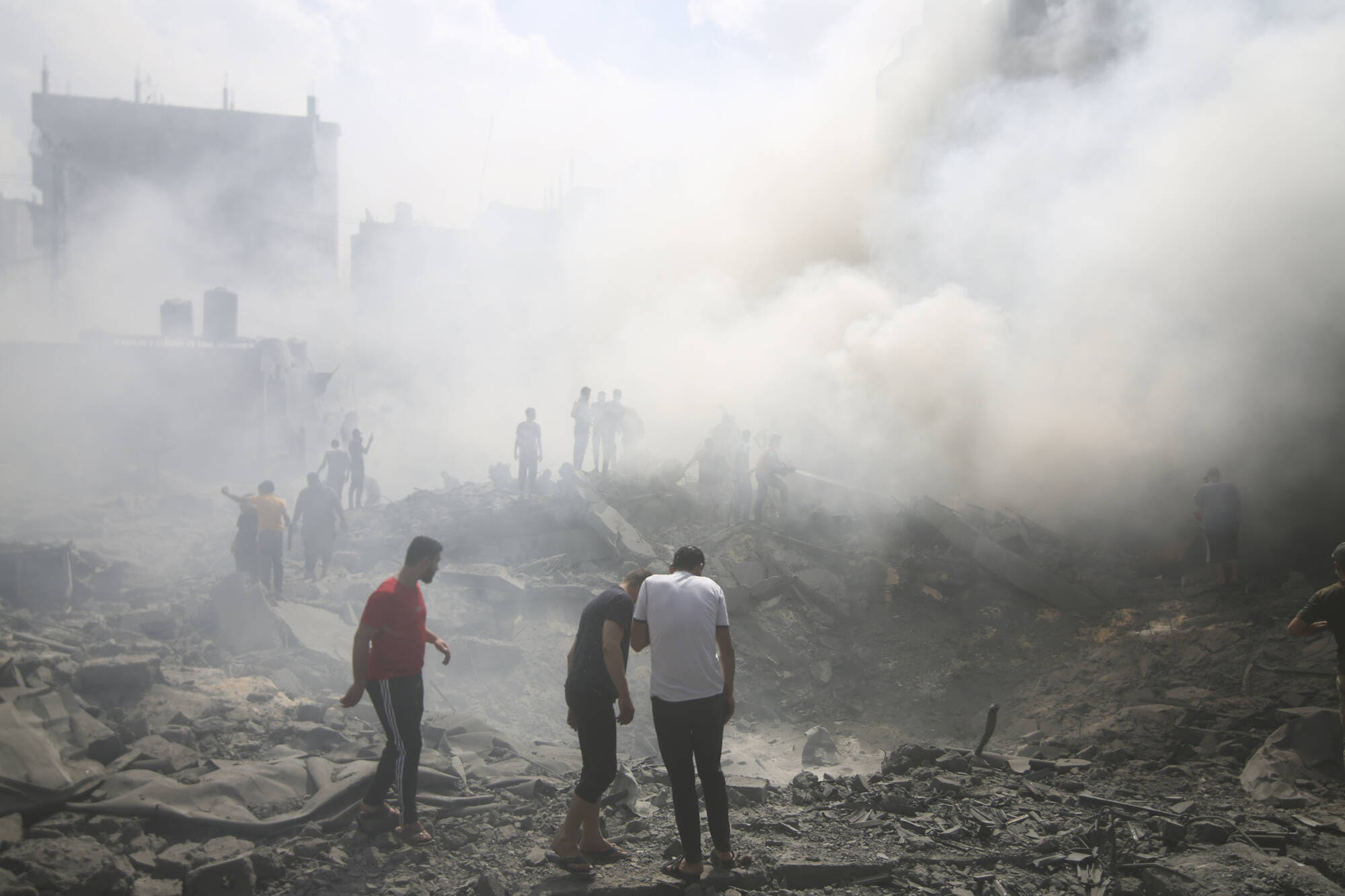
 LIVE Dr. Raz Segal, referring to the 9 December Statement of Scholars in Holocaust and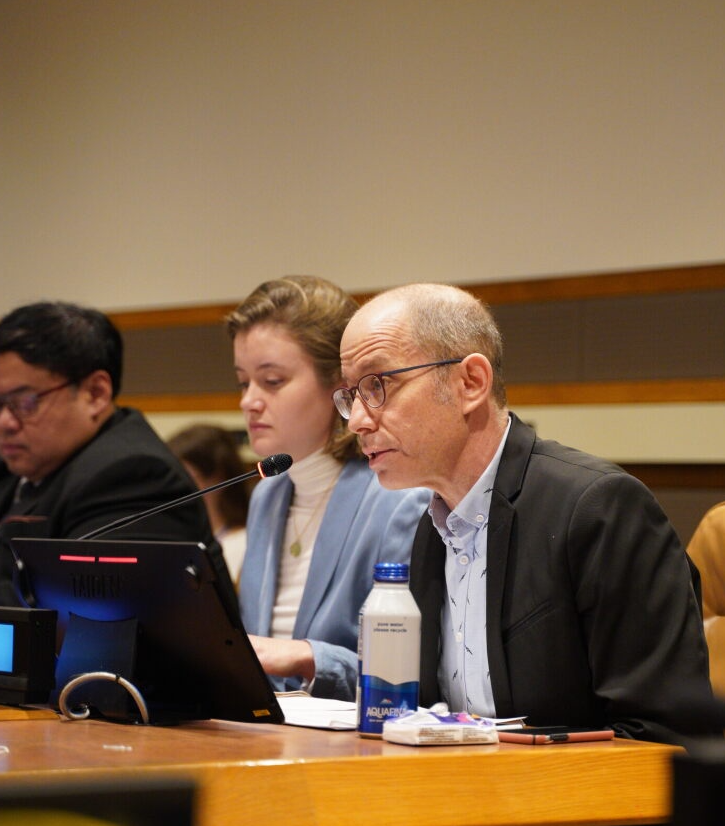


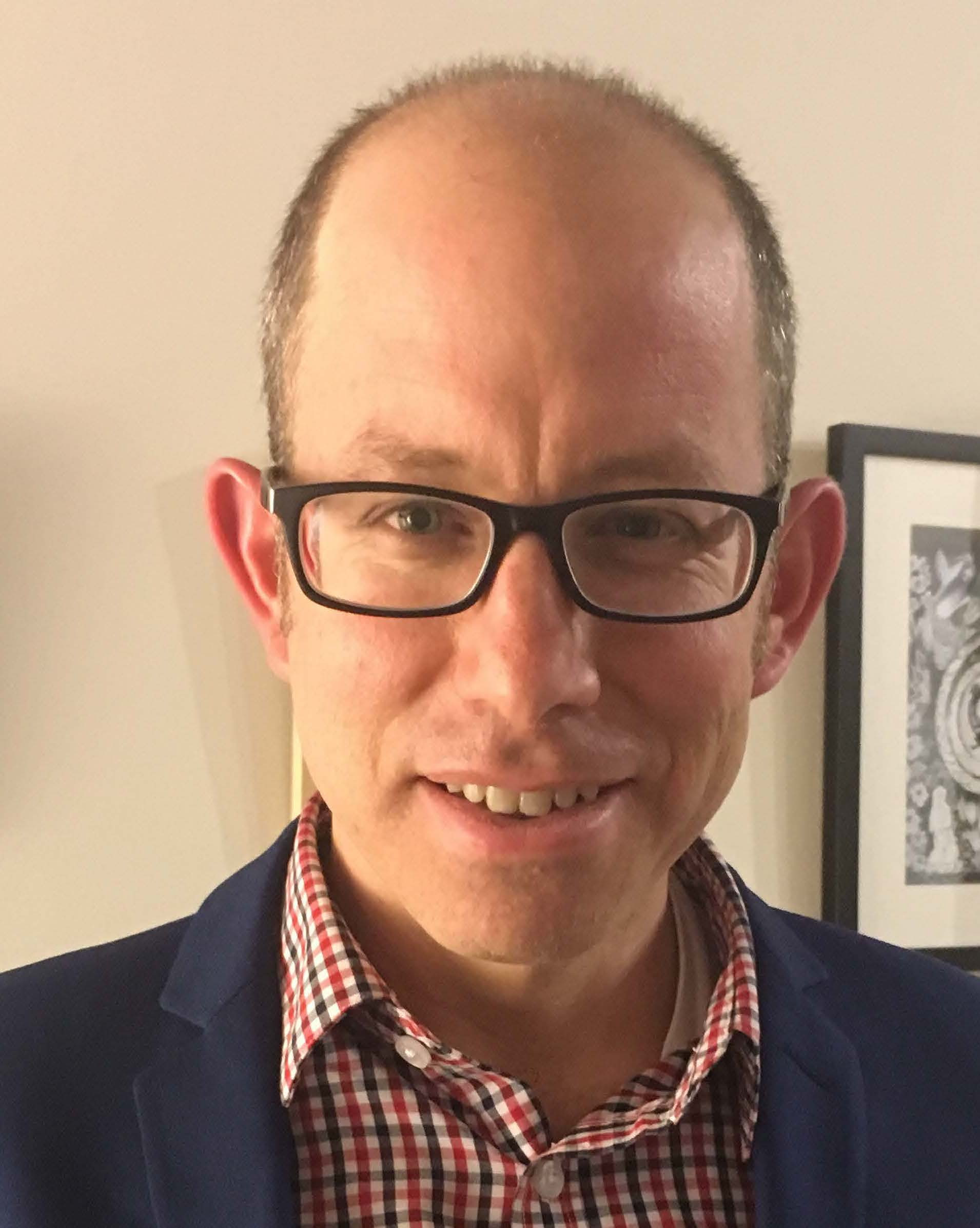
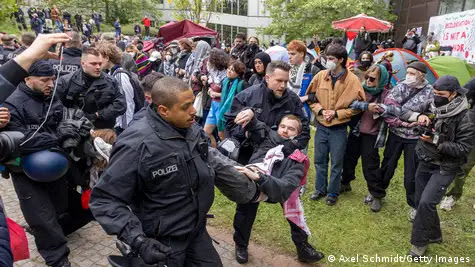

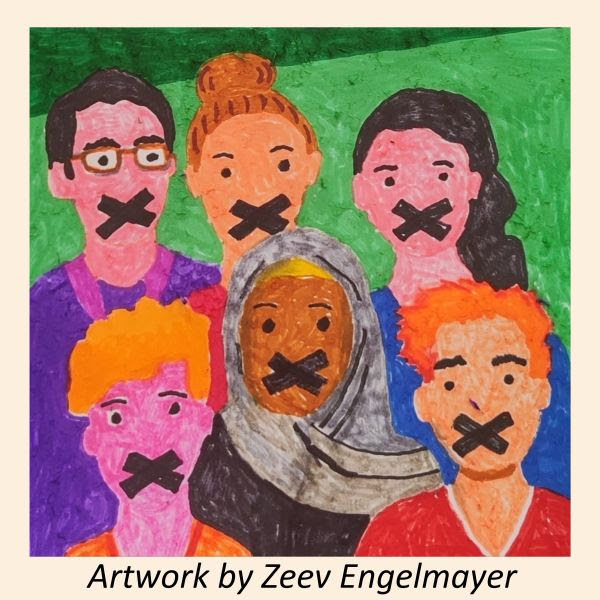

 israel-academia-monitor.com