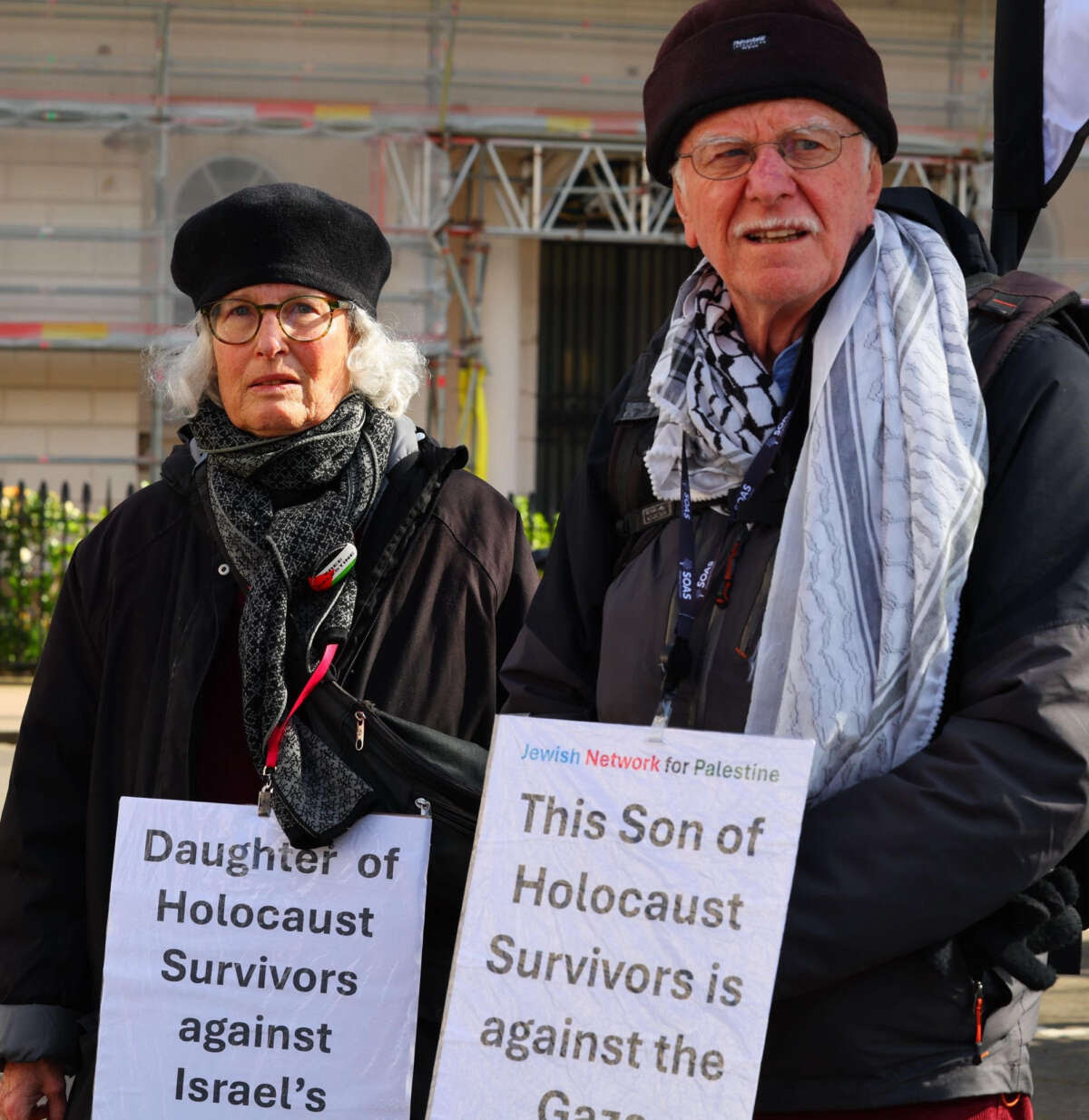
Haim Bresheeth and Ilan Pappe Legitimize Israel’s Demise

09.10.24

Editorial Note

For two decades, IAM has repeatedly covered various anti-Israel Israeli professors teaching at British universities, including Ilan Pappe, the so-called New Historian, and Haim Bresheeth, a filmmaker, who pro-Palestinians have recruited them to bash Israel. 

Recently, both were interviewed on a TV program by Five Pillars, a UK-based news site covering current affairs related to Islam and Muslims. The message of the program claimed: “There is only one way this is going and that is the end of Zionism.” The program is titled “Al-Aqsa Flood, Gaza Genocide & The End of Zionism.” The written introduction states, “Israeli historian Ilan Pappe and filmmaker Haim Bresheeth reflect on the horrors Israel has inflicted upon the Palestinians since October 7, 2023, and explain how by showing its ugly face to the world Israel is sealing its own demise.”

Five Pillars journalist opened the interview by stating: “365 days of mechanized Slaughter yet 27,905 days of the continued Nakba five pillars spoke with Israeli historian Ilan Pappe and Israeli filmmaker and academic Haim Bresheeth to situate the last year in the grand timeline of the Nakba.” 

Bresheeth: “In many ways, the 7th of October, which people consider as Nakba two, is so much worse. In the first Nakba, about 15,000 Palestinians died. In this last year, since the 7th of October, 23, in all likelihood, around 300,000 Palestinians already died.” 

Pappe: “But what is more important, I think, is to understand that this is an attempt to complete what was incomplete. The present Israeli government believes it has an opportunity to complete the Nakba.” 

Bresheeth: “The other thing is, of course, in the first Nakba, 750,000 people left their homes. Now we’re talking about 2.3 million people.” 

Pappe: “So in that respect, we are in the same historical period, where you have an attempt to create by force a Jewish state in the middle of the Arab world against the will of the Palestinians.” 

Bresheeth: “And they have left their homes, but they can’t go back to them because the homes don’t exist, the schools don’t exist, the hospitals don’t exist, the mosques don’t exist, the universities have gone, so what we are talking about is a terrible event not just on the Palestinian timeline but in world global terms.” 

Five Pillars: “Just from the top of your memory, what are some of the worst atrocities and debacles that we’ve witnessed this past year? 

Pappe: “I think the worst is anything to do with toddlers and babies. I mean, seeing babies being operated without anesthetics, being left alone on a hospital corridor, being buried with the hands of their parents and grandparents tears your heart. If the power and hatred and ruthlessness of a state is directed against such a person, you understand we hit the bottom.” 

Bresheeth: “What really stands out for me are a few things. First of all, the great massacres in and around hospitals, so they not only bombed hospitals but they bombed them with one or two tons of bombs, which are actually the bombs that they used in Lebanon a week ago to kill Hassan Nasrallah. You know, we’re talking about a hole in the ground which is 20 meters deep, it’s never been used on any civilian population ever before, and let alone in a hospital. But I’m not just talking about that, I’m talking about the tens of thousands of people who were killed in safe areas that the Israelis sent them there, saying your house, your home, your room, your shop, is not safe anymore, we’re going to wipe it out, now go there and stay there because this is safe, and then they kill thousands of people in those areas, and Israel is lying as a matter of course, when they correct it after a day or after a month or after a year, most people don’t hear the corrections. People don’t know that half of the Israelis killed on the 7th of October were killed by the IDF. President Biden apparently has seen beheaded babies on television, I think he needs a technician to look at his television. What are we talking about, I think, the behavior of Israel is without precedent, and it’s not very surprising that the ICJ has already said that this is plausible genocide, meaning in English, they are committing genocide.” 

Five Pillars: “You mentioned, you know, the charges against Israel, do you think its reputation has been damaged?” 

Pappe: “The support for Palestine in the global civil society has increased dramatically.”

Bresheeth: “Basically what we see, billions of people, even in the West, an understanding that wasn’t there before.” 

Pappe: “And even more importantly, I think, is the fact that the institutions that represent international law, such as the ICJ, for the first time, adopted the language to describe Israeli actions either in the West Bank or the Gaza Strip in a way that reflects much better the reality compared to the language used by governments and mainstream media.” 

Bresheeth: “I consider it the South African moment of Palestine, you know, until a certain moment, in the case of the South African Apartheid, people didn’t understand that this needs to be wiped out, and then they understood, billions of people understood, people understood that things are not great in Palestine, but they did not understand how brutal and how inhumane the Israelis can be and now they understand it.” 

Pappe: “I think its International reputation has been severely damaged, in fact, anyone with a modicum of decency in them cannot support Israel.” 

Bresheeth: “But even in the UK, there are seven Jewish organizations supporting Palestine and most of them are anti-Zionist. This has never happened before, so there are little lights. For example, tomorrow in the European Parliament, Jews from all over Europe are going to celebrate the Jewish New Year for Palestine, they are going to speak to as many parliamentarians as possible as European Jews, saying to them, you cannot support this genocide.”

Five Pillars: “Where do you see all of this going five years from now?” 

Bresheeth: “There’s only one way it should go, and I think it’s going that way, and that is the end of Zionism.”

Pappe: “I distinguish between short-term and long-term processes. I’m afraid the short term doesn’t bring any good news. I think, I am optimistic about, I don’t know if it’s 5 years, or 7 years, or 8 years, but I think there are deeper processes in place, processes that are disintegrating the Israeli state from within, but we have to be patient, it will take a while.”

This is the end of the interview. From this program, it is evident that Pappe and Bresheeth wish for the demise of Israel. The odious descriptions of Israel have fueled the large-scale pro-Palestinian protests in the country, contributing to an alarming rise of antisemitic incidents.

Those who castigate Israel as alleged apartheid should note that their hateful words created a new reality, a need to protect Jews by segregating them from the general population.  The British government, which has firmly quashed attacks on minority migrants during the recent race riots should do more to prevent such attacks against Jews rather than resort to protective segregation. 

Over the decades, British universities have recruited numerous Israeli-bashing academics to escape the label of antisemitism. All these, despite the fact that Great Britain adopted the International Holocaust Remembrance Alliance (IHRA) Definition of Antisemitism. 

REFERENCES:

https://www.facebook.com/share/v/4Rayj4jCr2JTbXXg/

https://www.youtube.com/watch?v=NNub9OPvKMU

Al-Aqsa Flood, Gaza Genocide & The End of Zionism

5Pillars183K subscribers

4,088 views Oct 7, 2024 #Palestine #Israel #GazaIsraeli historian Ilan Pappe and filmmaker Haim Bresheeth reflect on the horrors Israel has inflicted upon the Palestinians since October 7, 2023, and explain how by showing its ugly face to the world Israel is sealing its own demise. #Palestine#Israel#Gaza FOLLOW 5PILLARS ON: Website: https://5pillarsuk.com YouTube:    / @5pillars   Facebook:   / 5pillarsuk   Instagram:   / 5pillarsnews   X: https://x.com/5Pillarsuk Telegram: https://t.me/s/news5Pillars TikTok:   / 5pillarsnews  

Lior Sternfeld in the Service of the Iranian Regime

02.10.24

Editorial Note

Last week, the media reported that Dr. Lior B. Sternfeld, a US-based Israeli academic, met Masoud Pezeshkianin, the Iranian President, in New York as part of an interfaith dialogue hosted by Iran during the UN General Assembly. Sternfeld, an associate professor of History and Jewish Studies at Pennsylvania State University, is the author of Between Iran and Zion: Jewish Histories of Twentieth-Century Iran. Sternfeld gave the Iranian president a copy of his book. With Sternfeld were several rabbis, including Abby Stein, a transgender female rabbi who is pro-Palestinian progressive, along with Muslim and Christian representatives. The Iranian PressTV posted photographs from the meeting, showing also members of Neturei Karta, the anti-Zionist ultra-Orthodox group.

Channel 12 reported that Sternfeld was invited by Iranian researchers with whom he has been in contact. It is said he checked with officials in Israel and got their approval to participate. “It was interesting. It was difficult. It was respectful.” Sternfeld quoted Pezeshkian as saying, “the war is terrible and has to stop.” Sternfeld stated, “Iran wants to play a mediating role on the issue of the hostages.” He also said that Pezeshkian asserted that when Israel and the Palestinians reach an agreement on an end to conflict that is acceptable to most Palestinians, Iran won’t carry the flag of the Palestinian struggle.

In contrast, Iran, in addition to advocating for Israel’s destruction and backing terror groups sworn to do likewise — such as Hamas and Hezbollah — has passed several pieces of legislation sanctioning commercial and cultural relations with Israel. 

Sternfeld’s 2019 book, Between Iran and Zion, deserves attention. In 2021, Dr. Alessanda Cecolin from the Department of History, University of Aberdeen, UK, whose 2013 Ph.D. focused on Iranian-Jewish Identity, reviewed Sternfeld’s book and found a lacuna. 

She stated, “Chapter 4 examines Iranian Jews’ participation in and response to the Islamic Revolution. The main focus of the author is to look at the role of the Jewish intellectuals and their support to the revolution. This chapter follows the development of the leftist intellectual movements and Marxist Jews and claims that the majority of Iranian Jews supported the revolution… The chapter, however, does not account for those Iranian Jews who remained loyal to the Shah. As such, the overall impression is that the whole community supported the revolution when, in fact, mainly the members of the Association of Jewish Iranian Intellectuals (AJII) actively supported the revolution. Evidence suggests that thousands of Jews left Iran during and in the immediate aftermath of the revolution. Despite this lacuna in the chapter… Between Iran and Zion is an important contribution to the current post-Zionist debate on the status and history of Middle Eastern Jews.”

Likewise, Prof. David Yaghoubian from California State University, San Bernardino, who teaches Iran and the Arab-Israeli conflict, also reviewed the book. He wrote, “The book presents a revisionist interpretation of Jewish Iranian history that explores the interrelationship between Jews and broader Iranian society. Sternfeld’s approach and findings challenge existing historiography that either views Jewish Iranian history in a vacuum, or extends lachrymose interpretations that selectively center on Jewish oppression and dispossession before ultimate salvation through Zionism and immigration to Israel.”

But, the core problem with Sternfeld’s work is an article he wrote in August titled “Threatened by a moderate Iranian president, Israel is pulling him into a fight.” Sternfeld stated that “Through Haniyeh’s assassination in Iran’s capital, Israel appears to have sought to drag the Islamic Republic into a regional war — one that Iran hoped to avoid — on the first day in office of the new, moderate president.” And that “Haniyeh’s assassination in Tehran was intended to urge Iran to respond, and perhaps escalate hostilities, thus finally bringing about the full-blown regional war that Israel craves.”  Or that “The Iranian government thus remains reluctant to go to war, in part because it recognizes its domestic risks: war would likely strengthen the ultra-conservative opposition to Pezeshkian, and justify further escalation of oppressive measures at home and abroad. But right now, Israel remains eager to pull Iran into a direct confrontation.”

He wrote that there is a “long and seemingly counterintuitive tradition of Israel preferring conservative, fervently anti-Israel presidents in Iran over reformists, whom it sees as detrimental to its strategic interests. After all, part of Israel’s support among American and European governments derives from the idea that it is a Western democratic outpost in a ‘dangerous neighborhood,’ which can defeat bad actors in the Middle East before they reach Europe and the West. According to this logic, Iran is the chief enemy: an anti-Western, antisemitic, theocratic dictatorship that poses a clear and immediate danger to the world. When Iran elects moderate leaders, it undermines this monolithic caricature — and Israel, which refuses to change its outlook toward its regional neighbors, sees a diplomatic threat.” 

He argues that the president of Iran, “As part of his policy of economic openness, and in order to revitalize Iran’s oil industry and economy, he prepared a huge concession for the American oil company Conoco, which included the development of two new oil fields. Supreme Leader Ali Khamenei approved the offer, recognizing the value of extending an olive branch to the United States, and by 1995, the U.S. State and Treasury departments had given Conoco approval to move forward with the deal. Then the Israel lobby — AIPAC and the Israeli government — panicked and acted to thwart the franchise. After they warned members of the U.S. Congress of the ‘danger’ of trade agreements with Iran, President Bill Clinton bowed to the pressure. In 1995, he issued two executive orders banning all trade by American companies with Iran, and then allowed a series of new sanctions to be imposed on Iran. The Conoco deal collapsed, and the opportunity to develop U.S.-Iranian diplomacy was lost. The story repeated itself a few years later under the presidency of Mohammad Khatami, who was elected on a platform that emphasized the need for dialogue between Iran and the West. Shortly after entering office, U.S. President George W. Bush signaled he was interested in revisiting and potentially restoring US-Iran relations. Therefore, Israel and AIPAC swiftly built up a broad coalition in Congress to renew sanctions on Iran.” 

Because of the Israelis, according to Sternfeld, President George W. Bush gave his “Axis of Evil” speech and a “series of new sanctions on Iran. The United States, Israel, and the West had a much easier time with Mahmoud Ahmadinejad, Khatami’s successor, whose provocative style and harsh anti-Zionist statements made it easier to portray Iran as a danger to Israel and the world. But moderate politician Hassan Rouhani was elected president in 2013 on a promise to reach an agreement with the United States and the West that would allow Iran to maintain its nuclear program for scientific and civil purposes, in return for sanctions relief — a situation that Israel was once again unwilling to accept. The Iran nuclear deal in 2015 represented a victory for diplomacy, but it was presented by Israel as a ‘charm offensive’ meant to disguise Iran’s true ambitions. The Israeli government was determined to prevent a thaw in relations between Iran and the West and the possibility of another vision for the Middle East, which could limit Israel’s ability to maintain its policies toward Palestinians.”

According to Sternfeld, “Unlike the picture that Israel and its allies paint, Iran is a rational actor. It is a country with domestic and international interests, and it employs many tools to achieve them: internal repression, ties with militias and non-state actors throughout the region, and various aid and support enterprises.” 

Sternfeld is not alone among Israeli academic legitimizers of a brutal regime that terrorizes its own people, uses proxies to destabilize the Middle East, and wages conflicts small and big against Israel.  Shlomo Sand and Ilan Pappe come to mind.  As IAM repeatedly demonstrated, these and others like them are rewarded with academic positions in American and British universities. The trend to employ bitter critics of Israel in many Middle East Studies departments has added to the antisemitic and anti-Israeli turmoil on Western campuses and raised questions about the direction of liberal arts education.  

No doubt that Sternfeld’s description of the Iranian regime as moderate and Israel as the villain earned him the invitation to meet the Iranian president.

REFERENCES:

https://www.timesofisrael.com/us-based-israeli-professor-says-he-spoke-with-irans-president-at-interfaith-meeting/amp/

US-based Israeli professor says he spoke with Iran’s president at interfaith meeting

Lior Sternfeld says he gave a copy of his book to Pezeshkian, who knew he was Israeli; transgender rabbi, fringe anti-Zionist Haredi group also participated in event

By TOI STAFF 25 September 2024, 1:14 am  

A US-based Israeli academic said Tuesday he met in New York with Iranian President Masoud Pezeshkian, as part of an interfaith dialogue hosted by Iran on the sidelines of the UN General Assembly.

Lior Sternfeld, an associate professor of history and Jewish studies at Pennsylvania State University, said Pezeshkian knew he was Israeli and had also told the UN delegation ahead of the session. Despite this, the invitation was not canceled, according to partial remarks posted by the liberal Hebrew media outlet Relevant.

The author of “Between Iran and Zion: Jewish Histories of Twentieth-Century Iran,” Sternfeld said he gave the president a copy of the book.

Several rabbis also attended the meeting, according to Channel 12 news, along with Muslim and Christian representatives. Among them was Abby Stein, a transgender female rabbi and activist who is a leading figure among pro-Palestinian, progressive Jews.

Iran’s Press TV posted photographs from the meeting, which showed that members of the virulently anti-Zionist fringe ultra-Orthodox group Neturei Karta were also present.

Channel 12 reported that Sternfeld was invited by Iranian researchers with whom he has been in contact. The network said he checked with officials in Israel and got their approval to participate. It also said Sternfeld raised the issue of the hostages held by Iran-backed Hamas in Gaza.

“It was interesting. It was difficult. It was respectful,” Sternfeld said of the meeting, while quoting Pezeshkian as saying that “the war is terrible and has to stop” in the Relevant video.

Sternfeld claimed: “Iran wants to play a mediating role on the issue of the hostages.”

He also said Pezeshkian asserted that when Israel and the Palestinians reach an agreement on an end to conflict that is acceptable to most Palestinians, Iran won’t carry the flag of the Palestinian struggle.

Iran cut off diplomatic relations with Israel after the 1979 Islamic Revolution. In addition to advocating for Israel’s destruction and backing terror groups sworn to do likewise — such as Hamas and Hezbollah — Tehran has several pieces of legislation sanctioning commercial relations with Israel and forbids its athletes from competing against Israelis in international competitions.

Then-Iranian president Mohammad Khatami caused a domestic storm when he was accused in the conservative Iranian media of saying hello to then-Israeli president Moshe Katsav at the Pope’s funeral in 2005. Khatami denied the interaction occurred.

================================================================


ISRAELI PROFESSOR WHO MET IRAN’S PRESIDENT: ‘IRAN ISN’T A UNIQUE EVIL, IT’S A REGIONAL PLAYER LIKE ANY OTHER’

Part of the Jewish delegation that sat with President Masoud Pezeshkian in New York, Penn State professor Lior Sternfeld tells Haaretz that being in the room with Iran’s president was an opportunity he couldn’t miss


By Etan Nechin
Haaretz Israel News
25 September 2024

NEW YORK—On Tuesday, one of the most surprising gatherings on the sidelines of the UN General Assembly was a meeting between Iranian President Masoud Pezeshkian and a group of Jewish delegates. And arguably, no one was more surprised than the Israeli professor who attended.

Lior Sternfeld, an associate professor of history and Jewish studies at Penn State University and an expert on Iran, told Haaretz he was taken aback when he received an invitation two weeks ago. The meeting was billed as an “interfaith dialogue” (It was later described in Iranian media as “a meeting with several religious leaders and scholars”).

“At first, I wasn’t sure if [the invitation] was genuine. But after some inquiries, I confirmed its legitimacy,” Sternfeld said. The academic’s work on Jews and Iran includes the book “Between Iran and Zion: Jewish Histories of Twentieth-Century Iran,” which assesses how Iranian Jews contributed to Iranian nation-building projects.

Sternfeld said he was also surprised by the reaction when he disclosed his nationality after receiving the invite. “To avoid embarrassment, I informed them that I am, in fact, an Israeli citizen. They assured me it was not an issue.”

The next step was to confirm that his participation was permissible under Israeli law, which prohibits contact with officials from an enemy state. After consulting with the Israeli authorities, Sternfeld determined that his attendance was acceptable.

“It wasn’t an easy decision – I wondered if it was just a ploy,” he said. “But being in the room with Iran’s president, to speak and to listen, was an opportunity I couldn’t miss.”

Several American-Jewish figures, including transgender and pro-Palestinian activist Abby Stein, also attended the meeting in New York. Others present included Ezra Tzfadya, a Rutgers University professor who specializes in Shia Islamic and Jewish political and legal thought, plus representatives from the Neturei Karta Haredi sect (which refuses to recognize the State of Israel and is a permanent presence at pro-Palestinian protests).

Sternfeld, who recently penned a column arguing that Israel is “threatened by a moderate Iranian president” and “Haniyeh’s assassination in Tehran was intended to urge Iran to respond… bringing about the full-blown regional war that Israel craves,” said he was the only Israeli present. The meeting, which lasted 90 minutes, was very formal, he noted: “Every delegate had a chance to speak, and Pezeshkian responded to everyone collectively.”

=============================================

Threatened by a moderate Iranian president, Israel is pulling him into a fight

Israel prefers hardline leaders to maintain a monolithic view of the enemy. Its assassination in Tehran now forces the reformist Pezeshkian into a corner.

By Lior SternfeldAugust 13, 2024

On July 5, Masoud Pezeshkian won the run-off elections in Iran to replace Ebrahim Raisi as president of the Islamic Republic, after the latter’s death in a helicopter crash in May. During the short campaign, Pezeshkian sought to win over voters with the basic platform of his reformist camp: restarting negotiations with the West to lift sanctions, building the economy, fighting poverty, and investing in housing, healthcare, welfare, and civil society. He was officially sworn in as president at the end of the month. 

Ismail Haniyeh, the head of Hamas’ political bureau, came to Tehran to attend Pezeshkian’s inauguration. Based on multiple reports, Israel hired local agents to plant explosives in the hospitality compound in which he was staying, used by the Revolutionary Guards to host high-ranking guests. Through Haniyeh’s assassination in Iran’s capital, Israel appears to have sought to drag the Islamic Republic into a regional war — one that Iran hoped to avoid — on the first day in office of the new, moderate president. The expectation is that Iran will have to respond, and more forcefully than its previous choreographed attack on Israel in April. 

This continues a long and seemingly counterintuitive tradition of Israel preferring conservative, fervently anti-Israel presidents in Iran over reformists, whom it sees as detrimental to its strategic interests. After all, part of Israel’s support among American and European governments derives from the idea that it is a Western democratic outpost in a “dangerous neighborhood,” which can defeat bad actors in the Middle East before they reach Europe and the West. 

According to this logic, Iran is the chief enemy: an anti-Western, antisemitic, theocratic dictatorship that poses a clear and immediate danger to the world. When Iran elects moderate leaders, it undermines this monolithic caricature — and Israel, which refuses to change its outlook toward its regional neighbors, sees a diplomatic threat. 

Decades of thwarted diplomacy

In the mid-1990s, Iran was reeling after a turbulent 15 years: the revolution of 1979, an eight-year war with Iraq in which hundreds of thousands were killed and wounded, the death of Supreme Leader Ruhollah Khomeini in 1989, and an economic crisis that threatened to crush the Iranian economy. Under President Akbar Hashemi Rafsanjani, who had assumed office in 1989, the country aimed to rebuild itself — and chart a new path forward internationally. 

In particular, Rafsanjani sought to turn a new page in relations between Iran and the United States. As part of his policy of economic openness, and in order to revitalize Iran’s oil industry and economy, he prepared a huge concession for the American oil company Conoco, which included the development of two new oil fields. Supreme Leader Ali Khamenei approved the offer, recognizing the value of extending an olive branch to the United States, and by 1995, the U.S. State and Treasury departments had given Conoco approval to move forward with the deal.

Then the Israel lobby — AIPAC and the Israeli government — panicked and acted to thwart the franchise. After they warned members of the U.S. Congress of the “danger” of trade agreements with Iran, President Bill Clinton bowed to the pressure. In 1995, he issued two executive orders banning all trade by American companies with Iran, and then allowed a series of new sanctions to be imposed on Iran. The Conoco deal collapsed, and the opportunity to develop U.S.-Iranian diplomacy was lost.

The story repeated itself a few years later under the presidency of Mohammad Khatami, who was elected on a platform that emphasized the need for dialogue between Iran and the West. Shortly after entering office, U.S. President George W. Bush signaled he was interested in revisiting and potentially restoring US-Iran relations. Therefore, Israel and AIPAC swiftly built up a broad coalition in Congress to renew sanctions on Iran. 

After the attacks of September 11, the political and public discourse in the United States completely changed, but there were still avenues for U.S.-Iranian cooperation. Khatami, for his part, asked to help the United States stabilize Afghanistan after the U.S. invasion, which could have helped achieve a sustainable resolution to the war. 

Iran had been the most important regional enemy of the Taliban government in Afghanistan, and in December 2001, the United States, Iran, and Russia sat down together in Bonn to establish an Afghan Interim Authority to replace the Taliban — an agreement that led Israeli Prime Minister Ariel Sharon to accuse Bush of appeasement, à la Neville Chamberlain. The White House officially rejected those comments, but the next month the collaboration came to an end. On January 29, 2002, Khatami’s efforts were answered by President George W. Bush’s “Axis of Evil” speech and a series of new sanctions on Iran.

The United States, Israel, and the West had a much easier time with Mahmoud Ahmadinejad, Khatami’s successor, whose provocative style and harsh anti-Zionist statements made it easier to portray Iran as a danger to Israel and the world. But moderate politician Hassan Rouhani was elected president in 2013 on a promise to reach an agreement with the United States and the West that would allow Iran to maintain its nuclear program for scientific and civil purposes, in return for sanctions relief — a situation that Israel was once again unwilling to accept. 

The Iran nuclear deal in 2015 represented a victory for diplomacy, but it was presented by Israel as a “charm offensive” meant to disguise Iran’s true ambitions. The Israeli government was determined to prevent a thaw in relations between Iran and the West and the possibility of another vision for the Middle East, which could limit Israel’s ability to maintain its policies toward Palestinians. 

After Donald Trump was elected president, in his obscurantism and ignorance, he canceled the agreement, signaling to Iran that it has no partner in the United States, or even in Europe — where American sanctions prevented European economic cooperation with Iran. In turn, Iran accelerated its nuclear project in a way that would not have been possible under the agreement.

This helped contribute to the election of President Ebrahim Raisi in 2021, whose campaign emphasized the failed attempt at diplomacy with the West. However, even under Raisi, there were contacts between the United States and Iran, which had long-term diplomatic potential. Then came Pezeshkian’s inauguration — and the assassination of Ismail Haniyeh in Tehran only a few hours later.

Urging escalation

Unlike the picture that Israel and its allies paint, Iran is a rational actor. It is a country with domestic and international interests, and it employs many tools to achieve them: internal repression, ties with militias and non-state actors throughout the region, and various aid and support enterprises. When one strategy fails, Iran shifts to another. 

Iran can survive and enjoy profitable cooperation with Russia and China. But its preferred way of rehabilitating its regional and international standing is through reestablishing relations with the West. Whenever it has had to choose between developing relations with Russia and China or an agreement with the United States and the West, Iran chose the latter.

Haniyeh’s assassination in Tehran was intended to urge Iran to respond, and perhaps escalate hostilities, thus finally bringing about the full-blown regional war that Israel craves. Pezeshkian, on his first day in office, was forced to choose whether to abandon the platform he was elected on, and be dragged into a war that would mainly please his opponents within Iran (especially within the regime’s conservative establishment), or stick to his original path. 

It is very possible that Pezeshkian will have to defend Iran’s reputation vis-à-vis the Palestinians, especially Hamas, and perhaps upgrade its support for the group. And so while Israel’s security services have proven that they can assassinate a Hamas leader in a hotel room in the heart of Tehran, they have failed to protect millions of Israeli civilians. 

Days after the assassination, multiple officials from Pezeshkian’s administration affirmed that the current president’s priorities remain focused on domestic issues, especially Iran’s economy. Iran’s Foreign Minister even went on record to say that the Islamic Republic would withhold its response if Israel agreed to a ceasefire in Gaza — a message reiterated by Iran’s UN delegation in recent days. The Iranian government thus remains reluctant to go to war, in part because it recognizes its domestic risks: war would likely strengthen the ultra-conservative opposition to Pezeshkian, and justify further escalation of oppressive measures at home and abroad. 

But right now, Israel remains eager to pull Iran into a direct confrontation — with devastating consequences for civilians across the Middle East. 

A version of this article was first published in Hebrew on Local Call. Read it here.

Prof. Lior Sternfeld teaches modern Iranian history in the Department of History and the Jewish Studies Program at Penn State University. He is the author of “Between Iran and Zion: Jewish Histories of Twentieth-Century Iran.”

=============================================================

https://www.jadaliyya.com/Details/39864
Lior B. Sternfeld, Between Iran And Zion, Jewish Histories of Twentieth-Century Iran (New Texts Out Now)

Lior B. Sternfeld, Between Iran And Zion, Jewish Histories of Twentieth-Century Iran (Stanford University Press, November 2018)

Jadaliyya (J): What made you write this book?

Lior B. Sternfeld (LS): As a historian of Iran, it has bothered me greatly that historiography of this country makes no effort to reflect the complex social composition of Iranian society. Diversity has shaped Iranian society for centuries, and understanding it is crucial to the understanding of this society today. Iran is a country of minorities. There are almost thirty minorities (religious, ethnic, lingual) and only about half of the population is Persian Shi’i. If you read any of the “big histories” of Iran, you do not get this sense. This historiographical mold can be attributed in part to the nation-building projects of the twentieth century, and also to the dominant trends of Iranian nationalism, to which many of the minorities responded and wanted to interact with.

The case of the Jewish minority presents multiple historiographical and methodological challenges. Historiography of Iranian Jews has been heavily influenced by Iranian national historiography, on the one hand, and very secluded views and methodologies of Jewish studies and Zionism, on the other. The result of this has been a very shallow understanding of the Jewish experience in Iran in the twentieth century. Daniel Tsadik’s book on the nineteenth century had recently come out, revising the entire way scholars should look at the Jewish communities. I read this book in a very transformative period of graduate school and decided to write a paper, a paper which became my first article of this project on Jewish participation in the 1979 revolution.

I found out that the Jews were involved in the revolution in several ways. The Jewish hospital played a key role, and there were other fascinating aspects that, until that stage, remained very silent. The response to my article convinced me that I should write the histories of Iranian Jews in the twentieth century, in all their plurality. I wanted to try and analyze the profound social, political, and cultural transformation of these communities in a very turbulent century.

…just like Iranian society which is far less homogenous than it is usually portrayed, Jewish society is also very diverse.

J:  What particular topics, issues, and literatures does the book address?

LS: This book addresses the responses of Iranian Jews to mainly three political/cultural/intellectual streams that shaped Iran in the twentieth century: Iranian nationalism, Communism, and—in the Jewish case—two phases of Zionism, pre-1948 and post-1948. Iranian Jews articulated many responses to each of these streams. The responses came from different communities, rooted in different contexts, and manifested themselves in myriad ways. For example, we see that Jews felt deep gratitude in a way to the Pahlavi monarchy, which—as they perceived—had liberated them by removing the barriers that blocked them from integrating and assimilating. At the same time, the communist Tudeh Party was the strongest and fiercest opposition to fascism and anti-Semitism in Iran and outside; it talked about social justice, and the vision of an egalitarian society—something that resonated with the Jewish communities, who remained mostly in the lower classes at that time. It was thus the only political party that accepted Jews (and other religious minorities) as members, and so gained many of their support.

This book attempts to show that, just like Iranian society which is far less homogenous than it is usually portrayed, Jewish society is also very diverse. While I am looking at the ethnically Persian Jews as the majority, we also have Kurdish Jews, Iraqi Jews (that can even be categorized as two or three different groups) Ashkenazi Jews (also made of two groups—German professionals that came to Iran in the 1930s, and the other Polish refugees), and many Israeli Jews. All of them helped create these nuanced and multi-hyphenated identities that characterized Iranian Jews—and in a way, still do.  

J: How does this book connect to and/or depart from your previous work?

LS: I was trained as a social historian of Iran, and I was very much interested in writing social history of the national movement of the late 1940s and early 1950s. Reflecting back on it, I am not sure that I knew at the beginning that one of the missing pieces of this story is the aspect of minorities—but I was excited to study this new angle.

My training also brought me into the major debates of the rejuvenating subfield of Jewish studies in the Middle East. Without the works of Joel Beinin, Orit Bashkin, Sarah Abrevaya Stein, Aomar Boum, Joshua Schrier, Michelle Campos, and others (most of them published also with Stanford University Press), this field would have looked tremendously different.

J: Who do you hope will read this book, and what sort of impact would you like it to have?

LS: I hope that readers interested in Jewish life in the Middle East in modern times and in Jewish-Muslim relations, aside from the Israel-Palestine conflict, would pick up this book. I am also hoping that Iranian Jews in Israel, and other Iranian Jewish diasporas, would find this account enriching. I hope that Iranians in Iran and abroad would find this analysis of their national story useful, allowing additional voices to be heard and illuminating parts of their histories that—for social, cultural, and political reasons—have been unearthed until now. This is something that I have already seen beginning to happen on my book tour. Folks of Iranian-Jewish heritage, first- or second-generation immigrants from Iran, tell me how they relate to the stories I tell; each adds another story that could have entered the book. There is always the Tudehi uncle, the “liberal student” cousin, the many interactions with Zionist organizations, and the perceptions of Iran as a homeland, etc.

J: What other projects are you working on now?

LS: I am now working on two projects. The first one is an attempt to find the origins of “third-worldism” in the Middle East. The story of the third world usually gives prominence (or even ideological monopoly) to the decolonized nations of Southeast Asia. I am not necessarily disagreeing with that analysis, but I think that the Middle East played a greater role than the anecdotal piece it received in the grand historiography. In this project I examine intellectual-popular discourse of the 1930s and 1940s, including that regarding Zionism (which many Middle Eastern intellectuals considered to be a post-colonial movement), through the establishment of the “Third Force” party in Iran in 1948-9, and Prime Minister Mosaddeq, who actively tried to form a Middle Eastern bloc to counter the influence of Britain, France, the United States, and also the Soviet Union on the other side.

My second project focuses on Iranian-Jewish diaspora communities, especially in the United States and Israel. I want to see how the immigration experience shaped their memories of the “old country,” cultural preservations, relations with non-Jewish immigrants from the same places, etc.

J: You tell a story of centuries-long journey for integration and you underscore the immense cultural attachment and Iranian national identity and pride. Yet the overwhelming majority of the Iranian Jewish community left Iran after the revolution. So, did this project fail? If they felt so attached and part of the society, why did they leave?

LS: I tell a story of a journey. And it is a journey—not a linear steady development—and if there is one thing I want the reader to take from this book is that understanding Iranian-Jewish history is not black and white; it is not a story of persecution and redemption, but rather it is a story that always existed in the middle. It is the story of the hyphen between identities and ideologies.

There were two waves of Jewish emigration out of Iran. The first was in 1948 to 1951, when about a quarter of the Jewish population of Iran left, mostly for the newly-established Israel. The Jews who left in the first wave were—broadly speaking—the poorest and the neediest of the Jewish communities. For them, immigration to Israel could offer some kind of redemption—be it religious, national, financial, or cultural. As I show in the book, even this was very complicated, as some returned to Iran at some point in the future.

The second wave was profoundly different in sociological terms. By the 1970s, the vast majority of the Iranian Jews were part of the upper middle classes and the elites. Most of those who left in the aftermath of the 1979 revolution left as part of their “class” exodus, and not necessarily because they were Jews. We also see that they left for the same places that the non-Jewish Iranians of the same socio-economic class moved to (and much fewer to Israel). This is not to say that, as Jews they did not face increasing dangers and discrimination, but the fact that we see today a community in Iran that is still substantial (unlike any other Middle Eastern country) suggests that we cannot read their history in the same terms that we read Jewish histories of other societies.

Excerpt from the book

Iranian Jewish Zionist: An Identity Mélange

During this period of extensive migration to Israel, even as Iran served as a base for that considerable effort, Zionist and non-Iranian Jewish officials were hardly concerned with the complexity of Jewish Iranian identity. Could Iranian Jews be proud, patriotic Iranians while practicing Jewish traditions? Could they be sympathetic to Zionism and to Israel at differing levels? What about Iranian Jews identifying first and foremost as Tudehi but, in accordance with Tudeh’s official party line, strongly supporting the establishment of Israel? For all Iranians, and Iranian Jews in particular, identity categories were not mutually exclusive (in contrast to what had been expected by Israel and modern Zionism). While many viewed the establishment of Israel favorably, and rejoiced over their homeland’s good relationship with Israel (at least in the beginning), they had no intention to exchange Iran for Israel. The percentage of Iranian Jews choosing the Zionist option was relatively low, and those who did immigrate envisioned that they would see an elevation in their status by doing so.

The slowdown of immigrants prompted Zionist organizations to investigate and analyze this unexpected turn of events. Ultimately they arrived at the identity issue. In 1953 Habib Levy wrote a comprehensive report on Zionist activism in Iran and submitted it to Israel’s president, Itzhak Ben-Zvi, whom he knew from the latter’s visits to Iran. President Ben-Zvi forwarded Levy’s report to the chairman of the board of the Jewish Agency, Berl Locker. Surprisingly, Levy’s tone in this report sharply contrasts with the spirit of his historical writing. In his books (both his memoir and his three-volume history of the Jews of Iran), he praises Iranian Jews’ commitment to Judaism and Zionist ideals. Conversely, his report submitted to Israel’s president seems rather gloomy:

When news arrived of the establishment of the State of Israel, the Jews rejoiced… 30% of Persia’s Jewish communities prepared for their Aliyah—in camps without any sanitation, exposed to the death angel on one side and on the other side, greedy officials of the Jewish Agency that in odd ways and on weird pretexts robbed them of their few belongings. Despite life in Iran being comfortable, they [Iranian Jews] went to Israel and were going to forget the bitterness of the Galuth [exile]. After two thousand and four hundred years of exile, and after 24 hundred years of suffering and tears, they were drunk from excitement and did not pay attention to obstacles, betrayals, and deeds of pocket-picking… Unfortunately today the excitement has dissipated and their fiery nationalistic and religious feelings that were a source of endless power and energy have faded.

Beyond the serious accusations targeting Jewish Agency officials and Israel (accusations upheld by corroborating evidence), Levy lamented the loss of this rare opportunity to keep Zionist fires kindled in the hearts of Iranian Jews. The rest of the report also bears examination. In analyzing the reasons that Iranian Jews were turning away from or losing interest in Zionist ideology, Levy cites the following: “lack of physical, national, religious, and spiritual guidance or training.” In other reports, and as a matter of policy, the Jewish Agency tended to blame insufficient knowledge of Hebrew and the practice of Reform Judaism (as opposed to its Orthodox counterpart) for loosening the bond between Iranian Jews and Zionism/Israel. With that in mind, it is interesting to turn once again to Abramovitch, the JDC observer, whose 1952 report contradicts this assessment. In fact, he describes a heightened emphasis on Hebrew language acquisition and Judaism education among Iranian Jewish youths:

We can point to a whole series of achievements. My recent tour of the provincial towns has been an unexpected pleasure. The younger children, those of the primary schools, not only understood our questions but also answered them correctly. Years of guidance and regular examinations have convinced teachers that our instructions should be carried out, that curriculum we’ve suggested should be taught, and that idiotic superstitious stories abandoned. Children read correctly; they translate correctly; there is proper order to their biblical stories, as well as sequence in their history and religious knowledge. Mr. Cuenca, A.I.U. director, and we can point to a whole series of achievements. My recent tour of the provincial towns has been an unexpected pleasure. The younger children, those of the primary schools, not only understood our questions but also answered them correctly. Years of guidance and regular examinations have convinced teachers that our instructions should be carried out, that curriculum we’ve suggested should be taught, and that idiotic superstitious stories abandoned. Children read correctly; they translate correctly; there is proper order to their biblical stories, as well as sequence in their history and religious knowledge. Mr. Cuenca, A.I.U. director, and Mr. Szyf, who accompanied me on this last trip, were as pleasantly surprised as I was at the answers.

How should we reconcile Levy’s and Abramovitch’s contradicting reports? One way to square the two is to conclude that there was, in fact, no credible connection between Hebrew fluency and a deep understanding of Judaism’s teachings and traditions. Later in his report, Levy offers other fascinating though equally far-fetched criticisms that do not necessarily correlate with his other writings. First, he states that Iranian Jews suffer from the absence of a centralized organization. This unfortunate fragmentation, reflected in the proliferation of small community organizations, meant that Iran’s Jewish community lacked a unified front. Without a strong, central organization, Levy opines, requisite political and social influence will never be achieved. Additionally, the majority of wealthy Iranian Jews had distanced themselves from Jewish nationalism. Finally, and perhaps most critically, he laments, “The young Jewish students overwhelmingly [will] tend to support the Tudeh Party, when there is a void of worthy Jewish organizations.”

Levy fails to entertain the possibility that Iranian Jews purposely avoided creating a strong central organization—which would have distanced their community even further from the larger nationalist sphere. Is it not possible that the Jewish community desired to assimilate, to fit seamlessly into the Iranian social fabric, to count themselves as respected and respectable citizens, and thereby enjoy the same rights and experiences as their non-Jewish Iranian peers? Levy also overlooks key reasons why Jewish students overwhelmingly tended to support Tudeh. As demonstrated in Chapter 2, during the early years from 1941 through 1953, Tudeh offered young Jews a stronger connection to their generation and to Iranian society. Since Tudeh was the largest and single most important political organization in Iran, it is little wonder that young Jews found Tudeh so attractive.47

Another section of Levy’s report is devoted to the hardships that Jews faced upon arriving in Israel. Interestingly, Levy mentions racism and discrimination toward Mizrahi and Persian Jews, regardless of their social status, education, or training. Levy points out that these émigrés could not speak Yiddish, a strike against them. Also, their places of origin made them especially vulnerable to discriminatory practices. Levy proffers the following example: Iranian Jews wanting to enroll their children in an elite boarding school near Haifa were told that the school was at full capacity. Nevertheless, in the ensuing days and weeks their Ashkenazi neighbors enrolled sons and daughters with no problem.48 This type of news made its way to Iran, undeniably hurting Israel’s already questionable reputation around immigration. During those early years, not only did many Iranians return to Iran but, as discussed in Chapter 1, Iraqi Jews also migrated from Israel to Iran. These Iraqis, after finding life impossible to adjust to in Israel, and legally prevented from returning to their Iraqi homeland, settled on their second-best option. Iran at least provided a somewhat familiar cultural climate, and furthermore, a significant Jewish Iraqi community had already established itself. Therefore, Iran became a preferred destination for many Iraqi immigrants, to the dismay of Israel and Zionist organizations.

Brazil Campuses as a BDS Battleground

26.09.24

Editorial Note

BDS in Brazil is gaining strength. Already in 2018, Brazil’s Socialism and Liberty Party (PSOL) passed a resolution reaffirming its support for the BDS movement.

Last year, on April 3, 2023, the State University of Campinas, known as Unicamp, based outside Sao Paulo, shut down the “Israeli University Fair,” an event on campus promoting Israeli universities.  The University of Haifa, The Hebrew University, Bar Ilan University, and the Technion organized the fair.  Dozens of protesters camped outside the building, blocked the entrance, and declared they would not leave as long as Israelis were inside. They put up Palestinian flags on the walls and carried Palestinian flags while chanting anti-Israel slogans, such as, “we will not allow Brazilian universities to be used to market occupation, colonialism apartheid and Zionism.” Campus security intervened and helped out the Israeli representatives, leading to the event’s cancellation. 

The organization Masar Badil, the Palestinian Alternative Revolutionary Path Movement, Brazil chapter, reported that the action at UNICAMP University was a “direct example of the future of the Zionist entity and its colonial project in Palestine, which will inevitably fall.” Stating, “Our Palestinian people were supported today by their friends and allies, Brazilian revolutionary forces dedicated to confronting racism and fascism. We salute the central leadership role of the Al Janiah cultural center in Sao Paulo, Samidoun Palestinian Prisoner Solidarity Network – Brazil, the Alkarama Palestinian Women’s Movement, student organizers and committees, women’s organizations and labor and union activists in bringing about this victory. Dozens of leftist organizations and movements had earlier gathered at the Al Janiah Cultural Center about one week ago to organize a mass response to the marketing of Zionist universities at Unicamp.”

The Gaza War turbocharged the anti-Israel protest. On June 7, 2024, the Association of Professors at Brasilia University (ADUnB) held a public class titled “Eight Months of Genocide in Gaza: Boycott, Development and Sanctions against Israeli Apartheid and the Role of Brazilian Universities.” Jamal Juma and Maren Mantovani, National and International Secretariats of the Palestinian National BDS Committee, spoke at the event that former ambassador Tadeu Valadares chaired. 

Another BDS case took place recently. Dr. Jorge Gordin, an esteemed scholar from the Hebrew University, Department of Spanish, Portuguese, and Latin American Studies, was forced to cancel a series of lectures at the Institute of Political Science (IPOL) of the University of Brasilia on September 11, 12, 18, 19 and 20. 

IPOL published a statement on Instagram, “To ensure the safety of the university community, IPOL has decided to cancel the activities planned with Prof. Jorge Gordin. At the same time, the Institute regrets and is available to all interested parties to promote debates, always respecting divergent opinions and academic freedom.”

The cancellation came after some students complained that Gordin was “republishing military propaganda from the Israel Defense Forces” on social media.  The group behind the protest is CAPOL, a non-profit organization of the Institute of Political Science at the University of Brasília, representing undergraduate students. The head of CAPOL, Maynara Navi, stated that the protest was “spontaneous,” noting that the cancellation was received with great satisfaction. She said, “It must be said that Brazilian public funds were used to bring this professor to give a lecture at the university, which must be stopped and reviewed… This professor comes from a university located in illegally occupied territories.” 

Navi is unaware that the Hebrew University was founded in 1925. 

CAPOL breaches its own regulations, which state in Article 4 that it would “Encourage participation and discussion on issues that affect society as a whole, without distinction of race, color, sex, nationality, sexual orientation, political or religious beliefs.” 

The Brazilian case is one more demonstration of the “cancel culture” of academic institutions and the BDS supporters around the world.  It is an example of antisemitic hypocrisy when Jews and Israel are concerned. Using “safety concerns” is a thinly disguised excuse for failing to live up to the IPOL commitment to “promote debates, always respecting divergent opinions and academic freedom.”  

It also exposes the lies of the BDS movement, which would let us believe that individual Israeli scholars are not targeted in the BDS campaigns.  

REFERENCES:

https://www.middleeastmonitor.com/20240919-brazil-university-cancels-course-by-israeli-academic-after-protests/

Brazil university cancels course by Israeli academic after protests

September 19, 2024 at 10:19 am

The Institute of Political Science (IPOL) at the University of Brasilia (UnB) cancelled a course which was due to be taught by Israeli Professor Jorge Gordin after students protested his presence despite being a vocal supporter of “Israeli military propaganda”.

Gordin, who teaches at the Hebrew University in occupied Jerusalem, is known for his open and unwavering support for Benjamin Netanyahu’s government and its military.

The head of the Academic Centre for Political Science (CAPOL) at UnB, Maynara Navi, said the students campaign against the visiting professor was “spontaneous”, noting that the cancellation was received with great satisfaction, as both the Association of Professors (ADUnB) and the University Council have already declared that Israel is an apartheid regime.

“It must be said that Brazilian public funds were used to bring this professor to give a lecture at the university, which must be stopped and reviewed,” she continued.

“This professor comes from a university located in illegally occupied territories, so …. all the academic production he does costs the Palestinians a heavy price,” Navi added.

In April 2023, Palestinian and Brazilian organisations succeeded in forcing the State University of Campinas (Unicamp) to cancel the Israeli Universities Festival, after peaceful demonstrators blocked the entrances to the building, and announced that they “will not allow Brazilian universities to be used to market occupation, colonialism apartheid and Zionism.”

===================================================

Google Translate

UnB cancels professor’s lecture after “Israeli military propaganda”

Professor Jorge Gordin was supposed to teach at the Institute of Political Science at UnB. Students complained about “Israeli propaganda” on his profile

Samara Schwingel

09/14/2024 17:50 ,updated09/14/2024 17:50Metropolises

The Institute of Political Science at the University of Brasilia ( Ipol/UnB ) has cancelled a lecture that was to be given by Professor Jorge Gordin of the Hebrew University of Jerusalem. The event was suspended after students complained that Gordin was “republishing military propaganda from the Israel Defense Forces ” on social media.

He was scheduled to give lectures on September 11, 12, 18, 19 and 20. Students were notified of the cancellation last Wednesday (9/11). According to the statement made by Ipol on social media, the event was discontinued to “guarantee the safety of the university community”.

In the same publication , the Ipol Academic Center released an open letter in which it revealed the reasons for the cancellation.

“Yesterday, at the request of students, Capol’s academic coordination identified posts by this professor on social media, in which he republished military propaganda from the Israel Defense Forces,” the text says.

Students issued a call to attend his first class with paraphernalia and flags in defense of Palestine. “The management of Ipol became aware of this entire context and decided to cancel Jorge Gordin’s presentation and release a statement reinforcing the need to respect divergent opinions and academic freedom.”

“Capol is pleased with the decision to cancel Jorge Godin’s activities and hopes that IPOL’s selection of external exhibitors will be rigorous, with a close eye on possible attacks on the image of the Palestinian community, which is going through a period of genocide and barbarity,” the text concludes.

=========================================================

ipol_unb
To ensure the safety of the university community, IPOL has decided to cancel the activities planned with Prof. Jorge Gordin. At the same time, the Institute regrets and is available to all interested parties to promote debates, always respecting divergent opinions and academic freedom.
1w

psipatricialembert
If he were a Hamas fan, I guarantee that they would not ask for this boycott!
1w 3 likes Reply
psipatricialembert
Censorship!!!!! Anti-Semites!!!!
1w1 likeReply
September 11

=========================================

 https://www.gazetadopovo.com.br/vida-e-cidadania/unb-cancela-aula-professor-defendido-israel-redes-sociais/
UnB cancels class of professor who allegedly defended Israel on social media

Guilherme Grandi
09/13/2024 15:27

Suspension occurred after students claimed to have discovered posts by Jorge Gordin with propaganda for the Israel Defense Forces. | Photo: reproduction/LinkedIn

The University of Brasília canceled activities with Professor Jorge Gordin last Wednesday (11) for allegedly defending the actions of the Israel Defense Forces on social media. He was scheduled to teach classes for five days at the Institute of Political Science at UnB (IPOL) and his participation was suspended to “guarantee the safety of the university community,” the institution reported in a post.

IPOL did not provide details on the reason for canceling the activities, stating only that “it is available to all interested parties to promote debates, always respecting academic freedom”. Gazeta do Povo has been contacting UnB since Wednesday (11) to comment on the cancellation and is awaiting a response.

The reason for the suspension of activities with Gordin was explained by the institute’s Academic Center, stating that students requested the cancellation after posts of his were identified in which he republished on social media posts of “military propaganda of the Israel Defense Forces”.

IPOL stated that, after this request, the students made a call to participate in the class on Wednesday (11) carrying accessories and flags in defense of Palestine.

“The IPOL management became aware of this entire context and chose to cancel Jorge Gordin’s exhibition and release a statement, in which it reinforces the need to respect divergent opinions and academic freedom,” the institute pointed out.

According to his profile on a professional social network, Jorge Gordin describes himself as an expert in regional and local politics, having conducted research on federalism and decentralization in countries such as Israel, the United States, Germany and Brazil. He graduated from, among other institutions, the Hebrew University of Jerusalem, and has worked as a researcher at the German Institute for Global and Regional Studies and at Diego Portales University in Chile.

The report also tried to contact Gordin and is awaiting a response.

Gordin had scheduled a mini-course on the 11th, 12th, 18th and 19th with the theme “Comparative territorial politics” and “The paradox of Argentina revisited”, on September 20th.

The Academic Center also stated that it was “satisfied” with the institute’s decision to cancel activities with Professor Jorge Gordin, and stated that it “expects that the selection of external exhibitors by IPOL will be rigorous, with a close eye on possible attacks on the image of the Palestinian community, which is going through a period of genocide and barbarity.”

IPOL’s decision to cancel activities with the professor, however, divided opinions. Comments on the post in which the suspension was announced classified it as both “regrettable”, “intolerance”, “embarrassing” and “unilateral democracy”, as well as “Zionism”, “victory for all Arab students at UnB” and “effort to stop this supporter of genocide”.

The Israeli response was immediate following the Hamas terrorist attacks on October 6, 2023. The offensive included airstrikes and a ground invasion of Gaza to dismantle the group’s military infrastructure. Hamas, which has killed civilians, raped women and tortured Israelis, is still holding people kidnapped in the attacks.

The conflict subsequently expanded to other fronts as well, and Hamas-allied groups in Lebanon, such as Hezbollah, launched attacks on Israel, raising fears of a wider regional conflict.

Copyright © 2024, Gazeta do Povo. Todos os direitos reservados.

================================================================

Pro-Palestine protests force UnB to cancel course with professor from Israeli university

Published by

Caroline Saiter

September 12, 2024

The Institute of Political Science (Ipol) at the University of Brasilia (UnB) has cancelled a course that was to be taught by Professor Jorge Gordin from the Hebrew University of Jerusalem in Israel. The decision was made following a protest by pro-Palestinian students who opposed the professor’s presence.

In a public statement, Ipol regretted the development and stated that it had cancelled the course “to guarantee the safety of the university community”.

Jorge Gordin was scheduled to present a short course entitled “Comparative Territorial Politics,” which would be held on September 11, 12, 18 and 19 in the institute’s auditorium. A lecture entitled “The ‘Argentina’ Paradox” was scheduled to take place on the 20th.

“Due to the reactions that were raised, and although the topic of the lecture was not war, out of caution and in agreement with the professor we decided to interrupt the activities. We reaffirm our commitment to respectful dialogue, freedom of expression and academic freedom,” the institute said in a note sent to Mônica Bergamo’s column in Folha de S.Paulo.

=================================================

💻 PUBLIC CLASS | ADUnB-S.Sind. will hold, on the afternoon of this Friday, June 7, the Public Class: “Eight months of genocide in Gaza: Boycott, Development and Sanctions against Israeli Apartheid and the role of Brazilian universities”.

The event will be attended by Jamal Juma and Maren Mantovani, National and International Secretariats of the Palestinian National BDS Committee, respectively.

The mediation will be carried out by retired ambassador Tadeu Valadares.

===============================================================

Protesters force cancelation of Brazil university event promoting Israeli academiaAmid demonstration by pro-Palestinian activists, security at State University of Campinas escort out representatives from four of Israel’s top institutions of higher learning
By CANAAN LIDOR 5 April 2023, 1:57 am

One of Brazil’s most prestigious universities shut down a promotional event on its campus organized by several Israeli institutions of higher learning, following protests by pro-Palestinian demonstrators.

The State University of Campinas, situated near Sao Paulo and know as Unicamp, on Monday unexpectedly cancelled the “Israeli University Fair,” an annual promotional event scheduled that day. It was organized by the University of Haifa, the Hebrew University of Jerusalem, Bar Ilan University and the Technion – Israel Institute of Technology to attract students and academics.

Dozens of protesters demonstrated outside the building until campus security intervened and extracted the promoters of the Israeli universities, leading to the event’s cancellation, the R7 television channel reported. Unicamp’s rector, Tom Zé, had declined pro-Palestinian activists’ demand that the university scrap the event but said he supported the right of students to demonstrate against it.

The decision to cancel the event was taken because of security concerns, his office told R7.

The protesters camped outside the building and said they would not leave as long as Israelis were inside. They scrawled Palestinian flags on the walls and carried Palestinian flags as they chanted anti-Israel slogans.

The Israelite Federation of Sao Paulo, or FISEPS, condemned the protesters.

“The images of protesters fomenting hostility to Israeli university representatives are revolting and need to be investigated and firmly condemned by authorities and society,” FISEPS said.

Samidoun, an international pro-Palestinian group whose Brazil chapter was involved in the protests at Unicamp, celebrated the cancellation as a “victory.” Masar Badil, another local pro-Palestinian group, wrote in a statement that just as the event was canceled at Unicamp, “the Zionist entity and its colonial project in Palestine, will inevitably fall”.

=====================================================

Victory in Brazil: Popular mobilization leads to cancellation of “Israeli Universities Festival”

Apr 3, 2023 

Palestinian and Brazilian organizations and mobilization led to the cancellation of the “Israeli Universities Festival” at the UNICAMP university near Sao Paulo, Brazil. Palestinian activist Rawa Alsagheer announced that the festival, scheduled for today, 3 April, was “cancelled under organized popular pressure,” emphasizing that this is “an important achievement in Brazil on the popular boycott front, thanks to the sacrifices of the Palestinian people, the steadfastness of the prisoners’ movement and the revolutionary solidarity forces that stand with us.”

She said, “The Zionist university fair was cancelled a short while ago, under the pressure of the crowds of demonstrators who occupied the building and surrounded its main entrances until the announcement of the cancellation.”

The Masar Badil, the Palestinian Alternative Revolutionary Path Movement, affirms that this action at UNICAMP University is a direct example of the future of the Zionist entity and its colonial project in Palestine, which will inevitably fall.

Our Palestinian people were supported today by their friends and allies, Brazilian revolutionary forces dedicated to confronting racism and fascism. We salute the central leadership role of the Al Janiah cultural center in Sao Paulo, Samidoun Palestinian Prisoner Solidarity Network – Brazil, the Alkarama Palestinian Women’s Movement, student organizers and committees, women’s organizations and labour and union activists in bringing about this victory.

Dozens of leftist organizations and movements had earlier gathered at the Al Janiah Cultural Center about one week ago to organize a mass response to the marketing of Zionist universities at Unicamp.

============================================

 Growing Brazilian Political Party Reaffirms Support for BDS Movement for Palestinian Rights

 آذار/مارس 07,2018-12:00 AM

The call for BDS measures in Brazil is particularly significant because the country is one of the largest buyers of Israeli weapons and military technologies in the world.

 March 7, 2018 — Last month, Brazil’s Socialism and Liberty Party (PSOL) passed a resolution reaffirming its support for the BDS movement for Palestinian rights. PSOL is a growing progressive party in Brazil, with six representatives in the National Congress, nine in different state assemblies and 53 in municipal chambers. In 2017, it was the party with the largest number of new members in the country.

 The call for Boycott, Divestment and Sanctions (BDS) measures in Brazil is particularly significant because the country is one of the largest buyers of Israeli weapons and military technologies in the world.

 PSOL’s resolution states that the party is committed to “intensifying efforts to place a military embargo on Israel” and references “technologies and techniques” exported by Israel to Brazil that “deepen repression, racism and militarization against the interests of the Brazilian people.”

 Pedro Charbel, Latin America Coordinator for the Palestinian BDS National Committee (BNC), which leads the global BDS movement for Palestinian rights, said:

 The BNC is heartened by the PSOL’s reaffirmation of its support for the BDS movement for Palestinian rights. The party has heard the call from Palestinian civil society for a meaningful and effective expression of solidarity, and it has responded affirmatively. We hope the party and all its members will keep working to advance BDS in Brazil.

Brazilian authorities use Israeli armed vehicles to repress demonstrations in São Paulo, and Rio de Janeiro’s deadly military police, notorious for targeting poor Black and Brown people, receives training from Israeli companies. Brazil spends millions on Israeli weapons and military technology.

The Brazilian government should heed the call by Brazilians and Palestinians alike to stop trading in military weapons, technology and training with Israel.

Whether in Rio’s favelas or in the occupied and besieged Gaza Strip, we are working together to defeat a global industry of injustice.

Juliano Medeiros, PSOL’s president, stated: PSOL’s resolution reaffirms the Brazilian Left’s long-standing commitment to the Palestinian people and to the pursuit of a just and lasting peace in the Middle East.

The Palestinian BDS National Committee (BNC) is the largest coalition in Palestinian civil society. It leads and supports the global Boycott, Divestment and Sanctions movement for Palestinian rights.

BDS – 7 March 2018

Anti-Israel Academic Erica Weiss from Tel Aviv University

19.09.24

Editorial Note

Another social experiment by an anti-Israel Israeli academic has emerged.

Her name is Erica Weiss; she is a professor of Anthropology at Tel Aviv University. Much of her work focuses on Israel’s army refusal. For example, “Competing ethical regimes in a diverse society: Israeli military refusers;” “Best Practices for Besting the Bureaucracy: Avoiding Military Service in Israel;” Refusal as Act, Refusal as Abstention;” “Incentivized Obedience: How a Gentler Israeli Military Prevents Organized Resistance;” “Beyond Mystification: Hegemony, Resistance, and Ethical Responsibility in Israel;” “Sacrifice as Social Capital among Israeli Conscientious Objectors,” and similar.

Weiss is leading a research project on coexistence called “Praxis of Coexistence.” In Israel, she looks at coexistence between Israelis and Palestinians. Her team focuses on “working-class and poor cities where residents don’t always buy into the ideology of liberal multiculturalism yet still find ways of living together,” she writes. “We carry out research in six countries, in cities such as Birmingham in England, Ramle in Israel, and Timișoara in Romania, where significant tensions exist between religious and ethnic groups cohabiting the same spaces.” Her project “investigates how communities accommodate differences in culturally resonant ways and asks what everyday practices and justifications they draw on to maintain civil relations and avoid conflict and violence.”

In a recent article, she claims “Criticizing Israel is risky business in academia.” She takes issue with the alleged risks of academics who criticize Israel.  She brings three examples: the case of the anthropologist Ghassan Hage, who was dismissed from the Max Planck Society in Berlin for his anti-Israel posts on social media; the Palestinian feminist scholar Nadera Shalhoub-Kevorkian who claimed Israel was committing genocide in Gaza as well as called for the abolishment of Zionism; and the anthropologist Regev Nathansohn, an untenured professor at Sapir College in Israel, who signed a petition calling for the United States to stop arming Israel and characterized the war on Gaza as “plausible genocide.” 

Weiss claims, “Many of the scholars who have been punished for criticizing Israel, including Hage, Shalhoub-Kevorkian, and Nathansohn, have long track records of research and writing oriented toward finding ethical paths forward in the ongoing disaster in Israel/Palestine. Their work promotes the kind of dialogue that’s critical to any progress that Jews and Palestinians may hope to make toward peace and justice in the region. These scholars are trying to enact and give life to ethical projects beyond the academy to oppose state violence and ethno nationalism. This is grounded research in the deepest possible way. The only threat they pose is to the ability of Israel to act with impunity.” 

She stated, “When I see the work of these scholars being misrepresented and attacked, I feel a duty to speak out.” 

Weiss misrepresents the cases: Nadera Shalhoub-Kevorkian made her decision to retire from the Hebrew University and Regev Nathansohn is still teaching at Sapir College.

Her defense of Ghassan Hage is egregious. Hage was indeed dismissed by the Max Planck Society in Berlin, which reacted to his posts, including a poem published on October 7, 2023.  

Hage wrote, “When the Zionists occupied Palestine and the Palestinians resisted, the Zionists decided to teach them a lesson by upgrading their occupation and make it a hard occupation, and the self-congratulatory transnational consortium of colonialists acquiesced: Israel has the right to defend itself they said. And when the Palestinians continued to resist, the Zionists decided to teach them a lesson by upgrading their occupation and make it a hard and unyielding occupation, and the self-congratulatory transnational consortium of colonialists acquiesced: Israel has the right to defend itself they said. And when the Palestinians continued to resist, the Zionists decided to teach them a lesson by upgrading their occupation and make it a hard, unyielding, and strict occupation, and the self-congratulatory transnational consortium of colonialists acquiesced: Israel has the right to defend itself they said…. And here we are today. And the Palestinians, like all colonized people, are still proving that their capacity to resist is endless. They don’t only dig tunnels. They can fly above walls. And the Zionist response is to say: we’ll show you! No more Mr. Nice Guy! We’re going to further upgrade our occupation to at least monstrous, homicidal and diabolical. And does anyone among the self-congratulatory transnational consortium of colonialists think of saying: Don’t you think we need to find a way out of this infernal cycle? No, for indeed, the self-congratulatory transnational consortium of colonialists is part of the infernal cycle, and all it has in it to do is to acquiesce and say: Israel has the right to defend itself”

Max Planck Society explained that Hage was fired because of his “posts on social media expressing views that are incompatible with the core values of the Max Planck Society.” 

Weiss then discusses “Human rights experts and activists [who] have named the situation in Palestine ‘scholasticide’ or ‘educide,’ terms that refer to the systematic destruction of a people’s educational system… According to numbers released by the Palestinian Education Ministry in April 2024, Israeli forces have killed more than 5,000 students and 260 teachers since October 2023. They have bombed all 12 of Gaza’s universities and attacked more than 500 schools—including buildings where displaced families are sheltering.”

She asks, “What should concerned people do about attacks on educators who express critiques of the Israeli state?”

Weiss argues that “Scholars and educators who have worked constantly toward a vision of multi ethnic and multi religious coexistence, like Hage, are being accused of hatred… we need to be helping the public understand our fellow scholars’ work and why it matters when they are censored. When these scholars are accused of criticizing Israel, their commentary and analysis must be understood within the context of their body of work and the political reality in Israel/Palestine.”

Weiss continues, “University administrators and politicians who accuse critical scholars such as Hage of antisemitism seem incapable of distinguishing between those who use their critical voices to question violence and racist and colonial policies and create conditions for justice and peace in the region, and those who promote actual antisemitism, including in some academic circles.”

Weiss argues, “As someone who has worked on questions of state violence, coexistence, tolerance, and peace in Israel/Palestine for two decades, I was struck by how Hage’s descriptions of multi ethnic and multi religious communities resonated with historical accounts of the region before the state of Israel was created. I still find these possibilities of pluralism in the communities where I work.” In Ramle, Israel, she found “coexistence between Israelis and Palestinians, looking at daily interactions between neighbors in places like this food market… in Ramle, I have seen deep friendships and relationships of care and reciprocity between Jewish families that arrived from Middle Eastern countries decades ago and their Palestinian neighbors. These relationships call on older traditions of religious tolerance in the region.” 

She ended her article by urging, “we must expand our responses beyond anemic defenses of academic freedom and freedom of expression. As essential as these principles are, they do not enable us to fully demonstrate the ‘post-truth’ distortions of ethical reasoning and commonsense that are occurring in the censorship of critical voices of Israel. We can and must do more. We must use our knowledge of history, politics, and culture to name and challenge the ethical distortions being brandished in cynical rhetorical ploys. Those consuming media related to Israel/Palestine can also do more to fact-check and analyze the content and sources they encounter, following guidance from organizations such as the News Literacy Project. In this era of rampant misinformation, we need more scholars, journalists, and other informed citizens to step up and communicate about distortions of facts beyond the academy. And we need an academy that puts decisions about sanctions in the hands of those who are qualified to make these evaluations, such as experts in the Middle East and antisemitism, rather than administrators and lawyers.”

Over the years, IAM has profiled many Israeli academics who abuse their positions to contribute to the anti-Israel propaganda masquerading as scholarship. Erica Weiss represents an addition to this club of veteran Israel-bashers.   However, her position is especially perverse given the brutality of the Hamas attack against civilians.  How can one describe the barbarity of killing innocent women, men, the elderly, and children, abducting others, or gang-raping women as “resistance”?  Weiss, who is so enamored of “ethical solutions” to the Israeli-Palestinian conflict, fails to realize that ethics should apply to the treatment of Israeli Jews as well. 

These Israel-bashers are following the formula that the Palestinians (including Hamas) can do no wrong and the Israelis can do no right. This pernicious formulation allows Hamas to be portrayed as “resistance heroes” and their victims (even the peace activists in the kibbutzim) as villains in the settler-colonial drama. 

The case of Weiss highlights the failure of the academic community to oppose activist scholars who abuse their position to spread propaganda.

REFERENCES:

Speaking Truth to Israel Requires More Than Academic Freedom

Educators and students critical of Israel’s war on Gaza face censorship, harassment, and dismissal. An anthropologist who researches coexistence between Israelis and Palestinians argues such critics need more than free speech protections.

ByERICA WEISS

11 SEP 2024

CRITICIZING ISRAEL IS risky business in academia. As a professor at an Israeli university who leads a research project on coexistence between Israelis and Palestinians, I’ve witnessed the threats firsthand.

Students motivated by right-wing organizations have recorded me and my colleagues in classrooms and hallways, waiting for us to say something they can take to the administration, press, or police. Faculty critical of Israel are surveilled by activists from ultranationalist organizations such as Im Tirzu and Israel Academia Monitor. Israel’s legislature is currently considering a bill requiring the Council for Higher Education to fire professors who show “support for terrorism,” a coded phrase often interpreted to include criticisms of the state.

I lead a collaborative, international research project called Praxis of Coexistence. Our team looks at working-class and poor cities where residents don’t always buy into the ideology of liberal multiculturalism yet still find ways of living together. We carry out research in six countries, in cities such as Birmingham in England, Ramle in Israel, and Timișoara in Romania, where significant tensions exist between religious and ethnic groups cohabiting the same spaces. The project investigates how communities accommodate differences in culturally resonant ways and asks what everyday practices and justifications they draw on to maintain civil relations and avoid conflict and violence.

In December 2023, I attended an online seminar featuring the anthropologist Ghassan Hage, a leading expert on race and migration. I found his work enlightening and suggested reading Hage’s recent book, which focuses on coexistence and religious pluralism, with the Praxis group. Everyone was enthusiastic to do so. But a few days before we met on Zoom to discuss the book, the news broke that Hage had been fired from his position at the Max Planck Institute for Social Anthropology in Germany.

In a short statement, the Max Planck Society stated that Hage’s views, as expressed in social media posts, were incompatible with the values of the institution. Hage had denounced Israel’s ongoing war on Gaza, and the society implied his criticism was antisemitic according to German law. Hage responded to this claim, standing by his critique of Israeli ethnonationalism and condemnation of the violence and humiliation imposed on Palestinians. He reasserted his commitment to the “ideal of a multireligious society made from Christians, Muslims, and Jews living together on that land” of Israel/Palestine—an ideal that I share.

My group and I exchanged this news on WhatsApp. We were deeply confused by the decision to terminate his contract, which was particularly disorienting in light of our recent engagement with Hage’s valuable work.

Unfortunately, Hage’s experience is far from unique right now.

In Israel, attacks on educators and students critical of the state have intensified since October 7, 2023. In March 2024, Palestinian feminist scholar Nadera Shalhoub-Kevorkian was suspended from Hebrew University in Jerusalem after claiming Israel was committing genocide in Gaza and calling for the abolishment of Zionism on a podcast. Later Shalhoub-Kevorkian was arrested at her home by the police, though quickly released.

Another example: Anthropologist Regev Nathansohn, an untenured professor at Sapir College in Israel, signed a petition calling for the United States to stop arming Israel and characterizing the war on Gaza as “plausible genocide.” He was attacked by students, condemned by his college, and put on unpaid leave, making him ineligible for unemployment benefits.

This is just the tip of the iceberg.

This is without speaking of the situation for Palestinian academics in the West Bank and Gaza, for which the term censorship is wholly inadequate.

Human rights experts and activists have named the situation in Palestine “scholasticide” or “educide,” terms that refer to the systematic destruction of a people’s educational system. According to numbers released by the Palestinian Education Ministry in April 2024, Israeli forces have killed more than 5,000 students and 260 teachers since October 2023. They have bombed all 12 of Gaza’s universities and attacked more than 500 schools—including buildings where displaced families are sheltering.

GOING BEYOND “ACADEMIC FREEDOM”

What should concerned people do about attacks on educators who express critiques of the Israeli state?

After Hage and other scholars were fired, suspended, and threatened, many individuals and scholarly associations came to their defense. The American Anthropological Association, the European Association of Social Anthropologists, the British Society for Middle Eastern Studies, a group of Jewish Israeli scholars, and others wrote and circulated statements and letters of support.

Most of these statements focus on condemning censorship and emphasizing the rights of academic freedom and freedom of expression. The Board on Academic Freedom in Germany, where scholars critical of Israel face particularly restrictive conditions, urged “universities and research institutions to commit themselves to building and maintaining spaces for discussion and encounter, which welcome plurality and contradiction.”

Protecting academic freedom and freedom of expression is crucial—especially given the widespread silencing of Palestinian human rights advocacy. But doing so does not address the full extent of the problem.

One could imagine a situation in which a scholar espoused offensive or problematic views but was protected by these freedoms. On its own, a commitment to protecting free speech is politically and ethically neutral; this is why the American Civil Liberties Union defends the Black Lives Matter Movement and the Ku Klux Klan.

Protecting freedom of speech alone is not enough.

The free speech discourse misses the way the recent wave of dismissals and suspensions are in many cases a complete upside-down distortion of reality. Scholars and educators who have worked constantly toward a vision of multiethnic and multireligious coexistence, like Hage, are being accused of hatred. Protecting their freedom of speech alone is not enough.

Scholars in the social sciences and humanities must put our ethical values and critical thinking tools to work to explicitly challenge such “post-truth” distortions. To start, this means insisting that a scholar’s work is more than their social media presence. But beyond that, we need to be helping the public understand our fellow scholars’ work and why it matters when they are censored. When these scholars are accused of criticizing Israel, their commentary and analysis must be understood within the context of their body of work and the political reality in Israel/Palestine.

CRITICAL SCHOLARSHIP ON COEXISTENCE

What does it mean to “support Israel” today?

Jacqueline Rose, a humanities professor who has explored internal Jewish critiques of Zionism, argues Israel is locked in a “spiral of destruction.” This spiral harms and traumatizes Palestinian people and Israeli people. Israel, Rose argues, is ruled by a government that is systematically eliminating any chance for justice and peace.

Within this political context, antisemitism and anti-Zionism are wrongly conflated. University administrators and politicians who accuse critical scholars such as Hage of antisemitism seem incapable of distinguishing between those who use their critical voices to question violence and racist and colonial policies and create conditions for justice and peace in the region, and those who promote actual antisemitism, including in some academic circles.

When the Praxis research group met to discuss Hage’s reading, we were struck by his commitment to understanding how communities learn to coexist with others who are different from themselves. His work describes a mode of living within dense, urban settings that is attuned to others and in conversation with people who sometimes express dramatically opposing claims and aims. This approach to navigating conflict contrasts with the tendency within modern capitalist societies to impose order by avoiding direct engagement and using the law to live impersonally and transactionally.

Hage’s insights resonated deeply with the empirical data we’ve gathered. In the places we work around the globe, people from varied religious and ethnic backgrounds live intimately in ways similar to those Hage describes. Neighbors and strangers often seek to deal with conflicts directly and avoid involving the police or the state. In these places, a stolen bike will start a long chain of calls and conversations involving intermediaries, parents, and community and religious leaders, all seeking to find a path to repair that avoids violence.

The author’s research focuses on coexistence between Israelis and Palestinians, looking at daily interactions between neighbors in places like this food market in Ramle, Israel.

In other words, Hage highlights and theorizes modes of living together with difference that actually work. As someone who has worked on questions of state violence, coexistence, tolerance, and peace in Israel/Palestine for two decades, I was struck by how Hage’s descriptions of multiethnic and multireligious communities resonated with historical accounts of the region before the state of Israel was created.

I still find these possibilities of pluralism in the communities where I work. For example, in Ramle, I have seen deep friendships and relationships of care and reciprocity between Jewish families that arrived from Middle Eastern countries decades ago and their Palestinian neighbors. These relationships call on older traditions of religious tolerance in the region. They persist in part because Ramle remains peripheral in contrast to economic centers like Tel Aviv or symbolic centers like Jerusalem.

These fleeting and partial spaces of Israeli/Palestinian coexistence—ones that defy the ethnonational logics of the Israeli state—could be nourished, but they run the risk of disappearing entirely.

LIVING OUR ETHICAL AND POLITICAL VALUES

Many of the scholars who have been punished for criticizing Israel, including Hage, Shalhoub-Kevorkian, and Nathansohn, have long track records of research and writing oriented toward finding ethical paths forward in the ongoing disaster in Israel/Palestine. Their work promotes the kind of dialogue that’s critical to any progress that Jews and Palestinians may hope to make toward peace and justice in the region.

These scholars are trying to enact and give life to ethical projects beyond the academy to oppose state violence and ethnonationalism. This is grounded research in the deepest possible way. The only threat they pose is to the ability of Israel to act with impunity.

When I see the work of these scholars being misrepresented and attacked, I feel a duty to speak out. I know many anthropologists and other scholars agree. But we must expand our responses beyond anemic defenses of academic freedom and freedom of expression. As essential as these principles are, they do not enable us to fully demonstrate the “post-truth” distortions of ethical reasoning and common sense that are occurring in the censorship of critical voices of Israel. We can and must do more. We must use our knowledge of history, politics, and culture to name and challenge the ethical distortions being brandished in cynical rhetorical ploys.

Those consuming media related to Israel/Palestine can also do more to fact-check and analyze the content and sources they encounter, following guidance from organizations such as the News Literacy Project.

In this era of rampant misinformation, we need more scholars, journalists, and other informed citizens to step up and communicate about distortions of facts beyond the academy. And we need an academy that puts decisions about sanctions in the hands of those who are qualified to make these evaluations, such as experts in the Middle East and antisemitism, rather than administrators and lawyers.

Erica Weiss

Open Bio

====================================================================

I am a cultural anthropologist researching the ways people navigate the ethical dilemmas they encounter during their everyday lives and with people who are different than themselves.  

I am originally from New Paltz, New York.  I did my Ph.D. in Anthropology at Princeton University (2011). I joined the faculty of the Department of Sociology and Anthropology at Tel Aviv University in the fall of 2013.  I do my research in Israel and Palestine, using ethnographic methods.

I live in Caesarea with my husband, Michael, and our three children, Jordan, Boaz, and Adar.


Research:

Peace and Inter-Religious Coexistence- I am interested in how people think about and imagine peace.  I am particularly interested in the ways that people who are far from the professional spheres of peace and reconciliation think about peace.  I am interested in understanding the ways secular and religious groups think about peace differently and through different traditions.

Ethics and Ideas of Justice– My research involves a non-normative examination of the way people understand their ethical obligations.  In my previous research, I looked at the way Israeli soldiers struggle to reconcile the responsibility they feel towards Palestinians and the responsibility they feel towards other Israelis.  In my new research I am asking how people understand coexistence through the lens of faith.  I ask how religious study and prayer inform people about their ethical responsibilities to their neighbor, and how they come to understand who falls under this category of care.

I am interested how political ideology effects people’s understanding of community and responsibilities to the state and to one another.  Israel has both liberal and non-liberal components both within the legal and political structure and within the Israeli population.  This diversity means many ethical models coexist and compete in public and private.  I am very interested in tracing these influences in my work.

Democracy- I am interested in the ways different groups imagine the public sphere.  How people think about topics like religion and state, community, public discourse, and civic conflict resolution through their different traditions and beliefs are of particular interest.  


Current Collaborations: 

Carole McGranahan, “Rethinking Disciplinary Ethics in Anthropology” and editing essay collection
“Rethinking Pseudonyms in Anthropology” in American Ethnologist, University of Colorado,
United States
Nissim Mizrachi, The Perception of Tolerance in Israeli Society, Tel Aviv University, Israel
Yifat Biton, Building a Research Driven Model for Conflict Resolution, Bridging Insights, Israel
Gili Re’i and Eilon Schwartz, Expanding the Imagination of Peace, Van Leer Institute, Israel

I am a senior lecturer in the Department of Sociology and Anthropology at Tel Aviv University.


====================================================================

Erica WeissTel Aviv University | TAU · Department of Sociolgy and Antropology

Publications (14)

State-authorizing citizenship: the narrow field of civic engagement in the liberal age

Article

Full-text available

  • Aug 2018
Erica Weiss

Liberal citizens are held ethically accountable not only for their own acts and behaviors, but also those of their state. Reciprocally, a proper liberal subject is one that metonymizes with the state, merging their fates and moral worth, and taking personal responsibility for the state’s actions. I claim that as a result, the liberal subject is not…

View

Competing ethical regimes in a diverse society:: Israeli military refusers

Article

  • Feb 2017
Erica Weiss

All Jewish military refusers in Israel defy state law and incur public acrimony for their transgression. Yet different social groups use distinct ethical regimes to justify this controversial act. While liberal Ashkenazi refusers cite personal conscience, ultra-Orthodox refusers rely on scriptural authority, and Mizrahi refusers often appeal to fam…

View

Best Practices for Besting the Bureaucracy: Avoiding Military Service in Israel

Article

  • Sep 2016
Erica Weiss

This article considers the evasion of mandatory military service in Israel. Exemption from service is granted on a number of grounds at the discretion of military bureaucrats. Each year, many young people seek to obtain such an exemption for a wide variety of reasons, both ideological and pragmatic. At their disposal is a body of knowledge, collect…

View

Refusal as Act, Refusal as Abstention

Article

  • Aug 2016
Erica Weiss

View

‘There are no chickens in suicide vests’: the decoupling of human rights and animal rights in Israel: ‘There are no chickens in suicide vests’

Article

  • Jul 2016
Erica Weiss

en In this article, I consider the shifting politics of animal rights activism in Israel in relation to human rights activism. I find that whereas in the past, human and animal rights activism were tightly linked, today they have become decoupled, for reasons I explore in this article. Although human and animal rights activism once shared social an…

View

Incentivized Obedience: How a Gentler Israeli Military Prevents Organized Resistance

Article

  • Mar 2016
Erica Weiss

In this article, I offer an ethnographic examination of neoliberal techniques of control through absence by the Israeli military, the state institution most associated with discipline, indoctrination, and direct coercion. I highlight the ways that the apparent withdrawal of the state from practices of indoctrination and the punishment of conscienti…

View

Provincializing empathy: Humanitarian sentiment and the Israeli-Palestinian conflict

Article

  • Sep 2015
Erica Weiss

This article considers the role of the humanitarian sentiment empathy in peace initiatives in the Israeli-Palestine conflict. Recently, a sustained critique of humanitarianism has emerged. While many of these accounts focus on the ethical effects of specific manifestations of humanitarian governance, there is a significant strain criticizing the in…

View

Beyond Mystification: Hegemony, Resistance, and Ethical Responsibility in Israel

Article

  • Mar 2015
Erica Weiss

This article reevaluates the usefulness of the theoretical continuum between hegemony and resistance in light of recent Israeli experiences. Specifically, through the comparison of “conscientious objection” and “draft evasion,” I find that the breakdown of hegemonic consciousness is not sufficient to understand why some disillusioned Israeli soldie…

View

Sacrifice as Social Capital among Israeli Conscientious Objectors

Article

  • May 2014
Erica Weiss

This article considers counterhegemonic sacrifices as a means of social intervention, and in doing so explores the social efficacy of non-ritual sacrifice in the modern era. Ethnographically, this article examines the way Israeli conscientious objectors succeed in having their refusal of military service and the social costs they incur understood a…

View

Conscientious Objectors in Israel: Citizenship, Sacrifice, Trials of Fealty

Article

  • Mar 2014
Erica Weiss

In Conscientious Objectors in Israel, Erica Weiss examines the lives of Israelis who have refused to perform military service for reasons of conscience. Based on long-term fieldwork, this ethnography chronicles the personal experiences of two generations of Jewish conscientious objectors as they grapple with the pressure of justifying their actions…

View

Security and Suspicion: An Ethnography of Everyday Life in Israel by Juliana Ochs

Article

  • Sep 2012
Erica Weiss

View

Principle or Pathology? Adjudicating the Right to Conscience in the Israeli Military

Article

  • Mar 2012
Erica Weiss

The Israeli military’s Conscience Committee evaluates and exempts pacifists from obligatory military service, based explicitly on concern for liberal tolerance. However, I found that liberal pacifist applicants’ principled objections to violence challenged the state, and as such, applicants who articulated their refusal in such terms are rejected b…

View

The Interrupted Sacrifice: Hegemony and Moral Crisis among Israeli Conscientious Objectors

Article

  • Jul 2011
Erica Weiss

In this article, I explain why some of the most elite and dedicated soldiers in the Israeli Defense Forces ultimately became conscientious objectors. I argue that because the sacrificial moral economy, and not the state as supersubject, was hegemonically inculcated in these young people, resistance was possible. This case prompts a reconsideration…

View

The Deployment of Moral Authority: Veteran Activism in Israel

Article

  • May 2009
Erica Weiss

View

===============================================

Saturday, October 7, 2023Israel-Palestine: The Endless Dead-End That Will Not End

When the Zionists occupied Palestine and the Palestinians resisted, the Zionists decided to teach them a lesson by upgrading their occupation and make it a hard occupation, and the self-congratulatory transnational consortium of colonialists acquiesced: Israel has the right to defend itself they said.

And when the Palestinians continued to resist, the Zionists decided to teach them a lesson by upgrading their occupation and make it a hard and unyielding occupation, and the self-congratulatory transnational consortium of colonialists acquiesced: Israel has the right to defend itself they said.

And when the Palestinians continued to resist, the Zionists decided to teach them a lesson by upgrading their occupation and make it a hard, unyielding, and strict occupation, and the self-congratulatory transnational consortium of colonialists acquiesced: Israel has the right to defend itself they said.

And when the Palestinians continued to resist, the Zionists decided to teach them a lesson by upgrading their occupation and make it a hard, unyielding, strict and brutal occupation, and the self-congratulatory transnational consortium of colonialists acquiesced: Israel has the right to defend itself they said.

And when the Palestinians continued to resist, the Zionists decided to teach them a lesson by upgrading their occupation and make it a hard, unyielding, strict, brutal and severe occupation, and the self-congratulatory transnational consortium of colonialists acquiesced: Israel has the right to defend itself they said.

And when the Palestinians continued to resist, the Zionists decided to teach them a lesson by upgrading their occupation and make it a hard, unyielding, strict, brutal, severe and unrelenting occupation, and the self-congratulatory transnational consortium of colonialists acquiesced: Israel has the right to defend itself they said.

And when the Palestinians continued to resist, the Zionists decided to teach them a lesson by upgrading their occupation and make it a hard, unyielding, strict, brutal, severe, unrelenting and ferocious occupation, and the self-congratulatory transnational consortium of colonialists acquiesced: Israel has the right to defend itself they said.

And when the Palestinians continued to resist, the Zionists decided to teach them a lesson by upgrading their occupation and make it a hard, unyielding, strict, brutal, severe, unrelenting, ferocious and callous occupation, and the self-congratulatory transnational consortium of colonialists acquiesced: Israel has the right to defend itself they said.

And when the Palestinians continued to resist, the Zionists decided to teach them a lesson by upgrading their occupation and make it a hard, unyielding, strict, brutal, severe, unrelenting, ferocious, callous and merciless occupation, and the self-congratulatory transnational consortium of colonialists acquiesced: Israel has the right to defend itself they said.

And when the Palestinians continued to resist, the Zionists decided to teach them a lesson by upgrading their occupation and make it a hard, unyielding, strict, brutal, severe, unrelenting, ferocious, callous, merciless and heartless occupation, and the self-congratulatory transnational consortium of colonialists acquiesced: Israel has the right to defend itself they said.

And when the Palestinians continued to resist, the Zionists decided to teach them a lesson by upgrading their occupation and make it a hard, unyielding, strict, brutal, severe, unrelenting, ferocious, callous, merciless, heartless and cruel occupation, and the self-congratulatory transnational consortium of colonialists acquiesced: Israel has the right to defend itself they said.

And when the Palestinians continued to resist, the Zionists decided to teach them a lesson by upgrading their occupation and make it a hard, unyielding, strict, brutal, severe, unrelenting, ferocious, callous, merciless, heartless, cruel and brutish occupation, and the self-congratulatory transnational consortium of colonialists acquiesced: Israel has the right to defend itself they said.

And when the Palestinians continued to resist, the Zionists decided to teach them a lesson by upgrading their occupation and make it a hard, unyielding, strict, brutal, severe, unrelenting, ferocious, callous, merciless, heartless, cruel, brutish and inhuman occupation, and the self-congratulatory transnational consortium of colonialists acquiesced: Israel has the right to defend itself they said.

And when the Palestinians continued to resist, the Zionists decided to teach them a lesson by upgrading their occupation and make it a hard, unyielding, strict, brutal, severe, unrelenting, ferocious, callous, merciless, heartless, cruel, brutish, inhuman and heinous occupation, and the self-congratulatory transnational consortium of colonialists acquiesced: Israel has the right to defend itself they said.

And when the Palestinians continued to resist, the Zionists decided to teach them a lesson by upgrading their occupation and make it a hard, unyielding, strict, brutal, severe, unrelenting, ferocious, callous, merciless, heartless, cruel, brutish, inhuman, heinous and hideous occupation, and the self-congratulatory transnational consortium of colonialists acquiesced: Israel has the right to defend itself they said.

And when the Palestinians continued to resist, the Zionists decided to teach them a lesson by upgrading their occupation and make it a hard, unyielding, strict, brutal, severe, unrelenting, ferocious, callous, merciless, heartless, cruel, brutish, inhuman, heinous, hideous and barbarous occupation, and the self-congratulatory transnational consortium of colonialists acquiesced: Israel has the right to defend itself they said.

And here we are today. And the Palestinians, like all colonised people, are still proving that their capacity to resist is endless. They don’t only dig tunnels. They can fly above walls.

And the Zionist response is to say: we’ll show you! No more Mr. Nice Guy! We’re going to further upgrade our occupation to at least monstrous, homicidal and diabolical.

And does anyone among the self-congratulatory transnational consortium of colonialists think of saying: Don’t you think we need to find a way out of this infernal cycle?

No, for indeed, the self-congratulatory transnational consortium of colonialists is part of the infernal cycle, and all it has in it to do is to acquiesce and say: Israel has the right to defend itself

******************************************

Comment:

J October 10, 2023 at 1:47 AM 

You reduce the actions of Palestinians to the word “resist”, yet indiscriminately firing rockets into populated areas is not “resistance.” You overlook the overt intolerance of Palestinians towards Jews (a two way street, undoubtedly), but you cannot attribute a noble cause to Palestinians and an un-noble cause to Israel, as it is a biased simplification in both cases.

New Journal in Israeli and Palestinian Studies Promotes anti-Israel Bias

12.09.24

Editorial Note

Last week, Cornell University’s Department of Near Eastern Studies hosted the Palestinian Studies Speaker Series. The speakers were Tamir Sorek, a professor of Middle East history at Pennsylvania State University, and Sonia Boulos, an associate professor of international human rights law at Antonio de Nebrija University, Madrid, Spain. Deborah Starr, professor and chair of the Cornell Near Eastern Studies Department, was the moderator.

Sorek and Boulos are the co-editors of a new academic journal, The Palestine/Israel Review, published by The Pennsylvania State University Press.  In their talk, they explained that the Journal “was created to challenge the typically separated approach to Israel and Palestine studies in academia.”  To this end, the Journal includes Israeli as well as Palestinian scholarship. 

Sorek said in his talk, “About three years ago, a group of scholars at Pennsylvania State University started thinking… Let’s build a journal that will try to bring these two scholarly fields together.” The journal’s “relational approach,” according to Sorek, aims to emphasize “the intertwined conflicts and progress of Israeli and Palestinian societies. He said that their study in academia has branched due to opposing political agendas.” Sorek argued that Israel studies has largely ignored the “settler colonial context, crucial for understanding Zionism, Israeli society and any kind of interaction between Israelis and Palestinians.” He said that “conversely, Palestine studies focuses on the historical injustices faced by Palestinians.” 

Buolos explained that the Journal’s key goal is “to increase awareness of how Israeli internal conflicts and policies impact Palestinian oppression.” The Palestine/Israel Review encourages writers to use literature in Arabic. “There exists an entire academic world in Arabic.“ Buolos pointed to the lack of Western use of Arabic materials. “We’re trying to fight against this [to] give voice to the people writing about these things.” 

Boulos and Sorek wrote in the Journal’s Introduction: “The current war in Gaza, with the International Court of Justice ruling that a genocide is plausible, has highlighted the pivotal role of settler colonialism as an analytical framework to understand and contextualize the current wave of apocalyptic violence. At the same time, references to settler colonialism have triggered discursive resistance among certain academic circles. To debate this issue, Palestine/Israel Review organized a special webinar titled “Israel–Hamas: A Colonial War?” While the title focuses in its first part on Israel versus Hamas, the second part challenges the claim that Israel is fighting a war against Hamas, and suggests that the recent violence inflicted on Gazans is an escalation of a continuous physical and symbolic erasure of Palestine and Palestinians.” 

They argued, “Ever since the recent cycle of apocalyptic violence erupted in Gaza, there has been a political struggle between those who believe that the history of recent violent events begins with the Palestinian Nakba 75 years ago or even earlier, and those who want to set the clock on 7 October. We at Palestine/Israel Review place ourselves in the first camp. We believe that the 7 October attacks, including the atrocious targeting of Israeli civilians, and the ensuing Israeli violence in Gaza that could be framed as genocidal (as the provisional measures issued by the International Court of Justice indicate) cannot be understood outside the context of Israel’s settler-colonial history. Coloniality can also explain how the colonial roots of the international order and of international law have enables this violence. But those who believe that the history of this unfolding human catastrophe begins on 7 October suggest that Hamas’s crimes fall outside history, politics, and sociology, and rationalize Israel’s violence as an act of self-defense. This discourse often ignores the Palestinians’ right to be free from oppression and domination, paying little or no attention to the fact that Israeli occupation in itself ‘constitutes an unjustified use of force and an act of aggression,’ as highlighted by the UN Special Rapporteur on the Situation of Human Rights in the Palestinian Territories, Francesca Albanese.”

Furthermore, they argued, “to dismiss the relevance of settler colonialism and broader historical perspectives, members of this camp have relentlessly attempted to discredit scholars who refer to settler colonialism by accusing them of legitimizing violence against civilians.” 

To debate these issues, Palestine/Israel Review organized a special webinar titled ‘Israel–Hamas: A Colonial War?’ As stated, “While the title focuses in its first part on Israel versus Hamas, the second part challenges the claim that Israel is fighting a war against Hamas, and suggests that the recent violence inflicted on Gazans is an escalation of a continuous physical and symbolic erasure of Palestine and Palestinians.”

Several scholars participated and published papers in the Journal, as Boulos and Sorek described: 

Oren Yiftachel argued that “the 7 October attack and accompanying discourses by Hamas leaders places them under the rubric of counter-colonization.”

Ian Lustick argued that Israel “was imagined and created by Jews as a means of salvation, retribution, and protection… now appears as probably the most dangerous threat facing Jews, both in Israel and in the diaspora.”

Honaida Ghanim argued that “Palestinian hopelessness has intensified to an indescribable extent,” leading to an “intractable organic crisis that culminated in an eruption of extreme violence. Recognizing the colonial character of this dynamics is crucial for confronting it.”

Michal Frenkel was, for Boulos and Sorek, a “snapshot of mainstream Israeli academia, which resists the contextualization of the 7 October attacks in a broader historical perspective marked by continued oppression and dispossession of Palestinians.” Frenkel argues that the “colonial lens is sometimes applied, especially by those not directly involved in the study of Palestine/Israel, in ways that appear to justify actions like the Hamas massacre of Israeli and foreign civilians on 7 October.” Instead, she offers an “imperial analysis” that “involves scrutinizing the shifting relations between various empires across different historical periods.”

Boulos and Sorek concluded, “The war in Gaze continues as these lines are going to press. While we are still looking for words to describe and explain the horrors, vocabulary borrowed from other settler-colonial conflicts remains the optimal—even if not perfect—working tool.”

Worth noting that the talk and the Journal reflect the evolution of the pro-Hamas advocacy among scholars known for their long record of delegitimizing Israel, using the critical, neo-Marxist jargon.  Hamas is a terror organization and, as such, has been condemned for its atrocities and the murderous attack on October 7. To call the Gaza attack and Israel’s response a “colonial war” is farfetched even by the notoriously biased standards of academics in the field of Middle East Studies.  As IAM documented, these scholars are nothing more than propagandists for the Palestinians. 

These scholars should be reminded that nearly a year into the Gaza War, there is a large body of empirical evidence that Hamas runs a brutal dictatorship in Gaza, stifling critics who complained about the diversion of billions of international aid to build the enormous network of tunnels and the vast corruption of the Hamas government which helped its officials to build a luxurious neighborhood in Gaza City nicknamed “Beverley Hills.”

The academics featured in the Cornell symposium and the Journal forgot to mention some five hundred kilometers of tunnels built by Hamas. In what is arguably the most radical case of embedding within the civilian population, access to the tunnels was located in public spaces, mosques, schools, and hospitals, forcing the noncombatants to act as human shields for the terrorists.

As usual, in the “colonial” rendition of the conflict, the Palestinians have no responsibility. They are depicted as powerless – like individuals subjected by their colonial master, Israel. Nothing can be further from the truth.  The Palestinians had plenty of opportunities to make better choices. First, in the 1947 UN Partition Plan, which, under the pressure of the Arab countries and their leader Haj Amin al Husseini, an ardent admirer of Hitler, they rejected, forcing them into the 1948 war in which they lost.  After the 1967 War, the Israeli Labor government proposed to trade most of the territories taken in the war for a peace agreement. The Palestinians who participated in the Khartoum Conference responded with the “three no’s:” No Peace with Israel, No Recognition of Israel, No Negotiations.  After the signing of the Oslo Accord in I993 between Israel and Yasser Arafat’s PLO, the Iranian theocratic regime mounted a huge effort to sink the agreement. Its’ proxies, Hamas and the Palestinian Islamic Jihad, launched a wave of suicide bombing that morphed into the Second Intifada, where thousands of Israelis were killed and wounded.

There is little doubt that the October 7 attack was also a response to the Abraham Accords.

By omitting the historical context of the Israeli-Palestinian conflict, these scholars are not interested in historical truth or facts. Equally important, they have not helped the Palestinians to make more reasonable choices. But these are never their goals; their purpose is bashing Israel.

REFERENCES:

https://events.cornell.edu/event/palestineisrael-studies-carving-out-a-new-intellectual-space
Palestine/Israel Studies: Carving Out a New Intellectual Space

 Tuesday, September 3, 2024 5pm to 6:30pm

About this Event

Goldwin Smith Hall, G64 Kaufmann AuditoriumView map Free Event

232 East Ave, Central Campus

Sonia Boulos (Nebrija University, Spain) and Tamir Sorek (Penn State University), co-editors of the new journal Palestine/Israel Review, will give a talk, “Palestine/Israel Studies: Carving Out a New Intellectual Space” on Tuesday, September 3. This lecture is the first in the Palestinian Studies speaker series.

Knowledge about Palestine/Israel is often shaped by conflicting political struggles. Separate scholarly fields for Palestine and Israel studies reflect different political agendas. Israel studies tend to normalize colonial power dynamics, while Palestine studies challenge them. This separation overlooks the intertwined nature of Palestinian and Israeli societies. Boulos and Sorek question if a new, integrated approach to studying these societies is possible, focusing on structural barriers like the unequal positioning of scholars and resource gaps.

Sonia Boulos is an associate professor of international law at Nebrija University, Spain. Her research focuses on international protection of human rights. She has worked on human rights issues related to the Palestinian minority in Israel, such as, gender equality, due process in Ecclesiastical family courts, and the policing of the Palestinian minority in Israel.  Boulos is a co-editor of the new journal Palestine/Israel Review.

Tamir Sorek is a professor of Middle East history at Penn State University. He studies culture as a field of conflict and resistance, particularly in the context of Palestine/Israel. He is the author of The Optimist: A Social Biography of Tawfiq Zayyad (Stanford University Press, 2020), Palestinian Commemoration in Israel: Calendar, Monuments, and Martyrs (Stanford University Press, 2015) and Arab Soccer in a Jewish State: The Integrative Enclave (Cambridge University Press 2007). Sorek is a co-editor of the new journal Palestine/Israel Review.

Sponsor:

Department of Near Eastern Studies

Co-sponsors:

Jewish Studies Program

Einaudi Center‘s Southwest Asia and North Africa (SWANA) initiative

===============================================

Scholars Discuss New Journal Which Joins Israeli and Palestinian Studies

By Christine Savino

The Palestine/Israel Review was created to challenge the typically separated approach to Israel and Palestine studies in academia, according to Tamir Sorek, an editor for the journal.

Sorek, along with co-editor Sonia Boulos, spoke in Goldwin Smith Hall on Tuesday as part of the Palestinian Studies Speaker Series hosted by the Department of Near Eastern Studies. 

Boulos is an associate professor of international human rights law at Antonio de Nebrija University and Sorek is a professor of Middle East history at Pennsylvania State University. The talk was moderated by Deborah Starr, professor and chair of the Near Eastern Studies Department.

The Palestine/Israel Review is published by The Pennsylvania State University Press and includes Israeli as well as Palestinian scholarship.

“About three years ago, a group of scholars at Pennsylvania State University [and I] started thinking, why not?” Sorek said. “Let’s build a journal that will try to bring these two scholarly fields together.”

Sorek explained that the journal’s “relational approach” emphasizes the intertwined conflicts and progress of Israeli and Palestinian societies.

He said that their study in academia has branched due to opposing political agendas.

Sorek argued that Israel studies has largely ignored the “settler colonial context [that is] crucial for understanding Zionism, Israeli society and any kind of interaction between Israelis and Palestinians.”

He said that conversely, Palestine studies focuses on the historical injustices faced by Palestinians.

Buolos explained that one of the journal’s key goals is to increase awareness of how Israeli internal conflicts and policies impact Palestinian oppression. 

The journal also addresses the structural challenges that Palestinian scholars face, such as language barriers, which hinder their participation in academic discourse, according to Buolos. The Palestine/Israel Review encourages writers to use literature in Arabic.

“There exists an entire academic world in Arabic,“ Buolos explained. “We’re trying to fight against this [lack of Western use of these materials to] give voice to the people writing about these things.” 

This Palestinian Studies Speaker Series, alongside the Antisemitism and Islamophobia Examined speaker series, is being hosted amid high tensions on campus.

Since the start of the Israel-Hamas war in October 2023, the University has seen incidents of antisemitism and Islamophobia, causing students of both groups to express fear for their safety on campus.

Pro-Palestine demonstrations have continued into the Fall 2024 semester, including the vandalism of Day Hall on the first day of classes.

===========================================

https://scholarlypublishingcollective.org/psup/pir/issue/1/1

Palestine/Israel Review: Carving Out a New Intellectual Space 

Tamir SorekHonaida Ghanim

Abstract

View articletitled, <em>Palestine/Israel Review</em>: Carving Out a New Intellectual Space

Open thePDFfor in another window

ARTICLES

“Judeo-Arabic” and the Separationist Thesis 

Ella Shohat

Abstract

View articletitled, “Judeo-Arabic” and the Separationist Thesis

Open thePDFfor in another window

Walking with Ghosts along the Bazaar: Urban Life in Ludd, Palestine, at the Turn of the Twentieth Century 

Tawfiq Daʿadli

Abstract

View articletitled, Walking with Ghosts along the Bazaar: Urban Life in Ludd, Palestine, at the Turn of the Twentieth Century

Open thePDFfor in another window

Walking to Unsettle Jerusalem 

Dorit Naaman

Abstract

View articletitled, Walking to Unsettle Jerusalem

Open thePDFfor in another window

Egyptian Popular Culture in Late Ottoman and Mandate Palestine 

Joel Beinin

Abstract

View articletitled, Egyptian Popular Culture in Late Ottoman and Mandate Palestine

Open thePDFfor in another window

Circumventing Israeli Control: Palestinian Furniture Exports via Israeli Settlements 

Walid Habbas

Abstract

View articletitled, Circumventing Israeli Control: Palestinian Furniture Exports via Israeli Settlements

Open thePDFfor in another window

Settler Mimicry: Colonization and Decolonization through Imitation 

Achia Anzi

Abstract

View articletitled, Settler Mimicry: Colonization and Decolonization through Imitation

Open thePDFfor in another window

Old and New Strategies for Exploiting Structural Change in Palestine/Israel: A Review Essay 

Ian Lustick

Extract

View articletitled, Old and New Strategies for Exploiting Structural Change in Palestine/Israel: A Review Essay

Open thePDFfor in another window

Is the Israeli Discipline of “Middle East and Islam Studies” Decolonizing? 

Eyal ClyneAssaf David

Abstract

View articletitled, Is the Israeli Discipline of “Middle East and Islam Studies” Decolonizing?

Open thePDFfor in another window

A Special Project on the War in Gaza

Introduction: A Colonial War 

Sonia BoulosTamir Sorek

Abstract

View articletitled, Introduction: A Colonial War

Open thePDFfor in another window

Settler Colonialism and Decolonization 

Raef Zreik

Abstract

View articletitled, Settler Colonialism and Decolonization

Open thePDFfor in another window

Colonial—And Counter-colonial: The Israel/Gaza War through Multiple Critical Perspectives 

Oren Yiftachel

Abstract

View articletitled, Colonial—And Counter-colonial: The Israel/Gaza War through Multiple Critical Perspectives

Open thePDFfor in another window

Must Every Golem Die? 

Ian Lustick

Abstract

View articletitled, Must Every Golem Die?

Open thePDFfor in another window

The Urgency of the Settler Colonialism Framework in Understanding 7 October and the War on Gaza 

Honaida Ghanim

Abstract

View articletitled, The Urgency of the Settler Colonialism Framework in Understanding 7 October and the War on Gaza

Open thePDFfor in another window

The October 2023 War—From a Colonial to an Imperial Analysis 

Michal Frenkel

Abstract

View articletitled, The October 2023 War—From a Colonial to an Imperial Analysis

Open thePDFfor in another window

=================================================

Introduction: A Colonial War 

Sonia Boulos;

Tamir Sorek

Palestine/Israel Review (2024) 1 (1): 219–222.

https://doi.org/10.5325/pir.1.1.0010

Abstract

The settler-colonial paradigm has gained traction in the study of Palestine/Israel in recent years. The current war in Gaza, with the International Court of Justice ruling that a genocide is plausible, has highlighted the pivotal role of settler colonialism as an analytical framework to understand and contextualize the current wave of apocalyptic violence. At the same time, references to settler colonialism have triggered discursive resistance among certain academic circles. To debate this issue, Palestine/Israel Review organized a special webinar titled “Israel–Hamas: A Colonial War?”. While the title focuses in its first part on Israel versus Hamas, the second part challenges the claim that Israel is fighting a war against Hamas, and suggests that the recent violence inflicted on Gazans is an escalation of a continuous physical and symbolic erasure of Palestine and Palestinians. Five scholars from different disciplines participated in the webinar.

GazaHamassettler colonialismwebinar

Issue Section:

A Special Project on the War in Gaza

Ever since the recent cycle of apocalyptic violence erupted in Gaza, there has been a political struggle between those who believe that the history of recent violent events begins with the Palestinian Nakba 75 years ago or even earlier, and those who want to set the clock on 7 October. We at Palestine/Israel Review place ourselves in the first camp. We believe that the 7 October attacks, including the atrocious targeting of Israeli civilians, and the ensuing Israeli violence in Gaza that could be framed as genocidal (as the provisional measures issued by the International Court of Justice indicate) cannot be understood outside the context of Israel’s settler-colonial history. Coloniality can also explain how the colonial roots of the international order and of international law have enables this violence.

But those who believe that the history of this unfolding human catastrophe begins on 7 October suggest that Hamas’s crimes fall outside history, politics, and sociology, and rationalize Israel’s violence as an act of self-defense. This discourse often ignores the Palestinians’ right to be free from oppression and domination, paying little or no attention to the fact that Israeli occupation in itself “constitutes an unjustified use of force and an act of aggression,” as highlighted by the UN Special Rapporteur on the Situation of Human Rights in the Palestinian Territories, Francesca Albanese. Furthermore, to dismiss the relevance of settler colonialism and broader historical perspectives, members of this camp have relentlessly attempted to discredit scholars who refer to settler colonialism by accusing them of legitimizing violence against civilians.

To debate these issues, Palestine/Israel Review organized a special webinar titled “Israel–Hamas: A Colonial War?” While the title focuses in its first part on Israel versus Hamas, the second part challenges the claim that Israel is fighting a war against Hamas, and suggests that the recent violence inflicted on Gazans is an escalation of a continuous physical and symbolic erasure of Palestine and Palestinians. Five scholars from different disciplines participated in the webinar.

In his contribution, Raef Zreik argues that settler colonialism is a useful frame for analyzing Israeli society, economy, politics, and law. However, resort to this paradigm as an analytical tool should not exclude other frames of analysis, such as class struggle, feminist approaches, cultural analysis, global politics, economic analysis, and nationalist analysis. But more importantly, no particular political solution can emerge “from the mere fact that a situation can be analyzed under the frame of settler colonialism.” A solution would ultimately depend on the particularities of each settler-colonial society.

Oren Yiftachel argues that the recent cycle of violence in Israel/Palestine is indeed a horrific outcome of the settler-colonial relations between Jews and Palestinians. However, he argues that settler colonialism alone “cannot provide a sufficient account of the complex forces driving Israel/Palestine in general, and the Gaza flashpoint in particular.” He distinguishes between decolonization and counter-colonization. The former “entails the political and legal dismantling of the tools of colonialism,” while the latter entails “the (violent) overthrowing of the regime of a legitimate political entity and the potential eviction or subjugation of settler-immigrant population, even after several generations.” Accordingly, Yiftachel argues that the 7 October attack and accompanying discourses by Hamas leaders places them under the rubric of counter-colonization.

Ian Lustick refers to the legend of the golem in Jewish tradition, who was created by Rabbi Loew, the Maharal of Prague, to defend the Jews against ferocious antisemitism. While successful in his mission to protect Jews from anti-Semites, with time the golem becomes more and more violent, destructive, and uncontrollable. This eventually forces his creator to end his life to save the community from his violence. Lustick argues that just like the golem, Israel “was imagined and created by Jews as a means of salvation, retribution, and protection.” However, the Zionist settler project with its violence “now appears as probably the most dangerous threat facing Jews, both in Israel and in the diaspora.”

In her contribution, Honaida Ghanim argues that the new far-right leadership under Benjamin Netanyahu has deployed the strategy of “conflict management” to dismantle the Palestinian cause. This strategy involves the Judaization of the space and demography on the one hand and the division of Palestinians into isolated communities under Israeli dominance on the other. This was paralleled with international and regional abandonment of Palestinians. Therefore, Ghanim argues that “Palestinian hopelessness has intensified to an indescribable extent,” leading to an intractable organic crisis that culminated in an eruption of extreme violence. Recognizing the colonial character of this dynamics is crucial for confronting it.

The contribution of Michal Frenkel is a snapshot of mainstream Israeli academia, which resists the contextualization of the 7 October attacks in a broader historical perspective marked by continued oppression and dispossession of Palestinians. She argues that the “colonial lens is sometimes applied, especially by those not directly involved in the study of Palestine/Israel, in ways that appear to justify actions like the Hamas massacre of Israeli and foreign civilians on 7 October.” Instead, she offers an “imperial analysis” that “involves scrutinizing the shifting relations between various empires across different historical periods.”

The war in Gaze continues as these lines are going to press. While we are still looking for words to describe and explain the horrors, vocabulary borrowed from other settler-colonial conflicts remains the optimal—even if not perfect—working tool.

Nadera Shalhoub-Kevorkian’s Upscaled Career

05.09.24

Editorial Note

Last week, the Palestinian feminist academic Prof. Nadera Shalhoub-Kevorkian resigned from her position at the Hebrew University, where she served as Lawrence D. Biele Chair in Law at the Faculty of Law-Institute of Criminology and the School of Social Work and Public Welfare.

IAM reported on her case that Shalhoub-Kevorkian said in a March 9, 2024 podcast, “yes it’s time to abolish Zionism, this is where I’m going today, just abolish Zionism. Well, it can’t continue, it cannot, it’s criminal, it’s criminal. Only by abolishing Zionism, we can continue, this is what I see… they [the Israelis] will use everything to further kill, it’s a killing machine and it’s a necro, political regime that can survive only on the erasure of Palestinians… the body of the Palestinian, the living body, the dead body, the cut to pieces body, are all capital in the hands of this Zionist entity and of course, they will use any lie, they started with babies, they continued with rape, they will continue with million other lies, every day with another story, we stopped believing them. I hope that the world will stop believing them.” 

Arab media also reported the case. The largest Arab media company, headquartered in London, named The New Arab and its affiliate site Arab 48, which belongs to the Qatari-owned Fadaat Media, stated that in the Podcast, Shalhoub-Kevorkian detailed her experience of “working and living under the Israeli occupation” and “spoke about the genocide in Gaza.” Consequently, she was suspended from teaching by the end of the semester in March and then briefly arrested in April for charges of “incitement for her vocal anti-war and anti-Zionist stance.” 

In an interview, Alaa Mahajna, Shalhoub-Kevorkian’s defense lawyer, said, “Professor Shalhoub-Kevorkian made the decision early on… that it was impossible for her to work at a university defining itself as Zionist, but which at the same time talked about freedom of expression and education.” Her lawyer also said that Shalhoub-Kevorkian received compensation from the university for “its behavior towards her.” Her decision to resign was due to “conditions which have been created in the Israeli universities, which consider themselves to be Zionist, and criminalize those opposed this.” 

Her latest article, “How Should We Read This War?” was published in May in the newsletter The New York War Crimes’ Nakba Day Edition, published by The New York Crimes Company, bearing the slogan, “Revolution and Resistance Until Liberation and Return.” Shalhoub-Kevorkian wrote: “We witness actual, overt academic oppression as they willfully ignore professional academic behavioral standards and freedom of expression in broad daylight. We see the USA, Germany, France, Britain and other western nations interfering in their universities, denying the right of freedom of expression to all except for those in power. All this calls into question the universality of academic freedom as well as the discourse of equality and justice. Zionism, moreover, benefits from anti-Zionism which it equates with anti-Semitism in order to silence ‘moderates’ and in doing so, erects an ideological barrier against any consideration of the Palestinian cause, in order to prevent thinking of a way out of the crisis beyond an exclusionary and substitutional logic toward the Other. The farcical show put on by the US Congress criticizing university presidents, resulting in the resignation more than one of them, has created a punitive system that works on behalf of the occupier. The ‘policies’ that have labeled symbols such as the keffiyeh — or the Arabic — language as provocative have allowed events such as the shooting of Palestinian youths in Vermont, resulting in one of them being paralyzed. All this state terrorism, this thought terrorism — the real, ongoing threats that we thinkers and researchers face today — result in greater determination on our part to refuse white racist violence, to hold fast to our human principles, to refuse genocide. The questions do not end here: there are struggles over truth, over numbers, over the validity of data, over scientific accuracy, over dates by voices that knowledge ultimately determined by the occupying forces.” 

After hearing that Shalhoub-Kevorkian has resigned, a group of academics from the Hebrew University wrote in protest a public letter on August 29, 2024, to Prof. Asher Cohen, President of the Hebrew University, and Prof. Tamir Shafer, Rector of the Hebrew University. They stated, “We, members of the academic staff and administrators at the Hebrew University, learned with great sadness from the media about the retirement of our colleague Prof. Nadra Shalhoub Kevorkian from the Hebrew University, ending decades of studies, teaching and research. Her resignation followed a nearly year-long negative campaign, which included public letters from the university management and colleagues who sought to denounce and ostracize her, publications in the media, and even a continuous and humiliating police investigation (including an all-night arrest). Regardless of our positions in this particular case, we see her retirement and the moves that led to this move as a fatal blow to the Hebrew University and its academic freedom. Along the way, starting from the beginning of the affair in October, the university administration sided with the accusers of Prof. Shalhoub-Kevorkian and, in an unusual move, suspended her from teaching at the end of the first semester.”

According to the letter, “All this, without examining her words in depth and while making statements to the media that harmed her, her good name and her personal safety. The media took sentences out of context, distorted her words and attributed things to her that she did not say, and the university’s statements condemned her in blatant violation of the accepted rules of criticism within free academic research. In an academic setting such as ours, it is possible to deal with different positions, some of which are critical and shocking and not necessarily pleasant to the ear, to express disagreement if necessary but still maintain every guard for freedom of expression and academic freedom. Instead of listening to the words of Prof. Shalhoub-Kevorkian and dealing with her claims to the letter, the management chose to deal with half-truths and sweeping generalizations. When she was invited to a police investigation based on her academic articles (absurd in itself), the university publicly disowned her and not a single representative of the university stood by her side during any of the humiliating police investigations she was required to attend. Even now, the news of Prof. Shalhoub Kevorkian’s retirement is being celebrated in the media, with the addition of lies and half-truths and in violation of her privacy. “ 

The letter ended: “We hereby express our deep disappointment with the university administration, and our fear for our safety and the safety of our colleagues and students in the difficult days ahead of us. The painful end of this affair is a silent and paralyzing message for all university researchers, not least for Palestinian researchers. As written in the letter of the faculty members to the management in April, this year it was Nadera that was put on the dock without a defender, and tomorrow it will be each and every one of us.”

The undersigned are Prof. Amos Goldberg, Prof. Abigail Jacobson, Prof. Shlomi Segal, Prof. Liat Kuzma, and Dr. Einat Rubinstein.

Worth noting that Prof. Amos Goldberg, who signed this letter, has abused his scholarship in Holocaust Studies by equating the tragedy of the Jews in the Holocaust to the self-inflicted Palestinian Nakba. That the murder of six million Jews is comparable to the Nakba reflects the dominance of the post-modern neo-Marxist, critical scholarship in the social sciences.  As IAM repeatedly noted, this approach does not require empirical evidence to prove a theory. Hence, Goldberg recently claimed that Israel is conducting a genocide in Gaza.

Shalhoub-Kevorkian abused her scholarship; she has become an anti-Israel activist whose academic writings besmirched Israel without providing evidence-based proof.

Not surprisingly, Shalhoub-Kevorkian’s lawyer told the Arab media, “Professor Kevorkian has received many offers from well-known and prestigious educational institutions across the world, including Harvard University in the US, and many other academic institutions… and she will continue her career in one of the world’s prestigious institutions.”

As in the case of a number of Israeli scholars who made a career of bashing Israel, such as Ilan Pappe, Neve Gordon, Ariella Azoulay, and others, Shalhoub-Kevorkian receives a boost to her career with a position in a prestigious university abroad. 

REFERENCES:

https://www.newarab.com/news/hebrew-university-academic-resigns-due-repressive-environment

Nadera Shalhoub-Kevorkian: Hebrew University professor resigns due to ‘Zionism’s hold on Israeli universities’

Palestinian scholar Nadera Shalhoub-Kevorkian has left The Hebrew University of Jerusalem due to her rejection of Zionist ideology’s hold over Israeli academia.

Ameer Ali Bweerat
30 August, 2024

Renowned Palestinian feminist academic Nadera Shalhoub-Kevorkian has resigned from her post at the Hebrew University of Jerusalem saying this was due to her rejection of Zionism and its “control” of Israeli academia in the wake of Israel’s “genocidal” war on Gaza.

The news of Shalhoub-Kevorkian’s resignation circulated on Wednesday as far-right organisations – such as the self-styled human rights group Btsalmo (In His Image) – celebrated her departure from the major Israeli institution.

Shalhoub-Kevorkian’s decision comes following an intensive public campaign of intimidation against her after she signed a November petition calling for an immediate ceasefire in Gaza.

Following her signing of the petition, which was also endorsed by over 1,000 researchers across the world, the Hebrew University asked her to “find another academic home”.

She was then suspended from teaching in March and briefly arrested in April for charges relating to “incitement” for her vocal anti-war and anti-Zionist stance.

Her defence lawyer Alaa Mahajna told The New Arab’s affiliate site Arab 48: “Professor Shalhoub-Kevorkian made the decision early on […] that it was impossible for her to work at a university defining itself as Zionist, but which at the same time talked about freedom of expression and education”.

He explained that she had taken her decision before and informed the university she would not be continuing her employment there in the new academic year.

Israeli media and organisations such as Btsalmo put Shalhoub-Kevorkian’s resignation down to the pressure placed on her by figures and organisations who condemned her anti-Zionist positions and her description of Israel’s war on Gaza as “genocidal”.

However, Mahajna clarified that the scholar had in fact based her decision on what was happening more broadly in Israeli academia, namely, the hold of Zionist ideology over universities, as well as the political persecution of those deviating from this ideology, and the prohibition of free speech.

The campaign of harassment against Shalhoub-Kevorkian reached its peak on 12 March 2024 when the Hebrew University temporarily suspended her teaching duties due to her stance against the war on Gaza and other anti-Zionist positions she had expressed in a podcast aired on March 9.

In the podcast episode named “There is so much love in Palestine”, Shalhoub-Kevorkian detailed her own experiences of working and living under the Israeli occupation and spoke about the genocide in Gaza, the Israeli authorities’ withholding of bodies, and settler violence.

Shalhoub-Kevorkian was later arrested from her home in the Armenian quarter of the Old City of Jerusalem on 18 April 2024, and her home was ransacked by police.

However, she was released after appearing before the Jerusalem District Court despite the police’s appeal against the court decision.

The police claimed that Shalhoub-Kevorkian had engaged in “serious incitement against the State of Israel by making statements against Zionism and even claiming that Israel is committing genocide in the Gaza Strip,” and noted the “significant influence” her statements have.

Despite her release, she was subjected to several further interrogations at a police station in Jerusalem.

While her decision to resign was not recent, Mahajna explained that the news had been circulated publicly on Wednesday, after proceedings against Shalhoub-Kevorkian had continued in recent months.

“The right-wing organisation Btsalmo had filed a complaint to the university’s ethics committee against Professor Kevorkian in May, and we responded that they had no authority to submit a complaint against [her], and the university administration agreed”.

He added: “Btsalmo is a right-wing extremist organisation with a racist agenda against Arab citizens, which focuses its efforts and activity against Arab academics in Israeli educational institutions.

“The work of this fascist and racist organisation is to constantly persecute Arabs to satisfy the extremist Israeli right.”

Mahajna said that Shalhoub-Kevorkian had received compensation from the university for its behaviour towards her, and ultimately her decision was due to “conditions which have been created in the Israeli universities, which consider themselves to be Zionist, and criminalize those opposed this”.

Regarding her academic future, Mahajna said: “Professor Kevorkian has received many offers from well-known and prestigious educational institutions across the world, including Harvard University in the US, and many other academic institutions […] and she will continue her career in one of the world’s prestigious institutions.”

This is an edited translation with additional reporting. To read the original article click here.

This article was originally published by Arab48.

Translated by Rose Chacko

===================================================

https://newyorkwarcrimes.com/media/pages/print-issue-vol-ii-no-9/1f30c8fdb7-1715784569/nywc_no9.pdf


How Should We Read This War?

 By NADERA SHALHOUB-KEVORKIAN 

 In this essay, the noted Palestinian feminist scholar and activist Nadera Shalhoub-Kevorkian asks how to “read this war” — that is, how to understand the present nakba and genocide. This is far from a purely theoretical venture for Shalhoub-Kevorkian, but one that is central to forging paths for resistance and solidarity in the face of Zionist destruction. In March 2024, Shalhoub-Kevorkian was suspended from her position at the Hebrew University. Despite being reinstated after international outcry, she was arrested by Israeli police the following month and subjected to torture in police detention before her release. 

 This essay was first published in Arabic in December 2023 and appears here for the first time in English translation. 

 The last question Ghassan Kana fani asks at the end of his book Men in the Sun is: Why didn’t you bang on the sides of the water tank? Those who do not dare bang on the sides of the water tank die, because banging and shouting imply a hope for life. So what, then, does Ghassan Kanafani’s cry mean? Do remaining silent and cowardly, seeking stability, meekly yielding to despotism, and surrendering to exploitation mean death between the burning walls of the tank? The ethical task is psychological, 

                 “… even the rules of analysis have all failed us.” 

 political — all-encompassing. The economic task is a necro-political challenge to economies of life and death that face indigenous people today. These two sets of challenges face Palestinian researchers at every step. How can we not bang on the sides of the tank ever louder, especially when we witness and painfully live through the ongoing butchery of our compatriots in Gaza; when we face the loss of our loved-ones, our children, our men, our women, our students, our colleagues, our doctors, our journalists, our society, our future… 

 How can we go on breathing every day when we live through the horror of abandonment and are subjected to continuous crimes? How do we build up our refusal as we sink under the weight of our patriotic, our intellectual, our lived social-psychological concerns. How do we find answers for our steadfast generations and our future in the face of a policy of endless genocide? 

 How do we read this war, with all its horrors — particularly in view of the fact that our chronology starts with the colonial settler project and its boundless criminality? Do we read this war in the context of physical injuries, such as those described by Dr. Ghassan Abu Sitta, to understand that these injuries are a confirmation of the criminality of the massacres of the colonial settler project? Should we walk together from the Baptist Hospital [aka Al Ahli Arab Hospital –trans.] to the Shifa Hospital, to the pediatric hospitals that were subsequently bombarded, to the cancer hospital and the Health Services Centers, and consider the significance of their targeting? And then to the Khodaj Center where we see continued mutilation of Palestinian bodies, and from there to babies in the neonatal units deprived of oxygen, their bodies left to rot. 

 Doesn’t this way of reading events suggest that the bodies of our children — the sons and daughters of our people — their dismemberment, their uprooting, their pain and its treatment are the political capital that feeds this massacre and this project? Or should we read this war through the military-political action in its spectacular approach to criminality, and the endless American support of these crimes, as well as the British assistance in these endeavors with Britain’s declaration that it would assist in the war against our people by providing military intelligence and espionage? 

 Or through the militarized political support of America and its use of veto power — in addition to both its overt and covert means of support and its insistence on dehumanizing Palestinian men and women? Or should we read it by looking at Israel and its current state of shock — with its crimes of revenge, and its surveillance and legal pursuit of the daughters and sons of our people? Or by looking at the violence visited upon Palestinian political prisoners, at the use of our children and adolescents as a weapon against us, in addition the re-imprisonment of freed prisoners? By looking at the shedding of the mask of democracy and civilization? Should we look at Israel and observe its desire for revenge? 

in spite of the solidarity of the actual Arab peoples? The loss of political will of the Arab regimes underscores the vital importance of the people taking the cause to the street in order to shake and weaken immoral “law and order,” both locally and internationally. Or should we read it through the Palestinian Resistance shouting against and resisting the mutilation of both the living and the dead, shouting its opposition to systematic ethnic cleansing, proudly displaying its involvement in self-defense, demanding the right to live and to do so in dignity? movements the world over, demanding an end to the massacre and calling for a ceasefire? 

 *** 

 We must consider all these decisions we have to consider. We face great challenges, as even the rules of analysis — its terminology, its criteria, methods of interaction, thought processes, the public statements — have all failed us. As an example, the methods of speech and analysis of such prominent thinkers as Judith Butler, Žižek, Habermas and others have supported the criminals by failing to understand the present crimes in their colonial context. They have 

 *** 

 Or should we read this war through the manifestation of the total unmasking of the colonial settler project throughout the entirety of our Palestine? Or through the abandonment of nations — Arab ones in particular — that have not only lost political will but who, to the contrary, have worked towards marginalization of the Palestinian cause through normalization with Israel, along with continued, systematic uprooting and massacres 

 Or should we read it through an analysis of worldwide solidarity, and the refusal of people across the world, as exhibited by demonstrations  

analyzed the issues through preconceived notions, those of a white racist mindset, when discussing an occupied nation and comply with the imposed “codes of obedience.” I can also assert that they are profiting from the situation; they are watchful of the specter of our occupiers enmity, and fear the punishment and losses associated with any opposition to them. Laws, norms, universal principles of international law, criminology, the study of genocide, feminism, medical sciences as well as military codes of conduct have all evaporated when it comes to Palestine, and more specifically when it comes to Gaza. Ideological conceptions and practices have whittled away principles like the “right to self-defense,” the “innocence of defenseless citizens,” like “child protection policies” or the “enforcement of international laws and norms” — their application now limited to one party only. These laws and norms have, in fact, always sacrificed Palestinian lives and bodies. They ignore the justice of their cause and their right to resistance in favor of the lie of “values and norms” that bear no relationship to humanity or socio-political justice — thus unveiling the lies told about the morally deficient system of “human rights.” Because the Palestinian, in the lexicon of world politics and Zionist hegemony, is not only seen as nonhuman but as non-animal as well, non-deserving of compassion. Palestinian children are non-children, undeserving of protection, of saving, of medical care. The law has been used only in favor of those in power. There are those who deserve to be grieved and there are those who don’t deserve grief. The conversation about what is just, about morality, about “fairness” and “justice”, that preceded this televised massacre have yielded to the influence and the diktats of McCarthyite Zionism. The truth is revealed. We have seen, for instance, what they have done to universities in this country [Israel – trans.], starting with the militarization of academia and academic research, campaigns of violent arrests (which existed previously but under the pretext of legality, whereas now no such pretext is needed). We witness actual, overt academic oppression as they willfully ignore professional academic behavioral standards and freedom of expression in broad daylight. We see the USA, Germany, France, Britain and other western nations interfering in their universities, denying the right of freedom of expression to all except for those in power. All this calls into question the universality of academic freedom as well as the discourse of equality and justice. Zionism, moreover, benefits from anti-Zionism which it equates with anti-Semitism in order to silence “moderates” and in doing so, erects an ideological barrier against any consideration of the Palestinian cause, in order to prevent thinking of a way out of the crisis beyond an exclusionary and substitutional logic toward the Other. The farcical show put on by the US Congress criticizing university presidents, resulting in the resignation more than one of them, has created a punitive system that works on behalf of the occupier. The “policies” that have labeled symbols such as the keffiyeh — or the Arabic — language as provocative have allowed events such as the shooting of Palestinian youths in Vermont, resulting in one of them being paralyzed. All this state terrorism, this thought terrorism — the real, ongoing threats that we thinkers and researchers face today — result in greater determination on our part to refuse white racist violence, to hold fast to our human principles, to refuse genocide. The questions do not end here: there are struggles over truth, over numbers, over the validity of data, over scientific accuracy, over dates by voices that knowledge ultimately determined by the occupying forces. Here in our Palestine, the failures of our times are embodied 

There is a loss of moral compass, starting with the colonial-settler project and genocide, collective punishment, ethnic cleansing, racism, and continuing with what is termed “religious extremism” within and outside of the state, including the violence of Christian Zionism, where the concept of Amalek legitimizes our extermination via religious teachings and allegations. The continued massacres and even the so called “cohabitation” and peace, reconciliation, the rapprochement between the two people, pluralism and multiculturalism along with other forms of racist psychological warfare are playing with our minds and persons with the goal of depriving us of life and land, and are used for the type of silencing that legitimizes death and makes it inevitable, including death in “the tank.” Except that today we refuse not to bang on the tank. We decide to forcefully and solidly build liberation discourse and movements, and to end the deep-seated occupation. In 2023 truth stood naked in Gaza, and exposed the genocidal war, which included cutting off water and medicine, eviscerating human beings, trees, rocks. The genocide deployed psychological warfare, with its mercurial local and foreign dynamics, with racist and criminal standards, with its violation of the body, of life, leading up to death of Palestinians Genocidal methods, in Israel’s genocide on Gaza, are numerous. They include forced migration and extermination and deliberate targeting and stripping of men. Not that they can ever diminish the dignity of the Palestinian man, but precisely because they have failed to paralyze Palestinian society’s historical and current refusal of eradication. These methods prove their systematic ideological terror and underscore their intention to target our social fabric and societal bonds, to dehumanize our life force and our love, to deny childhood from our children, to target parenthood, to destroy the sanctum of the homes that bring us together and provide us with shelter, to level those homes, the schools, the universities, the hospitals, the playing fields, the cities, the mosques, the churches. They eradicate universal ethics (if there were ever any, because what is happening in Gaza has exposed the truth), to the point that state terrorism is now clearly revealed, visible and audible to all. Today we are left to wonder: when will the global appetite for genocide against the Palestinian who refuses to accept the laws of the jungle and rises up in resistance, refusing eradication, be sated? Resistance carries a price, and our history and our present bear the marks and the burden of a terrible pain. 

 *** 

 But today we urgently need the following: First, Palestinians’ refusal of humiliation is our identity, our journey and our future. Our heads are held high, as we proclaim in our slogan, “Raise your voice high, death rather than humiliation, raise your voice, raise your voice, the one who cheers doesn’t die.” Second, Palestinian’s love of life is our path forward, a uniting factor that brings us together psychologically, morally, intellectually and politically. Because as Rafif Zeyada said, “We teach life” and as Mahmoud Darwish said, “We love life even if we have no access to it.” Third, to stress the importance of strengthening Palestinian awareness to the ways of the enemy’s propaganda. As Waleed Daqqa taught us, “we mustn’t forget that this is a war against the intellect”. Fourth, to analyze and to challenge, both intellectually and politically, the question as to how the world, with all its laws, standards and ethics, failed us and ignored our voices in the midst of the unseen massacres of Deir Yassin, El Tantoura, Lod, and others, up to Gaza today, even as the massacres are broadcast on television and other media. We need to resist the politics and discourses that enable and support these violent narratives. Fifth, to stress the importance of collaborative thought in order to build practical, analytical and liberatory policies today. I insist on the need for an abolitionist politics, which warrants profound and serious study such that we may offer liberatory political and intellectual analysis. The banging on the walls of the tank has become a matter of life and death in the midst of this carnage. Among the questions we pose ourselves now is: how is each of us to act in this moment? Where do we start and how do we proceed in our abolitionist and liberatory struggle in face of the Zionist genocide? Are there moral-political tenets we need to adopt together? How do we consistently stress today, together, that we refuse to accept militarized approaches and criminal judicial pursuits? Stop the massacres, stop the genocide! How do we struggle together, struggle along with unity and wisdom as we were taught by Kanafani. What is the role of each one of us in this struggle? 

 *** 

 What should we do? What kind of movement do we initiate politically, intellectually, in terms of research, curriculum? How do we explain our narrative in the face of state terrorism and its supporters and those who work tirelessly to block the critical output of our intellectuals, thinkers and researchers, in the face of those who work in opposition to our resistance, whose condemnation of our efforts builds a barrier to understanding our political project? Our cause today, yes, our Palestinian cause, is the battleground that will define where our times are heading in terms of morals, in terms of work and life. We need to expose this history and today’s destructive political reality and we need to dismantle both of them. We need to dissect state violence in the Palestinian coroner’s morgue, we need to dissect those behaviors that were brought to attention by my dear colleague, the Gazan doctor Ghassan Abu Sitta, along with our activists, our children, our men, our women, our correspondents. We need to expose the authorities and the destructive powers of the state and its allies as so many of our activists and researchers, our pundits, our politicians have, and we need to bang on the walls of that tank… Yes, we need to bang on the walls of that tank not only to offer an alternative critical analysis of the facts, but in order to liberate our people and our Palestine, and to put an end to this genocide.   

=============================================================

———- Forwarded message ———
From: Abigail Jacobson<abigail.jacobson@mail.huji.ac.il>
Date: Thu, Aug 29, 2024 at 3:11 PM
‪Subject: [HUJI PARTICIPATE]: מכתב להנהלה בעקבות פרישתה של פרופ’ נאדירה שלהוב קבורקיאן‬
To: <hujipar@listserver.huji.ac.il>

שלום רב,

אני מצרפת מכתב שכתבנו להנהלה בעקבות פרישתה של נאדירה שלהוב קבורקיאן אתמול. המכתב עוסק בהתנהלות האוניברסיטה בעניין, ומביע חשש לחופש הדיבור, החופש האקדמי ובטחוננו כולנו. 

מוזמנות.ים לחתום. 

https://docs.google.com/forms/d/e/1FAIpQLSeBduxGUP2FQmf7ioyMOlt_CR6-L-VeDi2z8blKK1OIaGOw3Q/viewform?usp=pp_url

בברכה,

אביגיל

Prof. Abigail Jacobson
Eliahu Eilath Chair in the History of the Muslim Peoples
Department of Islamic and Middle Eastern Studies
Academic Director, MA Honors Program in the HumanitiesThe Hebrew University of Jerusalem
abigail.jacobson@mail.huji.ac.ilhttps://shamash.academia.edu

29 באוגוסט 2024

לכבוד:

פרופ’ אשר כהן, נשיא האוניברסיטה העברית 

פרופ’ תמיר שפר, רקטור האוניברסיטה העברית

אנחנו, חברות וחברי סגל אקדמי ומנהלי באוניברסיטה העברית, למדנו בצער רב מהתקשורת על פרישתה של עמיתתנו פרופ׳ נאדרה שלהוב קבורקיאן מהאוניברסיטה העברית, בתום עשרות שנים של לימודים, הוראה ומחקר. פרישתה באה בעקבות מסע השחרה בן קרוב לשנה, שכלל מכתבים פומביים של הנהלת האוניברסיטה ושל קולגות שביקשו להוקיע ולנדות אותה, פרסומים בתקשורת ואף חקירה משטרתית מתמשכת ומשפילה (כולל מעצר למשך לילה שלם). ללא קשר לעמדותינו במקרה הפרטי הזה, אנחנו רואים בפרישתה ובמהלכים שהובילו למהלך זה מכה אנושה לאוניברסיטה העברית ולחופש האקדמי בה.

לאורך הדרך, החל מראשית הפרשה בחודש אוקטובר, התייצבה הנהלת האוניברסיטה לצד מאשימיה של פרופ’ שלהוב קבורקיאן ובצעד חריג השעתה אותה מהוראה בסוף הסמסטר הראשון. כל זאת מבלי לבחון את דבריה לעומקם ותוך יציאה בהצהרות לתקשורת שפגעו בה, בשמה הטוב ובבטחונה האישי. התקשורת הוציאה משפטים מהקשרם, עיוותה את דבריה וייחסה לה דברים שלא אמרה, והצהרות האוניברסיטה גינו אותה תוך הפרה בוטה של כללי הביקורת המקובלים במסגרת מחקר אקדמי חופשי. במסגרת אקדמית כשלנו ניתן להתמודד עם עמדות שונות, חלקן ביקורתיות ומטלטלות ולא בהכרח נעימות לאוזן, להביע חוסר הסכמה במידת הצורך אך עדיין לשמור מכל משמר על חופש ביטוי ועל חופש אקדמי. במקום להאזין לדבריה של פרופ’ שלהוב קבורקיאן ולהתמודד עם טענותיה לגופן, בחרה ההנהלה להתמודד עם חצאי אמיתות והכללות גורפות. כאשר היא הוזמנה לחקירה משטרתית על סמך מאמריה האקדמים (דבר אבסורדי לכשעצמו), האוניברסיטה התנערה ממנה בפומבי ואף נציג של האוניברסיטה לא התייצב לצידה במשך אף אחת מחקירות המשטרה המשפילות שאליהן נדרשה להתייצב. גם עתה, הידיעה על פרישתה של פרופ’ שלהוב קבורקיאן נחגגת בתקשורת, בתוספת שקרים וחצאי אמיתות ותוך פגיעה בפרטיותה. 

אנחנו מבטאים בזאת את אכזבתנו העמוקה מהנהלת האוניברסיטה, ואת חששנו לבטחוננו ולבטחונם של עמיתינו ותלמידינו בימים הקשים שעוד צפויים לנו. הסיום הכואב של פרשה זו הוא מסר משתיק ומשתק עבור חוקרי וחוקרות האוניברסיטה כולם, לא כל שכן עבור חוקרות וחוקרים פלסטינים. כפי שנכתב במכתב חברי הסגל להנהלה באפריל, השנה זו היתה נאדרה שהועמדה ללא מגן על ספסל הנאשמים, ומחר זה יהיה כל אחד ואחת מאיתנו. 

על החתום:

פרופ’ עמוס גולדברג

פרופ’ אביגיל יעקבסון

פרופ’ שלומי סגל

פרופ’ ליאת קוזמא

ד”ר עינת רובינשטיין

BDS Infiltrating Australian Campuses

29.08.24

Editorial Note

After many years of failure, the BDS movement has started to see success on Australian campuses. 

One avenue of entrance is Australia’s National Tertiary Education Union (NTEU), a not-for-profit trade union for Australian tertiary education. NTEU has close to 30,000 members and offices on campuses at most universities. 

In a regional vote in mid-July 2024, the NTEU ACT Division, an NTEU branch, held a General Meeting to consider supporting an Academic Boycott of Israel, in line with the guidelines of the Palestinian Campaign for the Academic and Cultural Boycott of Israel (PACBI), and to make that a policy recommendation to NTEU National Council. More than 80 percent of members supported the motion titled “NTEU support for the Academic Boycott of Israel.” 

The motion explains that  “On 7 October 2023, Hamas’ terror attacks on Israel resulted in the killing and abduction of Israeli civilians. The National Tertiary Education Union (NTEU) has condemned these attacks, called for a ceasefire, and called for the release of hostages. The Israeli response to the 7 October 2023 attacks has also drawn widespread condemnation. The International Court of Justice found on 26 January 2024 that South Africa had established a plausible case that Israel has engaged in genocide in Gaza. On 20 May 2024, prosecutors from the International Criminal Court announced they were seeking arrest warrants for Hamas leaders and Israeli leaders, alleging war crimes and crimes against humanity. Israel has also failed to comply with international law in relation to an International Court of Justice ruling on 24 May 2024 that Israel must immediately halt its military offensive in Rafah.” 

The motion goes on to note: “Since the beginning of the conflict, tens of thousands of civilians have been killed. At the same time, education has been systematically destroyed in Gaza. Every university in Gaza has been destroyed, and many educators and students are among the casualties. The destruction of Palestinian education has been referred to as a ‘scholasticide’. Palestinian civil society has called on the international community to respond to ongoing oppression and occupation by engaging in the Palestinian Campaign for the Academic and Cultural Boycott of Israel (PACBI).” 

There were earlier signs that a change was coming. The official position of the NTEU, titled “NTEU Statement on Israel and Palestine,” from October 20, 2023, states that “NTEU supports the policies and statements… that call for an end to violence in Israel and the occupied Palestinian territories and for the creation of an independent Palestinian State. The quest for a comprehensive peace between Israel and Palestine, based on the co-existence in conditions of security of two sovereign, independent and viable states, requires renewed international attention and support as a highest and urgent priority.” NTEU supports “An end to the occupation of Palestine; Development of a just and sustainable peace in accordance with resolutions 242 and 338 of the UN Security Council; In accordance with 2 above, removal of illegal settlements, withdrawal of Israel from all Palestinian lands and the dismantling of the separation wall; and Immediate recognition by all countries of Palestine as a sovereign state with East Jerusalem as its capital, confirming the right of the Palestinian people to self-determination in a freed and independent Palestine.” 

The NTEU calls the Australian Government to “Recognise Palestine as a sovereign state with East Jerusalem as its capital; Until such time as Israel has withdrawn from all Palestinian lands, all illegal settlements are removed, and the separation wall is dismantled: Cease the strengthening of trade relations, including any Free Trade Agreement, with the state of Israel; and Suspend all military and intelligence ties and co-operation with the state of Israel; and Restore aid funding to the occupied Palestinian territories and immediately implement an additional and comprehensive humanitarian aid program for Gaza following the destruction of water, electricity and medical services and the resultant humanitarian catastrophe. Further, NTEU supports the work of Union Aid Abroad (APHEDA) and calls on all members to contribute through APHEDA to the aid effort in Gaza and the West Bank by donating.”

Later, the NTEU posted an announcement titled “University action and solidarity with Gaza: Supporting human rights and academic freedom,” published on May 10, 2024, stating that the NTEU “calls for a permanent ceasefire in Gaza, condemns the use of starvation as a weapon, urges the Australian government to halt military trade with Israel, and advocates for a two-state solution to secure a just and sustainable peace.” NTEU “condemns the horrific impact of the war on the higher education community in Gaza, and recognizes the responsibility that Australian universities have to a global higher education community that champions human rights, peace, and democratic debate. We therefore, call on Australian universities to: Explore and implement practical support measures for affected Palestinian educational institutions, their faculties and students, such as the provision of resources, partnerships and institutional scholarships.” 

In particular, “Critically review, disclose and divest from research and commercial partnerships with firms and entities directly involved in military support for the war on Gaza. Ensure that Enterprise Agreements and policies protecting academic and intellectual freedom are clearly communicated and vigorously enforced.” 

Equally important, the NTEU states that it demands to “Critically review any university’s adoption of the International Holocaust Remembrance Association’s definition of antisemitism, which itself constitutes a challenge to academic freedom.”

Moreover, NTEU is currently running a national campaign to encourage UniSuper to divest from Elbit Systems. UniSuper is a not-for-profit company whose shareholders are 37 Australian universities. It is governed by a corporate trustee named UniSuper Limited. All the Australian universities are represented on the Consultative Committee of UniSuper. In a public letter to Peter Chun, the CEO of UniSuper, NTEU wrote, “We note that UniSuper has a small investment in Elbit Systems, a weapons company that is one of the largest suppliers of military technology to the Israel Defence Forces (IDF). Given that the IDF is responsible for the death of over 35,000 civilians in Gaza since October last year, UniSuper’s holding in this company is clearly inconsistent with the fund’s values as an ethical investor, and can only damage UniSuper’s hard-won reputation. Based on this, we the undersigned call on UniSuper to divest in total from Elbit Systems and to work with other profit-for-member super funds to divest from Elbit Systems.”

The NTEU ACT Division, as stated in the motion passed in mid-July 2024, has used the rather novel accusation of scholasticide. According to Scholars Against the War in Palestine, a pro-Palestinian solidarity group, scholasticide was first coined by Professor Karma Nabulsi, a Palestinian expert on the laws of war at Oxford University. Nabulsi conceptualized it in 2009 in the context of the “Israeli assault on Gaza, Palestine,” but also with reference to “a pattern of Israeli colonial attacks on Palestinian scholars, students, and educational institutions going back to the Nakba of 1948, and expanding after the 1967 war on Palestine and the 1982 invasion of Lebanon.” 

As happens with the US campuses, Qatari money bolsters anti-Israel activism on Australian campuses. Jonathan Muir, former Australian ambassador to Qatar, spoke to the media in early 2022, noting that cooperation in education remains significant in the Qatar-Australia bilateral relations, undertaking various projects between academic institutions. More specifically, “Qatar and Australia have done a number of research projects – between Qatar Foundation, Qatar University, and about 23 Australian universities over the past few years.”

For an unknown reason, Australia’s NTEU adopted the false narrative of the Palestinians, which blames Israel for sabotaging the creation of a Palestinian state. The NTEU has never mentioned the numerous opportunities that the Palestinians had to create a state, nor the enormous effort that Iran mounted to sabotage the Oslo peace process and other opportunities.   

Even worse, the NTEU has rejected the Working Definition of Antisemitism, which was adopted widely.

Instead of boycotting Israel, Australia and other Western countries should find out who is behind the calls to boycott Israel and turn the table against them.  Better still, Western governments should censure Qatar for sponsoring terrorism. 

REFERENCES:

https://www.nteu.au/News_Articles/Local_News/ACT/AcademicBoycott.aspx

NTEU ACT members vote to support Academic Boycott of Israel

Motion supported by more than 80 per cent at Division General Meeting

NTEU ACT Division held a General Meeting of members on Monday 15 July 2024 to consider whether to support an Academic Boycott of Israel in line with the guidelines of the Palestinian Campaign for the Academic and Cultural Boycott of Israel (PACBI), and to make that a policy recommendation to NTEU National Council. 

More than 80 per cent of members supported the following motion:

Motion: NTEU support for the Academic Boycott of Israel


Preamble: 
On 7 October 2023, Hamas’ terror attacks on Israel resulted in the killing and abduction of Israeli civilians. The National Tertiary Education Union (NTEU) has condemned these attacks, called for a ceasefire, and called for the release of hostages.

The Israeli response to the 7 October 2023 attacks has also drawn widespread condemnation. The International Court of Justice found on 26 January 2024 that South Africa had established a plausible case that Israel has engaged in genocide in Gaza. On 20 May 2024, prosecutors from the International Criminal Court announced they were seeking arrest warrants for Hamas leaders and Israeli leaders, alleging war crimes and crimes against humanity. Israel has also failed to comply with international law in relation to an International Court of Justice ruling on 24 May 2024 that Israel must immediately halt its military offensive in Rafah.

Since the beginning of the conflict, tens of thousands of civilians have been killed.

At the same time, education has been systematically destroyed in Gaza. Every university in Gaza has been destroyed, and many educators and students are among the casualties. The destruction of Palestinian education has been referred to as a ‘scholasticide’.

Palestinian civil society has called on the international community to respond to ongoing oppression and occupation by engaging in the Palestinian Campaign for the Academic and Cultural Boycott of Israel (PACBI).

NTEU policy positions on international issues are determined at the national level – by National Council as the NTEU’s highest decision-making body, and by National Executive in between meetings of National Council. A Division General Meeting can recommend policy positions for consideration by National Council or National Executive in accordance with Rule 21.1 and Rule 22.3 of the NTEU Rules.

NTEU ACT Division notes:

  • NTEU position on Israel and Palestine (NTEU Policy Manual, see ‘Israel and Palestine’ under ‘International’);
  • NTEU Position on Palestine (NTEU National Council motion, October 2022) ;
  • NTEU statement on Israel and Palestine (NTEU national statement, 20 October 2023);
  • Australian Council of Trade Unions (ACTU) statement on Gaza, noting that NTEU is affiliated with ACTU (ACTU statement, 22 April 2024);
  • Education International (EI) statement ‘Global Student Forum and Education International joint statement on Palestine protests on university campuses’, noting that NTEU is affiliated with EI (EI statement, 3 May 2024);
  • NTEU statement ‘University action and solidarity with Gaza: Supporting human rights and academic freedom’ (NTEU national statement, 10 May 2024); and
  • NTEU’s current national campaign to encourage UniSuper divestment from Elbit Systems.

NTEU ACT Division moves:

This meeting of NTEU ACT Division members, in accordance with Rule 21.1 and Rule 22.3 of the NTEU Rules, makes the following policy recommendation to 2024 NTEU National Council:

NTEU supports the Academic Boycott of Israel in line with the Palestinian Campaign for the Academic and Cultural Boycott of Israel (PACBI) guidelines.

==========================================================

UNSW and University of Melbourne NTEU branches pass BDS motions in landslide votes

In landslide votes, they each called on their respective universities to endorse an academic boycott, divestment from weapons and arms manufacturers and end its relationships with Israeli universities, in accordance with the demands of Palestinians. 

By Valerie ChidiacAugust 21, 2024

On Tuesday August 20, the National Tertiary Education Union (NTEU) branch at UNSW passed a motion endorsing the Boycott, Divestment and Sanctions movement (BDS) while the Melbourne NTEU branch meeting took place today with 315 people present and a 97% vote in favour.

In landslide votes, they each called on their respective universities to endorse an academic boycott, divestment from weapons and arms manufacturers and end its relationships with Israeli universities, in accordance with the demands of Palestinians. 

The UNSW deemed the motion as befitting an “urgency of action” given the International Court of Justice (ICJ) preliminary ruling that Israel is “plausibly committing genocide”, as well as the destruction of all universities in Gaza and the targeting of academics.

The UniMelb motion similarly noted that Israel is “committing genocide in the Gaza Strip” detailing the physical, human, scholastic, medical, and institutional facets, and backed the 19 July by the ICJ which confirmed that Israel is “responsible for the crime of apartheid” and its illegal occupation of Palestinian territories. 

They emphasised the “direct involvement of Israeli universities in perpetuating genocide in Gaza and Israeli apartheid, through their roles in weapons research and military training”, and therefore UniMelb’s institutional ties to universities and “weapons manufacturers that arm or support Israel and other repressive regimes.”

As such, the “potential exposure of staff and students to moral and even legal censure” via this connection to war crimes was highlighted, and that because of the ICJ’s ruling for states, there is an obligation for all institutions to “not to enter economic, trade, or investment relations with Israel” that assist and maintain Israel’s occupation.  

The UNSW NTEU demanded that Management:

  • Disclose total monetary figures awarded to UNSW in research contracts with complicit companies
  • Disclose subject matter of said research
  • Cut ties with all organisations enabling violence in Gaza
  • Establish international scholarships for Palestinians arriving from Gaza and partnerships with Palestinian academics and universities 
  • Replace the funding of all staff whose positions depend on arms manufacturers with research for the public good 
  • Ensure protest on campus and academic freedom in relation to Palestine is protected 

The UniMelb motion shared the aforementioned demands, in addition to calling for:

  • Management to cut ties with and cease partnerships with “the defence industry/sector, the weapons industry and militaries in general”, including research collaborations
  • Amendments to its Gift Policy “to abstain from accepting gifts from donors in the defence sector”
  • Amendment to its anti-racism commitment by ending its adoption of the controversial (IHRA) Working Definition of Antisemitism which conflates anti-Zionism with anti-Semitism
  • Join the Scholars at Risk program and host endangered Palestinian academics

Both branches specified that this motion “does not prevent collaboration with individual academics” rather any collaborations with Israeli universities or those “officially mediated” by Israeli institutions. 

The UNSW branch also reiterated that “support for Palestine and a commitment to justice is union business” having previously passed motions condemning the 2021 forced evictions of Palestinians in Sheikh Jarrah, and another in solidarity with Palestinians experiencing genocidal violence after the October 7 attack, calling for an immediate ceasefire and humanitarian aid.

Following a Government Information (Public Access) Act 2009, UNSW was revealed to have ties to companies such as Lockheed Martin and Boeing, who have research contracts with the US Department of Airforce, Army, and the Navy, and institutional partnerships with the Hebrew University of Jerusalem and Bezalel Academy of Arts and Design. Similarly, UniMelb is known to have ties to Lockheed Martin, Boeing and BAE Systems, and partnerships with the Hebrew University of Jerusalem and Technion — Israel Institute of Technology.

When asked to comment on the passing of the motion, a spokesperson for UNSW said they are “committed to driving positive societal impact which includes contributing to the security and cohesion of Australia and the wider global community.”

They reiterated their unequivocal support for academic freedom and commitment to “conducting and managing research responsibly and with integrity” including in “joint research and collaboration with international research partners… critical to Australia’s success, security and advancement.” 

“The University’s mandatory disclosure scheme for foreign affiliations and partnerships enables consideration of potential risks of our international engagements and fulfilment of our disclosure obligations to government.”

The spokesperson also spoke to the establishment of an Environmental Social Governance (ESG) Advisory Group which will “further focus alignment and reporting” on “environmental, social and governance goals and outcomes” as well as review “investment frameworks, supply chains, policies, procedures and practices… [and] more proactive and transparent reporting.”

David Gonzalez, NTEU branch president at UniMelb said in a press release that “staff and students have been surveilled, silenced and intimidated repeatedly by University management when expressing views against the death and destruction unfolding in Gaza.” 

Gonzalez went on to address Chancellor Jane Hansen and Vice-Chancellor Duncan Maskell, asking them to end the University’s “institutional support of a genocide” and “stop asking staff to be complicit.” 

Both NTEU branches concluded by calling for a widespread pressure campaign on the University and called upon NTEU branches across Australia to pass similar motions.

USyd’s NTEU branch passed a motion in favour of an academic institutional boycott of Israel on May 9 of this year, which also provided the basis for UniMelb’s motion.

=======================================================

‘No exchange with Technion, they help Israel drop their bombs’: Students protest medical school’s exchange program with Technion

The Faculty of Medicine currently has an exchange program with Israeli Institute of Technology – Technion – in occupied Palestine, the institute behind the D9 bulldozers used to demolish stolen Palestinian neighbourhoods and hide graves in Gaza. 

By Jesper Duffy

August 22, 2024

At 1pm on Wednesday August 21, students and staff gathered in front of F23 to protest the University of Sydney’s ongoing ties with Israeli universities. 

The Faculty of Medicine currently has an exchange program with Israeli Institute of Technology – Technion – in occupied Palestine, the institute behind the D9 bulldozers used to demolish stolen Palestinian neighbourhoods and hide graves in Gaza. 

The rally opened with chants of “Mark Scott, can’t you hear, we won’t build your weapons here,” and “Uni is for education, not for Gaza’s decimation,” led by Midhat Jafri, a member of Students Against War (SAW). Rally chair, Vieve Carsnew (SAW) opened by linking the struggles of Indigenous peoples in Australia and Palestine, and condemning Vice-Chancellor Mark Scott for his response to the Student General Meeting where he called those in attendance “terrorist sympathisers”.

The first speaker, Daej Arab, spoke about his experience with the movement as a member of staff in the Faculty of Medicine. He said he was inspired by the students rallying outside F23, and that the rally had brought him out to do something he had never done before. 

Arab condemned the medical school’s pretence that the exchange program is harmless, and called upon Mark Scott to listen to the results of the SGM, NTEU votes and the 250 medicine students who have petitioned to end this exchange agreement. He concluded by saying “Mark Scott will be gone in three years with his millions, but we will still be here supporting Palestine.”

The rally then marched down Eastern Avenue and Physics Road towards the Nanoscience building, where Jacob Starling (SAW) condemned Mark Scott for maintaining the many ties with Israel despite the high death toll in Gaza. 

Starling linked the Gaza Solidarity Encampment to the introduction of the Campus Access Policy, saying that students have succeeded in scaring management, and continued to do so with the SGM, and the unauthorised stall day on July 31st. He further linked USYD’s ties to the Australian government’s complicity in US imperialism, saying that the true terrorist supporters are the bosses who ignore the workers and line their pockets with genocide. Starling ended by urging mass mobilisation, calling for “thousands of students to disrupt business as usual” until demands are met.

Vieves  Carnsew then led the rally to the Susan Wakil building, where security refused protesters entry and locked the front door. The third and final speaker, Tawhid, a medicine student, opened by saying “I am disgusted I can study here in this building yesterday, but cannot protest here today.”

He explained the Gazan origin of the gauze he used in class the day before, mourning the fact that Gazan doctors don’t have access to their own invention and instead must use t-shirts and other material to tend to deadly wounds. 

Tawhid condemned the virtue signalling of the University’s empty reconciliation with First Nations Australians, while profiting off of the genocide both here and in Palestine. He said that he “[does] not consent to [his] student fees going towards the killing of Palestinians” and hopes that he is the last cohort of this university to wonder who his fees are killing today.

After the rally, students and staff who were scheduled to use the facilities in the Susan Wakil building were outraged at the front door being locked. One student was seen in a verbal argument with security over the protest being locked out of the building.

=======================================

https://redflag.org.au/article/melbourne-university-mass-meeting-declares-support-for-palestine
Melbourne University mass meeting declares support for Palestine

18 August 2024
Bella Beiraghi

More than 600 Melbourne University students attended a mass meeting and rally on 15 August to demand that the university end its complicity in the genocide in Gaza. The meeting was the largest pro-Palestine action ever held on the campus.

Oskar Martin, Students for Palestine member and Indigenous socialist, moved the meeting’s only motion. It called on the administration to “fully divest from weapons companies and cut all ties with the state of Israel, Israeli corporations and Israeli academic institutions in line with the global boycott, divestment, sanctions movement”.

In his speech, Martin condemned the university, arguing that “what matters most to them is investments that boost their portfolios and power”. He then turned his fire on the officials in the University of Melbourne Student Union. “The student union didn’t want this meeting to happen. They previously backtracked on supporting BDS … but we kept fighting and we won!”

The student politicians who control the student union are mostly from factions associated with the Australian Labor Party. Despite their pretending to champion students’ rights and democracy, their approach to the special general meeting was one of sabotage.

Students for Palestine activists gathered the signatures of 1,200 students to demand the union call a special general meeting on Palestine, as the constitution requires. In response, the union hired lawyers from Labor-aligned law firm Slater and Gordon to find a legal basis to prevent the meeting happening.

The union has form in this regard. In 2022 the union adopted a motion in support of Palestine and the boycott, divestment and sanctions campaign against Israel. But after legal action brought by Liberal Party-aligned student Justin Riazaty, the union abandoned its position.

The lawsuit was settled in February this year after the union agreed, in the middle of a genocide, to rescind its support for Palestine and pay Riazaty tens of thousands of dollars. The student union has since sought to censor pro-Palestine activity in the union, prohibiting office-bearers from using their budgets and social media to oppose Israel’s genocide.

But their winning streak ended on Thursday afternoon. The student union officials watched, aghast, as hundreds of students descended on the amphitheatre wearing keffiyehs, waving Palestinian flags and holding placards inscribed on one side with “Unimelb must divest” and on the other “Students for Palestine”.

“Disclose, divest, we will not stop, we will not rest!”, the students roared. Cheers and impromptu speeches echoed around the amphitheatre as student union staff sought shelter behind a barricade they had set up to prevent Students for Palestine activists from reaching the stage.

From the stage, I opened the meeting (to the president’s horror), and the floor was ours. “Put your hand up if you’re here today to stand against Israel, to stand against our government, to stand against our university and to fight for a free Palestine!”, I asked the crowd. A sea of hands shot up in response. Chants of “Free, free Palestine” and “From the river to the sea” made the meeting feel more like an open-air rally.

At one point the student union president tried to address the crowd to explain why the union hadn’t done more to publicly support Palestine. She was heckled, “You voted to rescind the motion!”, and quickly vacated the stage.

Students hadn’t come to this action for mealy-mouthed words or empty platitudes. We get that from the federal Labor government every day. The crowd was electric with righteous indignation at our university’s complicity in genocide. Yasmeen Atieh, a Palestinian socialist and member of Students for Palestine, told the crowd:

“All over the world, students and workers have stood up to their universities and governments, declaring that we will not sit silent whilst people are being killed. Estimates are now that 186,000 have likely been murdered. From opposing the war in Vietnam to fighting against South African apartheid, students have been at the forefront of movements to spark change for decades. And today we’re making history again. Every one of us is making our voices heard, telling the university that it needs to divest. We are telling our government, the Labor Party, that we will not stop and we will not rest until Palestine is free.”

Students overwhelmingly voted up the motion, followed by a victory march to the vice-chancellor’s office, where we stuck our petitions to his office surrounds, warning: “We’ll be back!”

It was a victorious day for Palestine solidarity activism, and a credit to all the activists who refused to accept the union’s cowardice on Palestine, who refused to give up and who campaigned tirelessly to make the meeting a success.

===============================================

Palestine and Inner West Council: a panel on the case for Boycott, Divestment and Sanctions (BDS)

Arguing against the premise that Palestine is not an issue for local government and is about “rates, road and rubbish”, Griffiths said that in this case, rates matter more than ever, as they are going towards companies complicit in, and profiteering off of genocide in Palestine.

By Valerie Chidiac

June 23, 2024On Sunday, June 23, Dylan Griffiths, an Inner West councillor in the Djarrawunang/Ashfield ward, Palestine Justice Movement, BDS Youth, and Unionists for Palestine held a panel at the Marrickville Pavilion advocating for Boycott, Divestment, and Sanctions (BDS) within the Inner West council.Arguing against the premise that Palestine is not an issue for local government and is about “rates, road and rubbish”, Griffiths said that in this case, rates matter more than ever, as they are going towards companies complicit in, and profiteering off of genocide in Palestine.He then spoke about the two ceasefire motions before the Council in November and December 2023, and the open letter put forth by Antony D’Adam MLC and Greens Member for Newtown Jenny Leong. In particular, the stance of Labor councillors and their vote against the motion was spotlighted, with Green Left having reported details from the meeting, and the minutes publicly available. Griffiths then made the point that the final November motion (“Inner West Council supports ceasefire in Gaza”) only came to fruition after public backlash and the resignation of the Inner West Multicultural Committee.Tasneen Shubarta of BDS Youth explained their role in empowering youth to end the illegal occupation through “achievable wins” as strategically determined by the BDS national committee. This includes the implementation of Israeli Apartheid Week on university campuses and targeted boycotts against companies like Intel, Sodastream, and Elbit Systems. Shubarta described the BDS movement as “nonviolent and opposed to discrimination”, based on the South African model which saw divestment as a “recognised tool for change.”Hewlett-Packard (HP) was deemed relevant to the Inner West Council investment portfolio, as well as the Council being serviced digitally by HP. It was argued that if this is the case in one council, it is likely a standard across other councils. HP is directly involved in supplying technology to the Israeli military such as the tiered ID card system and is the exclusive provider of computers for the Israel Defence Forces.Shubarta stated that councils must:

  • Audit their investment portfolio, disclose and divest
  • Pledge for an apartheid free zone 
  • Review policies and ethical practices on an annual basis 

Ahmad Abadla, a Palestinian activist from Khan Younis, summarised the legal case for BDS, and spoke of his lived experience in Gaza, particularly four weeks before October 7 and the start of the genocide.“Gaza is beautiful and will remain beautiful despite the wholesale destruction,” Abadla said, elaborating on his amazement at the ability of Palestinians to find hope and a will to live.Abadla identified BDS as the best method for people in the West to help Palestinians, and spoke to its narrow beginnings, often deemed “fraught”. He spoke to the history of Jewish businesses being targeted by real antisemites in the 1930s and that Zionists have weaponised this trauma to limit the potential of BDS when it is “one of the most potent tools available for Palestine.”He continued that under the Genocide Convention, private individuals, corporate actors, and city councils must not be complicit, meaning “there may be real legal and financial consequences for being linked to Israel’s crimes and genocide against Palestinians.”Abadla implored the Inner West Council to adopt and call for BDS to prevent and punish Israel’s war crimes and genocide, concluding that “if Gaza doesn’t win, we will all lose our conscience and humanity”.Antony Loewenstein, local resident and author of The Palestine Laboratory: How Israel Exports the Technology of Occupation Around the World (2023), who advocated for a BDS motion proposed in 2011 at the then-Marrickville council spoke next. Loewenstein argued that BDS scares those who oppose it, and so they believe that they can demonise it by framing it as anti-Israel and antisemitic. He then stated that change will not come from a sudden mass movement of Israelis from within, but from an outside movement like BDS applying pressure, similar to the outside forces that were one of the reasons for the fall of apartheid in South Africa. Lowenstein continued that Israel is petrified of BDS, since it spends massive funds to counter it, and is supported by the US, which has made BDS illegal in over 30 states. He elaborated on the reasoning for BDS, with corporations like Starbucks and McDonalds having supported Israel long before October 7, and that Israel is one of the top 10 arms industries in the world, battle testing its weapons on Palestinians before being sold globally to other countries to deal with their minorities. He spoke to the criticism of 2011 which viewed BDS as repeating the attacks on Jewish businesses like in Nazi Germany. Loewenstein asserted that BDS is “not going after Jewish people for being Jewish, but for associating and partnering with Israel”, and that all councils must have a Palestinian-led BDS movement. Lowenstein concluded by predicting that many Western states and elites will remain in support of Israel but that civil society and public opinion are being swayed, especially in the 18-35 age bracket.What are the next steps?

  • Inner West Council’s relation with HP will be questioned by Griffiths in a council meeting in August.
  • Community group Inner West 4 Palestinehas been formed and its first meeting will occur next Friday, June 28 at the Marrickville Library.
  • The process of auditing and disclosure of relationships with complicit companies.
  • A motion in the City of Sydney Council will be presented on Monday night at Sydney Town Hall, with a rally outside and bike riders cycling in support.

100 seats were filled up, as people stood outside on the lawns of the Marrickville Pavilion to listen to the panel. Many also participated in the open discussion at the end, including USyd student campers and National Tertiary Education Union (NTEU) members. 

Various observations were made including that Marrickville is the only Australian city to have a sister city in Bethlehem. 

The following suggestions were made to amplify BDS goals:

  • Mobilise community members to attend council meetings and pressure councillors or threaten the loss of their seat in the coming elections in September.
  • Check where your superannuation funds are being invested in.
  • Send submissions for the council’s anti-racism framework, emphasising all First Nations involvement and justice.
  • Rejection of the IHRA definition of antisemitism as it harms the Palestinian solidarity movement.

One NTEU member also suggested an on-the-spot vote for the council to adopt a BDS policy, which saw every attendee put up their hand in support.

It was concluded that contrary to as many would claim, local government has a significant part to play in pushing for BDS. 

livestream of the panel can be found on BDS Youth’s Instagram.

===================================================================

https://www.nteu.au/NTEU/FAQs/Policy_Manual.aspx?International=5#International

NTEU STATEMENT ON ISRAEL AND PALESTINE 
 
As an active affiliate of the Australian Council of Trade Unions (ACTU) and Education International, the global confederation of education unions (EI), NTEU supports the policies and statements of both organisations that call for an end to violence in Israel and the occupied Palestinian territories and for the creation of an independent Palestinian State. 
The quest for a comprehensive peace between Israel and Palestine, based on the co-existence in conditions of security of two sovereign, independent and viable states, requires renewed international attention and support as a highest and urgent priority. 
 
NTEU supports:

  1. An end to the occupation of Palestine; 

  2. Development of a just and sustainable peace in accordance with resolutions 242 and 338 of the UN Security Council;
  3. In accordance with 2 above, removal of illegal settlements, withdrawal of Israel from all Palestinian lands and the dismantling of the separation wall; and 
  4. Immediate recognition by all countries of Palestine as a sovereign state with East Jerusalem as its capital, confirming the right of the Palestinian people to self-determination in a freed and independent Palestine.

In accordance with these principle calls on the Australian Government to:

  • Recognise Palestine as a sovereign state with East Jerusalem as its capital; 

  • Until such time as Israel has withdrawn from all Palestinian lands, all illegal settlements are removed, and the separation wall is dismantled:
    • Cease the strengthening of trade relations, including any Free Trade Agreement, with the state of Israel; and
    • Suspend all military and intelligence ties and co-operation with the state of Israel; and 

  • Restore aid funding to the occupied Palestinian territories and immediately implement an additional and comprehensive humanitarian aid program for Gaza following the destruction of water, electricity and medical services and the resultant humanitarian catastrophe. 


Further, NTEU supports the work of Union Aid Abroad (APHEDA) and calls on all members to contribute through APHEDA to the aid effort in Gaza and the West Bank by donating at https://palestinecovid.raisely.com 

===================================

https://www.nteu.au/News_Articles/National/Supporting_Human_Rights_and_Academic_Freedom.aspx

University action and solidarity with Gaza: Supporting human rights and academic freedom

10 May 2024

This motion should be read in conjunction with the “
NTEU Statement on Israel and Palestine” issued 20 October 2023.

NTEU endorses:

  • The “ACTU statement on Gaza” released 22 April 2024  which calls for a permanent ceasefire in Gaza, condemns the use of starvation as a weapon, urges the Australian government to halt military trade with Israel, and advocates for a two-state solution to secure a just and sustainable peace;  and 
  • the “Global Student Forum and Education International joint statement on Palestine protests on university campuses” released 3 May 2024 ,  which expresses solidarity with students and academic staff worldwide participating in peaceful protests supporting the Palestinian people and condemns all forms of Antisemitism and Islamophobia;
  • and reaffirms the Union’s longstanding view that the right to peaceful protest, freedom of expression, and academic freedom are fundamental to the character of universities.

NTEU joins with many others in Palestine, Israel, Australia and internationally to reiterate demands for an immediate ceasefire in Gaza, the immediate and unconditional release of all hostages, unrestricted access to humanitarian aid, and the lifting of the siege of Gaza.

NTEU condemns the horrific impact of the war on the higher education community in Gaza, and recognises the responsibility that Australian universities have to a global higher education community that champions human rights, peace, and democratic debate.

We therefore, call on Australian universities to:

  1. Explore and implement practical support measures for affected Palestinian educational institutions, their faculties and students, such as the provision of resources, partnerships and institutional scholarships.
  2. Critically review, disclose and divest from research and commercial partnerships with firms and entities directly involved in military support for the war on Gaza.
  3. Ensure that Enterprise Agreements and policies protecting academic and intellectual freedom are clearly communicated and vigorously enforced.
  4. Critically review any university’s adoption of the International Holocaust Remembrance Association’s definition of antisemitism, which itself constitutes a challenge to academic freedom

This constitutes the NTEU’s position and remains in place until amended, withdrawn or replaced by the National Executive or a future National Council.

=======================================================

https://act.newmode.net/action/nteu/unisuper-divest-elbit-systems

UniSuper divest from Elbit Systems

To: Peter Chun
CEO, UniSuper

Dear Peter

We note that UniSuper has a small investment in Elbit Systems, a weapons company that is one of the largest suppliers of military technology to the Israel Defence Forces (IDF).

Given that the IDF is responsible for the death of over 35,000 civilians in Gaza since October last year, UniSuper’s holding in this company is clearly inconsistent with the fund’s values as an ethical investor, and can only damage UniSuper’s hard-won reputation.

Based on this, we the undersigned call on UniSuper to divest in total from Elbit Systems and to work with other profit-for-member super funds to divest from Elbit Systems. 

First Name *
Last Name *
Email Address *
Mobile *
04xxxxxxxx no spaces
State/Territory *
– Select –
Current Employer
– None –
Are you a member of UniSUper
 Yes
 No
Are you an NTEU member?
Email Opt In
 I would like to stay informed about the campaign to divest form Elbit Systems and other NTEU campaigns.

This campaign is hosted by NTEU. We will protect your privacy, and keep you informed about this campaign and others.

=============================================

  Scholasticide Definition 

Scholasticide is a term that was first coined by Professor Karma Nabulsi, an Oxford don and Palestinian expert on the laws of war. She conceptualized it in the context of the Israeli assault on Gaza, Palestine in 2009, but also with reference to a pattern of Israeli colonial attacks on Palestinian scholars, students, and educational institutions going back to the Nakba of 1948, and expanding after the 1967 war on Palestine and the 1982 invasion of Lebanon. 

The term combines the Latin prefix schola, meaning school, and the Latin suffix cide, meaning killing. Nabulsi used it to describe the “systematic destruction of Palestinian education by Israel” to counter a tradition of Palestinian learning. That tradition, Nabulsi observed, reflected the enormous “role and power of education in an occupied society” in which freedom of thought “posits possibilities, open horizons”, contrasting sharply with “the apartheid wall, the shackling checkpoints, [and] the choking prisons”. Recognizing “how important education is to the Palestinian tradition and the Palestinian revolution”, Nabulsi noted that Israeli colonial policymakers “cannot abide it and have to destroy it.”

During the latest Israeli genocidal war on Gaza, Palestine in 2023/2024, scholasticide has intensified on an unprecedented scale. Israeli colonial policy in Gaza has now shifted from a focus on systematic destruction to total annihilation of education. There is, indeed, an intimate relationship between genocide and scholasticide. Raphael Lamkin, the pioneering Polish Jewish legal scholar who first defined genocide and played a key role in inserting the concept into international law, saw genocide as an effort to “undermine the fundamental basis of the social order.” Key to this effort, in Lamkin’s conception, was the assault on the cultures of national, ethnic, racial, or religious collectivities. 

Scholasticide is comprised of any of the following acts that entail systemic destruction, in whole or in part, of the educational life of a national, ethnic, racial, or religious group: 1) Killings and assassinations of university and school teachers, students, staff, and administrators. 2) Causing bodily or mental harm to university and school teachers, students, staff, and administrators. 3) Arresting, detaining, and incarcerating university and school teachers, students, staff, and administrators. 4) Systematic harassment, bullying, intimidation of university and school teachers, students, staff, and administrators. 5) Bombarding and demolishing educational institutions. 6) Destroying and/or looting of teaching and research resources including libraries, archives, and laboratories, as well as facilities supporting the educational process, including playgrounds, sports fields, performance venues, cafeterias, and residence halls. 7) Impeding the import of essential materials for rebuilding damaged schools and universities. 8) Obstructing the creation of new educational structures. 9) Besieging schools and universities and using them as barracks, logistics bases, operational headquarters, weapons and ammunition caches, detention and interrogation centers. 10) Closing educational institutions and/or disrupting their daily operations. 11) Invading educational institutions. 12) Restricting faculty, student, and staff access to educational institutions. 13) Denying education to political prisoners including child detainees. 14) Hindering access to the internet, disrupting the provision of electricity, and preventing free entry of educational supplies including books and laboratory equipment. 15) Blocking the hiring of academic staff and denying them entry to their institutions through visa denial and other restrictions. 16) Revoking residency rights of students or academics who may pursue educational opportunities abroad. 17) Preventing scholarly exchange in all its forms. 18) Disrupting international and domestic funding of educational institutions. All of these acts are currently being carried out to devastating effect in Gaza, Palestine. They are part and parcel of the genocidal effort to impede the reproduction of the social order in that occupied territory, as part of a broader effort to render it uninhabitable, hence paving the way for its comprehensive ethnic cleansing. Many of these acts have long been practiced against educational institutions and communities in the Occupied West Bank and East Jerusalem, and some are experienced by Palestinian citizens of the Israeli State.  

============================================================

https://www.gulf-times.com/story/711274/education-key-part-of-qatar-australia-relations-envoy

Qatar / QatarEducation key part of Qatar-Australia relations: envoy

Joey Aguilar

Published on March 07, 2022 | 10:55 PM

Co-operation in the field of education remains to be a significant part of the Qatar-Australia bilateral relations, undertaking various projects between academic institutions of the two countries, Australian ambassador Jonathan Muir has said. Speaking to reporters recently, the envoy said Qatar and Australia have done a number of research projects – between Qatar Foundation, Qatar University, and about 23 Australian universities over the past few years.
Citing the reopening of Australia’s borders to the world, Muir said that students in Qatar will have the opportunity to study in Australia, which he noted has the 3rd largest number of international students around the world after the US and the UK. “It is important that Qatari students and students in the Qatari community more broadly know that Australia is open for business. Like many countries, we were closed for a long time to new students for a couple of years. Australia is consistently ranked in the top 10 for students around the world,” Muir said.
He noted that many students from various countries go to Australia – renowned for its excellent education system – taking up courses like engineering, marketing, and business, among others. Muir said that there are many potential scopes for co-operation between Qatar and Australia in the education field, as well as in trade and investment, and culture.
Noting that Australia enjoys a “great trading relationship” with trade volume reaching QR5.5bn in 2021, he pointed out that Aviation services remained Qatar’s top export to Australia, bringing goods not only to the country but also through Europe and the Middle East. Qatar Airways, the envoy pointed out, plays a key role in this co-operation and has been bringing travellers from Qatar and other parts of the world. He urged citizens and residents to visit Australia this summer.

BRICUP Spreads Anti-Israel Propaganda to Germany 

22.08.24

Editorial Note

Since its founding in 2004, IAM has been reporting on the British Committee for the Universities of Palestine (BRICUP), a campaign for academic and cultural boycott of Israel.  BRICUP emerged in England in response to the Palestinian call for an academic and cultural boycott of Israel, making its debut in 2002 in an open letter to The Guardian. The letter was signed by Steven and Hilary Rose, two Jewish academics (husband and wife), the founders of BRICUP. At the time, they were professors of biology at the Open University and social policy at the University of Bradford, respectively. In their letter, they called for a boycott of Israeli institutions. The launch of BRICUP was announced at a conference at the School of Oriental and African Studies (SOAS) in 2004.

BRICUP’s Mission is “to support Palestinian universities, staff and students” and “to oppose the continued illegal Israeli occupation of Palestinian lands with its concomitant breaches of international conventions of human rights, its refusal to accept UN resolutions or rulings of the International Court, and its persistent suppression of Palestinian academic freedoms.” BRICUP will “Continue to pressure the UK government to exclude Israel from joint academic and scientific activity. Develop a policy which encourages individual academics to break their professional links with Israel.”  BRICUP encourages “Refusing research collaborations with Israeli institutions or to referee papers or grant applications issuing from such institutions; Refusing to attend academic conferences in Israel; Supporting Israeli academic colleagues working with Palestinian colleagues in their demand for self-determination and academic freedom.”  BRICUP urges to “Work within our trades unions and professional organizations in support of such actions; Explore forms of support for Palestinian academic colleagues.”

BRICUP has worked hard to involve other countries. Recently, the organization announced that “German academics publish ‘Archive of Silence’ that lists instances of censorship on Palestine.” BRICUP described the project: “As Germany continues to arrest dozens of Jewish people (specifically for protesting genocide, as a concept and with reference to the Gaza genocide ), academics have documented a giant spreadsheet of all the canceled speakers and scholars in Germany of those who also oppose genocide.”

Archive of Silence is a collection of “cancellation/silencing” cases and is continuously updated. Readers are encouraged to contribute by submitting cases via email. The list of incidents includes 156 cases of both academic and cultural events starting from October 8, 2023, to this day.

Here are a few recent cases that IAM compiled from the Archives: 

Case 151, from June 7, 2024: “Federal Chancellor Olaf Scholz (SPD) has removed Geraldine Rauch, President of the Technical University Berlin, from his circle of advisors of the “Zukunftsrat” due to accusations from CDU and Springer press leveled against her for liking a post on X that contains an image associating Netanyahu with Nazi symbols. Members of the Academic Senat and politicians up to federal level had additionally called for her resignation as the President of TU.” 

Case 149, from June 04, 2024: “The University of Heidelberg canceled the event ‘Palestinian activism and (German) Media’ with activists Hebh Jamal and Mahmud Abu-Odeh that was to take place as part of the seminar ‘#Islam: Religious Dynamics in Online Spaces’ out of fear of ‘political agitation’ by the speakers.”

Case 137, from May 30, 2024: “The Humboldt University requested that the open event ‘Being a doctor where there are no more hospitals’, organized by Decolonize Charité, would be closed to the public. Additionally, they requested that the bags of all participants are checked by security for ‘spray paints/cans, colors, weapons including pocket knives, batons or objects that can be used as such’.”

Case 143, from May 08, 2024: “The University of Düsseldorf imposed severe restrictions on an event about the Nakba by requesting a security concept from the organizing student group Die Linke.SDS. In addition to asking them to preliminarily lay out how they would deal with criminal and/or antisemitic statements, they demanded them to hire a professional security service for the event. Due to the student groups’ lack of funds for a security service and the short-term nature of the requests, the event had to be canceled.”

Case 129, from April 01, 2024: “UdK Berlin decided not to renew Tirdad Zolghadr’s contract as a guest professor at its Graduate School despite a previous verbal agreement that the position would be extended until September 2025.” The Archives of Silence explained that the decision was taken in a vote “that was subject to backroom pressure and bureaucratic trickery, assumably because of his support for the student protests against the genocide in Gaza. The university has not given any explanation for this.”

Case 130, from April 05, 2024: “University of Cologne disinvites Jewish-American philosopher Nancy Fraser from visiting professorship over her signing the open letter Philosophy for Palestine.” The Instagram account of Archives of Silence details this story:  “On April 5, 2024, the University of Cologne announced that its award of the Albertus Magnus Professorship to Nancy Fraser had been rescinded. The reason provided for this decision was that Prof. Fraser signed the open letter, Philosophy for Palestine, in November 2023, alongside over 400 philosophy professors from around the world. The letter expressed solidarity with Palestinians, condemned the massacres in Gaza perpetrated by Israeli forces, and called for an academic and cultural boycott of Israeli institutions. Nancy Fraser is Professor of Political and Social Science and Professor of Philosophy at the New School in New York. She is widely considered as a successor to Hannah Arendt and one of the most important intellectuals of the present era.”

Archive of Silence cited an interview with Jacobin, where Fraser stated, “It is a clear violation of the university’s own stated policy as well as of the […] values of academic freedom, freedom of opinion, freedom of speech, and open discussion. Whatever complicated rationalizations are being given as to why this proceeding allegedly doesn’t violate those values ring hollow to me. This also sends a very strong signal to all people in the university and scholars around the world: if you dare, say, express certain views on certain political subjects, you will not be welcome here [in Germany]. It has a chilling effect on people’s freedom of political speech… I also think that it’s so important that Germans understand something of the complexity and breadth of Judaism, its history, its perspective. They are sort of signing on with this idea of an unconditional pledge of allegiance to Israel, that that’s the German responsibility – unqualified support for the state of Israel. Given what Israel is currently up to, this is a betrayal of what I would call the most important and weighty aspects of Judaism as a history, a perspective, and a body of thought.” Archive of Silence added, “The disinvitation faced immediate backlash from academics worldwide.”

A thorough search of the full list of the Archives shows the “cancellation/silencing” is not about promoting Palestinian culture, as BRICUP suggested. Rather, BRICUP and the German group are all about delegitimizing Israel, an act of antisemitic hatred defined by double standards.  There are numerous conflicts around the world where thousands of lives have been lost. Yet academics have not organized delegitimization and calls for boycotts, no matter how brutal the fight has been, as the cases of Sudan and the Russian invasion of Ukraine demonstrate. 

IAM has repeatedly pointed out that anti-Israel propagandists prefer to use Jews to avoid accusations of antisemitism. The BRICUP and the German Archives of Silence are a case in point.  But this strategy is outdated. The International Holocaust Remembrance Alliance (IHRA) Working Definition of Antisemitism, which many countries adopted, makes clear that the ethnicity of the anti-Israel activists is irrelevant. What matters is the persistent double standards that have created much of the antisemitic tropes from antiquity to the present day. 

REFERENCES

German academics publish “Archive of Silence” listing instances of censorship on Palestine

20 February 2024

As Germany continues to arrest dozens of Jewish people (specifically for protesting genocide, as a concept and with reference to the Gaza genocide ), academics have documented a giant spreadsheet of all the canceled speakers and scholars in Germany of those who also oppose genocide. It’s called the “Archive of Silence“.

https://docs.google.com/spreadsheets/d/1Vq2tm-nopUy-xYZjkG-T9FyMC7ZqkAQG9S3mPWAYwHw/

Archive of Silence – Cancellation & Silencing Public List
This list is provided for informational purposes only and is not exhaustive. It does not guarantee complete accuracy, as the dates mentioned are, in some cases, the exact date of cancellation, while in others, they represent the date of the first available information about cancellation/silencing. Please be aware that this list is a work in progress and will be continuously updated to reflect the most current and accurate information available. Users are encouraged to verify details independently and consider this list as a general reference rather than a definitive source. If you notice missing cases, you can contribute by submitting them to us via the email address archiveofsilence@protonmail.com, and we will add them to the list.
108.10.23ARTE/BRMalcolm OhanweGerman state television terminates contract with Malcolm Ohanwe after supporting Palestine on X
209.10.23Late Night BerlinNura Habib OmerTalk Show Late Night Berlin disinvites rapper Nura over her Instagram story with “Free Palestine” slogan
309.10.23DocumentaReza Afisina and Iswanto Hartono (Ruangrupa)Documenta director Andreas Hoffmann distances himself from Reza Afisina und Iswanto Hartono for liking the video of a Palestine demo in Berlin. They remove their likes and say that it was a mistake.
409.10.23Autonomes Zentrum KölnActivistAutonomes Zentrum Köln Silences Solidarity with Palestinians on their Instagram and during an Event on the “Arab-Israeli Conflict” ➔ AZ Köln published a statement afterwards
511.10.23Universität MünsterPalästina AntikolonialUniversity of Münster cancels room for a lecture on the struggle for liberation in the West Bank organized by Palästina Antikolonial
611.10.23Saskia EskenBernie SandersGerman Social Democratic Party leader Saskia Esken boycotts Bernie Sanders over his lack of sufficient support for Israel
712.10.23Haus für Poesie BerlinGhayath AlmadhounHaus für Poesie cancels the release event for “Kontinentaldrift: Das Arabische Europa”, edited by Syrian-Palestinian poet Ghayath Almadhoun
812.10.23Heidelberger KunstvereinJumana MannaPalestinian artist Jumana Manna’s exhibition at Heidelberger Kunstverein canceled as a result of a defamation campaign
913.10.23Frankfurt Book FairAdania ShibliCancellation of award ceremony for Palestinian author Adania Shibli at the Frankfurt Book Fair by Litprom e.V.
1013.10.23Maxim Gorki TheaterMaryam Abu Khaled & Karim DaoudMaxim Gorki Theater indefinitely postpones “The Situation”, a multilingual play by Israeli-Austrian writer Yael Ronen
1113.10.23SchwuZ BerlinVisitor & PerformerSchwuZ requests attendee and performer to conceal texts in solidarity with Palestine
1213.10.23Ministry of EducationPublic school employees & studentsMinistry of Education urges solidarity only with Israel in schools
1314.10.23Festsaal KreuzbergGuestGuest asked to leave an event at Festsaal Kreuzberg because of her handbag with a keffiyeh tied around it
1415.10.23Münchner KunstakademieNicolás JaarMünchner Kunstakademie cancels event with Nicolás Jaar following his criticism of Israeli occupation forces and the White House
1516.10.23Städtepartnerschaftsverein Köln-BethlehemHalima AzizA planned exhibition of Halima Aziz’s works as part of the Palestinian Film Festival was canceled after a defamatory report by Ruhrbarone. The Palestinian Film Festival has been postponed indefinitely.
1617.10.23TD Berlin – MonologfestivalTeam of “Mein Bedrohliches Gedicht“Monologfestival cancels performance of “My Threatening Poem”, a play about the Palestinian poet Dareen Tatour and her time in Israeli Prison
1718.10.23ARDJournalists working for ARDARD allegedly sends internal document with new language regulation on the Middle East conflict to avoid criticism of Israel and questions about the history of the recent escalation. ARD has confirmed that there was a new language regulation, but has not confirmed the authenticity of the leaked document (»Glossar Berichterstattung Nahostkonflikt. Zur internen Nutzung. Stand 18.10.2023«)
1819.10.23Upday (Axel Springer)Employees at UpdayUpday, a news app owned by the Axel Springer, gave instructions to prioritize the Israeli perspective and minimize Palestinian civilian deaths in coverage
1920.10.23Axel Springer VerlagKasem RaadAxel Springer Fires Lebanese Apprentice Kasem Raad for Questioning their Pro-Israel Policy
2022.10.23Charité BerlinMuslim Students of CharitéCharité management found out about the cooperation between the Muslim Students group and the NGO Islamic Relief on October 22. On October 26, the group was dissolved by the Charité students’ superordinate association, and the working group’s website has been unavailable ever since.
2124.10.23Germany’s Federal Agency for Civic EducationCandice Breitz & Michael RothbergGermany’s Federal Agency for Civic Education postpones “We Still Need to Talk”: A symposium on German remembrance culture by Candice Breitz and Michael Rothberg
2225.10.23.Bündnis90/Die GrünenMarjam SamadzadeThe Ministry of Social Affairs in Schleswig-Holstein prematurely terminates the position of the Secretary of State for Integration Marjam Samadzade over her comment on social media
2325.10.23Jüdisches Museum BerlinUdi RazJewish Museum Berlin ends collaboration with guide Udi Raz for referring to the human rights situation in the West Bank as “apartheid” during a museum tour
2426.10.23Asta der Universität KasselSaitun InitiativeAsta of Uni Kassel cancels the screening of the film Gaza Fights for Freedom, organized by the Initiative Saitun.
2527.10.23BLITZ (club in Munich)DJ LCYMunich club BLITZ cancels DJ LCY’s performance over Instagram video supposedly questioning Israel’s right to exist
2630.10.23Street Dream Festival Essen-KaternbergInternational street artist BastardillaStreet Dreams Festival in Essen-Katernberg removes a mural by Bastardilla referring to the symbol of the Palestinian key and the Nakba
2701.11.23Makroscope Mülheim an der RuhrTinne ZennerMakroscope cancels film screening program by Tinne Zenner for being a letter signatory of Palestine solidarity statements
2801.11.23HAUMena Prison Forum, UMAM Documentation and Research, medico InternationalOrganisers postpone three day event “Understanding Prison
Carceral Culture and Human Rights in the MENA Region / 30.11.–2.12. / HAU2″ due to “the situation in the Gaza Strip, the instability and threat of violence in Lebanon and the highly emotional public debate”
2901.11.23DOKUARTS Filmfestival BerlinFilmmakerFilmmaker faces backlash from DOKUARTS film festival Berlin for signing an open letter
3001.11.23Die ZeitUdi RazInterview didn’t get published because of Raz’s support for BDS
3101.11.23German GovernmentCentre for Egyptian Women’s Legal Assistance (CEWLA)German government cuts funding to Egyptian women’s rights organization Centre for Egyptian Women’s Legal Assistance (CEWLA) after the chair calls for a ceasefire and support for BDS
3202.11.23Universität KasselGroup of StudentsPresident of the University of Kassel abruptly ends memorial ceremony held on campus for a student killed in Gaza
3303.11.231. FSV Mainz 05Anwar El GhaziMainz 05 soccer club terminates Anwar El Ghazi’s contract over pro-Palestinian social media posts
3403.11.23HÖRTéa, Sam ClarkeHÖR censored pro-Palestine clothing worn by two performers
3504.11.23silent greenMykki Blanco / visitorsVisitors were asked to take off keffiyehs at Mykki Blanco concert, horrible defamatory media coverage about Mykki Blanco afterwards
3606.11.23Dieter Reiter (Münchener Oberbürgermeister), Volker Beck (DIGeV)Münchner Forum für Islam (MFI), MuslimratLord Mayor of Munich cancels interfaith community prayer for peace after Volker Beck’s criticism of the Muslim Council
3707.11.23VolksbühneJeremy CorbynVolksbühne Berlin disinvites former Labour leader Jeremy Corbyn from Europa den Räten conference over pro-Palestinian advocacy
3808.11.23Unknown German InstitutionGhassan HageAnthropologist Ghassan Hage reported on X on Nov. 8 that he was nominated for a German scholarship/award, but the nominators were asked to comment on his “BDS sympathies” and the committee is not sure if he can be awarded.
3709.11.23Komitee des Weltgebetstages der Frauen in Deutschland, Deutscher Koordinierungsrat der Gesellschaften für christlich-jüdische ZusammenarbeitHalima AzizThe World Day of Prayer committee in Germany censored specific materials planned for the World Day of Prayer in 2024, including a cover image created by artist Halima Aziz. This image depicts three Palestinian women adorned with jewelry shaped like keys around their necks and ears. Initially created for global distribution, the artwork aimed to elevate the voices of Palestinian women during the World Day of Prayer. Titled Praying Palestinian Women, the painting was selected by the international committee to represent the event’s theme. However, the German committee deemed the image antisemitic and accused Halima Aziz of failing to distance herself from Hamas. Other countries kept using the original material and image.
4009.11.23Philipps-Universität MarburgRevolutionäre Linke & Jüdische Stimme für einen gerechten Frieden in NahostUniversity of Marburg denies acces to room for a lecture about anti-Semitism due to Palestine stance of organizers
4110.11.23Deutschlandfunk KulturIris HefetsDeutschlandfunk Kultur disinvites Iris Hefets from a radio discussion about the war in Gaza.
4211.11.23Institut für ZukunftGuestGuest asked to remove kuffiyeh in the club or leave the venue due to a complaint from another guest who claimed to feel “unsafe” in the presence of her scarf
4311.11.23Showroom of Pixel GrainRaphaël MalikPixel Grain cancels photo exhibition about Muslim life in Berlin because of “the situation in the middle east”
4413.11.23Folkwang Museum EssenAnaïs DuplanMuseum Folkwang cancels part of an exhibition on Afrofuturism over curator Anaïs Duplan’s pro-Palestinian social media posts
4513.11.23Decolonize Berlin e.V.Thamil Venthan AnanthavinayaganThamil V. Ananthavinayagan’s chapter for a book on decolonial jurisprudence and practice in Germany was rejected by Decolonize Berlin for its discussion of Germany’s culpability in the ongoing genocide against Palestinians
4615.11.23ACHT BRÜCKEN Festival KölnSharif Sehnaoui, KarkhanaThree concerts that were planned for 2024 were canceled because of the artist’s support for BDS. One of the concerts by Karkhana was canceled by ACHT BRÜCKEN Festival.
4715.11.23RBBDeborah FeldmanDeborah Feldman got disinvited from an RBB Radioshow.
4815.11.23Schloss ElmauDeborah FeldmanDeborah Feldman got disinvited from a reading at Schloss Elmau.
4915.11.23Die ZeitDeborah FeldmanDie Zeit made the first big interview with Feldman but canceled the publishing.
5015.11.23Frankfurt Book FairDeborah FeldmanGot disinvited from an event at the Frankfurt Book Fair.
5115.11.23Heinrich Böll FoundationSpeakers of Feminist Voices ConnectedThe Böll Foundation cancels the “Feminist Voices Connected” conference, because of the situation in Gaza and the “polarized atmosphere in Germany”.
5216.11.23Documenta 16Selection committee (Bracha Lichtenberg Ettinger, Ranjit Hoskoté, Simon Njami, Gong Yan, Kathrin Rhomberg & María Inés Rodríguez)Smear campaign against Ranjit Hoskoté (Indian poet and critic), member of the Documenta curator commission, due to him having signed a BDS letter in 2019. Hoskoté then resigned. The rest of the Documenta 16 selection committee collectively resigns afterwards.
5316.11.23Universität RegensburgVincent BevinsUniversity of Regensburg rescinded its invitation to Vincent Bevins to give the keynote address at an interdisciplinary conference and present his new book, due to pro-Palestine posts on social media
5418.11.23Club EschschloraqueLiad Hussein KantorowiczA concert by Israeli performance artist Liad Kantorowicz planned for 25.11 was approved by Club Eschschloraque in Berlin on the condition that she is not allowed to speak, only sing. The concert happened, although with limitations in artistic freedom.
5519.11.23ARDAnnemarie JacirARD removes Annemarie Jacir’s Palestinian film Wajib from their program
5619.11.23TransCenturyLankumTransCentury Festival cancels concert by Lankum due to the group’s support for Palestine
5719.11.23Bezirksvertretung Elberfeld-West in Wuppertal, Ulrich Endemann (FDP)Sebastian Schröder, DIE LINKE WuppertalMotion “Peace and justice for Gaza” was excluded from discussion and vote by trickery
5820.11.23Berlin Senate for CultureOyounBerlin Senate cuts funding for cultural center Oyoun over alleged “Hidden Antisemitism”
5920.11.23International Short Film Festival OberhausenBrett Kashmere, Astria SuparakInternational Short Film Festival Oberhausen cancels theme program by curators Brett Kashmere and Astria Suparak
6020.11.23Universität PotsdamEmily JacirTalk canceled due to social media activity
6121.11.23Biennale für aktuelle FotografieShahidul AlamBiennale für aktuelle Fotografie 2024 canceled after one of the curators, Shahidul Alam, made social media posts that organizers deemed antisemitic
6222.11.23WDRWDR JournalistsWDR retracts a previously published text in their children’s magazine on the history of the Israel-Palestine conflict following criticism and accusations of being ‘one-sided’.
6324.11.23Neue Welle (club in Leipzig)DJ ZeynepZeynep cancels performance and residency after Leipzig club investigates her Gaza-related social media posts
6424.11.23Saarland MuseumCandice BreitzSaarland Museum cancels exhibition by Candice Breitz after “controversial statements” on Gaza war
6525.11.23München ist bunt!, Kultur im TrafoIlan Pappé, Salam Shalom, Jewish-Palestinian dialogue group, Women in BlackKultur im Trafo and München ist bunt! attempt to cancel a talk by Jewish Israeli historian Ilan Pappé for alleged hatred against Jews
6628.11.23City of Bochum, Jury of Peter Weiss PreisSharon Dodua OtooThe city of Bochum withdraws the Peter Weiss Prize from writer Sharon Dodua Otoo for alleged support of BDS
6728.11.23Wissenschaftszentrum Berlin für Sozialforschung (WZB)John KeaneProf. John Keane resigned from WZB after 25 years following a diffamation and smear campaign.
6801.12.23KLAENG Jazzkollektiv KölnCalamita & Aya MetwalliKLAENG jazz collective cancels festival performance by Aya Metwalli and the band Calamita because of their support for Palestine
6901.12.23Fridays for Future GermanyElisa BaşFridays for Future Germany excludes climate justice activist Elisa Baş after Springer Media hate campaign
7001.12.23Polizei Nordrhein-WestfalenTeachers and school children of NRW schoolsNRW police handed out brochures to schools encouraging educators to file a complaint with the police if a student says Israel is committing genocide, makes a comparison with the Holocaust, or uses the slogan “from the river to the sea.”
7101.12.23tazNadja VancauwenbergheTaz article with the title “Why won’t my german friends speak out against Israel’s war crimes in Gaza? An outsiders perplexed perspective” was written by Nadja Vancauwenberghe for taz, but the publication got canceled.
7207.12.23Sophiensæle BerlinDusty WhistlesSophiensæle puts employee Dusty Whistles on leave following her intervention on December 7 in the context of the “Trust the Process” festival.
7308.12.23RWTH Aachen’s rector Ulrich RüdigerPhoebe Walton of Forensis / Forensic ArchitectureRector of RWTH (Rheinisch-Westfälische Technische Hochschule) Aachen cancels lecture on police killings by Phoebe Walton of Forensis / Forensic Architecture (planned lecture was Monday 11.12.2023)
7411.12.23BMZ, Auswärtiges Amt6 Palestinian NGOs (including Al-Haq)BMZ and Federal Foreign Office terminate cooperation with 6 Palestinian NGOs under the pretext that, according to Israeli accusations, they are front organizations of the Popular Front for the Liberation of Palestine (PFLP) and have diverted aid funds to them. There was no evidence for these allegations.
7513.12.23Heinrich Böll Stiftung, Bremen SenatMasha GessenHeinrich Böll Foundation and City of Bremen cancel award ceremony of Hannah Arendt Prize to Masha Gessen
7613.12.23Music festival in Leipzig (name not known yet)Mykki BlancoMykki Blanco gets disinvited from festival over her support for Palestine
7714.12.23SPDMoheb Shafaqyar (DIE LINKE)After a post critical of Israel on X, Moheb Shafaqyar, under pressure from the SPD faction, announced his resignation as deputy BVV chairman of Friedrichshain-Kreuzberg
7818.12.23BERTINI-PreisMarione IngramTalks by holocaust survivor Marione Ingram were ‘postponed’ by BERTINI-Preis due to her protesting with a sign saying “Stop Genocide in Gaza”. She was supposed to address students receiving awards recognizing their commitment to social justice activism.
7919.12.23Freie Universität BerlinFU students for a Free PalestineFU Berlin used armed police to forcibly evict a non-violent, pro-Palestinian occupation of a lecture hall by a group of students.
8020.12.23BerghainArabian PantherBerghain cancels event due to Arabian Panther’s Palestine solidarity
8121.12.23Meet Your NeighboursRamy Al-AsheqMeet Your Neighbours disinvites Palestinian-Syrian poet Ramy Al-Asheq due to his pro-Palestinian social media posts
8203.01.24HTKW LeipzigStudierendenkollektiv LeipzigA professor of museology announces in an e-mail that he will exclude people who are critical of Israel from his courses.
8309.01.24Staatliche Hochschule für Gestaltung KarlsruheAdam BroombergKarlsruhe University of Arts bans visiting professor Adam Broomberg from teaching after immense pressure from German government and the right wing press in reaction to Broombergs anti-Zionist posts on social media.
8412.01.24Universität zu KölnStudent at Uni KölnStudent is banned from the University of Cologne for two days for sharing an Instagram story with the slogan “from the river to the sea”. Court overturns decision.
8512.01.24Universität zu KölnMuslim studentA Muslim student was attacked by a group of white students who accused her of antisemitism, presuming she was behind the broadcasting of a recording that emerged from a speaker, drawing attention to the situation in Gaza. They called the police, who were racist and violent towards her. Additionally, the university banned her from entering the premises (Hausverbot).
8613.01.24Städtepartnerschaftsverein Köln-BethlehemPalästina Filmtage KölnOn October 16, Städtepartnerschaftsverein Köln-Bethlehem postponed Palästina Filmtage Köln, rescheduling the festival to take place from January 13 to 16 with a revised program. Notably, the film ‘Tantura’ has been removed from the lineup and there have been complaints on social media about a perceived one-sided selection in favor of Israeli perspectives.
8717.01.24Bundeskunsthalle BonnDaniela OrtizBundeskunsthalle Bonn installed signs next to Daniela Ortiz’s artwork The ABC of Racist Europe framing it as “antisemitic”. They further organized an event on January 17, 2024, discussing the alleged antisemitism without any communication with the artist.
8818.01.24radioeins (rbb)Jürgen ZimmererHistorian Jürgen Zimmerer refuses an interview with radioeins “Die Profis” on the topic “Why the war in German South West Africa remains relevant for later history” because the moderator insisted not to talk about Namibia’s position on South Africa’s lawsuit agains Israel in the preliminary discussion, stating it was anti-Semitic.
8922.01.24Universität MünsterCine ClubThe University of Münser postponed a screening of the documentary Roadmap to Apartheid (2012) after pressure from the Young Forum of the German-Israeli Society Council. They reschedueled the screening to take place on February 5 in the presence of state security of Germany. The students occupied a room in the university to screen the film independently on January 31. Ultimately, the rescheduled screening was also cancelled.
9023.01.24Region HannoverEmilia RoigRegion Hannover postpones the regional women’s New Year’s reception and disinvites the Jewish speaker Emilia Roig due to her “anti-Israel stance”
9123.01.24German policeTaqadum Al-KhatibGerman police summons Princeton University and Berlin Free University researcher, Taqadum Al-Khatib, for interrogation after he published a post on his X account stating that “Surviving a Holocaust doesn’t give you the right to enact another.”
9226.01.24Jazz Against The MachineAngelica SummerJazz Against The Machine festival disinvites queer performance artist and singer-songwriter Angelica Summer from a panel on “Music and politics – our responsibility as musicians” because she insisted to not only speak about the AfD, but also about Israel-Palestine. After negotitations, they reinvited her, but she declined. Instead, she suggested inviting Palestinian musician Faed Shadid and the festival made it happen.
9326.01.24Folkwang Universität der Künste in EssenLaurie AndersonPerformance artist Laurie Anderson renounces professorship at Folkwang University as a result of debate on her political stance
9427.01.24T-Keller GöttingenDJ FárDJ Fár’s set at T-Keller was interrupted by a white German man for playing a song by Sorah titled “Palestine Will Be Free”
9530.01.24Museum in GermanyJohanna Tagada HoffbeckAn unknown museum expresses their shock about a post by Johanna Tagada Hoffbeck on her Instagram which shows a badge with the words “Free Palestine”. They critique the artist’s political statement in what they consider “a non-political” field, add that they can only sign “Free Palestine from Hamas” and state their scepticism about their collaboration. Tagada Hoffbeck thus decides to cancel her upcoming solo exhibtion at the museum.
9631.01.24Evangelische Akademie FrankfurtCombatants for Peace, Osama Elewat & Rotem LevinThe Protestant Academy in Frankfurt took down the video of an event by the Palestinian-Israeli group Combatants for Peace after facing criticism for their use of the term “apartheid” in reference to Israel.
9731.01.24Haus37, Stadt FreiburgDIE LINKE FreiburgEvent “Über Palästina sprechen” was cancelled by two venues.
9801.02.24Universität FreiburgFachschaft Islamwissenschaft Uni FreiburgThe University of Freiburg revoked the room for a screening of Not Just Your Picture – The Story of the Kilani Family that was organized by the Fachschaft Islamwissenschaft. The documentary tells the story of two German-Palestinian siblings whose father was killed by an Israeli airstrike during attacks on Gaza in 2014, and the screening was to be followed by a discussion with Ramsis Kilani, one of the two siblings.
9901.02.24City of Munich (councillors from the Greens/Rosa Liste and SPD/Volt)Munich Peace ConferenceCity of Munich withdraws 6.500 € funding for the Munich Peace Conference last minute.The Greens specifically pointed to the “one-sided” views of speakers Yanis Varoufakis and Clare Daly, who have pro-Palestine stances.
10002.02.24Syndikat-KollektivPalestine Speaks/ healthcare workers’ meeting
Syndikat-Kollektiv cancels the venue for a healthcare workers’ meeting scheduled in Berlin on February 3 upon learning that Palestine Speaks mobilized for the event.
10102.02.24TransmedialeVaria, Constant, TITiPI, Digital Discomfort WorkgroupTransmediale doesn’t allow the participants of the panel “Anti-Colonial Tech through Resistance and Discomforts” to explicitly show their solidarity with Palestine. In consequence, they withdraw.
10206.02.24AdBK MünchenJumana MannaJuamana Manna’s application for the extension of her guest professorship got rejected due to unfounded accusations of antisemitism made by the German press.
10307.02.24Max Planck Institute for Social AnthropologyGhassan HageMax Planck Institute fires Professor Ghassan Hage for social media posts
10407.02.24Solidarische FöderationPro-Palestinian Telegram usersA bot called Rose, made by Soldarische Föderation (a leftist networking center for telegram group admins), kicks out pro-Palestinian users from leftist Telegram groups.
10508.02.24Jüdische AllgemeineKaya YanarCharges of incitement to hatred are raised after Jüdische Allgemeine frames Kaya Yanar’s YouTube video about Israel’s crimes and lies as antisemitic.
10609.02.24Universität MainzLinke Liste & Sozialistischer Deutscher Studentenbund (SDS)The University of Mainz accused Linke Liste and SDS of antisemitism after an event where they labeled Israel’s attacks on Palestinian civilians as genocide. Consequently, the university banned both student groups from hosting future events and using university rooms.
10710.02.24Hamburger BahnhofGroup of activistsThe Hamburger Bahnhof canceled the final day of the 100-hour-long performative reading of Hannah Arendt’s “The Origins of Totalitarianism” after a group of activists peacefully disrupted the event on Saturday evening in protest against the presence of Mirjam Wenzel, director of the Jüdisches Museum Frankfurt, known for her Zionist stance. Hamburger Bahnhof accused the acitivsts of violence and hate speech in their subsequent statement. Some of the activists were criminalized and reported to the police as a consequence of that framing.
10813.02.24CDU, SPD, MasiyotHigh school students in NeuköllnCDU and SPD advocate for use of brochures distorting the Nakba to high school students in Neukölln
10914.02.24Humboldt-Universität BerlinNotInOurName HUHumboldt University Berlin sends student council members to pro-Palestinian student meeting
11015.02.24Unknown location in HamburgSozialismus von UntenLocation of the event “Wie kann Palästina befreit werden” got canceled.
11116.02.24German-Israeli Society Passau, Im Tirtzu, University PassauCombatants for PeaceThe University of Passau canceled an event by Combatants for Peace following immense pressure from the German-Israeli Society and the Israeli right-wing organization Im Tirtzu. Prior to this, the organizers were threatened that the event would be canceled if they did not accept the speakers proposed by these groups.
11216.02.24International Conference for Intimacy Coordination 2024Workshop & panel organizersAfter a speaker raised concerns during a panel about participating in the ICIC2024 due to the call for a strike against Germany, a complaint was made to the conference organizers and they were told to refrain from “making divisive statements that can or have caused harm in our community”. The members of the panel on African perspectives on intimacy consequently withdrew. ➔ ICIC2024 published a statement in response.
11317.02.24Antenne MünsterPalästina AntikolonialAntenne Münster censors radio show with Palästina Antikolonial
11418.02.24Ende Gelände BerlinA Lake By The MõõnEnde Gelände Berlin cancels concert by A Lake By The Mõõn due to their social media posts
11519.02.24Haus am LützowplatzMohammad Shawky HassanDirector of Haus am Lützowplatz Rejects Mohammad Shawky Hassan’s installation due to red-green-black color palette and Arabic typography
11622.02.24Sweat MusicDJ Mama SnakeSweat Music cancels DJ Mama Snake’s gig at the launch of Sweat Festival at Fridas Pier in Stuttgart, citing the artist’s support of BDS and their statements regarding ‘the events in Israel’ as the reason.
11722.02.24SAVVY ContemporaryAbu HajarSAVVY Contemporary rejects rapper Abu Hajar as speaker for Palestinian film screening over state funding concerns
11822.02.24HafenklangGGGOLDDDHafenklang Hamburg cancels concert by GGGOLDDD for their signing of the letter “Musicians For Palestine”
11929.02.24Kunstverein BraunschweigJohanna HedvaJohanna Hedva’s solo exhibition got canceled because they wanted to use the phrase “undeniable genocide” in the press release to situate the exhibition in the context of what is happening right now.
12001.03.24BGA OldenburgJüdische Stimme, BDS Initiative Oldenburg, Palästinensische Gemeinde in OldenburgAfter pressure from BGA Oldenburg, the venue for the lecture “What does Zionism have to do with the genocide in Gaza?” by Wieland Hoban was canceled. The organizers decided to hold the event online through Instagram nonetheless.
12103.03.24Unknown venueStudent collective Not in our name ASH (Alice Salomon Hochschule)The venue for an event organized by Not in our name ASH was canceled just four days before the scheduled date due to intimidation by a group accusing the organizers of antisemitism. The event happened on March 3 at a different location.
12210.03.24BretterbudeYuna & obszolenzBretterbude cancels gig by Yuna and obszolenz at ShadesOfTechno due to their Palestine solidarity
12312.03.24VHS HeilbronnMoshe ZuckermannAfter pressure from DIG Heilbronn, VHS Heilbronn dropped out as co-organizer of a discussion with Israeli historian Moshe Zuckermann due to fear of criticism. The event took place in a different vernue, organized by Heilbronn Peace Council on its own behalf.
12418.03.24Akademie der KünsteEnad MaroufEnad Marouf, recipient of the Will Grohmann Prize, was treated disrespectfully during the award ceremony at Akademie der Künste after he spoke up against the systemic dehumanisation of Palestinians and brought attention to “a plausible genocide” on stage.
12518.03.24RAA Berlin (Regional Centre for Education, Integration and Democracy)Project coordinator at RAA BerlinRAA Berlin (Regional Centre for Education, Integration and Democracy) fires project coordinator over social media activities critical of Israel
12622.03.24Police / Court / Bajszel/ Masiyot e.V.Juval CarassoJuval Carasso got beaten by police and is now punished with 25 days in prison or a fine of €2,000 for calling the brochure Mythos#Israel1948 anti-Palestinian propaganda during the launch event at Bajszel in September 2023.
12726.03.24Berliner SparkasseJüdische Stimme für einen gerechten Frieden in NahostBerliner Sparkasse suspends the bank account of Jüdische Stimme and demands they state the names of their members and addresses without giving a reason why.
12830.03.24leo:16 Kultur- und Kneipenkollektiv, MünsterSolidarity concert organizersA request from students to hold a Palestine solidarity concert at the leftist bar Leo:16 in Münster was left unanswered for weeks and finally rejected by the bar collective.
12901.04.24UdK BerlinTirdad ZolghadrUdK Berlin decided not to renew Tirdad Zolghadr’s contract as a guest professor at its Graduate School despite a previous verbal agreement that it would go until September 2025. This was decided in a vote that was subject to backroom pressure and bureaucratic trickery, assumably because of his support for the student protests against the genocide in Gaza. The university has not given any explanation for this.
13005.04.24Universität KölnNancy FraserUniversity of Cologne disinvites Jewish-American philosopher Nancy Fraser from visiting professorship over her signing the open letter Philosophy for Palestine
13108.04.24SWRHelen FaresSWR dismisses Helen Fares from moderating the digital dialogue format “MixTalk” due to “her extreme policial positions” after she posted a video on Instagram using the app “No Thanks” which helps identify products by companies that support Israel.
13212.04.24German PolicePalästina Kongress, Ghassan Abu-Sittah, Salman Abu SittaGerman police switched off power to the venue holding the Palestine Congress when Salman Abu Sitta began speaking online and canceled the three-day conference. British-Palestinian speaker and doctor Ghassan Abu Sittah had earlier been denied entry into Germany to attend the event.
13312.04.24Cologne police, Sozialdienst Katholischer Männer (SKM Köln)ArtistsThe Cologne police destroy mural depicting the north of Gaza
13417.04.24Bezirksamt Friedrichshain-KreuzbergMädchen*zentren Alia und Phantalisa / FRIEDA-Frauen*-zentrum e.V.District office Friedrichshain-Kreuzberg closed down the two girls* facilities Alia and Phantalisa over workers’ social media activity and activism in solidarity with Palestinians
13521.04.24Bennohaus MünsterJüdische Stimme für einen gerechten Frieden in Nahost, Revolutionäre Linke, Palästina AntikolonialThe managing director of Bennohaus Münster cancelled an event with Wieland Hoban, chairman of the Jewish Voice, on the topic “What is anti-Semitism?” that was to take place on April 26.
13622.04.24Christian-Albrechts-Universität zu KielWieland Hoban (Jüdische Stimme)Kiel University cancelled the room for an event with Wieland Hoban, chairman of the Jewish Voice, on the topic „Palestine solidarity & repression“ that was to take place on April 24. The event was organized by Students for Palestine Kiel, Solidarischen Hilfe Kiel and DKP.
13724.04.24S. Fischer VerlagLana BastašićS. Fischer Verlag, Lana Bastašić’s former publisher, cancelled her reading at the bookshop LeseGlück in Berlin without informing her. Bastašić had terminated her contracts with S. Fischer Verlag in January 2024 over their failure “to be vocal about the ongoing genocide happening in Gaza” and their silence “on the systemic and systematic censorship happeing in Germany”.
13626.04.24Otto-von-Guericke-Universität MagdeburgPalestinian students at the University of MagdeburgPalestinian students at the University of Magdeburg received an email from the university, telling them that they’ve been recategorized as “stateless” due to governmental “changes in the statistical requirements.” After facing criticism, the university reversed their decision, stating, “this procedure turned out to be unnecessary at the present time and will therefore not be implemented.”
13902.05.24Union International ClubNathan ThrallAn event titled “Life, Death, Tragedy in Israel and Palestine” with Jewish-American author Nathan Thrall was canceled last minute by the host Union International Club in Frankfurt without an official explanation. The panel, which was organized by Bard College Berlin, was then moved to an alternative location (medico-Haus) and took place on May 7, 2024.
14004.05.24Institut für Zukunft, Trip FestivalDeli GirlsAhead of a gig by techno-punk band Deli Girls at Leipzig’s IfZ as part of TRIP Festival, the venue and festival staff expressed discomfort and passive aggressive behaviour towards the band’s request to project pro-Palestine visuals during their set, asking, “Free Palestine from what” and pointing to the festival’s no-flag policy. They ended up not projecting the visuals and Deli Girls thus played harsh noise instead of their own material as a form of protest.
14106.05.24Universität GöttingenZivilgesellschaft für Gerechtigkeit
Göttingen, Students for Palestine Göttingen, MERA25 Deutschland
The University of Göttingen banned the planned lecture “Gaza: The ongoing genocide in the context of the Nakba” at Stadtlabor at short notice due to “fire safety and security concerns”.
14206.05.24SO36Interventionistische Linke BerlinSO36 canceled the event “War in Gaza – Peace Perspectives from the Region” with Israeli and Palestinian speakers at short notice. The reason given was that they wanted to respect the Holocaust Remembrance Day Yom HaShoa and therefore refrain from discussing Israel in their venue on this day, despite the fact that the clash of dates had been pointed out by the organisers of the Interventionist Left from the outset.
14308.05.24Heinrich-Heine-Universität DüsseldorfDie Linke.SDS DüsseldorfThe University of Düsseldorf imposed severe restrictions on an event about the Nakba by requesting a security concept from the organizing student group Die Linke.SDS. In addition to asking them to preliminarily lay out how they would deal with criminal and/or antisemitic statements, they demanded them to hire a professional security service for the event. Due to the student groups’ lack of funds for a security service and the short-term nature of the requests, the event had to be canceled.
14413.05.24Federal Ministry of Education (BMBF), Bettina Stark-Watzinger (FDP), Sabine Döring (CDU)Lecturers at Berlin universities who signed an open letter against police violence and in support of freedom of assembly and freedom of expression at universitiesThe Federal Ministry of Education (BMBF) requested an internal review of whether funding can be canceled for critical university lecturers. The explicit reason for the review was an open letter from university lecturers against the eviction of a temporary pro-Palestinian occupation of Berlin’s Free University (FU) in which they spoke out against police violence and in support of freedom of assembly and freedom of expression at universities. The Federal Education Minister Bettina Stark-Watzinger (FDP), who had publicly criticized the open letter and questioned whether the lecturers “stand on the ground of the constitution,” later claimed that she was unaware of the request to review the cancellation of funding and consequently retired her State Secretary, Sabine Döring (CDU), who initiated the review.
14525.05.24Approximation FestivalKelly MoranPianist Kelly Moran expressed her solidarity with Palestine and dedicated two pieces to the children in Gaza shortly before the end of her performance at Approximation Festival in Düsseldorf. According to Volker Bertelmann (curator of the festival, who is also known as Hauschka), she broke an agreement not to make a political statement on stage. He said, that she “crossed a line” and that he would not invite her again.
14625.05.24JugendKULTURcafé FranzmannRobyn Caskets, Ms AyRanAfter a pro-Palestinian performance by German-Palestinian drag queen Robyn Caskets for Düsseldorf pride at JugendKULTURcafé Franzmann, the performer received harsh backlash for using visuals that are also used by BDS. Another pro-Palestinian performance by drag queen Ms AyRan was censored for not reflecting the political values of the venue.
14729.05.24KvU – Kirche von UntenInternationalist Queer Pride Berlin, fluid.visionKvU made the last minute decision not to host the event “Fluidity” anymore. The event organized by fluid.vision focussed on queer resistance and was to raise funds for the Internationalist Queer Pride Berlin (IQP). Despite the fact that the soli cause was clear from the beginning, KvU stated that they do not want to support the donation goal anymore due to alleged “antisemitic incidents at IQP in the last three years” and IQP’s collaboration with the groups Palestine Speaks and Berlin against Pinkwashing.
13730.05.24Humboldt-Universität BerlinDecolonise Charité BerlinThe Humboldt University requested that the open event “Being a doctor where there are no more hospitals”, organized by Decolonize Charité, is no more open to the public and refused entry to external participants. Additionally, they requested that the bags of all participants are checked by security for “spray paints/cans, colours, weapons including pocket knives, batons or objects that can be used as such”.
14904.06.24Universität HeidelbergHebh Jamal, Mahmud Abu-OdehThe University of Heidelberg canceled the event “Palestinian activism and (German) Media” with activists Hebh Jamal and Mahmud Abu-Odeh that was to take place as part of the seminar “#Islam: Religious Dynamics in Online Spaces” out of fear of “political agitation” by the speakers.
15005.06.24Student competition organised by the Landtag Baden-WürttembergJudith ScheyttA member of the state parliament of Baden-Württemberg asked awardee Judith Scheytt and her friend not to wear their keffiyehs when taking a photo with the president of the state parliament during the award ceremony of the student competition for political engagement organised by the state parliament of Baden-Württemberg and the regional centre for political education Baden-Württemberg.
15107.06.24Olaf Scholz (SPD), Friedrich Merz (CDU)TU president Geraldine RauchFederal Chancellor Olaf Scholz (SPD) has removed Geraldine Rauch, President of the Technical University Berlin, from his circle of advisors of the “Zukunftsrat” due to accusations from CDU and Springer press levelled against her for liking a post on X that contains an image associating Netanyahu with Nazi symbols. Members of the Academic Senat and politicians up to federal level had additionally called for her resignation as the President of TU.
15208.06.24Ract!festivalVisitors of Ract!festival 2024Ract!festival asked visitors to refrain from wearing a keffiyeh in order to “enable a largely conflict-free festival”, despite initially allowing it.
15311.06.24DHLBubbleDHL closes Bubble’s Paketshop for hanging posters in solidarity with Palestine
15414.06.24Humboldt Forum BerlinVIsitor of Humboldt ForumA visitor of Humboldt Forum was asked by security to remove a tote bag with Palestinian symbols (watermelon & fishnet design) or to leave. The Humboldt Forum later responded, saying that they “do not tolerate political symbols that trivialize violence or discriminate against groups of people. In our view, the melon on the bag is not such a symbol and should not have been flagged by security.”
15518.06.24Gymnasium TiergartenGraduates of the Gymnasium TiergartenThe Berlin high school “Gymnasium Tiergarten” canceled the ceremonial awarding of graduation certificates to its students due to fear of pro-Palestine protests and students wearing keffiyeh.
15621.07.24CSD KölnPalästina-Solidarität KölnPalästina-Solidarität Köln was denied participation in the Cologne CSD because the organisers felt that the Palestine issue did not “fit into the overall picture”. When reminding the organizers of this year’s motto “Human Rights” and the fact that CSD is a demonstration, they offered a “compromise” and said that Palästina-Solidarität Köln can join the march, but without any reference to Palestine (no melons, kufiyas or banners).

==================================================================================================

Project on Middle East Political Science (POMEPS)

Supporting plausible acts of genocide: Red lines and the failure of German Middle Eastern Studies

Benjamin Schuetze, Arnold Bergstraesser Institute (ABI) Freiburg, Freiburg Institute for Advanced Studies (FRIAS), Germany

Since the International Court of Justice (ICJ) ruling on January 26, 2024, it is official that Germany, the perpetrator of the largest genocide ever deliberately executed, is one of the primary supporters of what the principal judicial organ of the United Nation has described as plausibly amounting to genocide.[1] German support for Israel’s onslaught on Gaza stretches from an intervention in front of the ICJ; a 10-fold increase of German military exports to Israel,[2] including tank ammunition;[3] an unparalleled crackdown on pro-Palestine protests due to ‘possible antisemitism’;[4] the decision to not approve new funding for the United Nations Relief and Works Agency for Palestine Refugees (UNRWA) in Gaza in light of unsubstantiated Israeli claims that employees had aided Hamas;[5] and the assurance of unconditional support for Israel by effectively the entire German political elite – as expressed in the unanimous parliamentary approval of a motion that assures Israel of Germany’s ‘full solidarity and any support needed’.[6]

It is hard to overestimate the scale of human suffering that Germany’s unconditional backing of Israel has enabled and caused, and continues to do. First and foremost, Germany has willingly made itself complicit in the killing of – at the time of writing – at least 31,045 Palestinians, including more than 12,300 children, in the destruction of more than half of Gaza’s homes and all of Gaza’s universities, and in the forced displacement of more than 85% of the total population of Gaza.[7] It would take four times the space of this essay to merely spell out the first names of all Palestinian children killed by the Israeli military over the past months. While German political and military support for Israel is nothing new, the audacity with which German politicians and members of the public legitimise said support with claims of moral authority, even in the face of overwhelming evidence of Israeli war crimes, and criminalize any criticism of those crimes, is new. The latter include indiscriminate attacks on civilians, deliberate starvation, looting, torturing and genocidal language.[8] Evidence for it is abundantly available for everybody to see, including via videos, tweets and testimonies by Israeli soldiers, who proudly record themselves blowing up Palestinian homes in honour of the birthdays of their loved ones, and who use tanks to deliberately run over civilians alive, mutilate dead bodies, and shoot unarmed civilians.[9]

This is remarkable because for decades Germany has celebrated itself for its culture of remembrance and its acknowledgment of responsibility for the Holocaust. However, Germany’s culture of remembrance is first and foremost about Germany itself and about desired self-understandings. German atonement for the Holocaust did not emerge from, nor does it go hand in hand with, a full and unconditional embrace of international human rights, regardless of the current government’s claims of pursuing a value-based foreign policy. The ongoing colonial amnesia and widespread ignorance vis-à-vis ‘Germany’s other genocide’ – the killing of 75,000 Herero and Nama in today’s Namibia – are a case in point.[10] Germany’s almost exclusive focus on the Holocaust has enabled blatant ignorance of German colonial crimes. Insistence on the Holocaust’s singularity or exceptionality – while emotionally understandable given its monstrous scale – is analytically problematic, as it takes the Holocaust out of ‘normal history’, separating it, as remarked by Raz Segal, from ‘the piles of bodies and destroyed cultures that European imperialism and colonialism […] had left around the world in the preceding few centuries,’[11] and ignoring the prevalence of genocidal tendencies in Germany long before 1933, as well as racist continuities that stretch until today. Also, as stated by Michael Wildt, it ‘blocks an appropriate culture of remembrance, which should be open and ‘multidirectional’.’[12]

The dominant understanding of the Holocaust is centred around the elimination of six million European Jews. This narrative sidelines and relegates to lesser importance the German mass killing of people with disabilities, LGBT people, and Soviet prisoners of war, as well as the Romani genocide (porajmos).[13] This narrow definition of the Holocaust is a crucial first step in constructing Israel, the self-proclaimed homeland of all Jews worldwide, as ‘the Holocaust’s happy ending for Germans,’ as pointedly stated by German Jewish journalist Emily Dische-Becker.[14] For German political elites, Israel appears to constitute a source of redemption. Anything that challenges this and/or Israel’s own supposed moral authority might potentially open the floodgates to the uncomfortable realisation that antisemitism, racism and genocidal tendencies have shaped and continue to shape German politics much more profoundly than merely for the twelve years of Nazi rule.

The main character in Germany’s culture of remembrance are not the victims of past German crimes, but Germany itself, and desired self-understandings that revolve around German innocence, civilisation and moral authority. These are protected at all costs. While the monstrosity of the Holocaust is clearly irreconcilable with this, the open acknowledgment of said monstrosity and the almost exclusive centring of Germany’s institutionalised culture of remembrance around it has bizarrely been turned into just another sign of Germany’s moral superiority.[15] The process of doing so requires simple answers to complex questions, such as the mentioned narrow definition of the Holocaust, the equation of Judaism with Israel, and the repression of dissenting Jewish voices, as well as various acts of silencing, open disregard and omission, such as the mentioned colonial amnesia. Together, they facilitate easily implementable political acts and rituals that supposedly provide continuous evidence of Germany’s moral superiority, in reality however merely illustrate the extent to which German society and politics is deeply German-centric and marked by structural racism.

In this context, a number of red lines have emerged. Their combined effect is the continuous upholding of images of German redemption, civilisation and moral authority, irrespective of German support for what could plausibly amount to genocide. Since the October 7 Hamas attacks, these red lines have solidified at lightning speed, and are increasingly reminiscent of authoritarian contexts. One such red line is the use of well-established academic terminology, such as ‘genocide’, ‘Nakba’, ‘settler colonialism’ and ‘apartheid’. Comparisons of ongoing Israeli violence to the war crimes committed by Nazi Germany constitute another marked red line, as illustrated by the cases of Masha Gessen and Ghassan Hage.[16] Further, observation of a Palestinian right to resist Israeli occupation, and support, but also already merely indicating understanding for the non-violent Boycott, Divestment and Sanction (BDS) movement can be added as a third distinct red line. A fourth one concerns the question of contextualisation. Contextualisation, which is distinctively different from legitimisation, is arguably to quite some extent what social science research fundamentally is about. German mainstream discourse, however, not only insists on framing Israel’s ongoing horrific war on Gaza within the context of Hamas’s violent assault on October 7, it effectively seeks to legitimise the former by continuously centring the latter. This becomes all the more problematic as the insistence on the need for contextualisation is deployed selectively. References to the context of decades of Israeli occupation, within which both the Hamas attacks and the ongoing war on Gaza occur(red), are thus mostly avoided.

The upholding of these red lines and the associated discursive protection of German moral authority in the face of active political and material support for Israeli war crimes draws on a number of highly disturbing intersecting dynamics. These are based on the dangerous and factually incorrect equation of Judaism with Israel, and include the externalisation of German antisemitism onto Arabs, the criminalisation of pro-Palestine activism and Palestinian identity, the normalisation of Islamophobia, and a full-scale attack on postcolonial approaches. When it comes to responding to these worrying trends, there is no beating around the bush: we must state directly that German Middle Eastern Studies as a discipline has failed. Despite better knowledge and safe job contracts (at least in the case of the not insignificant number of Germany-based professors of Islamic law, Arabic language, and history, geography, economics and politics of the Middle East and North Africa), German Middle Eastern Studies excels in acquiescence, silence and/or absence from public engagement. This is not to say that individual scholars have not publicly taken a principled stance – but the field as a whole has failed its most existential challenge.

Jannis Grimm has argued that, in Germany, showing empathy for both Israeli and Palestinian victims of political violence ‘is a tricky balancing act’, and insisted that, in light of increasingly polarising debates, ‘universities must remain places of dialogue’.[17] The November 2023 statement ‘Principles of solidarity,’ in which Nicole Deitelhoff, Rainer Forst, Klaus Günther and Jürgen Habermas expressed the narrow limits of their solidarity, by fundamentally refusing to even engage ongoing discussions among genocide scholars about whether the legal standards for genocide have been met,[18] was followed, in early December, by a much more balanced analysis by Hanna Pfeifer and Irene Weipert-Fenner.[19] Both this article and the one by Grimm are important contributions, but primarily argue in favour of a more differentiated and balanced discussion. While both articles were, in the German context, much needed interventions, the ICJ decision and the escalating death toll among Palestinians warrant more critical assessments. The arguably most powerful latest intervention by a Germany-based Middle Eastern Studies scholar dates back to summer 2023, when Muriel Asseburg, in an interview, observed that many Palestinians accuse ‘the West’ of double standards, insisted on the legitimacy of certain forms of Palestinian resistance against Israeli occupation, and expressed her understanding of BDS.[20] While Asseburg immediately became the target of a defamation campaign, including accusations of antisemitism by the Israeli embassy, she, luckily, also received significant official and public backing. Whether she would have received such support after October 7 is troublingly unclear.

It is clear that public interventions that challenge the above-mentioned red lines come at a cost. Given the scale of the dynamics that we are currently bearing witness to, each and every one of us, however, must do more to resist. This counts all the more for Germany-based Middle Eastern Studies scholars and/or political scientists, including this author, but especially for those on permanent contracts. This is not to say that all of the aforementioned dynamics can easily be overturned by a discipline that is seen as exotic by the mainstream and, when compared to others, remains rather small. Still, the relative silence of Germany-based professors of Middle Eastern studies, especially politics, is deeply troubling. It testifies to a widespread tendency to remain passive, to best avoid the topic of Israel/Palestine, and to certainly not seek to proactively impact public debate by adopting what may be seen as a controversial position.

But if an ICJ decision about the plausibility of Israel committing genocide does not make a scholar publicly speak out against unconditional German support for Israel, what will? What purpose does a state-funded expert in Arabic language have, who remains stuck in the ivory tower when politicians representing that state contemplate the generic prohibition of Arabic slogans at public protests?[21] What purpose has a renowned scholar of Ottoman and/or Arab history who fails to publicly speak out against the open distortion and/or negation of simple historical facts in state-funded exhibitions?[22]What purpose have scholars working on decoloniality, who are only decolonial in funding applications, or selectively on those topics where there is no controversy to be feared? What about an expert of MENA politics, who remains silent when politicians from the biggest German political party suggest withdrawing citizenship from anti-Semites, but in doing so only mean those with dual citizenship, i.e. Arab immigrants?[23] There is no lack of expertise, there is a lack of courage to take a principled stance against the large-scale dehumanisation of Arabs and Muslims, and the ongoing mass murder of Palestinians.

Given the extent to which almost all German political parties have adopted Islamophobic and/or anti-Arab discourses,[24] public engagement by Germany-based scholars studying Islam, the Arab world, and/or postcolonial politics is not anymore an option, but a duty. Resistance must occur on a number of fronts, including defending academic freedoms much more proactively, and imparting knowledge about the Arab world to German society at large, as well as to politicians and decision-makers in particular, who far too often still lack even basic knowledge of politics in the Arab world and orientalise it. The public showing of exhibitions about the Nakba,[25] and the establishment of more school and university exchange programs with the Arab world are only some examples of what is highly needed.

A key reason behind the silence of German Middle Eastern Studies is the widespread but incorrect and dangerous equation of Israel with Judaism and, relatedly, of antizionism with antisemitism, and the concomitant levels of self-censorship when it comes to publicly discussing Israel/Palestine. The German parliament’s designation of the BDS movement as anti-Semitic and public adoption of the IHRA definition of antisemitism – as opposed to the Jerusalem Declaration on Antisemitism,[26] which provides much clearer guidance to identify and fight antisemitism – have heavily restricted freedom of speech on Israel/Palestine.[27] With its heavy focus on Israel, the IHRA definition helps gradually redefine antisemitism so that Germany can now, in light of its unconditional support for Israel and in light of initiatives like Strike Germany, bizarrely portray itself as victim of antisemitism.[28] Contrary to this, the state-condoned repression of Jewish voices in solidarity with Palestine however only barely conceals the German establishment’s own antisemitism.[29]

Antisemitism is thriving in Germany. For instance, ‘Jew’ is widely used as an insult in schoolyards.[30] Last year it was leaked that the Deputy Minister-President of Bavaria circulated an anti-Semitic pamphlet in his school days. Despite this, his party was re-elected with an increase of the vote. According to official figures, 83% of recorded violent anti-Semitic acts in Germany in 2022 were committed by the far-right.[31] It goes without saying that antisemitism must be fought no matter the context. If, however, critique of Israeli politics is almost automatically met with accusations of antisemitism, something is seriously going wrong.[32] This development has reached a point whereby the German mainstream has increasingly adopted the generic labelling of any critic of the occupation as anti-Semites, similar to, among other actors, the Israeli far-right.[33] It is hard to top the absurdity of non-Jewish German bureaucrats accusing Jews in solidarity with Palestine of antisemitism.[34]

Besides the active silencing of Jewish voices in the name of fighting antisemitism, German authorities have gone so far as to enable Berlin schools to prohibit mere indicators of Palestinian identity, such as the wearing of the Kuffiyah and the use of ‘free Palestine’ stickers or slogans.[35] The police in North Rhine-Westphalia started circulating an information brochure to regional schools, in which it states that accusing Israel of committing a genocide may constitute hate speech and may thus be indictable as a criminal offense.[36] If the ICJ was based 200 km further east of The Hague, its judges might face legal issues. In Germany, using well-established academic terminology, quoting the principal judicial organ of the UN and/or merely being Palestinian is widely interpreted as support for terrorism and/or antisemitism. According to an initiative for research on antisemitism based at the University of Trier, ‘Stop the genocide in Gaza’ is an anti-Semitic slogan.[37] Local Berlin authorities introduced a brochure to school programs that trivialises the Nakba. An exhibition on the establishment of Israel, officially supported by the Federal Government Commissioner for Jewish Life in Germany and the Fight against Antisemitism, claims that the primary reason for Palestinian expulsion and flight in 1948 was ‘general fear of the threat of war’,[38] instead of deliberate ethnic cleansing, as is historically proven.[39] Among other places, the library of the University of Freiburg hosted this exhibition, which also reproduces the colonial trope of an empty Palestine that was available for Jewish colonisation. The term settler colonialism, which effectively is, as stated by the British Society for Middle Eastern Studies (BRISMES) a ‘descriptor of the policies of dispossession and displacement implemented by the Israeli state against Palestinians’,[40] evokes similar reactions as the term apartheid, which the German government rejects outright, despite Amnesty International (among many other human rights organisations) providing ample evidence for its applicability in the case of Israel/Palestine.[41]

The criminalisation and/or public condemnation of terminology such as ‘genocide’, ‘Nakba’, ‘settler colonialism’ and ‘apartheid’ renders meaningful conversations about Palestine practically impossible. An ever-growing archive of cancelled public events, awards and/or job contracts gives testimony to the scale of ongoing attacks on academic freedom.[42] The idea that Israel could be a perpetrator of genocide fundamentally clashes with the German state’s self-understanding as defender of international human rights and its embrace of Israeli security as part of its own reason of state. As a consequence, German politicians and mainstream media fiercely police the use of the above terminology and almost instinctively insist on Israel as victim of genocide. As such, it can be portrayed as both the logical recipient of unconditional support and an easy source for moral redemption. Discursive framings matter, plausibly genocidal acts don’t.

Thus far, the most powerful and vocal resistance to the German state’s direct support of plausible acts of genocide comes from outside the political establishment. Creative artists, as well as Arab and Jewish activists, journalists, lawyers and intellectuals have been among the most prominent voices of dissent.[43] Instead of providing such critical Arab and Jewish voices with a platform, mainstream debate is, with a few exceptions, characterised by the silencing of Arab voices and the policing of Jewish ones, i.e. the integration of those who are pro-Zionist, and the turning of Anti-Zionist ones into passive objects to be patronised. At the core of public German debate are (non-Jewish) Germans who seek to speak on behalf of minorities, and who police Jewishness, anti-Semitism, and what is deemed to be acceptable terminology. Just as the ‘Antideutsche’ ‘weaponise the fetishisation of Jews through their obsessive Zionism,’ as stated by Rachael Shapiro,[44] the far-right use their support for Israel as entrance ticket into the mainstream.

In theory, German Middle Eastern Studies would be well equipped to offer a counterweight to the above-described developments. However, fear of reprisals and the curious persistence of the belief that scholarship can and should be apolitical have thus far prevented any form of more vocal public engagement by the German Middle Eastern Studies Association (DAVO). This institutional silence has only helped worsen an already toxic German public debate on the Arab world at large and Palestine, Palestinian suffering and the Palestinian right to resist Israeli occupation in particular. While promising efforts are under way to hopefully soon establish a DAVO Committee on Academic Freedom (CAF), akin to similar already existing committees operated by both BRISMES and MESA, the level of institutional and individual reluctance is considerable. What is certain is that if/when established, a DAVO CAF would have a lot of work to do.

[1] International Court of Justice (ICJ), 2024, ‘Application of the Convention on the Prevention and Punishment of the Crime of Genocide in the Gaza Strip (South Africa v. Israel)’, 26 January 2024, summary, https://www.icj-cij.org/sites/default/files/case-related/192/192-20240126-sum-01-00-en.pdf.

[2] Reuters, 2023, ‘German military exports to Israel up nearly 10-fold as Berlin fast-tracks permits’, 8 November 2023, https://www.reuters.com/world/europe/german-military-exports-israel-up-nearly-10-fold-berlin-fast-tracks-permits-2023-11-08/.

[3] Middle East Monitor, 2024, ‘Germany approves supply of tank shells to Israel amidst Gaza conflict’, 17 January 2024, https://www.middleeastmonitor.com/20240117-germany-approves-supply-of-tank-shells-to-israel-amidst-gaza-conflict/.

[4] ZDF heute, 2023, ‘Zahlreiche Verbote von Pro-Palästina-Demos‘, 13 October 2023, https://www.zdf.de/nachrichten/politik/deutschland/israel-palaestina-demonstrationen-deutschland-verbot-100.html.

[5] Auswärtiges Amt, 2024, ‚Gemeinsame Erklärung des Auswärtigen Amts und des Bundesministeriums für wirtschaftliche Zusammenarbeit und Entwicklung zu UNRWA‘, 27 January 2024, https://www.auswaertiges-amt.de/de/newsroom/-/2641704; The Guardian, 2024, ‚UNRWA staff accused by Israel sacked without evidence, chief admits‘, 9 February 2024, https://www.theguardian.com/world/2024/feb/09/head-of-unwra-says-he-followed-reverse-due-process-in-sacking-accused-gaza-staff.

[6] Deutscher Bundestag, 2023, ‚Solidarität mit Israel‘, 10 October 2023, https://www.bundestag.de/israel-solidaritaet.

[7] Aljazeera, 2024, ‚Israel-Gaza war in maps and charts: Live tracker’, 27 February 2024, https://www.aljazeera.com/news/longform/2023/10/9/israel-hamas-war-in-maps-and-charts-live-tracker; Aljazeera, 2024, ‘How Israel has destroyed Gaza’s schools and universities’, 24 January 2024, https://www.aljazeera.com/news/2024/1/24/how-israel-has-destroyed-gazas-schools-and-universities.

[8] Amnesty International, 2024, ‚Israel/OPT: New evidence of unlawful Israeli attacks in Gaza causing mass civilian casualties amid real risk of genocide’, 12 February 2024, https://www.amnesty.org/en/latest/news/2024/02/israel-opt-new-evidence-of-unlawful-israeli-attacks-in-gaza-causing-mass-civilian-casualties-amid-real-risk-of-genocide/; The Guardian, 2024, ‘Israel is deliberately starving Palestinians, UN rights expert says’, 27 February 2024, https://www.theguardian.com/world/2024/feb/27/un-israel-food-starvation-palestinians-war-crime-genocide; Alessandra Bajec, 2024, ‘How Israeli soldiers are engaged in widespread looting in Gaza’, The New Arab, 18 January 2024, https://www.newarab.com/analysis/how-looting-israeli-soldiers-gaza-widespread; Amnesty International, 2023, ‘Israel/OPT: Horrifying cases of torture and degrading treatment of Palestinian detainees amid spike in arbitrary arrests’, 8 November 2023, https://www.amnesty.org/en/latest/news/2023/11/israel-opt-horrifying-cases-of-torture-and-degrading-treatment-of-palestinian-detainees-amid-spike-in-arbitrary-arrests/; United Nations, 2023, ‘Gaza: UN experts call on international community to prevent genocide against the Palestinian people’, 16 November 2023, https://www.ohchr.org/en/press-releases/2023/11/gaza-un-experts-call-international-community-prevent-genocide-against.

[9] See Middle East Eye, 2023, ‘Israeli soldier gifts explosion in Gaza to his daughter’, Youtube, 26 November 2023, https://www.youtube.com/watch?v=IZ7NpSCpzSA; Reliefweb, 2024, ‘Israeli tanks have deliberately run over dozens of Palestinian civilians alive’, 4 March 2024, https://reliefweb.int/report/occupied-palestinian-territory/israeli-tanks-have-deliberately-run-over-dozens-palestinian-civilians-alive-enar; Middle East Monitor, 2024, ‘Unarmed Palestinian fatally shot by Israeli sniper despite white flag in Khan Yunis’, 24 January 2024, https://www.middleeastmonitor.com/20240124-unarmed-palestinian-fatally-shot-by-israeli-sniper-despite-white-flag-in-khan-yunis/.

[10] Exberliner, 2020, ‘Historian Jürgen Zimmerer on Germany’s other genocide‘, 12 March 2020, https://www.exberliner.com/politics/jurgen-zimmerer-interview/.

[11] Segal, Raz, 2024, ‘Opinion: Why International Court of Justice ruling against Israel’s war in Gaza is a game-changer’, Los Angeles Times, 27 January 2024, https://www.latimes.com/opinion/story/2024-01-27/icj-israel-south-africa-gaza-genocide-court-ruling.

[12] Wildt, Michael, 2023, ‘What does Singularity of the Holocaust Mean?’, Journal of Genocide Researchhttps://doi.org/10.1080/14623528.2023.2248818.

[13] Wiedemann, Charlotte, 2022, Den Schmerz der Anderen Begreifen (Berlin: Propyläen), p. 67 and p. 107.

[14] Dische-Becker, Emily, quoted in Jackson, James, 2023, ‘Critics question the backstory of one of Germany’s leading counter-extremists’, Hyphen, 3 July 2023, https://hyphenonline.com/2023/07/03/critics-question-the-backstory-of-ahmed-mansour-one-of-germanys-leading-counter-extremists/.

[15] Wiedemann, Charlotte, 2022, Den Schmerz der Anderen Begreifen (Berlin: Propyläen), p. 271.

[16] Fitzpatrick, Matt, 2024, ‘As the war in Gaza continues, Germany’s unstinting defence of Israel has unleashed a culture war that has just reached Australia’, The Conversation, 13 February 2024, https://theconversation.com/as-the-war-in-gaza-continues-germanys-unstinting-defence-of-israel-has-unleashed-a-culture-war-that-has-just-reached-australia-223329.

[17] Grimm, Jannis Julien, 2024, ‚Universities must remain places of dialogue’, Qantara, 15 February 2024, https://qantara.de/en/article/german-academia-and-war-gaza-universities-must-remain-places-dialogue.

[18] Deitelhoff, Nicole, Rainer Forst, Klaus Günther & Jürgen Habermas, 13 November 2023, Normative Ordershttps://www.normativeorders.net/2023/grundsatze-der-solidaritat/.

[19] Pfeifer, Hanna & Irene Weipert-Fenner, 2023, ‚Israel-Gaza: A German War Discourse‘, PRIF bloghttps://blog.prif.org/2023/12/07/israel-gaza-a-german-war-discourse/.

[20] See interview with Muriel Asseburg, ‘Nahost-Expertin Muriel Asseburg über Israel & Palästina’, Jung & Naiv, 27 June 2023, https://www.youtube.com/watch?v=333rt6aUVnE.

[21] Zacher, Tobias & Martin Teigeler, 2023, ‚Essener Islamisten-Demo: Reul will Deutsch als Demo-Sprache‘, WDR, 9 November 2023, https://www1.wdr.de/nachrichten/landespolitik/innenausschuss-demos-100.html.

[22] See for instance DEIN e.V., ‘1948: Die Ausstellung. Wie der Staat Israel entstand’, https://www.1948-web.de/.

[23] CDU/CSU, ‘Antisemiten dürfen keinen Platz in unserer Gesellschaft haben‘, Pressemitteilung, 17 November 2023, https://www.cducsu.de/presse/pressemitteilungen/antisemiten-duerfen-keinen-platz-unserer-gesellschaft-haben.

[24] Mustafa, Imad, 2023, Der Islam gehört (nicht) zu Deutschland: Islam und antimuslimischer Rassismus in Parteiensystem und Bundestag (Bielefeld: transcript).

[25] See for instance ‘Die Nakba: Flucht und Vertreibung der Palästinenser 1948‘, https://www.lib-hilfe.de/infos_ausstellung.html.

[26] ‘The Jerusalem Declaration on Antisemitism’, https://jerusalemdeclaration.org/.

[27] The German Rectors’ Conference called for the adoption of the IHRA definition at all German universities, ‘Kein Platz für Antisemitismus‘, Entschließung der HRK-MItgliederversammlung, 19 November 2019.

[28] Deutschlandfunk Kultur, 2024, ‚Folgen des Boykottaufrufs Strike Germany: Berlinale-Absage und Verlagstrennung‘, 19 January 2024, https://www.deutschlandfunkkultur.de/folgen-des-boykottaufrufs-strike-germany-berlinale-absage-und-verlagstrennung-dlf-kultur-0fe5ce84-100.html.

[29] Flakin, Nathaniel, 2024, ‘German Elites are redefining Antisemitism so they can be the victims’, Portside, 20 January 2024, https://portside.org/2024-01-20/german-elites-are-redefining-antisemitism-so-they-can-be-victims.

[30] Zentralrat der Juden in Deutschland, 2019, ‚“Du Jude“ als Schimpfwort auf dem Schulhof?‘, 25 October 2019, https://www.zentralratderjuden.de/aktuelle-meldung/artikel/news/du-jude-als-schimpfwort-auf-dem-schulhof/.

[31] Bundesministerium des Innern und für Heimat, 2023, ‚Politisch motivierte Kriminalität erreicht neuen Höchststand‘, 9 May 2023, https://www.bmi.bund.de/SharedDocs/kurzmeldungen/DE/2023/05/fallzahlen-pmk-2022.html.

[32] See also ‘Offener Brief jüdischer Intellektueller: Die Freiheit der Andersdenkenden‘, TAZ, 22 October 2023, https://taz.de/Offener-Brief-juedischer-Intellektueller/!5965154/.

[33] Falah Saab, Sheren, 2024, ‘On Israeli TV, You’re an Antisemite if you dare mention the Occupation’, Haaretz Today, 26 February 2024, https://www.haaretz.com/israel-news/haaretz-today/2024-02-26/ty-article/.highlight/on-israeli-tv-youre-an-antisemite-if-you-dare-mention-the-occupation/0000018d-e60c-de64-afff-f67f1cee0000. See also various German media reactions to the 2024 Berlin International Film Festival.

[34] See for instance the cancellation of the Hannah Arendt prize award ceremony for Masha Gessen and the prohibition of Jewish Palestine solidarity protests in Berlin, ‘”Gefahr der Volksverhetzung”: Berliner Polizei untersagt jüdische Kundgebung am Oranienplatz’, Tagesspiegel, 14 October 2023, https://www.tagesspiegel.de/berlin/berliner-polizei-untersagt-judische-kundgebung-am-oranienplatz-unmittelbare-gefahr-von-volksverhetzenden-antisemitischen-ausrufen-10624429.html.

[35] RBB TV, 2023, ‘Berliner Schulen können Tragen von Palästinenser-Tüchern verbieten‘, 13 October 2023, https://www.rbb24.de/politik/beitrag/2023/10/berlin-israel-senatsverwaltung-guenther-wuensch-schulfrieden-palaestinenser-tuecher-free-palestine-.html.

[36] Polizei Nordrhein-Westfalen LKA, 2023, ‚Nahost-Konflikt: Informationsbroschüre für Schulen, Lehrkräfte und Eltern‘, December, https://muenster.polizei.nrw/sites/default/files/2024-01/231227_lka_informationsbroschure-nahostkonflikt.pdf.

[37] Initiative Interdisziplinäre Antisemitismusforschung, 2024, ‚Statement der IIA zu einem antisemitischen Graffiti auf dem Campus der Universität Trier‘, January, https://www.uni-trier.de/universitaet/fachbereiche-faecher/fachbereich-iii/faecher/geschichte/studium-und-lehre/initiative-interdisziplinaere-antisemitismusforschung/aktuelles/stellungnahmen/pressemittteilungen.

[38] DEIN e.V., ‘1948: Die Ausstellung. Wie der Staat Israel entstand’, https://www.1948-web.de/.

[39] Pappe, Ilan, 2007, The Ethnic Cleansing of Palestine (London: Oneworld Publications).

[40] BRISMES, 2024, ‚Statement on Settler Colonialism, Decolonisation and Antisemitism’, 19 February, https://www.brismes.ac.uk/files/documents/19022024_BRISMES_Settler_Colonialism_Statement.pdf.

[41] Amnesty International, 2022, ‘Israel’s Apartheid against Palestinians’, 1 February, https://www.amnesty.org/en/latest/campaigns/2022/02/israels-system-of-apartheid/.

[42] Archive of Silence – Cancellation & Silencing Public List, 2024, https://docs.google.com/spreadsheets/d/1Vq2tm-nopUy-xYZjkG-T9FyMC7ZqkAQG9S3mPWAYwHw/edit#gid=1227867224.

[43] Some of the most prominent voices are Nadija Samour, Hebh Jamal, Hanno Hauenstein, Ghassan Hage, Masha Gessen, Deborah Feldman and Amro Ali.

[44] Shapiro, Rachael, 2024, ‘German memory culture, anti-Semitic Zionists and Palestinian liberation’, Aljazeera, 1 March 2024, https://www.aljazeera.com/opinions/2024/3/1/german-memory-culture-anti-semitic-zionists-and-palestinian-liberation.

The American Association of University Professors Moves Closer to Boycotting Israel

15.08.24

Editorial Note

On August 12, 2024, the American Association of University Professors (AAUP) released a new Statement on Academic Boycotts, written and unanimously approved by the AAUP Committee A on Academic Freedom and adopted on August 9 by the AAUP’s governing Council. 

The new statement reconsiders the 2006 AAUP opposition to academic boycotts.

The newly revised policy maintains that “academic boycotts are not in themselves violations of academic freedom and can instead be legitimate tactical responses to conditions that are fundamentally incompatible with the mission of higher education.” The AAUP recognizes that “when faculty members choose to support academic boycotts, they can legitimately seek to protect and advance academic freedom and the fundamental rights of colleagues and students who are living and working under circumstances that violate academic freedom and one or more of those rights. In such contexts, academic boycotts are not in themselves violations of academic freedom.” 

According to the AAUP, the “freedom to produce and exchange knowledge depends upon the guarantee of other basic freedoms and human rights, among them the rights to life, liberty, security of person, freedom from arbitrary arrest or detention, and the rights to liberty of movement and freedom to choose one’s residence.” 

The statement argues that “individual faculty members and students should be free to weigh, assess, and debate the specific circumstances giving rise to calls for systematic academic boycotts and to make their own choices regarding their participation in them.”

Also stating, “a faculty member’s choice to support or oppose academic boycotts should not itself be the basis of formal reprisal.” 

The AAUP “reiterates that academic boycotts should neither involve any political or religious litmus tests nor target individual scholars and teachers engaged in ordinary academic practices, such as publishing scholarship, delivering lectures and conference presentations, or participating in research collaborations.” For the AAUP, “Academic boycotts should target only institutions of higher education that themselves violate academic freedom or the fundamental rights upon which academic freedom depends.”

It is the AAUP’s Committee A on Academic Freedom and Tenure, which is behind the new move. According to its publication, it has “long held that academic exchange should be freely conducted without regard to political or religious viewpoint. On that basis, since its 2006 report On Academic Boycotts, the committee has opposed academic boycotts and encouraged faculty and academic associations to “seek alternative means, less inimical to the principle of academic freedom, to pursue their concerns.” At the same time, according to Committee A, the AAUP has “recognize[d] the right of individual faculty members and groups of academics not to cooperate with other individual faculty members or academic institutions with whom or with which they disagree… when such noncooperation takes the form of a systematic academic boycott, it threatens the principles of free expression and communication on which we collectively depend.”

“While we reaffirm Committee A’s commitment to the free exchange of knowledge, regardless of political or religious viewpoint, we also recognize that the committee’s position opposing academic boycotts has been controversial, contested, and used to compromise academic freedom.” The AAUP “position deserves reconsideration and clarification.” 

According to Committee A, “the Association’s own history is “complex” and “includes support for campus strikes, support for divestiture during the anti-apartheid campaigns in South Africa, and a questioning of the requirement of institutional neutrality during the Vietnam War.”

Committee A recognizes that when “faculty members choose to support academic boycotts, they can legitimately seek to protect and advance the academic freedom and fundamental rights of colleagues and students who are living and working under circumstances that violate that freedom and one or more of those rights. In such contexts, academic boycotts are not in themselves violations of academic freedom; rather, they can be considered legitimate tactical responses to conditions that are fundamentally incompatible with the mission of higher education.” 

The “freedom to produce and exchange knowledge depends upon the guarantee of other basic freedoms, including the rights to life, liberty, security of person, and freedom from arbitrary arrest or detention; the rights to freedom of thought, conscience, and religion; the right to hold opinions without interference; the right to freedom of expression; the right to participate in public affairs; the right to equal protection and effective protection against discrimination; the right to freedom of association; the right to peaceful assembly; the right to work; the right to participate in cultural life; the right to education; and the rights to liberty of movement and freedom to choose one’s residence. Not all of our academic colleagues and students in the United States and around the world are afforded these fundamental rights.”

Interestingly, Rana Jaleel, the chair of Committee A, is a pro-Palestinian activist. In a 2016 AAUP publication titled “November-December 2016: Race on Campus,” Jaleel published an article, “Teaching Palestine: The importance of bringing the Israel-Palestine conflict into the mainstream.” She stated, “the AAUP must, in the name of academic freedom, continue to push back against legislation and campus policies that cast any critique or less than favorable academic assessment of the Israeli state as discriminatory.”  In plain English, Jaleel and other activists have turned their classes and writings into the propaganda arm of the Palestinians. Even worse, Jaleel is a signatory of the petition “Endorsers of the US Campaign for the Academic and Cultural Boycott of Israel.”

The widely-read Inside of Higher Education emphasized the significance of the change under the title “AAUP Ends Two Decades Opposition to Academic Boycotts.” The author described “the AAUP’s now-abandoned statement opposing academic boycotts shows how the organization found it necessary, from the beginning, to thread the needle on what kinds of protests it deemed acceptable.”

Critics have pointed out the ongoing social science revolution, which turned from post-WWII positivism to activism.  As well known, in positivism, social sciences were committed to detailed empirical research to reach conclusions.  The currently dominant neo-Marxist, critical theory has little interest in empirical reality because of what it describes as the cultural hegemony of the ruling classes. To unmask the “true reality,” scholars must apply more “intuitive methods” like ideologically driven ontology and epistemology.  The influx of activist faculty, notably in sociology, political science, and Middle East Studies, many of Middle Eastern origins caused a wholesale delegitimization of Israel. Worse, in a manifestation of double standards – the hallmark of antisemitism – the activist scholars have not attempted to censure Iran and Arab societies where violations of human rights are widespread.  In Iran, for example, women who refuse to wear the hijab are arrested, some even killed, and gays are executed by hanging.  In some Arab societies, LGBTQ live often in hiding; ironically, Palestinian LGBTQ have sought refuge in Israel.   

Clearly, the AAUP is becoming not only an anti-Israel podium but also unacademic. By arguing that “academic boycotts are not in themselves violations of academic freedom,” the AAUP contradicts the essence of academic freedom. The whole academic world will lose once academics start boycotting each other due to politics.

REFERENCES

https://www.aaup.org/news/new-aaup-statement-academic-boycotts

New AAUP Statement on Academic Boycotts 

The AAUP has released a new Statement on Academic Boycotts, which was written and unanimously approved by Committee A on Academic Freedom and adopted by the AAUP’s governing Council on August 9. 

The new statement reconsiders the AAUP’s prior categorical opposition to academic boycotts set forth in the 2006 report On Academic Boycotts. The AAUP’s revised policy maintains that academic boycotts are not in themselves violations of academic freedom and can instead be legitimate tactical responses to conditions that are fundamentally incompatible with the mission of higher education. The statement recognizes that when faculty members choose to support academic boycotts, they can legitimately seek to protect and advance academic freedom and the fundamental rights of colleagues and students who are living and working under circumstances that violate academic freedom and one or more of those rights. In such contexts, academic boycotts are not in themselves violations of academic freedom. 

The freedom to produce and exchange knowledge depends upon the guarantee of other basic freedoms and human rights, among them the rights to life, liberty, security of person, freedom from arbitrary arrest or detention, and the rights to liberty of movement and freedom to choose one’s residence. The statement concludes that individual faculty members and students should be free to weigh, assess, and debate the specific circumstances giving rise to calls for systematic academic boycotts and to make their own choices regarding their participation in them. Further, it holds that a faculty member’s choice to support or oppose academic boycotts should not itself be the basis of formal reprisal. 

The statement reiterates that academic boycotts should neither involve any political or religious litmus tests nor target individual scholars and teachers engaged in ordinary academic practices, such as publishing scholarship, delivering lectures and conference presentations, or participating in research collaborations. Academic boycotts should target only institutions of higher education that themselves violate academic freedom or the fundamental rights upon which academic freedom depends.

The full statement can be found here.

Publication Date: 

Monday, August 12, 2024

https://www.aaup.org/report/statement-academic-boycotts

Statement on Academic Boycotts 

The following statement was approved by the AAUP’s Committee A on Academic Freedom and Tenure in July 2024 and adopted by the Association’s Council in August 2024. It supersedes Committee A’s 2006 report On Academic Boycotts.


The AAUP’s Committee A on Academic Freedom and Tenure has long held that academic exchange should be freely conducted without regard to political or religious viewpoint. On that basis, since its 2006 report On Academic Boycotts, the committee has opposed academic boycotts and encouraged faculty and academic associations to “seek alternative means, less inimical to the principle of academic freedom, to pursue their concerns.”1 At the same time, as Committee A observed in that report, the AAUP has “recognize[d] the right of individual faculty members and groups of academics not to cooperate with other individual faculty members or academic institutions with whom or with which they disagree.” Yet, the committee continued, “when such noncooperation takes the form of a systematic academic boycott, it threatens the principles of free expression and communication on which we collectively depend.”2 While we reaffirm Committee A’s commitment to the free exchange of knowledge, regardless of political or religious viewpoint, we also recognize that the committee’s position opposing academic boycotts has been controversial, contested, and used to compromise academic freedom. We therefore believe that this position deserves reconsideration and clarification.

Academic freedom and productive debate may not always be appropriately secured by a categorical position that disregards nuance and is inattentive to context. As Committee A’s 2006 report observed, the Association’s own history is “complex” and “includes support for campus strikes, support for divestiture during the anti-apartheid campaigns in South Africa, and a questioning of the requirement of institutional neutrality during the Vietnam War.”3 The report also quoted comments made by Nelson Mandela to the African National Congress: “In some cases . . . it might be correct to boycott, and in others it might be unwise and dangerous. In still other cases another weapon of political struggle might be preferred. A demonstration, a protest march, a strike, or civil disobedience might be resorted to, all depending on the actual conditions at the given time.”4

Committee A recognizes that when faculty members choose to support academic boycotts, they can legitimately seek to protect and advance the academic freedom and fundamental rights of colleagues and students who are living and working under circumstances that violate that freedom and one or more of those rights. In such contexts, academic boycotts are not in themselves violations of academic freedom; rather, they can be considered legitimate tactical responses to conditions that are fundamentally incompatible with the mission of higher education. The freedom to produce and exchange knowledge depends upon the guarantee of other basic freedoms, including the rights to life, liberty, security of person, and freedom from arbitrary arrest or detention; the rights to freedom of thought, conscience, and religion; the right to hold opinions without interference; the right to freedom of expression; the right to participate in public affairs; the right to equal protection and effective protection against discrimination; the right to freedom of association; the right to peaceful assembly; the right to work; the right to participate in cultural life; the right to education; and the rights to liberty of movement and freedom to choose one’s residence. Not all of our academic colleagues and students in the United States and around the world are afforded these fundamental rights.

Committee A therefore holds that individual faculty members and students should be free to weigh, assess, and debate the specific circumstances giving rise to calls for systematic academic boycotts and to make their own choices regarding their participation in them. To do otherwise contravenes academic freedom. Faculty members’ choices to support or oppose academic boycotts should not themselves be the basis of formal reprisal.5 While such choices may be criticized and debated, faculty members and students should not face institutional or governmental censorship or discipline for participating in academic boycotts, for declining to do so, or for criticizing and debating the choices of those with whom they disagree. The decision to participate in an academic boycott should be situationally sensitive and consider the full range of alternative tactics available to achieve the desired goals. We reiterate that academic boycotts should neither involve any political or religious litmus tests nor target individual scholars and teachers engaged in ordinary academic practices, such as publishing scholarship, delivering lectures and conference presentations, or participating in research collaborations. Academic boycotts should target only institutions of higher education that themselves violate academic freedom or the fundamental rights upon which academic freedom depends.


1. “On Academic Boycotts,” Academe 92, no. 5 (September–October 2006): 42.

2. “On Academic Boycotts,” 42.

3. “On Academic Boycotts,” 40.

4. Nelson Mandela, No Easy Walk to Freedom(London: Heinemann Educational, 1990), 63, quoted in “On Academic Boycotts,” 42.

5. See also “Committee A Statement on Extramural Utterances,” Policy Documents and Reports, 11th ed. (Baltimore: Johns Hopkins University Press, 2015), 31.

================================================

https://www.insidehighered.com/news/faculty-issues/academic-freedom/2024/08/12/aaup-ends-two-decade-opposition-academic-boycotts

August 12, 2024

AAUP Ends Two-Decade Opposition to Academic Boycotts

In 2005, the American Association of University Professors spoke out against this form of protest amid calls for scholars to spurn Israeli institutions. Now, the group says boycotts “can be considered legitimate tactical responses.”

By  Ryan Quinn

A photo illustration with a quote from the AAUP’s new statement on academic boycotts, superimposed over a longer portion of the statement.

The American Association of University Professors has dropped its categorical opposition to academic boycotts.

Photo illustration by Justin Morrison/Inside Higher Ed | American Association of University Professors

The American Association of University Professors (AAUP) has dropped its nearly 20-year-old categorical opposition to academic boycotts, in which scholars and scholarly groups refuse to work or associate with targeted universities. The reversal, just like the earlier statement, comes amid war between Israelis and Palestinians.

In 2005, near the end of the second intifada, a Palestinian uprising, the AAUP denounced such boycotts; the following year, it said they “strike directly at the free exchange of ideas.” That statement has now been replaced by one saying boycotts “can be considered legitimate tactical responses to conditions that are fundamentally incompatible with the mission of higher education.” The new statement doesn’t mention Israel, Palestine or other current events—but the timing isn’t coincidental.

The new position says that “when faculty members choose to support academic boycotts, they can legitimately seek to protect and advance the academic freedom and fundamental rights of colleagues and students who are living and working under circumstances that violate that freedom and one or more of those rights.”

The AAUP is both a union and a national faculty group that establishes widely adopted policies defining and safeguarding academic freedom and tenure. Its Committee A on Academic Freedom and Tenure voted to approve the new stance in July, and the group’s national Council voted to approve it Friday.

The old policy had “been reportedly used to squelch academic freedom,” said Rana Jaleel, chair of Committee A. Now, “what we’re saying is that we trust our members—our faculty on the ground who are doing the organizing work—to assess, weigh and decide whether or not they want to participate in academic boycotts,” she said.

The AAUP’s new statement still says boycotts shouldn’t “involve any political or religious litmus tests nor target individual scholars and teachers engaged in ordinary academic practices,” such as conference presentations. It says such “boycotts should target only institutions of higher education that themselves violate academic freedom or the fundamental rights upon which academic freedom depends.”

“Freedom to produce and exchange knowledge depends upon the guarantee of other basic freedoms,” the document says—including, among others, the freedom to live, the freedom from arbitrary arrest and the freedom of movement.

Both two decades ago and today, the organization’s statements on academic boycotts have come amid calls from Palestinian supporters to boycott Israel—academically, economically and otherwise. Despite the AAUP’s past opposition, some major discipline-based U.S. scholarly associations have endorsed academic boycotts of Israel: the American Studies Association did so around a decade ago, and the American Anthropological Association joined last year.

The AAUP, while it called for an “immediate ceasefire” in Gaza in February and has now dropped its opposition to academic boycotts, hasn’t gone as far as specifically endorsing an academic boycott of Israeli universities or the broader boycott, divestment and sanctions movement.

=================================================

https://www.aaup.org/article/teaching-palestine

November-December 2016: Race on Campus

Teaching Palestine

The importance of bringing the Israel-Palestine conflict into the mainstream.

By Rana Jaleel

I teach courses that reflect my work in critical queer, feminist, and ethnic studies, security studies, and law. In all of my classes, I teach about Palestine. When I tell colleagues this, I tend to hear one of the following in reply:

1. That’s brave; I avoid it like the plague.

2. You are going to get in trouble.

But teaching Palestine is not about bravery or troublemaking. It is about academic freedom—about the ability to conduct research and teach about a topic of global import without undue constraint.

For any account of the historical and contemporary politics of race in the United States, the issue of Palestine has been and remains a significant, if at times overlooked, subject. US civil rights–era activist groups—including the Student Nonviolent Coordinating Committee and the Black Panthers—advocated global racial justice platforms that viewed Palestinian problems as racial problems akin to their own. More recently, the Israel-Palestine conflict has emerged as a key element of the Black Lives Matter “Vision for Black Lives” policy platform (which calls for the cessation of US funding and military aid to the Israeli state and dubs its treatment of Palestinians “genocide”). The issue has also arisen in more conventional venues, proving contentious at the 2016 Democratic National Convention.

Yet despite the fact that the Israel-Palestine conflict is unequivocally a mainstream political and social issue, on many campuses, it is almost too fraught to mention.

BDS and Beyond

The AAUP categorically condemns academic boycotts on the grounds that they inhibit the free exchange of ideas and are therefore prima facie violations of academic freedom (although this position is a matter of no small amount of internal debate; see, for example, the lively exchange in volume 4 of the AAUP’s Journal of Academic Freedom, published in 2013). But initiatives developed by opponents of the boycott, divestment, and sanctions (BDS) movement have smuggled in proposals and regulations that undermine the very academic freedoms they purport to defend. These include campus policy and mission statements that equate anti-Zionist and other criticisms of certain Israeli state actions with anti-Semitism. Undertaken in the name of antidiscrimination, these policies can chill classroom discussion of Israel and Palestine—especially as nationwide legislative efforts to forestall BDS activism embrace this same logic.

Over the last several years, a groundswell of legislation introduced at the local, state, and federal levels has taken aim at human rights activism related to Palestine, specifically BDS. According to Jewish Voice for Peace, as of August 2016, twenty-two states had introduced or passed anti-BDS legislation that seeks to deny public funding to organizations that choose to participate in the BDS movement. This year alone saw anti-BDS laws enacted in Alabama, Arizona, Colorado, Florida, Georgia, Illinois, Indiana, Iowa, Rhode Island, and South Carolina. Similar legislative initiatives are being organized in dozens of other states. Meanwhile, in New York, Governor Andrew Cuomo signed an anti-BDS executive order, and in New Jersey, another anti-BDS bill passed the legislature. Eugene Kontorovich, a law professor at Northwestern University who has consulted with groups advancing anti-BDS legislation, describes the turn to legal activism as an attempt to “use state contracting power to fight back against racism.”

These efforts have bolstered campus-oriented initiatives that deny the distinction between critical perspectives on Zionism or Israeli state policies and anti-Semitism. The same logic lends credence to projects like Canary Mission, the latest in a line of anonymous blacklisting sites designed to intimidate students, faculty members, and community activists engaged in Palestine solidarity work. Canary Mission has used Twitter to reach these students’ employers and prospective graduate departments, claiming that members of Students for Justice in Palestine are racist and anti-Semitic and that they support terrorists.

At the institutional level, in March 2016 the University of California Board of Regents proffered a document intended to reaffirm antidiscrimination as a core institutional tenet by restating the mission of the University of California. These “Principles against Intolerance,” however, identified only one specific form of discrimination (anti-Semitism), and early iterations of the principles essentially equated anti- Zionism with anti-Semitism. All ten UC academic senate divisional chairs as well as many individual faculty members cosigned a statement in response, noting that the document as written would be “counterproductive . . . insofar as it reinforces the perception that those in charge of the university take discrimination against some groups more seriously than discrimination against others.” The responding statement also urged the regents to refrain from altering the mission statement of the University of California system absent “the same tests and discussions as the mission of the 1970s,” which had included extensive consultation with systemwide faculty, staff, student, and other university community members.

Both Canary Mission and the “Principles against Intolerance” (and its incursions on shared governance) are the fruit of a collective unease about discussing Israel and Palestine that has been cultivated through the collapse of critique into (illegal) discrimination. In today’s climate, it is personally and professionally risky to participate in activist or academic work on Israel and Palestine in or out of the classroom. This situation endangers meaningful engagement with race, including the comprehensive study and discussion of global antiracist social movements. These tensions resurface each quarter in my classroom.

In the Classroom

Like it or not, discussion of Israel and Palestine is a necessary component of any course that aims to cover contemporary thinking in critical ethnic and queer studies. Critical ethnic studies scholars grapple with global racial solidarity platforms of the sort offered by Black Lives Matter and indigenous activists. Like certain US civil rights–era activists before them, these activists link the logic that fuels US racial injustices domestically with a global foreign policy animated by racial hierarchies, now including the US military funding of the Israeli state. Queer studies scholars—particularly those whose research involves sexuality and transnational social movements—have produced multifaceted works that follow what happens when gay movements, often historically oppositional or even antagonistic to state interests, succeed in wooing the state to their side. The recent and unprecedented successes of these movements have given scholars a lot to talk about: How are states now championing sexual rights in ways that can mask other forms of oppression, including racial and migrant oppression? What steps may democratic states take in the name of security (including the protection of sexual and racial minorities)? What are the possibilities and limits of contemporary global racial and sexual solidarity campaigns?

Each quarter, my classes engage with these questions in the US and Canadian, Western European, and Israeli contexts because these states and regions broadcast their embrace of certain LGBTQ issues to signal a larger dedication to democratic rule. Often, states undertake this signaling to refute legitimate criticisms of the state’s repressive policies against other marginalized groups, especially racialized minorities. Queer activists and scholars call this practice “pinkwashing” and use the term to mark the limits of who gets protected, whose and what types of “diversity” (racial, sexual, or otherwise) are valued within liberal multicultural democracy. The Obama administration, for example, has praised queer DREAMers even as US Immigration and Customs Enforcement deports a record number of migrants and detains transgendered ones under deplorable conditions. Similarly, through its state-sponsored “Brand Israel” campaign, Israel seeks to establish itself as a “Mecca” and global destination for LGBTQ persons—unless those LGBTQ persons happen to be Palestinian. In short, the advent of same-sex sexual rights as a state agenda has opened new vistas of global activism and scholarship that require critical examination— not unthinking or automatic acceptance or rejection—in and out of the classroom.

But before introducing this scholarship in my courses, I have to establish and defend the necessity and propriety of speaking about Israel and Palestine at all. In the current political climate, some students come into the classroom already equating any criticism of Israeli state policy with anti-Semitism. This, in turn, makes it difficult for them to enter classroom discussions in which simplistic media representations of the Israel-Palestine conflict as a purely ethnoreligious antagonism are displaced, disrupted, or in any way complicated. Some classroom statements that have provoked shock, tears, deadening silence, and rage from students from a range of political and ideological persuasions include the following:

1. There is a Palestinian diaspora.

2. There are Jewish Arabs and Christian Arabs, Jewish Palestinians and Christian Palestinians. And there are Druze, Samaritans, migrant workers (who come primarily from the Philippines, Sri Lanka, India, and Thailand and often labor in substandard conditions), and African refugees, among others, who reside in Israel and Palestine and are affected by their respective laws and policies.

3. Sharia is neither a uniform nor a unified body of law.

4. Anti-Semitism and Islamophobia are both severe social problems.

5. US-based social justice activism has historically linked and continues to link domestic racial oppression, including black oppression, to global racial struggles, including Palestinian ones.

These are statements of fact, well established by vast bodies of scholarship. What’s disturbing is not that students (and faculty) don’t know these particular facts. What’s disturbing is that clear moral lines have been drawn in ways that place facts beyond the discursive pale, where they have come to be seen as traumatic psychological triggers rather than as subjects of academic inquiry or political debate.

This has little to do with any shortcoming on the part of the students, who are overwhelmingly serious thinkers and above all striving to be good people, and everything to do with the political and cultural context in which we find ourselves—one that can perversely curtail academic freedom in the name of a hollow concept of antidiscrimination that supplants equity or justice concerns with behavioral policing and speech prohibitions. Here, a neutral civility (read: silence) in the face of Palestinian human rights abuse is recompense for an anti-Semitism that spans centuries. Here, the prescribed, purportedly antiracist response to the long-standing problem of global anti-Semitism amounts functionally to silence in the face of state violence.

Everyone researching, teaching, or otherwise engaged in any discussion of race at the university, however, deserves better. And some of the work to make “better” a possibility must start on our campuses and within our professional organizations, including the AAUP. Whatever one believes about BDS, faculty and other academic workers should be concerned with how the idea of its unlawfulness has at times transmogrified into the presumed incorrectness—even racist illegality— of discussions or analyses that do not begin and end with an at least tacit endorsement of the Israeli state. For some wings of queer studies, for example, this silencing essentially amounts to a silencing of disciplinary work. When one of the tasks of queer studies scholars is to analyze how certain notions of sexual freedom can become a vehicle (for better or worse) of state power, no state or institution can emerge entirely unscathed. And if a core tenet of a functioning democracy is robust political dissension and critique, no one should expect, desire, or require affirmation of or complicity with state action as proof of another’s nondiscriminatory bona fides.

For these reasons, when we talk about race on campus, Israel and Palestine should be considered. And in order for Israel and Palestine to be considered adequately, the AAUP must, in the name of academic freedom, continue to push back against legislation and campus policies that cast any critique or less than favorable academic assessment of the Israeli state as discriminatory. To insist on the academic freedom necessary to speak, teach, and conduct research about Israel and Palestine is to preserve a condition of learning. It is to ensure the intellectual space necessary to consider how to live in an interconnected world and how to produce the kinds of knowledge that can be responsive to and responsibly engaged with it. Most crucially, to insist on that academic freedom is to acknowledge and refuse to obscure a history of global antiracist work and social justice organizing premised on the core belief that people share interests that connect them across identity groups and state membership designations. That’s a lesson as good as lost if evidence of antiracist thinking on and off campus continues to require deference to, if not praise of, the state.    

Rana Jaleel is assistant professor of gender, sexuality, and women’s studies at the University of California, Davis. She is also a member of the AAUP’s Committee on Women in the Academic Profession.

Israeli Efforts to Combat Academic Boycotts

08.08.24 

Editorial Note

Since its foundation in 2004, Israel Academia Monitor has reported on numerous cases of academic boycotts. Indeed, some of the early advocates of BDS were Israeli academics, such as Prof. Rachel Giora, Dr. Anat Matar, and Prof. Ilan Pappe, among others. The Israeli academic community and the government were very slow to respond to these challenges. The upheaval on campus in the United States and Europe changed this attitude. Currently, several efforts are emerging to combat the threats of academic boycotts. 

On July 9, 2024, The Lobby for Higher Education held a meeting in the Knesset titled “The State of Campuses in the USA and Boycott Campaigns: Challenges and Opportunities for the Israeli Higher Education System.”

The Israeli Ministry of Innovation, Science and Technology published an announcement titled “The Higher Education Lobby in the Knesset,” which received little media attention. 

The Higher Education Lobby meeting was chaired by MK Ze’ev Elkin and MK Eli Dallal. The Lobby dealt with the state of higher education under the threat of boycotts. Gila Gamaliel, the Minister of Innovation, Science and Technology, said, “Calls for a boycott have devastating consequences for the freedom of research and international cooperation on our part, and it is a matter of long-term potential damage. We will not stand by while Israel’s research and academic centers are under a gnawing attack from Israel’s economic and security strength.” The heads of higher education institutions, ministers, and members of the Knesset also participated in the discussion. 

Minister Gamaliel referred to the increasing calls for a boycott that have devastating consequences for the freedom of research and may harm high-tech, technological, defense, and medical industries – which depend on academic research. The Minister informed the lobby that she defined the fight against the boycott as a top priority issue in her Ministry’s activities with the intention of protecting Israeli research. Israeli researchers are, according to her, “under a gnawing attack against Israel’s economic and security strength.” Following her remarks, the Minister reviewed her Ministry’s activities to curb the destructive consequences of an academic boycott in the Israeli and international arena, which includes formulating and approving an operative decision-making proposal in the Ministerial Committee for Innovation and Science chaired by her in the amount of NIS 90 million for the purposes of a legal fight against the boycotts; conducting scientific conferences in Israel; exposure of programs in Israel for students from abroad, promotion of binational research, exposure of tours in Israel for senior researchers and teams from academic institutions abroad.

The Minister also announced she is working to form an international front against boycotts and manifestations of anti-Semitism in the academic and scientific arena, as she did recently in her meeting with her German counterpart, who stated: “There must be no place for hatred of Israel and hatred of Jews,” and that “Jewish students and lecturers must be able to feel safe.”

Minister Gamliel assured the heads of higher education institutions that the Ministry of Innovation, Science and Technology will act resolutely to ensure that the scientific boycott does not harm Israeli education and research and that Israeli researchers and students can continue to create and lead in their fields despite the challenges.

Another effort to fight the boycott comes from the Technion – Israel Institute of Technology. The Technion’s Samuel Neaman Institute for National Policy Research has recently established a task force to collect data on academic boycott activities worldwide, analyze them, and suggest ways to confront them.  As the Samuel Neaman Institute notes, “Since the Hamas attack on October 7th, 2023, there has been an increase in reports of anti-Israel activities on campuses worldwide.” The task force addresses the issue under the banner “Scholar Shield.” It includes the following team members: Prof. Boaz Golany, Prof. Rivka Carmi, Tsipy Buchnik, Ella Barzani, Oshrat Katz Shacham, Golan Tamir, and Prof. Yair Goldberg. The task force collaborates with the Council of University Heads (VERA), the Council of College Heads (VARAM), relevant government ministries, and other stakeholders. 

Responding to the boycott calls, the Israeli association of scholars, “BaShaar – Academic Community for Israeli Society,” published their position paper on July 9, 2024, titled “The Academic Boycott on Israel.” It states that BaShaar “views with great concern the expanding trends in academia worldwide to boycott Israeli academia. The calls for a boycott are a central part of the wave of riots and demonstrations that sweep campuses. In some cases, these calls reveal blind antisemitism, anti-Israelism and often even blind support of Hamas terror organization, its atrocities and its charter which calls for the destruction of Israel. These trends should be fought vehemently.”  BaShaar added it “condemns supporters of the murderous terrorist organization Hamas, the rising manifestations of anti-Semitism against Jews just because they are Jews, the anti-Israelism that denies any right of the State of Israel to exist, and the incitement and boycott movement.”

BaShaar stated there are some liberal scholars who are not blindly Antisemitic or anti-Israel. Such scholars do support the calls for a boycott out of “critical response to Israel’s policies and activities in Gaza and the genuine concern for the tens of thousands of Gazan casualties, many of them non-involved civilians, men, women and children in this terrible war and the demand to guarantee the needed humanitarian help.”

BaShaar then argued that even in such cases, the “call for boycott is unjustified.”  BaShaar said, “Regardless of one’s views concerning the policies of the Israeli government, they do not justify an academic boycott. Science and humanities should serve as bridges between people and nations. Academic values and ethos including freedom of thought and expression, tolerance, equality and progress are now under attack in many countries, including Israel. Israeli universities are committed to these values, as declared by academic staff, academic organizations and university managements. An academic boycott joins such attacks and undermines these cherished values.” BaShaar ended by calling “upon our colleagues worldwide: while one may certainly express her or his criticism and strong concern about Israeli policies and actions, it should not follow the road of boycott.

However, upon announcing the newly established Scholar Shield on the pages of Academia-IL-Bashaar, two messages surfaced from Israeli academics. The first arrived from Prof. (emerita) Outi Bat-El Foux, Department of Linguistics, Tel-Aviv University, who wrote, “There are no Israeli academics who act against Israel, but there are people who interpret the words and actions of academics as activity against Israel and as anti-Semitism. Even those who advocate a boycott of academic institutions do so for Israel, and not against it, with the true intention that the boycott will cause the government to behave with a certain degree of sanity.” The second message that followed arrived from Hanna Herzog, Professor Emeritus of Sociology, Department of Sociology and Anthropology, Tel Aviv University, who wrote, “I agree with what Outi wrote. Still, I was amazed to receive this email – is this what the Neaman Institution was created for? To be part of the Shin Bet or any other state body. And all for money. Where did we get to?” 

Bat-El Foux’s comments are sheer sophistry with its twisted logic and turgid prose. BDS, in her opinion, “would cause the government to behave with a certain degree of sanity.” In other words, she considers the Israeli response to the murderous attack of Hamas on October 7 “insane,” as opposed to the “sane” behavior of Hamas.  Herzog’s comment lamenting that the Neaman Institute is “part of the Shin Bet” is even more egregious. The BDS crowd made no secret of their desire to degrade Israel’s leading role in advanced technology in a variety of fields, including medicine, environmentally friendly agriculture, and environmental amelioration. Not incidentally, many of the scientific-military developments, including the Iron Dome, saved the lives of countless Israelis from targeted attacks of Iran and its proxies on the civilian population.  Israel’s enemies would want nothing more than to degrade the technological advantage of a country surrounded by existential threat.  

IAM welcomes the new initiatives to fight BDS abroad.  However, since some Israeli academics have supported a boycott against Israeli institutions for decades, the lesson is clear: the efforts to combat BDS should start at home. 

REFERENCES

https://www.gov.il/he/pages/knesset-most-innoveast

משרד החדשנות, המדע והטכנולוגיה

שדולת ההשכלה הגבוהה בכנסת

שרת החדשנות המדע והטכנולוגיה גילה גמליאל בישיבת שדולת ההשכלה הגבוהה בכנסת: “לקריאות לחרם השלכות הרסניות על חופש המחקר ושיתוף הפעולה הבינלאומי מצדנו, ומדובר בנזק פוטנציאלי ארוך טווח. לא נעמוד מנגד בעוד מרכזי המחקר והאקדמיה בישראל נמצאים תחת מתקפה המכרסמת בעוצמתה הכלכלית וביטחונית של ישראל.”

 תאריך:

29.07.2024

שדולת ההשכלה הגבוהה

שרת החדשנות, מדע וטכנולוגיה גילה גמליאל השתתפה היום (ג’) בישיבת שדולת ההשכלה הגבוהה בכנסת בראשות ח”כ אלקין וח”כ אלי דלל שעסקה במצב ההשכלה הגבוהה תחת איום החרם.  
בדיון בהשתתפות ראשי מוסדות ההשכלה הגבוהה בישראל, שרים וחברי כנסת התייחסה השרה גמליאל לקריאות המתגברות לחרם המביאות להשלכות הרסניות על חופש המחקר ועלולות לפגוע  בהיי-טק ובתעשיות טכנולוגיות, ביטחוניות ורפואיות – התלויות במחקר האקדמי. השרה עדכנה את המשתתפים כי הגדירה את המאבק בחרם כנושא בעדיפות עליונה בפעילות משרדה מתוך כוונה להגן על המחקר הישראלי, על החוקרות והחוקרים הישראלים הנמצאים לדבריה “תחת מתקפה המכרסמת בעוצמתה הכלכלית וביטחונית של ישראל”.

בהמשך דבריה סקרה השרה את פעילות משרדה לבלימת ההשלכות ההרסניות של חרם אקדמי בזירה הישראלית והבינלאומית הכוללת גיבוש ואישור הצעת מחליטים אופרטיבית בוועדת שרים לחדשנות ומדע בראשותה בסך 90 מיליון ₪ לצורכי מאבק משפטי בחרם; ביצוע כנסים מדעיים בישראל; תוכניות חשיפה בישראל לסטודנטים מחו״ל, קידום מחקר דו לאומי סיורי חשיפה בישראל לחוקרים בכירים ומנהלים ממוסדות אקדמיים בחו״ל.   
בו בזמן השרה עידכנה כי היא פועלת לגיבוש חזית מאבק בינלאומית בחרמות ובגילויי האנטישמיות בזירה האקדמית והמדעית כפי שעשתה לאחרונה בפגישתה עם מקבילתה הגרמנית שהצהירה: “אסור שיהיה מקום לשנאת ישראל ושנאת יהודים״, וכי ״סטודנטים ומרצים יהודים חייבים להיות מסוגלים להרגיש בטוחים״.  
השרה גמליאל הבטיחה לראשי המוסדות להשכלה גבוהה כי משרד החדשנות, מדע וטכנולוגיה יפעל בנחישות להבטיח כי החרם המדעי לא יפגע בהשכלה ובמחקר הישראלי וכי החוקרים והסטודנטים הישראלים יוכלו להמשיך ליצור ולהוביל בתחומם, למרות האתגרים.

=======================================
https://neaman.org.il/en/SCHOLAR-SHIELD
SCHOLAR SHIELD

SCHOLAR SHIELD

Prof. Boaz Golany,Prof. Rivka Carmi,Tsipy Buchnik,Ella Barzani,Oshrat Katz Shacham,Golan Tamir,Prof. Yair Goldberg

If you come across any instances of an academic boycott targeting Israelis (such as academic faculty members, post-doctoral students, or students) or academic institutions in Israel, please report them using the following link: https://surveys.sni.technion.ac.il/survey/index.php/893414 

The BDS movement has been active globally for over two decades. The movement operates on multiple fronts, including economic, political, academic, and cultural. Since the Hamas attack on October 7, there has been a significant increase in anti-Israel activities on campuses across the USA, Canada, Australia, and Western and Northern Europe. Students, faculty, and even some university administrators have organized protest camps, marches, roadblocks, and have forcibly prevented Israelis and Jews from entering parts of the campus. Additionally, there have been calls for halting student exchanges with Israel and banning Israeli researchers from submitting proposals to national and international foundations.
These developments compel Israeli universities and the government to evaluate the potential consequences of the BDS movement’s escalated actions. This includes examining the practical, scientific, academic, legal, and economic implications and exploring measures to mitigate their impact. Recognizing the potential harm of an academic boycott on Israel, the Samuel Neaman Institute has established an ad-hoc task force to address the issue under the concept of SCHOLAR SHIELD. This team collaborates with the University Heads’ Committee, relevant government ministries, and other organizations.

Additional resources


* The Samuel Neaman Institute is not responsible for the content of external sites

Download files:

SCHOLAR SHIELD Initiative – One Pager (761KB)

====================================================

https://neaman.org.il/en/Files/SCHOLAR%20SHIELD%20Flyer_20240806101314.280.pdfSCHOLAR SHIELD

ADDRESSING ACADEMIC BDSContext & Need 

Following the Hamas attack on October 7th, there has been a notable surge in anti-Israel activities on university campuses worldwide. This surge is being manifested through protest encampments, marches, blockades, preventing the access of Israeli and Jewish students and faculty to sites on campuses and more. Academic BDS (Boycott, Divestment, Sanctions) supporters are calling for the severance of research collaborations with Israeli scientists and academic institutions, termination of student exchange programs, excluding Israeli researchers from submitting proposals to national and international research funds, cessation of investments by universities endowment funds in Israeli companies etc. Institutional Response 

The escalating academic boycott, either implicit or explicit, necessitates proactive measures by universities and government agencies to both assess the potential impact and address the needs involved in combating it. To this effect, the Samuel Neaman Institute for National Policy Research has formed a task force entitled “Scholar Shield”. This task force collaborates with the Council of University Heads (VERA), the Council of College Heads (VARAM), relevant government ministries, and other stakeholders. Project Objectives & Approach

The project aims to collect data on BDS initiatives, analyze it and develop insights that would help individual researchers, university leadership teams, the Council for Higher Education and government ministries thwart the boycott attempts and mitigate their impact. 

Key Activities

Mapping BDS Incidents

• Incident Reporting system 

• Data Mining 

Information Center 

• Mapping BDS Initiatives 

• Creating Global Network 

Knowledge accessibility & Dissemination 

• Dashboard • Dynamic Toolbox • Periodic Reports 

Research Focus 

The collected data and accumulated knowledge will enable the project team to address critical research and policy questions, such as: 

   • Identification of countries/universities with stronger BDS impacts and trends over time. 

   • Analysis of Israeli universities’ exposure to academic BDS and trends over time. 

   • Examination of research fields more vulnerable to academic BDS and trends over time. 

   • Quantification of the overall impact of academic BDS on Israeli academia, including economic damages. 

   • Identification of effective responses and best practices in tackling the phenomenon. 

SCHOLAR SHIELD 

SAMUEL NEAMAN INSTITUTE

Technion, Haifa 

neaman.org.il

PR@sni.technion.ac.il

====================

https://surveys.sni.technion.ac.il/survey/index.php/893414

Reporting an Academic BDS Incident

Since the Hamas attack on October 7th, 2023, there has been an increase in reports of anti-Israel activities on campuses worldwide. The Samuel Neaman Institute for National Policy Research has established a task force whose purpose is to collect data on academic boycott activities worldwide, analyze it and suggest ways to confront it.  To support the team, the Neaman Institute has created an infrastructure over time and from various sources.

The following questionnaire aims to assist the task force in gathering information about this phenomenon and its scope, enabling analysis, insights and recommendations for action.

If you have experienced or encountered an academic BDS incident, we would appreciate your participation in filling out the questionnaire.

Your contribution to this research is important!

Please note that all information received from the questionnaire will be used solely by the Samuel Institute team for processing and analysis purposes. No personal data will be shared with external entities without your explicit consent. The Samuel Institute is committed to full confidentiality and protection.

Best regards,

Boaz Golany, Senior Research Fellow at the Samuel Neaman Institute and Professor at the Technion – Israel Institute of Technology

Rivka Carmi, Senior Research Fellow at the Samuel Neaman Institute and Emeritus Professor at Ben-Gurion University of the Negev

For more information and a list of useful sources, visit the project page on the Neaman Institute website: 

https://www.neaman.org.il/EN/SCHOLAR-SHIELD================================================

Position Paper | The Academic Boycott on Israel | 9.7.24

“BaShaar – Academic Community for Israeli Society”* views with great concern the expanding trends in academia worldwide to boycott Israeli academia. The calls for a boycott are a central part of the wave of riots and demonstrations that sweep campuses.

In some cases, these calls reveal blind antisemitism, anti-Israelism and often even blind support of Hamas terror organization, its atrocities and its charter which calls for the destruction of Israel. These trends should be fought vehemently. “BaShaar” condemns supporters of the murderous terrorist organization Hamas, the rising manifestations of anti-Semitism against Jews just because they are Jews, the anti-Israelism that denies any right of the State of Israel to exist, and the incitement and boycott movement.

There are, however, liberal colleagues who are not blindly anti-Semitic or anti-Israel. These scholars support the calls for boycott out of critical response to Israel’s policies and activities in Gaza and the genuine concern for the tens of thousands of Gazan casualties, many of them non-involved civilians, men, women and children in this terrible war and the demand to guarantee the needed humanitarian help. “BaShaar” argues that even in these cases, the call for boycott is unjustified.

“BaShaar” has demanded in the past and continues to demand that the Israeli government should refrain, as much as possible, even during war, from acts that harm (even unintentionally) the civilian population, and act in accordance with the laws of war. Humanitarian aid, shelter, food, and medical care must be ensured for the civilian population. Additionally, the Israeli government must formulate a strategic plan for the release of the remaining 120 hostages, as a first priority, to ensure the safety of Israelis in general and the displaced communities in particular, to significantly weaken Hamas, and to look for ways for a future Palestinian management of the Gaza Strip for the benefit of its people. A responsible handling of these issues by the Israeli government is necessary for ending the war and building a better peaceful future for both Israelis and Palestinians.

Regardless of one’s views concerning the policies of the Israeli government, they do not justify an academic boycott. Science and humanities should serve as bridges between people and nations. Academic values and ethos including freedom of thought and expression, tolerance, equality and progress are now under attack in many countries, including Israel. Israeli universities are committed to these values, as declared by academic staff, academic organizations and university managements. An academic boycott joins such attacks and undermines these cherished values.

We, therefore, call upon our colleagues worldwide: while one may certainly express her or his criticism and strong concern about Israeli policies and actions, it should not follow the road of boycott.

We call on academia and research institutions worldwide to fight against and oppose any manifestation of racism, anti-Semitism, Islamophobia, and anti-Israel views. We urge members of the international academic community to ensure that the academic space is a safe space for all and to denounce and eradicate any activity that endangers personal and institutional security.

PDF Version: BaShaar position on the Academic Boycott on Israel 9.7.24

Link to the Hebrew version

========================================

https://sites.google.com/view/israelacademia23/science-and-boycotts

Upholding Academic Freedom: 

A Call to End Boycotts Against Israeli Academics

Dear colleagues,

As members of the Israeli academic community in Israel and internationally, we are increasingly alarmed by the recent institutional attempts to boycott Israeli academics and implement bans within organizations and institutions on collaborating with Israelis. This includes attempts to exclude Israeli colleagues from existing grant projects; the cancellation of student exchange programs involving Israeli partners; and the cancellation of lectures by Israeli faculty. We are also witnessing attempts to eject Israelis from academic forums and working groups and a range of other actions by international colleagues to diminish the visibility of lectures by Israeli faculty and otherwise air-brushing out references to their home institutions’ location in Israel.

To date, all of Israel’s institutions of higher education are reporting numerous cases. Most of these cases have originated in Europe, but we are witnessing a growing number in the U.S., Canada, and Australia.

First and foremost, institutionally imposed boycotts as imposed for example by Ghent University break the clear boundaries safeguarding the academic freedom of the faculty within these institutions. We find it unacceptable for a university to ban its faculty from pursuing their research based on the political decisions of its management. We call on our colleagues within these universities to uphold their own academic freedom and resist calls to break ties with their colleagues.

We further call on all academic colleagues of all nationalities to join us in calling for the cessation of boycott attempts against Israeli academics, on both legal and ethical grounds, and thus uphold the fundamental principles of professional conduct and academic freedom. Moreover, we strenuously call for the global research community to enhance communication, dialogue, and collaboration as a powerful tool that can foster peaceful resolution of conflicts and improve the lives of all.

We are heartened by the European Commission’s stance that the termination of grants within the Horizon Europe Programme with Israeli researchers on the basis of their nationality “would be improper and would amount to discrimination prohibited under the Association agreement” of Horizon Europe.[1] The letter’s author, EU research and innovation commissioner Dr. Iliana Ivanova, made this statement in a reply to a letter by Flemish universities. Dr. Ivanova’s letter comes in the wake of decisions by a series of these universities to suspend research ties with Israel.

We appreciate the clear voices of objection to boycott, to discrimination against Israeli researchers[2]. The collective will of all members of academia who care about academic freedom, freedom of speech, and freedom from discrimination is critical, particularly in the face of crisis. 

The global academic research community, which engages in the overall pursuit of knowledge for the betterment of humanity, is a critical player in the pursuit of solutions to conflict. Both the bonds brokered in the research process (the means to the end) and the insights and discoveries that emanate from it (the end itself) are essential in the common mission to advance and improve the state of humanity, in all countries and territories, and for all peoples.

Signed,

Oct7-Academic

Further reading: Horizon Europe Association Agreement

[1] https://acrobat.adobe.com/id/urn:aaid:sc:AP:082a53b7-587d-488f-852d-a0ad5df5ded0

[2] German alliance: https://www.allianz-der-wissenschaftsorganisationen.de/en/topics-statements/gegen-einen-boykott-der-israelischen-wissenschaft/

Dutch rectors: https://dub.uu.nl/nl/nieuws/universiteiten-verbreken-banden-met-israelische-universiteiten-nietSign the lette

———- Forwarded message ———
From: Dana Barnett 
Date: Tue, Jul 30, 2024 at 11:23 AM
‪Subject: Re: [Academia-IL-Bashaar] טופס לדיווח על מקרים של חרם אקדמי‬
To: 

לכבוד: אלה ברזני, צוות חרמות ברזל, מוסד שמואל נאמן.

שלום רב,

אני מנכלית עמותת מוניטור האקדמיה הישראלית.

בשנת 2004 פתחנו אתר אינטרנט ומאז אנחנו אוספים חומרים מהאינטרנט ומפרסמים פוסטים על אנשי אקדמיה שפועלים נגד ישראל, דה לגיטימציה לישראל, קוראים לחרם, ואנטישמיות. 

אנחנו גם מתייחסים אל אנשי אקדמיה ישראלים מהאוניברסיטאות בארץ הפועלים נגד ישראל.

יתכן וזה ישמע תמוה אבל ישנם אנשי אקדמיה ישראלים שעבור הטבות וצ׳ופרים קראו לחרם נגד ישראל, כבר מתחילת שנות האלפיים.

אני חוקרת את התופעה כבר עשרים שנה וכתבתי על כך דוקטורט ומאמרים אקדמיים.

אשמח לתרום לצוות מהידע שלי.

כל טוב,

ד״ר דנה ברנט

טל׳: 054-4283749

www.israel-academia-monitor.com

===============================

———- Forwarded message ———
From: Outi Bat-El Foux<obatel@tauex.tau.ac.il>
Date: Tue, Jul 30, 2024 at 6:28 PM
‪Subject: Re: [Academia-IL-Bashaar] טופס לדיווח על מקרים של חרם אקדמי‬
To:

הרשו לי לציין שאתר מוניטור מזעזע, אבל בשם חופש הדיבור יש לו זכות קיום. אין אנשי אקדמיה ישראלים שפועלים נגד ישראל, אבל יש אנשים שמפרשים את דבריהם ומעשיהם של אנשי אקדמיה כפעילות נגד ישראל וכאנטישמיות. גם אלה שדוגלים בחרם על מוסדות אקדמיים עושים זאת למען ישראל, ולא נגדה, מתוך כוונה אמיתית שהחרם יגרום לממשלה לנהוג במידה מסוימת של שפיות. Prof. (emerita) Outi Bat-El | Department of Linguistics | Tel-Aviv University | Tel-Aviv 69978, Israel | obatel@tauex.tau.ac.il | www.outibatel.com

BRING THEM HOME https://stories.bringthemhomenow.net STOP THE WAR
The Community Education Center (CEC) | https://en.thegardenlibrary.com/copy-of-מרכז-ילדים-ונוערAid Organization for Refugees and Asylum Seekers in Israel (ASSAF) | https://assaf.org.il/en/
Sexual Harassment in Academia | safeacademy@academia4equality.com | https://academia4equality.wixsite.com/hatradotAcademia for Equality | info@academia4equality.com | https://www.academy4equality.com/
================================================================

———- Forwarded message ———
From: Hanna Herzog<hherzog@tauex.tau.ac.il>
Date: Thu, Aug 1, 2024 at 11:41 AM
‪Subject: RE: [Academia-IL-Bashaar] טופס לדיווח על מקרים של חרם אקדמי‬
To:

מסכימה עם מה שאותי כתבה.

ובכל זאת, נדהמתי לקבל דוא”ל זה – בשביל זה נוצר מוסד נאמן ?  להיות חלק מהשב”ק או כל גוף מדינתי אחר.

והכל תמורת כסף

לאן הגענו?

חנה הרצוג

————

חנה הרצוג

פרופסור אמריטה לסוציולוגיה

החוג לסוציולוגיה ואנתרופולוגיה

אוניברסיטת תל אביב

מנהלת שותפה “שוות”

לקידום נשים בזירה הציבורית

מכון ון ליר בירושלים

http://www.vanleer.org.il/en/wips

ושותפה ל”יודעת מרכז ידע דיגיטלי למגדר” 

www.yodaat.org

כלת פרס אמת ( 2018)

AIS Life Achievement Award (2022)