10.02.22
Editorial Note
A recent Haaretz article discusses findings of History Professor Gadi Algazi of Tel Aviv University on the issue of Bedouins in the Negev.
Algazi is a specialist in the social and intellectual history of European Judaism. His latest academic work pertains to the Mutina Hebraica Project which, “proposes a dialogue between the digital humanities, the history of knowledge and Jewish history,” using new archival investigations and the development of computer tools for the automated reading of manuscripts by applying artificial intelligence to the analysis of texts.
Outside observers may be puzzled why a professor of the history of European Jewry should present himself as an expert on Israeli Bedouins. But Algazi is part of a group of activists who uses his academic perch to advocate for issues outside his academic field. He was hired to teach and research in his field of expertise then switched to political activism disguised as academics. According to the article, Algazi provided an expert report to the Israeli court.
The illogic of Algazi is glaring. There are two problems with the article, Algazi discusses a letter written by the South Commander, General Moshe Dayan, who raised the possibility of moving Bedouins and compensating them. Algazi then moves to juxtapose the court case of al-Arakib (Araqib), where the Bedouin claimants failed to prove ownership, as the Supreme Court dismissed the case in 2015. Clearly, Algazi has an agenda, by connecting Moshe Dayan’s memo on moving Bedouins from one place to another – not particularly the al-Arakib Bedouins – to the claimants’ lack of proof of ownership and the shacks they built that have been destroyed hundreds of times by the police.
The article purports to influence another Bedouin court case, as it states, something the Israeli public would consider unethical.
The al-Arakib court case pertains to the Bedouins’ efforts to establish ownership of approx. 2000 dunam. Their case was rejected because the claimants failed to prove they cultivated such a large territory of the so-called Mewat Land, a land which under the rules of the Ottoman Empire could not be owned. Their ownership was neither established under the British Mandate nor later by Israel. Had the claimants claimed a land size they could cultivate, their case might have been accepted.
As the article indicates, Forensic Architecture provided the digital imaging of al-Arakib, headed by another anti-Israel Israeli activist, Prof. Eyal Weizman, from Goldsmiths University of London. Still, no imaging can provide a continuous presence in al-Arakib. Bedouins are nomadic and roam many areas during a year.
In the verdict of the al-Arakib case by the Supreme Court in 2015, Aref Al-Aref, a historian and governor of the Beer Sheva District during the British Mandate period, was cited. He wrote in 1933, “The Bedouin had extended periods of time during which they had no interest whatsoever in land. Moreover, they looked down on anyone connected with working the land, because they perceived that as a disruption and a distraction to the life of wandering and brigandage. It is possible that the foundation of their hatred of farmers and their lifestyle can be found here. However, at present [1933] the situation has changed and the Bedouin have begun leaning towards agriculture.”
Algazi is an academic with a pro-Palestinian agenda. As such, he is not a neutral researcher.
Algazi has a long history of political activism. IAM published a post last year identifying Algazi as Israel’s first conscript objector who wrote in 2001 a chapter that praises draft dodging. Moreover, the Netherlands radio program “Vox Humana” interviewed Algazi, who said, “At the age of 12, he had already decided that he would refuse the inevitable military service in the occupied territories that would eventually be expected of him. And at 18, when he became the first Israeli to publicly refuse to serve there, he was used as an example by the establishment. For years, every time he was called up for service and refused, he was imprisoned.”
While it is his right to have an opinion or refuse army service and face the consequences, his academic career would not have been possible without the strong support of several backers. Possibly, one of them was the late Leon Sheleff, a professor of law and sociology at Tel Aviv University whom Algazi thanked at the end of the draft-dodging chapter. An obituary of Sheleff in Haaretz in 2003 stated that “Professor Sheleff was a moral and conscientious man who specialized in the relation between law and society,” a close colleague said. “The South African born Sheleff was a member of the Habonim, a socialist-Zionist movement, who became a passionate peace advocate upon immigrating to Israel. He wrote a book dealing with the circumstances in which refusing military service is possible.” It would not be beyond the realm of imagination to assume that Sheleff helped Algazi, the celebrated draft dodger, to obtain his position at Tel Aviv University.
Another possible backer is Gerardo Leibner, a professor in the Department of History at TAU. A highly activist academic who became involved in the Israeli-Palestinian conflict.
In 2002 Algazi and Leibner submitted an article to a Palestinian anti-Israel propaganda outlet based in Ramallah. They detailed how they and their friends support the Palestinians and oppose Israel.
In the recent article on the Bedouins, Algazi minimizes the Army’s concerns about the radicalization of the Bedouin community. It is well known that Palestinians have tried to destabilize the situation in the Negev, a situation that would impose new security challenges. For example, The New Arab newspaper based in London reported on February 01, 2022, that “Historical archive reveals Israel’s plans to expel Negev Palestinians.” Another pro-Palestinian media outlet, Middle East Eye, published an article on January 31, 2022, “Historical documents reveal Israel’s plan to empty Negev of Palestinians.” This new propaganda line aims to persuade the Bedouins that they share the same fate as the Palestinians.
Turning the Bedouin community into a “mini Palestine” is a major concern for Israel’s security, but for pro-Palestinian Algazi, Israel’s interests are not on the agenda.
References
https://www.haaretz.com/israel-news/.premium.MAGAZINE-documents-reveal-israel-s-intent-to-forcibly-expel-bedouin-from-their-lands-1.10579891
Documents Reveal Israel’s Intent to Forcibly Expel the Bedouin From Their Lands
Published by “If Americans Knew“
1951 Documents Reveal Israel’s Intent to Ethnically Cleanse Bedouin from their Lands
CONTACT@IFAMERICANSKNEW.ORG FEBRUARY 8, 2022
New research has uncovered an Israeli military operation commanded by Moshe Dayan, whose goal was to forcibly remove Bedouin Palestinians from their lands. ‘Transferring the Bedouin to new territories would annul their rights as landowners and make them tenants on government lands,’ wrote Dayan in 1951. The documents show an orderly state expulsion plan…
Israel has evicted the Bedouin from the Negev village of Al-Arakib dozens of times, but they keep coming back. Israeli forces then demolish their homes again
To a large extent, Al-Arakib’s story is that of the entire Negev Bedouin community. Israel doesn’t recognize as theirs the tens of thousands of dunams they once lived on and where they still live…
By Netael Bandel, reposted from Ha’aretz (video below translated and added by IAK)
It’s quiet in the unrecognized Negev Bedouin village of Al-Arakib. It was even quiet a month ago, when stormy protests against the Jewish National Fund’s tree planting were taking place some 30 kilometers away.
But another issue could prove even more explosive, perhaps much more. And it stems from this quiet village.
At first glance, there’s nothing special about what Justice Ministry officials are calling the “national strategy case.” It’s just another Bedouin lawsuit over ownership of Negev lands that the state expropriated after the 1948 War of Independence.
Bedouin have testified previously that soldiers forcibly expelled them. For the first time, however, Algazi’s research seems to provide evidence of an orderly state expulsion plan
It will most likely fail in court, just like all its predecessors. And the Justice Ministry thinks it will be the last of its kind – that the state’s victory in this case would preclude any further Bedouin suits.
However, an appendix to this suit might change the outcome, albeit unlikely. It’s an opinion by Prof. Gadi Algazi, a historian from Tel Aviv University. His in-depth research has uncovered a military operation commanded by Moshe Dayan whose goal, the documents show, was to forcibly expel Bedouin from their lands.
“Transferring the Bedouin to new areas will revoke their rights as landowners and the land will be leased as government land,” wrote Dayan, then head of the army’s Southern Command, in a letter Algazi discovered. And a document written by the military government predicted that if the Bedouin, who refused to leave, didn’t move voluntarily, the army “would have to move them,” Algazi’s opinion added.
The Justice Ministry still thinks this case will end like all the others. Nevertheless, there’s a chance this historical material could set a legal precedent with implications far beyond recognizing Bedouin ownership of this one village.
What’s left of Al-Arakib is easy to reach. Head south on Route 40, turn right after the Lehavim Junction and you’ll see what looks like ruins. An ancient cemetery may be the clearest evidence of the life still here. At the moment, there’s a tent and two vans here. One van serves more as shelter from the weather than as a means of transportation.
The state has already evicted the Bedouin from Al-Arakib’s roughly 2,000 dunams dozens of times, but they keep coming back and reassemble. Israel then demolishes their homes again.
To a large extent, Al-Arakib’s story is that of the entire Negev Bedouin community. The state doesn’t recognize as theirs the tens of thousands of dunams they once lived on and where they still live.
‘The research proves that what David Ben-Gurion explicitly denied in the Knesset actually happened, and how. There was an organized transfer of Bedouin citizens’
Officially, the Bedouin left during the war and didn’t return, so the state expropriated the land. Then, the Land Acquisition Law of 1953 made this situation permanent. The law states that expropriated land would become state property if its Arab owners, despite still living in Israel, didn’t return to it between May 15, 1948 and April 1, 1952, and if the land was expropriated for “essential development needs” and still served those needs.
The state expropriated 247,000 dunams in the Negev, but 66,000 of them remain unutilized to this day. That underutilization has sparked a wave of Bedouin lawsuits, but the courts have rejected them time after time.
“Given the unique nature of the Acquisition Law and the unique historical circumstances leading to its enactment, there’s no room today for challenging the constitutionality of the expropriations carried out under it,” the Supreme Court wrote in three separate rulings. In one, then-Justice Asher Grunis wrote that even though the courts have authority to hear all these cases, “the decision, practically speaking, is largely moot.”
Nevertheless, “largely” isn’t the same as “always,” especially since the Bedouin are now raising a new argument – that the expropriation itself was illegal. Granted, Bedouin have testified previously that soldiers forcibly expelled them. For the first time, however, Algazi’s research seems to provide evidence of an orderly state expulsion plan.
‘Move away for a little while’
Ismail Mohammed Salem Abu Madiam was born in Al-Arakib in 1939, a scion of a family that had lived there for many years. They grew various crops, including wheat, barley and corn. They also raised camels, horses, donkeys and sheep. When he was a child, during the British Mandate, he would go to Be’er Sheva with his uncle to sell the sheep.
“I was 9 when the war broke out in 1948,” he said in an affidavit to the court. “We feared attacks by the army, so the neighbors’ families moved to our plot to be less vulnerable. They returned to their lands when the end ended.”
When he was 14, he said, the military governor came to the village to speak with his grandfather. “He ordered us to move away for a little while. We were told the army was planning maneuvers in the area and we could come back afterward.”
‘I scrolled down the screen in the archive and the file got stuck on page 999. It was probably just a simple technical error – somebody didn’t think there’d be files any longer than that’
They were moved to a site around 300 meters from their land. They eventually returned to Al-Arakib and he bought a house in Rahat, not far from his family’s lands.
“Throughout this period, I never knew the state claimed that the land wasn’t ours or that it had been expropriated,” he said. But when the repeated evictions began, he and other villagers realized that the state viewed the land as no longer theirs.
Over the past decade, Al-Arakib has become the standard bearer for the Bedouin’ fight for recognized ownership of Negev lands. The state has evicted the residents – who consider themselves the owners but are called squatters – dozens of times.
The narrow opening left by Grunis’ ruling encouraged the Abu Madiam and Abu Freih families now to sue for ownership of Al-Arakib’s 2,000 dunams. They are represented in the Be’er Sheva District Court by attorneys Michael Sfard and Carmel Pomerantz.
Another local tribe filed a similar petition and lost, but that petition lacked Algazi’s findings.
“Even if we don’t win, heaven forbid, I’ve achieved my goal,” said Dr. Awad Abu Freih, the head Sapir College’s biotechnology department and the lead plaintiff. “The history has been told, and also written. My story, that of my father and my grandfather, won. This isn’t just another case, just another name. This is Al-Arakib, which has insisted on continuing to live and refused to die, even if they buried us alive.”
Algazi’s research reveals for the first time the large-scale operation to evict the Bedouin and move them elsewhere in the Negev that Southern Command launched in November 1951, with approval from Chief of Staff Yigael Yadin. The eviction had security justifications, but it also had another goal – severing the Bedouin’s ties with their lands.
“The research proves that what David Ben-Gurion explicitly denied in the Knesset actually happened, and how,” Algazi told Haaretz, referring to Israel’s first prime minister. “There was an organized transfer of Bedouin citizens from the northwestern Negev eastward to barren areas, with the goal of taking over their lands. They carried out this operation using a mix of threats, violence, bribery and fraud.”
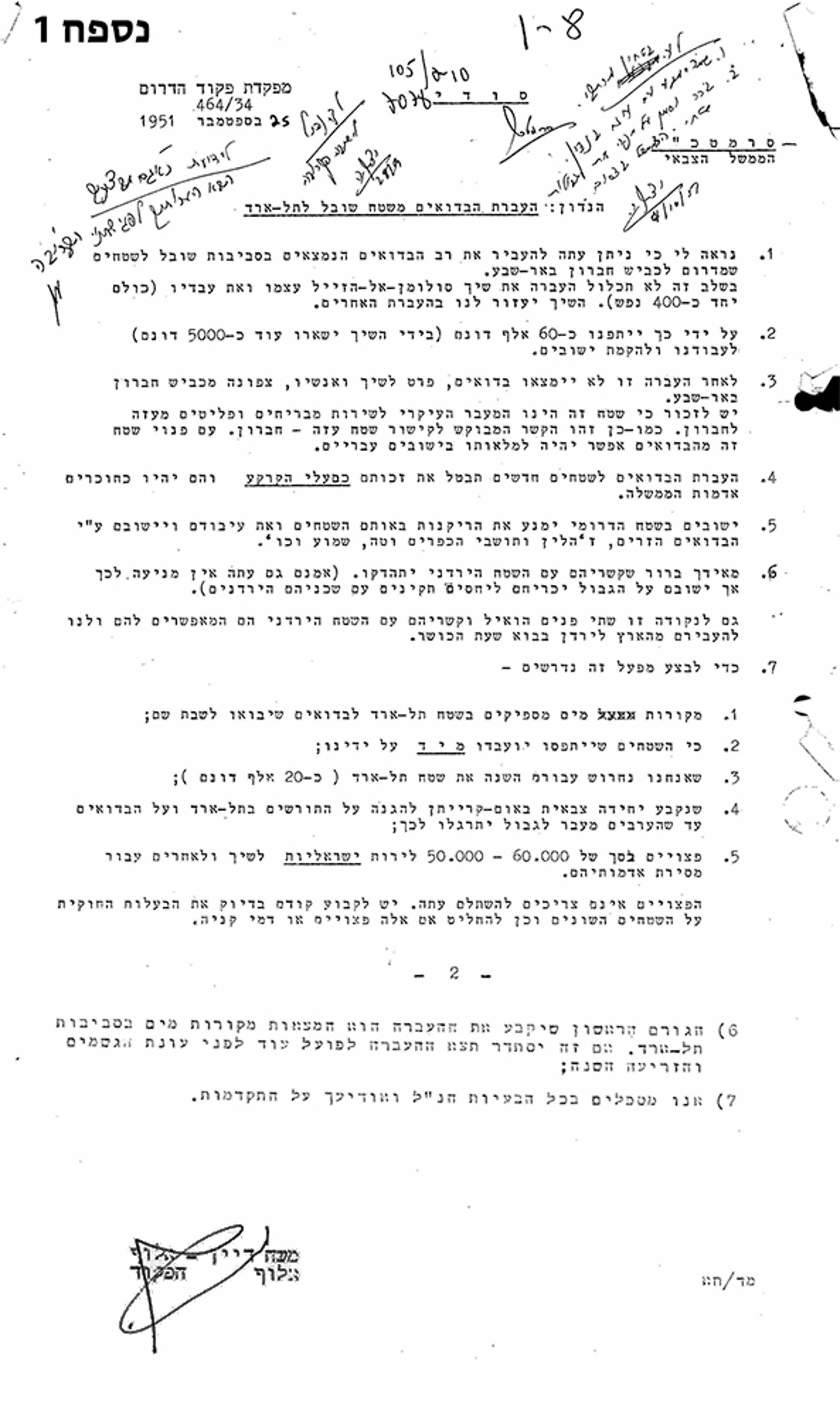 Letter from Moshe Dayan, the head of the Southern Command, to the deputy chief of staff, dated Sept. 25, 1951.
He said his opinion shows how the operation was carried out, down to the level of the notes exchanged by military government officers implementing it. The most senior of them knew it was an illegal operation, and that’s why it was important to them not to give the Bedouin written “transfer” orders, he added.
Another discovery was “the Bedouin resistance and protests, the stubbornness with which they tried to hold onto their land, even at the cost of hunger and thirst, not to mention the army’s threats and violence,” he said. Yet another finding was the way the official story was drafted. “It shows how they censored and edited the reports step by step, until the version in which the Bedouin moved ‘voluntarily’ was accepted,” Algazi said.
For years, Algazi has been an active participant in the Bedouin’s struggle in general and in that of Al-Arakib’s residents in particular. He began his current research in 2011 by delving into documents in the archives of the Defense Ministry and the Negev kibbutzim. “I had heard things and wanted to see if there was any truth to them,” he explained.
“I found a treasure trove in the kibbutzim’s archives. Sometimes I found myself with an archivist who had devoted years to collecting and organizing the material. Other times I was simply sent to dig through an old cupboard. But in any case, I never imaged this would gradually turn into research that would keep me busy for eight years.”
Algazi’s research led to the letter Dayan sent to the General Staff on September 25, 1951. “It’s now possible to transfer most of the Bedouin in the vicinity of [Kibbutz] Shoval to areas south of the Hebron-Be’er Sheva road,” he wrote. “Doing so will clear around 60,000 dunams in which we can farm and establish communities. After this transfer, there will be no Bedouin north of the Hebron-Be’er Sheva road.”
Dayan raised security considerations in favor of moving the Bedouin to the area of the Jordanian border, but security was not the only consideration. “Transferring the Bedouin to new territories will annul their rights as landowners and they will become tenants on government lands.” Dayan made a similar statement a year earlier, in June 1950, during a meeting of Mapai. “The party’s policy should be aimed at seeing this community of 170,000 Arabs as if their fate has yet to be sealed. I hope that in the coming years, we will be able to transfer these Arabs out of the Land of Israel.” A year after expressing this aspiration, the documents reveal, he partially executed his plan, moving them within but not outside the state’s borders.
Dayan’s letter was not easy to find, says Algazi. “In November 2017, a huge, disorganized file of correspondence of the military government, containing 1037 pages, was released for viewing,” he recalls. “The scanned file was once a big fat, disorderly folder lying on a dusty shelf somewhere full of correspondence, some interesting, some boring. I scrolled down the screen in the archive and the file got stuck on page 999. It was probably just a simple technical error – somebody didn’t think there’d be files any longer than that.”
Algazi was told the file would be fixed. Two years later, he was informed it was. “Dayan’s letter turned up in the final 40 pages along with another two parts of the correspondence that completed the missing puzzle pieces,” he recalls. “I was sitting in the archives, and I could hear Dayan speaking. In his unique style, he said openly things that others would wrap in cellophane paper: ‘Transferring the Bedouin to new territories would annul their rights as landowners and make them tenants on government lands.’ Clear and simple.”
But, adds Algazi, the cunning Dayan, in charge of Southern Command, thought he had managed to arrange the transfer with the Bedouin’s agreement and was making sure not to explain exactly how he achieved that agreement. “Dayan cooked it up, and it failed,” he says. “When it transpired that there was no agreement, the pressure and violence began. Indeed, right after Dayan’s letter, I found in the same file a report by the military government concerning the Bedouin’s refusal to move – and what needs to be done to meet the goal.” This time, the author is the acting military governor of the Negev, Major Moshe Bar-On. He wrote: “We received orders from the head of Southern Command to pressure the Bedouin tribes in the northern region, even going so far as to say that if they don’t move of their own free will, the army will be forced to move them.”
The means of ‘persuasion’
There were many means of persuasion, but some of the information remains censored. For example, Maj. Misha Hanegbi described in his report on November 21, 1951, a patrol in the region that was aimed at “hastening” the transfer of Bedouin when it ran into “stiff resistance from the locals to leaving their lands.” The report stated that only “after negotiations” was the transfer carried out. However, an entire paragraph is then blacked out – one that could shed light on the means used to “persuade.”
However, testimonies submitted by locals as court affidavits reveal some details. “I remember how the army ordered my family to leave Al-Arakib and head northward,” recalls 80-year-old Hussein Ibrahim Hussein. “Some people who resisted the deportation were arrested. We were told the lands were being confiscated for a few months for military purposes. The Military Police turned up, tied up our things, and told them to move.” They moved but tried to return. It didn’t end well. “I was arrested. My uncle was arrested, we were all arrested” he states. “We would go in to see, the army would detain us for a day or two and then release us.”
Not everyone in the military supported the operation. The Negev governor, Lt. Col. Michael Hanegbi, wrote to the chiefs of staff that “the presence of the Bedouin in the area serves as a buffer against attacks by infiltrators from the east against our settlements along that line. The fact is that our settlements in this area hardly suffer from attacks, which are very frequent in other areas.” He also warned that the alternative lands designated for the Bedouin were barren and that “the problem of water is the eastern region was getting worse.” On another occasion, Hanegbi reported that “despite restrictions prohibiting the use of violence, attempts were made, with the agreement of command, to try and force them to move.” He added: “A military government unit took down a number of tents and loaded them on to a vehicle. The tent owners did not leave and did not join their families who had been transferred.”
Additional testimonies to events were received from residents of nearby kibbutzim. The area “was surrounded by police and military government in military vehicles,” Yosef Tzur of Kibbutz Shuval wrote to kibbutz movement leaders. “People fled, tents were taken down and those who were caught were piled into vehicles and taken to Tel Arad.” A little of what happened when the uniformed officers turned up was revealed by Sheikh Suleiman Al-Okbi in an interview with Yedioth Aharonoth in 1975. “Military units began turning up on our lands from time to time and they would shoot in the air,” he told Yedioth. “People were scared and the women were frightened to work in the field and graze the animals.”
Lieutenant Colonel Hanegbi wrote in one of his letters that “the transfers were conducted primarily through persuasion and economic pressure.” He went on to reveal more. “We had no legal foundation and we were also under orders not to use force, so we had to behave cautiously in our actions and without becoming entangled in legal problems.”
Algazi found evidence of this economic pressure in a note written by the prime minister’s advisor on Arab affairs back then, Yehoshua Palmon (who, the researcher says, was “the most senior figure in setting policy toward Israel’s Arab citizens”). Palmon wrote that the military government prevented the Bedouin from sowing their lands to pressure them into agreeing to move. There was evidence of this practice on the ground. Kibbutz Shuval wrote to the Mapam Party on January 28, 1952, that “the military government forced the Bedouin to leave their lands. Their food supplies were stopped.” According to the kibbutz residents, food supplies were stopped over a period of months.
Other methods of harassing the Bedouin were employed according to an affidavit submitted to the courts by Hussein Ibrahim al-Touri, who was born in 1942. He described how the military “would come and harass us, take us to prison, and so on.” He stated: “The soldiers would take a rope, tie a tent to a command car and demolish it. We were told to move and that if we were to return they would burn our homes down and take us to Jordan.” Abed Hasin Abu-Sakut, a fellow villager, said that after leaving their lands, they returned occasionally, but then “the soldiers would shoot or arrest us and fine us.”
They didn’t just return to their lands of their own accords. Algazi says the state gave the Bedouin the impression they were only being temporarily evacuated. In a letter from the time, Captain Avraham Shemesh wrote that he had allowed evacuated Bedouin to return from time to time to work the soil “until the Beni Okba tribe was allowed to return to its lands.” According to the testimony of local Bedouin similar statements were repeatedly made to them. “The elders said the military governor gave my uncle a letter saying that the army needs the land for six months, after which we would return,” Ahmad Salam Mahmoud al-Okbi testified in court. “I remember how a year after the deportation in 1951, my uncle returned to the land with others. I was there and grazed sheep. One day, a military officer by the name of Sasson Bar Zvi who I knew turned up. He said that if we didn’t leave, he would take us to jail.”
The document reveals that the area kibbutzim raised objections on several occasions to the policy. In late 1951, Kibbutz Mishmar Hanegev, Kibbutz Shuval and Kibbutz Safiach (Beit Kama) wrote a letter to the Foreign Affairs and Defense Committee protesting the transfer of Bedouin, arguing that they helped settlement.
“We felt a duty to emphasize that this was being done through conspiracy, bribery, and pressure,” they wrote, reporting that “some tents were moved by force.” The kibbutzim’s protest led Mapan to investigate the matter in November 1952. Lieutenant Colonel Hanegbi testified that he had only carried out the orders given him, but confirmed that the army’s intention was to “undermine the status of the tribes being transferred, so they would leave the country.” As part of the operation, he said, “scare tactics and bribery were used, but not always.” Hanegbi contended that military personnel had behaved “cruelly and crudely” toward the Bedouin. As a result, a recommendation was made to annul his party membership.
Algazi says that while there have been a number of studies in recent year about the period of military rule, “there was no study or affirmation until today that the 1951 deportation took place.”
A matter of timing
Throughout the hearings, the state and the prosecution did not deny the operation’s existence but argued that against Algazi’s opinion emphasized the civilian considerations of the transfer while playing down the security considerations. The state also raised a claim concerning the operation’s timetable. They argued that operation began before the law was passed, so Dayan could not have known what criteria would be set for seizing land. However, some could argue that Dayan possibly knew about long-term political plans because of his position and standing.
Another issue concerns how long Al-Arakib has existed. The state denied the claim that there was a permanent settlement on Al-Arakib’s lands. The petitioners assert there had been a Bedouin settlement at the site prior to the state’s establishment, based on an opinion provided by Forensic Architecture, a research group at the University of London. Forensic Architecture, headed by Prof. Eyal Weizman, combined digital tools with maps and reconnaissance of Al-Arakib to reach that conclusion. The opinion will take on greater significance if the claimants manage to progress to the second stage of the hearing on proof of ownership.
The state argues the court should reject the claim due to a delay of decades in filing it. But the Bedouin also have a response for that: They were never told the lands were appropriated and the state misled them into thinking the lands had been taken away only temporarily. A letter received in 2000 from the Israel Lands Administration stated that “no appropriation has taken place” on the lands.
One way or the other, all parties are waiting to hear from the court. Meanwhile, Algazi expects to make further findings. “The difficulty is in reconstructing an operation carried out by people who knew it was not really legal, and therefore made sure not to put down certain things in writing,” he tells Haaretz. “In addition, although we are talking about events that took place 70 years ago, only some of the documents have been revealed. We are waiting for the day when we will be able to study all of them.”
****
Netael Bandel is an attorney who writes for Ha’aretz
==========================================
https://english.alaraby.co.uk/news/archive-reveals-israels-plans-expel-negev-palestinians
Historical archive reveals Israel’s plans to expel Negev Palestinians
MENA2 min read
The New Arab Staff
01 February, 2022
Newly researched documents dating back to 1951 support Palestinian Bedouins’ claims to lands in the Negev Desert, where protests have been going on for the past month over lands targeted for seizure.
Newly studied archives showing Israel’s intention to forcibly displace thousands of Palestinians from the Negev Desert (also known as the Naqab) could help Bedouins claim back their lands, Israeli media reported on Monday.
Professor Gadi Algazi, a historian from Tel Aviv University, uncovered archives documenting a 1951 Israeli military operation to forcibly expel Palestinian Bedouins from their lands in the Negev, a large desert historically inhabited and cultivated by Bedouin tribes.
The archival materials were originally released in 2017.
They include a letter written by Moshe Dayan, then head of the Israeli army’s Southern Command, and a document written by the military government in the area. According to Algazi’s research, the two documents prove the army’s intention to forcibly move the Bedouins from their lands in order to seize them.
“There was an organized transfer of Bedouin citizens from the northwestern Negev eastward to barren areas, with the goal of taking over their lands. They carried out this operation using a mix of threats, violence, bribery and fraud,” Algazi told the Israeli daily Haaretz.
Some believe the documents could shift the balance in favour of displaced Negev Palestinians in various lawsuits against the Israeli government, and create a legal precedent.
Bedouins from the Negev have testified for years that Israeli soldiers expelled them but this is the first time historical research provides evidence of an orderly state expulsion plan.
Israel’s official stand on the Negev is that Palestinian Bedouins left their land following Israel’s 1948 declaration of independence, and never returned.
Known as the Nakba – or Catastrophe – by Palestinians, this dramatic event witnessed the flight of hundreds of thousands of Palestinians from massacres committed by Zionist militias, who seized their villages and towns.
In 1953, Israel passed laws expropriating all land whose owners had been absent and not returned by April 1952, effectively seizing the property of Palestinians who left during the Nakba.
The new archival revelations come as protests continue in the Negev against an afforestation plan led by the controversial Jewish National Fund (JNF), a quasi-state organ whose aim is to buy a maximum amount of land on behalf of Israeli Jews. The protests began in early January.
The Israeli Land Authority assigned some 1,300,000 square metres of land belonging to a Bedouin tribe to the JNF, with 370,000 square metres being allocated for forest planting.
Several protests have taken place across Palestine in solidarity with Negev residents. The latest one took place on Sunday in Jerusalem.
Israeli forces have arrested dozens of activists and demonstrators, including several children, since the start of their campaign to “Save the Negev”.
================================================
https://www.middleeasteye.net/news/israel-negev-palestinians-empty-plans-revealed-new-documentsHistorical documents reveal Israel’s plan to empty Negev of Palestinians
Documents cited in a legal challenge against the Israeli government acknowledge that officials knew operation was ‘illegal’ post-1948
By MEE staff
Published date: 31 January 2022 17:02 UTC | Last update: 5 days 18 hours ago
Newly unearthed Israeli historical records reveal officials’ relentless efforts to forcibly empty Palestinian lands of their Bedouin inhabitants in the Negev during the 1950s.
Haaretz reported that the records were revealed as part of a legal case over land ownership pursued by Palestinian citizens of Israel in al-Araqeeb, one of the dozens of villages deemed illegal by Israel and barred from water, electricity and transportation services, among others.
Araqeeb was demolished 197 times by Israel, which seized its lands, and its Palestinian inhabitants have long challenged the Israeli government in courts over the issue.
Haaretz reported on Monday that the Israeli government is considering the case as of “national strategic” importance to set the bar of other lawsuits filed by Palestinian citizens of Israel contesting the confiscation of their lands.
However, Araqeeb’s case has been followed with an opinion and appendix by Gadi Algazi, an Israeli history professor at Tel Aviv University, who spent the past eight years studying the government memos, records and letters regarding the Negev, the largest region in the country.
Algazi had revealed documents as part of the legal case of numerous plans to push Palestinians, who remained in what became Israel after the 1948 war, out of their lands.
A military operation was set up by Moshe Dayan, the southern region commander, in November 1951 to kick out Palestinian Bedouins from areas in the northwest of the Negev to the east and from north of Hebron-Beer Sheva road to the south of it.
This would turn Palestinians who became citizens of Israel into tenants.
“The transfer of the Bedouins to new territories will nullify their right as landowners and they will be [treated] as tenants of government lands,” Dayan wrote in a letter, first reported by Haaretz.
Dayan’s plan was then approved by Israel’s army chief of staff Yigael Yadin, which also suggested that if the Palestinians were not “voluntarily transferred”, the Israeli fledgling forces would “be forced to transfer them” and forcibly remove them from their lands.
Officials at Israel’s Ministry of Justice believe that Araqeeb’s case would end like its predecessor, in other words, in favour of the government. Still, these historical documents unearthed by Algazi could have legal implications, Haaretz said.
The village of Araqeeb spread over 200 dunams (200,000 square metres), and what remained of it, which Israel continuously demolished, has been rebuilt repeatedly.
Palestinian lands in Araqeeb were seized, like many other villages, according to the 1953 Land Acquisition Law.
Israel said that lands in the Negev, which Palestinian owners did live on between 15 May 1948 and 1 April 1952, belonged to the Israeli government that had expropriated 247,000 dunams in the Negev.
The new historical records reveal that Palestinians in that period were forcibly deported by Israeli forces deploying threats, violence, bribery and fraud, Haaretz reported.
‘Discrimination and neglect’
Algazi told Haaretz that senior Israeli officials knew that the operation to deport Palestinians from the Negev was “illegal”, thus they avoided giving them “written eviction orders”.
He also said that the records attested to a resistance undertaken by Palestinian Bedouins against the Israeli plan to move them out of their lands.
“[It was] a revelation the stubbornness with which they tried to hold on to their land, even at the cost of hunger and thirst, not to mention threats and military violence,” Algazi told Haaretz.
In recent weeks, hundreds of Palestinian citizens of Israel in the Negev have protested against a forestation plan in their villages led by the Jewish National Fund (JNF), which they see as a way to deprive them of their lands.
On Sunday, almost 200 of them demonstrated outside Israeli Prime Minister Naftali Bennett’s office in Jerusalem against the plan, calling it a “policy of discrimination and neglect”.
About 300,000 Palestinian citizens live in the Negev; 100,000 live in 35 unrecognised villages and lack essential public services
================================================
The Supreme Court sitting as a Civil Appeals Court
CA 4220/12
Before: The Honorable Deputy President E. Rubinstein
The Honorable Justice S. Joubran
The Honorable Justice E. Hayut
The Appellants: 1. The Late Saliman Muhammed Al-Uqbi
2. Saeed Ali Al-Uqbi
3. Majed Ali Saliman Al-Uqbi
4. Maher Ali Al-Uqbi
5. Fatma Al-Navari Al-Uqbi
6. Noel Al-Aasem Al-Uqbi
7. Dalal Al-Uqbi
8. Tamam Al-Uqbi
9. Raja Al-Uqbi
10. Khasan (Nouri) Saliman Al-Uqbi
11. Anwar Saliman Al-Uqbi
12. Ibrahim Saliman Al-Uqbi
13. Saeed Saliman Al-Uqbi
14. Khalil Saliman Al-Uqbi
15. Rakhab Saliman Al-Uqbi
16. Khalma Saliman Al-Uqbi
v e r s u s
The Respondent: The State of Israel
Appeal on the judgment of the Beer Sheva District Court in CC 7161/06, CC 7275/06, CC 7276/06, CC 1114/07, CC 1115/07 and CC 5278/08, that was delivered on March 15, 2012 by the Honorable Deputy President S. Dovrat
Date of Session: 4th of Sivan, 5774 (June 2, 2014)
On behalf of the Appellants: Adv. Michael Sefarad; Adv. Adar Grayevsky
On behalf of the Respondent: Adv. Moshe Golan; Adv. Havatzelet Yahel
J U D G M E N T
Justice E. Hayut:
An appeal on the judgment of the Beer Sheva District Court (the Honorable Deputy President S. Dovrat) dated March 15, 2012. The judgment was delivered in a consolidated manner for six land settlement cases (CC 7161/06, CC 7275/06, CC 7276/06, CC 1114/07, CC 1115/07 and CC 5278/08) and denied the Appellants’ claims of ownership of various land lots in the northern Negev, and accepted the State’s claim that the ownership of such lots should be registered in its name and in the name of the Development Authority.
The Background and the District Court’s Judgment
1. In 1971 a land settlement proceeding, pursuant to the Land Rights Settlement [New Version] Ordinance, 5729-1969 (hereinafter: the “Settlement Ordinance“), began with respect to lands in the Northern Negev. In the framework of this proceeding, Appellant 1 claimed ownership of three land lots south of Rahat (known as Araqib 2, Araqib 6 and Araqib 60) and of three land lots north of Netivot (known as Sharia 132, Sharia 133 and Sharia 134) (hereinafter: the “Araqib Lots” and the “Sharia Lots“, respectively, and jointly, the “Lots“). The State, for its part, also claimed ownership of said Lots, and in its claim primarily relied on the fact that the Lots are located within the boundaries of the blocks in that area which had been expropriated in their entirety in 1954 by virtue of the Acquisition of Land (Confirmation of Deeds and Compensations) Law, 5713-1953 (hereinafter: the “Acquisition Law“). The settlement proceeding, which relates, inter alia, to the discussed Lots, was not completed for many years, and in 2006, Appellant 1’s heirs (Appellants 2-16) filed six claims to the court of first instance, in which they petitioned that they be declared owners of the Lots and that the Lots be registered in their name.
2. The six claims were consolidated and, as stated in its judgment dated March 15, 2102, the court of first instance rejected these claims with instructions that the blocks in which these Lots, among others, are located, be registered in the name of the State and the Development Authority (Blocks numbered 400367, 400369, 400371, 400526 and 400527). The court first examined the validity of the expropriation executed by the State in 1954 pursuant to the Acquisition Law. Upon rejecting a series of arguments raised by the Appellants against the validity of such expropriation, the court concluded that the expropriation was lawfully performed, and that the Appellants’ claim survey, in which they claimed ownership of the Lots, should be rejected. However, the court of first instance ruled, in reliance upon the case-law that was adjudicated in CA 4067/07 Jabareen v. The State of Israel (January 3, 2010) (hereinafter: the “Jabareen Case”), that the fact of a valid expropriation does not nullify the need to address the matter of the rights, if any, held by Appellants prior to the expropriation, in order to rule regarding any compensation deriving therefrom. In addressing this matter, the court of first instance analyzed the provisions of the Land Law, 5729-1969 (hereinafter: the “Land Law“), including Sections 152-156 of the Law, and ruled that the main acts of legislation upon which the matter of the rights held by the Appellants prior to the 1954 expropriation should be examined, are: The Ottoman Land Code of 1274 to the Hijra (1858) (hereinafter: the “Ottoman Land Code” or the “Land Code “) and the (Mewat) Land Ordinance, 1921 (hereinafter: the “Mewat Ordinance“), which were in force and effect on the effective date (1954). This is in light of the provision of Section 156 of the Land Law, which prescribes that the provisions of Sections 152-155, which abolish the classification of the lands that were in effect pursuant to Ottoman legislation, do not derogate from land rights that existed prior to the legislation of the Land Law.
3. The court examined the Appellants’ rights in and to the Lots on the effective date (1954) in accordance with the provisions of the Land Code and the Mewat Ordinance. It concluded that on the effective date, these lands were State-owned Mewat lands. In reaching this conclusion, the District Court relied primarily on the State’s expert opinion by Prof. Ruth Kark, which it preferred over that of the Appellants’ expert opinion, Prof. Oren Yiftachel. The court rejected the Appellants’ argument that the Lots in dispute are “Miri” lands which had been possessed and cultivated ab antiquo by the Al-Uqbi tribe, to which they belong (hereinafter: the “Al-Uqbi Tribe” or the “Tribe“). Additionally, it rejected the Appellants’ argument that even if the land at issue is Mewat land, they acquired such rights by virtue of cultivation and revival. The court further rejected the Appellants’ argument that at some stage, and in accordance with internal arrangements that were made among the members of the Tribe, the ownership rights regarding such Lots were acquired by the Appellants’ family. In this context, the court did not accept the Appellants’ argument that during the Ottoman period and the subsequent period of the British Mandate the Bedouin tribes, including the Al-Uqbi Tribe, benefitted from autonomy such that the governing authorities recognized internal arrangements made by the members of the Tribe with respect to the lands in the Negev as valid arrangements reflecting property rights, even if such rights were not registered in the Land Registry (the “Tabu“).
The court of first instance elaborated that in order for land to be considered Miri land pursuant to the Ottoman Land Code, it must be demonstrated that at some point it was assigned to some person by the authorities. The court of first instance ruled that the Appellants had not proven that the Lots were assigned at any time whatsoever by the authorities to their family or to any other person, and therefore they had not proven that the land at issue is Miri land. On the other hand, the court ruled that the Lots should be classified as State-owned Mewat land from the date of the expropriation, since, as emerges from Prof. Kark’s opinion, in the year in which the Ottoman Land Code was legislated (1858), the Lots stood barren and uncultivated and were more than a mile and half (2.2185 km) away from a permanent town. Thus, the conditions prescribed in the Land Code for classifying land as Mewat land were met. In the factual dispute between the parties regarding the Lots’ distance from a place of settlement at the time of the legislation of the Land Code, the court of first instance ruled that the Appellants did not meet the burden to prove the existence of a permanent town within a mile and half of the Lots, and also did not prove that the Tribe ever settled on the Lots in dispute. In this matter, the court of first instance adopted the opinion of the State’s expert, Prof. Ruth Kark, who testified that until the end of the First World War (1918) there were no permanent towns in the area of the Lots and these Lots were barren and uncultivated, preferring this opinion over that of the Appellants’ expert, Prof. Oren Yiftachel, who claimed that the Tribe established towns on the Lots and had cultivated them ab antiquo. The court of first instance elaborated on the fact that Prof. Kark’s opinion was detailed and thorough and relied on reliable historical sources from which it emerges that the Lots were barren wild areas at the relevant time. On the other hand, the court ruled, Prof. Yiftachel’s conduct left an uncomfortable feeling and compromised his credibility. The court of first instance elaborated on the fact that during his cross examination, it was discovered that Prof. Yiftachel relied on sources without having read them, cited some of the sources upon which he relied in a tendentious manner and ignored sources which did not support the conclusion he wished to present. As for the possibility of acquiring rights in and to Mewat lots by way of cultivation and revival, the court ruled that this possibility was eliminated upon the legislation of the Mewat Ordinance in 1921, and therefore, the Appellants must prove that they cultivated and revived the Lots prior to 1921. Based on Prof. Kark’s opinion and testimony, the court of lower instance reached the conclusion that the Lots were also barren and uncultivated when the Mewat Ordinance was legislated in 1921. Therefore, it ruled that the Lots have always been Mewat land, in and to which the State is granted ownership, and that at no stage were the conditions that are required for changing its classification from Mewat to Miri, and for acquiring private ownership therein and thereto by the Appellants’ family, fulfilled.
4. The court of first instance further ruled that the additional opinions that were filed by the Appellants regarding the Lots’ condition during the years preceding the establishment of the State also do not come to the aid. With regard to the opinion of Mr. Shlomo Ben Yosef (hereinafter: “Ben Yosef“), the aerial photograph interpreter on behalf of the Appellants, the court ruled that it cannot substantiate the Appellants’ argument as to the cultivation and possession of the Lots during the relevant years, given the fact that it is based on one sole aerial photograph from 1945. The court of first instance emphasized that according to Ben Yosef’s testimony, it emerges from the aerial photograph that in 1945 the Lots were cultivated in a very sparse manner, and that Ben Yosef’s claim, that in that year there was a Bedouin rural town on the Lots’ area, is unfounded and refers to the presence of a thin population spread over an area of 30,000 dunams. With regard to the opinion of Mr. Abu Friecha, the surveyor on behalf of the Appellants (hereinafter: “Abu Friecha“), the court of lower instance elaborated on the fact that, except for one, all of the sites that were marked by him on the map, and with respect to which it was argued that they attest to the existence of an ancient Bedouin town in the area of the Lots, are outside of the area of the Lots. Additionally, the court of first instance stated that Abu Friecha admitted in his testimony that he did not measure the area of the Lots at all, and only marked sites on the map to which Appellants referred him. Additionally, Abu Friecha confirmed in his testimony that some of the sites that were marked on the map that he presented are not in fact located where they were marked. Therefore, the court of first instance ruled that this opinion also does not substantiate the Appellants’ argument regarding the existence of a permanent town within a mile and a half of the Lots at the relevant period of time, or that they were cultivated prior to the legislation of the Mewat Ordinance in 1921.
5. In addition, the court of first instance rejected the Appellants’ argument that nomadic or semi-nomadic settlements (meaning, settlements that move within a single tract of land in accordance with the seasons of the year), can also, pursuant to the Ottoman Land Code, be considered a “town” such that the lands adjacent thereto would not be considered Mewat lands. The court of first instance elaborated on the fact that according to the interpretation of the Land Code that was given in case-law, a town for which the surrounding lands shall not be considered Mewat lands is a permanent town that is grounded in one place throughout the entire year. Therefore, the court of first instance ruled that even if the Al-Uqbi Tribe roamed in the area of the Lots between 1858 and 1921, this does not grant them ownership of the Lots. As was already stated, the court rejected the Appellants’ argument that even if the Lots at any stage were classified as Mewat, they acquired ownership of the Lots due to cultivating and reviving them. In this context, the court further ruled that even had the Appellants’ argument regarding cultivating and reviving the Lots not been rejected on a factual level, the cultivation and revival thereof alone would not have been sufficient to lead to the conclusion that the Appellants became owners of the Lots. This is because neither the Lots nor any part thereof were ever registered in the Land Registry (the “Tabu“) in their name, in the name of Appellant 1 who is the testator thereof or in the name of the person from whom Appellant 1 allegedly inherited the rights therein and thereto. In this context, the court mentioned the provisions of Section 2 of the Mewat Ordinance pursuant to which a person who cultivated Mewat land before the ordinance was published is required to register as the owners of the rights within two months from the date of its publication, otherwise he will lose his rights in and to the land. The court of first instance further rejected the Appellants’ argument that the Tribe is not required to register the Lots in its name in the Land Registry (the “Tabu“) in order to acquire rights therein since the Ottoman administration and the British Mandate government granted the Bedouin autonomy in the Negev areas and granted legal validity to rights that were acquired in and to the land pursuant to traditional Bedouin law. The court of first instance also adopted Prof. Kark’s opinion in this matter, pursuant to which both during the Ottoman period and the British Mandate period there was no sweeping recognition of the Bedouin’s ownership of lands in the Negev, and preferred it over the opinion of Prof. Yiftachel who posited that the Ottoman administration and the British Mandate government granted legal validity to rights that were acquired pursuant to traditional Bedouin law, even without being registered in the Land Registry (the “Tabu“). In this context, the court of first instance rejected the Appellants’ argument that their position is supported by the declaration voiced by Winston Churchill, the Secretary of State for the Colonies, in a meeting he held with the High Commissioner in 1921, that the British will not harm the special rights and customs of the Bedouin (Official Report, 29 March 1921, Great Britain Public Record Office, C.O. 733/2/77; hereinafter: the “Churchill Declaration“). In this matter, the court of first instance ruled that one cannot attribute a legal status to the said declaration without it having been anchored in explicit acts of legislation, and that had the British been interested in granting binding legal status to the Bedouin land ownership system, it can be assumed that they would have expressed this in official legislation. Additionally, the court of first instance ruled that it is not at all clear what Churchill meant in the said declaration, and therefore one cannot rely on this declaration in order to create legal rights ex nihilo.
6. The court of first instance further stated that the Appellants’ argument that they are exempt from registering their rights in and to the Lots in the Land Registry (the “Tabu“), is not consistent with various contracts that were presented by them as testimony. For example, in contracts C/1 and C/13, which relate to the Araqib 2 and Sharia 132 Lots, the seller undertakes to register the lot in the name of the purchaser. The court of first instance elaborated on the fact that had the members of the Tribe believed that purchasing rights in accordance with traditional Bedouin law was sufficient in order to grant legal validity to their ownership of the land, it can be assumed that they would not have bothered to stipulate the registration of the lot in the Land Registry (the “Tabu“), in the sale agreement. As to the contracts themselves, the court of first instance stated that they do not state the origin of the Lots’ sellers’ rights in and to the land, and that in the absence of registration of the sellers’ rights in the Land Registry (the “Tabu“), these contracts cannot constitute evidence that rights therein and thereto were lawfully acquired. Additionally, the court of lower instance ruled that contracts between private parties do not bind the authorities or grant them rights in and to the land, when rights were not lawfully acquired therein and thereto to begin with.
7. After ruling that the Appellants’ family did not acquire rights in and to the Lots by virtue of cultivation and revival, the court of first instance examined whether they have a claim by virtue of a period of prescription. In this context, the court of first instance elaborated on the fact that the Ottoman land laws do not allow acquiring rights in and to Mewat lands by virtue of prescription, and therefore, once it was determined that the Lots are Mewat classified lands, the Appellants do not have a prescription claim. Above and beyond that which was necessary, the court of first instance also rejected the Appellants’ claim of acquired rights in and to the Lots by virtue of a period of prescription on its merits. The court ruled that, pursuant to the Ottoman Land Code and Section 22 of the Prescription Law, 5718-1958 (hereinafter: the “Prescription Law“), insofar as at issue is possession that began before 1943, continuous possession of the land for the duration of 15 years is required in order to acquire rights in and to land by virtue of a period of prescription. In the case at hand, the court of first instance ruled, the majority of the documents that the Appellants presented with respect to the Lots relate to the years between 1943 and 1951 (when the Appellants claim they were expelled from the land) and the earliest document they presented with respect to the Lots was a tithe payment certificate from 1937. The court of first instance therefore ruled that the Appellants did not meet the burden of proving that they held the Lots continuously for the period of time required by the above-mentioned laws.
8. An additional claim that was raised by the Appellants related to the rights in and to the Lots by virtue of indigenousness and transitional justice. In this matter, the court of first instance ruled that this is a weighty matter that the legislature should address, but further ruled that the existing law does not recognize rights by virtue of indigenousness and therefore it is inappropriate to address this claim. Furthermore, the court of first instance stated that it doubts whether the Al-Uqbi Tribe can be considered an indigenous group under international law since they themselves claim that they arrived in the Negev after it was already controlled by the Ottoman Empire, and therefore they are not an indigenous minority which was conquered by a foreign administration that arrived to its land.
For all of these reasons, the court of first instance rejected the Appellants’ claim of rights in and to the Lots and ordered that they be registered in the name of the State and the Development Authority. Additionally, and in light of the conclusions it so reached, the court of lower instance did not find it appropriate to rule that the Appellants are entitled to compensation due to the expropriation of the Lots, pursuant to the Acquisition Law.
The Appellants’ Arguments
9. The Appellants do not accept the District Court’s judgment and in the appeal before us they claim that their family has been living in the Negev for centuries, and that despite this the court of first instance ruled that during that entire time it did not acquire any rights whatsoever in and to its lands. According to the Appellants, this is an unjust and unreasonable outcome that derives from the adoption of an historical and legal doctrine, rooted in case-law, by virtue of which the Bedouin tribes are dispossessed of their historical lands. The Appellants dispute the court of first instance’s factual findings, including, inter alia, the rulings that the Lots were barren and uncultivated between 1858 and 1921 and were further than a mile and half from a town. Additionally, the Appellants dispute the legal conclusion that the court of lower instance reached, that the Lots are State-owned Mewat land. Finally, the Appellants claim that the court of first instance’s findings and conclusions with respect to the validity of the State’s expropriation in 1954 pursuant to the Acquisition Law are also erroneous and warrant intervention.
10. On a factual-historical level, the Appellants claim that the court chose to ignore substantiated evidence that was presented before it and that relies on various research and historical sources which prove that the Al-Uqbi Tribe had been settled on the Lots and had cultivated them since as early as 1807. In this context, the Appellants refer, inter alia, to the opinion of Prof. Yiftachel, and the annexes thereto, to the opinion of the surveyor Abu Friecha, to the opinion of the aerial photographs interpreter Ben Yosef, and to the testimonies of the Tribe’s elders (hereinafter: the “Tribe’s Elders“), who allegedly delivered a first-hand version as to the condition of the Lots at the relevant time. Additionally, the Appellants refer to various official publications of the Mandate government and of the State of Israel in the years following the establishment of the State, which, according to them, prove that the Tribe was settled on the Lots and cultivated them. The Appellants claim that given the many pieces of evidence as to the possession and cultivation of the Lots by the Tribe throughout generations, the court of first instance erred when preferring Prof. Kark’s opinion to that of Prof. Yiftachel. It is argued that contrary to Prof. Yiftachel, who visited the area of the Lots and who, in addition to the historical-theoretical research, also elaborated on the physical evidence of the existence of an ancient Bedouin town in the said Lots, Prof. Kark’s opinion relied exclusively on the journey literature of various 19th century European travelers, missionaries and researchers who passed through the Negev areas on their journeys. According to the Appellants, the travel literature upon which Prof. Kark relied should not be considered credible, since their authors did not come to the Negev in order to research the Bedouin population and their entire reference to such population was incidental and is suffused with western prejudice. In addition, the Appellants argue that even if it would have been appropriate to trust the testimonies of the 19th century researchers who visited the area of the Lots, Prof. Kark’s opinion ignored testimonies and letters of many Negev researchers who were mentioned in Prof. Yiftachel’s opinion and who reported on extensive Bedouin agriculture and settlement in the Negev.
11. Alongside the appeal they filed, the Appellants are also petitioning to submit an additional piece of evidence at the appeal stage, which relates to the Tribe’s possession and cultivation of the Lots. At issue is a document which is alleged to be a report that was prepared by the Hachsharat Hayishuv company in 1920, which includes a survey regarding the condition of the Negev lands. In this survey, it is argued, areas that were possessed and cultivated by the Appellants’ testators were appraised, and it proves their rights in and to the Lots. This evidence, it is argued, was discovered at the last stages of conducting the proceeding at the court of first instance, as a result of research that was conducted by Prof. Yiftachel together with additional researchers in order to write a joint article. According to the Appellants, its submission at the appeal stage should be allowed in light of its importance and in light of the fact that at hand is a case addressing a matter of principle. I shall begin by stating that I do not find it appropriate to allow the evidence to be submitted at the appeal stage, based on the criteria outlined in this matter in case-law. It has been ruled that leave to submit new evidence in appeal shall be granted sparingly and only in cases in which the evidence that is being requested to be added is simple and conclusive and bears significant importance relating to the core of the dispute between the parties (CA 105/05 Dahan v. Michele Kason, paragraph 4 of Justice E. Arbel‘s judgment (November 10, 2005); CA 1773/06 Aleph v. Kibbutz Ayelet Hashachar, paragraph 17 of Justice A. Procaccia‘s judgment (December 19, 2010); CA 679/11 Dardikman v. Nadav, paragraph 29 of Justice U. Shoham‘s judgment (March 27, 2014)). This is not the case in the case at hand. Precedent also establishes that the party requesting to add the evidence must demonstrate that it did not know of its existence when the hearing in the procedural instance was conducted and also could not have discovered it had it acted with proper diligence to do so (see CA 374/08 Katan v. Horenstein, paragraphs 9-10 of Justice Z. Zylbertal‘s judgment (December 25, 2012)). In the case at hand, it emerges from the application itself that the evidence was in the Appellants’ possession at the time the case was being heard in the court of first instance. Despite this the Appellants did not bother to submit it nor do they not provide any explanation whatsoever for such conduct.
12. At the legal level, the Appellants argue that according to the laws that applied to the Negev area until the establishment of the State, the fact that the Al-Uqbi Tribe had lived and resided on the Lots for generations granted them ownership thereof. The Appellants repeatedly argue that both the Ottoman administration and the British Mandate government granted the Bedouin legal autonomy to manage their property and their lands in accordance with traditional Bedouin law. Therefore, according to the Appellants, the Ottoman Land Code and the Mewat Ordinance did not apply at all to the Negev areas until the establishment of the State and the law that was in effect in the Negev at the relevant time was traditional Bedouin law. According to the Appellants, the court of first instance ignored the many pieces of evidence that were presented attesting to the existence of such autonomy from which the Bedouin tribes benefitted at such time in the Negev expanses and the evidence that was presented regarding the acquisition of rights in and to the Lots by the Appellants’ family in accordance with traditional Bedouin law. In this context, the Appellants emphasize the fact that both during the Ottoman period and the British Mandate period many Bedouin registered land in the Negev in their name and sold them to the Zionist institutions. This fact, it is argued, proves that prior to the establishment of the State the authorities recognized the Bedouin’s rights in and to the Negev lands and allowed them to register these lands in their names, if only they wanted to do so – both before the legislation of the Mewat Ordinance and thereafter.
13. Alternatively, the Appellants claim that even if their rights in and to the Lots should be examined in accordance with the Ottoman Land Code and the Mandate Mewat Ordinance, the court of first instance erred when ruling that the Lots were State-owned Mewat classified lands rather than Miri lands owned by the Appellants. In this context, the Appellants claim that the court of first instance erred by not transferring the burden of persuasion to the State, given that the State has acted with a material lack of good faith and, for over 30 years, intentionally avoided bringing the conflicting claims that were filed with respect to the Lots in the framework of the settlement proceedings before the court. This conduct, it is argued, caused the Appellants severe evidential damage and severely sabotaged their chances of proving their ownership of the Lots. According to the Appellants, the court of first instance erred by not expressing this in the form of shifting the burden of persuasion, such that instead of the Appellants being required to prove family ownership of the Lots, the burden would transfer to the State to prove that at hand are Mewat lands that were owned thereby.
14. On the merits of the matter, the Appellants argue that the correct interpretation of the Ottoman Land Code should lead to the conclusion that in the case of the Lots, the conditions required for classifying lands as Mewat lands were not met. First, it was argued that it was proven that the Appellants’ family had been possessing and cultivating the Lots for many years, and therefore they are not abandoned and barren lands which pursuant to the Land Code could be considered Mewat lands; Second, it was argued that the Lots were not more than a mile and half from the location of a town as the Land Code requires. In this context, the Appellants argue that according to its correct interpretation, the Ottoman Land Code also recognized nomadic (or semi-nomadic) settlement of Bedouin in the Negev as a “town” such that the lands adjacent thereto are not Mewat lands. It was argued that this interpretation coincides with that which is stated in other Mandate government acts of legislation in land matters. The Appellants further argue that the said interpretation of the term “town” in the Ottoman Land Code coincides with the purpose of such law to encourage agricultural cultivation of barren lands by way of granting ownership of the cultivated lands that are adjacent to population concentrations. The Appellants further argue in this context that the court of first instance erred when it ruled that even according to the Appellants the Lots were not settled year-round and the towns in which it was alleged that they resided were no more than temporary camping locations that were built on occasion. According to the Appellants, this ruling is an erroneous interpretation that was given by the court of first instance of their claim that the Al-Uqbi Tribe were not nomads, but rather semi-nomads. The meaning of this claim, so it is alleged, is that the members of the Tribe settled in permanent camping sites from which they would roam during the winter season and to which they would return once the rains stopped. It was argued that the Al-Uqbi Tribe had two such permanent camping sites, one in the Araqib Lots and the other in the Sharia Lots. However, the Appellants emphasize, they never argued that the towns that the Tribe built in the Lots existed only during part of the seasons or that they ceased to exist when they went out to graze.
15. Additionally, the Appellants argue that the interpretation offered by them of the term “town” in the Ottoman Land Code is warranted in the instant circumstance in order to prevent the absurd and discriminatory result that the court of first instance reached, by which areas of livelihood that functioned for centuries as towns for all intents and purposes are not recognized as towns for the purpose of determining the ownership of the land. According to the Appellants, the narrow definition which this court adopted in the past for the term “town” in the Ottoman Land Code, pursuant to which only a permanent town that is built with stone houses is a town which is surrounded by Miri lands, does severe injustice to Bedouin and discriminates them due to their nomadic lifestyle and culture. Therefore, it was argued that the court of first instance erred when it did not consider the interpretation offered by the Appellants of the term “town” in the Ottoman Land Code, and instead adopted the existing case-law in this matter, without reexamination, as requested by the Appellants.
16. An additional argument raised by the Appellants is that the court of first instance erred when it ruled that the Lots should be classified as privately-owned lands or as Mewat, in accordance with their condition in the year in which the Ottoman Land Code was legislated (1858). According to the Appellants, the court of first instance perceived itself as bound by case-law established by this court. However, the Appellants argue, this is a legal mistake, since terms that are prescribed in an act of legislation should be interpreted at the time they are being implemented in a given case. Therefore, according to the Appellants, one must deviate from existing case-law rules with respect to classifying lands in the Land of Israel pursuant to the law that preceded the Land Law, and rule that the classification of the Lots, as privately-owned lands or as Mewat, should be examined in accordance with their condition at the time the settlement proceedings therein began.
17. Alternatively, the Appellants argue that even if the Lots should be classified as Mewat lands, it should be ruled that their family acquired ownership therein by virtue of cultivation and revival, as it was proven that the family cultivated these lands for many years. In this context, the Appellants argue that the fact that their family did not act to register the Lots in its name within the period of time prescribed by the Mewat Ordinance does not deny the possibility that it acquired rights therein and thereto by virtue of revival. This approach, it is argued, coincides with the Mandate Supreme Court’s interpretation of the Mewat Ordinance and with the fact that those who did not register their rights in and to cultivated Mewat land within two months following the publication of the ordinance nevertheless succeeded in registering their lands in their name in the framework of the settlement proceedings that followed its legislation. Additionally, the proposed interpretation is consistent with the fact that, even many years after the publication of the ordinance, many Bedouin did not have difficulty registering lands throughout the Negev in their names and selling them to the Zionist movement. Additionally, according to the Appellants, said interpretation coincides with the fact that Section 2 of the Mewat Ordinance was omitted from the “Drayton” Official Compilation of Mandate Acts of Legislation that was published in 1933. Therefore, it was argued that not registering the Appellants’ family’s rights in and to the Lots does not lead to the loss of such rights.
18. An additional argument by the Appellants is that the Lots should be registered in their name even if they did not acquire rights in and to them pursuant to the Ottoman Land Code and the Mandate Mewat Ordinance that preceded that Land Law. In this context, they point to three normative sources, as follows: the laws of equity, the basic laws and international law. With regard to the laws of equity, the Appellants argue that the Mandate law and case-law recognized that use and possession of land for many years create equity rights therein. Therefore, even if their family did not acquire rights in and to the Lots pursuant to the Ottoman Land Code and the Mandate Mewat Ordinance, it acquired ownership rights therein and thereto by equity, due to the fact that it possessed and cultivated the Lots for generations. With regard to the basic laws, the Appellants argue that the Ottoman Land Code and the Mandate Mewat Ordinance should be interpreted in accordance with the constitutional principles of equality and human dignity. These principles, it is argued, warrant interpreting the land legislation that preceded the Land Law in a modern manner which would prevent discrimination against the Bedouin population and its continued dispossession from its historical areas of livelihood in the Negev. With regard to international law, it was argued that since the Bedouin are an indigenous group on the Negev lands, such laws should be interpreted in a manner that grants them rights in and to their historical lands. The Appellants further argue that the Bedouin have unique protections and rights by virtue of international law which should be considered when ruling on the matter of their ownership of the Lots. Therefore, even if according to the Mandate and Ottoman land legislation that was in effect during the relevant years, they did not acquire rights in and to the Lots, at present there is an obligation to recognize these rights by virtue of international law. According to the Appellants, the court of first instance erred when it ruled that the law in Israel does not recognize rights by virtue of indigenousness. It was further argued that the rights of the Bedouin in and to the Negev lands are grounded in this context in customary international law. Such grounding, it was argued, requires the Israeli courts to consider the rights that the Bedouin acquired in and to their historical lands even if this law was not adopted in an Israeli act of legislation.
19. Finally, the Appellants raise arguments that relate to the legality of the expropriation orders that were issued to the Lots by virtue of the Acquisition Law. According to them, these orders were issued to Lots based on the erroneous assumption that at hand are barren Mewat lands that are not owned by anyone. However, once it was been proven that the Lots were owned by the Appellants’ family, this case falls within those special and extraordinary cases in which one can appeal that which is stated in the expropriation certificate. It was further argued that the expropriation orders for the Lots should be cancelled on the grounds that since the expropriation, the Lots have stood barren for 58 years and only in the last two years was an attempt made to plant a few groves therein. Therefore, the Appellants argue that the court of first instance erred when it ruled that the purpose for which the Lots were expropriated was realized. This ruling is based on the fact that the expropriation of the Lots was made as part of the expropriation of a larger tract of land, and assumes that if the purposes of the expropriation in part of such tract of land were realized, then it can be said that the purpose of the expropriation was realized with respect to its entirety. However, the fact that other land lots that were expropriated along with the Lots in dispute were used does not mean that the purpose of the expropriation was also realized with respect to those lots which remained barren. The question whether the purpose of the expropriation was realized should be examined with respect to each lot on its own.
The State’s Arguments
20. The State relies on the judgment of the court of first instance and claims that the appeal should be denied. On a factual level, the State argues that the court of first instance was presented with abundant evidence to the fact that, from the beginning of the 19th century until after the establishment of the State, the Lots stood barren and uncultivated. With regard to the parties’ expert opinions, the State argues that it was proven to the court of first instance that Prof. Yiftachel’s opinion is tendentious and unfounded and it follows that the court of first instance justifiably preferred Prof. Kark’s opinion and testimony. With regard to the opinion that was submitted by the surveyor Abu Friecha and by the interpreter Ben Yosef, the State claims that it was proven that they were materially flawed and cannot be relied upon as opinions that substantiate the Appellants’ arguments. Therefore, the State claims that the Appellants did not succeed in proving that the Al-Uqbi Tribe settled on the Lots and cultivated them for many years prior to the establishment of the State and that at most it was proven by them that during certain periods of time the Lots served the Tribe for grazing and camping.
21. The State further argues that the Appellants acted unlawfully, and, in the framework of the appeal, submitted a revised version of Prof. Yiftachel’s opinion without receiving leave, despite the fact that the court of first instance did not permit its submission and instructed that it be ignored. Additionally, in the framework of the appeal, again without receiving leave, the Appellants submitted an article written by Prof. Yiftachel relating the issues emerging in this proceeding and allegedly constituting an adaptation of the opinion that he submitted in the proceedings (the article of Prof. Yiftachel, Sandy Kedar and Ahmad Amara “Re-Examining the ‘Dead Negev Doctrine’: Property Rights in Arab Bedouin Regions” Mishpat U’mimshal 14 7 (2012)). This article was also not presented to the court of first instance. Therefore, the State requests that this Court ignore both the revised version of Prof. Yiftachel’s opinion which the Appellants submitted at the appeal stage, as well the article that he wrote based on this proceeding. The State further argues that some of the professional literature that the Appellants submitted in the framework of the appeal was not submitted thereby in the court of first instance, and it claims that for this reason it should also be ignored. I shall begin by stating in this matter that a review of the article to which the argument refers indicates that it is indeed based on the opinion that Prof. Yiftachel submitted in this proceeding, while adapting the opinion to the format of an academic article, and that the Appellants are using it as an additional opinion on their behalf, and without the article having been submitted with the court of first instance. Additionally, the Appellants cite various sources to which the article refers without them having been submitted with the court of first instance or in the appeal. There is merit to the State’s argument in all that relates to reliance upon the article or upon the new references to which it refers. Additionally, and in accordance with the decision of the court of first instance dated March 7, 2010, that which is stated in Prof. Yiftachel’s third opinion should be ignored insofar as it exceeds referring and responding to Prof. Kark’s opinion.
22. At the legal level, the State argues that there is no substance to the Appellants’ argument that the Ottoman Land Code and the Mandate Mewat Ordinance should not be applied in this matter due to the autonomy which was granted to the Bedouin in the Negev during the periods of time when the Ottomans and British ruled the area. According to the State, the Bedouin in the Negev never received autonomy as alleged and even if there were periods of time in which the Mandate and Ottoman administrations had difficulty effectively controlling the Negev areas, they always perceived it as part of the sovereign land of the Land of Israel, that is subject to their control, and acted with respect thereto accordingly. It was further argued with respect to the Mandate period that not only is there no reflection of the fact that the Mandate government granted the Bedouin autonomy in the Negev areas and adopted their customs as a legal source of acquisition of rights in and to land, but actually the acts of legislation that were legislated and the Mandate case-law indicate the contrary. As to the Appellants’ argument that the Bedouin managed to register many lands in the Negev areas in their name even after the legislation of the Mewat Ordinance, the State claims that there may be various explanations, but whatever the reason may be, a sweeping conclusion that the ordinance does not apply in the Negev area or that the Bedouin were granted legal autonomy by the Mandate authorities cannot be drawn from such registration of lands in the name of the Bedouin after the legislation of the Mewat Ordinance.
23. Given the conclusion that the state of the rights in and to the Lots must be examined pursuant to the Ottoman Land Code and the Mandate Mewat Ordinance, the State argues that the ruling of the court of first instance, that the Appellants’ family did not acquire any right whatsoever in and to the Lots, should be adopted. In this context, the State argues, inter alia, that Appellants’ interpretation of the term “town” in the Ottoman Land Code such that it includes Bedouin camps that are populated seasonally, is contrary to the language and the purpose of such law. According to the State, the Bedouin lifestyle was not foreign to the Ottoman Empire, which controlled vast areas in the Arabian Peninsula and Northern Africa. Therefore, had the Ottoman legislator perceived the Bedouin lifestyle as a source for acquiring property rights, it would have explicitly prescribed this in the law. Not doing so is not an inadvertent omission, and the conclusion that should be drawn is that the Ottoman legislator did not intend to grant rights in and to the land by virtue of the Bedouin lifestyle. The State further states that the Ottoman legislator distinguished between Mewat classified land and other classes of land when determining the criterion of distance from the end of a town (a mile and half). This fact also indicates that the Ottoman legislator did not wish to exclude the nomadic tribes’ areas of livelihood from the Mewat definition.
24. The State further argues that given the conclusion that the Lots were Mewat lands, and given the Appellants did not prove the cultivation or revival of the Lots as required nor that that they received the authorities’ permission for these activities, the court of first instance was correct in ruling that the Lots were Mewat lands when the Mewat Ordinance was legislated in 1921, and remained such thereafter. With respect to the interpretation of the Mewat Ordinance that is offered by the Appellants, the State claims that there is no substance to the Appellants’ argument that Mandate case-law interpreted the ordinance as allowing the acquisition of rights by virtue of revival of Mewat lands, even after its publication in 1921. It was argued that the judgments to which the Appellants refer in support of their argument all ratify the validity of the Mewat Ordinance and hold that after its legislation it is no longer possible to acquire rights in and to Mewat lands by virtue of revival. As to the fact that Section 2 of the Ordinance was omitted from the Drayton legislation arrangement of 1933, the State states that even the Appellants agree that this does not mean that the section is cancelled, and that in any event, this is not sufficient to change that which is prescribed in Section 1 of the ordinance, i.e., that a person who revived Mewat lands without the authorities’ permission will not be entitled to acquire rights therein and thereto. Additionally, the State argues that the court was correct in ruling that the Appellants do not have a claim by virtue of a period of prescription, since this is not possible in Mewat lands. It further argues that in any event the rulings of the court of first instance should also be adopted on their merits, as the Appellants did not prove continuous possession and cultivation of the Lots for the period of time that is required to substantiate a claim of prescription in accordance with the Ottoman Land Code and Section 22 of the Prescription Law. With regard to the Appellants’ argument that rights in and to the Lots were acquired due to the fact that the Al-Uqbi Tribe has been possessing and using them ab antiquo, the State argues that even if this argument had been proven, the meaning thereof is that these are lands that were used in a collective-public manner by the Tribe. The legal conclusion that is derived from that is that these are Matruka-classified lands, and in accordance with Section 154(a) of the Land Law, they should be registered in its name.
25. As to the burden of evidence, the State claims that, contrary to the Appellants’ arguments, the starting point in land settlement cases is that the person claiming the right in and to the land is required to prove his claim, and if he has not met the burden, the land shall be registered in the name of the State. Additionally, the State posits that there are no grounds for the Appellants’ claim that the delay in the examination in court of their claim to the Lots transfers the burden of evidence to the State to prove that the Lots were not Mewat lands. The State claims in this matter that it avoided filing a claim in relation to the Lots and advancing the examination in court of the rights therein and thereto as a result of its policy to prefer promoting compromises in Negev land settlement claims rather than seeking judicial resolutions. According to the State, this was because of the fact that the Bedouin population does not have legal rights in and to the Negev lands, and it assessed that judicial rulings to this effect would not advance the integration of this population in the life of the State. Therefore, the State preferred to promote unique decisions for the benefit of the Bedouin in the Negev by virtue of which they would be able to receive compensation even in the absence of rights in and to the land. The State adds that in the case at hand it also avoided bringing the Appellants’ matter for judicial ruling because it preferred the path of a compromise, and that it should not be charged with acting in bad faith conduct for doing so. The State further claims that the Appellants refused to any compromise arrangement that was offered to them with respect to the Lots, and emphasizes that if and to the extent the Appellants believed that the delay in completing the settlement proceedings related to the Lots was causing them damage, they had the option of filing a claim to the court at any time they wished, just as they eventually did in 2006. In any event, the State claims, even if it shall be ruled that the burden of evidence in this case lies on it to prove that the Lots are Mewat land, it met this burden in light of the evidence that was presented to the court of first instance.
26. As is recalled, the Appellants raised additional claims that even if rights in and to the Lots were not acquired under the Ottoman Land Code and the Mewat Ordinance, these rights can be normatively anchored in the laws of equity, the basic laws and international law. In this matter, the State claims that ownership by virtue of laws of equity is no more than a recognition of a legal right, and in the absence of rights pursuant to law, it is inappropriate to adjudicate equity rights. The State further claims that if and to the extent there is substance to the claim that the Appellants’ tribe had been settled on the Lots for many years, then this would have constituted forceful unlawful seizing of lands from the authorities’ possession. Such seizure does not grant equity rights, and internal agreements among the members of the Tribe also do not have the power to grant a legal right in and to land when such a right would not have existed to begin with. With respect to the argument that the Mandate and Ottoman land legislation should be interpreted in the spirit of the basic laws, the State claims that it is inappropriate to interpret acts of legislation that have long been cancelled in a manner that is not true to the language and purpose thereof only in order to grant the Appellants rights that they never acquired in and to the land. The State further argues that accepting the Appellants’ claim to a new interpretation of the Mandate and Ottoman land legislation in the spirit of the basic laws, will prejudice legal stability and certainty, and would mean a retroactive infringement of rights that third parties acquired in and to Negev lands throughout the years pursuant to existing law. With regard to international law, the State claims that the court of lower instance was correct in ruling that Israeli law does not recognize rights of indigenous people, and further claims that the State of Israel did not join the United Nations Declaration on the Rights of Indigenous Peoples of 2007 to which the Appellants refer and which does not constitute a binding international norm even among those nations that have signed it. The State further argues that the existence of such a customary norm in international law has not been proven and that there is no comparison to be drawn between indigenous people in countries such as Australia and Canada on the one hand, and the Bedouin population in Israel in general, and the Appellants in particular, on the other. In this context, the State emphasizes that in the countries that recognized the rights of indigenous people that reside in their area, at issue were collective rights that were granted to the entire indigenous population in their area. By contrast, in the case at hand the Appellants are requesting to register the Lots in their name, and to acquire private ownership thereof.
27. The State does not object to the approach adopted in the judgment which is the subject of the appeal and which, while rejecting the arguments raised by the Appellants with respect to the validity of the expropriation in 1954, further examined whether the Appellants have a right or an interest in the Lots for the purpose of ruling in the matter of compensation to which they might be entitled by virtue of the Acquisition Law as a result of the expropriation. The State does not object even though the Appellants did not raise claims regarding compensation at all and sufficed with claims regarding the rights in and to the Lots to which they are allegedly entitled and regarding the expropriation orders being null and void. Therefore, in the appeal, the State focused its arguments on both of these issues as well. The State’s response to the Appellants’ arguments regarding the rights in and to the Lots to which they are allegedly entitled was detailed above, and with regard to the voidness of the expropriation orders, the State claims that the conclusions of the court of first instance should be adopted. It emphasizes that the possibility of challenging the expropriation orders which were issued by virtue of the Acquisition Law is very narrow to begin with, and is non-existent in the case at hand in light of the fact that the Appellants are challenging the legality of the expropriation of the Lots more than 60 years after the expropriation. On the merits of the matter, the State claims that the question of whether the Lots were privately-owned at the time of their expropriation is not relevant to the legality of the expropriation, since the Acquisition Law allows expropriating privately-owned land if and to the extent it was not in the owners’ possession at the time of the expropriation. As to the Appellants’ argument that the expropriation should be cancelled on the grounds that the purpose of the acquisition was not realized, the State notes that the case-law regarding the cancellation of expropriations in which the purpose was not realized, does not apply to expropriations by virtue of the Acquisition Law. In any event, the State also notes that according to the Land (Acquisition for Public Purposes) Ordinance, 1943 (hereinafter: the “Land Ordinance“) as amended in Amendment no. 3 in 2010, expropriations to which such case-law applies will also be valid even if their purpose was not realized if 25 years have lapsed since the publication of the notice. For this reason as well, the State argues, and given the fact that in the case at hand more than 60 years have lapsed since the expropriation was effected, the claim regarding the purpose of the expropriation not being realized does not aid the Appellants.
Discussion and Ruling
28. The six consolidated claims which were heard by the District Court addressed conflicting claims of ownership that were raised in the framework of a land settlement proceeding. Although the Appellants’ claims in this matter were pushed to the margins of the appeal, the first issue that must be addressed in this appeal is the issue of the validity of the expropriation pursuant to the Acquisition Law. This is due to the fact that the State’s claim in the settlement proceedings primarily relied on that expropriation, and the ruling in this matter materially projects onto the other issues that were raised in the proceedings (regarding the possibility of objecting to the validity of an expropriation pursuant to the Acquisition Law, by way of an indirect challenge, see CFH 1099/13 The State of Israel v. Abu Friech (April 12, 2015)). If and to the extent I shall reach the conclusion that these claims are to be rejected, it will be necessary to further examine whether the Appellants had any right or interest whatsoever in the Lots prior to the expropriation, including all of the sub-issues that emerge in this context. This examination is necessary in order to rule whether the Appellants were entitled to compensation or to alternative land due to the expropriation. It should be noted that the reference in the judgment which is the subject of the appeal to the matter of the right or interest of the Appellants in and to the Lots prior to the expropriation for the purpose of ruling in the matter of the compensation due to the expropriation was at the initiative of the court of first instance. The court deemed itself obligated to examine the issue in light of that stated in the judgment in the Jabareen Case (paragraphs 38-39 of the judgment). This is despite the fact that the Appellants, on their part, did not raise the said arguments regarding compensation due to the expropriation before the court of lower instance. I posit that it is doubtful whether this is what the judgment in the Jabareen Case intended. However, once the court of first instance chose to take this path, and once the State agreed therewith, and did not raise any in limine argument in this matter, I shall also continue to take this same path if and to the extent I shall reach the conclusion that the arguments in the matter of the voidness of the expropriation should be rejected.
The Expropriation of the Lots
29. On more than one occasion, this court has addressed the unique characteristics of the Acquisition Law and of the expropriations that were performed by virtue thereof as a law that was intended to retroactively legitimize the seizing by the government of abandoned lands without legal authority, in the years following the establishment of the State (see CA 3535/04 Dinar v. The Minister of Finance (April 27, 2006), in paragraph 6 of the judgment of Justice (as was her title at the time) D. Beinisch (hereinafter: the “Dinar Case”). Section 2 of the Acquisition Law provides that upon the fulfillment of three cumulative conditions which are prescribed in the section “[the property] shall vest in the Development Authority and be regarded as free from any charge, and the Development Authority may forthwith take possession thereof.” These are the terms: (a) on April 1st 1952, the property was not in the possession of its owners; (b) the property was used or assigned for purposes of essential development, settlement or security during the period between May 14th, 1948 and April 1st, 1952; (c) on the date of the expropriation it was still required for any of the said purposes. Section 2 of the Acquisition Law further provides conditions for issuing an expropriation certificate. With respect to these certificates it has been ruled that they constitute conclusive evidence to the veracity of their contents and that the possibility of challenging their legality is very narrow (see HCJ 5/54 Younis v. The Minister of Finance, IsrSC 8 314, 317 (1954); CA 816/81 Gera v. The Development Authority, IsrSC 39(1) 542, 547 (1985); HCJ 84/83 El-Wachili v. The State of Israel, IsrSC 37(4) 173, 179-180 (1983); CA 517/85 The Commissioner of the Waqf of the Maronite Church v. The Development Authority, IsrSC 42(1) 696, 701-702 (1988), as well as the Dinar Case, in paragraph 6). The original owners of the abandoned lands that were seized by the government and expropriated pursuant to the Acquisition Law are entitled, under the law, to compensation or to alternative land in the event that the expropriated land was used for agriculture and was its owners’ main source of livelihood (Section 3 of the Acquisition Law). However, there is no opening whatsoever in the Acquisition Law allowing the return of the expropriated land to its original owners, even if the owners returned thereto. There is no denying that the Acquisition Law severely infringes the right to property that was recognized as a constitutional right in the Basic Law: Human Dignity and Liberty, and the opinion has even been expressed in the past that had the Acquisition Law been legislated at the present time, it would have been appropriate to cancel it due to it being unconstitutional (see the Dinar Case, in paragraph 7). However, it is an old law that is at issue, and the preservation of laws section that is prescribed in Section 10 of the Basic Law, which has its own logic, does not allow harming its validity, despite the constitutional difficulty it raises. Additionally, it had been ruled that in light of the Acquisition Law’s special nature and the unique historical circumstances that led to its legislation, it is inappropriate at the present time to appeal the constitutionality of the expropriations that were effected by virtue thereof or to determine criteria that are more flexible that those that were prescribed in case-law for the purpose of interpreting the conditions for expropriation that are prescribed in Section 2 of the law (see the Jabareen Case, in paragraphs 35-36 of the judgment of Justice Y. Danziger, see also the Dinar Case, in paragraph 7).
30. In the case at hand, the Appellants do not argue that the conditions prescribed in Section 2 of the Acquisition Law were not fulfilled with respect to the Lots. For example, they are not claiming that they possessed the Lots at the Acquisition Law’s effective date (April 1, 1952). All that the Appellants argue is that the relevant expropriation orders were issued based on the erroneous assumption that the Lots are barren Mewat lands while in fact they were lands that were owned by their family. Even if the Appellants’ claim that they are the owners of the Lots had been accepted, it would not have been sufficient to lead to the expropriation being void. Indeed, according to the condition prescribed in Section 2 of the Acquisition Law, for it to be possible to expropriate it under this law, it was sufficient that the expropriated land not be in its owners’ possession on April 1, 1952, provided that the other two conditions prescribed in the section were also fulfilled.
31. The additional claim that the Appellants raised regarding the validity of the expropriation is that the orders should be declared void due to the fact that the purpose of the expropriation was not realized. This argument was justly rejected by the court of first instance since it relies on the case-law from HCJ 2390/96 Karasik v. The State of Israel, IsrSC 55(2) 625 (2001) (hereinafter: the “Karasik Case”), which, as has already been decided on more than one occasion, does not apply to expropriations that were effected pursuant to the Acquisition Law (see the Dinar Case, in paragraph 8; and HCJ 840/97 Sabit v. The State of Israel, IsrSC 57(4) 803, 815 (2003)). In any event, it was ruled in the Karasik Case that the application of its case-law rule is meant to be based on legislation that shall implement the principle and shall prescribe the conditions for its application (in this matter also see HCJ 2390/96 Karasik v. The State of Israel (February 9, 2009)). In this context the State correctly referred in its arguments to Amendment no. 3 of the Land Ordinance, pursuant to which the application of the Karasik case-law rule was limited to 25 years from the date of the publication of the expropriation notice. Given the fact that at hand is an expropriation from more than 60 years ago, there is no application to the Karasik case-law rule, even if we were of the opinion that is applies to expropriations pursuant to the Acquisition Law (see in this matter: HCJ 9804/09 Shawahna v. The Development Authority (May 29, 2014), in paragraph 18 of the judgment of Justice D. Barak-Erez; and CA 6288/98 Klil v. The Development Authority (August 11, 2011), in paragraph 9 of the judgment of Justice (as was his title at the time) A. Grunis). It shall be noted, above and beyond that which is necessary, that according to the findings of the court of first instance, the claim that the purpose of the expropriation was not realized, should also not be accepted on its merits. It emerges from the evidence that was presented (the affidavit of Mr. Shlomo Tzizer, Head of the Development Department at the Southern Region of the Israel Lands Authority, which was attached as Exhibit Res/5 in the Appeal), that 4 out of 6 of the Lots in dispute (Sharia 133, Sharia 134, Araqib 6 and Araqib 60) have, for years, been used for agricultural and forestation purposes, and this is sufficient in order to contradict the claim regarding non-realization of the purposes of the expropriation with respect to all of the Lots on its merits (see the case-law rule that in this context, the uses in all of the expropriated area should be examined and not in each lot separately, in HCJFH 4466/94 Nuseibeh v. The Minister of Finance, IsrSC 49(4) 68 (1995), in paragraph 9 of the judgment of Justice E. Goldberg; the Jabareen Case, in paragraph 36).
32. Once the Appellants’ arguments regarding the validity of the expropriations in 1954 pursuant to the Acquisition Law were rejected, it is inappropriate to intervene in the ruling of the court of first instance that the Lots should be registered in the name of the State and the Development Authority, and the Appellants’ claim for ownership of those Lots was justly rejected. However, in accordance with the course of the discussion that was outlined in paragraph 28 above, we must now examine whether prior to the expropriation the Appellants or their heirs possessed a right or an interest in and to the Lots, entitling them to receive compensation or alternative land due to the expropriation in accordance with that stated in Section 3 of the Acquisition Law.
The Normative Framework for Examining the Appellants’ Rights in and to the Lots
The Autonomy and Traditional Bedouin Law Argument
33. The question of whether the Appellants or their heirs possessed any right or interest in and to the Lots prior to the expropriation should be examined in accordance with the law that applied to these Lots at such time. At hand is a case of an expropriation from 1954, and the question that arises is what the law was that applied to the Lots at such time which determined the existence of a right or interest therein and thereto. Prior to the legislation of the Land Law in 1969, and even after the establishment of the State, the land laws that had been legislated during the Ottoman period and the Mandate period remained in effect. The Appellants claim that these laws should not be applied to their matter since the Ottoman administration and the subsequent Mandate government granted legal autonomy to the Bedouin in the Negev and allowed them to conduct themselves in accordance with traditional Bedouin law and to acquire rights in and to land by virtue thereof. The Appellants further claim that according to traditional Bedouin law, prior to the expropriation, Appellant 1 and they as his heirs, possessed an ownership right in and to the Lots. A similar claim regarding the special law that relates to the Negev lands and the rights of the Bedouin therein and thereto was raised in the past and rejected by this court in CA 218/74 Huashela v. The State of Israel, IsrSC 38(3) 141 (1984) (hereinafter: the “Huashela Case”), where Justice A. Chalima ruled as follows:
“And the last among the arguments that were voiced on behalf of the appellants claims that the appellants should be granted special treatment due to the special nature of the Negev lands. This claim is not to be recognized in this appeal. If the Ottoman legislator did not find it appropriate (and the Mandate authorities acted in the same way when legislating the 1921 ordinance), to designate special laws in the framework of the law to the Negev lands, which were similar to many and widespread areas in the Ottoman state, it is not the court’s role to grant reliefs such as those that are requested, which do not comply with the legislator’s explicit provisions. This argument shall also not be accepted and is rejected.” (ibid, on page 154)
The Appellants are aware of this court ruling in the Huashela Case, however according to them this is an erroneous ruling and they call for it to be changed. On the other hand, the State claims that it is not appropriate to change that which was ruled in this matter in the Huashela Case. According to it, the District Court justly ruled that the question whether the Appellants’ family acquired any right or interest in and to the Lots should be examined in accordance with the Mandate and Ottoman land laws that were in effect in the Land of Israel prior to the establishment of the State and which remained in effect until their cancellation in 1969, upon the legislation of the Land Law.
34. After examining the parties’ arguments regarding this matter, I am of the opinion that the Appellants’ arguments regarding the existence of Bedouin autonomy in the Negev area prior to the establishment of the State should be rejected. In this context, the Appellants refer to geographical-historical research in which it was stated that the Ottoman administration and the subsequent Mandate government had difficulty controlling the area of the Negev and the Bedouin tribes that resided therein, and attributed little importance to this area (see Ruth Kark, The Negev During the British Mandate – The Jewish Settlement, page 1 (1974), attached as Supporting Reference 8 of the Appellants’ Supporting References Binder; Ruth Kark, Landownership and Spatial Change in Nineteenth Century Palestine: an Overview, in Transition From Spontaneous To Regulated Spatial Organization, 96 (M. Roscizewsky Ed., 1984) attached as Supporting Reference 9 of the Appellants’ Supporting References Binder; Ruth Kark, The History of the Jewish Frontier Settlement in the Negev 1880-1948, page 33 (2002), attached as Supporting Reference 7 of the Appellants’ Supporting References Binder (hereinafter: “The History of the Settlement“) – I shall parenthetically note that these supporting references, and additional supporting references to which the Appellants referred in their summary arguments, were presented to the court of first instance, contrary the State’s allegation that these supporting references were first submitted at the appeal stage. As shall be specified below, this research does not substantiate the Appellants’ claim that in the years preceding the establishment of the State, the Bedouin were granted autonomy in the Negev which included the authorities’ official recognition of traditional Bedouin law in the sense that the Bedouin were granted property rights in and to the Negev lands.
35. It emerges from the sources to which the Appellants referred that during the Ottoman period the Ottoman administration perceived the Negev to be an area that is subject to its sovereignty and acted to gain the upper hand over the Bedouin population residing therein. For example, researcher Yasmin Avci states, in her article that was attached as Supporting Reference 10 of the Appellants’ Supporting References Binder, that:
The second half of the nineteenth century was a period when the Ottoman government’s centralization efforts gained momentum. In Southern Palestine, this entailed a struggle for central government to gain the upper hand over the Bedouin tribes. In the 1860’s, the Ottoman government was still using military power to end the internal strife between the Bedouin tribes. However, from the 1890’s on, the government began to use sophisticated means and tactics in order to secure control and encourage the migration of the Bedouin element in the empire. The creation of a new town, namely Beersheba, the changing apparatus of administration, the construction of public buildings in the desert, all meant that the government attempted to penetrate the nomad’s way of life (see Yasmin Avci, The Application of Tanzima in the Desert: the Bedouins and the Creation of a New Town in Southern Palestine (1860-1914), in MIDDLE EASTERN STUDIES, Vol. 45, No. 6, 969, p. 969 (2009))
Prof. Kark wrote similarly in her book, excerpts of which were attached as Supporting Reference 11 of the Appellants’ Supporting References Binder, where Prof. Kark states that:
The Ottoman period reveals a very robust policy on the part of the Ottoman government to gain firm control over the Negev and its nomadic population. Through registration of land, granting land to local sheikhs inside the municipality, establishing a trading center and market place and establishing a permanent military presence and settled villages on the periphery, the Negev was changed dramatically. In addition the seeds for Bedouin sedenterization were sown. (see Ruth Kark and Seth J. Frantzman, The Negev: Land, Settlement, The Bedouin and Ottoman and British Policy 1871-1948, in BRITISH JOURNAL OF MIDDLE EASTERN STUDIES, Vol. 39(1), 53, p. 58 (2012))
The Appellants request to rely on the weakness of the authorities that characterized the Ottoman period with regard to the Negev areas and to interpret it as the granting of autonomy to the Bedouin tribes that resided in that area. However, even if the sources to which the Appellants referred are sufficient to indicate difficulty in controlling this territory, in the absence of explicit evidence to such effect neither the alleged granting of autonomy nor the alleged granting of property rights in and to the Negev areas pursuant to traditional Bedouin law can be inferred therefrom. Such evidence was not presented by the Appellants. It shall be noted that the fact that the sources which the Appellants presented indicate that during the Ottoman period the Bedouin divided the rights in and to the lands of the Negev among themselves, in accordance with traditional Bedouin law, does not constitute sufficient evidence to this end. At most, they are sufficient to prove that at the Bedouin-tribal level there was significance to this division, but they do not prove that it was entitled to official recognition on the part of the Ottoman administration. Thus, the majority of the sources to which the Appellants refer in this context do not at all state that the Ottoman authorities recognized the property rights of the Bedouin that derived from traditional Bedouin law (see Clinton Bailey, Bedouin Law From Sinai And The Negev: Justice Without Government, pp. 263-271 (2009), attached as Supporting Reference 12 of the Appellants’ Supporting References Binder; Chanina Porat, From Wilderness to a Settled Land: Land Acquisition and Settlement in the Negev 1930-1947, on pages 16-17 (1996), attached as Supporting Reference 14 of the Appellants’ Supporting References Binder (hereinafter: “From Wilderness to a Settled Land“)). Some of the sources upon which the Appellants rely explicitly state that the Ottoman administration did not recognize Bedouin ownership of the Negev lands (see Sasson Bar Zvi, The Tradition of Adjudication among the Negev Bedouin – Studies of Encounters with Bedouin Elders, on pages 146-147 (1991), attached as Supporting Reference 15 of the Appellants’ Supporting References Binder). The only source to which the Appellants refer from which such recognition may be implied, is the article by Gideon M. Kressel, Joseph Ben-David and Khalil Abu Rabi’a, Land Ownership Among the Negev Bedouin (Supporting Reference 13 of the Appellants’ Supporting References Binder, on page 41), where the authors state that “after the establishment of Beer Sheva (1903), the official Ottoman institutions recognized the special autonomous arrangements of the Bedouin society, and such recognition is what led to the establishment of the tribal tribunal. […] In hearings that addressed ownership of lots, three [judges] customarily presided…“. However, this general statement is not sufficient to substantiate the Appellants’ claim that the Ottoman administration recognized property rights granted under traditional Bedouin law. In this context it is not superfluous to note that the article’s authors themselves state therein that very little is known about the legal status of the Negev lands at the end of the Ottoman period and that the only information in this matter is indirectly inferred from transactions that the Zionist movement made with the Bedouin regarding such lands (ibid). We shall relate to this below.
36. The Appellants wish to find support to their claim that the Bedouin were able to acquire rights in and to Negev lands by virtue of traditional Bedouin law in the fact that the Ottoman Empire purchased the lands upon which the city of Beer Sheva was built from the Muhammadeen Tribe (of the Azazma Tribal Confederation). This fact, which was not disputed and was mentioned by the experts on behalf of both of the parties, does not come to the aid of the Appellants, since such purchase does not necessarily attest to the fact that the rights were granted to the Muhammadeen Tribe by virtue of traditional Bedouin law. It is certainly possible that these were rights which were recognized by the Ottoman authorities by virtue of the Ottoman Land Code. For example, collective rights to use Matruka-classified lands for camping and grazing (to which we shall relate more elaborately further below). Support to this position can be found in the fact that the payment that was given to the Muhammadeen Tribe by the Ottoman authorities for the Beer Sheva lands was given to the entire Muhammadeen Tribe and not to certain individuals thereof. To this one must add what is stated in Prof. Kark’s opinion, that in all that relates to the Beer Sheva lands, the Ottoman Empire indeed agreed to pay the Bedouin tribes for purchasing the land, however shortly before then, at the end of the 19th century, Sultan Abdul Hamid II transferred extended areas in the Negev in which Bedouin roamed, to his private ownership, without paying them anything. This leads to the conclusion that the Sultan deemed these lands to be the Ottoman Empire’s property with respect to which he can act as though they were his own (see Prof. Kark’s opinion dated January 31, 2010, Res/C1, on pages 16-17 and the references therein).
37. In addition to the purchase of the Beer Sheva lands from the Muhammadeen Tribe, the Appellants wish to infer the Ottoman administration’s recognition of rights acquired by virtue of traditional Bedouin law from the fact that Bedouin from the Al-Atawneh Tribe managed to register Negev lands, in an area then called Jemama, in their name and sell them to the Hachsharat Hayishuv company. These lands were later used to establish Kibbutz Ruchama, and according to the Appellants, this proves that the Ottoman administration recognized the Bedouin’s ownership of the Negev lands, and therefore allowed them to register it in their name and to sell it. The Appellants further state in this context that in her testimony Prof. Kark did not know how to provide another explanation to the fact that these lands, which according to her were Mewat-classified lands, were registered in the name of the members of the Al-Atawneh Tribe (see Prof. Kark’s testimony, on pages 51-52 of the minutes of the hearing dated June 23, 2010), and they find this to also reinforce their position.
I am not of the opinion that one can draw such a sweeping conclusion as the Appellants wish to draw from the private case of the Ruchama lands that were sold to the Hachsharat Hayishuv company by the members of the Al-Atawneh Tribe after they were registered in their names. In her book, The History of the Settlement, to which the Appellants refer, Prof. Kark states that the said case is the only case in the Ottoman period in which lands in the Negev were registered in the name of Bedouin and that in that case it was done so as to enable the sale to Zionist institutions after the authorities had raised obstacles in approving the transaction (ibid, on pages 44-45). As mentioned, sweeping recognition by the Ottoman administration of traditional Bedouin law as entitling rights in and to land cannot be inferred from this single case nor can conclusions be drawn therefrom regarding the Lots that are the subject of the claim.
38. The Appellants’ claim regarding autonomy that was granted to Bedouin in the Negev during the Mandate period also primarily relies on reports that the Mandate government had difficulty controlling the Negev and the Bedouin tribes residing therein. However, as the State mentions, the Mandate government, similarly to the Ottoman administration, also made efforts to gain the upper hand over the Bedouin tribes in the Negev and legislated special laws to such effect, including: The Prevention of Crimes (Tribes and Factions) Ordinance, 1935 and the Bedouin Control Ordinance, 1942. As was already stated, the difficulty of controlling the Negev areas should not lead to the conclusion that autonomy was granted to the Bedouin tribes residing therein, and the fact that the Mandate government applied efforts to effectively control the Negev and the Bedouin tribes residing therein indicates that it perceived the Negev as its sovereign area and not as area in which the Bedouin have control in the form of autonomy. With regard to the Appellants’ claim that the Churchill Declaration constituted a legal autonomy for the Bedouin tribes in the Negev, I agree with the ruling of the court of first instance that it is not clear what Churchill meant when he undertook towards the heads of the Bedouin tribes that their special customs and rights would not be harmed. This is a general and vague statement, and the Appellants did not present any supporting reference that substantiates the far-reaching meaning they wish to attribute thereto. Therefore, the Appellants’ position that at hand is a declaration that grants Bedouin autonomy in the Negev areas cannot be accepted, particularly given that explicit acts of legislation from the Mandate period rule out this conclusion.
39. The Appellants further refer to Article 45 of the Palestine Order in Council, 1922 (hereinafter: the “King’s Order in Council“) and wish to find support for their claims regarding the autonomy that was granted to Bedouin during the Mandate period. Article 45 prescribes as follows:
The High Commissioner may by order establish such separate Courts for the district of Beersheba and for such other tribal areas as he may think fit. Such courts may apply tribal custom, so far as it is not repugnant to natural justice or morality.
The Appellants wish to infer the alleged autonomy, and the possibility in the framework thereof to acquire title to the Negev lands that was recognized by the Mandate authorities, from the fact that the Mandate authorities allowed the Bedouin, under said Article 45, to operate in accordance with their traditional laws and even to conduct legal proceedings in special courts of their own. This argument is to be rejected. The establishment of the special courts for the Bedouin population and the powers granted thereto were regulated in the Tribal Courts Regulations, 1937 (hereinafter: the “Tribal Courts Regulations“). Regulation 3 of these regulations instructs that these courts may only address disputes that were transferred thereto by the President of the District Court or the District Clerk (a similar provision also exists in Section 3 of the Order Establishing Certain Courts in Palestine, 1924, that was published in the Official Gazette 120, page 764, 1924), and Regulation 6 of these regulations explicitly instructs that “A tribal court is prohibited from deciding on any matter of ownership of land assets, but it is rather permitted to issue such an order that it shall deem fit in the matter of possession of the land assets“. These provisions indicate that the tribal courts that the Mandate government established were meant to settle internal disputes among the Bedouin themselves, if and to the extent such disputes were transferred to them to be ruled upon with the authorities’ approval, but that these courts were not authorized to decide and rule on anything that relates to property rights in and to the Negev lands. Indeed, the regulations indicate that such power was explicitly denied therefrom. Thus, it can be deduced that the Mandate government wished to maintain the power to address matters that relate to ownership of the Negev lands, and this conclusion clearly contradicts the Appellants’ position in this context. The Appellants refer to the judgment in the matter of Ashour Ghandour v. Abdullah Abuo Ghaban, 1 P.L.R. 458 (1929) and claim that it supports their position that the Mandate government recognized the rulings of the tribal courts regarding rights in and to the Negev lands. A review of this judgment indicates that it too does not support this position, and that all that was ruled therein is that the tribal court may address a dispute regarding the possession of land if the dispute was transferred thereto by the President of the District Court.
40. The Appellants further refer in their arguments to records (notebooks) which, according to their approach, reflect the traditional Bedouin system of ownerships of the land and the manner by which the Bedouin divided the Negev lands among themselves. The Appellants further claim that the Mandate government recognized the validity of these records as records that attest to their rights in and to those lands. The Appellants did not present any evidence that supports their claim regarding the Mandate government’s official recognition of such alleged traditional ownership system, and in this context it is not superfluous to note that the traditional ownership system alleged by the Bedouin with respect to the Negev lands was not the only unofficial system of rights that that was maintained in the country during the years preceding the establishment of the State. During such period there were a number of communities in the country, including: the settlements of the first wave of immigration (the first “Aliya“) and the Templer colonies, which created internal rights registers. However, the Mandate law did not give any consideration to these registers and did not recognize the rights thereunder insofar as they contradicted the Ottoman title deeds or records (see Sandberg, Land Title Settlement in the Land of Israel, on page 161). Similarly, it is difficult to assume, and in any event, it was not proven, that the internal registers that the Bedouin maintained were treated differently. In this context, it is not superfluous to note that the Correction of Land Registers Ordinance of 1926, allowed the abovementioned internal registers to be incorporated into the new register (ibid, on page 164). Such incorporation was not performed with respect to the unofficial internal records which they allege that the Bedouin maintained with regard to the Negev lands.
41. The Appellants further claim that during the Mandate period the Bedouin registered many parts of the Negev lands in their names in the Land Registry (the “Tabu“) (the Ottoman register that was recognized as the official register by the Mandate government) and sold them to the Zionist institutions, and they argue that this supports their claim that the Mandate authorities recognized the rights that the Bedouin acquired in and to these lands under traditional Bedouin law. The fact that transactions to purchase land in the Negev between Zionist institutions and Bedouin were registered in the Mandate transaction register does not mean that the Bedouin succeeded in registering ownership of the Negev lands or that the Mandate authorities recognized the Bedouin’s rights in and to these lands. The reason being that during the Mandate period, in the case of land that had not undergone a settlement proceeding – and this was the status of the lands of the Negev at such time (and to a great extent, also at the present time) – the land register was only a register of transactions and did not constitute evidence of ownership of the land (see Moshe Doukhan, The Land Laws in the State of Israel on page 147 (Second Edition, 5713) (hereinafter: “The Land Laws in Israel“); Aharon Ben Shemesh, Land Legislation in the State of Israel, on page 261 (1953) (hereinafter: “Land Legislation in Israel“); Sandberg, Land Title Settlement in the Land of Israel, on pages 180 and 188). Section 9 of the Land Transfer Ordinance, 1920, explicitly states as follows regarding this matter:
No guarantee of title or of the validity of the transaction is implied by the consent of the Administration and the registration of the deed. A person acquiring land under this Ordinance will be subject to any registration which may hereafter be introduced by the Government of Palestine …
42. Thus, the registration in transactions’ register of the transactions that were made by and between Bedouin and Zionist entities with respect to Negev lands only proves that the Mandate officers agreed to register these transactions, and they did so without this obligating them to recognize the validity thereof or the rights that were acquired thereby. This conclusion is supported by the sources upon which the Appellants rely in their arguments. It emerges from these sources that the Zionist entities that purchased the lands from the Bedouin in the Negev were aware of the fact that the Bedouin’s rights in and to the Negev lands were not yet clarified and that it is possible that this would become a difficulty when they requested to register as the owners of the land (see Kark, The History of the Settlement, on pages 58, 76 and 78; see also Porat, From Wilderness to a Settled Land, on page 16). Additional support of this conclusion can be found in various reports of the Mandate government from which it emerges that even though the Mandate authorities recognized the fact that the Bedouin have certain rights in and to the Negev lands, they were of the opinion that these are not rights of ownership of the land, but rather some sort of collective usage rights (such as grazing rights), and ruled that it would not be possible to determine the precise nature of these rights until the completion of the settlement proceeding of the Negev lands. It further emerges from these reports that the British viewed the traditional Bedouin system of ownership of the land as a way in which the Bedouin divide their areas of livelihood among themselves, and not as a system of laws with legal validity. Thus, for example, in a report that was prepared for the Secretary of Colonies in 1930 regarding the matter of the settlement of lands in the Land of Israel, it was written as follows:
One of the problems of land administration in Palestine lies in the indefinite rights of the Bedouin population. […] The majority of these Bedouin wander over the country in the Beersheba area and the region south and south east of it, but they are found in considerable numbers in the Jordan valley and in smaller numbers in the four other plains. Their rights have never been determined. They claim rights of cultivation and grazing of an indefinite character and over indefinite areas. Mr. Shell recorded that they have established a traditional right to graze their cattle on the fellah’s land after the harvest. In region which they regard as their own, they divide the country among their various tribes, and in the tract recognized as the sphere of the tribe, the Sheikhs or the tribal Elders divide the individual plots among the families of the tribe. The position is unsatisfactory. If, for instance, artesian water were discovered in the Beersheba area, there is little doubt that claims would immediately be urged, by the tribes of the Beersheba tract, to the land commanded by that water. The Bedouin are an attractive and picturesque element in the life of the country, but they are an anachronism wherever close development is possible and desired. At the same time their existence cannot be overlooked. In any solution of the Palestine problem, they are an element which must be recognized. Also in any plans of development it will be necessary carefully to consider, and scrupulously to record and deal with their rights (see Report on Immigration, Land Settlement and Development, by Sir John Hope-Simpson, C.I.E., p. 73 (1930) in LAND LEGISLATION IN MANDATE PALESTINE, Vol. 7, No. 3, 27, p. 101 (M. Bunton Ed., 2009) (hereinafter: the “Simpson Report“); see also the Mandate Government’s Letter to the Jewish Agency which was attached as Annex 52 of the opinion of Prof. Yiftachel, on page 3).
The court of first instance rightfully found additional significant evidence that members of the Al-Uqbi Tribe did not consider the internal records upon which they claim the ownership system of the Negev lands allegedly relied to be officially valid in the fact that some of the agreements which the Appellants presented with respect to the Lots included stipulations and undertakings to register the transaction in the Land Registry (the “Tabu“).
43. Interim summary – the Ottoman administration and the subsequent Mandate government perceived the Negev to be part of the sovereign area that is subject to their control. The conclusion that is drawn from all that which is stated in paragraphs 33-43 above is that the Appellants did not succeed in proving the existence of a legal autonomy for the Bedouin in the Negev during the years prior to the establishment of the State in the framework of which said authorities allowed the Bedouin to acquire property rights in and to the Negev lands by virtue of traditional Bedouin law. Therefore, one must further examine whether, under the Mandate and Ottoman land laws that preceded the Land Law, the Appellants’ family acquired any rights whatsoever in and to the Lots which are the subject of this appeal, for which they are entitled to compensation or to alternative land as a result of their expropriation under the Acquisition Law.
I shall now turn to this question.
The Ottoman Land Code and the Mandate Mewat Ordinance
44. Section 1 of the Ottoman Land Code (as per the translation of the President of the Mandate Lands Court in Jerusalem, Richard C. Tute), prescribes as follows:
Land in the Ottoman Empire is divided into classes as follows:
(I) ‘Mulk” land, that is land possessed in full ownership;
(II) “Mirie” land;
(III) “Mevqufe” land;
(IV) “Metrouke” land;
(V) “Mevat” land.
(see Richard Clifford Tute, THE OTTOMAN LAND LAWS, p. 1 (1927) (hereinafter: “The Ottoman Land Laws“)
“Mulk” is land that is wholly owned by a private individual; “Waqf” is land that was dedicated to G-d; “Miri” is State-owned land, to which a private individual was granted the right of use for certain purposes; “Matruka” is State-owned land, in which the entire public or a certain public was granted collective usage rights for certain purposes; and “Mewat” land is State-owned barren land that was not assigned for anyone’s use (see Frederick M. Goadby & Moses J. Doukhan, THE LAND LAW OF PALESTINE, p. 17, 37, 44, 52 and 69 (1935) (hereinafter: the “Land Laws of Palestine“); Tute, The Ottoman Land Laws, on pages 1-2; Ben Shemesh, Land Legislation in the State of Israel, on pages 28-38; Doukhan, The Land Laws in Israel, on pages 39, 46, 47, 54 and 62; Pliah Albeck and Ran Fleischer, Land Laws in Israel, on pages 40, 47, 68, 79 and 85 (2005) (hereinafter: “Land Laws in Israel“); Eliyahu Cohen, Land Transactions and Registration, on pages 3, 5, 27, 30 and 34 (D. Maimon, Editor, 1988)). The Ottoman Land Code did not create new classes of land but rather only statutorily anchored the land classification that existed across the Ottoman Empire prior to its legislation. However, once legislated, the Land Code defined the various classes of land across the Ottoman Empire in a clear and absolute manner (see Ben Shemesh, Land Legislation in Israel, on page 27). It was not argued, and hence not proven, that the Lots were classified as Mulk or Waqf land. Therefore, the possibilities of classification of the Lets prior to the legislation of the Land Law are narrowed down to the three remaining classes of land (Miri, Mewat or Matruka). According to the Appellants, the land at hand is Miri-classified land, while the State claims that it is Mewat-classified land. As mentioned, the court of first instance rejected the Appellants’ claim that at hand is Miri-classified land and accepted the State’s claim that at hand is Mewat-classified land. Furthermore, the court of first instance rejected the Appellants’ claim that even if at hand is Mewat-classified land, they acquired rights therein and thereto.
Are the Lots Miri-Classified Land?
45. Section 3 of the Ottoman Land Code prescribes what Miri land is:
State land, the legal ownership of which is vested in the Treasury, comprises arable fields, meadows, summer and winter pasturing grounds, woodland and the like, the enjoyment of which is granted by government. Possession of such land was formerly acquired of sale or being left vacant, by permission of or grant by feudatories (sipahis) of “timars” and “ziamets” as lords of the soil, and later through the “multezims” and “muhassils”. This system was abolished and possession of this kind of immovable property will henceforward be acquired by leave of and grant by the agent of the Government appointed for the purpose. Those who acquire possession will receive a title-deed bearing the Imperial Cypher. The sum paid in advance (muajele) for the right of possession which is paid to the proper Official for the account of the State, is call the Tapu fee (Tute, The Ottoman Lands Laws, on page 7).
As emerges from the section, Miri land is any land in and to which the government granted possession and usage rights to a private individual. Prior to the legislation of the Ottoman Land Code, the rights of possession and usage in and to Miri land were granted by tenants appointed by the Ottoman administration and the tenants were responsible for collecting taxes in consideration for the use of the land. At some stage the Ottoman authorities reached the conclusion that those tenants were misusing their position and exploiting the farmers who were cultivating the lands for which they were responsible. Therefore, the tenant regime was cancelled and in its stead another regime was instated, pursuant to which the right to use Miri land was granted directly by the State and the taxes in consideration for the use of the land were paid directly to its purse, without the tenants’ brokerage. This change, which is reflected in the provisions of Section 3 of the Ottoman Land Code, was essentially administrative, and did not change the classification of the land that existed prior to the legislation of the law (see Goadby and Doukhan, Land Laws of Palestine, on pages 2-6; Ben Shemesh, Land Legislation in Israel, on pages 12-13, Doukhan, Land Laws in Israel, on pages 34-37; Albeck and Fleischer, Land Laws in Israel, on pages 7 and 237-239; Tute, The Ottoman Lands Laws, on page 8).
46. We learn from Section 3 of the Ottoman Land Code that in order to prove that at hand is Miri-classified land, it is necessary to demonstrate that it was, at some point in time, assigned by the authorities to the use of a private individual (see Goadby and Doukhan, Land Laws of Palestine, on page 17; Tute, The Ottoman Land Laws, on page 8). Additionally, the section conditions the possession and the use of Miri land upon receipt of a title deed (a Kushan) (see Goadby and Doukhan, Land Laws of Palestine, on pages 17-18; Sandberg, Land Title Settlement in the Land of Israel, on pages 136-137). However, due to the many flaws of the Ottoman registration method, there were in fact Miri lands that were also possessed without a Kushan and without having been registered as such in the old land registers (see CA 87/50 Libman v. Lifshitz, IsrSC 6 57 on pages 91-92 (1952) (hereinafter: the “Libman Case”); Sandberg, Land Title Settlement in the Land of Israel, on pages 147-155; Doukhan, Land Laws in Israel, on pages 367; Goadby and Doukhan, Land Laws of Palestine, on page 271), and in this context it was even ruled that a Kushan or registration in the old land registers, do not constitute conclusive evidence of the existence of rights in and to land (see the Libman case, on pages 91-92; and CA 7210/00 Dana v. The Israel Land Administration, IsrSC 57(6) 468, 476 (2003)).
47. The Appellants did not at any stage present a Kushan for the Lots or any registration thereof as Miri lands in the old land registers. I am willing to assume that that in and of itself is not sufficient to reject the Appellants’ claim that at hand are Miri lands in and to which they acquired rights. However, in order to prove their claim in these circumstances, the burden lies on the Appellants to demonstrate that the Lots were at some time assigned by the authorities for the use of any of their testators or to any other private individual from whom they acquired the rights therein and thereto.
This burden was not met by the Appellants since none of the evidence that they presented substantiates such a finding. Thus, for example, Prof. Yiftachel attached as Annex 13 to his opinion, two pages from a hand-written chart that according to him were photographed from the IDF Archives, and which relate, inter alia, to the Araqib area (in some of the cases “Aragib” or “Ragib” was stated in the column referring to the “location of the land”). These pages include lists of dozens of persons who cultivated the land, and “Al-Uqbi” or “Uqba” are noted alongside most of them in the ownership column, and it is stated that this is Mulk-classified land (Annex 13). According to Prof. Yiftachel, this table is an Israeli document that attests to the Al-Uqbi Tribe’s ownership of the disputed Lots, and to them having been cultivated, and to the agricultural crops therein. In the heading of the first of the two pages of Annex 13 that were attached to Prof. Yiftachel’s opinion, the words “IDF Archives 1953/233-834” are printed, and it thus prima facie emerges that it is a document that was prepared in 1953. This document does not specify to which years the documentation incorporated therein refers, but given the Appellants’ claim that the Al-Uqbi Tribe was transferred by force in 1951 by the Israeli Military Administration to the Siyagh area (the Beer Sheva, Dimona, Arad triangle), it is clear that it is not documentation that relates to the year in which the document was allegedly prepared. Additionally, it is not clear who prepared the document, for what purpose and in what context, and in any event it is a not an official document that documents the property rights in and to the Negev lands. It does not refer to a private owner and the ownership that is stated therein is to the entire tribe, without relating to specific lots in the Araqib area. Additionally, the document relates to Mulk-classified land, while the Appellants themselves do not raise a claim that the Lots are so classified, and rather claim that they are Miri land. In light of the many question marks that emerge with respect to the two-page Annex 13 of Prof. Yiftachel’s opinion, it appears that it is not possible to conclude therefrom about the assignment of the disputed Lots for the use of the Appellants’ family or for the use of any other private individual. An additional document that was attached to Prof. Yiftachel’s opinion, and from which he wishes to infer that the State of Israel recognized the Lots as land that belongs to the Appellants’ family, is the document that was attached as Annex 14 of his opinion. According to him, this is a certificate of the Development Authority from 1956 in which all of the lots that were expropriated are classified as Miri-classified lands. A review of Annex 14 does not indicate any of that which Prof. Yiftachel wishes to deduce therefrom. It is an illegible copy of a hand-written chart, and it is not clear who prepared it, when it was prepared, and for what purpose, and therefore no evidential weight whatsoever should be granted to this document.
48. Once we have reached the conclusion that not only did the Appellants not acquire rights in and to the Lots as Miri land, but that no evidence was presented at all by virtue of which it is possible to classify the Lots as Miri to begin with, then, in fact, the need to discuss the additional claim that the Appellants raised – that they acquired rights in and to the Lots by virtue of a period of prescription – becomes superfluous. It shall however be noted, above and beyond that which is necessary, that even if we were to assume that the Lots were Miri-classified land, this would not have come to the aid of the Appellants, because, as the District Court rightfully ruled, they did not prove the existence of the terms and conditions that are required in order to create a claim by virtue of a period of prescription, neither under Section 20 nor even under Section 78 of the law (regarding the terms and conditions prescribed in these sections, and the differences between them, see Pliah Albeck “About Land Limitation Laws in Israel” Kiryat Hamishpat, A 335, on pages 344-350 (5761-2001) (hereinafter: “Land Limitation“); and Albeck and Fleischer, Land Laws in Israel, on pages 207-212; Tute, The Ottoman Land Laws, on pages 23-24 and 75-80; Goadby and Doukhan, Land Laws of Palestine, on pages 257-261; Ben Shemesh, Land Legislation in Israel, on pages 53-65 and 131-134; and Doukhan, Land Laws in Israel, on page 316).
49. In order to acquire rights under Section 20 or under Section 78 of the Ottoman Land Code (together with Section 22 of the Prescription Law), continuous possession of land for a period of at least 15 years, or 20 years if it began after March 1, 1943, is required. In order to acquire rights under Section 78 it is additionally required that the possession of the land shall be accompanied by significant cultivation thereof by the possessor (see Albeck, Land Limitation on pages 344-350; and Albeck and Fleischer, Land Laws in Israel, on pages 207-212). As shall be clarified below, the Appellants, at most, proved continuous possession of part of the Araqib 2 Lot, from 1936. This possession lasted at most until 1948, when the Al-Uqbi Tribe fought alongside the Arab armies and dispersed, after the State of Israel’s victory, to Gaza and to Jordan (see the testimony of Muhammed Al-Grinawi, on pages 53-55 and 60-61 of the minutes of the hearing dated June 7, 2009; the testimony of Ahmad Abu Siam, ibid, on pages 74-75; the testimony of Ismaeel Muhammed Salem Al-Uqbi, ibid, on pages 89-94 and 102-103; the testimony of Younes Salem Muhammed Al-Uqbi, ibid, page 114; the testimony of Muhammed Al-Asibi, on pages 50 and 55 of the minutes of the hearing dated October 26, 2009; also see the opinion of Prof. Kark dated January 31, 2010, Res/C1, pages 20-22 and the references therein). Therefore, it was not proven that the Appellants’ family possessed the Lots or any of them for the period of time that is required in order to acquire rights by virtue of a period of prescription. Additionally, the Appellants did not succeed in proving that they cultivated the Lots continuously throughout the said required period of time, and as shall be clarified below, at most the Appellants proved partial and interrupted cultivation of some of the Lots in certain years.
50. In light of additional arguments that the Appellants raised in this context, it is important to emphasize that even if we shall assume for the benefit of the Appellants that the Al-Uqbi Tribe indeed lived and roamed in the areas of the Lots for many years, this fact does not entitle it to rights in and to these Lots by virtue of a period of prescription. Support of this can be found in the judgment of the Mandate Supreme Court in the matter of Village Settlement Committee of Arab en Nufei’at v. Samaonov, 8 P.L.R. 165 (1941) (hereinafter: the “Samaonov Case”), where it was explicitly ruled that the Bedouin lifestyle, in the framework of which Bedouin tribes roam from one tract of land to another, in accordance with the seasons of the years, does not entitle rights by virtue of a period of prescription:
It is clear that grazing and wood cutting are rights which are recognized by the law, but I do not think that their exercise gives any right to the land itself. As to camping, whether or not the pitching of tents on the same spot for many years would give rise to prescriptive rights it is not necessary to determine, as in this case the Settlement Officer found that the tents were pitched in the most convenient and accessible places according to the seasons and occupations followed at time. I do not think that by moving tents hither and thither over a tract of land the owners of the tents can establish prescriptive title to the land.
An appeal on the judgment in the Samaonov case was filed to the Privy Council, which denied the appeal and ruled that it is inappropriate to interfere in the Mandate Supreme Court’s judgment (see P.C.A. 17/44 The Village Settlement Committee of Arab En Nufei’at v. Aharon Samaonov (1944); also see in this matter, Haim Sandberg, The Land of the State of Israel – Zionism and Post-Zionism, on pages 144-146 (2007)).
Interim summary – The Appellants did not prove that the Lots were Miri-classified Lots. And even had they proven that, it would not have come to their aid, since they did not succeed in proving that they acquired rights therein, not even by virtue of a period of prescription.
Were the Lots Mewat-Classified Land?
51. As was mentioned, the State claimed that the Lots were and always had been classified as Mewat land, and this claim was accepted by the District Court. In the appeal, the Appellants reiterate their claim that the terms and conditions that are required in order to classify the Lots as Mewat land were not proven, and they further argue that the burden of persuasion in this matter lies on the State due to the fact that it acted with lack of good faith and delayed bringing the conflicting claims that were filed with respect to the Lots before the court to be ruled upon, and thus caused them evidential damage.
This argument was rightfully rejected by the court of first instance.
Section 22 of the Settlement Ordinance prescribes that “The State’s rights in and to the land shall be examined and settled regardless of whether or not they were officially claimed, and any right in and to land that was not proven in the claim of another, shall be registered in the name of the State“. Therefore, the State is not required to prove its rights in and to the land in the framework of the settlement proceedings, and if and to the extent the claimant did not prove that he has rights in and to the land that is being claimed, it shall be registered in the name of the State (see CA 182/54 The Custodian for Absentees’ Property v. David, IsrSC 10 776, 782-783 (1956)). The Appellants’ claim, that the State acted in bad faith by delaying the transfer to judicial ruling of the claims that Appellant 1 filed with respect to the Lots and in doing so caused them evidential damage, lacks substance. First, nothing prevented the Appellants from filing the claims on their own to be examined by the court, as they eventually indeed did in 2006. Second, the State explained that, on its part, it refrained for years from transferring claims to be ruled upon judicially due to a policy of preferring to promote compromise agreements in land settlement claims in the Negev rather than judicial rulings (see the testimony of Ms. Chagit Manos, Claims Controller at the Beer-Sheva Land Rights Settlement Office, page 6, lines 11-12 of the minutes of the hearing dated July 7, 2010). This is a worthy policy in land settlement cases, in general, and in land settlement cases in the Negev, in particular, and therefore, this should not be held against the State (see Sandberg, Land Title Settlement in the Land of Israel, on pages 294-295 regarding the advantages of the approach that prefers a compromise in settlement claims rather than a judicial ruling). In the case at hand, the Appellants rejected various compromise offers that the State raised in accordance with the Israel Land Administration’s decisions before and after the claims were filed thereby with the court (regarding this matter see recent decision 1383 of the Israel Land Council “Land Prices, Compensation and Building Lots for Bedouin in the Negev” (September 29, 2014)).
52. Did the court of first instance err when it ruled that the Lots are Mewat land? Section 6 of the Ottoman Land Code defines Mewat land:
Dead land (mevat) is land which is occupied by no one, and has not been left for the use of the public. It is such as lies at such a distance from a village or town from which a loud human voice cannot make itself heard at the nearest point where there are inhabited places, that is a mile and a half, or about half an hour’s distance from such (Tute, The Ottoman Land Laws, on page 15)
Section 103 of the Ottoman Land Code further rules in this matter that:
The expression dead land (mevat) means vacant (khali) land, such as mountains, rocky places, stony fields, pernallik and grazing ground which is not in possession of anyone by title deed nor assigned ab antiquo to the use of inhabitants or a town or village, and lies at such a distance from towns and villages from which a human voice cannot be heard at the nearest inhabited place. Anyone who is in need of such land can with the leave of the Official plough it up gratuitously and cultivate it on the condition that the legal ownership (raqabe) shall belong to the Treasury The provisions of the law relating to other cultivated land shall be applicable to this kind of land also. Provided that if any one after getting leave to cultivate such land, and having had it granted to him leaves it as it is for three consecutive years without valid excuse, it shall be given to another. But if anyone has broken up and cultivated land of this kind without leave, there shall be exacted from him payment or the tapou value of the piece of land which he has cultivated and it shall be granted to him by the issue of a title deed (ibid, on page 97).
53. It emerges from the integration of that stated in these sections, that in order for land to be deemed Mewat, three cumulative terms and conditions must apply with respect thereto: First, that it is not possessed by anyone and was not assigned to anyone by means of a title deed (Kushan) (“is occupied by no one” [Section 6]; “is not in possession of anyone by title deed” [Section 103]); Second, that it was not assigned for public use (“not been left for the use of the public” [Section 6]; “nor assigned ab antiquo to the use of inhabitants or a town or village” [Section 103]); Third, that it is barren and is more than a mile and half (2.2185 km) away from a city or a village (“vacant … land” [Section 103]; “at such a distance from a village or town… that is a mile and a half” [Section 6]; for this matter see CA 518/61 The State of Israel v. Badran,IsrSC 16(3) 1717, on pages 1719-1720 (1962) (hereinafter: the “Badran Case”); see also the Huashela Case, on pages 147-149). The first condition is meant to exclude lands that are possessed by virtue of a Kushan, i.e. Miri and Mulk lands, from the definition of Mewat, while the second condition is meant to exclude lands that were assigned for public use, i.e. Matruka land, from the Mewat lands. The third condition, that the Mewat land must be more than a mile and a half away from a town or a village is meant to exclude grazing lands that are adjacent to villages and are used by their residents, even without having been assigned thereto, and which, as I shall specify below, constitute a type of Matruka (see Tute, The Ottoman Lands Laws, on pages 15 and 97; Doukhan, Land Laws in Israel, on page 48; Albeck and Fleischer, Land Laws in Israel, on pages 68-71; and Ben Shemesh, Land Legislation in Israel, pages 37-38).
As was specified in paragraphs 45-50 above, the Appellants did not prove that at hand are Miri-classified Lots, and did not claim that at hand is Mulk-classified land. Therefore, for the purpose of classifying them as Mewat lands, the first condition that is prescribed in Sections 6 and 103 of the Ottoman Land Code, is met. What remains to be discussed in this context is the fulfillment of the second and third conditions, and for the sake of the convenience of the discussion, we shall first address the question of whether the third condition is met.
The Fulfillment of the Third Condition: The Lots’ Distance from a “Town or a Village”
54. The Appellants claim that the Lots do not meet the third condition that Mewat land must be more than a mile and half away from a town or a village. According to them, there was an ancient Bedouin town of the Al-Uqbi Tribe on the Lots, and the Al-Uqbi tribe resided thereon and possessed them in a permanent manner. This claim was rejected by the court of first instance, which ruled that it was not proven that the Al-Uqbi Tribe ever resided in the area of the Lots (page 23 of the judgment). This ruling is too sweeping, and justifies our intervention on several grounds. First, it appears that the State neither disputes the fact that the Al-Uqbi Tribe roamed in the areas of the Lots nor the fact that it is possible that it used them during certain periods of time for grazing and camping (see paragraphs 27 and 79 of its summary arguments). Second, it appears that there is no dispute that the cultivations visible in the 1945 aerial photographs were the products of Tribal activity. And third, it emerges from the evidence that was presented, including various sources and testimonies of the Tribe’s Elders, that there is substance to the Appellants’ claim that members of their Tribe customarily roamed in the area of the Araqib Lots (see the testimony of Muhammed Abu Jaber, on pages 4-5 of the minutes of the hearing dated June 7, 2009; the testimony of Younes Al-Uqbi, ibid, on pages 107-108; and the testimony of Muhammed Al-Asibi on page 51 of the minutes of the hearing dated October 26, 2009). It further emerges from the sources to which the Appellants refer that in addition to the Araqib Lots, the Tribe also customarily roamed in the area of the Zahliqa Lots (see Aref Al-Aref, The History of Beer Sheva and its Tribes – The Bedouin Tribes in the Beer Sheva District, on pages 100-103 (translated by: M. Kapeliuk, 2000), attached as Supporting Reference 31 of the Appellants’ Supporting References Binder (hereinafter: the “Bedouin Tribes“); and Yosef Braslavi (Braslavsky) Do You Know The Land, Volume B The Negev Land (The Northern Negev), on pages 270-271 (5716); attached as Supporting Reference 32 of the Appellants’ Supporting References Binder).
55. However, while it emerges from the evidence stated above that, during certain periods, the Tribe customarily roamed in the area of the Lots, this is not sufficient to substantiate the Appellants’ claim that there existed, simultaneous with the periods in which the Tribe roamed to other places, an ancient Bedouin town in which the Tribe resided in a permanent manner. Contrary to that which was alleged by the Appellants, no physical evidence was found in the Lots that attest to the existence of an ancient Bedouin town at the location. As the court of first instance stated, all of the sites (excluding one) that the surveyor Abu Friecha marked on the map, that the Appellants submitted and that according to them attest to Bedouin settlement in the area of the Lots, are in fact outside of the boundaries of the Lots (see the testimony of Abu Friecha on page 63, lines 12-17 of the minutes of the hearing dated February 24, 2010). Additionally, it emerges from the opinion and the testimony of the interpreter Ben Yosef that, according to the aerial photograph of the Lots from 1945, there is one house in the Lots, on Sharia 133 Lot, with respect to which it was not clarified when it was built and to whom it belonged, and an additional house on the Araqib 2 Lot with respect to which the Tribe’s Elders testified that it belongs to Appellant 1, and the Appellants themselves claim that it was built in 1936, meaning, during the Mandate period (see paragraph 14 of their summary arguments in the Appeal). Other than that, the aerial photograph from 1945 does not include any other characteristics that attest to the existence of a permanent Bedouin town in the area of the Lots. It shall be emphasized that according to the testimony of interpreter Ben Yosef, the water pits and the camps that were sighted in the photograph are all outside of the area of the Lots (see pages 12-17 of the opinion of Mr. Ben Yosef, submitted as Exhibit App/3; and his testimony on page 41, line 21 until page 42 line 8 of the minutes of the hearing dated February 24, 2010). It should be further noted that Ben Yosef clarified in his testimony that, from his experience, the settlement that appears in the 1945 aerial photograph outside of the boundaries of the Lots is also not a permanent, but rather a nomadic settlement (ibid, on page 19, lines 5-6, and page 20, lines 6-12).
56. The historical certificates and documents upon which Prof. Yiftachel wishes to support his opinion with respect to the existence of an ancient Bedouin town in the area of the Lots, also do not substantiate this conclusion: Annexes 12 and 17 of Prof. Yiftachel’s opinion are a copy of a document that is alleged to constitute a directive of the Military Administration to the members of the Appellants’ tribe to concentrate in the “original location“; Annex 18 of the opinion is a copy of a document that is alleged to be a letter from the office of the Military Governor of the Negev to the Sheikh of the Al-Uqbi Tribe in which he is required to submit a report regarding the lands that are cultivated by the members of the Tribe, and the owners of which are not present within the borders of Israel; Annex 19 is a document that is alleged to be Appellant 10’s school report card from 1950 at the “Bnei Uqbi” School; Annex 22 is a copy of a handwritten note which was allegedly written by the representative of the Military Administration in the Negev, in which he specified the areas that would be handed over to the Tribe “until the members of the Bnei Uqba Tribe return to their lands“; Annex 23 is a copy of a letter which was allegedly sent to Appellant 1 from the Custodian of Absentees’ Property, in which he was required to deliver agricultural produce that belongs to someone else; Annexes 24 and 25 are illegible copies of maps, the original of which is unclear as regards the question of where the Lots of the claim appear thereon, if at all. With respect to the map that was attached as Annex 24, it should be noted that Prof. Kark states in her opinion that the name of the Al-Uqbi Tribe appears thereon at a location that is distant from the Lots, while the names of other tribes are written in the Lots (see Res/C1, on page 17); Annex 30 is a copy of a handwritten letter that was allegedly sent by the Sheikh of the Al-Uqbi Tribe in which he complains about having been taxed twice for the same crops. Other than Annex 18 (which was also submitted as Exhibit App/6 in the Appeal), no translation was attached to any of the Annexes that were specified above and no confirmation or verification was presented with respect to any of the Annexes, attesting that they are authentic documents. In any event, even if I shall assume for the benefit of the Appellants that these are authentic documents, and that the contents thereof are as they are alleged to be, none of these documents substantiates the existence of a permanent Bedouin town in the area of the Lots (and in this context, also see Prof. Kark’s reference to the annexes that were mentioned in pages 17-18 of her opinion (Res/C1).
57. An additional document upon which Prof. Yiftachel relies in support of the claim regarding the existence of a Bedouin town on the Lots, is a list of the names of places in Palestine that the Mandate government published in 1940 (A Gazetteer of Place Names Which Appear in the Small Scale Maps of Palestine and Trans-Jordan (1940); Annex 56 of his opinion; hereinafter: the “Names List“). The name of a place called El-Araqib appears in this list. The Appellants did not bother to attach an expert opinion that clarifies whether the coordinates appearing next to the name El-Araqib on the Names List corresponds with the actual locations of the Lots or of any of them. However, even assuming that the location appearing in the Names List as El-Araqib is located in the area of the Lots, this list does not support the claim that this it is a permanent town. To the contrary. In the prologue to the Names List it is written that this list also specifies unsettled places that appear on the map. It is further stated in the prologue that the notation “Vill.Unit” will appear alongside places that are officially recognized by the government as a town (a ‘Village Unit’) for tax and administration purposes, along with a notation of the area of the town and an estimation of the number of residents residing therein. It is evident that such a notation does not appear in the list alongside the name “El-Araqib” nor is its area nor the number of residents residing therein stated with respect thereto. All that is stated alongside the name “El-Araqib” on the list is that it is a “locality”, a note that does not necessarily indicate that it is a settled area (regarding this matter, see Prof. Kark’s testimony on page 110-114 of the minutes of the hearing dated May 6, 2010). An undated list of tithe tax payers (Annex 35 of the opinion), which is mentioned in Prof. Yiftachel’s opinion as an additional document that supports his position that there was an ancient permanent Bedouin town on the Lots, also does not attest to this. Prof. Yiftachel states that “El-Araqib” is written in that document in the column designated for specifying the town. However, this alone is not enough to draw a conclusion that a permanent Bedouin town existed at that location, especially given the fact that the other evidence that we reviewed thus far, does not support this conclusion. Therefore one can assume that the words “El-Araqib” were meant to describe the area of the crops for which the tithe tax was collected pursuant to such list, and the existence of a permanent town on the Lots cannot be inferred therefrom. An additional piece of evidence upon which Prof. Yiftachel supports his claim regarding the existence of a permanent town in the Lots is a voter’s notice which was sent to Appellant 1 in 1949, upon which “El-Araqib” was written in the slot designated for specifying the “name of the city or the village” (Exhibit App/7 in the Appeal). As was already noted, Appellant 1 built his house on the Araqib 2 Lot in 1936, and therefore it can be assumed that the voter’s notice stated “El-Araqib” for the purpose of identifying the location where he resides. However, one house is not a town, and the existence of a town cannot be inferred from one voter’s notice. Therefore, this document also does not substantiate the claim that the Appellants raised in this matter.
58. Hence, the documents and the sources upon which Prof. Yiftachel relied are not sufficient to substantiate the Appellants’ claim regarding the existence of a permanent Bedouin town on the Lots. A similar conclusion also emerges from the testimonies of the Tribe’s Elders that the only permanent characteristic that appears at the site is Appellant 1’s house on the Araqib 2 Lot, (see the testimony of Muhammed Abdalla Abu-Jaber on pages 4-17 of the minutes of the hearing dated June 7, 2009; also see the testimony of Elayn Muhammed Al-Grinawi, ibid, on pages 43-47; the testimony of Ahmed Jachada Abu Siam, ibid, on pages 53-65; and the testimony of Muhammed Al-Asibi, on pages 42-52 of the minutes of the hearing dated October 26, 2009, who in their testimonies do not mention any characteristic, other than Appellant 1’s house, of permanent settlement in the Lots). Some of the witnesses testified as to the existence of houses and water pits that were dug in the area of the Araqib Lots (see, for example, the testimony of Younes Salem Muhammed Al-Uqbi, on page 112 of the minutes of the hearing dated June 7, 2009). However, considering the fact that in the aerial photograph from 1945 no houses or water pits are seen within the boundaries of the Lots, and considering the fact that according to the Appellants themselves, the Tribe lived and roamed in a wide tract of land of 19,000 dunam, it can be assumed that the pits to which these witnesses refer are located outside of the area of the Lots. It should be further noted that contrary to Prof. Yiftachel’s claim that there was a school building on the Araqib Lots where the Tribe’s children studied, it emerges from the testimonies of the Tribe’s Elders that there was no school on these Lots: Witnesses Ismaeel Al-Uqbi and Muhammed Al-Asibi testified that the schooling took place at Appellant 1’s house on the Araqib 2 Lot (see page 89 of the minutes of the hearing dated June 7, 2009, and pages 45-46 of the minutes of the hearing dated October 26, 2009), while witnesses Muhammed Al-Grinawi and Younes Salem Muhammed Al-Uqbi testified that the children of the Tribe did not study in the Araqib area at all but rather in neighboring villages (see pages 73 and 112 of the minutes of the hearing dated June 7, 2009).
59. In contrast, and as the court of first instance stated, in the framework of Prof. Kark’s opinion the State presented abundant evidence attesting to the fact that there never was a permanent Bedouin town on the Lots and to the fact that the Lots were not cultivated between 1858 and 1921. The claims raised by the Appellants against Prof. Kark’s opinion cannot be accepted, and contrary to that which is alleged by them, her opinion does not exclusively rely on the writings of researchers who travelled the Negev in the past but rather on a wide variety of reliable sources, including: land surveys, historical maps and various official certificates that relate to the area of the Lots from which it emerges that the Lots were not settled and cultivated between 1858-1921. Fault should not be found in Prof. Kark’s reliance on the reports of various researchers who travelled in the Negev during the previous centuries (with respect to an expert’s reliance of professional literature, see CrimA 889/79 Hemo v. The State of Israel, IsrSC 36(4), 479 (1982), in paragraph 13 of the judgment of Justice M. Ben Porat), and as the court of first instance rightly stated, Prof. Yiftachel also extensively relied on the reports of various western researchers who passed through the Negev during the last centuries, insofar as they supported his arguments. As is recalled, the court of first instance preferred Prof. Kark’s opinion over that of Prof. Yiftachel’s based on the reasons that were specified above in the chapter that describes its judgment, and we have not found it appropriate to intervene therewith, both because this is a matter in which an appeal instance does not customarily intervene (see, for example, CA 4126/05 Chagazi v. Amutat Va’ad Edat Hasfaradim (June 20, 2006), in paragraph 11; CA 5131/10 Azimov v. Binyamini (March 7, 2013), paragraph 12), and because we have found that in the case at hand the underlying reasons justify this preference.
60. Due to all of the reasons upon which we have elaborated above, it is to be ruled that although the Al-Uqbi Tribe roamed in the area of the Lots and used them during certain periods of time for camping, grazing and seasonal agriculture, there was no permanent town of the Tribe on the Lots, neither at the time the Ottoman Land Code was legislated (1858) nor thereafter. Therefore the Appellants’ claim that with respect to the Lots, the third condition among the conditions prescribed in Sections 6 and 103 of the Ottoman Land Code for the purpose of classifying lands as Mewat is not met, is to be rejected. However, the Appellants do not suffice with the claim that was rejected regarding the existence of a permanent town. In the alternative, they further claim that said third condition is not met, even if there was no permanent town in the area of the Lots in the relevant years, since it is sufficient that the Tribe maintained nomadic settlement at the location for the condition prescribed in Sections 6 and 103 of the Ottoman Land Code, that Mewat land must be more than a mile and half away from a city or a village, to not be fulfilled. They further claim that even if the Lots were barren and not settled at the time of the legislation of the Ottoman Land Code, this does not mean that they are Mewat lands, since the examination of the Lots’ distance from a town should be done at the time the land settlement proceedings take place. According to them, the interpretation that the land’s classification is determined at the time of the legislation of the Ottoman Land Code and remains set from that time onwards is not logical, and a reasonable interpretation of the Ottoman Land Code should consider the changes that occurred over the years in the area of the Lots. The Appellants are aware of the fact that these claims were rejected in the past by this court, which ruled that the location of a town pursuant to Sections 6 and 103 of the Ottoman Land Code is only a permanent town and also a permanent town that existed at the time of the legislation of the Ottoman Land Code (see the Badran Case, on page 1720; the Huashela Case, in paragraph 4 of the judgment of Justice A. Chalima; and CA 55/63 Suaed v. The State of Israel, IsrSC 20(2) 3 (1966)). However, the Appellants claim that this interpretation is erroneous and discriminatory and they request that it be revisited.
61. After reviewing the arguments raised by the Appellants in both of these matters, I reached the conclusion that it is inappropriate to change the precedents from the Badran Case and in the Huashela Case regarding the type of settlement to which the third condition, that is prescribed in Sections 6 and 103 of the Ottoman Land Code for the purpose of classifying Mewat land, relates, nor with respect to the effective date for the examination of the distance between the land being classified and the location of a town.
In the translation by Tute and Ben Shemesh of Sections 6 and 103 of the Ottoman Land Code, the term “city or village” was used, and this is also the case in the translation by Doukhan of Section 6 (see Tute, The Ottoman Land Laws, on pages 15 and 97; Ben Shemesh, Land Legislation in Israel, on pages 37 and 147; and Doukhan, The Land Laws in Israel, on page 466; however in his translation of Section 103 of the Ottoman Land Code, Doukhan uses the term “town”: ibid, on page 480). It is difficult to see how a nomadic settlement can be seen as “city or village.” As the State notes, the Bedouin lifestyle was not foreign to the Ottoman legislator, and it appears that if it had been its intention to include nomadic Bedouin settlement among the towns for which the surrounding lands are not deemed Mewat lands, it is presumed that it would have used the appropriate terms to do so and not terms that clearly describe permanent settlement. The purpose that the Appellants attribute to the Ottoman legislator in this context was also not proven at all. According to them, nomadic Bedouin settlement should also be included among the definition of the towns with respect to which the surrounding lands are not Mewat, because the legislator wanted “to encourage people to cultivate lands that are distant from towns” (paragraph 38 of their summary arguments). This claim does not bear any substance, and is actually contrary to the purpose for which Section 103 of the Ottoman Land Code was legislated, to which I shall refer below, which was meant to incentivize cultivating and reviving Mewat land that was distant from places of settlement and which, for example, was used for nomadic settlement, by allowing the person who revived Mewat land to acquire rights therein and thereto.
62. The Appellants wish to find support for the interpretation they suggest in the fact that the Village Administration Ordinance, 1944, the Mandate Settlement Ordinance, and the Settlement Ordinance that replaced it, define the term “village” also as a “tribal area”. One cannot simply carry the definition of the term “village” in acts of legislation of the Mandate government and of the State of Israel, that were intended for different purposes, to the distinct context of interpreting the Ottoman Land Code. As the State mentions, the definition of the term “village” in the acts of legislation to which the Appellants refer was meant for administrative purposes and did not determine substantive rights in and to land. Therefore, it appears that there is no foundation for the interpretation the Appellants suggest for Sections 6 and 103 of the Ottoman Land Code, relying upon these acts of legislation. Additionally, it emerges from various official publications of the Mandate government that even it interpreted the terms “city or village” in Sections 6 and 103 of the Ottoman Land Code as relating only to permanent towns. Thus, in an official notice that the Mandate government published on November 10, 1921, regarding “Determining the Boundaries of the Government’s Lands” (published in the Official Gazette 56, page 9, 1921) it was stated that a committee shall be established to determine and mark the borders of the Government’s lands in the country. In Section 4 of the notice it was written that “all of the abandoned lands, with respect to which there are no title deeds and which were not delivered to the residents of any place or village, and that are at such a distance from the last house of the place or village from which a human voice cannot be heard, shall be marked by the committee as Mewat lands” (my emphasis; ibid, on page 10). Hence, even the Mandate government did not consider nomadic settlement as a town for which the adjacent lands are not Mewat lands.
63. As mentioned, an additional claim that the Appellants raised is the claim that the date when the status of the land should be examined for the purpose of its classification under the Ottoman Land Code is that date when the settlement proceedings take place and not the date when the law was legislated. This claim is also to be rejected. Contrary to Miri lands, for which the Ottoman legislator made sure to prescribe provisions that arrange their status upon the change of the nature of the land (see, for example, Sections 5 and 6 of the Law of Possession of Real Estate from 1331 of the Hijra (1913) and Sections 44, 82 and 89 of the Lands Code; for more on this matter see Goadby and Doukhan, Land Laws of Palestine, on pages 29-32; and Tute, The Ottoman Land Laws, on pages 2, 6-7 and 169-170), similar provisions were not prescribed for Mewat lands. Therefore, there is no reference in the Ottoman Land Code to the impact of the expansion of towns or of the establishment of new towns on the classification of the lands adjacent thereto. Tute wrote about this as follows:
The Land Code (vide Art. 31) did not contemplate the extension of the inhabited sites which were in existence when it was passed. It was not therefore foreseen that the extension of those sites would create difficulties. Their rapid growth in recent years brings them continually nearer to the former Mewat area, and, under the definition we are discussing, must result in a progressive curtailment of that area. The process, at the same time, brings into existence an indeterminate class or land, which was formerly Mewat. On this area which is neither Mewat, Mirie, nor assigned pasture, squatters are likely to settle, against whom the present law gives the State no rights, other than those conferred by a strict enforcement of the prohibition of building contained in Art. 31. Such land cannot regarded (under Art. 105) as unassigned pasture, because, ex hypothsi, it lies outside the boundaries of any town or village (Tute, The Ottoman Land Laws, page 16).
Further on, he adds as follows:
The Code does not contemplate any great extension or the village sites which existed when it was framed (Vide art. 31). Of late years the sites of many towns and villages have, however, been greatly extended, and new inhabited-sites have been formed. This means that the limits or the Mewat have retreated with the advance or habitation. The process results in the creation of intermediate land which cannot be brought under any of the classes dealt with by the Code. As the rakaba of such land has never been transferred it apparently remains with the State. It might however be held that, under the conditions referred to, the boundaries of towns or villages adjoining the Mewat must be held to enlarge with the area reachable by the human voice. Whatever view is taken the result is that the Mewat lands of the State are being steadily reduced by the subtraction or areas which, are often of great and increasing value. Legislation is clearly required to deal with the situation. (ibid, on page 98).
64. Despite Tute’s position that the land created as a result of the expansion of the towns that existed at the time of the legislation of the Land Code towards the area of the Mewat lands is of an undefined class, it appears that it can be classified by means of interpretational principles which the Mandate courts applied when they dealt with such issues. Indeed, a situation in which certain land does not precisely correspond with one of the land definitions existing in the Ottoman Land Code, was quite common in the law that preceded the Land Law (see Ben Shemesh, Land Legislation in Israel, on page 27). In order to deal with this difficulty, the Mandate Supreme Court in Cyprus ruled in the matter of Kyriako v. Principal Forrest Officer, 3 C.L.R. 87 (1894) (hereinafter: the “Kyriako Case”) that in the event in which certain land does not precisely meet any of the land definitions existing in the Ottoman land legislation, the law that is most suitable should be applied thereto, and it should be classified as the class of land to which it is closest (ibid, on pages 94-95). According to Goadby and Doukhan, such land will generally be classified as Mewat (see Goadby and Doukhan, Land Laws of Palestine, on page 45; and see Doukhan, The Land Laws in Israel, on page 48).
It thus emerges that any land, which at the time of legislation of the Ottoman Land Code (1858) was Mewat land and was more than a mile and half away from a permanent town, shall generally continue to be deemed Mewat land and that the expansion and development of the towns in the years following the promulgation of the land legislation cannot change this. This is the case unless the land became a different class of land by way of revival or assignment by the authorities, pursuant to the provisions of the Ottoman Land Code.
In the case at hand it was proven that the Lots were not cultivated and were not near a permanent town when the Ottoman Land Code was legislated. Since the establishment of new, and particularly nomad, towns in their vicinity cannot change the classification relevant at the time of the legislation of the Ottoman Land Code, it is sufficient that the Lots were more than a mile and half from the site of a permanent town on the effective date in order to meet the third condition that is prescribed in Sections 6 and 103 of the Ottoman Land Code, for their classification as Mewat land.
The Fulfillment of the Second Condition: Are the Lots Not Matruka Land ?
65. Once we have ruled that the third condition that is prescribed in Sections 6 and 103 of the Ottoman Land Code is met with respect to the Lots, it remains to be examined whether the second condition that is required in order to classify the land as Mewat – that it is not land that was assigned or left for public use, i.e. that it is not Matruka land – is met.
Section 5 of the Ottoman Land Code defines Matruka land as follows:
Land left for the use of public (metrouke) is of two kinds: –
(I) That which is left for the general use of the public, like a public highway for example;
(II) That which is assigned for the inhabitants generally of a village or town, or of several villages or towns grouped together, as for example pastures (meras) (Tute, The Ottoman Land Laws, page 14)
The section distinguishes between two types of Matruka land: that which was “left” to the public and that which is assigned for the use of the inhabitants of a certain city or village. According to Tute, the difference in the terminology between the sections indicates that Matruka land for the use of the general public can become such by being left to the general public to be used even without it being explicitly assigned for its use. By contrast, Matruka land that is intended for the use of a specific population can only become Matruka land by way of explicit assignment by the authorities (ibid, on page 14 and 100; also see Goadby and Doukhan, Land Laws of Palestine, on page 56). This approach was rejected by the Mandate Supreme Court and also by this court which ruled that Matruka land that serves a specific public can also be created by way of an implied assignment if it was left to be used by that public, and there is no obligation that there by an explicit assignment by the authorities for such purpose (see Abu Hana v. The Attorney General, 5 P.L.R. 221, p. 224 (1938); CA 4/50 The Attorney General v. The Tel Aviv Municipality, IsrSC 5(1) 725, 726-727 (1951); CA 673/85 Peki’in Local Council v. The State of Israel, IsrSC 42(3) 627, 631-632 (1988) (hereinafter: the “Peki’in Case”)). As to the duration of the use of the land that is required in order for it to be considered Matruka, it was ruled that it is necessary to demonstrate use over such a long period of time that no one remembers when it began (ibid, and also see CA 24/57 Malakh v. Jandekalo, IsrSC 12 757 (1958), in paragraph 3 of the judgment of Deputy President S.Z. Cheshin). It was additionally clarified that use that began in our generation cannot be considered use ab antiquo, which can entitle collective rights of usage in and to land (see CA 504/61 The State of Israel v. The Tel Aviv-Jaffa Municipality, IsrSC 16 872, 875 (1962) (hereinafter: the “Tel Aviv Municipality Case”)). According to the interpretation of the Mandate Land Court when examining the duration of the use, each case must be examined as per its circumstances, however it is difficult to assume that use that is less than 100 years can entitle collective rights of usage in and to land (see Government of Palestine v. Village Settlement Committee of Sajad and Qazaza, 2 C.O.J. 672, p. 676 (L.C. Jaffa, 1933) (hereinafter: the “Qazaza Case”)). It was further ruled that the entitling use must be continuous and that different uses in different periods cannot be deemed one continuous use which has the power to make land become Matruka (see the Tel Aviv Municipality Case, on page 875; the Peki’in Case, on page 632; and CA 438/70 The Umm Al-Fahm Local Council v. The State of Israel, IsrSC 26(1) 813, 816 (1972)). It was additionally ruled that the use that creates Matruka land that was assigned to a specific public must be exclusive to such public, and if others could have also benefitted from the land in the same manner that the specific public claiming rights could have, it should not be deemed as land that was assigned for the use of that specific public (see the Tel Aviv Municipality case, on page 875, and the Peki’in case, on page 632).
66. The Ottoman Land Code refers to a variety of public uses of Matruka land, such as: public roads, vehicle parking, gathering cattle, markets, granaries, worship areas, wood-chopping area and grazing areas (see Sections 91-101 of the Ottoman Land Code). The use relevant to the case at hand is grazing rights. The code distinguishes in this matter between grazing lands that were assigned ab antiquo to a specific public (Sections 97 and 101) and grazing lands (Section 105) that are within the boundaries of the village and that serve its residents for grazing even without having been assigned thereto (see Tute, The Ottoman Land Laws, on pages 92-94 and 100 regarding the said distinction between the types of grazing lands. Also see Tute’s approach, ibid on page 14, that lands that comply with the definition of the category of Section 105 of the code, are Mewat lands). Section 97 of the Land Code entitles the residents of the village to an exclusive right to graze their herds in areas that were assigned to them and to prevent strangers from doing so. By contrast, under Section 105 the residents of the village are only entitled to a right to graze in the areas that are adjacent to their village without paying taxes therefor, but it does not allow them to prevent strangers from grazing in these areas. Furthermore, while the grazing rights under Section 97 are protected against both private individuals and against the State, grazing rights under Section 105 do not prevent the State from expropriating the land or granting it to any person as Miri land (see The Attorney General v. Village Settlement Committee of El Maqaibla, 8 C.O.J. 485 (L.C. Nablus, 1935); and Tute, The Ottoman Land Code, on page 96). Section 101 refers to seasonal (summer and winter) grazing rights and it is unique in that in addition to use for grazing purposes, it also allows cultivating the lands with the consent of the residents to whom grazing rights were assigned. Section 101 indeed uses prohibitory language, and provides that one cannot cultivate the lands listed therein without the consent of the residents to which they were assigned. However it can be inferred that upon the consent of the residents, they can be cultivated (see Tute, The Ottoman Land Laws, on pages 95-96). With regard to Matruka lands that are designated for grazing under Section 101, Tute writes that it can be presumed that the Bedouin are the ones that have a special interest in the option of cultivating the land in addition to the grazing rights. In his words:
It may be presumed that the persons chiefly interested in the provisions of this article are members of the Bedouin tribes, who wander in search of pasture and water, and do a little sporadic cultivation when the rainfall permits (ibid, on page 96)
67. Indeed, the possibility that various parts of the Negev lands were left ab antiquo for the use of various Bedouin tribes for purposes of camping, grazing and seasonal agriculture emerges from the evidence that was presented in this proceeding, and the possibility that the said Lots were also left for such use of the Al-Uqbi Tribe as Matruka lands, cannot be ruled out. However, the Appellants did not claim this in the court of first instance or in the appeal, and the relevant facts were not sufficiently examined or clarified in the framework of the discussions in this proceeding. In any event, even if the Appellants were able to substantiate an argument regarding the Lots being Matruka lands that had been left for the use of the Al-Uqbi Tribe under Section 101 of the Ottoman Land Code, this would not have aided the Appellants in any way, since rights in and to Matruka land are always collective rights and the Ottoman Land Code prohibits private individuals to acquire rights of their own in and to lands of such classification (see Goadby and Doukhan, Land Laws of Palestine, on pages 54-55). Section 101 of the Ottoman Land Code even explicitly provides that:
These summer and winter pastures cannot be bought and sold, nor can exclusive possession of them be given to anyone by title deed … (Tute, The Ottoman Land Laws, page 95).
The Ottoman Land Code further prescribes that it is not possible to use Matruka land for any purpose other than that for which it was assigned. Additionally, it was prohibited to turn the right to public use of Matruka land into private rights, and it is not possible to transfer the rights that were granted therein and thereto to private hands by way of distribution, sale or transfer. Additionally, it is not possible to acquire rights in and to Matruka land by virtue of a period or prescription (see Section 102 of the Ottoman Land Code; and Tute, The Ottoman Land Laws, on pages 15, 89, 93 and 96; Ben Shemesh, Land Legislation in Israel, on pages 164-174; Albeck and Fleischer, Land Laws in Israel, on pages 86-87). For these reasons, the classification of the Lots as Matruka lands, even if they were to be classified as such, does not in any way advance the matter of the Appellants who claim to have private rights in and to such Lots.
68. In any event, the Appellants did not claim, and obviously did not prove, that the Lots were Matruka land. Therefore, and to the extent that this relates to the proceeding at hand, the second condition prescribed in Sections 6 and 103 of the Ottoman Land Code for the purpose of classifying the Lots as Mewat land, is also met. However, even given this conclusion, it is still necessary to examine the Appellants’ alternative argument that if, and to the extent it shall be ruled that, at hand are Mewat lands, they acquired rights in and to these Lots by virtue of the cultivation and revival thereof, pursuant to Section 103 of the Ottoman Land Code and the Mewat Ordinance.
Cultivation and Revival of Mewat Land
69. Section 103 of the Ottoman Land Code indeed allows acquiring rights in and to Mewat land by virtue of its cultivation and revival, and prescribes that a person who revived Mewat land with the authorities’ permission shall receive a Kushan therefor, without consideration. Similarly, a person who revived Mewat land without permission by the authorities shall pay the value thereof and thereafter shall be given a Kushan therefor. In the past, prior to the legislation of the Land Code, a person who revived Mewat land with the authorities’ permission received it as fully owned Mulk. The Ottoman Land Code cancelled this option and thereafter Mewat land that was revived is inhabitable only as Miri (see Ben Shemesh, Land Legislation in Israel, page 148; Tute, The Ottoman Land Laws, on page 99). The Mandate courts ruled that in order to acquire rights in and to Mewat land by virtue of revival, continuous and effective cultivation thereof which leads to a clear and permanent change in its quality, is required (CA 226/42 Kirkorian v. The Attorney General, 10 P.L.R. 302, p. 304-305 (1943) (hereinafter: the “Kirkorian Case”); CA 153/46 Habbab v. Government of Palestine, 14 P.L.R. 337, p. 341 (1947) (hereinafter: the “Habbab Case”); also see Goadby and Doukhan, Land Laws of Palestine, pages 48-49; Doukhan, The Land Laws in Israel, on pages 51-52; Sandberg, Land Title Settlement in the Land of Israel, on pages 125-128). It was further ruled that the mere revival of land does not turn it into Miri and that it is necessary to such end to submit an application to register the land in the name of the reviver (see the Kirkorian Case, on page 304 and Doukhan, The Land Laws in Israel, on page 52).
This was the state of affairs until 1921, when the Mandate government legislated the Mewat Ordinance. This ordinance prescribes that anyone who revived Mewat land without the authorities’ permission, not only will not receive rights therein and thereto, but will be considered a trespasser and shall be subject to punishment. In this manner the Mewat Ordinance cancelled the possibility of acquiring rights in and to Mewat land by virtue of reviving it without the State’s permission. As to the revivals that were effected prior to its legislation, the ordinance prescribed a period of two months from the date of its publication during which a person who revived Mewat land without permission may report this to the register officer and request that the land be registered in his name. It should be noted that de facto, the Mandate authorities applied a lenient approach and agreed to recognized revivals that were effected before 1921 even if they were not reported within the period of time that the Mewat Ordinance allocated (see Goadby and Doukhan, Land Laws of Palestine, on page 47; and Doukhan, The Land Laws in Israel, on page 50).
70. In order to substantiate their argument that they acquired rights in and to the Lots by virtue of cultivation and revival pursuant to Section 103 of the Ottoman Land Code, the Appellants would have had to first prove that their family cultivated the Lots continuously and effectively before 1921. Second, the Appellants would have had to prove to that the family approached the register officer pursuant to the Mewat Ordinance and requested to receive a registration certification of the Lots in their name by virtue of such cultivation and revival, and that they received such a certificate. The court of first instance examined the evidence that was presented thereto and ruled that the Appellants did not prove this. As a rule, the appeal court does not tend to intervene in factual rulings and reliability findings of the court of first instance, except in extraordinary cases of a conspicuous error, relating to evidence presented or to ignoring evidence which could change the conclusion the court of first instance reached (see CrimA 8146/09 Avshalom v. The State of Israel, paragraph 19 (September 8, 2011)). In the matter at hand, the Appellants claim that the court ignored evidence and many testimonies that were presented thereto which could lead to a different conclusion in the matter of the cultivation and the revival. Therefore, we were of the opinion in this case, and even only for the sake of caution, that it is appropriate to examine the entirety of the evidence to which the Appellants referred in this context. However, even after examining all of the evidence we are of the opinion that the conclusion reached by the court of first instance, that the Appellants failed to prove cultivation and revival of the Lots as Mewat lands at the relevant times, nor the existence of a registration certificate that was issued in the name of any member of the family under the Mewat Ordinance by virtue of said cultivation and revival, should remain unchanged.
71. Prof. Yiftachel, the expert on behalf of the Appellants, states in his opinion that “The lands that are claimed at El-Araqib and Zahliqa […] are only a small part of wide areas that are estimated, according to oral testimonies, to be approximately 19,000 dunam, that were possessed and cultivated by the [Al-Uqbi] Tribe, during the first half of the 20th century” (page 11 of the opinion). However, the Appellants did not present any objective evidence that attests to the fact that their family cultivated the Lots in dispute before 1945. In his opinion, Prof. Yiftachel states that these Lots were cultivated by the Al-Uqbi Tribe ab antiquo and he substantiates this based on various sources from which it emerges, in a general manner, that the Negev lands were cultivated by Bedouin tribes, and on sources from which it emerges that the Lots at hand are located in areas in which the Al-Uqbi Tribe customarily roamed. The earliest document which was attached to Prof. Yiftachel’s opinion, and which according to him relates to the Lots, is a receipt that relates to the years 1927-1928 for the payment of tithe taxes (Annex 6 of this opinion). Prof. Yiftachel further claims that the tax was paid for agricultural product from harvests on the Araqib Lots (three of the six Lots in dispute), which were cultivated by the Appellants’ family. The Appellants did not bother to attach a true and correct translation of the writing in the said receipt, but the examination thereof shows that the receipt form does not even have a slot in which the area relevant to such agricultural produce is to be stated and specified. Therefore, it cannot be ruled that the said receipt indeed relates to agricultural produce from the Araqib Lots (compare with the Huashela Case, on pages 153-154). This is the case even if we ignore the fact that at hand is only one receipt and the fact that this receipt is from 1927, meaning, six years after the effective date in the Mewat Ordinance (1921), after which it was no longer possible to acquire rights by virtue of Section 103 of the Ottoman Land Code through cultivation and revival. Additional evidence that Prof. Yiftachel presented of the cultivation of the Lots by the Appellants’ family are: a receipt of payment of tithe tax from 1950, which was also alleged to have been issued for taxes that were paid for agricultural produce from the Araqib Lots (Annex 19 of the opinion), and two additional receipts for payment for plowing, also from 1950 (Annex 21 of the opinion). Similar to the receipt from 1927, these receipts also do not state to which areas they refer, and in any event, given the fact that they relate to 1950, they cannot substantiate the Appellants’ claim regarding cultivation and revival of the Lots in the years that preceded 1921.
Prof. Yiftachel further attaches two lists of tithe tax payers to his opinion. One, which allegedly relates to the Araqib Lots, does not bear a date (Annex 35 of the opinion), and the other, which allegedly relates to the Zahliqa Lots (Sharia 133 and Sharia 134 Lots), which are adjacent to the Sharia 132 Lot, bears the date of September 22, 1937 (Annex 36 of the opinion). Due to the quality of the photocopy, and in the absence of a translation or an explanation regarding the contents of such documents, it is very difficult to understand what is said therein. From the little that was legible, it is not possible to reach the conclusion that Prof. Yiftachel reached regarding the Appellants’ family’s alleged continuous cultivation of the Lots which are the subject of the hearing during the relevant years.
72. Additional documents which were attached by Prof. Yiftachel as Annex 13 of his opinion (two pages from the IDF Archives), also do not substantiate the cultivation and revival claim for the reasons specified in paragraph 47 above, where we addressed these documents in another context, and it is not necessary to reiterate what was stated. Additionally, Prof. Yiftachel sought to rely on aerial photographs of the Lots from 1945 and 1949 in order to substantiate the cultivation and revival claim. With respect to the aerial photograph from 1945, it emerges from Prof. Yiftachel’s opinion, and from the testimony and opinion of interpreter Ben Yosef, that a certain part of the Lots was indeed cultivated in that year. In the absence of a contradicting argument, I am willing to assume that the cultivation was effected by the members of the Al-Uqbi Tribe. An opinion of an interpreter was not attached to the aerial photograph from 1949, and in light of its poor quality it is difficult to infer anything therefrom. Therefore, we have at most a piece of evidence of cultivation of a certain part of the Lots in 1945, and this too is not intensive cultivation that covers the majority of the area of the Lots, as Prof. Yiftachel claims. The court of first instance elaborated on this when it addressed the testimony of interpreter Ben Yosef and said that the picture that emerges from his testimony is entirely different from the one that Prof. Yiftachel tried to portray. In the court’s words:
An entirely different picture emerged, of very partial cultivation [of the Lots], to say the least. Thus the percentage of cultivation in Araqib 6 is 21%, in Araqib 60 at a rate of 5%, where only 3 dunams are arable, the rest being the a channel of a river, ravines where no cultivation is possible at all, not even for grazing. He adds that 10% of the Araqib lands are unusable ravines. With regard to lot 6 he states that most of the area was expropriated by the military and military posts are stationed thereon. In Araqib 2, the entire area is being cultivated (page 26-27, 51). It is not clear from this data as to how Prof. Yiftachel saw intensive cultivation covering most of the Araqib lots – puzzling. The conclusion is that no basis of evidence has been presented of intensive cultivation, also not in 1945 (paragraph 19 of the judgment).
These conclusions of the court of first instance are well substantiated and it is inappropriate to intervene therein.
73. The Appellants further refer in their arguments to the testimonies of the Tribe’s Elders and object to the fact that the court of first instance ignored these testimonies and did not attribute proper consideration thereto. A review of such testimonies indicates that it is difficult to substantiate the conclusions that the Appellants are trying to reach thereupon, since they are very general and sweeping testimonies with respect to the cultivation of the Lots in dispute which do not contain any precise identification of the Lots or of the years of cultivation or of the nature of the cultivation. As to the continuity of the cultivation, some of those witnesses confirmed that every few years there was a draught year in the Negev during which it was not possible to grow harvests in the ground (see, for example, the testimony of Muhammed Al-Grinawi, pages 52-53 and 62 of the minutes of the hearing dated June 7, 2009; the testimony of Ahmed Abu-Siam, ibid, on page 81; the testimony of Ismaeel Al-Uqbi, ibid on page 86; the testimony of Muhammed Al-Asibi, on pages 43 and 61 of the minutes of the meeting dated October 26, 2009). These testimonies correspond with that which is stated in Mandate government official reports, such as the Village Statistics of Palestine from 1945 (attached as Annex 54 of Prof. Yiftachel’s opinion; hereinafter: the “Village Statistics“), where it was written that:
The Beersheba sub-district has been inhabited from time immemorial by the Bedouin tribes of Palestine who cultivated what areas they were able to depending on the amount of rainfall in a given year. Furthermore, it should not be forgotten that Arab practices have been to rotate cultivation, that is, land cultivated one year are left fallow for one or two subsequent years because of lack of fertilizer and sufficient rainfall (ibid, on page 35)
Similar words were written in a letter dated March 13, 1937, that the Mandate government sent to the Jewish Agency regarding the Jewish settlement in the Negev lands (Annex 52 of the opinion; hereinafter: the “Mandate Government’s Letter to the Agency“), in which it was written that the Bedouin in the Beer Sheva region cultivate their lands only in “favorable seasons” (ibid, on page 3). Therefore, the testimonies of the Tribe’s Elders regarding cultivating lands in the Araqib area, even if we were to attribute them to the Lots, relates at most to certain years that were not explicitly defined. In any event it is not possible, from these testimonies, to draw the conclusion of continuous and effective cultivation in the relevant years, as required in order to prove the condition of cultivation and revival that grant rights in and to Mewat lands by virtue of Section 103 of the Ottoman Land Code. In this context it is not superfluous to note that contrary to the position of Prof. Yiftachel that the Bedouin engaged in agriculture ab antiquo, it emerges from Prof. Kark’s opinion and from the sources that were presented that this was a gradual and relatively late development. For example, Aref Al Aref, the historian and governor of the Beer Sheva District during the Mandate period, writes that “The Bedouin had extended periods of time during which they had no interest whatsoever in land. Moreover, they looked down on anyone connected with working the land, because they perceived that as a disruption and a distraction to the life of wandering and brigandage. It is possible that the foundation of their hatred of farmers and their lifestyle can be found here. However, at present [1933] the situation has changed and the Bedouin have begun leaning towards agriculture” (see Aref Al Aref, The Bedouin Tribes, attached as Supporting Reference 31 of the Appellants’ Supporting References Binder and cited on page 10 of Prof. Kark’s opinion dated January 31, 2010, which was submitted as Exhibit Res/C1).
74. It emerges from the analysis of the evidence specified above that Prof. Yiftachel does not rely in his opinion on any objective evidence whatsoever that indicates that the Lots were cultivated by the Appellants’ family before 1945. However, even if I shall assume, for the benefit of the Appellants, that the receipts, the tax records, the aerial photographs and the rest of the testimonies and documents that were presented can prove the cultivation of the Lots in certain years, this is not sufficient to meet the condition of continuous and effective cultivation before 1921, as required under Section 103 of the Ottoman Land Code and under the Mewat Ordinance, in order to acquire rights in and to Mewat lands. Furthermore, even had the Appellants proven that they cultivated and revived the Lots before 1921, they would have had to further prove, as stated above, that they approached the register officer under the Mewat Ordinance within the time that was prescribed therein and requested to be registered as the owners of the Lots by virtue of said cultivation and revival, and that their said request was granted. The Appellants did not prove any of the above. This is sufficient to deny the Appellants’ alternative claim that if it shall be found that the Lots are Mewat lands, the Appellants’ family acquired rights therein and thereto by virtue of cultivation and revival. The Appellants are aware of this difficulty and therefore they further argue that the Mewat Ordinance was not applied to the Negev areas, and therefore, according to them, its provisions should not be considered when addressing the matter of the rights they acquired in and to the Lots by virtue of cultivation and revival. This argument is to be rejected since, as was already mentioned, the Mandate government perceived the Negev as area that is subject to its sovereignty, to which the laws it legislated, including the Mewat Ordinance, apply.
The Appellants further argue in this context that the Mewat Ordinance was not de facto implemented, and that the Mandate government allowed the acquisition of rights in and to Mewat lands by virtue of cultivation and revival, without the authorities’ permission, even after the legislation of the Mewat Ordinance in 1921. They refer in this matter to Mandate case-law rulings that support their said approach. However, a review of these judgments reveals that they do not support the Appellants’ claim: the judgments in the Habbab Case and in the Kirkorian Case addressed lands that were revived prior to 1921, and in the Kirkorian Case, the application to register the land in the name of the possessors was even filed within the time prescribed in the Mewat Ordinance. In the Habbab Case, the application was indeed not filed in time but since the register officer was willing to address it, the court ruled that it does not find it appropriate to be punctilious with the Appellants in this matter; the Genama Case also addressed land that was allegedly revived without the authorities’ permission prior to 1921 and the ordinance’s provisions were applied in that case; the judgment in the Debbas v. The Attorney General, 1 A.L.R. 205 (1943) also addressed land that was revived by the appellants therein and the Mandate government agreed to grant them rights therein and thereto in consideration for the payment of its value, even though they did not meet the conditions of the Mewat Ordinance. The settlement officer was of the opinion that since the Mewat Ordinance cancelled the appellants’ right to receive rights in and to the land by virtue of revival, he was not permitted to approve the settlement by and between them and the government. The Mandate Supreme Court ruled that the Mewat Ordinance does not deny the settlement officer’s authority to approve the agreement that the government made with the appellants.
Thus the Mewat Ordinance was binding and was implemented in the Mandate case rulings, inter alia, in respect to the Negev areas.
75. An additional claim that the Appellants raise in an attempt to overcome their inability to present a registration certificate with respect to the Lots in accordance with the Mewat Ordinance, is the claim that Section 2 of the Mewat Ordinance should be interpreted in a manner that does not deny the rights of a person who revived Mewat land to acquire rights therein and thereto and to register them in his name, even upon the lapse of the two month period that was allocated in that section. According to the Appellants, the said Section 2 indeed prescribes that any person who revived Mewat land without the authorities’ permission must notify the register officer of this within two months from the date of publication of the ordinance and must submit an application to register the land in his name. However, so the Appellants claim, the section does not prescribe that a person who does not do so loses the rights he acquired in and to the land by virtue of revival. The Appellants find support for their claim in the fact that Section 2 of the Mewat Ordinance was omitted from the publication of the ordinance in the “Drayton” Compilation of Mandate Acts of Legislation. The interpretation of the Mewat Ordinance that is suggested by the Appellants was not accepted by this court, which explicitly ruled that any person who revived Mewat land prior to the publication of the Mewat Ordinance, but did not submit an application to register his rights at the date prescribed therein, is not entitled to register the land in his name. For example, it was ruled in CA 298/66 Kassis v. The State of Israel, IsrSC 21(1) 372 (1967), that:
In 1921 the Lands (Mewat) Ordinance was legislated, and granted a last opportunity to receive a Kushan on Mewat land, which had been revived earlier, by giving notice within two months from the date of publication of the ordinance. In the above CA 518/61 [1] it was explained that anyone who missed this time, can no longer benefit from registration of Mewat land in his name in a settlement, even if he revived the land prior to 1921, and even Section 54 of the Lands (Settling Property Rights) Ordinance will not come to his aid, since according to the last part of that section it does not apply to Mewat land. (ibid, on page 375; also see the Badran Case, on page 1721; and the Huashela Case, on page 147; also see Tute, The Ottoman Land Laws, on pages 16 and 98; Doukhan, Land Laws in the State of Israel, on page 49; Ben Shemesh, Land Legislation in Israel, on page 148; Albeck and Fleischer, Land Laws in Israel, on page 74).
As to the matter of the omission of Section 2 of the Ordinance from the Drayton Compilation of Acts of Legislation – no interpretational significance whatsoever should be attributed to this since an ordinance entitled the Revised Edition of the Laws Ordinance (No. 2), 1934 appears in the said compilation of acts of legislation and states various sections which shall be omitted from certain acts of legislation that are published in that compilation, including Section 2 of the Mewat Ordinance. However, this ordinance further rules that the said omission shall not derogate from the validity of the sections that were omitted.
76. Finally it shall be noted that it is not possible to acquire rights in and to Mewat lands by virtue of a period of prescription (see Goadby and Doukhan, Land Laws of Palestine, on page 263; Tute, The Ottoman Land Laws, on page 16; and Albeck, Land Limitation, on page 344). Therefore and given the conclusion that according to the evidence that was presented in this proceeding, the Lots are Mewat land, the claim of prescription will also not come to the Appellants’ aid.
Did the Appellants Acquire Rights in and to the Lots by Virtue of Other Laws?
77. All of the reasons specified above lead to the conclusion that the Appellants did not acquire rights in and to the Lots by virtue of the Mandate and Ottoman land laws which entitle them to compensation for their expropriation in 1954. Did the Appellants acquire rights in and to the Lots by virtue of other laws? In this context, the Appellants wish to lean on three systems of laws and claim that they generate rights in and to the Lots; one – the laws of equity; two – international law; and three – the basic laws. I shall begin by stating that I did not find that any of these laws support the Appellants’ claim regarding acquiring rights in and to the Lots.
The Laws of Equity
78. The laws of equity are a legal doctrine originating from common law. This doctrine is meant to add rules and rights to written law, which are meant to prevent situations in which the application of the letter of the law leads to an unjust result that does not do justice with the spirit of the law and the principles of natural justice (see John Mcghee, SHELL’S EQUITY, p. 4 (13th Edition, 2000)). The laws of equity were imported into our law by means of Article 46 of the King’s Order-in-Council, which prescribes that the Ottoman legislation and the Mandate government’s ordinances “shall be exercised in conformity with the substance of the common law, and the doctrines of equity in force in England.” In accordance with that stated in Article 46 of the King’s Order-in-Council, the Mandate courts, and the Israeli courts following their lead, applied the laws of equity in various fields, including in the field of land law (see, for example, Farouqi v. Ayoub, 4 P.L.R. 331, P. 339-338 (1937) ), which was delivered following the judgment of the King’s Council, in P.C.A. Faruqi v. Aiyub, 2 P.L.R. 390, p. 394 (1935)); For Israeli case-law that applies the laws of equity, see CA 400/67 Howard v. Melamed, IsrSC 22(1) 100 (1968); and for Israeli case las that applies the laws of equity in the field of land law, see, for example, CA 528/66 Stern v. The Lot 36 in Block 6127 Company Ltd., IsrSC 21(2) 342 (1967) (hereinafter: the “Stern Case”); and FH 30/67 Stern v. Stern, IsrSC 22(2) 36 (1968)).
In 1969 the Israeli Lands Law was legislated, with Section 161 entitled “Denial of Equity Rights” which prescribes that “From the commencement of this law, there is no right in and to land except under law“. In light of this provision, generally speaking, the application of the laws of equity in the field of land law came to an end (for a sweeping denial of equity rights in and to land, see LCA 178/70 Boker v. Anglo-Israel Management and Responsibility Company Ltd., IsrSC 25(2) 121 (1971), and for a certain softening of this case-law rule, see CA 189/95 Bank Otzar Hahayal Ltd. v. Aharonov, IsrSC 53(4) 199 (1999); see also in this matter Miguel Deutch, “The Fall (?) and Rise of the Equitable Right in Israeli Law: The Law in the Wake of Reality” Tel Aviv University Law Review (Iyunei Mishpat) 24(2) 313 (2000)). Having said that, it is important to note that in light of the provision of Section 44(a) of the Settlement Ordinance that provides that in the framework of settlement proceedings “The court will rule in accordance with the land laws that are in effect at the time of the discussion, and shall consider the rights in and to the land both in accordance with the law and in accordance with equity“, the English laws of equity have maintained a certain hold in Israeli law in this context.
79. In the case at hand, the Lots were expropriated in 1954, meaning, prior to the legislation of the Land Law. According to the Appellants, if and to the extent their arguments regarding acquiring rights in and to the Lots pursuant to the Mandate and Ottoman laws shall be rejected, at the very least they possessed, at such time, rights by virtue of the laws of equity by virtue of the possession of the Lots and their alleged cultivation for years. As was already noted, the Appellants did not claim any compensation or alternative land by virtue of the Acquisition Law, but once we have ruled that the Lots were duly expropriated in 1954, even if the Appellants’ argument for rights by virtue of equity laws shall be accepted, at most it can lead to the conclusion that the Appellants are entitled to compensation or to alternative land by virtue of the Acquisition Law for the expropriation of the Lots. However, the Appellants’ claim that they acquired rights by virtue of equity laws cannot hold. As was specified above, the equity laws were meant to realize the spirit of the law and to lead to a just result in cases in which there is a lacuna or another legislative mishap. However, an equity right is not created ex nihilo and is not established when the alleged right contradicts an explicit provision in law. The Mandate Supreme Court elaborated on this in the Qazaza Case, ibid, on page 675, stating as follows:
It is perfectly true, as the Settlement Officer states, that an equitable right cannot be established in contradiction to the clearly expressed provisions of substantive law, or, in other words, that Equity cannot create a right that the Law prohibits.
Given the provisions of the Mewat Ordinance and the provisions of the Ottoman Land Code, upon which we elaborated above, which provide that the Appellants’ alleged rights of ownership of the Lots is rejected, they do not have any such right by virtue of the laws equity (compare CA 525/74 Issa v. The State of Israel, IsrSC 29(1) 729, 732 (1975)).
The International Law Regarding the Rights of Indigenous People
80. According to the Appellants their rights in and to the Lots should be recognized by virtue of international law regarding the rights of indigenous people, either by way of interpreting the Mandate and Ottoman land laws and the evidence laws in accordance with the principles of international law which, would entitle them to such rights, or by way of recognizing their rights in and to the Lots by virtue of the principles of international law, even without linkage to such laws.
This argument is also to be rejected.
First, in order for a norm that originates in international law to be of binding validity it must be anchored in customary or treaty-based international law (see CA 24/48 Shimshon Batei Charoshet Eretz Yisraeliim Lemelet Portland Ltd. v. The Attorney General, IsrSC 4 143, 145-146 (1950) (hereinafter: the “Shimshon Case”); HCJ 69/81 Abu Eita v. The Commander of the Judea and Samaria Region, IsrSC 37(2) 197 (1983), in paragraph 12 of the judgment of the Deputy President (as was his title at the time) M. Shamgar (hereinafter: the “Abu Eita Case”)). Second, if and to the extent the matter relates to norms that originate in treaty-based international law, it has been ruled that they are not binding unless they were adopted by or incorporated into an internal act of legislation (see CA 439/76 Histadrut Maccabi Israel, Merkaz Kupat Cholim Maccabi v. The State of Israel, IsrSC 31(1) 770, 777 (1977)). Third, with respect to norms that originate from customary international law, it is necessary to demonstrate that they are accepted and recognized by many countries in the world, to such an extent that no civilized country could ignore them (see the Shimshon Case, on page 146; the Abu Eita Case, in paragraph 12 of the judgment of Justice M. Shamgar; CrimA 336/61 Eichmann v. The Attorney General, IsrSC 16 2032, 2040-2041 (1962)), and it is necessary to demonstrate that there is no Israeli act of legislation that contradicts it (see HCJ 769/02 The Public Committee Against Torture in Israel v. The Government of Israel, IsrSC 62(1) 507 (2006), in paragraph 19 of the judgment of the (Ret.) President A. Barak; LCA 7092/94 Her Majesty the Queen in Right of Canada v. Adelson, IsrSC 51(1) 625 (1997), in paragraph 11 of the judgment of President Barak). The burden of proof “regarding the existence of a custom that has the characteristics and the standing, as described […] lies on the party claiming it exists” (the Abu Eita Case in paragraph 14(b) of the judgment of the Justice M. Shamgar), and in the case at hand, on the Appellants.
81. In all that relates to treaty-based international law regarding the rights of indigenous people, the State of Israel has not joined the United Nations Declaration on the Rights of Indigenous Peoples of 2007, to which the Appellants referred, and did not adopt it in internal Israeli legislation. In any event, the declaration cannot come to the aid of the Appellants since declarations of the United Nations General Assembly do not have any binding force (see South West Africa, Second Phase, judgment, I.C.J. Reports 1966, p. 6, para. 98 pp. 50-51) and the Appellants did not refer to any international convention or international treaty that recognize the rights of indigenous people, and in any event it was not alleged that the State of Israel adopted such a convention or treaty. Additionally, no evidence was presented that the Mandate government or the Ottoman Empire recognized rights by virtue of indigenousness or adopted international norms, if and to the extent such existed, in acts of legislation in the relevant years. In other words, the Appellants did not prove the existence of a past or present binding norm in treaty-based international law that impacts their rights in and to the Lots. Additionally no binding norm was proven to exist in the past or at present under customary international law. The Appellants refer in their arguments in this context to an Australian judgment (Mabo v. Quinsland (No. 2) (1992) H.S.A. 23, 175 C.L.R.). This judgment also does not come to the Appellants’ aid. First, the Australian judgment is not sufficient to meet the required burden for substantiating the argument regarding the existence of a binding international norm under customary international law (with respect to the burden of proof regrading customary international law, see the Abu Eita Case, in paragraph 14 of the judgment of Justice M. Shamgar). Second, the Australian judgment recognized collective rights of an indigenous tribe in and to their lands, while in the case at hand the Appellants are claiming the Lots for themselves and claim to private ownership therein. For this reason as well the example is not relevant to the issue at hand. In light of this conclusion there is no need to address the various arguments that the parties raised regarding the question whether or not Bedouin qualify for the term “indigenous“.
Rights Under the Basic Rights
82. According to the Appellants, the Mandate and Ottoman land laws that preceded the Land Law should be interpreted in the spirit of the basic laws and in accordance with constitutional principles of equality and protection of property. In the spirit of these principles, so the Appellants argue, their rights in and to the Lots should be recognized. Indeed, the approach that the basic laws serve as interpretational tools even with respect to legislation to which the preservation of laws paragraph applies is well grounded in the rulings of this court (and see recently in CA 5931/06 Husein v. Cohen (April 15, 2015)). However, the Appellants’ argument that the Mandate and Ottoman legislation should be interpreted in the spirit of the basic laws is flawed by its generality, and the rights that the Appellants are requesting by virtue of this claim do not coincide with the explicit provisions that are relevant to the case at hand in such legislation, upon which we elaborated above. Interpretation in the spirit of the basic laws is not a magic formula that can create rights ex nihilo, as President A. Barak has already said:
It is necessary to recognize that not in every case can a law be given a dynamic interpretation. It is not always possible, by way of interpretation, to adjust the law to the new social reality. There also are laws that have a “firm” purpose […] In these laws there is no option for dynamic interpretation. A loyal interpreter gives these laws an interpretation that will accord with their purpose at the time they were legislated (see Aharon Barak, Interpretation in Law – Statutory Interpretation, Volume 2, pages 272-274 (5743); and regarding the interpretation of the Acquisition Law, see and compare, the Jabareen Case, in paragraph 35 of the judgment of Justice Y. Danziger)
It is undisputed that the matter of the Bedouin tribes’ rights in and to the Negev lands is a weighty matter for which a solution must be found, to the satisfaction of all of the parties, and the sooner that happens, the better. However, for the reasons specified above, the basic laws cannot impact explicit Mandate and Ottoman land legislation in a manner that creates property rights ex nihilo. Therefore the solution to this matter – a fortiori when the matter relates to private rights the Appellants are claiming – is not to be found in this channel.
Epilogue
83. Due to all of the reasons specified above, I shall suggest to my colleagues to reject the Appellants’ arguments insofar as they relate to the validity of the 1954 expropriation of the Lots pursuant to the Acquisition Law. Additionally, I shall suggest to my colleagues to reject the Appellants’ arguments that relate to the rights they acquired in and to the Lots, whether by virtue of traditional Bedouin laws or by Mandate and Ottoman land legislation, or pursuant to the laws of equity, international law and the basic laws. I shall further suggest to my colleagues to rule that in light of these conclusions, the Appellants are not entitled to compensation or to alternative land under the Acquisition Law, due to the expropriation of these Lots.
If and to the extent my suggestion shall be accepted, we shall deny the appeal and consequently cancel the interim relief that was granted on May 6, 2013. However given the circumstances of the matter, I would further suggest to my colleagues that we not issue an order for expenses.
JUSTICE
Justice S. Joubran:
I agree with the thorough judgment of my colleague Justice E. Hayut, and heartily join in her call to find a solution to the matter of the Bedouin tribes’ rights in and to the Negev lands (paragraph 82 of her judgment). The State should act promptly to find a way in which it will be possible to settle their rights in and to such lands.
JUSTICE
Deputy President E. Rubinstein:
a. I concur with the exhaustive and informative opinion of my colleague, Justice Hayut, who examined the issues of the appeal based on material from near and far, and from which much can be learned about the development of the land laws in the country since the Ottoman period and about their implementation in the Negev; both by the abundance of sources therein and in furtherance of the detailed judgment of the court of first instance (Deputy President Dovrat). It is regretful that the attempts to reach a compromise, which we encouraged, were not successful.
b. The issues that arise in the judgment and in those similar thereto are among the most complex ones in the relations between the State of Israel and the Bedouin in the Negev and they began even before the establishment of the State. The legal situation which my colleague described in detail is suffused with these complexities. I share her conclusions and the need for solutions, and as is known, the State has, presently and in the past, applied various efforts that focused on the establishment of Bedouin towns and on other paths, but they have not been completed; also see just recently LCA 3094/11 Alkiyan v. The State of Israel (May 5, 2015), paragraphs w – x regarding the solutions that were proposed for the matter of the Bedouin settlement in the Negev and the supporting references there, including The Report of the Committee for Proposing Policy to Regulate the Settlement of Bedouin in the Negev (the Justice Goldberg Committee, 5769-2008), and the implementation efforts.
c. It is not superfluous to note that problems that were encountered in the early years of the State also emerge at present (see, inter alia, C. Porat “The Development Policy and the Matter of Bedouin in the Negev in the State’s Early Years, 1948-1953” Reflections on the Resurrection of Israel (Iyunim Betkumat Yisrael), 7 (5757-1997), pages 389, and particularly 436-438; Havatzelet Yahel “Land Disputes between the Negev Bedouin and Israel”, Israel Studies 11(2) (2006), 1-22, and additional supporting references that were presented by my colleague in the Alkiyan Case; also see Arieh L. Avneri, The Jewish Settlement and the Claim of Dispossession (1878-1948) The Tabenkin Institute for Studies of the Kibbutz and the Labor Movement, 5740 pages 189-192, regarding the acquisition of lands in the Negev in the 1930’s and 1940’s, including the nature of the lands and the identity of the sellers, while stating that the bulk of the land that was acquired in the Negev was barren and inferior, and generally without tenants; also see ibid, pages 215-216, regarding the Negev development plan that was proposed in 1937. Also see G. Biger, A Multi-Bordered Land, The First One Hundred Years of Delineating the Borders of the Land of Israel, 1840-1947 (5761-2001) 212; David Ben-Gurion, The Renewed State of Israel A (1969), on pages 557-558, which describes the hopes for the development of the Negev to which he was especially devoted, and as is known he moved to Sdeh Boker as part of a message to the public. It appears that it emerges from the literature that the essence of the Bedouin experience was nomadic, and not “ordinary”, agriculture, even if there were exceptions, and we carefully listened to the Appellants’ arguments. Also see D. Ben Gurion The War Diary (The War of Independence) edited by G. Rivlin and E. Orren (5743-1982) B 525; and in another context see The War Diary A, 75). Having said that, it is clear that the ambition that the State develop the Negev for the benefit of the entire public, does not contradict the need to attend to the matter of the Bedouin and their rights.
d. Regarding the adoption of customary and treaty-based international law by Israeli law, also see, in addition to the sources that my colleague presented, T. Broude “The Status of International Law in Domestic Law”, in International Law by R. Sabel with the participation of other authors (2nd ed. 5770 – 2010), pages 71-75 and the supporting references there; also see R. Sabel “Citizenship and Human Rights” ibid, 205, 211.
e. The settlement of the matter of the Bedouin in the Negev remains on the agenda and the problems have not ended, but the path to a solution, including with respect to the Appellants, is in the spirit of that which is stated in my colleague’s opinion; and one must hope that material and good-will solutions, will be found in a respectful manner and while applying broad mutual perspectives; see my paper “The Equality of Minorities in a Jewish and Democratic State” Zehuyot 3 (5773 – 2013) 141, 143-146.
Deputy President
It was decided as stated in the judgment of Justice E. Hayut.
Delivered on this 25th day of Iyar, 5775 (May 14, 2015).
THE DEPUTY PRESIDENT JUSTICE JUSTICE
=============================================================
Tuesday, July 2 2002תעאיוש בארץ המחסומים – מאמר מכתב העת בעיות ישראליות
פורסם בערבית בכתב-העת בעיות ישראליות (רמאללה), כרך 6, קיץ 2002
גדי אלגזי וחררדו לייבנר
תעאיוש בארץ המחסומים
تعايش في بلاد المحاسيم
| “נתקלתי | واجهث |
| במחסומים בדרכים | حواجز في الدروب |
| הראיתי את התעודה | وابنت تذكرتي |
| וחיפשו בידי ובכלי. | وفُتش في يدي وفي جيوبي |
| חשתי כזר | احسست احساس الغريب |
| שנקלע לעיר נוכרית.” | يدبّ في بلد غريب.* |
| “אני מן הדרום”. טקסט: חסן אלעבד אללה, לחן: מרסל ח’ליפה. | شعر: حسن عبد الله; الحان: مرسيل خليفه |
1.
כאשר הרמטכ”ל הימני ביותר שהיה לצה”ל מאז הימים החשוכים של רפאל איתן חוזר ואומר, שישראל לא יכולה להגיע להסדר עם הנהגה פלסטינית בראשות יאסר ערפאת, אין הוא מבטא רק את דעתו האישית או את שאיפותיו להתמקם בימין לקראת פרישתו מן הצבא וכניסתו הרשמית לפוליטיקה. קיצוני ככל שיהיה, דבריו של מופז מייצגים את הלך הרוח הדומיננטי באליטה הבטחונית הישראלית. אותה אליטה בטחונית, אשר קידמה בזמנו את פרויקט אוסלו, נסוגה ממנו כעת. “חומת מגן” והכניסות הבלתי-פוסקות של צה”ל לשטחים מצביעות בבירור על המגמה של חזרה לשלטון כיבוש ישיר על כלל השטחים. בכיוון דומה מצביע גם הנסיון למסד את משטר המחסומים וההגבלות על חופש התנועה בתוך הגדה באמצעות הנפקת אישורי מעבר בין המובלעות הפלסטיניות. זהו ניסיון לקיים שלטון כיבוש דה-לוקס: דיכוי ישיר, עם אופציה מתמדת לנהוג כריבון אלים בכל נקודה בגדה (וזו אחת המשמעויות של הפלישות הישראליות החוזרות לשטח המוקטעה), אך ללא כל נטילת אחריות על החיים האזרחיים, על הכלכלה, הרווחה, הבריאות ומערכת החינוך. הממסד המדיני-בטחוני הישראלי מבקש לשלוט בחיי היומיום של הפלסטינים באמצעות אישורי מעבר ומגבלות, אך לא לשלם אגורה לשם קיום התשתית האזרחית.
עידן אוסלו מת בתום תקופת הסדרי הביניים, כאשר ההנהגה הישראלית, למרות מאמציה, לא הצליחה לכפות על התנועה הלאומית הפלסטינית הסדר קבע שהיה תפור ליעדיה: שמירה על קונצנזוס פנים-ישראלי מינימלי (השארת גושי התנחלויות), המשך השליטה האסטרטגית (מים, גבולות חיצוניים, וטו על שיבת הפליטים, פירוז) ושליטה כלכלית ניאו-קולוניאלית (אזורי תעשייה ממושטרים עתירי עבודה זולה לאורך הגבול ותכתיבי מכס ומסחר). עם זאת, ברור לכולם שאף גורם רציני באליטה הבטחונית הישראלית איננו רואה את המצב הנוכחי או את החזרה לכיבוש ישיר מלא של הגדה והרצועה כאפשרויות ריאליות, בנות קיימא לטווח הבינוני והארוך. ההכבדה הנוכחית בכיבוש נועדה להשיג “הכרעה”, שמשמעותה ייצוב ארוך-טווח של יחסי הכוחות הנוכחיים. בתוך הממסד הפוליטי והבטחוני, נמשכת המחלוקת בשאלה, איזה הסדר כפוי ניתן לייצב? כאן מתחדש הויכוח ההיסטורי העתיק בין הפלגים השונים של המימסד הישראלי: מה עדיף, מקסימום שטח או מינימום ערבים?
אלה שמטרתם העליונה היא “מינימום ערבים”, מעלים כעת הצעות רבות להפרדה חד-צדדית “נדיבה”, הפרדה בטחונית שכרוכה בנסיגה מ”התנחלויות מבודדות”, היערכות צבאית סביב גושי ההתנחלויות וב”מרחב התפר”, כלומר מספר קילומטרים מזרחית לקו הירוק. במקרה זה, כמה אלפי מתנחלים יצטרכו להתפנות, כשצ’קים נדיבים ותשומת-לב תקשורתית רבה מרפדים את דרכם. אך את עיקר המחיר ישלמו עשרות אלפי כפריים פלסטינים, הנמצאים בתחום גושי ההתנחלות או במרחב התפר. קווי ההפרדה יותוו כך שמקומות היישוב עצמם יהיו בשליטה פלסטינית, אך רוב האדמות יהיו חלק מ”מרחב התפר” או יסופחו לגוש ההתנחלויות הקרוב. כך תושג המטרה: מירב האדמה עם מינימום תושבים. זהו ההקשר שבו יש לראות את הכתר הנמשך וההתעללות היומיומית השיטתית בתושבי כפרים ועיירות רבים באזור “קו התפר” (למשל באזור טול-כרם, קלקיליה וסלפית). הם נועדו לערער את אחיזתה של האוכלוסייה הפלסטינית באדמתה ולבודד אותה כדי להחליש אותה. אם מהלך הנסיגה החד-צדדית יתבצע בעיצומה של שפיכות דמים גדולה ופעולות צבאיות נרחבות, הנסיגה המתוקשרת – ביטוי מובהק לנכונות הישראלית הידועה לפשרות – עלולה להתבצע תוך כדי עקירה של כפרים שלמים או הפקעת קרקעותיהם של אחרים.
בעלי הגישה הטריטוריאלית מעדיפים למשוך את המצב הקיים ככל הניתן, תוך הרחבת ההתנחלויות בשקט וחיזוקן. מבחינתם האידיאל הוא ליצור אפרטהייד דה-פקטו בתוך השטחים. מכיוון שברור להם, שלא ניתן יהיה להשיג השלמה פלסטינית עם האפרטהייד, הכרוך בהגבלות תנועה וגזירות יומיומיות מבחינת האוכלוסייה, הם נוטים יותר ויותר לבדוק את האפשרות של טרנספר – ולו מקומי וחלקי – של אוכלוסייה פלסטינית בחסות של שפיכות דמים, שרשרת פיגועים ופעולות תגמול צבאיות. העימות החמוש נתפס על ידי גורמים פוליטיים ובטחוניים שונים, ובראשם שרון, כמסגרת נוחה, היוצרת הזדמנויות לשינוי משמעותי במציאות הטריטוריאלית והדמוגרפית.
שתי הגישות המנוגדות משלימות זו את זו. חלקים שונים במימסד הישראלי יכולים לעבור מתמיכה באחת לשנייה לפי הנסיבות המשתנות. אלה שמבקשים לבלוע שטחים, מגלים לעתים את מגבלות ההתפשטות ומבקשים לטהר אותם; אלה שחרדים כרגיל מעל לכל לטהרתה של המדינה היהודית ומהשתלבותה במזרח הערבי ותומכים לכן בהפרדה, מתפתים שוב ושוב להרפתקות התפשטות. איננו מתיימרים לדעת להיכן נוטה שרון. כיוון שיחסי הכוחות לטובתו, הוא נוטה להתקדם, כשהוא משאיר לעצמו את מירב האופציות פתוחות. בנטיותיו קרוב שרון יותר לאגף הטריטוריאלי, אבל הוא גמיש דיו כדי לאמץ, בנסיבות מסוימות, את רעיון הנסיגה החד-צדדית, המציעה יתרונות דמוגרפיים (כלומר, מעשי נישול וגירוש מוגבלים ב”במרחב התפר”). האסטרטגיה שלו היא של החרפה הדרגתית של העימות, הנחתת מכות קשות לתנועה הלאומית הפלסטינית, תוך יצירת תנאים נוחים בדעת הקהל הישראלית והבינלאומית, בהמתנה להזדמנויות מתאימות.
הצד השני של מדיניות שרון הוא ליכוד דעת הקהל הישראלית מאחוריו וביצור הקולקטיב הלאומי כדי שיעמוד מאוחד נוכח איום השלום הצודק. בעבור הוכח, כי חלקים ניכרים של החברה הישראלית יכולים להיחלץ מן החלומות המשיחיים של ההתנחלות המתמדת – כאשר עתיד אחר, של שלום, נראה ממשי ובר-השגה. לפיכך נוקט שרון מול דעת הקהל הישראלית אסטרטגיה מקורית. הוא אינו מבטיח לאזרחי ישראל את ימות המשיח. הוא אינו מבטיח ניצחון צבאי בנוסח הימין המשיחי ולא “מזרח תיכון חדש” בנוסח פרס. שרון מקפיד לא לפרוש חזון פוליטי – בין היתר, משום שאינו מאמין, שיוכל ללכד את החברה הישראלית סביב הסכמה פעילה לחזונו. במקום זאת, הוא מבקש לגרור את הציבור הישראלי להשלמה עם מדיניותו מחוסר ברירה, מתוך ייאוש ופחד. הוא אינו מבקש מן הישראלים שיסכימו למדיניותו הסכמה פעילה, אלא שיסכינו לה, שישלימו אתה מחוסר ברירה. הוא מוביל את העימות מהסלמה להסלמה, כדי למוטט כל סיכוי להסדר מדיני ולהפוך את הדיון על עתיד העמים לבלתי רלבנטי. ברק הכין לכך את הקרקע, בכך שהודיע שאין סיכוי להסדר פוליטי עם הפלסטינים. שרון ממשיך ומחריף את מדיניותו, בכך שהוא לא רק מודיע לישראלים שאין עתיד – אלא מחסל אותו במו ידיו, בטנקים ובולדוזרים. הוא נבנה מתחושת הייאוש והעדר המוצא, המשתרשת בישראל לאחר כל גל של פיגועי התאבדות. באמצעות החרפת הלחץ על האוכלוסייה הפלסטינית, פעולות חיסול, הרס בתים ופרובוקציות הוא טורח להזין את מעגל האלימות המשרת אותו. הברבריזציה של החברה הישראלית מבוססת בחלקה על ייאוש. כאשר אין תקווה ואין מוצא, נשארים רק ה”בטחון האישי” וההגיון הרצחני של הנקמה. זהו הקשר בין שני המרכיבים של תוכנית שרון: להכות את התנועה הלאומית הפלסטינית – ואת העם הפלסטיני בכללותו – מכה אנושה, כדי לעמוד על החורבות העשנות של מחנה הפליטים בג’נין ולהכריז בפני הישראלים: אין עם מי לדבר. זוהי נבואה המגשימה את עצמה.
יחסי-הכוחות הקיימים נוטים לטובת שרון ובן-אליעזר. יש צורך לפיכך באסטרטגיה של התנגדות לכיבוש, שאינה מצטמצמת בתגובה מיידית לעוולותיו ולפשעיו, אלא מנסה לשבש את ההגיון העומד בבסיסו ואת מימוש מטרותיו ארוכות-הטווח. צד אחד שלה חייב להיות ללא ספק חיזוק הצומוּד הפלסטיני. זהו למשל ההקשר שבו השתלבה תנועת תעאיוש במערכה ציבורית להגנת תושבי דרום הר-חברון מפני הנסיונות החוזרים ונשנים לגרש אותם מאדמותיהם. אך בנוסף למחאה הפעילה, יש צורך בחתירה תחת ההגיון הבסיסי של מדיניות המימסד. אם זו מבוססת על הפרדה וסגר, צריך לחתור תחתיהם. יש להציע לחברה הישראלית מוצא ממעגל הדמים, לא רק מחאה נגד הכיבוש – אלא אלטרנטיבה אפקטיבית, חיים מחוץ לגטו החמוש הנבנה סביבה: תעאיוש בין שווים.
2.
“חומת מגן” – השם שניתן למבצע הצבאי האחרון של שרון ומופז – אינו מקרי. השם מצביע על ניסיון לנצל את תחושות הפחד של הציבור הישראלי כדי להכות בעם הפלסטיני; הרס ומוות נועדו להבטיח ביטחון אשלייתי. אך מעבר לכך, השם שניתן למבצע הצבאי הוא המשך למסורת ארוכה. החל בחומה המגינה על אירופה מפני אסיה, שהמתיישבים היהודים היו אמורים להוות חלק ממנה לפי חזונו של הרצל; דרך ה’חומה ומגדל’ של תנועת העבודה ו’קיר הברזל’ של ז’בוטינסקי, וכלה בדברי בן-גוריון, אשר תיאר את שיכונם של עולים חדשים באזורי הספר כהקמת ‘חומה אדם’, חומה שהלחץ החיצוני מגבש ומלכד אותה.[1] מכאן אפשר היה להמשיך מן ה’משלטים’ ל’מעוזים’, מ’גדר המערכת’ ל’רצועת הביטחון’, מן ה’סגר’ ל’כתר’, ובתוך כל אלה — את עיצובה של החברה הישראלית כ’מדינה במצור’.
עלינו להקפיד על “גידור החברה היהודית”, כתב אהרון אהרונסון לפני יותר משמונים שנה. ואילו אבשלום פיינברג תיאר בעקבות מלחמת העולם הראשונה את ה”חשיבות הכלכלית והציביליזטורית” של “חוטי התיל הדוקרניים” בפלשתינה, אשר יקיפו את המושבות הציוניות, ישסעו את הנוף ויגבילו את חופש התנועה של יושבי המקום. וכך כתב:
“במשך עשרים-וחמש שנה היו הכל עדים למראה, איך לאורך עשרות ומאות קילומטרים מוקמות גדרות של חוטי-ברזל דוקרניים לאורך עצי האקציה שניטעו כאן. האקציה טיפסה, התפתלה בתוך התיל, ירוקה בכל עת, פורחת, מפיצה ריח וכן גם עמוסת קוצים, אלגנטית ומחמירה ומגינה על הנטיעות שהפקידוה על שמירתן. אפילו התן החל להיתקל במכשולים, ובעיני בן-בריתו ההולך-על-שתיים, הערבי, הלכו המכשולים האלה והחמירו יותר ויותר. ואם נתאר את התמונה בסגנון הברית החדשה, יהיה עלינו לומר: מצד אחד, בתוך השטח המוקף גדר, בעל-הבית האמיץ העומד ללא לאות על המשמר, ומצד השני, בחוץ, הגנב האורב לגזל (שני גזעים, שתי תורות-מוסר) — ושני אלה הצליחו לחיות בשלום.”
גדר חיה, חוטי תיל המשתלבים בצמחים ומקיפים את “בעל הבית האמיץ” מול אויבו “הערבי”, כאשר שני אלה מצליחים “לחיות בשלום” משני עברי הגדר – זהו אחד הניסוחים הקולעים ביותר לחלום הציוני, לפנטסיה קולוניאלית הנהפכת לסיוט: גדר תיל מפרידה וכולאת, מלכודת ליושבים בתוכה – ואסון לנמצאים מחוצה לה.
מכאן ועד היום מעצבת ההפרדה את החברה הקולוניאלית שהתהוותה בארץ. היא נועדה להבטיח, שהמתישבים יהפכו מרצונם לחלק מ”חומת-אדם”. הלחץ החיצוני ילכד אותם ויכריח אותם להסתמך על חסות חיצונית אימפריאלית. לעומת זאת, כל סיכוי להשתלבותם במרחב, כל פירצה בגדר המקיפה אותם, מאיימים על עצם המשכו של המפעל הקולוניאלי.[2] כדי לחיות בשלום, על המתיישבים להתחיל לנהוג ולתפוס את עצמם כיושבי המקום, להשתחרר מן השריון המקיף אותם, שנדמה להם שנועד להגן עליהם – אך בפועל ממיט עליהם חורבן. מכאן עולות כמה מסקנות הן ביחס להתנגדות הפלסטינית לכיבוש בשטחים, והן ביחס לפעילותנו בתחומי מדינת ישראל.
מהלכים דיפלומטיים ופיגועים באוכלוסייה אזרחית אינם מהווים אסטרטגיה יעילה נגד הכיבוש. ההנהגה הישראלית מצליחה לרתום אותם לשירות הנצחת המהלך הקולוניאלי. ניתן להציב התנגדות יעילה לכיבוש, אם לוקחים בחשבון את ההגיון העמוק של המהלך הקולוניזטורי. מול שרון יש להציב אלטרנטיבה, שיש בה התנגדות חסרת פשרות להמשך הנישול, התנגדות אזרחית, עממית והמונית, המונעת את הדמוניזציה של העם הפלסטיני – יחד עם נכונות להשלים (לא לצרכי דיפלומטיה ולא כטקטיקה) עם המציאות שכבר נוצרה, עם קיומו של עם ישראלי כחלק בר-קיימא של הארץ ושל האזור. רק העם הפלסטיני והעמים הערביים יכולים להציע ליהודים בישראל מה ששום מעצמה זרה אינה יכולה לתת להם: לגיטימציה של ממש וערבויות לבטחונם הקיומי. יותר מכך: הם יכולים לסייע לישראלים להיחלץ מחומת הברזל המקיפה אותם, בכך שיציעו להם תעאיוש אמיתי, בין שווים, לאחר הפלת גדרות התיל, בהן כיתרו את העם הפלסטיני.
כיצד אפשר להעביר מסר כזה? כיצד לשכנע בו את הישראלים? במלים בלבד אי-אפשר לעשות זאת. חשוב עוד יותר היה, שפעולות ההתנגדות לכיבוש יביעו את המסר הזה לישראלים, יסמנו עבורם אלטרנטיבה של תקווה. קשה מאוד לבקש זאת מעם החי תחת כיבוש, מאנשים הסובלים מלחץ יומיומי וחשופים למעשי הטרור הממלכתי שמבצעת ישראל. אבל, יש לעם הפלסטיני אינטרס עליון להכשיל את ההיגיון הקולוניזטורי הבסיסי – העימות המוביל לנישול, המלווה בהתיישבות וגורר עימות נוסף. לא קל, אבל ניתן למצוא דרכים לחתור תחת החומות המנטליות כדי להרחיב ככל האפשר את הפער בין החברה הישראלית לבין הנהגתה המדינית-בטחונית.
התנגדות אפקטיבית לכיבוש, אם כן, אינה יכולה להסתפק בזירות בהם מתנהל הכיבוש עצמו. בעצם, היא לא יכולה להיות רק “התנגדות”. יש צורך דווקא באסטרטגיה “התקפית”, כזאת שמנסה לקבוע בעצמה את זירת המאבק, חותרת תחת ההיגיון הקולוניאלי ומציבה אלטרנטיבה שיש בה גם תקווה לחיים אחרים. לכן היא חייבת לכלול גם את התהליכים הפנימיים בישראל.
החברה הישראלית מבוססת על הפרדה קפדנית לא פחות בין יהודים לערבים. היא התנאי המוקדם לאפקטיביות של האפליה כלפי המיעוט הלאומי הפלסטיני, והיא מרכיב מרכזי בבניית השריון שנועד להקיף את הקולקטיב היהודי. כל המבנה החברתי בישראל מנציח את ההפרדה והאפליה. ערים מעורבות אינן מעורבות; הן מבוססות על גטאות. שוק העבודה מפוצל; מערכת החינוך מופרדת. האפשרות של חיי תעאיוש בחברה הישראלית היא הסיוט של הממסד הישראלי על כל אגפיו. על כן, כל מערכת האינדוקטרינציה (בתי-הספר, כלי התקשורת, מוסדות התרבות ומומחים למיניהם) נרתמת לחיזוק וביצור של המימד הבדלני בזהות היהודית. משרד הפנים מערים קשיים עצומים על התאזרחותם של לא-יהודים, ערבים או אחרים. משרד הקליטה צמא לבואם של עולים יהודים. למרות האבטלה והשאיפה לקצץ בהוצאות הממשלה הוא שולח שליחים, מעודד יהודים לבוא ומבטיח הרים וגבעות. יחד עם הסוכנות היהודית הם מנסים לכוון את העולים לפי האינטרסים ההתיישבותיים הלאומיים: לייהד את הגליל, לחזק את אריאל, מעלה-אדומים או קריית-ארבע. העולים יקבלו הטבות מפליגות, אם יבחרו ללכת למקומות יישוב, שבהם הפריבילגיות היחסיות שיוענקו להם יציבו אותם מול שכניהם הערבים. הם יהפכו, במלותיו של בן-גוריון, ל”חומת אדם”.
בדרך זו ילמדו אותם ישראלים-יהודים חדשים מיד את נוסחת הפלא של הקיום במסגרת המפעל הציוני: מה שטוב ליהודים רע לערבים ובהכרח גם ההפך. כדי שלא יתפתח תעאיוש, חס וחלילה, כלי התקשורת ההמוניים מזהירים את היהודים חדשות לבקרים, באין-ספור צורות ישירות ועקיפות מכניסה ליישובים ערבים ומקשרים חברתיים. בגיאוגרפיה המדומיינת של רוב האזרחים היהודים בישראל, היישובים הערביים נותרים מטושטשים. טייבה משויכת ל”משולש”, מחוז רחוק ובלתי נתפס אצל התל אביבי או הרמת גני המצוי, שלא יודע שטייבה היא גם ב”שרון”, כמו שכפר-סבא ממוקמת לא רק סמוך (מול!) לקלקיליה, אלא גם במשולש הדרומי. ההפרדה הממשית ולא פחות ממנה ההפרדה המנטלית, הם מנגנונים המשרתים את המשך יחסי השליטה ומאפשרים לחדש את תהליכי הקולוניזציה בתוך הקו הירוק ומעבר לו. הגדרות והחומות המקיפות מתחמות היטב את הקולקטיב הלאומי-אתני, מלכדות את יושבי המצודות, מנכרות אותם מיושבי המקום, הנהפכים ל”סביבה עוינת”, ומשרטטות את קווי העימות בין יהודים לערבים. ללא החומות והגדרות המפרידות, ה”אנחנו” וה”הם” היו עלולים להתבלבל והיה קשה מאוד ללבות אינספור פעמים את העימות ההיסטורי, שהוא תוצר של מהלך הכיבוש-ההתיישבות-והגירוש הקודם – והוא גם התירוץ למהלך הבא.
גם במסגרת של יחסי שליטה ואי-שוויון, הכלכלה הקפיטליסטית המפותחת והחברה המודרנית יוצרות, למרות הכל, הרבה נקודות מגע אנושיות, שיכולות לערער על היגיון ההפרדה. כך למשל באוניברסיטאות, בהן מוצאים עצמם יהודים וערבים זה בצד זה. זה היה הבסיס החברתי לפעולתן של קבוצות שמאל משותפות, כגון קמפו”ס, שמילאו תפקיד חשוב הן במאבק נגד גזענות ואפליה, והן בתנועת המחאה נגד המלחמה בלבנון. אך גם במקומות עבודה או בבתי-חולים יכולים להיווצר סיטואציות חברתיות, המעמידות בסכנה את עקרון ההפרדה. לפעמים, המגע האנושי או ההזדהות על רקע בסיס משותף אחר (מקצוע, אהדה ספורטיבית, אינטרס עסקי, ועוד) מעמידים בסימן שאלה את הדיכוטומיה הלאומית המקובלת. בדרך כלל, אלו רק ספקות קלושים ובלתי-מנוסחים אל מול אידיאולוגיית ההפרדה השלטת ברמה. על רקע זה יש להבין את הופעת מושג ה”דו-קיום” (coexistence), תפיסה של יחסי-גומלין ומגעים לא-קונפליקטואליים בין יהודים לערבים, שמנסה לווסת את המגעים האלה מבלי לערער על ההפרדה היסודית. ממש כשם שמעצמות-העל ביססו ביניהן דו-קיום חמוש בתקופת המלחמה הקרה מבלי לבטל את היריבות ובלי לגעת ביסודות הקונפליקט ביניהן, כך מבקש הדו-קיום לנהל חיי יומיום, שבהם ערבים ויהודים אינם נגררים לעימותים בלתי-פוסקים ואף משתפים פעולה ביניהם. כל זאת – בלי לגעת בגורמי הקונפליקט ובלי לערער על הגדרת המחנות היריבים. אסור לזלזל בתירבות הקונפליקט, במיוחד אם ניקח ברצינות את סכנת הברבריזציה האלימה שלו. אבל דו-קיום אינו יכול להיות תעאיוש. תעאיוש פירושו חיים משותפים, על בסיס של שוויון, המערער על חומות ההפרדה והשבטיות.
זהו, לדעתנו, ההגיון הפוליטי הבסיסי, המנחה את פעולות תעאיוש. לפני שנסקור כיצד הגיון זה מתבטא בפעילות הקבוצה, עלינו להדגיש, שאנו מבטאים את פרשנותנו הפרטית בלבד. מצד שני, מדובר בתוצר של פעילות קולקטיבית. הניתוח מבוסס אומנם על ניסיונות פוליטיים קודמים בהם היינו מעורבים, אך איננו פרי מחשבתנו בלבד. הוא הלך והתגבש מתוך פעולות תעאיוש, בשיחות ארוכות עם פעילותיה ופעיליה. שנית, יש פער ברור בין החזון המקיף של תעאיוש לבין התנועה הקטנה, הנושאת את השם הזה. היא אומנם התחזקה בשנה וחצי האחרונות והשיגה כמה הישגים משמעותיים, אך ודאי אינה מימוש מלא של הדברים שפרשנו כאן. אך הפרקטיקה הפוליטית והחזון החלופי חשובים הרבה יותר מן הארגון הספציפי המבקש לקדם אותם.
3.
במהלך המחצית השניה של אוקטובר 2000 מצאנו את עצמנו יחד עם פעילי שמאל, שדרכינו הצטלבו בהזדמנויות שונות בעבר, נפגשים בהפגנות היהודיות-ערביות המעטות שנערכו בערים הגדולות. 13 פלסטינים אזרחי ישראל נהרגו מדי כוחות הבטחון; האינתיפאדה השנייה פרצה. היינו נבוכים וכועסים. כעסנו על השמאל הציוני ה”מבולבל”, שנטש את מחנה השלום ואת שותפיו הערביים. היינו נבוכים בשל חוסר האונים של הכוחות העקביים בשמאל הישראלי ושל התנועות הפוליטיות בציבור הערבי. חשנו תחושה קשה ביחס לעצמנו, משום שבשעות קשות של מבחן, בשעות של פורענות, לא היינו מסוגלים לייצר שום תגובת-נגד משמעותית חוץ מטלפונים מודאגים לחברים. בשעת מבחן עליונה לא היה מי שיגייס את פעילי השמאל היהודים לעזרת חבריהם הערבים. בשעה זו הוכח כוחו של משטר ההפרדה בחברה הישראלית לשתק את הפעילות הפוליטית. מי שכמונו השתתף בעבר פעילות שמאלית יהודית-ערבית, חש כאב צורב נוכח חוסר המעש. הזיכרון ההיסטורי של הפיצולים הקודמים בין יהודים לערבים במסגרות השמאל בארץ בשעת משבר פוליטי לא בישר טובות. בסוף אוקטובר 2000 העניקה דעת הקהל היהודית בישראל הכשר הולך ומתרחב לפגיעה בזכויות המיעוט הפלסטיני ורעיון הטרנספר צבר מאז חסידים ולגיטימציה. מצד שני, בציבור הערבי התחזקו מגמות בדלניות מובהקות. התפשטה התחושה, שאין מה לצפות משותפים יהודים ויחד עמה גם גברה הטינה חסרת ההבחנה כלפי היהודים. לאחר פרצי המחאה ההמונית הסוערת והדיכוי האלים, החל בסוף אוקטובר שלב של הסתגרות, פחד ופסיביות.
בינתיים החריף העימות בשטחים הכבושים. ברק השלים את הישגו העיקרי – לשכנע את דעת הקהל היהודית, שאין עם מי לעשות שלום בעת הזאת. הכתר והסגר הפכו לאמצעים העיקריים להכנעת העם הפלסטיני, בעוד שפיכות הדמים היומיומית נמשכת, “מחנה השלום” הציוני התנדף. על כן גברה חשיבות תנועות השלום העקביות. אך לא יכולנו להסתפק בפעילויות במסגרת תנועות מחאה של שמאלנים יהודים, רדיקליות וצודקות ככל שיהיו. החברים הערבים הראשונים בקבוצה חשו מצדם בסכנות הכרוכות בבידוד הפוליטי לאחר אירועי אוקטובר 2000, ובה בעת היו מעונינים לחרוג בפעילותם אל מעבר למישור המקומי ומעבר למסגרות המפלגתיות. כמונו, גם הם היו צמאים לשותפות פוליטית ערבית-יהודית. יחד חשבנו על הקמת קבוצת פעולה ערבית-יהודית שתפעל נגד הכיבוש, אבל שתהיה גם מסוגלת להגיב בשעת פורענות כלפי הפלסטינים בתוך ישראל ושתחתור כנגד ההפרדה והבדלנות הלאומית-שבטית. המחויבות העמוקה, הרגשית והמוסרית, למאבק יהודי-ערבי משותף בשתי הזירות, קדמה לכל בירור בשאלה, איזו מין קבוצה אנו רוצים להקים וכיצד ניתן לפעול בתנאים החדשים שנוצרו. מעל הכל רצינו להיות ביחד, יהודים וערבים, בשעת סכנה, בימים הקשים שצפינו שעוד יבואו. זאת המחויבות שלנו מעבר לכל שיקול של תועלת פוליטית. כדי לעמוד במחויבות הזאת, נדרשנו לבנות שותפות עמוקה המבוססת על אמון מלא. לכן, בשיחות ובפעולות ראשונות התחלנו לחתור להיכרות מעמיקה, אישית, כזאת שחורגת מדיונים פוליטיים, אך גם אינה חומקת מהם. רק ברית מלמטה של פעילים, ההולכת ונרקמת תוך פעולות משותפות, תוך התמודדות ביחד עם קשיים וסכנות, עשויה להצמיח אמון עמוק. לא היו בידנו מתכונים תיאורטיים או מעשיים. היה לנו כיוון כללי, כוונות ותחושת מחויבות.
עם זאת, רוב הפעילים בגרעין ההתחלתי של תעאיוש היו בעלי ניסיון פוליטי קודם, גם במסגרות יהודיות-ערביות. הכרנו גם כמה מהרגישויות, שכדאי לקחת בחשבון תוך כדי העבודה המשותפת. חתרנו לעבוד ביחד ללא התנשאות, ללא אידאליזציה, בלי פשרות כלפי המדיניות הרשמית ובלי להינתק מן הסביבות החברתיות המגוונות שמהם אנו באים. כדי שפעילות ערבית-יהודית לא תישאר בגדר הצהרה פורמלית, הכרחי שכל ההחלטות יתקבלו ביחד, שהפעילים הערבים והיהודים ישקלו ביחד את הרגישויות והמשמעויות של כל פעולה במהלך תכנונה. התנסויות פוליטיות קודמות שכנעו אותנו, שיש לתת עדיפות לפעולות על פני ניסוחו של מצע מדוקדק. ידענו הרי מראש, שכולנו מתנגדים לכיבוש ותומכים בשוויון מלא בין ערבים ליהודים בתוך ישראל. בקלות יכולנו לבלות שבועות ארוכים בפולמוסים על פרטי תוכנית השלום הצודק\האפשרי\הרצוי. במקום אמון היינו זורעים אז פלגנות ווכחנות. המציאות הבוערת תבעה מאיתנו להתקדם בתחום הפעילות המעשית. רצינו גם לבנות קבוצה רחבה מבחינת זהויותיהם הפוליטיות של הפעילים, קבוצה שפתוחה לשיתוף פעולה עם מפלגות וארגונים על בסיס של הסכמה על פעילות משותפת, אך שומרת על עצמאותה. מדיניות זו הוכיחה את עצמה, וכיום יש בינינו רבים שאינם חברים או פעילים באף מפלגה או ארגון ובצדם גם פעילים ופעילות, שהם בו בזמן פעילים בחד”ש, בבל”ד, במר”צ, בארגוני שלום, בארגונים פמיניסטיים, בקשת הדמוקרטית המזרחית ובארגונים חברתיים שונים.
מכיוון שלא היינו קואליציה של נציגי ארגונים וגם לא ארגון היררכי עם חלוקת תפקידים מוגדרת מראש, אימצנו מהר מאוד דפוסי התארגנות של דמוקרטיה השתתפותית, שבה ההחלטות מתקבלות בפורום פעילים רחב, על בסיס ליבון עמוק של אופי הפעילות. מטרת הדיונים הממושכים בקבוצה אינה חידוד הבדלי העמדות השונות כדי לגבור בעזרת הרוב על המיעוט, אלא להבין לעומק את ההגיון העומד ביסוד העמדות השונות, ולשכנע זה את זה במידת האפשר כדי להגיע להסכמה, שיכולה לשמש בסיס לפעולה משותפת. ניסינו לקבל החלטות בהסכמה ונוצרה אווירת שיחה שאפשרה לקיים דיונים ממצים, תוך הקדשת תשומת לב רבה לפרטי הפעולות ולמשמעויותיהן בנסיון להיבנות מריבוי הפרספקטיבות בתוך הקבוצה. מתחילתה היתה תעאיוש קבוצה הטרוגנית מבחינת גילאים, נסיון חיים ומוצא מעמדי, אתני ותרבותי.
עיקר המחשבה מוקדש בתעאיוש לפעולות עצמן. הנטיה של רובנו היתה לפעולות סולידריות ישירות, פעולות בעלות משמעות מעשית ולא רק סמלית. ניסינו לחשוב ביחד, כיצד ניתן בתנאים הקשים שנוצרו לא רק להצהיר על מסר פוליטי – אלא להעביר אותו. איך לעצב פעולות, שמערבות את מירב האנשים בפעילות ומעודדות אותם לקחת אחריות? כאשר התחלנו לפעול בנובמבר 2000, מטרתנו לא היתה ליצור קבוצה מצומצמת של פעילים מסורים, אלא לאפשר גם לדור חדש של פעילים להצטרף. חיפשנו דגמי פעולה, המאפשרים לחרוג מן המעגל המצומצם של פעילים פוליטיים. נראה לנו, שאמון ומחויבות עמוקים קשורים לדברים מוחשיים, שמאבק בכיבוש או באפליה קשור לעניינים קונקרטיים, “קטנים” בראייה הכוללת, אך גדולים ומשמעותיים מאוד עבור בני אדם הנתונים בדיכוי. גם השמאל העקבי, בארץ ובהרבה מקומות בעולם, איבד לעתים קרובות את המגע והקשר בין המישורים העקרוניים של מאבקיו לבין המימד המעשי הקונקרטי של הדיכוי והשחרור. ההיגררות של השמאל הרדיקלי והחברתי לפוליטיקת הסמלים והסיסמאות יכולה לגרום לאובדן היסוד המגייס והמעצים שבמאבקים הקונקרטיים. כאשר הזהות הפוליטית מסתכמת בנקיטת עמדות אל מול דבריהם של הפוליטיקאים המיוצגים במרקע הטלוויזיה, הופכים כולנו לאסירי המדיה, המתווכת לנו מציאות ועמדות.
לשיקול העקרוני הזה יש משמעות מיוחדת בהקשר הספציפי בו אנו פועלים. במלים ובסמלים קשה מאוד להתגבר על הפחד והגזענות, שהמציאות הפוליטית הכוללת עצמה תורמת לשעתוקם. ספק גדול אם טקסטים מנוסחים היטב מסוגלים כיום לשכנע פלסטינים, כי יש להם שותפי-אמת בישראל במאבק נגד הכיבוש, או לשכנע ישראלים, כי יש חלופה ממשית להסתגרות מאחורי גדר ההפרדה. “חשיפה תקשורתית” אינה יכולה כשלעצמה לערער על הדרך בה נתפסת מציאות פוליטית, הנקבעת על-ידי בולדוזרים, מחסומים, ומוות יומיומי. לכן, איננו מציבים לעצמנו כמטרה מרכזית להופיע בטלוויזיה ואנו נמנעים מהוצאת הצהרות לעיתונות או מקיום אירועים בעלי ערך סמלי רק כדי “להיכנס לתקשורת”. כניסה של 200 אזרחים ישראלים, יהודים וערבים, לכפר בגדה הסובל מסגר והתנכלויות נראית לנו פעולה מועילה וראויה יותר ממשמרת מחאה עם קוריוז מעניין למען צלמי העיתונות. איננו מזלזלים כמובן בכוחה של התקשורת ובחשיבותן של פעולות סמליות, המכוונות להגיע באמצעותה אל האנשים. אך האפקטיביות של פעולות כאלה – בהם השתתפה קבוצת תעאיוש בצד תנועות השמאל האחרות – מותנית בתנאים חברתיים מוקדמים, בראש ובראשונה – בקיומה של אוירה, המאפשרת לחלקים ניכרים בציבורים אליהם הן מופנות להזדהות עם המסר שהן מבקשות להעביר. לא זו האוירה שבה אנו פועלים בדרך כלל. מעגל הדמים שבו אנו נמצאים מעמיק את התהום שבין נקודות-הראות של פלסטינים וישראלים. הוא מציב את תחושותיהם וכאביהם בניגוד חריף זה לזה. לכן המעטנו בפעילויות סמליות. ההחלטה להתמקד בסוגי פעולה אחרים היתה גם קלה יותר, משום שמראש החלטנו לא להתחרות בגופים הפוליטיים הקיימים אלא להוסיף לפעולתם מימדים שנראו לנו חסרים. רבים מפעילי תעאיוש משתתפים לכן בפעילויות נגד הכיבוש ולמען שוויון שיוזמות קבוצות אחרות.
תוך כדי דיונים התעצבו דפוסי הפעולה המאפיינים כיום את תנועת תעאיוש. הם לא היו קיימים מראש כמתכונים מוכנים, אלא נולדו תוך שיחות ופעולות, במבחן של ההתנסות הרפלקטיבית ובעזרתם של פעילים פלסטיניים בשטחים הכבושים. בשטחים מצאנו שותפים להעדפה שלנו לפוליטיקה “מלמטה”, פוליטיקה עממית, בלתי-אלימה, ישירה וקונקרטית. בכפרים שבאזור סלפית יצרנו קשר עם פעילים פוליטיים פלסטיניים, שעזרו לנו לעצב את אופני הפעולה של הקבוצה והיו מוכנים להיכנס לתהליך המורכב של בניית אמון ושותפות. אלה אינם דברים מובנים מאליהם בימים של שפיכות דמים יומיומית ושל דיכוטומיות לאומיות-שבטיות. למרות הלחץ המתמיד של הכיבוש, מגזרים רבים בחברה הפלסטינית לא איבדו את יכולת ההבחנה כלפי החברה הישראלית. ללא קונצנזוס מקומי רחב לא ניתן לערוך ביקורים המוניים של אזרחי ישראל בכפרי הגדה. לולי האמון העמוק שרוחשים לפעילים כאלה בישובי הגדה המערבית, לא היינו יכולים לפעול. יחד איתם התחלנו לארגן את שיירות המזון והסולידריות. השיירות התפתחו מתוך דגם נפוץ ומוכר של הבעת סולידריות – משלוחי המזון מן הפלסטינים בישראל לאחיהם הסובלים מסגר ומצור כלכלי בשטחים הכבושים.
השיירה הראשונה שלנו יצאה בתחילת דצמבר 2000 לעבר הכפר חארס באזור סלפית. זו הייתה שיירה משותפת של קבוצת תעאיוש וסניף חד”ש בכפר קאסם. החידוש היה קודם כל בהרכב היהודי-ערבי, לא רק של מי שנסעו יחד עם משאית המזון לחארס, אלא גם של התורמים לאיסוף המזון. השיירות של תעאיוש כרוכות בגיוס תרומות גם בדרך של פנייה ישירה לאוכלוסייה יהודית-ישראלית. בדוכני איסוף שלנו במקומות ציבוריים בערים הגדולות מבקשים הפעילים תרומות מעוברים ושבים בכרוזים, בכרזות ובשיחות בעל-פה. זהו אתגר בפני כל עובר אורח: האם אתה מוכן להזדהות עם סבלם של הפלסטינים בשטחים הכבושים? גם כאשר האווירה הציבורית לא מאפשרת לנו לקיים בדוכנים ברחוב (ארבעה דוכני איסוף פוזרו באלימות על-ידי בריונים), במיוחד בתקופות של פיגועים קשים נגד אזרחים, הפניה של עשרות פעילים לבני המשפחה, לחברים לעבודה ולמכרים לתרום ולהזדהות היא צעד פוליטי חשוב, המעמת אנשים עם תוצאות מדיניות הממשלה. אנשים רבים שאינם רוצים או מסוגלים מסיבות שונות להשתתף בפעילות פוליטית שוטפת מצאו בתרומה לשיירות המזון דרך להביע את עמדתם, דרך לקשור עצמם למאבק ולהרגיש שהם אינם מבודדים בחברה הישראלית. הפעילים הערבים שיצאו לדוכנים בערים הגדולות בצד חבריהם היהודים הרגישו, שלמרות העוינות והגזענות המאפיינים את הרחוב היהודי הם מסוגלים להעז ולהביע עמדה פוליטית ברורה. במקרים מסוימים לדבריהם של החברים הערבים היה משקל רב יותר בדיונים עם עוברים ושבים לא משוכנעים. מצד שני, האיסופים המשותפים של פעילים יהודים וערבים ביישובים הערביים בתוך ישראל שברו את תמונת העולם הדיכוטומית הנפוצה והגבירו את תחושת המחויבות של חלק מהאוכלוסייה.
היציאה בשיירת מכוניות ארוכה, כאשר הפעילים הערבים והיהודים מתערבבים זה בזה ומתחייבים להגן אלה על אלה, היא עצמה הפגנה פוליטית ממדרגה ראשונה. מדובר בהפגנה לא מתסכלת, המחזקת את המשתתפים בה ומפגישה אותם עם המציאות הקונקרטית של הכיבוש. המשתתפים בשיירות נתקלים במחסומים, בערמות העפר החוסמות את הכניסה ליישוב ורואים את עצי הזית שנכרתו בידי מתנחלים בחסות הרשויות. הם פוגשים את האנשים המובטלים מאונס זה חודשים ארוכים ואת ילדי המקום, שהמונח “יהוד” הוא כרגיל עבורם שם נרדף לחייל או מתנחל. הפרספקטיבה של המשתתפים בשיירה גם היא משתנה בצורה מרתקת. בדרך כלל הצבא והמשטרה עוקבים מקרוב אחרי שיירות תעאיוש, וכאשר אינם מנסים לחסום את דרכנו, הם מנסים ללוות אותנו ליעדנו ונדחים בתקיפות בכניסה ליישוב המיועד. הצבא מציע להגן עלינו, האזרחים הישראלים הנוסעים בתוככי השטחים הכבושים, ואנו מסרבים. עד עתה הצלחנו לאחר מו”מ ולחץ מצידנו להיכנס לרוב הישובים הפלסטינים ללא ליווי צבאי. עבור ישראלים שחווים ביקור כזה לראשונה, רגע ההינתקות מן הג’יפים שעקבו אחרינו, המפגש עם המארחים שלנו והכניסה לכפר מאפשרים להם לחוש לרגע מוקפים על-ידי צבא כיבוש כמו האוכלוסייה הפלסטינית.
העובדה שהפעילים מביאים איתם עזרה קונקרטית לקהילות הפלסטיניות בשטחים – לא כמעשה נדבה או אקט הומניטרי גרידא, אלא כביטוי לסולידריות פוליטית של קבוצה יהודית-ערבית הפועלת בתוך ישראל – משפיעה על אופי הפעולה. השיירה אינה נושאת מסר סמלי בלבד. עובדה זו מעניקה לפעילים נחישות וכוח, ובה בעת מחזקת את אופייה הבלתי-אלים של הפעולה. מצד שני, היא מקשה על כוחות הצבא והמתנחלים לעצור אותם. כאשר ניסה כוח משמר הגבול למנוע מאיתנו באפריל 2001 לפרוק משאית מזון בכפר יאסוף, רק המחישו בכך לעיני המצלמות את אחד מאמצעי הדיכוי הקשים, היעילים, הבלתי-נראים והבלתי-מצטלמים שהפעילו ברק ושרון – הכתר והלחץ הכלכלי. חיילי מג”ב דחפו והיכו פעילים, שפרקו שקי אורז וסוכר. הפעילים המשיכו בפריקה תוך כדי התנגדות לא-אלימה לקול תשואות תושבי הכפר.
אבל, התנאים הצבאיים והפוליטיים לא תמיד מאפשרים לקיים שיירות סולידריות המוניות כפי שהיינו רוצים. דווקא בעת החרפה של הדיכוי הצבאי וכניסה של צה”ל לשטחי איי, יש צורך מיוחד בעזרה הסולידרית שלנו. כך היו מספר מקרים בהם מצאנו דרכים להעביר מזון או תרופות כסיוע סולידרי מיידי ללא שיירות המוניות. במהלך הפלישה הגדולה הראשונה של צה”ל לרמאללה ארגנה תעאיוש יחד עם קואליציית הנשים לשלום ועם וועדת המעקב העליונה לערבים בישראל הפגנה גדולה מול מחסום א-ראם, בתביעה להעביר משאיות תרופות ומזון לרמאללה הכבושה. למרות נסיונות לפזר את המפגינים בגז מדמיע ואלות, נאלצו הרשויות לאפשר לסיוע לעבור כתנאי להסכמתנו להתפנות. חזרנו על מתכון זה, יחד עם שותפינו, במחסום מול ג’נין שבועיים לאחר מכן.
העמקת המימד החברתי של הפעולה הפוליטית מחייבת מעורבות ארוכה-טווח במאבקים מקומיים. דוגמא טובה למערכה מקומית מסוג זה אפשר למצוא בפעילות תעאיוש בדאר אלחנון, כפר קטן בלתי-מוכר במשולש הצפוני.[3] זה כעשרים שנה שרשויות מדינת ישראל משקיעות מאמץ רב בנסיון לסלק את תושבי הכפר ממקומם. יחד עם תושבי המקום, ארגנה תנועת תעאיוש מחנה עבודה התנדבותי באוגוסט 2001. היה זה פרויקט צנוע, ששאב את השראתו ממסורת מחנות העבודה ההתנדבותיים, שפרחו בשנות השבעים והשמונים.[4]
כ-400 מתנדבים יהודים וערבים מכל רחבי ישראל סללו במהלכו כביש גישה בן כמאה מטר לכיכר הכפר, סילקו את הריסות הבתים שנהרסו בשנים הקודמות והקימו מגרש משחקים לילדים. כל בנייה בכפר בלתי-מוכר אסורה, אך היתה זו יוזמה שקשה היה מאוד לשלטונות להתנגד לה. ואכן, כוח המשטרה שהגיע למקום בשעת העבודות נאלץ לסגת. צו ההריסה שהוציאו הרשויות בוטל בבית-משפט השלום; המדינה ערערה על כך והמערכה המשפטית והציבורית נמשכת. היא אינה מצטמצמת להגנה על הקיים בלבד: הוגשה תוכנית מתאר חלופית לכפר ומאז נמשך המאמץ ליצור ברית רחבה ביישובי הסביבה ולובי פרלמנטרי למען דאר אלחנון.
אין זו פעולה קיצונית; היא קונסטרוקטיבית, בלתי-אלימה – ורדיקלית במובן העמוק של המושג: היא חושפת את שורשי האפליה הסמויים מן העין – ומבקשת להעמיד אותם בסימן שאלה. במקום להסתפק בהתגוננות סבילה כנגד המלחמה השקטה שמנהלות רשויות המדינה נגד המיעוט הלאומי הפלסטיני, מציע מחנה העבודה אתגר קונקרטי למדיניות השלטונות ופותח מערכה פוליטית. אך חשוב לראות, שהפעולה הפוליטית אינה מכוונת רק כלפי השלטונות, אלא כלפי המשתתפים עצמם: ראשית, הקהילה המקומית התלכדה סביב הפרויקט הקונקרטי, שכן במרכז המאבק עומדים האינטרסים החיוניים שלה, ולא סיסמאות מופשטות בלבד. שנית, המשתתפים במחנה, ערבים כיהודים, התוודעו במהלכו לאפליה המבנית של אזרחי ישראל הפלסטינים. מי שעבד בדאר אלחנון ולמד מקרוב את תולדות הנסיונות לסלק את תושביו, לא יתקשה להבין, מה פירוש “כיבוש הקרקע”. משתתפי המחנה גם הפכו מחויבים להגן על מה שבנו יחד עם התושבים. שלישית, האתגר הקונקרטי גייס את הקהילות המקומיות השכנות לסולידריות פעילה עם תושבי דאר אלחנון. ברית הפעולה הרחבה למען דאר אלחנון איחדה את הכוחות הפוליטיים מלמטה, וחשוב עוד יותר – אפשרה לרבים לצאת מן הסבילות ולבחון אפשרויות פעולה חדשות.
חלק ניכר מפעילותה של תעאיוש בשטחים הכבושים התרכז בשני אזורים, שסכנת נישול וסיפוח נשקפת להם הן לפי תוכניות ברק והן לפי מפות שרון: אזור סלפית ואזור דרום הר חברון. בתוך מעגל הדמים שאני מצויים בו, בימים של פגיעות יומיומיות בזכויות האדם בשטחים הכבושים, יש צורך דחוף להסב את תשומת-הלב הציבורית למהלכים הטריטוריאליים והדמוגרפיים, היוצרים מציאות חדשה: התנחלות, נישול, עקירה וסיפוח. מכאן חשיבות המערכה להגנה על תושבי דרום חברון, אותם מנסים שלטונות ישראל זה כמה שנים לגרש מאדמותיהם. פעילי תעאיוש הצטרפו למערכה בדרום הר-חברון בקיץ 2001. גם כאן נוצרה עד מהרה ברית פעולה בין תעאיוש לפעילי גופים אחרים המתנגדים הכיבוש, שצברו נסיון רב במערכות הקודמות להגנת התושבים מאז 1999 – פעילי הוועד נגד הריסות בתים, רבנים לזכויות אדם, האגודה לזכויות האזרח, הפורום למען דו-קיום בנגב והמרכז לאינפורמציה אלטרנטיבית, אליהם הצטרפו קואליציית הנשים למען השלום ו”גוש שלום”.[5] גם במקרה זה היתה חשיבות עצומה לשיתוף הפעולה המקומי עם פעילים פוליטיים פלסטיניים מן השטחים הכבושים – אנשי הוועד להגנה על הקרקעות. במערכה סבלנית וממושכת נגד ההתנחלות והנישול הם השכילו לגשר בין מאבקה של הקהילה המקומית על זכויותיה להקשר הפוליטי הכללי. מאז 1999 מנסים השלטונות לגרש את תושבי אזור סוסיא, שחלקם מתגוררים במערות, מגדלים צאן ומעבדים את אדמותיהם בגבעות הצחיחות שמדרום ליטא. מולם ניצבות כמה מן ההתנחלויות התוקפניות ביותר שבשטחים הכבושים. תרומתה המיוחדת של תעאיוש למערכה היתה ביצירת פעולות מחאה וסולידריות רחבות, רבות משתתפים, שנועדו, ראשית, לחזק את אחיזתם של תושבי המקום באדמותיהם מול הברית הבלתי-קדושה של הצבא, המתנחלים והמנהל האזרחי ושנית, לשבור את תמונת האויב ולהביא אלפי אזרחים ישראלים להזדהות – בעיצומו של עימות מזוין – עם התושבים הפלסטינים של דרום הר חברון וזכויותיהם האנושיות. שיירות האספקה יצרו יחסי אמון וקירבה, שאפשרו לפעילי תעאיוש ששהו במקום להתייצב לצד התושבים בשעת נסיון גירוש מקומי ולסכל אותו. לאחר גירוש נוסף, שבוצע באישון לילה, יצאה למקום משלחת סולידריות, שיצרה חגורה אנושית כדי לאפשר לתושבים לשוב לאדמותיהם. התמיכה בתושבים הפלסטיניים הוציאה גם את המתנחלים מריבצם. הם ניסו למנוע את פעולותינו, לחסום את דרכן של השיירות ולהתעמת עם הפעילים. אך בעוד שבשנה האחרונה צוברים המתנחלים אהדה רבה בציבור הישראלי, במקרה זה נתפסו הם כצד התוקפן. במקום החזית המוכרת, המציבה יהודים מול ערבים ויוצרת הזדהות אוטומטית בציבור היהודי עם המתנחלים, נוצרה כאן חזית משותפת, ישראלית-פלסטינית, נגד הכיבוש. השילוב בין פעולה רחבה, השתתפותית, יד ביד עם אנשי המקום – עם מערכה ציבורית ומשפטית, המגיעה עד בית-המשפט העליון, יכול להיות דגם למאבקים עתידיים. נכון לשעת כתיבת הדברים, תושבי דרום הר-חברון יושבים כיום על אדמתם, אך האיום עדיין מרחף מעל ראשיהם.
4.
שלוש הדוגמאות הללו – שיירות הסולידריות, מחנה העבודה בדאר-אלחנון והמערכה נגד גירוש תושבי הר חברון – מבהירות, אנו מקווים, כמה מעקרונות הפעולה שהתפתחו בתעאיוש מאז הקמתה: הנסיון לחרוג מן ההגדרה הצרה של פעולה פוליטית, המצמצמת אותה לאקטים סמליים – כדי להשיב לפוליטיקה את המימד הקונקרטי, החומרי והמקומי שלה; הבחירה המודעת בפעולה פוליטית בלתי-אלימה; מתוך מודעות ליחסי הכוחות הקיימים, הנסיון לבחור זירות ואופני פעולה, שיציבו את משטר הכיבוש והאפליה במגננה ויאפשרו לאנשים להזדהות עם הפעולה. כוחן של פעולות בלתי-אלימות כאלה הוא בכך שהן רחבות והשתתפותיות במידת האפשר – שהן מאפשרות למירב האנשים להשתתף בהן ולהזדהות איתן.
הבחירה בשם ‘תעאיוש’ הייתה מלווה בלא מעט לבטים. אנו מודעים לכך, שכיוון שבעברית כמו בשפות אחרות אין מונח מקביל ל’תעאיוש’, יש המתרגמים את המושג “תעאיוש” לעברית כ”דו-קיום”. אל זאת כוונתנו. לא ייתכן תעאיוש בתנאים של אי-שוויון, של יחסי כוח ושליטה, בחברות בהן מושרשת אידיאולוגיית ההפרדה. לרעיון התעאיוש יש מימד אוטופי, הרחוק מאוד מהמציאות הממשית בה אנו חיים. מאידך גיסא, יש בכוחו להצביע על חלופה לעימות הלאומי ולכל הסדר פוליטי, שלא ישנה את היסודות הקולוניאליים של העימות ולא יהיה מבוסס על שוויון וצדק. הפעולות המשותפות החותרות תחת הכיבוש וההפרדה בונות כאן ועכשיו, בהווה, את היסודות לשותפות עתידית, להפיכת התעאיוש מחזון למציאות חברתית. הפעולות האלה לא רק יוצרות שותפות ערבית-יהודית, אלא גם מקרבות את הפעילים למימדים של מציאות חברתית שלא תמיד הכירו. נחשפים מקורות נוספים של דיכוי ואי שוויון, מעבר לקולוניזציה והעימות הלאומי. הבכורה של הלכידות הלאומית בסדר היום הפוליטי ובתודעה של רוב האוכלוסייה היהודית והערבית מאפשרת להסוות ולמזער סתירות חברתיות מסוגים שונים, הכרוכות בדיכוי, ניצול וסבל. הריבוד החברתי הקולוניאלי אמנם גורם לכך שלשאלות חברתיות רבות יש מימד לאומי. אך השאלות האלה לא יכולות להצטמצם לשאלה הלאומית. הפוליטיקה של הקונקרטי, הנוגעת בבעיות היומיומיות של בני האדם, מאפשרת להם לא לדחוק את ענייניהם הממשיים כמי שמופלים לרעה או מנוצלים על בסיס מעמדי, מגדרי, תרבותי, עדתי, דתי, שייכות משפחתית או אחר, מפני עניינם הלאומי או עמדתם בנושא הסכסוך הלאומי והשלום. היציאה לפעולה מחוץ לגדרות, כנגד הגדרות והדיכוי, עשויה לא רק לתרום למאבק לסיום הכיבוש ולשלום צודק ושוויון, אלא גם לאפשר לאנשים להשתחרר מהגדרות המנטליות, להיאבק על ענייניהם ולמצוא שותפים חדשים ומגוונים. זהו הסיוט של הממסד הקולוניאלי.
ברורות לנו גם מגבלות הכוח שלנו ושל הכוחות השותפים לנו בהתנגדות הפוליטית מול מדיניות ההרס, הכיבוש והנישול. הסיבוב האחרון של הפעולות הצבאיות המחיש את יחסי הכוחות השוררים ואת מגבלות תנועות המחאה והסולידריות בישראל, ובכלל זה את המגבלות של דפוסי הפעולה שפיתחנו בתעאיוש. מכאן האחריות שמוטלת עלינו: למצוא דפוסי פעולה נוספים שיאפשרו לפתח ולהעמיק את ההתנגדות לכיבוש, לחתור תחת משטר ההפרדה ולבנות חלופה של שותפות שוויונית. זה אתגר העומד בפני כולנו.
| מפעולות תעאיוש, נובמבר 2000—מאי 200212 שיירות סולידריות לשטחים הכבושים, בהשתתפות אלפים מאזרחי ישראל, מאז דצמבר 2000דוכני איסוף מזון ותרומות בישובים יהודים וערבים למען תושבי השטחים הכבושים הנתונים בסגרמערכה נגד גירוש תושבי דרום הר-חברון, הנמשכת מאז יולי 2001משמרת מחאה יהודית-ערבית ביום האדמה בואדי ערה, ליד ערערה, מארס 2001מחנה עבודה התנדבותי בכפר הבלתי-מוכר דאר אל-חנון במשולש, אוגוסט 2001מחנה עבודה התנדבותי בכפר הבלתי-מוכר ח’רבת אלוטן בנגב, מאי 2002משמרת מחאה מול משרד הבטחון בתל-אביב במחאה על פציעתו של עיסא סוף, תושב חארס, יוני 2001תרומת דם קולקטיבית בבית-החולים אל-מקאסד למען הפצועים במחנות הפליטים, מרץ 2002ארגון מפגשים של תלמידי תיכון ערבים לפני בגרות עם סטודנטים ומרצים באוניברסיטת תל-אביבמשלחת סולידריות המונית לרמאללה, ינואר 2002תהלוכה של אלפי יהודים וערבים למחסום ג’נין יחד עם ועדת המערב העליונה של ערביי ישראל, אפריל 2002הפגנה מול מחסום טול-כרם, מרס 2002השתתפות במאבקם של תושבי עיסאויה נגד הכתר, להסרת המחסום ונגד העוצר על השכונההשתתפות במאבק תושבי טירה וטייבה נגד כביש חוצה ישראלאיסוף תרומות למען תושבי מחנה הפליטים ברפיח (אוקטובר 2001-יוני 2002)הפגנת אלפים יהודית-ערבית במחסום א-ראם והעברת 4 משאיות סיוע לרמאללה, אפריל 2002הפגנה מול מחנה אנצאר בנגב והעברת סיוע לעצירים, יוני 2002שיירת מכוניות נושאות דגלים שחורים ב-1.10.2001, יום השנה להריגתם של 13 פלסטינים אזרחי ישראל בידי כוחות הבטחון ומשמרת מחאה מאולתרת באום-אל-פאחם בזמן ההתנגשויות של התושבים עם כוחות המשטרההשתתפות במאבקם של תושבי שכונת שיח’ ג’ראח נגד הריסות בתים ונישולהשתתפות בשתי הפגנות המוניות בתל-אביב מטעם הקואליציה היהודית-ערבית לסיום הכיבוש, פברואר 2002 ומאי 2002ימי עבודה התנדבותיים בעין נקובה (הרי ירושלים) ובעין ח’וד (אזור חיפה)משמרות מחאה ברמלה נגד מעצר תושבי לוד שהואשמו בהתקהלות בלתי-חוקית בשל השתתפות במשמרת מחאה נגד הכיבוש (אפריל 2002)אוהל מחאה נגד הכיבוש והאפליה, יפו, מאי 2002השתתפות סולידרית במאבקם של תושבי מג’ד אלכרום נגד הריסת בית, יוני 2002 |
* “נתקלתי / במחסומים בדרכים / הראיתי את התעודה / וחיפשו בידי ובכלי. / חשתי כזר / שנקלע לעיר נוכרית.” “אני מן הדרום”. טקסט: חסן אלעבד אללה, לחן: מרסל ח’ליפה.
[1] דוד בן-גוריון, “צבא להגנה ולבניין”, (1948), יחוד ויעוד: דברים על בטחון ישראל (תל-אביב: משרד הבטחון, 1971), עמ’ 44-52, כאן: עמ’ 51.
[2] חשוב להבהיר את ההבדל בין גדר וגבול. הגבול המדיני אמור להבדיל בין קיבוצים אנושיים ריבוניים, ולאפשר להם מגע-ומשא אנושי, מרצונם ולפי בחירתם. הגדר — גם גדר המכלאה — מקיפה את הנשלטים, אבל בשום פנים ואופן אינה מגבילה את השליטים; היא חדירה לחלוטין מצד אחד, כפי שהוכיחה מאז ישראל ב”פעולות תגמול”, “פעולות עונשין”, “סיכול ממוקד” ו”מבצעי מנע”. בדומה לכך חובה להבהיר, כי תעאיוש אינו טמיעה: אין פירושו ויתור על זהות תרבותית, אלא החופש לחיות ביחד ולפתח זהות ללא דיכוי והגמוניה. זהות חברתית, כמו זהות אישית, היא תהליך פתוח של אינטראקציה בין-אנושית.
[3] ראו דו”ח מפורט באתר תעאיוש: taayush.tripod.com.
[4] מחנה העבודה המרכזי, שנערך ביוזמת עיריית נצרת, היה מסגרת ייחודית, שתוך כדי ביצוע פרויקט לרווחת תושבי העיר הפגישה את תושבי המקום ופלסטינים אזרחי ישראל עם פעילי שמאל יהודים ופעילים פלסטיניים מן השטחים הכבושים.
[5] ראו דיווח מפורט באתר תעאיוש וכן באתר המיוחד המוקדש למאבק: www.southebron.com.
This entry was posted on Tuesday, July 2nd, 2002 at 23:00

 israel-academia-monitor.com